We Played The Pipe For You, And You Did Not Dance

So, apparently the non-binary gender chick (no, it’s not sexist.  I’m very non-binary in that.  Any wimpy, over-educated hot house flower with tender feelings and its head up its own yaya is a chickie.  The ones who happen to have a penis are the worst) wimped out of her crusade and entertained herself with reviewing an eighties book that is about a character with non-standard gender presentation.

As someone who despite DD cups and a face not even her own father would call chiseled or rugged routinely gets addressed as “sir” and was more than once addressed as “sir” and/or treated as a guy even when she was 17 and in a red dress and pumps (no, I don’t get it either.  I’ve encountered people like that, though, when I was working retail.  When I looked away from them to do something I remembered them as the opposite gender. Perhaps I camouflage well) I wish that character should cry me a river.

No, for the record, I don’t want to become a guy. (Nor do I think I’m “really” a guy.) I’m happily, not to say enthusiastically, heterosexual so becoming a guy to go after guys would be stupid.  Also, frankly, some of us have seen the binary categories for what they are.  I.e. some of us have caught on to the fact that “the contents don’t always correspond to label.  Some settling might have occurred during shipping.”  Or in adult terms, there’s the binary polar opposites, and then there is the real world presentation where on average most women have mostly stereotypical girly characteristics (you bastages can have my collection of snazzy shoes when you pry them out of my cold dead hands.  Also, the house must be clean to GIRL standards.  Also, seriously, I throw like a girl.  And my collection of lipstick is second only to my collection of shoes.  Yes, people still call me “sir” while I’m in red high heels and lipstick. [And other clothes, before you ask.  Have some carp!] No, I don’t want to probe that.  Yes, it pisses me off.) and most men still have mostly stereotypical manly characteristics, but in any real world individual distribution is “human and imperfect” not “human stamped pink or human stamped blue.”  This does not mean the classifications are invalid.  The classifications are opposite poles of the statistic distribution of gender characteristics.

IOW only someone who has done most of her growing up in books would mistake “archetype” for “the only ones allowed to exist,” and think that in the real world or in any good books gender is ever “binary” which I assume she thinks means two categories and nothing outside them, in between them or blended from them.  (There are only ten types of people in the world.  The ones who understand binary, and the ones who don’t.)  When in fact, in the real world and in good books the opposite is almost the exact truth.  (Everyone is an individual and some people are more feminine/masculine than others, but no one is “pure” anything — least of all pure stereotype.)

And I don’t know what books she did her growing up in, but it wasn’t the chronicles of our sci-fictional kind.  No, seriously.  For instance, in this particularly book that she’s so impressed with, apparently the final conclusion is that the character is neither male or nor female.  (Rolls eyes so hard they roll on the floor.  Would someone find them please?  I’ll touch type in the meantime.) I haven’t read the book, so I don’t know how it’s done.  There was a book – Waiting for the Mahdi, the name of the author evades me – where it was done very well and the character was truly between the genders.  However, the startled wonder and amazement of the Non Binary Gender Chickie who is convinced this is the first time this was done in SF – Darling, really, Google The World Well Lost by Theodore Sturgeon.  Sheesh, you kids are so cute —  makes me think that she’s not read much sf/f, really. (And hasn’t lived much either.)

Now, I’m not going to say that this is a triumph of education over real life, or that this poor chickie must have led a very sheltered existence, because I don’t know her.  After all, the Aspergers spectrum is rife in our field, and even people who are not technically Aspergers have acquired some of the modes of the spectrum through contact – and one of the characteristics of my Aspergers friends is believing what they’ve been told or read (even the fiction!) over what they see with their lying eyes.  This is part of the whole needing to put things in categories and classify them, something that the real world is notoriously averse to.

It’s entirely possible, if she’s of the kind who’d rather believe classifications and classes than their eyes, that she simply took a degree in one of the various Marxist disciplines that are so good at the classifications and stratification.  Women’s Studies, for instance.  Or Post Modern Involute Reasoning of some description.  In that case, she might have been a perfectly normal human being who has become a “no obvious gender definitions” chickie, hopefully temporarily.

This is, of course, neither here nor there – though if she’s in any way redeemable, we wish her a speedy cure, because going through life confused about the meanings of BOTH “gender” and “binary” is a sad way to exist and also because I suspect she’s very uncomfortable over not EXACTLY fitting what she views as “female” and thinks is mandatory (Darling, it’s like your mother’s shoes.  Even when you grow to the right size, they won’t fit right, because it’s not you.  It’s her.  In the end, growing up is about becoming YOURSELF.  And none of us are archetypes or stereotypes.  This is why we’re individual human beings.  Familiarize yourself with this idea.  Did you know that our Constitution is supposed to maximize INDIVIDUAL liberty?  You don’t have to fit any dead communist’s idea of classes, either) – because what I find amusing about all this incident, including the attempt to Correiarize Correia by a gentleman who brought a knife to an intellectual machine gun fight, is not that she’s limited herself now to writing book reviews, instead of trying to shame people who write… you know… men who are mostly men and women who are mostly women, like what happens in what we mostly call the real world.

No, what I find interesting and amusing is that it has confirmed something I’ve long suspected( as well as my impression that reports of our cultural demise are greatly exaggerated).  I’ve long suspected that the maintenance of the ever-more-divorced-from-reality-victim-classifying- and-rewarding-culture (that is … post-communist, or at least what communism became after it was proven nonviable as an economic system) depends on a monolithic information/entertainment system.  But the monolithic information/entertainment system seeds its own demise.

They fully conquered the system at least two/three decades ago and had it pretty much staffed it with fellow-travelers fifty years ago.  They disseminated truth from above. People who disagreed with them were culturally isolated and shunned.  Meanwhile, the opinion makers lived in the original echo chamber as they spun further and further away from reality.

This is how we come by the spectacle of a very young writer lecturing the rest of us on the need to write non-standard sexual personae and CLEARLY imagining that SF exists circa, oh, the thirties or forties (even in the fifties there were, if you knew how to read, very many non-standard sexual personae in SF/F.)

You see, SF/F is a literature of the weird, the strange and the far fetched.  Even those of us who, should we be more heterosexual would have to be tied down (those who’ve had the first book of Star Cat Chronicles inflicted on them at workshops KNOW what I mean),  are fascinated with non standard identities, which, by definition, extend to sexual personae and feminine/masculine non-standard distribution.  (And which doesn’t necessarily have anything to do with what the person or character is attracted to.  … In my case, for instance, I’m attracted to mathematicians.  Okay, Mathematician.  I’m deathly monogamous.)

Again, the strangeness is not that she presumes to lecture us to “write fewer standard males and females, ya’ll” which would, at best, cause us to smile and pat her on the head.  No, the true bizarreness which has caused us to do a double take, swallow our tongue and not even know how to answer, is that she seems to think she just discovered this.

(Frankly it is as funny and sad as when my boys – and both hit this at around 14 or 15 would make jokes about some sex act they’d just heard of, all you know, implication and nudge nudge, and get shocked half out of their socks when Dan and I caught it, picked it up and took it to the next level.  The priceless look on each of their faces as they realized that their generation did not IN FACT invent sex, not even particularly dirty sex, will warm the cockles of my heart forever. We only had to do this ONCE, too.  After that the untrained puppies realized there were bigger dogs in the pack.)

That strangeness – I am a science fiction writer – has caused me to wonder if she is an alien.  An alien would, of course, believe what it says on the label about “what males are” and “what females are” and then — realizing the discrepancy with real world people — would agitate for us to have other labels.

It would never occur to the alien that the other labels are there all along, not as prescriptive absolutes, but in the form of realistic characters in novels and movies (and yes, yes, plays — Has this sheltered flower of Academia ever watched Twelfth Night, one wonders?  Never mind. “My father had a daughter loved a man, As it might be, perhaps, were I a woman, I should your lordship.”…… “I am all the daughters of my father’s house, And all the brothers too: and yet I know not.”)

The thing is that she IS an alien, you know?

The system in which she’s been raised, the authorities she respects, the people who have informed her precarious culture all have told her that we live in a world of binary choices, that capitalism is essentially about making you fit in a mold (Darling, they sold you a bill of goods.  It’s the top down systems that do this.  Think about China, or for that matter Russia.  Out here, in businessman’s land, we don’t care what you think you are.  If you think you’re a fish, we’ll sell you the gills to cosplay.) And that she needs to speak truth to power (Darling, child, oh, sweet innocent one, to find out if you really are speaking (unpleasant) truth to power observe what gets rewarded.  Note that no one has ever gone broke praising Marxism, and think carefully about who “the man” in power really is) against this oppressive system, that exists ONLY in her mentor’s mind.

She’s a good girl.  She’s trying hard to obey the precepts she was taught and the voices in her TV from all the “opinion makers.”  She’s trying to be the voice of the voiceless.  She’s trying to carry aloft the banner against capitalist repression (Darling, we’ll sell you a better banner.  At half price.) She’s trying to give back to the community that exists only in her own mind.

She has no idea why all these evil Haters McHateys came out to yell at her, because she’s only doing what she was taught to make the world a better place.

The world is full of these injustices.  And since the information/entertainment complex is no longer a unified top down voice, we’re going to see a lot more of these moments, these bizarre public confrontations.

You see, until about five years ago, we who laughed behind our hands at this exquisite divorce from reality, would have stayed quiet.  Had to.  Our only hope of publication once we were out politically was Baen and nothing outside it, and we had meals to buy and baby needed shoes.  Now?

Ah!  Outside Baen I wouldn’t CONSENT to work with one of the publishing houses.  I don’t trust them.  They’re aliens.  And not friendly aliens.  And I never hankered for awards beyond the one I won (Prometheus) and I couldn’t be bothered with the accolades of the alien system.

All I ever hoped for out of writing was to make a living, and that’s happening more and more with a lot of work (but I never expected not to work, either.)

They have nothing I want.  They certainly have nothing I need.  And I’m not alone.

To make things worse, for all these years, they’ve been able to go off more and more on their insanity, drinking their own ink (Darling, that’s unhealthy!) and spinning more and more out of contact with reality till to be a “real radical” you had to say completely insane things and demand that everyone follow them. (“PIV is unnatural, because first time hurts!  “PIV” is totally a thing, because I can’t say heterosexual sex, because that would be like hatey mchatey and stuff! Women have mental communication with plants! My head is made of cabbage and I mainlined an entire DVD of Avatar!”)  And we didn’t say anything, because we wanted to eat.

Then suddenly… suddenly it’s all changed, and when they say what is – I want you to understand this – in their circles completely unexceptionable and sensible, the world explodes around them.

They have no explanation for it.  They try to mau-mau those double-plus-ungood thinkers (it works in colleges still!) and call us names, and we laugh in their faces.

We’re seeing that happen more and more.  And it will only accelerate as the preference cascade unrolls.  You can only keep a completely unrealistic system of beliefs in place if you can make sure no one publicly laughs at it.  Not just that most people don’t laugh at it, but that no one laughs at it.  Because once someone shows up laughing at it in public, other would-be-mockers know they’re not alone.  More coherent systems than this and older and more dignified too, have fallen to the pointing finger and the horse laugh.

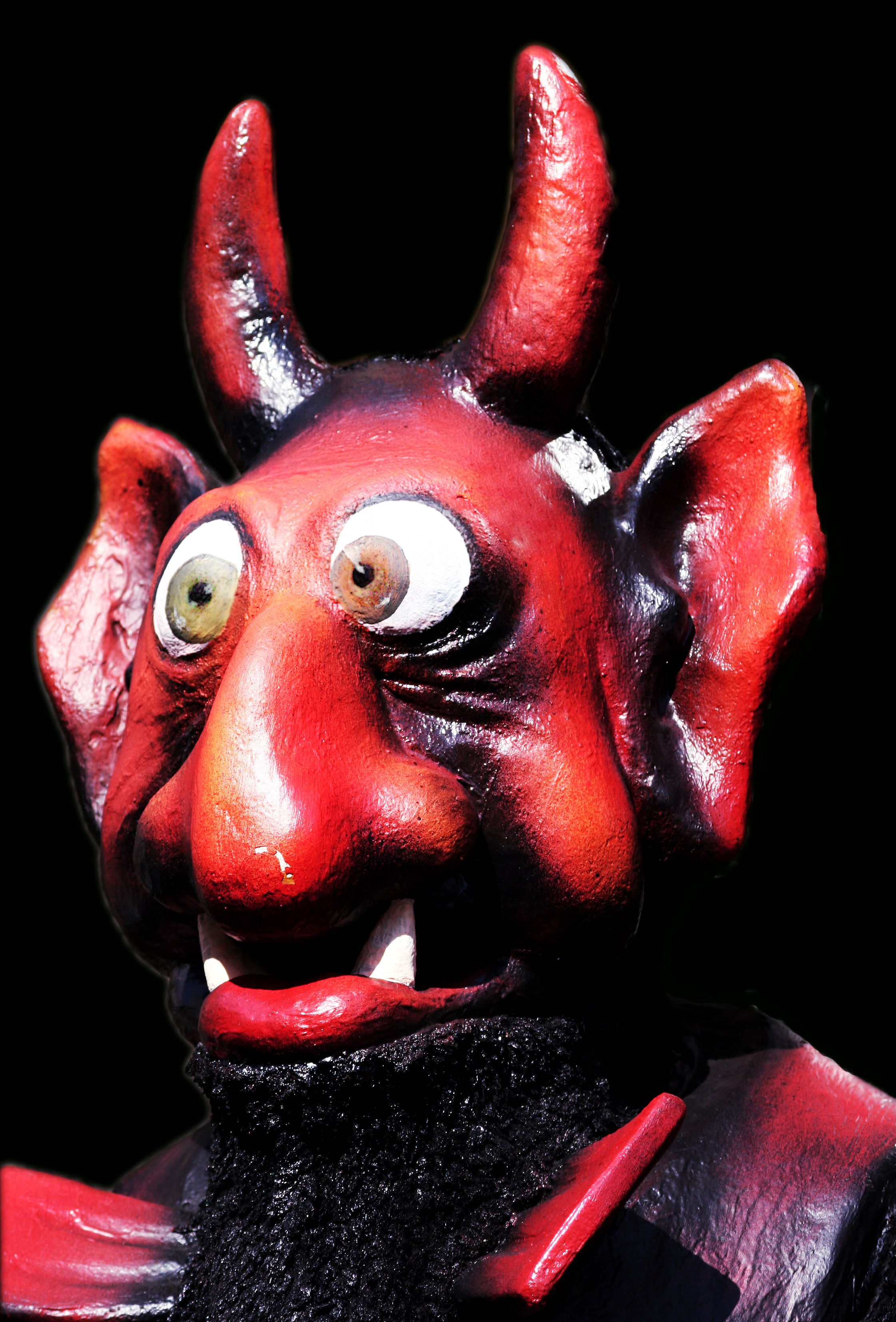
The Media is hitting the same wall – their attempts to talk up the Summer of Recovery 1 and 2 and 3 and 4 and… what is it now? Six? – fall on their faces.  The only power they retain is the power to demonize and I’m going to go out on a limb and say even that will fail them before the end of this year. Because once you see it’s only a painted devil, you’re not afraid anymore.

And then?  And then they run around in circles, confused about why it’s not working.  They pressed the button.  Why didn’t the lever fall?  The racist/sexist capitalists aren’t crying in shame?  Why not?  Dang it.  Is this thing broken?

Hello, hello?  Who is out there?

If any writer had ever written about non standard gender/sexual personae before the mid-eighties, which OF COURSE never happened, we could even quote him to echo their disconsolate and confused cries.  They know who they are, with their little clique, out there in the dark – but who are all you zombies? ;)
If This Goes On

I’ve been listening to If This Goes On in audiobook while I clean the house.  I still think that Heinlein was right about the coming theocracy – that is he was right about the theocratic impulse that he saw in the American people.  I see it too.  It’s what I’ve referred to in the past as Americans being, in the community of nations, the Aspergers kid who takes things seriously, things that no one else accepts as written/said.  This has a good side, such as a lot of us taking things like the Constitution very seriously, and a bad side, such as people taking the whole multiculti thing seriously.  (The rest of the world might parrot it, but no, they don’t take it seriously.)

The problem was that Heinlein was a man of his time – as we are all men and women of our time, and it would be good for certain people on the extreme left to remember that – and his place, and when he thought of “theocracy” he thought in terms of traditional religion.

I think it’s funny, since even as he wrote If This Goes On that “traditional religion” he spoke of was vanishing from the world.  It was largely gone from Europe, and the seeds of its vanishing were already planted in the states.  Religious faith in a supernatural power was in fact being replaced with a faith in the state as the arbitrary of morals and the end of all psychic life — a faith that would penetrate even the Catholic church and most of the protestant churches in the US (no? Ask any mainline minister/priest about government help to the poor/immigration laws/socialized health.)

Now, when I say Heinlein didn’t see it, I should say he didn’t consciously see it.  True artists see thing with other than their conscious mind.

Though Nehemiah Scudder is not Christian as such, he is “Christianish” and the religion is definitely supposed to ark to the Christian fundamentalism of Heinlein’s youth.  He mentions in fact the first prophet teaching at Mississipi  Valley tent revivals and all the names of places/mapping of the character’s mind is Bible-related.

This to me is the most alien part of Heinlein’s world building, and the reason I never got Job, A Comedy of Justice.  I was not raised in a religion that in any way resembled that strain of American religion.  My own spiritual formation was far more haphazard, but also more mystical and less rigid.  And, again, by the time I became aware of it, in the early seventies, in Europe, religion in all its forms was sneered at by all “right thinking people.”  (Yes, I’m religious.  I’m contrary.  Deal.)

Of course, the fact that this supposed “monolithic” religious consensus was already dissolving is what allowed Heinlein to publish works like If This Goes On and Job and even Stranger, I guess.  The intellectual life of this country had broken free from traditional religion shortly after WWI, as it did all over the world.  Part of it was the recoil at the war.  A lot of it might have been the fruits of the French revolution.  (Things work themselves very slowly through the collective mind.)  And of course the blossoming of the state, and the edging out of religion in favor of the state had been going on for a long time — since at least Henry VIII.

To me this was obvious as was what might or might not have been obvious to Heinlein (I think to a certain extent he saw it, but perhaps not consciously) because I was born almost sixty years later, and in a place where the transfer of moral arbitration from the divinity to the national state was almost completed. (And not because I am more of a clear thinking than Heinlein, thank you so much.  I don’t intend to be haunted.)

Now, before you think this is a Heinlein bashing post and before the Heinlein bashing brigade sashays over, let me repeat what I said before: Heinlein was a man of his time.  Science fiction pretends to have a crystal ball, and convincingly written science fiction is good enough to pass as the future to contemporaries.

It is not, however, an act of prophecy, and that science fiction which is convinced it is is the worst of all (No?  Read some of “the ice age is coming” sf from the seventies, or the “we’re all burning up” from the late eighties/early nineties.  It wasn’t even believable THEN such its righteous air of jumping on the bandwagon.)

However, Heinlein was a good artist and like all good artists (Pratchett, anyone?) saw things he might not even have been aware he was seeing.

Nehemiah Scudder might have been intended for a fundamentalist preacher, with only a vague whitewashing so it could be published, but forget that part.  That part was sort of a reflex from Heinlein’s own upbringing.

Instead, let’s analyze what Nehemiah was.  He was someone infused with a set of beliefs that denied the American constitution and the right of free people to rule themselves.  He rode to power on a set of beliefs that were supposed to be “good” for people.  The “moral” thing to do that would get us to paradise.  His policies more or less crashed the economy, at least in relation to the rest of the world, and were completely devoid of contact with reality.  His moral precepts were all pervasive and impinged on everything – and he rewrote the past and made people think he had come to power over a terrible, heathen land – and that there had been no free citizens before him.

I was going to say “let us not make invidious comparisons” but you’re free men and women and I’m not going to dictate what you can and cannot think.  Instead, I’m going to point out that the worship of the state and that beast which goes under the name of Progressivism is in fact a religion.

Someone said it’s not a religion but a cult, because religions are more internally consistent, but that’s not true.  They’re comparing the religion of Progressivism to Judaism and Christianity.  Those tend to be internally consistent, or at least its followers try to make it so – in the present era.

This was not always so, and it certainly doesn’t apply to every religion, particularly not to folk religions.  I know.  I grew up in an area where every invader and every ruler left behind a piece of folk religion and a bit of superstition.  People believed in them all and in the official religion, regardless of the contradictions.

This is more what Progressivism resembles.  It’s made of the myths of many groups, all of which are sure they’re THE group and willing to tolerate fellow travelers.  Thus progressive women have their myths, starting with the Earthly paradise of the matriarchy and ending, eventually with the restoration of the same matriarchy.  Black supremacists… we won’t go into their myths.  We’ll just say they deny other races full humanity.  If you poke around, you’ll find it.  And the myths of the class warriors start in a distant paradise of Rosseau-like nonsense, where men neither spun nor labored and yet had everything they needed, through the current vale of tears of Capitalism, which is weirdly responsible for every human vice (that is for vices that existed before it existed) and which will end in the wonderful classless society of the future, where, to quote Star Trek, “we don’t have money, we just work because we want to.”  (Thus throwing all the credits system away.  Never mind.)

And the impulse that drives this type of worship of the government is the same impulse that drove the Prophet’s sacred armies in If This Goes On.

The excuse is not divine, it’s more suited to our times.

For over a century people – who really don’t know a scientific principle from a hole in the ground – have been preached to about science as the ultimate arbiter of all things.  And of course, the state is run according to ‘science’ and enforces ‘science.’

It’s truly amazing how much we resemble medieval peasants, who believed in the divine right of kings.

Look – science and capitalism (the real science, i.e. things that are provably so, not the nebulous foggy computer model predictions which can only be considered to be coming through if you squint and shake the magic eight ball) have lifted humans above our normal condition of poverty.  They also made the “ruling elites” and the would be ruling elites very uncomfortable.

There is a subset of human for whom it is not sufficient to be happy or rich.  His neighbors must be miserable and poor.  This is manifest usually by trying to distance oneself from those one considers one’s social inferiors.  As someone who shops in thrift stores and loves diners, I’ve been known to shock other college-educated women with my “plebian” tastes.  They might not be any better off than I, but by gum, they keep a proper distance.  (I always sucked at this, and it was even worse in Portugal than here.  The classes are more distinct.)

This I suppose is normal monkey behavior.  At least Dave Freer tells me simian bands signal “class and status” all the time.  I don’t know.  By those lights, I’m a rather crazy monkey, since I do what I like to do and damn the torpedoes.

That subset of the “elites” has been dying to bring back the proper state of things, where they get to enjoy all this improved stuff, but the peasants are kept in their right place.

If you look at most of the dictates of our state and its “green” obsession, you’ll see just that.  We won’t go into the hubris of imagining that humans have that much effect upon the Earth or the “read me” files, or…  We’ll just go into the fact that if the Earth were in fact cooling disastrously or burning up disastrously, there would be scientific solutions to the problem (and actually a warmer temperature wouldn’t be a problem for a long, long time.  Humans thrive in warm periods.)  Gregory Benford ran a series of articles in reason suggesting hacks to cool the Earth if indeed it were burning up.

More importantly, if the Earth were burning up/freezing over, the solution wouldn’t be exactly the same, and wouldn’t so much resemble an excoriation of sins that the peasants committed when they tried to live in the same way as the elites.

Al Gore, whose carbon footprint is larger than Estonia’s and Moldavia’s put together, flies around the world telling people that they’re not supposed to drive cars, live in artificially cooled/warmed houses, have enough electricity to entertain themselves, etc. etc. etc.

The gist is “you’re sinful.  You’ve overstepped your bounds.  Go back, or cataclysm will follow.”

This is, like in all imperial religions, created and centered on the state (this is not new, btw.  Rome had one.) a religion that applies to the masses, not the rulers.  The rulers are special by virtue of being rulers.

And this part is what is right about If This Goes On.  Heinlein foresaw the theocracy quite well, and the impulse that drove it quite well.  His lens was just a little deformed by his perspective.

The book is still worth it and there are points that will make you stop with sudden realization.  For instance, when he says that the worst thing the Prophet did was steal history from the American people, so they had no idea their ancestors had been free.

Our children have no idea, either.  If you have kids, make sure you find them some stories from oh, the beginning of the last century.  And some movies, like 1766 1776  (this is why I’m not an engineer.  Digits do weird things between mind and fingers) and The Patriot, though flawed are worth it.  So is Independence Day by showing, in the end, American ingenuity coming through.

But all our kids have been taught are the sins of America and none of its glories.  And Heinlein was right about that part – if you don’t know your own history, if you don’t know the truth, your mind is already a prisoner of those who taught you the flawed history.

One of the mistakes Heinlein’s generation made was thinking the religious impulse went away when organized religion did.  It doesn’t of course.  As religion loses force, the state-as-religion moves in.  Of the two the second is probably the most harmful, as it wants to bring about a reality that simply doesn’t fit into the physical world.  No matter how much we squash capitalism, we’re not going to have an Earthly paradise.  (On the contrary.)  The paradise hereafter is each person’s concern and ultimately neither testable nor enforceable (not to say that some places and times haven’t tried it.)

The reason the book is still applicable, is that theocracy can exist outside conventional religion, and he nailed exactly how it works.

We keep wondering how things like journolist can exist, how people who are supposed to be writing the truth can justify lying in unison.  We keep wondering how people in the IRS can live with themselves when they’re persecuting the enemies of the party in power.

The answer is that they’ve been taught a distorted history.  In the light of that history what they’re doing is just and necessary.

Their minds were captured by the enemy – which is a toxic mix of statism and Marxism– and therefore they are no longer free.

The only way to return freedom to the people is to break the mental chains holding them.  This involves breaking the back of the media-entertainment complex.

We’re not there yet.  We might not be there for the rest of our lives.  The process takes time. (Another thing for which “If This Goes On” is useful.  You see the slow “de-indoctrination” of the main character, and how long it takes.)

However, it has begun.  And even in its beginning, its scaring the living daylights out of the statists, the state-worshippers, the enemies of freedom.

It is our duty as free men and women, to continue scaring them.  It is our duty to scare them as much as possible, and to free as many people as possible from their rotten doublethink.

The truth shall set you free.

UPDATE: If you feel a terrible need to listen to the accent that ate the world, here’s an interview with me.

Marquess of Fantailer Rules – By David Pascoe

Hurrah, Huns! Forward the Raiding Party! Der can be on’y one t’ousand! I’ll gi’ ye sich a kickin’!! (pre-digression: do we have a battle cry? I was tempted to write Deus Vult, but I know we aren’t all believers, let alone Christian. Perhaps, “let the deity/greater power of his/her choice sort them out!” would be more appropriate. Tongue planted firmly in cheek, of course.) This has been building for a bit. In that dark pit inside my skull. Some was sparked by comments here made weeks ago now. Some just came clear with the recent sound and fury over post-binary <del>sex</del>gender and Tor’s ongoing … oddness (more on that later).

We don’t all play by the same rules.

It’s obvious, really. You and I (and others of our ilk) hold with honor and deals made on a handshake between two honest people. We believe in working hard for our daily bread in the hopes of passing on a better world to our spawn. We believe in doing well by those around us, whatever their origins, and provided they aren’t outright antagonistic.

And this is reflected in our readin’ and writin’. Slightly outsized people – because who wants to read about the normal, especially when there’s dragons needing slaying (metaphorical dragons; all slaying of real dragons should be left to the professionals, who more likely than not will receive a late-night visit from a dark dragon in a black suit) – doing heroic things, often with high-powered implements of one stripe or another. Yeah, they get, well, perhaps an overgenerous helping of life’s slings and arrows, but they roll with it and fight back. Preferably within a few hundred pages or so. No really, no more than three books. <i>Seriously</i> no more than seven. More than that is just too many. Unless it’s good. Is it good? It is good, isn’t it?

*cough*

Anyway, we believe in behaving politely toward our fellow man. Or woman. Or, perhaps *cough* whatever gender applies. Others do not believe this, or anything approaching it. There are those who act – the truest indicator of belief – in a manner that betrays their assumption that narrative trumps reality. When you speak of facts (in your small-minded, modernist insistence) there is an instant check against the dominant narrative.

Is the government spending more money than it takes in revenue each year? This doesn’t mean mounting debt (well, it does, but you’re too unenlightened to understand the intricate realities of such enormous numbers, you ‘orrible little non-person, you); what it really means is that we’re leveraging our population to provide much-needed assistance to reduce income disparity among those victimized by systemic privilege. And it’s a <i>good</i> thing, you racisssss! When the rest of the world’s collective jaw drops at our chief executive bowing to foreign heads of state, it’s not because that’s a sign of weakness -akin to showing your belly to the alpha wolf – so much as a clever gambit in the on-going (and subtle, which you clingers just don’t understand) smart diplomacy, which will gain us the trust of potential allies in the war against the Man.

This can be seen in the ramp-up to every election cycle (which suggests that both of the major parties participate in this peculiar form of mass delusion) when <del>lying liars</del>politicians will say nearly anything to get into or remain in office. Following their success, they then work to stay in <del>power</del>office as long as possible, so as to maintain their opportunities for graft. I’m given to understand there are a few who actually do work to serve their constituency instead of fleece them, but it’s often tough to tell them apart.

The above is, perhaps, one of the more accessible examples, but it is by no means the most egregious. After all, politicians have to please <i>someone</i> to attain and then hold power. Much more common are those who buy into the pernicious lie of postmodernism without even the excuse of personal, material gains. Most of the useful idiots of the world (whatever their adherence) get only the feeling of being inside their particular circle. To know that their views are approved of by somebody, even if only in potentia.

As an aside, the Magic of teh Interwebs(TM) has provided a wondrous realm of sparkles and anonymity; a safe haven for tribes to gather and make war on each other without fear of spilling their own precious bodily fluids. In my darker moments, I pray for an Event that will give a non-fatal electric shock to anybody who posts something stupid online. In my more lucid moments, this notion makes me fear for the future of the species. End aside.

When objective reality intrudes on the narrative, it’s reality that must change. See Obamacare, Fast & Furious, or the continuing Benghazi attack aftermath. In more recent memory, see the moving goalposts in Larry Correia’s skirmishing with scifi establishment (how do you damn the Man when you <i>are</i> the Man?). It’s never about the arguments made, or the people who died; it’s about what they </i>mean</i> to truly important things like reproductive freedom or who has the power to circumvent the Constitution.

When somebody asks, “what difference, at this point, does it make,” whether an attack was caused by an obscure YouTube video or by deliberate malice aforethought, implicit is the guiding narrative that causes are unimportant next to how an event can be used to further a political ideology. If, whether for political purposes or simply because somebody couldn’t be arsed (what difference, at this point, does it make?), American citizens are left without sufficient protection in a hostile environment and rescue attempts are killed in the womb, it’s more important to use it for one’s own advantage than to do what is “right.”

After all, postmodernism decries such outdated concepts as good and evil. There is only, “what is right for me,” and “what is less right for me.” It’s far more important to feel good about your choices, whatever they are, than it is to choose something good in the first place.

Which aren’t the rules by which the rest of us typically operate. We (specifically those of us here) presume that physical reality imposes certain limitations that bind any philosophical framework we build to guide our choices. Just because we don’t like a facet of reality doesn’t mean we get to ignore it’s implications. Or at least, we assume that we ignore it to our ultimate detriment.

Part of joining civilization is the subordinating of certain individual natural rights (the right to kill people and take their stuff, for example. just off the top of my head) to some nebulous concept of a greater good. One of these is the right to be unconstrained in social interactions. Most civilized apes learn early on – with their mother’s milk, one might say – that our right to swing our fist ends at the next ape’s nose. And in verbal exchanges, as well.

What, then, do we do about those who refuse to play fair? How do we treat the barbarians in our midst? And can we do it without sacrificing our own integrity, or must we stoop to their level?

How about not arguing basic facts? Suppose you’re “discussing” the <del>coming ice-age, global warming</del> I mean, climate change. Let them have “man causes climate change,” and then inquire as to how much of a causative factor. Then make them show their work. Find a reputable source that claims humanity is the primal cause of global climate change across millennia. They can’t? Odd, that. Caveat: this method will only work with those without strong  – read: progressive – pre-conceived notions.

Beyond that, when dealing with those whose minds are closed and unreachable, is mockery the best policy? The Korreiakin emphasizes that he doesn’t argue on the internet to convince anybody, but to provide ammunition for those who agree with him, and garner a modicum of relaxation from the rampant foolishness of others. Do you think this is true? Is there any other way of dealing with vile progs whose minds are beyond the reach of reason?

To Fear A Painted Devil

'Tis the eye of childhood that fears a painted devil
‘Tis the eye of childhood that fears a painted devil

Over the week I’ve been watching the kerfuffle between the SFWA glittery hoo ha who decided that binary gender was a bad default assumption, and that no SF novel should include it.  Then Larry Correia weighed in.  Then Jim Hines weighed in against Larry Correia and then–  Sorry, by that point the mind boggled.  I like Larry Correia, and I have a good idea he might like me (as a cousin, say) but honestly, I wouldn’t go up against him when sarcasm or wit is on the line.  Particularly when you come unarmed to a battle–  No, wait.  Never mind.

The entire kerfuffle – in its initial phase – was covered by my friend Kate who makes some apropos comments on gender too.  If you’ve been living under a rock these last few days, go and read it.

But my own personal disturbance over it started with a comment left over at MGC on that post of Kate’s.  Actually not even the comment, which was the stupid, but the way the commenter tried to prove his “conservative” bonafides.  It opened with (I SWEAR!) “I’m a conservative.  I read Heinlein and Orson Scott Card.”

Right at that moment my mind shut down.  Because the chances of that person being conservative are about the same of my being an aardvark, and I just looked in the mirror.  I’m not.

Look, first of all I know very few readers of Heinlein who’d define themselves as conservatives.  We might sometimes, to make things shorter, call ourselves libertarians.  A few of us with a little more sense of humor will call ourselves Rational Anarchists.  But very few hardcore fans of Heinlein, such that he’d be the first mentioned in their comment, would say “I’m a conservative.  I read Heinlein.”

First of all, because for a conservative, in the sense it is understood by most sentient people, Heinlein was a lousy one.  A patriot, sure.  A lover of freedom, sure.  But he liked goring sacred cows too much to conserve anything.  And most of his readers who could be called “conservative” purely loathe his later workers.  (Most of his readers who call themselves liberals but are really establishment conservatives do too.  I’ve been with them on panels.  Never mind.)

At any rate proving your bona fides as a conservative is never followed by “I read Heinlein” and proving your bona fides as a Heinlein fan NEVER starts with “I am a conservative.”

But the second point was where my mind snapped.  Heinlein AND Orson Scott Card.

Guys, I don’t know if I’m a fairly typical Heinlein fan.  I don’t know if there’s such a thing as a fairly typical Heinlein fan.  I do read Heinlein and I read half or so of OSC’s works.  In the statism/freedom scale, I’d place OCS far to the left of me and probably most Heinlein fans.  Now, he still writes a good story (about half the time) and he’s on my “trust but verify” list.  That is, he’s on my “don’t buy sight unseen, because this might be one of the books I can’t stand.”  And yeah, a lot of his opinions and plot twists bother me at a fundamental level, as a Heinlein fan.  But he’s not horrible about it, he tells a good story, and half the time I suspend my disbelief by the neck and read on.

However I’d wager good money against any Heinlein fan coming up with “I read Heinlein and OSC” like that.  Look, I’d say “Heinlein and Pol Anderson” if I were going for a political thing.  And if I were more conservative than I am, perhaps “Heinlein and Pournelle.”  (Yes, I do read Jerry, but I mean if I were trying for political bonafides.)

I just couldn’t imagine the circumstances in which any sane person who really meant it would write “I’m a conservative, I read Heinlein and OSC.”

I told my friend Charlie Martin this and he said, “Oh, that’s easy.  It was a liberal troll trying to quote the “biggest fascists he could think of.”

He’s probably right.  As almost all tests show, liberals can’t in any way analyze the way in which a conservative thinks.  This explains things like people coming here assuming I MUST be a fundamentalist, or that I’m an admirer of Hitler or that I am – of course – racist and trying to blend in by pretending all these things.  It reminds me of nothing so much as the guy who shot up a conservative organization by going in with a Chickfillet bag as camouflage.

But that made me think again on what the heck is going through their minds.  Look, I’m going to be absolutely and plainly blunt: no one – no one in his right mind or even out of it; no one in possession and enjoyment of more than one working braincell, in fact – can read either Heinlein or Card and think they’re “fascists.”  Yes, Card is far more statist than Heinlein, but he’s not advocating for a government bigger than we have now – at any time.  And Heinlein advocated a government as small as possible (at least after he got out of his Fabian socialist mindset, but that’s a discussion for another time.)

What I mean is, it’s impossible to read these two authors and think they are a liberal’s definition of “conservative” which includes of course, racist, sexist, homophobic, and whatever else ist we’re not supposed to be today, including I suppose lookist and intellectualist.

Both men DO have a pretty strong dose of the populist, meaning a sort of rock-bottom common sense that meant they were never full statists, and they are in general highly approving of humans, including the defective ones and those of other races.

And yet, in the minds of readers who have in fact never read them – or at least never with an open mind – these people are “fascists” and “haters” and we who read them are reading them because we’re Hatey McHaters.

I’m tired of going the full rounds about this on Heinlein panels.  It always comes down to “Heinlein is a sexist because his women enjoy hetero sex” or “Heinlein is a sexist because not every one of his characters is a woman” or “Heinlein is a sexist because aprons.”  (If you search for apron, I did a post about the irrationality of this in the past.)  None of it makes sense, and the women (they’re always women) I argue this with either have not read Heinlein or changed their opinion of Heinlein after academics told them often enough that he was racist, sexist and awful.  If they’re my age or younger, they’ve never read him because they KNOW he’s sexist.  One of my friends hated him because she read the opening of Friday and he had her raped, so of course he enjoyed it, and he was a rapey McRaper.  (Look guys, I had a character tortured in AFGM.  I guess that makes me a sadist.  And because of who it was, I guess an homophobe, too?  Or maybe I was just showing what dictatorships will do? And that Life, Liberty and the Pursuit of Happiness have a price, often paid in blood?)

I’m still not sure why they turned on Heinlein, but I think it was his unwillingness to go along with the demonization of the US that had become fashionable, and the fact that if you read him very carefully you can’t help but notice the similarity between his totalitarian societies and some of what is going on.  (No?  I was recently listening to If This Goes On and as soon as I locate the paper copy, there will be blog post apropos what happens when a people has its history stolen, and also when you’ve been taught not to think.  Which is where we are, with this.)

I know when they turned against Orson Scott Card and it was because he disapproves  of church-observant Mormons being homosexuals.  Not because he thinks the later is inherently the worst thing ever, but because he thinks it’s incompatible with total commitment to a demanding religion.

Okay.  It’s his religion.  I could care less.  I think the reasons he gave are silly, but also understandable for the gay culture he’d have known in the fifties.

This does not make him a horrible person.  It doesn’t make him a monster.  It doesn’t make him a fascist.  It makes him an older man whose opinions might be slightly out of touch with today’s realities, and someone you can read and enjoy and still disagree with.

But the first time I heard about this was from a friend who had heard that he wanted all gays executed.  She didn’t trace the original comment, but she’d heard it from friends she trusted…

And this is how demonizations occur.  We saw this with Resnick and Malzberg and the whole nonsense about their “leering over women in bikini” when all they’d done was comment on how beautiful a now dead editor was.  (I don’t know about you, but I’d love to be remembered that way after I’m gone.)  And we saw it full force with Orson Scott Card.

Right after Kate made her post, they started in on Larry, taking off after him on twitter, about how he was a misogynist and various kinds of hater.

And then when he took the idiots to school, he got accused of attacking those smaller than him.

Sigh.

Next time a troll on MGC tries to establish his “conservative” bonafides, he’ll tell us he reads Heinlein, OSC and Larry Correia.  And he’ll never understand why we’re laughing so hard.

The funny thing, though, is that they are not only completely ignorant about us, and so unaware of it that the dime never drops, but that these demonization cycles seem to be coming closer and closer and get more hysterical.

The next person who disagrees with them or pokes the tiniest bit of fun at them will be declared “worse than Hitler” and they’ll call for his hanging.

I think I know why.  Part of the reason the episodes are coming closer together and getting crazier is that they’re losing power and they know it.  They convinced an entire generation of women that Heinlein should not be read.  This was because “all the right thinking people know that.”  This is breaking.  There are enough blogs, and enough of us female Heinlein fans ready to tell them they’re idiots and then describe exactly in what part of their anatomy their head is lodged.

With Resnick and Malzberg the backlash was faster and louder and even a lot of their number thought (privately) that they were off their rocker.  With Card, I think only the choir thinks he’s “a fascist.”

And with Larry…  There is no word for this.  It’s like a Chihuahua trying to hold onto a car by the back bumper.  They have not only bit off more than they can chew, they’ve bit off more than they can… bite.  In tactical terms it’s getting involved in a landwar in Asia or going up against a Sicilian when death is on the line.

But wait, there’s more.  The other reason they’re getting crazier and crazier and trying to enforce group conformity more and more is that they are no longer in possession of the bully pulpit.  It used to be due to quirks of distribution and culture in NYC that got get bought and properly distributed you had to be a darling with a “not Baen” house.  Oh, Baen had bestsellers, but they were more a midlist house.

So advances with other houses were bigger, and prestige was immeasurably higher.

Well… The times they are achanging.  The collapse of the chains; amazon; the internet where people can find out about books that were publishing put paid to the cozy gentleman’s arrangement of yore.  Even when these people are getting published, their advances are smaller, and they have to compete with all the great unwashed for sales.  They no longer feel their own specialness.

For some of us this was a wonderful freeing thing – we could be ourselves and never mind that we might lose a little money (we didn’t.)

But for people whose only thought has been to kiss as much derriere as possible so they could be the biggest darling around, and get pushed and called wonderful by the NYC houses, this HAS to be a scary and unstable time.

So, how to keep the “followers” in line that will at least give them some prestige and cash?

Simple.   If you have nothing to offer; if your incompetence is glaringly obvious; if you can’t entice voters readers, scare them of the other side.  Tell them what monsters the other guys are.  How they are terrible horrible scary.  Make people ashamed of admitting they read these Haters McHateys.

The problem with that is that this tactic works about as well as crying wolf.  After a while the fatigue of all denunciations will set in.  And having found how exaggerated ONE accusation is, these people will never believe the next group-madness episode.  And then people start believing everything you say is a lie and believing the opposite.  It’s inevitable.  And I know it is because it was a similar process that brought me out of the left. (Though I never arrived at believing the exact opposite of everything they say.  They’re not that reliable.  And I ain’t surrendering my right to think things through for myself.)

You can create scarecrows all you want to, but after a while even dumb birds realize these are just clothes stuffed with straw.

“It is the eye of childhood that fears a painted devil.”

And most children eventually grow up.

Zachary Ricks Talks About Onramp Science Fiction

And I pimp my readers!

UPDATE: There is new content in the subscriber space tab.

*Keep in mind these are Zachary Rick’s recommendations, not mine, which would be different!  (And I can do if you really want me to.)  And thank you to Monsieur le Mollusc for the pimping of my readers’ books (I ain’t never seen books in mini-skirts and go-go boots before, is all I’m saying.)*

The Science Fiction Onramp

So, apparently there has been talk about a need for “entry-level” science fiction and fantasy. Who is talking about this and why they feel it I leave to you, dear reader. But I’d bet it has something to do with the fact that the giant movie blockbusters of the last, oh, decade or longer, have been largely science fiction and fantasy tales. With movies like The Avengers pulling in beaucoup bucks, with the success of the Hobbit, one would anticipate that we’d see similar big numbers in science fiction and fantasy books.

Something tells me that just isn’t happening.

I took a gander at the top selling books of 2013 at Amazon. And the results were… interesting.

In the top 20 books, you had eight works of fiction. (Jeff Kinney’s latest Wimpy Kid book, Dan Brown’s Inferno, Rick Riordan’s The House of Hades, F. Scott Fitzgerald’s The Great Gatsby, John Green’s The Fault in Our Stars, Markus Zusak’s The Book Thief, R.J. Palacio’s Wonder, and Veronica Roth’s Divergent.) (Incidentally, three of the top ten books were written by conservative commentators of some sort. Rush Limbaugh, Charles Krauthammer, and Bill O’Reilly. And at least three of them had specifically religious themes. So much for the thought that conservatives / the religious don’t read. Take THAT, vile progs!)

Anyway, two of those books are recognizably science fiction or fantasy. And both of those are YA. Which is what I’d consider definitionally to be onramp material.

The trend gets a little more stark when you look at the top Kindle books of last year. All 20 of those were fiction. Five of them were science fiction or fantasy (Three in Veronica Roth’s Divergent series, the final Hunger Games book, and… Ender’s Game.) All of these would be considered YA.

We don’t need an onramp for science fiction. Those books are science fiction. And they’re hitting new readers – the YA group. So the more interesting question is… what happens to these kids between the time they’re devouring books like The Hunger Games, Twilight, or Percy Jackson and later life? Do they switch genres? Do they stop reading altogether? Do they no longer have time? YA keeps putting out science fiction and fantasy blockbusters. Percy Jackson, Katniss Everdeen, and of course, Harry Potter are cultural icons, beloved by millions. And they’re smack dab in the middle of the science fiction / fantasy landscape, selling plenty. But adult sales of science fiction / fantasy aren’t that high (unless you’re George R. R. Martin).

So, what’s happening?

Well, looking at the people who were asked about “entry-level” science fiction and fantasy, and reading their comments, I have to say that maybe we’re losing a significant number of those because we keep recommending things that poke them in the eye. Remember that list of top 20 in 2013? With three books by conservatives and at least another three with overtly religious themes? Maybe… just maybe… what’s being written, published, and promoted is hostile to their worldview.

I mean, well, duh, right? Those people SHOULD have their worldview adjusted! Ha ha!!! But we have not yet devised a means to make people read those books once they’ve left school. And for some reason, people don’t buy and read books that are overtly hostile to their deeply held beliefs. Those books wind up against a wall, or in the recycling bin.

And then authors wonder why people aren’t reading their overtly hostile, condescending, sarcastic, bitterly acidic prose. Since the Progressive Era began, it’s been said that the goal of education should be to make a man as different from his father as possible. And SF has long been nothing if not progressive.

A good example – Arthur C. Clarke’s Childhood’s End.

WARNING: SPOILERS BELOW FOR A BOOK OVER SIXTY YEARS OLD.

Childhood’s End tells the story of how human beings evolve to a level where they become no longer human. In fact, the end of the book has all human life abandoning their bodies, joining in some sort of energy-hive-mind thing, and leaving Earth forever. Which is cool and all, until you start considering what that says about human beings and who we are and what our role is in the universe. Personally, I thought it was a pretty downer ending, but apparently a bunch of people thought it was the cat’s pajamas. “Yeah, humanity will be totally awesome once we ditch every thing that makes us human! Whoo!

SPOLIERS COMPLETED. THANK YOU.

Other recommendations included The Handmaid’s Tale. Apparently, it’s all about the oppression of women. I’ll admit to never having read it. My better half, however, did. And she hates that book with a flaming purple passion. But she’s an avid reader, having devoured the Divergence and Beautiful Creatures books herself around the holidays. (I think she set a personal record for Beautiful Creatures. Four books. Three days. Merry Christmas.) She loved them. Except the end of the last Divergence novel, which she didn’t like that much. (She has similar feelings about the last Hunger Games book.) Her perspective is that there’s a lot of great science fiction out there, and more coming.

Let’s humor the “industry insiders” for a minute and assume that an on-ramp is needed, even though it looks like that may not be the case based on my admittedly anecdotal evidence above. Every science fiction and fantasy fan worth his salt has a favorite book – something they spring on other people who claim not to like science fiction, and I’m no exception. Mine is and pretty much always has been Ender’s Game by Orson Scott Card – a marvelous book. It’s full of fantastic ideas, interesting characters, and the climax is both thrilling and slightly horrifying. Apparently, that’s no longer a viable choice. It appeared on the list that kicked off this rant, but was surrounded with a groveling apology for having suggested it now that the author has been outed as someone who happens to believe in and practice his religion – a religion that has proven unwilling to change its practice and beliefs to fit in with current fashion.

Well, in my admittedly arrogant opinion, current fashion sucks.

At any rate, the talk about a need for entry-level science fiction as an industry is sheer folly. There’s not a need for entry-level science fiction and fantasy. There’s a need for good science fiction and fantasy. And there is plenty of that.

But let’s say that you really do need an onramp book. Maybe you have a friend who’s an avid reader, but they don’t touch science fiction or fantasy because cooties or something. Maybe keep the following in mind.

First, make allowances for taste. Some people do prefer other genres, and that’s totally legitimate. [Pfui.  Prove it — SAH :-P]

Second, keep your audience in mind. I think everyone should be able to read and appreciate Lois McMasters Bujold – especially Shards of Honor and Barrayar. (Combined by Baen into one handy volume – Cordelia’s Honor.) But the ladies may not appreciate, say, Scott Sigler’s The Rookie. (Football. In the 27th century. With aliens. Who are also gangsters. Four books so far. And a fifth up for pre-order on Saturday. All totally indie published in hardback.)

After that, make sure the book is interesting. I mean, that goes without saying, right? But if you’re trying to get someone to read a piece of science fiction because it’s important or progressive or transgressive or a bunch of other similar adjectives? You’re doing it wrong. Likewise if your book features the Sledgehammer Of Morality on any side – prog or non-prog. You want to hook someone, making them feel guilty for their deeply held beliefs is probably not the best way of doing it.

So, that’s it. Allowances for taste. Keep the audience in mind. Fun.

I’ll kick it off with one of my all time favorites – Alfred Bester’s Demolished Man (which is just barely edging out Bester’s The Stars My Destination in my preference at the moment.) Bester plays with great concepts, wrapping questions about free will, justice, and power into a fairly tight police drama. When the cops are telepaths, how do you get away with murder?

And I turn it over to the Huns. What’s your onramp book?

Not that we need one…
And NOW For the PIMPING:
Another happy Saturday, Huns and Hoydens! We’ve a small selection this week; apparently you lot were feeling bashful this week about shameless self-promotion. Repent ye, repent ye, and plug your work without qualm! And for now, go check out these books from fellow fans. As always, future entries can (and should!) be sent to my email. Happy reading!
Jason Dyck, AKA The Free Range Oyster
Promotion Wrangler, Mercenary Wordsmith, and Minion Extraordinaire

Michael Kingswood

Glimmer Vale

Glimmer Vale
Lydelton, a small fishing town in a remote valley called Glimmer Vale, is the perfect place for two fighting men on the run to stop and decide on a plan. But when Julian and Raedrick arrive they find the town besieged by a ruthless band of brigands. Worse, the brigands have taken up station in the mountain passes, blocking the two friends’ escape. With no way around the brigands and no option of returning the way they came, Julian and Raedrick accept an offer of employment. Their mission: defeat the brigands and restore peace to Glimmer Vale.

They are outnumbered at least twenty to one, long odds even if they recruit help. But that help may not be enough when the specter of their past rears its head, forcing Julian and Raedrick to openly face what they are fleeing or risk losing not just their freedom but the lives and fortunes of Lydelton’s inhabitants.

Also available from these fine sources:

Dan Melson

Empire and Earth (Rediscovery Book 3)

Empire and Earth
Earth needed help – and nobody else was going to step up. Graciela Juarez has gone from a late-twenties college student to Second Order Guardian and one of the Empire’s better pilots. But events on Earth are building to a climax, and the Empire is determined to let Earth sort things out for itself – or not. It really doesn’t matter to them. But it matters to Grace. By whatever means necessary, she will save Earth from the demons – and from its own insanity.


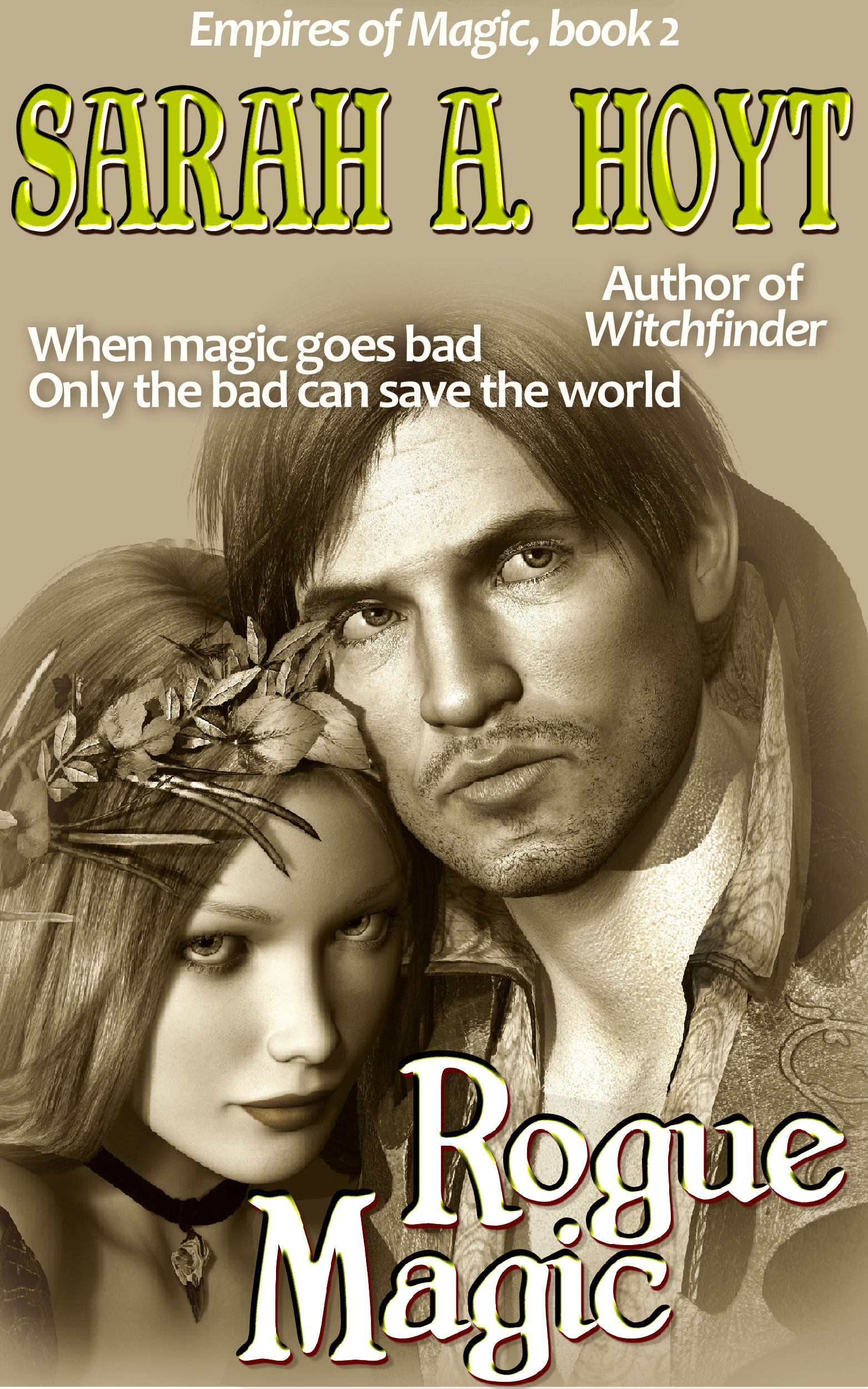
Rogue Magic, Free Novel, Chapter 36

*Sorry this is so late.  WordPress crashed three times while I was trying to put this up, and it necessitated a whole reboot.*

roguemagicnewcover

The prequel to this — Witchfinder — has been removed.  I do promise to go through the copyedits as soon as humanly possible and send the advance copies to those who pre-ordered.  You’ll know when that’s eminent because I’ll remove scattered chapters from this blog.  I do hope to manage it next week, but I’m not promising as I’m still finishing a novel under contract to Baen. Meanwhile, if you donate $6 and note it in the field, you’ll get advance-subscribed to this novel.  I do, however, understand it can be a long time to wait, and if you want to, do so.  I will continue to post chapters here, roughly one a week.
NOTICE: For those unsure about copyright law and because there was a particularly weird case, just because I’m making the pre-first draft of my novel available to blog readers, it doesn’t mean that this isn’t copyrighted to me.  Rogue Magic as all the contents of this blog is © Sarah A. Hoyt 2013.  Do not copy, alter, distribute or resell without permission.  Exceptions made for ATTRIBUTED quotes as critique or linking to this blog. Credit for the cover image is © Ateliersommerland | Dreamstime.com

Miss Caroline Ainsling, sister of the Duke of Darkwater:

It didn’t take long.  You see, Michael – my brother Michael – is a mathematical and mechanical genius, which in turn makes him a magical genius.  The fact that his share of power is higher than Seraphim’s and almost as high as Gabriel’s , which should be impossible without elven blood, but never mind.  When I asked, he started showing me the equations for sympathetic magic and contagion of power, and I thought about exactly how I’d set up the gardens of my home when I married Akakios.  We’d have an orangery and an apple grove, because he was fond of the trees, and for the scent too.

But that had been months ago.  I rarely asked Michael to explain anything, and when I did, it was never very long before my eyes glazed and I went inward to my happy land.

I’m fairly sure I’m not more stupid than I need to be.  Well, except perhaps about social occasions, when my fellow students were always telling me, “Caroline, don’t be more stupid than you need to be.”  But that was the result of being raised so isolated and so oddly, so that I was almost mama’s confidant, and a play fellow to Michael, as well as following Seraphim and Gabriel around.  It was not any deficiency of my understanding.

And yet, when I tried to grasp the higher mathematical truths of magic, my mind slid away from them, like they were made of ice, and I couldn’t follow what Michael assured me was the simplest of reasonings.

Which was why I didn’t even try, that evening, in Seraphim’s office, after Sydell had arrived, and after the fountain had exploded.

It was funny in a way.  Look, I remember being about three and there was a fire in a wing of our home, and everyone ran out of their beds and downstairs in their underclothes.  I’d discovered things I’d never seen before, and could not have guessed about people.  For instance, our dignified buttler wore a wig in his day work.  In the middle of the night, he was bald, except for a fringe of white hair around his head.  And the parlor maid slept in something embroidered and lavish that would have suited mama, except mama said it was highly improper, and after that mama had said something about no one wearing that to bed when they sleep alone, and a few months later, the first parlor maid was married to our head gardener.  Which I thought was a lot to come off frilly nightgowns in gosshammer muslin and edged with lace, but mama seemed very sure.

Of course, that night in Seraphim’s office, no one was in their underwear, but in a way I got the same feeling that I was seeing everyone undressed.  Seraphim kept raking his hand back through his hair, his eyes were red rimmed, and he looked distraught.  And Sydell kept pacing back and forth and muttering the occasional word that made no sense to anyone else.

Michael in turn, looked almost spell-bound, his eyes fixed as though on some distant landscape, and looking so much like when he’d been a captive of the late king of fairyland that my heart wrenched.

I looked away from him, and that’s when he asked Seraphim, “The statue, outside?  What happened to it?”

Seraphim stopped raking his hand through his hair and barked out.  “Jonathan.  Jonathan Blythe.”

And Michael nodded, as though no more explanation was needed; as though the earl of Savage were a known exploder of statues.

Then Sydell stopped and more or less growled, “I have to go in and see if I can save him.  I have to.  And it’s no use at all you telling me what risks I’ll run.  I know them well enough.  But if anyone can bring him back I can.”

Seraphim started to open his mouth, snapped it shut so hard I swear I could hear his teeth clashing together, opened it again and barked out, “Right.  Then why are you telling me this.  You could have gone from your own estate surely?  It is no part of my job to help a man commit suicide.”

Sydell laughed.  It wasn’t an ironical laugh.  It really was a laugh, as though Seraphim had told a joke.  “No, thank you, I don’t need help.  What I need is a legal document.”

Seraphim’s eyebrows shot up.  “What?”

“My son… well, at any rate my heir.  If I go, he is left unprotected, and frankly if anyone probes too closely his paternity will be doubted too.  And if he’s an award of the crown… well, you know…”

Seraphim didn’t say anything to that.  I didn’t either.  Awards of the crown got “sold” in marriage at the most outrageous prices and with total disregard for their happiness.  It was something I’d heard Seraphim and Nell discuss.  Nell didn’t like it, but this was tied up in such a net of rights, duties and ancient traditions it would take centuries to fix.

And even I knew that Sydell’s supposed son was actually his half brother and the son of his father.  If anyone probed into that, the legitimacy of the child would be questioned, and I was sure Sydell had legitimate relatives enough – if distant – eager to get their hands on the property.

Seraphim opened his hands wide.  “What do you want me to do about that?”

“I want to leave you in charge of him.  I want you to make him your personal award.”  There was a pause.  “Please?  I owe the child a duty.  I don’t want him in a home for magical orphans, which is where he’d end if he becomes a court award.  I grew up in one.”

Seraphim had then called a legal clerk – it must be nice to have legal clerks you can call at any hour of the night, though the man did look like he’d been asleep and I later found out he’d slept in a truckle bed at the back, as did many others on other beds, of course, on duty as long as Seraphim remained in the office.

The clerk started drafting a document, and then Michael stepped forward and touched Sydell’s shoulder, making him jump about a foot off the ground, and then said, “If you’re going in, have you considered a Arrar maneuver?”

“What?  That would be foolhardy.”

And that’s when I stopped understanding anything.  Numbers flew, and Michael got a paper off Seraphim’s desk and started drawing figures on it, and Sydell corrected the figures, and Seraphim must have been as exasperated by it all as I was because he finally must have caught something – he said, “Here, what is this?  Michael can’t go with you!”

And Michael looked up and said, “I can.  Indeed I must.”

“But having been—”

“A changeling means I’m immune from most of it.  It’s like … it’s like having caught the small pox once.  Seraphim, let go of the paper, and do you not have a pen that’s not in dire need of trimming?”

And then the numbers and figures returned, and Seraphim must have understood some of it, because he leaned over the paper to tell them they were out of their minds if they thought he’d let them do that.

Akakios leaned over me, and touched me on the shoulder.

Looking up, I saw he looked concerned and grave, as he made a head motion towards the outer corridor.

It’s amazing how silent his hoof-fall can be when he wants it to.  We crept out of the office unnoticed.

Out in the hallway, he leaned close and said, “I can go back to fairyland.  I was listening to what they were saying, and I can go.  I can use one of those entry points.  I think I have to, Caroline.  I’m sworn liege to Night Arrow, and he must be brought to reason… be brought alive again.”

I nodded.  “If you go, I go with you.”

“Caroline!”

“No.  Look.  Our betrothal is, I’m told, as binding as marriage, and if it is, wherever you go, I go.”


“But… it will be very dangerous.”

“So will be staying here if you fail.” I got hold of his hand in both of mine.  “Akakios, if you die, I’d rather be by your side than here, and not knowing what happened.”

His eyes misted.  He’d deny it, mind, but I saw them glitter.  “Very well,” he said.

It is very awkward to have a centaur help you mount his horse-half, but we managed.  We tiptoed out of the office.  Fortunately, the guards outside were still too busy with the fountain to pay much heed.  Outside the plaza, Akakios did something that opened the magical path to fairyland, and we charged along it.

Those Whom the Cat Gods Love

*A blast from the past post from December 13 2010.  It’s a silly post about how we came by our cats.  Also, as a public service, announcement, Peter Grant sent me an email asking:

Following my recent guest article, as you’ll recall, a reader asked how
to avoid the pitfalls of writing about military service and combat
without having experienced them.  I’ve been thinking about how to
approach the subject, and tonight I put up a blog post asking my readers
for input.  It goes into a lot of detail about the problems involved,
and asks whether it’s worth trying to set the record straight, or leave
well enough alone.  You’ll find it at:
Writing about military service and war

I’d be grateful if you’d please mention that to your readers tomorrow,
and ask them to click over, read the article, and leave their comments
and input.  — Peter

Also, under various news: in case you wondered what was up with Witchfinder, part of it has been trying to get the cover just right.  Well, I think I have now, so I’m posting it below.  Now health holding a little while, I’ll get the edits gone over and send to the subscribers and make an ARC available for purchase.  (Why an ARC?  Because I’ll only officially release it three months from now. I’m going to announce it, send it out for reviews, etc.)witchfindercoverfinalSoon, very soon.  I promise.*

And now, Those Whom The Cat Gods Love!

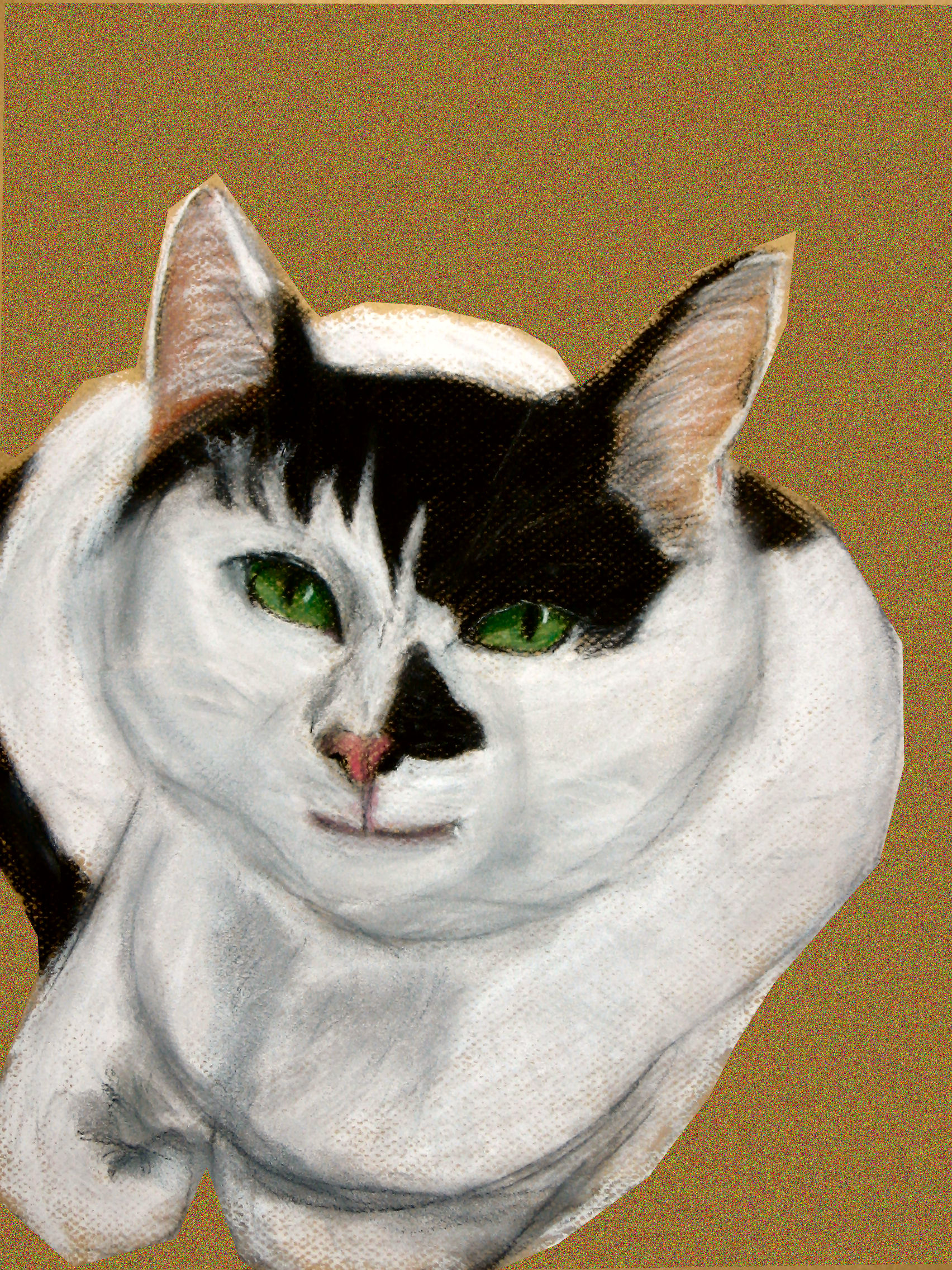
D’Artagnan in pastels, by Sarah

Cats. I think twice in our whole lives as cat owners (though there is some doubt as to who owns whom) we went out of our way to get a cat. First, when we bought our first house. We finally could have pets (before that we had a remote controlled jeep we called Fido and took for walks. Freaked out the neighbors) and I held out for a marmelade cat. We heard of a friend whose daughter, living in a college dorm, had unwittingly given refuge to a female marmelade (it’s so rare, she assumed cat was male) in what the victorians called an interesting condition. This girl cat, Tiffany, had delivered herself of four bouncing baby kittens and the dorm didn’t even allow pets, much less five cats in one room.

So we went out and fell in love at first sight with this bouncy little ball of fat and fluffy orange fur whom they called Garfield – and we called Pixel. Problem was Pixel was still nursing, at eight weeks, and eating no solid food. Also, he was very attached to his identical, somewhat thinner, twin whose original name I can’t remember but whom we named Randy.

My husband who had never had a cat in his life told me “you know, they’ll need company while we’re away at work. If we take the twins it will be better.” So, we promised to pick them up when Pixie started eating solids and we went home.

This is when the cat-gods intervened. You see, cat gods are… well… cats. They hear your willingness to host one of their minions, and they … see an opening. In the next week, my husband went for a drive and rescued a scrap of a black kitten, whom he named Petronius the Arbiter before I ever met him. (Pete earned the nickname “Cat from Hell” on his own.)

Suddenly and through no fault of our own we found ourselves with three alpha males. (Pixie did start eating solid food. At sixteen weeks. No, I’m not joking. For the longest time he’d run away if there were more than three pieces of dry food on his dish. I have NO idea why. I think he thought they were preparing for revolution? We had to feed him three bits at a time. But he grew into a lovely and headstrong cat who “spoke” the closest to human I’ve ever heard including freaky internet talking cat videos. The other cats used to have him talk to us when there was a problem, (like lack of food or water) earning him the family title of Speaker to The Humans.)

But the cat gods weren’t done with us – oh, no. Over the next year we rescued a couple of twin orphans, DT and Zebbie.

And then it stopped raining kittens – or at least being at maximum capacity, (though we lost Zebbie a year in) we were more careful about you know… attracting the critters – for about twelve years. At which point, I thought “all our cats are going to get old. We should get a new kitten to cheer us up.”

My husband said if we got any more cats, we’d have to get a Cornish Rex. I THINK he thought this would stand in the way of the mad feline divinities. Lo and behold, there was a litter for sale half an hour from our house. We acquired Miranda with part of the advance for my first book. (She rules the household with an iron paw.)

The problem is – apparently – we’d attracted the attention of the cat gods. The next year, when Pete died, through a combination of factors too weird to explain, we rescued Euclid (aka Pythagoras in the mysteries, aka, the world’s most neurotic cat.) A year after that we lost Randy and two years later, D’Artagnan waltzed into our kitchen in the middle of a snow storm. He was a little 8 week cat all fluff and meows. We couldn’t find anyone who admitted to knowing him (though we found out whose he was eventually. Yes, we did. They threw him out. During a snow storm.) What could we do? He’s been with us ever since.

And I thought that was it, even though we lost Pixie. Turned out I was wrong. You see – sigh – I thought it was perfectly safe to go mini golfing on a warm summer night. Only, there was this incredibly fuzzy white and grey cat (other than the patches being grey, he looks EXACTLY like a Turkish Van. Same personality, too) starved and covered in grease and with a broken tail. He came to my younger son and… yeah. His name is Havelock Vetinari, Havey for short or – appropriately – Absurd. He was a great comfort to DT in her last year of life. She’d lost all her friends and none of the three new cats were friendly, but Havelock liked to cuddle and groom her.

And that’s it, right? We’re safe now, right?

Only Robert says when he moves he’ll probably take D’Artagnan. And Marshall says if when he gets to move he’s taking Miranda. (They’re inseparable.) And we’re thinking… is the cat gods attention activated by our wanting cats, or by a cat family being a few cats below par? Maybe we should get a dog instead? Is there such a thing as a dog god?

I Want To Teach the World to Sing

When I was a kid I went through years of angst, because you see, what I wanted to do – all I wanted to do, the only work I didn’t find boring or annoying – was write, and yet I had imbued the belief that I should do something that “was socially relevant” or “contributed to society.”

In part this is why I ended up studying languages.  Yep, I was going to “foster international understanding.”  (Which of you giggled?  Have a carp!)

Do I need to go into why this was stupid?  Yes?

Look, I have nothing against believing you have something to contribute to the world beyond what the world is willing to pay you for.  If I did, I wouldn’t have done the years of soul-sucking making no money whatsoever work needed to actually get good enough at my work to make money.  Unfortunately writing is one of those things that really can’t be taught in the classroom.  Or not well.

The problem I have is with believing that you should do something that “contributes to society” beyond, you know, what people are willing to pay you for.

The reason I object to this, is that this sort of do-goodism tends to fall into the “Christmas gifts to total strangers.”  You’re giving someone things they don’t want, at great expense to yourself, and the things will just get discarded or used in ways you’ll never think of.  In the worst case scenario, in which your desire to ‘give back to society’ leads you to become a politician, you end up making laws to make people use those ‘gifts’ that you insist on giving them because you’re sure they’re good for them.  Obamacare for instance, is sort of like passing a law that forces everyone to wear the Christmas sweater knit by their aunt Peggy, the one with the odd color tastes, who is near blind and has the attention span of a hamster, so that the thing is ugly, shoddy and full of dropped stitches that start unravelling the moment you put the sweater on.

Look, first all – why do you need to give back to society?  When did you steal it?

I’m not saying that the fact we live in a civilized society isn’t a great boon.  (Though becoming less of one as… never mind) I’m not saying we all don’t make use of the various inventions since fire, or that I’m not grateful that people with more engineering skill than I have made things like this here computer I’m bootstrapping onto the information superhighway (which might have been started with a government program – so, arguably, if you want to go there, legalized theft – but which became what it is by the grace of porn, lolcats and Heinlein flame wars.  I’m an active participant in the last two!)

What I’m saying is that none of those things was done for my benefit.  It’s not like at the dawn of mankind someone said “Hey, Og, somewhere in the future there will be this chick named Sarah who will need this fire thing.  Let’s do it for her!”  It’s not even like it’s being maintained for my benefit.  In the bowels of the technocracy, Engineer 24 doesn’t get up every morning and say “Hey, let’s make sure that Sarah has the internet up so she can write her blogs, so that her huns are distracted a few more hours.  You know, if those guys became disgruntled, they could be dangerous.”  (Okay, maybe Engineer 24 says that.  He doesn’t know ya’ll were never, so to put it, gruntled.)

Yes, I have the benefit of living in a civilized (waggles hand) society.  But that is mostly because every member in it gets up in the morning, scratches a place or two, grumbles through a shower and breakfast and then goes to work (those of us who work – a brave and increasingly small minority.  We few, we lucky few) because it’s in his/her best interests to go to work – because work benefits him/her in ways either monetary or psychological.  (And here, no fooling, though I’m making a point about working for money not immaterial yayas, if you’re unemployed and it looks to be long term – and in this economy… — consider setting a schedule and working every day at something.  It could be “just” looking for a job, or it could be learning a new skill that might allow you to contract out.  Or it might be, if your spouse/support person is working, cleaning the house and taking burdens off his/her shoulders so you’re contributing something.  I’m not saying get up, put work clothes on and sit down to work 9 to 5.  You might, of course.  I often do.  BUT the important thing is to do something focused and organized, so your day isn’t a blob.  It is not good for man – or woman – to be idle.  But the point is do it for your own benefit.  Have what you do contribute something to your values and your way of life.  Don’t do it “for the people.”)

This idea of doing something “to benefit” faceless others, whether they’re “society” or “the people.” When I was eight, my father told me that the greatest crimes against humanity have been committed in the name of “the people” – I’m now fifty one.  I have only seen this confirmed over and over again.

The reason for this is that “the people” or “society” can’t talk.  (Not really.  Yes, there’s polls.  There’s also lies, damn lies and statistics.)  That means that “doing something for the people” becomes “doing something to the people” which involves in turn “forcing the people to do things I want.”  And the “best” part is you can do it with a glow of virtue because you’re “giving back to society” for all the roads and internet and things.

The sheer and rank stupidity of these “altruistic” “gifts” to society is obvious when you think of trying to “give back” to say, your family.  No, seriously.  My family gives me tons in emotional support, work, sudden help with something I screwed up (thank you honey for keeping the computers running, and sons for driving me to the vet because I don’t want to drive in snow, and for countless cups of tea fetched, and for moving furniture so I can paint walls, and–.)  So, periodically I try to give back.  Unless this is focused and specific (say, they’re sick, and I make them lemon tea) it tends to backfire.  Like when the boys were 12 and 8 and I decided to take time to play with them, because I was always writing.  A) they’d planned a computer game marathon, and I really couldn’t play on their computer.  B) they became very suspicious of my motives, and got weird.  C) they led me to the office and told me to write.  Or take the time I rearranged my husband’s office to “make it nice” for him, and we had one of the worst arguments of our marriage.  (Turned out he liked the way his office was.)

If you can’t “give back” to your nearest and dearest with any degree of accuracy – beyond doing your part in the running of house and family – even supposing you owe society something… HOW are you going to give it back?

If only there were some way to be able to tell when society wants something.  I mean, wants it enough to value it, and not to receive it with a half-embarrassed smile and a “thank you, aunt Peggy” and then pitch it in the trash – laws allowing?  If only there were some arcane way of telling when someone wanted something enough!

Oh, I know – we’ll have these tokens that people can give each other in exchange for goods and services – cool, uh?

You’ll know that a good or service is needed/wanted by how many tokens people are willing to give you for it.

It’s a little risky, of course.  Say that you wish to do something, and train for it, and later find that no one will give you tokens for it.  There will be a few of those tragedies, but fortunately the cost will be born by individuals and is usually recoverable-from, since all skills have auxiliary skills that can be used to get the tokens, even though they might not be what the person REALLY wants to do.  But they can do that in their spare time, when they’ve exchanged their tokens for food and rent, right?

At least we can dispense with the massive bureaucracy to weigh the contributions of engineers one through twenty four and decide what compensation they should receive!  Yeah.  Let’s install the token-exchange system.

What?  What do you mean it’s already been done?  Oh.  I see.  Og sold the secret of fire for enough salt to put on the meat he cooked?  Miraculous.  You mean he didn’t invent fire “to give back to society” for the pelts and things he got? And then, over time, the exchange evolved to symbolic tokens, so we can all shop for what we want and need without carrying a live goat in each pocket?  And all of this takes place on its own, without government intervention?  And in fact goes on despite government intervention, in the form of black markets, in tyrannies?  And it gives us an accurate representation of what large numbers of people want and need?  (Don’t blame me if what they want and need is often the sham wow.) Who would have thought of that?

… Certainly not our enlightened leaders, and not anyone who has gone through school systems in western countries, where we are taught that greed (i.e. making money in exchange for what you produce) is bad, and that your aim in life should be to “improve the world” and “change society.”

Heck, they convinced even me.

I’m not the best example.  Translation would probably have paid better in the long run.  But I couldn’t take it.  Turns out – I know, shocker – that if people understood what everyone says the world over, we’d have a ton more wars.  (Not to mention murders of entire countries.  Think of it as the family of nations babbling loudly in the back seat of the world car.  “If Syria doesn’t stop singing that annoying song, I’m going to bash its collective head.”  “Iran, if you don’t stop whining about Israel, I’m going to come back there and give you what for.”  “No, honestly, Greece, if you ate all your cookies, Germany doesn’t have to give you any.”  “And no one touch anyone else!”)

So, I went into writing and so far – slowly – it pays enough for my simple needs, though the irregularity of pay makes me neurotic like a shaved Persian.  And besides, I have plans to make more.  And I bear the cost of my failures – i.e. I throw my own d*mn Christmas sweaters in the trash, instead of making laws to force everyone to wear them.

Honestly, given the fractured histories and fraught personalities of people who devote their lives to “giving back to society” all I can think is “and they give it to society good and hard.”

For the rest of us – particularly the idealistic fools among us – by all means don’t turn your back on charity.  Help those in need if you know what they need and are sure you’re not projecting.  (The best way to do this is to give to those you know well, because then you also know when aid becomes a shackle and know when to stop. Always remember, in charity as in anything else, that your first rule should be “first do no harm.”)

But as your main work in life?  Do what people will pay you for.  Study how to optimize your work so they give you more.  If you fail, pick yourself up, figure out what your mistake was, and start again.

And don’t worry about being “greedy.”  Unless you’re making money by playing currency speculation (and even that might have its uses in G-d’s wide world.  I just don’t understand enough to tell you what they are) or other financial shell games dependent on a system of crony capitalism, take that money as a sign you’re doing something society wants.

Heaven knows why society would want the sham wow.  But if that’s what they do want, give it to them and take the money, and laugh all the way to the bank.

The other way lies incompetence, greed for power, coercion, and truly nasty Christmas sweaters (or non functional health systems) that you’re required by law to use and pay for.

Give back to society like Og did – go make some money!

Tangentially related post What’s Love Got To do With it? Over at MGC.

I Come To Praise Unfairness

Friends, Huns, Countrymen – I bring you bad news.  (Are you sitting down?  Do you have a glass of water handy?  You might need it for the shock.)

The world isn’t fair, life isn’t fair, you aren’t fair, and I’m not fair either.  Any attempt by governments, authorities, teachers or any other position mostly devoted to exerting power and force to bring about fairness will massively and painfully backfire and increase unfairness, usually in both reactions.

No? Look, every kid knows this instinctively.  This is why tale-bearers are despised.  Adults, too, now I think about it, when you’re very young.  They blunder onto the scene, where you’ve just taken your cookie away from little Joe who took it from you earlier (and who has already eaten his) hear Joey say “He took my cookie, it’s mine” and take it away from you and give it Joey again.  Governments do the same, but with police forces and nuclear arsenals.

And yet, those same kids, at the back of their minds, in their hearts of hearts, want life to be “fair.”  The cry of the nursery is “it’s not fair” – but if it only stopped there, we’d all be fine, right?  Only it never stops there.  Most adults these days, in our massively pampered and wealthy society seem to go through life engaged in a blue snit screaming fit of “It’s not faaaaaaaaaaaaaaaaaaaaaaaaaaaaaaair” and usually appealing to the government to make it so, as if the government would do any more than take your rightful cookie and give it to someone else… and as if that made it fair.

Look, even in the best of societies, where everyone is absolutely equal before the law (can we try for that again?  Pretty please?) you’re not going to have a fair society.  It’s impossible.

Let’s start with time (why not.  I need more of it, and that too isn’t fair.)  We each get an allotment of years on this planet.  And that too isn’t fair.  I had friends who died in their teen years; I had a cousin who died at three; my parents in their eighties have survived more than half their friends; and all of those are better off than a baby who dies hours after birth.  But leaving that aside, let’s consider the slice of time we get…

Sometimes I indulge in a fantasy of sending my current mind back in time to fix something I muffed.  Not to my childhood, though.  My childhood was uncomfortable.

The bathroom (it was a bathroom, not an outhouse) was outside the kitchen door.  Outside.  Think how wonderful that was when it was cold in winter.  And we had no heating.  The water on our glass often formed a crust of ice over night.  And the only clothes I seemed to have as a kid were wool.  I’m massively allergic to wool.  I didn’t know that.  No one else seemed to, either.  I itched ALL the time.

But wait, there’s more.  What about going back 30 years?  Remember metallic tooth paste tubes, that flaked paint on your fingers?  Remember, pre-Amazon, having to drive to the next city to find an article that was more out of ordinary? (Even ten years ago, my son’s shoes, because he wore size 15.  His feet have only grown.)  Remember having to go out to buy a book?  Running out of reading material/stuff to watch during a blizzard?  Remember having to consult five books to find the answer to a simple, factual question?

And as is, I grew up in massively privileged times.  How would any of you like to spend your (likely smaller) assortment of time in oh, Elizabethan England?  Even as a nobleman?  Black death, executions, no freedom of religion, oh, my.

Further back?  You don’t want to go further back.  Not all the treasures of Pharaoh could buy the comfort and joy to be obtained by someone in a mobile home park, living off social security, in the 21st century.  Is that fair?

What about geography?  I was born in Portugal, often called the second or the slippery-slope world in the sixties.  Would I have preferred to be born in the US?  Eh.  In most areas, sure.  How about the USSR?  No.  Nyett, nein, comrade.  As PJ O’Rourke put it quoting a Russian Joke, “Moscow state apartment.  Will trade for sleeping bag on the streets of NYC.”

Fair?  What’s fair got to do with it.

What is fair about someone being born with, oh, money, and someone else with mathematical ability?  What is fair when someone is so sickly that all they can do in life is be taken care of?

Fair?

Who promised you fair, friend?  They lied.

So – is everything bad?

Oh, hell no.  Some ways things will be unfair will necessarily be for you.  I live in a very comfortable time, for instance, even when we were dead broke.  I’m better off than 90% of humanity.  Go me!  I’m published and make money from my writing.  I’m better than a lot of writers.  Go me!

I’m sure if you look around you’ll find things you are better off than other people about too.  Remember, even if it were possible to make everything fair, it would probably mean you giving up stuff/comfort/happiness.

“Fair” is an illusion of your back brain, because in hominid tribes, “fair distribution” was better for group cohesion.  But even there, the chief got more mammoth than the rest.

It’s also usually a cover for envy.  “Hey, it’s not fair.  He’s got more mammoth cookies than I have.”

In the name of fairness, entire empires have been built, multitudes exploited, the world despoiled and mass graves filled.

Fair?

Life isn’t fair.

And it’s a good thing.


Where’s the Money? — by Amanda Green

*I’ll note two things in addition to Amanda’s post below — first I heard elsewhere that Hines had made 40,000, which for the record might be.  You see, when you report earnings in a year, are you reporting money PAID in? or money signed for — Or it’s possible the person reporting got confused. I don’t know and don’t care enough about JM’s fortune’s to check.  BUT most traditional advances are paid in three installments.  (Baen is different.)   Next, something Amanda didn’t touch on, but I — who have worked in publishing for 14 years — will.  If you’re going traditional (other than Baen, which is why I keep working with Baen) you need to factor into the “cost of doing business” the fact that the royalty reports are often blatantly crazy — like basing it on Nielsen’s which report AT MOST 2/3 of sales (their claim) but more likely 1/3 (from independent analysis); that the publisher, like one of mine, might claim a book that stayed on the shelves everywhere, including high end bookstores only sold 1k books because “A lot of them were spoiled.” — spoiled by what?  Who knows? — and that you won’t get your copyrights back without a major fight.  Predatory contracts and the fact you have no say in how your book is treated is another big deal.  It was to save my nerves (Honestly guys, if you page back, you’ll find posts.  My hair was coming out by the handfuls.  I thought “vitamins” I thought “menopause” but no, it was stress.) that I stopped working for all publishers but Baen and Naked Reader Press (but that’s a special thing since it’s an endeavor of friends) and Goldport Press (ditto.)

For the rest, I agree with what Amanda says.*


 Where’s the Money? — by Amanda Green

Over the last couple of weeks, there’s been a lot of discussion going on across the internet about how much money writers make – or don’t make. It started with the results of the 2014 Digital Book World and Writer’s Digest Survey. Authors started talking on Facebook and other forms of social media about where they fell in the survey results. Some said the survey proved what they’d been saying all along – that only those who are traditionally published or are hybrids make any money writing. Others took a different view, questioning the results of the survey and any bias it might have had.

I decided to look at the survey after I’d seen a post by Jim Hines about how much money he’d made this past year as a writer. For some years now, Hines has posted his income from writing. I applaud him for it but will admit that he doesn’t give as much detail in his reports as I’d like to see. So, let’s start with what Hines had to say and then go from there.

According to Hines, his income for 2013 breaks down like this:

  • Novels (U.S.): $55,350
  • Novels (Foreign Editions): $1,000
  • Self-Published: $1,650
  • Short fiction and Nonfiction: $1,500
  • Miscellaneous: $1,300

If my math is right, that’s a total of $60.800. That’s nothing to sneeze about and kudos to him for earning that much. However, here is where my questions begin.

Hines notes in his post that he sold three books to his publisher during 2013. So it is safe to assume that a good chunk of the novel sales figure comes from advances. Unfortunately, he doesn’t tell us what amount that might be, so we can’t weigh advances against royalty payments. The reason this concerns me is multi-fold. First, authors who sell to digital first publishers or who self-publish don’t get advances. Their income is royalty only. Second, it’s common knowledge that most traditionally published books don’t earn out their advances. The lack of numbers about these two concerns means it is more difficult to weigh his earnings against a self-published author.

We also don’t know the number of titles he has self-published and if any of them were new to 2013. He also admits that he has don’t nothing to promote his self-published titles.

Still, he made more than a lot of folks do at a “real” job. But is he the exception or the rule – both for traditionally published authors and those who take the digital first, hybrid or self-published route.

The 2014 Digital Book World and Writer’s Digest Survey was set up so that respondents were split into one of four groups: aspiring writers, traditionally published writers, hybrid-published writers and self-published writers. Of those four groups, the aspiring writers counted for more than 65% of those responding.

Okay, right there I have a problem. If by “aspiring writers” the survey meant those who have never been published, why were they included in a survey on earnings? An aspiring writer has never sold anything before. That means they haven’t earned anything from their writing. To include them in a survey to determine what type of writer makes more money is to skew the results. To include them to the extent that they make up approximately 2/3rds of the respondents is to basically invalidate the results if for no other reason than it brings into question the validity of the rest of the survey.

But I digress. . . .

According to the survey, approximately 77% of the self-published authors who responded made $1,000 or less a year. “[A] startlingly high 53.9%” of traditionally published authors made the same amount. As for hybrid-published authors, 43.6% said they made $1,000 a year or less.

Needless to say, I have problems with these figures as well. To start, the bias of the survey is clear in the language used to describe the number of traditionally published authors in this category. No descriptive is used for self-published or hybrid-published authors. But it is a “startlingly high” number of low-earning traditionally published authors.

My next issue is that there is no breakdown on what these authors are publishing. For all we know, the self-published authors put out only short stories – which sell for substantially less than novels – while the traditionally published authors were putting out books in a well-established series. Without knowing if the survey was comparing literary apples with oranges, we can’t put too much weight behind these figures.

If that’s not enough to make you at least question the built in bias that might exist in the survey, follow the link in the article linked above. It will take you to a site where you can download the survey – for the mere price of $295. Note, too, the title of the download: What Advantages do Traditional Publishers Offer Authors. Sounds like there’s a slant in favor of legacy publishers to me. How about you?

The funny thing is that a lot of authors felt the same way. The numbers they saw reported in the survey didn’t make sense. Go to Facebook and you’d see them talking about what percentile they fell into. Author Beverley Kendall went one better. She put together her own survey that she pulled together in a 25 page plus document and then posted to her website. While I won’t and can’t say it is completely accurate, I will bet it is a much more accurate picture of the industry and of what authors are earning than the other was.

There were 822 respondents to the survey that were split into the following groups: self-published, traditionally published or digital-first published. 65% were self-published. 21% were traditionally published and 14% were digital-first published. None were “aspiring authors”.

The first breakdown made was the percentage of authors who made $10,000 or more in 2013.

  • 56.90% of traditionally published authors fell into this group.
  • 46.04% of self-published authors did as well.
  • 44.95% of digital-first authors also made this amount.

It is at this point that Ms. Kendall points out that the monies earned by traditional authors include their advances while self-published and digital-first authors don’t have that luxury. To me, that makes the number of authors falling into those categories all the more impressive.

Ms. Kendall then goes on to give more information than we’ve gotten from the overviews of the other survey – and, sorry, but I’m not paying hundreds of dollars to buy the survey to see the actual questions and breakdowns. In her breakdown of information garnered through her survey, she looks at the impact of genre on earnings – and notes that romance readers buy a LOT of books. She notes that series also seem to improve sales. She also confirms something Kris Rusch and Dean Wesley Smith have been saying for a long time: volume sells. The more titles you have out there, the more your sales will grow.

From the survey:

Those having 1 – 3 books for sale:

  • 79.93% earned less than $10,000
  • 13.14% earned $10k – $25k
  • 3.65% earned $25,001 – $50k

You can see the trend.

Now, for those with 12 – 20 books for sale:

  • 21.70% earned less than $10k
  • 11.32% earned $10k – $25k
  • !5.9% earned $25,001 – $50k
  • And it continues up to 7.55% earning more than $500,000.

Ms. Kendall also points out that being professional with your work helps as well. Having your novel edited and having good covers helps promote sales. She also takes the time to compare her earnings from traditional publishing with what she has made self-publishing and I wasn’t surprised to find she prefers the latter for obvious reasons.

What does all this mean? First, that any survey can be manipulated to skew the results to favor the stance of the sponsor of the survey. Second, neither of these surveys were scientifically done. So there is no telling what the actual margin of error might be. But, if I had to choose one to help guide me in making a decision about whether to try to go the traditional publishing route or the self-publishing route, it would be Ms. Kendall’s. She opens her questions and the results up for all to see. She also didn’t have two-thirds of the respondents being “aspiring writers”.

From personal experience, I can also say that most of what Ms. Kendall says seems to be exactly what is happening with my own career. The more I publish, the greater my sales. Each title seems to help sales of the titles before it. My series – both under my name and under my pen name of Ellie Ferguson – sell better as individual titles than the one non-series book I have out now. Books where romance is a major theme sell better than those without it. Beyond that, each year my sales increase. I have made the equivalent to an advance on one book this past year and this next year looks to be even better.

The choice about whether to go indie or to go the traditional route is one each author has to make. However, don’t make that decision based on faulty information that is obviously slanted in the favor of legacy publishers. You have to make an informed decision and that means doing your homework. If you see a survey like the 2014 Digital Book World and Writer’s Digest Survey, especially if it doesn’t let you see the data and how it was compiled without paying major money to do so, then question its validity and look for alternative information.

For me, I’ll continue working with a micro press and putting work out on my own. I know there is money in it. I might not get rich, but at least I know the majority of the money paid for my novels comes to me and not to supporting some ostrich-like publisher in New York that still denies that the industry is changing and that continues to treat its authors like so many interchangeable widgets.