My Name Is Inigo Montoya!

*So, yes, this is a SORTA blast from the past post — but it’s one that wasn’t published here, but at The Lensman’s Children as a guest post in October 2010.  I apologize for doing a repeat post of sorts, but Through Fire has FINALLY started coming together and I’m up to my eyeballs in it.  And then again, I started feeling I needed to do a post on what Heinlein meant to me, because some people are talking a lot of insanity about the poor man, who is not alive to defend himself.  But there’s really nothing I want to say about Heinlein which I didn’t say in this essay.  And so here it is.  A reprint and not a reprint, and some of you might have missed it, so…

UPDATE: since this was written in those days of halcyon sanity four years ago, I feel compelled to clarify — because I don’t want to be answering stupid comments all day, I want to be finishing my book — that no, I’m not threatening to kill anyone.  The end of this essay is simply my expression of belief that those who are so afraid of Heinlein that they must make it a thought crime for people to read him, don’t stand a chance now that the gatekeepers can’t keep out those of us who learn and read from everyone and everything.  Because, you see, we do.  Yes.  Everyone.  Yes.  Everything.  Sticks and stones may break my bones, but ideas are just grist for the mill.*

I’ll start this blog by coming clean and admitting I swiped the title from a speech given in Johannesburg by my friend Dave Freer. I swiped the intention of the title, too. Dave used it to mean that the pseudo-literary aspirations of science fiction had killed what was different and interesting about the genre. He meant that classical science fiction had “fathered” him and that he meant to carry on its legacy, regardless.

My reference is more specific. Years after Robert A. Heinlein had died, my husband and I managed to – yes, it did take some work – have the child we’d been trying to conceive for six years. He was – still is! – a boy, so we named him what we had always planned to name him: Robert Anson Hoyt. Because he’d been due on the fourth of July (I spent months singing Yankee Doodle Dandy to my belly!) when – incidentally — labor started, we didn’t realize the significance of his birth date on the seventh. Not until my husband called my brother and told him the name of his brand new nephew. My brother said, “Oh. And on Heinlein’s birthday.”

The coincidence was too much for my husband who forced me (trust me, it took forcing) to send a birth announcement to Mrs. Heinlein. This initiated a correspondence between us which — eventually – extended to my having her AIM handle. This handle was Astyanax. In one of the last conversations we had I asked her about its significance.

I was, of course, aware that Astyanax was the offspring of Hector and Andromache and supposedly thrown from the walls of Troy after the sacking of the city. But in some versions of the story Astyanax lived on to found settlements in Corsica and Sardinia.

Ginny – I could never call her that while she was alive, though she asked me to. Respect forced me to call her Mrs. Heinlein – told me that was exactly what she meant. Just like the Greeks thought that they’d successfully put Hector down and that no one would survive to avenge him, so the establishment thought it had successfully put Heinlein down and no one would survive to avenge him.

On the face of it, this seemed absurd. After all Heinlein died in his eighties, after a successful career. He was not murdered. His city was not sacked. Even for a metaphorical city, where it referred to Science Fiction, you could attribute falling readership to myriad conditions, including changes in US retail.

However, I knew exactly what she meant. You see, I’d come at Heinlein from an odd direction. In fact, it was many years before I realized that the first book of his I read must have been when I was nine or so. Have Spacesuit, Will Travel. At the time I didn’t realize it was science fiction. I had no concept of Science Fiction. To me my Science Fiction reading started with – of all things – Out of Their Minds, by Clifford Simak. In fact, when I first read Heinlein after realizing what science fiction was, something about the way his characters acted and talked, scared me a little.

I was more comfortable in Clifford Simak’s quieter universe, with its more docile heros. Except some books of Heinlein’s would demand to be read again and again – Puppet Masters; The Moon Is A Harsh Mistress; Starship Troopers. Little by little, Heinlein grew on me. The first time I encountered the notion that taxes were a form of extortion was in his books. First argument against gun control, too, in Red Planet. First argument for individual freedom – The Moon Is A Harsh Mistress. First statement that the future is always better than the past – The Door Into Summer. Growing up in a country that had been a monarchy for most of its existence, a country where in fact, the citizens were held to owe something to the country, not the other way around, this seemed like insanity. But it stayed with me. And it took root.

By the time I was in my early twenties, I knew that Heinlein was not only my favorite author, but – hands down – the greatest influence in forming my mind and spirit. (This, by the way reading mostly his adult books, as only about half of his juveniles were ever translated to Portuguese and available at the time I was buying.)

I was very shocked when I came to the US and found that it was not fashionable, and – in some quarters – not acceptable to be a Heinlein fan. Considering his beliefs, and his work, ranged from hard left to pragmatic right, not just because he was not captive of a view point, but because his beliefs changed through his life, Heinlein is, like the bible, something in which everyone can find something to criticize. There were, for instance, the people who objected to what seems to be the militarism of Starship Troopers. (Never understood that one. Starship Troopers is if you’re hit, hit back and you have a right to survive but that’s me.) There are people who object (oh, of course. Even Heinlein saw that more than the rest, I think, because he expected it) to the sex which ran the gamut of everything people might consider offensive. There are people who object to his views on religion. There are people who object to his female characters wearing high heels. I’m sure I’m leaving a lot out.

(Though I never heard anyone object to Puppet Masters, which is odd, since the story questions our perceptions; our ability to know we’re our own people; media behavior and, incidentally, the limits of Constitutional liberties. No, I don’t object to the book. You see, like Heinlein I believe scary subjects are the ones that should be explored. In an entertaining manner. To make money and make people think, too.)

However, over time, criticism in the field I aspired to enter coalesced around objections coming mostly from the left. This happens possibly because with obvious and clear exceptions the writers and critics in the field, range from left-of-center to left-of-Stalin. (This is not a criticism, merely an observation.) So we hear that Heinlein was unfair to women, too militaristic, too pro-business, too pro-space-colonization and of course, that one thing he could never escape forever (given that if he’d lived he’d now be 102) a dead white male. And yes, we DO hear that he has too much sex, from people who clearly haven’t read their field for a while. Needless to say those who think the proper place of genre literature is competing for space in college reading lists find him “too simplistic” and not nearly “nuanced” enough.

By far though, the shrillest criticism I’ve heard of Heinlein – perhaps because being female I move in female circles socially and sometimes professionally – comes from college-educated women. A female friend told me she’d gotten furious when reading Friday’s rape in the beginning of Friday and had never read him again. The idea baffled me, since lots of authors write about rapes – lots of romance authors, who are mostly female. Mystery, too – and it doesn’t mean they enjoy them or approve of them. It was clear from the raid after Friday’s liberation   that the rapists were killed and their organization destroyed. (Yes, one survives, but he was constrained to rape her, which changes things. And at any rate, he undergoes his own trials by fire. And he was like Friday an artifact, so not a free man.) There was punishment for the act, so why the outrage?

And then I started hearing it from everywhere. Heinlein was anti-woman, they said. This despite the fact that he always maintained in his books that women were superior to men in most ways, and my having first encountered the concept of “date rape” in his books. Heinlein didn’t even write real women, only men with tits. This last baffled me even more since, on a smaller scale – I was never built on the heroic scale. Emotionally and mentally, at least. The hips are getting downright monumental, these days – I’d always identified with his women. And I knew lots of women like them. Ironically some were women who didn’t like him because – they said – he wrote men with tits. At the same time, while being accused of being too masculine, his women were attacked for liking men, for enjoying sex and wanting to be pregnant and for not having ever been told that “all penetration is violation.” (Like a lot of Heinlein criticism, the contradictions can make your eyes cross and your head spin around three times.)

Sometimes the very fact that his women were larger than life was brought up as evidence that he hated women. A puzzling idea, since his men were also larger than life. It’s what made his books so appealing. Very few people – outside college reading lists – want to read about average Joe getting up and struggling with the heart break of Psoriasis.

Sometimes the fact that his women liked men and were willing to dress and behave to please men was brought up against him. Children, if you don’t know what’s wrong with that reasoning, I can’t help you. (Though I might find you some diagrams and a couple of very good manuals.) Women will always dress and behave to please men (even when that includes pretending they won’t) and men will always dress and behave to please women.

Yeah, there are the exceptions, but then they’re really only playing on the opposing team and the same rules apply. Heinlein himself said that everything from poetry to nuclear physics were only variations on the old game. Humans – mirabile dictu – are driven to mate and will go out of their way to make themselves attractive. (Shame on Mr. Heinlein for making his women human, instead of poreless rubber dolls with agendas.)

I soon realized none of these people – mostly women, though also a few men – had ever actually read Heinlein. Certainly no more than a few pages. They had heard how terrible he was and made up their minds about him before they read the first sentence. But they knew   just knew   all that they’d been told was true. And possibly more.

Which is how we came to the sad state of affairs where pros in panels can dismiss Heinlein by saying that like any old man he was obsessed with sex and politics.

The true reason for all this – though I won’t say it was coordinated. Most of it can be attributed to stupidity, a wish to belong and fear rather than malice – is that Heinlein scares the living daylights of those who would restrict the operation of human reason. And so he should.

Yes, his politics varied over his lifetime. He tackled themes that no sane human being would tackle, for fear of retribution. Themes in which powerful elites have a lot invested. Power. Sex. Money. Religion. The definition of human. Obliquely and sideways, race. The changes technology can bring to all of those.

Now, some of the themes were less than elegantly handled. Sex for instance. But when you’re examining the effects of extreme longevity on the incest taboo, it is quite possible there is no delicate way to tackle it.

However, more important than his themes or his political inclinations, or his preoccupation of the moment was his determination that the human mind should be free   free to examine and discover. Free to know. Free to find the truth. Which is why I perceived him – first in rejection, and later in embrace – as the quintessential American writer. His values were – always – of Life, Liberty and the Pursuit of happiness. The primacy of the individual over the state or the church or the coercive group. It could be argued that having been educated in Heinlein I had to become an American citizen. In fact, had become one, in all but name and law long before I landed on these shores.

As he said it, himself When any government, or any church for that matter, undertakes to say to its subjects, “This you may not read, this you must not see, this you are forbidden to know,” the end result is tyranny and oppression, no matter how holy the motives. Mighty little force is needed to control a man whose mind has been hoodwinked; contrariwise, no amount of force can control a free man, a man whose mind is free. No, not the rack, not fission bombs, – not anything – you can’t conquer a free man; the most you can do is kill him.

He never anticipated   or perhaps he did (he did after all mention the crazy years) – an ideology (political correctness) that would make it impossible for anyone to talk about anyone else’s problems, particularly for a man to write about the problems of women without oppressing them by his very act of “usurping” their “victimhood.” An ideology – or perhaps merely a belief – that would make it impossible to disagree with the verdict of the cognoscenti once they’d declared any person’s ideas forbidden, any person’s reasoning offensive.

Mighty little force is needed to control a man – or a woman, or a child – whose mind has been hoodwinked.

They’ve managed to lock Heinlein’s ideas, his thoughts, his persuasive, infectious insistence on individual will and free reasoning, behind walls where most people won’t dare trespass. They have killed him as dead as they can, because – to quote Shakespeare, possibly talking about Marlowe – When a man’s verses cannot be understood, nor a/man’s good wit seconded with the forward child/Understanding, it strikes a man more dead than a/great reckoning in a little room.

They think they are safe. The man’s words are dead. His wit is not available to the new generations. Even his gallant wife is gone.

But, alas, they counted without Astyanax. We are legion. And as long as there is a library standing, as long as the net remains reasonably free and gives us access to his works and those of other believers in freedom, more of us will appear.

I am not going to pretend I am equal in greatness to Heinlein. Would that I were. It was in full humility and sense of my own ineptitude that I dedicated my book Darkship Thieves to him. I hope there is in it at least a spark of his genius, but I know there’s probably no more than that.

But I was raised by Heinlein through his books, and I hope at least the spirit and the intention of the search for truth and individual freedom remains in my work. As well as the certainty that it’s always easier to be a live lion than a live lamb or a dead lion.

I am sure many stand ready to kill me – or at least my career – I’m sure I’ll be held to have despicable personal habits and low mental prowess. Heaven knows, I quite often feel tired and dispirited, as though I’m bleeding from multiple wounds.

But the need to awaken people drags me up again. I start writing to remind others of their innate freedom to think beyond the boundaries imposed by any ideology, any government, any church, any in-group, any literary current. The belief animates me that, so long as we keep fighting for Life Liberty and the Pursuit of Happiness and using our minds to improve the present, the future will always be better than the past.

And then, like Inigo Montoya, the mad Spaniard in The Princess Bride, I rise again and resume my search for those that killed my father: that intransigent refusal to think; that serf-like willingness to believe the wisdom of the self proclaimed “betters”; that boneless, spineless conformity that goes along to get along.

My name is Inigo Montoya. You killed my father. Prepare to die.

The King is Dead! Long Live the King! — a guest post by David Pascoe

The King is Dead! Long Live the King!– a guest post by David Pascoe

This isn’t political. Or at least, not overtly. You see, we buried my grandfather recently. He’d lived a good, long life. He served aboard ships in the Pacific in WWII. My grandmother gave me his dog tags (me being the only other in two generations to serve in the military), and I found an old silver bracelet of his with his name on the front and his serial number on the reverse. It’s around my wrist as I type this.

There were a lot of tears on that overcast Friday afternoon, as we put Mor Far’s (Swedish for “mother’s father”; he had four daughters, so all his grandspawn could call him that) mortal remains in the sandy soil of the Nevada hills, in that little national cemetery. My father spoke at the graveside. Probably some of the best words he’s spoken in a long career as a counselor and pastor, and I’m proud of him.

My grandfather was very patriotic, and not a little conservative. I joked that his casket was haze gray (and underway *rimshot*), and Fallon NAS sent a couple of young ratings to fold his flag and present it to my grandmother. That Mrs. Dave and I had to refold it between the party afterward and the after-party is no comment on them. Those guys were fantastic; folding a flag you’ve never folded before can be dodgy, and they didn’t have time to test it. Even better were the veteran volunteer group who provided the color guard and fired the salute. I’m pretty sure that had the weather been the least bit more hospitable, they’d have shown up on the backs of a mess of motorcycles. Which would have been fun. After, the speechifying and the ceremonying, Mor Far’s five grandsons (and one great-grand, for parity) escorted the casket to the waiting backhoe thingy. We wore his favorite garb: denim and plaid flannel. In addition, I wore a hat, because I’m stylin’ that way.

Once the dust was returned to the dust, we went back to one of the several abodes available, and spent several hours telling stories about Mor Far. His daughters spoke of growing up with him. His sons-in-law remembered to us what it was like to try to work their way into the family. The younger generations told of his jokes, puns and games. I think he taught us all how to play Cribbage, though I don’t know that many of us ever beat him. A running thread was of his support for literacy. He’d spent many years as a library administrator. Most of the gifts I received from my grandparents were books, often signed by the authors and illustrators. This trend continued, with Mor Far frequently making books suggestions that I wish I’d paid more attention to. He did introduce me to Louis L’Amour, to my enrichment.

After the party (and the flag refolding) many of us repaired to my parents’ home for the after-party, where we continued to talk to each other about life and our patriarch for several hours until everybody disappeared into the night. The next day we had the memorial service. Then the after-party, where we had more of the same. And lots of food. Several of us ended up outside around a fire-pit singing songs. After that, back to my parents’ where I mixed several Old Fashioneds and Gin/Tonics. My cousins and I talked about guns. We hashed over some of our frustrations with American and global society. We imbibed. I took to call it SnowCon, as the entire weekend felt like one big party. (There was hardly any snow; Snow is my grandfather’s surname.)

I’m not fishing for sympathy, or trying to talk up a man none of you knew. Part of this is my working out of my own grief, and I beg your indulgence for it. Our society doesn’t handle death and grief well, and this is – in my not terribly humble opinion – one of the better representations of how to do it I’ve run across. The clan gathered, honored the dead, and had a great time. Tears were wept, guffaws were laughed, and we celebrated the life of our patriarch. There isn’t really anything terribly tragic about an 88-year-old dying from old age, but the very immediacy of it gives an impact out of all proportion to Mor Far’s general lack of notoriety.

Death is part of our world, and we – as a society – have tried to limit our exposure to it. To our own detriment, I expect. (Just give it time.) We worship youth and the beauty of it. We’re constantly trying to lose weight, get stronger, get fitter, look younger, have better hair, etc. Our celebrities look decades younger than they should, and that breeds imitation. For goodness sake, almost the entire plastic surgery industry is based on the idea that you can use a knife to stay young-looking!

We do this to our food. Almost nobody slaughters their own animals anymore. I understand that if you want to sell meat, The Law requires you take your animals to a certified abattoir for “processing.” Most Americans have no idea what the blood and shit stink of violent death smells like. (I certainly don’t, though I know several of the Huns do.) We just know that cows eat grass and make more cows and milk and end up on our plate as steak or hamburger. And honestly, most of us are likely just fine with that divorce.

But it’s hurting us.

Perhaps if we knew better what death was, fewer of us would be interested in forcing others to try to solve problems. Maybe a few more people would harp less about suffering, and do more to alleviate it. Y’know, on a personal level. Lord knows, as long as humans are still human, we’re not going to rid our species of pain. And wouldn’t that be a lovely place to live? No wants, all needs fulfilled, and nobody feels pain anymore. Likewise, no innovation, no incentive to work harder (or at all) and – worst of all – no instant accountability. Stupidity should hurt, and when you live a bit closer to the bone, it does. Stop paying your bills, and angry people come looking for the money you owe them. Stop treating your fellow citizens like human beings, worthy of respect in their own right, and you’ll get locked up. Probably beaten silly and possibly killed, in the bargain. (Looks like I strayed into politics. Oops.)

Death is a fact of life. (Yeah, yeah, and taxes. Darn-it. If only I hated roads…) Just as it’s a fact that those in positions of power are most likely to be those who are least connected to the reality we live in. History is replete with examples. Recent history, even. Say, immediate history. *cough* And Death (WHO SPEAKS IN ALL CAPS) always catches up in the end. It just so happens that those with the greatest ability to avoid it in its myriad of faces throughout life are often those who end up bringing it to others in unspeakable numbers. Again, see recent history.

And there’s always another king waiting in the wings.

Yeah, I’m not entirely satisfied with that ending. So what if there’s another would-be-autocrat looking run things according to his (or her, leave us not be sexissss (or hir, as we wouldn’t want to be cis-issss, wait a sec – what are you doing with that carp?)) personal whims? Or those whims he was taught he should have, as a right-thinking person of goodthinky-ness. Look, we of all people know this. Such are a long-standing tradition in scifi and fantasy. Further, it seems like most of them come to ignoble ends, too. (Though let’s not tell the current crop of hopefuls that, shall we?)

What’s our place, then? What for, therefore, is that therefore there for? We keep on as we have been. We know that it’s the magic in our words that changes people for good or ill. Take Marx (please!), or a certain canny Arab from a few centuries back. On the other side of things, take Siddhartha Gautama or that Nazarene guy. And we humble few march in their footsteps, looking to make the world a better place.

Not buying what I’m selling? Look, you, we tell stories. Important stories about people doing people-things, and getting sucked into Great Events. Sometimes they screw up, sometimes they get screwed up (if they’re very, very lucky, they get well screwed in the process). In our stories, they typically come out on top, for a given value of victory. What our world needs from us, we tellers of tales, is stories that grab the imagination and teach us that life is worth living, and to the full.

So who cares which fundament is currently warming the throne. We know that the wizards have the best job. And with so much less heavy lifting, too.

OT Note — this is Sarah — Mike Williamson asked me to share this:

Michael Z Williamson’s first novel, “Freehold,” first released in 2004, is being re-released in a signed, hardcover edition.  This is a one time run, and there will only be about 1000 of them printed.
If you are interested, please order today both to ensure your copy, and to boost the Amazon sales rank.

The Problem of Engagement — a guest post by Toni Weisskopf

*As you know, I’ve been worried about the direction of conventions, of fandom, of the… public face of our field. Those of you who are in the Baen Bar know Toni Weisskopf, publisher of Baen Books posted about it in her conference.  I thought her perspective on the field was important — particularly for me, who know next to nothing of the history of fandom — partly because it echoed my own views of where we stand and asked her if I could echo it here.  She has graciously given me permission to do so.  The raiding party post by David Pascoe will run tomorrow morning.*

The Problem of Engagement — by Toni Weisskopf


The latest fooforaws in the science fiction world have served to highlight the vast cultural divide we are seeing in the greater American culture. SF, as always, very much reflects that greater culture.

It is also nothing new. When fandom was first starting there was the “Great Exclusion Act” when a group of young, excitable, fanboys attempted to spread their political/fannish feud propaganda at the first Worldcon in New York, and were not only prevented from doing so but not allowed back into the con. All fandom was aflame with war! (The fact that this line is a cliché is also a clue that fandom is not, and never has been, a calm peaceful sea of agreement.)

The reason we have a fandom to disunite now, is because calmer heads prevailed. Bob Tucker in particular, with intelligence and humor, led fandom to the idea that it ought have nothing to do with greater world politics, but should concentrate on the thing we all loved, that being science fiction. (Mind you, his sympathies were with the ones who were excluded, but he was able to overcome his own political inclinations for the best of fandom.)

The fact that fandom as an open culture survived more than seventy years is a testament to the power of that simple, uniting concept. That we are once again looking to be rift by a political divide was perhaps inevitable. But as fandom has grown, expanded and diluted itself, we may have won the überculture wars and lost our heart.  We have not been able to transmit this central precept to new fans. Geeks are chic, but somehow we’ve let the fuggheads win.

And, from my observations, this is an inevitable consequence of the creation of any kind of fandom, from tattoos to swords to us. There is a thing people like. Thing people make initial contact with each other to discuss things and thingishness. At some point a woman (and it’s usually women, no matter what the thing) organizes gatherings, and thing fandom grows bigger and better. At some point, the people who care not about things, but merely about being a big fish in a small sea, squeeze out the thing people. Sometimes thing fandom just dies, sometimes it fissures and the process is recreated. So the fuggheads always win. The only question is how long can we delay their inevitable triumph?

SF fandom has managed to stave it off for a long time. Sadly, we no longer have a Bob Tucker. We don’t have one fan who is so widely respected and loved that his pointedly humorous yet calming voice can soothe the waters. Again, simply a reflection of the greater culture. When SF was aborning, radio and the pulps created huge mass audiences for entertainment. All of fandom read and were influenced by essentially the same small pool of creative endeavor. Now we have not only 300 hundred channels of cable (and nothing on), but the vast output of the Internet, both pro and amateur. It is possible to be a science fiction fan and have absolutely no point of connection with another fan these days.

For instance, a slur that has been cast at people who dare criticize the politically correct, self-appointed guardians of … everything, apparently, is that they read Heinlein. Well, Heinlein is one of the few points of reference those fans who read have. Of course we all read Heinlein and have an opinion about his work. How can you be a fan and not? The answer, of course, these days is that you can watch Game of Thrones and Star Wars and anime and never pick up a book. And there’s enough published material out there that it is entirely possible to have zero points of contact between members of that smaller subset of SF readers.

So the question arises—why bother to engage these people at all? They are not of us. They do not share our values, they do not share our culture.

And I’m not sure there is a good enough argument for engaging them. There is only the evidence of history, which is that science fiction thrives on interaction. Artists, readers, authors, editors, all united in discussing the things that are cool and wonderful, together. We share a belief that the future is worth engaging. It’s an on-going conversation, and it’s worked well that way. Take the example of Eric Flint’s Ring of Fire series. It started out as one novel, not especially envisioned to be the first of a series, an alternate history. The author asked for help researching some abstruse historical points, and did so on an on-line forum of readers. Fourteen years and sixteen novels and nine collections later (not even counting 40+ issues of the on-line professional magazine), a huge, intricate and rich SF world has been imagined and developed.

That process would not, could not, have occurred within any other genre. Yes, it took the brilliance and guidance of one person to set it in motion and shape it throughout, but it is the result of hundreds of people pulling together to explore and create on their own. Not as some side “fan fiction” endeavor, but as part of the—commercially viable—whole. And when I say “commercially viable” it is shorthand for: “lots of people like it and are willing to show this by paying money for it to continue.”

So the core of science fiction, its method, is still a valid way of creating the cultural artifacts we want. But is it necessary to engage those of differing political persuasions to get this method? I feel the answer is probably yes. You don’t get a conversation with only one opinion, you get a speech, lecture or soliloquy. All of which can be interesting, but not useful in the context of creating science fiction. But a conversation requires two way communication. If the person on the other side is not willing to a) listen and b) contribute to the greater whole, there is no point to the exercise.

And this, I think, leads to why the awards are important. They are a resource for continuation of culture. They are a reward for work that is approved of by the field, and a sign to those outside the field that this is what we, the insiders, think represents the best we can do. Awards become instant history. You make Wikipedia.

But awards lists only maintain their legitimacy so long as they in fact accurately reflect the field. So if a large part of the field feels that its interests are not being served–and they do–the award is compromised.

What to do? Fight to reestablish legitimacy? Establish a different awards list? I have long argued that winning the George Washington awards (every royalty period) is all the recognition needed—living well is the best revenge. And that is one reason Baen is publishing a “Best of Military and Adventure SF” reprint anthology next year—it’s a way to get more money into the hands of writers who write what we feel is the good stuff. It will in its way be a “juried” award with cash prize awarded by a small pool of experienced editors.

But are the popular awards worth fighting for? I’m not sure our side has ever really tried, though there are indications that previous attempts to rally readers of non-in-group books were thwarted in ways that were against the rules of the game. And yet, to quote Heinlein, “Certainly the game is rigged. Don’t let that stop you. If you don’t bet, you can’t win.”

I think the problem is that folks just really feel they have no possible conversation with the other side any more, that the battle for this part of the culture isn’t worth fighting. And I think again SF is mirroring the greater American culture. Our country is different because it, like science fiction fandom, was built around an idea—not geographic or linguistic accident, but an idea—we hold these truths to be self evident. And it is becoming more and more obvious that the two sides of American culture no longer share a frame of reference, no points of contact, no agreement on the meaning of the core ideas.

And yet, I can’t help but think that at some point, you have to fight or you will have lost the war. The fight itself is worth it, if only because honorable competition and conflict leads to creativity, without which we, science fiction, as a unique phenomenon, die.


Party by the Rules

Did you hear about the caterer who was so self centered, he thought that parties were a place of business?

No?

Well, there are apparently a lot of writers who think so.  Because science fiction conferences are – for them – a place of business and a must-attend, they think that they are the same for everyone else.

As I’ve said before in this space, there is a set of my colleagues so strange that they think the important part of the gift is the box.

My cats think that too.

But I think it’s actually odder than that.  I think my colleagues have lived so long in fictional worlds that they think rules prevent things from happening.

If only there were rules about not robbing banks!

I’ve been getting the usual pitches for cons — mind you this year it’s Ravencon and Liberty con and that’s it, because a) money is tight and b) the reason money is tight is that nothing really got turned in last year, and it must be compensated for this year, so we can sell this house and move (which must be done for various reasons including this house is too much to keep up while having a full time writing job). — and reading them, and about half of them tell me they’ve signed on to the non-harassment rules, so you know, I’ll be perfectly safe.

They’re SO proud of it.  And I sit here and all I can think is of the non-harassment rules in work places, and of the normal behavior of fans, male and female, and then I think:

Before you start screaming, I’m not for harassment (who is?) and I’m not even against rules.  Some basic, enforceable rules are useful.  Say “don’t bring up pron on your computer in a con suite with children playing around.”  Or say “Don’t go feeling up people, or cornering them and trying to feel them up.  And don’t try to get into their rooms.”

Most cities/countries/human societies already have rules against being a total *sshole. They’re called laws.

Why, yes, that later has happened to me, (no, I wasn’t doing it, sillies.  Well,  I do this stuff to my husband — groping, not pron — but he doesn’t mind.)  I fail to see in the situation what a rule would have done about that, since the first instance (trying to corner me and feel me up) was done by a — then — powerful editor, late at night, in a semi-deserted corridor on the party floor.  Quite frankly, what he was trying to do was already against the rules — civil society rules.  I believe forcibly stopping someone and trying to grope them is assault, right?  Unfortunately, I also wasn’t carrying a handy policeman in my pocket.  I was carrying a knife (I usually am) but you know how con hotels are about blood stains on the carpet.

Fortunately I had my knee with me — and my foot.
To be fair to him, Darkship Thieves wouldn’t be published for another six years.

It never even occurred to me to report it, because a) he was a powerful editor.  b) I was a newly published writer.  c) No one saw it.  d) He was more than three sheets to the wind — and probably wouldn’t remember it in the morning.

Note that C is the killer.  It would be he said, she said, and no matter how many rules there are about it, and no matter that it was I saying it, he should be considered innocent until proven guilty.  And I couldn’t prove him guilty.  Had I been able to prove him guilty, I wouldn’t have bothered the con com.  I’d have gone straight to Tor.  (Yes, him.  Though I only figured that out recently.)

On the other hand, let’s not make of this more than it was — yeah.  He made me feel uncomfortable.  Am I the only woman in sci fi who went to bars when young?  Evading drunk gropers is par for the course, and it shouldn’t make you spend the rest of your life acting like a rape victim.

I had an uncomfortable minute.  I’m going to assume that he had a longer uncomfortable time.  Our transaction was cancelled in my favor.

That bill was paid with interest.

And right now you’re thinking “But if you had that happen to you, why would you object to a few sensible rules against harassment at cons?  Even if the rules don’t stop it, wouldn’t it be good to remind the troglodytes attending that there are rules?”

The most important part of my objection is this.  A con is not this to most people:

(Why does the male office worker look like Hitler?)

To most people — to the fans, the people that make a convention a convention — a con is this:

Okay, this is clearly a furry convention, but…

This means that a set of people who are so far from average they can’t see it with a periscope use conventions as a means of meeting potential mates; of talking to friends they haven’t seen in years; of — sometimes the only time in the entire year — letting their hair down and being themselves.  I know that I keep a running check at the back of my head not to freak the mundanes.  If I’m talking to someone at church, or in the park, or when the kids were little at school, I have to remember not to use sf references or the geek jokes that are the language of our people.  Because even in these days when geek=cool, the wrong word at the wrong time and suddenly you’re:

Don’t answer your art teacher’s injunction not to be afraid of dark tints with “Come to the dark side! We have COOKIES!” You’ve been warned.

So if people now have to mind their every word and be very careful what they say and do at a con, suddenly it’s not a place to go and relax anymore; it’s not a place to have fun.  Suddenly it’s:

Or depending on the rules, and on the rule creep, and on how much credence it’s given to “she said” versus “he said”, it becomes:

Of course, we don’t have to worry about this, because there are no people in science fiction and fantasy (either professionals or fandom), so exquisitely messed up that they suffer from pre-emptive ptsd.  PRE traumatic stress disorder, you could call it.  That is, there are no people who freak out at the mere thought of someone maybe, possibly, saying something that could, might, offend them, at a talk they can attend or not, as they prefer.

Because in an assemblage of geeks and outcasts, we never have anyone who either been stomped on so hard, or been raised as such a precious little princess (particularly the guys! ) that they think the right not to to be offended is a basic right.  And we NEVER have people who completely misinterpret someone else’s actions and think they’ve been “harassed”.

But it is worse than that.  In offices, things can be weird enough.  Studies have been done on what’s considered “sexual harassment.”  Did you know the same exact come-on from an unattractive man with poor hygiene and from an attractive man with signs of wealth are variously considered “harassment” or “Flirting”?

Mind you, in offices, the business of the company and the reason people are there takes precedence, and if there’s no flirting and no hanky-panky (to the extent that’s possible with human beings) it’s all to the good.

So why do I object to no flirting and no hanky-panky at cons?

Guys, do you hear yourselves?  The business of a con is this:

Cross that with the social skills of my people:

How many guys are going to have what they think is a perfectly respectful come-on mistaken for harassment?  How many geek girls are going to take offense at the fact that he is — let’s face it — often lame and think they were abused? (I should add here the only cases of SERIOUS sexual assault I know of at cons, and the ones that go largely unpunished/unreported are guy-on-guy.)

This is what is waiting to happen.  Over and over and over again:

How long, in fact, before conventions become a bit of a chore and something people avoid?

So I look at all these “rules” being put in place by people who think the world can and should be made safe for them, people who believe that not just sticks and stones, but words can break their bones, and I think of the royal families of Europe, when their kids were hemophiliac, trying to save the royal line by putting cushions around every tree and bush to keep the kids from hurting themselves.  It didn’t work for them.  For us… Knowing how overworked, tired, uncompensated the few people people willing to serve on con committees are (I put one on long ago, not in sci fi.  Trust me) I predict what they’re going to get is an avalanche of complaints from booth babes that some guy looked at them wrong.

The good news is that though rules can’t make a con safe — they can make the con com nuts; they can make everyone uncomfortable; they can create spectacularly involved he-said, she-said situations — people can make a con safe.

You need one rule: Jim Baen’s “Don’t be a butthead.”

And you need a bunch of people ready to enforce that rule.  You also need women (and men) who aren’t fainting flowers and, in the last instance, stand ready and willing to defend themselves.

Because no matter how many friends you have, or how many fans ready to defend you, they can’t always be with you at all times — for the same reason you can’t carry a policeman in your pocket —  if you do this:

You’re only giving the butthead power he shouldn’t have.  RULES CANNOT STOP BUTTHEADS.  And there is a hair-fine difference between buttheads and nice guys with zero social ability — which are abundant in our field.  Complaining about the nice guys will just make them run away and hide in the basement for the next fifty years.

So, be prepared to do this:

Because that’s something that both the buttheads and the misguided geeks will get and learn from.  And recover from — far more quickly than an involved, disciplinary “he said/she said” bureaucratic mess.

Do I expect this to be listened to?  What, with people who believe violence never solved anything and that rules will keep them safe?

Yes, I really DO like this GIF

Never mind.  Carry on with your:

But don’t come crying to me if after the first few crazy blowups, fans do this:

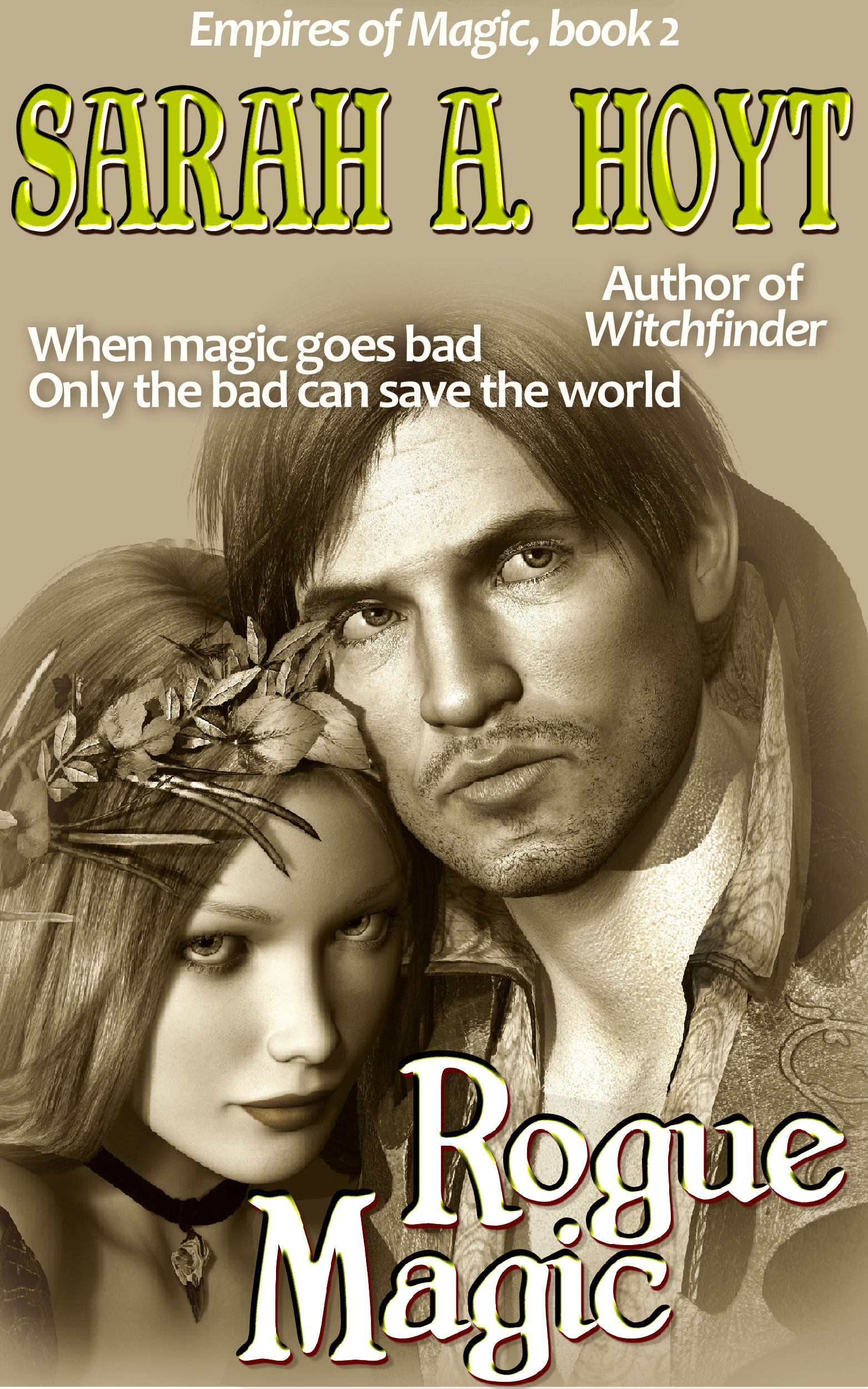
Rogue Magic, Free Novel, Chapter 40

*Oh, yeah, the next musketeer mystery is ALMOST ready to go — my proofreader caught the death flu.  And Witchfinder is hanging by a thread, before subscribers get it.  Thanks to everyone for your patience to me this last year.  I’m not kicking anyone out of my subscription, even if they don’t renew, because I figure I owe you a year of  freebies, anyway.  I think I am FINALLY crawling out from under, just up to my neck in overdue stuff both traditional and indie.*

roguemagicnewcover

The prequel to this — Witchfinder — has been removed.  I do promise to go through the copyedits as soon as humanly possible and send the advance copies to those who pre-ordered.  You’ll know when that’s eminent because I’ll remove scattered chapters from this blog.  I do hope to manage it next week, but I’m not promising as I’m still finishing a novel under contract to Baen. Meanwhile, if you donate $6 and note it in the field, you’ll get advance-subscribed to this novel.  I do, however, understand it can be a long time to wait, and if you want to, do so.  I will continue to post chapters here, roughly one a week.
NOTICE: For those unsure about copyright law and because there was a particularly weird case, just because I’m making the pre-first draft of my novel available to blog readers, it doesn’t mean that this isn’t copyrighted to me.  Rogue Magic as all the contents of this blog is © Sarah A. Hoyt 2013.  Do not copy, alter, distribute or resell without permission.  Exceptions made for ATTRIBUTED quotes as critique or linking to this blog. Credit for the cover image is © Ateliersommerland | Dreamstime.com

Wolfe Merritt, Supervisor of Manufactories for the Earl of Savage


The Promises of Rogues


I never knew when we went through the portal.  What I did know for sure was that we were not sent to the Earth, which is what we were promised.

There might be reasons.  After all the magic had gone bad, and was twisting everything.  The Lady Helen had not planned to end in the myth world, and none of us had planned to end up in the belly of leviathan.

Perhaps Hermes didn’t mean what happened.  Or perhaps he did.  The gods can be right bastards.

But I knew that something was wrong the moment I broke through the portal.  First, it was the oddest portal I’d ever seen and there was not the momentary freeze of the inbetweener.  Only we were in Mythworld, then suddenly we were not, and there was mist all around and in the distance a glimpse of a fairy-like castle, and I groaned, and then I cursed under my breath, and then I regretted cursing, because in fairyland words can make things happen.

The Lady Helen, still firmly grasped within my arm, a promise of warmth, a bit of life in this world that had none, turned to look at me.

“We’re in fairyland,” I said.  “In fairyland.”

My voice must have echoed my dismay.  Indeed, I felt as though a hole had opened at my feet and I would presently tumble into it head first.  And from there to the madness I’d known once before was but a breath.

The Lady Helen looked at me, her eyes wide and scared.  I tightened my arm around her, involuntarily and she said, all gasping, “How do you know?  How can you know?  What—”

“I’ve been here before,” I said, between gritted teeth.

And to her look of great shock, because I suppose it is not normal for people of my station – or indeed for anyone – to go traipsing out to fairyland on a whim, I laughed.  I would not normally laugh at the lady nor at her surprise, but indeed it was the strangest thing, for how could one explain one’s life when even one’s own mother found it strange and inexplicable how her son had turned out.  “Pardon me,” I said.  Myrth still colored my words.  “Pardon me, but it is a long story, and a complicated one.  You see, I had to go to fairyland, open a portal on my own, and pay the forfeit too, because it was the only choice I had to get my son back.”

“Your son,” she said in a wondering tone.  Around us, the tendrils of magic fog grew, a sort of pink dazzle in which I could almost see forms.  “You told me you had one,” she said.  “And that you were married.”  She pulled a little away from me, though not much, and to own the truth it was all foolishness.  The barriers between us were much stronger than the mere objection of my being married.  As though her family would ever let her marry a man with no title, no position and one, moreover, who worked for them in a menial position.  She must know that as I did, as I had been conscious of ever since fate had pitchforked us together into this strange adventure.

Before this moment, I’d known that I admired the Lady mightily. I knew nothing of her, then, of course, save her looks and that expression she had, as of a mouse caught in a trap, but a mouse who means to fight back tooth and nail.  But I didn’t love her, anymore than one would fall in love with a statue or a picture.  That is, one hears of men doing so, but they’re invariably the sort of noblemen who also would fall in love with a tree, if the fancy took them.

But after the time we’d spent together, I knew her.  Her quick wit, her indomitable courae.  I knew that she was perhaps the one woman I could love.

And yet, it went for nothing.  I was married, though both the legality of my marriage – since there were varying opinions on the legal status of marriage to the fair folk – and the status of it – since my wife had disappeared into fairyland seven years ago – were not very clear.  But more important than that, she was so far above me as the moon is above the Earth.  And what was more, Jonathan Blythe, Earl of Savage was my employer.  And Jonathan Blythe was the image, and in many ways the echo of his grandfather.  If he even learned I was in love with his sister, even with my never having done anything to make my love into a more practical concern or a more physical affection, I knew him well enough to know he’d have me horsewhipped.  And that was if he were in one of his more lawful moods.  If he were in one of his other moods, if the stories of his grandfather which I’d heard were true, I might find myself stabbed in an alley, in a darkling midnight.  And that was if he didn’t bind me, hand and foot, and sell me to some amphibian magical people in some parallel world, where I’d spend the rest of my life fanning water larvae or whatever else nasty job he could think of.

I sighed and told her, in as cold a voice as I could manage – though let go of her I could not.  Not in this eery, irrational place – “I married a maiden of the fairfolk I found in the woods near my mother’s house.”

She gasped, and this time, though she too didn’t fully wish to leave I think – because there is much comfort in sheer human company in the fairy woods – managed to be within the circle of my arm, without touching.  “But you must know—”

“That it’s not advisable?  Yes, I knew.  But you see, she looked so lost, so forlorn.  She didn’t know how she’d come to be in our woods.  She was mother-naked and lost, and she looked….”  I paused.  “Like one of the naked little birds who have fallen from a nest, and who will die if you don’t care for them.”

It seemed to me she giggled, quickly suppressed.  But when I looked at her, she was red and just nodded.  She cleared her throat.  “So you did it… to protect her?”

“I think so,” I said.  “though there was the glamour, of course.   You know how … no, you probably don’t.  But there is glamour to the fey.  After a while I thought I was in love with her.”  I shrugged.  “I was in love with something, though it might be a counterfeit of what I thought I loved.  Like…. Like when they give you gold coins that are nothing but rubbish.”

She nodded.  The mist around us was thicker, and I wished to heaven that I didn’t have to tell her this story in fairyland, where words were like living things.  It tried to hurry the narration, “I married her.  After a year she left.  She left behind – we thought – my son, Jimmy.  Until we realized it was but a counterfeit, too.  And then I came to fairyland, in search of him.  And I took him back.”

Oddly, it seemed to me she relaxed.  “Oh,” she said.  And then with a sort of nascent hope.  “Then you’ve been here.  And left before.  And… and won.”

I bit my lower lip.  I really didn’t want to tell her what I had to tell her next.  But she had to know, “Not unscathed,” I said.  “there is always a price.  And mind yourself, and try to stand beside me.  What I heard is that in fairyland you always walk alone.  I don’t know if that is true, but I know you can find yourself alone, away from all your companions.  And that no one can protect you.”

I don’t know if she heard me, because on that moment, she was gone.  I was alone in fairyland and the magical fog made me cold to the bone.

Around me echoed the sound of laughter – sharp, little laughter like bells out of tune.  Laughter with sharp teeth in it.

Pimping one reader!

*From Monsieur le Oyster, this morning.  And yes, I’m writing chapter of Rogue Magic.*

We had just one submission this week, so hopefully that means you all are too busy writing to send me links! Now take a break from torturing your characters and watch someone else torture theirs! As always, future entries can (and should!) be sent to freerangeoyster [aht] gmail [daht] com. Happy reading!
Jason Dyck, AKA The Free Range Oyster
Pachyderm Fancier, Mercenary Wordsmith, and Surfer on the Human Wave

Karen Myers

Bound into the Blood – A Virginian in Elfland (The Hounds of Annwn)

Bound into the Blood
DISTURBING THE FAMILY SECRETS COULD BRING RUIN TO EVERYTHING HE’S WORKED SO HARD TO BUILD.

George Talbot Traherne, the human huntsman for the Wild Hunt, is preparing for the birth of his child by exploring the family papers about his parents and their deaths. When his improved relationship with his patron, the antlered god Cernunnos, is jeopardized by an unexpected opposition, he finds he must choose between loyalty to family and loyalty to a god.

He discovers he doesn’t know either of them as well as he thought he did. His search for answers takes him to the human world with unsuitable companions.

How will he keep a rock-wight safe from detection, or even teach her the rules of the road? And what will he awaken in the process, bringing disaster back to his family on his own doorstep? What if his loyalty is misplaced? What will be the price of his mistakes?

Also available from these fine sources:

What Is Human Wave — a blast from the past post 3/2012

*So, why two blasts from the past in one week?  Partly because I was doing the preamble to book plug Friday and it touched on Human Wave, and I thought it was time we had a reminder.  Can you believe it’s been two years?  We need to make more waves! And let’s get with that linked list and all.  Cross-promotion DOES work.*

UPDATE: the complement to this piece is at Book Plug Friday.

This is a manifesto.  I’m not sure what we’re manifesting, but it’s probably destiny.  Or density.  When you’re dyslexic, it can get confusing.  But in any case we’re manifesting something and it’s a patent manifestation.

The proximate reason for this is my post – here.  Or in other words, it’s another fine mess my mouth got us into.  (Okay, my typing fingers.  If you’re going to be nitpicky, you’re right out of the club.)

The purpose of this is to create a new “idea” in science fiction, a new way to look at the genre.  Properly observed (and I’ve observed it) I think the genre should be a way to play with possible futures, with possible outcomes, with possible ideas.  The wonder of science fiction lays in the open possibility.

When we have the list of what we’re sort of aiming for, we can start getting people who “subscribe” to those ideas, or to most of them
Once we have the list of who you are and your websites, we shall send enforcers to your hom…  No, wait.  That’s another list.  Oh, I see.  That’s the list the trolls left behind.  Never mind.

Once we have that list, we can we can have some large, linked aggregate, so we can help each other, and get more attention to the whole idea.

We should also en-list some critics and reviewers.  I know some reviewers but not much about critics in their native habitat.  However, someone else might.

Because we are rebelling against enforced conformity of style and opinion, of belief and ideology, this list is not “though shalt nots” but “You’re allowed to.”  It is also, in the nature of my nature (Okay, who let the copyeditor in?  Rent his robes and throw him to outer darkness, where there shall be wailing and gnawing of blue pencils) to know that this job is not completed.  Heck, it’s not even really started.  There will be discussion of this list at both According To Hoyt and Mad Genius Club.  Come and be heard, and let the discussion begin.

You are allowed to write escapist science fiction – or fantasy.  Sometimes we just need a good read.  If it doesn’t have a big idea but is enjoyable, it’s still a worthy endeavor.

You are allowed to write as much as you wish.  In the new limitless market we see no reason to artificially restrict your output.  Anyone who thinks quality depends on how long something took to write has never known either professional writers or struggling middle-graders.

You are allowed to write first person.  You are also allowed to write second person, third person, and in persons yet to be invented.  As long as your work is entertaining, we hold you harmless in matters relating to verbal malfeasance.

If your world building holds internal consistency, at least according to the buying public, anyone objecting because it doesn’t conform to his or her idea of a future shall be pelted with soft boiled eggs and wear the yolk of shame.

Your objective is to sell books.  Writing is communication.  Your objective is to communicate with as many people as possible.  Or at least to amuse them, distract them, or make the burden of life less burdensome for a while.  Wishing to feed your family is also an acceptable goal.

You can write male heroes.  You can write female heroes.  You can write alien heroes.  You can write human heroes.  You can write western heroes.  You can write non-western heroes.  You can write squirrel-heroes (but you have to know you’re weird.)  You can write it in a boat, you can write it with a goat (but which end do you hold on the paper?) You can write it in a moat (but it will probably drip) and you can write it on a stoat.

You can have a happy ever after.  You can have a happy for a while.  You can have a fleeting happy.  It’s your happy and you can have it if you want to.

You can write action and plot oriented books.  (Who will stop you?  You’ve researched fighting techniques, right?)

You can write sex.  Or not.  It all depends what fits the plot.  You can even write sex with a robot.

You can write politics.  You can write them from the right, from the left, from the middle, the top, the bottom or everywhere at once.  Just remember to make them fit the plot.  And remember not to infodump.

So do we have no principles?  No guidelines?

Oh, it’s guidelines you want, then?  Well, I was manifesting.  But fine.  I’ll throw out a few simple rules:

1 – Your writing should be entertaining.  If you’re writing for the awards and the literary recognition, you’re hanging out with the wrong crowd. (Does the other crowd have a tiny raccoon in a kilt?  Or even a quilt?  Think!)

2 – Your writing shouldn’t leave anyone feeling like they should scrub with pumice  or commit suicide by swallowing stoats for the crime of being human, or like humans are a blight upon the Earth, or that the future is dark, dreary, evil and fraught with nastiness, because that’s all humans can do, and woe is us.

3 – Your writing should not leave anyone feeling ashamed of being: male, female, western, non-western, sickly, hale, powerful, powerless.  It should use characters as characters and not as broad groups that are then used to shame other groups.  Fiction is not agit prop.

4- Your writing shouldn’t be all about the message.  You can, of course, have a message.  But the message should not be the be-all end-all of the novel.  If it is, perhaps you should be writing pamphlets.

5 – You shall not commit grey goo.  Grey goo, in which characters of indeterminate moral status move in a landscape of indeterminate importance towards goals that will leave no one better or worse off is not entertaining.  (Unless it is to see how the book bounces off the far wall, and that has limited entertainment.  Also, I’m not flinging my kindle.)

6 – Unless absolutely necessary you will have a positive feeling to your story.  By this we don’t mean it will have a happy ending or that we expect pollyanish sentiments out of you.  Your novel and setting can be as dystopic as you want it.  In fact, your character can die at the end.  Just make sure he goes down fighting and dies for something, so the reader doesn’t feel cheated.

7 – You will write in language that can be understood.  You will have an idea of what your story is about, or at least of its beginning, middle and end.  And so will your reader, once he reads it.

8 – You are allowed to write scientific speculation that counters “currently established fact” – just give us a reason why that makes sense in your universe.  (For some universes it can be highly whimsical, for others you’ll need serious handwavium.)

9 – You will not be boring.  Or at least you’ll do your best not to be boring.

10 – You shall not spend your life explaining why your not-boring is better than your fellow writers not-boring.  Instead you will shut up and write.

Comments, suggestions, goats?  Stoats?  Oranges?  Peanuts?  Lightly thrown chickens?  (What? I find thrown chickens humorous.  No, I don’t know why.  Oh, please, I’m a writer.  Like I have the money for a psychiatrist.)

For Your Own Good — A Guest Post By Patrick Richardson

For Your Own Good — A Guest Post By Patrick Richardson

“Of all tyrannies, a tyranny sincerely exercised for the good of its victims may be the most oppressive. It would be better to live under robber barons than under omnipotent moral busybodies. The robber baron’s cruelty may sometimes sleep, his cupidity may at some point be satiated; but those who torment us for our own good will torment us without end for they do so with the approval of their own conscience” — C.S. Lewis.

It’s perhaps hard to add anything to this, but I shall try. This seems to be the point we’re at these days, however.

“For our own good” we’ve been subjected to everything seatbelt laws to the banning of big gulps in New York City to Obamacare.

Individually these things may not add up to much. They seem so reasonable when they’re proposed.

Take seatbelt laws — please. They were passed in the 1970s and early 80s mostly. It seemed so reasonable. Seatbelts save lives. That’s indisputable. And people who are not wearing them tend to get injured even if they’re not killed outright. There’s always some social cost to those injuries, and besides we should all wear them, right?

So the feds passed a law and said any state which doesn’t require them will lose their highway funding.

So all the states passed them and we’re all safer, at least in theory. I’m not convinced highway fatalities dropped all that much because of seatbelt laws but I will agree that every cop I’ve ever talked to says he’s never unbelted a dead man.

The problem here, is we’ve given up a little freedom. We do it again and again with all these regulations and laws passed “for our own good.”

They always seem reasonable. They always seem to make sense.

The proponents talk to us softly, softly, so as not to disturb anyone. They use phrases like “what about the children?” Which are calculated to keep dissent to a minimum. Who wants to be against the children?

And so slowly, slowly, we’re hemmed in. We’re wrapped in regulations and rules. Laws and ordinances. All “for our own good.” As the international community of the oh so caring and oh so sensitive create a world none of us recognize any more.

A world in which the language has been changed to avoid “offending” any of a number of easily and perpetually offended groups. Where personal freedom has been erased in the name of “social responsibility.”

A world in which all risk has been eliminated — at least in the minds of the caring and sensitive — and with it all personal responsibility or freedom.

For this is the end result of this sort of tyranny — a grey world in which it is impossible to get ahead. In which your every move is regulated and watched.

A world in which the state is mother, the state is father, all hail the state.

It’s already happening folks. From the school lunch regulations handed down by the federal government to the thousands of pages of Obamacare with its Byzantine regulations no one can possibly follow.

Is it deliberate?

Yes. At least on the part of certain elements on both right and left. The people who propose these regulations know perfectly well what they’re doing — they’re securing their own power.

The useful idiots who continually promote this stuff? Not so much. They are mostly true believers who think they’re doing the right thing.

So too the odious little twits, they of the Transnational Cis-Sisterhood of the Glittery Hoo Haa, who decided Jonathan Ross should not present the Hugo awards because, he’s offensive, ageist, sizeist, speciesist and Just Not Our Kind. Or something.

Look, from what I’ve read he’s a bit on the crass side. However.

First, he’s a comic. They get paid to be rude. It’s in the job description.,

Second, he is well known in the UK, friends with one of the top writers in the genre, Neil Gaiman. WORKS in the genre, having written comics. His WIFE is a former Hugo Award winner who wrote the screenplay for Stardust and X-Men: First Class.

He Gets. It.

But why the hell should we let that stand in the way of a good outrages and HooHaa Glitter Explosion?

Look, Ross could have brought exposure to the genre like it hasn’t seen since the Golden Age. That exposure would likely have meant the Hugo would actually MEAN something like it hasn’t in decades. Instead a few people who are members of the International Coalition of the Perpetually Butthurt threw a collective hissy fit — not over anything he’s actually said, but over what he MIGHT have said. I mean WTF? Are we living in a freaking Phil Dick story?

It’s time those of us with a brain — and a sense of humor — told these idiots to STFU.

First, because they’re part of the problem, the self-inflicted wound that’s killing SF. Our demo is trending older and older, and these silly twits are doing everything they can to drive away younger readers.

Second because this kind of exclusionary crap is the same sort of stuff that was done to most of US when we were younger.

We’ve said for years we’re better than the Mundanes.

It’s time we bloody well acted like it.

How Much Sharper Than A Serpent’s Tooth

Speaking of maligning a generation, my sons inform me they’re sick and tired of all the articles maligning the Millenials.  To be sure, even I am tired of those, and weirdly it starts me feeling sympathetic to my friends who are boomers, and understanding why they get so upset when people like me (the in between generation) and genxers pile on them using the worst members of their generation to pillory them.

To be fair to us, the obnoxious boomers are very obnoxious.  And to be fair to those who pile on the millenials, what they’re mostly complaining about is the echo boom.

The echo boom was the long-delayed reproduction of most boomers, and technically my son Robert – born in 91 – is one of them.

Which shows you the craziness of this whole “generation thing” being by years, and not by “general definitional experiences.”  To lump me with the boomers – conceived by WWII veterans after their return home, by definition – for instance, is fairly nuts, since my dad was a child during WWII, and since – born in sixty two – what the “summer of sixty eight” means to me is that I learned to write.  (I’d known how to read for a while, but arguably my handwriting wasn’t readable till I was 19 – for a brief and shining moment, at that.  Since I’ve typing mostly since then, my handwriting has gone back to “flog me if I know what I wrote down.”)

So, mostly the millenials who upset the general public – you know, the entitled, unique special flowers with “all the right credentials” who melt when asked to do any actual work – are the children of “the bad boomers” – the noisy stereotypical ones who give roughly half the generation a bad name.  And technically those kids aren’t “millenials” so much as defined by being born to those boomers who thought they were re-inventing life.  The president is one of them, and he’s a year older than I.  BUT arguably my kids went to school with a lot of them.  This was probably worsened by their being in gifted classes.  In their case they were in gifted/advanced classes because they bore easily, but the system is gameable by determined parents, and the sort of parent I’m talking about is very determined to get their little display child everywhere.

My kids, and the other half of their generation, who weren’t born to parents who sent them to an urban public school with five hundred dollars of pocket money a week (you only think I am joking) had to work very hard from kindergarten on.  Because this is when the generation of “question authority except mine” was in charge of education and therefore the children had to be (and often were) more responsible and organized than the adults.  My kids had to compete against kids whose parents had had the one, special, important child late in life, and helicoptered around it so hard it was hard to hear for the sound of their rotors.  They did their kids homework for them, sometimes engaging the resources of an entire office which they managed to research it for the precious snowflake.  (You only wish I were joking.)  This meant even when number two son, who is always a perfectionist, would devote a month to his geography project, including art and all, he would have a B, because you can’t compete with professionally-generated booklets.  It also meant when applying for universities, they competed against professionally completed applications by people who are paid to get the special kids in.  (They have a name, but I can’t remember it, so I want to call them Fluffers.  They cost from a couple thousand of dollars to tens of thousands.  They write the application essays, buff the resume, etc.)

At this point you’re probably asking “But Sarah, you have resources – why didn’t you help your kids?”  Oh, I did.  I spell-check, and copy-edit their essays or any other piece of writing.  If they remember to show it to me.

No, seriously.  Why not?  Because that is the source of all the moaning we hear about millenials.  “They can’t perform.”  “They don’t take criticism.” “They have no idea what effort is.”

I’ve been fortunate, as a parent, to have my teeth kicked in several times while pursuing my chosen avocation.  What I mean is, writing is a difficult field to break into when you have no connections, no idea how to navigate the network, and no interest in fitting whatever the flavor of the month NYC was looking for.

Complaining?  Don’t you believe it.

This is not fifty shades of writer, and I didn’t enjoy my eviscerations by publishers and critics any more than the average human being, but I tell you what, it taught me that life is never a little padded playground.  If you want to play with the big boys and at the big level, you’re going to get bruised.  The trick to life is not to never be knocked down – it’s to have the resources to get up and fight again.  Read the biography of any man who accomplished anything, from the founding fathers to oh, Heinlein, and you’ll see their eventual success was preceded by a series of often stunning failures.

Studies have been made.  People who are most successful at love are those who aren’t afraid to fail at relationships.  People who are most successful at business are those who survive failures and go on trying.  If you’re afraid to fail, you’ll never get anywhere.

So I figured the best gift I could give the boys, given I don’t have a few million to cushion their way through life (and at that, that might be child abuse), was to let them learn to fight their own battles, skin their own knees, bruise their own noses.

Has it worked?  Who knows?  I’d say they have a tendency to be perfectionists, who try too hard and become more neurotic than shaved monkeys, but that’s probably hereditary.  However, I do know they’re not like the millenials people complain about.  They don’t require praise and cup cakes just to do their job.  They work hard – really hard – at what they’re supposed to do and always go a little further.  And they have learned that failure isn’t the end of the world.

Oh, yeah, and they resent being lumped in with the precious flowers.  As they should, because they aren’t like them.

And because this isn’t generational or time bound.

Take the SFWA thing, for instance.  No, I’m not going to harp on it.  Yes, I find it palls, too.  But I use it was an illustration, in this case, so bear with me.  I use it as an illustration because I’m in possession of facts the average outsider probably lacks for what really is at the root of all this.  And it relates to the theme of this article and is universal.

When I was trying to break in, back in pre-history circa 1998, as a young mother of 36, I read all the industry news religiously.

Imagine how I choked on my own tongue when the editor of a large magazine said in print that no one under 40 had enough “life experience” to write well.  Yes, the editor was one of those boomers, but then most of them were.  Long march, and all that.  I was 36 at the time, and I figured that this was their equivalent of “never trust anyone over 30” — now “never trust anyone under 40” since their parents weren’t trying to break into publishing, and designed to keep people like me out.  Because it made no sense in any other way, since well… life experience has nothing to do with how long you lived, just like writing practice has nothing to do with how long you’ve been writing.  You might have been writing since six, but you write an essay a year.  Or you might have been writing since six, but you write five novels a year.  Even if the first person has been writing for thirty years and the second for five, the second has more writing practice.  In the same way, I know young people who’ve survived massive personal tragedies and fought for everything they have, who are more mature, more “experienced” than pampered college professors who have done nothing, their whole lives, than live in the hot house of academia.

But little by little I found out at that point in time, that was the general opinion of NYC publishing.  (Except Baen, of course.)  “If you’re under forty, you’re too young to write well.”

Fast forward five years.  My first series had tanked, and I was submitting proposals everywhere.  I kept getting back rejections not to the material but to me.  “We’re looking for younger writers.  Early twenties.  See, we need to attract more young readers, so we need young writers, who speak their language.”

As someone who both speaks English, just like the younger writers, and who was reading Heinlein when she was in her teens and he was in his sixties, I tend to think no rational person could believe that the age of the writer has anything to do with the age of the reader.  The cynic in me goes “Oh, so the editors had twenty something year old kids at that time.  Or their friends did.”  On the other hand it’s possible they aren’t rational.  Certainly this sad tale shows that this thing is both still going on, and that it defines “not rational.”

That btw is the sad story of a twenty something year old writer, who got a 200k advance for a book of essays, which then proceeded to sell less than 8k copies, which didn’t daunt the publishers from offering her 30k for her next book.  And she’s lamenting about it all in a tale that  you’d have to have a heart of stone not to laugh at like an hyena.  But see, she’s a “feminist socialist” and young and female and so, of course, exactly what NYC publishing was looking for, since well… they often confuse the wrapping for the gift and the writer for the work.

Anyway – the most important influx of these writers, who got doors thrown open for them because they were the right age/gender/upbringing – most of whom were very young and female – was about ten years ago.  Young women just out of college were getting huge offers for books that were what young women just out of college and with no life experience would write (and no, I’m not committing the error above.  This wave of what I call “red carpet acceptances” was targeted at young, just out of college and parroting the right “truths” – no life experience or rational thought wanted, or, in fact, accepted.) – very derivative, with a lot of sex and, in mystery, a lot of shoe and fashion shopping.  (I read Manolo shoe blogger, but look, there are limits to how much I care about shoes.)

Which brings us to now.  These young people, often very protected, were taken in and told they were the next best thing.  Not because of what they did, but because of what they WERE.  Success was their right and inevitable.  Like the poor kid who wrote the essay I linked, they were told they were so smart and brave and stuff for exactly parroting what they’d been taught.  And by and large – with a couple of exceptions – their stuff didn’t sell all that well, though they’ve won awards and been fetted and told how wonderfulglittery they are.

And even the ones who were successful are now shaky, because all they ever did was enter into traditional publishing and be massively supported and do fairly well within that framework.

I don’t even know if the smartest ones know all the breaks they got.  I doubt it.  First of all, because in publishing this stuff is all hidden and it’s hard to realize how much support you had, or even that other people didn’t get it.  (Unless you don’t get it, in which case you start wondering how the process broke down, then find out this is standard.)   Second because it’s human to take credit for our own success, no matter how helped.

So, you see, in their eyes, they think everyone else got this sort of magic carpet ride.

Now, as the carpet wobbles in the air currents, going indie is unthinkable, and of course someone else must be doing something wrong.  It must be those old, antiquated people, out of touch with the current generation, who refuse to retire.  Or perhaps it’s discrimination.  Must be discrimination.

And now you know what is at the back of the SFWA hysterics, and also what is coming to us, in society in general.  In the case of the SFWA darlings it’s worsened by their being now in their thirties.  When you’ve been told you’re so special BECAUSE you’re young, the thirties have to be a shock.  And you’re not famous yet, and people like Heinlein are still more read/influential than you – and… trembles lip… they’re dead.

But this is coming to society at large, because we do have a lot of kids my kids’ age, (and about ten years older) just about, raised by helicopter parents under the idea that children were trophies.  They’ve been making sure Johnny and Jane (only for this set they’re likely to be spelled Gionny and Gianne) never experienced failure and had perfect credentials since kindergarten.

I’ve actually heard parents bragging about that entire generation as “the best educated, the nicest, kindest” – sorry guys, I vouch for my kids being fairly well educated, generally decent human beings.  Not for any “generation.”

But  little Gionny and Gianne don’t know that.  They were told all their lives how special and important they are.

Only the economy – Summer of recovery 6 coming up!  How that must perk you up! – not to mention technological change are ensuring these people – who have never skinned their knees —  meet the wall at speed at face first.

How will they handle it?

One would like to think they will pull themselves up and charge on.  Doubtless a lot of them will.  Maybe even the majority.  But that will still leave a vocal and noisy and very large group of people who will throw serial tantrums because it can’t be their fault.  And who will try to pre-emptively protect themselves from any hurt-discrimination. And who will scream it’s all the fault of those bigoted old people who don’t have the decency to die.

So, hold on to your seats.  The ride is about to get rough.

And if you have kids, let them fall and skin their knees and bruise their noses a few times.  The most interesting people have scars.  Being thirty five and behaving like an unspanked baby is a dreadful fate.(VERY interesting people are a mass of scars.) 

And some things – like failing – you can only learn to survive by doing.

No one likes kicks in the teeth.  But you learn to wear a mouth guard.

* Oh, and if you’re a beginning writer, there’s a post on how to start your career over at Mad Genius Club.

I Come To Praise Rote

So Amanda’s post here last week got picked up by the BBC who thought she was “maligning a whole generation.”

Maybe she was.  Maybe she wasn’t.  I’ve long disagreed with Amanda on the “kids need more homework” but I don’t think it’s so much a disagreement on what we think the kids should be doing, as that we’ve encountered different forms of school-stupid.

My particular form of school stupid was my kids being given HOURS of homework that had no possible redeeming value.  No, seriously.

Look, I’m not the sort of parent who thinks that rote, repetitive tasks have no value in education.  On the contrary.  I learned to read and write in a village school where even the slow kids learned to read and write and cypher too: largely through never-ending repetition.  What is more, I suspect I had the same sensory and hand coordination issues as my younger son.  For instance, I didn’t start enjoying detail work, like sewing or embroidery, until after sixteen which is typical.  That type of work was incredibly difficult to me, all out of proportion to other kids my age.  And the same with you know, all clothes “itched” etc.  What’s more, when I started reading/writing I had the same issues.  BUT since my father – before I entered school – believed in rote learning, he set me to do a page copy a day (and the pages got more text as we went on.)  By six I wrote slow but not disastrously so, and by fourth grade I wrote faster than other kids.  (Mind you ANYTHING else I needed to do with my hands was a disaster.)

In fact, when younger son came home to homeschool for a year, and he was dealing with all these sensory issues and difficulty in focusing that made him write verrryyyy slow, the optometrist gave us a million exercises for him to do.  I have issues visualizing written instructions.  I was supposed to supervise his exercises and I had NO clue what he was supposed to do or in what order.  There was all this stuff with beads and string and rulers, and frankly I’m not smart enough to even know what to do.  So I ditched all the professional advice.  (eh!) Instead I set him to copy a page – increasing to three pages – a day.

By the end of the year, not only was his writing much faster (though still slow for his age, but not badly so) but he had impeccable spelling and grammar.

In the same way, I’ve taught language, and I can tell you the way they teach it in our schools, trying to make it fun and giving the kids colorful magazines written in the language, before they even know the basics is not only insane – it’s counterproductive.  When neither of my kids could learn French, I asked for their books and looked through both instructional materials and notebooks.

Guys, I TAUGHT languages.  The only way my kids could learn languages from what they were given was to be naturally gifted on the order of my brother, who could be dropped naked in the Amazon forest and would emerge two weeks later speaking the language of the nearest tribe like a native.

I’m not like that and neither are my kids, and neither are most people.  Most people NEED a basic vocabulary which includes a couple of verbs and some grammar rules, before you drop them into the deep end head first.  And the easiest way to acquire a vocabulary is to memorize lists.  Which is boring, and rote, but by gum it works.  (It is in fact all that most language learning software does.)

Now, after you have the basics, say about second year level, then you need to be dropped into the deep end head first.  I did this with older son (younger never really wanted to learn French, so he scraped by with a b, and then stopped taking it) by teaching him lists and lists and then, over summer, having him read Dumas in French (with dictionary at hand.)  Once he finished the Three Musketeers he had a very tolerable command of French.  (And an outdated swearing vocabulary.  Apparently Ventre Saint Gris said in class made his teacher – native – say “oooh, lala.”)

Anyway, I realize that because it worked for me and mine, it doesn’t mean it works for the entire population.  But kids used to come out of school minimally competent in reading and writing and now they don’t.  And in my area at least – though apparently not Amanda’s – kids do more and more homework.

I realize #2 son had issues that slowed his writing, so stuff took longer, and I won’t use him as an example, but #1 son, who was faster than average, usually had 4 to 5 hours homework.  EVERY night through high school.

Now I don’t know about you, guys, but when I was a kid my homework took at most two hours.  Three if we were ramping up for a test.  Which left me time free to read, spend time with my family, have hobbies.

But what was weird was the nature of the homework.  Part of the reason it takes so long is that it tries to be “fun fun fun” instead of just having rote memorization.

Look, let’s say you’re trying to teach your cat to fetch paper balls.  Yes, it can be done.  I did this with Pixel (best cat evah.)  — well, I had no kids, and I was bored.  Shut up – by throwing the ball, picking it up, bringing it to him, throwing it again.  Eventually a light bulb went on in his head, and he started bringing me the paper ball.

Now imagine that you’re told cats only learn if it’s fun.  So, first you soak the paper ball in sardine juice and throw it.  It seems to work better, because the cat goes to it immediately.  But then he tears it apart.  So then you fill a water bottle and spray the cat when he starts eating the paper.  Now the cat is afraid of the paperball and you must add catnip to make him go near.  Now he’s playing with it but not bringing it to you.  So you put sardine juice on your fingers.  He comes, but he doesn’t bring the paper ball…. Etc. Ad Nauseum.

As tedious as the first process is, the second, as you can see, can extend to absurd lengths.

Well, it’s sort of like that with teaching.  Say they’re trying to teach basic French vocabulary.  They can’t give a list like “Fille->girl” because that would be rote and bad pedagogy.  (And besides any idiot can learn that way, so what’s the fun in that?)

Instead the homework will involve going through the fun fun magazine printed for French teens, finding every picture of a girl and writing down the page number of the page where the girl is.  Then looking at all the captions (without reading French, remember) and finding the common words.  Then you write all those down.  Then you write your answers as to what “girl” is in French.

Guys, writing down Filleàgirl twenty times affixes it your mind better and takes five minutes (TOPS at kid speed.)  To do the other?  An hour.  And at the end of it, the kid is tired, cranky, and has learned nothing, because girl could be fille, or it could be gamin, or jollie, or elle or…

So my kids had HOURS of homework which not only didn’t teach them anything, but didn’t leave them free to learn anything on their own.

Not only that, but because the homework wants to teach kids in ways the kids don’t know they’re being taught, most of the exercises come across as utterly pointless.

Like most kids I HATED vocabulary lists.  I HATED copies, and there is nothing more despicable than multiplication tables.  BUT I knew why I was being given these.  I was supposed to memorize them, duh.

The kids don’t.  What I mean is, no one could.  Most of the stuff makes no sense for its stated purpose. They just know they have hours after school of putting tab a in slot b and coloring tag c and they have to do it because homework now a days counts way more than it did in my day.  (I should know.  I was very good at spacing homework.)  So even if you have all As in tests but don’t do homework, you’ll fail.  (Trust me, younger son tried this.)

So what the kids are taught is that they must perform senseless tasks they don’t want to do, which accomplish nothing, or be punished…

Worse, as I found out, the teachers don’t even remind the kids that homework is supposed to be turned in.  “Oh, I told them two weeks ago.  They’re supposed to remember.”  This is used as early as elementary when most kids CAN’T remember, so unless the parents remember it for them, it’s not going to happen.  (Surely you DO remember being young and the sense of floating in timelessness?  That’s neurological.  You’re not good at keeping track of time at that age, and I was told by a psychologist friend this can persist till 14 in boys.)

OTOH when older son had to have surgery and we asked the teachers for homework for the next two weeks, we found that they didn’t know it and had no plan.  From then on our reaction to homework was “the children must plan, because I can’t.”

This too is a bad thing.  Someone in power who does what he/she pleases while the kids/peasants must scrupulously follow the rules.  Bad precedent.

My point is, calling for more homework isn’t going to fix this mess.  The teachers happily pile on more and more mind bogglingly stupid homework, designed to avoid that awful “rote” and thereby more or less utterly pointless.

Now they’re talking about year around school, because the kids just don’t have enough time to learn.  (Rolls eyes.)

Oh, and they say that “it’s because the kids have so much more to learn.”  Poppycock.  This reminds me of publishers saying that “people are reading less because there’s so much more entertainment.”  When in fact, people were reading less because they had trouble finding anything they wanted to read.

How about you teach kids to read and write and let them pick up “all that important stuff” on their own?  Because, guess what, they do to the extent they need/want to.  And if they can’t read/write, the rest won’t happen EITHER.

Guys, there will never be enough time so long as we try to teach the kids without the kids knowing they’re being taught.

I come to praise rote, not to bury it.  Sure, if ALL you learn is by memorization, you create a learning system like China’s, where people can’t reason over what they learn.  But what we’re creating is exactly the same – a sort of behaviorist hell, where we’re trying to teach people things through other actions, but which ends up imprinting the idea that obeying pointless instructions is good.

Basic skills can be acquired through memorization.  I would skip the wooden ruler on the knuckles for memorizing the multiplication tables, because all it did was make me incapable of speaking when called on (I was likely to mentally transpose and say 45 instead of 54, and then the ruler would descend.)

And after you have the basics, you should move on to more challenging things.

If you’re trying to learn the basics without rote, you’re doing it wrong.  If you have the basics and still doing rote, you’re doing it wrong.

Removing all rote from learning because it’s bad after a certain point is like making strollers illegal because kids are supposed to learn to walk.  All it does is limit people’s choices and take away the time parents should be doing other stuff.  (OTOH some parents would become Olympic lifters.  I mean, Robert weighed fifty pounds at 2. And he wasn’t fat.  I have pictures.)

Right now?  Homework or no homework?  I’d say homework is a tool for keeping your kids FROM learning, unless your kids go to an exceptional school.

Agitating for more homework without checking on content is not the answer.

In fact, the more I look at it and hear, and exceptional schools like second son’s second high school excepted, I’d say the best thing you can do, if at all possible, is bring those kids home and make them do some copies and memorize their multiplication tables.  At least they’ll be bored for a reason.