Our Education System is going to be Our Downfall – Amanda Green

*Sarah has gone on a canoodling writing weekend for her anniversary.  She’ll be back Monday.  Please, don’t burn down the blog in her absence.  Also, decorating it in Hello Kitty Theme will NOT (repeat NOT) be appreciated.

Also, an  announcement Witchfinder is on Sale on Amazon and Barnes and Noble for 2.99 electronic through noon on Monday.  It’s 2.99, so less than a half but a little more than 1/3 the price.  Please share the news as much as you can.  Much appreciated.*

Our Education System is going to be Our Downfall – Amanda Green


Our current education system is, in all too many situations, a joke. From revisionist history to students being told they can’t wear t-shirts with the American flag on it on certain days because it might upset other members of the school population, it has become clear that there is more importance being placed on turning out a generation of Stepford students than in teaching students to think outside the box.

One of the pet whipping horses and, in my opinion at least, rightly so is the Common Core curriculum that many districts across the country have adopted. If you have spent any time on Facebook the last month or so, you’ve seen an image of what looks like a pretty simple math problem on it. The top of the image shows how most of us were taught to solve the problem. The bottom of the image is, frankly, a bunch of gobbled-goop.

commoncoremathsm

Now, I don’t know about you, but the top method makes a great deal more sense to me. The one article I found defending the bottom method stated that the Common Core method was better because students didn’t understand why they answered the way they did in the top method. Sorry, but that doesn’t fly, not if the students were taught how to add and subtract and not just told to memorize the tables.

A quick look at the two problems shows a difference right off the bat. In the top, you have the problem and the answer. The bottom shows, supposedly, the methodology for getting to the answer. So, the issue is skewed right off the bat – and by both sides of the equation. The side disliking Common Core didn’t show the methodology in the top example to illustrate how easy it is to solve the problem in the first place. In other words, if it is that easy, why do you need all the gobbled-goop?

As for the Common Core proponents, they will show the methodology in order to explain why it works but they won’t show the methodology on the top because, duh, it is a more streamlined process.

But that is just one example of the issues with not only Common Core but the education system in general. Another come from an assignment handed out to eight graders in Rialto, California this past May.

The assignment asked students to discuss whether the Holocaust “was an actual event in history,” or whether it was “merely a political scheme created to influence public emotion and gain,” the San Bernadino Sun reports.

More specifically, the students were given three sources they could use to justify their position. Frankly, I hesitate to use the term “sources” since they were given handouts and those were all they could use. These so-called sources were About.com, History.com and “Holocaust denial site BibleBelievers.org.au”.

Really reliable and accurate, much less in-depth sources the students were given. Right?

Making matters worse, when concerned parents and the media contacted the school district about the assignment, administrators said that no student had argued against the existence of the Holocaust as an actual event. Funny though, when the Sun got hold of hundreds of papers turned in for the assignment, it found at least 50 students who argued that the Holocaust was a lie. One student justified their position that the Holocaust was a lie because one of the sources said it had been exaggerated.

Needless to say, the community as a whole was outraged, and rightly so, over the assignment. Not only were the students not being taught about the horrors of the Holocaust and all those who lost their lives as a result, they were being given good grades for arguing against its existence.

After the fact, the district has pulled the assignment from the curriculum and it is “being revised.” The episode – and I have to wonder if, by that, they mean the publicizing of the assignment – is now viewed as a bad mark for the district. Whether this was, as the Anti-Defamation League put it, a misguided attempt to help students learn critical thinking or not, it was a badly thought out assignment. Worse, it was an assignment approved of by those in the district in charge of curriculum. If that isn’t a cause for worry, I don’t know what is.

Take into account the fact that the district also said “the assignment is merely to teach students to evaluate the quality of evidence made by advocates or opponents of an issue.”

If that were the case, why choose sites like About.com as one of the so-called sources? It is about as reliable on most things as Wikipedia. There is no real requirement, as far as I know, for any sort of special knowledge or training to answer a question. Then there is History.com. You know them. They’re the internet side of the History Channel, home to such historically accurate shows as Vikings. (yes, the snark meter is on high right now.) And the final “source” was from a Holocaust denier site – the only one you could really say advocates or opposes this particular issue.

Worse, this is the sort of thing that is happening more and more often in our schools. Quick internet searches will reveal where curriculum guides are rewriting our Constitution, especially the Bill of Rights, to meet the agenda of whatever the group’s political agenda might be. You will find reports, along with images to support them, of districts handing out worksheets claiming that the Second Amendment allows people to own only certain types of guns and only if they register them.

Some of the alleged attempts are more subtle than others. There is a text book in which the Second Amendment reads, according to sources, that “The people have a right to keep and bear arms in a state militia.” The actual phrasing of the Second Amendment is, “A well regulated Militia, being necessary to the security of a free State, the right of the people to keep and bear Arms, shall not be infringed.”

So what is Common Core? It is a Washington DC based non-profit organization (yeah, yeah, I laughed too). Its mission statement reads as follows:

Common Core seeks to ensure that all students, regardless of their circumstance, receive a content-rich education in the full range of the liberal arts and sciences, including English, mathematics, history, the arts, science, and foreign languages. We work with teachers and scholars to create instructional materials, conduct research, and promote policies that support a comprehensive and high-quality education in America’s public schools.

Here are some examples of what different Common Core worksheets look like.

Now, like Common Core or not – and I don’t – there still has to be some sort of understanding that our education system is to educate and not indoctrinate. We have to stop worrying about teaching to the lowest common denominator and we have to give our teachers back the ability to adapt curricula to meet the needs of each and every student without having to spend weeks or months justifying it to the powers that be. We need to challenge our students, all of them, and give them back the joy of learning.

Frankly, I don’t give a flying rat’s behind if a kid can explain to me why 32 – 20 = 12. If he has been taught properly, he will understand the process. My concern is that he not be so intimidated or turned off by a complicated process for something that is really very easy to do. I was one of those kids who was hit during school with multiple changes in how math was taught. As a result, I hated math. Each change in the process made everything much more complicated than it needed to be. You have to teach the basics first and build from there. Not start on the 14th floor.

But what really concerns me is what we are doing to our kids when it comes to history and government classes. Yes, the victors write the history books. It’s been that way for time immemorial. This need our education system seems to have to go back now and rewrite history so it conforms to the current definition of politically correct is going to lead to our downfall if it isn’t stopped soon. The quote, “Those who do not learn history are doomed to repeat it,” will come into play. We already have students who have never heard of the Korean War and who don’t understand the origins of the World Wars. Others have been taught that the only reason our country fought a civil war was because of slavery. Those are just a few of the examples.

It is time we, as parents and grandparents, aunts and uncles, cousins and friends, started paying attention to what our younger generations are being taught. It is time to tell our school boards that they need to get their acts together and start focusing on teaching and not on mandating policies that keep teachers from being anything more than glorified babysitters. It is time to tell our government, especially the federal government, to quit mandating policies for our local districts that make no frigging sense and only serve to lower our education standards.

In other words, it is time to start giving a damn and letting our voices be heard.



We Are the Field

*First, an announcement Witchfinder is on Sale on Amazon and Barnes and Noble for 2.99 electronic through noon on Monday.  It’s 2.99, so less than a half but a little more than 1/3 the price.  Please share the news as much as you can.  Much appreciated.*


My Eyes on Twiter TM (he can identify himself if he wants to) informs me that the usual suspects were blathering last week about how it was really bad that we not only wanted to publish to our little niche, but we also wanted to “take over the field.”

So who is “We”? Well, the think it’s the “conservative” writers, and given the brilliant understanding they have of our side this means mostly – they think – killjoys with an agenda of “do not trespass.” This was obvious since the conversation then went on to say that the dangerous ones on our side were people like me and Larry and Ringo who “pretend to be moderates” and therefore might “attract a following.”

First of all on the “pretend” – no, thank you, I’m quite done pretending, and I wasn’t very good at it to begin with.

Second of all on the “moderate” – I am offended. Since when is someone who wants to hang the komissars from lampposts using their own guts as ropes a moderate?

Oh, yeah, sorry, I forgot. I’m a “moderate” because I don’t fit the view of “conservatives” (which for these purposes is everyone not to the left of Lenin) shown on tv, books and movies for the last forty years or so. You know, someone who is a cross between the SNL “church lady” and Sam the Eagle from the Muppets, and who folds like a cheap lawn chair at the first sign of opposition, or even the first cliché thrown at them by a “smart” liberal. You know, things like “War hurts children and other small things” and “We’re all naked under our clothes.”

Once you understand that this is what the left thinks the “opposition” is (poor things, their control of the media and entertainment has done them a very great disservice) is, you start understanding why they’re such hidebound, cliché-ridden fanatics.

You see, they think the choice is between two sets of beliefs, both monolithic, whole and undigested. Part of the reason they believe this, of course, is that the left has always, either by reason of policy or on their own, cracked down pretty hard on “deviationism” and insisted on “party discipline.”

This is something the communists brought with them, and it allowed them to pivot over say the Hitler-Stalin pact. But it also means that for people to consider themselves on the left, they must believe three thousand contradictory things before breakfast and lunch and dinner.

Some of the minor ones include:

The idea that we should be free to do what we want to with our bodies, but that we all “belong” to the government, who can order us to stop eating unhealthy food, or NOT exercising. (Why they don’t realize this will eventually, given enough governmental power, extend to things like abortion or gay sex is beyond me. It not only requires them to believe that government will self-restrain, it also requires them to ignore the history of China and the Soviet Union and Cuba.)

The idea that women are the exact same as men, or perhaps more able, but at the same time they need protection at all times, and men can talk them into anything with their “superior” male minds.

The idea that every culture is the same but ours is uniquely bad.

The only way they can believe this is because they’ve gotten used to the idea that their beliefs come into a block – that if you believe in one part of the agenda you have to believe in all of it.

This is also what keeps them in line and from even considering conservative agendas. For them to accept, say, the idea of fiscal responsibility, they think they’d have to stop talking to all their gay friends, stop making off color jokes, or whatever the hell they think conservatives are.

In that light, of course I’m “pretending” to be a dangerous “moderate” who might seduce people over into accepting my dangerous agenda and believing in the constitution and disbelieving in Marx. According to what these poor bunnies have been taught, this means they’ll need to dress modestly, go to church every Sunday, support racial segregation, etc. etc. – ie. An agenda that no conservative has supported in totality EVER.

So, I’m here to inform them that it’s not like that. They really need to get past their binary view of the world. Most – not all, but most. There are some who are on this side simply as knee jerk rejection of everything the liberals say. Which can get bad because most of what the liberals say is internally contradictory – of us are on this side because we didn’t get our beliefs ready-made off the shelf.

We couldn’t, see, because tv, radio, movies, news, books, didn’t present anything we believe in as a coherent wholesale agenda. Instead they presented us with two alternatives, one pushed as right and the other as wrong, and both internally contradictory, laughably incoherent, and out of touch with reality.

This means when we saw all the cracks in the agenda being shown as “right” (I believe for me that started when I saw how they reported things I’d been present at. And there was no resemblance) we started examining positions and beliefs by themselves, individually, testing them against reality and choosing what to believe in and what not to believe in.

And eventually we arrived to a set of beliefs we’re okay with. Some we might not be as attached to as others. And some are not for public consumption. Oh, and our politics and religion might not have anything to do with one another, except in the sense that sincerely held religious beliefs will influence politics, but that doesn’t mean even that is taken wholesale. Look, I’m sincerely religious, and I hold myself to a set of beliefs and behaviors that I believe move me towards salvation. This doesn’t mean that I believe everyone should be forced to do the same. I know this is hard to believe, but my Mormon friends don’t think coffee should be outlawed (which is why they’re still my friends.) And my gay (conservative) friends don’t believe churches should be forced to marry them. (Most of them would prefer to get government out of marriage, too, but that’s something else.)

It is possible to be pro-freedom and not religious at all, in fact. Or to be religious but to be rigorous with oneself but not with others. For instance, my religious beliefs are very much anti-group-relationships but I don’t think people should be punished for this (they might be their own punishment!) and in fact I’m reliably informed that some of my friends are in those. They’re still my friends. (And not to the left of Lenin.)

It is this flexibility that allowed us for years to read what the publishers put out, despite the fact that most of it was not only steeped in the vilest Marxism, but also spent quite a bit of time denigrating things we believed in, like fiscal responsibility or gun ownership. We even enjoyed some of it. You see, I can say that Terry Pratchett was one of the best writers (in any field) ever, while thinking his views on guns and monetary policy – were it not for the fact they are standard European views and therefore part of his environment – are crazy enough that people proclaiming them should have to wear tinfoil on their heads as a warning.

They can’t. Because their beliefs are a monolith of fail that they can’t examine without falling apart, they can’t even read Heinlein. In the middle of the free love and group marriage, they might come across a paragraph about fiscal responsibility or lack of respect for government, and then their brittle façade would crack.

This is why one of the usual suspects was giving thanks on Twitter for the fact that her bookstore refused to stock “right wing” science fiction, so she was never exposed to “fascist” ideas. (Yes, this is the East German, who manages to be completely oblivious to what “fascist” really means, and thinks libertarian fits there. Because, you know, “Achtung, vi vill take over the vorld and leave you RUTHLESSLY alone.” [Cackles at the thought of the screams of outrage at fake German accent.]) Because you see, ideas are a sort of contamination. If you read the wrong ideas, you might find yourself agreeing with some of them, and then, no matter how minor your agreement, you are forever corrupted. You are no longer “one of the good people.” The thought crime no matter how momentary will cast you into outer darkness.

Is it any wonder that under them most of science fiction has become about as daring as the Baptist Single Woman’s Social? (Probably less. Some of my friends are Baptist.) Is it any wonder to be accepted as a “progressive writer of science fiction” you have to “speak truth to power” (circa the imaginary fifties that live only in progressives’ heads) in exactly the same way everyone else does, and be forever afraid of putting a foot wrong or having a wrong thought, lest you’re thrown out?

To the scaredy ( and conformist) cats on the other side of the political fence, I bring good news and bad news.

The good news is that most of us do not want to “take over” the field. You see, most of us – not being a monolithic block – would have trouble organizing our way out of a paper bag. A lot of us still read people well to the left of us. Heck, to a lot of the right in sf/f, I am well to the left. To others I’m unimaginably right. Oh, and sometimes I’m both to the same person.

Not having a rigid set of beliefs, if we tried to take over, the Federalists would get in a fight with the Nationalists, the Nationalists would beat the One-Worlder-Libertarians over the head, and the anarchists would denounce all of us.

So, no, we’re not stealing your trick of proclaiming a platform and demanding everyone follow it.

The bad news is that we don’t need to take over the field. We’re already here. Science fiction has always attracted people who like to turn ideas over in their minds, think on them, sometimes try their flavor. Sometimes these ideas are dangerous enough that the rest of society thinks we’re nuts. Sometimes we are nuts.

You – the academic Marxists, the rigid thinkers – have managed to run most of the Odds – in the sense of people that don’t fit on either dies from official fandom, and from publishing houses, and from official publishing circles, mostly by pointing your finger and screaming about thought-crimes.

But with indie, that tactic won’t work. We’ll still get out there. We’ll still publish. And yep, we’ll still “contaminate” new generations with dangerous thoughts and ways of looking at life. Ways that shatter your conformist, block-think.

Dangerous visions, you could call it.

We’re here, we’re diverse in thought. And we ain’t going anywhere. Get used to it.

So I finally got the zazzle store fixed

Also I realized how ill I must have been last year, because it would take me forever to get a product up.

Anyway, this is not today’s post, as such, just something to hold you while I write it.  Also, I thought those of you not the in facebook diner might want to see these because… funny.

First up, designs by older son:

I Ate At The George T-ShirtDid you visit beautiful Goldport Colorado and stop for pancakes at the funny diner on Fairfax with the neon dragon flipping pancakes on the sign?  Buy one of the souvenir t-shirts to remember the special moment.  No, of course the waitress didn’t just growl at you!

I Wasn't Eaten At The George T-ShirtDid you visit beautiful Goldport Colorado and stop for pancakes at the funny diner on Fairfax with the neon dragon flipping pancakes on the sign?  Are you fairly sure the waitress growled at you?  Did the proprietor look a little… dragonny?  Well, buy this t-shirt to proclaim your good fortune.

The next three are by our very own Shadow Dancer (Thank you!)  Available for all your t-shirt illustration needs.  (I hope.  I didn’t ask her.)

carpethecarpEat, drink and be carped, for tomorrow we die.
getcarpedAchievement unlocked! 

borntobehunIs your poor child destined to be one of us?  Proclaim it proudly!

Then there are a couple of designs by Chris Muir (THANK YOU!)

superwriterYeah… I know.  But it is a great drawing for a t-shirt.

And for those of you following the evilness of the evil league:

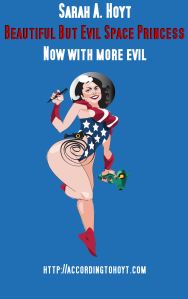
now with more evilAvailable in t-shirt and Mug

Yes, there will be others: quotes from books, writers t-shirts and funny hun-joke t-shirts — but they will come in a trickle over time and I’ll try to remember to tell you about them!  I only got this done yesterday because I was on three hours of sleep (Curse you Jagi Lamplighter for keeping me up all night reading!) and needed to “work” but words were beyond me.

Invaded by Aliens

It is a cliché of bad science fiction – as in what I tell all my newbies not to do – to start a story with characters telling themselves/each other things they already know.

“As you know, Bob, we were invaded by aliens in 1939,” has become a catch phrase in my family, as in when someone is telling us things we already know. You know, something like younger son will say, “In case you didn’t notice, the economy sucks” and I say “As you know, Bob, we were invaded by Aliens in 1939.

Now, while I don’t believe we’ve been invaded by aliens, it occurred to me that this was a great story starter. But then I realized that (though I don’t believe we’ve been invaded by aliens,) the resulting world is as close as it can be to ours, and in many ways makes more sense than ours. Or, as a vocal woman once said, “At this point, really, what difference does it make?”


“As you now, Bob, were invaded by aliens in 1939, and since then they’ve been doing their best to destroy humanity. But because they’re cunningly disguised, most people aren’t aware of it and think the culture has gone inexplicably bad.”


-Our entertainment and culture vilifies the very concept of humanity.

-Our entertainment and culture vilifies the concept of “good” meaning benefiting most of humanity.

– Our entertainment and culture vilifies the concept of success and successful people are viewed not as role models but as evil villains.

– Our entertainment/culture/education holds up to ridicule and opprobrium the human cultures that have made the most humans happy/healthy and wealthy, while glorifying cultures where women are held as chattels and anyone different (mouthy women, original thinkers, gay people) are at best hanged from cranes, and at worst tortured in inventive ways.

– Successful Western countries are ASSUMED to “deserve” being swamped by third world immigrants and made into hell holes like the ones the immigrants came from.

-TV programs exhibit “extinction lust” fantasizing about a world without humans.

– “Environmentalists” loudly equate men and rats in their scale of priority and think human population should be reduced to one tenth what it is.  They refuse any solutions that don’t involve extreme population reduction and return to a short, brutish and nasty standard of life for all humans.

– To this end, a vocal and poisonous belief called “feminism” has been propagated, to keep the human males and females from making more humans.

IN THE UNITED STATES IN PARTICULAR:

  • Our elites vilify the United States compared to anyone else. Yes, even evil pirates, rapacious fascists like China, corruptocrats like Putin and the unholy mess that’s the Middle East other than Israel. Faced with that bucket of fail, our president went around… apologizing for the US.
  • We routinely help our enemies and stab our allies in the back, or as someone said “changed sides on the war on terror.”
  • While the world falls apart around us, the most important thing in the world for our elites is to subdue their own populace, be it by ridiculous environmental regulations, gun regulations, hectoring on diet (according to disproven principles,) and targeted economic war – IRS, EPA, and various banking regulations – of which the problems made for old coin dealers are the drop of water in this bucket of scary that makes my hair stand on end. You figure out why.
  • While the world falls apart around us, our cultural elites, blithely blind to what is going on in countries where women, gays and minorities truly are oppressed (as in dead-oppressed) blather on about the future being queer and about how many angels can dance on the head of a pin, how to eliminate the tyranny of bi-gender assumption from fiction, games, and other creative culture outlets.
  • While anyone who behaves like these “elites” (I prefer aristos. It’s more… accurate) is told that they’re brave and “speaking truth to power” while reaping all the rewards possible by the society that supports them (and doing their best to tear it down) anyone pointing out the suicidal folly of this behavior is called… “a conformist” and “unoriginal” and “scared” or a “sell out” while, in fact having to swim against the cultural current, because the main current is supporting the suicide-encouraging ones.


I don’t believe we’ve been invaded by aliens. But do look around.

If we had been, how could you tell the difference?

At this point, really, what difference does it make?


One American Looks at Nationalism – Alma Boykin

*My apologies to Alma and everyone for being so late putting this up.  The reason is I was going to write a post today and save this one for this weekend, when I kidnap husband for Anniversary celebrations.  Unfortunately I REALLY need to go finish painting the porch and I got so late writing post for MGC — partly because husband and I had to talk about something else, while I was writing — and I want to get out there before it’s too hot to be outside and working.  Sorry Alma and everyone.  BUT otoh this post is apropos my post yesterday*

One American Looks at Nationalism – Alma Boykin


I don’t “get” nationalism, not really. I grew up in the United States, and we don’t “do” nationalism. We do patriotism, much to the dismay and occasional despair of the Anointed, those who dream of one world government, peace in our time, equalization of poverty, and a free-range organic soy chicken in every pot. (Or free pot for every chicken, depending on where they live.) There are some sectional differences that flare up, mostly as proxies for something else (modern economic situation, mostly). But that strange thing called “nationalism” doesn’t apply to Americans, and I suspect it doesn’t apply to Aussies, New Zealanders, or Canadians, either.

Why not? Because the U.S. is a state (political) without nations in it (excluding American Indians, for reasons you’ll see). A state based on an idea and not on past glories and victimhood.

As I learned in college, a nation and a state can be totally separate animals. And since 1800, nations within states tended to generate uneasy politics, often because of economics as well as claims of cultural supremacy. Until the Long Nineteenth Century (1789-1914), states often contained multiple nations. “Nation” meant a group of people from the same region who often spoke the same language and may have claimed a single ancestor or ancestral group, like the Bohemians and Princess Libuse, or the Magyars who descended from a princess impregnated by an eagle. But the states, like what became France, or the Holy Roman Empire of the German Nation (as opposed to Charlemagne’s version), or the Grand Duchy of Poland-Lithuania, or Spain, contained multiple nations, all of who paid taxes and service to the monarch. The state included nations, but most nations did not have their own state.

Then along came a couple of philosophers, Napoleon, and the Romantics, and trouble ensued. Trouble, that is, if you were a monarchy or republic with unhappy nations inside your borders; or if you belonged to a nation that wanted its own state, or at least official recognition as being co-equal with other nations in the state, because “Glorious ancestors! Our noble patrimony! A majority share of the national budget!” The early ideal of universal brotherhood shifted during the 1830s into the desire for recognition of these magical nations—and their “ancient” (occasionally mythical) borders.

During that long century, nationalists in Europe dug for evidence that could tie their ancestors, mythical or otherwise, to a large chunk of territory. The Romanians, for example, claimed descent from the Romans and looked back to the Roman Empire as well as later Slavic tribes in order to demand ownership of Transylvania, even though large numbers of German and Magyar-speaking peoples lived there for hundreds of years, and the Magyar/Hungarians had controlled the region for centuries. “Doesn’t matter, the Romans were there first, so it should be Romanian.” Farther into the Balkans, the Albanians and others claim descent from the Illyrians, a pre-Roman tribe, and assert that their presence dates back thousands, if not tens of thousands of years. You can see that this might not end well.

This came to mind because I’ve been giving myself headaches trying to understand Eastern and Central Europe recently, a topic I tend to approach from an American’s view. As a result, I read about the plight of the poor, oppressed Hungarian nobility and gentry and my mental eyebrows started to rise. The mental monologue goes something like this: “Let’s see, you beat up the peasants, you abandoned your king at the first battle of Mohaçs so you could go loot the churches and run his Habsburg wife out of the country while the Turks took over a third of Great Hungary, you played all sides against each other, you beat up on the Slavs around you and tried to eradicate their culture after 1850 while shutting them out of the government, but you are the victims. Riiiight. While bragging about how great you were before 1444, and of the glories of the magnificent Hungarian kingdom. Pardon me if I have some trouble taking all this at face value.”

You see, I’d read much of this twenty years ago, but with different names. Rebecca West’s book, Black Lamb, Grey Falcon is a history of the Serbs as victims. Their last czar, after a vision from the Lord, chose a heavenly kingdom over an Earthly one and got himself and his troops slaughtered at the Battle of the Field of Blackbirds (Kosovo Polje) in 1389. As West described it, the Serbs, the last defenders of Christendom, suffered as martyrs under the Turks and the Habsburgs for centuries after that, and so on and so forth. The book is well written and very persuasive—if you don’t know much about the area, especially if you forget what happened in the Balkans between 1989 and the rise of Wahabism there. I suspect if I went looking, especially in foreign-language sources, I’d find works written in a similar spirit about the Poles, Romanians, Bulgarians, and Bohemians. And do not get me started on Stanislav Kirschbaum’s A History of Slovakia. He writes well, but his bias shows in neon lights with sparklers around it.

To an outsider from a country that doesn’t have a sense of nationalism, all this sounds a little silly. You can’t claim borders or rest on achievements that vanished centuries ago. OK, so his ancestors spoke Bohemian and hers spoke German. Big whoop. Have your ethnic parties, like Americans of Irish ancestry have in March or the folks down in Fredericksburg do every October, and get on with life. Except the burden of history (and Marxist economics) weighs too heavily for that.

Americans don’t have that history. We don’t have 1500-year-old castles and monasteries. Neither do we have fights over slices of the economic pie disguised as claims of ancient ancestors. Because that’s what a lot of nationalism since 1848 has become: demands for chunks of what generations of Marxists have declared are limited government resources (because all comes from the government) based on borders and people that disappeared 1000 years ago. Add in the desire to avenge wrongs committed 500 years ago and rediscovered or reemphasized and turned into rallying points by politicians (see the Battle of Kosovo, above), and a couple of Marxists claiming that since your ancestors were oppressed, you should get an extra share of the “pie” and be allowed, if not encouraged, to pay back old economic wrongs by, oh, driving out the Saxons, Catholics, and/or Jews, and you get an unholy mess that leaves Americans wondering why the h-ll these people can’t take a deep breath and go get real lives.

To those of us who grew up in places and times without Marxist economic ideas draped in ethnic flags, the claims of nationalism sounds foolish at best and dangerously parochial at worst (see the anti-Semitic spasms of the Hungarian Jobbiks and the Russian National Unity Party, Pamyat). As a historian, I understand nationalism intellectually when I read about it, but I don’t “get” it. I don’t feel especially loyal to any of my ancestors’ birthplaces. There are cultures I identify with and some that I find repulsive, but I can’t imagine basing all my political and economic and cultural dreams on, oh, say, bringing back the days of King Brian Boru or Fredrik Barbarossa. As a fiction writer, I can imagine how some characters think about their volk, but it’s a prickly mental sensation, like wearing an itchy wool suit on a hot, humid day. It doesn’t fit and I just don’t get it.


The Children’s Crusade

I hate to run my mouth about anything medieval even if it’s specific to Portugal, because some of you are experts in the time and the stuff, and I’m not.

So, I won’t.

Instead, I’m going to run my mouth with qualifications. (Yeah, you thought I’d stay quiet, did you? You poor ducklings.)

The way I was taught/understood The Children’s Crusade, it was an effort mounted by Europe in the belief that there was a magical character to children and to faith, and that given the faith of a child, they could easily take over Jerusalem.

It was a mystical thing, with little connection to the world outside, or indeed to anything real, but it was deeply felt and internalized by people in what amounted to a theocracy.

Understand, I’m not putting the faith of the times down, but having achieved wall to wall dominance (save for the Moorish invasion) in Europe, Catholicism dominated every facet of life, to an extent even the most religious of us could not understand or engage with. People used the highly ritualized Catholicism of the time as a prism to see life through, and given that humans are humans and most of us never engage with the transcendent and those who do can’t stay engaged all the time, it was more superstition than anything else. The stories of saints and even of the life of Christ mixed with the local legends of the local divinities to create what’s technically known as a hot mess, which meant that most of the time their superstitions weren’t even about Christianity as such.

But because they were in an echo chamber those superstitions assumed the strength of proven facts. (No human experiences or proves everything by and for himself) and so… the children’s crusade.

Which goes a long way towards explaining what we’re seeing at our Southern Border.

Look, even in its worst aspect, what we’re seeing is not of a number sufficiently large to make a difference. I hear a hundred and two hundred thousand variously mentioned. And I’m not putting it down. It is a huge number.

But unless someone has been pissing down our necks about the number of immigrants already here, it’s a drop in the bucket. (The possibility of someone pissing down our necks is quite real. We’ve entered a state in which it’s easier to trust British newspapers about our numbers, and where even my moderate left friends roll their eyes when the unemployment numbers come out. And let’s face it, exaggerating the number of illegals has always – more or less – been a thing, because it gives more money for social services agencies as well as creating a “crisis” that calls for blanket naturalization. I’m not the only one to think that, because people keep quoting numbers widely apart for the number of illegal immigrants here.) Sane people often say something like “we have between three and eleven million illegal immigrants.” Because we can’t be sure, because our governing classes lie to us. BUT one thing is for sure: even if it’s just three million, even if we added a quarter million before someone puts an end to this insanity, it won’t be the end of the world.

Oh, sure, it will strain our schools and our medical systems. Oh, sure, we will get one or two terrorists in, and maybe a backpack nuke, which could change things dramatically.

But what I mean is, it won’t “fundamentally transform America” unless by transform you mean it will royally p*ss us off.

The kids, (and quite a few adults claiming to be kids) streaming over our border can’t conquer us, any more than children could conquer Jerusalem against experienced warriors.

Then what the heck is going on?

Magical thinking. On both parts, I’m afraid, but mostly on the part of our elites. (People in the third world aren’t isolated enough from every day realities to engage in magical thinking, “magical realism” notwithstanding. Or at least not to engage in it beyond the quotidian “good luck gesture” and such.)

First to understand the part of the people sending their kids across, or the kids coming across. This isn’t very hard, and might be more clear to me than to anyone else.

No, not because I wanted to come here. I wanted to come here because I grew up in books set in America and on translations of Readers’ Digest from the fifties, when granddad had subscribed (in Brazil) and on histories of America. I wanted to come home. I very much doubt that most of these kids have spent years poring over Heinlein and the founding fathers.

On the other hand, I come from a country (and a region) of emmigrants. And I knew that if I didn’t manage to get into the US right away (it’s hard) I’d still have to leave Portugal as soon as possible. It will tell you something that the corruptocracies of Europe were a better destination. I had plans and back up plans for the plans and back up plans for those plans. I’m sure by now I’d have made it here. But I got lucky and fell in love with and married and American.

Which is neither here nor there – I knew both the drive of people my class (college students, mostly) and of people who were dead broke and starving. The downside of Portugal having a deep past, with castles and picturesque views, and quaint customs like the summer solstice “everyone goes to the street and dances all night” thing is that it that deep past is a vast underwater drag. Portugal is like an iceberg. Culturally what you see at the top is maybe 2% of the whole beast. The way the culture really behaves underneath, hidden from outsiders, is the other 98% and that’s mostly how it’s behaved through Roman and Muslim and Christian.

Certain things are very hard to understand from outside, and very hard for them to change from inside. The past will have its due. Which explains why Portuguese politics resembles nothing so much like the Roman system of patronage and why proverbs like “he who has no patron dies in jail” is not even vaguely scandalous.

This means that the system almost doesn’t work. Material wealth in the world at large is so great right now that even in Portugal people aren’t like the old immigrants to Germany I talked to on a train, unable to eat meat but twice a month.

But there’s stuff other than the material which drives people from a country. Portugal has gotten much worse, crime and insecurity wise, than it was when I left. But even at the level it was then, it created a bad background to life. And knowing that if what you wanted to do was not something you had contacts in, you couldn’t do it pushed a lot more people out. And then there was material need, and the stories that the streets of France (yes, France) were paved with gold. We knew they were true, too, because those lowest class people who went to France came back in a few years and looked… glossy. It’s the only way I can describe it. They went and they came back, and their kids looked healthy and sassy.

So, that’s what we’re seeing from the other side. Our government having invited them (I don’t know whether to trust that there were pamphlets distributed at American consulates, but after the IRS and the EPA and everything else, would anyone really be surprised?) and promised them citizenship which then means they can chain-bring their whole families, they’re coming to the place where the streets are paved with gold, and where there’s hope they can do something better than what their ancestors did.

No, it’s not because of “instability and war” because unless our press is more blind than usual, there ain’t no such thing going on in South and Central America right now. Or at least there ain’t more of it than there’s been since forever. If these children were primarily streaming in from Syria or Lybia, I’d understand it, but they’re not. Yes, South and Central America is a hot mess, but it has been since… well, since before the conquistadors came through. And that’s a d*mn long time.

In fact, the stories I’ve read of individual kids coming through, they came through not because they were starving or at war, but because their parents are in the US and the grandparents or uncles or whatever who’d been looking after them takes them to a bus and entrusts them to the coyotes.

But Sarah, you say, why would anyone do that with an unprotected child unless they’re truly and absolutely desperate?

Because the concept of children is different in the US. Sorry, guys, it is.

We “lived so well so long” that we’ve forgotten the normal behavior of humanity and what children mean or don’t mean even right now abroad. Look, our laws make it almost impossible for raising children to be anything but a net financial drain, a source of time loss, a labor of love. As our birth rate plummets, each child becomes “the all precious one child” or the “all precious two children” (I know. I suffer from that.)

I come from a different time and place. My family was relatively well off, definitely educated, and ran to small numbers of children. (Mom was one of five, dad one of four. For their time and place these were small families.) Of their siblings only my aunt had more than two – she had four because she wanted a son – and half had only one. That’s a precipitous birth rate drop in a generation – but the attitude was still there.

What do I mean? If you heard of a child dying at say, eight, it wasn’t “oh, the poor thing, so young and innocent.” No, the adults would shake their heads and say “almost raised.” Their pity was for the parents who having got the child through the most intensive-care years, now lost all their labor.

Families of poorer people seemed to view the death of a child as sad, of course, but something like between the death of a pet and an adult. It wasn’t as serious. A child might be mourned because he or she was the only one of its kind (our neighbor never got over losing her daughter in the measles/small pox/whatever the hell it was when we were three (Robert says from presentation and mortality sounds like small pox). She had three sons.) Or because he/she was the only one. Or for some other reason. But normal children as children didn’t have the value they have to us.

I was reading about the poor woman arrested for letting her nine year old go to a park alone with a cell phone, and I told Robert “Likely they’d arrest me now for the way I raised you and your brother.” Because see, we lived in a small mountain town with a large complement of nosy grandmothers so that the kids COULD be free range. At five, Robert would walk downtown (two blocks. It’s a 5k people town) to the arcade, to buy himself a corn dog and play the games. At seven, he’d take his three year old brother with him. I’m not going to lie: the first few times I followed from a block away, making sure they were being good about crossing the street and such. But I wanted them to be free-range and self-sufficient and not dependent on mom to drive them everywhere, and not hemmed in by structured play dates.

This of course sounds like borderline abuse now.

But in other countries it’s not like that. They still have larger families. Children are still a means to an end.

When I was growing up there was a family of hereditary beggers who blinded their children (the family was known for being blind) if they were born with sight, so they could continue in the family tradition. And they blinded them at birth because blind children bring in the most money.

You are now probably thinking I’m maligning people from third world countries. I’m not. They’re the norm. We’re the anomaly.

So if you had a chance to send your young kid on this perilous journey to secure for the entire family the blessings of the United States wherethestreetsarepavedwithgold, why WOULDN’T you do it? He/she is a kid. He/she is supposed to benefit the family. It’s not like you’re blinding him/her.

And then… And then there is the people who invited them – who promised these children and by extension these families the ability to become Americans and to bring their whole tribe to greater opportunity and prosperity.

What were they thinking?

And here we are in the children’s crusade. You see, these children are magical.

Under the twist Marxism took in the seventies (I think. Might have been earlier. I suck with dates) the proletariat that failed to rise were discarded in favor of the “international proletariat.” I.e. the people in the Western countries who refused to take to Marxism were discarded by the dreamers in favor of the idea of internationalism and the idea of the poor of oppressed countries.

People like our president – generational, fervent Marxists – have been raised with the idea that there’s a magic to people of exotic races (yes, he thinks so, trust me) particularly people of oppressed races from poor countries. So, you know, your South American campesino trumps the inner city Chicago youth from the projects.

It’s a magical category and a magical thought. They think that people have more “power” in proportion to their class (oppressed) and color (brown.)

In current Marxist eschatology the poor from third world countries will inherit the world, because of their magic victimhood that gives them the power to defeat everyone else.

It’s entirely possible that they think if they bring in a few thousand of the “oppressed” it will be enough to change us completely, because, oppressed power or something.

But it’s more likely that they have in mind something more physical. Apparently a lot of these “kiddies” have criminal records and have belonged to gangs. Which means… I don’t know. At any other time I’d think this was insane, but it’s entirely possible the elites view these “children” as their defense against us should we turn on them. Look, disarming us didn’t work and they tried so hard, by flooding Mexico with guns which action should make us give ours up in disgust, and by screaming when a nut shot up some school children. They need some protection.

That’s an hypothesis.

The other one is that they think that they can use these young adults, carefully distributed, to tip the polls in selected places. While this is more plausible, it still doesn’t make much in the way of sense because, well, guys, we had places with more than 100% vote for the president. They can’t get much more dirty than that, and they don’t need physical people to game the polls.

Perhaps they think they can overwhelm the system enough it will collapse. This is possible. It’s the idea that what rises afterwards is communism that is insane. I mean even in Russia or for that matter France, that’s how it was sold, but it’s not what happened. If things collapse we’re more likely to get a strong man, and I doubt he’ll be from the left, the current generation being what it is.

None of it makes much sense, in fact, given the numbers involved, unless it is predicted in magical thinking.

You know, Children- Purity of oppression- something happens – fall of capitalism.

This is the level of intellectual understanding we’re dealing with now.

The children’s crusade is in full swing, and theocrats singing L’International will not listen to reason. In all this, I pity the poor people caught in the middle and decided with false promises, and the people who will die because of the terrorists and weapons that inevitably will cross over.

As for our elites, I think they might be past help.  Like the desperate theocrats of medieval Europe, they sacrifice the children of others, and are unaware of the suffering they cause.

It is up to us — our duty and our sacred obligation — to bring them into contact with reality as speedily as may be.


I Don’t Hear No Fat Lady Singing – Kate Paulk

I Don’t Hear No Fat Lady Singing – Kate Paulk

Rather more years ago than I care to admit, I was a teenager living in Australia, in the state of Queensland, during what is generally regarded to be the most corrupt government that country and state has ever experienced – and by corrupt, I’m talking the real thing. Bribery, protection rackets, severe restrictions on political speech by individuals, you name it. It’s sometimes referred to as the “Joh era” for Joh Bjelke-Petersen, the Premier and not-quite-dictator of the time (I suspect he wouldn’t have minded full dictatorial powers if he’d been able to swing them).


Some background for those who aren’t familiar with Australian politics and particularly the Queensland version (which is almost everyone here): most state governments in Australia follow the Westminster system, with a lower and an upper house elected on a more or less 3 and 6 year cycle. The leader of the majority party becomes the Premier and is the effective head of government. An appointed Governor is the official head of state, with the power to dismiss governments if they become non-functional.


Queensland is unicameral: there is one house, and the party with a majority can do pretty well anything they want. Since it’s a representative system, the party with the most votes is not necessarily the party that has the most representatives and governs. In addition, policing, education, public hospitals, most utilities and roads and the like are all managed at the state government level, so the Queensland Parliament has a hell of a lot of power. There are also a lot of Quangos – quasi-non-government organizations – whose leadership is usually appointed by the state parliament and which manage a lot of the state level infrastructure.


Yes, I know this is pretty dry stuff, but it’s important to where I’m going.


During the Joh era, the state parliament drew the electoral boundaries. You want to talk gerrymandering? These guys had it refined to the point where they were retaining power in parliament with less than 30% of the vote. As I recall the record was a smidgen above 25%… To manage this some of the districts had three or four times as many voters as other.


The state police ran the largest protection rackets in the state – the Vice Squad was notorious for tipping off illegal brothels in time for them to vacate the premises before a raid so they’d be “clean” and able to continue operating. And of course, paying their protection money. If they didn’t pay, they didn’t get the tip-off. The Drug Squad operated much the same way with illegal drugs.


At the time, the accepted method for businesses to get the coveted government contracts was to make large “anonymous” cash donations by leaving a brown paper bag full of cash on the Premier’s desk. The contracts would be forthcoming and keep coming as long as the “anonymous” donations continued.


Of course, everyone knew what was going on. You couldn’t miss it. There were jokes – usually rather black ones – snide comments about how the opposition party would soon require all their members to have been jailed for participating in illegal demonstrations, and periodic inquiries into corruption that always found that there were no problems.


Sound familiar?


Here’s the thing – this was a conservative government, by Australian standards. Taxes were lower than any other state. They balanced their budgets (mostly) and for the most part kept to the areas the Australian Constitution defined as state government responsibilities. But under the covers… the political cartoonists who drew Bjelke-Petersen in a fascist-style uniform with crossed bananas on the armband weren’t that far wrong.


Because it doesn’t matter what the official flavor of a government in power is, once it becomes corrupt and abusive. It can be as fiscally responsible as all get-out (of course, all that extra slush money helped with the budgeting), have low taxes, and all of that, and still be functionally a fascist police state. What makes it that is the preferential treatment of those who paid their dues (cash only, in brown paper bags left on my desk) and the ability of the police to make arbitrary arrests and find something to charge them with later. Both happened.


This should sound really familiar by now.


Everyone thought it wasn’t going to change any time soon. The prevailing wisdom was that there wouldn’t even be a chance for anything to get less corrupt until Bjelke-Petersen eventually resigned. He had the media fairly well controlled, using a combination of withdrawing government advertising from any media outlet that criticized his regime and punishing libel/defamation suits to prevent too much from being circulated (he was well known for referring to press conferences as “feeding the chooks” (chickens)).


Then one media outlet ran a carefully researched documentary that they’d researched for six months. They immediately got hit with the usual defamation lawsuits, but the makers had anticipated that and had their defense lined up and ready to roll. The piece got enough attention that an inquiry was set up – but someone neglected to tell the commissioner that he was supposed to whitewash the whole thing. Instead, the Fitzgerald Inquiry had Queenslanders avid for the next round of revelations of just how deep the corruption ran.


The end result was that two state ministers and a retired police commissioner faced charges of corruption and did jail time. The only reason Bjelke-Petersen didn’t join them was that somehow an utterly partisan supporter ended up on the jury and refused to entertain anything except a not-guilty verdict. Since the jury had to be unanimous to return a verdict and everyone else was just as certain from the evidence that he was guilty, a mistrial was declared, and the state declined to retry on the grounds that Bjelke-Petersen was too old (he was well into his 70s at this point).


In the meantime, that horribly gerrymandered electoral map? It wasn’t enough to save the ruling party. They lost, badly (an Australian political saying is that oppositions never win power. Governments lose it), and the new government promptly turned over management of the electoral boundaries to the Australian Electoral Commission.


Now after that long-winded run-up, here’s the point.


Even though it seems like the vileprogs have everything wrapped up just the way they like it, even though they seem to have the media in their pockets, even though they’ve managed to create a functionally fascist police state here in the USA, they can still lose.


It’s not over. They haven’t taken the gloves off yet because they know they don’t have the power they’d need to go openly where they want. In fact, they know they’re losing ground – that’s why the ever-louder screams of outrage.


Under the surface the ones with brains are desperately trying to deny that the wheels have fallen off the cart, and the cart itself was never worth shit anyway.


We’re gaining ground. As long as we don’t fall for their games and manipulation, we can expose them for the frauds they are and turn this mess around.


It won’t be easy. They’re burrowed in deep, like ticks in a Shar-pei’s hide. But it can be done and we – the ones who’ve spent our whole damn lives cleaning up the messes of those who have preceded us – we can do it.


And we will.


UPDATE: A note from Sarah — My novelette The Big Ship and the Wise Old Owl is free this week on Amazon.  Get one.  Get two.  Give one to your in laws.  Give one to your best friend.  Give one to your best enemy.  It’s free.

Letting Bureaucrats Run With Codes

For everyone who has ever thought “this would be best done by a centralized bureaucracy” let me remind you that when you let things be done by “the government” what you’re doing is giving power to people who have sat behind desks so long they’ve turned into Terry Pratchet’s auditors and think reality is classifiable into codes and numbers.

Perhaps it is because I’m one of those people who whenever she runs into a carefully coded system that I feel leery of such systems.  Though with National Health Care to give them credit (it’s credit, right?) they’re trying to cover every possible instance…  Except I bet I still fall between the cracks.

They’re also classifying as pathologies things that… you’ll see.

So, this started because son shouted from his room “WT ACTUAL F People?”

In such circumstances I run to see what he’s looking at.

It was this!

We’ll start with the codes that most affect our people, shall we?

​1. R46.1: Bizarre personal appearance.

The Funny Take: We call this a Science fiction convention!

The Serious Take: Bizarre according to WHOM?  Perhaps I don’t like your mustache, doc!

From the other side:  We call this a Science fiction convention!

W5609XA: Other contact with dolphin, initial encounter

Funny Take: Don’t do it, Lady!  Make him buy you dinner first!

Serious Take: Well done, you.  Now all the employees of Sea World are covered when a dolphin gets amorous.

The other take: What happens at the convention pool stays in the convention pool.

2014 ICD-10-CM Diagnosis Code W53.21 Bitten by squirrel W53.21 is not a billable ICD-10-CM diagnosis code and cannot be used to indicate a medical diagnosis as there are 3 codes below W53.21 that describe this diagnosis in greater detail. ICD-10-CM codes become active beginning October 1, 2015, therefore, this and all ICD-10-CM diagnosis codes should only be used for training or planning purposes until then

Funny take: Bitten?  Bitten?  The bastards had lances!

Serious take: seriously wouldn’t “animal bite” do?  What is it with the weird specificity?  Is this how you justify your sucking at the tax-payer teat?  And really, really, THREE more specific codes?  And guys, no one get bitten by a squirrel for another year, okay?

The other take: Were you at one of those Science Fiction cons?

5. Y93.D: V91.07XD: Burn due to water-skis on fire, subsequent encounter​.

Funny Take: Yes, I know you discovered the formula for Greek Fire.  Don’t use it to make water skis

Serious Take: Someone turn off the Merry Melodies cartoons in this bureaucrat’s office.

Take from the other side: Was this Sunday morning, at worldcon?

16. V97.33XD: Sucked into jet engine, subsequent encounter.

Note for those not speaking the lingo — subsequent encounter means the patient came to the doctor who wasn’t on the scene of the accident.

Funny take: Does the code cover that much superglue?

Serious take: Dude!  Dude.  A jet engine is a blender.  A really large blender.  With fire in it.  If you get sucked into it, you’re not going to need a code.  You’re going to need a coffin.

Other side take: Well, we call it a jet engine, but it was really Mike down in the Klingon party after, you know–  Ahem, anyway, you get him a couple of drinks, and he can get a little rough.

W22.02XD: V95.43XS: Spacecraft collision injuring occupant, sequela.

Funny Take: Was this a Star Trek “sequela”?

Serious Take: Another code that affects millions, no, mayhap billions of people a year, and so totally warrants its own code, right?

Take from the other side: It's all true

S1087XA: Other superficial bite of other specified part of neck, initial encounter.

Funny take: I don’t think it’s billable.  Do you know a chick named Buffy?

Serious take: How serious was this bite?  How often does this happen?  Or do people go to the doctor for a hickey

Other side take: What do you mean those fangs weren’t fake.  Kate Paulk SAYS she writes FICTION.

Z63.1: Problems in relationship with in-laws.

Funny take: Wait, what?  You go to the doctor for that?

Serious Take: No, seriously?

From the other side: They found out you go to science fiction cons????

Y34 Y34 Unspecified event, undetermined intent

The funny take: At last.  A code to end all codes.

The serious take: W the actual F people?  REALLY?

From the other side: It’s okay.  You can admit to us you go to science fiction conventions.  It was Mike, wasn’t it?

And that is a small sample.  If you search ICD-10 codes and are willing to part with a good portion of your time, you’ll find many, many more instances where you’ll laugh out loud.  Mostly because, paraphrasing  what Heinlein said in Stranger in a Strange Land, laughing is what you do when the situation is too sad to cry about.And perhaps the most laughter/crying worthy of all is this comment on this site after an article about the codes:

#Cassie Kiehl commented on September 25, 2011:While the Wall Street Journal may think it’s a laugh, with over 300 million citizens, macaw mishaps are going to happen. The specificity of the codes helps to track public health hazards that could occur in pockets due to particular services, vendors, products, or even the pet de la mode. Interestingly, the US pioneered injury coding , changing our ICD-9 version to include causes of injury. Clearly the WHO ran with it in ICD-10. Fortunately, there are software solutions to speed iCD-10 coding like SpeedECoder, http://www.speedecoder.com. There’s no difference in time typing macaw than dog when someone comes in for an animal bite.

Yes, indeed.  But the specificity in codes betrays the type of mind where EVERYTHING must be classified.  What this person doesn’t seem to understand is that once the code exists, you become the code, and if you fall outside the code, you stop existing.

And that, ladies and gentlemen is the evil of letting bureaucrats run with codes.  They poke their moral sight out, and start seeing people as things: Classifiable, measurable widgets easily pluggable into the system, each intrinsically valueless.

I hope laughter is the best medicine, because a lot of us are going to die laughing.

Good Art Cheeeeep – Dorothy Grant

*Yeah, I know I owe you a chapter, but the thing is I’m finishing for reals stories that are overdue, (Novella delivered, yay) and haven’t had time to go through the backlog, which we agreed must happen, right?  Hopefully next week.
I was going to tease you with a chapter of the interim book, but I’m sitting here, half dead.  Those of you who are younger than I remember that stupid crap like jumping from walls, climbing cliffs and hopping from trains that are not quite stopped will come to haunt you in your old age.  Yeah, when you’re twenty you just grow past all of this, but at fifty one the bill comes due.  Or at least for the last week my left shoulder has been giving me issues, as in can’t sleep without advil.  Yesterday was stupid enough to go to bed without, and finally woke up enough at three am to take some.  Which brought pain level to bearable and allowed me to sort of sleep.  Anyway, I was whining to our very own Dorothy and she said, “hey, want a guest post?”  So, here it is.*

Good Art Cheeeeep – Dorothy Grant
Where do you find good art cheap?

Ahem, would all the authors look at me? Ignore the howling mob of artists and illustrators bearing down on us with torches and pitchforks after that question was asked; I’ve got the gates close and the drawbridge up.

Thank you. Now, the first answer is another question: what is good art? You with the pretentious air, you sit down. This is not your moment to pontificate. You over there giggling and quoting Neil Gaiman’s Make Good Art speech… sigh. You’re actually closer than you know. Let’s try a simple working definition. Good art for authors is an image that will catch a browsing reader’s attention, communicate genre, tone, and theme, and lead them to click on the little icon and investigate your blurb to see what the book’s about.

You over there, complaining that definition is marketing, not art? Just. Shut. Up. Or I’ll throw you to the angry mob of commercial artists and illustrators who make such images for a living. Michelangelo didn’t paint the Sistine Chapel out of some wild whim of artistic vandalism, he did it because he was paid to produce work to spec on theme.

Now, how do you find good art?

There are three ways to approach this.

1. Start with books you like, in the genre you’re writing. You don’t even have to buy them, just click the “look inside” feature and check out the copyright page in the front matter. Many indie publishers list their cover artists, illustrators, and cover designers there. (If they’re not wearing all those hats by themselves, anyway.) Quite a few trad publishers put in the artist, too, though rarely the designer. (That’s likely to be an employee.) This one is likely to be moderately expensive in terms of time and money – after all, you already know that the listed artists do sell their art for commercial use, and you just have to backtrack where and how much. On the other hand, you’ll also end up having to sigh and filter out artists like Michael Whelan and Kurt Miller, because they do this for a living and charge prices that put them well out of our reach. Someday… Anyway, the artists run from $6 USD on a royalty-free site to $12,000 USD for custom oil painting.

2. Start by browsing the places that have art for sale, looking for things that’ll fit. This is very expensive in time, but cheap in money. Where are these places? In person, check the artist’s alley at your local conventions; you can browse portfolios (look at the art for sale) and ask artists about commissioning a custom cover, or buying the rights to use a piece they’ve already done as your cover.

Online, you can look at royalty-free stock sites. This is far cheaper than commissioning, as you pay one flat fee to download the art and use it as you wish in accordance with the terms of the rights agreement. This includes places like dreamstime, fotalia, photo morgue, istockphoto, etc. This option starts at free (morguefile), and then goes to around $6 – $20 USD.

Beware! For royalty-free sites, if you’re wildly successful and sell more than a set amount of books, you are legally obligated to return and purchase a higher circulation license. Also, you are not buying the right to put the image on things for sale – so selling posters, t-shirts, or mugs with your book cover is right out, legally! If you try to make money on an image in ways you did not purchase the rights for, especially that that you are not compensating the artist for, don’t be surprised if they come after you legally like you’d come down on a pirate site selling your books!

That said, it is by far the least expensive in money option.

3. Buy a pre-made cover from a designer. This already has the art purchased and the design work done, and costs less than custom because the designer did it on spec, hoping to catch a customer. All you have to do is tell them your author name, book title, and any minor tweaks if you want them, and it’s all done. This’ll take the time to skim designers, but starts at $50 USD.

Caveat! The designer got their work from somewhere, and all the restrictions on the rights they purchased still apply to you, when you buy from the designer! Also, make sure you’re buying the right to use, modify, and possess (there’s some more legal language, too, here) the cover design; If you hit bestseller, there should be no legal way for the designer to come back and demand more money, or assert legally that you don’t own the finished product and they can yank it. (It’s happened.)

Whatever you do, pay attention to which rights you buy or license. Not all artists, especially ones starting out, are savvy about this, just as not all authors are savvy about copyright, rights licensing, sub-rights, and territorial rights. The more rights you buy, the more expensive it’s likely to be – for example, artists will often retain the right to sell the image (and often retain the original painting, if it’s a physical painting, and sell it separately.) If you want exclusive use – nobody else can use this image – it’s going to cost more than if they retain the right to put it up on a royalty-free site and earn more money from other folks downloading it. If you want the right to merchandise – to sell posters, keychains, mugs, whatever with the image as part of your cover design, that’s going to be a fair chunk more, because now you’re directly competing with the artist’s main ways of earning income – namely, selling their image. And if you want to be able to sell the unaltered image – that is, to take their painting or design, and sell it yourself as though you were the artist – that’s going to cost you as much as the artist thinks they could make from that image over the lifetime of copyright. Protect yourself, protect the artist, and protect your ability to do friendly business in the future by learning about rights and making sure both parties are clear on who’s getting what before money changes hands.

Fiscally Conservative, Socially… Uh… by BILL READER

Fiscally Conservative, Socially… Uh…

by BILL READER


Like every small-L libertarian everywhere, I am perpetually required to explain my beliefs to people who have me confused with one of the wide range of big-L Libertarian ideologies. And it was in one of these endless, unread letters to the internet about the difference between Anarcho-Syndicatilist-Voluntarist-Mocha-Grande-Double-Thunder-Signature-Homestyle-Extra-Crispy Libertarianism and libertarianism as practiced by sane people that I realized — the classic representation of a generic libertarian to a person new to the term has changed. Or rather, it should change.

Now, doubtlessly many of you will have been quicker on the uptake on this point, but here is how the average layperson (who even knows what libertarianism is) hears about libertarianism: fiscally conservative, socially liberal. Don’t tell me I’m the only one who’s heard that. Following the new Reason study on millennials, which found a profile somewhat matching that definition, there are tons of people concluding millennials are libertarians (Someone ought to study the effects of being endlessly over-examined and studied on a generation’s behavior. It didn’t do good things for boomers, I know that.).

Here’s the problem. As I was writing my rebuttal it suddenly fell on me that “Socially liberal” doesn’t mean what it used to. It used to mean — well, in any case, it used to be plausibly interpretable as — wanting the government to be uninvolved in social matters. But to the extent that the Democrats represent social liberalism anymore, here’s what it means now.

It means that I can force you to buy contraception, abortions, vasectomies, hysterectomies, sex-change operations and, really, anything else I deem even marginally related to sex, regardless of your personal moral beliefs. Out goes keeping the government away from the bedroom, in comes getting three government lobbyists and a tax inspector in on the action. Hope you bought a sturdy boxspring! Why do you have to buy these things? Because if it’s not subsidized it’s illegal. So why can’t I make you buy me guns, which I remind you I have an actual constitutional right to (I assure you the founders DID have prophylactics, even if they were made of leather, so we must assume the right to have them provided by the state was forgotten, not excluded)? But guns ought to be illegal, because why would you want guns anyway? It’s to kill black people, isn’t it? Shut up, racist.

It means that I can force churches, in even more blatant contravention of the first amendment, to marry gay couples. Never mind that the federal government, an institution whose only role should be mediation of interactions between states and representation of the states as a whole to the world, has no business in a wedding unless Maryland and Ohio get hitched. Marriage is all wrapped up in federal tax law, so in a parody of droit du segnoir, the government gets to participate in the entire life of both members in a married couple, forever. If you want to turn marriage over to contract law, which already has a country-wide body of legal precedent and which does not give a fig what the genders of the parties are, you’re homophobic and probably also sexist.

Speaking of which, it also means that you accept without question the claims of feminists, who of all the constituent parties of the left have gone the furthest off the deep end. Women’s rights is a pretty easy social issue. I believe women should have equal rights, the way I believe people of different races should have equal rights. Hell, it’s so basic I practically don’t even think about it. It’s like asking whether people have a right to breathe. But if you’re “socially liberal” then you see actual equal rights for women and minorities as sexist and racist. When a Democrat says equal rights for women, they mean throwing out sixth amendment rights for males, massive settlements in favor of women, believing that writing lengthy dissertations about the inherent evils of PIV is empowering and intellectual as opposed to jaw-droppingly insane (If you don’t know what that is, I wish I could see your expression when you Google it), and believing that rape culture is everywhere even as the definition of “rape” is reduced to feeling that someone has done something sexually inappropriate in your vicinity.

For that matter, believing that people of different races should have equal rights isn’t socially liberal any more. “Socially liberal” is believing people of different races are interchangeable widgets who can be hired according to quotas rather than competence, believing that disliking the president with arguably the worst economic and foreign policy record in living memory is purely because he tans well (to which I respond that Kerry, I’m sure, would have done just as badly, and I recall that he tans very poorly), and believing that wanting to protect our southern border is an act of racism rather than a defense of our cultural values (For that matter, it means throwing out the idea that a country even can have cultural values. And here I fear many of my fellow libertarians often wander into the weeds, especially the one-world, no-conflict crowd. It’s sad when even libertarians fail to understand the tragedy of the commons. But I could write an entire post about that, and if Sarah lets me, I may just.).

Even the little things don’t hold anymore. I want federal laws on marijuana taken off the books. As with marriage, it’s out of the government’s jurisdiction. And in all jurisdictions I believe it’s a silly thing to regulate, just as alcohol, tobacco and caffeine are silly to regulate, but I at least respect the rights of citizens in individual states to say differently. Utah may well decide it wants to regulate alcohol and caffeine. Could it fairly be called a misrepresentation of the constituency in, say, Salt Lake City? Besides unless the government coerces states, as it does with the highway money to hold the drinking age where it is, there will always be a few states that allow marijuana. Democrats, to the extent they even do want action on marijuana legalization (the Obama administration, as in all things, talks a good game, but walks like it’s lame), would see it done through a federal amendment and the usual Washington pushing and pulling for general compliance. “Socially liberal” that may be, but a libertarian who turns around and asks for a centralized, top-down solution to a problem needs to examine the meaning of their terms.

I could go on forever, because the corruption of the Democratic party and, by extension, the public’s understanding of what “socially liberal” means has extended so deep an entire shelf of books could easily be written on the subject. Many of you will say it doesn’t matter. “Socially liberal” still means what it means regardless of how it’s used. I have a hunch you might also call yourself a “classical liberal”. I am forced to remind you again that you are misunderstanding how languages work. How words are used is primary and absolute in a language. Their technical definitions, as written in the dictionary, might as well be scribed in sand for all they mean beyond those pages. This is why languages known only through their written form are classified dead. Just as people who argue that “irony” should only be used in the strict theatrical sense are wrong, you too are wrong. You are dooming yourself to perpetually confusing those you communicate with and weakening your own ability to argue points over semantic disagreements. We both have an idea what “socially liberal” ought to mean, but I promise you that when we’re done hammering out the perfect definition between ourselves it will still mean the things I have said above to thousands of people out there. That, and many, many worse things, besides.

What am I, therefore? I am fiscally conservative and socially… well, socially libertarian. I believe in reserving to the states and to the people those rights and duties not clearly associated with mediating interactions between states and representing the United States as a whole to the world. I believe that, wherever possible, the individuals closest to an issue or, at worst, the state in which groups of individuals closest to an issue reside, should be allowed to decide on social issues. As a lodestar in that discussion I believe the best solutions will be the ones that involve the least paperwork, the least government interference, and the least litigation, but I also believe that groups and citizens alike are happiest, and find the best solutions fastest, when they are allowed to do things which I consider stupid. Because, ultimately, I am willing to admit that I am not omniscient, and suspect from history and from established patterns what the answers are, rather than knowing them absolutely. I am willing to let the laboratory of states take my hypotheses and test them. I do not demand 50 uncontested replicates of every idea, followed by endless press releases explaining the experiment was a success regardless of the actual results. I am many things. But I am no longer what we call a “social liberal”.