Swords in the Bronze Age by J.M. Ney-Grimm

Swords in the Bronze Age by J.M. Ney-Grimm

Tracking down knowledge is my drug of choice. Each new fact is just so interesting! Even better is the moment when an entire constellation of facts coalesces, and I see how it all fits together and what it all means. That’s a total thrill!

But my insatiable curiosity (and I seem to be able to be curious about everything and anything) was not why I researched bronze metallurgy in ancient times. I was writing a novel set in the Bronze Age of my North-lands, and my protagonist was essentially the treasurer for a warlord. The wealth of the citadel lay in its metals and – especially – its weapons. So I needed to know all about how the metals were extracted from the earth, how they were purified and poured into ingots, and what forging techniques were used. My protag knew all that stuff, so I needed to know about it also.

For those of you who share my curious bent, here’s what I discovered.

Gritty DetailsToo many of the sources I found were overly theoretical. The author might explain why ancient cultures developed metallurgy as they did or how they traded for their tin. But I needed nitty gritty details.

How were their smelting furnaces set up? How long did it take for the metal to become molten? How exactly did the ancients fashion bronze scale mail? How did they make their bronze swords?

Historical re-enactors and experimental archeologists proved to be my most fruitful sources. I found actual patterns for re-creating bronze helmets and bronze armor, along with photos of the finished results. I found videos showing Bronze Age combat techniques.

Smiths Were MagesThe website of Neil Burridge, a smith who creates Bronze Age artifacts using authentic materials and methods, had the details I was truly seeking. Videos of him in action allowed me to see a real smith moving within the forging environment, garbed in the protective gear of heavy apron and gauntlets, using the tongs and crucibles, exercising prudence with the liquid fire that is molten metal.

He also explained vividly the awe with which the ancient smiths were probably regarded. Metallurgy was not a theoretical science for them. It was a practical discipline, absolutely necessary for their tools and weapons, but with techniques developed over hundreds of years and handed down from one smith to another.

They didn’t know why these techniques worked. And they weren’t infallible. Sometimes a pour would turn out a perfect result. Other times it would fail, and the smith wouldn’t know for sure what had caused the failure. Certainly ordinary people, with no access to a smith’s secrets, would have regarded the whole business as magical.

Why Would a Skilled Smith Waste His Time?Although the people in my novel were using Bronze Age technologies, I envisioned them as possessing military organization more like the armies of ancient Rome. Thus my smiths would not spend days setting up for the pouring of one sword that might – or might not – deliver success. They would pour many blades in one day, and then hand the blades off to others for the steps that transformed the plain metal blank into a weapon.

Anvilfire.com, a website “dedicated to advancing modern blacksmithing while retaining traditional standards of craftsmanship,” supplied me with information about this finishing process. The bladesmith created the blade. A separate shop did the grinding and polishing. Yet a third made the hilt and secured the blade to it. And a fourth made the scabbard.

Making a sword was resource intensive, both because of the valuable metals required and because of the labor from many skilled individuals that went into it.

Firesetting at the Copper MineSo what about those materials? Bronze is made by mixing a small part of tin with a larger portion of copper. The ancients didn’t have modern strip mines or deep underground mines. Nor did they have sophisticated machinery run by deisel engines. How did they get copper and tin out of the ground?

Copper mines bore some resemblance to my expectations. The copper deposits needed to be relatively near the surface, but the ancients actually did tunnel down to a vein of ore. There, at the working face, they built a fire to heat the ore-containing rock. Once the rock reached a high enough temperature, they doused it with cold water. This process increased the brittleness of the rock and induced a preliminary degree of cracking. Blows from a hammer or pick could then break it into rubble, which could be heated in a smelting furnace to extract the copper.

StreamworksTin was another matter, one entirely new to me.

Tin was found in alluvial deposits in stream beds, usually as a very pure tin gravel well stirred with gravels of quartz, mica, and feldspar (gangue). So the trick was to separate out the tin gravel from the others.

The method of the ancients, as far back as 2,000 BC, was this:
• Dig a trench at the lowest end of the deposit.
• Dig a channel from the nearest water source to pour water over that part of the deposit
• Allow the stream of water to wash the lighter gangue into the trench
• Pick up the heavier tin gravel that remained
• When the lower portion of the deposit had yielded all its tin, dig another trench a bit higher and redirect the water channel, to allow the next section of the deposit to be harvested

The tin gravel thus obtained would be roughly smelted on site, simply roasting the gravel in a fire. The pebbles resulting from this rough smelt would then be transported to a dedicated furnace for a second smelting that yielded the purer tin needed by bladesmiths.

tinPebbles

What About the Ingots?Modern ingots are rectangular blocks, but those of the ancients took several different forms. The earliest were so-called “biscuit” ingots, round on the bottom like a muffin, gently concave on the top. They took the shape of the earthen pit into which the molten metal dripped from the smelting furnace.

But metal is heavy, and the biscuit shape awkward to carry. Around our own Mediterranean, an “oxhide” form was developed. It weighed about 80 pounds and possessed four “legs,” one at each corner, that allowed it to be tied between pack animals or gripped and carried by men.
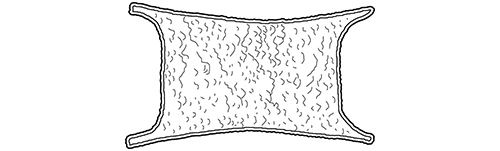
oxhideINGOT (1)

I became fascinated with an ingot form used much later by the Chinese in the Malay Penninsula. These were hat shaped, much smaller (weighing only a pound), and actually used as currency.

hatINGOT

A Peculiarity of Forging in BronzeBronze has one very peculiar property in the smithy.

Most metals, such as iron or even copper, when heated and cooled slowly to room temperature, become more ductile and more workable. They are less prone to internal stresses.

Bronze does not behave like this. When slow cooled, it becomes brittle and difficult to work. Thus it must be heated to cherry-red and then quenched in water. This quick cooling makes it so soft that it can then be hammered. The hammering condenses the metal, giving it more rigidity.

A bladesmith will hammer near the edge of a blade to harden it and help it keep its sharpness, while allowing the center rib to retain more of its resilience.

Were These Swords Any Good?If you compare a bronze sword to a steel sword, the steel is always going to win. But when the Bronze Age gave way to the Iron Age, bronze metallurgy was at its peak. Several thousand years had gone into the development of the most superb techniques. Iron metallurgy was in its infancy, and getting the iron swords to be rigid enough was a problem. The iron swords just weren’t as good as the bronze ones, which were light, strong, just rigid enough, and held an edge well.

But there’s no need to take my word on this. A YouTuber with a passion for swords, Skallagrim from Canada, discourses quite knowledgeably about the pros and cons of bronze. More amusingly, he tests one of Neil Burridge’s bronze swords “to destruction” in the video below.

(There’s a brief reprise snippet of Mr. Burridge before Skallagrim gets going with his destruction. Go to the 3:30 mark, if you want to skip that snippet.)

Even after all my research, I cannot call myself more than a mere smatterer. I learned enough to write The Tally Master, and not much more. But I hope you found these tidbits entertaining, and I’ll be happy to answer questions in the comments below. Or to speculate with you, when I don’t know the answer. ;)

Dances With Demons

I was going to write about something completely different. Or perhaps not. I was going to write about understanding people from completely different backgrounds; about putting yourself in other people’s shoes.

Particularly in the age of the internet — and yes, particularly on the left, but we do it too — it’s very easy to judge someone for something stupid and build a whole picture of what people are like that has nothing to do with reality.  (Take for instance all the assumptions made about my beliefs and preferences because I prefer less authoritarian government.  Or less preachy fiction, for that matter.)

Before you defend on “we do it too”, I’ll remind you I’ve been called a communist and/or an atheist for … not being a conservative, but a libertarian.  When I disagree with socon stuff I quickly get called names.  As for libertarians, they’ve been known to call me statist (!) because I say “Yeah, but we’re never going to get it.  Not on planet Earth.”

So, I was going to do a post on that.  I might still.  But not today.

Today friends I love so much they’re like family to me decided it was a great day to get in an argument about suicide, and whether it is just a cowardly act, and whether telling people all the mess they’re leaving behind would change their decision.

I’m not going to get into the morality of suicide and whether it’s cowardly.

Look, some are, I’m sure.  The guy who ran through all his money with gambling.  The criminal who seeks to evade punishment.  That’s “the coward’s way out.”

But that’s not always the case with suicide.

There’s the “inexplicable” the “why did he do that?” the “What the actual hell happened?”

This one, circling back to understanding other people, often seems inexplicable to the people who are outside.  It often takes our best and brightest.  It often happens with no outward sign.  And yep, it leaves families very angry and guilty and a thorough mess for the survivors.

The problem is that this one is best understood as “possession by demons.”

I’ve been there.  That moment you step off the ledge, you’re absolutely convinced that you’re doing what’s best not just for yourself but for everyone around you.  Even if you’re rational enough to see the mess you leave behind, you are certain it’s still better than dealing with you as you are.

It’s a lie.  It’s an awful lie. Again, it is better understood by externalizing it and realizing that depression lies.  If you view depression as demons taunting you, it’s easier to realize they lie.

What causes it? Why do best and brightest, people we admire, kill themselves?

Part of it is the defect that makes them great. We’ve talked about people who think they’re great at something (writing, art, whatever)  and who thoroughly suck at it.  Worse, they’ll never get better, because they don’t see ANYTHING that needs improving.  Those people might never accomplish anything.  They also will never kill themselves.

The high achievers, though, those that drive themselves to things we can only dream of?  They often feel they’re total failures.  I have a couple of friends like that.

And when you feel like your life is one of unremitting failure you open yourself to the demon voices.

No, I don’t mean that literally.  Or maybe I do.  Sometimes I think it would help if we could externalize it and view those voices as something else, out there.

We do that anyway, to an extent, by considering it an illness.  And it is.  I mean, it’s brain chemistry, though often exacerbated by personality.

On the other hand the personality is the same thing that allows us to succeed.

I’m not that successful, but many of you know I dance with the black dog on a regular basis.  Lately it’s been better for no reasons I can control: mostly that my hypothyroidism is getting treated, and that my hormonal cycle is a thing of the past.

But I’ve been there. Often.  Might be there again in the future.

So, if you’re there…. there are some things you need to know:

1- the voices in your head lie.  You’re not worthless.  In fact, you’re probably very worth it.  You just have this little defect in your brain. It causes you to devalue everything good you do. It’s not how other people see you.  It’s lies.  You are, as a friend says, “seeing the world through a distorted lens.”

2- Your being here can save someone else. Sometimes just your existing can save someone else.  You might never know it. There is someone out there who once engaged me in conversation on a day that would otherwise have ended very badly.  For her it was just a chat with a stranger.  For me it was life saving.  You might save someone’s life and not even know it.  If you die now, you won’t be there to save someone’s life.

3- It will get better.  I understand even for very ill people, bedbound, there are moments of joy as well as moments of suffering.  There will be better days.  I know you don’t believe me now, but do try to hang on.

For those of you on the other side:

Watch carefully, but don’t berate yourself, because sometimes you can’t see it.  Many people HIDE depression.  It’s the nature of the beast.  Mostly men, though not just men.

If you do spot it, bring it up.  Talk it out.  Listen.  Sometimes just having someone to listen to you helps.  And sometimes you call the suicide hotline and give your friend the phone.

If someone you love kills him/herself.  You’re going to be angry.  You’re allowed to be angry.  It’s an awful mess to stick someone with.

Don’t torment yourself by feeling that you must have done or failed to do something.  That’s not how it works.  Suicide is never a rational decision.  Rational people don’t kill themselves.

You can still be angry, but if it helps, view it as a car accident, a disaster, or more accurately a fatal birth defect.  The same thing that made the person you loved driven and self-demanding is the same thing that killed him/her.

Sometimes the demons win. Sometimes those who dance with the black dog stumble and fall.

All we can do is reduce the number of times that happens.


What were they thinking? by Amanda S. Green

What were they thinking? by Amanda S. Green

All too often, I find myself asking just that, especially when it comes to our public school system. No, this isn’t a post condemning public schools and recommending homeschooling. Although, to be honest, I am quickly going in that direction. This is a post about consequences and the need to finally start applying them to school districts and their security forces instead of granting a free pass.

I’ll be one of the first to admit that Dallas ISD has had its problems over the years. There was a time not so long ago when it seemed like there was a revolving door in the superintendent’s office. Then there are the issues so many major cities with a large school district face, issues too many to list in this post. However, there is one premise every parents operates under when she sends her child to school. We expect that child to be kept safe. The last thing we expect is for district employees and contractors to harm our child.

In the past week, two incidents have come to light that must raise questions about not only the training of ISD employees, especially the district police, and the way in which it communicates with the parents of students attending DISD.

The first, on the surface, doesn’t look that different from a lot of situations that arise. A couple of tween/teen girls got into a fight after school and the campus cop stepped in to stop them. So far so good, right? After all, he’s there to keep the peace and make sure no one gets hurt. The problem is that a video, admittedly a poor quality video, shows him picking up a 12-year-old girl and body slamming her to the ground. The girl and her family claim he then pepper sprayed her. The girl suffered a broken clavicle and, duh, had to go to the hospital. Oh, and she was suspended three days for fighting.

As I said, the video is grainy but you can make out the campus cop grabbing the girl and slamming her to the ground. He then makes a move that may or may not confirm the family’s allegations that he pepper sprayed her. That will, in all likelihood, be left to the district and possibly to the courts to determine.

Oh, and the district? It has admitted that “his actions [the officer] do not appear to represent the type of response we want our officers to display.”

Duh!

In the meantime, the officer has been placed on administrative leave. What is truly disturbing, if true, is the family’s allegation that students who videotaped the encounter were told by the school to delete the videos. CYA or misinformation? I don’t know but, for the moment at least, I can believe someone (with or without approval of the administration) telling them to do just that. If true, it is another chilling indicator that our schools are no longer safe for our children — not only are they punished for protecting themselves but now they are at risk of injury from overzealous employees.

Where is the accountability? I hope DISD makes its investigation into what happened transparent to the public. If not, then perhaps it is time for the superintendent’s office door to open so new leadership can be let in.

That incident is bad enough. But, as noted above, there was another that took place. This instance involved a 7-year-old boy with ADHD. In this case, the boy’s mother was allegedly contacted by the administration at the charter school he attended and told he had been causing problems. This wasn’t anything new, as the school was aware. So, as she had apparently done before, she went to the school to pick him up.

Only to discover he had been taken into custody and transported to a behavioral health care facility. There he was held for close to a week before he was released to his family. The reasoning was he  no longer presented a danger to himself.

Now, if the child was acting out to that degree, the district acted properly. However, its communication with the mother sucked big time. The district, of course, is refusing to release any details of the incident due to privacy laws. The mother is accusing them of not only poor communication but of using excessive force. You see, there are pictures of her son with his hands cuffed behind his back, walking down the school corridor between two uniformed officers. Now, I know it is only a picture and that means there is a lot we aren’t seeing. But, in this shot, we see a kid who is standing still and not acting out. He isn’t fighting the cuffs or the officers. he isn’t trying to get away. So what really happened?

By the way, even though the district claims it can’t say anything more about the incident, in a message to parents asking them “to not continue to spread misinformation.” So, it doesn’t want to give details or release the rest of the photos/video of what happened but it has no problem saying the mother is lying. Riiiiight.

Again, where is the accountability?

I have no doubt both incidents could have been handled much better than they were. Nor do I have any doubt that some of the blame for it lands squarely with the children and/or their parents. the 12-year-old shouldn’t have been fighting. The 7-year-old should not have been acting out. But, especially in his case, we need to know the full circumstances. The school apparently knew he had been classified as a special needs student (if I read the accounts right).

So, is the problem with training, with hiring the wrong employees or is there something else, something systemic within the district that needs to be corrected? Whatever it is, if I had a child of an age to go to public school and I lived in DISD, I’d have second — and third — thoughts about sending him.

New Short Story in the Honor and Duty series out now.

51cgabs60sl

Diversity and Memory

Human memory is very short.  This is one of those things that drive me bonkers when people talk of how it was “when”.  Unless you were alive “When” what you’re getting are the stories you were told.

And stories are inherently untrustworthy.  Yes, even oral transmission.  Yes, even the sagas changed.  Okay, some societies were more successful than others at transmitting long, complex stories orally.  But even then, without writing things drift over time and become weird.  And if it’s not something considered sacred or important, things drift over 100 years or so.  What I call the space grandmother-to-grandchild.  Because children misunderstand or their imagination adds bits that they then pass on as “as true” as the parts they were given.

I was reminded of this when I was singing a song I learned as a lullaby.  I was singing it when working on the house for sale, and Robert who understands only rudimentary Portuguese said “Oh, for the love of, mom stop it.  I don’t want to hear about a woman taken by death.”

At which point I stopped and blinked at him.  “What?”  I’ve actually always rather liked the song, which is of a stranger who knocks at the door and demands the daughter of the house accompany him some space (he is supposedly blind.  So this is charity.)  She walks him to the edge of the village, where they’re overwhelmed by his companions, and then it turns out it was a duke who tried to marry her but she refused him because she didn’t want to leave her family/status behind.

The problem is there is a lot of varied symbolism, and son who had just taken a class in myth (and the Jungian theories thereof) had started an interesting rabbit.  It is possible the symbolism is for death, including that the stranger arrives at exact midnight, that he knocks on the middle door, that no one else in the house will wake, etc.

Being me, I spent sometime tracking the song.  It seems to be very old (about 14th century) but the version I was taught was only collected as fragmentary bits, and the only version they have complete removes all the spooky stuff and instead is a frank Cinderella story, making the stranger a king and going on about how rich the girl was afterwards.

The point being as far as wording, it’s all completely different, and there’s only echos and hints to give “this is the same story.”  That is less than a thousand years of transmission, in a language that didn’t change significantly.  (Medieval Portuguese sounds more like Spanish but it’s perfectly understandable.)

So, in my explorations of “What if there were people we know nothing about, entire civilizations, say at Classical Greek level?” I kept face-palming when coming across intimations, that surely, of course, there were these long sagas transmitted orally for… seven thousand years, or ten or twenty.  Look, sure, we’d get some of the same general “feel” but the details and language would be completely different.

The closest you have to this, that you can verify is the transmission of what I call “Bible lore.”  When the church used Latin, people got taught a mishmash of what was in the New Testament and well… whatever they understood.  And they passed that to their children.  And it got passed on.

I spent most of my time in the village correcting the stories that had passed on, (yes, I was an insufferable kid.)  Stuff like “No, our Lady wouldn’t be around at the time of the deluge, unless you mean Balaat, which means “our Lady” in Phoenician.  What is wrong with you?”  But nothing was wrong.  Just invasions, language changes and people assuming what was now had more or less always been, projected backwards.

Human memory is vague and transmission is uncertain.  All of us about my age (almost mid-fifties) who have kids, have gone through this.  At some point I bet your kids came to you and asked, “When you were a kid, what was your favorite computer game?” or “when you were playing x or y how did you get around level 4?”  And when you said you didn’t have computers as a kid, they assumed you’d grown up in poverty.

This is funny, and obviously kids figured it out when they grew up. But when the change wasn’t as rapid and catastrophic, that wasn’t necessarily true, and people just happily projected their circumstances backwards.

We see that in America, to an extent, with the projecting backwards of some sort of “paradise” around WWI and WWI.  A “freedom” paradise at that.  When, no, actually statism was rife and the way of the future and everyone believed in it.  Which is what got us where we are, and why we must fight back.

It’s also what drives me to frothing at the mouth about the “diverse past” brigade.  These are the people who will go insane, because you have no black and/or Chinese/etc people in say Medieval England.

EVERY time I talk about this, and how stupid it is, we get “the begs” “But there were moors.”  “But the silk road” “But–”

The begs are bullsh*t.  No, they seriously are bullsh*t.

Before the 14th to 15th century Europe was remarkably genetically uniform.  Sure there were the Moors, who mostly are “Mediterranean” looking and mostly were in Mediterranean parts of Europe.  Sure there were Chinese that someone had seen, somewhere.  But there were no more than about 1 in a million of people who were TRULY exotic looking.

Look at the digs they’ve done of medieval villages.  Not only were they all the same race, they were usually all relatively closely related.  “Genetically uniform.” Unless you’re digging in a major port city, like London, and even there the “diversity” is less than you find in any of our very white suburbs.

I grew up in a relatively diverse country and WELL AFTER the middle ages, but people from the next village over were “foreigners” and people from 200 miles away had derogatory names attached to them. We did have a black person in the village.  She was known as “the black person.”  And we had a descendant of Chinese.  The family was known as “the Chinese” though you’d need a microscope to see any difference between them and the other villagers.  Then there’s my sister in law known as “of the (female) Moor.”  Their entire family is.  Who knows how many generations back.  I’ll note they run to redheads and blonds, so —  You figure it.

“But Sarah you grew up in a uniquely insular and closed in place.”  Not even.  Not hardly.  We were about 30 miles from the sea, and the village was “diverse” in that a blond (Portuguese blond, which means light brown hair) or a relatively tall woman (like me) occasioned little remark.

We once had my aunt from Brazil (she married my uncle) come back and try to trace her origins.  This took us, circa 69, on a long trip through the mountains of Portugal (they’re not real mountains.  The tallest mountain in the country is 1km if you count the tower built on top.  But mountains enough) driving through old roman roads and dirt tracks made for ox carts.  We found villages where work stopped and a holiday was declared because they had visitors.  In these villages the title for an older woman was “auntie” because she PROBABLY was.

In the middle ages?  With no transport except shanks pony?  People who trace such things say divorces happened in the following way: you couldn’t take your wife anymore, so you walked fifty miles away and declared yourself a bachelor.  Your wife, meanwhile, when you didn’t return, was officially a widow.

Now people move around, they always have.  So here and there you’d find one person who’d started out in Africa, or maybe one who’d come from Asia.  But they’d be so few as to be irrelevant in terms of population, really visible and yep notorious in terms of “oddity” (to the point people would come to gawk at them) and in general “Strange”.

So unless THEY are the point of the story, to put them in the story being treated as just another person is not historical.  It’s wishful thinking.

The problem we have is that the left wants to project “diversity” into the past so we will all think that every society was this mosaic of different, exclusive societies.

This is because the left is what is known as “delusional” and “Self defeating.”

When there was “diversity” in the past, and it didn’t end in a war, it was like when Portugal imported an untold number of slaves in the sixteenth and seventeenth century (seriously, even beggars had slaves to beg for them); they were never sent back, but by the mid twentieth century black people were almost as rare as blonds in continental Portugal (I once mentioned this in a group discussion and some idiot came back with she’d been to Portugal in the eighties, and she’d seen a lot of black people and they’d taught her their lovely songs, or something equally asinine.  Yep.  Thousands (maybe as much as a million) black people came to Portugal after the African colonies were handed over to the USSR and their Cuban mercenaries under the guise of “independence.”  Those people were like Cubans in Florida, escaping at great peril from a murderous regime.  BUT that was post 75, not before.)  So what happened to all those black people?  They got “genetically swamped” and the general hue of the population got slightly darker.

And that’s what happened to any “diversity” in the past.  I found, reading a biography from the 19th century, where the high class British woman says all servants are “Portagee” that apparently there was a large influx of Portuguese into England at that time.  What happened to them?  They got genetically swamped and I guess some Englishmen can tan.  (In my day the outflux of immigrants was to the countries half-depopulated by WWII: France and Germany, most of all.  And sometimes in France I come across someone with a Portuguese name.  But most of them? They’re Frenchmen.)

The truth is that diversity in the past was more melting pot than salad bowl.  Sure, if you had some reason to be resentful or separate (thinking of the Mouraria in most Portuguese cities (aka the Moor neighborhood that remained after the reconquest)) you’d have your separate area.  Though I’ll note genetically by the 20th century those areas were the same as the rest of the country.  Linguistically and religiously too.  In fact, Jews are the only minority in a majority population that succeeded in keeping somewhat separate/keeping language and customs/and some genetic integrity.  Note I said “some.” Jewish people in Germany looked more German than Jewish people in Spain.  (Leading to the story On Venus, Have We Got A Rabbi.)

Mostly diversity is what you have when there was some great population dislocation (invasion, mass immigration, etc) and it’s a step on the way to “reconstituted homogeneity.”

By projecting the type of “salad bowl” diversity they favor into times that were startlingly (to us) non diverse and where what “diversity” there was was on its way to being smoothed out, what the left is doing is trying to create the idea that all this “separate but equal” forever is the NORMAL state of affairs, and the way human societies are.

The reason this enrages me is that it works.  People see this in books and movies and series, and become confused, so that I get the “begs”.  “But there were moors!”  “But there was contact with Asia.”

It works on projecting the lie backwards.  It doesn’t make it any less of a lie.

What it does is make people believe the gulfs between populations are so vast, so insurmountable, that we should each “stick to our own kind” and balkanize society.  After all, all these diverse groups have been keeping isolated since ever.  There must be reasons for it.

What the left can’t understand is that if people believe and embrace that, what they’ll have is not their beautiful mosaic of cultures.  Because humans are naturally tribal, and naturally loyal to their own kind, what they will get is the new-racialist theories that are starting to appear.  “Hey, if these people have always been there, won’t mingle with us are and incapable of learning our language/customs, we don’t need them.”

The Jews are the only group that managed to keep separateness in Medieval Europe.  They paid for it in suspicion, progroms and frankly massacres whenever things went wrong. They are still the object of suspicion and hatred by the new racialists.

If you convince the majority that all these other minorities have been around that long, that separate, that’s the level of suspicion and hatred you’ll be calling down at them.

And this is why I say the left is delusional and self-defeating.  The end of their careful lying is the exact opposite of what they think they want.

I don’t like where they’re pushing us (as opposed to where they think they’re pushing us.) but that’s the least of my annoyance.  Mostly I’m annoyed that they’re forcing lies on future generations.

To decide where we’re going and how we’ll live, we need to know the truth, the unvarnished truth and how things worked themselves out.

To build a future based on lies is like building a bridge with rotten boards.  It might look pretty, but it will mean death and devastation long before you get to the other side.


We Are The Superior Civilization

You know, sometimes I am a wee bit daft.  (Taking two hours this morning to rip out carpet in the powder room and coat the floor in two layers of kilz is part of how I’m daft.  Yes, I’ll be putting floor in again, but not carpet.  Carpet in the bathroom is icky and when Terry Pratchett said Gaspode smelled like a privy rug, he wasn’t doing him any favors.)

Anyway, how I got daft is that when I floated that there might have been “civilizations” between the emergence of anatomically modern humans, and ya’ll objected because no signs of dentistry, no extensive mining operations and even the crab bucket, I thought “Well, absence of evidence is not evidence of absence.”  It wasn’t till yesterday morning that I stopped and went “waitaminut, Czar Nicholas’ skeleton showed signs of prolonged and horrific abscesses. We only found out how extensive the Roman mining operation in the village was when it rained for a month and roads collapsed under cars.  And even with the crab bucket and no Judeo-Christian ethic, ancient Asia had a lot of very advanced, flourishing civilizations.”

Which is when the dime dropped and I realized you guys immediately translated civilization to “as good as we have or better.”  Which, of course, made me giggle.  Because I’d have liked you to tell a Roman, with their world-bestriding empire that they weren’t civilized.  Or, before that a classical Greek.

Understand I am not imagining others before us had the internal combustion engine, or steam, or trains, or…  Sure, they might have, but that’s a heck of a coincidence, since those things usually come about by an individual stroke of genius, and even when they do they often aren’t used the way we did (Romans and their mechanical toys.)

To imagine other civilizations of which we’ve forgotten every trace followed exactly the same route we did to the same place we’re at requires believing that inventing steam and the internal combustion engine and harnessing electricity is as natural to humans as dams to beavers.

Now, maybe that’s true.  It would certainly make for a very good science fiction story.  (Short story, I think.  Too much of a punchline thing for a novel.)  BUT the odds defy rationality.

I was imagining, you know “builds houses of wood or stone.  Domesticated SOME animals.  Has villages and cities. Might have trade over long routes. MIGHT have had wheeled vehicles.”  (The last, as we know, one can have quite sophisticated civilizations without.)

Look, it’s not your fault.  Since the seventies, we’ve been bombarded by crazy bs about superior aliens or superior lost civilizations.  (And before that, there was a trickle of it, too, going back I think to the eighteenth century, just couched in different terms.)  You’ll get stuff about how the pyramids were built of stones that floated at the sound of a certain note.  (A C note, or the equivalent, I bet.  “Listen, Mac, you take this stone to the top of the pyramid, I give you a C Note.  A  hundred Amontheps in your pocket, bucko. Buys a lot of fish and falafel.”)

Part of this, and part of the reason it intensified since the seventies were the “unilateral disarmament people.”  You know, those jokers who wanted us to get rid of our own nukes and stand disarmed in front of the USSR, who would then realize we were peaceful, and not attack, and everyone would live in peace and harmony with rainbows and farting unicorns.  Yes, it was a stupid and crazy idea since the continued survival of the USSR depended on plunder and conquest.  But I’ll remind you our last president still believes that bag of moonshine.  All of it, including the unicorn farts.

As I was saying, because this was a tough sell, and because a lot of science fiction writers were very scared of the nukes (even Heinlein, though at least he never advocated unilateral disarmament.  Instead, he put his hopes on the UN.  Head>desk.  We’re all human.) and susceptible to USSR propaganda, there were a ton of stories of superior civilizations JUST LIKE OURS that had killed themselves in nuclear holocaust.  They weren’t all billed as fiction. Sodom and Gomorrah and pillars of salt were often brought up as “proof” of a previous nuclear holocaust.

For these stories to be effective, both fiction and the ones that didn’t admit to being fiction, you HAD to have lots of similarities to us.  Previous civilizations had to have developed exactly to the same way and the point we have, or no one would buy the urgency.

Hence, when anyone says “there was a civilization before us” your head (our head) jumps to airplanes, trains, steel mills, refrigerators, dentistry.

I’m telling you the chances of that are negligible, though I won’t scruple using a more advanced than us past civilization to give my characters a nasty shock when they get to space.  I won’t because that’s just cool.

However of things like Ancient Greece or Rome?  I almost think the chances against it are worse.  And of course civilizations that live and die by coastal sailing would be mostly engulfed in the great melt of the last ice age.

And no, Europe hasn’t been extensively studied.  As I said before, Europe is mostly built on Europe.  And you can’t dig in a field without finding SOMETHING.  If you think everyone runs to the academics or the authorities when something is found, you don’t understand people’s interest in building a house, or sowing a field, as opposed to you know, giving up ownership of their land in all but fact.  Frankly I’m amazed so many people do report discoveries.

But the thought of “superior civilizations” got me to thinking of what say the Romans or the Greeks, or those other ancient civilizations if they ever existed, would make of us in the West.  We cross the globe by flying through the air.  Not just heads of state or priests, no, common people.  He*ll, our pets fly.  Most places have clean, fresh water that someone doesn’t have to carry a mile or so (which has been most of the work of humanity I think, forever.) Forget aqueducts.  We have water that comes from our faucets whenever we want it.  Cold AND hot.  We have temperature control inside our houses, allowing us ignore the weather and keep warm in winter and cold in summer.  We can magically cure diseases that killed millions of people by injecting this magical elixir into the sick person’s veins.  Our old live a long time in relative comfort.  We  get our teeth fixed and replaced, so most people can chew to the end of their lives.  Most of us can read, and most of us have access to untold wisdom of the sort their hermetic orders would kill for.

We are the superior civilization.  We are the enlightened ones, the shining and resplendent inhabitants of the wonderful future.

And we worry about what gender we feel like being that day, who is allowed to pee where, whether someone used the wrong word to refer to someone else who might be offended, whether our use of fossil fuels offends Gaia, whether slapping a kid on the behind is a criminal offense, whether we are doing all we could do with our lives.

In other words, we’re neurotic, unsatisfied, and a bit crazy like most of people who were born and raised rich throughout most of human history.

Which is why if we really were doomed to repeating a cycle, and if the civilizations before us were the same but more advanced, the message of the pyramids would be “Don’t use so much toilet paper.  Just wash one square and reuse it.”

Perhaps we should be grateful they are truly profoundly unlikely to ever have existed or tried to send us any message.


Here, have some books – by Free Range Oyster & Vignettes by ‘nother Mike, Mary Catelli and Luke

First of all, happy mothers day to all the mothers around here.  Where good mothering happens, THERE’S civilization.

motherlion

Here, have some books – by Free Range Oyster

Alma Boykin

Clawing Back from Chaos

A Cat Among Dragons Book 9

Love. War. Insanity. Just another year in Rada Ni Drako’s worlds.

Rada survived the Battle of the Tunnels in the Harz Mountain campaign, but at what cost? Even love may not be enough to save her soul. And if it is, will she ever heal enough to face the danger slowly building around her?

A patient enemy has been working far behind the scenes, stalking the halls of power, nudging England’s future toward chaos. An enemy that has Rada and her god-children in its cross-hairs.

The Dragon has retired. Can the Cat fight alone? Or will the chaos outside overwhelm even Rada as she Claws Back from Chaos?

Mary Catelli

Winter’s Curse

Who but a fool would linger after Zavrien laid his curse? Ill luck can kill – and all the more in Zavrien’s enchanted, endless winter, haunted with ice giants and frost fairies. When the soldier Gareth is cursed, the young wizard Perriel learns how dangerous lingering can be. But she can hold out a sliver of hope for breaking the curse – if it doesn’t break them first.

The Witch-Child and the Scarlet Fleet

Trapped in a pirate port… Caught between pirates who would force him to use wizardry in their aid, and a king who would force him to spy, Alik will need every scrap of wits and wizardry to forge his own path.

Treachery And Spells

Two novellas of magic and adventure… Caught between pirates who would force him to use wizardry in their aid, and a king who would force him to spy, Alik will need every scrap of wits and wizardry to forge his own path. A curse of ill luck leaves Perriel and Gareth trapped in an endless winter, with only the faintest hope of breaking free.

Journeys And Wizardry

Drunken mermaids – a clan cursed to become crows – a magic book that even the Nameless Necromancer fears – and more in this reprint collection of thirteen stories and a poem.

David Burkhead

Oruk Means Hard Work

Life among the orcs is hard. So difficult and ubiquitous is brutal labor among them that “Veth oruk”/”Work is” is their most common greeting. When Elara, princess of the elves is captured and enslaved by them that is the life she must learn to live, a life of hard, unremitting labor with no hope of rescue.

Work is.

Vignettes by ‘nother Mike, Mary Catelli and Luke

So what’s a vignette? You might know them as flash fiction, or even just sketches. We will provide a prompt each Sunday that you can use directly (including it in your work) or just as an inspiration. You, in turn, will write about 50 words (yes, we are going for short shorts! Not even a Drabble 100 words, just half that!). Then post it!  For an additional challenge, you can aim to make it exactly 50 words, if you like.

We recommend that if you have an original vignette, you post that as a new reply. If you are commenting on someone’s vignette, then post that as a reply to the vignette. Comments — this is writing practice, so comments should be aimed at helping someone be a better writer, not at crushing them. And since these are likely to be drafts, don’t jump up and down too hard on typos and grammar.

If you have questions, feel free to ask.

Your writing prompt this week is:
cautious

Quisling’s Heirs and Quisling’s Foes by 60 Guilders

Quisling’s Heirs and Quisling’s Foes by 60 Guilders

At our most gracious hostess’ request, I have updated Dorothy Thompson’s “Who Goes Nazi?” for the present. I confess myself inadequate to the task, but she told me she’d have to do it if I didn’t, and she’s got enough on her plate.

There are times when one wonders who would collaborate with an invading regime and who would not, or who would gleefully take up the whip hand themselves. In a world where there are reds to the left, browns to the right, terrorists and dictators in front, and bureaucrats behind, simplifying it down to one ideology just won’t cut it. So we’ll be discussing two more basic philosophical schools: those who wish to have slaves and masters, and those who wish for there to be neither.

Imagine yourself, at a reception held by a Mister John Boddy, the only person these days who could attract such a disparate group as we will be observing tonight. Let’s start with that fellow over there, the one holding the wine glass somewhat uncertainly, like he’d rather be holding a bottle of beer. Mr. A is an oil engineer, who Boddy met and became fast friends with when he decided to invest in the Bakken shale boom. He doesn’t know much history or philosophy, but I can tell you that if it came down to it, he would die free. He doesn’t have much truck with people telling him how to do his job or live his life, and he extends to everyone else the same courtesy. Such a fellow would have to be forced into the role of master at gunpoint, and the role of slave would require his family taken hostage as well.

Contrast him with the fellow he’s talking to, Mr. B, similar in type but not in character. Both men, truthfully, think themselves underpaid for their work. They both grouse about their bosses, and both, deep down, think the world would be better off if more people lived according to their lights. Mr. B, however, is an inveterate meddler who was raised by inveterate meddlers—and be assured, should a group come to power who shared his opinions, he would cheerfully truckle to them in order to lord it over others.

Mr. C is of a similar type to Mr. B, but with the added complication of having managed to get a Ph.d.—despite, frankly, having little inclination or aptitude for inquiry. What he does have, however, is a deep and abiding need for respect and a knack for telling people what they want to hear, combined with a crippling fear of failure. What is often referred to as “impostor syndrome” is in his case a reality, and he knows it. He will enthusiastically sign on to any cause that might allow him to quash anyone who could and would reveal him for what he is.

Ms. D, the gender studies professor who he is currently engaged in conversation with, is a truly sad case. Unlike many of her peers, she actually was hard done by in an overly traditionalist environment, and in a fashion that, once the authorities learned of it, resulted in several felony convictions with lengthy sentences and without parole. This resulted in her becoming something of a minor celebrity within certain circles, and a leading role in fighting against the sort of mentality that led to her abuse. Unfortunately, she has radicalized to the point where she assumes that everything that has results unfavorable to a woman is the result of “the patriarchy,” and, if pressed, would admit that she thinks accusation is proof enough regarding certain crimes. Given the chance, she would eviscerate even Mr. C if he put a foot wrong.

Now consider, for a moment, Mr. E, arguably her male counterpart, currently glowering in the corner. His story involves a shrew of a wife, terrible friends, and a violently biased family court judge whose verdict resulted in him never seeing his beloved children save but once a year—children who, by now, hate him because of the lies their mother tells them and hate their mother for the same reason—and being forced to pay alimony to the point where, despite being a white-collar professional, he has no car and lives in a dingy one-bedroom apartment. Initially only raging against those specific persons who had wronged him, he has extended his wrath both to all womankind and any man who does not see females as the enemy, and would take any chance he could to wreak his vicarious revenge.

Mrs. F, over by the fireplace, is different from both of these. Mr. A is her husband, with whom she has had five children—a fact that, when Ms. D realized it, caused her to instantly dismiss her and drift over to C. This was D’s loss, frankly. Mrs. F is not much more intellectual than her husband, it is true, but raising three boys and two girls will tell you much about how society actually deals with men and women, and about how to live life well. Were she to learn of Ms. D’s story—or Mr. E’s, for that matter—she would extend to them her sympathy, but would never let either of them near her children, whom she has raised to treat people like they’re people, not means by which to work out one’s own neuroses. She would not want to fight to keep or make a world where they could live in such a manner, but that would only make her the more ruthless, that she might never have to again.

Mr. G, who Mrs. F is talking with, is an odd sort, and possibly one of the most interesting people here. Born over the ocean, he will cheerfully admit to being a drifter, a dabbler and a dilettante, one of the many reasons that he has never married. Arguably technically homeless, he’s worked on every continent, and has seen the best and worst humanity has to offer because of it. Some might call him something of a hitchhiker, and so he is—but he’ll leave you a twenty for the gas, and offer to pay for your meal and his. He doesn’t think anyone owes him anything, and he knows when he’s discharged a debt. He’s a wanderer who thinks others should have the same right as he, and woe betide any who would abrogate that right.

Mr. H, who has just joined in on their conversation, is as anachronistic in his way as Mr. G is in his. He has never left the United States—indeed, he barely ever leaves his home state, the virtues of which he will expound upon for hours if he is permitted to do so and does not believe that he is boring his listener. However, he will also listen for hours to people talking about where they have been. His is a profound intellectual curiosity tempered by a desire to never leave the place of his birth, but he detests the idea of being bound to one place by any will other than his own, or being prevented from learning about whatever he wants to.

Then there’s Mrs. I, presently talking listlessly with Mr. J, her husband. There is not much to say about them, really, save for the fact that if one wishes to know what the cultural zeitgeist is, one need only find them and inquire about their opinions, as said opinions will match the average opinion of the society around them to a T.

Then there’s Miss K, who’s here because she’s the daughter of one of Boddy’s old friends. She’s been drifting from conversation to conversation, and has lingered on the outside of all the conversations in the room—she considered talking to E, as she’s a good-hearted soul, but the look he shot her when he approached was very unwelcoming. Her parents worry about her, as she’s a sophomore at a public university—however, they need not fret. While she agrees with a few of the things Ms. D says about modern society, she finds her monomania to be off-putting, and much prefers the company of persons like Mr. A and Mrs. F, and would not aid any regime that had no place for the latter.

Finally, there is Mr. L, who just arrived and is gravitating towards Mr. C and Ms. D. He is the sort of person one might expect to see at a party like this—that is to say, he was born with a trust fund, as were his parents before him. He is acutely conscious of two things: that neither he nor his parents did anything to earn the wealth that they were born to, and that they have done nothing with that wealth that justifies their holding it. A better man might have given the lion’s share of it to charity and settled down to live off the interest of the rest in a modest house in the suburbs. Mr. L, however, has decided to tear everyone else down in order to assuage his own feelings of inadequacy, and is very popular in certain political circles because of it.

Now, upon observing the people at this party, one might be inclined to express concern for the future. But hold a moment—do you see what’s happening? The engineer, his wife, the wanderer, the homebody, and the neophyte are gravitating towards each other, leaving the others to stew in their self-created miseries.

This expresses the truth of the matter: in the end, there are many types that may or may not side with a tyrant, depending on what sort of tyrant he is. The more answerable question is who will never side with a tyrant, and you see them there now—the people who understand, even if they cannot express their understanding, that there is enough in being human to lift the head of a beggar and bow the head of a king, and that in this no one is any better than another.

See them talk and laugh as though they have always known each other despite only having met tonight, and know that none shall break them.

The Lies

I have the best job in the world.  I can make up fantastic constructions: frothy lies, that amuse me and respond to the rule of cool.  And the best part is that I don’t have to REALLY lie.  I mean people know I’m making this up.

Believe it or not, novels used to get frowned on because of that.  They were an affront to the Almighty, since they described things that never happened.

Years ago, in my conference in the Baen bar, I found someone who had even more strict ideas of how evil my work is.  You see, he only read science fiction.  He refused to read fantasy (at the time all I had with Baen was the Shifter’s series) because it talked about things that couldn’t exist in the world as created, and so was eeeeeeevil.  Even though those who’ve read the shifter series know there isn’t even any magic or witchcraft in that series.  Heck, it doesn’t even have vampires.

OTOH it DOES say “fantasy” on the spine.

I’ll confess I’m a peeve — in other words, still myself — because I giggled at that.  Oh, sure, FTL?  Cool.  Antigrav?  Groovie. Gateways to teleport you to another planet?  Very good.  Aliens? Fine.  Shape shifters?  Die, you evil witch.

Me, I have — obviously — a different view of fiction: all fiction, fantasy, mystery, science fiction, historical, even those occasional “literary” pieces that aren’t deadly dull.  (There are a few.)

I believe fantasy stretches the mind.  They have recently found out that people who have imagined getting say in a plane crash and escaping are more likely to survive if their plane actually crashes.

Right, we don’t write only about plane crashes, but we write about all kinds of situations, some of them supremely weird.  What it does, I think, is create what I call “flexible minds” so that even if the world goes completely bizarre on you (these days it often does) you can roll with the punches.  In a society that is changing very fast in unanticipated ways, it makes it easier to function.

I remember years ago when all of Dan’s workgroup read SF/F and their boss remarked how adaptable they were, and capable of “thinking outside the box.”  That is because it was where they lived.

Yesterday I shared my pet peeves when I’m researching possibilities on worldbuilding for a new series.  Some of you went all literal on me, which annoys the crap out of me, particularly since what I was sharing was stuff that makes even me run away (like pyramids) and it’s not even because it’s wrong (most of what I was looking at was at best unconventional) but because it’s trite.  It’s become a cliche.  It no longer fits the rule of cool.  (Also the moment pyramids or Templar knights come in, you know things are going into astral bodies and enlightened aliens, which is even more annoying, since that’s not what I want.)

When you go all literal and go “No, this is absolutely impossible” though there is really no evidence it is (highly unlikely?  SURE.) you’re doing the opposite of “flexible minds” which means when something falls out of place, you’ll hold on to the old ideas and refuse to move on or worse, starting trying to find “begs” as to why the new find is flawed, the new way of doing things is wrong, shaking your cane and screaming “get off my lawn.”  Which is bad for you and bad for society.

All you have to do to see the result of encouraging your mind to be the opposite of flexible is to look at the left side of the isle right now.

They knew Hillary was going to win the election; they knew their “progressive” (forward to the nineteen thirties!) future was inevitable; they knew their ideas are all on the right side of history.  And then it turned out… it wasn’t PRECISELY so.

Younger son tells me that their teachers assured them (multiple times) no Republican would win ever again, because the left was CORRECT. (Which explains why people his age have so much trouble listening to other opinions.  It’s like questioning their faith.)

Turned out all those polls that showed no support for Trump could be summed up by “Absence of evidence is not evidence of absence.”

And they can’t cope.  If I hear one more call for impeachment I’m going to blow a gasket.  You might hate what Trump is doing (meh.  By and large better than I expected) but if anything he did was liable to impeachment, Obama would have been impeached a dozen times or more.  Worse, they don’t seem to understand “impeachment” doesn’t mean removal.  (If it did Billy Jeff would have been out’a’there too.)  WORSE they don’t seem to understand that even if they managed to remove Trump, they’d just get Pence.  And if they removed HIM they’d get (I THINK) Ryan.

Instead, because this is not rational, because this is their minds trying to retreat to the reality they KNEW was true, to the theories and beliefs that comfort them, they have this movie running in their heads that goes: impeach Trump. Automagically, Hillary is president.  Or maybe Obama comes back.

It makes absolutely no sense, and even someone with a rudimentary knowledge of the constitution or our form of government KNOWS that’s not just impossible.  That’s “Thetans gave us the pyramids to sharpen our razors” crazy.

And yet otherwise sane colleagues of mine post this sh*t all the time, and expect it to happen “any minute now.”

This is cult-level faith.  It’s the sign of inflexible minds.  They convinced themselves that paradise was just around the corner, and now they’re locked in a long scream, unable to cope, unable to function, unable to see what they want is impossible.

They’re the toddler standing in the middle of the grocery isle, screaming at the top of his lungs “but I wanna.”

Because they can’t budge, this might very well come to blows.  Worse, it makes our enemies think we’re on the verge of civil war (I don’t think we are) and therefore makes us look vulnerable, in a very violent and scary world (the result of Obama’s “diplomacy.”  That man thought apologies and shows of weakness would bring peace.  Because he doesn’t get the difference between the real world and kindergarten is that there is no benevolent teacher to keep the wimps safe.)

What’s even worse, if they had won, because they KNEW how things were supposed to go, they’d never have seen what a disaster Hillary was.  (You know this, because they’re still lockjawed in “Obama had a scandal free administration.”  Sure thing.  Fast and Furious. Benghazi.  The pay for play Hillary conducted as secretary of state, etc, etc, but sure.  No scandals here.) And if she turned out to be really, really bad, they’d still be trying to interpret it all as hunky-dory and going to the wall saying “If only Hillary knew.”

Inflexible minds are enablers of tyranny.

No one asks you to believe in lies, of course.  (Before the more literal of you go crazy.  Hey, I said pyramids come in I run out.) But we do ask you to be able to put your mind in the “What if” of a story.  Yeah, sure, you could pick the imaginary world to pieces.  EVEN IN CONTEMPORARY non-fantastic literature, it’s really easy to find holes, if you go in to find them.  It’s much harder than you think creating a wholly coherent lie.  Particularly one of 100k words or more.

HOWEVER if you let yourself go and try to play in the story (this is why our worldbuilding comes up with lots of stuff to support it.  “Sure, magic has always existed, why do you think all the books talk about it.  It’s just that this Magical legion has been playing keep away with it, and covering it up.”  Yeah, you can see the holes, but just go along with it) you’ll get two benefits: it’s like a gym for your mind, playing out “what ifs” and making it easier to go with the flow when things change; and it helps you identify the signs of lies being constructed.  If you read a lot, you know what gets said and what gets left out to build an entire world that couldn’t exist in ours, but that can kind of function for the space of an enjoyable story.

Flexible minds.  For the times, they are achanging.


The Warning Bells

Many years ago, Dan and I were not exactly New Age — we’ve always both had a horror of what you could call whoo whoo stuff, and even if we flirt with it, we usually spring back to reality fairly quickly — but we could be mistaken for that by people who didn’t look too closely.

Part of it was that we did most things from scratch, like, you know, cooking and clothes making and stuff like that, including rebuilding the “distressed” houses we bought.  Now, this was economic sense, not “We believe our clothes should be woven entirely out of organically grown wheat” but if people didn’t know all the tips and tricks of “how to live on one salary and make it look like two” they assumed we were doing it to save mother Earth, or whatever.  So we rang a lot of people’s “crazy hippie bells.”

When Dan got his job in CO it was through a contractor the company he’d actually be working for. The contractor had a relocation specialist who got in touch with with us.  Weirdly, she wanted us to — back then — buy in Denver, and commute to the Springs (given the hours programmers worked in the early 90s, that was a non-starter.) Mind you, the area she wanted us to buy in was considerably more central and now more expensive than where we are.  Maybe we could have afforded it in the 90s, when it was still considerably blighted, and maybe we should have, even if we only went there on weekends.

Anyway, part of the way she determined where you should be living was with an interview where she asked us the weirdest questions.  And at some point she went “Wow, you’re eccentric, but no bells.”  And we went “bells?” and she said she’d be talking to some people, they sounded perfectly sensible, and suddenly her “crazy warning bells” would start to ring.  You know, something like “We’d like a house near our [type of church] and the park, so we can walk the dog, and a good school for the boys.  Oh, yeah, and it must be near a good New Age Store so we can buy pyramids for defense, when the UFOs land.”

With us it had gone the other way around, mostly because what she’d mistaken for “really weird” was “science fiction geek” (remember, we weren’t always as dominant as we’re becoming.)

This is apropos of the fact that I’ve been reading a lot of weird and speculative stuff about human evolution, pre-history and ancient civilizations.  Yes, it’s for world building.  Yes, you’ll get the benefit of it, through Baen if they accept the series.

It’s not the first time I’ve done this.  Part of the background for the Shifter series, and the reason it’s more sf than fantasy was a Hindu-financed book on “forbidden archeology” I read many decades ago.  For this I need a millennia old organization that has seen a couple of civilizations about our level — but magic based — rise and fall. So it’s important to have an idea what to refer to, etc, although the books would take place in the present.  It’s closer to the background of Repairman Jack than Star Gate.  More plausible than Star Gate, too.

Anyway, the problem is that I find myself watching these videos or reading these books, and suddenly the bells go off.

I’ll start by saying that a lot of these “archeologists of the damned” have a point.  Not in everything, mind, but because archeology is  submerged into such a sea of unknown unknowns and also besieged by crazy people talking about the Power of Pyramids, there is a tendency for academy-sponsored archeologists to come up with the most stodgy, conservative theory ever and hold onto it buckle and tongue, even when contrary evidence surfaces.

These “priests of science” screaming “the science is settled” piss me off so much I ALMOST become a pyramid power person myself.  At least I feel like denting their shiny theories all over, just because I can.

However when reading or listening to unconventional archeologists, there is ALWAYS that point where I feel like I’m talking to the old civil engineer in Porto who had gone insane and who spent his days drawing a bridge to cross the Atlantic.  He was sensible and rational, talking about forces and waves, and stuff to do so storms didn’t break the bridge.  And then, after you listened to him for hours, he’d say “And it will float, because it’s made entirely out of soap.  And it won’t dissolve because soap doesn’t dissolve in salt water.”  (This has become a short hand in our family.  When one of us is making some plan completely out of reality, one of the others will go “and it’s made entirely out of soap.”)

I’ve come to understand WHY the relocation agent said “and then the bells go off” when talking about some of her former clients.  Also, I’ve learned to identify the “and it’s made out of soap” moment.  Here are some of the “my bells are ringing” moments.

1- Again with the fracking pyramids.

Seriously, I get it.  They’re very impressive, and we can’t for absolutely sure know how they were built, or why only for a relative brief period, with before and after being completely unable to reproduce the tech.  I GET IT.

What I seriously doubt is that every new discovery that doesn’t quite fit the pattern is tied to the pyramids.

The same goes for the Templars.  In fact mention of the Knights Templar is usually a bell so loud I can’t think through it.

2- It’s ALL about the stars.

The minute someone explained Gobekli Tepe with “It’s all about the constellations” my eyes started rolling so hard I looked like a slot machine.  Oh, sure, sometimes buildings align with this or that constellation, or might have if they were built at a particular time.  I’ll even buy that SOMETIMES this was intentional (if you’re building in a way that aligned with the stars ten thousand years before or after you built, probably not.)  BUT SERIOUSLY every single time?
More than likely when the buildings aligned with the stars it was because of some kind of astrology, like say Chinese homes and graves are aligned in certain ways, and not to “send a message” to us.  (More about that later.)  No, seriously.  I can’t imagine anything more unlikely than spending decades of man-years building a thing so we could send a message to our descendants ten thousand years hence.  I seriously doubt that most of us can really muster much care for our descendants that far off, okay?

I also have real trouble believing that there are no other messages to send to the future than “when the sun is in the seventh house, and mercury aligns with Mars….”

I’m fairly sure for whatever reason Gobekli Tepe or the pyramids were built it was to be USED in their time, and not as a sort of telegraph through the ages.  Which brings us to…

3- It’s all about US.  Not the people who built the thing.  Not the aliens who are supposed to have arrived.  No, it’s all about us.  And if you read the books or watch the videos, you can’t help thinking of Good Omens, where aliens start popping out all over to give the most trite messages ever.

This is the same thing.  It turns out that what the ancients who built the pyramids want to tell us is whatever the New Age cause du jour is.  So that, you know, they built huge structures of stone to tell us the age of Aquarius is coming and we should all be enlightened and smoke weed, and stuff. OR the Maya calendar was right.  Or we should not have cars and pollute.  Or– whatever.  The cause du jour that confirms the “researchers” biases.  You got it.  That’s exactly what the ancients went through horrible time and effort to tell us.  Because it’s all about us.  We know we’re the most important people in history, so why wouldn’t they?

You know in Independence Day when they say “they didn’t come millions of miles to start a fight with us.”  Well, as an alien species that’s one of the few reasons to come hundreds of light years, or whatever.  Because you need the planet to survive.

And as an ancient people, supposing there was some kind of civilization before, whatever they built they built for THEM.  If it’s all about us, it’s probably all moonshine.

4- It’s all mystical… and it’s all true.

Sure, I’m sure the ancients had their own religions, just like we do.  And it could be immensely important for them to go through endless expense to gratify their beliefs or worship their gods.  But–

But just because they’re older and they believe it, it doesn’t make it true.  It doesn’t mean their civilization really was run by Zeus or more likely for these things Osiris.  It doesn’t mean that their theory of what happens after death is true.

It just means that’s what they believed.  (And here the “priests of official science” can also just stop with calling everything they don’t understand a temple.  Sometimes “We don’t know what it was for” is PERFECTLY acceptable and the right answer.)

5- They were advanced/we don’t understand how they developed/where they came from, so it must be… Space Aliens!

Seriously?  In the time now estimated from when human beings first came into being to the first confirmed civilization signs (Gobekli Tepe) as of right now, there’s space for SEVERAL civilizations.  Hell, there’s space for civilizations at our level, much less say Roman level.

The “priests of science” idea of a long stagnation and TONS of nonsense about when “sentience began” (Are you sentient tovarish? How about a cat?) is just that, nonsense.  Absence of evidence is not evidence of absence, and the long stagnation might simply be a period when all the signs of civilization are buried under water/were destroyed by vulcanism/ are under ice in Antarctica.  The only reason that sounds crazy to you is how crazy archeologists of the damned who have posited this before being… well… crazy.  But ignore the pyramids and Easter Island, and think in terms of likelihood.  Assume our ancestors were a lot like us, tinkering apes.  And assume what is now 150k to 200k of anatomically modern humans.  The most ancient sign of “civilization” we have goes back 12k years.  Now do the math.  There could EASILY accounting for time in between to “forget’ except at the level of distant legends ten past “lost” civilizations.

These don’t need to be more advanced than ours — that’s also a sign of crazy cakes — or even advanced the same way.  Their material culture might well have been at the level of ancient Greece or Rome, though.  (Though how cool would it be if one of of those made it to the stars, and when we get there they’re like “b*tch, what took you so long?” because they took every “civilized human being” and only missed some aboriginals in the jungle, hence accounting for our genetic bottle neck.  BUT NOTE I’m a writer, and I like this because it sounds cool, not because it’s plausible.)

But that’s the other part of it and a rebuke to the priests of science too.  Yep, things like Gobekli Tepe and the pyramids can and sure as shooting did co-exist with the most primitive stone tools and cave drawings.  Because, you know, even now, with Western Civ having more penetration that even our ancestors 200 years ago could possibly imagine, there are still Amazonian tribes who don’t have a concept of counting above 3.  And if we all got into an interstellar ship to escape Nebiru (don’t get me started.  That’s a gong, right there) tomorrow, there would be a lot of people left behind who are at different civilization levels, never got the call and are REALLY GOOD at hiding.)

6- The old myths are ALL true.

That’s a massive bell, right there.  One of these guys was talking about oral traditions transmitted ten thousand years.

Sure there are some fragments, but mostly we retain one central event (both the deluge and dragons seem to be worldwide) but the story gets crazy different really fast, the moral is all different, etc.

Sure I’m willing to believe there might be some elements that are distant echoes of something.  MAYBE.  BUT they could also be distant echoes of how the human subconscious is wired.  (From the resemblance between modern soap operas and the stories of ancient gods, I’d go with the human subconscious likes certain things, like mysterious twins, ‘she didn’t really die’, everyone being in lust with everyone else no matter how unlikely.  Oh, yeah, and talking babies.  This seems to be a BIG thing.)

But coming from a culture in which things were transmitted through the ages I am aware both of the persistence and the distortion/limits of oral tradition.  Sure, sagas like the Odyssey an get passed on, but there is no indication they were done as anything but cultural artifacts.  When it comes to “things my grandmother said” and you think about it, it become more complicated very quickly.

For instance, there are things my grandmother told me her grandmother told her, which I assume had happened in her grandmother’s time but which must be a lot older.  And things I ASSUMED grandmother was telling me of experience which are impossible. Like, say, the Napoleonic wars.  Because the math just doesn’t work that way.

I realized how unreliable this is, when I realized my kids thought I came from a family of three.  You see, we have a cousin who was raised with us.  I always referred to her by her first name, so they assumed…

Now multiply that by ten thousand.  The great shocking event — like, say, the deluge — might remain, but it will move all over in time and space.  Which brings us to: was it universal?  Or did someone from that culture have a lot of kids with traveling feet who carried the legend EVERYWHERE over a couple of centuries.  I mean, it’s like the Victorians thought Amerindians were the lost tribe of Israel.  Turns out that genetics confirm a lot them have Jewish genes.  Score, right?  Well…. we’re close enough to have traced it and… no.  For whatever reason in the 17th century, an Iberian Jew went over most of the Americas impregnating Amerindian women, who bore his sons, who apparently were similarly successful with the opposite sex.  (I have a theory this was an ancestor.  On paternal grandmother’s side.  Her father had a …. reputation.)  I think, though I’m not going to put hands in fire, they actually got a probable name for this great inseminator.  But suppose a couple thousand years have passed.  Both the legend of Jewish origins and the genetics would be muddled, and we might think that the Victorians were right.

When dealing with deep antiquity assume not only garbled, but far less likely to match our expectation than you’d think.

This matters, and the crazy bells are annoying, because of course, it would be good for us to know where we come from.  Say ice ages or meteors, or even our scavenger-species tendency to stop reproducing when secure ended civilization several times before.  The ancients might not have MEANT to give us a warning, but we could still take it, and take steps to prevent it happening to US.

However, none of that matters, because the moment that you start investigating anomalous stuff, the crazy people come out of their holes tolling their little bells that say “unclean, unclean” (Or more likely “the purpose of the pyramids was to sharpen shaving blades!”) and then the Priests of Science take fright, pull up their skirts and entrench, screaming “extraordinary claims demand extraordinary proof.”  Like, you know, given the nature of our species as tinkering monkeys, the idea of 190k years of pure stagnation ALSO isn’t an extraordinary claim.

There have been scientific studies on other fringe phenomena, like, say, telepathy, which ended up being blighted the same way.  In fact one of the books I have says that “there is undeniably something there, but the idea attracts so many charlatans it’s impossible to conduct a straight study.”

Same thing.  The more the “Knights Templar built the Pyramids to guide ALIENS” people make noise and toll the insanity bell, the less likely it is that sensible people will want to study and consider anomalous discoveries.  Which means it takes something really big like Gobekli Tepe to make us revise our chronologies or consider we might not know everything.

Now this is very fertile ground for fiction writers like me (of course I’m cackling guys.  What do you think?) but it doesn’t help understand what came before us, or who we are, or what we’re capable of, or even our persistent downfalls.

No, I’m not going to fight through the crazy bells anymore.  I got my world building.

Sooner or later we’ll know more, but I doubt we’ll know “the truth” in my or anyone living’s life.

And a great part of this is that the lies are so attractive, even if completely crazy.


IP Law and Internet Idiots by Amie Gibbons

IP Law and Internet Idiots by Amie Gibbons

(Usual disclaimer, nothing in here is meant to be taken as legal advice. These are all generalities and some flair because I’m feeling dramatic today. You have a specific question, go hire a lawyer.)

*Puts the lawyer hat and melodramatic, somehow coming out like a preacher’s tone on.*

Ladies and gentlemen of the internet, I present to you a pickle, nae, a quandary. I ask of you to stop, and think before you ink.

For we have a demon amongst us and that demon’s name is ignorance. He has a big mouth, no idea what he’s talking about and no clue just how stupid the rest of us think he is.

But oh, you say, this demon is no threat for truly the village knows the idiot.

This is the quandary, for the villagers know the idiot, but this thing we call the internet has allowed the idiot to travel far beyond the walls of his humble home and spread his message far and wide.

The idiot will tell you, you can post anything from the internet to the internet and it will be righteous. I tell you, dear peoples of the internet, it is not.  For the higher law of the copyright prevails over the wisdom of the masses. He will tell you fair use will protect you, but nae, it will not, for fair use is merely a defense, and you will have to spend your precious gold proving that defense in court because it is what we call an affirmative defense, meaning once your accuser proves you did indeed violate copyright, then you must prove your defense.

And what is this defense? The idiot will say it is available to all who innocently post on the internet. And here, he leads you down a false path, for it is not. Fair use has metrics to weigh your guilt, the greatest of which is whether your use may bring you in gold. Even if it does not, it may cost the rights holder, and there, my good folk, lies their argument.

He will tell you a picture on the internet will never be traced, and this is not true.  The world of blogs is littered with horror stories of bloggers sued for using a picture that was not theirs to use.  He will tell you that you must file officially to obtain a copyright.  Oh, poor innocent of the internet, he leads you astray, for a work has the copyright as soon as it is made.

The idiot will tell you he can take a forum, a website, a domain name and it would be looked upon favorably for these things do not exist in the world of flesh and wood, and he would be wrong.  The power in the idea can not be so contained and it too is protected by the great power of IP.

The internet idiot will tell you that you can use anyone’s creation, so long as it is on the internet and not protected by this law of copy.  And he would be wrong.  For the law of trademark sits with her brother copyright, and she is a far less tangible creature.  The power she presides over lies in the name, and what is in a name, but power over the creation?

The name is not the end of this, oh no, copyright’s and trademark’s strange cousin, brother to the patent, is the trade secret, and he also wants his say.  If the power is not in the name, nor in the design, but in the utility, it is in the realm of patent and trade secret. If the power comes from the secrecy, it is under trade secret’s domain.

And he wields strange powers. He can turn a simple list of clients into gold, a recipe into an empire, and he can come down with the power of his brethren, though he is far less known.

So beware, good people of the internet, the village idiot has traveled amongst us for far too long, and his lies have spun a web in which many an innocent poster has languished.

And it has cost them much time and gold.

(Okay, got a little silly with that one, couldn’t help it. And don’t forget to check out my latest novel about silly psychic Ariana Ryder, Psycho (and Psychic) Games.)