We’re Already That Which Passes

man-1169309

I used to think my grandmother had seen amazing change in her lifetime.  She did, look you.  She was born in 1904, in a village that still had iron rings embedded in every wall or pavement near the door, so you could tie your horse, while going about your errands.

She died in 1992, in a world that had not only sent flights to the moon, but where flights to other continents were normal and easy and even (relatively) affordable, compared to the long transatlantic ship travel my grandfather did.  Her children who had immigrated to Venezuela and Brazil could visit, if not every year, then every other year, something that had been unthinkable when she was young.

But in a way, her quotidian life was not that much different.  Part of it was the village being in many ways a slow community, lagging behind, taking what it wanted from progress and ignoring the rest.

When I was very little — this was important, since I sometimes needed to be rushed to the hospital for oxygen (I really have never been very well, except briefly in my twenties, which I now feel I squandered) — there were two cars in the village, both panel vans, both associated with jobs.  The joking description for the road I lived on when I was little was the road “oooh, there comes one.”  Meaning cars were rare enough they were remarkable.  This changed in the late seventies and early eighties, of course, but it was a slow “let’s adapt to this” ramp.

I mean the village grew before I was born.  I know that, because when I was 6 my uncle from Brazil came to visit first time in 20 years, and was amazed at all the new houses, and some new people.  But all his old acquaintances were till there too.  I wonder what he’d make now of Porto swallowing the village whole due to the highway being put in, and of high rises all around.

The thing is the changes in he 20th century were more “outside the house.”  Sure, there was the telephone (Grandma — and us — only got that in the late seventies, but we could cross the street to answer the phone in the general store, if called for.)

Our changes are direct, personal, where we live, some of us more than others.

We tend to think nothing changed, because well, where is my flying car?  WHERE are my moon colonies?  (My grandkids could very well live in one, but never mind.)

But so much has changed about daily life.

You see, mysteries, contemporary or near past are like time capsules.  Because the crime and solving it depends on the details of everyday life, you get to see/feel/taste the past.  Agatha Christie is a primer to between the wars.  And in another ten years people will look, confused, at “A murder is announced.”

I realized that two mysteries I wrote in the late eighties are now unpublishable and unsalvageable, because the murder/solution depends not only on there being no cell phones, but there being no computers.

My kids are more aware of what used to be than most of their generation because they read, but the number of times I’m telling them something, or we’re watching a mystery and they say “Why didn’t he search that on the net?”

I used to wake up, the first twenty years of my marriage, and spend an hour reading the daily papers (local, Denver and the WSJ.)  The arrival of monthly magazines gave me a day off as I read all the news and opinion pieces.

It changed so suddenly, that the postage I had to mail out short stories on submission has been “feeding” all our postage needs for the last 10 years.  Short stories (not that I really write on spec anymore) and novels go out electronic.  And more and more they get published electronic (and I need to catch up on paper) right here too.

I’ve gone from telling people how to submit, to just telling people to go indie at least at first.  Those people in general make more money than I do.  (Go indie, young man, go indie.)

And the secondary order effects are still percolating, things we don’t see coming yet. Note the village was swallowed up by a big city on the delayed arrival of a 20th century tech.  The highway which now runs up and down the length of Portugal wasn’t completed till the end of the century, but it makes it possible honestly (it’s a small country) to commute from one end of the country to the other if you so wish.  My brother, on his first job, used to go to Lisbon for the week and commute Fridays and Mondays by train.  It took half a day.  Our trip to the beach at the Southern end of Portugal took eight hours by car (usually at night.)  This means populations are dislocating, and what was once a highly regionalized country is homogenizing.  It will mean strange marriages, the break up of traditional culture (good and bad.)

The US went through that in the 20th century to an extent, (except it’s more within states) but it’s now going through something different…

More and more people work from home.  Sure, there are some professions that won’t be able to do it.  But many can.  And things change.  Part of the reason our society is as it is, part of the reason for the state as moral arbiter is the working out of another change form mid-twentieth century: most women working.  Kids raised by strangers.  The schools having free rein, because you have to trust someone and who checks EVERYTHING when you’re dead tired.

Internet? Cell phones? Work from home?  More autonomy in a lot of professions, like mine?

Where does it lead?

This morning I woke up with the idea that soon, not very far off, the world I was born into will be strangely romantic.  Checks? Phones? Letters? Newspapers?  The stuff of romance.

At some point in the future, a novelist will make us as quaint as the regency.

But for me it is yesterday.  Caught between the times, I only want to see where this is going.  Sure, there will be turmoil and confusion, but so far the changes seem as though they’ll empower the individual.  And that’s something I approve of.


The Siege- by Bill Reader

holloko-195752

The Siege Bill Reader


The de facto position of the Democrats in what I’m coming to think of as the annual government shutdown scare is maybe more ridiculous this year than it’s ever been before. This year is criminal hostage-taking at its finest—the Democrats struggling to set up a heads-I-win-tails-you-lose without anybody noticing.
To boil down the essentials—Democrats want DACA. No surprise there. They’ve spent long enough screwing over average Americans with their policies that said Americans have become a little unreliable at toeing the party line. If you wanted votes the way the Democrats do—and, of course, had the moral compass of a prostitute, and an understanding of American civics like a Soviet middle-schooler or, then again, a modern Harvard humanities graduate—you’d probably want DACA too. Indeed, when they think of DACA, I imagine Democratic senators unwittingly contribute to the strength of the Trump economy—since they likely are doing much to stimulate the handkerchief industry while they try to manage their drool.

What’s not to like? Illegal Mexican aliens come pre-indoctrinated with the socialist ideals that have made Mexico so amazingly hospitible that said aliens can’t stand to live there anymore; they don’t care much about government corruption because corruption is government where they come from, and that’s music to the ears of the party that gave us, say, the Clintons; they are dirt poor so, by corollary, they’re easily bribed with welfare programs; they’re a convenient source of gardening and housekeeping staff for the Democrat-voting oligarchs of California, whose East coast friends are therefore inclined to think fondly of them; and best of all, they are authentic non-Americans—who by and large understand America’s philosophical roots even less well than the average Democrat, and in many cases hardly even speak English. Put simply, they offer myriad opportunities for Democrats to give themselves more power while continuing to systematically dismantle America—if only they can get their hot little hands on them.

Republicans want to pay America’s military. Some would say that’s the least we could do, given the immense sacrifices they make for the good of the country. They devote years of their lives—and sometimes, unfortunately, lose their lives entirely—in order to preserve the United States against enemies. Unfortunately salaries for troops come from the government, so if you want to pay troops, the government technically has to be functioning. Given that Republicans do not have a supermajority, that unfortunately means that that you have to get some Democratic senators to agree that perhaps we should pay the troops. And this is a problem, because regardless of the lip-service they’re required to pay, asking Democratic senators to pay the people who protect America from enemies is, at the best of times, like trying to sell Fireman’s Ball tickets to arsonists. They simply can’t get into the spirit of the thing.

So the Democrats have come up with a lovely idea—sure, we’ll let you pay the troops. Just give us DACA. Or, to translate this so it’s unadorned—we’ll let you pay the people who protect America as long as you institute a key policy for destroying America. If the Democrats were laying siege to a castle—which in some ways is exactly what they’re doing, since they seek, essentially, to starve our military into submission— this would be something like saying “we’ll be happy to break our siege, as soon as you open the gates and let us in”.

Disgusting? Yes. That’s politics for you. The inevitable question is, what are you gonna do about it, Jack? Well, I have an idea. Remember, ultimately we need to diffuse the ability of the Democrats to force the country to make a huge, difficulty-to-reverse mistake—but we also can’t sacrifice our fighting men and women who they’ve taken hostage. Wrest that away from them, and their position isn’t half as strong. Well, I can’t promise this’ll work, but here’s my thought. Perhaps it is, at least, a nucleus or a beginning for others to build upon.

Washington can’t reliably guarantee that it’ll support our troops. It may well be up to us.

Okay, now I base the possibility of this plan on a few key things. First, although it is certainly true that not every member of the military is conservative, I nonetheless feel that the average Democrat’s view on the military is closer to the average Democratic senator’s than to ours. Not to put too fine a point on it, conservatives are probably more likely to know and keep up with a military family in their friend circle, especially in these polarized times. Secondly, Republicans are consistently more likely to put money into extra-governmental causes than Democrats— exemplified by higher charitable giving on the Right, for example. This, of course, is not really a case of charitable giving—this is just having the backs of our friends and neighbors while the people in Washington try busily, on the one hand, to threaten them with bankruptcy so as to use them as a cheap bargaining chip for, on the other hand, rendering the thing they have devoted so much to and sacrificed so much for moot. So it’s both pretty resolutely extra-governmental, in that Washington couldn’t be bothered, and certainly a worthwhile cause. Thirdly, though I appreciate that the Obama economy pretty thoroughly depleted many of our cash reserves, and many of us are still high… or perhaps, low… and dry, the first year of the Trump presidency has gone some little way towards beginning to turn things around. I wouldn’t say anyone I know has money to spare, not after a decade like the last one. I certainly know I don’t. But perhaps we have just enough margin to stretch what we have a little further now. Some companies are giving bonuses, some businesses have started hiring again, some commodities like oil are, if not hitting their record lows, at least a little less dear on average. Maybe we have a little wiggle room, just in time for it to serve a purpose.

I’m not asking you to draft a check for a whole salary. Just based on the military people I know, I don’t think they’d accept it. But find your military friends and help as you can, and operate on the understanding at the outset that a rough period is coming up for them. Just as you’d help have the back of a friend who was bereaved after a death in the near family, or otherwise going through a difficult time, this will be a time for inviting people over for dinner or bringing meals over, lending a hand with housework and fetch-and-carry stuff, and yes, maybe helping out with a rent check or a car payment here and there. But I’m not, as such, suggesting an extraordinary task, just an ordinary one at an extraordinary time in America’s history. These are humble things, but if we can pull them off, we may be able to help provide the necessary buffer to get through what is, in fact, a siege.

Because if the Democratic senators decide not to bend, then ultimately, our long term strategy has to be to push through until we can replace them. Best case scenario, we can actually continue to take ground in the next election and, at the very least, put the fear of G*d in the Senators who survive this year. Even though, as a high-level stratagem, importing foreign socialists probably is the Democratic party’s best shot, individual politicians may decide that keeping their own bread buttered is more important to them than the party. Why not? It’s a calculation a fair number of politicians have consistently made over the years. This would require an unprecedented election season, where the Republican base shakes off the coating of ennui that usually accrues on a winning party after an election and faces up to the fact that the Democrats, on the other hand, have wasted no time in lining up another existential threat to the nation, to follow on Hillary Clinton.

Worst case we may have to hold out longer, and then we really will need the improved economy to hold out, because after all, TANSTAAFL is still built into the nature of the universe. In which case, well, though the constant fight is surely stultifying, I’m afraid that’s simply indicative of the truth of the political turmoil under the surface of the United States—people who disavow our founding principles so vehemently that they would see us destroyed got just about to the brink of succeeding. Now we sit watching the long, slow, tense struggle, both sides trying to get the upper hand and deal a fatal blow, but on such a giant scale that every twitch, one way or the other, takes weeks to evolve. It’s horrific while also being extremely dull, like the mathematics of entropy or an unassuming but highly poisonous plant spreading through a garden.

But if we succeed, then we will be managing to take from America’s most fervent enemies their most potent chance of destroying us. Moreover, we will have turned simple friendship—not to say, citizenship—into a gentle, and subtle, but highly effective shield for America in its time of need. We may well be able to make ploughshares do the work of swords. I doubt it will ever get recognition if we can pull it off. It is, by intent, distributed and personal, and hence reflects our deepest beliefs, since that’s just the way that we recognize the world innately to be. It won’t get you accolades or medals or probably even speech, but it will stop a friend getting unfairly screwed over and it might well get us all a future.

As I say, I don’t think this is an end-all, be-all idea, but it’s what I plan to do. I submit it as a starting point. And anybody, anybody at all who has other good ideas, I welcome them.

We must survive the siege.

An Announcement and Sunday Vignettes by Luke, Mary Catelli and ‘Nother Mike

An announcement from this blog’s management (who happens to be wearing pajamas and having her first cup of coffee, but you can imagine me in a business suit and looking sharp, if it works better for you.)  We have a new address for book pimpage.  It goes by the veddy cryptic address of bookpimping at outlook dot com.  If you have a book coming out, or a book on sale, or even a book you loved and want to tell the world about, send us the Amazon link at that email, and we’ll put it up on Sunday with the vignettes. – SAH

An Announcement and Sunday Vignettes by Luke, Mary Catelli and ‘Nother Mike

So what’s a vignette? You might know them as flash fiction, or even just sketches. We will provide a prompt each Sunday that you can use directly (including it in your work) or just as an inspiration. You, in turn, will write about 50 words (yes, we are going for short shorts! Not even a Drabble 100 words, just half that!). Then post it! For an additional challenge, you can aim to make it exactly 50 words, if you like.

We recommend that if you have an original vignette, you post that as a new reply. If you are commenting on someone’s vignette, then post that as a reply to the vignette. Comments — this is writing practice, so comments should be aimed at helping someone be a better writer, not at crushing them. And since these are likely to be drafts, don’t jump up and down too hard on typos and grammar.

If you have questions, feel free to ask.

Your writing prompt this week is:rub

On the Psychology of Friendship and Social Media – by Cedar Sanderson

tattoo-2894318

On the Psychology of Friendship and Social Media – by Cedar Sanderson

I ran across a paper the other day about the correlation of social media and self-esteem. The study was conducted on people who posted a photo, and how they felt when it got a lot of ‘likes’ versus few or none. The results were not terribly surprising, but still interesting when teased out into a statistical analysis of the human reactions to one another. The takeaway from the paper: “we also predicted that having a sense of purpose in life – or a “self-organizing life aim that organizes and stimulates goals, manages behaviors, and provides a sense of meaning” would moderate the effect of likes on self-esteem.”

So, having a purposeful life means that one’s self-esteem is less contingent on external validation. Not that the external validation of one’s social media connections ‘liking’ one’s curated glimpses into one’s life means much. Unpacking this more, we start to see that a ‘like’ or even the slightly more effort of choosing an emoji that more nearly conveys a real reaction to a photo, is worth something only if we consider that the viewer could have scrolled on by without the reflexive tiny ‘click’ of a mouse. So little energy, so little time… and yet we give that power. We crave the flood of validation and the emotional rush it delivers to our brains, so we spend far more time and energy on creating just the right photo for our social media connections to get the maximum possible reactions to it. There are people who make a career out of this. It’s not hard to prove my point – google ‘Instagram Husbands’ for ridiculous articles about the travails of the man behind the camera catering to his needy partner while she poses and pouts.

But that’s an extreme example. And, by reading through the study of how people reacted to the validation via social media, we see that not everyone succumbs to the temptation to become an attention whore. Some can find validation through their own selves, by living a goal-oriented life. One presumes that their self-esteem is thus supported by meeting goals, which makes them feel good, and they challenge themselves not by composing the perfect photo or status post, but by setting new goals that have measurable results in the real world.

So why does this work? “individuals’ self-esteem was responsive to evidence of one’s value to others, even in virtual environments” Humans like to feel needed, to feel as though they bring something of value to the table in a relationship, even one as attenuated as social media connection online alone. When an individual sees the likes pile up, they believe they have made someone else out there happy, and in return their reward/pleasure center of the brain is stimulated. Even in person, friendships have this value-reward attached to them. If one of the friends perceives that they have no value to the other friend (or to a group of friends) their self-esteem takes a hit, and their connection to the other person weakens or fails entirely. So the social media study is, really, a snapshot of how we interact with friends. It would be absurd to say that someone who only ever ‘likes’ a social media status is a friend, but yet in a friendship, with no validation, the relationship is eroded.

Self-validation sounds like a perfect solution. You don’t need anyone. You’ve mastered the art of feeling good about yourself. You set goals, and you meet them, and you set harder goals and meet those, too. You’re the king of the world! If you tell yourself that you’re doing great, you believe you.

I don’t know about you, but I have trouble doing that. My internal dialogue has a lot more sarcasm and despair than perkiness and optimism. I enjoy seeing a photo get likes, but it’s not the end of the world if it doesn’t (although I will admit to more than a little feeling of irritation that FB chooses to hide content via their algorithms since they want to get paid more than to let me show off my work. Well, duh.). What matters to me, deeply, is what my friends think about the purpose of my life, the internal goals I am driven by, and my value to some few humans on the face of this earth who matter to me. Because they can’t all matter, except in abstract.

That’s not a mean thing to say. “But the People! Teh Global Community!” Um, no, not really. I don’t know all those people. While they matter in the abstract sense of humanity, and yes, humanity does matter to me because people are individually pretty amazing and cool and I usually like folks once I get to meet them and know them… but they aren’t my friends until that happens. My self-esteem and valuation of my contribution to society is unruffled as long as those who form my social circle like me. And maybe like my photos, too.

How many people can really matter to us? I’ve seen numbers that vary anywhere from 300, to 9. The numbers tend to go down with age – the nine came from a study of people aged 50+ – an artifact of reduced external context (active workplaces, social interactions, loss of friends and family to death, and lessened need for external validation). I came across a concept I rather like, metaphorically speaking of our relationships with the social circle as being like a convoy. The term in the paper “used to evoke the image of a protective layer, in this case, of family and friends, who surround the individual and help in the successful negotiation of life’s challenges. Each person can be thought of as moving through life surrounded by a group of other people to whom he or she is related through the exchange of social support.”

Or, since one of the few movies I can remember curling up with my Dad to watch, in the era when we had a CB radio, was Convoy… I think of it as each truck being a person (and my mental image comes from another movie, one I watched with my kids: Cars). Sometimes they travel together, chatting on the radio, and other times some of the group peels off to drive down different paths. They wouldn’t be traveling together if they weren’t providing support to one another, even if all that is is a friendly voice on the radio keeping you from falling asleep at the wheel. Sometimes maybe the support is more tangible – like help changing a flat tire. Sometimes you need help, sometimes they do. It’s a network of caring that gives us the validation externally we can’t always manage internally, to come back to my original premise.

It’s not that self-esteem is the be-all and end-all. Feeling good about oneself no matter what isn’t the point of life. There’s time when life sucks, and our internal dialogue does, too. With a purpose to work toward – be that our daily work, our family, or more complex desires to leave the world a better place for our having been in it – we’ll experience less desire for ‘likes’ than if we lack an internal compass that is pointing us in the direction of our goals. All of us, however, lose that direction from time to time. Grief, stress, fatigue, there are so many reasons that our needle starts to spin aimlessly. For those times, traveling with that convoy of friends really means support is near at hand. Self-validation means that those friends will be there: the instagrammer will find that when their pouts turn to real sadness, the shallow ‘likers’ are long gone on to the next fun photo in their feed. But the true friends, the ones who are always there, they give a shoulder to cry on. It can’t be all crying all the time, or the convoy breaks up because ‘man, take that thing into a garage and get it fixed!’ It’s a relationship. It’s back-and-forth, sometimes you need a hand up, and sometimes they do. Without self-validation, you can’t have true friendship.

And without self-validation, we’d be less able to survive the death of friendship. Not a physical death: the convoy metaphor has the trucks veering off a shared path for many reasons. Lack of mutual support, a need to deliver goods to another location (moving, job changes, slow decrease in communication from daily chatting to the occasional ‘like’ on a photo), a breakdown that can’t be helped with (be that mental or physical – some people push everyone away when they are in pain). I have lost touch with many friends, for many reasons, on the road of life. I’ve formed permanent bonds with relatively few, partly because I’m an Odd and partly because of my odd upbringing (although it is certainly arguable that I’m an Odd because I was brought up oddly). We moved a lot when I was a kid. Even with the rise of the internet and the explosive growth of social media that allow us to be more connected in more ways to more people in more places than at any previous time in history, if you don’t have the ability to sit down in person and re-form the bonds from time to time, friendships fade. That’s part of the reason that most long-distance romantic relationships fail to thrive. Even though I’m in one of the few rare exceptions, I’ll be the first to say that had I not been impetuous enough to trust him and make a long visit, we would never have been more than online friends with no real romance between us.

When a friendship dies, sometimes we’re left sitting on the curb wondering ‘was it something I did? Was it something I didn’t do, or say, or…?’ and without the ability to self-validate, we might find ourselves stuck there, unable to form new bonds out of fear of what happens when those bonds break. It’s like rubber bands stretched tight…if you don’t let go, it’s going to break, snap back, and hit you in the face, and that hurts. Having enough self-confidence to let go and carry on alone is crucial to long-term mental health and survival. Taking the risks to reach out despite fear of the immediate (rejection) or the future (death) means the ability to form new friendships. To maintain old ones that have been fading. Or to know when it’s time to let go, and travel with the diminished convoy, talking over the radio and stopping to help fix a busted whatchamajigger. Life doesn’t stop when we want to cry. Life doesn’t like all our photos the same. Life just keeps going, and if we stay focused on the horizon of our purposes in life, we can keep going, too. Look down at your phone all the time to monitor your social media, and you’ll be ‘most likely to get wiped out in the crosswalk.’

Cites:

Akiyama and Antonucci, Journal of Gerontology, 1987: Social Networks in Adult Life and a Preliminary Examination of the Convoy Model

  1. Andreassen et. al., Addictive Behaviors, 2017: The relationship between addictive use of social media, narcissism, and self-esteem: Findings from a large national survey
  2. Burrow and Rainone, Journal of Experimental Social Psychology, 2017: How many likes did I get?: Purpose moderates links between positive social media feedback and self-esteem.


Shiny! Let’s be Bad!

agent-148505

Most humans want to fit in, and will go a long way to fit in.  In fact, most if not all dictatorships in the 20th century depended on this impulse.  “You don’t want the neighbors to think you’re a bad person” or mutatis mutandi, Jew/Jew sympathizer/wrecker/hoarder/saboteur/running dog of the imperialism/etc etc.

No army in the world can hold even a small mutinous fraction of a large population in subjection, if they are not held back by internal controls and stops, and the ancient social-ape impulse to be liked and accepted by the band.

What strikes me when reading books about the holocaust or the various communist massacres is not that these were horrible people and monsters.  It’s that 99.9% of the people involved were just “human beings” put in a position where the unthinkable had become normal, and there was no one to say “oh, wait, this is objectively not only evil, but one of the craziest things ever.”

The same instinct that made us civilized, that creates rules of behavior like “I will not kill and eat the neighbors” can be turned around completely on its head, where killing and eating the neighbors, or at least their children, is acceptable, as something you do to survive.  (See holodomor.)  In that case, of course, it was needed to survive, because you and yours were being deliberately starved.  However, the fact humans can do things like that then move on, get past it, go back to normal life, tells you how plastic humanity is, when faced with times/a community gone crazy.

Manners, good behavior, lack of social aggressiveness, all of that which we take for granted is in fact, completely part of the “we all do this, and that’s how we fit in society.”

And in the west at least, for a long time, it has been part of the public facade that we’re a meritocratic society, that people will succeed or fail, sure, with some element of luck, but mostly based on what you can do, what you know, and how hard you’re willing to work.

Now all of us have been in jobs and situations where … we knew it wasn’t precisely so.  Sometimes it was simply that, you know, the editor’s ex-roommate or the boss’s son in law were going to get promotion and advantages no one else could have.  This happens, and is, unfortunately human.  You lumped it, and you moved on, looking for another situation where your talents were better appreciated.

In the last few decades, in certain industries and certain fields of endeavor, it would slowly (or fast, in my case, since I’d seen the movie before) dawn on you that you weren’t going to get anywhere if your political opinions weren’t left.  It became clear, hearing say editors talk, that the furthest to the left, the better — which is why some bright lads and lassies formed the “young communists club” for science fiction writers, AFTER the wall fell, and by the time it was formed not one of them under 30 — but if you believed in the free market, individual freedom, and despised the idea of benes for protected classes (even if — particularly if — you fit at least two of them) you’d better keep your opinions to yourself and pretend you were too stupid to understand politics.  Because the moment you revealed your politics your career was done.

This was particularly insidious because the pretense wasn’t that it was your politics.  Even the people shutting you out might not realize that’s why they were doing it.  The fact is that the left has erected a facile self-image as both concerned underdogs (they’re not, they’ve had most of the power most places since world war II) and the “smart” ones.  In fact, of course, they are not that.  All of us, even the blind ones, could see the writing on the wall.  It took a thoroughly disconnected geek not to perceive leftism as a social positional good. Most of us aren’t that.

The people who embraced the “easiest setting” of life as a leftist intellectual were two categories: The first is the genuine good boys and girls.  In this case “good” doesn’t imply moral.  It implies people in whom the fitting-in impulse is stronger than thought.  They are the kids teachers’ loved and parents praised.  They instinctively figured out leftism was how to be “good” and therefore followed it.  The other category, of course, are the amoral SOBs, which usually went the furthest.  They knew how the wind blew.  They were smart enough to know it was wrong, and that communism was the charnel house of history.  The brightest might even know why and that the corpses inhere from the principles.  But they didn’t care.  The way to the top of most professions (except some stem) was to play that game as hard as they could.  What if they were screwing future generations.  They’d got theirs.  I have no proof, but I have long suspected this second group were the ones that were catapulted to leadership.

However, the self image of both groups is that they were the smart ones, the caring ones, and — this is very important — the SANE ones.

This meant the minute you outed yourself as not belonging to either group, as in fact, having too many principles for your own good, you were considered stupid, uncaring (racist/sexist/homophobic) AND insane.  So it was easy enough to exclude you “per cause.” “Yeah, so and so is a good writer/worker, but he/she is insane.”  “Difficult to work with.”  “Couldn’t be part of the team.”  “Isn’t googly.” (Follow that link if you have a strong stomach.)

I’ll never forget — pre twitter — the day I voiced a mildly non-conformist opinion in an email list for female writers.  I don’t know which was crazier: the public pile on, inferring things about me that my worst enemy couldn’t say, or the private panicked emails, saying “I agree with you, but…”

There is a term for this.  It’s preference falsification.  And in totalitarian societies it can be so total that each individual can’t figure out that his opinions are in fact the majority and only a small minority at the top actually believes the opinions they enforce.  It’s what explains Ceausescu and his equally brutal wife being beloved figures in the morning, and cooling piles of bullet-riddled meat by the afternoon.  It’s also what gave us Trump’s victory.

Since then… things have changed.

Look, I kept my peace for many years, and because I couldn’t pretend to be a liberal (because, reasons.  I know too much about the nature of the beast.  I like to sleep at night.  More importantly, I like to look at myself in the mirror in the morning.  Putting on makeup by touch is possible, but can yield inconsistent results) I pretended to be apolitical, and would let political references, jokes and barbs roll off my back.  Now, that required me to work mostly in historical fiction, of course, but that was fine.

It was only two things that allowed me come out of the political closet — besides something that was either my subconscious or perhaps the divine applying iron-clad boot to my behind — a) the existence of indie.  b) the fact that the left had gone so far they were demanding vocal endorsement.  And that I couldn’t give.

Freedom is just another word for nothing left to lose.

Even after Trump’s victory most people held their social facade.  If you were in a certain set of professions you’d never (still) admit you voted for Trump.  Wild horses couldn’t make you. For one, you’re probably addicted to food on the table and a roof over your head.  For another, the left is so busy demonizing everyone who voted against Hillary, that it would be the same as stepping forward and saying “Yes, I’m racist, sexist and homophobic.”  EVEN if objectively not only are you not any of those, but there is no evidence Trump is any of those. (I was told there would be prison camps.  Honestly, worst Hitler, EVER.  Not even Hillary’s promised “adult fun camps.”  Sheesh.)

But the left has now gone as zany everywhere and publicly as it’s been for years in my field and covertly.  (As for my field it has gone…. I think it’s achieved terminal velocity on the way to insanity.)  You must loudly proclaim your hatred for Trump, you must exhibit something like Tourette’s about everything the man says and does, no matter how unimportant.  And you must at all times proclaim yourself of the body and stamp out heresy with all your being.

Of course this sends all the wrong signals.  A confident ideology doesn’t engage in heretic hunts, and tolerates the philosophical fringes.

But more importantly, what the left is doing is sending out the same signal I got loud and clear five or six years ago “you can’t pretend well enough for us to leave you alone.  You must join, or we’ll destroy you.  We’ll make sure you never work in this town/business/field/world again.  We’ll leave you nothing, not even your reputation.”

What they’re forgetting, again, is that freedom is just another word for nothing left to lose. Or put another way, if you take away everything because someone failed to conform PERFECTLY, then you leave people free to act the way they always wanted to.

And us, on the right?  Us, the damned?  We were never “good boys and girls.” We were just conforming enough to fake it.  A lot of us were the people who cut classes, spit in the teacher’s eye, and still had straight As.  We are the people who have spent a lot of time infiltrating YOUR organizations, just so we could survive.  And, oh, yeah, we do have a moral code.  And it’s not yours.  And you’ll never get us to kiss ass again, because you’ve proven yourselves unstable, narcissistic buffoons.

We’re evil you say?  We’re crazy?  We don’t play well with others?

Aw, shucks, honey.  That was us being good.  But you wouldn’t leave us alone.  And now many of us are coming to the conclusion the masquerade isn’t worth the reward.

We’re looking at all the work we put in not to disturb you, and the things you call us, nonetheless, and we’re going “Oh, yeah?  You think we’re bad?  You ain’t seen nothing yet.  Shiny.  Let’s be bad guys.”

The only question is how fast what I think is a majority gets there.  But the worm is already turning, and you can’t stop it.  Screaming and name calling will only increase the speed of the turn.

You’d better learn to swim, or you’ll sink like a stone.  For the times, they are achanging.

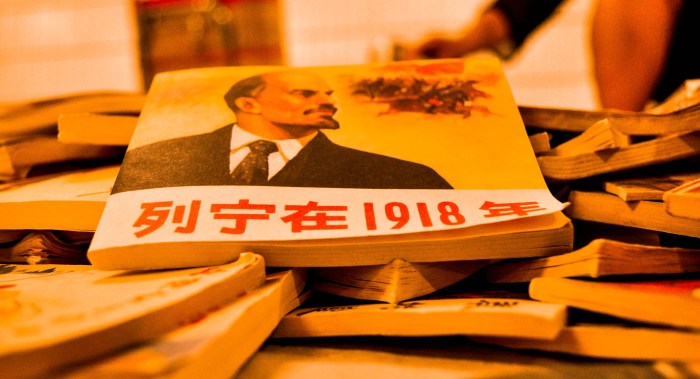
Lenin’s The State and Revolution – An Introduction – by Amanda S. Green

lenin-1724576

Lenin’s The State and Revolution – An Introduction – by Amanda S. Green

Last night, I talked with Sarah about today’s post. Unlike last week’s post, or even the series on Clinton’s What Happened, this post simply wasn’t coming together. I finally had to put it aside and tell her I’d get her the post this morning. I needed to sleep on it and, hopefully, inspiration would strike. In the light of day, I’m not sure inspiration struck, but I realized what the problem was. Simply put, the 1933 edition I was reading was, while my preferred edition, like wading through molasses on a day when the temperatures were below freezing. It wasn’t the subject but the translation. It flowed like the original Russian text. The problem is English isn’t meant to flow that way, not any longer. Or maybe my brain just doesn’t flow that way, not for quick reading, any longer.

So, I went trolling the internet for a different version. As I did, I kept my 1933 edition at hand as well as my Russian text of the pamphlet (which I finally found this morning). Using the preview function on Amazon and even checking out some free PDFs of the text, I finally found one I like.

The State and Revolution (Penguin Twentieth Century Classics) will be the version I mainly use for the purposes of this new series of posts. Yes, the text is slightly different from the translation I prefer. But, checking it against the 1933 edition and the original Russian, it is (at least so far) accurate. The language has been updated slightly for easier readability but the meaning is still the same. Better yet, the introductory notes give not only information about the book (or pamphlet as it was originally called) but also the history of Russia and of Lenin’s life.

Many Westerners know little about Lenin the man. We think of him as the founder of the Soviet Union. We remember the images of him addressing the masses or on propaganda posters. We even remember the pictures of what was supposed to be his body lying in state inside Lenin’s Tomb in Moscow not just years but decades after his death. When I visited the tomb, more than one person did a riff on the old Memorex commercial’s tag line, changing it to, “Is he real or is he wax?”

But we know little about the man himself, much less about this particular work.

Lenin’s history as someone working against the Romanovs started when he was a young man. He joined anti-Romanov groups and by mid-1890’s “was a leading Marxist ‘underground’ revolutionary in Petrograd.” (TSAR, p vii) In 1896, he was arrested. 1897 saw him being exiled to Siberia. After serving his sentence there, he immigrated to the West in 1900. In 1903, he came to prominence during the Second Party Congress by becoming the leader of the Bolsheviks after their split with the Mensheviks. The Bolsheviks, also known as the Reds, would not only defeat the Mensheviks and others in the Russian Civil War (1917 -1922), they would also become the Communist Party of the USSR. Lenin led them throughout this time, both as their spiritual leader and as their figurative.

But, back in the summer of 1917, Russia was still in turmoil. World War I continued, draining Russia’s already strained resources. With Nicholas II overthrown in February of that year, Lenin and other “revolutionary figures” began returning to Russia. Lenin, who has been in Switzerland during the war, found himself facing a number of hurdles in his attempt to return to Russia, however. Russia’s allies, knowing of Lenin’s opposition to the Tsar, blacklisted him, preventing him from traveling to Petrograd via France and the North Sea. Because of that, Lenin had to travel through Germany, with approval from Berlin. That route, along with Berlin’s approval, led to the accusation of him being a German agent.

The Provisional Government leveled the charges against him, charges he denied. Very quickly, he became a leading figure in the opposition against the new government. He proclaimed “that the emergencies of war and economic disruption were resolvable only through the installation of a government of soviets.” (TSAR pg xiii). To do this, the Bolsheviks began their “campaign” to “convince the working class, the soldiers and the peasants that the party’s representatives should replace the Mensheviks and Socialist Revolutionaries in the soviets.” (TSAR pg xiv)

Long story short, Russia was a mess at this point. In May, a newer coalition government was formed. The Bolsheviks still didn’t hold the power they wanted and they used the upheaval to foment more dissent.  After the government banned a protest in late June 1917, the demonstration was met with force from the government. The government held Lenin responsible, even though he hadn’t been in contact with Petrograd at the time, and ordered his arrest on the charge of being a German agent.

For Lenin, this meant once again going on the run. During this time, he began writing The State and Revolution. What is interesting is realizing that it wasn’t written for those in Russia he was supposedly fighting for. It wasn’t even written for most of those in the Bolshevik Party. It was written for the well-educated, for those who could go out and debate and spread the intellectual aspect of Lenin’s beliefs.

Many don’t realize he never finished the pamphlet even though he lived 7 more years. It was supposed to have had one more chapter. Also, as noted in the preface to the second edition, written in 1918, Lenin added a new section to chapter 2.

Lenin believed The State and Revolution was his most important contribution to the political debate. He worried it wouldn’t be finished before his death and, while on the run from the government, asked a friend to make sure it was published should anything happen to him. Yet, do you know why he didn’t finish it? In a postscript to TSAR, he wrote, “It is more pleasant and useful to go through the ‘experience of revolution’ than to write about it.”

Preface to the First Edition

The opening paragraphs make clear Lenin understood the turmoil of World War I, following upon the problems Russia faced after the 1905 Revolution and the Russo-Japanese War (1904-1905) made a fertile ground for a new revolution. In language similar to what we heard from certain parties during the 2016 presidential race, he did his best to stir the pot of inequality.

The imperialist war has brought about an extraordinary acceleration and intensification of the process of transformation of monopoly capitalism into state-monopoly capitalism. The monstrous oppression of the laboring masses by the state, which is fusing itself more and more closely with the omnipotent associations of the capitalists, is becoming ever more monstrous. . . The unprecedented horrors and miseries of this protracted war are making the conditions of the masses intolerable and increasing their indignation.  (pg 3)

Translate that into Bernie-speak or even Hillary-speak and doesn’t that sound familiar. Capitalism bad. Money and power are in the wrong hands. The oppressed are tired of being second-class citizens. We must rise up and take control.

And the imperialist war is nothing other than a war for the division and redivision of this kind of booty [enslaving small and weak peoples, holding power for the state, etc –asg]. The struggle for the liberation of the laboring masses from the influence of the bourgeoisie in general and the imperialist bourgeoisie in particular is impossible without a struggle against opportunistic prejudices on the theme of the ‘the state’. (pg 3)

The “state” is all about the “state” and to hell with the individual. Sound familiar? As for the “laboring masses”, I can just picture Bernie making that speech. Even though this is only the preface to the work, I have to wonder what sort of world Lenin really imagined. Sure, he will write that, in a true socialist existence, the state will eventually cease to exist. But I have to wonder if he really believed that or if it was all a con. After all, he’d seen the best and the worst humanity had to offer. Was this all a big con? The irony of what he professed compared to what he wrote and what the great Soviet state turned into shouldn’t be lost on any of us.

TSAR is split into three sections. I’ll deal with each section in a single post (at least that’s the plan). Lenin’s description of the sections shows his disdain and contempt for those who didn’t view Marxism as he did. (pg 3)

  • First . . . we examine the doctrine of Marx and Engels on the state, pausing to give specially detailed attention to aspects of this doctrine that have been forgotten or have been subjected to opportunist distortion. (And I will try to point out how Lenin himself fell victim to this “opportunist distortion.”)
  • Then we deal with the main representative of these distortions, Karl Kautsky, the leader of the Second International which has suffered such a wretched bankruptcy in the present war. (A charge that most definitely could be leveled against the USSR, especially after Lenin’s death.)
  • Finally, we sum up the main results of the experience of the Russian Revolutions of 1905 and particularly of 1917. (The latter of which is an interesting comment, especially considering the “revolution” was ongoing at the time Lenin wrote this. Yes, the Romanovs had been deposed and later murdered by the “revolutionaries”, but the Provisional Government maintained power until the October Revolution. The preface was written in August 1917. So the revolution had yet to see the end of its first phase.)

He closes the preface with the following:

Thus the question of the relation of the proletarian socialist revolution to the state acquires not only a practical political importance but also the importance of a most urgent current problem: how to explain to the masses what they will have to do in the very near future to liberate themselves from the yoke of capitalism. (pg 4)

As we go forward with this series, I’d like each of us to keep this last quote in mind. TSAR was written as a road map for the leaders of the Bolsheviks, to help them manipulate the masses to their side. Remember it when you listen to any politician, but especially those who talk about redistribution of wealth, of taking from one group or class in order to give to another. Look for the similarities and, when you see them, be prepared to counter with factual evidence of not only how this plan worked in the Soviet Union but also how it would impact our country.

Marx started us down this road during the “modern age” with his “From each according to his ability, to each according to his needs” bullshit. Lenin took that and ran with it. The reality, ignored by all too many, is that the producers of the world would become the slaves to the takers. We aren’t talking about reasonable welfare programs here. We are talking about a state of existence where the State tells you what to do, takes the results of your work and distributes it to everyone. Most humans don’t work well in that sort of existence. After a while, resistance and resentment build. If revolution doesn’t occur then resignation does. The desire to work hard and to innovate slowly atrophies and dies. Is that the kind of life you want for your children or grandchildren?

I don’t.

The best way to fight the Bernie-bots of the world or the more subtle Clintons and Obamas of the world are to recognize and understand not only what their goals are but the basis for them. Am I an expert on this topic? Hell no. But I continue to work hard to become one because it is only by understanding the historical implications and applications of their beliefs that I can help fight the current day attempts to send us down the path to socialism or worse.

[For raising the tone of this blog — ATH is culture! — and helping me with the exposing of the roots of the current mess — in her case with more facts! — if you decide to  send the woman a drink–  And her Amazon author page is here -SAH]


On Shaking The Dust From One’s Sandals

porto-1972450_1920

Portugal is not a shithole.  I think I can say that impartially, since I’ve acculturated long ago, and wouldn’t go back there to live if you sent wild horses to drag me that way.

It feels profoundly uncomfortable to most Americans.  I can say that too, because I am an American, because it was built not with the dictates of the free market — I’ll sell you anything so long as you buy it — in mind, but with other dictates, including pride, appearance and a lot of other stuff.

This is why the faucets run like diuretic gerbils, the electrical boards in houses suck (and no the excuse of global warming wouldn’t wash for a minute in the US) gas and energy in general are prohibitive, and service… isn’t what you’d call wonderful.  All of which add up to profoundly uncomfortable for Americans — and yes, I know my Portuguese readers are going to say we’re spoiled, and darn tooting we are.  You ain’t whistling Dixie. And we mean to continue being spoiled — but still not a shit hole.

Not that I’m going to punch out anyone who calls it such.  I’m just going to assume they have no experience of real shitholes.

You see, you can judge a country’s status as an … ah…. excrement sinkhole by figuring out “Migration out or in?”

In Portugal this picture is complicated.  They are suffering “brain drain” as their youngest, brightest and most educated decamp for Germany, England, or even Brazil (where the picture is also complicated) but at the same time they receive immigrants from Africa, Brazil, South America, China and, weirdly, Russia (I’ve never figured out if these are descendants from people who took their crappy cars when the wall came down, and drove until they hit the ocean (or drove/walked till they hit the ocean) or whether they’re a fresh migration.  I know the first existed, but I haven’t sussed out the other particulars.)

So, Portugal is not a shithole.  What it is is a country so tied down by regulations, rules, and the ever present weight of tradition (Portugal, like many Baltic countries produces way more history than it can consume locally) that it works at cross purposes to itself.

Looking at what Portuguese (at least some) can do abroad, in terms of insane amounts of work and sometimes success, one assumes that if Portugal could eschew its perennial fascination with socialism, it would … well…. I don’t know, but it would be scary for good or ill.

I mean for a country tied up with socialism (first national, then international) for the best part of a century, it’s not doing badly at all.  Look at it this way: it hasn’t gone Venezuela.  And the gentleman in the back who just said that’s because they can’t do anything efficiently, not even socialism, is just being mean.  Yes, the Portuguese have been locked in a tragic fight throughout history with their traditional enemies, the Portuguese, but that’s no reason to look down on them.

On the serious side, and what this is leading to, what would I do if Trump said “We don’t need more immigrants from that shithole, Portugal?”

Gulp. Then get on the phone and calm dad down, because he’s 86 — and even if he’s freezing through one of the coldest winters in their history, because their electrical boards suck, being now designed to prevent global warming, and therefore unable to accommodate say a hair dryer and a washing machine running at once, much less a heater in every room — he’s very proud of his country and very patriotic and we wouldn’t want him to do himself harm by being so mad.

And then I’d shrug.  Portugal is not a shithole, true.  But there is also no reason to seek out immigrants from Portugal IN PARTICULAR.

Mind you, the US doesn’t.  The “diversity visa lottery” LOOKS FOR immigrants from failed states.  For those purposes, Portugal is lumped in with Europe, and therefore it’s almost impossible to immigrate from there, which is why the Portuguese brain drain is going to places like Germany and Great Britain.

In fact, one of my teachers who spoke five languages, and whose husband was a fully trained electrical engineer, had been on the waiting list for 10 years when I was 18, and I bet you they haven’t made it here, yet.

But you know, that’s the whole point.  I don’t think Visas should be handed out to Portuguese particularly because Portuguese are cute and colorful and produce great wine, or whatever the reasoning.

I think, if we’re going to take in immigrants, we should take them in according to their usefulness to the US.

I happen to know we have a massive shortage of engineers, for instance. So, say, if it’s determined that Portuguese engineering schools/engineers pass muster and the US decides to import a few?  That’s fair.  Same with engineers from all other countries.  Of course, it will depress younger son’s future wages, but you know, fair is fair and engineering graduates are too few by far to replace retiring engineers.

So what is my justification?  What do I do for the nation?

Ah.  I came in a different way (though at the same time I had an offer for teaching at an East Coast college while finishing my doctorate, and if I hadn’t fallen in love with Dan, I’d have come in that way for a while at least.)

But I am very conscious of gratitude to you for taking me in and letting me be one of you.  Portugal is not a shithole.  It just never fit me right, like a prickly garment that does its job, but is not quite comfortable.

I feel much better in America.  And I’m very grateful.  And I try to do what I can to justify taking me in.

So far?  I’m probably still at a deficit.  Sure, we pay taxes, and we haven’t taken public assistance, but that’s the bare minimum.  And I raised two boys who will probably be productive citizens.  And of course I write books which make at least some money/create some wealth.  And I try to fight the good fight in the culture war.

Are these remarkable achievements?  No.  They’re the bare minimum to pay my way.  I want to do more, and now that we’re dealing with some long-standing physical issues, I just might manage it.

The point of it though, is that I’m conscious of which way this relationship runs.  I owe the nation a debt, and I’ll do my best to pay it back.

It might never happen, but I will try my damnedest.

For I was a stranger, and you took me in.  And I owe you.


Telling the Hard Truth – by Dave Freer

migration-2698946

Telling the Hard Truth – by Dave Freer

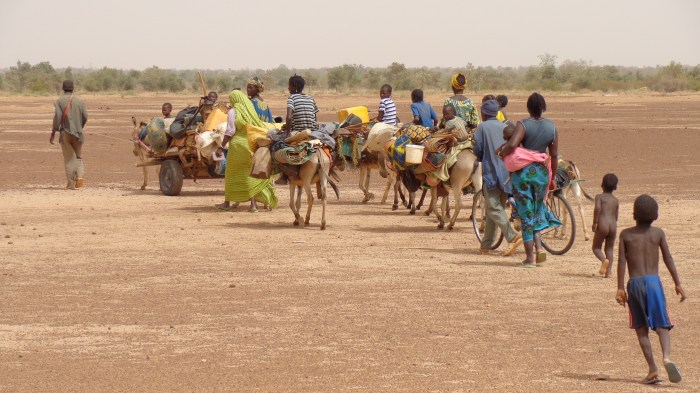
Hello. My name is Dave and I came from a shit-hole.

My friend Sarah Hoyt pointed me to a self-righteous fury spewing from the South African ANC (the political party which has governed South Africa since the end of apartheid) about the idea of South Africa being a shit-hole and bad America was. I was born there, and eventually migrated to Australia, of which I am now a proud citizen, and which I love, and try my best to pay back for its enormous generosity in taking us in.  Now, South Africa is a beautiful country, with some fine people… but the ANC have presided over it now having one of the highest murder and rape stats of any country in the world not at war.  Corruption is endemic, and racial hatred – both white on black and black on white – if anything is worse than at the end of apartheid. Public Health is in a sad state, and education isn’t much to write home to mother about, principally because ‘writing’ might be challenge, and mother (adult education is a neglected disgrace) still can’t read. There are squatter camps, squalor, mud huts without toilets in the bush. Electrical grids are failing, potable water is a major problem. There are good patches of course. There are things which have improved. But it’s only not a shit-hole when compared to places like Zimbabwe. Any criticism from it is like a serial child rapist and murderer complaining about you saying ‘shut up’ to your kid.

Whether President Trump really said ‘Why are we having these people from a shit-hole come here’ or not… I would like say that I think it the most valuable statement about migration made in the last fifty years, and one that cried out to be said. What’s more I think saying it is not only refreshingly honest (because it is a common thought, but one no-one dared say it, and people need to hear it), but actually exceptionally good for both migrants and shit-hole countries. It’s a coarse, blunt statement, but it’s probably the only possible way to make the point effectively.

As I said, I am a migrant myself, and no, I don’t hate migrants.

But I do realize there is a problem that needs dealing with, if this is not to all end in tears. It is in fact VERY like alcoholism (which is why I used the opening line I did): you’re never going to solve the problem while you pretend it isn’t there.  Getting it out in the open, acknowledging the realities, both of how the people in the country migrants are wanting to go to feel about it, and of WHY the migrants move, is vital to the longer term happiness and well-being of migrants and the countries they move to.  It also is the only real chance that shit-hole countries will improve. It’s like ignoring a toddler’s tantrum in the toy aisle.  It’s not easy for a loving parent: but you’re no loving parent if you let the child have what they want. You’re just avoiding embarrassment and lots of noise – and possibly for that screwing your kid over for life.

Let us stop worrying about upsetting tender liccle feewings – which allow the situation to fester under a covering of ‘sensitivity’. Fifty years of trying that… have made matters a lot worse.

Reality: Almost no one migrates from a place to an unknown country if the place they’re in is not comparatively (at least in their minds) a shit-hole compared to the country they’re moving to. Anything else is like people pretending the alcoholic with the shakes and horrors doesn’t drink.  That doesn’t help the alcoholic or them.

The other vital point of ‘Why are we having these people from a shit-hole come here?’ that so many people getting affronted by the accurate ‘shit-hole’ part miss… is that this is first and foremost a question. WHY are we having them come here?

Let’s start with a basic premise. Your country and government’s first duty is to its own people. They, and their ancestors, for their descendants, paid – as the saying goes – in blood and treasure, for the shape the country is in now. It’s due to the people who live and lived there. I’ve heard various ridiculous arguments about wealth, security and comfort being due to almost anything else (from geography to mineral wealth to the legacy of colonial exploitation, etc.) None hold water, because there is a counter example for every one of them.  It comes down to the people and the culture of those people, which shapes that state. Sometimes it is put into form by a constitution, but that too derives from its people. The first duty any government owes – is to its own people.

So that ‘WHY’ is exactly what any country, what any citizen ought to ask.  And a good reason is not ‘because the migrant needs or wants it.’  If you’re going to include that reason at all, it has to come a long way down the list, well after ‘it will have no negative effects on my people’.

I’m going to stick my neck out here (for good reason, as I will explain) there are very few migrants from anywhere (particularly shit-holes, and remember I am speaking of myself) that are just a straight good bargain for any first world country to take, as is.  There are no jobs that Americans/Australians/Japanese just won’t do. They might not do them for the price you’re willing to pay, but that is a different matter. Working out if suppressing labor costs (and earnings) is a net good for a country as whole after the costs (in welfare, health, education and social cohesion just to name obvious ones, leaving out less obvious like ‘exporting money from the country to be spent elsewhere’) is a huge task, which depends mostly on the caliber of the migrants you let in. Here’s a clue: taking them from shit-holes has some big costs.

Taking skilled migrants… has some short term advantages. Your country gets years of training and experience for free. Whether it is really good for the doctors and nurses and the training of doctors and nurses born and bred there, is another argument, entirely.  Every country gets caught in short squeezes: but giving an easy out may be bad long term for its people.

That leaves a handful of those special, truly rare talents. Great sportsmen, mathematical geniuses… yep. They’re a win, no matter where they come from. But these are one in a million migrants. If they were all of the migrants… nobody would care or not welcome them.

Which brings me back to my statement that few migrants are just welcome, and why it is so vitally important for the migrants to hear the hard question: ‘Why are we having these people from a shit-hole come here?’ Because that does what we should always do: puts responsibility on the party who benefits. Being a migrant never can be ‘as is’ – because ‘as is’ migrants suck.

If – like me – you’re a migrant, then: ‘Why are we having these people from a shit-hole come here?’ asserts the most valuable lesson any migrant could possibly get to make that migration a happy, successful experience both for them and the country they move to. Migrants are migrating because their birth-country is, for some reason, a shit-hole to them.  They need the new country to accept them.  And that needs a two pronged approach that everyone has been too ‘sensitive’ and ‘kind’ to bluntly tell them. It’s like the alcoholic again. You’re not actually doing them any favors pretending they don’t stink and they haven’t fallen asleep in their own vomit. You can certainly help them by telling them if they give up the booze they can be a decent bloke. BUT they have to leave the booze behind and accept it was a problem.  The alcoholic that can’t do that, and the migrant that can’t do that… are never going to get any better. And just as not even the best effort in the world can do anything for an alcoholic who hasn’t decided themselves to give it up and change, not all the ‘kindness’ in the world will help a migrant who brings the shit-hole with themselves, telling themselves it is not a problem. All they’re doing is making a new shit-hole.

I still hold that migrants can add value and be welcome, no matter where they come from. But it’s a huge hill for them (not others, not their host country) to climb, a lot of blood and treasure to catch up on – and a shit-hole, and all that goes with it, to leave behind.  Anything else will end in tears.  Working hard on it, leaving your past –culture, country, language – behind, and embracing the new, will have the citizens meet you half way, help you along, and welcome you. Migrants need to know this, accept this.

Not saying this openly is not doing anyone a favor.

Dave Freer’s Amazon page is here.

Wrong Battle, Insane Tactics

quixote

So I was reading Margaret Atwood’s article.  Yes, I know. What can I say.  It’s a very specialized form of masochism.

I wrote a post about it for PJMedia, which hopefully will go live today.  It’s about one of the things that truly annoyed me about the article.  Just one.  Mostly the fact that she doesn’t see the link between her actions and present insanity.  It’s like Robespierre stopping at the top of the steps to the guillotine and going “how did things get like this?”

But that’s only a portion of it.  There is more.  I realized reading her article, as she brings up the obligatory reference to Salem and in general the plight of witches (why are feminists obsessed with witches?  I want to take each of these new age twits who think that witches were some kind of feminist heroes, and make them read about Athenais de Montespan and the affair of the poisons.  Of course they might approve.  Most of the sacrifices were babies) and other things that are as ritualistic to feminists as the rosary to Catholics, it occurred to me (not for the first time.  There is an article about it here somewhere) that the problem with current feminism is that these women have gone to battle against the wrong enemy and therefore their tactics and their justifications keep spinning out more and more insane each time: because there is no way to win the battle they set themselves, since it was won before they started off and by means they don’t understand; and because they don’t understand how the battle was won, they keep fearing to lose again.

You see, Margaret brings up again the whine about how women couldn’t own property/weren’t considered fully adults, etc.  She also, of course, says that American courts discount accusations of sexual abuse/rape, and that American corporations ignore female complaints of misbehavior by males.

I’m not sure where she’s getting the thing about how courts and corporations behave, but then a person who could think of New England in current day as a theocratic state needs her head examined, because most of her ideas are coming from a highly improbable parallel world, and she doesn’t even realize it.

Sure, of course, Hollywood and publishing might ignore female complaints (and male too, look you) but that’s because they’re oligopolies, with those in power being able to do pretty much anything to their subordinates.  They resemble nothing so much as Ancient Rome.  Most sane businesses who do you know, real stuff, and aren’t bottlenecks dealing with artists and other obsessives aren’t like that.

But yeah, sure, there was a time (a very long time) when women were treated as something not quite as human as males.  I know why too, because unlike the feminists I know more of history than the cant about “couldn’t own property.  Were property.  Ahhhh, so scary.”

It’s a good idea when looking at historical oppressed groups, particularly those like women, to realize that a) well, the oppression might not have been oppression in the opinion of anyone living at that time b) there must have been a reason for such treatment that was deeper than “all men are villains and want to enslave all women” since patently most men aren’t villains, and most women are their mothers/sisters/daughters, and only a very few men hate all of those.

The reason… is survival.

Life for most men and women, even upper class ones, up to about a hundred years ago sucked rotten goat tit.

Everyone died young.  Okay, fine, if you were very wealthy and had damn good genes, you might live to your sixties or seventies, or, improbably, eighties.  (I saw my first eighty year old at 14, and he was what we’d now associate with 100.  And he was wealthy and from a long lived family.  My parents are now older than he was, but they look more like seventies then.)  Let’s not forget, ladies and germs that Shakespeare was “very old” at fifty eight which is staring me in the face, and which I have hopes (perhaps foolish) of exceeding and working past for twenty years at least.

But the child mortality was the most shockingly different thing from our own society.  It wasn’t even unusual to birth ten children and rear one or or two.  High class women in the regency (think the character in Pride and Prejudice) made two infant shrouds as part of their trousseau, because that was the minimum of children they could expect to bury early on, before they had the time to make more. Children or shrouds, now I think about it.

The risks were different for women and men, of course.  For men most of the risk was working outside or in dangerous jobs (then as now, statistically, most females did indoor, safe, boring work (though often backbreaking) and most men did outside, strength intensive, dangerous work.  For the upper classes this often involved going to war.)  For women it was pregnancy and child birth.  Even in our days there are so many ways either of those can go seriously wrong and hurt a woman.  And in those days, they couldn’t cope with or even diagnose “seriously wrong.”

So…. Think through the implications of this, okay?  Most women spent most of their lives pregnant and died young.

The myth of women not working or not being able to work outside the home is just that.  I have no idea why the feminists concentrate on a small sliver of the population during a narrow band of time (the Victorian age) except that they’re starting to imitate so many of the Victorian women (fictional) quirks (I need a safe room.  That man leered at me.  I am scared for life.  Give me my smelling salts!) that I think like women reading regency romances, they always imagine themselves as upper class ladies. (Go figure.)

Most women, even middle class women, worked.  For the middle class managing a house was at least as important as going out and earning money for such house.  Men looked for skilled housekeepers, because otherwise their wealth would be squandered.  And often — in my own family’s case — women helped with the business and the business management.

Lower class women often took work they could do in the house, and piecemeal.  You know, low paid, repetitive, but safe.

This was not because men didn’t want competition from women stevedores or stone masons.  (There were always some, though often they pretended to be men to avoid trouble.  Also they were the very extreme of body types for females, obviously.)  It was because they were PROTECTING and LOOKING AFTER women, trying to keep them SAFE.  Not because they looked down on women, or thought women were “lesser” but because women could do a very important thing that men STILL can’t do (and won’t be able to barring some truly strange science advances): give birth.

Because giving birth was such a high-risk enterprise, and because so many of the products of that enterprise died before pay back of the ah labor involved in bringing them to the world, it was THE most important work of society.  Those members able to do it had to be kept in such a situation that it allowed them to maximize that one thing they could do.

As for “the property of their husbands, etc, etc, blah blah blah” work was so brutal and hard, and providing for a family so difficult, that yes, a man wanted to make sure the children he supported were his own.

Also, because of very early (many women married before even 18) death in childbirth, etc, most women skewed younger than men as a population, which would encourage a certain degree of paternalism.  On top of that, hate to tell you, but women while hormonal are often not fully rational.  We can sort of compensate for it, but one of the pregnancy hormones is SUPPOSED to make you fat, dumb and happy.

I don’t know if most women need a minder while pregnant, but from both personal experience and watching friends go through it, I imagine many women do.

It is therefore only natural that in a society where most women are pregnant most of the time, men would view it was their duty to look after the puir confused things.

When feminists assume that back in a time with no contraceptive, high child mortality and an horrendous death toll of pregnancy, women should have been recognized as the equals of men, and that men were being evil villains for not doing that, they are demonstrating an astonishingly blind and ideological view of history.

In fact, even back in the middle ages and before SOME women were considered the intellectual equals of men.  (And sometimes the military equals.)  There are very few of them, again, not because The Man was keeping them down, but because the women attracted to intellectual or military pursuits are (like men) a minority and on top of that they tended to be either unmarried, childless, or the percentage of women not much affected by pregnancy.  I.e. a minority of minorities.

Women started making advances in what was considered, traditionally, male realms, like science or scholarship, (the others…. well…. there is a problem with upper body strength.  Sure.  Some women.  Again a minority of a minority) or being able to vote when two twin advances occurred: the first was the curbing of infant mortality.  When it became obvious (after a generation or so) that most of your babies would survive, it was possible for women to spend only a tiny minority of their lives pregnant.

The second was contraception that was cheap, easily available, and safe.  Yeah, okay, I have certain issues with the pill, because the medical issues of using it long term are only now showing up in the population at large.  That’s fine.

It remains that even the early “horse-dose” pill was safer than anything else anyone else had ever come up with for women to avoid getting pregnant all the time.

I allow and am amused by the handwavium of “some herbs” in fantasy novels, but most herbs were not contraceptives, but abortificients with the associated risks.  There was a berry that worked much like the pill, but it went extinct in Roman times.  (eh.)

Not having to spend the majority of their lives pregnant and not dying in disproportionate numbers in child birth gave women “equality” to the extent it can be had in this fallen world.

Because many reflexes remain from the aeons when women were so important they must be protected, in many ways it gave women the upper hand, particularly in social situations.

Which brings us to where we are now.

The “feminists” blind certainty that men oppressed women historically for no reason and “just evil I guess” is partly derived from idiot Marx who thought various parts of society were at odds for “no reason, except evil.”  But part of it is caused by both pig blindness and pride.  The pig blindness comes from ignoring historical fact.  The pride is in imagining themselves as virtuous victims, because their ancestresses were oppressed, and also in being sure that their present equality (to the extent they recognize they have it) comes from their virtuous “struggle” and shoulder to shoulder clamoring.

Because virtue feels so good, they refuse to admit the battle is largely won.  And because they think men oppressed women because “evil I guess” they are ever vigilant against a vast conspiracy of men turning around and dragging them back to the bad old times.  (Stupid I gu– No, wait, willfully stupid, for sure.)  Which leads them into misandry and revenge games.

That this more than anything might bring about a reversal (not likely since physical conditions have changed) as women are judged too petty and infantile to trust with serious business, never occurs to them.

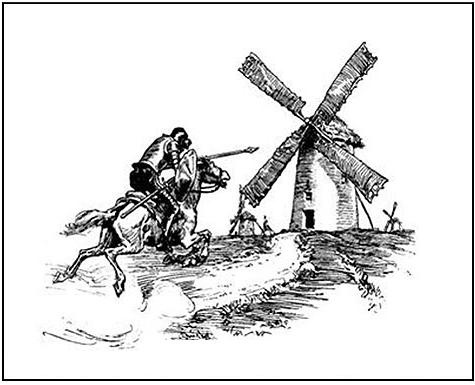
They continue attacking the windmill, unaware of how it looks to sane people, or how society at large might need those windmills to survive.

And, as with most crazy of the left, those of us who are rational and female, are being dragged down along with them.

All because of blindness and pride.  If it weren’t likely to involve me and my female descendants, it would be funny.  As is, it’s more of a tragedy.


Sunday Vignettes Now With More Despondence by Luke, Mary Catelli and ‘Nother Mike

So what’s a vignette? You might know them as flash fiction, or even just sketches. We will provide a prompt each Sunday that you can use directly (including it in your work) or just as an inspiration. You, in turn, will write about 50 words (yes, we are going for short shorts! Not even a Drabble 100 words, just half that!). Then post it! For an additional challenge, you can aim to make it exactly 50 words, if you like.

We recommend that if you have an original vignette, you post that as a new reply. If you are commenting on someone’s vignette, then post that as a reply to the vignette. Comments — this is writing practice, so comments should be aimed at helping someone be a better writer, not at crushing them. And since these are likely to be drafts, don’t jump up and down too hard on typos and grammar.

If you have questions, feel free to ask.

Your writing prompt this week is: helpless