Ah, Interpretation!- On The State And Revolution Part 2– by Amanda S. Green

museum-189040

Ah, Interpretation!- On The State And Revolution Part 2– by Amanda S. Green

Or how Lenin proves he’s no better than those he condemns.

In the previous post, I noted how Lenin opened  The State and Revolution with a condemnation of those “socialists” who didn’t follow his own particular brand of socialism. In good lawyer fashion, he accused the Mensheviks and others of watering down the doctrines of Marx and Engels. In the second chapter of  The State and Revolution he continues that attack. This time, he wraps his arguments in historical “facts” along with more sleight of hand as he presents his own interpretation of those “facts” as well as socialism’s foundation texts.

As always, everything revolves around the oppressed working class and Lenin’s basic tenet that capitalism, imperialism and all the other isms can only be replaced by a true socialist state through violent revolution. However, in order to prove his approach is the one Marx and Engels supported, he had to find a way to debunk Marx’s statement in the Poverty of Philosophy about the process leading to the disappearance of the state:

The working class in the course of its development will replace the old bourgeois society with an association which will exclude classes and their antagonism; there will no longer be political power properly so-called since political power is the official expression of the antagonism of classes in bourgeois society. (TSAR, pg 22)

This statement seems to imply a withering away of the state. More than that, a withering away without revolution or violence. Oops. Lenin certainly couldn’t let that go unchallenged. So he turned to the Communist Manifesto, written not long after Poverty of Philosophy:

We have seen above that the first step in the workers’ revolution is the transformation (literally ‘elevation’) of the proletariat into the ruling class, the conquest of democracy. The proletariat uses its political supremacy to wrest, by degrees, all capital from the bourgeoisie, to centralize all the instruments of production in the hands of the state, i.e. of the proletariat organized as the ruling class; and to increase the total of productive forces as rapidly as possible.

(TSAR, pg 22-23)

Leaving aside the fact the Poverty of Philosophy was never meant to be the political treatise the Communist Manifesto was, let’s be honest. The two passages aren’t at odds. The latter simply expands on the former. Lenin, however, being a master at manipulating facts and emotions to fit his needs and wants, used the “difference” to do more than point out the differences between his Bolsheviks and the other so-called socialists in 1917 Russia. He used it to paint those others as enemies of the working class, no better than their bourgeois “masters”. Unfortunately for Russia, he did his job all too well.

According to Lenin, the above quote establishes “the most remarkable and most important ideas of Marxism on the question of the state, namely the idea of the ‘dictatorship of the proletariat’.” (TSAR, pg 23) How ironic is it, looking back on Russia over the last 100 years, to see how his “dictatorship of the proletariat” never grew beyond that – a dictatorship. Russia once more became as interested in colonial expansion as the England and United States Lenin envisioned and condemned. Oh, Russia used different tactics, but no one can deny the way it moved into Eastern Europe after World War II. That expansion was not motivated by some desire to help those countries behind the Iron Curtain. Far from it. That expansion was for land, people, resources and money. Such a wonderful example of the “proletariat dictatorship” and there is no evidence that dictatorship is withering away to a true people’s state.

One of the key passages in this chapter, in my opinion, is this:

The notion that the proletariat needs a state is repeated by all opportunists, social-chauvinists and Kautskyites, who affirm this to be Marx’s doctrine while ‘forgetting’ to add, firstly, that the proletariat (according to Marx) needs a state on the wane, i.e. a state so organized that it immediately begins to wither. And, secondly, the ‘state’ needed by the laboring people is to be ‘the proletariat organized as the ruling class’. (TSAR, pg 23)

“Needs a state on the wane.” That’s true for any revolution to have a chance of succeeding. If the state is strong (healthy), most citizens aren’t going to want to overthrow it. Why would they? A healthy state has a healthy economy, a strong infrastructure and hasn’t (under most circumstances) turned to oppressive tactics that foment discontent.

Russia in the early years of the Twentieth Century was anything but healthy or “strong” and the decline begun before Nicholas II became the tsar continued and was worsened due to a number of factors, including World War I. After the Romanovs were overthrown and the provisional government formed, Lenin took advantage of the fact the “change” the revolutionaries fought for not only didn’t come but that it looked like many of those professing to be socialists simply slipped into the role of oppressors.

The state is a special organization of force; it is an organization of violence for the suppression of some class. What class must the proletariat suppress? Naturally, only the exploiting class, i.e. the bourgeoisie. The labouring people need a state only to suppress the resistance of the exploiters, and only the proletariat is in a position to direct this suppression, to carry it out; for the proletariat is the only class that is consistently revolutionary, the only class that can unite all the laboring and exploited people in the struggle against the bourgeoisie, in its complete overthrow. (TSAR, pg 23)

So the state is the oppressing force and necessary for the proletariat to rule. Except it’s not just rule. The proletariat is to “suppress” the bourgeoisie. Yet, even as it suppresses one class, the proletariat is supposedly the only class able to unite all the other classes.

I don’t know about you but I’m a suspicious sort of person. If I see a group of people proclaiming to be the liberators, the heroes of freedom and equality, suppressing anyone, I have a problem. What is to prevent the “dictatorship of the proletariat” from deciding I need to be suppressed? It is now the “state”, remember.

Lenin doesn’t answer that question, at least not yet. Instead, he returns to his attack on the social democrats, the Mensheviks and others. In today’s terms, he’d call them squishy socialists who only want to adopt the feel-good aspects of the philosophy. They didn’t preach revolution. They saw the state withering away into a true socialist society as a natural progression, something akin to an evolutionary process. Oh, sometimes you had to rise up and push the oppressors out of office, but you didn’t make the streets run red with blood. This, according to Lenin, was “petty-bourgeois socialism.”

Does that make what happened after the Bolsheviks took control “superior-bourgeois socialism”?

Here is where things start sounding familiar, almost reminiscent of the 2016 election cycle and some of the rhetoric that came from not only the Sanders camp but HRC’s as well:

The proletariat needs state power, the centralized organization of force, the organization of violence both to crush the resistance of the exploiters and to lead the enormous mass of the population – the peasantry, the petty bourgeoisie, the semi-proletarians – in the work of ‘establishing’ a socialist economy. (TSAR pg 25)

Again, Lenin reinforces the idea of not only the need of revolution but of a proletariat rule, not of the people but of an oppressor. Oh, he pretties it up to mask what he’s saying but that’s the gist of it all. The bourgeoisie must be oppressed and so must everyone else until they have been sufficiently indoctrinated that they no longer fight. The oppression, he promises, will lead to a “socialist economy”.

Riiight.

With regard to the state, Lenin is of a singular mind, or so he’d have his followers believe/ “all previous revolutions perfected the state machine, whereas it must be broken, smashed.” (TSAR, pg 25) Given this has been the belief of many revolutionaries throughout history. However, history does have 20-20 vision and we can look back and see how often the “crushing” of a state either left it vulnerable to invasion from outside enemies or how the crushing led to even worse conditions from within.

Irony, thy name is Lenin when we come to this:

The centralized state power characteristic of bourgeois society arose in the epoch of the fall of absolutism. Two institutions are most typical of this state machine: the bureaucracy and the standing army. (TSAR, pg 27)

Anyone who has done even the most minimal study of any socialist or communist government knows there is a centralized power. That power is absolute and failure to follow Party doctrine can lead to not just punishment but death. Bureaucracy is rife and the standing army there to quickly quash the first sign of rebellion. We’ve seen that in China, in the Soviet Union/Russia, in the actions of the USSR in putting down rebellions in Hungary and Czechoslovakia. But we are supposed to sit back and wait for the dictatorship of the proletariat to mature enough that it can finally wither away. The only problem with that it won’t. In the time it would take, the proletariat dictatorship will have become the oppressors of the future.

I think you get the picture. For the proletariat to fulfill its place in history, it must lead the revolution. Even though the state will be unnecessary in the socialist existence, the proletariat needs it to not only oppress but destroy the ruling class. It needs it to maintain control and prevent uprisings until a socialist economy can be established. Once that happens the dictatorship of the proletariat will no longer be necessary and the ‘state” will finally begin to wither away. Until then, everyone must trust and follow the proletariat because only it is able to lead and unite.

Now, can you imagine what would happen if a Wall Street lawyer was to get up and say this today? Most of us would laugh him off the stage. However, we didn’t laugh Bernie off the stage. A number of young voters fell into step with him, praising his “unique message”. Why? Because he took the tact of the Mensheviks and others Lenin condemned. He didn’t come out and preach that they need to make the streets run red. Even so, he – and Hillary in her own way – promoted this proletariat dictatorship where wealth would be redistributed, the “state” would care for you and we’d all be happy little socialist ants.

To limit Marxism to the doctrine of the class struggle means to chop up Marxism, distort and reduce it to something acceptable to the bourgeoisie. Only those persons are Marxists who extend the recognition of class struggle as far as the recognition of the dictatorship of the proletariat. This is what constitutes the most profound difference between the Marxist and the ordinary petty (as well as grand) bourgeois. This is the touchstone on which a real understanding and recognition of Marxism is to be tested. (TSAR, pp 31-32)

Read the first sentence and remember it. Remember it the next time you listen to Bernie or any of his ilk talking issues in Washington. Remember it when you listen to DNC talking heads or the media. The modern socialists, even if they don’t believe in the extreme version of the philosophy Lenin did, have learned a lesson from him. It’s not the one he meant to teach but, in some ways, it is more dangerous. They have learned how to drape their policies in a way they are “acceptable” to most people. That is what makes them so dangerous.

Think about it. How many people do you know who support universal healthcare in some form or fashion? It’s almost a knee-jerk reaction in some people because they believe no one should suffer because they can’t afford to see a doctor or go to the hospital. We’ve been taught, in our churches, at our dinner tables and in our schools to be charitable. Those leaning into the socialism spectrum play on that when they talk about universal healthcare or free college education, etc. What they never discuss is how those will be paid for because, once the veil is ripped away, there is a cost.

We have to start asking if these policies that sound so good are worth the price.

[T]he essence of Marx’s doctrine of the state has been assimilated only by those who have grasped that the dictatorship of a single class is necessary not only for every class society in general and not only for a proletariat which has overthrown its bourgeoisie, but also for the entire historical period dividing capitalism from ‘society without classes’, from communism. The forms of bourgeois states are extraordinarily varied, but their essence is the same: all these states somehow or other in the final analysis simply have to be a dictatorship of the bourgeoisie. The transition from capitalism to communism, of course, cannot help but produce a vast abundance and variety of political forms, but the essence will inevitably be the same: the dictatorship of the proletariat. (TSAR, pg 32)

Something else to consider as you read Lenin, he wants to do away with capitalism. He wants to not only overthrow but destroy the bourgeois. He advocates for the “dictatorship of the proletariat”. What he hasn’t told us yet is how long it will take to reach the nirvana of the true socialist state. Nor does he tell us how a socialist economy will work. If you take the carrot of not only success but potential fame and fortune (and all the other reasons people work hard), what will be a worker’s incentive to do more than the minimum required of him?

In its own way, Atlas Shrugged is as slanted and impossible as is Lenin’s socialist/communist haven. However, Rand was right about one thing. There comes a point when those who value themselves and their work will no longer be happy turning their work over to a “state” or those the state appoints without compensation or recognition. As much as humans want to be generous and merciful, we are human. We have faults and pride and greed are just two of them. For the state to wither away slowly as we evolve into a people who will willingly follow the adage “from each according to his abilities, to each according to his needs”, how many more revolutions will have occurred and how many more “dictatorships of the proletariat” will have morphed into the new state?

[For raising the tone of this blog — ATH is culture! — and helping me with the exposing of the roots of the current mess — in her case with more facts! — if you decide to  send the woman a drink–  And her Amazon author page is here -SAH]

The Right Way to Grieve and Support the Grieving By Out of the Darkness

woman-1246587

The Right Way to Grieve and Support the Grieving

By Out of the Darkness

Grieving is a topic most of us wish we could ignore, but is an absolutely universal process. We will all grieve a loss and we will all support someone who is grieving. It’s not just about death either, but about any kind of loss that one experiences. This can mean losing a job through termination or retirement, your worldview shifting, the end of a relationship, or simply growing out of an old identity. Anything that causes a break with something or someone on which you previously based a part of your identity can trigger grief. This post will be broken into two parts. The first is for the grieving. The second is for people supporting a grieving person. This is not meant to be a substitute for real medical advice or an all-inclusive guide. It’s an overview, meant to shine a light into a process that feels murky at best. Take what is helpful and leave the rest.

For the Grieving

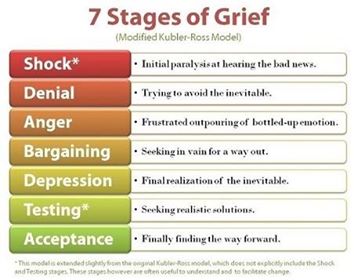
Despite the name of this post, one thing needs to be made very clear. There is no WRONG way to grieve. We’ve all heard of the five stages of grief, and damn near everyone who has been through it will say it’s bullshit. It is. That model has been replaced with a seven stage model.

grief

If you’re reading this blog, you’re probably intelligent enough to look at the pretty picture and get the idea. The main thing to remember is that these stages are not a straight line for most people, and that it is possible to move back and forth between stages at any given time or to feel like you’re experiencing two stages at once. That is normal and it’s okay. You are allowed to be both angry and depressed. You are allowed to be both testing and bargaining. You are allowed to be none of the above and in between stages, or too emotionally exhausted to deal with any of it right now.

The second thing to remember, especially as it pertains to death, is that you start grieving as soon as you actually get the news. If you found out two years ago that you or someone you love has a terminal disease process, you started grieving two years ago when the reality of the situation came to your attention. Sometimes people in this situation find that when the loss is final (in the case of death, the death actually occurs), that they don’t really feel anything or that they’re at peace. And then they feel guilty, because they feel at peace or because other people keep making them feel like everything shouldn’t be okay when it is. “What’s wrong with me that I don’t feel the least bit bad right now?” There’s an excellent chance that nothing is wrong with you. You’ve just already had a chance to grieve the loss before it occurred. That’s okay, and it’s healthy. When the people around you keep expecting you to feel bad, just try to remember that they haven’t had a chance to grieve yet, or don’t know how to support you right now. You can’t let their expectations define your experience.

There is a point, however, at which grief becomes overwhelming and destructive. Some people get stuck at one specific stage of the grieving process and just can’t move on. (The most common stages to get stuck on are shock, denial, anger, and depression.) They forget how to do anything else and just can’t deal with life any more, and this goes on for longer than a month or two. This is when you need help. It’s time to see a professional grief counselor, a therapist, or perhaps a member of your preferred clergy. If you happen to be in the military, your chaplain is trained to help with grief issues. Don’t let yourself linger too long in any one stage of grief, and don’t be afraid to get help. It doesn’t matter if you’re grieving the loss of your job or the loss of your wife. Your grief is real, and it is important. If you fail to deal with it, it will destroy your life.

For Those Supporting the Grieving

The absolute first thing for you to remember here is to shut the hell up. This isn’t about you. This isn’t about your normal or even your previous experiences with grief. When the grieving widow throws herself over her husband’s casket, you stand the fuck back and let her sob and scream out her pain and loss. She needs to do this, and you’re an asshole if you stop her. You’re literally stunting her ability to grieve. If your best friend starts screaming about how much of an asshole his dad is for dying and leaving him, you shut the fuck up. If your cousin starts trying to make deals with the gods to get his girlfriend back, shut the fuck up. If your coworker just got diagnosed with terminal cancer and seems to be pretending that nothing has changed, shut the fuck up. Rule number one is always to shut the fuck up and let people experience their grief.

Never, under any circumstances, tell someone that this experience is part of God’s plan when they are grieving. Even if you believe it, and perhaps especially if you believe it. It doesn’t help, and in that moment, you’re telling the person that God wants them to suffer. You’re telling them that God wants to take away things that make up their identity. You’re telling them that God is cruel. Later, when they’ve worked through the grief, they may be in a position to understand that they are better and stronger for having lost something. While they’re still grieving, there is no reason good enough. There doesn’t need to be a reason either. Part of living is learning to accept that bad things happen and we must adapt and overcome. Don’t build a wall between a person who needs a deity and the deity by telling them that whoever they worship is cruel.

If you have to shut up and can’t give them a reason for their suffering, what can you do? You can listen. When they’re ready to cry it out, you can hold them and let them cry. You can take up a fundraiser to give them financial resources if they’re needed. You can bring over meals, or invite them over for meals. You can help clean house or run errands. You can babysit. Basically anything you can do to lighten the burden of life so that the person you’re supporting can devote emotional resources to actually doing the work of grieving is a good idea.

Now, if this has been going on for quite some time (longer than a month with no forward movement) and the person you’re supporting has just completely lost the ability to function, or is burning every bridge around them as fast as they can light matches? You need to be willing to step in and gently but firmly tell the grieving person that they need help. You can get them the name of a grief counselor or take them to their bishop/priest/religious authority figure. You can be there for them and help them find the resources to get the help they need.

Grief is a universal experience, but it’s so incredibly unique. Every person will grieve several times in their life, and they will support people they love through grief several more times than that. There’s no wrong way to grieve, but there is a destructive way. There is a wrong way to provide support, however, and lots of people get that wrong. They mean well, but the road to hell is paved with good intentions. Don’t be afraid of grief. Be prepared for it.


The Stories We Tell Ourselves

Iscience-fiction-751758‘ve been saying for a long time that the way in which our environment is particularly abnormal, compared to most of the history of the human race, is that we’re saturated with story.

Humans like stories.  We seek them out.  It is entirely possible that is the difference between us and the various human breeds that existed before us.  Of course, we can’t know unless someone invents a machine to observe the past.  Pre-history by definition left no records of stories, unless, of course, cave paintings are that.  It is possible they are.

But ever since humans have been humans we’ve had stories.  Personal stories, family stories, tribe stories, sometimes all of them blending together, melding together.

Story is useful in a way, as an invention, hence my saying that might have been what gave us an edge.  I mean we’re fairly sure the difference between us and the other primates is that we can pass knowledge better through the generations, so it accumulates.  So, language, sure, is an edge.  But sometime probably at the dawn of unimaginably early pre-history, some genius realized that story was the teaspoon full of sugar that made the medicine go down easier.

And we crave story.  Even people who are not aware of craving it, or who think they don’t like fiction (my mom is one of those) crave story.  It might manifest as an interest in history or mythology, or something, but it is story.

Now, we’ve always been pretty good, clever apes that we are, at getting what we need.  Grandmothers told stories to their grandkids, kids made up stories for each other, some of us roll our own, and then there were tribal stories.  They wouldn’t be transmitted orally, memorized with great trouble, at a time when people lived very close to the bone, and told retold and embellished, unless they were a need, a craving of our kind.

Sure they “explained things” or at least a lot of them did.  But that was the superficial utility.  Just like mom who listens to history and mythology compulsively, because “they’re real” that ignores the fact that the explanations or the injunctions were wrapped up in story.  A far more elaborate story than needed.

There are linguists that think that the indo-european culture was a culture and a common-wealth, not necessarily a race or a tribe, and that the major drive for their conquering of Europe was in fact the big banquets they gave and the sagas told at those banquets.  There is some indication that each new tribe, coming in contact with these, western-civ’s ur-ancestors, invented a story to add to the tribal sagas, one that explained they always belonged, etc.

And civilization moved on.

It’s just that our craving for story has since the twentieth century become more easy to gratify.  There are stories everywhere you look.  Songs are stories, and are delivered whether you want to hear them or not in most public spaces.  Newspapers shaped “narrative” into stories, for easier interest and delivery.  Books are… trivially cheap.  (And now in audible, you can consume them while you clean.  Honestly, without audio books my house would be knee deep in trash.  I bore easily.  I’d never clean.)  TV and movies might actually be able to implant false memories.

My name is Sarah A. Hoyt and I’m a story junkie.  We didn’t have a TV till I was 8, so that is probably why I’m more immune to that form of story telling than to others.  But I listen, read, and make up stuff ALL THE TIME.

My morning used to start with three newspapers read back to back: the Colorado Springs paper, the Denver paper, and the Wall Street Journal.

Now it often starts with a skim of the usual blogs, to make sure no one destroyed the world while I was asleep (you know I can’t trust you.)

I find audio stories particularly enthralling, because as a sick little kid I lived for when my brother would read me stories.  When I re-read Enid Blyton (don’t judge me) or other early tales, I hear them in my brother’s voice.

This is of course all well and good.  The problem is that narrative — stories if you will — can be weaponized.

I don’t know how long ago that started.  I know that in one of China’s (many) fits of book burning, someone outlawed grannies telling stories.  I know that the Tudors got hold of probably the greatest story telling genius the world has ever seen and used him to burnish their image to a shine.  (I’m not one of the people obsessed with rehabilitating Richard III, which by itself is almost a shock, since I have such a need to rehabilitate so many historical figures, from Kit Marlowe to Kathryn Howard.  Because I’m not right in the head, that’s why,  but the truth is that on the bare facts of it, we have no indication he was any worse than most of the people involved in the bloody mess of the time, and he might have been better.  Yeah, we do know that the princes in the tower did die, but it’s a very cold case, and again, unless we develop a way to look back at the past, we’ll never be able to tell how or who actually killed them.  Even if it was someone in Richard’s service, it might well have been one of those “will no one rid me…”  However, we all use Richard III as a byword for evil and a forerunner of Hitler.  Meanwhile the Tudors who sent the same proportion of their subjects to the block as the great tyrants of the 20th century killed of theirs, are made out to be the “good” guys.)  And we know now that poor, doomed Marie Antoinette never said “let them eat cake.”  And that the idea the populace had of the royal couple complete with orgies and all out sexual perversions (which weirdly would have applied to the grandfather of Louis XVI) was a tissue of lies made up by the press.  Scurrilous stories.  Fake news, if you will.

But the 20th century, coming at the apex of the industrial revolution, which tended to the centralization and industrialization of everything, including communication, made it possible to tell a unified story.

Needless to say the party of big, unified and centralized government, got there first.  Those that thought the state needed to change humanity took full advantage of it.

We know that FDR was made into what people thought him to be by the stories.  The idea he saved us from the great depression (instead of causing it, and only letting go of the economy enough it recovered when WWII distracted him) is a media creation.  And many people still believe it.

Camelot appears to have been a photogenic man and woman lashed together in a semblance of marriage which hid a whole lot of #metoo and sex for money, but hey, the media, the books, the movies even made a rather flawed man into a king of legend.

And a millenial friend going through his comic book collection, reminded me recently that one of the superhero comics had a cameo by Clinton (I don’t really remember it) and that the opening for a cartoon of the time had Billy boy playing his saxophone.  I don’t remember either cartoon or comic, but when friend said their names (which have vacated my head) I recognized them as influential in the nineties.

The train wreck of Obama appearing in various comics as a superhero is a given.  Story.  Just story used as a weapon of control.

And yes, we know that the story is fracturing.  I don’t think Obama got as much mileage out of it as Clinton did.

But stories as a political weapon would be relatively (very relatively) harmless if all they did was burnish this or that historical figure, or give them an undeserved glow of success.  Because people can look at those things and go “oh, propaganda.”  That has developed, too, as a way to counter the pervasiveness of centralized story.

Slightly more effective are the stories about pet causes of the left.  I find Europe, where there are no dissenting blogs, and contrary facts don’t get reported, everyone thinks we’re losing glaciers and might never see snow again, or whatever.  (Glaciers are changing, not so much vanishing.)  They are therefore far more amenable to draconian measures to stop this doom of which there is no objective sign.

Then there are the people who are still convinced we’re on track for explosive over population, though the danger in western countries (and probably all over the world, if we could trust those statistics) is rather the other way.  Because there were so many stories, books, movies, made about over population.  And even though if we were on that track it would already have shown, they read these stories as kids and it became part of their unexamined idea of how the world will work.

This causes second order effects, like “plant based diets” which were supposed to counter the inevitable coming famine, and were therefore “sold” (in story including in scientific publications) as the healthiest thing ever, and which might be single-handedly responsible for various health crisis.

But there is more than that.  When Reagan took the presidency, the boomer generation was just starting to write, edit and consume vast quantities of story.

And suddenly stories, particularly those dealing with the future, went to grimdark, we’re all living under the bridge and eating garbage.  I called this “the rusty future” and it drove me insane, but it invaded everything.  It invaded everything, because most of the writers, and most of the publishers believed this was what would happen since Reagan had deviated from the policies (socialized everything, centralized everything, and nanny state) which, despite their not working, every story had told them was the way to go.  So publishers and writers panicked and foresaw a grim, dark future.  (Ginjer Buchanan, sometime shortly after Bush was elected, said that now horror would become ascendant, because under republicans “all we can do is scream and die.”  I don’t think she’s particularly unique for her generation or her profession.  At least not from the reaction to this comment, and other things I overheard at conventions.)

So what is the problem with that?

The problem is that humans attach to the narrative they heard when very young.  They fixate on it like it’s a true foretelling of the future.

To some extent, western civ has been telling itself bad things about itself since World War One.  This was partly the shock of finding they weren’t nearly as civilized as they thought they were and partly well… frankly communist propaganda.  If you read books written at that time they’re a bizarre stew of both.

But for a while it was all going to be redeemed by communism, or at least “socialism” which was really like communism but said that way so as not to scare the rubes, which was going to give us a shiny future, where everyone was taken care of and there was no need and no illness.

And then Reagan happened and the wall fell.  And even getting Clinton in wasn’t enough to change the tenor of the stories, because at the back of their heads they knew that people resisted this shiny future and that the Soviet Union had proven to be hell on Earth.

So they lost faith, again, just as they had after WWI, and since then their writing has been oh… alternate history, rejection of science, “problematic” (rusty, really, but they want to sound smart) futures and everything bad sad and going to hell in a handbasket.

The problem is the people who grew up on these tales are now adults, and that adults have a way of internalizing the fables of their childhood unexamined.  There are any number of people out there waiting for — and frankly wanting — doomsday any day.

I’ve heard them.  Doomsday, like the boomers “come the revolution” gives them a chance to settle scores and even up circumstances with all those people they feel should NOT have done well.  And it will prove once and for all that our way is wrong and their way is right.

These are sane and even nice people.  Consciously they don’t want things to fall apart.  Subconsciously, though…

So what to do about it?

Western civ is poisoned with stories against itself, choked full of the idea it must die that the world must live.  And these stories have corrupted many, maybe most people.  Yes, on all political sides.  Our last president was definitely an agent of these stories.

Like Puppet Masters, these stories sit in the subconscious and direct people against reality, against their own observation, against their (or anyone’s) best interest.

We are the cure.

We can’t stop the world being full of story.  But we must change the story.  We must change the movie in people’s heads.  We must give people a future of hope and life.

Go write, read, watch, create.

The future is ours.  Claim it.


You Go To War With The Underwear You Got On*

war-469503

One of the things that has always puzzled me about the left is that they assume wars are volitional, there is no reason at all behind them, and people just “decide” to go to war.

I used to think this silliness had started with the boomers and Vietnam, until someone gave me the collected, bound periodicals of World War I and I researched World War II, and nope, even then there were people treating war as a decision we could choose to engage in or not.

Sure, maybe WWI for America specifically (not for the rest of Europe) and maybe we should have stayed out of it (it seems odd for Europe to have lost most of a generation only to, 70 years later, give Germany what it wanted under another name.  Never mind.)

But that was a rare situation, and it certainly didn’t apply to WWII, where the enemy, filled with ideological evangelism, wouldn’t be satisfied unless they took on the world.  For the same reason, it doesn’t apply to the cold war or to the war started on 9/11, which some call the war on terror, thereby making as much sense as calling WWII the war on bombs.

Most of the time countries go to war for the following reasons:

1- their situation is unbearable.  This might be because of subjection to neighbors, or in more modern eras because it’s the only way to collect on debts; escape debts; OR get access to markets.
I know this is the part that the left thinks is “just because” because none of their collective have ever understood how business works.  Business, particularly for a country, can be the difference between starvation and prosperity for your people.  What’s more, economics rules always apply — always — regardless of whether your country has free trade or not, internally.  Because international politics doesn’t work by wishful thinking (nor does national but you can disguise it better.)

2- Disputed lands.  This was most of the reason for wars in pre-modern times, even when the disputed lands were minuscule, and didn’t seem to matter.  Again, the left views this as “just because” but it’s not, not really. Wait till point 4.

3 – To distract their people from the situation at home.  This is actually a common reason for totalitarian regimes, from fascist to communist to wage war.  It has the side benefit of bringing home consumer goods, which tend to fall off while a country is busily despoiling its own targeted citizens, be they Jews or Kulaks.  You know, if you took all the money of the 1% and redistributed it, it would be very little person.  And then it would be gone.  And then you’d have to come up with another plan next month.  This is why some nations go to war, but never, contrary to the lefty projection, constitutional republics.

4- To prevent people from attacking you.  This is something else the lefties never fully understand, but it goes like this: If you appear weak other countries will attack you.  Saying no country should attack another, is like trying to make one man responsible for #yesallmen or a woman responsible for #yesallwomen.  There is nothing you can do that will make sure no country falls into the insanity of totalitarianism, and no country ever misbehaves.  There will always be countries who need to do the dance in point 3, and if you look like an easy target, particularly if you’re fat and rich, they’re going to pounce on you.  So, sometimes point 2 is needed simply to avoid the appearance of weakness.  I.e. to prevent people from attacking you.

5- Because other countries are making noises like they want to attack you/bring you down/be a danger to your citizens.
Yesterday on TV I watched the circus of the usual demonstrators throwing a fit about the “travel ban anniversary.”
It’s …. cute.
If banning people from countries who have hated us for generations (hint, Great Satan is not a term of endearing) and whose compatriots have been caught trying to harm citizens of our country is forbidden, the only route left to us is to annihilate the country.
Yes, most people in that country/coming here are innocent.  But many who come here are de facto enemy combatants.  Is this a risk you wish to take with YOUR INNOCENT CIVILIANS for the sake of foreign nationals?  Yes?  Then don’t be surprised if after a few more attacks the answer pivots to “annihilation of the guilty with the innocent.”  Or you can shut up and let enhanced scrutiny go through.

6- In response to being attacked.  What we did after 9/11 was complicated by being attacked by non-state actors, but the threads leading back to supporters were there, sure enough, and beating up on those who attack your people is the most just of wars.

Unless you are a leftist, who thinks war is volitional — because so often their regimes are totalitarian and need it, perhaps? — and who therefore think there would be “peace” if people just decide not to fight.

Soft headed leftists, at least.  And those who pretend to be soft headed, and who want you to stop fighting so they can take over.  It’s not a coincidence that almost all the anti-nuke movements in the US were financed by the Soviet Union.

There is nothing we can do with these people.  They’re not amenable to understanding or explanation.  Laughing at them is the only possible response.

Except of course that they will do the same in private life.  They use “war” or in this case interpersonal conflict as a distraction from their truly crappy results when they take over an industry, a field or an institution.

This is why the first thing that happens after a collectivist take over of a country, an industry, a company, is the cannibal feast of denunciations, finger pointing and attacks.

And here, as in the greater conflicts between nations, they can only be distracted from eating their own by finding someone else to eat, someone else to attack.

So, when you get tired of their pounding on you, and you dare make a peep in response, they turn from their fellows into total war against you. Holy war, you could say.  They’re actually much like jihadists, believing paradise will come once they take over the world, and ignoring the fact they always fight among themselves and any place they take over is hell on Earth. (There is a post of mine going up at MGC in half an hour or so, speaking of.)

So, even at an individual level, war is not a choice.  Even for those who would rather read, write and ignore the *ssholes, they won’t let us ignore them.  They’ll come after us, our friends, our families, those to whom we have pledged loyalty.

And then we get off the desk chair (or on it, since it’s a war of words) and go to war.  Because the only way to be left alone is to win, and the left is famous for leaving people nothing left to lose.

You go to war with the underwear you have on.  And you fight to win, because there’s no other alternative: not because you want to; not because you enjoy it; not because it’s fun (it’s not.)

You go to war because there will be no peace till it’s won.


*Sentence for title gleefully stolen from Mark Alger, who is innocent of any association with me, save my reading him.

Sunday Vignettes by Luke, Mary Catelli and ‘Nother Mike And A Bonanza of Book Promo.

book-1332161

Vignettes by Luke, Mary Catelli and ‘Nother Mike

So what’s a vignette? You might know them as flash fiction, or even just sketches. We will provide a prompt each Sunday that you can use directly (including it in your work) or just as an inspiration. You, in turn, will write about 50 words (yes, we are going for short shorts! Not even a Drabble 100 words, just half that!). Then post it! For an additional challenge, you can aim to make it exactly 50 words, if you like.

We recommend that if you have an original vignette, you post that as a new reply. If you are commenting on someone’s vignette, then post that as a reply to the vignette. Comments — this is writing practice, so comments should be aimed at helping someone be a better writer, not at crushing them. And since these are likely to be drafts, don’t jump up and down too hard on typos and grammar.

If you have questions, feel free to ask.

Your writing prompt this week is: perfect

A Bonanza of Book Promo

*Note these are books sent to us by readers/frequenters of this blog.  Our bringing them to your attention does not imply that we’ve read them and/or endorse them, unless we specifically say so.  As with all such purchases, we recommend you download a sample and make sure it’s to your taste.  If you wish to send us books for next week’s promo, please email to bookpimping at outlook dot com.  One book per week. Amazon links only.*

STEPHANIE OSBORN: Trojan Horse (Division One Book 5)

51yodhayxsl

After returning the healer Doron to his homeworld of Edeptis, Echo takes Omega on a training run to make her a Pan-Galactic Coalition-certified starship pilot–celestial navigation, extra-vehicular activity, emergency repair, planetary surveys, you name it. And he secretly delights in seeing Omega’s joy at finally fulfilling a childhood dream.

But when the Cortians show on the scene, intending to take Alpha One into custody for crimes against the Cortian Amalgam, the resulting space dogfight severely damages the Trojan Horse, causing it to crash on a primitive protoplanet. Both Echo and Omega are badly injured, and it will take both of them working together to survive in the wreckage, while more Cortian vessels search for them overhead, and Fox and the rest of Alpha Line try to fight their way through to rescue their friends and colleagues.

KAREN MEYERS: The Chained Adept Bundle (Books 1-2): A Lost Wizard’s Tale.

51evtbtbzvl

The Chained Adept – Book 1 of The Chained Adept

A STRONG WIZARD WITH UNANSWERED QUESTIONS AND A CHAIN AROUND HER NECK.

Penrys’s past is unknown, but she’s got a better grip on her future: find out where she came from, discover what happened to her, and figure out how the unremovable chain around her neck makes her different from other wizards.

What any of this has to do with the renewal of an ugly war between neighboring countries, half a world away, is just something she’ll have to sort out, along with the rumors of wizards where they don’t belong.

Assuming, of course, that no one removes her as a threat before she can find her footing.

All she wants is a firm foundation for the rest of her life, with a side helping of retribution, and if she has to fix things along the way, well, so be it.
—

Mistress of Animals – Book 2 of The Chained Adept

AN ERRANT CHILD WITH DISASTROUS POWERS AND NO ONE TO STAND IN HER WAY.

Penrys, the wizard with a chain and an unknown past, is drafted to find out what has happened to an entire clan of the nomadic Zannib. Nothing but their empty tents remain, abandoned on the autumn steppe with their herds.

This wasn’t a detour she’d planned on making, but there’s little choice. Winter is coming, and hundreds are missing.

The locals don’t trust her, but that’s nothing new. The question is, can she trust herself, when she discovers what her life might have been? Assuming, of course, that the price of so many dead was worth paying for it.

WARD WAGHER: Accidental Nazi.

41hwqfiebrl

A misguided time travel experiment in the twenty-fifth century fans out to impact hundreds of parallel universes. The effects varied widely and influenced billions of individuals. It most directly affected people who appear to be at the precise inflection point to jump them into a world that was almost the same as the place where they left.

Heinrich Schloss had arrived at Berlin’s Tempelhof airport in 1982 to pick up his wife. After a brief migraine-like spasm, he opened his eyes to Tempelhof in 1941 to witness Hitler’s death in an airplane accident. A history professor who had grown up in a divided Berlin was now a party chieftain in Nazi Germany. All of those speculative conversations around the table with colleagues about what could have been changed to avoid the fall of Germany now had immediacy.

The Schloss of this parallel world had replaced Martin Bormann to assume his role of party leader. The transplant now had to make himself into the alternate Schloss and interact with the murderous Nazis who surrounded Hitler. Schloss discovers the perils of simply trying to do the right thing.

J.D.BECKWITH: eConscience Beta

51lh16lc2brl

Peacekeeper Incorporated’s breakthrough nanotechnology could bring repeat offense crime to an end, freeing society from the need for criminal incarcerations. But first, they have to finish testing it. With funding on the line, and time to prove out the project getting short, the lead scientist must find a way speed things up. That’s unfortunate for his guinea pig, and anyone who would stand in his way.

Can the goal of ending most crime justify committing one… even a few?
And what happens when you conflate altruism with egotism?

Find out in eConscience Beta, where two lab techs and an uncouth petty criminal must outwit a brilliant but sociopathic scientist who’ll stop at nothing to establish his legacy as the man who ended crime.

LEROY NICHOLS: The End Begins: A Square Root of Time Novel.

51x0tmk02brl

Josanin the Heartless just wanted to conquer the world, not save it.

Josanin has been an ambitious schemer all his life—a calculating wizard who has matched wits with countless heroes over the years. Dwarves, humans, halflings and elfin folk have all borne the brunt of Josanin’s desire for power. But an accidental discovery reveals that the Free Folk are the least of his worries. A terrifying legend out of antiquity, Alimnazer the Hearteater, is real and about to unleash total annihilation on the world. Much to his consternation, Josanin must play the hero for a change.

Josanin may be the chosen one, but he can’t stop an evil of such magnitude alone. To succeed, he’ll need the help of his most resilient foes, the fire paladin Prince Wilelm, his equally fiery wife, Princess Ambre, and all the champions with whom they’ve surrounded themselves. Unfortunately for him, these battle-tested heroes will never believe a word their old enemy Josanin says, much less volunteer to help.

Against such impossible odds, only a truly heartless manipulator like Josanin has the evil cunning to bend the champions to his will and set up a final battle that gives the world a sliver of hope against a would-be god.

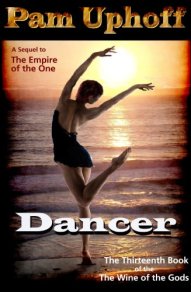
PAM UPHOFF:  Dancer (Wine of the Gods Book 15).

51fibo36-jl

*Fifteenth Book* In the Wine of the Gods Universe
Rael Withione was once one of the elite, a presidential guard.
After the assassination attempt, she has a long recovery ahead.
Investigating her brother-in-law’s murder was not part of her scheduled physical therapy.

Researching Your Fairy Tales – by Mary Catelli

vintage-1721914

[Yes, I know you’re going to say that this post is more suited to MGC.  And I confess that Mary wrote it thinking of writers.  But how many of us have had to defend Western culture in conventions, or even conversations, and point out that no, it’s not all “prince rescues princess”.  This gives you the background to point out most of what current crazies fight is imaginary.  Strong (really strong, not b*tchy) women have ALWAYS been appreciated, and western culture is no worse than others (and in many things it’s way better.) Perhaps because I put up with the usual idiocy at the recent con “there were no strong women at all before star wars” I feel forced to mention this.  Of course, in old tales, women weren’t made into ersatz men.  Garcons manque aren’t strong.  They’re sad. – SAH]

Researching Your Fairy Tales – by Mary Catelli

Would you like to work with fairy tales besides the Pop Top 20?
Would you like to invent fairy tales for your world that sound like fairy tales?

Would you like to have a character tell a fairy tale that has thematic resonance with the rest of the story?

Lots of possibilities out there!

Fairy tales, for instance, where the heroine bravely sets out to save her husband, or her brothers.

Where the princess opts to marry the servant and not the king whom the servant had brought her for.

Or the peasant decides that the princess who stole his magical treasures is not, after all, the girl for him.

Where the heroine gets to go to the ball three times because of having won the aid from a magical being, or even without magical help at all.

Where the maiden in the tower runs off with the prince before the witch catches them.

Where the story continues after they are married, and even had a child — or three.

Even — despite Disney — where a boy is the lead.

To find these, it is necessary to broaden your base of stories.  For instance, you could read all of the Brothers Grimm.  Or such important contemporaries and immediate successors as Peter Christen Asbjørnsen and Jørgen Moe (Norwegian), Laura Gonzenbach (Italian), Alexander Afanasyev (Russian)  or Joseph Jacobs (English and Celtic).

But the simplest way is perhaps to go to the library, go to the fairy tale section (Dewey Decimal 398.2, not that I have it memorized or something — adult section usually is best, though sometimes strange works get into the children’s), and look for books titled “Fairy tales of region” or “Folk tales of region.”

The next step is to check whether the region is France.  If so, you want to make sure it’s not a collection of literary fairy tales.  There are good folk fairytale collections from France — French Folktales by Henri Pourrat or The Borzoi Book Of French Folk Tales by Paul Delarue — but some are all literary.  Even if the literary ones are your interest (say, for a world with something like the precieuses in their salons), it helps to know the roots before you delve into the literary variations on them.

And then you read.

It does have the problem that you can’t play with the tales as easily, because your readers won’t recognize them.  You can, of course, change them and work with them, but the number of readers who will tell that your heroine went to Mr. East, Mr. South, Mr. West, and Mr. North because you are retelling “East of the Sun, West of the Moon” and they are the four winds — are very few indeed.  But that only requires writing the tale to not require knowledge of the original.  And you can do a straight retelling very easily.  (Though, being praised for your startling originality –as opposed to your cleverness in adapting it — is more annoying than you might think.  Especially when they start talking about your reasons for doing so.  No, you do not have be original to have your heroine rescuing your hero!)

The best collections for the writer, I think, are not straight as collected by folklorists, but have gotten a mild going over.  This is to do such things as smooth out such verbal issues as “Oh, I forgot to tell you that she was wearing the third dress for this,” and to conflate two variants of a tale, where each one left out one plot incident that, really, was crucial to making the story hang together.  Italian Folktales by Italo Calvino is particularly interesting in his footnotes of how he picked and chose variants and sometimes merged them and often choose colorful elements to elaborate his central one.  (For instance, he picked his Snow White variant because it was the only Italian one he found with bandits instead of dwarfs.)

Such books are seldom, if ever, a straight collection of pure fairy tales.  Most (especially those entitled “folktales”) include comic tales of simpletons or clever folks up to tricks, cumulative tales, and even legends.  Which, of course, you may find useful in their own ways.

But, on the whole,  it’s best not to read just one.  Read a dozen or so from different countries.  Or, perhaps, read a book like Beauty and the Beast Tales From Around the World by Heidi Anne Heiner or her Cinderella Tales From Around the World, both of which weigh in at a nice thumping 828 pages.  Reading one collection not specifically organized about a tale type gives you a bunch of fairy tales.  Reading a bunch of collections gives you many variations on a theme.  When you’re familiar with twenty variations of “Maiden in a Tower” tales, of which “Rapunzel” is merely the best known variation, you can master the type.

Then you can write fairy tales of your own for your world that will actually sound like fairy tales.


The Ground Moving Under Our Feet

life-3089646

This post is prompted by something that Amanda said on the comments to her post, yesterday: that traditional publishing should have seen the writing on the wall when their midlist writers started leaving en-masse for indie, but instead they lashed out and called writers widgets and said we could be replaced by others just like us… which is true… to a point.  The point is what they were missing: that things had changed, that there were other avenues, that the ones wedded to the old system and willing to be treated as widgets would be a self-selected population, and even those would probably not be willing to eat as much dirt as the rest of us did, when there was no other alternative.

Humans aren’t good at perceiving change, or perceiving conditions they’re not equipped to deal with by experience.

I’ve been in two earthquakes in m life, one majorish, one minor.  Both of them scared me so much that 17 years ago I nixed a highly advantageous move to California, because earthquakes.  (Turns out the decision was great, even if I made it for stupid reasons.)

The first earthquake I lived through, I was either 3 or 6 (these things run together in my mind) and it was pretty major, in that some houses in the village were severely damaged (stone houses, mind.) I slept through it, and woke up on the street, in my brother’s arms, blinking at all our neighbors in their pajamas or less.  (Grandad got his foot stuck in the guzunder, which was fortunately clean, but he ran down the stairs wearing a chamber-pot shoe because no one wanted to be caught in the house, in case it collapsed.

Apparently, if the house had collapsed both brother and I would have died, because having bravely pulled me out of the bed, he then spent precious minutes running back and forth from front to back door in my parents’ shotgun apartment (made out of what used to be my grandparents’ grain-and-other storage rooms) because he couldn’t decide which way to go out.  Remember he was a teen and we’d never had an Earthquake drill.

Years later (I think I was 21 or so, as I was already engaged to Dan) I was studying for finals, in my room, when the Earthquake hit.  My first thought wasn’t that the house was shaking (even though it visibly was) but that I was so tired I was hallucinating it.  Then I realized it was really shaking, and headed for the stairs.  And then the phone rang, and I FELL down the stairs, counting the last flight (nine or so stairs) on my behind.  (Fortunately cushioned there.)  It was a miracle I didn’t break a leg.  The ridiculous thing is that the phone call was my dad, who was up north where the earthquake hit first, and who was trying to warn me.

Note that Portugal is mildly disposed to Earth quakes.  (For years, the North has been waiting…. er…. expecting Lisbon to slide into the sea.)  In the North there are fewer than in the south, so ever ten or twenty years or so.  Meaning they’re not unknown, and you know they could hit at any minute, but they’re rare enough that your back brain interprets them as impossible.  Hence my brother’s reaction.  And mine.

Which is why people do fire drills, and Earthquake drills, and should be doing nuclear attacks drills again, too, and more sanely.

Because unless this is trained into your backbrain you don’t recognize it.  Because humans have got where we are through being REALLY good at identifying patterns like “if Ogg go play with tiger, Ogg get eaten.”  Other animals learn too, of course, but we have this thing called language to dissiminate this stuff far and wide.

But we’re not good at knowing when the pattern changes.  (We’re also vulnerable to faux patterns, aka faulty logic, and since, say, communism is internally consistent as a philosophy — though it has bloody nothing to do with the real world — people fall for it.)  All our adaptations are double edged swords, of course.

So, five? Six? years ago I heard an editor who is actually smart saying that this indie thing wouldn’t last.  When writers realized how much work was involved in covers, editing, publicity, dealing with sites, they’d come crawling back to editors and ask them to take it all over.

By then, I was already doing some indie, and knew a lot of people who were doing more.  Our covers weren’t very good or trivially easy, but we were learning.  And covers were the BIGGEST sticking point.  (We’ve got better.  The insert is novel hopefully coming out next month.) Because we, midlisters, were already doing everything else.  We were having to pay to have our traditional books proofread (and this was difficult, as sometimes they got messed up after that.)  We were already doing whatever publicity our books got.  And the sites were way easier to deal with than publishing houses.

ALIENCOVERFINAL
Coming hopefully next month. In the same world as The White Lady of Christmas, which is posted here somewhere. In fact, this is little Art Arcana III, all grown up.

So I stared in some shock, that someone smart didn’t see that this process which, yes, used to take an entire publishing house and trained staff, had in fact got so massively easier, due to automation, that it could be a one man job.  And that those of us who weren’t getting the star treatment didn’t really have any reason to go through the process.  Well, okay, some reason, SOMETIMES.  There are personal loyalties, etc.  BUT we certainly didn’t need to eat live frogs to get this stuff done for us, anymore.  Which is a massive game changer.

I don’t particularly blame publishing house personnel for not seeing it, either, really.  It’s like me looking at my books shaking in the bookcase above the desk and thinking it was just me being tired.  It’s not just that they know how many resources producing books took, it’s that they’re still surrounded by sycophantic wanna bes who think they’ll only be “real authors” if a house publishes them.  In the deluge they’re likely to miss that the quality of these ah… widgets has changed, and that people with a spine are not willing to break it for no better than “publication” anymore.  And PW and other publications who also can’t face the truth of the Earthquake under their feet don’t help things with stuff like “paper books are coming back, they really are.”

Now, when I talk of the changes that technology and the net have introduced in the last fifteen or so years, I usually illustrate with publishing.  It’s what I know better.  But it’s not just publishing.

The truth is that even those of us who believed the long march through the institutions had put a hard left cadre at the head of most things are shocked at how far this has gone, and are listening to the news about the FBI and the DOJ in something akin to stunned shock. And listening to the “defenses” of these things with even more stunned shock.

To me the whole thing looks like bullies who had been used to beating up weaker and smaller kids behind the shed, and suddenly the shed has gone transparent.  A lot of this was known (maybe not this much.  Okay, nowhere near this much) but couldn’t be discussed or admitted, because if you wanted to do anything you had to go past that shed and take your beating.

Now you don’t.  New media/blogs/indie have carved new paths.  Our brethren in education and movies are still prisoners, but I suspect it’s for less time than they expect.  Actually than anyone sane expects.

This ground is moving really fast.  Things are falling and rising up again.  And no one sees it clearly.

Of course, after 100 years of getting in position to control all of society (the only way socialism/communism can even PRETEND to work) the left is not going to take this calmly.  To the extent they’re waking up to how things are changing, they’re fighting back like weasels in a sack.  This is not going to be pretty.

I keep reading and in the back of my mind I’m expecting a “black day” like the revolution in Friday by Robert A. Heinlein.  A lot of assassinations and people disappearing from public life, and you don’t know why or which side is which.

I get that feeling that it’s time to assume the crash position and get ready for impact.  Now, this “time” might be one or two years.  It’s a blink of an eye in human affairs.  But I think a great scouring, a great upheaval and shaking is coming, and when it’s past we won’t even recognize the business, or political, or even daily life landscape.

In the end, we win, they lose.  Mostly because our philosophy is more aligned with reality.

BUT no one promised us a rose garden, and no one promised there would be no earthquakes.

Just try to run to safe ground, and mind you, don’t step in the guzzunder.

The State and Revolution Pt. 1 – by Amanda S. Green

revolution-30590

The State and Revolution Pt. 1 – by Amanda S. Green

Class Society and the State

Reading Lenin, whether you’re doing it in the original Russian or in English, is like reading a mix of law school textbook and philosophic arguments. You have to pay a great deal of attention to not only what he says but how he says it. Worse, reading it today, it is easy to fall into the trap of thinking how reasonable what he wrote more than a century ago seems. After all, we’ve heard so much of it as recently as the 2016 election cycle. That is what makes Lenin as dangerous today as he was in the early years of the 20th Century. It is also why it is so important that we study what he wrote and how he and his followers implemented his policies in the Soviet Union.

The first chapter of The State and Revolution is entitled “Class Society and the State”. Lenin spends the opening pages discussing how the “oppressing classes have constantly persecuted the great revolutionaries in their lifetime, reacted to their teaching with the most savage malice, the wildest hatred and the most shameless campaigns of lies and slander.” He goes on to write how the “bourgeoisie and the opportunists within the working-class movement at the moment co-operate in the elaboration of Marxism.” In other words, he accuses the middle class and the so-called opportunists of blunting the message of Marxism , “emasculating the essence of the revolutionary teaching. . . .” (-pg 7)

So, in other words, not only was the upper class the problem in Russia at the time of the revolution but, as far as Lenin was concerned, so was much – if not all – of the middle class. True, their “crimes” were the same. The upper class, the ruling class, wanted the status quo to remain. They had the power and did not want to give it up. The middle class, the opportunists of the time, stepped in as the Mensheviks and the Provisional Government took charge and perverted true Marxism, diluting it to their own purposes while giving lip service to the original.

Even as Lenin sets his Bolsheviks up to be the “true” believers, it becomes clear he was not above perverting and using Marxist doctrine to his own benefit. In fact, if there was ever an opportunist during 1917-1918 Russian history, it was Vladimir Lenin. Even as he wrote “our task is above all to re-establish Marx’s authentic doctrine on the state,” he meant to establish his own interpretation of it. (pg 7)

When it comes to the historical role and significance of the “the state”, Lenin writes:

The state is the product and the manifestation of the irreconcilability of class contradictions. The state arises where, when and to the extent that class contradictions objectively cannot be reconciled. And, conversely, the existence of the state demonstrates that the class contradictions are irreconcilable. (pg 8)

How many ways can he say basically the same thing in one sentence? If there weren’t irreconcilable class contradictions, there would be no state. At least according to the man whose great communist experiment led to one of the most oppressive “states” in human history.

In other words, Marx saw the state as “an organ of class rule, an organ for the oppression of one class by another; it is the creation of ‘order’, legalizing and perpetuating this oppression by moderating the clashes among the classes.” (pg 8) Now, let me ask you this: does the gist of this statement sound familiar? How often did you hear a variation of it being thrown out during the 2016 presidential race by first Bernie Sanders and then by Hilary Clinton? Keep this in mind as we continue the discussion.

Lenin spends several pages describing how the Mensheviks and others strayed from the true Marxist definition of the state and how the Bolsheviks, under his leadership would bring true freedom to Russia. “It is clear that the liberation of the oppressed class is impossible not only without a violent revolution but also without the destruction of the apparatus of state power which was created by the ruling class and which is the incarnation of this alienation.” (pg 9)

[Right here is both what allowed Marxist theory to infiltrate psychiatry in the west and give us the idea that capitalism caused madness.  Or that madness wasn’t real but an effect of capitalism.  Therefore the “mad” were actually dissenters and should be freed.  Hence closing our madhouses.  Also the excuse for putting political dissenters into mad houses in the Soviet Union.  Because they were rebelling against a “sane” state, after all.  And this confusion between politics and sanity is right here- SAH]

If this doesn’t bring to mind images of Antifa and certain BLM “protestors” or images of the so-called “concerned students” who shut down how many presentations by people like Ann Coulter or Milo simply because they didn’t espouse the “right” ideas, it should. Just as it should remind us of those politicians, both currently in office and those who didn’t find themselves sitting in the Oval Office, who encouraged the less than peaceful “protests” over the last few years.

In discussing the creation of a standing army and police, Lenin turns to Engels. Basically, a standing army and police are the creation of the state. It is there to keep the oppressed under control. That expanded to include the state’s use of these standing army and police to expand the state’s territory. How different it would be if we had a “self-motivating armed organization of the population” (pg 11) All those loving and giving and non-middle class oppressor would be so much less likely to use their weapons for anything but the “good” of the whole.

Pardon me while I laugh hysterically.

Of course, it doesn’t end there. You knew it couldn’t – or wouldn’t. Next up is the state as “an instrument for the exploitation of the oppressed class.” If that doesn’t sound like it came straight out of the Bernie Sanders playbook, I don’t know what does.

Lenin, being an expert at pushing the right buttons in a time of turmoil, boiled all of Engel’s writings on this particular question to this: what is it that places them [state officials or bureaucrats] above society? According to Lenin, this “theoretical question was resolved in practice by the Paris Commune in 1871”. (pg 13) A bit more about the Paris Commune shortly.

As the state arose from the need to hold class antagonisms in check and as it arose at the same time in the midst of conflicts among these classes, it is a rule the state of the most powerful, economically dominant class, which, with the assistance of the state, becomes also the politically dominant class, and thus acquires new means of suppressing and exploiting the oppressed class. (pg 13)

[This effed up idea, instead of the idea that the state arose to do the very few things that people can’t do individually is responsible for the insanity of socialism and communism.  They think the state needs to pick losers and oppress the “right” people.  It was never meant to be neutral.  There is no equal under the law. – SAH]

Does this mean the question is really “Which came first, the state or the rich, ruling class?” Or maybe it’s “What the hell is he talking about? Has he ever really paid attention to what people are really like?” [No. He knows what he wants them to be like.  As a sociopath, that’s all he needed – SAH]

Here is the money quote, one we need to always keep in the back of our minds:

A democratic republic is the best possible political shell for capitalism, and therefore, once capital has got control of this excellent shell, it establishes its power so securely, so firmly, that no change of individuals, of institutions or of parties in the bourgeois democratic republic can shake this power. (pg 14) Lenin goes on to note that Engels concluded universal suffrage was an instrument of bourgeois rule.

[Which also explains the Democratic congresswoman, wassherface saying the voters are ruining democracy.  I think we found the ink they drink. – SAH]

So where does the Paris Commune of 1871 come into all this?

The Paris Commune was the socialist – and radical – government that ruled Paris for a grand total of two months in the Spring of 1871. Napoleon III had been defeated the year before. The Second Empire ended and the Third Republic rose to power. France was at war with Prussia. In the upheaval that followed, the Paris Commune arose. For a brief look at the Commune, check out its Wikipedia page. Yes, it accomplished certain typical socialist goals. However, it is difficult to count anything it did as a success or an example of socialism in practice because of the short length of time the “state” once again took control. The very fact the Commune did not know any real time of peace, a time when they weren’t all fighting for a common goal, also casts doubt on how much of a real example of socialism in practice it could be.

I suggest that a more accurate representation of we what socialism in action can be is to look at the genesis of the Soviet Union. No matter how enticing some of the tenets of socialism might be, unless and until you accept that humans are flawed, they are selfish, some are lazy while others are driven, you will not be able to see the flaws of socialism. The underlying basis for it to be successful is for humanity to reach a point where each person puts the good of the many above the good of the one, NO MATTER WHAT. It means knowing that no matter how hard you work, the benefits of your labor go to all according to their needs. But who is it that determines that need? It certainly isn’t the person putting forth the effort.

It is important to remember that Engels preached that the State would “wither away”. In other words, “when the state finally becomes truly the representative of society as a whole, it makes itself superfluous. . .The government of persons is replaced by the administration of things and the direction of the processes of production.” (pg 16). This is the withering away. Of course, what Engels – and Lenin – doesn’t address is who directs and administers and 1) how they are chosen and 2) why they won’t fall into the same pit of oppression the current managers and administrators of the state have. [Neither of these men had ever run a business.  This is part of the reason they believe the state is therefor keep the classes in order or something.  They have no clue how much administration and how many decisions even a small business, let alone a big nation, take – SAH]

This withering away is, according to Lenin, the only “real legacy of socialist thought” in the socialist parties of 1917. He then goes into a perfect example of the game of twisting and reshaping what he said Engels wrote into what he says Engels meant. He changes the “withering away” to the state being “eradicated by the proletariat in the course of the revolution. It is the proletarian state or semi-state which withers away after the revolution.” (pg 17) In other words, we now have to look at the evolution from an oppressor state in at least three stages: revolution, the establishment of the proletarian state and, finally, the withering away of that semi-state into the socialist existence.

To accomplish the former, the proletariat must have its own “special repressive force” that will be used for the suppression of the bourgeoisie. Wait, what? Isn’t that just trading one oppressive government for another? Not at all, or at least not really, according to Lenin. It is necessary for the “eradication of the state as a state.” (pg 17)

Riiiight.

But it continues. “Engels refers quite clearly and definitely to the period after ‘the state’s expropriation of the means of production in the name of the whole of society’, i.e. after the socialist revolution. We all know that the political form of the ‘state’ at that time is the fullest democracy . . .democracy is also a state and that, consequently, democracy will also disappear when the state disappears. Revolution alone can ‘eradicate’ the bourgeois state.” (pg 19)

Every state, according to Lenin, is unfree and non-popular. Even so, he favored a democratic republic as the “best form of the state for the proletariat under capitalism, but we have no right to forget that wage slavery is the lot of the people even in the most deomocratic bourgeois republic.” (pg 19)

Wage slavery. Hmmm, why am I reminded of calls for huge increases in the minimum wage without one politician in favor of it explaining to the population the economic realities such an increase would bring into play? Let’s increase pay to a “livable wage” as determined not by the circumstances and location of the particular worker – much less his or her abilities and education and time of the job – but by an arbitrarily determined number. Let’s not worry about the economic impact that will have on the employer or how said employer will pass along that hit to his customers who, in turn, will pass their hit on to others. Welcome to the People’s Republic or Commune where consequences don’t matter until we can no longer deny them.

Over and over again, Lenin returns to his refrain that the proletarian state cannot replace the bourgeois state except by way of violent revolution. The withering away of the proletarian state is the eradication of “the state” and is not something that will happen overnight.

Think about Lenin’s constant refrain of violent revolution and look at what has been happening in our country. Look at the rhetoric coming from certain politicians who encourage the “protestors” to violate the rule of law, to ignore the concept of private property. See the parallels with what is happening now with what happened in the early years of the Twentieth Century.

Then ask yourself this: if we have that violent revolution here, who has been putting themselves into position to take control. Are they the people you want to trust with not just your future but your children’s and their children’s?

Recognizing not only the rhetoric but the tactics is important in preventing history from repeating itself.

[For raising the tone of this blog — ATH is culture! — and helping me with the exposing of the roots of the current mess — in her case with more facts! — if you decide to  send the woman a drink–  And her Amazon author page is here -SAH]
Semantic Confusion

My problem with the women’s marches, the one last year, and the one now, is that I still don’t understand them.  What’s more, the people marching in them don’t seem to understand them.

Go look at that link, I dare you.  When asked why they were marching in the … ah, sisterhood of the traveling pussy hats… the enlightened activists gave the following answers:

“So future generations don’t have to.”

“My Mother and Planned Parenthood.”

“My mother, she’s a homeless person.”

“I don’t want my children growing up how this is now.”

To which the only logical and appropriate response is “AND?” because, honestly, what do they expect to gain by marching?  “So future generations don’t have to?”  Don’t have to what?  What are you marching for, precisely?  The right to wear a pink pussy hat, or dress like genitalia?  I don’t think anyone ever disputed that, honestly.  Pointed and laughed, sure, but hey, that’s our right.

“My mother and Planned Parenthood” is roll on the floor funny.  What are the links between those two?  Does her mother work at Planned Parenthood, or just visit frequently?  Is she just happy her mom didn’t use Planned Parenthood to get rid of her?  WHAT?  What the hell does that even mean, and what does marching on the street like a loon do for either her mother or planned parenthood.

“My mother, she’s a homeless person.”  Oh, this one takes the cake.  I mean, in a country full of services for the homeless, in a country in which the only way to remain homeless for more than a couple of weeks is to be mentally so far gone you can’t function, or to have a drug or alcohol addiction, this flake is marching for her mother because her mother is homeless.  Here’s a clue, sparkle princess, marching for your mom will not do squat.  How about bringing mommy home and inviting her to sleep on the sofa?  That would do something.  Is your filial love predicated on marching so everyone knows how nice you are, but you can’t actually be bothered to help the woman who gave birth to you?  And what do you expect your silly march to do?  PRECISELY?  Will you explain this to me?  People will go “Oh, she’s marching with a pussy hat, I’d better take care of her mom?”

This last one is the same shit that liberals always tell themselves, and note the vagueness of it “I don’t want my children growing up how this is now”

Um…  you don’t want your children to grow up with electricity, abundant food, and better hygiene than any other society in the history of mankind?  Is that it?  No?  Then what don’t you want your children to grow up with?  A mother who can’t express herself to save her life?

Over all, over and over again, they seem unable to answer the one fundamental question: What are you marching for?  What do you expect to result from this?”

Some of them make allusions to some vague “lost rights.”  I want someone — anyone — to go over the law and everything that’s happened legally from last year till now.  What right have women lost?  Name me one.

They can’t of course.  It’s just that their betters told them that women would lose rights under Trump, and therefore we must have.  Somehow.

The smarter might make strange noises about health care, but that’s the veriest bullshit.  Insurance is not healthcare.  Obamacare was already imploding where it counted: on getting to see a doctor for your problems.  Not having to pay a fine for not having “insurance” doesn’t kill anyone.  The contrary could be argued.

But let’s concede they’d lost “rights”.  What in actual heck would marching around be-pussied do?  Despite some of the signs (like the one proclaiming this chick’s vagina was the scariest thing anyone had ever seen [we believe you, crazy lady]) a) people know women exist.  b) people know women have vaginas, and no, conservatives, republicans and libertarians aren’t scared of vaginas.  Well, maybe of crazy liberal vagina, because who knows what in heck diseases multiply there, but not of vaginas in general.  Most of us either have vaginas or think highly of them. c) even if women had lost rights — say the right to kill babies who can survive outside the womb, because mommy changed her mind — what would marching do for it?  Most people who think that right should be lost — including women — have reasons ranging from the cohesion of society to the idea that murdering innocent humans in batch lots is bad (‘mkay?) and their minds aren’t going to change because some frankly unhinged idiots march up and down saying things that mean nothing or carrying signs that are self-indictments as to inability to reason.

The other day I was watching liberals lose their sh*t when the results of the election came in (don’t judge me, okay? The alternative was calling my few remaining liberal friends and laughing) and there was a woman news anchor telling the world how she didn’t respect any woman who voted for Trump, because he was a serial assaulter (totally unproven), treated women like objects (COMPLETELY unproven, and according to women who work for him, counterfactual) and had talked about grabbing women by the pussy.

And my jaw dropped open.  leave aside that I’d lay you even money this idiot voted for Clinton, probably twice, and Clinton WAS a serial assaulter who treated women like objects, and it’s all proven and public record.

Let’s go to the “grab them by the pussy.”  All Trump said was that if you were rich enough women would let you grab them by the pussy.  He didn’t say he did it.  He didn’t say you should do it.  All he was saying was that women find things other than looks attractive. He was in fact saying women are hypergamic which happens to be true.  And yeah, he used the word “pussy.”  Dear idiots, if your vagina is the scariest thing anyone has ever seen, and if people who can’t say “vagina” can’t legislate it, you can’t faint with shock at the word pussy.  That’s not how this works.  that’s not how any of this works.

And no one is impressed with your strutting your pussy hats and vulva (no, those aren’t vaginas.  Geesh.  Did no one ever teach you anatomy) costumes, when you can’t articulate what you’re doing it for, nor reasonable goals you hope to obtain from this.  Because the things that come out of your mouths make me wonder why your vote counts as much as mine.

Heinlein’s books talked a lot about semantic incoherence during the crazy years.  I was unclear on the concept but I’m not anymore.

And the worst of it?  The absolute worst?

This is how women talk.  Note not individual women and not all women.  But it’s a thing women do in groups.

You see, just like testosterone boosts your self confidence and your ability to feel good about yourself, female hormones boost your ability to bond, your desire for group cohesion, and your not-perfectly-rational wish to belong.

So you get a group of women, and it’s easy to get them all to march out for no particular reason and with no end in sight.

You’re invited by friends, because “we’re all doing it.”  And you go, because your children or your mom or stuff.  Because your friend told you “we have to do it so the children don’t have to” or because “isn’t your mom homeless.”

And unless you’re rock bottom stupid (some people, male and female, are) you know it doesn’t make a wit of sense.  But your friend is so sure.  And if you ask questions or point out it makes no sense, they’re not going to talk to you again.  There’s going to be a rift, and who are your kids going to play with?

Women are evolutionarily designed to avoid conflict and reinforce the group.  This means they can be very good for creating happy extended families, and very bad for creating crab buckets at work or in political situations.  And they’re really good at mass movements of astounding and jaw-dropping incoherence.

This bothers me for two reasons:

It gives ammo to genuine bad actors who hate us and everything we stand for.  The Mullahs in Iran can say that even women aren’t happy living in the great Satan, look at their demonstrations.  Clearly, Islam respects them much more, by wrapping them in furniture covers.

It gives ammo to genuine misogynists.  They can assume that every woman is an incoherent zombie, and use it to curtail the rights of thinking women, or to sweep us out of employment, or to treat us like overgrown children.  Because honestly, the women on those marches are overgrown children.  They’re just not all women.

As a woman, and one who believes in female equality before the law (not in female equality, because we’re different from cell to hormone) I want these women to stop, to think, to consider what’s likely to come from this, and to behave like thinking human beings.

This might be impossible because “aren’t you marching? I knitted you a hat.  If you don’t come, I know you hate us all.”

It’s human.  It’s the way we’re made.  And I’m not going to march against it, but it’s annoying the heck out of me.


We’re Already That Which Passes

man-1169309

I used to think my grandmother had seen amazing change in her lifetime.  She did, look you.  She was born in 1904, in a village that still had iron rings embedded in every wall or pavement near the door, so you could tie your horse, while going about your errands.

She died in 1992, in a world that had not only sent flights to the moon, but where flights to other continents were normal and easy and even (relatively) affordable, compared to the long transatlantic ship travel my grandfather did.  Her children who had immigrated to Venezuela and Brazil could visit, if not every year, then every other year, something that had been unthinkable when she was young.

But in a way, her quotidian life was not that much different.  Part of it was the village being in many ways a slow community, lagging behind, taking what it wanted from progress and ignoring the rest.

When I was very little — this was important, since I sometimes needed to be rushed to the hospital for oxygen (I really have never been very well, except briefly in my twenties, which I now feel I squandered) — there were two cars in the village, both panel vans, both associated with jobs.  The joking description for the road I lived on when I was little was the road “oooh, there comes one.”  Meaning cars were rare enough they were remarkable.  This changed in the late seventies and early eighties, of course, but it was a slow “let’s adapt to this” ramp.

I mean the village grew before I was born.  I know that, because when I was 6 my uncle from Brazil came to visit first time in 20 years, and was amazed at all the new houses, and some new people.  But all his old acquaintances were till there too.  I wonder what he’d make now of Porto swallowing the village whole due to the highway being put in, and of high rises all around.

The thing is the changes in he 20th century were more “outside the house.”  Sure, there was the telephone (Grandma — and us — only got that in the late seventies, but we could cross the street to answer the phone in the general store, if called for.)

Our changes are direct, personal, where we live, some of us more than others.

We tend to think nothing changed, because well, where is my flying car?  WHERE are my moon colonies?  (My grandkids could very well live in one, but never mind.)

But so much has changed about daily life.

You see, mysteries, contemporary or near past are like time capsules.  Because the crime and solving it depends on the details of everyday life, you get to see/feel/taste the past.  Agatha Christie is a primer to between the wars.  And in another ten years people will look, confused, at “A murder is announced.”

I realized that two mysteries I wrote in the late eighties are now unpublishable and unsalvageable, because the murder/solution depends not only on there being no cell phones, but there being no computers.

My kids are more aware of what used to be than most of their generation because they read, but the number of times I’m telling them something, or we’re watching a mystery and they say “Why didn’t he search that on the net?”

I used to wake up, the first twenty years of my marriage, and spend an hour reading the daily papers (local, Denver and the WSJ.)  The arrival of monthly magazines gave me a day off as I read all the news and opinion pieces.

It changed so suddenly, that the postage I had to mail out short stories on submission has been “feeding” all our postage needs for the last 10 years.  Short stories (not that I really write on spec anymore) and novels go out electronic.  And more and more they get published electronic (and I need to catch up on paper) right here too.

I’ve gone from telling people how to submit, to just telling people to go indie at least at first.  Those people in general make more money than I do.  (Go indie, young man, go indie.)

And the secondary order effects are still percolating, things we don’t see coming yet. Note the village was swallowed up by a big city on the delayed arrival of a 20th century tech.  The highway which now runs up and down the length of Portugal wasn’t completed till the end of the century, but it makes it possible honestly (it’s a small country) to commute from one end of the country to the other if you so wish.  My brother, on his first job, used to go to Lisbon for the week and commute Fridays and Mondays by train.  It took half a day.  Our trip to the beach at the Southern end of Portugal took eight hours by car (usually at night.)  This means populations are dislocating, and what was once a highly regionalized country is homogenizing.  It will mean strange marriages, the break up of traditional culture (good and bad.)

The US went through that in the 20th century to an extent, (except it’s more within states) but it’s now going through something different…

More and more people work from home.  Sure, there are some professions that won’t be able to do it.  But many can.  And things change.  Part of the reason our society is as it is, part of the reason for the state as moral arbiter is the working out of another change form mid-twentieth century: most women working.  Kids raised by strangers.  The schools having free rein, because you have to trust someone and who checks EVERYTHING when you’re dead tired.

Internet? Cell phones? Work from home?  More autonomy in a lot of professions, like mine?

Where does it lead?

This morning I woke up with the idea that soon, not very far off, the world I was born into will be strangely romantic.  Checks? Phones? Letters? Newspapers?  The stuff of romance.

At some point in the future, a novelist will make us as quaint as the regency.

But for me it is yesterday.  Caught between the times, I only want to see where this is going.  Sure, there will be turmoil and confusion, but so far the changes seem as though they’ll empower the individual.  And that’s something I approve of.