I Must Write And My Nose Won’t Work

citypark april 2018

Coming at you this morning from sunny springtime snowbound Colorado, to tell you why the cat ate my homework.  Or at least the sinus infection did.

I really do not willfully set myself up to get these horrible infections and lose time off work.  The problem is that the symptoms of sinus infection (or ear infection, or throat infection) are easy to confuse, at its onset with the symptoms of auto-immune.

Since for the last two months we’ve been going from family issue to family issue (now in a lull and none of it relating to our marriage.  Just relatives and things happening) and on high stress mode, I assumed that the stuffiness, inability to breathe, etc were in fact just autoimmune.  A course of pred knocked back the symptoms enough that my hands stopped having holes in them, but then some fresh hell put eczema all over my arms.

It wasn’t until three days ago I realized I had a fever, and that the symptoms, including the need to sleep ALL the time were much like those of sinus infection.  Yes, I’ve been irrigating, etc, but it was so dry-and-dense that nothing came out.

So, antibiotics acquired.  I was also told to stay on mucinex.  And there hangs a problem, because mucinex makes me extremely dizzy and unable to concentrate.

The dizziness goes away when I stop it, so it’s definitely it, but I’m not sure what to do about it, since I’m fairly sure I need to dissolve the crud in my nose.  But mucinex makes it impossible to work.

Anyway, that’s why the books that were supposed to come out the last two months haven’t.  I’m going to see if I find something else that allows me to breath but also to write.

At any rate it’s a lovely writing weekend.  I’d planned on dragging older son to the zoo today, but I don’t think I’ll be able to convince him it’s a great idea to go out in the snow.

So this is my non-post post.  And now I’m going to have some coffee and attempt to work.


The Good, The Bad and the Eternal

So recently some twitter twit, of whom I’ve never heard in the whole course of my days too it upon herself to put down both John Ringo’s work and mine (I’m still not sure at all why I was pulled into this, except that I gall them by existing and not falling in line.)

Those of you who have read both of us might go “What do these two things have in common?”  I don’t know, but since this was was on a twitter thread where it was also proclaimed that we wanted people like the writer to die, you have to take it with a grain of salt.  I don’t think I’ve ever consciously desired anyone’s death, though I’ve been known to wish plagues of locusts or the like against people who are annoying me.  The person then backpaddled and said that the policies we support means people like him/her/zyr would die.  This is a puzzler.  The only policies I know of that cause people to die are derived from Marxism — 100 million and counting! — so I believe Xer was misinformed.  Maybe Syr read too fast and missed the “anti” prior to Marxist.  Or maybe the uninformed keyboard strummer really believes all that stuff about you know, not paying for contraceptives is the same as banning them.  Maybe zyr believes that if we don’t actually lovingly spoon mush into zyr’s mouth, and pay for it too we want zyr to starve..

However, it was the comment on our writing that amused me the most.  Look, I enjoy the heck out of some of Ringo’s books, but it took me a while to get into them, just because his plot structure is so different from mine.  I used a very classically ordered plot.  He doesn’t.  Took me a while to realize no, it wasn’t just formless.  And because I’m a writer, it drove me nuts, looking for the pattern, and it wasn’t until I figured out what thread he was following that I could relax and enjoy it.

It’s the same problem I had watching Japanimation with the boys.  Their concepts of story are so different from ours that on first exposure, it doesn’t fit well.

So, is John Ringo a good writer?  Uh. You know, I listened to the Black Tide series, in audio book, while fixing our previous house for sale.  We had been delayed putting it for sale because I’d had major surgery and been so ill, and we were renting elsewhere and running out of money.  On top of that everything that could go wrong did, from younger son stepping on a nail and putting it through his foot, to it raining continuously while we were doing repairs outside.

You’d think it was a depressing serious to listen to, while doing that, but the thing is, as bleak as much of it is, there is a hint of unquenchable human spirit a surging tide of hope (eh) throughout the book, and you actually feel uplifted by this.

I have, for my sins, a degree in literature (actually literatures, which is a word in Portugal, because I had to study the national literature of every language I studied.  My degree is in Languages and Literatures, formally.) If you ask me if John’s work is literature, the only thing I can tell you is that it’s not “literary” which is its own separate genre and requires a certain playfulness with words, and a certain obscuring of meaning which he doesn’t bother with.

But is it literature?  Well, literature and literary have bloody nothing to do with each other.  Literature, in the sense of the stuff you study in school, is stuff that either has survived the test of centuries to speak to those yet unborn when it was written.  Yeah, there’s also modern literature and that tends to be “literary and guessing” and most of it — thank heavens– will be mercifully forgotten if not mocked by our descendants.

That contemporary stuff is picked by literature professors on very specific characteristics.  Some of it is just confusion.  Because the old stuff we study tends to have a level of opaqueness in language, (because of the time when it was written and the evolution of language) they tend to assume that opaque meaning means “literary.”  In the same way because we study the old books according to the current fads, we tend to study the old books according to the prejudices of our time: that is to say through a social-classes, struggle, anti-authority, and other Marxist distorting lens.  Thus Pride and Prejudice becomes about female oppression and money, when well… no, it wasn’t about that except very marginally and at the edges.  And what they do to Shakespeare is unforgivable.

But because we view the immortal literature through those lenses, we’ve created an entire set of books, an entire genre (and subgenres of other genres) that tries to emulate those characteristics, and is both  purposely difficult to read and, at the same time, filled with the prejudices of our time, and the cause du jour.

I am glad to report that nothing of Ringo’s I read fits in those two characteristics.

Does this make it bad.  Good Lord no.  It moves the emotions, which is what any good writer should do.  He also has an amazing amount of logic and world building buried sometimes beneath action and a few jokes.

So, am I a bad writer?  Heaven only knows.  People in general don’t seem to believe so.  Yeah, little Damian lately of the Guardian thought I was, but that’s because I a) used first person, which is apparently a “marker” of bad writing (wouldn’t a lot of immortal writers be shocked.) and b) didn’t engage in pretty-wordage.  He might have been shocked if he read my first published novel, the one which was a finalist for the Mythopoeic.

And that’s part of it.  Am I a bad writer?  Well, if you equate a certain style with “bad” I’ve written some very bad books.  If you equate a certain style with “good” I’ve written a few good ones too.

Even if you judge them as I do, as “books that are immersive and cause you to experience powerful emotions” I’ve written good and bad books, both.  Every writer does.  My favorite authors all wrote some pot boilers and then some brilliant stuff.  Our books aren’t just the product of our minds, and whatever idea we had.  They’re the product of our state at the time.  When a book is due and I’m sick, or preoccupied with something else, it’s not going to be as good as it could otherwise be.  And yet, often, those are the most successful ones.

This is why I try not to pronounce on other people’s books.  I can tell you what I don’t like and what I like, and I can say if there are factual errors in a book, or even errors of narrative (like the person who kept signaling their character was a tall male, while she was supposed to be a small female.)

Most of the time, though?  Most of the time, the worst thing I can say about a book is “I couldn’t get into it.”  If after page five I just don’t feel any reason to read on, I can’t tell you why, but the book isn’t getting a second chance.  Now, are these ever ideological?  Rarely.  Only if the politics comes at it out of place.  A long diatribe about current politics in a future book, particularly naming names, will pop me out.

But usually it’s far more subtle than that.  Usually it’s just “this just doesn’t interest me.”  And sometimes, mind you, I personally like the author as an individual.  The book just fails to interest me, and since I’ve reached the age when I’m aware my remaining reading time is finite, off it goes.

Sometimes mind you, this is situational.  I might be unable to get into a book at a time when I’m ill or stressed, then find it completely immersive three months later, when I stumble on it again.  Similarly, I might love a book, then go back 20 years later and wonder why.

So I might say things like “I haven’t read it” or “couldn’t get into it” or even “I don’t like it” or “It depressed me.”  But I rarely say “it’s a bad book” PARTICULARLY if it’s a book by someone whose ideology I despise.  Because, you know, I’m aware that they’re rubbing me wrong on the ideological front, and therefore I might not appreciate their good points, or even their great qualities.  Because I’m human.

Will some of those books I couldn’t get into go on to become immortal literature of our time?  Probably.  Statistically speaking, at least one of them should.

Don’t I feel bad about it and like I should like it?  No.  Why should I.  What I like is what I like.  What I consider good is what works on me at the moment.  Writing and story telling being such a personal art, aiming at evoking not just an emotion but a series of them in the reader, I can only tell you “this was good for me now.”  And if it works many times over years, like Heinlein or Pratchett, I’ll tell you “this is just good.”  But it’s always for me, and through my lens.

Do I have any idea what works will be immortal?  What will resonate with future generations?  Ah!  No.  I’d be surprised if at least some of Pratchett and some of Heinlein didn’t make it.  I think it’s quite likely some of Ringo will make it.  And I think it’s unlikely to the point of making me snort-giggle any of my stuff will make it.

What about the stuff the SJWs write?  Will any of it make it?

Some might.  Just because someone is objectively mistaken and in need of dried frog pills, it doesn’t mean they aren’t touched by the divine spark that makes something immortal.  An that spark makes you forgive a million bad points.

The one thing I can say for sure is that they don’t know what will make it any more than I do.  And their attempts to get people to stop reading us because we’re “objectively bad” only mark them as kindergartners, repeating what they heard teacher say, without actually understanding.

As they usually tell us about drugs and the more outre sexual explorations “How do you know you won’t like it till you try it?”

“When any government, or church for that matter, undertakes to say to it’s subjects, this you may not read, this you must not see, this you are forbidden to know the end result is tyranny and oppression, no matter how holy the motive.” – Robert A. Heinlein.

And that goes double for half-baked keyboard warriors pronouncing a holy ban on things they admit they never read.

Pfui.  Only children and savages are afraid of the written word to the point of condemning it unread.

We are given a certain time and a certain number of books that allow us to experience someone else’s mind.  Sure, a lot of those minds I won’t like, or more likely won’t interest me.

But there are minds that interest me and which are vibrant and alive in all sides of the political spectrum.  And I’d be a fool to deny myself the pleasure of those immersive books just because their authors are politically deranged.

As for trying to guess which books the future will admire, and which it will praise, and trying to read them today?  Who cares?  When that future arrives you’ll be long dead.  Do you need approval so desperately that you must have people you’ll never meet retrospectively endorse your choices?  I don’t.

The future can like what it likes.  And I can like what I like.  And if the future likes something else, that’s fine.  I doubt I’ll care.

Read.  Read whatever you like.  Enjoy what you enjoy, hate what you hate.  But do not condemn books unread, because that’s a waste of time and mind.


A Higher Loyalty or Self-Justification? – by Amanda S. Green.

A Higher Loyalty or Self-Justification? – by Amanda S. Green.

I planned on finishing up Thomas Sowell’s “Black Rednecks & White Liberals” this morning. That’s not going to happen. I have been struggling with the post and decided it is better to put it aside for a week than try to force it. Sowell’s work deserves better than a quick overview. It is important enough to be given careful consideration, even when he writes about things that might make us uncomfortable.

But that left me wondering what I should do for Sarah today. I didn’t want to leave her without a post. Then I remembered the book waiting in the TBR queue. You might have heard about it. Some fellow who used to work for the government wrote it. It came out earlier this week and has the distinction of pissing off people on both sides of the political aisle. Need another hint? The Clinton camp still blames him for her losing the election and the Trump camp blames him for not indicting Clinton – and others.

That’s right, boys and girls. I’m talking about James Comey and his new book, A Higher Loyalty: Truth, Lies and Leadership. Before we get started on Comey’s initial comments in the book, I have done my best to put aside my personal feelings for the man and his actions over the last year and a half to two years. I want to give him, or at least the book, a fair shake. I also have promised friends of mine who know him and who are having problems reconciling the man they see on the promotion trail now with the one they worked with.

After a bit of trouble getting the e-book to open – for some reason, it doesn’t want to download to my MacBook Air – I finally opened it through the Amazon product page and started reading. While Comey probably had no input on the front matter, as a reader, the publisher (Flatiron Books, part of MacMillan) has already insulted me. Instead of the standard disclaimers, we are told this e-book is for personal use only and cannot be made available publicly in any way. Wait, what? Does that mean you can’t use excerpts in reviews? They might try to argue it but the wording is too vague. I am going to assume they mean you can’t loan it or share it with anyone.

But then you get to the copyright infringement language. Language the publisher so helpfully bolds just to make sure the evil customer who dared buy an e-book version knows. Talk about telling someone who just paid more than they should for the book that you don’t trust them.

The book opens with a note from Comey. That’s not so unusual in books like this. It seems authors – or their ghost writers – have a need to tell folks why they felt the need to write the book. Now, this is information that could be woven into the text elsewhere but why do that when you can put it right up front, making sure you set the narrative firmly in the reader’s mind?

Comey begins the book by asking a simple question, “Who am I to tell others what ethical leadership is?” He notes that anyone writing a book about this topic can come across as presumptuous and sanctimonious. He’s not wrong there. In fact, as I read the opening paragraph or two, those were my exact thoughts. Maybe it is my own knee-jerk reaction, but I’ve found more often than not that when someone starts off asking such questions, they are more than willing to tell you exactly why they are the one to write the book. But I pushed down that reaction and continued reading. After all, this is just the Author’s Note.

So why did he write the book if not as an exercise in vanity (something he denies). According to Comey, “We are experiencing a dangerous time in our country, with a political environment where basic facts are disputed, fundamental truth is questioned, lying is normalized, and unethical behavior is ignored, excused or rewarded.”

When I first read that statement, I laughed and wondered if he had paid any attention to life in D.C. during his tenure there. Then I wondered if he had ever studied history. To think you’d find ethics and truth in the political hub of a nation is like thinking you will find the proverbial needle in a haystack while standing five miles away and the only tool you have to help you is a standard pair of tweezers. At least he had the decency to note this “dangerous time” isn’t limited to the United States.

In some ways, I can even agree with him. However, the behavior he condemns isn’t limited to the current administration. Nor is it anything new. If you’ve paid any attention to current events over the last several decades, you’ll know that.

This is, according to Comey, a time for “ethical leadership”. He admits he’s not an expert in what that term means. But he has studied it, read about it and thought about it. I guess that is enough, in his mind at least, for him to spend a book telling us what an ethical leader is and how they should act. We’ll see.

An ethical leader, he said, doesn’t run from criticism or uncomfortable questions. Ethical leaders look beyond the short term or the urgent. They take “every action with a view toward lasting values.” These values are found in religious tradition or in a moral world view or an appreciation for history. There must also be a “fundamental commitment to the truth” or we will be lost.

He ends this Author’s Note by discussing how he came up with the book’s title. It seems it came about because of a dinner he had with President Trump. During that dinner, the President allegedly demanded Comey’s loyalty to him personally over Comey’s duties as the FBI director to the American people. I say “allegedly” because, at this point in the book, there is no proof that this discussion ever took place or that the comments were made as Comey lays them out.

So far, however, I have not had a urge to throw the book across the room. That puts it far above Clinton’s book, What Happened. But it does leave me with a number of questions and concerns going forward. While Comey spends a great deal of time in this Author’s Note talking about ethical leadership, he never really defines it. He talks a good game, but he never really gets down to the bottom line.

I also find myself wondering if, as I continue reading the book, I will find it turns more into a diatribe against the man who fired him and less about the purported topic of the book. I will continue reading but my skepticism is starting to rise. Perhaps Comey would have been better served if his editor had decided to put this Author’s Note at the end of the book or, better yet, weave its contents into the book as a whole. As is, Comey comes across not as a dedicated public servant but as someone who wants to lecture and, quite possibly, justify controversial actions he took over the last few years.

If there is enough interest, I’ll do a couple more posts on the book after I finish the Sowell essay. In the meantime, I will continue reading until I either want to toss my tablet against the wall or I finish the book. As I’ve said before, the only way for us to understand what is going on in our country is to educate ourselves. Sometimes that means reading books written by those whose beliefs we don’t share or whose politics we don’t agree with. I look at it as learning what the enemy playbook contains. Whether this book falls into that category or not waits to be seen.

Until later!

[OMG, the reading masochist is at it again.  If you want her to do more snarkage, hit her pourboire jar. – SAH]


So Creative!

creation-1906289

It never fails.  Sooner or later, in a  gathering of conservative/libertarian writers or artists, someone asks the same question “How come in all the creative professions, everyone is leftist.  Are right wing people just not that creative?”

I get very tired of it.  Okay.  I get very angry at it.  It is a bit of internalizing of enemy propaganda that drives me up the walls and tears divots off said walls on the way.  Particularly since the explanation that someone immediately comes up with is that “liberals” have to be more creative, since they’re going against what is established, while “conservatives” are by nature less creative, because, of course, they’re just going with established conventions.

That particular piece of nonsense has only one answer, really “Say what?” followed, possibly by “Are you nuts?”

For the entirety of my life, the left HAS been the establishment.  All the art works, all the news reports, all of the social sciences shout the beliefs of the left.  It is those of us who challenge the base assumptions of Marxism who have to figure out things from first causes, and to step out of conformity and make ourselves targets to everyone.  So that’s an explanation that works fine, maybe for another world and another reality with a completely different history, but it has absolutely nothing to do with our current reality.  Which, now that I think of it, is a lot like most Marxist theories.

So, what explains the “greater creativity” of the left.

Greater creativity?  Prove it, tovarish.

I mean, Hollywood has seemed to lose creativity and get more enamored of remakes in the same proportion that it’s got rid of all its conservatives, or even from anyone to the left of Lenin.  What remains of the fields they have taken over, and whose skins they wear demanding respect is as creative as a kindergartner who paints the circle blue instead of green.

Second, let me see, how do we explain that fields where all the gatekeepers are leftist are dominated by leftists?  Dur. I don’t know, it must be a mystery.

Seriously, that is the only explanation needed and in most cases the absolute truth.  Only in most cases?  Sure.  Sometimes they hate us for things that are neither craft nor politics based.  (Note I’m not sure that’s NOT the case with me, since I seem to have people love me or hate me on site for no reasons I can discern.)

This is when people say “but they don’t ask your politics.”

Sure.  They don’t.  Only sometimes they do.  As an older, not in the closet rightish colleague told me when I was complaining that the things that happened to my books were uncanny, but it couldn’t be political animosity, because I was deep in the political closet: “they know what you laugh at.  They know when you look offended.  You’ve given yourself away a thousand times without even realizing it.”

And it’s true.  The left, in control of any field, will make the most inappropriate political jokes, the most outrageous statements against anti-Marxists.  They will perjure themselves on the consequences of their philosophy, and they will abjure known facts of history without a qualm.

It’s almost impossible for anyone who has fought free of that miasma not to react to its being displayed so openly.  And I’m not going to tell you those tests aren’t intentional.  Witch hunts are a permanent fixture of the left side, like any intransigent religion.

Heck, lately they tend to assume if you’re not singing in the choir and proclaiming the silly cause du jour from the mountain tops you must be a “right wing extremist” or whatever they’re calling people not exactly like them today.

So, there is an effort to keep libertarians/conservatives off the field, and amazingly the field is full of liberals. You’d have to be a Marxist to invent some self-flattering cause.

The good news in a lot of these fields is that the worm is turning and turning fast.  The official gatekeeper picked offerings are in fact less and less palatable, while the indie or well less than official side picks up speed.

That is because we, thank heavens, retain creativity.  We’ve had to, in order to form the opinions we do have in the face of an intrusive and unforgiving establishment forever on the hunt for heretics.

Other things we had to develop include resilience and the ability to debate.  Note, it’s not our side claiming that words that disparage us endanger us, or that we need safe rooms.  We might now and then opt to stay away from the crazy people, but that’s because they’re so tiring, and besides, as grandma said “with the insane, I’d not even go to heaven.  They might push me down from there.”

We’re battlers, not afraid of trying new things, not afraid of experimenting with new ways to reach the public.

So, yeah, the creative establishment in every field is leftist now.  Doesn’t take much to figure out why. It is leftist because the gatekeepers selected for Marxists confusing “leftist social message” with “artistic worth.”

But a million pathways to success open every day.  And we, the goats, who have always operated differently from the rest of the band, are the ones better equipped to exploit them.

I feel like saying with Elizabeth I “This is the day the Lord has made, and it is wonderful in our sight.”

But instead I say: Build under, build over, build around.  Stop wondering why so many leftists are in positions of power.  Political nepotism does that.  It also destroys everything it takes over.

So be ready for taking the weight when the traditional institutions crash.

Now go and create.


Baseless Elitism: The Dangers Of Inductive Reasoning Vindaloo Diesel

Baseless Elitism: The Dangers Of Inductive Reasoning
Vindaloo Diesel

False Induction

You know what really bugs me? Elitism. Not all of it, only the unjustified kind. Justified elitism is your basic meritocratic thinking: “I have achieved/accomplished/finished this, I therefore hold in a higher regard those who can do this than those who can’t.” That’s one thing. Then there’s unjustified elitism, such as “I am an atheist and he isn’t. Because there is no proof of god, this means I’m smarter than him.” Or “I’m ‘progressive’ and he’s ‘conservative’. He doesn’t support government-mediated social welfare and entitlements. Therefore he is a petty-mined, unintelligent, uncharitable bastard.”

It’s not quite the same thing as racism or prejudice. Instead it represents a failure of inductive reasoning. Person A takes a position on a specific subject. Person B takes this position and then generalizes it into an overall assessment of Person A’s character, intellect, or other personal characteristics.

In other words, it’s like trying to figure out the composition of an entire forest by looking at a single fir tree.

Overgeneralization and Oversimplification

Other than the fact that I’m sick of this false elitism being perpetrated all over my backside, what’s really scary about this mode of thought is that it hampers open communication and understanding of the complexity and nuances of ideas. So let’s leave behind elitism for a minute and focus on the twin foibles of overgeneralization and oversimplification.

Nothing illustrates this better than the idea of the Party Line. ‘Oh you voted Republican? You must not be a conservationist.’ Or ‘Oh you’re a Democrat? Gun-grabbing hoplophobic eunuch…’

You can see the problem already. It’s attempting to impute an Either/Or where none should exist. Can you link conservation, gun control, drug legalization, and social welfare together logically? Not especially. Which might explain why I see no problem with supporting two of them and being vehemently opposed to the other two (guess which ones).

Whether it’s the two party system or the innate desire to label someone either ‘us’ or ‘them’, I couldn’t say. What I do know is that this tendency destroys our ability to question our own stance and understand the other guy’s, whether political, scientific, personal, or professional. This tendency to oversimplification means that instead of the four positions mentioned in the last paragraph, we see only one, whether referring to ourselves or to our political opponents. Attack one, attack them all. To put this into context, say Person A attacks Person B’s position that all handguns should be banned. ‘A’ presents a well-reasoned argument that may have had some sway over Person B if he hadn’t gotten all defensive and closed himself off to the merits of Person A’s case immediately. Why did Person B get so defensive? Because when Person A attacked one of Person B’s many political opinions, Person B felt like Person A was attacking not only his entire political ideology, but also his personal character. Person B was oversimplifying his own political views into a single artificially monolithic construct.

Turning this around, imagine that Person A expresses a distaste for the Intelligent Design. Person B then makes some remark implying Person A is of a decidedly leftist persuasion, like himself. Person A takes umbrage and decides to start a movement called Conservatives Against Intelligent Design (launching at the end of the month-ish). In addition to making a total ass of himself, Person B has alienated a lot of people who, like Person A, aren’t particularly socialist, but aren’t ID supporters either. Best case scenario is that people like Person A no longer voice their opinions, fearing they’ll be lumped in with people like Person B. Worst case is that people like Person C, who was on the fence about evolution-creation but was definitely conservative, and Person D, who’s a political opportunist, throw their hats in the ring in support of ID (I’m pretty sure this is the real reason for the strength of the ID movement). They’ve taken advantage of Person B’s conflation of one issue with an entire ideology and used this as a weapon against B. They’re not taking the opposite position on that issue in order to say ‘Hey we’re different from this guy.’

Oversimplification and overgeneralization are bad no matter how you look at it. But ignoring all the strategic pitfalls you may find yourself in by engaging in false induction, at its most basic it is a crime against reason: It prevents you from being honest in your assessment of the beliefs, opinions, and contentions of everyone including yourself.

The Sin Of False Pride

I’ve got no problem with pride, so long as it’s deserved. As my best friend and I used to say back in high school “It ain’t cocky if you can back it up.” Of course, that was our excuse for being egomaniacal twerps who deserved a good ass-kicking and never got it. But anyway, the thing about pride is that it’s generally contingent upon a perception of achievement or superiority. The problem I see today, the problem I mentioned in the first paragraph, is that either the perception is false, or the achievement/superiority is much smaller in reality than it is in the individual’s mind.

People who possess otherwise fine minds allow unreasoned and often silly propositions to piggyback their way into their ideology along with one well-reasoned. As is seen all to often in scientific circles, a man can develop one of the most important theories in sociobiology while simultaneously supporting crackpot conspiracy theories. The brilliance of one does not somehow invalidate the wrongheadedness of the other. Granted, that was an extreme example, but many scientists seem to not dwell even a second on the many inconsistencies between the various philosophical theories underlying leftist concepts (’the collective’ and ‘Maslow’s hierarchy’ being foremost among them) and what science actually says about individual behavior. They imply that being ‘experts’ or ‘having proven themselves’ by getting a PhD, their political stance must be as reasoned as their professional and scientific opinions, when nothing could be further from the truth. These are the same people, after all, who don’t understand the distinction between positive and negative liberty, or that between a classical liberal and a conservative.
Or a leftist may imply that because he voted for social welfare, he’s a more charitable person than the next man. He’s taken a simple proposition; that he supports government-mediated charity whereas the other man doesn’t, and extended it to imply that the other man doesn’t believe in charitable works whatsoever.

Or the conservative might look upon my own stance on marriage, drugs, or freedom of expression and declare that I am an immoral hedonist while he’s a sparkling beacon of tolerance, brotherly love, and non-judgmentalism. He’d be just as wrong as the men in the other two situations.

So long as we allow this false pride in ourselves and in others to go unchecked, we will never have a free exchange of ideas, we will never be able to argue on the merit of the positions themselves, and we will never find our way past the flawed positions that all political ideologies flow from.

** Vindaloo Diesel is alternately known on the internet as a meathead, intellectual, geek, or giant troll, which he uses to disguise the fact that he’s actually an amazing guy who helps people he should probably ignore. His friends find equal amounts of consternation and amusement in the fact that he’s incapable of dating women who aren’t evil gorgeous blondes who treat him like garbage. When he’s not ranting about life, the universe, and everything; he’s either lifting weights, looking for fights (but they keep running away!), engaging in juvenile humor, or making homoerotic jokes with male friends who may or may not actually be straight (because Gay Roulette is even funnier than Gay Chicken).


Meaning

fantasy-2861107

You aren’t G-d, and thank heavens, neither am I.

Not that I’m putting Stranger in a Strange Land down.  on a scale of Heinlein books, we’ll say it was my favorite at 14, not so much at 55, but still, you know, yeah “Thou art God” and all that might have been the zeitgeist of the time (or to quote Heinlein at a later date “what some writers will do for money!’) but Heinlein still missed the most outrageous implications of the idea.

And why should he not?  He was a man who believed in personal responsibility and tending your own garden, and keeping your nose off other people’s gardens, so his Martian who has tumbled on to a modified, collective solipsism uses his powers for good…. ish.  Sure, there’s a lot of mattress beating, but in the end, the “special powers” are used to do things like lose weight, fix one’s life, etc.

Being G-d — note, not godlike, which is more what people try to escape to with super heroes and all that — is rather more complicated a business.  You’d be responsible for before and after, for eternity and its sequel.  It’s a job only an insane person would want.  Unfortunately, a lot of insane people are being thrust into that position.  Or they’re going insane after being thrust into that position.

Not that they’re gods, or heaven have god like powers, but they don’t believe in a power or a reality higher than themselves, which effectively thrusts them into the position of deciding what the rules are, and what the purpose every single day.

Humans weren’t designed that way.  We’re creatures of the band.  Our remote almost-human ancestors would have been born into a rigid hierarchy, because ape bands have a rigid hierarchy.  It can change, but it can’t go away.  We were designed to obey rules and boundaries, learned and instinctive.  And the very keeping of body and spirit together, in more primitive times, imposed an order on a primate’s life, whether pre-human or human.  There was food to forage for, and things to hunt, and young ones to look after, and someone had to look out for the lions.

It wasn’t a wide and  formless chaos in which you didn’t even believe reality existed outside your perceptions.

No, I don’t believe in nobility of birth, which makes me rather mad for an ape.  But I do believe in structures, in order, in purpose.

I remember with both fondness and dread the summer vacations of my teen years.  The first month or so was lovely, as I could spend the day doing whatever I wanted.  The last month (particularly if the start of school was postponed way past October as it sometimes was due to stupid political tricks) was heinous.  I could spend the day doing whatever I wanted.

The difference is that in the beginning of vacation, I had a pile of books I’d been accumulating during the school year, I had walks I wanted to take, friends I wanted to touch base with, stuff that had been waiting to be written.

By the end of that vacation I’d done all that, and it was a formless nothing, broken occasionally with housekeeping duties (they were there at the beginning too, but viewed as interruptions.)  I never liked school much (I liked learning, but remarkably little of it happened at school) but by the end of that, it was a welcome relief, because it circumscribed those wide and formless day in which I, mostly, got sick of myself.

Were the social rules thrown out in the late sixties (heck, started to be thrown out in the early twentieth century after WWI) restrictive and stupid?  All social rules are restrictive and stupid, and a good number of them are objectively counterproductive.

Except for where they give us a framework and a guide to life.  When we threw out all social rules, we also threw out ancient precepts and cautions, things like “if you don’t work, you don’t eat” and “deserving poor” and… and misery or happiness are in your hands, choose.

Instead we replaced them with a lot of nonsense “victim of society” and “no one is ever really guilty” and “Who are we to judge.”

This opening of our minds till our brain fell off left those people not fortunate enough to be raised by people of strong principles floating in a sea of tedium and lack of purpose.  Since the only firm principle they have is that there was never anyone as enlightened or perceptive as themselves, they can’t examine their own beliefs and actions for errors.  They also can’t find reality with two hands and a seeing eye dog, which is why they think reality changes with what you believe, and therefore think that your refusing to engage in their preferred speech, or saying things they don’t like is a literal aggression.  Because they believe words an stories can tear the world apart and put it together in another shape.

It’s not that they’re gods — though they might think they are — but that they’ve reverted to the mind of the primitive savage, unable to connect cause and effect outside themselves, and therefore living in a world they think thoughts or intentions can alter for good and ill: buffeted by the thoughts and intentions of others, looking in vain for the safe room that will allow them to remake the world anew with their thoughts.

That is what is behind their attacks on those who don’t think the same way they do.  That is what is behind their bizarre displays like trying to levitate the Denver Mint.  It is definitely what is behind their belief that if they erase history and remake it in their image, and install a regime that has brought death wherever it was tried, this time there will be utopia.

They’re savages, in a haunted world, blindly offering sacrifice to forces they can’t understand and trying to think the world in their image and semblance, then finding scape goats when it doesn’t work.  Which is always, because that’s not how this works.  That’s not how any of this works.

Reality is that which doesn’t go away when you stop thinking about it.  It has a power over you.  The actions and wishes of others, both the ones that live with you, and those who occupied this earth for millennia before you were born have an effect on you,  both good and ill.  They discovered things that worked, and things that didn’t.

The perfect communist state is not going to suddenly work, just because you want it to, real hard.

Things like getting up early, keeping healthy, finding an occupation you can work at without too much suffering, looking after yourself and those you are responsible for, keeping a decent and cleanly appearance and space, abstaining from (too many) mind altering substances (well, a glass of wine doesn’t alter my mind.  It does relax my mood.  But that’s me, with my genetics.  Your millage may vary.) work.  They’ve worked … well, since we have records or humans.

What should you pursue?  What will give meaning to your life?

I don’t know.  I’m not G-d.  I do know that for all of us there’s something that’s worth doing really hard.  Whether it’s keeping the most amazing garden ever, or writing books, or simply being the perfect secretary.

For many of us what gives meaning to life is not what feeds us (and for a long time writing was both of those things to me, but different types of writing) and that is pursued in the after-hours. Or what gives meaning to life is not your work, but that it enables you to feed your family, go out with your friends, and enjoy those.

I know someone whose higher purpose seems to be long hikes; I know someone whose higher purpose is to be the best administrative assistant ever (haven’t talked to her in years, but Portugal, you know?); and I know writers and artists and clothes designers, partly because, you know, I tend to associate with that type of thing.

As far as I can tell your higher purpose in life should be something that will live after you, to be satisfying.  That can be raising your family, yes, but it can be writing books, crocheting, making quilts, or even just living an exemplary life, which people, seeing, want to imitate.  You won’t see your influence, but it will live on after you and shape the future.  Even if all you do is rescue stray kittens.

And you need companions on your journey, people who will see and understand.

The early left had all this, as they were convinced that they were working towards paradise on Earth, and they were by and large happy individuals.  I think the current left knows their purpose is nihilism disguised as revolutionary fervor.

That doesn’t work, because you start hating yourself and everything around you.

Work for something you think will bring good.  Yes, some of us will be tragically wrong like those early communists (though remembering humans AREN’T infinitely perfectable would have corrected their error) but many won’t, and thus the future becomes better than the past.

But more importantly, you won’t be floating in a sea of lack of purpose and tedium.  You’ll get up to do something which is an ordered endeavor and furthers what you believe is good.  And you’ll have a band, going along with you, and supporting you on the way.  You’ll be a happy ape, whatever else you are.

I doubt anyone will read my work after I’m dead, but someone will have read it, and used his or her own gifts to create something I can only dream of.  Or someone who read it will have said something to someone else, who will go on to create something great.

And so we go, and so things get better. Not from above, by government fiat.  Not because some human who is “a sort of god” can think us all into paradise with his mind, but slowly, incrementally, with the present grounded on the past and the future extending into infinity with promise we can’t imagine.

Now forgive me, I must go, I have my own tree to climb.  Later today I hope to finally catch the short story I’ve been hunting.  And then there’s a novel on the horizon.  It might even turn out to be great.

It’s a worthy pursuit.


Bookness by Sarah and Vignettes by Luke, Mary Catelli and ‘Nother Mike

book-1676969


*Note these are books sent to us by readers/frequenters of this blog.  Our bringing them to your attention does not imply that we’ve read them and/or endorse them, unless we specifically say so.  As with all such purchases, we recommend you download a sample and make sure it’s to your taste.  If you wish to send us books for next week’s promo, please email to bookpimping at outlook dot com.  One book per author per week. Amazon links only.-SAH*

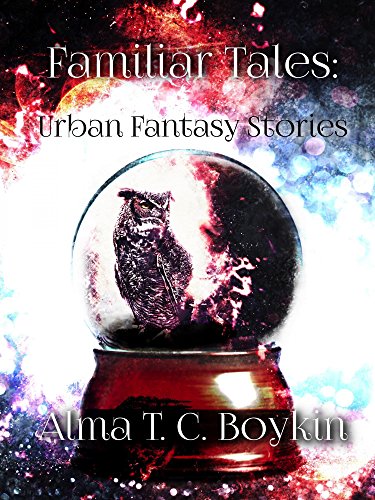
FROM ALMA BOYKIN: Familiar Tales

61hv2b7rfs6l

Smiley Lorraine: Wolverine. Rosie Jones: 100-lb. Skunk. Morgana Lorraine: Witch with Editorial Problems.

Welcome to a world where Familiars choose magic workers, and a few others, as their partners. A world of adventure, tax-deductions, bad publisher tricks, and odd veterinary clinics, where wolverines wear glasses and iguanas sing along with the radio—badly—while casting spells and keeping their chosen humans out of mischief.

Or try to.

(Five short-stories.)

AND IT HAS A SEQUEL:

FROM ALMA BOYKIN:  Strangely Familiar

61hzdkv4qbl-_sy346_


When a goth-gal gets a Familiar, everything changes.

Neither Jamie Macbeth nor Lelia Chan wanted Familiars. Now they have them, and Angus and Tay insist that their humans rise to the occasion. From inverted autos and giant cloven-hoof prints to attacking puzzle balls and the perils of shedding season, nothing’s quite the same once a Familiar saunters into the picture.

Especially when magic-workers start dying of unnatural causes. Or do they?

[The silly writer — what do writers know? — calls this a novella, but it’s actually a 50k word novel, not even short by indie standards.  Your gain, you get a bargain.- SAH]

FROM PAM UPHOFF:  Project Dystopia (The Directorate Book 8).

51xfrrt-mll

They didn’t warn him about the giant poisonous spiders.

Ebsa joins Paer on an archaeological project seeking to discover who built, and what destroyed a civilization on a cross-dimensional world just a few centuries ago. But the spider attacks were . . . not that bad.

It was when they drove to the coast to help an injured man that they discovered just how bad it could get.

FROM BERNADETTE DURBIN: Minstrel

51l7wce59zl

When a heroine in peril disguises herself as a minstrel to escape her treacherous, wrathful brother, she finds herself on a series of unorthodox adventures that raise from lowly minstrel to king’s advisor.

Vignettes by Luke, Mary Catelli and ‘Nother Mike

So what’s a vignette? You might know them as flash fiction, or even just sketches. We will provide a prompt each Sunday that you can use directly (including it in your work) or just as an inspiration. You, in turn, will write about 50 words (yes, we are going for short shorts! Not even a Drabble 100 words, just half that!). Then post it! For an additional challenge, you can aim to make it exactly 50 words, if you like.

We recommend that if you have an original vignette, you post that as a new reply. If you are commenting on someone’s vignette, then post that as a reply to the vignette. Comments — this is writing practice, so comments should be aimed at helping someone be a better writer, not at crushing them. And since these are likely to be drafts, don’t jump up and down too hard on typos and grammar.

If you have questions, feel free to ask.

Your writing prompt this week is: Capricious


Good Bad Books by Alma Boykin

mortality-401222

Good Bad Books by Alma Boykin

George Orwell talked about good-bad poetry, most notably Rudyard Kipling’s works. According to Orwell, the poems were memorable, well-written, and enjoyable to read and recite. Alas (for Orwell), the poems supported the Empire and King, failed to teach the proper social message, and distracted people from the real problems of the empire and of society as a whole.

In history we occasionally talk about good bad books. Now, these are not “well-written books with a bad message,” pace Orwell. Nor are they the books you sneak-read when no one is looking, adult Westerns or steamy romances, Aga sagas (a British sub-genre), or those books that used to arrive “tastefully packaged in plain wrappers for your privacy” according to the ads in the back of the magazines. Nor are they the so-bad-they’re-funny. No, these are the books that are so strikingly shockingly appalling that a herd of historians rear back on their hind legs and say “oh h-ll no! I’ll show you,” and a surge of really useful, good, insightful literature appears.

NOTE: THE FOLLOWING IS NOT AN EXCUSE TO BRING UP THE AMERICAN CIVIL WAR/WAR BETWEEN THE STATES/WHATEVER. IT IS AN EXAMPLE THAT I HAVE BOOKS FOR. 

One of the clearest examples of this is the historiography of the history of chattel slavery in the US. In 1908 U.B. Phillips wrote a book, American Negro Slavery arguing that slavery was not an entirely bad thing, that it had problems, but it was a civilizing force and that the Yankees had done terrible things by the way in which they eliminated it. It developed a regional following and some rebuttals, but lingered in the background for a while, until WWII exploded, bringing about a new generation of historians. In 1956 Kenneth Stampp argued that slavery was evil and that it was not paternalistic at all, but was all about economic control and domination. And then Stanley Elkins published, Slavery: A Problem in American Institutional and Intellectual Life in 1959 and everyone went, “whoah. That can’t be right.” Elkins argued from a psycho-historical standpoint, comparing slaves to Holocaust survivors, and introducing the idea of “sambos,” of African-Americans infantilized by the brutality of slavery, making them all immature victims. Yeah, you know what’s coming next.

1976, Eugene Genovese published Roll Jordan Roll: The World the Slaves Made and showed that slaves had been actors in their own right. Not infantilized, not made voiceless, the slaves created a rich culture with regional variations, one that encouraged strong family and community ties and that provided a foundation for the freedmen communities that followed. (And it’s a really well-written book, too. Highly recommend all his stuff.)  Peter Kolchin looked past the Atlantic to compare American slavery with Russian serfdom and demonstrating the complexities of both. In 2000 Ira Berlin’s book Many Thousands Gone covers the entire experience of slavery in North America, looking at how it varied in place and time. Phillips and Elkins two books, by now completely discredited, spurred a flurry of very good and useful research that added a great deal of personal story to the field of Southern History and slavery history.

How do you spot good-bad history? Well, for one, is the author proclaiming some new thesis that no one has ever considered, or applying a new technique in a way that perhaps doesn’t make sense. I consider John Demos’s book Entertaining Satan an example of this. He used Freudian analysis on the girls involved in the Salem, MA witchcraft trials. Now, there’s a big problem with trying to get inside the minds of people who left no written records. And a bigger problem with trying Freudian analysis on pre-modern minds. Yes, some things are pretty universal through the ages. Some, on the other hand, are not. Where Demos uses maps and demographic and economic studies he’s pretty good, but Freud doesn’t fit. And several books have come out that do a better job of discussing and describing the events, the whys and wherefores.

I also look for sources. There is a well known popular historian of religion who produces a number of books about different major faiths, including a recent comparison volume. This author never uses original sources. And some of the claims made really need primary-source support that the author does not provide. That sets my “bad history” needle twitching – a claim that lacks supporting evidence. “Trust me” is not a good historical argument. If I pick up a new environmental history, I go to the bibliography and start reading. If certain books and sources are not there, even just as passing mentions like “in contrast to So-and-So, my work shows that,” I get concerned.

I suspect we can find similar stories in fiction. Someone ventures forth with a horrible treatment of an original or useful idea, and a bunch of other writers go, “hey, I can do that, but better.” I know John C. Wright took the key scene of the award-winning dinosaur short story and produced one far better written, and more thought-provoking, using a very similar starting point. I’m not certain what one could do with Empress T, although the idea of someone being anointed by a mysterious force to be ruler of the galaxy has been used a few times. And IIRC it usually ends poorly for the galaxy. You could have some fun with the original Glittery Hoo Hah ™ trope, wherein, say, a spaceport workin’ gal has a fling with an alien and to her chagrin discovers that he’s fallen deeply in love with her and wants to be with her for the rest of their lives. She just wants to get the money so she can move on to her next client and pay her bills.

There are some historical (pre-historical novels, really) that took Jane M. Auel’s work, applied archaeology and serious anthropology, and came up with more plausible versions. Minus the naughty bits, or at least the most explicit naughty bits.

I’ve looked at the blurbs for a few feminist pacifist sci fi or fantasy books and thought, “Hmm, there’s an interesting idea there, but not worth my paying $35 and a lecture about the evils of war and how One Good Woman can bring Everlasting Peace and Harmony by the strength of her . . . ahem, moving right along.” But the idea that places do not exist until they are mapped has a lot of possibilities.

Something I’m exploring in the current free draft, Language of the Land, is what would happen if women really did run everything, a world where feminists run the show and men are legal minors all their lives, unless they are able to purchase manumission. And even then their rights are curtailed. The idea came in part from skimming a chapter of a really, really bad fantasy that I’m not going to bother naming, where this was presented as a good thing. I added an element of magic that levels the ground (literally) between men and women.

There are people who love any book. I’m sure somewhere, someone thinks Empress T. is a wonderful story with a fantastic plot. There are people who think Elkins had something in his hypothesis, even if he didn’t approach it correctly. I know Kris Rusch’s blog generated a heated discussion of “good and bad books,” with some useful ideas batted back-and-forth. There are also badly written books that are their author’s pride and joy. But those are not good-bad books, by Orwell’s definition or by mine.

[The inestimable Mizz Boykin has a non-bad book out.  Strangely Familiar: A Familiar Tales Novella.  Go and give it a try. – SAH]


It’s Not Even The End of the Beginning

ancient-165001
Though I’m taking a break from membership because the idiots are having a non-ironic exhibit on how great Cuba is and her “complex” politics (there’s nothing complex about feudal servitude, which is what the Castros have installed in the island) I love the Denver Museum of Nature And Science.

Most of all I love the “hall of life” which starts with the formation of the Earth and ends with proto-humans.

To begin with, some of the exhibits are aesthetically pleasing and stimulate the imagination (none of these are the large plastic models of the creatures while alive which need a make over/upgrade horribly bad. They look — and probably are — of seventies vintage.)  But more importantly, they give me the… length and breadth of the struggles of life on Earth, and a sense for how many times everything came near to being lost.

This is particularly good for me in the times we live in, because it reminds me that despair is a sin, or as someone or other told his followers, impatient for him to come back and put everything right for them “Do not fall into despair.”

Lately despair is everywhere.  As the magnitude of the — I don’t like the term, but it’s the most apt — deep state’s hold on our civil life, and their reckless disregard for the wishes of Americans become obvious, there are any number of Agony Annies wanting to turn in all their chips and cower in despondence and despair under their desks.  As it becomes obvious that not just our government but our culture is corrupt all the way down, they scream they’re being de-platformed and sit down for a good cry.

I’m often accused of being an optimist and out of touch with reality.  This usually provokes gales of laughter to those who know me well.  I’m a depressive with a tendency to spiraling fits of depression that make me unable to function sometimes for months, beyond the strict necessities of life.  ALL of my friends, and my family members know that, and also how many times they have to talk me out of the fetal position so I can, you know, bathe and dress. ( I do usually manage that, though eating varies between not at all and a lot.  I do manage to function to put a post up, or go to the store, or vacuum.  It’s just that there’s effort involved.  And fiction writing is sometimes quite beyond my energy.)

Now do I inflict that on readers of my blog?  No.

You know why not?  Because sometime in my thirties, I realized that I was going to end up heavily medicated and unable to tell which parts of my thoughts were me or the meds, or I was going to have to learn to tell reality apart from the whispers of the black dog.  Which I manage.  Most of the time.  Oh, I don’t manage to control the feelings, which is why everything is done with immense effort, but I can control the thoughts and reason through things.

In other words, I’m not an optimist.  I’m an individual who — for genetic reasons, I’m sure, though a lot of the depression is auto-immune related and might be part of the inflammation — unable to trust her feelings has learned to reason through to reality and to the real odds on things.

I think most normal people get their feeling of how things are going out of the air, which is to say, once one of the herd panics, the others stomp off in the same direction.

Look, I never told you things were wonderful, did I?  The left is in a raging panic, like any aristocrat who feels his power base tremble.  Their bizarre behavior and even more bizarre ideas that they’re not ashamed to put in public are a sight to see.  One none of us would have believed if we hadn’t seen it.  Hell, I grew up amid leftists, worked almost twenty years for an industry filled with them, and I see it and don’t quite believe it.

This wouldn’t precisely be a problem, if over the last almost century they hadn’t wormed into the positions of power in our culture, our society, and honestly at this point, most of our scientific institutions.  Because they have, though, this makes the institutional backbone of our society sick nigh onto death, which yes, does affect all of us.

The good news, though, is that they’re truly terrible managers, and sh*tty at running anything.

Good news? you say.  Yes, good news, because it leaves openings for other ways to do things.  I’ve told you before, publishing would never have met a real challenge from indie, if they hadn’t happened to decide that their job was NOT to sell books to the masses but to “educate” the masses, thereby rendering their product well night unconsumable, and leaving an opening for competition.

Let’s say they’re doing the same in other institutions too.  I can’t tell you of them because the stories I hear are from commenters and friends who are, for good and sufficient reason, deeply under cover.  But let’s say almost everywhere from the would-be hard sciences to retail, the story is more or less the same.  “The business is being run in the interests of Marxist ‘wokedness’ not of keeping the business going, and the wheels are starting to come off.”

The fact that they’re such terrible managers, and that the wheels started coming off 20 years ago are good things, because men are adaptable animals.  We’ve gotten used to working around these things to a great extent, often without noticing.

The fact that they’re going completely bat guano nuts is good too.  Why?  Because before this there was some doubt of ideological bias, even where it was plain as the nose on your face (well MY nose is VERY plain, guys.) I remember having an argument with a fellow righty about why there were so few conservatives/libertarians in publishing.  He completely bought their version, hook, line and yeah sinker, and maintained it was because conservatives “being the status quo” were less creative.  Note that this involved someone who was (and is) here in the trenches with us, knowing exactly how established the left is everywhere, believing that the right is “the establishment” instead of the club of the damned who managed to think themselves outside of polite society.

Now?  Now the left has gone so enraged, so in-your-face demanding of utter conformity and has so glaringly threatened job loss or worse for those who don’t march in goosestep with them, that these polite fictions that kept dissidents quiescent are gone.

Sure, you can believe them, but you have to be crazy to keep believing them when challenged, because frankly we have proof otherwise daily.

So why are so many people wanting to give up now?

To an extent, I understand. I mean we knew that the left had control of everything, but now it’s being rubbed in our face EVERYDAY.  It’s like knowing someone in your family hates you, versus actually catching them sinking a metaphorical knife in your back.  As I’ve had occasion to know recently (not in my literal family) even though you knew it was coming, it still hurts a lot.  (Hence “Curse your sudden and inevitable betrayal.”)

On the other hand, what exactly did we expect?  Those in power, when their grip starts to slip, will fight back.  How the hell else would you expect the story to go?  Is this a Mary Sue novel?

Sure, I see them running by with their heads on fire going “Google, Amazon, facebook.”

I’ve said it before and I’ll say it again: the reason those worked and became monopolistic is that they did their job better than others.  Amazon’s platform for instance is way better than any other ebook seller.  And yeah, I’m on Weme and Minds, and everything, but you know what, the flaws are obvious even compared to the current mess that is Facebook.

The counter-intuitive good news (yeah, I’m full of those today) is that they’ll fail and become vulnerable in the same measure as they become “woke” because “Wokeness” requires such a departure from reality at every level that it can’t function in the real world.

I’ll mention, on this, that Amazon is the least “politically involved” of these.  Yeah, I know, they pulled confederate flags, but that’s no more than corporate dunderheadism.  The screams that they’re censoring or deplatforming indie writers who are conservative are nonsense, and propagated by someone so far in the chamber that she can’t see outside it.  The truth is that they’re randomly deplatforming writers of whatever stripe in a futile attempt to get past fake reviews and robots that “page read” things for KU.  I don’t know what the solution to their problem is, I know what they’re doing is just pissing off random people.  They honestly might have to go with a “per book” price, and then consign themselves to eat a certain number of “borrows” which are from bots.  BUT I’m in enough writers’ groups with people of all stripes (in some of them I’m there because I’ve been quiet so many years they forgot I exist.  Let’s put it that way) and TRUST ME ON THIS, there is no political motive to the loss or reviews or the loss of accounts.  (And the later worries me more, as it’s more or less random, so scary.)

The others?  Well, they’re squandering their monopolistic advantage by becoming “the least respected name in–”  Which is how things get replaced, but yeah, not instantly.  Even publishing had a decade to play with their push-model crazy before the competition arose.  So some patience is indicated.

I have at least two friends of a technical bend working on ways to sell ebooks to the public that present a LIKELY possibility of competing with Amazon, despite Amazon’s entrenched advantages.  I’ve been using duckduckgo for searches over google (yeah, I duckduckwent) and so far Facebook has failed to banish me to outer darkness (Not to mention not banishing Brad Torgersen who has turned FB into a powerful platform.)  I checked my profile recently — ie. the things they think they know about me — and realized that they think I’m politically moderate.  Which explains all those calls from OFA in 2012, right?

So, again, our advantage is that yeah, they have control of the institutions, but they’re not very efficient or good at it.  Which means there’s room both for infiltration and competition.

Will this happen overnight?  Snort, giggle.  What are you, two?

The left took control of society before I was born.  It is unlikely I’ll face a level playing field before my death.  Possible, but unlikely.  It’s likely it will remain easy to get ahead in my field and others by making woke noises.  It’s likely that all we do is keep society functioning, and make small gains until… well… probably until my grandchildren are my age.  It took the left 100 years to get where it is.  We’re not going to reverse it overnight.

But we must try.

We must try because the left will destroy not just civilization but humanity, if left to play out its illusions uncontested.

We must try because we’re the people who don’t betray their principles for advancement.

And we must try because we are making gains.  Things are shifting ever so slowly.

No one now tries to tell you that there are no conservatives in most traditional publishing because conservatives just aren’t creative.  No one would believe them if they told you that.

No one in the general population is that worried about the left’s sacred cows, like anthropogenic global warming.  We’ve chipped enough at that.  If you go to Europe where we don’t have that kind of foothold, you’ll figure out how much really quickly.

More and more normal, every day people just scratch their heads at the leftists in their pulpits and say “Well, that’s a thing.”  Then shrug and go about their every day business.

The wheel is turning.  It’s slow but it is turning.  You can see it in a hundred interactions, a million little lights glimmering in the darkness.

If you want to give up do it.  The way ahead is still very hard.  You can get better rewards by making noises like a leftist.  (I’m afraid these days just keeping your lip buttoned is no longer an option.  If you do that, you’ll be lumped in with us, outcasts.)

Besides, despair is cozy and comfortable.  As Peterson says (and I said it before I heard him, btw) if nothing you do means anything, then you don’t have to do anything.  There’s no moral duty to resist the crazy, no imperative to act.  You can do nothing.  Sure, despair and depression come with that, but they’re a small price to pay for not feeling like you have to do or risk anything.  It’s a lot like all those writers who want to be writers but know no one would recognize their brilliance.  They’re free to write only when the muse strikes, and not bother putting their work before the public, because, well, it wouldn’t make any difference, and they’re cozy in their despair.  Hey, at least they don’t have to spend all their free time writing.

It’s an understandable choice.  And some people are just tired of fighting.  That’s even more understandable.

It’s not one I choose to take. And if you want to see the cause of liberty triumph, eventually, it’s not one you’ll choose, either.

Build under, build over, build around.  Get ready to take the weight of each institution as it goes gibbering off into the night of leftism.

Be not afraid.

We got this.



Perpetuating the Problem and Passing the Blame – by Amanda S. Green

Perpetuating the Problem and Passing the Blame – by Amanda S. Green

After last week’s little foray into snarking, I thought it time to get back to Thomas Sowell’s Black Rednecks & White Liberals. To say I believe this is an essay I believe everyone should read is putting it mildly. Sowell doesn’t shy away from hard topics nor does he sugar coat anything. What he does is poke holes into what liberals want us to believe are truths. He does so with facts, with logic and with experience. In doing so, he shows how liberals, especially white liberals, have caused more harm than good, despite all they crow from the proverbial mountaintop.

The next section of the essay is entitled “White Liberals” and Sowell wastes no time in getting down to business.

White liberals in many roles—as intellectuals, politicians, celebrities, judges, teachers—have aided and abetted the perpetuation of a counterproductive and self-destructive lifestyle among black rednecks. The welfare state has made it economically possible to avoid many of the painful consequences of this lifestyle that forced previous generations of blacks and whites to move away from the redneck culture and its values. Lax law enforcement has enabled the violent and criminal aspects of this culture to persist, and non-judgmental intellectual trends have enabled it to escape moral condemnation. As far back as 1901, W. E. B. Du Bois, while complaining of racial discrimination against blacks, also condemned “indiscriminate charity” for its bad effects within the black community. (BRAWL pp 51-52)

That single paragraph strikes at the heart of so much of the liberal agenda. Welfare. Relaxation of law enforcement rules (Hello, London, this applies to you too). Indiscriminate charity. Is it any wonder so many liberals, especially white ones, hate what Sowell has to say?

By projecting a vision of a world in which the problems of blacks are consequences of the actions of whites, either immediately or in times past, white liberals have provided a blanket excuse for shortcomings and even crimes by blacks. The very possibility of any internal cultural sources of the problems of blacks have been banished from consideration by the fashionable phrase “blaming the victim.” (BRAWL, pg 52)

Oh my, doesn’t that sound an awful lot like what we hear whenever someone starts questioning motivation, causation, or anything else when it comes to a cause the liberals have adopted. We are supposed to believe every woman who cries rape or sexual assault and not look at the circumstances surrounding the alleged crime because to do otherwise is to victim blame. We are supposed to take into account every time a cop is shot, especially if that cop is white and the shooter is black, the “fact” that cops are bad and have abused the African-American community for years. To do otherwise is to victim blame. Of course, that forgets one important fact, in that situation, the victim is the fallen cop and not the shooter. Except the African-American community has been assigned the status of victim by many who self-identify as liberals. Why? Because, more than 150 years ago, slavery was legal in this country. So, everything goes back to that and we, as whites, must continue to make amends for things done by people long dead. [AND to people long dead- SAH]

As Sowell says, blaming “others for anything in which blacks lag has become standard operating procedure among white liberals.” (BRAWL, p 52) There is something wrong with tests if blacks don’t pass at the same levels as whites. We have professors claiming math is sexist or racist. Yet no one seems to bat an eye and ask why Asians are able to take the same tests and pass them at the same – or higher – level as whites. No one seems to worry about how Hispanic or other minorities do on these exams. Yet white liberals cry “foul!” long and loud over how these tests are biased against African-American students.

My question to those liberals: what makes the African-American student more important of a minority than the others?

It is a question that will never be answered or, if it is, will be turned against me. I’ll be accused of showing my white privilege, of not understanding the problem, of being insensitive. I will become the problem, as will anyone else who asks similar questions, at least in the minds of the liberals. After all, it is so much easier to blame the person asking the question than it is to actually consider the question, and the problem underlying it, and realize you might actually be part of the problem.

Any parent knows there comes a time when you have to tell you child you expect certain behaviors from him. There are certain social rules they have to learn and follow. There are certain levels of achievement in school they have to attain and, if they surpass them, they will be rewarded. Parents, at least good parents, don’t tend to reward or accept mediocrity from their children if their children are capable of doing more. They certainly don’t encourage it. You want the best for your children so you encourage them to do their best. THAT is how they get into the better colleges. THAT is how they find the better jobs. THAT is how they earn promotions.

And that, my friends, is something the liberals don’t discuss, much less admit, when they continue to promulgate a welfare state and a welfare state of mind.

Think about it. When is the last time you heard a liberal suggest someone might want to look at themselves, at what they did that led up to their failure? It doesn’t matter what sort of failure. It is the act of introspection in question here. According to Sowell, you don’t see liberals doing that very often. “Apparently there can only be external reasons for anything negative that happens to blacks.” (BRAWL pg 53) What a disservice that is to the African-American community. By taking this approach, you don’t allow them to grow. You allow them to make excuses and blame others without ever taking a hard look at themselves.

The incorrigibility of white society—and the corresponding futility of black efforts to improve their situation by improving their own education and other qualifications—is another leitmotif of much white liberal writing. (BRAWL, pg 54)

Let’s all take up the cry of “White guilt! White privilege!” After all, that’s basically what the liberals are claiming. We can’t understand because of the color of our skin. It’s all our fault.

Except there’s a bit of a problem with that. Not all of us who question the cries of “white guilt” and “white privilege” are white. Another problem is those claims are only applied when someone questions a situation involved African-Americans. You don’t hear it when we discuss any other minority. Why is that? Liberal America doesn’t have an answer for that. Or, if it does, it won’t give it because it will disrupt their narrative.

Something else liberals tend to “overlook”, as Sowell points out, is the hostility – the prejudice – some members of the African-American community hold towards others: Jews, Hispanics, Whites, etc. Why don’t we hear about this? Because we are told over and over again that only whites can be prejudiced, “that racism requires power, which blacks do not have.” (BRAWL, p 54) However, as Sowell points out, “the arbitrary proviso of ‘power’ was never part of the definition of racism until racism among blacks became widespread enough to require a convenient evasion.” (BRAWL, pg 55)

Once again, the rules are changed to fit the narrative and no one had better question it or you’ll be guilty of victim-blaming, of showing your white privilege, etc. We must march to the “right” beat – or is that the “left” beat – or be condemned.

Liberals have been so busy finding excuses and immortalizing them that they have become a large part of the problem.

The general orientation of white liberals has been one of “What can we do for them? ”What blacks can do for themselves has not only been of lesser interest, much of what blacks have in fact already done for themselves has been overshadowed by liberal attempts to get them special dispensations—whether affirmative action, reparations for slavery, or other race-based benefits—even when the net effect of these dispensations has been much less than the effects of blacks’ own self-advancement. For example, although the greatest reduction in poverty among blacks occurred before the civil rights revolution of the 1960s, the liberal vision in which black lags are explained by white oppression requires black advances to be explained by the fight against such oppression, symbolized by the civil rights legislation of the 1960s. This scenario has been repeated so often, through so many channels, that it has become a “well-known fact” by sheer repetition. Moreover, this protest-and-government-action model has become the liberals’ preferred, if not universal, model for future black advancement. (BRAWL pp 55-56)

This sort of “help” has been anything but. How many generations do we now have of families living on welfare? Yes, welfare is necessary in some situations, but it should not be an end-all, cure-all for our nation. It should be there to help those who can’t work. It should offer training for those who can work but who lack the skills. But, for the latter, there should be a limit to how long they continue to be on the dole. It doesn’t matter what their race, color, creed or sexual identity might be. What we need to be wary of is becoming a welfare state.

But there I go again, blaming the victim and showing my white privilege. (Yes, that is my great-grandmother – my Cherokee great-grandmother – who is spinning in her grave at the idea of my family claiming white privilege.)

Well-meaning or not, liberals have done more harm than good. Worse, they continue to do so, without qualms and without daring to look at the impact their actions have had on a large section of our population. How do we stop it? I’m not sure we can. Not unless we are willing to stand up and speak out and face, without losing our temper or becoming defensive, the condemnation they will sling our way.

For now, we need to read more authors like Sowell. We need to learn our history and learn the facts – not accept the “corrected” history they would thrust down our throats.

Looking at the rest of the essay, it’s going to take two more weeks to finish it up. Sowell manages to pack more information in a few pages than most so-called scholars do in tomes. So, until next week, do yourself a favor and pick up something by Sowell and read it.

[For raising the tone of this blog — ATH is culture! — and helping me with the exposing of the roots of the current mess — in her case with more facts! — if you decide to  send the woman a drink]