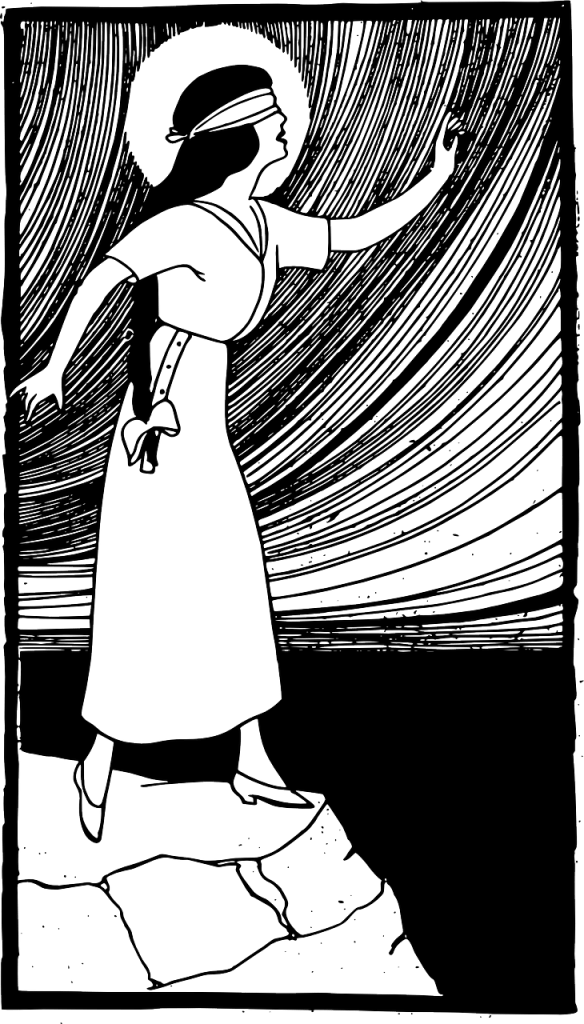
I had a dream I was being lined up against a wall and blindfolded. Which must account for my being here, stark awake at 5 in the morning, I suppose.
Only what woke me was “Why the blindfold? I don’t need a blindfold. I want to see.”
Why? Well, because if you’re blindfolded you can have false hope. “Maybe they’ll relent at the last minute. Maybe they’re not really aiming at me. Maybe.”
A lot of people are doing that right now, a lot of people who should know better. But they have jobs — a lot of them with the government that’s about to be openly taken over — or they have an oath they swore that they don’t want to think obligates them to take action that will endanger their jobs, their families, their quiet little life.
A lot of people are holding their hands over their eyes as hard as they can, for the same reason — still — most conservatives don’t protest. We have jobs, we have families, we have lives. While some of us are so broken that politics are vital to us, most of us prefer to keep that as a quiet vice, while we enjoy our lives.
Which, btw, is how we got where we are.
That blindfold is lovely. It keeps your heart from racing. It keeps you standing in line with your fellows, while they aim at you.
At worst this will prevent you from doing what you can to actually survive. (That’s why they blindfold you, not as a kindness. And in this metaphor, that’s really important.) At best it lets you die while thinking everything is fine. Again, this is particularly true in the metaphor.
Though perhaps not just in the metaphor. As someone who has looked straight into machine guns aimed at her, at sixteen, let me tell you you don’t know what you’ll do. You just don’t. In my case I froze. Also, fortunately, in my case that saved my life. And probably the life of thousands of people behind me (and other people in the front row, but mostly a guy about my age whose name I never knew. (Pal, if you’re reading this, yeah, the adults were sh*tty to skedaddle and leave us in front, but be aware that’s the only time freezing would probably work to our advantage. Anyway, freezing is not normal for me, and the two times it happened it saved my life. BUT it’s not a decision you make. It’s in the back brain. The next time I had guns pointed at me while unarmed I was 22. And I’d provoked it. And I went sarcastic. Was it the right thing? I don’t know. I’m still here. Those guys didn’t know what they were doing. I could see that. I could also see what my words did. If I’d been blindfolded, I’d never have known that.
So, not just a metaphor, but a metaphor too.
As I went to bed last night, most of the right was busily pulling that blindfold over its eyes, convincing itself that yep, there was no significant fraud.
I’ve seen this process often enough that it shouldn’t disgust me anymore. Instead, I should count myself lucky — very, very lucky — that I’m no longer being called crazy and having things thrown at me because I say there is fraud. Back in 2008 everyone was so busy going “No, the American people REALLY want socialism” that I was treated as a crazy person.
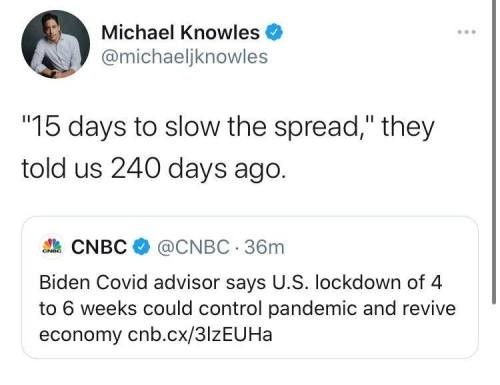
Kind of like I was treated as a crazy person when I said that the covidiocy was a covidiocy. Heck, randos will come out of the woodwork because of THAT sentence, to tell me what a horrible person I am. E pur si muove Modderpockers!
Yes, you can come up with all sorts of tap-dancing — that blindfold is so silky, so soft, so comforting — but the truth has been there from the beginning. And the orders, all over the world? The same orders? Sure, they all just arrived at “let’s kill the economies and imprison law abiding citizens for what amounts to a common cold for most age groups” unanimously at once. They choose to obscure the real statistics, the fact that masks do nothing, etc, all at once. Randomly. And the next coin I throw into the air will land neither face down nor face up. It will never land, in fact. It will become a fluffy yellow duck and fly away.
In the same way, the left ran a man who never got more than 2% of the vote on his own on a national election and a woman who came in last in her home state. They ran their campaign from the basement, while scaring people about the dangers of going out and voting in person, and demanding mail in ballots. And they had more votes than anyone in history.
Nice, nice blindfold. Is that silk?
“But everyone hates Trump. Mean tweets.” Bullshit. And you know it. Yeah, tons of people hate him. Because media. Because the media has convinced a large number of idiots that NOT trampling states governance means he’s a fascist. But a lot more people who hate him will vote for him. Crawl over broken glass to vote for him, in fact. I did in 2016 when I thought there was 99% chance he’d be a disaster. But Hillary was more disastrous.
And now you think people hate Trump enough they went and voted for the people saying “we’ll lock you and open borders.” “The most important things are climate change and health care for illegals.” And yeah, even with the media trying to hide that, most people know. They’ve seen the way the left behaved these four years.
Also you know the numbers are cooked. And if you don’t it’s because you choose not to know. Because you love that blindfold.
Hell, I knew the cooking was coming since they started running Commie la whorish and her zombie meat puppet. The additional fillip of not even campaigning? You’d have to be stupid not to know the fix was in.
You’d have to be blindfolding yourself. It’s very fashionable. It goes with the covidiocy mask.
How long has the fix been in, and how is it done? Well, it’s done in all sorts of ways, but I’m going to bet on the computer-control thing, and I’m going to bet it’s been in place since 08 at least, though they still run tons of the normal side fraud too, because the left can’t leave anything to chance. They know people don’t like them, and frankly they hate us and want to destroy us. They don’t trust independently thinking people, and they want to stop them running around with thoughts.
Anyway, I’m sure the computer is the lynch pin for four reasons:
The first is that there is no way our votes need to be beamed out of the country to be counted. And there is no excuse for vote counting machines to be connected to the internet.
The second is that the left accused the GOP of changing votes via the internet and of having the voting machines connected to the internet in 2004, and the left ALWAYS accuses the opponents of what they’re already planning to do.
The third is more complex, but is to me clear as day: the left don’t behave as if they need or want your vote. They have behaved since Obama at least as though they’re putting on theater so you can accept their “wins” as legitimate. Agitprop, not wooing the public. And yeah, I’ll give you that Obama was “popular” for complex reasons in 08, and he either won or came very close to winning against McCain who was not popular at all. BUT even there, you know, the merchants who bet on how popular he was with merchandise, even in my favorite fabric store which was in an ethnic neighborhood? Yeah. They didn’t make bank. All that stuff was gone in a couple of weeks, on the discount table. And if he’d been as popular as projected, it would never happen. And the buycotts of anyone who opposes the left are massive, while “get woke, go broke” is a thing. On the ground and from observation? Obama had maybe half the real support Clinton had. And the current G team has maybe a tenth of that. You know how you said “All the left had to do was act sane the last four years.” Well, no, they don’t have to. Because your vote no longer matters, peasant.
The fourth is that they’re working SO hard on making the very idea of computer fraud sound ridiculous.
But, you’ll say, Sidney Powell is on our side. She’s always been. Yeah. She probably is. And if the democrats were a political party that would actually mean something. But they’re not. They’re a criminal enterprise.
In other words, the feeling I’m getting is that feeling we’re all familiar with from the Trump administration: he’s trying, but he has to rely on other people, and every other wrung below him is either doing nothing, engaging in white mutiny, or outright working against him. Yes, even people nominally on our side.
Why? Because everyone has a handle. Everyone can be blackmailed. AKA the Chief Justice John Roberts principle. And the left like any criminal enterprise has specialized on having the dirt on practically everyone.
Me? Oh, they probably do. There are things I’d prefer the world at large not know. Not for me, mind you, but for those around me. Then again, I’m a libertarian. And not wholly sane.
Yes, even someone like me, at my level, has had “threats.” Thank heavens I’m too crazy and stubborn to even understand them. Which, btw, I’m sure is Trump’s secret too. But most people? There’s a handle, and it can be grabbed. And some thing that happened in 18, right after the election? Let’s say there’s ways to affect me and my family that involve grabbing other people’s handles. Only explanation for the shower of sh*t that came down in one week, November 2018 from seemingly unrelated sources. And the unremitting “bad luck” that has marked the last 2 years.
Does that sound paranoid. Okay. Then you can believe that Trump is really bad at hiring, that the FBI and CIA and the rest of our agencies have not been corrupted, that the Supreme Court is not compromised. That a lot of people like me are just “accidentally” unlucky in ways that prevent us having any real power in our fields.
How is that blindfold? Comfy?
But Sarah! Then you have to be paranoid!
What? The worldwide, irrational, not to any scientific standard covidiocy lockdown is no reason to be paranoid?
You know, I hear they make padded blindfolds. Tri-ply, so no ray of light comes in.
Look, if our vote is as good as gone — and hell, guys, we in Colorado, California, Oregon and unfortunately now everywhere, have always known the fix was in. Utah is the only state where vote-by-mail means “no one to the right of Romney will ever win again.” (And in Utah there’s complex cultural reasons.) — you have to be aware of what that means. You have to look into the gun.
For an example of what it means, look at California. Or take a gander at Denver. Go ahead. It means they don’t care. They can impose whatever fantasy they want, destroy you however they want, make you do the most nonsensical things, while preening and posing for others like them. Because what are you going to do? Vote them out?
Which means if you keep that blindfold on, the bullet WILL come. You will die. Fast-ish at a guess. Probably within ten years, we’ll be marching lockstep with Europe. Or worse. Did you know they really are serious about the Green New Deal? Or that they’re already talking redistributing land by skin color?
Hello, Zimbabwe!
Keep that blindfold on and you’ll assume at least half the country and probably more are effectively a ridiculous feminist activist from college.
Accept the reality of fraud? And be aware you’re not alone. Be able to see what’s actually happening. And maybe duck or jump on the shooter at the crucial time.
For instance, the only plausible for the current lockdowns is that they’re terrified you’ll talk to each other and share knowledge that this election is f*cked up. Just like we did with Hillary’s emails, even though the media ran an absolute blanket of silence over how stupid that was. This is why they’ll keep us locked up for another year, maybe two. Well, that and because it will destroy most of our structures of life.
As for the mandatory vaccine, that’s not the goal, although with these loons in the pocket of China, I wouldn’t put it past them to have something to sterilize you or worse in that “vaccine.” China has been known to run that gambit on their own captive populations. Fortunately they’re really incompetent, so it’s 50/50 if what they mean to do will work. BUT the point is for you to have a “health passport.” Achtung! Papers please! They’re already implementing this shit in parts of the EU. What it means is another handle on EVERYONE. Oh, you won’t play ball? Well, we cancel your health passport. Good luck ever leaving your house again.
If you think about them as a criminal enterprise, it all starts making sense.
And you start seeing ways to fight back. Most of which aren’t even — probably — obvious.
For now? Well…. For now just letting other people know they’re not alone is a good beginning.
After that come other things….
Look, whichever way this falls, you need to know it’s going to get sportive for a long time. How long? Judging by how many people will do anything not to remove the blindfold? and how many are convinced donating and volunteering is the way to go, when FRAUD is massive and in your face? YEARS. Maybe a couple of decades.
Yes, get food and emergency supplies. And weapons, which in this case are emergency supplies. And not just guns. Partly because you can’t get guns for love or money right now.
Second, make connections. In your area, and across the country. People you really, really can trust. (Yes, they might have a handle, and you might be f*cked. Which is why the longer you know them the better, okay?)
Third, if you mean to do anything that takes advanced medical services, from having babies to getting major surgery? DO IT AS SOON AS POSSIBLE. Things are not instant, and even though our current idiots are in a hurry, it will take probably a decade for our medical services to hit Cuba level.
Fourth, if you’re in a blue state, no matter how much you love it, plan your escape. One year or two, four maximum. I suspect the next four years are going to see a re-shuffling the likes of which has never been seen in American history. No, I have no clue where “safe” is. Same as “if the US falls, there is no safe place in the world” (you people abroad have been warned, now.) “Who knows which places will be safe in the US.” It’s possible no place will be safe. But a large city probably isn’t. So, plan.
Fifth keep your job as long as you can, but be prepared to lose it. Because the economic dislocations are going to be bizarre and massive. If, like me, you’re dependent not just on the net, but on lefty companies…. you might be f*cked. Or not. I’d really feel a lot better if someone came up with an alternative to Amazon.
At any rate, if you have a choice: give not your money to leftists. If you can get a good or service from someone not on the left, do so. If you can hire and have two choices, pick the non leftist. If you can do someone a favor, pick the non leftist. The left has always done this thing, where they preferentially hire and buy from their own. Which is the power they now hold.
For some things, you cannot avoid giving them your money. BUT if you must buy books from Amazon, at least buy from non-leftists. And preferably indie. (Yes, plans in works. At least for me/a group of us. BUT making an outright competitor is impossible, because of the tax situation. If you have to pay taxes in every state, just keeping lawyers on staff to do it closes the internet to the average Joe Blow. Which was the intent.)
If you keep the blindfold off, you can see other things and other ways to knee them in the groin, before they can kill you. Or before those who can do wrestle the gun they’re holding to your head.
If nothing else, you can see the next panic they try to stampede the population into and not fall for it. And perhaps have a few of your friends also not fall for it.
If you keep that blindfold off, and refuse to believe their story over your lying eyes, you can remain free and fight back in the measure of possible. And maybe one day rebuild.
Because guys, seriously, this lot can’t find their *ss with two hands and a seeing eye dog. Their “great reset” (Complete with German accent and white cat on lap) is the sort of plan a Bond villain would laugh at. It only sounds plausible to the very rich and very sheltered. They’re going to get eaten. Possibly literally.
But on the way there, they’re going to cause untold horror and misery.
Don’t let it be to you!
Keep that blindfold off. Remember, as Heinlein said, they can’t control a free man. They can only kill him. (And if you’re stupid enough to think that doesn’t include women, it’s probably too late for you.)
So, yeah, the fraud was massive. There are four lights. And keep your clothes and weapons where you can find them in the dark.










 According To Hoyt