Cross My Palm With Silver

Making predictions is hard.

Particularly about the future.  What’s even harder is to influence the world one way or another – be it with your writing, or your teaching, or just your wonderful sunny personality.

When I opened Darkship Thieves with “You always get what you don’t want” I was merely echoing my grandmother’s oft-repeated aphorism.

I don’t know if you went through the same, but I remember being three or a little older, and starting to daydream about my adult life.  Of course the early dreams were crazy stuff, but they’d be.  I had no clue how adults lived, after all.  But then the older ones got sharper and more defined.

Look, I’m a realist.  Always was.  At age eight, I was going to grow up and live in Denver.  (This was so far back I did not know Denver was not by the ocean.)  At age fourteen, I knew what the US immigration policy looked like, and I knew a couple who had been on the waiting list for ten years (both Phds though, I’ll grant you, not stem.)  At age three I dreamed of growing up and having babies, but at age twelve I knew most boys filled me with an irresistible desire to hit them hard over the head to stop them talking.  (I didn’t know about duct tape.  Also, most girls gave me the same issue.  Middle school was hell.)  At age five I dreamed of being pretty and popular, but at age ten, I knew neither was likely to happen.

So I could extrapolate my life quite well.  I was going to get a Phd, teach in college and look after my parents in their old age.  I can’t tell you, given my trajectory, how LIKELY that future was.  like 99.9% likely.

Instead, because of a friend delaying in the bathroom in tenth grade, (after a badminton match.  We’d just showered, but she insisted on stopping by the bathroom on the way out of the school.) And my getting bored and looking on the bulleting board, I ended up in the United States for my senior year in highschool.  (Well, the poster showed a girl coming out of an egg with a suitcase.  It said “get out of your shell” and a number.  NOTHING about what it was.  If it had said “exchange student program” I’d never have thought about it.  But it didn’t.  So I called the number to find out what it was, and they said “How about we send you the papers.”  And I said “sure” knowing my family couldn’t afford it.  Turned out it cost very little and… we…  The rest is history.)  This in turn led to my becoming… a sparring partner (wash your mind.  We just argued A LOT) with my family-liaison’s son.  Which, four years later, after a nasty breakup, led to my calling him and… well…  We’ve been married twenty seven years.  And I’m a professional writer, something that seemed impossible even thirteen years ago.

Okay, if I just disqualified myself from future-prognosis, I assure you I’m not the only one.  If you look back at your own life, you’ll find that while each step at the time was perfectly logical according to who you are, the trajectory would have seemed wildly improbable to you at ten.  Or twenty.

Maybe you never thought you’d marry.  Maybe it’s your profession that surprised you.  Or where you life.  Few of us live predictable lives, because we don’t live alone.  We are factors in a chaotic system, but we are not the only factor.

A-propos de quoi am I telling you this stuff?

To be bluntly honest, I think it’s part of what’s ailing science fiction.  It’s impossible to listen to Heinlein juveniles, or anything else from that time, without catching that sense of confidence of “this is how the world will go.”  It’s also impossible not to see how different the world is from anything they could have predicted.  Rather like being 14 and trying to extrapolate your life at sixty.

And this means that anyone reading it today knows that it’s not “an accurate prediction of the future” – impossible to convince ourselves our predictions are any more accurate.  (Unless we’re really, really egotistical and lack self-examination powers, which mind you, a lot of us do. But not enough to maintain the illusion.)

So am I saying that science fiction is passee?

No.  Science Fiction was never about predicting the future.  The clue to this is that writers were not in carnival fairs, and didn’t say “cross my palm with silver” (Okay, I lie about that last one.  Though I prefer gold.  Or would.)

The contradiction of science fiction is to make it sound like it’s about the future – like the writer can see into the future and see clearly enough to make it real and believable to the writer.  But it should not – and I don’t think it ever did – have pretensions of being accurate.  (Again, if we could do that, we’d win the lottery.)

But then, what good is it? you ask.  Well, let’s put it this way – your daydreams of being a grown up when you were very little were in no way accurate.  BUT they were important.  They gave you an idea life wasn’t static, and you wouldn’t always be a kid, dependent on your parents.  It got your mind working towards such ideas as “I’ll live independently and need to make a living.”  So, as each new stage arrived, in what is, looking backward, years of vertiginous change, you weren’t scared.  You’d tried this on, if in slightly different form, in your mind.  You could think about it clearly now because it wasn’t new and scary.

Science fiction is like that for our entire species.  We can – and do – look to the future through it.  Science fiction is the dreams of mankind.  (Fantasy, too, but it’s a different thing.  It’s like those daydreams you had – what you didn’t? – that you’d find out you were a dragon shape shifter.  You knew they’d never come true, but it was fun to think about it on a summer afternoon, and work out exactly how you’d hide it.)

In a time of rapid change – now – we must dream ahead.  The future will not be what we expect, but it will rhyme.  (I didn’t become a college professor looking after my parents, but it could be argued I think too much, and look after my kids…)  If we’ve looked ahead and sort of seen ourselves in a very different society, we’ll be able to think of developments more clearly.

(Take clones – please.  While the real cloning didn’t resemble SF, people who read SF were nothing phased by cloning.  While their co-workers ran around talking about the end of the world they read the articles, absorbed it, compared it to the scenarios they’d read before, then said, “Oh, look.  This is not that different from twins.  No, it doesn’t do anything to your soul.” etc.)

So, we need science fiction.  And what type of science fiction do we need?  Distopic?  Hopeful?  Human wave?  (Now old) New Wave? Space? Earth Bound?  Feminist? Politically incorrect?  Hard?  Or scientific sacred-cow goring?

Yes.

We need all of the above.  Only a wide range of dreams can prepare us for an unknown future and allow us to try on new ideas and new ways of facing the world, so that whatever the world throws at us, we have at least some notion what is going on.

This is why having gatekeepers establish “one correct type” of science fiction is so pernicious.

What we need are tales of wonder and the imagination.  The crystal ball are broken, but our dreams aren’t.  Dream a little dream (or a big one) today.

Edited to add: Welcome Instapundit readers and many thanks to Glenn Reynolds for the link!

Witchfinder Free Novel chapter 32

*Okay, so it’s late and only one chapter.  In my defense, I’ve been hit with an emergency request and I need time to work on that, since it must be done today.  It is, you could say, a debt of honor.  I WILL try to give you two chapters next week.  At least this is not a short chapter (grin.) Oh, I might have repeated cards.  If so, I’ll deal with it on rewrite.  I kept trying to edit and getting confused :-P*

*This is the Fantasy novel I’m posting here for free, one chapter every Friday.   If your conscience troubles you getting something for free, do hit the donate button on the right side.  Anyone donating more than $6 will get a non-drm electronic copy of Witchfinder in its final version, when it’s published.
There is a compilation of previous chapters here  all in one big lump, which makes it easier to read and I will compile each new chapter there, a week after I post.  When the novel is completed and about to be edited the compilation page will probably be deleted.

Oh, this is in pre-arc format, meaning you’ll find the occasional spelling mistake and sentence that makes no sense.  It’s not exactly first draft, but it’s not at the level I’d send to a publisher, yet. *

For previous chapters, look here:  https://accordingtohoyt.com/witchfinder/

Symbol and Sign

She cut cards like a card sharp, and it caused him to raise an eyebrow at her, before he knew what he was doing.  Heaven knew she’d not be the first member of her family to have a wicked addiction to the gaming tables, but the disaster that had been her great great grandfather’s reign didn’t need a reprise.

But she looked up as she brought the deck back together and grinned at his expression.  “You need not look so dismayed, your grace.  I was not weaned on betting or card games.  Please remember Earth is different.  Mostly I learned to play Go Fish with my grandmother’s friends when they visited.  And one of her friends taught me to cut cards.”

“Go … Fish?” Seraphim asked, wondering if she was trying to insult him in a subtle way.  But no, it didn’t have that tone.

“Oh.  Yes.  I imagine in Avalon even quite young children of good houses play Faro and loo in the nursery.”

“Not silver loo,” he said, in the hopes of making her laugh, and it worked.  Her silvery laugh rang out, though she looked as though not quite sure he was joking.

“Well, in my world,” she said, softly and seemingly unconscious of knowing this was not quite her world.  “Children don’t play for money.  I think Go Fish is primarily designed to help you learn the suits.”  She disciplined her features, amusement banishing.  “Now, if you excuse me, even my poor methods require me to concentrate before I scry.”

She took a deep breath and steepled her hands over the playing cards. Elegant hands with long slim fingers, and Seraphim saw them bedecked in rings, and for a moment, wondered if he was having a premonition.  Then he realized her hands resembled those of the Queen, which he usually kissed, when he visited.  The Queen, of course, usually wore rings.

Something like a non-physical pain seized his middle making his breathing difficult.  After Nell went back to Avalon, after she was returned to her family, all he’d see of her were those evenings when his family got invited in to discuss important magic policy points.  She’d give him her hand to kiss…

He realized his eyes wanted to fill with water, and he refused to allow it.  Stupidity.  Of course she was the princess of Avalon and of course she had to go back.  He might have used her parents’ grief to get her to understand this, but her parents’ grief was true nonetheless.  And also, the kingdom needed her.  Without her…  He refused to think about it.

The king had refused to name a successor because, of course, naming a successor was the same as admitting his only, beloved daughter was either dead, or gone so far from this world that she might as well be dead, for all she’d never come back.

And neither the king, nor his father, nor yet his father’s father had had any siblings.  Four generations back, there was a numerous family of seven girls and two boys.  All the girls and the younger boy had been married to royal houses in Europe.  If the king died without descendants – or with no descendant able to come back and claim the throne – the isles would fall pray to the dynastic ambitions of a dozen ducal families in the kingdom itself, who would claim their distant relationship to the king – on the level of Seraphim’s own, at least five generations back and more – was preferable to turning the kingdom over to strangers.  At the same time, the territorial ambitions of Europe would be unleashed too, and he doubted that there would be a kingdom small enough not to send at least a second son to stake a claim.  Even the Portuguese royal family were cousins, he thought.  And the Low Countries too.

Behind his eyes, which closed in an attempt to block out his thoughts, images of armies descending on his beloved homeland and laying it to waste while killing its peasants and raping its magic passed like a blood-soaked painting succeding another.

He was called back from these troubling visions, by a slap of a card on the table.  “This,” Nell’s voice said, slowly.  “Is the questioner, who I think for this purpose must be you, as you’re the only other person present, and one involved in this matter.”  She lay down the king of Clubs and Seraphim grinned at it, because he suspected half of Avalon would expect him to be the king of hearts in any reading.  But clubs was more like it.  His was wealth acquired by work – or at least it would be, if he had his way.  Right now the wealth was largely imaginary.  Even his exalted position – before this adventure – was something precarious that only work could secure to him.

“And this,” Nell said.  “Is myself – since I’m also involved in this matter.”  She lay the queen of Hearts over the top of the King of Clubs, crosswise.   That not-quite physical pain troubled Seraphim once more.  The Queen of Hearts.  A woman who represented home.  As Nell must, being the rightful princess of Avalon.  A woman who represented love– His brain skittered away from that thought.

Over the last few days, he’d been closer to Nell Felix than he’d ever expected to be to a woman not related to or married to him.  She’d helped him with details of every day life and shown him the mysteries of zippers, among many others, which had required a level of closeness he’d not expected to have with a decent woman not betrothed to him.

Truth be told, before his discovery of her origins, he’d thought that he would have to do the decent thing and marry her.  Where this would leave him with Honoria, was not something he wanted to contemplate.  It was quite possible that Honoria had severed her relationship to him in his absence, particularly since he was fairly sure he was now considered a fugitive to justice.  If not, then he must perforce jilt her when he returned, and marry Nell.

He was fully aware that in either case this would cause a rift between the two houses, possibly for generations.  Though he supposed, Michael being sixteen, he could be offered as a husband to Honoria, a sacrificial lamb in Seraphim’s place.  Michael, being who he was, and married already to his inventions, was likely not to notice a forcible marriage, anyway.  He’d drift gently through the ceremony, then disappear into his workshop to sketch a magic powered ring-bearer.

The image made him smile, and then he remembered both that Michael was a captive in fairyland, and might well be dead now, and that he could not possibly marry Nell.  She was the princess of Avalon.  The ROYAL princess of Avalon.  What talk had there been of her marriage, over the years, should she return?  Something about Francis of France.  Seraphim shifted uncomfortably in his seat. He hoped not.  The rumors about Francis were almost as ugly as those about the fellow that Penny had taken up with at Cambridge.  They were definitely as … odd.  Such a marriage, royal or not, was not likely to result in the harmonious union that the current monarchs enjoyed.  It would also probably not result in children.  Unless– He put an end to the thought, quickly, before it could fully form.  He was not his father.

Nell was out of his reach by position and birth.  And anything of an underhanded nature, anything disrupted of the vows of marriage – undertaken for love or by duty – would be beneath his honor.  He sighed audibly, and realized that Nell had lay a row of cards above them.

He stared down at the ace of diamonds; the three of diamonds; and eight of clubs; a ten of clubs; an ace of clubs.  He looked up at Nell and waited for her interpretation, knowing there were as many interpretations as readers, and it was important to know what the one scrying thought it all meant.

“These are the roots of the trouble,” she said, her eyes troubled.  The long, elegant index touched cards.  The three of diamonds, “Legal trouble, or trouble with the law.  I think this is a given, for you and me, both.”  The eight of clubs, “This trouble would seem to result from jealousy and greed – though I don’t know whose.”  The ten of clubs.  “Travel to distant lands.”  Her lips quirked.  Then her finger pushed at the ace of diamonds, bringing it out of the row.  “This one is troubling, because I have no idea what it means – I get a strong feeling it refers to a piece of jewelry.”

“Perhaps it is your pendant,” Seraphim said.

She inclined her head, though apparently not convinced.  “And the ace of clubs.  This represents happiness and wealth,” she said.  “And I fail to see how that can be at the root of our problems.”

This time Seraphim inclined his head, acknowledging his own confusion.

“These,” she said, rapidly slapping cards down.  “Are the people and things who can help us.”

The Jack of clubs, the Jack of hearts, the Queen of clubs, the Queen of spades, and a five of spades.  Nell frowned at this array at the feet of the two original cards, then, rapidly, reached into the deck an covered the Jack of clubs with a cross wise Jack of Spades, and then over the two, slanted, set the four of clubs and the six of diamonds.  Then she seemed to regard this mess, and the whole row with a look of utter bewilderment.  “Uh,” she said, and scratched her nose, in an endearingly young-looking gesture.  “That, I think, your Grace, must stand for your family, but…  Is your mother perhaps contemplating a second marriage?”

“What?” the exclamation was wrenched from him, uncouth bluntness and all.

Nell sighed. “Well,” she said.  “I’d assumed this,” she set her finger on the Queen of Spades.  “Was your mother.  It usually stands for a widowed lady.  And this,” her finger on the Queen of clubs, “I assumed was your sister Caroline, who seems self-willed and intelligent.”

“She is that.”

“And this,” the Jack of hearts, “Would stand for your brother…”  She paused, seeming bewildered.  “Either of your brothers, to be sure.  Since it often stands for a male relative.”

“To be sure,” Seraphim agreed.

“But this,” she pointed to the small pile.  “Is clearly someone about to embark on a second marriage which is fraught with perils and complications.  And, as you know, the Jack, can stand for either male or female.  Usually for young, but not always.”

Seraphim felt a sick lurch in his stomach.  His mother had been widowed long enough and surely she was allowed to marry again.  But what if she chose unwisely?  He would go a long way to keep her from hurt.  She had told him nothing of another relationship.  What would she keep from him?

But Nell’s hands were rapidly slapping down another row of cards: the two of spades, the Nine of Spades, ten of spades, the three of spades and the four of clubs.  Her finger pointed as she said, “Gossip and intrigue; bad luck in all things, destruction and deaths; imprisonment and unwelcome news; unfaithfulness and broken partnership; changes for the worse, lies and betrayal.  That seems to be at the root of our troubles.”

“Intrigue me,” he said.  “I’d have thought that we had been plunged into this by loving kindness and a wish to help us.”

“Don’t be scathing,” she said.  “It is clearly trying to tell us there is a vast conspiracy underlying this all.”

“That too we could have gathered.”

“Undoubtedly.”  The finger poked at the ten of spades.  “This one worries me.  Whose imprisonment?”

“Michael’s maybe,” Seraphim said.  “Or yours being sent to this world.”

“Very possible, and in fact part of it, I sense,” she said.  “But I also sense that’s not complete.  There is more in this.”

“The conspiracy.”

“No, I mean, there are other people imprisoned.”

Seraphim’s stomach lurched again.  “I’ve had dreams,” he said.  “It is very possible that even now Gabriel is in jail.”  He tried not to think of what the law thought of half-elves and how harshly it dealt with those unpredictable creatures.  “It is my ambition to bring him out safely before they can do one of the curious things they love doing to half elves, like stripping him of his magic.”

Nell almost let the pack of cards fall.  “Strip him of– Is that even possible?”

“Very possible.  If you don’t mind destroying the mind with it.”  To her credit, she looked as sick at this as he felt.  “That,” she said.  “Must not be allowed.”

She slapped a row of cards down.  “These are the people arrayed against us,”   The three of clubs, covered by the nine of hearts; the seven of hearts; the nine of clubs; the king of spades.  After a while, and hesitating, she covered the king of spades with the eight of hearts.  “Someone who is making a marriage or attempting to make a marriage to gain advantage from his partner.”  Honoria.  Seraphim’s stomach lurched.  “But it’s covered by the dream card.  This marriage is a key to all this person’s hopes and dreams.”  Honoria.  He really was an abominable cad, Seraphim thought.  Well, he would marry her, then.  It wasn’t as though he could marry Nell.  “And unfaithful, unreliable person who breaks his promises.”  Seraphim’s mind lurched to that damned necromancer that Gabriel had got enmeshed with.  Seraphim should have killed him.  But at the last minute, the man’s gallant deloping at their duel – firing into the air, which admitted his guilt in the matter – had touched Seraphim’s compassion.  At least the cad and the filthy necromancer knew he was a cad and a filthy necromancer.  Seraphim’s hand had deviated a few inches and not got him through the heart.  A mistake that.  He’d make sure the hunt to find him resumed.  Yes, as a half elf, he was likely to be put to death for Necromancy.  But then better that than endangering Penny.  “A new lover or admirer to whom you should not be resistant.”

“Beg your pardon?”

“I don’t know,” she said.  “It’s among the people or things that might either attack us or array to make our life difficult.  How would I know.  It’s probably your mistress or something.”

“I don’t have a mistress.”

“No?  Gossip would have you any half a dozen of them.”

“Indeed.  Carefully laid gossip, m’dear.  The truth is I can’t afford a single mistress, much less six.”

“Very well then,” she said, and pursed her lips, in clear disapproval of his morals, which made his having a mistress or not a question of money, not of heart.  “It might be a relationship for someone else.  I daresay it will become clear.”

“I daresay, like most scrying, probably much too late.”

“Indeed,” she agreed.  “And these.”  She tapped on the juxtaposed cards.  “These are – or is, perhaps – an ambitious, authoritative man and a” she frowned.  “An intruder.  Someone from elsewhere.”

“Covering the ambitious man?”

“Yes, not merely involved with him, which would be crosswise, but covering.”

“Oh,” Seraphim said.  He shook his head.  “Someone from…  An elf?  A changeling?”

She started.  “Yes.  Yes.  Definitely that.”

Seraphim sighed.  “Not a surprise.  They are involved in this to their black hearts, I’d say.  It worries me, because Gabrie–”

At that moment, they both felt it: like a tearing midair that indicated someone had opened a portal nearby.  Nell dropped the cards and ran out the kitchen door, Seraphim following more slowly, out the door, past the small patio, through the gate in the fence, to a field they’d watched the mechanical plows – Nell called them tractors – dig up the day before.

In the middle of the field were two men, one of them standing and swaying on his feet.  “Mr. Penn,” Nell said.  “But who is it with him?”

Seraphim stared, “The damned necromancer,” he said.  “But why is he digging in the dirt with his bare hands?”

Stephanie Osborn’s Time Displaced Detectives

Ladies, Gentlemen, Fireflies, Dragons and Life Forms Not In Compliance with The ATH bi-annual Commenting Life Form Survey, kindly give a warm According To Hoyt welcome to Stephanie Osborn.

The Displaced Detective series, which Twilight Times Books debuted in late 2011, involves bringing Sherlock Holmes from an alternate reality (supported by judicious use of M theory) into “our” modern world. (In actuality, even the spacetime continuum depicted in the books isn’t really ours, but it’s close enough to hardly tell the difference. The only way one can tell this is in knowing Colorado Springs, CO and environs, especially the geology, which I studied intensively during my trips there some years back.) This was my way of bringing my two favorite genres, SF and mystery, together, and using my favorite detective into the bargain. But it wasn’t a simple task.


The first thing I had to do was to determine if Holmes was in the public domain. There’s a long story there in itself. It seems that the initial copyright on all of the stories expired 75 years after Doyle’s death as per normal, and then was, through much legal wrangling, pulled back under copyright again by the estate, but THOSE copyrights have now expired entirely in the UK, and all except for the Casebook collection has expired in the US. So Holmes was in the clear for me to use as a character, despite much controversy on the subject.


I’ve read Holmes since I was young, and I’m so familiar with the stories that I can beat the average person hands down in a trivia contest. (Another Holmes aficionado, maybe not quite so readily, but I can make it a good horse race.) I’ve also read a lot of the aficionado studies, and much of that stuck in my memory too. But I wanted to make sure I got the character right, so throughout the writing of the books, I’ve periodically immersed myself in the original Conan Doyle stories. I’ve joined the Nashville branch of the Baker Street Irregulars (The Scholars of the Three-Pipe Problem) under the name “Boswell,” and I participate in their activities whenever possible, which adds to the ability to study and get more perspective.


But that’s hardly all I’ve done.


I acquired several broken-in pipes, ranging from a long-stemmed pipe to a half-bend pipe, in everything from apple-wood to briar-wood to clay. (Contrary to popular belief, Meerschaums are not the pipes that Holmes actually smoked, in all likelihood; they were introduced by stage actor William Gillette, because that type is well balanced for hanging from the mouth while he delivered his lines.) And I learned to smoke them. It turns out that there is a distinct talent to smoking a pipe; it is not easy, and it almost always requires lighting twice. The first time seems to heat the tobacco, and goes out quickly; the second time actually lights the pipe properly so it will stay lit – if properly seen-to. A pipe ignored for more than a minute or so will go out entirely and require the whole double lighting protocol all over again. Tobacco is an interesting substance; the smoke is very soothing to the smoker, and aids in putting aside things that one does not desire to think about, and I can see why it would have helped Holmes concentrate. Unlike most, however, I was fortunate not to find myself becoming addicted to the stuff.


As brandy is one of the more commonly mentioned liquors in the Holmes stories, I also researched the brandies in existence at the time. Now, brandy is the common English term for cognac, and it was developed by distilling wine. Given the long periods of time required to transport kegs of wine via ship, often the wine spoiled, or turned into vinegar, by the time it arrived. Transporting bottles was a poor idea; should the ship encounter high seas, the bottles would break. Converting the wine to brandy was a way to keep the liquor from spoiling, and proved to be tasty in and of itself.


Myself, I thought Holmes might be a bit of an Anglophile, and so I selected Hennessy as the brand I would drink with my pipe; my research demonstrated that it existed in Holmes’ time, and was easily obtainable now. (Interestingly, Glenlivet, a popular old single malt Scotch, was a relatively new label back then.) However, as Holmes was related to the French painter Horace Vernet (a real person in our own timeline) via his grandmother being Vernet’s sister, it is entirely possible he might have favored French cognac. Watson referenced brandy, however, not cognac. And so I felt my selection was reasonable for my research.


Unfortunately one night I discovered the reason why so many Victorian gentlemen retired to the study after dinner for a smoke and a drink. Firstly, you should know that I emphatically do not like the sensation of being drunk, on the few times it has ever happened by accident, and so I stop when I feel the buzz hitting, if not before. But it seems that tobacco “potentiates” (multiplies) the effects of any drug with which it is used. I later found that this is the reason that hookahs using a blend of opium and tobacco were used in opium dens; it provided a bigger high for less quantity of drug. In my case, the tobacco rendered the alcohol in the brandy much more potent than I had expected. It is the first, last, and only time I have ever been so drunk I threw up. I immediately decided at that point that I had more than enough knowledge of pipe smoking to write Holmes effectively, and while I still continue to collect pipes as an eclectic hobby, I no longer smoke them. Brandy, not so much either.


As mentioned, Holmes and Watson were both smokers – pipes, cigars, and cigarettes. But the cigarettes were hand-rolled, and all were lit with either matches or hot coals, or possibly at the jet of a gas lamp. The fusee, a type of flare or flintlock, was the first kind of automatic lighter, and was not particularly safe, especially, I gathered, for men with facial hair.


There are other things that I had to take into consideration, such as the items of everyday existence. When Holmes was introduced to the modern day, he discovered that simple things like personal hygiene had changed considerably. Whereas we take the modern disposable razor for granted, as well as shaving foam or gel, Holmes would have used a straight razor, shaving soap, and brush, and would periodically have visited his barber for a beard touch-up. The beginning of what would become our modern razor was developed about that time, and was termed a “safety razor,” because the blade was contained within the head and it was more difficult to produce a serious wound with it. (No Sweeney Todd types with that.) Toothbrushes looked much the same, but were made of different, more natural, materials – when they were used at all. There was no such thing as toothpaste, per se. Various tooth powders were used, ranging from baking soda to literal powdered stone, e.g. pumice – which often eroded the tooth enamel, undermining their purpose. Deodorants existed; one of the first that was introduced (as “Mum”) later became the brand “Ban.” But they were typically pastes or creams applied with the fingers. After-shaves, while in use, would have been basic preparations of alcohol or witch hazel, possibly lightly fragranced, blended and provided by the local apothecary, or as known in London, “chemist.” Likewise any personal fragrances, colognes, etc.


Then there was the matter of furniture. Holmes’ flat at 221b Baker Street contained an item of furniture known as a tantalus. My research indicates that the tantalus still exists today, but we know it by different names: the wet bar, or liquor cabinet. That liquor cabinet would contain multiple decanters, likely of crystal, and probably with a metal sign hanging around the neck of each, denoting its contents. The cabinet also would have contained a “gasogene,” the early form of a seltzer bottle. It consisted of two bottles held together with wicker or wire, one containing tartaric acid and sodium bicarbonate which reacted to produce carbon dioxide, and the other containing water. When the handle was depressed, carbonated water emerged for mixing into drinks – when the thing didn’t explode from pressure, that is.


A proper gentleman such as Holmes, would be attired from the skin up as follows: vest and pants (these today would be called boxers and undershirt – NOT a t-shirt, but a tank top style), stockings (socks), a shirt with replaceable collar (ring around the collar? Throw it away and get another), button-up trousers (modern pants, trousers, or slacks, but with a button fly) held up by braces (suspenders), a double-pocketed waistcoat (“WES-kət,” now known as a vest), and if in public or with visitors, a suit-coat of various styles, and a tie of some sort, approximating the modern bow or regular tie, or something even fancier. The tie was often referred to as a cravat. Shoes were leather, usually ankle height, and buttoned up. Note also that some men of the era wore corsets, although there is no evidence that Holmes or Watson did so.


Accessories would include cufflinks and a pocket-watch. The watch was properly placed in one waistcoat pocket; the chain was threaded through a buttonhole in the waistcoat and over to the other pocket. On the other end of the chain would be some necessary trinket such as a pipe tool (for cleaning and/or tamping one’s pipe) or a jack-knife (pocket knife), and this would be tucked into the waistcoat pocket opposite the pocket-watch. In addition, when going out, no London gentleman would be caught dead without his cane (young or old, handicapped or no), kid leather gloves, and silk hat (top hat). Optional accessories included studs instead of shirt buttons, a stick pin for the cravat, spats (to protect expensive leather shoes from the mud on the streets and in the gutters, which not infrequently still contained the contents of chamber pots, at least in certain parts of London), watch fobs, and overcoats and wool scarves in winter.


The only skin which showed on a Victorian male or female in public – if they were of any station at all – was the skin of the face and upper neck.


So imagine Holmes’ surprise to be in our modern society: women in trousers and jeans, short sleeves on everyone, low necklines, sport coats, shorts, and so forth. Hats are rarely seen except for cowboy hats in some circles, and baseball caps in others; top hats are only stage props. Canes are for the elderly or injured; t-shirts are worn as outerwear – and let us not even mention swimwear! To quote Dr. Skye Chadwick, Holmes’ foil and the other protagonist of the series, a Brazilian string bikini would “make your Victorian sensibilities run away screaming, if not outrightly curl up and die.” Holmes actually finds the military uniform much more comfortable mentally, as they are styled more along the lines to which he is accustomed, and uses them freely (under the government’s sponsorship) in his disguises.


As the series progresses, I’m finding myself delving into other historical aspects, such as the differences in dialects just within the city of London during Holmes’ time. How many people, outside of dialecticians, could tell the difference – or even know there was one – between an East End and a Cockney dialect? (Not many.) What do rural Englishmen sound like? (Not so different from redneck Southerners, but with a slight twist.) What exists in London today where 221b should be? (A bank headquarters.) Did 221b ever exist in our reality? (No, it didn’t. Upper Baker Street, where Holmes’ flat would have existed, didn’t get numbers until 1932. The street numbers only went to 100 at the time Conan Doyle wrote the stories.) Did the Baker Street Irregulars really exist? (Yes, they did, but not as street urchins. In WWII the headquarters of the Special Operations Executive, an espionage, reconnaissance and surveillance organization that eventually merged into MI6, was located in Lower Baker Street, and took on the nickname, which is not to be confused with the international fan organization of the same name.) Is there an Underground station nearby that Holmes and Watson could have used? (Yes, the Baker Street Station, one of the world’s oldest.)


It’s been a fun ride so far, and I’ve no doubt it will continue to be!


~~Stephanie Osborn

Stephanie’s Website

http://www.amazon.com/Case-Displaced-Detective-Arrival/dp/1606191896/
http://www.barnesandnoble.com/w/the-case-of-the-displaced-detective-stephanie-osborn/1106607718

http://www.amazon.com/Case-Displaced-Detective-Speed-ebook/dp/B0063XNLL8/
http://search.barnesandnoble.com/books/e/2940013631014
 

Blame It On The Robots

The kid’s team wasn’t really counting on winning regionals in Denver, so getting ready for world finals has been much like herding cats without the benefit of tuna.

This would be okay, except of course I’m trying to get the grossly overdue Royal Blood out the door.  This means I’m either at the office writing, or at some robotics-connected thing.

All this to say the next chapter of Witchfinder isn’t ready.  I’ll do it/them (I’m hoping to have at least two) by Sunday.

I’m awfully sorry.
— Running out the door to the office RIGHT after I post this.

The Damned Die Hard

Something random from the drawer, because I CAN’T start every novel that pushes into my head, and sometimes I write the beginning to shut it up — and now that I can go indie, I wonder “should I?”

If You Stand Before The Fires Of Hell
And Death Is at Your Back…

    I

    Night had fallen, a strange night that painted the deep, dark sky with vivid streaks of violet.  I  didn’t want to think about how night could fall in a world outside normal reality – an Earth with no sun.
            This night was not a natural thing, but a living darkness that advanced liked probing fingers, or like creeping fog.  I felt cold where it touched, as though it leached all warmth from living flesh.
    The four tents we had pitched close together on the grayish, barren ground, were covered with a brittle black frost that let out an odor like old charcoal or frozen ashes.
    As darkness overpowered light, another kind of light became visible: red, roaring, and somehow managing not to add anything to the visibility.  It shone from the East like the forest fires I remembered from when I was a very little girl.  Unlike those fires, though, it would not bring warmth, but a sort of frozen burning and eternal torment.
            If I concentrated and stopped breathing for a moment, I could hear a noise coming from that glow.  It should have been the crackle of fire, but instead it was the moans and cries of a thousand tongues in despair superimposed on the triumphant, gloating cackle that was the battle cry of the legions of hell.  Impossible to say I was not scared.  Old veterans of the legion would be scared by this.  I was terrified.
    I’d have swallowed, but my tongue was almost glued to my palate.  The water, though we’d rationed it for three days, was down to a cup or so per person, and I’d been husbanding my share so that I’d not permitted myself more than a few drops.  And so, we must die, one way or another.  Either of thirst and hunger, on this plane unsuited to human life, or mowed down by the forces of hell.  One way or another, we would die today.
    My squad huddled in a circle, talking.  They were only feet from me, but I couldn’t hear their words.  It didn’t matter, because I could hear their tone, which was almost as lost and scared as that of the damned souls.
    This is how they take us, I thought.  From the inside out.  They couldn’t any other way.
    It was my thought, formed in my mind, but I could almost hear my father’s voice in it and see him glaring at me for allowing myself to be so weak.
    I cast a look at the four tents.  Somewhere in there, Richtofen sat, gripped by a fever that should not infect any mortal.  Marlowe had disappeared on the reconnaissance this morning.  Turned or dead, he would not be back.  The sky above was dark, starless.  The squad – all six of them – looked like children lost in the night.
    I was the ranking officer here.  Right.  I tightened the grey wool cloak of the witching regiments around myself.  It had gotten ripped and burnt a little at the edges, in the last week, but it didn’t mater.  It was still the mark of all I’d learned in basic.  Such as it was.  “Squad, Attention! On your feet.” They shambled to attention, facing me, so fast that I knew they hadn’t even thought, much less realized it was me giving orders.
    A pathetic force to face the uncountable millions the other side could throw at us: a line of twelve, anchored at one end by Jeremy’s pale, too-tall body, and at the other by Dave Black’s squat, glowering figure.  They blinked at me, and I could imagine the rebellious whine forming just behind their eyes.  Particularly Dave’s.  Well, no matter then.
    “We will not sit here and wait for death and eternal damnation,” she said.  “We’re going to attack.”  The words seemed like insanity, even as I said them.

    #

    My name is Lillith Marie Elizabeth Quattermain, and I never meant to be a soldier.  I certainly never meant to volunteer for any fighting outfit.  I fully supported the right of women to fight in combat, even if it left me a little puzzled as to why they would want to.
    Perhaps it was because I was the daughter of a veteran.  Dad had fought in World War two.  Not that he talked about it much.
    I’d been born after all that, mind.  Well after.  And he never said anything to me.  Once, when I was fifteen or so, I’d asked him what it was like to be a member of The Greatest Generation, and he’d just curled his lip and shaken his head and said they’d done what they had to do and most of them were too stupid to realize what they were risking.  And that was that.
    But sometimes, when his friends came over – fewer and fewer of them as time went on – they’d sit around and drink beers and not talk about the war.  Those silences were the most eloquent thing I’d ever heard, and by themselves they gave the lie to all tales of heroism and glory.
    So I’d grown up and gone to college and studied classical music, and toured with my violin all over most of Europe and a good part of the other continents, before that telephone message reached me in a hotel in Paris, in the wee hours of a grey October morning.
    The meeping of the squat grey phone on the bedside woke me and I groped for it without waking.  I only half understood the words that came out of it, “Lilly?  Your dad died.  Funeral day after tomorrow.  Can you get back?”
            The words made no sense.  Oh, sure, I knew dad was old – he was in his late sixties when I was born.  But he never seemed to get any older, either, so that I’d come to regard him as one of those immutable features of the environment, a mountain or a shore.  I started to say “Wha– ” and stopped, because I recognized the voice.  I followed that voice, like a lifeline to the meaning.  “Uncle Mark?”
    “Yeah,” my dad’s oldest, closest friend rasped, from the other side.  “I’m sorry Lilly.”

Mixing Genres or Genre Mix-up?

Ladies and gentlemen, welcome Amanda Green author of Nocturnal Origins, Nocturnal Serenade and Nocturnal Haunts, as well as my co-worker at Naked Reader Press and a friend.

When Sarah asked if I wanted to guest blog here at ATH, I jumped at the chance. Then I had to stop and think about what I wanted to blog about. Part of me wanted to post about the latest developments in the Apple-Big 5-Department of Justice carnival. But there is so much news coming out about that right now, I haven’t had time to read it all, much less make sense of it. Part of me wanted to simply do a post on writing, maybe something that could promote my work. So, for weal or woe, writing it is.

Nocturnal Origins is the first book in the Nocturnal Lives series. When I was shopping it around to agents and publishers, I had to try to figure out how to frame it. Was it urban fantasy (now called contemporary fantasy by some)? Was it mystery or suspense? Was it paranormal romance or just romance? In other words, what was it?

The problem was that it was most of those. Like so many books these days, it mixed genres, something that used to be a very big no-no. It didn’t start out that way, but that’s how it ended up.

The basic premise for Origins is that Mackenzie Santos, a detective with the Dallas Police Department, is trying to investigate a series of brutal murders. What makes it personal is that the murders bear a frightening similarity to an attack she survived. Toss in a new partner she really doesn’t want and the fact that she keeps waking up in places she shouldn’t and the fear that she might be losing her mind.

By itself, that could describe a police procedural where the main character is flawed and possibly suffering from Post Traumatic Stress Disorder. In a way, that’s exactly what is happening. However, there is one more bit of information that needs to be factored in. Mac is not only waking in places where she shouldn’t, but she is doing so nude and remembering running free, hunting prey as a very large cat – a jaguar to be exact.

So, to go back to the original question of what the book is, it is a police procedural because the main focus of the book is tracking down the killer and doing so before anyone else dies. It is also urban (or contemporary) fantasy because of the fact she is also now shifting into a jaguar and because she discovers that there are others like her. While this is an important part of the book, in some ways it is a secondary part because the murders are still the focus of the book.

But, as I shopped the book around, I discovered something. The so-called professionals, the agents and editors, had blurred the line between urban fantasy and paranormal romance so much that they couldn’t – or wouldn’t – get past the facts that Origins was written in third person and that there was no sex in the book. In fact, one of those professionals all but accused Mac of being gay because I didn’t have her at least lusting after everything that was male. Another suggested I rewrite the book using only first person point of view. THEN they might consider it.

What these pros wanted would have changed the entire thrust of the book. I’d started out writing a police procedural that turned into something with fantastical elements in it. I found myself wondering if I’d submitted the book under a man’s name — or if I’d written the main character as a male — if they would have made the same suggestions. All I knew for sure was that to do what they wanted would have weakened the book. So, I finally took it off the market and put it away, figuring I’d try again later. Long story short, my boss at Naked Reader Press who had read the book decided that NRP would put it out and told me to send it to another of our editors to get it ready for publication. I’m thrilled to say it sold well enough to bring out Nocturnal Serenade and Nocturnal Haunts.

But what I went through trying the “traditional” publication route with Origins did make me think about how we package our books and what packages traditional publishers and agents seem to expect. It was very obvious that market trends played a part. Lady porn, as some of my friends call paranormal romance, was really taking off when I was sending Origins on the rounds. In a lot of ways, Mac fit the “kick ass heroine” mold. So why wasn’t I writing along the model the publishers and agents wanted?

The simple truth is that that wasn’t the story I wanted to tell. Nocturnal Origins is a police procedural. You could take out the fantastical elements and still have a novel there. Mac would still be trying to find the killer before anyone else died. She would still be trying to learn to deal with a partner she really didn’t want. She’d still have other issues, real life issues, she’d be dealing with.

All the fantastical elements added was that she had to learn to first accept that she was no longer “normal” and that the monsters she’d loved watching on TV and in movies as a kid were real. Worse, she had to come to terms with the fact that her family not only knew about the monsters but that they ran in the family and no one told her. This is a theme that continues into Nocturnal Serenade.

That was enough to throw at poor Mac in one book. At least in my mind it was. I explained to the pro who wanted to know why she wasn’t having sex – preferably often – in Origins was that she had more than enough to cope with as it was. She was tracking down a potential mass murderer. She was wondering if she was losing her mind and then wondering if the world had gone insane when she sees someone actual shift shapes in front of her. Then she has to accept that she turns furry – without having to rent or buy a costume. Exactly when was she supposed to find the mental space to find someone she cared enough about to have sex?

Fortunately, readers seemed to agree with me. One of the nicest comments I had about the book was one that compared it to the Dresden Files. Fantastical elements mixed with real life in a way that makes sense. No one emailed or posted reviews asking why there was no sex or why the book wasn’t written in first person. Instead, they seemed to appreciate the book as it was written and isn’t that what we, as writers, want?

Now, don’t get me wrong. I know I mixed genres in Origins and I mixed in even more in Nocturnal Serenade. I added the sexual element in the second book. Why? Because it seemed the natural progression of the story. Mac is still learning to deal with what’s happened to her, but it isn’t the sole driving force of her life now. She’s been part of the local pride long enough to be drawn to another member. More importantly, she is drawn to him as a woman, not just on the animal level. Does it help that he also shifts into a jaguar? Absolutely.

But the sexual aspect is still only one part of the book. It is still primarily a police procedural mixed with family issues. The former because that is who Mac is. The latter because her mother is being threatened. Add in her grandmother who comes to town after learning that her daughter, Mac’s mother, has been hurt and you have a lot of family issues flying around.

Nocturnal Haunts is sort of the odd ball of the three. While there is a hat tip to the fantastical element of the novels, it doesn’t play much of a role in the story. Haunts is a straight police procedural. Will it fly as such? All I know is that it seems to be, at least so far.

In my mind, all three titles are police procedurals with a twist. That is usually how I present them. They aren’t urban (or contemporary) fantasy because that isn’t the main thrust of the novels. They sure aren’t paranormal romances because, well, they just aren’t. There’s certainly not enough sex in them to come close to qualifying. Nor is the sex the focus of the plot. Even now that Mac is involved with someone, that is, as I said, more in the line of character development than as a plot device.

Is it possible to write in just one genre these days? Absolutely. But, in my experience at least, it is much more fun if you can play in several sandboxes at once. The key is in finding the ones that are right for you and for your book. It’s easier in short stories to stick with just one but why would you if you don’t have to.

For me, I’ll always mix genres. Hopefully, I’ll be able to balance them in a way that makes sense to the plot and with regard to the characters. Most of all, I hope I’ll be able to do so in a way readers enjoy. After all, isn’t that what every writer hopes for?

Sometime Later This Year

I need to write this book, which only took 15 years and several blind avenues to make sense in my mind.  Now I have the voice and the central theme and the rest will work itself out:

The Brave And The Free

Screaming In the Dark
His Serenity

I think there was always something wrong with me, something fundamentally broken.

My first coherent memory is of being three or so, a chubby little girl with sandy blond hair, standing with clenched fists, screaming at my trainers that no, I wouldn’t do what they said.  I would have none of it.  And unless they told me why I had to do what they said I would not do it.  They couldn’t control me.

Eventually the paddle and the whip, judiciously and liberally applied brought it home to me that the reason to do what my trainers ordered me to do was simple: to avoid pain.

But that didn’t mean I’d forgotten.  Inside the impeccably trained Guardian, inside the exercise-hardened body, the procedure-following operative, I was still that little girl, three years old, with my fists clenched tight and screaming my rage at the world.

That angry child could neither be appeased nor silenced.  She needed only an opportunity to get out.

She found it with the mission to ensnare Reehat Vorat, his Serenity of Daice.

At least Father had told me that the man we knew as Reehat East was his Serenity in exile, living in disgrace on Earth.  I didn’t believe him.  This man looked nothing like I imagined, nothing like the Vorat men.

Deep History

As most of you know I consider myself American.  More than that – in a joke you won’t get until A Few Good Men comes out unless you’ve read Darkship Thieves about a thousand times – I consider myself A Usaian.

But there is one think in which I must break ranks with y’all – and that’s when we talk about what I’d like to call deep history.

First of all, I’m going to say I don’t know history like ya’ll know history – by which I mean the US in general.  I don’t know if you realize this, but we probably have more “history hobbyists” than any other country in the universe.  By which I mean someone whose job it is NOT to study history, but who does nonetheless become an expert in a certain time or place.  For instance, my plumber is an expert on the attire, food, guns and what I’d call “daily life” of Colorado in civil war times.

I’m terrified of the various history hobbyists around the US.  I mean, most of them are rather forgiving, but no matter how much research I do, how well I track things, and how many of the hobbyists I enlist, if I write something set no matter in how obscure a time period, I’ll get fifteen letters saying “that shape pot didn’t exist in the fourteenth century.”   Or, “young lady, is this set in DUMAS’ time or the musketeers’ time?”  (Actually I do have an answer to that one and it is – it is set in the world of Dumas’ musketeers, which had bleed through.  In the case of the vampire musketeers, it’s an alternate.)

For five glorious years when we had money (pre-nine-eleven) I belonged to the history book club and one year I managed to spend something like nine thousand dollars in books.  It was a good year.  My husband thought I was insane.

This is not normal in other countries.  People don’t study history, much less THAT detailed a history, for fun.  Professors do, but as we know, they can have fun, but they can’t SHOW it.

So, in that as in so many things the common man in the US is a wonder and compares favorably the creme de la creme of other lands.  I take my hat off to you, and I’m both proud and humbled you let me be one of you.

BUT one thing you’re missing and that has two roots: you are missing the sense of how messy history really is, and how persistent.

There are two reasons for this – one of them is that the country is young and for at least half the people (and probably more) a linguistic barrier with the past intervened.  That is, in almost every American’s history there is one side where the parents had to learn a new language and could or would not ever fully communicate their legends and stories in English to their offspring.    The other part of this is that the country is mobile.  Some of these … what I’d call fossilized history are never fully expressed – they pass on because both parents believe them/know them/use them without thought.  But here, when a person from one part of the country (or another country [grin]) marries someone from far away, you sort of edge away from your crazier beliefs/expressions/traditions.  Many of them don’t live up to the full light of rationality, and when you try to explain them to your spouse, they disappear.

What exactly do I mean?  Oh, I mean stuff like the unexamined assumptions built into language.  For instance, the local slang word for pig and blond man was the same.  It was “Russo” Yep, the Russ Vikings DID raid that portion of the country.  Why do you ask?

And then there was the way that “The ancients said” put an end to any argument about how to do things.  Or charming proverbs like “He who has a mouth goes to Rome.”  (Never figured out if that referred to Catholic Church hierarchy or to ancient Rome.)

When I talked about fossilized faith, it was at that level.  How deep does it go?  Deep.  For instance, on the first of May everyone puts a certain flower in every opening of their house.  Why?  To keep evil spirits out.  If you research (I did) it turns out that the flower was sacred to the Celtic Goddess of Spring.

How deep?  Well…  Judging from the Tiffany Aching series, Pratchett and I share a fund of the same folk superstitions and culture.  And look, yeah, Portugal and the British isles had contact forever, but not that DEEP – not at the level of folk religion/culture.  There is, after all, the language barrier.  And yet…  And yet it’s there, and I suspect goes back to pre-Roman times.

So when people tell me that “human beings are rational” or “they just do things because everyone else does it” they’re ignoring the accumulation of history, the accretion of little meaningless-seeming details that, in their entirety, give form and texture to daily life, and even influence the seemingly-all-rational decisions we make.

The sort of fracture that US culture allows is good in a way.  It allows us to move fast, less fettered with meaningless tradition and history.  (And a good half of it if not more IS meaningless.)  My boys have been known to describe Portugal as a swimmer fettered to a large iron ball.  That iron ball is history.

On the other hand, when it comes to understanding human limitations Americans born and bread bred [stupid auto-complete fingers!] can be (not to say are.  Some aren’t) curiously lacking.  This is good to an extent: to dream the impossible dream and all that.  But it also makes people judge the US far more harshly and come up with bright ideas like the US can’t make war JUST to further its national interests, and if it does so, it’s “evil” – because the people saying this don’t realize every nation throughout history did this, and still does, in fact, when it can get away with doing it.  It leads to people turning on the US because it’s not perfect – because they don’t understand the essential “brokenness” of humanity and therefore of human history.

In the same way when dealing with other countries or expecting other countries to behave in a certain way.  The US can be the kid who sits there going “But that’s not rational!”  And of course it’s not.

I don’t know if there’s any way to get that feel for human history and the try-fail of human attempts at betterment without growing up in an old country.  Some of you have, obviously, managed it.  I know it takes more than the sort of hobbyist history that so many people engage in.  I suspect it takes questioning the texts themselves, looking for primary sources, and always thinking a lot.

To those of you who manage it – I am in awe.  To those who don’t – try to understand not every country is the US.  The US is in many ways uniquely blessed.  It doesn’t even come close to being uniquely evil.  Learn other countries’ history without blinders and without setting different standards for them.  And learn that what is in books is always only half the story.

Real history is a story of trying and failing.  Of falling to get up again.  Of keeping trying and keeping faith.  And sometimes you have to have great patience and work in increments to a goal.

No one is perfect, not even us.  Perfection is a goal to aim towards, but it can rarely be achieved.

By the by, guest blogging today at Vampchix and Bite Club

Sword & Blood

*If you don’t read vampires, please don’t read further.  Also, fair warning because this blog is normally PG — there is EXPLICIT sexual stuff in the prologue (not quite sex) — so if you shouldn’t be reading that stuff, don’t.  Or just page down or search for “Ruins and Fallen Angels.  This is the first book of the Vampire musketeer trilogy.”*

This book, Sword And Blood, under Sarah Marques is available from Amazon and Barnes and Noble and probably your local bookstore, though you might have to order it.  The prequel novella, First Blood, is available in eformat from Naked Reader Press  and Amazon.

PROLOGUE

Paris, Wednesday, April 9, 1625

His captors dragged and pulled him past the ruined marble archway, the ropes on his wrists too tight, the ropes on his ankles loosened only enough to allow him the small steps he must take to avoid falling. They had stolen his sword. His blond hair was matted with blood, but he didn’t know whose.

Three of them held him on either side, their supernatural strength making it impossible for him to escape.

Still he struggled, his fevered mind knowing only that he must break free from the hands gripping his arms like vises. He must defeat the bone-crushing grasp of fingers on his waist.

Pulled into the shadows of the defiled church—with its broken cross, its holy statues scribbled with obscenities and painted with leers and fangs—he twisted, suddenly. The frantic hands tightened on him. He managed to sink his teeth into one of the implacable fingers holding his arm.

The metallic taste of blood filled his mouth. The one he was biting—a coarse-haired man, who in life must have been a peasant—pulled his hand free and grinned widely, displaying long fangs that sparkled in the guttering light of the candles surrounding the bloodstained altar.

“Oh, good effort!” the bitten man said, speaking as though Athos were a puppy or a kitten. Then, looking up, he said in quite a different voice, “We’ve brought him, milady.”

Athos turned—and his mind stopped.

She stood by the altar, as she had stood by quite a different altar, fifteen years ago, when she had given him her hand in marriage. You could say she was tall and beautiful and slim and blond—but that omitted much of everything she truly was. The first time he had seen her, in the humble cottage that the priest of Athos’ parish was given as a prerogative of his office, he’d thought her an angel descended from heaven.

Whatever had happened to her in fifteen years since he had last seen her had changed neither her countenance nor her figure. She retained the perfect oval face with large, expressive violet-blue eyes. Her hair was still that shade of blond on the edge of silver, still a straight, glimmering cascade down to her waist.

She wore simple clothing, albeit much more expensive than it had been when he met her—a white overdress made of velvet with a collar outlined in ermine shining like ice around her neck. A silver belt delineated a waist that could still fit the span of his two hands.

She stepped down from the altar platform, down the marble steps, between the candles, her steps so graceful and lovely that Athos, unable to breathe, could only think he was seeing her ghost—that she had descended from heaven to redeem him. To forgive him for his horrible crime against her.

The last time he had seen her, he’d left her for dead after hanging her by the neck from the branch of a young tree. He looked anxiously at her neck for signs of the ordeal, but by the light of the candles it looked white and perfect, and he wondered if all this were a dream.

Or had the other been the dream? An evil nightmare, conjured by a demon? Perhaps the whole world they lived in was a nightmare. Perhaps none of it was true. Perhaps vampires didn’t fill half the world and more, maybe France wasn’t at war in all but name. Perhaps he and this exquisite beauty were still married and their lives were whole back in Athos’ domain of La Fère.

He felt his dry lips move, and heard himself rasp out, “Charlotte!”

She spoke in the voice he remembered, the musical tones that fell on the ears like the caress of soft fingers upon the skin. “Did you miss me, Raphael?”

Looking like she was dancing in air, she drew near, until she was standing close by him, her scent enveloping him. So near that were he not still held immobile, he could have leaned down and kissed her. “Yes,” he told her, struggling to embrace her. “Oh, yes.”

And then the fact that she was here, and that he had been brought to her by Richelieu’s guards penetrated his mind, and he knitted his brow. “Did they . . . ” He was about to ask if they’d captured her too, then he remembered one of those holding him had talked as if she’d ordered it. They had called her milady. An English term, but proof they held her in respect. He looked at her in horror. “Charlotte!”

She grinned, displaying sharp fangs he had never seen. They glimmered brightly on either side of her mouth. “What else, Raphael?” she said. “How else do you think I could have survived that noose?” She stared up at him, her eyes gleaming. Then, looking away, she told the men holding him, “Strip him!”

Athos twisted, pivoted, trying to avoid them, but a hand reached out and ripped his doublet, then his shirt, and finally his breeches and undergarment, leaving him shivering in the spring night in his stockings and boots. Those too were torn from him.

She said, “The altar.”

Two of the vampires lifted him and laid him down on cold marble. They tied him down, arms and legs twisted and bent, to the columnar supports.

Athos and his friends had found corpses tied like this. Blood masses they called these rituals, though Aramis had said no masses were celebrated. There was no ritual, just a group of vampires all feeding on the human victim until he was dead. A communion, perhaps, but not holy.

The cold, hard altar leeched the heat from his skin and thought from his mind. He was immobilized, hand and foot, atop, he was sure, old bloodstains. They tightened a rough rope across his torso, biting into his flesh. This was his last hour. He would die here, bound so he could not move. He would die here, and his friends would find him, dead and pale and defiled.

He licked his lips and managed to summon voice to his dry mouth, “Listen, Charlotte, I don’t . . . I don’t blame you for wanting your revenge.”

She checked the knots at his hands, her light fingers just touching his skin as she adjusted the rope. “Oh, good,” she said. “I would hate to think you withheld your forgiveness from me.”

One of the watching male vampires laughed, but stopped abruptly as Charlotte glanced down at him.

Athos shook his head. Before he died, he must make her understand. “It isn’t that,” he said. “I just . . . I realized afterwards I judged you too quickly. Just because you . . . just because you were branded with the fleur-de-lis, it didn’t mean you were a Judas goat or that you served the vampires. I should never . . . I should have asked you first. Before . . . executing you. Trying to execute you.”

She smiled at him and did not say anything. Her fingers moved idly from his wrists, as if of their own accord tracing the contour of muscles on his arm, sculpted and strengthened by his sword fighting day after day for fifteen years. “I think you’ve grown more muscular, Raphael,” she said, smiling a little. “You were too thin when we were married.” Her fingers, at his chest now, moved slowly down, cool and velvety soft, tracing his flat stomach.

“And I see I can still make you react,” she said as her hand traced the edges of his burning erection.

He shivered. She was a vampire. Other vampires watched them. Yet it took all his will to clamp his lips together to keep from begging her to touch him, to forget it all, to be his wife again.

But no matter how much he still needed her—through the horror and fear and remorse, and the mind-snapping craving of his body—the Comte de la Fère would not beg.

And yet . . . and yet, his bound back lifted fractionally off the marble, attempting to arch his body upward toward her touch.

She looked up at his face, and smiled slowly, knowingly, as though she guessed his thoughts and knew the extent of his need. Then she pulled her hand away and leaned in so close to his face that he could smell the familiar lilac scent she wore. “You are right, you know?” she said, confidentially. “I wasn’t a Judas goat.”

“No?” he said, relieved and crushed at once, because that meant he had tried to hang an innocent woman, a woman he’d adored with his whole heart, a woman who had survived only to become this. If only he hadn’t been so quick to judge. If he hadn’t been so proud. If he—

“No,” she said, smiling widely, her soft, moist lips glistening, sensuous and inviting. “I was already a vampire.”

With that she withdrew and struck, her fangs biting deep into his neck and forcing a scream out of him. Pain burned into his muscles and propagated like fire along his nerves, descending, tortuously, down his spine. He screamed until he could scream no more. Tired and wrung out, he lay still in a puddle of his own sweat and looked up at Charlotte’s eyes dancing with amusement.

He tried to speak, but could not find the strength.

Then the feeling changed and instead of pain, bliss radiated from her mouth on his neck, sucking his life away. A tingle of pleasure like nothing he’d ever felt—an overall caress, skin-enveloping, nerve shattering—took him completely and soothed him. Transported on its wings, he felt his body react again, excitement gathering, coursing along his veins—pounding, demanding release.

She bit deeper and his mind fogged. He plunged into the darkness of death.


Ruins and Fallen Angels


Grief carried D’Artagnan to Paris. Like a tidal wave swelling from shock to anger, it propelled him across the devastated country, riding on lonely roads amid denuded fields.

As the anguishing surge receded, it left him sitting on an ornate chair in the private office of Monsieur de Tréville, Captain of the Musketeers.

“I don’t know what you heard in the provinces,” the captain said. He was a small man, a Gascon, like D’Artagnan. Even though silver threads mingled with the dark in his long straight hair, he didn’t look old. No wrinkles marred his mobile olive-skinned face and his eyes remained bright. He stood behind a great armchair facing D’Artagnan. His long thin fingers clasped the frame tightly, flesh dark against the white-painted wood and the threadbare blue-gray velvet of the cushions. “But France is not England. We are not at war with the vampires. Our king and the cardinal have signed a truce between them. His Eminence might have been turned, but he still wants what’s best for France. Neither the king, nor the cardinal—nor I, myself—want to experience here the slaughter and mayhem that engulfs the other side of the channel.”

All the energy drained from D’Artagnan’s body, leaving his arms nerveless and his legs feeling as though they lacked the strength to support his body. He had run to Paris to fight the vampires, and to stand for king and queen. To support the forces of the light. To avenge his parents who’d been turned and had chosen to die as humans rather than live as vampires.

“My father said,” he heard his own voice echo back to him, aged and flat, “that I should come and offer my sword to you. That no matter who else had made peace with evil, you never would. That you knew darkness when you saw it.”

“Your father.” For just a moment, there was a flash of something in Monsieur de Tréville’s eyes. What it was, D’Artagnan could not tell. It flickered and vanished. In a changed voice, the captain said, “Your father and I fought side by side thirty-five years ago, when the first vampires came to France from Germany.” He sighed deeply. “Other times, my boy, other times. Now there’s a treaty in place. Daylighters are not to hunt vampires and vampires are not to turn the unwilling. Those turned must register promptly and become subjects of the cardinal, restrained by his laws. Only undeclared vampires, the ones in hiding, could be a danger, and we don’t have those.” He opened his hands. “Different times demand—”

Behind D’Artagnan, the door opened. A voice said, “I’m sorry to interrupt you, Captain, but you said you wanted to know when the inseparables came in.”

Turning, D’Artagnan saw a thin man in threadbare livery that seemed too big for him, looking in through the half-opened door. Just like all other Parisians, he looked starved, ill-dressed, and not so much worried as anxious. Ready to run at a sound like a hare amid wolves.

D’Artagnan knew no intelligent Parisian could take the truce or the treaty seriously. Monsieur de Tréville did not look that stupid.

In fact, he did not look stupid at all, as his fingers released their death grip on the back of the chair, and his eyes filled with an eager curiosity, leavened by hope and fear. His voice trembling with what appeared to be near-maniacal relief, he said, “All three? Athos, Porthos, Aramis?”

The servant shook his head and looked away as he spoke, as if afraid of seeing the reaction to his words. “Porthos and Aramis, only, sir. Should I send them away?”

Monsieur de Tréville’s face froze, the skin taut on the frame of his skull—as though he’d aged a hundred years in that moment and only iron will kept him alive. He licked his lips. “The two?” His expression became impenetrable. He drew his mouth into a straight line and crossed his arms at his chest. “Send them in, Gervase.”

The gentlemen had apparently been waiting just outside the door, because as Gervase opened it, they immediately entered.

They were splendid. There was no other word for them. D’Artagnan, who had waited in the captain’s antechamber, had seen the rest of the musketeers as something very close to immortal gods. He had listened to them jest about how many vampires they had killed, and taunt each other with the latest court gossip. How—fearless and unabashed—they called evil by its true name—vampire. Yet, admirable though they were, they admired others. They too had idols they looked up to.

All through the other musketeer’s chatter—like a touchstone, a prayer—he’d heard the names of the inseparables: Athos, Porthos, Aramis.

They were, according to their own comrades, the best and the bravest. It was said that in one night, the three of them alone had killed a hundred vampires. It was whispered that if France still had a human king, if the throne still belonged to the living, it was to the credit of none but the three noblemen who hid under the appellations of Porthos, Athos, and Aramis.

D’Artagnan, a Gascon and therefore inclined by nature to discount half of what he heard as exaggeration, and the other half as mere talk, now felt his mouth drop open in wonder at the sight of Porthos and Aramis. He thought that, if anything, the rumors had been an understatement.

Though their clothes looked as worn and their bodies as thin as those of other Parisians, the two inseparables were so muscular and broad-shouldered, and stood with such pride, that they lent their humble threadbare tunics, their frayed doublets, their mended lace and worn cloaks an air of distinction. Pride was an attribute one would have thought departed from mortals since the vampires had taken control.

The smaller of the two—just taller than D’Artagnan—had dark-golden hair and the flexible body of a dancer—or an expert sword fighter. His features were so exactingly drawn that they might have graced a well-favored woman. However old his clothes might be, they looked well matched and even better fitted. Made of dark blue velvet, no mended patches were visible. The ringlets of his hair fell over his shoulders, disposed in the most graceful of ways, with a longer love-lock caught up on the side of his head by a small but perfect diamond pin. Other than that pin, he wore no jewelry save for a plain, flat silver cross on a silver chain around his neck, and an antique signet ring on his left hand.

The other musketeer stood at least a head taller than any man D’Artagnan had ever seen. His chestnut brown hair was shoulder-long, his beard and moustache luxuriant; the bare patches on his tunic had been sewn by an expert hand and embroidered in what looked like gold thread. D’Artagnan only noticed they were skillfully covered rents because there was no other explanation for the haphazard nature of the embroidery, which meandered over his broad torso with the abandon of a gypsy caravan on an endless jaunt. He wore a ring on the finger of each massive hand—most of them ornamented with stones too large to be anything but paste or glass—and on his chest lay a thick gold chain, with a cross composed of rubies and garnets—or their counterfeits—dazzling in its splendor.

This would be Porthos, D’Artagnan surmised. He had heard the man was a giant. Indeed, he had arms like tree trunks, legs like logs, and the most terrified brown eyes that D’Artagnan had ever seen.

His gaze darted around the room in skittish anxiety and, alighting on D’Artagnan, it made the Gascon wish to make his excuses and leave. But the musketeers blocked the path to the door. Porthos’ gaze moved on, immediately, to stare in abject fear at his captain, whom Porthos outweighed by at least half again as much.

Looking at Monsieur de Tréville, D’Artagnan could understand at least part of the fear. The captain’s face had hardened, and his gaze threatened to bore holes in the two musketeers, if it could. Settling on Porthos, the hard gaze then dismissed him, focusing instead on Aramis, who bowed correctly. D’Artagnan had heard how valiant Porthos was and could only imagine his fear in this instance was that common malady known as timidity or shyness in social situations.

Here stood a man who could destroy vampires with a smile but who would be forever in fear of offending another human or committing a faux pas.

“Aramis,” Monsieur de Tréville rasped. “Where is Athos?”

Aramis smiled, as if he had expected this question all along. “He’s indisposed, sir. It’s nothing serious.”

“Nothing serious,” the captain said. He turned his back on them and stared out of his window. Through it one could just glimpse the broken cross atop the cathedral, the marble stark white against the lowing sky. “Nothing serious,” he said again, his voice heavy, like the closing of a tomb. “The cardinal bragged at his card game with the king last night. He said that Athos had been turned. That Athos was now one of them. The rumor is all over Paris.”

“It is . . . not so serious,” Aramis said.

“Not so serious,” the captain turned around. “So is he only half turned? You men and your careless ways. How many times have I told you not to wander the streets at night after your guard shift? Never to go into dark alleys willingly? And if you must go into them, to guard yourselves carefully? Do you have any idea what Athos will become as a vampire? Do you not know your own friend well enough to know what a disaster this is?” His voice boomed and echoed. Doubtless, the musketeers massed in the antechamber were eagerly drinking in every word he said.

Porthos and Aramis shifted their feet, looked down, and let their hands stray to their sword pommels. It was obvious that had anyone but their captain given them such a sermon, he would have paid dearly for it.

Porthos, who had been squirming like a child in need of the privy, blurted out, “It’s just . . . that . . . sir! He has the smallpox!”

“The smallpox?” the Captain asked, with withering sarcasm, even as Aramis gave his friend a baneful, reproachful glance and a minimal headshake. “The smallpox, has Athos, who is over thirty years of age? Do you take me for a fool, Porthos?” His voice made even D’Artagnan—over whom he had, as yet, no power—back away and attempt to disappear against a wall-hung tapestry that illustrated the coronation of Henri IV. “I’ve given the three of you too much freedom because I thought you’d at least defend each other. How can you have allowed Athos to be taken? From now on, I am making sure that none of my musketeers go anywhere, save as a group. Not after dark. And if I hear of any of you starting a fight with a vamp—”

He stopped mid-word, as steps were heard rushing outside, followed by a man’s voice calling out, “I’m here.”

A blond man burst through the door. He was taller than Aramis, almost as tall as Porthos, though of a different build. It was not so much that he appeared lithe and lean, though he was both, but on that leanness was superimposed a layer of muscle. D’Artagnan had seen similar bodies in a book of drawings by someone who had visited Greece. The ancients had excelled in the creation of sculptures of ideal men, which they placed as parts of their temples, supporting whole buildings on their backs. The buildings and the men were both a harmony of perfect proportion. Though D’Artagnan imagined this man must be Athos, and that he must, therefore, be over thirty, he looked like a young man in the early prime of his days. It was as though he had halted at the peak of golden youth and from its summit looked through the ages unafraid, carrying the best of his civilization upon his powerful shoulders.

Like most of the other musketeers, he did not exactly wear a uniform. Instead, he wore the fashion of at least ten years before—a black doublet laced tightly in the Spanish fashion and with ballooning sleeves; black knee breeches, beneath which a sliver of carefully mended stockings showed, disappearing into the top of his old but polished riding boots.

But it was his face that attracted and arrested one’s gaze as he threw back his head, parting the golden curtain of his hair as he did so. He said, “I heard you were asking for me, Captain, and, as you see, I came in answer to your call.”

He looked like the angel guarding the entrance to a ruined cathedral; beautiful, noble, and hopeless. The mass of hair tumbling down his back might have been spun out of gold, his flesh resembling the marble out of which such a statue’s features might be chiseled. The noble brow, the heavy-lidded eyes, the high straight nose, the pronounced cheekbones, and square chin, and the lips—full and sensuous, as if hinting at forbidden earthly desires. All of it was too exquisite, too exact; perfection that no human born of woman should be entitled to.

He also looked cold, unreachable, lost, and—except for still standing on his feet and moving—as if he’d died waiting for a miracle that had never come.

Monsieur de Tréville’s mouth had remained open. He now closed it with an audible snap, and advanced on the musketeer, hands extended. “Athos! You should not have come. You look pale. Are you wounded?”

Athos shook his head, then shrugged. “A scratch only, Captain,” he said. “And you’ll be proud to know we laid ten of them down forever, D’Alene among them.”

“D’Alene? The Terror of Pont Neuf?” Monsieur de Tréville asked, suddenly gratified.

Athos bowed slightly, and in bowing, flinched a little. His eyes, which had looked black at first sight, caught the light from the window—as he turned his head—and revealed themselves as a deep, dark jade green.

The captain squeezed the musketeer’s hands hard. Athos bit his lips, looking as if the touch pained him, though not a sound of complaint escaped him. “As you see,” he said, “we do what we can to defend the people of Paris.”

“Indeed. Indeed. I was just telling your friends how much I prize men like you, and how brave you are to risk your lives every night, in defense of the people, and how . . . ”

Athos, who looked pale and wan as if he were indeed wounded, and, in fact, as if he only remained standing through sheer will, didn’t seem able to withstand the barrage of words, or perhaps the additional pain of what must be the captain’s iron grip on his hands—so tight that Monsieur de Tréville’s knuckles shone white. He made a sound like a sigh, his legs gave out under him, and he began to sink to the floor.

His friends managed to catch his apparently lifeless body and ease him onto the carpet.

Bewildered, D’Artagnan suddenly perceived that the captain must be playing some deep game. The man who’d told him musketeers didn’t fight guards clearly was pleased that musketeers did. Which must mean D’Artagnan’s father was right and that Monsieur de Tréville fought against the vampires still—only carefully enough to not be caught at fault under the treaty.

D’Artagnan took a step forward to help with the fallen Athos, but the musketeer’s two comrades moved, obstructing his path.

The young man stopped, staring. It seemed to him that, as Athos fell—awkwardly caught by Aramis around the chest and Porthos by the shoulders to ease what would otherwise have been a floor-shaking collapse—his hair moved away from his neck revealing two deep, dark puncture marks on his neck.

Athos would not be the first to be bitten by a vampire and live to tell the tale. There was a time, D’Artagnan’s father had told him, that this was the basic requirement to become a musketeer—to have felt the bite of the vampire—and his allure—and to have survived it. But the bite mark combined with Athos’ pallor seemed to indicate a vampire might have gone too far. Far enough, in fact, that the human thus bitten turned into a vampire within twenty-four hours, and would be prowling the streets for living blood by the next evening.

D’Artagnan moved closer. He was barely breathing as he strove to see the musketeer’s neck. Surely, if he had been turned, his friends would not hide it. They were musketeers. Surely—

The two musketeers knelt, one on either side of their comrade, while the captain stood nervously at his feet. Aramis was unlacing Athos’ doublet, a sensible action indeed if he was wounded and needed air. With his movements, Aramis had also artlessly pulled Athos’ hair to hide what might be punctures on his neck. Perhaps it had indeed been by chance, but D’Artagnan found it hard to trust anyone.

“Sangre Dieu,” Porthos thundered, looking up and noticing that a crowd had come from the antechamber and gathered at the still-open door, to watch the excitement. “Back, all of you. Can’t you see the man needs to breathe?”

At that moment, Aramis lifted a reddened hand that he had just dipped beneath his friend’s doublet. “He’s all over blood,” the musketeer said. “He was badly cut in the fight last night.” As he spoke, he undid Athos’ doublet altogether, and showed the red-soaked shirt beneath. There was a sound of relief from bystanders as they released long-held breaths in a collective sigh.

Clearly if the musketeer could bleed still and in such quantity, when he could not have fed as a vampire yet, the rumor of him turning would be just that. Yet D’Artagnan was not so sure. Such things could be falsified.

Aramis pulled back the gory shirt to reveal a cut on the pale, burly chest beneath—a cut smeared in blood, some of it dried.

“My surgeon,” Monsieur de Tréville said.

“No, please, sir,” Aramis said. “Athos wouldn’t even let us bandage him last night. You know how private he is and how proud. He wouldn’t like it if it was known he suffered such a wound.” He looked toward the crowd with worried eyes. “I hope no one speaks of this.”

The mass of musketeers backed a step, then two, under his steely gaze.

Porthos stood, then bent down to pick up his unconscious friend. “I’ll take him to his lodgings, sir. His servant will bandage him up, been with his family since Athos was a baby. Athos cannot resent him. Yes, Grimaud will look after him.”

“Yes,” Monsieur de Tréville said, his gaze heavy on the bloodied shirt. “Yes. Do. Take care of my brave Athos.”

“We will, sir,” Aramis said, bowing a little.

But D’Artagnan had discerned two things. First, the appearance of Athos’ chest and the blood on it was wrong. If he had bled so copiously, most of the blood would have crusted around the wound. Instead, it was smeared around the pale skin in irregular streaks looking like it had gone from the shirt to the wound, and not the other way around.

Second, Athos wore no cross. While there was no requirement that musketeers—or indeed anyone—wear a cross, almost everyone did. A cross or some other chosen symbol of their faith that not only stood between them and the vampires, but which showed to the world that they were, indeed, still free men.

Had a vampire managed to get into the ranks of the musketeers? And were his friends hiding him?

When the three inseparables left the room, D’Artagnan slipped out and followed them.


The Destiny of Fools


Athos woke up held in living arms. For a moment, he did not know whose arms, only that they were strong and too warm and alive. That last truth communicated itself to him through smell and temperature, through feeling and his own quickened heartbeat and a desperate lust to feed, which made it hard for him to think.

He was being held like a child—which even his sluggish brain knew meant that the arms belonged to Porthos. But more important, more urgent, was that his head rested on Porthos’ shoulder, close enough to hear his friend’s heartbeat, close enough to feel the song of living blood through Porthos’ neck veins. Close enough to thirst.

Athos tightened his hands into fists and bit his lips together to keep his fangs from extruding. They had already appeared once today, while he was smearing the shirt. Even though he had used sheep’s blood, the smell had been enough for the fangs to descend from his gums, alien and demanding, in front of his teeth.

With his lips sealed together, Athos found that he could not speak; he opened them, but kept his teeth clenched. The voice that emerged sounded like something from beyond the grave even to him. “Put me down, Porthos. For the love of—” He remembered in time not to stain the holy name with his cursed tongue. “Put me down.”

Porthos looked down at Athos, startled. “Are you sure?” he asked. “You don’t look—”

“Down. Now.”

Porthos started to lower him, and Athos threw himself at the ground and away. He half tumbled, half ran out of Porthos’ embrace, to press his back flat against a wall. The support of stone behind him helped. Its coldness seeped through his clothes to steady his mind with icy sanity. They were in an alley just like the ones he had used to get to Monsieur de Tréville’s office. Narrow ancient alleys surrounded by buildings so tall that the bottom floor never saw the light of day. Daylight was only a mild bother here. Not a danger. He could hardly feel its faint sting on his skin. On the way to Monsieur de Tréville’s he had ensured that his hair and the lace of his sleeves covered every exposed inch of his skin as well. It was only in the captain’s office that he had felt sunlight on his face. Even the attenuated light, coming through the window with its half-drawn curtains, had been enough to fill him with panic and make him want to writhe in pain. That and the temptation to feed when the captain touched him had overwhelmed his senses and caused his faint.

“Athos!” Aramis said. “You are wounded. You bled. Perhaps they didn’t take enough to turn you, perhaps—”

Athos heard something between a gasp and a cackle tear through his lips, behind which, and despite all his will power, the fangs were now displaying fully. “It was from mutton,” he said. “I cut myself and squeezed the meat Grimaud had in the kitchen. I folded it in my shirt and pounded. I assumed the rumors would have started and you two fools . . . ” He shook his head, unable to go on. “Grimaud will never forgive me.” He pressed his palms back, flat against the stone, trying to will its coldness into him, trying to find his fast-evaporating control.

Heat rose through him like a fever, and he could smell his friends as he had never smelled anyone before. Blood rushing through their veins spoke of health and strength, filling Athos with an almost uncontrollable yearning.

It wasn’t hunger, though the mouth-watering need for bread after a long afternoon of work was contained within it; it wasn’t thirst, though the pounding of the blood sounded like the singing of a stream on a hot afternoon when he had been hunting all day. It wasn’t desire, but his entire body strained with the need to bite, to suck blood, just as his whole body had once lusted to join with the woman he loved.

He kept from striking only by desperate strength of will, by near-insane force of rationality. He would never bite Porthos and Aramis. They were his friends. He could not wish this hell on them. And he couldn’t bite anyone—anyone—without surrendering his immortal soul, or his remaining honor. He had abandoned his name, his lands, his home—all for the sake of fighting vampires—but he was still the Comte de la Fère. He would not stain that ancient dignity by becoming a bloodthirsty monster, stalking innocents and condemning them to death or damnation.

He controlled his breathing, as it hissed, ragged, between his teeth. He shook his head. “You do me no kindness,” he said in a voice tinged with the pain of holding back from feeding, “to refuse to grant me the true death. I beg of you . . . ”

“We don’t know that you’ll become a vampire,” Aramis said. “We cannot kill you simply because you’ve been bitten. Half the musketeers . . . ”

Athos’ laughter barked out, startling him. “Aramis,” he said. “My friend. Don’t delude yourself. You wouldn’t have chosen these alleys as the way to take me home, if you did not know how it stood with me.” He looked up at the distant sky, lost in the shadow between buildings, and decided there was enough light here. Just enough. “I wasn’t bitten. After . . . after I parted from you in that fight, they surrounded me. Fifteen of them. They tied me up before I even knew they were there. I was taken to a lair and there . . . ” He couldn’t bring himself to tell them what he’d found there. The wife he’d thought dead for fifteen years, still alive, or at least in that form of death in life that was vampirism. It wasn’t that he didn’t wish to. He couldn’t. He lacked the strength to pronounce Charlotte’s name. “And there I was drained,” he said. “Very thoroughly and carefully, to be at that point of almost full depletion at which one becomes a vampire, before the complete emptiness at which one dies.” He shook his head, as the sound of her laughter echoed in his memory, her musical voice telling him, as he woke from human death to vampire life, that his only way out, now, was to kill himself. “I was turned, Aramis,” he said, lifting his upper lip to reveal the glint of fangs.

Aramis took a step back and crossed himself, paling as he did so.

“Yes, do cross yourself,” Athos said. “Pray for me, Aramis. But give me mercy.”

“Mercy?” Aramis asked, stunned, his usually agile tongue stumbling over itself.

“Death, Aramis, death. While my soul is still unstained. I’m controlling myself by an effort of will. A . . . great effort of will. I came to that office to avoid you or Porthos being suspected of abetting a rogue vampire and being branded as Judas goats because it might be heard you . . . helped me to my lodgings last night and I have neither registered nor submitted to the cardinal’s authority—I’d see him in hell first. People would think you knew. You should have known. Now kill me, and go back. Tell them that you found out I was turned after all, and tell them that you killed me cleanly.”

Aramis took a breath, the noise of it so loud it seemed to echo inside Athos’ brain. He crossed himself again, but shook his head.

“Aramis,” Porthos said. “We are doing him no kindness. He asked for death when we found him yesterday. We should have given it to him. It’s the last duty of every musketeer to his comrade to keep him from becoming . . . ”

Athos looked up at Porthos, who was now far enough away that Athos did not have to concentrate so hard to avoid to tearing into his veins to satiate his unnatural need. From within his darkening heart and soul, Athos fished a word he wasn’t used to uttering, and turning his eyes to his friend, said, “Please.”

“Aramis,” Porthos said, looking sideways, a panicked expression in his dark brown eyes. “We must grant him final mercy.”

But Aramis shook his head again and, looking up, spoke with the sting of his usually sarcastic pronouncements. “Why tell me that, Porthos? You have a sword. You want to give him mercy, do so.”

Porthos’ eyes changed, softening into a sad mix of horror and fear. “I can’t,” he said. “I . . . I did it when I had to, Aramis. To those I loved. Until I came to Paris, I thought my heart dead to all friendship and love. Without your friendship—the friendship both of you offered me—I’d have become worse than the vam— the things we kill. You two have kept me alive and human. I could not . . . I cannot kill him. No more than I could kill you. Unless . . . unless I had to. To defend myself.”

“Well, then,” Aramis said, tartly. “Why do you think I could?”

Athos calculated the distance to his friends. He could charge them. He could grip one of them, maybe both. He could feed. Then they would kill him, and then—

His heart, straining in his chest, scarcely sustained by insufficient blood, made a noise that sounded like a drum in his ears. His body, his mind, his need, all told him to attack. But once he let himself go, he would no longer be able to control himself. Once he allowed himself strike, he would be a beast, intent only on getting what he needed. He knew how to fight, and he had his sword by his side.

Closing his eyes, to blot out the two of them—standing there, like fools, side by side—he could picture it all like a series of paintings behind his closed eyelids. He saw himself jumping out at them, stabbing Aramis through the heart and seizing Porthos . . . Once he closed his fangs on Porthos’ neck, he doubted his friend would fight. Or kill him. Beneath the brazen and admittedly larger than life exterior, Porthos was a shy, gentle creature. Not deficient in courage, but not able to withstand his friend’s will. It would end with Porthos dead, or turned.

Once Athos let go of himself, this outcome would follow, as easily and surely as a river flowed downhill. There would be no recall. Oh, they could fight other vampires and win against great odds. But he’d fought by their side for years. He knew their weaknesses. He could get in under their defenses.

“Traitors!” A loud voice called out, to Athos’ right side. “Traitors all! You’d allow a vampire to live and call himself a musketeer?”

Athos pivoted to face the voice, and saw a very young man running toward them. Small and slight, he had the olive skin of Gascony, an expression of rage on his face, and his sword drawn. By instinct, Athos drew his own sword, so that as the man came close enough to strike, he found Athos’ sword already raised in defense.

The vampire’s reflexes were faster, of course, but the boy seemed to have been made of the skin of the devil himself. He countered every one of Athos’ attacks, and attacked again, like fury incarnate. Something in the back of Athos’ mind whispered, you should let him give you quietus. It would end this and not stain your friends with your death.

But his mind raced ahead of the wishful voice. If this boy killed him, he would denounce his friends as Judas goats. They would be branded as such and banned from all lawful contact with humans. Marriage contracts would no longer apply to them. Even simple commerce with humans would be interdict. Their only choice would be to deal with vampires and to serve them. And, if they lied to hide their disgrace from their fellow men, and were found out, they would be killed. Aramis and Porthos would be at the very least dishonored and barred from free society. At the worst, dead.

“Athos,” Aramis said, his voice full of anguish. “He’s just a boy. What are you doing?”

“Isn’t it obvious?” Athos asked. “I’m fighting for all our lives. I would allow him to kill me, but I cannot allow him to condemn you as Judas goats. Do you see what you’ve done?”

As he spoke, he saw the expression of alarm and realization in the boy’s eyes. He also saw the boy’s chin jut out in determination. He was, what, a mere youth? From the incipient moustache on his upper lip and the still-childish roundness of his cheeks, he could not be more than nineteen, and Athos would guess closer to sixteen. Full of righteousness and fury. Doubtless, he came to the capital full of innocent eagerness, to fight the evil of vampires. Now he must futilely end his life here, at the hands of Athos, who would truly be much better off dead.

“Halt, in the name of the cardinal,” a voice called out behind Athos.

Athos, his sword raised, in the act of parrying the boy’s sword, glanced quickly over his shoulder. He could feel and smell and sense Porthos and Aramis, already moving into position behind him, between him and the boy and the guards of the cardinal. He could smell the guards too—the heavy musk that spoke of vampire. The smell he could now detect on his own clothes, though he knew the living could not.

The man who had spoken was Jussac, one of the most feared guards of the cardinal. He had his sword drawn and his fangs bared, his speech almost slurping, as if he were trying not to drool. “What have we here? A rogue vampire and a nice juicy pack of conniving abettors. Best surrender, gentlemen. You’ve more chance at living with our side.” Jussac was accompanied by other vampires whom Athos had met in combat and had been good enough fighters to escape with their heads still attached to their shoulders: Bisarac and Cahusac, and two other nameless adversaries.

“Surrender?” Aramis said. “Never.”

“Not while we live,” Porthos said.

“And you?” Jussac said, looking directly at Athos. “You at least must see it’s in your interest to come with us.”

Athos spun around. The boy wasn’t trying to fight him—he had gone utterly still, probably dazed by the presence of so many vampires, which had that effect on the living that hadn’t become immunized by long habit—nor was he the kind to strike by stealth. Glaring, Athos shook his head at Jussac. “I am not one of yours,” he said. “I was not willingly turned.” Something very much like a giggle escaped him. “I don’t hate vampires less for being one.”

Jussac leered at him, displaying his fangs. “Is that so? And you’d fight us? When you’re a fledgling of less than a night, and you have not fed yet?”

Athos, thinking the greatest mercy possible would be for him to die here and not at his friends’ hands, though he felt as though he were teetering on his legs and staying upright by sheer resolve, sneered back, “I would fight you with my last ounce of strength.”

“Oh very well then,” Jussac said, “if that is so. But the stranger, the boy, there . . . The cardinal needs to at least appear to observe the pact, and I don’t think that boy is of legal age to consent. I don’t think he’s of a legal age to be away from his mother’s apron. You, boy—scamper. You’re free to go back where you belong. And stay away from dark alleys in Paris, even during the day. That’s our territory.”

Athos heard the boy draw breath, sharply, as if wounded, and wondered what had brought it about—was it the mention of his mother? Or the idea that he could not walk where he pleased?

And then, breath was drawn again; Athos heard the boy’s heart speed up, and the faint rustle as he lowered his sword arm. Was he going to run? Athos thought at the boy’s age, he would have. As good as the boy was, how could he face these odds? He had survived one vampire, but only a single vampire who was very weak and who, in truth, did not want to kill him. The guards of the cardinal would not have such compunctions.

A hand dropped on his shoulder, hot even through doublet and shirt. “Sir?” the boy’s voice said, hesitantly.

Athos turned around, shaking his shoulder, to flip the hand away. “Yes,” he said. He wished the boy would not touch him, but preferred to endure the temptation of living contact than to show his weakness in front of the monsters.

The boy looked curiously shy, and all the younger because of it. He was gazing down, his slick black hair half-hiding his face. He looked up at Athos, at his word. “Sir, I heard what you said, and if you hate vampires . . . That is . . . It would do me great honor if you would allow me to fight by your side.”

“No,” Athos said. “Save yourself. Do you see how many of them there are? They have been vampires for years, faster and more cunning than any human being I know of. Even were I a true vampire, I wouldn’t be a match for them, I don’t have my strength. My friends and I will likely meet our death here. It’s only two musketeers and a lamed man against five.”

The boy shook his head, his face grave. “No. Two musketeers, a lamed man, and a boy against five,” he said, and allowed a little smile to appear.

“You don’t have to. You’re not a musketeer. Go, go and fight another day.”

The boy threw his head back, and looked up. His face seemed to age years in a moment. “When my parents were turned and chose to stand in the sun and die, rather than feed,” he said gravely, his voice cracking, “I decided I would be a musketeer and fight vampires. I might not be a real musketeer yet, but in my heart, I am. I must fight by your side.”

Athos read the pride and the pain in the boy’s face. He thought of the moment when he himself had made the same decision. He had been twenty. The boy looked much younger. But grief was the same at any age. As was courage. “Very well,” he said. He turned to his other friends and, though it cost him in self-control, clasped their hands, drawing them together in his strong hand. “Athos, Porthos, Aramis, and . . . what is your name, my friend?”

“D’Artagnan.”

“Very well, Athos, Porthos, Aramis, D’Artagnan, All for one—”

His friends answered, “—and one for all.” D’Artagnan smiled, clapping his hand atop theirs.

“How touching,” Jussac said mockingly. “Have you made a decision then? Any chance of a surrender?”

“Oh, we’ve made a decision,” Athos said and grinned, knowing it displayed his fangs. “We’re going to have the pleasure of charging you.”
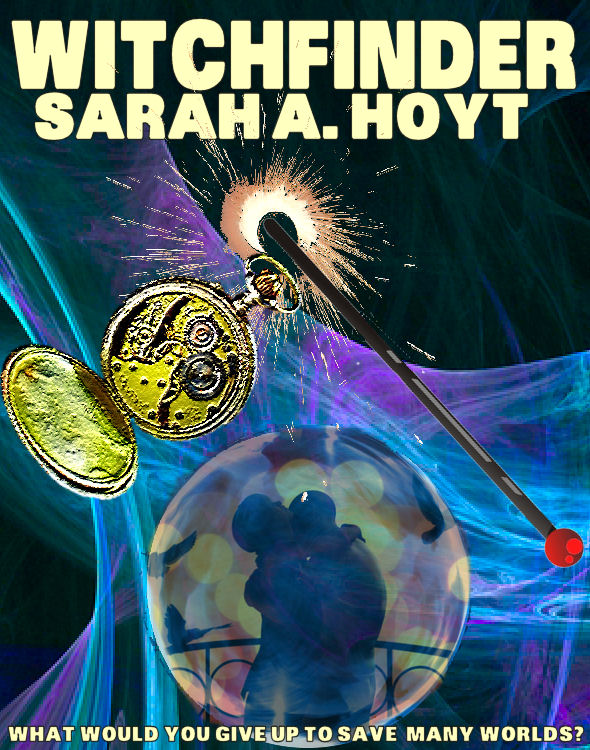
 

Making A Separation

First, calm down.  I know it’s become fashionable for people to announce broken relationships casually on their blogs, when you had no clue anything was wrong.  This is not what I’m doing.  My marriage is fine.  We have, at various times, threatened to divorce the kids, or at least to run away from the kids and the house for some more or less extended period.  I think normal people call this “vacation.”  It sounds like a lovely idea – and maybe we’ll have enough money to, sometime.

What I’m going to talk about, though, relates to running away from the kids, and the house, and also to breaking a habit almost as old as our marriage, and one which I always assumed I liked.

I’ve been working at home – working as defined as making money or having expectations of making money – for fourteen years.  I worked at home before that, but there is a different mind-set when you NEVER expect to be published than when you know you can sort of, almost, make what could be called a living.

My offices have varied.  When we lived in Manitou Springs, I had the entire third floor with a bathroom of its own.  This worked very well.  To an extent it was like being “at work.”  I went up sometime at eight am when I dropped the last kid off at school, and came down at five or five thirty when Dan came off work.  I even had a coffee maker there, so I didn’t need to come down to the kitchen.  Oh, okay, there was picking up the kids there as an interruption – until they were old enough to walk home alone – and the office wasn’t impervious to kids.  When I started out, and the first two years as a pro, Marshall usually played at my feet while I worked.  But those are minor adjustments.  The important thing is that “third floor = job” to me.  This was set firmly in my mind, so when I started reading blogs, I’d bring the laptop down to the living room or movie room for that.

Then we moved.  And we THOUGHT the arrangements here would be similar.  We have a third floor, though not with a bathroom.  I figured I could afford the occasional run down the stairs for bathroom breaks.  Only it didn’t work that way.

Look, the house is really well built and insulated.  If I’m up there, I can’t hear anything.  This started by being an issue because I couldn’t hear the kids (8 and 12 by the time we moved here) and I realized I was used to keeping a “sweep” for “trouble” while writing.  I couldn’t write without it.  Paranoia just mounted till I had to come down every five minutes.

And now that frankly I can trust them on their own (except they’re likely to come to the bottom of the stairs and mumble, “Mom, is it okay if we set fire to the neighbor’s political sign?” and then swear up and down I gave them permission) I can’t write up there because I’m still sweeping the house with my mind: for intruders; for kitteh breakage; for…

So four months after moving in, I setup half the bedroom as an office.  It has worked… sort of.  The bedroom is a double room, and I separated it with a curtain.  I also use the nook downstairs as an art nook, and the TV room for publishing and…

If you’re frowning at the page… yeah.  See, the thing is I know our work doesn’t quite fit in this house because at this point Dan and I have two offices each, and one shared, and none of them is QUITE right.

Again, let me emphasize I LOVE working at home.  It allows me to be here for emergencies.  It allows me to put a load of clothing in while I finish a blog.  It allows me to pet cats while working.  It allows me to answer the door, take messages, and keep the family running.

And if you’re frowning at the page… yeah.

The problem is exactly that.  For the last five   years I’ve found that if I spend 2 hours a day writing, it’s a lot. And it’s not uninterrupted writing – oh no – it’s five minutes here, ten minutes there.

In the past I found when my time becomes fragmented like that, I end up having to go to a hotel for a week to just get the books RIGHT in my head.  And then I can finish.  But that, even at a cheap hotel (can’t be too cheap.  Bed bugs are, pardon me, a right bugger when you’re trying to write) runs to $500 or so.  And it became very expensive to take these writing retreats every month, which – now that I’m trying to finish indie stuff too – is what I’d need.

Also, I became aware of … “pressure”.  I was never off.  Particularly now with Indie stuff and with having assumed the duties of cover director at Naked Reader Press.  There was always something I HAD to do.  I’ve always worked the occasional weekend or evening, but now it was EVERY one of them, so I never had time for my family and I felt like I was under the gun 24/7.

I always know when I’m about to blow a psychological gasket, because I start daydreaming of kidnaping Dan and vanishing to Denver for a long weekend.  (Which still wouldn’t be a bad idea.)

I also, being somewhat self-aware, started sweeping craigslist for offices for rent.  The problem was something in a relatively safe neighborhood (not the best in the world, but I’d not get raped coming out late afternoon in Winter) and at a price I could reasonably expect to make back.  And still I hesitated, because, dang it, I LIKE working at home.

For a few months I had what I call Office-ish.  Someone was allowing me to borrow a cube at their company and it was convenient because Dan could drop me off on the way to work.  It worked relatively well – I finished three books – but because the arrangement was ad-hoc and temporary I could not make the space mine, and also I was there very unofficially and people working around me got curious.  It wasn’t “my place” and I felt like I was imposing.

That no longer operates as that particular space has closed, as the company downsized.  So…  I was back at home and scanning craigslist.

Last week, unexpectedly, I found an add for an office that looked like it fit expectations, at a price I could reasonably hope to make back if I wrote even ONE indie novel a year in excess of what I have to deliver.  I went to see it.  I’m not going to say it is the thing poets sing of.  It is, to be blunt, a closet.  A walk in closet, with a window, but a closet nonetheless.  About the size of your average cube.

However, I can hang pictures on the wall, I can bring in my desk and tea things, the bathroom is just down the hall, and it is a very quiet building.  (Most of the time, there’s sudden eruptions of clapping from the Black Ribboners down the hall, but that’s survivable.)  More importantly, it’s within easy (and cheap) driving distance.  And it has plenty of daylight (which makes a difference.  It’s the reason I’ve rejected most other offices I could afford.  I’m photo-voltaic.)

It’s been almost a week (I started Wednesday) since I’ve been going there, and here’s what I found: a) I get a lot more done.  Five to six hours uninterrupted work really accomplishes a lot more than five minute increments amounting to the same time.  b) it gives me permission to not work at home, or at least not work at writing.  When I come home, I’ve usually written everything I CAN write, so I’m free to hang out, do crochet (which I haven’t had time to do in years and yeah, it’s my one feminine gift.  No, I don’t do wool.  I do miles and miles of fillet crochet.)  

More importantly though, it’s the sense that I can RELAX when out of the office.  When I’m there, I work VERY intensely.  When out of there, I don’t have to.  (Mind you, I still will for two nights a week or so, on publishing or NRP stuff.  But it’s not every night, and there is no feeling of “my work is never done.”)

Mind you, it means I’m gone most of the day, so if you’re sending urgent emails and no one answers, I’m not actually ignoring you.  I’m just at the office.  Again, if you’re the kind of person likely to have an emergency I CAN do something about, you have my cell number.  Send me a text.  Depending on the emergency, I’ll either tell you when I can deal with it, or call one of the kids to get into my computer and deal.

I’ll keep you posted on how it works out, ultimately, but for now it promises to be a boon to production and to permit me to make back several times the price of the office – as well as perhaps improve my mental health.  (Of course, if it doesn’t, I give it up after a year.)

Again, we’ll see.  But one week in, I see the virtues of making a separation between my main work and my part time jobs and family.

Now, if I can start writing these posts at the office the day before, I can leave for the office at a decent hour.