It Won’t Go By Itself

Okay, this is a mistake I keep running across, and possibly the most egregious of the mistakes in the “newby self published” stuff on Amazon.  So…

Listen to me, I am the voice that cries in the wilderness (or at least from behind a desk covered almost totally in cats.)

You can have a great character (or many.) You can have great settings.  You can even write fascinating scenes.  But your story won’t go anywhere if it doesn’t have an engine.

This is one of those rare problems in writing: one that as far as I can tell, I never had.  Mind you, I was once accused of having it.

Back then I had just met other writers, and while I – sort of – knew how to write, I had clue zero how to talk to other writers (yes, this too is an acquired skill.)  I did not know, for instance, that not everyone wrote the same way, and following the same process.  So I made no account for differences.

Back then I was in phase not much different from the current one.  I got the beginning of the novel.  From that I deduced the general idea of what was happening and what people needed.  THEN I wrote the novel.  Then as now, the lag time between first-scene appearance in head and writing the novel could be anywhere between two days to three years.  Then as now, that first scene hit with the force of a hammer between the eyes, and I had to get it down.

The person I was talking to was an experienced novelist.  Well, the most experienced I’d met up to the time.  She’d had one novel published eight years before.  In my innocent young-writer mind this translated as successful.

So I told her about the opening scene that had hit me “This woman notices someone following her.  No one else seems to see him.  One day she’s had enough and goes to talk to him.  He’s some sort of supernatural creature, I don’t know what yet.”

She – who worked from plot out, and therefore thought I was insane – told me “Your story lacks an engine.  There’s nothing to make it advance.”  This was true, insofar as that was not a story, yet, only a scene.

Yes, she kilt that novel.  She kilt that novel daid.  I had no idea, see, what she was talking about, and all I could think was “I’m doing something horribly wrong, and I can’t SEE it.  I’m the world’s worst writer.”  Not only didn’t I write anymore on that novel.  I didn’t write anything for three months.

And THAT was a mistake I made.  If you get ideas the way I do, don’t go imagining you need to have everything RIGHT up front.  However, by the time you’re writing the book, you should have an idea what the story is.  And that will give you an idea what the engine is.

The best way I know to explain this is with examples.

And the examples are from what you’d find at the back of a book.  Mind you, often this is the level of “outlining” I do to get a story idea to hold till I have time to deal with it.

So.  Imagine you read the following outline:

John has moved to Greece to study the classics.  While there, he adapts to local customs and has many interesting run ins with natives.  Occasionally, people try to beat him up for talking funny.

Is that a novel?  Uh.  At best it’s a travelogue.  John might be a fascinating character.  Scene by scene his run ins with natives might be side-splitting.  BUT the story has no engine.  There’s nothing propelling it forward.  Unless it’s a highly literary piece of work – why should people keep reading?

Frankly, having judged contests and mentored, what I see is a never ending collection of John eating breakfast, John mangling Greek, John seeing funny local customs.  IF you’re lucky, there will be the occasional episodic John gets in a fight and takes weeks to recover.  Here’s the thing.  Take John at the beginning and at the end of the novel.  Did he change?  No?  Did anything around him change?  (And if you’re going to defend the picaresque novel, read on.)  Did his actions make ANY difference at all?  Could you take what happened and scramble it around with minor adjustments (so, he hasn’t learned to like souvlaki at that third dinner.  Have him eat something else.)?  Well, then it’s not a novel.  All the parts are there, but they’re not working in concert.

“Well, oh, great one,” you say (about time you said it, too!)  “How do you give it an engine?”

Stop smirking.  Of course I can.  I can give it several engines, depending on what genre this is.  Watch me:

Mystery:
John has gone to Greece to study classics.  Finding a body on the site of some interesting inscriptions was not in his plans.  When the corpse turns out to be that of a colleague he hasn’t seen in twenty years, and who shouldn’t be in Greece at all, faced with the local authorities’ suspicion of him as the only foreigner around, John is forced to investigate – easier said than done given his lack of knowledge of local customs.

Romance:
When John goes to Greece to study the classics, the least thing he expects is to fall head over heels for a dark haired local.  His courtship, fraught with cultural and linguistic missteps demonstrates that the course of true love never does run smooth.  Will he win the exotic beauty?

Fantasy:
When John goes to Greece to study the classics, the least thing he expects is to fall head over heels for a dark haired local. Or is she a local?  She tells him her name is Diana, and glimpses of her at night seem to show her in a familiar aspect, dressed in the ancient way and accompanied by dogs, carrying a bow in the moonlight.  Is John’s love eccentric?  Is she playing the world’s most elaborate joke on him?  Or has he fallen in love with the ancient goddess of the haunt?  And if he has, what does it mean to the world at large that the ancient gods walk again?

Science Fiction:
When John goes to Greece to study the classics, the last thing he expects is to find an artifact made in alien metal and written in what looks like proto Greek.  The story it tells is the Iliad – if it had taken place among the stars.  With mysterious strangers trying to destroy the fragment and a beautiful woman trying to discredit it, John finds himself in the adventure of a lifetime, one that at the end of it might very well have him lost among the galaxies.

The beauty of this, is that you can take the first book – with all the funny incidents and events, and John being a general twit about Greece and the Greeks, and make it into any of these, by adding a plot line that follows the … movement line of any of these ideas.  He can have all his social faux pas and linguist malapropisms while talking to everyone who was around at the time of the murder.  He can sample local cuisine while talking to his lady fair.  He can even investigate the legend of Diana while eating and talking and strolling about the country side.

The engine of the novel is the thing that keeps us reading through all those incidents, the thing that makes us turn the page to see “what happens next” and “how will it end.”

Of course, some minor points in addendum – the action should rise, and the stakes should get higher.  What do I mean by that?  Well, at first the authorities are suspicious John murdered the other guy, then they take him in to question him, then they start following him.  At the end of this he could/should be on the run, trying to get the real killer, before he experiences Greek prisons.  A similar dynamic should apply to the others.  Think of this as moving an engine up through the gears to climb a mountain.

You should avoid having too many of the same kind of scene – hurt-comfort, peril, redemption – or scenes that feel the same: scenes that take place in a boat for instance, are unusual enough that if you have too many will feel like the same scene.

Your character should be affected by each rising point of action.  I.e. try not to have them make the same mistake ad nauseum, unless there’s a reason they lost all memory.

And now, you say, what about picaresque novels?  They violate a lot of these rules, they have no rising action (or often don’t) and they often have similar type of scenes.

The best known picaresque novels are Leslie Charteris’ the Saint, though Barry Hughart’s Bridge of Birds, etc, have a similar feel.  And to an extent some mystery series feel like picaresque novels – like Rex Stout’s Nero Wolfe series.

The picaresque novel (I’ve linked to the wiki definition) as far as I’m concerned is a novel of man at odds with his world.  There is something about your hero that is so odd that it puts him at odds with the world/society.  The novels are often episodic in nature, consisting of a series of events/adventures that do not rise in action.  (In Rex Stout’s case it would be the series, not each novel.)

So, do these novels lack engine?  No.  The engine is the character.  You need to have an extraordinary and extraordinarily strange character.  These novels resemble nothing so much as the stories of gods and heros our ancestors must have told around the camp fire.  EACH individual segment still follows the rules – rising action, something accomplished, etc – and each segment illustrates the extraordinariness of the character.

In other words, John, no matter how nice, brave and courageous he is, won’t be enough.  John needs to have one characteristic: the saint’s cunning; Master Li’s intelligence; Goodwin’s doggedness and Wolfe’s amazing intelligence and erudition – and this characteristic needs to come into conflict with its world, over and over and over again.  Whether your character emerges triumphant, or he’s the perpetual underdog, yet he must be tested over and over, and each episode must be amusing enough to keep the reader going past the break.  A purely picaresque novel is a difficult thing to write and this is often combined with a more traditional format (as Hughart did.)  Do not think this is the way of addressing the lack of engine in your story.  It’s more the way of tuning your engine if you are a virtuoso.

Now go make sure you have an engine to keep your story running.

An Affair of Honor

Lately I’ve been thinking about honor.  Maybe because I spent the last couple of months mulling over the musketeers.  Maybe because I’ve gone back to a regency-reading jag as I work on things as far from regency as possible.

Honor has got a bad rep lately.  It’s been dragged through the mud, and its garments are draggled.  Association of its names with such egregious ideas as “honor killings” has done it no good.

It’s particularly unjust since honor killings are more shame-killings.  I grew up in a culture that still shows a lot of Arab influence, (well, they were there almost as long as the Romans, you know?) and I almost understand honor killings – if I squint and look sideways.  I was, after all, raised in a village (so like Miss Marple I’ve seen all there is to see of human wickedness.)  Of course Portuguese – at least civilized ones – don’t honor-kill their daughters.  But we had a case in the village where a father shaved his daughter’s head because she was talking to a strange boy.  And even with my family’s rather odd behavior, since we were all readers and a fair number of us engaged in creative work, I came across that “how could you talk to him when you were alone in the house?  What will people think?  You have shamed us all.”  I came across it more than once, because I have trouble wrapping my mind across the nonsensical.  And to me – particularly when this started, when I was about eight – seeing a little friend who happened to be a boy was no different from seeing a little friend who happened to be a girl.

But the overwrought minds of village spinsters and old women looked at this the way “enlightened” militant “feminists” do.  Like the one who accused my nine year old of sexual harassment for touching a girl’s behind while trying to get her attention.  (He didn’t fondle her.  He reached through a crowd and poked her, to ask if she wanted to play a space exploration game.)  If you’re a male you have lust and evil on your mind, and any woman allowing you near has lost her virtue.  (They must live MUCH more interesting lives than I do.)

Anyway, honor viewed that way is more what the public thinks of you and what you allow the public to know.  You can lose your honor through all sorts of stupid things that have nothing to do with what is in your heart and mind.  You can be “disgraced” the way a regency maiden was disgraced because she tripped in public and fell across a gentleman, and didn’t immediately faint or whatever.  (Well, at least in regency romances.  I believe true society had more leniency.  I mean, even in the village, even with my eccentric behavior and the fact I wore shorts outside the house – oh, the humanity! – only half the people considered me a slut.)

We find this in Shakespeare too.  “I will bite my thumb at them; which is a disgrace to them, if they bear it.”

This type of honor is fun, of course.  Well, fun to write about.  It allows you to get your characters in all sorts of nonsensical situations.  It is a good stand by for making your character marry someone she hates, for instance.  Or for making your male character fight a stupid duel.  Since we sometimes require non-brain-damaged characters to act like idiots, this type of honor can be a good tool.

BUT…

But the honor I want to talk about isn’t that.

It’s not the external, being paid homage, being rendered honor.  It’s the internal honor, in the secret of your heart, in the center of your being.

To explain it: we all live our lives by certain principles.  Yes, even those you think have no principles have stuff they live by, even if it’s just “look out for number one.”

This is very obvious in fiction, because, of course, the characters live only on the page, and their characteristics stand in obvious relief.  Characters live by some principles.  Athena’s in Darkship Thieves, for the longest time, is “survive” but she does have others, which come to the fore when tested.  Things like “I will not return kindness with evil.”  And of course “I will not abandon those who looked after me.”  (Kit.)  This is even more true of Kyrie in the shifter books, whose internal principle is “look after those who can’t look after themselves.  Not because they’re good, or deserve looking after, but because they can’t.”

(Writers live by some principles, too.  For instance, my refusing to write an autobiography, in which I’d have to tell a lot of lies to protect OTHER PEOPLE’s secrets might have cost me promo and a “dahling of literary establishment” career, but it was my internal principle NOT to step on family and friends on the way to success.  To do it would have broken me, and made it impossible for me to be me.  Break that barrier, and nothing stands between me and shooting people who annoy me.  Me as me stops existing.)

Here’s the thing – it’s not that you can’t have a character break one of their inner principles.  You can, but then all hell should break lose internally as well as externally.  And that type of principle, inner principle, can only be broken if it’s either only partially broken, or if it’s something the character can convince him/herself is an exception.  Say, Kyrie COULD leave someone to starve in the dark.  BUT that person had better be a danger to the other people she feels she must protect.  (And even then, frankly, she’d be more likely to kill them cleanly.)

The reason I’m bringing this up is victimhood.  In this case the treatment of victimhood in books.  What do I mean by that?

When you lose sense of an internal honor, a moral code, a guiding principle, you tend to misunderstand things like Kyrie’s animating period of “look after those who can’t,” which is one of the animating principles of western civilization.  Instead of its being “look after those who can’t, because you owe it to yourself as a human being” you see it as “look after those who can’t because… victims are special.”

I’m getting very tired of seeing this in books written in the last thirty years or so.  People who are downtrodden are some sort of saints – magical, not really human.  They don’t need anything else to make them magnificent – just that someone be mean to them.  The meaner someone is, the more “saintly” the character is treated as – even if the reader can tell he or she is in fact the twit of the universe.

Let me make it clear for those of you short on understanding: the reason Cinderella deserved the prince was NOT because her step sisters were mean to her, but because she was beautiful and sweet.  The sisters are on their own course and earn their own doom.  HER job was to keep her internal honor, and it is that which earns her the prince.  (And please let’s not argue about older versions, okay – I’m talking about it as it’s known.)

Harry Potter is not the main character because he was mistreated, but because he was the boy who lived.  The mistreatment which reaches almost comic proportions is an (effective) attention getting device, but it is not how Harry Potter earns his position in the world.

If your character is repulsive or totally amorphous, that will show through the victimhood, and make the reader – this reader at least – gag.  More than that, while you might make us root for the underdog – it’s almost a reflex – if the underdog doesn’t prove himself, and is always and perpetually the victim, the story becomes an exercise in sado masochism, and will give off a “sick” feeling.  You will also be contributing to moral confusion that is already too prevalent.

Now, I’m not saying you can’t torture your character (look, if you read the beginning of A Few Good Men) you’ll understand why that’s funny coming from me.

I’m saying you should still develop your character after that and make him/her grow.  Or of course, make him a terrible person, if he/she is the villain.  I mean, why can’t a victim be the villain?  Sometimes the poor bastard in the dungeons DID do enough to deserve it.  (Er… not in AFGM, by and large.  Oh, there’s stuff never talked about but visible between the lines that probably would have earned him a spanking, but not dungeons.  THAT was real politik at work, I think.)  Or perhaps he’s still a twit who needs to grow out of what took him there.  Even if punishment was excessive.

I’m tired of the idea that victim = virtue.  We’re starting to see it seep into politics with the idea that groups who have been excluded have some sort of extra special specialness.  You know that isn’t true.  They’re human.  We’re all human.  I do not approve of people being excluded or looked down on for color of skin or other irrelevant traits, (or even relevant.  There’s more to character than intelligence, for instance) but I also don’t approve of their being sanctified because they were excluded and/or victimized.  

“But I was put down” is not a claim to heroism.  “But I was put down and achieved something nonetheless” IS.  

So, in the end, it’s the internal honor that counts – at least for me, and by and large in life – and what the old biddies in the village think… not so much.  And if the biddies are the readers in the global village, enough of them will get disgusted with the idea that victim means virtuous.  Also, you’ll be contributing to insanity in society at large.

Make your characters (and as much as you can, yourself) persons (worthy of) honor.  We’ll all win by it.

Divine Madness

Years ago a very weird thing happened.  Because of it I wrote Sword And Blood.  (And have the two planned sequels outlined safely in notes, with key scenes in longhand.)

First of all let me say that when I started out writing, I didn’t outline anything.  I tried outlining a novel, because I’d read one should, but then I didn’t want to write the novel.  My subconscious thought it was done and simply wouldn’t budge.

So I learned not to outline.  Just write it.  However I was young and novels are complex things.  I’d start out with an idea of where it started and where it ended, but what happened in the middle often went “wrong.”  As in, I was incapable of imagining to the depth or realism or detail needed and took the easy way out – coped out, in other words.  And then it didn’t feel right, and I either ditched the novel or spent two months trying to back up to where it had gone wrong.  It made the whole writing process difficult and protracted.

And then I got ill while trying to write a book.  To make things easier, I outlined it at a very high level, then did ten chapters at a time at a detailed level.  This time it worked.  For about ten years, I became a plotter and outliner.  Heck, I used to outline short stories.

Then strangely my old complaint came back.  I couldn’t outline.  If I outlined, I betrayed the story.  I can’t fully explain it, but when I outlined, I wrote in the “easier” option.  Easier to see and easier to endure.  Carefully outlined novels became somehow shallower, not as deep.

Writing some scenes is like falling on your sword.  You see the metal there, you know it’s going to hurt like a bugger before it does its job.  And you do it… once.  Now imagine our Roman who fell onto his sword magically reanimated and healed and doing it again… on purpose.  I doubt anyone could.

So when I outlined I flinched from the painful scenes and instead of falling on my sword, I gave myself practice cuts on my skin.  And then – because with me an outline has that effect – when I wrote it, I stayed at that level.

And then I broke.  This was now almost five years ago, also known as the year when I homeschooled and wrote six books.  Oh, yeah, and attended a bunch of cons.  I remember at a con in March telling someone I’d just finished my second book of the year, and having her look at me like I was nuts.

Round about June (four books) I realized I couldn’t turn my mind off.  I know this sounds silly.  I know you’re going “Why would you want to turn your mind off?”  Because I’ve found “turning off” as in, spending a day or two reading and absorbing other people’s ideas, or going for a walk and enjoying the mere sensory experience, or any of a half dozen similar things are needed for me to keep writing without getting ill or entering a sort of total, deadly silence.  (Though I’m finding having an office and working on different stuff on the weekend is enough to provide a break.  But I’m not doing six books OR homeschooling either — okay, it might turn into six books, but they’re not six books under contract and to specs.  It’s different.)

Normally the surefire way to turn off my mind is to go to Denver overnight, go for a walk by the duck lake, or hit the museums or the zoo.  Being away from home/work is enough.

But five (almost) years ago I couldn’t do it.  Going away helped… for a week.  And then I wanted a vacation again.  Because the mind never fully went off track on the current novel.

That’s when I found my escape…  Which involved doing … more.  That is, it involved my starting art classes. While I was concentrating on that, I couldn’t think of writing.  More, it was a different mode of thinking: all tactile and visual, not words.

And it was while coming out of an art class that I got all three (to be honest six, as there’s three sequels with a character yet unborn in the first three.) books… the best explanation is “downloaded” into my mind, completed.  Even the wording was there for key scenes.  (Mind you, it’s been a while, so in writing the second and third, I’ve found I’ve lost stuff, and “getting it right” involves a tuning process, much like turning a radio dial.  I know when it’s “right.”)

That it was vampires didn’t surprise me.  I run to horror when I’m near snapping.  That it was that detailed, that complete, and… well… like it had come from someone else’s head, did shock me.

Around that time I was talking to Walt Boyes and he recommended the Origins of Consciousness in the Breakdown of the Bi-Cameral mind.

While I think the man has something there, I think his thesis is fundamentally wrong.  We always like to think we invented things over our ancestors, but thinking we invented consciousness is really one step beyond the pale.

I think what he’s forgetting is what any anthropologist or literature critic would take into account.  What he’s using to evaluate a whole culture is the output of a few people – shammans, playwrights (in Greece) or bards, all of which claimed divine inspiration.  The thing is, we have no way of knowing if they believed in what they claimed, or if this was their way of gaining credibility with their tribesmen.  Beyond that, we don’t know if they were typical, or if they were as different as authors are today.

Look, it’s a secret we don’t tell everyone, but the thing is that there are very few writers whose story doesn’t escape them in ways that baffle non- writers.  I’ve yet to meet a writer who doesn’t sometimes say something like “And then the story twisted” or “The character just wouldn’t die” (or live.  Even when you try to save her.)  Get a few writers who trust each other together, and there it comes.  Mode of speaking?  Maybe.  From my experience, though, it’s sometimes the only way to describe what we go through.

That these incidences of experiencing what seems like someone else/something else in your mind tend to happen when we’re tired/frazzled/on our last brain cell is probably significant.  Julian Haynes description might even have something to do with what happens in our minds.  (Though I doubt most of us think it’s gods or even characters dictating.  We just talk about our novels like they have minds of their own, like this “Damn thing wouldn’t be written third person!”)

In my more grandiose times, I imagine there’s something in fiction writers’ brains that is designed to communicate with/catch communication from parallel universes.  But that’s probably because I am a fiction writer.  In my everyday thinking, I assume those novels that show up fully formed are in fact hatched by our subconscious.  Or at least mine.

Whatever the truth, I’ve found that after Sword and Blood, the novels refuse to be outlined.  And are deeper and stronger without being outlined before – not even a vague outline, though I know in my mind how they’re going to end, all along.  It’s the way there that can feel like someone else drew the map.

It is very hard for me to give myself over to this sort of shamanistic trance, this divine madness.  I’m a rational woman.  I’m more than a little bit of a control freak.  And I’m fairly sure I have a consciousness.

If my job were anything else at all, I’d just claim that this never happened.  I’d scoff at people talking about it. And I would SERIOUSLY doubt the stuff written this way is better.

But I am a writer.  And the divine madness seems to work.  And so, I force the rational woman to close her eyes – or, as seems to work better, to be short on slep and beset with other work – and then… I jump in.  And I let the muses guide me.

I was going to write about this, but really there’s nothing I can add to Mike Cane’s thoughts. Yeah, the 8.99 paperback is the refutation of all the “but we can’t sell for that price.” Beyond which, ebooks aren’t shipped (or for that matter printed), so they’re cheaper, and for most of the large companies, ebooks are DRMed and one-copy-only, so you end up buying them for everyone in the family — thereby paying 4x what you’d otherwise have paid. (Okay, I only do that for Terry Pratchett and F. Paul Wilson, but…) So the disconnect in David Carr’s “reasoning” is stunning.
I know I’ve said this before, but I just wish people would THINK.

mikecane's avatarMike Cane’s xBlog

It comes from the New York Times today — Book Publishing’s Real Nemesis — and is manufactured by David Carr, who has a shocking ignorance of eBook history, recent history, and is plainly biased towards the status quo.

The Justice Department finally took aim at the monopolistic monolith that threatened to dominate the book industry. So imagine the shock when the bullet aimed at threats to competition went whizzing by Amazon — which not long ago had a 90 percent stranglehold on e-books — and instead, struck five of the six biggest publishers and Apple, a minor player in the realm of books.

That’s the modern equivalent of taking on Standard Oil but breaking up Ed’s Gas ’N’ Groceries on Route 19 instead.

What the hell is this guy talking about?

View original post 1,797 more words

Stop Me, Or The Writer Gets It

I don’t believe in fear of success.

No, that’s not exactly true.  There might be people out there who are genuinely afraid of doing well and succeeding.  I just have never met any.

I’ve met any number of people who, unconsciously or consciously sabotage their career, their love life, or their economic well being.  Some of these people use “Fear of Success” as their excuse.  I guess because it sounds so much better than “I’m not sure I’m good enough” or because they, themselves, don’t understand their self-destructive behavior.

Look, we all have self-destructive behavior.  I, myself, have found there are things I MUST do even when it will destroy my career or lose me half my audience. Is this a fear of success?  I don’t think so.  I think in my case it comes closer to “there are things that are more important than my career.”  I find myself pivoted into issues where my speaking out will alienate editors and sometimes writing friends.  At that time, the decision comes down to “Is this topic/idea more important than my career?”  In other words “Is it bigger than me?”  If it is, I speak out.

It’s a balance.  Part of my duty (something to talk about later) is to ensure I maximize my income, so we give our boys a better start in life than we had BUT with indie I can write confessions on the side.  I can even (Hey, there’s such a thing as single malt and a mild buzz) write erotica under a deep pen name, if I’m starving.  So if you remove my duty from it, what is left is what matters most.  That’s the only deciding factor.

So, that’s number one.  Sometimes people know behavior is self destructive, but really, for them, to their value set, it’s the only thing they can do.  You simply can’t know from the outside.  And yeah, they might fob you off with “fear of success” because they can’t or don’t want to explain it to you.

Then there is not knowing where to start.  I think this is less of a problem with the net, because you have all these writers and publishers blogs to consult.  In my time, not knowing how to start was huge.  For instance, mid-eighties all the houses needed synopsis.  I simply had no clue what a synopsis looked like.  I didn’t send novels out for five years.  I had no idea HOW.  The thought of reducing my entire novel to ten pages gave me cold sweats.  I’d done precis in college, but had no clue if that was what I should do.  (Answer – yes, no, maybe.)  Then someone local published a small chapbook called “proposals that sold.”  I immediately started sending stuff out again.  Got an agent the next year.

You’ll say “you could have figured it out on your own” and undoubtedly, I could.  Not to the conventions that would sell, mind, but something that at least meant I sent stuff out.  Wouldn’t have made any difference, but it would have looked better to myself, in retrospect.  But isolated as I was, ignorant as I was, and afraid of approaching “real writers” for fear they’d laugh at me – among other things, because I am ESL writing in English.  How crazy is that? – it was one last, overwhelming barrier.  The straw that broke the camel’s back applies to this type of situation, and I’ve seen my kids go through it.  I don’t know who the joker is that decided kids must apply to college while finishing their senior year – usually during first finals.  Perhaps it is because both my kids were AP/Honors/Advanced and it’s more demanding.  But I’ve seen them let college applications slide, refuse to jump the hoops for scholarships, and kind of willy-nilly blow deadlines.  I think it’s because they can’t cope.  It all climbs up, and they can’t cope.  That was the “How do I write a synopsis?” was to me.  Not a fear of success, but a neurotic shutting down and hiding under the bed.

But the most common “fear of success” thing I see is actually a fear of failure.  I get that.  I have that too.  Like most writers I have the bottomless, negative self confidence in my writing.  I understand just enough of what I do, to know how much I don’t understand – in fact, how much I don’t get – about how my writing works.  And what’s not under my control freaks me out and makes me afraid it’s not god enough.  So I live in fear of failure.  Like Wily Coyote, running mid air, sometimes I try to run hard enough to escape the inevitable lack of ground under me.

However, there’s something people who fear failure do that prevents success.  (This reminded me of it.  Apparently writers are not alone.) I think the first question that anyone asked me as a more experienced (I wasn’t published yet) writer was “How long do you leave a submission in, until you pull it?”  At the time to me this meant gibberish.  “You leave it till it’s sold or rejected.”  But no.  Later on I came to know my modus operandi was amazingly rare.  I didn’t pull books or shorts, but everyone else did.  And at the time doing that ranged between stupid and suicidal.  Stupid if the book or story had been just waiting, but suicidal if it had been making its way up from undereditor to editor to managing editor or, worse, if it was on the executive editor’s desk, ready to be sent to you with an editorial rewrite request or even an acceptance.  An editor who has gone through the process of accepting an unknown will never forgive the unknown for spitting in his face and withdrawing.  So unless you’re sure you’re J K Rowling and Pratchett and Heinlein rolled into one, this was an insane thing to do.

Now… other considerations obtain. and therefore, in addition to the above, I’ll give you a few touchstones for figuring out if you’re committing suicide in a complex manner.  If you’re doing any of these things, don’t.

– Don’t pre-reject by not submitting.  If you write a short story you think would be perfect for Analog or Asimov’s – or even a long shot there – don’t not send it in.  At least if you think the prestige of a traditional publication is still worth it.  (For most people it is.  For those who are, like me, midlist, it might not be.)

– Don’t commit suicide by removing stuff that the editor might want.

– If you’re traditionally publishing, don’t air dirty laundry in public.  (Don’t even try the quoque tu, Sarah.  I am only traditionally publishing through Baen and they’re family and through Naked Reader, where I have a say.  The others… meh.  Let the laundry hang.)

Those are old points, mind.  Now remember the market is changing very fast, and even if you’re still traditionally published, there are new caveats:
– Don’t confine yourself to traditional only.  Always remember, belt AND suspenders.  If you’re riding in the titanic, a lifeboat seems puny, but it will save you drowning, if the thing hits an iceberg.

– Follow industry blogs and indie writers’ blogs too.  I can’t say this enough.  FOLLOW those blogs.  DO it.  I don’t care if you don’t have time.  It’s the equivalent of being on the deck of the titanic and saying you don’t have time to use the binoculars.

– If you go to conventions, be aware of what is happening with the publishers there and what their authors think of them.  The days of pitching blind are gone.

– Keep trying.  Or to quote what an acquaintance-I-hope-will-become-a-friend quoted at me from Heinlein, in another context, last week “The cowards never started and the weaklings died on the way.”

You’re afraid of failure, and failure is a real danger particularly these days, with the industry crumbling under us.  So, what are you going to do?  Are you going to curl up and die and admit you can’t cut it?  Or are you going to fight?

Never give up.  Never surrender.

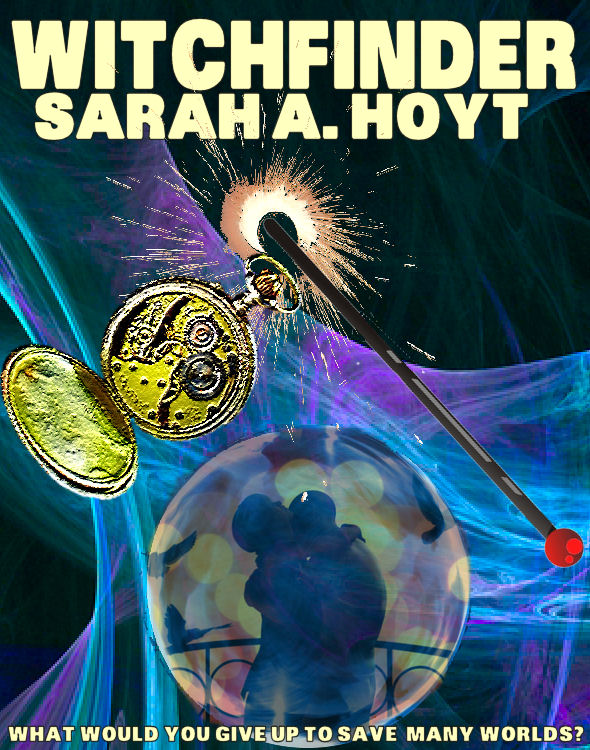
Witchfinder Free Novel — chapter 33

*This is the Fantasy novel I’m posting here for free, one chapter every Friday.   If your conscience troubles you getting something for free, do hit the donate button on the right side.  Anyone donating more than $6 will get a non-drm electronic copy of Witchfinder in its final version, when it’s published.
There is a compilation of previous chapters here  all in one big lump, which makes it easier to read and I will compile each new chapter there, a week after I post.  When the novel is completed and about to be edited the compilation page will probably be deleted.

Oh, this is in pre-arc format, meaning you’ll find the occasional spelling mistake and sentence that makes no sense.  It’s not exactly first draft, but it’s not at the level I’d send to a publisher, yet. *

For previous chapters, look here:  https://accordingtohoyt.com/witchfinder/

The Threads of Time

Caroline knew this was a dangerous spell, but she’d seen Gabriel do something like it.  Not to this level, she thought, as she stared at the wounds on the dragon-woman’s back.  She needed to reach for a time when the woman’s back had been whole, and superimpose it on her mutilated back.

Of course, doing that in fairyland might be more difficult than doing it in the human world.  Or at least more dangerous.  But Caroline had realized long ago that you didn’t have a choice between something you really liked, and something you dreaded.  Or not usually.  You had a choice between two things that were both unpleasant, and you tried to choose between them for the least unpleasant one.

In this case, she could choose to ignore the woman’s need and keep herself safe.  But then it was unlikely she would be allowed to walk the rest of the paths of fairyland till she found Michael.  And even if she were, she wouldn’t have the allies she was supposed to acquire through her journey.  She knew the rules of fairyland.  Everyone did.  They were built in to the earliest stories told to the smallest children.  In fairyland, you had to help three people in desperate straights, and then – after you did that – you’d get where you wanted to go.  Distance in fairyland wasn’t straightforward, or measured in meters.  It was measured in feelings and the heart, and three good deeds were the sacrifice needed to get where she was going.

To rescue her brother Michael.

She pulled back a strand of her thick, curly black hair.  It felt clammy.  All of her felt clammy, as if the clearing had suddenly got very hot.  The dragon woman turned back to look at Caroline over her shoulder.  Her eyes were the oddest Caroline had ever seen, a golden-orange, as though it had flecks of fire burning in its depths.

“I’m going to do something…” she said, and looked into the woman’s eyes, and swallowed.  “I’m going to use magic that might feel odd to you.  Please, bear in mind, I do it only from the best intentions.  It is the only way to heal you.”

The large, fiery eyes blinked.  “Do it, then,” she said, intently.  “Do it and be done with it.  I cannot bear to be captive here while my baby might need me.  Do what you have to do, no matter the risk.  You were sent to me by the paths, they must know you can heal me.”

Caroline wished she could be anywhere near that certain.  She put her hands up and recited the incantory protections for when one worked with time.  For all the good it would do her, here, in the heart of a place built entirely of magic, and while using the magic on a sentient being.

She was going to die of this.  No.  She banished the thought, forcefully, and lifted her hands, to let the magic flow through her palms, onto its destination.

Then she did what she dimly remembered watching Gabriel do.  She remembered seeing it – and she might have – though it would have required her to link to his mind and look through his mind’s eyes.  Perhaps she had.  She had been very young and very unguarded, and Gabriel, too, hadn’t guarded against her.

Because of that, she could remember the mental vision of time as a tapestry.  She’d once seen a tapestry weaving machine.  Michael had wanted to see one of the new manufactories, operated almost exclusively by magic, where men did no more than feed thread to the machines, and clip the finished product, or clean around the working, moving parts of the machine.

She and Michael had escaped through the window of their nursery while their nanny was asleep and walked down to the village, where one of the manufactories was.  It had taken them the best part of the day, and when they’d been found – through a spell cast – Seraphim had collected them in the carriage.  She remembered being afraid he was finally going to give them the spanking that he and Gabriel so often threatened Caroline and Michael with.  In retrospect, though, she thought what he had done: sitting white faced and tight lipped next to her in the carriage for the full hour drive back home, had been far worse.  As had the fact that neither Seraphim nor Gabriel smiled at or talked to Caroline or Michael for a good two months.

The manufactory itself she hadn’t thought about till now.  Michael had been fascinated by the gleaming, moving parts, the thread moving into place, all without the touch of human hands.  Caroline had looked at the people cleaning accumulated lint from the machines, or feeding them the colored thread.  They were children, little older – or perhaps younger – than herself.  It was the first time she’d been aware of her good fortune and her station in life.

Now, though, as she reached for the threads of time, she saw it exactly as that machine in that long ago manufactory.  There were threads – the life of each person, the path of each object everywhere – being fed into time, and what emerged was the completed tapestry.  Reaching out, she touched the mind-seen strands mid-air.  There were Caroline and Michael going to see the manufactory.  There was Gabriel, coming in in the middle of Seraphim’s birthday party, in that outlandish outfit, all rags, with the livid marks of whip marks across his face and the exposed parts of his skin.

Caroline blinked at this.  She’d been born after Gabriel had joined the house, and she was quite sure that, though she’d heard him described as filthy and covered in rags, she’d never heard of whip marks.  Whip marks why?  Who’d dare whip the child of the Duke of Darkwater – even if a bastard son?  She blinked, and shelved the thought for another day.  For a moment that thread, and the one next to it – Gabriel and… she blinked again – Seraphim’s? gleamed with the bright blue of strong magic.  It was tempting to see what was happening to them.  But she could not.  Not in the middle of this working.

Instead, she concentrated on the thread of the dragon lady – a thread of pure fire woven through the tapestry.  It was tangled and twisted, and ran along side two other threads, both of which seemed to merge with those of the Darkwater family.  If Caroline had time–

Enough of this foolishness.  She didn’t have time.  Instead, she ran her fingers along the length of the thread displayed by magic in front of her eyes, but in fact existing in dimensions humans couldn’t see.

There.  There was the last time this … person had been whole.  Now…

Carefully, Caroline took the time thread betweent wo fingers.  She couldn’t cut it and retie it, as Gabriel had done to the bird’s thread.  The bird had just been injured, and, presumably, its thread had touched no one’s fate but that of the cat who had dragged it.  This woman’s fate was enmeshed with various others – men, women, and possibly elves.  If Caroline cut the thread and tied it again, she would do damage to all those fates, and all of those people’s magic and – by extension – her own.  The recoil itself would kill it.

The recoil of this…  She tried not to think about it.  No point in it.  Instead, she took the thread and carefully, deftly, looped it around her fingers.

Touching that much power, that much strength, gave her an almost physical shock.  And as she grasped it to tie it together at the base of the loop, bringing the woman’s whole body in close proximity to this moment, she felt as though her fingers burned with it.  Her every instinct told her to let go, to let the thread fall into its natural position, to leave it alone.

The instincts were wrong.  She must – she must – rescue Michael.  She bit her lip against the pain and the burn that was forming welts in her small fingers, and forcefully tied the knot.

“Oh!” the woman said, and it sounded like some of Caroline’s pain had rebounded on her.  Her face flashed white and drawn, then for a moment it seemed about to change into a dragon’s.  But Caroline did not let go of it the thread.  She was not done.

Holding the thread and the woman’s life and existence through time, in her hands, she closed her eyes and forced those missing parts of her body – the clipped wings – forward through time and in existence in the presence.

She would never be able to explain it, but it felt as though the wings, on their way to the present, passed through Caroline’s own body, and her magic.  Her body they could not have passed through.  Not really.  But her magic, they might have, and it felt as though every sharp bit, every rough surface shredded her magic on the way through, leaving it bleeding and torn, like skin raked by claws and teeth.

Nausea hit afterwards, a nausea so strong that Caroline felt she could neither keep her eyes open, nor focus, nor even stand.  The threads fell from her suddenly lax fingers, and snapped into the tapestry, the loop still in place.  Her fingers hit the grass of the clearing.  She was aware of the threads vanishing from her magic sight, but she couldn’t think, couldn’t concentrate.  She clutched her middle.  She closed her eyes.  Nausea ebbed and flowed in her like a tide, and she groaned with the feeling that her body was made of nausea, a sharp point of discomfort and uncertainty, dissolving and twisting through the currents of time.

I shall dissolve completely and be gone, she thought, and whimpered with fear, thinking Gabriel had been right.  Of course he had.  And it wouldn’t be needed for him to punish her.  She was going to die of this.

“Thank you,” the woman’s voice said somewhere, outside her misery.  “If you need me, at any time and anywhere, call out to the dragon of the fire lake.  I am in your debt.”  And then there was the sound of wings and a feeling of unbearable heat.

Caroline opened her eyes, to find herself enveloped in flames.  Looking up, she saw the dragon, flying just above her, and blowing flames from its – her? – nostrils, which surrounded Caroline completely.

No.  I saved you, she thought.  You’re not supposed to kill me.

But the fire wasn’t killing her.  Hot, yes, but not lethal, it twined around her, an ocean of living flames.  It seemed to move through her, searing.  It was as though every weak place in her magic, every slow place, were burned away, leaving only the best, clear and glimmering in the firelight.

And then it was gone.  There was the impression of words in her mind “A gift of gratitude” and then the dragon was gone, flying away and through, to another time and another place.

Caroline didn’t know what the gift had been, and now she couldn’t asked.  She stood up.  The nausea was gone, but she felt as though she’d run for miles and miles.  Her breath came in short pants, her body was sweaty, the clothes sticking to her.  And her eyes seemed to prickle with sweat that had run into them.  And she was thirsty.  But you can’t eat or drink in fairyland.

On shaky legs, she made to take a step towards where she hoped the path was.

She heard the sound of hooves from behind and before she could turn to look, a male arm twined around her middle, and a voice said, “We have need of you.”

At first she thought it was a rider, and that he was bare from the waist up.  Then she realized it was a centaur who had got hold of her and was carrying her, held only by his strong arm, while his hooves galloped madly into a shifting landscape of fog.

No Place For The Eyes

My grandmother had a saying when someone was simply failing to get it.  “I’ve seen them blind,” she said.  “But never before have I seen them without a place for the eyes.”

Lately I’ve been thinking about this as the industries under attack by tech (not that tech is doing it on purpose, mind) just fail to GET it and think if they just paddle a little harder, they won’t go down with the Titanic and rescuers will be here soon, and then everything will go back to the way it was.

First, let’s establish something – what is happening to these industries is not simply a matter of technology rendering processes or ways of doing things obsolete.  Yes, that’s happening.  But the reason it’s taking such effect is that those industries – through business practices, through the fact that they were de facto oligopolies and gave immense power to a very few people, through series of unfortunate events and through sheer bullheadedness and refusal to listen to business facts – were running themselves into blind alleys.  Or had already run themselves there.

I’ve pointed out before how strange publishing had got, with a sort of circular reasoning where someone in an office decided what the numbers should be, then pushed the book to get EXACTLY those numbers, then took those numbers as confirmation they’d picked the right book and were publishing exactly what the public wanted.

The insanity was added by the fudge factor in the numbers – for instance, the reported print run was usually double the real printrun, it was almost impossible to find out exactly how many books were printed (reprints of less than 1k don’t have to be reported to the author and don’t count as reprints.  Whether they’re reported faithfully and to whom is a bit nebulous) and ebook numbers were largely pull from… er… air.  Sales reports could also be iffy in general – we’ve all heard of “bestsellers” who, it turned out, hadn’t sold.

So, basically, someone made up numbers, the same made up numbers came back to them and they said “Yes, we’re giving people what they want.”

Anything that went against this was swept under the rug.  The inconvenient facts, such as that print runs have shrunk 90% since the seventies, were “explained away” by telling us that people simply didn’t read as much (not quite true) and that movies and games were eating publishing’s lunch (true that, but only because games give boys something books no longer do: male heroes and action-packed story lines.)  If you pointed out that they weren’t publishing any books for boys, they’d tell you boys were sexist for not wanting to read girl books.  If you told them that they weren’t doing space opera, they told you no one wanted space opera.  If you told them Baen was doing quite well at that, they sneered “Oh, they’re right wing, and right wing people don’t read.”  (This despite the fact that baen has authors of every possible political persuasion and that to be blunt, I have yet to see different reading habits among my friends of different political stripes.  They will read DIFFERENT things [sometimes] but they all read about the same.  Stuff like time and career and education have more to do with it than political persuasion.  AND if you think that there is a great difference in education, you’ve been reading the wrong “analysis” – i.e. slanted ones.)

So, their denial of reality now shouldn’t surprise us.  They’ve had practice.  It’s just that they’re not getting how it has changed.  They no longer have control of printrun of distribution or, pretty much, anything.  They can’t make up numbers and have them echoed dutifully back at them.  But that doesn’t mater against the muscle memory of the years they could put their fingers in their ears and yell “lalalalalala” and reality didn’t intrude in their beautiful, ordered world.

I’ve said before here the next industry to be turned upside down and shaken by tech – like a rat in a terrier’s mouth – is education.  It’s probably a good five/six years from where publishing is now, but it is coming.

Yesterday, when reading this article, I knew it was true.  If you don’t wish to click through, don’t.  The claim of the article is simple: long distance learning via the net makes no difference.  People want/need to learn with other people.  Yoga videos didn’t end Yoga classes, therefore, there, colleges are safe.

Yes, that sound you hear is me giggling hysterically.  This reminded me so much of the articles as little as a year ago saying “Oh, ebooks have a ceiling.  No one wants to read books on a computer screen” and completely ignoring the Kindle and the nook and…

My long-distance-learning experience is now 5 years old.  And what they’re talking about is older than that.  HOWEVER what they talk about is older than my experience.

I took a correspondence course, once.  I never finished it.  I don’t know what the rate of finishing is.  In my case, I took it in lieu of going to Clarion, because I had two kids under five and couldn’t afford the time.  So I took a writer’s digest course in writing.  I was actually pretty faithful with it, but I got published halfway through.  Also, mostly, my teacher said “You’re good.  Keep going” which I didn’t feel improved my writing (though perhaps my mood.)

THAT was about twenty years ago.  Then my younger son had to be home schooled for a year and I discovered Great Courses.  This is what they’re talking about I that article – about that level – they’re recorded lectures by great professors.  They’re good to learn, if it’s something you’re not on a schedule to learn and don’t need to push yourself.  In other words, if it’s not something you particularly need to know.  I have used them to get background on an historical era or to understand the current thinking on something.

It works pretty well for homeschoolers, if the parent can get involved and do continuous homework/testing/further explanation, as well as make sure the kid is engaged with the video.  As good as classroom?  Not a chance.  Part of the reason the younger kid went back to school is that Dan didn’t have the time and I didn’t have the knowledge to extend his math lessons to where they needed to be.

BUT that’s old tech.  Those video lectures have existed since the mid eighties, I think.  Certainly since the early nineties.
In the middle of that same year, I discovered Lukeion Project.  It’s an academy online that teaches the classics, history and ancient language on line.

Marshall had become madly interested in the Greek classics, and they looked good.  And then under “they tempted me with knowledge” I realized they had Greek and Latin courses.  So I signed up for both.  (I keep meaning to go back, but not till the kids graduate.)

These are CLASSES.  They’re not teleconferences.  They’re more like instant messaging plus voice, but in a virtual classroom with fifteen or so students.  You get the teacher, speaking, and you can type questions.  If it’s a question that’s not relevant, they answer in typing.  If it is relevant to the rest of the class, they say “so and so has asked.”  You can ask and answer questions in voice too.

Let’s be honest.  I have a degree in languages.  I’ve found I can keep improving languages I know on my own, but not learn them on my own.  However, as far as my experience (or my kid’s) went there was no difference between this method and being in a classroom.  I stayed with it and worked my tail off, to the detriment of my health, since I was also writing six books that year.  I even made friends and developed a sense of fellowship.

The difference was as great between that and video lectures as between reading on computer and on kindle.  It’s simply not the same thing at all.

I’m not discounting that there might be groups of learners in small towns, who get together to study.  Humans are social animals.  BUT trust me, take it from someone whose writers group is virtual (and if I could figure out how, I’d mimic that classroom thing for that) and whose professional connections are all on line: distance learning is a contender and will only become more so.  It has a different “texture” from in person learning (you’re not as likely to check out the cute chick/guy across the classroom, for one.)  This is just like Kindle has a different “feel” from paper books, but it’s not inferior.  Just different.  HOWEVER it’s immeasurably more efficient and cheaper than a system that while not as sclerotic as publishing is becoming unaffordable and more dedicated to internal approbation by professors’ peer group than to actual results.

Will it work for exercise?  I don’t know.  That’s more a matter of forcing people to do things most of them frankly are resistant to.  I think the tech is NOT quite there yet.  You need camera connection to be reliable, and my experience with the things is that it sucks.  And the teacher would need a bank of monitors to see every student.  Give it ten years.  And it might never work for Yoga, because well… most people who do yoga want to be seen doing yoga.  It’s a culture as well as an exercise regime.

Will it work for art?  Probably.  With better video.  Will it work for mechanics/hands on assembly?  Um…  That is more difficult.  I’m not ruling it out, but I think it’s a long way off.  Like comics and art books, they’re still better by the old methods.  But it’s changing.

HOWEVER, most learning subjects do not require you to assemble stuff or for the instructor to read/see more than your words.  And those subjects and the way they’re taught will change and fast over the next four/five years no matter how much the establishment screams “Inconceivable!”

What can’t go on, won’t go on.  And creatures without eyes are limited to very restricted environments.  Dark ones, too.

But Crazy Has Places To Hide In *

It goes without saying that all writers are crazy.  At least it goes without saying because people inform me of this everyday of the week and twice on Sunday.

I maintain I’m not crazy, I’m eccentric, and I have proof.  They send me checks and I cash them.

But jokes aside, most people perceive writers as insane, whether we are or not.  Part of this is the fact that we do something other people don’t do.  No.  I’m not talking about sitting at the keyboard and waggling our fingers.  It’s the other stuff we do – the stuff with our minds.

While it’s not unusual for small children to have imaginary friends and to blur the line between reality and fantasy, it is unusual for grownups.  Someone was posting on Facebook yesterday how she’d told a nurse that she wasn’t upset when her heart went out of control.  She was writing and she was “in a different planet.”  Of course, then she had to work not to be sent to the psych ward.

I’ve learned – well, it’s been twenty seven years.  I’m a slow learner, but I’m not utterly stupid – not to let this stuff slip, but sometimes it still happens.  Like, when I get a call from the library, because I’ve blown returning that book by… six weeks, and I say “Oh, I’m sorry.  I was so submerged in this novel.”  And of course, the woman gets confused since the book that’s late is actually an history book.  Or like the late at night waitress who overheard Dan and I discussing how to get rid of a body.  Or how sometimes, in the presence of strangers, I turn to Robert or Dan and go “No, maybe I should use elves.  I think magic works better than science for that one.”

When we do that, we’re not giving writers a better reputation.  But, as they say in game shows, wait, there’s more!

Part of what goes on inside our minds when we’re creating worlds, is that we obsess on all kinds of little details.  Sometimes the details are only relevant for our particular story, and if what we’re studying is historical, it’s all too easy to go beyond the bounds of reason and become the world’s greatest authority on Venetian silver thimbles of the late fourteenth century.

That in itself is not a problem, unless you can’t help babbling on for months about Venetian silver thimbles.  Or how much superior they are to those inferior thimbles from Paris.  Then you might find that you lose all your friends, or at the very least, that your family learns to tune you out.  (There is a reason that if the words “Kit Marlowe” pass my lips, I stop existing to Dan and the kids for the next hour or so.  Or at least while sounds come out of my mouth.)

But that is not a terrible problem.  People shrug and let it go, pretty much.  It’s more… the habit of mind it creates.  Yeah, while you’re creating your world, these little details are life or death.  In the real world, things are rarely that fine grained, and you really don’t need to keep correcting people on points of minutia.  You need to establish your credentials in your world building so people believe your voice in the book.  In the real world, if you climb on a soap box and start preaching against Paris silver thimbles, people are ONLY going to listen for the novelty value, and before the men in white coats arrive.

But wait – there’s more!  In addition to what goes on internally in a writer’s mind, there’s something else that propels us to acting crazy (even when we’re not… really) and that’s the fact that our profession has no milestones.  Or rather, it has very few, and you can spend your entire professional life and never hit one of them.  Oh, if it’s a professional life, you’ll hit the small ones: you’ll sell short stories.  You’ll sell a novel.  You’ll sell multiple novels.  Those are the common ground of all professionals.  But then comes the crazy making stuff.  In the days of indie, what is “sell”?  I mean, you could have ten novels up, make 1k a year on each of them off Amazon, but are you published?  I mean, you just pushed that button.  (Dears, the answer is yes.)  What if you’re making a living (sort of) but you’re only published small press?  (Well, the way the market is now, you’re not alone.  You might also be better off, until NYC publishing clears itself up.)  What if you’re professionally published by one of the big six?  You’re published, but your books never seem to be in the local store.  You’re not a bestseller.  You’ve never won an award.  What do you tell people when they ask what you do for a living?  How do you present yourself?  We’re a social species, and one that is geared for status.  After a while, of people not understanding how hard you work, or that having three books out in this climate IS an achievement, you start acting crazy.  You start trying to explain to strangers how great your achievement are, and yelling, and windmilling your arms..  And then people believe you’re a crazy writer and think that’s the reason you’re not a best seller.

But wait – there’s yet more!  If you work for one of the traditional houses, EVERYTHING that goes wrong is your fault.  The things that go right is never to your credit, not unless you’re already a bestseller.  Instead, you “lucked out” or the editor did a “brilliant job.”  But if the book never makes it to the shelf and therefore doesn’t sell?  Your fault.  The cover was horrible and no one would touch that book?  Your fault.  Virtually no promotion, your fault.  This goes on until you go completely insane and enter one of two modes: continuous self promotion (which puts people off) or continuous self-justification (it’s not really my fault) which puts people off, and sometimes makes you wonder if you REALLY are crazy to be in the field, because clearly you stink on ice.

Of course, all this is made worse if you’re still trying to break in and not managing it, or if you’re just trying to get to that next level.  Look, even in indie, this field is not a meritocracy.  It’s closer than it was in traditional, but it’s not ALL how good you are.  It’s how good you are and how much you appeal to people RIGHT NOW.  This has to do with having the right idea at the right time, written in the right way.  There is now way to tell what that is, without widespread and expensive research.  You can’t do it.  So… you go crazy trying.

But WAIT – there’s even more!  Add to this complete lack of definition of your position in relation to the role you want to reach, and your completely nebulous status socially, AND the fact that the people who do have some control continuously tell you it’s all your fault, the fact that most of us work from home or at least alone.  If you work from home, nowadays, when the job entails having a blog, and doing promo work, and going to cons, chances are you’re writing around the clock and when you should be sleeping, even.  And that this is getting in the way of your normal non-writer contact with people.  And your also important contact with non-writer people.  (As if I knew any of them.  Ahahahahah!!!!!!)

But… yeah, there’s still more.  As you hurtle down the path to a mental breakdown because your book on Venetian thimbles didn’t sell, and some twit’s book called The Mystery of the Parisian thimble is a bestseller – because she was promo-ed out the wazoo, being a publisher’s step sister’s daughter – you have to be nice TO the twit who wrote about Parisian thimbles, nice to the editor who dropped your book on the floor AND nice to the fans of the twit.  After all, there are tons of them, now that she’s a mega bestseller.  You start pacing the floor in the middle of the night, picturing poisoning those martini’s she’s sipping on a tropical beach, while watching the skimpily clad hunks.  The anger just builds and builds, till you could radiate enough menace while sitting at your keyboard, to level a small third world country.  It’s going to escape somewhere, and you end up reducing the waitress who brought you a sesame bagel instead of the requested poppy bagel to tears with your pithy remarks.

But wait… yeah.  You know that most publishers are strictly non-earl-greyans, reformed, but you can’t stomach any tea but earl grey.  At parties and cons, you hear people on whom your success depends making fun of earl-grey drinkers, and talking about how stupid AND evil they are, and about how if they could they’d rid of the world of earl grey tea and those who drink it.  And you can’t speak.  It goes to build that anger, until you’re hunched over your keyboard, smelling the bergamot fumes and going “Ah!  You can have my earl grey when you pry it from my cold, dead hands, you Lapsong Souchong drinkers!”  You start posting in pro earl grey blogs under a nom de plume, and some days you think you’ll come apart from the tension between your public and private persona.

I’m here to tell you it doesn’t have to be that way.  Particularly nowadays, when you have other options.  Yes, it’s still a crazy profession.  No, you can’t do much about a lot of the things that drive you crazy.  But you can take a deep breath and do something about YOURSELF.

First – you have to live a life of the imagination, and yes, it will seem weird to most people.  It will seem weird to you sometimes.  Just accept it.  It is what it is.  Make sure you realize what you’re doing for work is what you’re doing for work.  It’s about as weird as my husband going off into some weird programing language analogy in the middle of dinner – and as normal.  Every profession has its special insanity.  Embrace yours.  When you must communicate with strangers, make sure you explain first.

Subsection of first – try to be in touch with other writers every once in a while, or, if you can, develop a group of writer buddies.  Not a critique group, though they can be that too, but people you can call up and say “I have Kit Marlowe again” and they won’t go “What?” but instead go “Oh, no.  What now?  Mysteries?  You know you have to finish the contract stuff first.”  Your friends make you feel perfectly normal.  (Often by being crazier than you.  Or at least you can tell that to yourself.  It’s very comforting.)

Second – learn that outside your head, no one wants to hear you go on and on about Venetian thimbles.  I mean, they’ll endure small amounts, but…  So, just take a deep breath, put the minimum needed into the book (the readers don’t need to suffer for YOUR research) and learn that what’s fascinating to you will make even your writing friends sleep.

Third, create milestones for yourself.  And don’t let them be dependent on anyone outside yourself.  “I want to sell a short story” is not a reasonable goal.  You can’t control the markets.  “I want to write ten short stories this year” is a reasonable goal.  “I plan to complete a novel” is a reasonable goal.  And what do you tell aunt Minnie, when she asks you why nothing has sold?  I don’t know. Rehearse.  It’s always best to say as little as possible and not to come across as defensive.  If you get asked why you haven’t won an award yet (hey, took me eleven years) saying “I don’t know.  I guess my stuff is just too odd for awards” works.  Particularly if you add, “It’s not what I’d like to do, it’s what I do.”  People tend to leave you alone, if nothing else.  But if you say “It’s all rigged, rigged!  They’re all against me” EVEN if it is true (I know a few cases) people think you’re crazy.  The only way to make that last one fly is to make a deliberately crazy face and say “but I’ll show them all!”  Then look normal, shrug and go “who knows?  Eh.  Maybe it will happen eventually.  Or not.”  And in the end, that’s what you need to cultivate, too.  Maybe it will happen.  Maybe not.  Let it go.  You can only do your best. The rest is not yours to decide.

Fourth – sh*t happens.  Repeat after me SH*T HAPPENS.  And sometimes it happens to people who don’t deserve sh*t.  This applies both if your traditional house just dropped your book on the floor – no, it doesn’t mean they’re evil.  Sometimes there’s huge stuff going on behind the scenes.  Okay, some are evil too, but that’s not the point – and if your indie book on Amazon didn’t sell a bazillion copies.  Perhaps it’s your fault, but more than likely it’s not.  It just wasn’t the season for Venetian thimbles.  Maybe what they really want is a book about venetian hooker shoes (Platforms.  Like all writers, I’m a font of useless knowledge.)  SH*T HAPPENS.  It’s not your fault.  Yes, you have to be good enough (remember those goals you set for yourself?) But beyond that, it’s in the lap of the gods.  Let them deal with it. It’s their job.  You just keep doing the best you can.

Fifth – you can’t anticipate what will sell.  Accept that.  You just do the best you can and you write what interests you.  Look, you have a better chance of making it with a book you REALLY want to write.  Interest tends to show through.  And no one wants the fiftieth clone of Twilight.  Or the five hundredth.

Sixth – control the work.  Control your expectations.  You can only do so much.  Sometimes that’s a lot.  Often, it’s not really.  Accept what you can do, and what you can’t. Work with that.  Pace yourself.  Take weekends off.  Take the occasional week.  Your work will be better when you come back to it.  (This is something I’m just learning.)  Writing is what you do. It might even be who you are.  But the well must be refilled sometimes, or it will go permanently dry.  If you can’t do the blogging, don’t.  If you hate cons, don’t go.  Do whatever promotion you feel able to, or none.  No one has found an effective form of promotion, yet, beyond “write the next book.”  So, do so.  At a reasonable pace.  (Oh, listen.  I’m working on it.)

Seventh – Envy is a sin, and it distorts everything.  Who knows, maybe the Mystery of the Parisian Thimble is good.  And if it’s not to your taste, maybe the author is still a nice woman.  So, she got promoted and you didn’t.  Yeah, that’s unfair.  But remember?  Control what you can control. Work on improving your writing.  And if she’s not insufferable, make friends – genuinely, with no resentment.  Tell yourself you NEXT book will leave hers in the dust.  It will be so good.  Then work on that.

And if the writer and the publisher are both insufferable, WHY ARE YOU WORKING WITH THAT HOUSE?  Don’t tell me it’s the only option you have.  No, it’s not.  You can always go indie.  Listen to me – make a sign and hang it over your desk.  Write on it “Life is Too Short To Work With *ssholes.”  (If you’re a minor and mom would object, feel free to write the last word as “idiots.”)

What about the fact that these Lapsong Souchongers disrespect Earl Greyans all the time and make bad jokes about them?  Well… If they think everyone who drinks deeply of the bergamot is evil, they are going to stop working with you when you reveal yourself.  So what?  See that sign I just told you to make?  Yeah.  Read it.  One thing you can be sure is that there are as many people out there crazy in tea love with Earl grey as there are with Lapsong Souchong .  Maybe more.  Work for them. Yeah, you’ll have to go indie, and you might never get an award.  Big deal.  You’ll be able to say what you think, and call your soul your own.  TRUST me.  It’s worth it.

Most of all, above all realize that writing – no matter how much you grew up worshiping writers – is not some amazing occupation for other people.  It’s a boring job and maybe a little weird.  So don’t go proclaiming your writerly status like it’s some sort of badge.  Let it go.  If they ask, tell them, but don’t try to impress them.  You have nothing to prove.

In the same way, writing – whatever your mom told you – doesn’t mean you’ll die in a garret of absinth poisoning, after catching syphilis from a Parisian whore (Hi mom.  I still haven’t even MET a Parisian whore.  And Absinth makes the heart grow fonder.)  You don’t have to act like it’s a terrible vice.  Again, if they ask, tell them.  Don’t try to defend yourself from imagined scorn.  You have nothing to prove.

Follow these few points, and you’ll still be a crazy writer, but no one will KNOW.  After all, you’d not want your characters to know you’d gone unhinged.  They’d never think of venetian thimbles the same way again.

*This is where the title comes from, and a lot of it (though obviously not all) applies to my career in traditional publishing, particularly “I’ve been saved by a blessed fatigue.”

People are Books!

And this time I’m not actually referencing the cartoon in Writers’ Digest many years ago.  This is not a matter of “there is a book in you, and it will have to come out.”

When I say “there are many books in me” right now, I’m not talking about the multitudinous confusion of voices that keep me awake in the night going “I’m only eighty thousand words.  A slim volume.  You could type me in three days.”    (And don’t get me started on the fights between my pen names.  In the same way it’s not madness if you’re rich enough, it’s merely eccentricity, it’s not schizophrenia if you get paid for it.  It’s merely being “driven” and “prolific” – that’s my story and I’m sticking to it.)

What I’m talking about, instead is about he stories that go to making up all of us.  Stories are an amazing thing.  See, we’re finding that false memories are very easy to implant, and though I can’t prove it, I suspect we’re more susceptible to a well written book than a movie when it comes to remembering it vividly as though it had happened to us.  Though this might depend on your type of intelligence.  I’m more verbal than visual and that might make a difference to me.  I don’t know if more visual people experience movies int hat way.  I don’t.  To me the books are more “real” because I get to know what people are feeling from inside their heads.  It’s a way to experience things that don’t happen to me – to live someone else’s life for a while.

I think this might be one of the reasons that biography is often found inadequate to explain historical figures, in way or another, and that to get the full rounded picture of someone, you need to know what they read – particularly what they read over and over until it became a part of them.

You could probably explain a lot about me, by knowing I was raised on Enid Blyton’s adventure series (pre-modernization) which means I absorbed a lot of British concepts of fair play and manners from the early twentieth century.  Into that fell Mark Twain, the adventures of Captain Morgan (with original color lithographs, showing every beheading and sword-wound in loving detail), then a lot of very odd books – including the complete work of Thomas Mann – and then Clifford Simak, and a lot of Heinlein.  Somewhere with that were a lot of WWII memoirs and fictionalized biographies.

With those books in me, how could I not feel more comfortable in an anglo-saxon culture.  What is otherwise inexplicable, becomes inevitable when viewed that way.

At the same time I was reading a lot of non fiction and philosophical works, which informed me, but did not mold my personality.  However, to this day, I remember growing up in England and having adventures with my cousins (and Tim, the dog) off the coast, during summer hols.  I remember fighting for Luna’s freedom alongside Wyo and Manny.  I ran the Way Station with Enoch.  I was a slave in an alien planet, sold to an old beggar-man who was really an intergalactic spy.  Oh, yeah, and I went riding with the musketeers on that long hail-Mary pass to retrieve the Queen’s jewels from Buckingham.  I remember the horses dying under me, and perfidious inn keeper laying a trap for us.

Those experiences have become part of my soul in such a way, that should there be a weighing of the heart after death, I’ll have to explain why we chose to let Mike harass the Warden.

Yes, of course, I was also there, at the end, when the Earth got bombed, and I became a smuggler to hide the books that civilization might rise again, maybe that will count in my favor.

I am as much a child of those books and those authors as I am of the relatives who raised me, of the landscape I grew up in.  Sometimes, I think I am more so.

This is both good and bad:

It is good because for many of us, it gives us a chance to have children we never had – to touch generations yet unborn.

It is bad, because it gives us a chance to touch generations yet unborn.  How are we touching them?  Whose influences are coming through our writing?  Is this what we want the people reading us to become?  Do we even know?  How much control do we have?

Just like with having children, when you find out that you didn’t just reproduce yourself, but ancestors you never even met, your literary children will go on paths you can’t predict, and forget new ways of seeing things, give people experiences for good and ill that you can’t imagine.

Embrace it, own it.  Be proud of it.  Imperfect you might be.  Not the equal of the giants who formed you.  You might struggle and hem through word.

But in the world of tomorrow, a world past your death, that book will be part of someone.  It will make someone act the way they remember your characters acting.

And just like with sending your DNA forward, you’ll be alive and present in that moment, in the heart of humanity yet to be.