Guest Post — by Scott McGlasson

*No, I didn’t forget Witchfinder, but this has turned into “one of those weeks” and we’re beset with errands.  I will post it later this afternoon.  Meanwhile our very own BS McGlasson…. er… I mean Scott… startled me two weeks ago with a question ‘does creating a character often give you an inferiority complex’.  As I couldn’t say that it did, I told him to write it up  and if I liked it, I’d make it a guest post.  Yeah, yeah, to the rest of you, the glory and undying fame of writing before billions millions er… thousands of my adoring fans fascinated minders can be yours too.  And I run into heavy stuff often enough I don’t mind having a few guest posts laid by.  The caveat is I hate editing with an undying passion so it will take a while for me to read it.  Meanwhile, put your hands together (not that way.  I WILL do Witchfinder, you don’t need to pray for my sanity or whateve… oh, I see.  Thanksgiving.  Yes, I see that) and give a warm ATH welcome to Scott McGlasson.*

I, Suck

by Scott McGlasson

We spend a great deal of time working on the minute details of our characters, but none so much as our protagonists and our antagonists.  With protagonists, even the shady anti-heroes, they inevitably have qualities that make us care about what happens to them.  When a character really works, it’s almost like we’re meeting an actual person and listening to the way they describe themselves rather than we few dreamers creating them out of whole cloth.

Have you ever created a character that made you criticize yourself in some way?  Once the characters had fleshed themselves out, have you ever looked at their way of doing things compared to how you do and found yourself lacking?  Cuz I have recently and it’s not all that much fun.

My journey into self-inflicted angst began, as most journeys of self-inflicted angst do, at Borders Books.  But first…

Scott: So, Borders Books…tell me.  What is best in life?

Borders Books:  The open latte counter, fleet-footed employees nowhere to be found, overpriced books in customers’ hands, and the pink highlights in our employee’s hair.

Scott:  Wrong, Borders.  It’s to crush your profits, see your customers driven before you, and to hear the lamentations of your granola-gnawing staff.

…and now back to the blog, already in progress.

Like most of you, whether you want to admit it or not, I raided my local Borders Books as it was going out of business.  How could you not?  In the weeks before the nearby franchise closed, they went from thirty percent off to eighty percent off books which had, only weeks before, been ridiculously expensive.  The trick, it seemed, was to ride the crest of the chaos, hiding away the titles I wanted under other less interesting books like A Winner’s Guide To Successful Parcheesi Tournaments.  Books of that caliber worked very well to camouflage my future purchases from the grubby little paws of other wannabe writers.

The end result was a veritable Tower Of Babel of babble about writing.  At least half of those books were on character development and how your protagonist could very well suck if you didn’t pay heed.  Well, I didn’t pay heed, but I did pay ten cents on the dollar.  Today most of said tomes are under a layer of dust roughly comparable to that layered atop a forty-year-old’s home gym equipment.

Hidden deep within this collection of preemptive errata were things I’ve actually found quite useful.  Sarah Domet’s 90 Days To Your Novel, for instance, has two things going for it that I was able to apply to my greener than green, wet behind the ears authoring; a solid approach to synopsis and outline, and a useful way to do character sheets.  Am I going to use the rest of it?  Hell.  No.  There’s no way on this Earth or any other that my manuscript will be finished in 90 Days, but I see nothing wrong with selectively parsing out the useful tidbits.  Just won’t tell anyone I used a “90 Days To…” book, ‘kay?  Don’t rat me out.

From what I gather from the published authors that I’ve traded correspondence with (including our immediate blogging goddess), most do not use character sheets to flesh out their cast.  In the interest of aping success, I had not planned on using them either and was generally happy with the way my main guys and gals were describing themselves.  I hit a low point in my plot development last week and needed to go off on a tangent to break the block, so I thought I’d give this character sheet a shot, as it were.

It had the typical stuff.  His/Her Name?  Where Does He/She Live?  What Is His/Her Most Prized Possession?  Etc, etc, ad nauseam.  Where I really hit the meat of this exercise was working on my protagonist’s personality traits.  Bare in mind, the guy in question is not your average, everyday Joe.  If he was, he would be dead along with around five and half billion other such.  No, this guy is an accomplished soldier, an inspiring leader, a reluctant monarch; in other words, a great man truly worthy of narration.  But aside from all of that, Michael Edward Turner is a doer.  He does.  He came, he saw, and he did.  He will do again.  He’s the once and future doer.  He’s…well, you get the gist.

The first thing one learns about leadership, aside from the awesome bennies (especially if it’s bureaucratic leadership), is that a great deal of it is just making a damned decision and acting on it.  That’s a very powerful thing…acting on it.  The sheer act of will that takes a thing from an idea such as “You know what?  That dent in the drywall needs to be patched,” to, “Remember back when we used to have that dent in the drywall?”  What is that except being a leader of one’s one inner demons (or daimones, if you’re Walter John Williams, which you probably are not) and marshaling them into action at the behest of directed will?

Sure we’re not talking about saving the human race from both a zombie apocalypse and an alien invasion here.  We’re talking about fixing a frigging dent in the drywall.  So why is Michael E. Turner doing all of these wonderful things within the electronic pages of my manuscript while my drywall remains unpatched?

I have long acknowledged that I’m a procrastinator.  I do pine for a self-imposed work ethic of the sort that allows our gracious hostess to not only have a huge amount of work behind her—and in front of her, God willing—but also crank out wonderful screeds every day, sometimes twice a day, that keep the bloggerati thinking.  Sure, I pine away, but what is pining if not yearning without realizing?  What’s keeping me from such a work ethic?  What’s preventing me from spending hours a day behind the keyboard, working on my manuscripts rather than using that time to absorb vacuous entertainment?  Lack of will, for the most part.  Sheer, unadulterated lack of will.

And that’s where Michael is kicking my ass up one side and down the other.  Michael sees a job that needs doing, squares his shoulders to the task at hand, and gets it done the best way he knows how.  Sure, he’s got his problems—if he didn’t, he wouldn’t be interesting—but he accomplishes.  As I talk to this guy and discover more and more about him, I can’t help but wonder, “Why can’t I be more like that?”

And there’s the rub.  If a rational, mature adult can conceive of a character like Michael in such detail, why can’t said rational, mature adult BE those things?  Certainly, we can write about characters doing horribly evil things to victims in works of fiction and our moral compass prevents us from doing such things in real life, but what’s keeping us from emulating the positive aspects of our characters?  This doesn’t necessary work for every aspect of a fictional character, I grant you.  I can fully flesh out a character that can fly like a superhero, but gravity has something to say about me doing it in real life.

If I can fully flesh out a driven, accomplished individual with many positive character aspects, what’s stopping me from trying to adopt those aspects in my own life?  The answer, inescapably, is myself.

How about you?
Who Wants To Live Forever?

I’m getting very tired of writing obituaries, and Ric Locke’s was one I particularly didn’t want to write.
I met Ric Locke less than a year ago.  Objectively, we spent a few hours together – hard to say who was stalking whom – at Fencon in Dallas, and we’ve corresponded irregularly since, mostly about writing and publishing matters.
Subjectively, he was a brother of mine, closer than my blood brother in one thing at least: we had an all-consuming shared experience which made us kin.
It is very hard to lose a sibling you barely got to know.  On the other hand, he died where he belonged, and not far away from kith and kin, in a strange land: he died as he was meant to be – a writer of science fiction.
Indulge me if I mention that sixteen years ago now, I was in the hospital with what turned out to be a weird from of pneumonia, but which at the time was “undiagnosed nasty” which wasn’t responding to anything and from which I was expected to die.
At the time I had finished eight books, all unpublished.  (I had started a lot more.)  What fretted me at that moment, more than anything – more than fear of dying at 33, more than the kids who were then 1 and 4, more than my husband who would be left alone – was that I was dying with my work unpublished.  Worse: I was dying as a non-writer.
The writer-thing starts like that.  You feel that you belong with them: with the writers you admire.  Particularly in science fiction and fantasy, where we’re a tribe within a tribe, an isolated group inside an isolated group.  You look at them, there.  And through all your doubts, through all your certainty you’re not that good, you yet feel certain they’re your people.  You belong with them.  Reading them only increases your feeling, until it’s so overwhelming that it seems odd to you no one else knows about it.
And that was perhaps the greatest problem, sixteen years ago.  I was dying far from my tribe, a stranger in a strange land.  They wouldn’t know I existed.  They wouldn’t mourn my passing.  My words and my worlds would die with me, not mix in with the rich lore from my ancestors: Heinlein, Asimov, Simak.  My words and my worlds would die, and never appear again as a glimmer in the DNA of the field.
Ric was spared that.  He lived long enough and he had confidence enough to take his long-unpublished manuscript, Temporary Duty, and put it out there for people to buy.
Ric, as a man, seemed a decent enough person.  He was witty, funny, and gracious enough not to blow up at the small-press writer at the con who insisted there was no money in indie, when I think Ric had earned in royalties in a month what the man made from a whole book.
He was also brave.  That’s what I want you to remember.
I remember being where he was: the place where you feel your work is publishable, but every door is still slammed in your face.  (I was right, as Ric was.  Some of those books are now published.)  You know you are a writer, but no one else knows it.
It’s a terrible place to be, and it makes you doubt who you are and what you can do.  The demons of insecurity gather round whispering, “It’s human, but is it art?”  (Or even story.)
That was the experience that bound Ric and I.  We knew about those long years in the dark.
But he was brave.  Braver than I might have been.  I’ll never know, because I broke in before I had a chance to do what he did, which was to step out of the dark into the light and to say “I am a writer.  I’m a Science Fiction writer.  These are my people.  These are my tribe.  I am worthy.  I belong with them.”
And he was right.
Now Ric is gone, but Temporary Duty isn’t.  His world, his thoughts, his characters, have joined the collective consciousness of the field.  In the way this field works, bits and pieces of it will surface, here and there, forever.  Years from now, I’ll be reading a Human Wave Science fiction novel and go “That’s Ric Locke.  That’s Temporary Duty.”  Like recognizing an ancestors’ eyes in a new born baby, it will keep a bit of him alive forever.
And besides, every time you open his book, every time you read it, he’ll be alive again and speaking.
He had much less time than he expected or we hoped for.  But in the last year and half he became one of us.
He’s gone, but he’ll live forever.  He died, but he died in the arms of his people and has joined his “ancestors” in science fiction writing.
It’s the best mortal man can aspire to.
And he left us a legacy too: you, out there, you with the ten manuscripts under the bed or moldering in your closet – do you have the courage to put them up?  Nothing is standing between you and the light now, but your own cowardice.  Do you think you belong with us?  Stand up and be counted.
Do you want to die isolated and have your worlds die with you?  Or do you want to live forever?

*Witchfinder tomorrow.  I’m simply not up to it RIGHT now.  Sorry.*

Post Will Be Late Tomorrow

Mostly because I’m trying to figure out if the report of Ric Locke’s death is true or not.  (His hometown newspaper has not reported his obit, which if he died on Tuesday, it should have.)

Part of me hopes very much it’s not true and that he’ll come by to tell me so.  I know lung cancer is a horrible disease, but people do recover, and I’d been looking forward to seeing him again at Fencon.

Right now, not being absolutely certain is worse than knowing, processing and grieving, so I’m left in the air.

How NOT To Make Friends And Influence People

That title is about me.  This could as easily be titled “In Which I Offend Everyone II” (for part I look here.)

First let me piss off at least half of my audience when I say that I am pro-gay-marriage.  Marriage, not civil unions.  The reason for this is that I believe marriage is a stabilizing thing and therefore good for society.  And male/male couples – though the statistics don’t seem to bear me out – lacking whatever is supposed to make women more stable in mating – though again, the statistics don’t seem to bear me out, but I think that’s a wobble of the times – need the stabilizing influence of a ceremony and a public commitment to hold the course.

Yeah, it is a radical departure from the way marriage has been viewed for centuries, but for millennia, before the innovation we’ll call double monogamy, marriage was viewed as the union of a man and several women or, alternately a ceremony whereby a man acquired a woman’s promise of fidelity but in which he, himself, remained free to play the field with no consequences.  In many parts of the world that is what marriage still means.

Yeah, we could just have civil unions, but look here – it’s already happening, where it’s allowed – that IS what will destroy traditional marriage, because younger people will view it as less scary than marriage, and if they can have the legal benefits with the “freight” of tradition of marriage, they’ll do that.  At the end of that, we are France where no one ever gets married.  This is bad for children and bad for society.

Now, some people are afraid gay marriage advocates will force churches to perform these against their doctrine.  I used to snort at this.  I mean, how many Baptists rush into the Catholic church demanding to be married there?  (FYI that would be against Catholic doctrine.  In fact, even just one of the couple not being Catholic means the case has to go through ecclesiastical trial and a dispensation has to be obtrained.)  How many Jewish couples flock to mosques demanding a wedding ceremony then sue when they don’t get it?

That would be insanity, right?  And gay marriage advocates are no crazier than anyone else, right?

This is where I piss off the other half of my readership.  Guys – you’re making it hard for me to believe you shouldn’t all be in straitjackets, or at least shouldn’t all down a good dose of Prozac with your Cheerios every morning.

What’s that you say?  Hater you say?  Well… there you go again.

Look, children – shut up, sit down.  As I tell my teen and early twenties sons, you act like two year olds, you get treated like two year olds – I have TONS of friends who don’t agree with me on gay marriage.  I have tons of friends who don’t agree with me on much of anything.  Hell, I have friends who are communist.  I think they need to learn history, but that doesn’t mean I think they’re bad people AS PEOPLE.

On gay marriage, some of my more violently opposed friends ARE gay.  Some oppose it because they think it will up the ante on getting in other people’s face in a vain attempt at getting the approval mommy and daddy denied.  Some oppose it because they think it will destroy the bohemian aspects of gay life.  And some oppose it because given our common law marriage laws and alimony suits, no gay guy will ever feel comfortable letting an unemployed friend crash on his sofa for a few months.

And yeah, I have a bunch of friends who oppose gay marriage for religious reasons.  It is not my business to get between my friends and their G-d and tell them what they can and can’t believe.  As PEOPLE they’re not bad, and they wouldn’t mistreat a gay person for being gay.  (THOSE people are bad as people.)

I even have friends who believe in gay conversion therapy.  Look – I have friends who believe in crystals, auras and that they’re aliens in human bodies too.  Other than the fact that these quirks have enormous entertainment value (sue me, I’m a writer) they are otherwise sensible people, if you ignore the blind spot.

Do I picket their houses?  Write endlessly about how evil they are?  Tell them they’re not allowed to believe what they do?  WHY?  WHY IN HELL WOULD I?  WHAT WOULD IT GET ME?

So, yeah, you knew it was coming, guys, what the hell is this thing with Chick-fil-A?  No, seriously.  Have you gone off your collective minds?

I confess I have a soft spot for the chain though I’ve never eaten there. (IF we eat fast food we usually go for Carl’s Junior who gives you bunless burgers on request.  Also, they have a positive policy of hiring people with mental disabilities, which I’d like to support.)  The soft spot hinges solely on the dyslexic cows adjuring everyone to eat more chickin.  It’s a clever campaign, and I like clever campaigns.

Then comes this storm in a teacup.

Several things you might not be aware of – first this is a rehash of an attempted storm a few months back.  I know about this because my husband (the world’s least political person) got caught in the crossfire by innocently pointing out that what caused it was a FAKE pamphlet distributed at NYU saying that the company would only hire good Christians or whatever.

Second, this controversy was re-ignited with fake stuff.  Again.  The owner never said he was opposed to gay marriage (go here) – in fact the subject NEVER CAME UP.  The journalist simply decided to insert that because… roses are red?  Journalists are?  Who knows.

“Fine, you say.  But he’s a Christian activist and therefore against gay marriage.  He gives money to anti-gay-marriage causes.”

Oh, no.  Double plus ungood.  How dare he commit a thought crime?

What?  You didn’t realize that’s what you were going after?  Look, in these circumstances it’s always good to turn it around and see what it would be like done by the other side.

People who are against gay marriage are free to boycott my books – I doubt they were reading them before anyway, given the number of gay characters I have (it’s not my fault, it’s what falls in the subconscious.) – In fact everyone is free to boycott – meaning not buy – my books.  Judging by my sales figures any number of them exerts that prerogative.  People who are against gay marriage can even post on facebook about what a poopy-head I am.  Considering I’ve been hit by both sides of the “racist” field for ONE book, that wouldn’t even begin to upset me.

Now imagine the mayors of conservative towns coming out in force to say that trash that Sarah A. Hoyt writes is not allowed in their town because Sarah is a fag-lover.  Doesn’t that make your skin crawl?  Don’t you want to go “Hey, she’s allowed to believe whatever she wants to?  This is America and we have the first amendment.”  “BUT” they’ll say “She gives money to pro-gay-marriage causes,” they’ll say.  (And before you strain trying to figure out which of the current loonies I’m giving money to — I’m not.  For one, I don’t have money now.  But when I was richer (and younger, and stupider) in the late 90s early 2000s, I gave a lot of money to the Libertarian Party who was, then, pushing marriage equality.  Fair enough.)  And all you can answer is “Why shouldn’t she if she believes it’s the best for society?”

Right, now turn it around again.

The owner of Chick-fil-A, who is a Southern Baptist, believes that homosexuality is a sin and gives money to anti-gay-marriage causes.   Uh uh.  Quick, stop the presses!  Let’s make a federal case out of this.

In our democratic republic, a man whose religion opposes gay marriage gives money to prevent… gay marriage?  Yeah. This totally justifies mayors of large cities coming out and grandstanding and saying this man’s business – which, btw, does not provide bits of fried gay person but bits of fried chicken – is not welcome there.  It totally justifies calling the man a Nazi.  Because, of course – Sarah nods sagely – he’s been advocating killing all gay people.

No?  Because that’s what calling him a Nazi implies.  (Mind you, even if he advocated it, it wouldn’t make him the moral equivalent of Hitler – it would just make you the moral equivalent of stupid – because he doesn’t have the armies or police force to enforce it.  Our city has a KKK parade — or used to — which was a great occasion to get out with the anti-KKK signs, that’s all.  And THOSE people believe in killing gays — and Jews and Catholics.  BUT they don’t have the power to enforce it, so they’re just nuts we can make fun of.)  There are places that kill gays – mostly in the Middle East.  Cuba imprisons them (at least if they’re the passive partner, which means a guy who is raped can get imprisoned for life.)

Do I see any of you exert half that much rage and venom against those targets?  No, of course not – because a) that would be politically incorrect and you nerds and geeks want more than anything to be part of the cool “in” crowd.  b) because those are seriously bad dudes and that would be dangerous and you – all of you, girls, guys, gay and straight – are raging wussies who wouldn’t actually take on anyone you think might fight back and fight dirty.

What you should be asking yourself is “why Chick-fil-A”?  The country is filled with businesses owned by Southern Baptists.  I worked for one (small) way back in the day.  It was a nice place to work because it closed on Sundays.  The owners believed in that.  Being where it was and when it was, they also probably believed that both Jews and Catholics were evil evil people.  I still worked for them and didn’t implode in a puff of smoke.  We sold cheap imports from third world countries, and the checks cleared which allowed me to buy groceries.  They could believe whatever the hell they wanted to, I believed in groceries.

To my knowledge none of these businesses has been the target of not one but TWO disinformation campaigns – first the NYU thing, now this.  So, what’s behind this?  How the hell do I know?  I don’t have the time to study the org chart for the company, so at least one of these might be wrong, but several reasons I could put forth would be: someone inside the company wants to oust the current owner; someone outside the company wants to damage it – competitor or disgruntled employee; or this is the equivalent of the “war on women” and someone wants to distract you from the economy and remind you some people out there don’t approve of gay marriage.

Of course, there’s another hypothesis.  It’s Machiavellian, but not out of the question: one of the people who thinks gay marriage is dangerous because gays will become this little thought-enforcing army forcing even religions that disapprove of homosexuality to perform gay marriages has started this campaign to show how hysterical and unstable y’all are.

No?  You don’t think so?  You think this behavior is earning you friends?

Oh, yeah, fine, it’s a lot of fun to post nasty things about a fast food chain which can’t retaliate because businesses don’t do that.  It’s a lot of fun to act all righteous and indignant against people who can’t do anything to you, personally.  And kiss ins?  I’m all for kiss ins.  What the hell do you think that will do except shock some kiddies eating there?  (And not many, not in 21st century America.)

What are you going to do for an encore?  Go after every business in this country that’s owned by a religious person?  Till – what? – everyone in the nation turns against you and buys a roll of duct tape to shut you up?

Guys, when you get to the point of getting on MY nerves, you’ve lost the plot.

Go ahead, shake your little fists, why don’t you?  The people united shall never eat chick-a-filla.  Man, those are logical and convincing arguments!

Never mind those strings moving you around and never, never look up to see who’s making you dance.  Oooh, you’re so hip and cool now.  Just a part of the “in” crowd.

Keep this up and in ten years the only place gays will have a role will be in comedy, as the hysterical, irrational comic relief.

As an heterosexual woman whose grandchild or great grandchild might very well be gay and for whom I would like the benefits of marriage, I’ll be over here crying my eyes out.

UPDATE: welcome Instapundit readers and thank you Glenn Reynolds for the link!

Update, Andrew Klavan is normally more socially conservative than I am (and certainly more vocal about his religion.  While I’m religious and practice my religion and hold myself to my religion’s rules, I don’t think I have the right to argue public positions on that basis.  Let me explain — I saw what religious rule did to Europe in the middle ages.  You don’t want that.  Even a good religion gets corrupted when given secular power) , yet his position is much like mine.
The only caveat would be that I don’t understand how he thinks he’d know if the “good gay people” shunned the nutbars.  It’s not like the media would amplify their voices as they do those of “homosexual leaders” and “gay activists.”  (In an unrelated note, I plan to start calling myself an Heterosexual Leader.  If I were any more heterosexual/not married/NOT actively religious, there would be restraining orders up and down the land.)

Canst Thou Minister To A Mind Diseased?

Over the weekend I had to explain several times how books come to me.  (I’ve decided, btw, that this is the reason I – at least for now – prefer to work out of contract.  Because it allows this to happen.)

The book I mostly had to explain was A Few Good Men, and what happened was this: I’d just started Darkship Renegades, and the local con was in town – January.  It has a bad habit of hitting just as I come off the holidays and my brain is engaging again.  (No, I don’t take the holidays off, but I’ll admit I probably should.  Precious little gets done, and that usually of the administrivia type “clean the drawers” or “organize outlines” or…  Because when the world presses that close about me, none of that isolation needed to immerse myself in the dream happens.)  So, I worked on DSR until the LAST possible minute, and then Dan started muttering about dragging me to the con still attached to my computer, and how we had panels, and we were LATE.

I ducked into the bathroom to put my makeup on.  And there, mascara wand in hand, the opening of A Few Good Men hit – with its own flavor and distinctive voice.

The world celebrates great prison breaks.  The French territories still commemorate the day in which the dreaded Bastille burst open before the righteous fury of the peasantry and disgorged into the light of day the innocent, the aggrieved, the tortured and the oppressed.
    They forget that every time a prison is opened, it also disgorges, amid the righteous and innocent, the con artists, the rapists, the murderers and the monsters.    
    Monsters like me.

That voice, and the story was so prevalent in my mind I actually read that paragraph – as well as a bit of A Fatal Stain – at my reading.  I think I bewildered the readers.  But to me, it mattered.  I already had the entire book in my head, you see.

Did I do something to bring that about?  Not consciously.  In fact, I’ve come to the conclusion the best way to explain how novels “hit” my mind is the old excuse of someone being caught drunk, disorderly and Southern, “I was sitting on my front porch, reading my Bible, when suddenly–”

What I mean by all this is that many writers – I don’t know if it’s most – experience most of the their books – even I have gone at them the rational way before – as stunning intrusions into their ordered daily life.  You might not be sitting on your front porch, reading your Bible, but you’ll be putting on makeup, or washing dishes or – last week – ironing up a storm.  And all of a sudden, out of nowhere there will be a “voice” or a “personality” or a full story in your head, loud as an Hallelujah chorus and twice as startling.

And when that happens you HAVE to write it.  There is no other choice.

Well, at least there is no other choice if you’re an inexperienced author.  If you are, over the years you’ve developed several methods of delaying, indefinitely filing or putting a stake through the d*mn things before they have time to take over.

This is especially needed because they have a tendency to “attack” when you’re midway through something else.  Depending on your school of thought – more on this later – this happens because you are already tuned to whatever it is that “broadcasts” these ideas OR because you don’t really want to finish the current novel (because you’re afraid it won’t be very good, or because you don’t actually like hard work, or because you feel unequal to it, or–) and the new idea is your subconscious giving you an out.  You take your pick, I’m not religious about either option.

EXCEPT that with 23 novels under my belt (that’s the SOLD ones, mind.  Another eight, perhaps nine – who keeps count? – before.) I don’t often feel like I can finish a novel and I’m familiar with the compromise of bringing the ideal platonic vision into the hard world outside the cave.  And yet, the things still attack – always – just as I hit stride on another novel.  Also, if I’m ill or out of it and AM struggling with the novel, slogging every half page as if I were breaking granite off a mountain side, the other ideas DON’T hit.  That would seem to be advantage side one.

In fact, I’ve just been reading a book on mental illness, focusing particularly on schizophrenics (it has some application to The Brave And The Free, though most of what is happening to Reehat is self-induced.)  Many writers – those of us who experience ideas as intrusive eruptions of the outside upon our thoughts – would, I suspect be classified as low-level schizophrenics: the point at which you experience part of your thoughts as an outside reality, but don’t confuse them with reality.

The difference is that we don’t seem to progress to the later stages which most schizophrenics who require outside intervention do.  (Well, most of us don’t progress to the later stages.  As in most other places in society the introduction of certain type of recreational drugs into the artistic society in the sixties and seventies broke some writers badly: mostly those who experience stories as coming from the outside.)  Also most of us can integrate more or less well into the everyday life around us.

Yes, it is often less well, as many of us have problems juggling the inner and the outer life.  But most of us are as sane as anyone else required to take fictional stories and people seriously for a large portion of their working time.  Still you find most of us living perfectly mundane-yawn-inducing lives.  When not pounding the keyboard till our fingers bleed, we are parents, housewives, computer programmers, students, and often, until we make enough to live from, manual laborers of some sort.  (I’ve often thought if all else fails I’ll go into house cleaning.  I can do it, and it has the huge advantage of my being able to day dream through it.  The problem of course would be how many ideas would attack while cleaning in the trance.)

We are perfectly normal until we can get together with our kind and explain this odd issue we all suffer from and which would have “normal” people wishing to commit us all.
Are we truly insane?  Who knows?  While I’m not one of those who believes mental illness is a society construct due to the strains of capitalism (and of course Marxists were NOT being hypocritical, when they said that while supporting a system that DID punish political dissent as mental illness – after all, you’d have to be insane to oppose the Marxian paradise.  See?  All explained.  Tails I win, Heads you lose.  If you run into a situation like this, you might be in the presence of the corrupt Marxist philosophy.)  Nor do I think “we’re crazy because of industrialization” nor any of it.

I think the brain is a complex biological mechanism that not only can be thrown off by defects of manufacture (genetic defects I mean) and dents acquired in use (environmental pressures) but also can be influenced by whatever is going on in the rest of the body.

The later is very hard for me to accept because I like to think I’m in control of what I think and what I think with.  However, having been caught in an off-kilter hormonal cycle from hell off and on for ten years (no, not menopause.  Menopause is relatively easy to understand by comparison) I’ve come to realize that in at least one part of this cycle (which will keep worsening if not interrupted) I get so profoundly depressed that the only reason not to commit suicide is that I can’t muster enough energy.

By definition any “genteel” sort of affliction that doesn’t interfere much with how others around you experience you and might even bring pleasure to others – via stories – does not require treatment.

The truth is most of us would fight you tooth and nail if you tried to treat us.  See, the dream-state we enter when writing can be experienced as pleasurable or not, but one thing it is: intense.  We experience more intensity when working than most people do in their daily lives.  And one thing human beings have proven they can’t stand is boredom.  All the junkies who prefer bad trips to humdrum are living (or sometimes dead) proof of this.

So if you have a mechanism in your mind that can take you elsewhere and elsewhen and make you – for a time – someone else, but which is mostly under control and doesn’t affect your daily life, has no physical bad effects and is free – would you give it up?  I don’t know about you, brother, but I wouldn’t.  In fact I don’t.  In fact, sharing with other writers the belief that most decongestants  “turn of the writer thing” I will go through winter honking like a goose and sounding like Darth Vader rather than take them.

Since we’ve learned there are adaptations – celibacy – that benefit a colony of organisms even while not benefitting the organism, it’s in fact entirely possible that writers are a positive adaptation.  I have this theory that they gave Indo-European culture the boost to become the dominant culture in the world.  Writers are, for lack of a better explanation, the thing in the human community that tells people what they are.

Or we could all be nuttier than good quality fruitcake, of course.  This is possible.  But as long as we keep track of which voices in our heads are really hours, and which reality is really reality, there is no reason for anyone to intervene.
Now, in the past the way to keep the “writer thing” in its place was business.  If you were a working professional, you had to deep six, delay or modify many ideas, so you could finish/run with the ones that would support you.  (I can’t tell you how to kill, delay or modify the strong-presenting dreams, because what works for me might not work for you.  Thought avoidance works for the kill, but for the delay often you have to write down a few pages and reassure yourself it will be there when you come back to it – which is what I did with AFGM.  For “modify” you might have to write it out first, then edit ruthlessly.)

With indie that’s more difficult.  It’s easier to jump from dream to dream, never fully interacting with reality.

Can I help you with that?  Well, so far I’ve been keeping track of which world my body is actually in.  Finishing something before moving on is another thing.  I’m currently writing four novels at once, which is the best compromise I’ve found.

Generally, to keep your balance, remember reality is the thing that bites you if you ignore it.  You can spend time with hands over ears going lalalalalala at your character, but you’re not going to get evicted for failure to pay the mortgage THERE – you will for failing to pay it here.  Remember that kids and pets are important in the REAL reality.  If you don’t feed and pet your cats, they’ll sit around your desk and not let you write.  And kids need to be fed, cleaned, and moderately paid attention to.

And always remember which voice in your head is truly yours.

If you do that, you’ll keep balanced between reality and dream, you might even make a living off the dream AND there will be no reason to give you anti-psychotics.  Which, friends tell me, interfere with the writing-thing like nobody’s business.

That’s the best I can do for you.  It’s a battle we each must fight alone.  The success in fighting it determines whether you become a professional writer or a common, garden-variety nut.

Good luck.

Race Me!

What is race?  If you just answered it is a competition based on who can go faster, you win a gold star.  Because the other meaning of the word is far, far more elusive.

Phillip K. Dick speaking of sanity once said something like (like because I’m too lazy to go look for a quote, and besides it’s late, my having woken up about an hour later than normal and having had to deal with stuff postponed from the trip) Sanity is an edge narrower than a foothold, sharper than the tooth of a guard dog, more elusive than a phantom.  Perhaps it doesn’t exist.  Perhaps it’s a phantom.

Now, just as with sanity there are degrees.  While Phil Dick might have considered the guy on the street corner, weedling on himself and ranting about giant ants perfectly sane, most of us would have no doubt in seeing him for total nuts.  And while you can look at me and my friend Amanda – who is a redhead – and go “well, I’m not sure” if you set Amanda next to someone from Papua New Guinea, you’ll probably go “okay, they have different sets of inherited characteristics.” And you’d be right.  Heck, we all have different sets of inherited characteristics.  I’m fairly sure my brother and I inherited characteristics each from one side of the family.

So, how do we define race?  How do you go “you have this and that characteristic and that other therefore you’re this race.”  If you’re saying “I know your race when I see you” – go sit in the corner and think about your misdeeds.  I’m impressed over and over again by how many American blacks would be immediately and instinctively considered white in other countries.  Perhaps not Obama – although it depends on the country and the circumstances – but Jeremiah Wright?  Oh, for heaven’s sakes, there wouldn’t even be any hesitation.  The man looks Portuguese.  He doesn’t even look like one of the darker – still white – Portuguese.

What we consider black (I refuse to use African-American for the same reason I wouldn’t call myself Portuguese-American – and I got here yesterday. Because the American part is what counts.  Besides, African-American is not a race, it’s an origin.  If Dave had come to the US instead of OZ he could damn well call himself African-American.  Not that he would)in the US would pass unnoticed as Caucasian most places in the world.  (Maybe not Germany or Scandinavia.)

Did you know that if you put an afro on me and I have a tan, I am functionally black?  No?  Well, I was for most of the seventies, and this in Portugal, where race distinction requires a deeper tan and more African features.  And yet, three of my four grandparents were blue/green eyed and two were blond.  And the features don’t even all come from the same side.

Are you under the impression there is some set of genes that makes a race or another?  Well…  There aren’t.  There are some genetic defects that make it fairly sure you belong to one race – or sub-race – but that’s about it.  Even genetic testing at the level we have it can’t say for sure that you don’t have any x blood, just that you PROBABLY don’t.  That the genes you inherited don’t have traces of x doesn’t mean one of your siblings or cousins doesn’t.  We found out recently for instance that my sons have way more Amerindian blood than we thought, because Robert has some health problems that trace to that – however Dan has always considered himself anglo-Irish, and he just doesn’t tan.  If you put him under the sun long enough he’ll turn a slightly less blue-tint shade of pale.

Race is in fact a phantom.  It is also a survival of the human instinct for tribalism.  Throughout history “race” has applied to – not a set of genetic characteristics – but “my tribe” vs. another tribe.  If you’re my tribe you’re probably my cousin and look somewhat like me.  If you are another tribe, you look different.  That’s the earliest definition of race.  Later it extended to national unit and at the time that national units were sharpening their stories, to be accepted as valid, and you can read Nineteenth century about the Portuguese race and the English race and the Irish race.

And now…  And now we have the present system, in which the government uses race to divide and conquer.  In the name of righting injustices and banishing the increasingly more invisible specter of racism, they are looking for race in all the wrong places.  For instance, my maiden name now makes me a different race.  Which is interesting, because for years it didn’t.  My maiden name is Marques de Almeida (it is common in Portugal to do this sort of thing because there are very few family names, comparatively, so Marques de Almeida is a different descent line from say Soares de Almeida or…  You get the point.) If I had spelled that with a z when I became a citizen, I’d have been immediately and without blinking Hispanic, Latina or whatever you want to call it this week.  But I spelled it with an s and therefore I was white.  Now the feds say I’m Latina anyway.  Well and good.  But how does a letter make me a different race?  And what difference does it make, anyway, when at least one branch of the family came from near enough Spain that with one thing and another (and yet another) I probably have a lot of Spanish ancestors (not that I’ll admit to it for sure.  Not under torture.  I mean… Spaniards! – I’m joking, I swear.)

It is possible that you can’t eradicate tribalism from the human soul.  And if you can, I’m not the one to say the federal government should set about doing it.  They’ve already gone too far towards doing that and, like most attempts at changing the human soul with the blunt mallet of statism, it has backfired horribly.

Yes, black people in America have a troubled history – of which the government and the entertainment industry makes a point of reminding them every time they turn around.  So what?  Are they the only people taken slave in the history of the world?

Believe it or not, a lot of Americans believe this.  I once sat through a speech given by a Catholic Bishop – A BISHOP, not a parish priest – who decided to hang his point on the day of the speech being the day of two saints who were slave and mistress (both women.)  I can’t remember their names, but back in Roman times, slave and owner converted to Christianity and died for it.  What was the theme of the Bishop’s sermon?  Racism.  And as he spoke it became obvious this man, who SURELY somewhere along the line studied history, assumed – unthinking – that the slave was black.  She might have been, but it’s unlikely.  From the time period it is far more likely she was blond and blue eyed, while her mistress was somewhat more melanin enhanced.

But American schools don’t teach this.  They don’t teach that each and everyone of us has ancestors who were enslaved – that slavery was an evil that stalked humanity UNTIL the industrial revolution freed us.   Nor that most people were enslaved by people who looked just like them.

I once asked a teacher why not and was told that teaching that – though it’s true – would be racist.  Because singling out people who tan easily, have curly hair and might have recent slave ancestry and telling them they are the ONLY ONES who were ever enslaved is not racist (besides being a lie.)  And apparently it builds their self esteem.  You know, self-esteem is built on being a victim, which makes you virtuous, right?  If I told you “You were beat up by everyone in kindergarten, even the little girl on crutches” it immediately makes you feel powerful, doesn’t it?

No.  It makes you feel like you need protection and therefore it serves the government’s ends, not yours.  Which is why true history of slavery is NOT taught in schools.  Not to save anyone’s “self esteem.”

Phantom.  We’ve given them cart blanche to hunt a phantom. Should we allow our government to spend money and resources pursuing a phantom?  What’s next?  We’re going to give them a mandate to ferret alien landings?  Look, that probably would be better.  At least, it would be less harmful.  This race thing which of course the government sees as a means to win power by pitching a set of their bosses – the people – against the other has now become silly season.  When you say things like “unemployed” is a code word for black, you’ve entered nuts territory.  You don’t even deserve to be tarred and feathered, just pointed at and laughed, because you just crossed that edge of Dick’s definition and proved you’re insane.

In an increasingly more race-mixed America – and world – race is becoming harder and harder to track down.  You see, it’s not easy to pin.  The child of blond people can have black hair – a recessive gene surfacing.  Dan and I could theoretically produce a blond, blue eyed child.  Actually it’s not even that rare, in Portugal, for a family of Mediterranean looking people to throw out a blond child.  We had a couple of blond sheep among my cousins, one of whom could be my twin, except for blond hair and blue eyes.

What you have to remember is this: unless your ancestors come from a very small place and have been isolated for thousands of years, you probably have ancestors from all over the world.

One of my belly laughs on the DaVinci Code is that if Jesus and Mary Magdalen TRULY had had children and any of those lines survived, the descendants wouldn’t be the kings of France – the descendants would be ALL OF US.  Heck, if any of Shakespeare’s descendants survived (well, not from his wife, obviously, but for heaven’s sake, the man worked away from home a good deal) there is a good chance most of us in the anglosphere are descended from him.

We are of a randy species that never really made a distinction based on skin color or much of anything else when it comes to giving someone a two-penny upright.  And lost travelers, ship wrecked sailors, prisoners of war and heaven knows what else, have ensured that enough of that occurred to keep us one species.  Yes, people from Scandinavia can make babies with people from Sub-Saharan Africa, and that means that some gene exchange has kept on occurring.  (We’ve found that species – defined as unable to have viable offspring – occurs in far fewer generations than we previously imagined.) [It wouldn’t mean that someone from Sub-Saharan Africa made it to Sweden every few thousand years, either – just that a lot of someone’s made it to Northern Africa, and then those in turn made it to the Mediterranean and…  Genetic exchange on the retail plan.]

Now, with international travel, more of it occurs.  And meanwhile government bureaucrats are looking for racial characteristics and code words and unconscious racism under your bed and mine and trying to convince us that the way to eliminate racism is to keep emphasizing different characteristics of some sub-group.  Because you know, if we start saying “There’s nothing wrong with redheads” and “redheads are people too” and “you bought carrots.  It means you hate redheads” it will foster integration and good will and not cause EVERYONE to do a double take every time they see a redhead AND CERTAINLY not cause everyone to be afraid to mention “carrot” or “orange” near a redheaded friend.

They think we’re stupid, and they’re trying to make us insane.

I don’t know about you, but I personally am tired of it.  I’m ready to go under the bed with the fumigation equipment – for ants.  Today’s emergency – and if I find any government bureaucrats there, I’ll laugh at them.  Which is what we all need to start doing.

And as for race…  My parents told me I was human.  (Though for a while they weren’t sure.)  I choose to believe them.

Scattered con report with hints of odd homecoming

We had a great time at the con.  First year in a new hotel and LC is growing, so it was a bit odd, including being booked for a lot of signings — I found this odd, since I’ve only had ONE new novel out in the last two years and most people don’t even know it’s mine — and a reading, plus two panels, one on DSR and one on AFGM
.

I’d have preferred to be on some more “general topic” panels, even if it was okay.   However, I ended up on more than 3 panels a day.  Don’t ask me why, but any more than that is a “killing load” for a presenter at a con, or at least for THIS presenter.  When you add Dan’s panels in, we really had no down time.

That’s a minor quibble.  I’d prefer a little more time to socialize.  It is, however, not that horrible since it was a day and two halves, not the five days of say, worldcon, over which that rhythm WOULD destroy me.

Chattanooga was lovely as always.  We got to see rain, which I always like — we’re from Colorado.  This water from sky thing is totally alien.

I got to spend a lot of time talking to Jerry Pournelle, which is good, as it’s been ten years since we’ve seen each other.  We don’t always agree, but Jerry is one of those friends I can discuss anything with, ranging wide, and have him correct me when (often) I’m a dumbass.  I also got to introduce him to sons.

Also got to meet Glenn Reynolds and Doctor Helen.  He’s just as nice — nicer? — in person as online, but Dr. Helen surprised me.  Oh, she’s a lovely person, BUT what surprised me is that for someone so forceful and full of personality online, in real life she’s shorter than I AND delicately built.  (Also very pretty, which doesn’t even make me jealous.  I never was that pretty.)  I guess it’s tightly compressed awesomeness?

Anyway, she spent time talking to younger son who normally doesn’t even like talking to adult women.  (Shrug.)

The Baen party was great, of course.

My two regrets: I couldn’t hug everyone goodbye — no time as we left Sunday from Atlanta, so we had to run — and I had NOT NEARLY enough time to see all my friends.  Notably this year we missed our usual conversation with Kelly and Star.

Now, for odd homecoming: when Dan went to get the mail from outside yesterday, there was a stick of dog poop wrapped in a dollar bill on the front porch.

We have NO idea what the hell this means but cursory searches indicate it both as an anti-gay thing — which doesn’t make much sense — and being pushed on some sites as “a way to punish your neighbors who don’t clean up after their dogs.

In either case, it leaves me published puzzled (published too, but I don’t know why I typed that.  Stupid autocomplete fingers.)  No one in the household is gay (Not that it would be all right to do this if one of us were — it wouldn’t.  It’s just this makes it more bizarre) which symbolically makes no sense, btw, and we don’t own a dog (as for leaving dog poop on the porch of people who don’t clean it, while it’s tit-for-tattish, I don’t have an issue, but WHY the dollar bill?  And again, we don’t OWN a dog.)

I’m left to assume one of our neighbors is either insane or rock-bottom-dumb.  Both of these make me somewhat uneasy.  When combined with aggressive enough to undertake such a stupid gesture… well, let’s say our feelings that we should already have moved might be justified.  HOW to get there is something else.  (We keep having a feeling we should already be in Denver.)  perhaps it’s time to reinforce window and door locks.
Update: I THINK I know what caused this and if so it was “anti gay”  — you see, it was Pride Weekend in the Springs, and apparently some people got pretty exercised about it.  The friend who house/cat sits for us when we go to cons is not gay.  (None of our gay friends live close enough.)  He is however of Apalachian origin and its being a summer day, he spent sometime on the front porch shirtless.  Clearly some neighbor of ours is looking for gays under his bed and decided shirtless = gay.  It’s still insane, and doesn’t make me happy to have someone that nuts in the neighborhood, but at least it’s PROBABLY explained.

Announcement

Sarah asked me to let everyone know that she hasn’t dropped off the face of the earth. Instead, she has been dripped straight into the middle of LibertyCon and is having a great deal of fun, even if she is meeting herself coming and going. However, the hotel isn’t cooperating. The internet connection is slow enough there that Sarah will be back home before anything she tries to post actually goes live. Don’t worry, though, Sarah will be posting just as soon as she gets home. So check back soon.

— Amanda

How to save civilization (from itself)

Yesterday I went to a panel by Niven and Pournelle on their upcoming book on how to save civilization.


The premise of the book is that there is a dinosaur-killer headed for us, and we have to shift fast to save civilization. This permits some liberties with social society but, most importantly, it focuses the mind wonderfully.


The part of the panel I listened to (yes, I wanted to go to all of it, but kids getting anywhere at Liberty con is like a slalom course of meeting old acquaintances and new fans and there’s a high chance I’ll be late for everything, or sidetracked entirely (more on that later)) came to the conclusion that first we had to reform education. Which is right.


But as I sat there, nodding and occasionally clapping, several things came to me about how to save education – from itself – which is of course the way to save civilization.


First, the way to do it is to make its mission clear and narrow. At another part of the panel, Jerry said that if they fired all the incompetent teachers, they would – of course – have nowhere to go, but it wasn’t his job in this book to care about those people. It was only his job to save civilization.


It occurred to me that our civilization has got lost in the weeds because of mission drift. We’ve gone from “making sure enough people have enough to eat and can raise the next generation and avoid getting killed” to “we want to make sure everyone is happy, has fulfilling life, never ever ever experiences anything even vaguely offensive and unfair, etc.


That is not the job of civilization. I don’t know whose job it might be, except perhaps G-d’s, but it’s not the job of civilization and can’t be done by a mere group of humans.


In the same way, our education has gone from being narrow and focused “we want every kid to read” to “we want every kid to know enough to be perfectly happy, fulfilled, caring, never make anyone unhappy, and live a perfect life.


This is not education. This is redemption. Any system not inspired or run by angels will fall short.


They also touched on “not every kid is meant to go to college.” This is true. The problem is that we’re having too few kids – no. Don’t argue. Whether human population is still growing or not (bet you a dime it’s not. It’s all statistically hoccus poccus. Take away the bullshit and made up people and I bet you we’re already falling, life extension notwithstanding) we in the west are having too few kids – and therefore there’s an impulse to recruit all of them to maintain our technological civilization.


For all I know the impulse might be there because we need every one of them. What do I know?


BUT having too few kids creates the “all too precious child” syndrome that in turn forces us to pound our little square pegs into round holes at enormous costs for everyone.


My grandparents generation accepted pragmatically that one child out of six, even in very smart families might be “school stupid” and have them learn a trade instead. Our one such is wealthier than all his siblings combined, because he invented a new apparatus to do what his trade did.


He wasn’t stupid. He just hated reading. He CAN read, mind. He hates it though.


Now, our schooling is designed to do everything, and doesn’t do practically anything. Like publishing it’s so dysfunctional that the first alternative will topple it.


BUT when that happens, we’re still stuck with governmental requirements that insist kids must know very odd things, like how to conserve water.


Other than an asteroid headed for us, what we need to do is make learning cheap and ubiquitous. The net is doing that for us. Then, if we must have requirements from government (no, I don’t think we must, but hey, who am I?) make them basic and clear. “Every kid must know how to read and do simple multiplication and division.”


From then on leave them alone. If learning is ubiquitous, cheap and rewarding, they’ll do it.  Not everyone must read Shakespeare and know calculus. It’s not your mission to save them.  ONLY to save civilization.


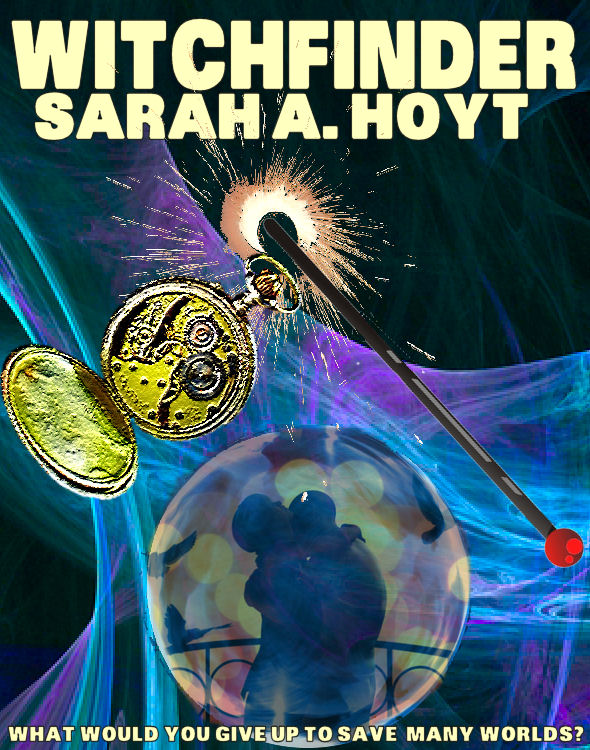
Witchfinder, chapter 49

*Another short chapter, and I apologize.  I’ll try to get a double one up next week.  We’re still recovering from “Home hell week.”*

*This is the Fantasy novel I’m posting here for free, one chapter every Friday.   If your conscience troubles you getting something for free, do hit the donate button on the right side.  Anyone donating more than $6 will get a non-drm electronic copy of Witchfinder in its final version, when it’s published.
There is a compilation of previous chapters here  all in one big lump, which makes it easier to read and I will compile each new chapter there, a week after I post.  When the novel is completed and about to be edited the compilation page will probably be deleted.

Oh, this is in pre-arc format, meaning you’ll find the occasional spelling mistake and sentence that makes no sense.  It’s not exactly first draft, but it’s not at the level I’d send to a publisher, yet. *

Little Necromancer Lost

“My rooms?” Jonathan said.  Then nodded suddenly.  “Aye.  My rooms.  We can go there.  I have some fine smuggled brandy which I–”

“Have had quite enough of?” Seraphim essayed.

Jonathan grinned.  “Nonsense.  I can tell you’re not a Blythe.  If you were linked to those mad people by family ties as I am, you’d know as I do that there is no such thing as drinking enough.”  He blinked in Seraphim’s direction.  “Have you considered, dear chap, that everything that has happened to you, even the royal seizing of your estates and the attainder of your title do not compare in misfortune to being related to m’sister?”

Seraphim felt as thought the world had whirled under his feet.  “The attainder of what?”

Jonathan looked almost comically dismayed, a school boy caught in an horrendous gaffe.  Which, in many ways was exactly what Jonathan was.  An overgrown, bumbling, schoolboy.  “Very sorry, Darkwater, that is–”

“That is, I don’t actually have any right to that title any longer?” Seraphim asked.

“I’m sure it’s all a misunderstanding.  Or at least not a misunderstanding, but you know, they mean to do it, only not–”

“Indeed,” Seraphim said, and felt more than ever that they shouldn’t in fact have this conversation in an alley.  But it came to him, like a flash, that they probably also shouldn’t have it in Jonathan’s rooms.  They might not suspect Jonathan of betraying them to Seraphim, exactly, but when someone was that unhappy with the course of events that he gave off his despair and anger like a cloud, his family couldn’t avoid knowing it.  Particularly not his very magical family.

But Seraphim’s pockets were sadly to let.  Particularly since these pockets weren’t even, technically his but belonged to the pants he’d got from Nell.

The thought of Nell was not a good one.  Their match had never been a likely thing, but now…  “Perhaps we can find a parlor somewhere that we can let for an hour or two,” he said.  “In some hostelry.  A coffee room or something.”

“At this time of night?” Jonathan said.  “Unlikely.  Everyone will see us coming and going.  I’d think you’d not want to be seen.  That is, I’d not want to be seen if there were a price on my head. What I mean is–”

“You can explain your meaning better shortly,” Seraphim said.

“My rooms,” Jonathan said, “Are this way.”  And, with the cocksure certainty of the very drunk, turned away from where the alley met the street and towards the other end, where it was blocked by rubbish bins.

Seraphim lurched after him, trying to stop him, but before he could get hold of Jonathan’s sleeve, Jonathan tripped and fell – head long forward.

From where Jonathan had fallen came a sound like someone wakening, and then a male voice – not Jonathan’s – asked, “Who are you?” Even as Jonathan said, in a startled tone, but in the same vaguely polite way he’d employ to someone he’d stepped on at a ball, “Pardon me, pardon me.  Exceedingly clumsy of me dear fellow.  That is– I do beg your pardon.”

“I don’t want you to beg my pardon,” the other man said.  “I want you to get off from on top of me.  Where am I?  Why have you brought me here?  What kind of perfidious magic did you use to pull me–”

“Marlon,” Seraphim said.  “Elfborn.”

Now Marlon surged out of the alley muddied floor, shoving Jonathan to the floor, and was on his feet, suddenly, his fists balled.  “Darwater.  I should have known.  You brought me here to get me way from him.  How dare you?  How dare you?”

“I beg your pardon,” Jonathan said, mildly from somewhere near the floor, “But you should just call him Ainsling.  His title is under a decree of attainder.  I wouldn’t wish you to commit a social solecism, old fellow.  Who are you, anyway?  Elfborn?  Marlon– Not the necromancer?”

Marlon cast the man a look over his shoulder, while Seraphim decided to ignore Jonathan entirely and instead to respond to the necromancer with withering disdain, “I did not transport you, if that’s what you ask.  Last I left you, you were talking to Gabriel in the room under the house.  I went to my own room and decided it was time I stopped hiding and worked on solving our difficulties.  I don’t know what happened to you nor why nor even who might have transported you here.”

Marlon stepped forward, Seraphim was not sure why and never asked, because as Marlon surged towards him, the light from the street behind Seraphim hit the man’s face, and Seraphim saw that it was covered with black residue, as though someone had coated in coal.  His expression must have shown his horror, because Marlon said, “What?  Am I quite disfigured?”  His hands went up to his face.  Meanwhile Jonathan had stood up, and blinked at Marlon, “No.  It is magic explosion stuff– Ice and – magic.  It will come off.  But it is the result of dragon magic.”

“Dragon?” Marlon asked, and blinked.

Seraphim realized with a sinking feeling that the two of them, one drunk and the other possibly concussed – he couldn’t imagine how Marlon could have found the time to be drunk, but he had been lying unconscious in an alley – could discuss this till the end of time, possibly loudly.  And if there was a price on his head or not, there surely was one on Marlon’s.  He let out air with an explosive sigh.  “Jonathan,” he said, keeping his voice low.  “Says Sydell is half dragon.  Please, say nothing, Mr. Elfborne, there is no time for this.  I believe there is a conspiracy afoot that has ensnared both myself and my whole family including Gabriel.”  He felt obscurely he should despise himself for using the man’s misguided affection, but a drowning man will get hold of any floating straw.  “Jonathan seems to know something of it, and wants to go to his rooms, to talk, but I’m afraid his rooms might be bugged.”

Elfborn nodded.  He didn’t speak or protest, which at least spoke well for his intelligence.

He was quiet a moment, then gave a disquieting little laugh.  “Well,” he said.  “I’ve been hiding for years.  I can take you to the place where I’ve hid.”

Seraphim bit off the question of how many corpses were hidden there too.  This was the most unlikely ally and the most unlikely offer of help.

“If you must know,” Marlon said, sounding stiff and forlorn.  “Gabriel ended or attachment quite decisively just before… whatever this spell was, but…”

“But?”

“But I would like to see him and your family restored to a safe position.  He’s lost too much already, partly through my fault.  And I… might even know something about this puzzle.”

Seraphim wanted to say no.  He wanted to turn back such tainted help.  But he met Marlon’s gaze and read in it concern and sincerity.

“Very well, then,” he said.  “We’ll go to your… hiding place.”