It’s Only Words – A Blast From The Past Post from December 2010

It’s Only Words – A Blast From The Past Post from December 2010

It is one of the er… interesting aspects of a writing career that moments of heartbreak and the most fallow, dark years are inextricably linked to the moments when something clicks.

Perhaps it’s true of life, anyway. Human beings are creatures of habit. If everything is going along fine – or even tolerably – nothing changes. This in terms of society explains why wars and revolutions tend to change the world in scientific and innovation terms as well as in political and social. Because once everything is made “wrong” or “uncomfortable” and a mass of humans are broken out of their routine, then you can reestablish your quotidian life using new information/science.

In 1997/8 I’d come to the conclusion I’d never sell, not at the professional level. This required I rearrange my entire life, which had been geared towards my learning the craft and trying to get published for over a decade and strongly geared that way for at least six years.

I realized early on that I couldn’t actually give up writing. It’s an ingrained habit that long predates any dreams of publishing for pay. I make up stories and I write them down to get them out of my head. I finished my first “novel” (Okay, so it was forty pages) at ten AND wrote it during finals week in fourth grade (which actually determined what kind of secondary school I would attend, so it wasn’t as unimportant as it sounds.)

So, in 98, first I tried to write just for myself, but that didn’t work. When you’re writing for yourself, there’s no reason to make sure you are understood or understandable. There’s no reason to affix the details to paper. What you write ends up sounding like memories of dreams – things that come out of the subconscious and submerge again. After a while it feels pointless.

I needed to write FOR someone, but I had no audience. These days I might have written for online. How that would have turned out is anyone’s guess, and I truly have no clue. Perhaps I’d have attracted no readers, studied, and ended up about where I am. Or perhaps I’d have attracted a couple hundred, just enough to keep writing at the level I was.

As it turned out, though, self-publication at the time was – at best – silly. So I thought I’d keep writing just as a hobby and to get readers, I’d write for fandom. Finding a fandom was something else again. My dad used to introduce me to people with “this is my daughter, she doesn’t like television” – making sure people knew my handicap up front.

I’m not going to be high and mighty here and say I picked the one fandom that was out of copyright on purpose. If Anne McCaffrey hadn’t stomped so hard on all fanfic related to her work, I’d probably have fallen into dragon riders world fanfic. Hard. As it was all the traces of those that I could find were long since shut down.

Other than that, my tastes verge on the fuddy-duddy. I wasn’t going to attempt Heinlein fanfic, (I’m not that crazy) or the rest of the genre. Dumas fanfic is the ONLY fanfic that runs to foursomes. Er… same gender foursomes. And I didn’t want to write erotica, anyway. I wanted to write stories.

So I fell into Austen fanfic at Derbyshire Writers Guild and The Republic of Pemberley. I got myself kicked out of the Republic of Pemberley in short order. No, I didn’t want to write erotica, but I reserve the right to make stupid jokes. Apparently, that wasn’t allowed at RoP.

This left me with DWG. And because I had learned to write for publication – even if I hadn’t been published – I studied the market first. What I found was so surprising that it took almost a year for it to penetrate.

You see, partly because I am foreign born and an ESL speaker, I paid a lot of attention to words, always. I think I’ve shared that my idea of how my work was received at publishers when I first started writing – I thought people sat around laughing at my misuse of idiom and wondering where I was from.

Because of this, I obsessed on words for many, many years. In fact, when I went to the Oregon writers workshop, Dean Smith STILL had to order me to not think about the words. (For which I can never thank him enough.)

But DWG taught me how truly unimportant words are. If you start writing a story that puts Darcy and Elizabeth in a perilous situation, you can have malapropisms in every line and grammar mistakes in more than half the text, and you’ll still have a lot of comments and a large following.

I’m not saying that people don’t care about words and mistakes, and I’m not going to say that most fanfic authors are illiterate – both would be false. At DWG though there are writers from all over the world and from all avocations. People write in their spare time and don’t spend hours polishing for the best word.

Most of them are still easily on a par with published work. One or two are startlingly bad with words. And there is one who, for a while, had a “fandom” of this author’s own, devoted to analyzing and making fun of the tortured sentences.

And yet, even this language-slaying author had a real fandom, that followed the posted serials with bated breath and gave the author much love in comments.

Why? Well, because the plot of these series were almost unbearably tortured. There were kidnappings and murders and mad wives in towers, and men pining away for love, and women who were despoiled and… Yeah, I know, you’re laughing “all the elements of cheap melodrama.”

I will remind you that this melodrama sold more than any of our more plausible and restrained novels sell. I’ll also say that while the lack of internal logic annoys me – personally – a lot of people LIKE these extreme situations. Why? Because the extreme situations bring forth extreme emotions.

And in the end, people read to follow the emotions, to fee what characters they care about are feeling.

What I found at DWG is that the words mattered far less than characters people could love and situations that enthralled them or made them empathize.

What do you think? Should an author shamelessly play with the audience’s feelings? Do you read for the feeling of it? What makes you return again and again to an author?
The Tragedy of the Squid Farms

There is a well-night unanswerable question that “progressives” ask in every arena. Say, for instance that politicians in Chicago are beyond corrupt and this has a lot to do with the Chicago machine and in turn is responsible for the raging violence on the streets (because elected officials know it won’t wash back on them) and they’ll come back with “yeah, and if there wasn’t a machine, who should have been elected?”

The same thing with the Hugos, where over and over the bright enough to be stupid puppy-kickers ask “Oh, yeah, who should have won the Hugo instead, then? If the process hadn’t been the playground of insiders and whisper lists this whole time?” (And please, don’t try to deny it. When Gerrold told Brad that he’d never win a Hugo it was an admission. And besides, we saw the effects of it.)

This is their “defense.” It amounts to “If you have no knowledge of a better parallel world, then your argument is invalid” but they’re very happy with it because the question is unanswerable, and therefore they presume that the best work won, and can strut around about how fair they are.

Dave Freer did a post on Monday on the “quality” of quality in writing. He writes better than I do, so I won’t repeat his argument, just give you a link to it.

The take away for TL/DR readers is “you can’t say ‘this is good’ because humans have individual tastes and enjoyment of a book as a work of art has nothing to do with the minimal requirements of “Words and grammar are used properly.”

I’ve known this for a long time, because my tastes are, to put it mildly, weird. I read just about everything, but rarely (except in some romance subgenres) do I like the bestsellers in the genre. The books that leave me resonating like a bell are often things the world didn’t notice. When I joined the Don Camillo fan group on line 10 years ago I was the only person there under eighty. I might still be.

It extends to other media too. For instance, in movies, I like Second Hand Lions, a movie almost no one ever heard of.

This is so prevalent for me, that usually when a friend pushes a book at me, I know I’m going to hate it. I read Harry Potter at last when I was too sick to leave my big armchair and those books were the only ones within reach.

So I’ve known for a long time that “won an award” was almost an anti-recommendation for me, since the mid-nineties at least. I still liked Connie Willis’ books, but most of the others that won awards left me going “Say the what?”
And here I need to qualify that notwithstanding the typos in these posts (I write them very fast and don’t proof, since I don’t really get paid for them – yes, the donations help, but it’s not the rate I get for books – and today is probably speshul because I’m slammed under raging allergies and con crud acquired via husband. So I had to take Benadryl and I’m extremely sleepy) I have a natural fluency with words.

When it comes to writing, words are what I do. Maybe words and characters, and yep, still working on plot, but words I get for completely free. I came at writing via poetry and come from a long line of poets, so perhaps there’s something hereditary there.

For years, at least since I’ve been aware of awards and what is considered “quality” in the field, it seems to revolve around wording and how beautifully ideas are framed. There is a reason for this, I think, in that since only certain writers/ideas were acceptable to award committees and publishing push teams, the competition was in “how beautifully it’s written.” Which is fine. It’s like the court painters in France before the revolution, all copying the same casts and competing on how realistic they could make the drawing.

Unfortunately, because this was the way to get awards, which are often all a book can get in the way of publicity (The Prometheus Award did wonder for my career, for instance) in these days of declining print runs and premium shelf space, it meant that the entire field oriented towards “more prestige/beautiful prose” books.

Now before someone misunderstands me (rolls eyes) this doesn’t mean nothing else got published. No one can accuse the 10th incarnation of werewolf romance of being a prestige book.

What it means though is that if you had it in you to write beautiful prose, both your agents and publishers tried to push you towards doing just that. The only way this makes sense – literary fantasy sells way worse than adventure fantasy – is if they’re chasing awards and the boost of credibility they give.

Sure, you might burn ten author’s careers by pushing them towards the literary end of the spectrum, but if you hit the award-and-recognition jackpot with the eleventh, you’re going to be collecting for text book excerpts and such for a long, long time.

I got pushed to write literary fantasy and by and large avoided it, because the Shakespeare trilogy had taught me I became very unhappy working in that vineyard.

However most people who got pushed that way probably didn’t feel as strongly about lit fic as I do and just went along and did it, limiting their audience and sometimes (because bad numbers are always the writer’s fault) losing their career along the way.

So, what does that have to do with the question of “What should have won instead?”

The same thing that if I said “If we’d spent less on the war on drugs and channeled that money to space exploration we’d be much better off now” and someone said “like how? What would we have?”

To which the only answer is “Squid farms on Mars.” And then your interlocutor can point out how ridiculous that is, since Mars has never had squid and probably can’t be colonized by even humans.

To which the answer is “Sure. Now. But if we had started 40 years ago…”

Because you can visualize a pathway of incremental improvements in science that would lead to thriving squid farms on Mars if we hadn’t used the money on the war on drugs or the great society or any of the other boondogles into which we’ve poured our money and effort.

In the same way, if there hadn’t been an unspoken push towards “literary” in the awards, a lot of writers who tanked their careers might still be around and writing (almost anything sells better than lit. fic.) And a lot of people who are writing the “bit words, safe ideas” branch of our field might be writing something far more exciting, something that brought print runs out of the doldrums. Something that would engage the public, restore the value of the award as a signal, and in general be good for all writers of sf/f.

Is this sure? No. How could it be. We might have come up with another way to sink the field.

The sad truth is that those squid farms on Mars never existed, so I can’t point at them and go “See what you killed?” (Though there are a ton better books than those that won the Hugo every year, too, but that’s part of how the awards were oriented. I can answer with some, but mostly I’ll trip up in not knowing WHEN they were published. For instance, F. Paul Wilson’s Hosts should have won in that year. I just don’t remember what the year was. And it’s possible if the win went to Connie Willis, I’d be divided.)

BUT the most important effect of a corrupt award, that is given to right-think told in beautiful words is not that some books will be ignored for the award. It’s that many books will never get written, or never get that boost of attention that makes the author successful and allows for more, better books written in the future. (For instance, I found out about Ender’s Game when OSC won.)

The field, little by little, becomes diminished. Long before the award becomes meaningless for sales, the field has become narrow enough to not attract a broad slice of readers. And the print runs fall.

The tragedy of the commons is nothing to the tragedy of the squid farms on Mars. At least the commons got to exist.

Instead what we have here is a field in which masterpieces were never written or – as Dave Freer puts it – are moldering in a drawer.

Life isn’t fair, and we’ll never have a perfectly fair process. Some brilliant writers (maybe most) are bassawkwards on how to promote, let alone how to submit books for publication. But breaking up the “academic” and “lit crit” idea of what is good in sf/f might at least allow us to reorient the thrust of the field towards one that is likely to attract newer and more abundant readers.

And we’d all be better for it.

After all, squid farms on Mars could feed a hungry world.

Trust and Loathing – Cedar Sanderson

Trust and Loathing – Cedar Sanderson

Most of us have a need to trust someone. Man is not meant to dwell alone all of his days, and those who do are usually crippled by internal problems. This is not a bad thing, trust. But taken too far in the other direction, it can be equally as crippling. There must be a balance in one’s trust and loathing.

We all loathe something. It’s most likely not even a conscious decision on your part. For me, it’s the sound of someone chewing with their mouth open. I’d rather listen to fingernails on a chalkboard. The social concern these days is that no one show any sign of loathing another race. The problem is that we trust these voices repeating ‘racism’ too much.

There are not, genetically and anthropologically speaking, discrete human races. Livingstone and Dobzhansky wrote at some length about this in the 1960s. Nothing has changed since then, and in reality, the more we know about genetics, the more obvious it becomes that what is labelled ‘racism’ is in fact culturism. Phenotypical features that appeared in different geological areas were once used to slap handy labels on groups of people, but there it stops. There is one human race, Homo sapiens.

Tishkoff and Kidd wrote for Nature in 2004, “One of the problems with using ‘race’ as an identifier is the lack of a clear definition of race. Historically, ‘race’ has been classified based on both sociocultural and biological characteristics including morphology, skin color, language, culture, religion, ethnicity and geographic origin. Morphology and skin color are not always good indicators of race because they probably result from adaptation to environmental conditions and may have been subject to convergent evolution (e.g., people with dark skin are found in New Guinea, Southern India and Africa, and even within these regions, there can be tremendous variation in skin color). Culture, language, religion and ethnicity have strong sociocultural components and may not always be a good indicator of shared ancestry (e.g., ‘Hispanics’ in the US include individuals of European, Native American and African ancestry in all possible combinations). Nor is geographic origin always adequate for defining ‘race’ because of recent, historical and prehistorical migrations of peoples.”

And yet the current climate of inciting ‘racial’ tensions exists for a reason. I’m going to turn aside for a moment and talk about another movement that exists in parallel and on a microcosmic scale to the vast turmoil over human ‘races’ since that term was coined in 1775. It’s only really been around for three years, a virtual infant in cultural conflicts, and it only rose to true global consciousness (in a mere year!) this year. I’m speaking of those who have been dubbed ‘puppies.’

The Sad Puppy campaign for the Hugo Awards is such a little thing, when you look at it. Run by fans, for fans, and yet… And yet it became a nationally aware movement, with opponents who defamed good men without a second thought in media outlets, even to the point where the media was forced to backpedal as they had gone too far in their snapping, snarling rush to mangle the puppies. In SFF fandom it seems everyone is reeling in disbelief and confusion over what happened and why. Politics in minor scale has been with fandom from the beginning. What is it about now, to bring this over-the-top reaction to something that has been done before?

Why has there been such a backlash of feeling and vituperation against the sad puppy movement? What is it about this relatively small campaign of voting, done legally and very openly, that leads people to scream, stamp their feet, and lie on the floor weeping and pounding their fists against whatever they can reach? Comments on the campaign have ranged from repugnant, to calling for the ‘puppies’ to be interned in concentration camps. (Comment by Patricia Williams-King on Facebook, May 18 “From what I’ve heard about these “Puppies” they ought to be sent to the dog-pound in short order.”)

And that is where I saw the parallel clearly. What is the motivation of those who called for the internment of the Jew in Germany, and the Japanese in the US? Fear. Loathing of the ‘other’ and fear that those others threatened them in some way.

The Sad Puppies threaten the establishment, shake them out of their comfortable delusions that publishing is still business as usual. That the only concern they ought to have is to get more ‘diversity’ into the Hugo Awards, by which they certainly didn’t mean diversity of thought, gender or culture (they showed this by their gleeful disregard of a pool of recommended and nominated puppies who were all three).

Racial tensions in the US? Look behind the news, to see who stirs the pot. What is lurking back there? With the Hugo Awards, it is the few editors who stand to lose the most as they can no longer influence the awards with a mere 40-50 votes. It is the people who are unmasked as the petty tyrants and lickspittle toadies of those who have traded what was once a prestigious award back and forth for the last few years, devaluing it almost past redemption.

And in the larger picture, where those who would declare that skin color matters, we find people who can be legally convicted of only seeking the limelight for money and power. We must look more closely, behind the curtain to see who is twitching the puppet strings, and why. Don’t trust too easily. Don’t snap into loathing without understanding why you recoil in horror. Sometimes it’s not what is being handed to you on a platter, but the hand that is offering it to you that is filthy and unclean.

The problem is, of course, that we are acculturated from childhood to believe what we are told. Some of us (especially we who identify as Odd) have always had trouble with that, and it’s gotten us into trouble. Anecdotally, I can tell you it’s gotten me shunned from a church, separated from my mother at a time I desperately needed her, and then later… well, it’s a long story. Suffice it to say that I’m stubborn. I’m also not inclined to blindly follow along with the narrative.

A friend shared a conversation he’d had with his son while out on a hike. He’d looked at the rings on the stump of a tree with the elementary-school aged lad and was telling his son that you could see the effects of weather, drought, and… the boy interrupted. I know all about that, Dad, he’d informed his father (being of an age where he knew it all) that’s what climate change is. My friend was asking how he could help his son break out of the habit of listening to his teacher without critical evaluation of the pap he was being fed in school.

It’s not easy. Children in school need to listen to their teachers. If not, they get into trouble. If they tell their teacher what teacher wants to hear, they are rewarded. Classic negative/positive re-inforcement. In order to create a mind that is capable of true insight and critical thinking, the art of the critique must first be allowed, and that is a tricky thing to teach, so schools don’t even bother any longer. For my friend, we in the conversation suggested that he offer other materials that could logically refute the theory of anthrophogenic climate changes. Simply learning of the scale and statistics behind what it takes to truly influence the climate on a global scale could be an eye-opener to a smart young man. At this point you’re wondering how I wandered off into the weeds of glowbull warmening from the topic of racism and cultural othering.

Simple. It’s all related. These are big topics our children are being fed by school, by media, and again, there are puppets pulling the strings who have less than honorable intentions. It reminds me of a tale I read once, that a child learns to react with fear and loathing from his mother’s reactions to a snake, even an innocent snake who kills pests and vermin that would infest the mother’s house. There’s a song about it, too, now that I think on it. They must be carefully taught to hate, it goes. We’re being taught to hate. They are hating with every fiber of their being, and that hate has to come out somewhere, usually the internet as that’s safer for them. The last vestiges of empathy, civility, and compassion are declared to be of no use. Decry the other, they are told, and they do, at the top of their voices, using the mirror of their own hatred to paint their foes with familiar visages. Projecting their motivations, they attack without quarter or mercy.

Shout it from the rooftops

I could be in a better mood today, I could.

I’m not. To begin with my husband has shared his cold caught at comicon. This (probably) combined with working at the other house with paint fumes and such has caused my arms to erupt in an attack of eczema like none in years – for those who don’t know what that looks like, it looks like I have third degree burns all over my arms.

This morning over breakfast, I opened a medieval mystery which I bought because it was only 99c and to which the author (of a long running, traditionally published series) has thought it fit to append a ten page foreword going on and on and on about how there was “progressive” thought in the middle ages. (And she clearly thought “progressive” was an undiluted good thing, the exegesis towards which all our thought and feeling should trend.)

In itemizing the “blind spots” of our time, she mentions the McCarthy campaign as hunting “heretics” (Or, you know, as Heinlein said, enemy agents in war time.) However there is no mention of the climate in our campuses, academia or literary houses, not to mention art and social life, where the expression of less than enthusiasm for “progressive” politics gets you called names and accused of horrible crimes.

I decided when it came to blind spots the author needs to remove the beam from her own eye, before she starts talking. Also she needs to consider the wisdom of such a blind-side lecture on her ideas of history (no, really, she goes into a long ramble on homosexuality in the middle ages which might or might not be germane to the book, since I haven’t got to the book yet. Also, as someone who has read about the same topic, her view of it is a little limited. “Medieval” and “Europe” are very broad brushes and treatment of minorities – sexual or other – varied greatly depending on where you were and when.)

So, I’m not in a good mood.

At various points on this blog, I’ve mentioned whisper campaigns about conservative or even non-openly-leftist authors which once upon a time impaired their careers. More lately I mentioned the horrible things said about the Sad Puppy supporter and nominees, the accusations of “racism, sexism, homophobia” emanating from the anti-puppy side, first enshrined in the Entertainment Weekly article which got gutted when they realized they were treading thin legal waters, and then blithely repeated by everyone on that side without paying any attention to rebuttals.

I also mentioned there had been threats – by two well known authors (no, I’m not naming them, but commenters can) – one of which told Brad he’d never win a Hugo ever ever ever, and the other who went on at length on another colleague’s blog post about how everyone involved in this “will soon be looking for work.” I.e. “you join that side, you’ll never work in this town again.”

File 770 not only sent someone over to ask about examples of these threats (look, the commenters can provide them if they wish, but I’m not responding to “let’s you and him fight” strategies) but apparently the commenters went on about my “paranoia” in claiming these threats.

This was particularly funny considering how I ended that post – by reminding them they can no longer hold us back. Should they prevail on my publisher to stop publishing me, my income will probably go UP, judging by my first foray into indie, with an admittedly odd book. AND if I choose to go traditional, in this day and age it’s not precisely hard to start anew as a completely different author and create a background on line so they never know. Look at the exploits of Requires Hate and the fact they had no clue who she really was, or all her sock puppets.

I wasn’t being paranoid. I was laughing at their threats, because in fact they control nothing.

However, let’s be clear: mud sticks. Get something associated with unspeakable sins like “racism, sexism, homophobia” and the idiots will go on repeating it forever, no matter how often it’s disproved. This is how they came up with the notion that Brad Torgersen is in an interracial marriage to disguise his racism, or that Sad Puppies is about pushing women and minorities from the ballot, even though the suggested authors include both women and minorities. And I’m not sure what has been said about me. Echoes have reached back, such as a gay friend emailing me (joking. He’s not stupid, and he was mildly upset on my behalf) saying he’d just found out I wanted to fry all gay people in oil and that he needed a safe room just to email me from. Then there was the German Fraulein who has repeatedly called me a Fascist (you know, those authoritarian libertari—wait, what?) and her friends who declared Kate and I the world’s worst person (we’re one in spirit apparently) as well as calling me in various twitter storms a “white supremacist” (which if you’ve met me is really funny.) A friend told me last week that he defended me on a TOR editor’s thread. I don’t even know what they were saying about me there. I make it a point of not following all the crazy around, so I have some mental space to write from.

However, enough people have told me about attacks, that I know my name as such is tainted with the publishing establishment (not that I care much, mind) and that some of it might leak to the reading public (which is why G-d gave us pennames.)

This, however, including my blithe decision to change names if needed, gets called paranoia in a professional field that seems increasingly less professional and more devoted to hunting down and punishing wrong think.

And once this has been repeated enough, the feeble of mind will believe it because “everybody knows.”

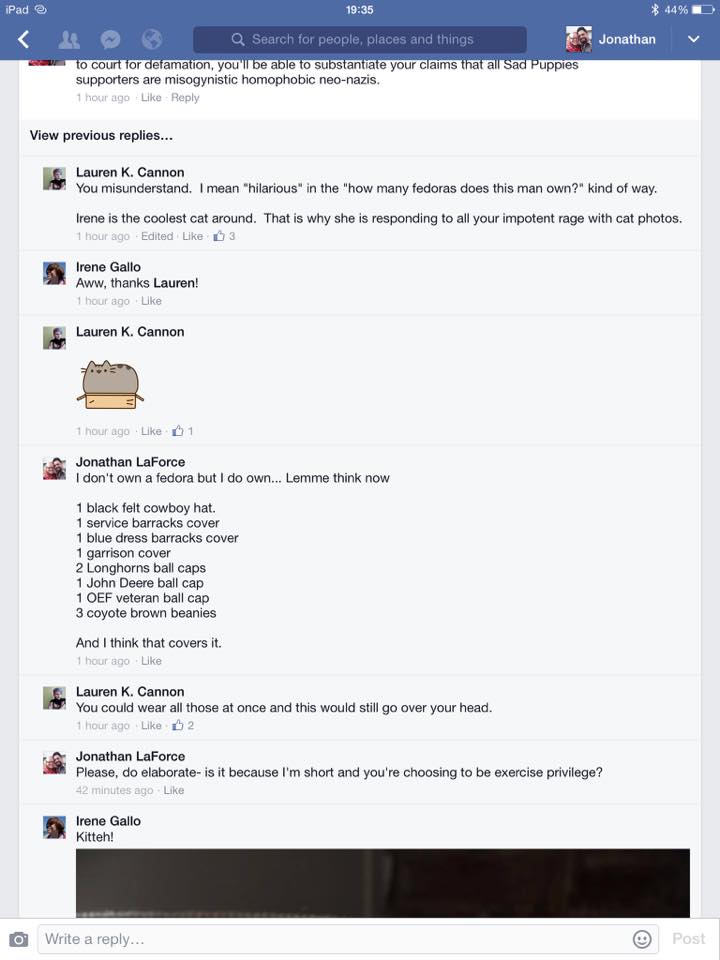
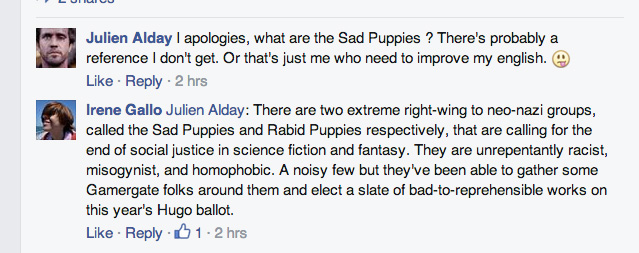
This feebleness of mind was in stunning display recently in the Facebook page of one Irene Gallo, Creative Director at TOR. (I hope that’s an art-related thing. Or do they think authors need help being creative?)

Note that those statements are so wrong they’re not even in the same universe we inhabit. Note also that when she talks about “bad to reprehensible” stories pushed into the ballot by the Sad Puppies, she’s talking about one of her house’s own authors, a multiple bestseller, and also of John C. Wright who works for her house as well.

Note also that when one of my fans jumped in and tried to correct the misconceptions, she responded with daft cat pictures.

11390073_10153087681863051_629689894180101268_n

Note that confronted with the total bankruptcy of their beliefs, and their massive “so wrong it’s not even just wrong” prejudices, they choose to wonder how many fedoras their questioner has. Because you know, fedoras are the hat of evil, or something.

1928395_10153087977693051_4708152232372966601_n

Note that this is an “argument” by SUPPOSED adults, with years of experience in the field.

This is the level of reasoning in the publishing houses that aren’t Baen, and the reason why it’s so easy to besmirch someone’s character and it used to be easy to make sure someone who was less than VOCALLY enthusiastic about your rightthink ideas would never work in publishing again.

Fortunately those days are past, and the Irene Gallos of the world, with their easy-bake-oven brains can no longer control who makes a living in this field.

And fortunately we now have proof that the whispers in the dark went on. In the age of the internet, what used to be whispered in the dark is now shouted from the rooftops.

And what I want you to consider is what her shout from the rooftops betrays.

Let’s say that her diatribe said instead, referring to the puppy-kickers “they’re socialists, communists, Marxist academicians who pushed bad to reprehensible works onto the ballot.”

Can you imagine that said, aloud? I can’t. Look, my field has a “young communists club” that writers advertise themselves as belonging to. Supporting the philosophy that killed 100 million around the world is a-okay in the field. And those things are not insults, but reasons to promote an author.  The sentence above wouldn’t even make any sense to most people who work in publishing houses.

Meanwhile anyone who opposes them gets called a neo Nazi (yeah, you know, the libertarian branch of the neo-Nazis), tarred with racist-sexist-homophobic, no matter how ridiculous the idea is and writers such as Jim Butcher and Kevin J. Anderson get called “bad to reprehensible.” When in fact all it means is “these writers DARE not push OUR political agenda.” All it means is “badthink, badthink, badthink.”

This is what is being shouted from the rooftops. THIS is the political climate in my field.

Paranoid? Oh, h*ll no. I was ready to walk away four years ago and never look back. No paranoia when you can be free of the whole mess at any minute.

Thanks to indie and Baen I don’t need to. And if those fail, there will be other works and other names.  They can’t stop us.

But beyond all that, it’s not paranoid to point out that in this field, in this time, in this place, anyone to the right of Lenin gets called names and treated as a pariah.

And that’s on display right there. The feeble of mind don’t understand the difference between “disagrees with me” and “is evil.” And they feel free to display their ignorance and their blinkered prejudice because everyone they know, all the “right thinkers” in their field approve of those same blinkered prejudices.

There was no medieval village so insular as the publishing establishment in NYC who thinks that the rules of their village and tribe are laws of nature.

Thank heavens the control exerted by those feeble of mind people over our careers is less and less with each passing day.

Paranoid? Bah. Angry as h*ll and not taking it sitting down anymore. Because we don’t need to.

Vive la revolution. Ça ira.

Promo Post Now, Post Later!

Alma Boykin

Blackbird

The Colplatschki Chronicles Book 7

The Turkowi fear the blackbird as a bird of ill omen. They’re right.

Matthew Malatesta fights, drinks (a little), and harbors no great ambitions, content to follow his brother. Treachery and a vow of revenge launch him north, into the Eastern Empire. Tempered by the fires of war, Count Malatesta, the Blackbird, soars into legend, carving a name and a country for himself.

Matyasa, the Blackbird: this is his story.

A Father’s Choice

Seventeen years after he abandoned her, Marleena learns that her father has just dragoned. Now she’s steamed at him for ruining her life and almost costing her both job and home. A surprise discovery on New Founders’ Day leads to her to a new understanding of the man she never knew, a man who loved her more than she could have imagined.

John Van Stry

Interregnum

Children of Steel Book 2

The war is over, Raj and Cassandra are together, and everything should be ‘happily ever after’, right?

Well, they would be, but Cassandra still has issues to overcome after spending three years in POW camps where abuse and torture were commonplace. Raj has gotten over most of his problems, after all, he did save his mate’s life, but there are still issues from his past that are dogging him. And of course, there are just a few minor things that need to be cleaned up, leftover issues from the war, and some of those issues shoot back.

Cedar Sanderson

The God’s Wolfling

Children of Myth Book 2

When The God’s Wolfling opens Linnea Vulkane has grown up since the summer of Vulcan’s Kittens. Sanctuary, the refuge of immortals on an Hawaiian island, is boring. When the opportunity for an adventure arises, she jumps right into it, only realizing too late the water may be over her head. Literally, as she is embroiled in the affairs of the sea god Manannan Mac’Lir.

Merrick Swift has a secret he’s ashamed of. Then when he meets Linnea and her best friend, he doesn’t like her. She’s bossy, stuck up… and oddly accepting of his wolf heritage. Like her or not, he must do his duty and keep her alive. The children of the myths are being plunged into the whirlpool of immortal politics, intrigue, goblin wars, and they might be the only ones who can save a world.

The Economics of Indie Publishing- Chris Nuttall

The Economics of Indie Publishing- Chris Nuttall

I was on a panel with Chris Kennedy and a couple of others discussing the economics of indie publishing. These are my conclusions.

There’s a general rule in traditional publishing that the money should always flow downhill to the writer. If you’re being asked to pay for anything, once you get picked up by a publisher or agent, you’re being conned. Editing? Cover design? Formatting? Promotional material? The publisher should pay for all of those – and if he doesn’t, something is very badly wrong.

However, this isn’t actually true of independent publishing. Certainly, as before, the writing is the author’s work, but there’s no publisher to pay for all the other items (or, for that matter, to find them.) The author has to meet those costs himself, unless he can do the tasks for himself. (I know authors who can do cover designs, but I haven’t met a single author who could edit himself successfully.)

In these cases, the author needs to budget – and pay for these items as a lump sum.

General Advice

Before you start hiring anyone to do anything, sort out the terms. You will need:

-Cost. How much is it going to cost you? I’ll try to give a set of basic figures in the more specific sections, but everyone has different figures.

-How. How are they going to do it?

-Payment method. How do you pay? I normally use PayPal; check this first, because it is quite embarrassing not to be able to pay. Do they want to be paid in a lump sum or in instalments?

-Time. How long will it take? What happens if they can’t produce the service/item in a given space of time?

-Rights. What rights to use the material do you get?

-Credit. How much credit do they want?

Editing

There are, in my opinion, two different categories of editing.

First, you have the conceptual edit, which covers everything from plot holes (just why do you have magically binding contracts enforced in your universe when someone didn’t actually agree to the contract?) to how the plotline shapes out (that’s a Deus Ex Machina) and continuity notes (you killed this character in the last book). Having someone read your book with a fresh eye is perhaps the only way you’ll catch these errors before the reviewers do.

Second, you have the line-edit. This basically covers spelling, grammar and everything else.

Editors vary wildly, both in cost and performance. Any editor who’s been in the field for a while should have a handful of authors willing to give a reference. (Ask for names or samples of their work.) A basic conceptual edit should cost between $100-$200, although costs can rise steeply if the editor has to read a handful of prequel books first. (If you don’t have the money, try finding another author and trading reads.) A line-edit can cost between $300 and $900. (Editors, in my experience, tend to raise their prices if the manuscript is riddles with errors.)

You’re paying, in a sense, for a private review of your work. The conceptual editor should not pull any punches – and you don’t want to encourage him to go lightly on you. Listen to the editor, then decide for yourself if their suggestions are valid or not. Even if you think the editor is wrong, it’s good to take another look at a weak section.

Editors, in my experience, don’t normally want to be credited in any way.

Cover Design

A book should not be judged by its cover – but the plain truth is that most books are judged by their covers. Getting a cover, unless you’re an artist yourself, can be daunting or expensive. However, there are some reasonable shortcuts.

-Stock Photos. Sites like ISTOCKPHOTO offer thousands of images, ranging from very basic drawings to outright space battles.  Purchase a copy, place your title, name and tagline on the front, then upload it to kindle. (Hint; make sure your image fits the kindle requirements.) Prices, again, can vary; I’ve purchased images at prices from $30 to $100.

However, there can be two problems. First, you may not find anything suited to your needs and, second, someone else may use the same cover. (This has happened to me).

-Artists. If you don’t mind spending a bit more money and waiting longer, you can hire an artist to design the cover for you. Prices can, of course, vary sharply; I’ve had artists charge minimal prices in exchange for the exposure and artists who wanted full price ($500-$1000). For this, you need a contract (or at least a stated agreement); you want permanent, exclusive and comprehensive rights to the artwork.

(By comprehensive rights, I mean you want to be able to use it as a book cover, CD cover, promotional artwork and anything else, without either referring to the artist or having to pay royalties over the long term.)

If you’re strapped for cash, try browsing an artist website and looking for someone willing to draw a basic cover for relatively little money.

The artists I’ve worked with have asked for cover concepts, then drawn sketches for me to approve before they started the serious work. Feel free to make the concepts as detailed as possible; remember, the artist has to work from what you tell him. Also, make sure the author understands requirements for kindle and other self-publishing platforms. It’s no good getting a spectacular piece of artwork when it can’t be uploaded onto the web.

DO NOT be afraid to raise objections or ask for alterations. You’re the one putting the book online.

Artists generally want to be credited as the artist and to have the right to host copies of the artwork as samples of their work. You should agree to this – free advertising <grin>.

Online Promotions

Now you’ve got your book online, you want to promote it – and, being an author, you will get emails advertising various services that promise to promote books.

Unfortunately, my general observation is that such services aren’t really worth the money you spend on them. I’ve tried a couple and I didn’t notice any real jump in sales. My strong advice would be to refrain from using any paid service.

Facebook does offer a paid promotional service, but again – I haven’t noticed any improvement in sales coming from using it.

Generally, it’s better to build up a presence on the net using free spaces – Facebook, a blog, twitter, etc – but be careful not to let yourself be sucked into spending all your time on the net! However, it’s worth investing in a domain name and a website; prices for these, of course, are very variable.

Paid Book Reviews

No. Don’t even think about it.

Yes, there are sites out there that promise thousands of 5-star reviews for an author willing to shell out. Some of them even actually do it. But …

It’s dishonest, it’s easy to spot, it will undermine the review system and it will utterly destroy your reputation. Trust me on this; don’t do it.

Conclusion

Ideally, you want to get more money out of indie publishing than you’re putting in. Keep decent accounts, work out what’s costing you time and money (and don’t forget to put money aside for taxes, as this is generally taxable income.) See what works, see what doesn’t work and …

Good luck!

The Sharp Edge of Guilt, a blast from the past March 2010

The Sharp Edge of Guilt, a blast from the past March 2010

Yesterday I was hanging around in the kitchen with my older son, waiting for the coffee to brew, and he made some joking comment about my being oppressed when I was growing up.

I told him I was oppressed enough, or at least women were, in that time and in that place – as they still are in many times and in many places.

Yes, I like to point out and do – often – that it wasn’t a gigantic conspiracy of men against women that kept women down for six thousand years because frankly most men can’t conspire their way out of a paperbag. (I suspect women are naturally better at it. No, don’t hurt me. Just women seem to be naturally more socially adept. But even women couldn’t manage a conspiracy of that magnitude.) And I like to point out – and do – it wasn’t shoulder to shoulder but the pill and changes in technology that liberated women or at least that made attempts at liberation reasonable instead of insane. (Of course, shoulder to shoulder makes for better movies and books, which is why everyone believes it.)

However, as I told the boy, given the conditions biology set up, women were “oppressed” enough in most cultures and in most places. Yes, men were oppressed too at the same time, because this type of shackles is double-sided, but the oppression of women lingered a bit longer than that of men – say a good couple of generations by habit and custom and because humans simply don’t change that fast. Which is why the oppression of women is remembered as such and the men are remembered as being on top.

So I told him in Portugal, until the seventies, women weren’t allowed to vote and, oh, by the way, a married woman couldn’t get a job outside the house unless her husband signed papers saying that they needed it, due to economic hardship. (Which of course, meant the dumb bastard had to sign a paper saying he wasn’t man enough to support his family. Made it really easy on him, it did.) I’m sure there were other legal and economic hobbles that went with that. And I told him of course in many many countries in the world that inequality persists, only much worse.

Which is when I realized he was squirming and looking like he’d done something wrong.

Guilt. My poor kid was feeling guilty of being born male.

Guilt is a useful enough emotion, in small doses and well administered. For instance when I was three I stole some very small coin from money my mom had left on the kitchen table. I don’t remember what – the equivalent of five cents. I stole it to buy a couple of peanuts at the store across the street (they sold them by weight. In the shell.) My mom made it clear to me I’d made it impossible for her to buy her normal bread order when the bakery delivery (no, don’t ask. Delivered. Door to door. Every morning. I missed it terribly my first years in the US, but now they don’t do it in Portugal either, anymore) came by the next morning because she didn’t have the exact change. It wasn’t strictly true. The money amount was so small she just said “I’ll make the rest up tomorrow.” But she told me it was, and how she had to be short a roll. My understanding there were larger consequences for my stupid theft made me feel guilty, and that ensured I never did it again. The same, with varying degrees of justice, managed to instill the semblance of a work ethic in me in relation to school work.

However, the guilt my son was feeling was stupid, counterproductive, all too widespread AND poisonous.

Stupid because he could hardly be held accountable for something that happened thirty years before his birth, even if he has the same outward form as the people who benefitted from an inequity. (And benefitted should be taken with a grain of salt here. Countries in which women are kept down might offer an ego bo for the guys, but they are far less materially prosperous on average. Everyone suffers.) Counterproductive because guilt by definition can never be collective. Well, not beyond a small group like, say the Manson family. You get beyond that and you can’t assign blame with any degree of accuracy. So, going and yelling at my father, say, for “keeping women down” when I was little would be as insane as yelling at my son. Why? Well, because a) he didn’t and wouldn’t (he was raised by a strong woman, practically on her own, while my grandfather was in Brazil, working and grandma ruled the extended family with an iron fist.) b) to the extent he enforced societal rules, it was usually to keep us from getting in trouble with society in general (which, btw, included women. In fact women were the greatest enforcers of “you shall not be seen anywhere with a young man you’re not dating” rule that got me in the most trouble.) c) his standing up and talking given who he was and the amount of social power he had (or in fact didn’t have) would have changed nothing except get him treated like a lunatic.

I’m sure there are good men in Saudi Arabia who find it abhorrent and painful that women can’t drive, for instance. I’m also sure they enforce that rule on their women because they don’t want them fined or imprisoned or worse. They can’t DO anything. Not as individuals. And they’re too busy feeding their families to organize and run campaigns no free women. Also, there have been some men who have organized and tried to make a difference, but there weren’t enough of them. That “grain of sand” stuff only works dramatically in movies. In real life, it’s more one generation raising the other; one friend talking to the other – until the balance TIPS.

And once it does making them feel guilty would be a counterproductive. Sorry for breaking Godwin’s law, but did we persecute ALL of the German people for Hitler’s crimes? No. Could any of them have spoken up? Many did. But most people who were alive at that time were good people caught in a social mechanic they couldn’t break out of – not individually. And they weren’t connected enough to form cohesive groups.

While we’re speaking of Germany, look at collective guilt and collective punishment for “crimes” that people supposedly committed which no individual could have stopped. If you’ve studied the mechanics of the avalanche leading to WWI (I have. There’s a novel about the Red Baron and time traveling started, and it will eventually get done) there was a certain unstoppable force to it. It was going to start sometime. Someone was going to fire the first shot.

It was Germany. They invaded other countries. The “Hun” entered European mythology of the early twentieth for reasons both good and bad. (Google WWI Belgian Nuns, for instance. Much of it was propaganda, but a lot of it, doubtless, happened.)

When they lost the war, they were treated as if they and they alone and they collectively were guilty. The penalty levied was so high they could not and would not pay and that it was crushing the man in the street.

There were other reasons leading to the rise of Hitler. However, THAT punishment facilitated it. It might not have happened without it. The “in for a lamb, in for a sheep” is a normal human reaction. If you’re held constantly guilty of things you did NOT do and could not have changed, you’re going to DO something anyway. I mean, how can it get worse?

To a certain type of woman – or man, though we’re only giving some tenured college professor males that kind of power – it is sweet to be able to play the victim ad nauseam. Particularly when you’ve never actually been victimized. And it is great to be able to make men squirm with stories of past injustice and feel guilty for things they are either way too young to have done (anyone born after the fifties, pretty much) or could not have changed if they tried, but which many of them mitigated in small ways.

And to a certain type of man – or woman, but in this case it doesn’t apply – it’s a great feeling to go around apologizing for the crimes of your ancestors. If you feel your accomplishments are diminished by theirs, apologizing gives a quick leveling. You recognize they did wrong, therefore you must be better than them. It’s a stupid feeling that ignores that you’re probably also doing things that your descendants will apologize for, but hey, it’s much better than actually trying to achieve something. Less work. Instant boost.

This dynamic gives power to passive-aggressives and bullies, the exact type of person you don’t want to have any power. And it makes good people feel like they’re bad and if they’re bad they might as well act it. It can, for instance, make young men very attracted to religions that DO oppress women (and no, sorry, that’s not most main line Christian religions, where you can leave if you want to.) Frankly, I think it’s a miracle more of my son’s generation hasn’t converted to one of those. I think it’s a witness to their essential decency, given the books, the movies and everything else designed to make them feel guilty for crimes they never committed.

So, let’s stop right here, okay? Being born with a penis is not a sign of guilt. Original sin and original taint are religious concepts that work ONLY in the mystical framework designed to control them and forgive them. In this workaday world of ours, they get in the way and engender a cycle of resentment and backlash.

Honestly, if aliens wanted to stop humans from reproducing, they couldn’t have come up with a better idea than this! Or if they wanted to ensure those who reproduced oppressed women again, this time without any real biological excuse.

You guys stop feeling guilty – even vestigially. You women, stop holding the cudgel over their heads. It’s not fair and it stopped being productive a while ago.

Now go forth and be free. It’s a brave new world and we’re the creatures in it. Don’t let inappropriate guilt twist it.

The Condescension of the Elites

Growing up through successive revolutions and counter-revolutions gives you a finely honed sense of what is socially approved (particularly when it can change on a dime.) And I got pretty good at seeing the difference between what was said aloud “We’re all for democracy and we accept all different opinions” and what was real “if you don’t toe the socialist line, we’re going to destroy your school career, your job, your hopes of any sort of advancement.” It’s not hard to “read” if you stop listening to the words and instead pay attention to what actually happens.

The weird thing is that most people either don’t have that ability or subsume it because it’s easier to believe what they’re told.

When I applied to come to the US as an exchange student, I went to the consulate to get my visa fresh off my brother’s office and my brother had just given me six or seven tapes of French singers some of which were communist.

My brother warned me strenuously not to take the tapes with me because I’d probably get denied a visa. Even back then I had some idea this wasn’t quite true, but to an extent, logically, it made sense. After all, the US was the nexus of anti-communism in the world, so surely—

Of course the (youngish) consulate employee and I ended up talking about the singers and exchanging tips on the better songs/tapes.

As I said, I already had some idea that in the US communist authors and singers weren’t shunned. I’d listened to enough singers who sounded like the Portuguese communists and who were multimillionaires in the US. But that was the first time I met an on-the-street American (he was a new employee there) and realized that it not only wasn’t true that communism and socialism were looked down upon on the US, but that the “cultured” groups in the US were pretty much indistinguishable from cultured groups in Europe, where leftism was a positional good and saying things like “Stalin was a little harsh” was not a reason to recoil in horror but a reason to nod and know the speaker was on the vanguard of culture.

By the time I moved to the US in the mid eighties, leftism and posing as a leftist were very much a mark of the “educated” and the “smart.” While the popular idea was that the Republicans were “the party of the rich” in fact to move in the wealthy and “classy” sets you had to parrot opinions that were indistinguishable from the opinions of the left and even the extreme left in Europe.

It’s only got worse since then. In the last thirty years, the long march through the institutions was completed, and art, news and academia are all firmly in the hands of the left. Which means that parroting the right (left) opinions is not only the way to advance, it’s the ONLY way to advance. In fact you have to at least nod to them in order not to be sent to Coventry.

And yet, most people still talked as though the people with power in the culture were “right wingers” and the people who broke ranks with the left and went to the right, in addition to having their character shredded and personal insults hurled at them were said to be “Selling out.” Even though, usually, their career vanished into a black hole after that.

So, pardon me – I’m not approving these comments because usually they’re one line, seem to think they mean “your argument is invalid” and one of them might be a well known serial troll – for giggling hysterically when I get comments on my blog that say something like “This post is so condescending”. And I get these every time I post about the Hugo controversy, even sideways and backwards, or with a vague reference to it. I’m going to guess the word of the month for the armies of the hangers-on of Mordor is “condescending.”

The problem, as always, as it that “condescending” has a meaning. And the meaning of condescending refers to tone, not to the argument itself. Even if posts were condescending in tone, it wouldn’t invalidate the argument itself.

If I said: “Your hair looks like a bird’s nest” as a statement of fact, the content of the sentence would not be factually any different from “You’re such a dork. I can’t believe you got your hair done to look like a bird’s nest. You should know better.”

The second is patronizing, but if your hair looks like a bird’s nest, it’s still exactly the same whether I say it politely or not.

So when I say that weakly attached hangers-on and lickspittles are running out to act as trolls on any blog that even mentions the puppies, and keep repeating the same accusations (“slate”, “bought votes”, “bad writing”, “not true fans”) regardless of how many time those are disproven is not factually any different whether I say it condescendingly or not.

But my posts in fact, tend not to be condescending. They are rather trying to lay out an argument rationally. (The condescending ones are distinguished by a “I’ll beat you to death with my vocabulary” feel. They can also fairly be called “rants.”)

So the perception of “condescension” supposing that these people know what the word means, of course, and are not just repeating what they heard – as I said, it seems to be the word of the month – comes from the fact that I’m questioning the value of their positional good. I.e. the translation of “condescending” in this case is “I can’t believe you, peasant, dare to question me, one of the elites.”

In fact, if one wades into the Sad Puppy mess (here, wear galoshes. You’ll need it) the side that says things like “You’re not true fans” or “your tastes are just low” or “your writing is bad” or “Our opinion of what is good IS the maker of what is good” or “you’ll never work in this town again” or “for daring talk against us, you’ll never win a Hugo” is not the Puppy supporters.

This is because the “power” at least if understood as traditional publishing power, in this field is NOT from puppy supporters. The people opposing the puppies (not their lickspittles running around blogs shouting the crumbs that fall from their masters’ tables) are powers in the field: well established editors with power of the purse; writers who get publicity campaigns and push and huge advances; critics who have for years been reviewing the “well regarded” stuff and establishing a taste that is Marxism with a mix of glitterati, or in other words, positional good leftism.

You’d think that people who have been extensively indoctrinated in Marxism would understand the difference between “establishment power” and “economic power” and the revolutionaries who come in saying “But you’ve been going wrong by alienating the reading public; we don’t give a hot damn what your political opinions are, but you need to tell stories people want to read, and if you don’t people should be able to participate in the intervention to make you see why your print runs keep falling.”

I.e. they would understand that they are in fact on the side that is being condescending by virtue of having all the power in the field, including power of the purse. (Well, almost all the power. I know three indie-only writers making six figures. Which, of course, is what has the establishment’s panties in a bunch.)

And they’d understand their bleats of “condescending” are all about “How dare you?”

Yeah. I have bad news. See where power is moving to indie. See how you’re being used as footsoldiers in a doomed effort by the establishment to keep their iron grip on what is “good” and “worthy of awards” or even “acceptable.” See how your masters can no longer guarantee you a good career or even A career.

The rest of us? You can object to our tone all you want. You can’t do anything to us. That rule that publishers had to be informed of our true names? Way out the window, now. Amazon doesn’t care. “Kill” our careers either by making sure we’re never traditionally accepted (and you’ll give orders to Baen, how?) or by destroying our reputations with your whisper campaigns, and we will simply come back under another name. There’s HUNDREDS of ways to do that legally if we want to go traditional. And we don’t even need those ways for indie.

So, Lords, and Ladies, and those who aspire to the favor of the “elites” this is to serve you notice: no matter how much you bellow and thrash around and send your hangers on to call us names, we will not bow, we will not apologize and we will NOT tug our forelocks at you.

If that’s being condescending to you, then we intend to continue being “condescending.”

The manor walls have fallen and the serfs have the liberty of newly-claimed lands.

There is no going back.

Ça Ira.

Psychological displacement in management, politics, and the culture wars – New Class Traitor

*Note from Sarah – Having located the cleaned up version which New Class Traitor sent me, I replaced the post*

Psychological displacement in management, politics, and the culture wars – New Class Traitor

All of us have a number of psychological mechanisms for coping with “the slings and arrows of outrageous fortune”. Some are adaptive (anticipation, humor, building social support networks, …) while others are maladaptive.

Displacement (a term originally coined by Sigmund Freud) is one such maladaptive strategy: the mind substitutes a “safer” goal, object, or target for one deemed to be unattainable or overly dangerous. Some classic examples of ‘displacement’ are a bully picking on a weak kid in response to being picked upon by a bigger bully, or the abusive mid-level employee who works out pent-up rage at bosses or customers on his underlings. Or, for that matter, the frustrated-at-work husband or wife doing so on their spouse.

Like all of us who have dealt with management (in my case, from both sides of the fence) I have on numerous occasions witnessed two ‘displacement’ mechanisms on the part of managers who were incompetent or out of their depth.

The two mechanisms are seemingly opposite but in fact closely related. Let me deal with the most common one first.

Faced with large and seemingly insurmountable problems, the outclassed manager starts hunting around for some umpteenth-order detail problem that (s)he deems to be manageable — then makes this the top priority, both to deflect attention from inertia on the first-order problems and to be able to “solve” something and declare victory, thus creating an illusion of competence and/or relevance.

One example known to me occurred at a large organization that shall remain unnamed. The previous CEO had been fired, and his successor inherited — together with a fundamentally sound fiscal situation — many problems such as toxic employee relations, administrative overload, and the appalling state of the organization’s IT management.

A competent manager — or even an astute amateur — would have tried addressing these problems first. Instead, the new CEO came out with a campaign to… address employee health by encouraging employees to bike to and from work, and providing loaner bikes on bike racks. Other initiatives were similar “polishing of the candlesticks while the house is on fire” — some of them might even have been good ideas if everything else were running smoothly. Needless to say, he did not last long in his job.

[See also “Ten habits of incompetent managers” http://www.fastcompany.com/919287/ten-habits-incompetent-managers ]

Interestingly enough, we see parallels of this ‘displacement’ behavior in the culture wars. One example is the preoccupation of various European and American anti-racist groups with the racism and judeophobia on the part of the old ethnic-collectivist extreme-“right” — while (at least publicly) largely ignoring the surging, much clearer, and more present danger from the (equally collectivist) hard-left and Islamists, whom they are unable or unwilling to confront.

Another is that of certain “transgressive” artists petting themselves on the back for images like a crucifix dipped in urine — while suddenly having second thoughts when the ox being gored is Islamic rather than Catholic, Protestant, LDS, or traditional Jewish.

Yet another is that of a POTUS who, faced with unprecedented national debt, a stagnant-at-best economy, and a foreign policy that is falling apart at the seams everywhere, instead pontificates on all sorts of trivial issues.

For yet another: in California, Proposition 8 would likely not have passed without the overwhelming support of the Latino and especially black communities — but the anger of pro-“gay marriage” activists was displaced from these ‘unsafe’ targets to a few LDS and evangelical individuals who had had the temerity to put their own money where their beliefs are.

One more example: various “social justice warrior” (more correctly: social justice Tartuffe) groups obsessing over all sorts of anti-female and anti-homosexual “microaggressions” while completely ignoring the hardcore misogyny and homophobia emanating from the Islamist sphere. Hmm, lemme see, who is the bigger ‘homophobe’: somebody who refuses to bake a wedding cake for Adam and Steve — or who actually makes custom wedding rings for Eva and Sylvia but dares display a poster asserting his personal belief in traditional marriage — or would that be those who hang “the people of Lot” from cranes (Iran), throw them from buildings (ISIS), or crush them under toppled walls (Taliban)? Or who is the bigger misogynist: somebody who disputes the tale of “mattress girl” or the gangs grooming adolescent girls as prostitutes, mass-raping women, or executing women for the crime of having been raped?

The more cynical among us would point out to the fact that the fate of “gays” in Iran does not lend itself well to collecting of cheap political points by self-serving radical-left hacks. However, I also believe that, for many other feminist or “gay” activists, there is the realization that radical Islamism is an opponent too big to handle — or where pushing back might bring them into ideologically uncomfortable ad hoc alliances with conservatives and libertarians — or even (gasp!) old-school Euro nationalists. So therefore the anger is displaced to “safe” targets.

So much for the first displacement mechanism. What about the second one? It takes the nominally opposite tack of diverting all attention to some superissue broadly seen as overarchingly important — about which one can then pontificate at will, thus freeing oneself from the need to actually try and address more mundane problems. For example, here in Israel (where I live part-time), the agenda of the day is understandably dominated by ‘ha-matzav’ (the [security] situation). Politicians of any stripe who want to raise their public profile — without the thankless hard work of writing and passing legislation that deals with mundane things like roads, crime, still pervasive oligopolies,… — can instead spew hot air about ‘the situation’/’the peace process’/… while quiet professionals get to do all the actual heavy lifting involved.

Abroad, “global warming” can act as a similar “get out of work free” card.

Some people engage in both forms of displacement at the same time. The former Mayor of New York was clearly very successful in creating and fostering the financial news agency that bears his name — but appeared to be out of his depth running a city with a population larger than Israel and a metropolitan statistical area population between Rumania and Australia. Rather than dealing with mundane yet serious issues like the bed bug epidemic, deteriorating personal safety post-Giuliani, or the woeful vulnerability of the city’s infrastructure to disasters both natural and man-made — hizzoner started on the one hand nannying the size of soda servings, and on the other hand pontificating about ‘global warming’. Neither of which was much help when Hurricane Sandy hit the city. The cold equations have no mercy on those who ignore reality.

Glamor and Fairy Gold

One of my friends recently pointed out I write really well about fairies. I’m not sure I write really well about them, but I do write about them. And my fairies/elves are not exactly according to legend. Well, they sort of are. Before you tell me I stole my first book’s plot wholesale from Tam Lin, let me point out no I didn’t, I stole it wholesale from Diana Wynne Jones’ Fire and Hemlock which in turn harked back to Tam Lin. So. There. (And before anyone gets up in arms, what I stole was actually the legend-structure, not the story.)

But most of what I write about fairies and elves is based on the current world and the structure of glamor, of “cool” of “positional good.”

After all, the one thing I gleaned from fairy tales is that fairies have glamor. They’re dangerous, inscrutable, often evil, but humans keep jumping through their hoops, regardless of experience, because they want to be “beautiful” and “cool” like elves.

I don’t write to lecture. (I write blogs for that occasionally, but even that is too much effort just to lecture.) Writing for me is a process of identifying one thread of thoughts going on in my head and to isolate it and figure out what my beliefs/thoughts/conclusions are in isolation. In other words and simpler, I usually write to find out what I think. (That is, my subconscious is way smarter than I am and attached to an idiot.)

So I don’t write my novels/short stories to “reflect the situation today.” But it occurs to me that I do write to try to digest what I see in a form that I can think of more clearly or differently. Or in yet other words, this is sort of like lighting an object differently before you draw it.

I was wondering – because friend asked – from where I draw inspiration for my stories about elves. And it occurred to me that it comes from me: from life. And that I who grew up without fairy tales until I was 16 or so (when I made a conscious point of reading them) keep coming back to elves for a reason.

It occurred to me I’m trying to figure out something in the real world. And that maybe that thing in the real world is the same thing that originated the early stories and legends about fairies, which perhaps speak to something about the human condition. (Bear with me.)

In the stories fairies are glamorous. They can make humans see, hear, believe things that aren’t there. You need magic or some other supernatural force to see them as they really are. They can trick you – almost always do – and pay you with dirt and rocks that you think are gold. And they are incapable of doing some basic things humans do. Humans under their influence also become very odd.

If you substitute “cool kids” or “elite” or “went to the best colleges” or other social markers of the sort for elves, the story is entirely too familiar.

My friend Cedar, today, posted about one of those lies that “everybody knows” and that are absolutely not true. Not only not true, but risible on their face. The lie is that Heinlein was a misogynist, which is not only a lie but a whole construct, an artifact of lies. And one that humans, nonetheless seem to buy wholesale.

I’m not going to repeat the argument. Cedar made it. But I’m going to quote what she said:

When the woman who had first made the titular accusation was questioned by multiple voices in startlement, she finally admitted that she knew it to be so, because she had read it in Asimov’s biography. Wait a minute, was my reply, you mean that man that Eric Leif Davin in his recent book Partners in Wonder wrote this about? ” Isaac Asimov is on record for stating that male fans didn’t want females invading their space.  According to the letter columns of the time, it seems that the only fan who held that opinion was… Isaac Asimov.  A number of males fans welcomed their female counterparts.  As did the editors, something Davin goes to great lengths to document.” (You can read more on the women that other women ignore here at Keith West’s blog) So this woman has taken a known misogynist’s claim that another man is a misogynist without questioning and swallowed it whole.

I run into this again and again. In a panel, once, questioning accusations of misogyny directed at Heinlein I got back “Well, obviously he was. His women wear aprons.” I then got really cold and explained that in Portugal, growing up, when clothes were expensive (how expensive. People stole the wash from the line. Imagine that happening here. People stealing clothes. Just clothes. Not designers, not leather, just clothes, including much-washed-and-mended pajamas.) we always wore aprons in the kitchen. And Heinlein was writing when clothes were way more expensive, relatively. (I buy my clothes at thrift stores. So unless it’s a favorite pair of jeans or something, I don’t wear aprons.) The difference is not “putting women in their place.” The difference is the cost of clothes.

And this is why I don’t get put on the “Heinlein, threat or menace” panels any more.

But 90% of the women who make the accusation that Heinlein hated women or couldn’t write women have never read him. They’ve just heard it repeated by people with “authority.” The cool kids. And so they can’t be reasoned out of this assumption, because it’s not an assumption. It’s glamor. (The other ten percent, usually, were primed to think he was a misogynist and read the beginning of a book and didn’t “get” some inside joke. Like, you know, the getting married after a tango. Which was pure fan fodder. They wouldn’t have thought anything of it if they hadn’t been primed. But they’d been primed. They were under a glamor to see what wasn’t there.)

We’ve seen the same effect over and over again with people who comment on blogs (clears throat) both cultural and political, and even historical and that, no matter how often they’re proven wrong, keep coming back and stating the same thing they said in different words, as though that would make it true. They seem incapable of processing challenges, doubts, or even factual disproof of their charges.

Glamor. They’re under an enchantment. Something has affected them so hard, they can’t think, but can only repeat what they were told.

It’s not true, of course. Or not quite.

The enchantment of the “cool kids” is the glamor of social approbation and of opinions as positional goods.

People who have bought into an hierarchy of opinions, with some of the opinions “politically correct” no matter how factually wrong, have agreed to put themselves under the arbitrary power of others, and to subsume their reason and thought to them.

In other words, they have agreed not to think or see for themselves, because if they do they will be cast out of the “cool kids” and treated as pariahs or the enemy. And they’ve seen what happens to those (us) the calumnies, the big lies, the personal character destruction.

They’re so scared of it, that they’ll do anything and say anything and believe anything. Including changing their opinions on a dime, as the opinions of the “in crowd” change.

It’s hard to break enchantments. Particularly enchantments as ambitious as this, which attempts to make an entire culture see what isn’t there and ignore what is.

To cast it, it required tight control of mass media and gate keeping of culture, both powers that are fast running out on the gatekeepers, as the internet replaces their magic.

Some magic remains. Those organs of mass media that still have whatever power like their sources to have credentials: “editor at—” or even better “won prestigious award.”

Those awards, those positions are things to conjure with. Which is why the fight over the awards matters to the establishment, the “cool kids”. No matter how debased in the real world, those awards help them cast glamor over the unwary.

Which is why the screaming and the moaning, the gnashing of teeth and the politics of personal destruction over an award that has no monetary benefit.

Because it’s an aid to a glamor that’s fast fading.

Those involved would do well to keep their minds clear on two things: the instruments of the glamor are fading. You can’t keep them from fading, short of the sort of cataclysm that plunges the world into a medieval reenactment. And that too will take their instruments away.

They’re fading because once the genii of tech is out of the bottle you can’t shove it back in, wish or legislate you ever so hard.

For those caught in their glamor, aware that they’re not seeing quite the truth but echoing the stories because they’re so afraid of falling from grace and being cast in the outer darkness where they become “non human” and can be attacked and reviled with impunity, I say “Remember the old fairytales.”

The elves never deal straight. A lot of you are hangers-on who will never, ever, ever be rewarded for your loyalty. You might not be attacked, but you also will never be taken into the seats of power.

This much is true: hangers on and lickspittles trade their birthright for nothing. In a highly hierarchical society (which theirs is) abasing yourself buys you nothing but more abasement.

And even the rewards they seem to give you are nothing but rocks and mud they disguise with glamor.

You’re fighting a war on the side of the establishment who has convinced you that they’re the underdog. Everything you think you know about the opponents is a lie. But you’re so afraid of falling from grace that you won’t think for yourself, because that might make you an unperson.

Only you can free yourself.

Only you can think, reason, and see for yourself, without glamour.

And all you need is courage.

Open your eyes.