The Quality of Writing

I’m sorry I’m monstrously late with this.  For some reason I seem to be sleeping till well past 8 am — my normal waking time being around 6 — and I have no idea why.  And then there were errands and stuff which inevitably get pushed to Sunday morning, since Dan and I and the remaining cretur in the house have things scheduled through Saturday.

Anyway, so, yesterday I had an interview for Sean Sorentino’s Wrong Fun podcast (out soon!) and it got me to thinking.

One of the things that came out was that the Puppy Kickers kept saying that we’d nominated “bad quality” stuff.  My normal stuff for that is to shrug my shoulders and say “de gustibus non est disputandum” or to quote mom in one of her more pungent moments “Tastes are like things, everyone must piss with his own.”

But to the extent that “Quality” is defined by established literary critics, yeah, they’re right.  The problem here though is that the type of quality defined by literary critics and the “quality” that makes a reader read the book, get excited, go out and hand sell to all his friends are completely different things.

This is where we get into the “Taste” of the elites, which is what literary critics define as Quality.

Until round about WWI when the wheels came off European culture (and in that strata, American taste always molded itself on European taste, starting before the revolution) “high culture” and “proper taste” which defined “quality literature” involved the author making sure the upper classes knew he was one of them.  That is, the story would be full of literary references, to either classical literature (a lot) or to various artists and writers which had become hallmarks of high culture.  (Shakespeare or Chaucer, not “quality” or high class in their own times, but rendered more difficult and therefore more rarefied a taste by the change in language.)

Then the wheels came off.  There was some insurgence and some of this type of thing before then, mind, but it was after WWI that self-loathing became the hallmark of the upper classes in Europe.  Then, because they were still the elite and (in their own eyes) the taste makers, the mark of rarefied good taste became the nostalgie de la boue.  Where Shakespeare and his like had written about kings and queens or at least Lords and Ladies, increasingly the “modern” and cutting edge literature bypassed even decent middle class who were despised as bourgeois and concentrated on ne’er do wells, the criminal element, the lowest of the low in morals more than in money.  Alternately it concentrated on the corruption and bankrupt morals of the noveau rich, the noblemen, those that could be seen as winners in life.

This is what Agatha Christie in her Miss Marple books more than once characterizes as “Unpleasant people in unpleasant circumstances, doing unpleasant things.”

This trend, roughly akin to an adolescent reveling in writing things that upset his parents, as communism became an established thing and the USSR reached out tendrils of propaganda to the west, turned into a mess of set-pieces, the “international realism” of socialists, about as artistically relevant as the national realism of the fascists.  It became set pieces to the point that you REALLY need to question your cultural assumptions to get at the truth.

The “literature” of this type has given us the exploited mill workers, for instance, living in horror and squalor.  While this is absolutely true when compared to the conditions of our time, those mill workers didn’t get the chance to live in our time, in the conditions of our time.  They had the choice of living off the land or going to the city and living in factories.  Life on the land has been painted with the soft tints of the romantics and the glorious tints of the early Marxists, but if you actually LOOK at the industrial revolution going on before our eyes in China or India, you realize people are coming to the cities and getting factory jobs because life is BETTER there than in the rural fastnesses they come from.  Sure, their lives as industrial workers would horrify American workers, but they’re relatively good for what they have available.

In this sense, the literature of that time did its job which was to sell a socialist future (though most of the authors who were trying to write quality were probably unaware of what they were doing or how the dictates of “quality” came from a self-hating and often outright traitorous elite.)  It shaped even the minds of those who are naturally suspicious of socialist tripe.

Then the wheels came off again, as in, the Soviet Union fell.  I know it’s hard for people now to believe it, but back in the eighties just before the fall many people believed the USSR life quality was roughly equivalent to the US’s, or perhaps a little better.  “There is no unemployment” was something we all heard.

When it collapsed it took with them the taste of the elites, as it took with them the vision of the communists who had become sort of, sometimes openly (in Europe) the patterns of the high culture.  (I don’t know, consider some of the hats that have been fashion in the past.  Fashion is always crazy.)

For a while communists went around looking lost.  Umberto Ecco referred to them as “defrocked priests” who have lost their vision of paradise.  And then … And then they decided we just hadn’t tried it hard enough or well enough.

But by the time they found this “new vision” (these doomsday cults never admit they were wrong, you know) they had given up on the idea of the proletariat conquering the bourgeoisie and rich, and had instead turned into sort of missionaries of victims and wounded people.

Instead of social class meaning what it meant to Marx, which was entirely economics based, it now meant “group vaguely aligned through some (usually natural) characteristic.”  So we have the oppressed class of oh, gay people who come from all backgrounds and regions and who face differing levels of acceptance from family and society, but who are deemed to be all equally victimized, and as such to need equal intervention from the elites to make them whole. Then there are racial groups, so factionalized that at some point we’re all going to become a race of one.

The elites took to this new way of viewing society like ducks to water, partly because you don’t actually need to do anything to help anyone anywhere.  Like Marx, who mistreated his illegitimate son from the woman who was somewhere between an indentured servant and a slave to his family, even as he preached social revolution and the triumph of the lower classes, they can simply preach acceptance and talk about how poor victims suffer without bothering to notice that their neighbor is unemployed and surviving on cat food.  If you ask them about this particular instance, they’ll tell you that, well, come the revolution he will have a job and food…  Meanwhile they’re working for the greater cause of bringing about the revolution.

And thus, more dreary than the “quality” that consisted of unpleasant people doing unpleasant things, we have the taste makers hailing the new “quality” which consists of “fighting patriarchy” or “white hegemony” or whatever latest crazycakes lens is applied to society.  Yep, the people with the power are accusing other people of keeping them down because they have a vagina or can tan or whatever.  (And the proof of this is the Dolezals of the world who find great rewards in pretending to be victims.)

Which brings us to “literature” by which you must understand I mean the stuff literary critics like.  That is inevitably what follows the rules of victimhood and points out some new victimhood or other.  Mind you, it’s not very fun to read, but it’s “quality” because it follows the taste of the elites and strokes their ego, same as references to Greek and Roman Myth used to.

And then we come to science fiction.  Science fiction was not “literature.”  Even if Heinlein made it more respectable, the actual literary critics still hate literature.  Those who write literary science fiction often deny it’s science fiction at all to get into the club.  Which is a little pathetic and makes me think of people with black ancestry “passing” in the time of discrimination.  Or, of course, Rachel Dolezal.  Because you will never be of them, and you have to deny what you are to PRETEND to be of them.  And yet they aspire to this.  (Of course, for some of them this means college posts and such, so…)

Which brings us to —

For the longest time, I’ve said that quality is personal, taste is personal.  But I’ve noticed a certain trend among those things the practitioners of what we’ll call human wave.  There is a quality of its own.

To me — note to me and note the elusive kind of thing it is, which might hit me but not you — “quality” fiction is that which portrays humans with such accuracy the characters impress you as people you know and the stories become part of you almost as if you’d lived through them.

To the extent that telling stories is part of what makes the human animal human — and there’s some evidence for this, both in passing on knowledge and in cultural binding — the stories that mimic reality (though making sense, which reality doesn’t.  Yes, stories must make sense) to your back brain enough that you find yourself in a situation and you think “Oh, this is like so and so, in such and such story” are the best.

Pratchett had that touch.  Though he wrote fantasy set in what we know is an imaginary world, his stories resounded with truth more than the truth itself.  That more true than truth quality made him, to my mind, the best practitioner of our craft in recent years, and possibly we shall not see his like again in my lifetime.

And that, to me, is quality, and what should be getting the publicity benefit of awards: and thereby bringing new readers to the field.

The rest, politics, markers of “elite” all that are the games rich (or at least upper class) people play to convince themselves they’re above the common run of humans and that their taste is more elevated than ours.  (Aristos should think deeply of their desire to be elevated.)

As for us, we’re a rabble with keyboards, an undisciplined peasantry, who refuses to bow and doff our hats to their “superior” taste.  Because we’ve read it, and honestly, the tulip craze makes more sense.

We have a “quality” all our own.

Ça irá!

The New Beginning of Witch’s Daughter

*And I’m going to try to be done with it this weekend.  Then I finish Darkship Revenge. (I’m sort of trying to do weeks for Baen, weekends for indie, only the last few weeks have been House Things TM)*

cover

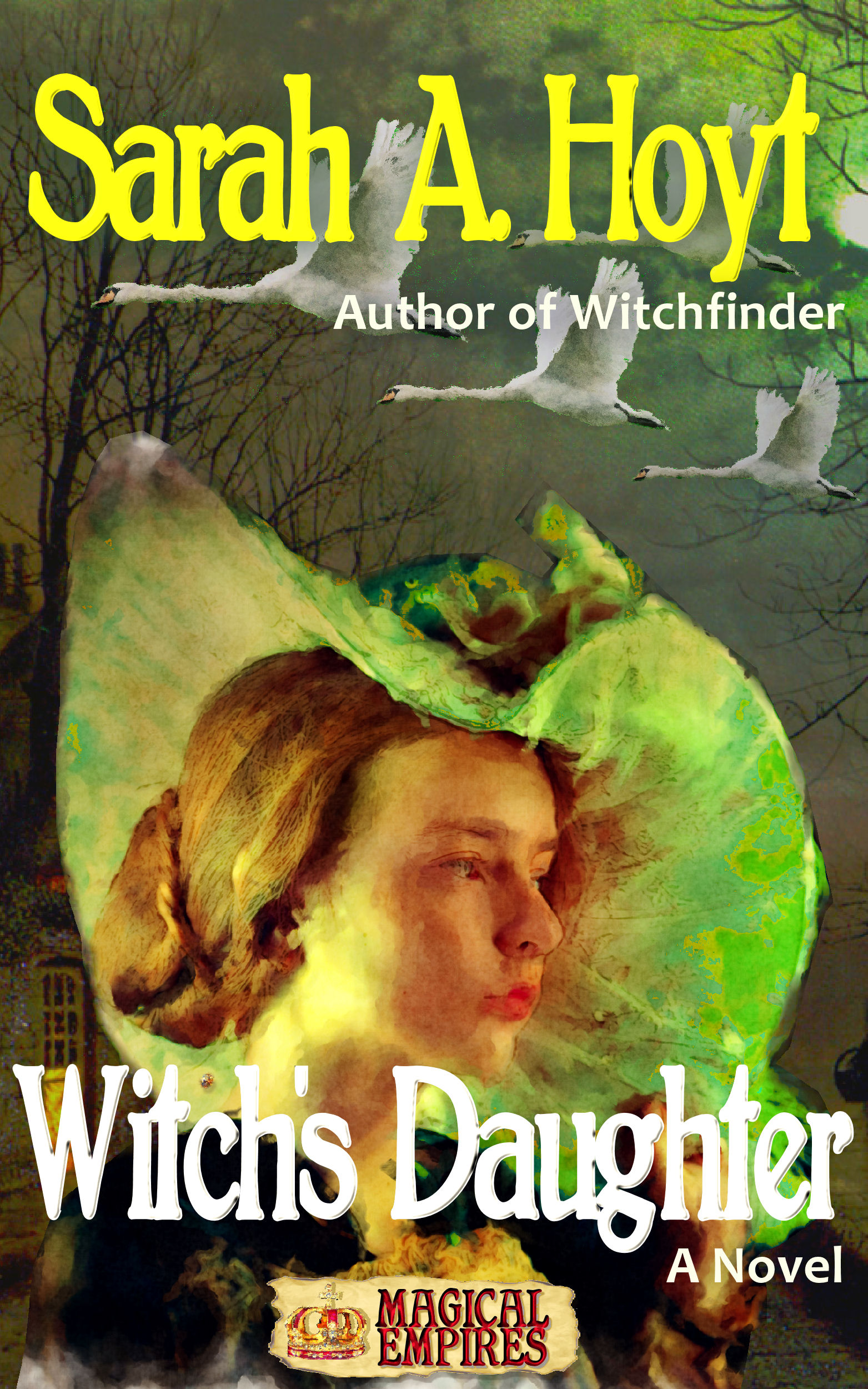
Witch’s Daughter

Sarah A. Hoyt


The Letter

It has often been said that dead men don’t talk. In Avalon, this wasn’t necessarily true. Dead men could talk if a reasonably talented necromancer were willing to risk the death penalty for reanimating a corpse.

But Michael had never heard of a dead man who wrote letters.

The letter lay on the breakfast table, next to the only setting on it, on a silver salve between the spoon and the porcelain creamer.

Michael Ainsling, youngest son of the late Duke of Darkwater and brother of the current titular, eyed it suspiciously, while he took his seat. His eyes widened slightly at the name of the sender, then he frowned at his own name in the space reserved for the recipient.

He hadn’t slept well, and dark rings marked the pale skin beneath the dark green eyes he shared with all his male relatives.

A well set up boy at the age when one resented being called such, he had that look boys have when they’ve achieved adult height but not yet had time to fill in. He’d been the quiet half of fraternal twins, his sister Caroline being the garrulous and outgoing half until six months ago. Then Caroline had been sent to an academy for young ladies, where she was presumably still garrulous but far away from Michael, so that Michael had to do his own talking and endure social interaction.

It had been thought – then – that Michael’s recent experiences had left him too frail to attend Cambridge. Michael frowned with distaste at the thought, as he folded and refolded his napkin. He did not understand why it had been thought better to leave him here on the deserted estate. With Caroline gone, Seraphim, now the tenth Duke of Darkwater and the prince consort of the Princess Royal, spending most of his time in London and Mama having left no one knew very well where, Michael’s was the only place setting at the table designed to accommodate seventeen.

Most of the days he swallowed tea and toast and rushed off to work in his workshop. Today… He glared at the letter by his cup.

And realized that the footman who’d discreetly followed him into the dining room hovered near his chair. “You may go, Burket,” he said, without taking his eyes off the letter.

“Will you need anything else, Lord Michael?” the man asked and made a broad gesture as though sweeping the breakfast spread clustered around Michael’s place setting: fried kidneys and some sort of pie, and toast and butter and something else that looked suspiciously like fish cakes.

Michael didn’t sigh. “No, thank you, Burket. I have everything I need.”

Truly he wanted the man gone so he could look at the letter at leisure. The sender’s name was Tristram Blackley, and surely there couldn’t be more than one of those. The writing and the paper both looked fresh, as though someone had dashed off the note just this morning.

But Tristram Blackley had been dead for sixteen years. Michael had studied him among the great inventors of his time, the man who had created the carpetship liners that crossed the air between Britain and the Americas and took the upper classes of Avalon on pleasure cruises the world over. He remembered mama telling him, once, that she’d known Tristram in youth, that he was a lot like Michael himself, always dreaming up new magical machines, but how he’d died young and how sad it was.

“Beg your pardon, Milord,” Burket said, which was when Michael realized the man had leaned over to pour him tea, and had almost poured it on Michael’s lap as Michael lifted his head.

“No,” Michael said. “Thank you. But you don’t have to pour my tea.”

Only now the man was buttering Michael’s toast and setting it on a plate, and smiling enticingly at Michael while nodding at the toast as though, for all the world, Michael were a toddler in need to be tempted to his food. “I know, milord, but you haven’t been eating, and what are we to tell his grace, should he ask? And he does ask, you know?”

Michael picked up the toast, with what he knew was ill-grace, and took a bite, while still frowning at the letter. He could well believe that Seraphim worried about his eating and his health and everything else. And that was nothing to what Gabriel, his older half-brother, once Seraphim’s valet and now the king of fairyland would do. Those two had always mistook themselves for parents of Michael and Caroline. And he was sure someone in the household was in Gabriel’s pay, too, and sent him regular reports.

When you have two older brothers who are far more powerful than you, and determined to protect, cosset and annoy you within an inch of your life, sometimes all you can do is play along. But Michael wished they’d let him read his letter in peace.

He took another bite, gulped down the tea, which was still hot, and then took another bite of toast, doing his best to simulate appetite he didn’t feel.

He had spent a restless and turmoil filled night, dreaming of fairyland and his recent captivity in it, and it was all he could do not to allow a long shudder to go through him at the confused and patchy memory of that dream. That was the problem, too. In dream and memory fairyland was never anything clear and solid, anything you could rebel against and resent. It was a foggy, threatening recollection, in which places and people changed shape and essence, and in which pain and worse happened to you without warning.

“That is better,” Milord, Burket said, in the sort of kind, patronizing tone that made Michael wish they hadn’t forbidden duels and that it weren’t frowned upon to duel one’s social inferiors.

“Would you fancy a kidney? Perhaps a fish cake?” At Michael’s headshake, Burket stepped back, but didn’t leave, as Michael expected. Instead, he cleared his throat and looked towards the entrance door to the room, set next to the window that looked out over the gardens.

There was movement, and then two women and a man came in, all of them smiling wide, but all of them looking just the slightest bit embarrassed, as though they were doing something they shouldn’t be doing. The women were Mrs. Hooper, the housekeeper, starched and stiff in her black dress with its immaculate white collar, Mrs. Aiken, the cook, and the man was Dyer, the Butler.

What on Earth could be the matter?

Before Michael could even think to ask, Mrs. Hooper advanced, curtseyed, advanced again, curtseyed again, then beamed at him, again, as if he were an infant in the nursery, and spoke, “Lord Michael, since today is your seventeenth birthday, we thought it only fair…” She stopped and sniffled, as though she were fighting strong emotion, though Michael had no idea what that could possibly be. “That is, last summer, milord, we thought you lost, and we wish you to believe we all hold you in the greatest affection, and therefore…” She blushed, which gave Michael all he could not to let his jaw drop in astonishment. Mrs. Hooper had never seemed fully human, much less capable of embarrassment. “Therefore we got you this gift, from everyone on the estate, to commemorate your seventeenth birthday milord.”

She dropped a parcel wrapped in silver paper, and neatly tied with a silk ribbon upon the table, just north of the letter from the dead man, then beat a hasty retreat.

Michael’s turn to blush, and to fumble with the paper. And then he had the devil’s own time concealing the expression of astonishment on his face, and overlaying it with gratification. “Oh, thank you,” he said, staring at the tiny gold box with the miniature scene of Zeus in judgment worked painted upon the porcelain lid. A snuff box? Why in heaven’s name did they think he’d take snuff? Even Seraphim didn’t.

But he also understood, immediately, how expensive such a thing was, and how much of a sacrifice it had been to the servants to contribute to it. That colored his voice and his expression, as he stood and said, “I am not good at flowery speeches, but—” He lifted the box and looked it over, “I am most gratified at your kind thought. Thank you. I thank you most heartily.”

The four of them curtseyed of bowed according to their different sexes, looking gratified, and left.

Which is when Michael opened the letter from the dead man.

Escaping The Tower

The problem with a wicked stepmother, Miss Albinia Blackley thought, as she stood in front of the mirror, wearing Geoffrey’s clothes, and tucking her abundance of blond hair into a hat rakishly set on her blond curls was when the wicked stepmother was in fact your real mama.

It was all very well, after all, for Miss Albinia’s brothers – who always called her Al – because Mama was just the woman who had married papa when Geoffrey, the youngest, was seven, and was in fact no blood relation to them. So they had nothing to be either sorry or worried for. It wasn’t their mama who mistreated them so.

Oh, it had been terrible for them, from what they’d said, to find that their kind and absent minded father had married a forbidding and interfering woman who was a powerful witch to boot.

But at least all of them, even Geoffrey, remembered papa. Albinia didn’t. She didn’t remember anyone but Mama, the sole authority and arbiter in her sixteen years of life. Albinia locked the door to her room as she thought this, and sighed, because now she was on limited time.

Mama didn’t like her to lock her door, ever, and there was no point at all imagining that mama didn’t spell that lock, so that she knew the moment Al locked it. Mama spelled everything and kept track of everything Al did, which is what made this so devilishly difficult.

But spell or not, Albinia must lock the door, to at least delay mama and give her a chance to escape.

Because the thing was, Mama or no Mama, Al must leave and go find the boys.

She didn’t know if the boys had felt this way when papa left shortly after marrying mama. She didn’t know because they never spoke to her of that time, before Al was born.

What she knew was that papa had disappeared shortly after marrying Mama, and had never returned and was presumed dead.

And now the boys had disappeared. Al didn’t know where, but she knew two things. One, that mama had made them leave against their will. And two that wherever they were they needed Al. And at any rate, Al needed them. Even if Mama was her real mama, Al was not going to stick around and have the full benefit of mama’s attention for the duration. Whatever the duration was.

She scrunched under the bed to find the old sheets she had torn and tied together. They had to be old and discarded, because that was the only way to make sure they were no longer bespelled. It had taken her six months to find some and to braid them into a passable rope, in the few minutes a day mama left her alone.

Tying the sheet to the foot of the bed and throwing it out the window was the work of a moment. Al’s mind ticked where mama would be now.

Even if she were close by, say in her room, as she would be at this time, she had to come up the North staircase, down the hallway and up to the door. Right now, she would be on the top step.

Al got the magical kit, likewise assembled painstakingly over a year, of discarded bits and ends, so that she could be sure no one had bespelled or could track any part of it. The hard part of it had been buying the herbs, because she’d had to spend her allowance on them, in a shop at the other end of Wulffen Downs, so that mama wouldn’t hear about her purchases. And she’d had to wrap them so they looked like candy.

It had earned her a sermon from mama about spending her money on tooth-rotting sweets. But she had got the herbs necessary for enchantments.   She tied the pouch to a cord under her jacket, and then slipped the few silver coins left of her allowance into her sleeve.

She could now hear Mama’s step in the hallway outside. Mama was clearing her throat, preparing to call her name.

Albinia pushed the window fully open, knelt on the parapet, and held on to the rope with both hands. She had remembered to put knots on the rope, and she set her feet on the first one, carefully, otherwise it would be like when she tried coming down from the cliff when she’d been bird watching with Edmund, and had got her hands burned, with the speed of sliding down the rope.

She clambered down the rope as, from above, came the sound of knocks and mama calling “Open up. Open up immediately young lady.”

She felt the little puff of magic as mama opened the door with a spell, and she moved faster down the rope, because she had to be on the ground, and running by the time mama got to the window. She had to go to her brothers. Geoffrey needed someone to help him make himself understood when he started stuttering and Edmund was likely to lose everything, including his paints, and Aaron, Jeremy and Joshua would argue about everything, and William was likely to disappear into his music, and Samuel would just go all extremely disappointed…

Albinia looked down to see how far the ground was. She had measured the tower where her room was situated. She’d calculated the height to the window five different ways.

But as her stomach sank to her feet, she realized none of that mattered now. Because she was not suspended from her own home’s window, but from a window open on a façade of glass. In fact, it looked like she was hanging from a giant glass cube. Except that as she looked forward, she could see these were windows and that oddly dressed people were pointing at her and a woman was covering her mouth, but looked like she was screaming something.

Gone was the tower of the manor house on the cliff, overlooking the ocean and the familiar marshes. Mama. Mama and mama’s magic!

She could feel as though an abrasion upon her magic, as if something, in this strange place were trying to get through her shields.

Beneath her, there were flashes of moving things that she couldn’t understand and the sound of klaxons superimposed on a low roar as of a million voices.

She had no idea where she was, dangling here, between Earth and sky, on her fragile ladder of sheets.

All she knew was that the ladder ended far short of the ground. More than the height of Al’s tower.

Far above, Mama leaned out the open window, and Mama’s voice called, “Albinia Blackley, you little idiot. Hang on. I shall pull you in.”

And Al let go of the ladder.

She let go before she could think. She let go, knowing only she couldn’t stand to go back in and explain herself to Mama. She let go knowing that she must get to her brothers, somehow, but not knowing how, except that she must get away from Mama and Mama’s magic, first.

She tumbled downwards, head over heels, wondering how it felt to hit the ground so far behind.

Would it hurt? Would she even feel it? She hoped she didn’t land on some innocent and kill them, even as air escaped her lungs.

Rescuing the Dead

Michael frowned at the letter. It was undoubtedly addressed to him, by a man who couldn’t possibly have known of his existence, unless he had read the announcement of Michael’s birth in some society newspaper.

Swallowing tea and toast as fast as he could, Michael put the snuff box in his pocket and retreated to his workshop.

Properly speaking, he had two workshops: one in the house proper, a room that had taken his father a substantial portion of the family fortune to build and the other far deep in the garden, where Michael assembled and tested those experiments that might explode or other otherwise cause damage to the family.

The workshop in the depths of the garden, he’d all but abandoned. Even if a changeling had been left in the inside workshop, it was from the outside workshop he’d been abducted with a cunning spell from the now fortunately dead king of fairyland. And though Michael was quite sure the present king of fairyland, his brother Gabriel, had no intention of kidnapping him, yet he felt alone and vulnerable in that building. It had been violated once, and could be violated again.

The inner workshop would be harder to breach. For one, when it had been claimed from its previous use as a ballroom, it had been lined in leather between two layers of copper, the whole bespelled, forming an impassable barrier to both organic-affecting and inorganic-affecting spells.

In the ballroom, a sort of platform had been built, and up on it, Michael had his sky-observing apparatus, which observations came in handy when calculating what form of spell to use.

The rest of the workshop was machines of Michael’s own invention, many of which now seemed impractical and childish to him. Take for instance his careful replica of the planet Earth, in brass, rotating in proportional time around a miniature sun. It had been fun to build, but what practical use was it?

Since Seraphim had visited the strange planet without magic where the Princess Royal had been raised, and brought back ideas for useful machines, like shavers and mixers and clothes and dish washers, Michael had been working hard on magical replicas for such wonders.

The clothes washer was a success, except that the housekeeper had banned its use saying it was an abomination and would run laundresses off their jobs by the score. However, Seraphim had arranged to have it tested in the royal palace and it was well on the way to becoming accepted in other, less hidebound households than the Darkwaters’. Seraphim said it would make Michael a fortune.

The automated barber, though… Michael frowned at his creation standing by the workbench near the far wall of the room. It was not a little portable thing, as Seraphim had described, because Michael had believed by making it large and capable of giving haircuts as well as shaves, it would be more popular. Particularly if it could also dress the hair of young ladies.

But all the thing had done, in actual fact, was chase Michael through the house, trying to cut… not his hair. The bits of his jacket it had got had been enough. Michael was not sure what had gone wrong with the animating spell, because when a cylindrical, man-high thing is wheeling after you brandishing knives, razors and scissors in its many arms, the only possible thing to do was to run as fast as possible.

Which he’d done, until Dyer had shot the mechanical barber through the head with a fowling piece. Michael stared at the creature with multiple holes through the space where its directing magic had been. Well, never mind that. This was not a good time to attempt to reproduce that… experiment.

Michael perched on a high stool and tore into the letter, breaking the seal which showed – he’d swear to it – a lamb eating a wolf.

The letter started formally enough, “Dear Lord Michael Ainsling, You’ll forgive my addressing this letter to you, though we’ve never been formally introduced, or, indeed, introduced at all.”

And it proceeded strangely, “You might have heard of me, and have some idea that I am dead, but do not let that concern you, as rumors of my demise have been greatly exaggerated.”

Michael chewed the corner of his lip, perceiving that the person who’d written this letter, in strong angular letters, was what Mama would have called an original. And by original she normally meant that they needed help finding their way across a street, and were none too certain where they might have placed their head that day. She had been known to describe Michael himself in such a way.

“I suppose it will be a matter of some concern to you how you come to be receiving a letter from me, whether you think me dead or alive, and also possibly some curiosity as to what you can do to help me, or hinder me, or indeed do anything in my case.

“I’ll tell you the truth. I do not know. I have cast and recast these runes, and all I can tell is that there is only one person in the world capable of understanding my work – and you must understand what keeps me prisoner here is my own work – and disabling it, so I might perhaps be set free.

“I have never had the pleasure of meeting you and the last thing I’d expect would be the Ainslings to throw any kind of magical genius in the normal way. I mean, you’ll pardon me for saying so, but your father was one of the accredited adventurers of my time, in more ways than one, meaning he was rather more adept at using other men’s magic all too often in order to use their wives likewise. And while your Mama was one of the beauties of her day, and indeed a diamond of the first water, I never found that she had an inquisitive and mathematical turn of mind. But then, of course, sometimes every breed throws a sport, and my runes assure me that you are that. A magical genius, I mean, not a sport, though I suppose that also.”

By this time Michael’s head was whirling and he felt he should have had rather more than one cup of tea to fortify himself to deal with this very strange missive. Brandy for a choice, except that none of the servants would let him have it, or at least not without telling Seraphim.

“However, before I can request that you rescue me, though I do, of course, request that, I must ask you to find my sons. You see, the woman I married, in what I’m sure now seems to me like a fit of madness, has applied some sort of spell to them, so I can no longer track them nor communicate with them.

“I’m afraid she means to do away with them and use the lands of my ancestors to form a dowry for her whelp. And while I have nothing against the mite, who was not born by the time I got confined to this place, and whom my sons inform me is a pretty good sort, in the way young females sometimes are, and not at all like her mother, I do not with for my legacy to pass wholly into her hands and those of whichever rogue Albinia chooses to marry her to.

“I presume you have a row boat of some sort on your property, as I vaguely remember there was a lake there, in which much boating was done in the summer. I remember the lady your mother looking very fine in a lace dress upon a boat, in fact. At any rate, if you apply the formula I enclose onto a rowboat, it should bring you where you need be to start unravelling this knot.

“Since the full extent of the knot laid by the one I must call my lady wife is not known or understood by me, I must trust in the formula and in the kindness of a total stranger to do what must be done. And my scrying assures me you’re the only stranger who can do so.

“In full hope, if not trust, of your doing what is needful, I subscribe myself your most grateful and devoted servant, Tristram Blackley.”

Having laid the letter down on his workbench, Michael stared at it, fully wondering whether the person who’d written was the – presumed dead – author of magical carpet travel on a grand scale, or simply a madman possessed of illusions of being such a parsonage.

It was not till he turned the page and looked through the formula, written in a hand that gave the impression of impatience with writing, that Michael blinked, whistled under his breath, and realized that this was indeed the work of Tristram Blackley.

No one else, barring an equal genius, could have come up with such a strange mix of magical formulae, turning a simple rowboat into a vehicle of both magical transport AND divination.

And Michael knew, as he knew his own name, that he would have to try it out. It was like climbing the tallest tree or exploring the dangerous path of the woods. He’d like to believe he was doing it for the sake of the unknown Mr. Blackley who seemed to be in a terrible position, but in his heart of hearts, he knew he was doing it for the thrill of it and to prove that he could.

Enough of nights hemmed in with nightmares of fairyland, and of moping the otherwise deserted estate. Michael wanted to be doing.
The State of Marriage

When I was a kid I was always highly amused by reading Agatha Christie characters refer to it as “The Marriage State” instead of just “being married.”

Yesterday here someone mentioned taking relationship advice from Agatha Christie which might be marginally better than taking relationship advice from Heinlein, but not by much.  And yet I did both and it turned out okay, though it could be said that is partly because I was solidly embedded in a married-people culture.  A culture where everyone married, unquestioningly, oh, and didn’t divorce.  I knew happy couples, and unhappy couples and couples who had lived apart after a few years or a few days or in one case a few hours* of marriage, and who sometimes lived with someone else and had for so long that the scandal had worn off, but were married, nonetheless.

One of my own uncles had left his wife after a few years, and lived with another one.  The family was at a loss for whether I should call her aunt or not.  She of course was more obsequious than all my other aunts in her observances and gave me a pearl brooch for my third birthday.  I loved it because it had two little birds made of pearls, but it caused my mom (it was her side of the family) some heartburns whether I should wear it around her family.  In fact, I suspect she eventually traded it in on something else, because thought it was one of my favorites, it’s the only piece of jewelry I remember from that young age that I don’t have.  And what I have includes some I wore when I was so young I chewed it out of shape.

Anyway, so marriage was a constant and even when the village women said “He beats me but he’s my man” one couldn’t detach the couple with a crowbar.  It was assumed to be the law of nature, coming or going, good or bad.

And to give you an idea of how unenlightened the times were, one of our cleaning ladies (mom had a succession of them, because she had a successful business and no time to clean, or shop) told me when I was ten or so, that if I thought I’d get a man who didn’t at least slap me every now and then, I was air dreaming.

This was a weird perspective, as men in my family (on dad’s side.  Mom’s dad had issues) never raised a hand to a woman, their own or not, and at that never raised a hand to a kid if they could help it.  The women were always the disciplinarians, and the men … well, dad could stop my worst tantrum with the words “I’m very disappointed in you.”

Someone in one of my groups on facebook was complaining about marriage, specifically that person’s own marriage.  Well, not complaining so much as baffled and confused as to how it’s falling apart despite his trying to do his best.

I sort of know why it’s falling apart.

Take that overlay above, and the fact when I was born/grew up Portugal still issued family passports, and if a woman wanted a solo passport, she had to have her husband’s signature.  For that matter, if a woman wanted to have a paying job outside the home (cleaning house didn’t count.  In that time and place you were often paid in produce and eggs and a chicken or so.) she needed permission from her husband.  I know this because I remember vividly (yeah, mom had her own business and worked in the kitchen, then in her workshop after they moved when I was 7, but she was the principal earner in the family) being astonished at a neighbor who wasn’t too sure of his letters coming over for dad to help him fill that form, so the neighbor’s wife could get a job in the textile factory and they wouldn’t starve.

Then put on it that every one of my teachers was a “feminist” and if you think that it’s only feminists here who went running off the deep end, way past equal work for equal pay and into turnip (the currently popular movie is not ALL about women, so it’s sexisssssss) you’d be shocked.

We’re talking a country where wife abuse was rampant, where men did have legal holds that prevented women from making an independent living, where a woman in her twenties would be treated by the police as a runaway kid and brought home to parents.  (One of my cousins whose father took after less than sane granddad.)  Unless she was married when she’d be taken home to husband.

You’d think fighting wife-abuse and trying to get laws/culture altered would make sense, right?

You’d be wrong.  Oh, Portugal never went far down the “Let’s reform language” partly because it’s a Latin country. I mean, sure, you can make up a pronoun to refer to women, or a pronoun to refer to men, or call men and women something stupid, or claim we shouldn’t have gender in language because oppression.  But that doesn’t pass the laugh test when your house and your garage, your tree and your cart and your plow are all female pronoun and your cheese, your car, your sweater and your dress are all male pronouns.  You can’t say it’s oppressive to have pronouns when they’re used for objects and in a way that defies logic too.  (The tree being feminine and the boat masculine are two of those that make you go “uh.”)

I don’t know mind you, since the first wave of feminists were about ten years older than I, that they didn’t try the pronoun thing, but if they did the gales of laughter led them to drop it.

Other than that once you left the village school — where the teacher merely, rightly, taught that intelligence doesn’t lie in the generative organs and that males or females can be smart, so shut up, stop dreaming of a husband, and learn to use your head — I passed on to teachers about ten to twenty years older than I, mostly female (as mom would tell me “such a pretty job for a lady”) and mostly having learned from whatever theories were passing around other countries in the sixties.

So we got the full fledged feminist instruction, and as with gun control, I was raised in Europe, for a while I believed all this.

The gist of it seemed to be “you won’t do anything for any man.  Because a man asking you to do the simplest thing is aggression and oppression.”

Well, they never quite convinced me to stop making dad his coffee.  (Yeah, he has the same dark eyes my younger son has, and this way of saying “Only you make it so well” — and yeah, it’s irresistible.) However, I remember the rip roaring fight when mom ordered me to continue cleaning up after my brother.  (This was absurdly unfair, as he was much older than I, but if he left a banana peel in the living room and it discolored the table I was the one punished, because my job was to clean up after him.)  Yes, I DO still think it was ridiculously unfair.  I also sort of understand that’s how mom was brought up and she completely didn’t “get” why I had objections.

So Alvarim, showing a grace I still sometimes strive for, got tired of my being in the dog house and made a deal with me.  If I cleaned up after him he’d pay me from his tutoring money (I think the equivalent of $20 a month.  Enough for three paperback books.)  And we wouldn’t tell mom.  (I wonder how much we puzzled mom, because now that he was a CLIENT I felt obliged to do proper stuff, so I bought little chocolates and left them on his pillow after turning down the sheets at night, and I gave him periodic gifts.  Anyway…)

BUT some of it wasn’t funny.  The “you shall serve no man” thing sank deep, as well as the idea that marriage was slavery, which accounted for a string of turned down proposals and also for my learning very little of HOW to keep house (because I was NOT going to do it.)  This led to years later my standing in the middle of Dan’s apartment looking at a box of pasta and wondering how we turned it into the soft stuff you ate.

It took me years to stop resenting doing the housework, after I was married, and if it weren’t for my sense of fairplay I might have wrecked my marriage.  But fairplay came in.  When we got married both Dan and I had both jobs and artistic pursuits.  My training/former job didn’t apply at all here.  So he said he’d support us, while I tried my hand at writing for a living.

Mind you, Dan was also raised in “enlightened” times so he never came home and said “Yo, woman, where’s dinner?”  (He still doesn’t, though he’s been known to make puppy dog eyes.)  And if I hadn’t cooked, he’d make his and my food.

But the sense of fairplay got to me.  He was out working (computers, eighties) twelve to fourteen hour days so I could write, and I wasn’t even cooking, despite being home all day.  So I learned. (And we each gained 100 pounds.  I CANNOT figure out how to cook for two people.  When last boy is out, we might very well have to have me cook for several days.)  And I learned to do other things, because I still wasn’t making money when the kids were born, and all our friends had two jobs, and, well… I didn’t want the kids to live like paupers.

We’re not over-bothered about who does what, mind.  I turn my hand to carpentry as well as to sewing.  He does car repair as well as accounting.  But we each try to do as much as we can for the other.  I think if you were to tally it, he still does more than I do, and I’m trying to figure out how to do some more to give him time to write, because I too want the sequel to his book.

We make do.

But the point was to stop thinking of him as a male oppressor.  As far as I can tell my husband, personally, never oppressed anyone (kids’ claims to the contrary notwithstanding.)

However those of you of a penis persuasion, not to count those of you who are older women and didn’t get the full brain washing indoctrination, might not realize how hard that is to do; how hard it is to let your guard down and think of the man you love as an individual.  It took me probably a decade to get fully over the indoctrination.  Because they don’t teach you that life was hard and most people had no rights at all.  They make all history before the late twentieth century a morality play where men oppressed women, because they’re just villainous that way or something.

And ninety percent of the time when I see a marriage headed for divorce (of course there are exceptions, and as I said the remedy for “he beats me but he’s my man” is to get out as fast as you can and before he starts in on the kids.  I’m not talking about those, but the cases where the woman is vaguely certain the husband is “oppressing” her, often by keeping all the “fun” of a day job to himself or something) something like this is going on.  The woman resents the man not for anything he’s done, but for the presumed mind set of ancestors that never existed and is sure if she doesn’t keep him low and humble with constant attacks, he’ll crush her under his boot.

Then there’s the reverse of that, as a lot of entertainment portrays women as putting an end to Lads being Lads together.  Women are brought in as “adults” to stop sprees of video gaming or pie eating in sitcoms.  That sort of thing.  So men associate women with killjoys.  And women associate men goofing off with oppressing women by making them be the adults…

When we were newly married, for instance, we stopped watching Married With Children, because it seemed designed to foster mutual marital resentment.

But in either case, in most of these divorces, the problem is not the spouses so much as not keeping crazy culture out of their relationship, and not looking at who they married AS INDIVIDUALS.

My mom is fond of telling that her grandparents used to share a plate (apparently an old Portuguese custom for married couples.  It strikes me as bizarre, but I don’t even see why.  After all married couples normally share a bed, right?) And after they got elderly, he had dentures while she still had her own teeth, and he’d complain she ate faster than him and got the greater share of the food.

These were her maternal grandparents, and as she told it, her grandfather never even raised his voice to scold his wife, so it was a gentle reproof and it became a family joke.  Whenever my dad was doing something that mom thought was excessive, she’d say “you have good teeth, you’re taking all the food.” (Though they DIDN’T share plates.)

Anyway marriage is like that.  It’s impossible to draw a line in the middle of a marriage and weigh in exactly what you do for whom.  I used to do the lion share of the work when the kids were little, and I often thought I’d break under it.  But Dan now is picking up on housework, as I also have work that pays, and there are no kids.  It’s probably about equal, save for stuff I’m really good at like cooking, and stuff he’s really good at, like accounting.

But the point is, you go through phases where metaphorically speaking one of you is eating all the food because he has good teeth.  It’s okay, it equalizes, eventually, somewhere else.  It’s no reason to call it quits, particularly if you’ve been at it for more than twenty years.

The solution is to stop weighing who does what or thinking he’s a natural-born oppressor.  You’re just people.  If the burden is too heavy, figure it out. Don’t assume he’s out to dominate you just because he has a penis.

And I say this because — this is important — in our day the Marriage State has become not the default but (particularly in its happy mode) a rarity.  If this continues, the cultures that will inherit the earth are the ones where women aren’t even second class citizens, but something more like domestic animals.

I don’t have daughters, but I might have an adoptive granddaughter soon, and maybe by a miracle blood granddaughters later.  I don’t wand this for any of them.

In a state of nature, where marriage doesn’t exist, for biological and psychological reasons, women are always the losers.  The opposite of “He beats me but he’s my man” is not a state of freedom, but a state of the woman having to kill herself to support the kids, or if there are no kids, of the woman (or man) becoming old and grey and lonely.  Yeah, in extreme cases, you should get out as soon as you can.  But in cases of vague dissatisfaction?  Remember he’s a person.  And remember you’re one too.  Work it out. It’s not his job to treat you like royalty because some putative ancestor beat some putative ancestress.  It’s your job to learn to pull together at the same yoke and either raise kids or set money by so you’re not a burden on strangers in your old age, and more importantly, so you’re not resoundingly, echoingly lonely.  Because there will come a time the rest of the world will have no use for you.  And your kids will be too busy to spend time with you.  This is not a threat, it’s the inevitable tendency of the flesh.  And humans are social animals. You need someone.  Or you will.  No matter how free an independent you are.  Friends, or spouses are difficult to cultivate when you’ll not put a hand to do a favor for any male.

Remember that.  Remember the present doesn’t last forever, and that the past was not as bad as they painted it in school.

He might at times eat all the food in the plate, but if you remember kindness and common charity to each other (love is an unreliable thing that comes and goes, or seems to, till you learn to see it always there, in different forms) then sometimes he’ll push aside most of the chocolate cake, and say he’s full because he knows you like it better.

And that’s marriage at its best state.  And it’s worth everything.  You know how your parents loved you when you were little?  This is a hundred times better.

I know.  I’ve been at this for thirty years.  And mostly it works.

*Almost forgot… yeah.  The “few hours.”  This woman in the village, whose dad had died when she was a toddler, got married, and the newly married couple moved in to her mom’s house (supposed to look after her mom and all.)  I guess the mom had forgotten to tell daughter what marriage entailed.  So in the middle of the night, daughter cries out “Moooom, he’s interfering with me.”  At which point, mom throws the husband out.  They remained married and separated for the rest of their lives.

I know this because being village kids, and lacking video games, when we walked by their house (mom and daughter’s house) on the way from school, we’d scream “mom, he’s interfering with me.”  This never failed to bring the mom out like a jack-in-box, to call us names and throw sticks and stones at us, which we OF COURSE thought was the funniest thing in the world.  (Yes, we were VERY bored.)

Checking Yourself

This is a quick post, and this is not about me.  (It’s a quick post because very late, for reasons I can’t divulge just now.)

Two days ago I was trying to come up with a theme for a blog in a group on FB and an Amanda (there are three of them and I can’t for the life of me remember which) said a good theme was “trust but verify” even yourself.

I normally don’t have this issue TOO FAR because I take no medications that could influence my mood.  Because of this, I don’t even take percocet until I’m at “pain screaming” levels.  I’m one of those people who look suspiciously at aspirin.  It’s how I was brought up, but also a wish to have my mind be my own.

However, sometimes books influence me.  Usually this influence is minor, like craving a certain food, or speaking with weird vocabulary choice.  (Lately Irish.)

But even when you’re not on meds, you can spin out.

The thing is when your brain is wrong, you won’t detect that you’re going crazy.  No, seriously.  It’s what you are thinking with that’s broken.  I’ve had friends spin out over post partum depression, or illness, or other stuff, that suddenly makes them paranoid or obsessed.

In my case, I went through a period when my hormones were off and I got PROFOUNDLY depressed.  Fortunately it was the “beige” and “do nothing” depression, so I wasn’t actively causing harm to myself or others, but I was passively doing so by lacking the ability to do/complete anything.  I knew I was off, but not by how much till it was fixed.

To a certain extent I’m going through that now, as I recover from years of illness (in large part also hormonal, but also chronic pain that kept me awake.  I’m still in shock at sleeping through the night almost every night, unless act of cat disrupts it.) and amazed at figuring out how “off” I was.

But particularly when you’re on meds and go out of control, sometimes people don’t realize how out of control they are, or how atypically they’re acting.

I had a friend who overnight decided I was her first and foremost enemy.  Yeah, eventually she got better, but the friendship will never be the same.

So, what can you do?

Well, if you starting in in a way you know you normally don’t/people tell you is not quite right, particularly if a lot of people who know you really well are telling you this?

Trust but verify.  If you’re under treatment consider if your meds stopped working/are having weird side effects.

If you’re not under treatment, check that you’re OKAY.  If you’re ill, even if it’s something stupid and minor, see if this can affect your behavior.  (Things do you wouldn’t believe.)

If you have a tendency to depression, figure out if you’re in the middle of it.

And if none of those, consider if you’ve been influenced by a book, a movie, an experience.  These are often of shorter duration, but I swear there have been books that left me… evil.  It’s the only way to put it.  And sometimes it lasts days.

Because your brain is what you think with, it’s important to make sure it’s not lying to you.

It’s also important to check with unavoidable reality.  I mean, maybe you think that your dog is trying to kill you, so observe carefully.  If he’s licking, not biting you, probably not.

So, trust but verify.  EVEN (Particularly) yourself.

And now I go because this week is unbelievable.  I’ll be back on track next week.  (And yes, this is also something that influences you.  When you have fifty things coming at you at once, you WILL do a great impression of an airhead.  Even if you’re not one.)

The Poison In The Pen – a blast from the past post from December 2012

*Forgive me the recycled post.  I meant to write today, but this week is turning into one of those when I run around like a chicken with my head cut off.  I promise to write tomorrow.*

The Poison In The Pen – a blast from the past post from December 2012

This morning over breakfast we were talking about where jobs seem to be going.  (Into the wormhole, but that’s not what we mean.)  Yes, we were talking about it for the usual reason – we fear the one full time “regular work” job in this household will end up going that way too.

In a way it’s almost inevitable.  You pile regulations on something and make it really difficult to do it legally –ie the regulations contradict each other – people WILL stop doing it.  Only…

Only people still have to do something.  Well, right now, as someone who occasionally hires contractors to help in my work, (yes, I wish I could hire full time, but I don’t think it’s happening) I can tell you the regulations are crazy.  You have to read through tome-like volumes to figure out what you have to pay and how much and… It adds a week of admin work onto your work.

But people still have to work.  And people still need employees.  So, what we see happening is a lot more temp/contracting/part time, and the work of managing the regulations etc to a great extent off-loaded to each individual as “self-employed contractor.”

As someone who has worked on this for ever, I can tell you we get the ugly stick on taxes.  No, seriously.  We pay self-employment tax, for the privilege of working for ourselves.  Many states have other taxes on top of that.  We contribute both sides of social security.

Tax policy lags reality and I think most of the self-employment beating we get comes from the fact that forty or so years ago most self-employed people were in the very well paid professions: doctors, lawyers – people who could hire secretaries and accountants to not only manage the paperwork but to find every possible loophole.

We don’t have that, so the end of the year, unless I made nothing (which has happened a couple of years) is hectic and vaguely angsty, as we gather all the paperwork, etc and make sure every I is doted and every t is crossed.

Which brings us to where all these regulations on employers is leading (into the kaki, but that’s not important right now.)  I think over the next few years everyone we know is going to become a contractor and working  probably for multiple people every year.

I suspect the people making these laws, if they’re thinking at all beyond the “this would be nice to make employers do”, think that the fact that this will make life more uncertain will make people rely on government more.

That’s not how it works.

Looking back the level of confidence in big government coincided the era of cradle to grave employment in large companies.  People who thought their bosses were competent to manage their job security and retirement would also trust other large, faceless entities.

The level of distrust in government has been growing since the eighties and while the people in government – who, after all, have cradle to grave security at least most of the time – might think this was because of Reagan’s rhetoric (Which is part of the reason Obama wanted to be the anti-Reagan) I think they have it wrong.

The world my generation faced when we came of working age was one of temp work, of layoffs for being less than absolutely efficient, of…  Yeah.  What it meant was that we learned to trust only ourselves and our network.  People we knew well, people we could trust.  No big, faceless entities, which, of course, means not government, by extension.

I don’t think they understand that in a world of all-contractors, first, resentment against tax regulations is going to grow like mad – when you spend your holidays doing books and trying to figure out how much you made and how much you’re going to owe, you get a tadbit resentful.   When you see how much you have to pay for the “freedom” of working for yourself, particularly for people forced into it by new laws, you get even more resentful.

Your reaction is not to go “Oh, daddy-government, look after me” – it’s “Those right bastards are robbing me blind coming and going.”

I don’t think the people making full time employment impossible (though I’ll admit that it was going that way anyway with technology, to where people might PREFER to be contractors – but not by force and not this quickly) realize this.

I don’t think they know they’re making their own poisoned pill.

The Why of The Who

When I was very little, I thought I was a cat.  Or perhaps it would be more accurate to say I thought cats were people like me.  I wasn’t a hundred percent clear on whether the cats would grow up to be me, or I’d grow up to be a cat.

You see, I was the much younger (my brother is almost ten years older than I and my (female) cousin raised with us like a sister is fourteen years older than I, and our other cousin raised nearby/in interaction with us was yet older than her, though I confess I don’t precisely know by how much.  You see, to me he was always a grown man. Because even fourteen year olds seem that way when you’re a toddler.

Normally, I suppose, this wouldn’t be a big deal, except for where I lived.  In retrospect mom’s expressed instructions that I choose my friends from the “cleaner” children in the village wasn’t bigotry but exasperation after the third or forth time she had to rid my waist-long hair of lice.  (I didn’t get my hair cut till my teenage years.)

The formative sense of my childhood, given where I lived, was loneliness.  Not so much after I entered elementary at six, and made friends with my desk mate, a friendship that continued, despite distance and differences (she married a Frenchman) until a few years ago, when I got so busy I lost track of her or she of me (if you read this, Isa, I miss you.)

This is part of the reason that by the time I entered elementary, I was reading.  And even after I had friend(s) loneliness remained, because you see, I was very sickly.  And though this was the sixties, habits of the times without antibiotics prevailed in Portugal.  I don’t think I attended even 3/4 of a school year until 6th grade.  (For some reason puberty fixed a lot of my immune issues.  No, I don’t know why.)  And when I was sick, I might spend one or two solid weeks in bed, not allowed to go out or have visits (other than my brother who read to me, and did voices and who was probably responsible for my learning to read by memorizing what words went with which square in the comic book.)

Before I could read (and even after) I spent an enormous amount of my time building entire cities out of legos and imagining the lives of people in them.

I remember vividly the last phase of that, when I must have been twelve or fourteen, and used to go to my grandmother’s in the afternoons, and build those cities out of scraps of wood from grandad’s workshop, and bits of leaves, and stuff, and then populate them with tiny plastic dogs.

Okay: the plastic dogs were free giveaways with detergent.  In an attempt to get people to stop making their own wash soap, the detergent companies deployed the most powerful leverage they could.  Yep, that’s right.  They bribed kids.  It took me a while after being in the US to get used to the idea that it was CEREAL boxes that offered toys, not detergent.

Most of the time the prizes were, even by cereal box standards, totally lame.  (Though I DID get a decoder ring.) It was stuff like little plastic horses, or dogs, or figurines of “professions of the world.”

But it was a lame world, back when pictures were in black and white, and honestly, most of my toys (and we weren’t that poor) were found objects, including the boxes things came in.

So kids would beg and really want these lame toys.

And when I was fourteen, I think, I took the entire batch grandma had been collecting for me (put it this way, it was after I read City, which had been given to me by the father of a high school friend) and played a Simak-like dog-populated world.  For hours.

Mind you by that time I was already writing, though I can’t remember if I wrote science fiction.  I did write endless, very bad, YA mysteries.

So, what is this in the name of?

Well, if I’m not thinking, if I let myself just be, in many ways I’m still that lonely little girl making up stories and imaginary friends. Even though I have friends, and a family and am rarely lonely.  (If nothing else I have cats, who never grow to be humans, but are good company anyway.)

So–

As a mother I look back and see all sorts of things that went wrong with raising my kids.  Things I did wrong.  I shouldn’t have put the younger one in school so early.  Or perhaps I shouldn’t have put them in school at all.  And I shouldn’t have been so demanding.  And I shouldn’t have…

But I wonder if given a choice, and the ability to do it over, my parents wouldn’t have chosen to raise us elsewhere, or at least raised me with more kids my age I could play with.  I seem to remember mom making some comments along those lines as to why I was insufficiently attached to Portugal, unlike my brother who would never leave the country because of his friends.

Oh, sure, it’s entirely possible if they’d done that, I’d have been a happier person.  Maybe.  I mean, the thing in Pratchett’s book (Lords and Ladies) about “what about when the house burned down and all our children died” if things had gone differently is a profound observation.  When we play “what if we’d done this instead” we tend to only see the rosier shades of that path. It could have gone disastrously, despite being the better path.

But let’s leave all that aside.  Let’s imagine my parents realized antibiotics made it unnecessary to keep me away from every living thing every time I was sick (Alvarim, if you’re reading this, you were clearly NOT a living thing.) Let’s say they actively went out of their way to get me little friends.  Let’s say the defining characteristic of my early childhood was instead “exciting games with kids my age.”

Would I be the same person?  Was who I am an inevitable result of my birth?  Or was it a result of where I was born and how it was then.  Or all of the above.

And I’m not saying I wouldn’t want to be … easier in the world.  More sociable.  Not overthink things so much.

BUT

BUT… would I still be me?

It’s hard not to believe that the stories come from that great, silent fund of loneliness at the bottom of who I am.

So — who are you?  There behind the eyes.  Who are you and why? For good or ill, I’m a little girl building imaginary cities (and worlds.)

Who are you?

What’s Your Story? – David Pascoe

What’s Your Story? – David Pascoe

I was about five when it happened. The first time, at least. I was minding my own business (maybe building something with my *meager* store of Legos, maybe ignoring my little sister. Probably both) when the Pop Dave put a strange and archaic object into the now-ancient (and quite defunct) device. Within moments, my conscious mind was ripped from my body and transport through time and space to a galaxy far, far away. I was no longer not-yet-kilteDave. I was a young moisture farmer on the run from the Empire! I was a budding, young Jedi with my father’s laserswordlightsaber, and the galaxy’s most evil man chasing me. Later on, I was member of the Captain’s away team (that job didn’t last very long).

After I learned to read – and got a library card – things really took off. I can’t remember all the times some kooky old guy told me I was the Chosen One, destined to topple the Dark Lord from his Dark Tower in the middle of his Dark Land. (Except for all the times the Dark Lord was a Dark Lady: hey, equal opportunity tyrant-remover, me.) I remember being a free trader, plying the spaceways. At least until the pirate attack that left half my crew dead. I’ve been a Terran Marine on strange planets, facing attack from without and mutiny from within. I’ve been a young girl, just learning about magic. I’ve been an ancient cyborg, working toward reacquainting a lost colony with the greater universe using meager resources and great wit. I’ve even done time as a clever spy, trying to keep the world from flying into a war nobody can afford, using only my cunning and charm. I’ve been a gold miner, a castaway, a stowaway, a gunslinger, a lawman, and outlaw, a scofflaw, a law-breaker, a conman, a thief, a rogue, a scoundrel, a marine, a sailor, an airman, a spaceman, a spacewoman, a space-something, and that barely scratches the surface of the people and roles books have opened to me.

I’m not bringing this up to boast about what I’ve read, or how much (not in this crowd), so much as to illustrate the depth to which reading science fiction and fantasy has informed my understanding of reality. I’ve learned about the structure – if not necessarily the attitude – of the Roman legions. I’ve learned about human nature, and how to read it. I’ve picked up tricks of leadership, and practiced observation of ethics and politics that began with my reading of scifi. And, of necessity, the voices (and attitudes) of the authors I’ve read have informed my attitudes toward same.

Makes me glad I read a bunch of libertarians and crypto-libertarians in my early life (though they fight in my head with the feudalists. Darnit, fantasy).

I’m going to venture into dangerous territory, here, and start generalizing (just a little bit). As an Odd, and usually not knowing any better, the content of the stories I’ve digested has come to shape by understanding of reality, per the above. From that, I’m going to guess (here’s the thin ice part) that most Odds are at least somewhat similar. Consequently – and I’m cutting a lot of shorts, here – the folks in the thick of the traditional publishing world have become acculturated to the stories that they grew up consuming.

Except instead of heroic work, they grew up imbibing, and digesting in, less … less freeing stories. Oh, sure, the Sexual Revolution promised freedom, along with the Age of Aquarius, but the legacy of those seems to be more a matter of anarchy (freedom of a sort, though mostly to die. Alone. In the rain) than freedom to thrive. And then there was the New Wave (chronologically they were more or less concurrent, though I expect the scifi fans had better parties), and its legacy of lit-ra-chewer (nose-inna-air) and literary “importance,” which has cast a pall over genre fiction into the present day. Through it all winds the taint of cultural Marxism.

And that’s the mindset operant in traditional publishing, and to an extent in the culture in general. Collective rights and responsibilities, but also merged (bizarrely) with the American mythos. Case in point: they believe they’re the little guy, fighting the Man for their piece of the American Dream. It’s a toxic brew, especially with the admixture of intersectionalist identity politics, as they are convinced they’re in the right. After all, there actually was a time when they were (more or less) powerless. It’s just that that particular time was decades ago, and now they hold the reins. Except … except in their minds. Or they simply justify their abuses by making a villain out of those who (however inadvertently) create genuine paths to freedom.

There’s a lot of cuts I’m shorting, in large part using the shared jargon of our particular in-group. The next step is usually a “and now go thou, and do likewise.” Only, I’ve been thinking on it, and I’m not sure there’s much to be done that we aren’t already doing. Those who aren’t writers, read. (subliminaladvertising*read our books*subliminaladvertising) And pass that on to someone who heretofore hasn’t read. Or play games that uplift the soul. Or make things, engage in citizen science, learn skills, do something to loosen the grip of the powers that be.

Those of us who create stories keep doing so, and making them Human Wave, or Superversive, or whatever label we choose to apply, but we tap those worlds where people are heroic. Where the little guy (or gal, leave us not be discriminatory based on base plumbing attachments, after all) stands up to evil. Motives surely won’t be pure, after all, they’re still human, but somewhere in there they’re doing the right thing because it’s the right thing. And most of all, let them be fun. We’re not preaching; we’re entertaining. It’s more important.

So, I’m still alive

But we had erranda (sounds so much better than errands) to run this morning, and so I haven’t been near a keyboard.

And now that I am I don’t particularly feel like blogging, so I’m going to give you one of those bizarre hodge podge posts I sometimes do.

This morning we woke up to fantasy fog.  Last year we had to drive through several of these (TO DENVER) to pick Robert up from interviews.

Fantasy fog is the sort of thick, milk-white fog where you can’t even see the sides of the road, or the bumper of the car in front of you.  On a trip to Denver, we followed the headlights of a car in front of us, without any idea if we were on a lane, two lanes, or driving on the side of the road.  We didn’t fall down the mountain and that must count as a win.  Given probabilities, in several universes we died, and Robert waited at DIA forever…

We’d have waited till the next day to pick him up, but he had a test, so…

Other than when I found myself on the road late at night, in fantasy fog, fantasy fog is a fine thing.  It sort of blurs the edges of the real and makes it seem like ANYTHING is possible.

Memorable under this heading is the day I was walking the kids to school and Kit Marlowe walked out of the fog, and past me.  Yep, Manitou is that sort of place.  The guy did have a passing resemblance to Marlowe, and he was an SCA person who favored Elizabethan wear.  He also used to walk around downtown CO springs, with sword strapped on.  Dan kept saying “There’s a time travel story in this.  I mean what better cover than “I am in the SCA?”  Because this is the way writers’ minds work.

Of course I grew up with this sort of fog, only it was black and stank.  A real peasouper.  This was because all the garbage from the city of Porto was sent to the “fertilizer factory” near us to burn.  Since the factory couldn’t accommodate it all/get permits for expansion, but the garbage still came, they would burn it in huge bonfires outside the factory.  Highly illegal, of course, but then everything was.

Since the factory was on a hill, when there was fog, it all fell down to the valley where we lived.  Which means foggy days meant being unable to breathe.  Mom has emphysema because of this.  (And genetic susceptibility.)  I wonder if it has something to do with making my immune system crazy and my airways hyper-sensitive, too.

Of course the fog here doesn’t stink, so it’s just cool and a little fantasy-like.  Provided we don’t have to drive to pick up anyone in DIA at midnight.

Other things that come to mind — I’m really trying to finish witch’s Daughter and making progress on Darkship Revenge.  I hate it when books come out together, it’s so hard to concentrate on just one.

Speaking of the song on the radio “Living like a renegade” what the heck does that mean?  Younger son sings it as “living like a darkship renegade” but unless they are Hoyt fans I have no clue what they’re talking about.  Unless of course they’re referring to the president’s secret service handle.  And anyone believe, btw. that handle was randomly bestowed?  No?  Neither do I.

Okay — having reassured you I’m alive, I’m going to go work now.

I’ll return (hopefully more coherently) on Tuesday.  Tomorrow I shall have a guest post.


Dancing with Shadows

Lately I’ve been reading a lot about the paranormal.  This is not (precisely) a Halloween frame of mind, but more that I had a book series hit me over the head unannounced.  Which is getting ridiculous as at last count I’m something like 5 books behind.

However, since I also feel like there’s something missing from Witch’s Daughter (the gentleman who just said, “yes, an ebook edition on my kindle” gets points for enthusiasm and has points deducted for impatience) it befits me to get more background.  I’ve been reading on myth and magic, but also on criptids and ghosts and that sort of thing.  Because double duty on two books/series.

BUT here’s the thing — reading about it, one can’t help consider, not just suggestibility but… How do I put this?  The effect of the human mind on the surroundings.

I’ve always found ghost hunters singularly foolhardy.  I grew up in a village and we had a healthy respect for the uncanny.  There was no avoiding that it was around and that if you went around believing in it it would just start uncanning all over the place like nobody’s business, and then where would you be?

What I mean is that things did happen for which there were no logical explanations and sometimes there weren’t even illogical ones.  You just took it that weird stuff happened and rolled with it.

What you didn’t do was going out to meet the stuff half way, look for it, or generally invite it to come around.  Because if you did that… well, there is a reason you don’t invite vampires (which don’t exist) into the house (metaphorically speaking.)  Because if you invite this stuff into your mind, things spin out of control.

Perhaps it is that the world is at least half narrativium and that reality has a bad tendency to try to accommodate what people think it is.  Oh, not in the big things.  I don’t think people can actually levitate the Denver Mint.  And I don’t think we can turn normal human beings into Homus Sovieticus.  (Or even homos sovieticus, which are like homos anywhere else, only with more hammer and sickle. Which are weird things to take into a bedroom.  Which is why the Soviet Union was gay-unfriendly [It is entirely possible this writer is low on coffee.  Bear with me.])

What I mean is that the human mind has a way of imprinting on surroundings, and a way (perhaps not yet figured out) to make other people who have had no contact with you see what isn’t there.  Trust me, I make a living by this, but I make it honestly.  I admit I’m lying.

What concerns me is not so much house where murder happened, and there’s haunts.  I mean, perhaps there’s an after image or something, some type of energy yet unplumbed that will explain this.

It’s more…

I was reading about this road in Ohio where it is said that a bus full of school kids had a crash and all onboard died, and multiple people see the ghost bus.  Only, of course, it never happened.  Or consider all the Cry Baby Bridges (I know, I know, the one near you is the real one.  I KNOW, but really, trust me) which can’t possibly be real cry baby bridges. And yet people see it/hear it.

Yes, some of this is expectation, but there is something else, something that attaches to places that people expect things to attach to.

There are dimensions to the human imagination that we don’t fully understand.

So consider where I am, even before this research (and I figured this is one of my problems with fantasy — exposing my neck too far to the things out there.  Again, I grew up in a village.  We respect the uncanny.  And sometimes even the canny.)

To be a really good writer, a fiction writer has to believe his own creation to an extent.  We have to weave it with the threads of verisimilitude and invest it with belief.  And in a way we’re trifling with the uncanny.  We’re making the imaginary real.  We’re stepping into that half light, dancing in that limnear world, enticing the uncanny in.

After a while writers get a little odd.  I’m one of the saner ones (Stop laughing.  I have a garum-loaded watergun) because I don’t see or hear my characters, except at the back of my mind, but let me tell you, I felt quite relieved when I heard that Rex Stout too knew what Nero Wolfe was doing even when he wasn’t writing him.

Because it seems crazy that you can answer questions about imaginary people without pausing to think.

But it is my job: to invite the imaginary, the non-existent, the … shadowy in, so I can make others believe in it for the space of a minute.

It’s a dangerous job.  It explains some of the crazier behavior in my field.

And it’s why it’s important to keep your logical mind sharp and grounded.  Because otherwise, the vampires will come in.

This Here Is A Promo Post – Free Range Oyster

*There will probably be another post later this afternoon, but meanwhile I have things I must do, so… listen to the ambulatory and unconfined mollusc.*

This Here Is  A Promo Post – Free Range Oyster

Alma Boykin

Chicken Feet and the Firebird

Alexi’s Tale Book 3

Alexi should have known better. Now Ivan the Purrable has a smart phone, a rusalka has her eye on him, and he’s got to keep a bunch of church scouts from being eaten by bears. And he volunteered for it. But when a storm, a fire, and angry Slavic spirits combine, even Sgt. Alexander Zolnerovich may have met his match.

CJ Carella

Bad Vibes

A story of monsters and those who hunt them.

Occult consultant Dante Godoy arrives to the small town of Redemption, Nevada, just in time to help Sheriff Matilda Knobb deal with two impossible murders. Together they will confront unspeakable evils in the night.

Shadowfall: Las Vegas

Bizarre murders. Disappearances. Suicides. Sightings of strange creatures in the night. The strangeness soon snowballs out of control, with people turning insanely violent without warning and sinister cults growing bolder and more dangerous. Nightmares come to life and monsters walk the streets of Las Vegas. And all those events are but a prelude to something far worse. Darkness is coming.

A police detective, a street gang member, an exotic dancer and a visiting tourist cross paths with a bizarre collection of occult troubleshooters trying to prevent the looming disaster. Their actions will determine whether or not Las Vegas will be destroyed by the occult forces gathering around it – and whether or not the rest of the world will follow.

Shadowfall: Las Vegas is set in the same universe as the short story Bad Vibes. It’s a horror-action novel with a dash of humor and film noir sensibilities, with a diverse and compelling cast of characters, Lovecraftian undertones and more than a few zombies.

Dante’s Demons

In a world reeling from the destruction of Las Vegas by Lovecraftian entities, troubleshooter Dante Godoy is on the front lines of the War on Horror, using magic and firepower to battle entities from beyond our reality while dealing with a very real inner demon of his own.

While investigating a murderous cult, Dante discovers a traitor within his own organization. Even worse, he is beginning to lose control over the unearthly entity living inside him. Can he save the world without losing his humanity?

A sequel to Shadowfall: Las Vegas and Bad Vibes, Dante’s Demons combines horror and action with a dash of humor.

Warning: contains graphic violence and adult language.