Inconveniences

Dan and I have a joke that we’d like to have two cats.

This has never actually happened in our married life.  Someone or something thinks the normal number of cats for the house is five, so when we lose one another is provided.  Sometimes the replacement comes a little ahead of the loss, so we end up over-catted for a few months. Right now we have five spread over two households and no new arrivals (knock on wood) which leads me to believe that when the kids move out we MIGHT actually get to two cats? Maybe.

It’s always in circumstances where they are least convenient, of course, because you know that’s how life happens.  Or something about the cat makes him really inconvenient.  For instance Havelock cat is a turkish van, in a family allergic to cats, and with me not able to clean every day to defuzz the house.  (I really need to train him to accept a bath a week, because he needs it, and it helps with my breathing.)  But Havey was skinny, had sores on his face from a fox attack, a broken tail and was covered in a thick layer of grease from eating off the dumpster of the Vietnamese restaurant next door.  We couldn’t leave him in the mini-golf course where people were hitting him with clubs for playing with the balls.

We were dealing with problems with middle school, I was contracted for six books, it was the last convenient time ever to deal with little half-feral kitten.

But he is our most affectionate/funniest cat, and the number of times he’s gotten one or the other of us out of a blue funk, including this year, when he climbs on us for pets when we’re really stressed and helps, have been more than I can count.  He’s a little entertainment system and life support in one.

If it comes to that, take Euclid (please, he’s more neurotic than he should be) whom we rescued from death row at the humane society, a year before nine eleven.  We really didn’t want to take him/didn’t need another cat, but he had a URI and their policy for that is to put them down.  He was a year old and very affectionate.  I didn’t know that through the days after 9/11 he’d help mend my broken heart.  And yes, I know that sounds loony, but it felt like everything was broken and wrong, till he curled in my lap.

Then there’s the kids.  Despite the fact both are very much wanted, they managed to arrive at the most inconvenient times possible.  Robert came not only when we became unemployed (in my case due to being put on bed rest) but also when the local economy had just taken a nose dive, so we spent the next two years moving around a lot and eventually across the country and paying mortgage/rent with so little money that we lived off bulk bits of chicken (sparing) and mega bags of frozen vegetables from I THINK Sam’s club (the company here in CO gave us a membership.  In the Carolinas we lived from side-of-the-road vegetable stands.)  Oh, yeah, and rice, because rice is cheap.

I suspect the weight we gained those years will never leave us, and it certainly finished turning my hair white.  I wouldn’t re-live that time for all the tea in China.  BUT twenty four years later, our kid is fun to hang out with and might eventually do something of worth in the world.

His brother too, was born when we moved twice in a year (I think the only reason we don’t have a third kid this year is that it’s physically impossible.  Even so, I keep hoping– er expecting to find a newborn in the milk cooler on the front porch.

Anyway, second kid is also fun to hang out with, and at 21 is not only a more or less declared Son of Martha but the voice of reason in his friends’ circle.

Then there’s friends.  it never rains but it pours.  If we’re tight on money, house/car need repairs, I’m feeling poorly, boys and Dan are swamped with work, that’s when a friend needs help, monetary or labor.

And yeah, we usually sigh, and retrench and help, because we’ve so often been helped (often by other people) when we needed.  I don’t think we’d have survived, otherwise.

I was thinking about that as I woke up.  I think part of being an adult is embracing the inconveniences, dealing with them, and often — in the case of cats and kids — after a while realizing they’re blessings, even when they aren’t.

Because the thing is I’ve seen people who turn their backs on every inconvenience, every cry for help, every opportunity to make someone’s day just a little better at little cost of time/effort.

And my experience is they pay for it.  Now, this is not a religious thing, mind you.  It’s a here and right in this world, thing.

People who live only for themselves and what’s most convenient/pleasurable might even end up well off, monetarily, but they usually are unhappy/sad/resentful people.

They’re the people who obsess on micro-aggressions and spend forever talking about how this or the other segment of the population should be eliminated.  The most benign obsess on their health and become nearly entertaining hypochondriacs, usually complaining of diseases never known to man. The less entertaining worry endlessly about their sexuality, or how someone looked at them on the street, which are less entertaining but more modern forms of hypochondria.

But behind it all there is this impression of almost hysterical despair, as they worry/complain they’re not getting what they should out of life.

It never occurs to them you get what you should out of life by starting out embracing inconveniences: kids, animals, friends.

I’m not so perfect in charity that I embrace EVERY inconvenience, and yes, I had to learn over time that there are people and things you can’t help.  You could pour all of yourself into helping a person or a situation with no improvement except that you lost your time.

BUT embracing some inconveniences is part of being an adult.  No, more than that, it’s part of being human.  You don’t get up in the morning and go look for trouble, but if you come across something that’s sorely wrong and you can help, you do so.

Note that this form of help, the form adults do, never involves screaming for someone else to help the person.  Oh, yes, if it’s beyond your ability and there is something you can do in terms of filling governmental forms or helping someone get more permanent help, you might do it.  Even if you disagree with government help, right now it is what it is, and taxes and regulations often prevent people from helping in person.

But if you come across someone who wants a meal and you go marching off demanding the government give free food to everyone, it’s just another way of avoiding the inconvenience, and avoiding dealing with real need, while still feeling “special” because you “understand the need” and lobby someone to help.

The help adults give is more concrete and less glorious.  You find a dog lost in traffic and you take it home, feed it, trace its owner and/or find him a home.  You hear a friend is going through tough times, so you cook a big meal and have the family over. You hear someone is having trouble making rent, and you forego that vacation you were going to take and forward the money.

The personal aspect of this keeps it from going out of control or consistently going to people/critters who won’t take advantage of this.

And of course, it doesn’t allow you to preen about your passion for social justice.  Mostly because you’re too busy with personal justice to do so.

But not only does it, little by little and imperceptibly make the world a better place, but it makes your life happier.  Yeah, okay, you might never have that $500 a day spa visit, but that would have passed in a day, while having used the money to help someone enmeshes you in the weft and warp of humanity.  Do a few of these, and you find you have a circle, who comes without your even needing to call and helps you before you even realized you needed help.  Like, say, my old writers group, watching my kids so Dan could be with me when I was in ICU for 11 days 21 years ago.  I had done very minor things for them along the line, including hosting the group and providing meals (when meeting was right after work on a week day.)  Their rush to help allowed Dan to be with me, which saved my life more than once.

And their cleaning the house when I finally came back home.  And brought us food for two weeks, while I recovered.

I was more than paid for those minor inconvenient kindnesses.

And when someone asks “Why are you bothering to do this?” The answer is “because I can.”

There might be a pay off in the future or not, but there is a pay off right now.  It makes you the kind of person who does what he/she can, not the kind of person to whines that there should be someone else doing something.

One tends to be much happier than the other, even if poorer and more strapped for time.

.


You Ain’t Seen Nothing Like Us Yet A Blast From the Past, October 2013

You Ain’t Seen Nothing Like Us Yet A Blast From the Past, October 2013

file2531299721717

It is a truism from psychology classes that you can’t stand at the window and watch yourself go by.  You also can’t grow up in a country and see it as outsiders see it.  And outsiders can’t see it as insiders see it.

If you ever see me standing somewhere and shaking my head and saying “Americans!” it’s not that I suddenly see myself as separate from you.  Or rather, it is, but it’s more that I see myself from separate and part of, which means I don’t fit anywhere.  The part of me that feels separate from the rest of you, though, is the girl who grew up overseas with an idea of America that you don’t see and probably can’t share.  The part that then came here, and adapted her notions, and figured out how you guys see yourselves.

In metaphorical terms, I’m the American that stands at the window and watches America go by. The caveat is that I grew up in a very particular time and place, and though I did see a lot of Europe and had a lot of European and anglosphere friends, I know next to nothing about Asia (though I had Japanese friends too.)  Still as far as I know though we share one or two traits with other nations, we’re the only ones who have all of them.

And I don’t mean some individuals in other nations don’t have these traits, or that some here don’t lack them (boy, I could tell you!) but that in general our culture has these traits and theirs doesn’t.  And that makes all the difference.

So I thought I’d hold the mirror up to you, because you guys keep trying to fit yourselves into roles that just aren’t there. “We’re Rome!”  or “We’re Carthage” or even “We’re the British Empire!”  (Which – Francis is right – is the closest and yet not a perfect fit.  In nation terms, the British take their laws as seriously as we do, but they’re more flexible.  In schoolroom terms, the British might be “in the spectrum” but they’re not full on Aspergers.)

No, we’re none of those.  By the Grace of G-d or the amazing concatenation of chance and self-selection, we’re something quite new in the history of the world.  And if there was something like us before – pre-history perhaps? – it is long since vanished from memory.

I’m going to list in no particular order the things that still strike the me-that-grew-up-elsewhere as amazing and wonderful about our country.  And yet I’m sure I’ll forget a dozen or so of them.  Maybe perhaps just enough of this will explain my view that while I think collapse is inevitable, I don’t think we can predict how it will turn out or what comes next.  The future is unwritten and being the special nation we are, it’s up to us to write it.

[BTW, I’m too lazy to look for it right now, but there’s a Facebook meme that encapsulates what I am: I’m an Apocaliptimist.  I believe everything is going to sh*t but I still think we’ll be all right through it all and it might turn out for the best. (The difference between me and the Libertarians who, like communists, expect their system to emerge spontaneously from the chaos, is that I think we’ll need to work like heck through the dark times to make sure we’re all right at the end.)]

So, here it is what I see when I stand at the window and watch America go by:

-We’re playful.  No, I don’t mean just in the sense that we have a sense of humor.  That too – and I was fully appreciative of the British humor before I came here, but the British humor has a back bite and a bit of the dour irony that American humor might have or not – but that’s not all.  We’re playful even when not making an outright joke.  For instance, the first thing that hit me about the High School I attended in the States for 12th grade was that someone had labeled the corridors in hand lettered signs.  For instance, the math/computer area was labeled Nerd Alley.  And the teachers let it stay up.  And no one thought this hurt the dignity of the school/education.  In fact, I’m almost sure they had the school’s unofficial approval.

Then there’s the senior prank I took part in, where we kidnapped the secretary’s stuffed bulldog collection, and asked for $5 in unmarked pennies.  My counselor called me and very seriously counseled me to give up my accomplices and talked about my making this an international incident.

Right now you’re going “Standard kid stuff.”  And shaking your head and going “and?” – And nothing.  Those are perfectly normal pranks.

Yeah, they are, in the states.  Don’t even try to do it anywhere else.

-We spontaneously organize in clubs and associations.  I think we’re losing this now, because everyone is so infernally busy.  (But the structure is still there.  It would take more than a generation to erase.) It’s impossible to have a club in America – even our writers’ group – without rules that everyone takes very seriously indeed.  In other countries – maybe excepting England – this is reserved for associations that are “official” and “important.”  Here, if you form a club to give crumbs to ducklings in the park, within three months it will be run according  to Robert’s rules of order, (Which I’ve told the older kid should be the name of his blog) with motions and chairs and who knows what.

This is absolutely needed because

-We don’t take orders well.  Any of us, really.  When I came to the US I kept seeing this sign in every work place “The problem in this place is all chiefs no Indians.”  I suppose it is politically incorrect now, so you no longer see it.  BUT it baffled me.  It wasn’t just that these people were saying that their workplace was unorganized, or that they had issues taking orders, but that they were BRAGGING about it in posters and cross stitch pictures. … and that they were right.

Portugal is famously unorganized.  My kids have various colorful expressions for the way things are done in Portugal.  Let’s just say they’re convinced that most people drive with a part of their anatomy no one should use. But it’s different.  The average Portuguese recognizes his “betters” and assumes that someone else has the right to lead them.  They just exhibit a sullen “make me” attitude.

In the States, we just don’t see why anyone else should be in charge.  We don’t recognize social superiors, and we barely recognize technical superiors.  The forlorn cries for us to respect “the office” of this and that when we can’t respect the current *sshat are a measure of how little inclined we are to do that.  In other countries the President or the Premier or whatever is “Important” and you DO respect the office and it rubs off on the person, no matter how much you hate the current clown.

The flip side of this is that we’re all of us forever looking at what we can do.  (There are exceptions, of course.  I’m not talking individuals, I’m talking the American character as opposed to other nations.)  If you face a mess, you don’t sit around waiting for orders to fix it.  You don’t even wait for other people to “buy in.”  You roll up your sleeves and start fixing what you can reach.

This is why that sign in the seventies was a brag.  It was was “We’re all trying to do the best we can, and we’re so good at that we can barely coordinate with which other.”  There is no other country where I can visualize “An army of one” making sense.

-This “We fix it” thing is why Americans open their purses and their hearts to help the less fortunate, whether it’s the person with too many kittens to feed down the block, or the victims of the tsunami across the world, in numbers the rest of the world doesn’t even come close to matching.

It’s not just that we’re well off or generous.  Yeah, we’re that, but we also feel that it’s our duty, dang it.  We don’t wait for the organization or the go-varmint or someone else to do.  We’re an army of one, moving in our own uncoordinated way, and moving mountains without even noticing.

And that’s also because most of us at some time were in need and got help, and know better than to wait for officialdom.

I was never more proud than when science fiction forgot its petty inanities and closed ranks to help Dave Wolverton’s kid.  Because that’s what we do.  We’re Americans.  We fix, we help, we move on, and we don’t keep score of who helped whom, and who didn’t.  You need help we’re there, a mob with a purpose.

– We are flexible.  No, this is important.  We change, and the society allows us to change.  The sense of humor, the organization, the initiative, all of it adds up to us saying “just because I’ve always been like that, doesn’t mean I’ll be like that tomorrow.  And society doesn’t try to keep us in our appointed pigeon hole.

And this is probably why you can become an American.  Most other nationalities, while you can naturalize, you’ll never “really” be whatever they are.

Here?  Despite the idiots running around hyphenating themselves, you can be an American no matter how funny you look or how strange you sound.  (Trust me.  I know whence I speak.)

And people will be offended at the idea that you wouldn’t be able to become a real American.

Part of the unappreciated thing by all – PARTICULARLY progressives – is that for all its flaws America is the least racist, homophobic, sexist and any other discriminatory thing you can think of.  If you’re an American you are an American, no questions asked.  (And all the Americans who think otherwise only think so because they’ve only seen the rest of the world on their best behavior.  Listen to them in unguarded moments, in their native language, and the picture is quite different.  I wish we could get our oikophobic co-citizens to understand that they really shouldn’t take what people say of their own country at face value.  This is why they think we are the worst in the world – because we engage in self-critique, even more than the Europeans.)

-And this is why we have a positive craze for self-improvement.  This can get outright silly with New Age stuff and cleansing your aura, but it also means that most of us aspire to being life long learners, even those who aren’t.

Yes, in other countries people go for adult education or learning this or that, but it’s usually very focused, very serious.  Here, it’s not unusual to find that someone is taking some very serious subject on the side, in their spare time, just for fun.

For years I belonged to the History Book Club, where my royalty checks should just be made over every month.  (My husband said.)  I don’t now, because I can poke around Amazon till I find things.  But that sort of thing, the History Book Club and the Science Book Club, and the Mathematics Book Club, and heaven knows what flourishes in America more than anywhere else in the world.

I remember when my brother rather condescendingly told me about a book on Chinese History he’d just discovered and offered to send it to me “since you won’t have that in America.”  Ah.  I’d read it five years before, through the History Book Club.

This is why despite the fact that our secondary education (and primary too, for that matter) suck rotten eggs, we continue to have an educated populace.  It’s also why finding out someone “only” has a high school education means nothing.  My plumber is an expert on the civil war and its weapons. One of my friends who has “only” a high school education and from a part of the country not known for the excellence of its teaching could give lessons to most of my literature professors.

In the same way that there are second acts in American lives, there are second and third and fourth careers, and a continuing education, and structures to support that, and the fact that no one finds it weird that a computer programmer is “really” a medieval sword expert and a weekend blacksmith.

This makes us uniquely adapted to this world of fast-changing technology, because none of us (okay, again, I’m talking the culture not individuals.  We won’t discuss Wisconsin teachers) regards a job as a sinecure or the education as the hoops to jump through for the sinecure.  No, we regard jobs as things you do for a while, and learning as the way to get another/different job.

Which is good, because

– The future comes from America.  Yes, yes, I know Verne, Wells and all that “invented” science fiction, but the only nation in which it was popularized as a genre, and not an entertainment of intellectuals bent on social critique – the only place it could be so – is America.

Some countries – most countries – are shackled to the past, either in embrace or in denial, and sometimes in both.

Portugal is a tiny country trying to swim through time against the pull of the huge cement sack of history tied to its middle.  They can’t do this and that because it’s never been done, or they have to do this because they did that before.  I get the same sense about all the other countries I know well enough.

But not America.  Oh, no.  Not us.

Americans seem to have come here to make things better, and therefore, the future is always better than the past (Yes I realize this makes the glitterati not really American.  What you thought they were?)

Americans are mad in love with the future.  We’re adult enough to know sometimes there are (d*mnably) rough patches, but by and large “every day, in every way, we’re getting better and better.”  And just wait till we finish tinkering and cajoling and inventing tomorrow.

Come and give me a hand.  We’ll come out of this collapse thing better than ever, stronger than ever.  The future?  Man, is it going to be snazzy, and new, and completely unexpected.

Boy, are you going to love it!

You ain’t seen nothing like us yet!

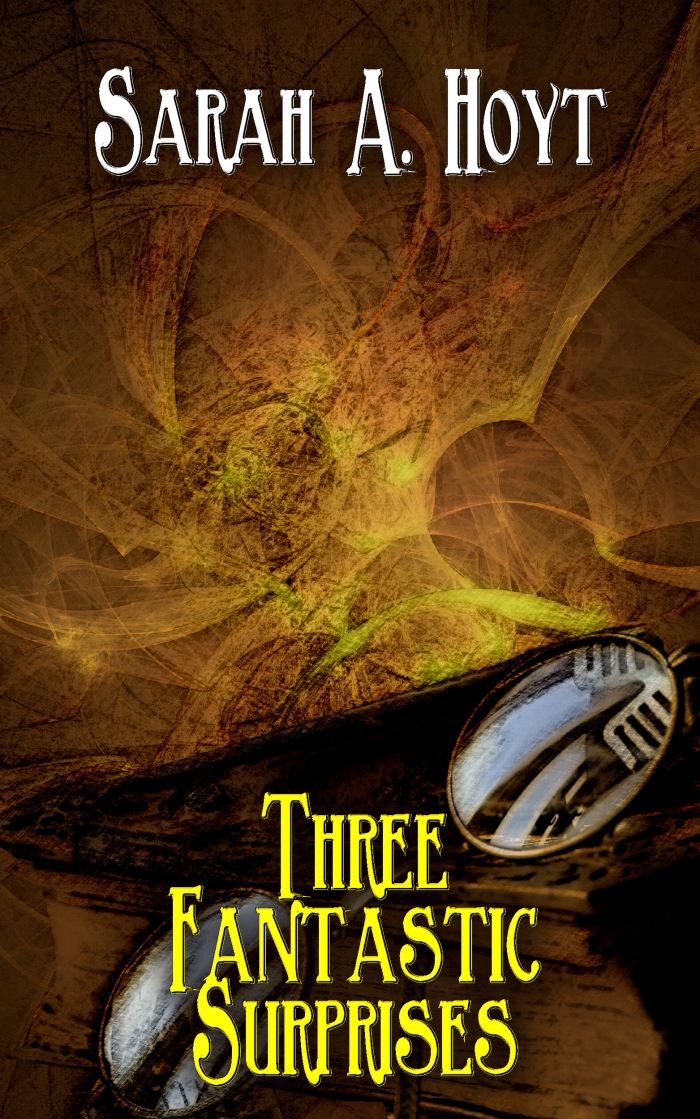
Three Fantastic Surprises

This is the Fantasy portion of your free gift (in every box.  Be the first kid on your blog… ahem.)

The first story was published in Baen’s Big Book of Monsters and the third is The Camels of Christmas.  The middle one is a never before published short story, which I hope you enjoy.

Again, give it away to friends, relatives, enemies, acquaintances, strangers or aliens.  It was pointed out to me in my author’s conference on Facebook that you can also trade it for sexual favors.

Just don’t claim it’s yours and don’t sell it and we’ll remain friends and my lawyer won’t have to get bent out of shape.  (And you don’t know how interesting a shape he can bend into.)

Oh, and don’t revise it.  I know it will have typos, they’re the fault of the green dragon who lives under my desk (okay, he’s black and he’s a cat, but never mind.)  However those are my typos, and if you fix them you might add your own!

threefantasticsurprises

Download for mobi readers (kindle)
Download for epub

Three Tales Of The USAians

I said I’d have free gifts for you by the end of the year, and I do.  If I can make this thing work, below will be a free book to download.  (There will be another — fantasy — later. I’m entering edits RIGHT NOW.)

These are all stories that have appeared on this blog, and I edited them, but it was done over the last week while house searching, so don’t expect flawless.

You can give them to friends, relatives, random strangers you accost on the street, but don’t sell them and don’t claim you wrote them, or we can’t be friends anymore.  (Also my lawyer will get very upset, and you don’t want to upset him, as he’s a very nice man.)


threefromtheusaians

Link for epub download

Link for Mobi (kindle) download.

An open reply to Mr. John Crisp, on the subject of Sgt Bergdahl – William Lehman

An open reply to Mr. John Crisp, on the subject of Sgt Bergdahl – William Lehman

In this season of Christmas, Chanukah, Yule, and so on, when most major religions recognize a time of love, faith and forgiving, I would like to echo those sentiments. But sadly, this isn’t that sort of post.

John Crisp is an op-ed columnist for Tribune news service (it’s interesting to note that my spell check wanted to make that communist, I think the machine knows more than I do) and teaches in the English department at Del Mar College, says the little bio that accompanies his column. This explains a lot, when you start to read his various opinions. (I’m semi surprised he holds the opinions he has while living in Texas, but well he is in the ivory towers, oh excuse me ivied halls of academia) Yes, this is pertinent, as I’ll get to in a moment.

Mr. Crisp felt the need today to speak out on the issue of Sergeant Bergdahl (yes, that’s right you clown, he is, at least until the court-martial a sergeant, not a private.) Crisp goes out of his way to paint a piteous picture of a poor, troubled, emotionally disturbed individual who should never have been allowed to enlist, and was mentally destroyed by the horrors of combat in an illegal and immoral war. He goes on to claim that Bergdahl’s most outspoken critics have never served in the military, much less in combat, and therefore are not qualified to judge him, but instead are using him as a political tool to attack the President. Further, he implies that actual soldiers will sympathize with this dirtbag, and in the end, it’s all Bush, Cheney and Rumsfeld who should be going to prison, not this poor misunderstood soul, who should be let out of the military without bad paper, much less a sentence.

Well Professor, I am a combat vet (Navy, not Army, but on this it doesn’t matter) and I’ve also been part of the staff (as the work programs director and Brig Duty officer) of a Naval Brig (you call it a military prison). So let me help you understand a few things:

I’m going to explain this to you in detail because I’m fairly sure that 1) you never served a day in uniform, 2) you probably don’t know anyone who has ever served a day in uniform, and 3) based on your editorials over the years you hold the military in general and those that serve in uniform in contempt, in spite of having absolutely zero first hand information to base that opinion on.

Now it is certainly possible, as you point out, that the Army screwed up in allowing this dirt bag to enlist. Be that as it may, he enlisted. One of the prime principles of the Military, a basic truth if you will, is that “we take care of our own” (now that isn’t always the way it works out sadly, sometimes because of politics, sometimes because we all fail and fall short of perfection, and sometimes because of idiots like you). How that maters in this case, is that for better or worse, Bergdahl was ours, he was a sergeant for Pete’s sake. (that is a Non Commissioned Officer, a guy in charge of other guys) So he had to have had something on the ball. He wasn’t the hopeless psycho you paint him to be, or he would never have made Sgt. As one of ours we are honor (a concept you have only an academic understanding of) bound to take care of him for good or ill. He abandoned his post. He violated the first general order of a sentry. In time of war, in a combat zone. We owe it to all of the men that did their job to hold him to the same standard.

I had a prisoner detainee (he hadn’t been convicted yet) who was absolutely insane. He was less than 24 hours from a “recruiter discharge”, for being absolutely bugfuck crazy (multiple personality disorder, hallucinations, you name it, he had it) when he lost it and racked up 18 charges in 30 minutes, including assault with intent to kill on a police officer, and assault with intent on a commissioned officer in the performance of his duties. We had him for 9 months while the defense fought to keep him from being given a Court. During that time, he spent most of his time on suicide watch, because of his issues. The Navy failed him, and the rest of us, and gave him his discharge. (we literally took him to the gate and tossed him out) We didn’t hold him and treat him, we just tossed him out on to an unsuspecting populace. He racked up several charges and hurt some folks badly. He’s spending the rest of his life in western state. It wasn’t his fault, it was our fault for releasing him.

Now let’s look at Bergdahl. He wasn’t insane, at least in comparison. (I’m sure you think we’re all a little loony to put on the uniform) he made Sgt, and made a conscious decision to walk off his post. Here to for, no one has tried the insanity defense for him that I have seen, but I’m sure that his defense council will try that, and every other trick in the book to save him from the results of his actions. Maybe they will succeed, and like that prisoner I had, he will be released with a medical discharge. That’s why we have court-martials, is to make that sort of call. But John, you are right about one thing, no combat vet that I know, and in fact, no vet at all that I know, thinks Bergdahl deserves prison. We think he deserves to be hung by the neck until dead, in accordance with the Uniform Code of military justice as pertains to Article 85 c. desertion in the face of the enemy.


Wanted

Day before yesterday, around the kitchen table, we were discussing how different the Spartans were from what 300 showed, and how 300 softened things considerably.  (One of the advantages of having the boys home for the holidays is that it elevates the cultural tone of the house. Being rather devoted to our work, Dan and I usually just discuss “things we’re stuck on.”)

One of the things we discussed was “father decision.”  I.e. when you presented the newborn to the father, yeah, he could reject him (or her) for gross deformity, for weakness (my dad who loved me dearly used to joke with me that if I’d been in Sparta, having been born very premature and at 11 inches long, I’d have been toast.), or simply because he wasn’t feeling it.

This brought to mind a discussion I had with my friend Eric Scheie, who says that the problem (one of them) with the current abortion system is that for all intents and purposes it makes humanity conditional on the mother’s say so.

This is not a post about abortion: it is a post about being disposable, and about conditional humanity, and fleeting “I won’t kill you” status.  But it is impossible not to touch on abortion.

Now whenever I bring this up, I’m met with a barrage of very strange argument, something like “Well, if the babies aren’t wanted they’re not going to be happy, so this is the right way to do it.”

Um… okay.  I don’t know about you guys out there, but I was not a wanted baby.  At least not by my mother.  (Dad wanted a large family.)  I wasn’t even wanted after she was pregnant with me.

Though I’ll say that after I was born she fought tooth and nail to keep me alive, a dicey proposition my first three years of life, and sacrificed time, health and treasure to the endeavor.

How much of this was that she now wanted me and how much was basic human decency, I don’t know and don’t care to probe.  I’m fairly sure she loved me by the time I was 16 due to an incident that proved it.  And we get along now.  (Btw. if you’re a doctor, telling the ten year old who just came in with a massive autoimmune attack that the asthma/arthritis/eczema complex is the “mark of the unwanted child” is not a kindness.  While it is possible, because epigenetics does amazing things, you’re still doing no one a favor when you say that.)

Yeah, mom and I had our rocky patches — anyone here didn’t have a rocky patch or two with their parents, particularly in adolescence? — partly because we’re different and alike in all the ways calculated to drive the other insane, but if you asked her, with as much of a pain as I was, I’m convinced she’d tell you I was worth it, now.

Leaving that aside, I might not be living amidst rose beds, but I’d say I’m one of the happiest people I know and certainly the most blessed.

A perusal of craigslist pet adds (I sometimes found myself there, and no, I don’t know why) tells you how fleeting and unreliable the “If you’re wanted you’ll be spared” status is.)  All those pets there were, presumably, once upon a time wanted.  And let me say right now that hell reserves a particular place for people who give away elderly dogs.  You keep the animal all his life, and convince him he’s loved and wanted, but when the going gets rough you expel him from the pack to live among strangers?  I’m sure killing the animal is kinder.

I don’t know which came first, abortion for convenience of the enshrinement of “being wanted brings happiness.” Back in the eighties I noticed Americans in general were more likely to euthanize their pets because “he’s senile.”

Now, we have euthanized two pets, and two others died while we were considering it.  In both cases there was no doubt death was imminent and there was nothing but pain on the way.  One’s kidneys had failed, and he couldn’t move and was just crying.  And the other, cancer fused her jaw.

However in the eighties I saw people euthanize pets literally because “he’s not as pretty as he was.”

I come from a farm culture, where animals meant not much.  (Even though I always had a tendency to get attached to birds who had fallen from nests, and bunnies missing a foot, and other things I dragged home.  Not right in the head is the real problem.  Too soft by half.) But treating a pet like a child or a family member and then killing it for not being pretty shocked me.

So the element of disposable was already there, in the eighties.

But there is more to it.  There is a justification or at least a strong excuse for this callousness.  Our lives are massively more complex in terms of changing circumstances than our relatives.  My dad had two jobs, and retired at 80.  Dan has had … 5?  (I think.  I haven’t counted.)  And he’s not near retirement age, yet.  My parents moved once.  They lived with my grandparents for years after marriage, then moved when I was seven to their own house, where they still live.  This house we just sold was the house we lived longest in: 13 years.  The next house we buy will be our fifth.  Our kids were born in different states. And we’re a very stable, never-divorced family and celebrated our 30th anniversary yesterday.

In all this change, children or pets that were very much wanted and even needed, suddenly are encumbrances.  Because I’m soft in the head, we kept the cats all through these moves, even when doing so cost us having to rent while selling.  But we did give up a (young) dog once, simply  because I was afraid she was going to get killed.  Our life had entered one of those periods when everything went crazy, I was (unexpectedly though very much welcomed) pregnant, and she got bored and kept tearing up the boards of the fence and getting out.  We lived on a four lane road, with continuous traffic.  She had several narrow escapes and then we decided we had to give her away.

Strangely and very much to my chagrin, 6 months later we were living in a semi-rural area with a dog-proof fence and our lives had changed to where I’d have cherished the dog as a walk companion.  I still miss my loup garou.

Which again goes to show that “wanted” or “inconvenient” is a fleeting state that should not be the only mark of “you’re human.”

There are already — spits — bio ethicists proposing euthanasia for kids who … don’t meet specs, I guess.  Or that the mother stops wanting.  I’d very much hope this never catches on but with all the arguments of “if you’re not happy you aren’t human” who knows?  I know in Europe, in certain countries (Holland, I’m looking at you) “I’m not happy” is a valid reason for assisted suicide.

It’s not our fault.  Our lives are complex and ever changing.  What was convenient and even a source of pleasure — a cat, a dog, a baby — becomes an unbearable burden when the job change or the house move, or the financial disaster strikes.

But perhaps that is the very reason that getting rid of living things or making them precious only at the whim of one of the members of the family or one of the partners in a marriage is a strange way to go about it.

At least the Spartans, once they’d accepted the kid, assumed he was human.  … well, at least unless he failed his manhood tests.

I don’t regret keeping the cats with us even when it was hellish during moves/changes.  I do regret giving loup garou away.

Maybe it’s because I’m soft in the head.  Maybe normal humans don’t feel that way.

And maybe I’m the one who is crazy thinking “mother’s approval” is a weird way to distinguish the babies we’ll chop to pieces in the womb from the ones we will go through extraordinary measures to save at 26 weeks.

But–

This is not a post about abortion, because dying might not be the worst thing that can happen to you.

I’m wondering more about the babies who were born and who are if not discarded treated like they’re not human because a new marriage, a move, or the child’s own lack of perfection made them “unwanted” and therefore less than human.

Like a lot of other people, I was “born owing money.”  From my earliest years I had the idea that there was something I must make up for.  BUT at least it never occurred to me that I wasn’t human.  Or that by not being wanted my life was worse than death.  Which is what we’re telling unwanted kids now.

I wonder what effect that has on adults.  It probably doesn’t stop them finding happiness, but does it make them feel more like they’re adrift in a world that doesn’t want/love them?

Maybe that’s why the “We all must belong to something.  I belong to the state” respondent at DNC said what she did.

And maybe that is the problem with trying to have a republic of free humans right now.

I don’t know.  I don’t care.  For all of you reading this: If no one else wants you here, I do.  And I will fight for you if needed.  It’s all I can do.


Joining the Majority – Amanda S. Green

Joining the Majority – Amanda S. Green


The coming of a new year always brings with it new laws. Most of the time, those laws go into effect with little to no fanfare. Many received even less coverage in the press when they were proposed, debated and eventually signed into law. This year is different. All you have to do is turn on the national news or pick up a nationally circulated newspaper or go onto social media sites like Facebook to know that Texas has completely lost its collective mind and should be shunned or removed from the union or some such idiocy. Curious as to what sort of horrible, terrible and really bad law goes into effect the first day of the New Year? Open Carry.

That’s right, folks. Texas finally joins the vast majority of states in this glorious union of ours by allowing people to legally open carry their guns.

Yes, you read that right. It joins the vast majority of states. As in it becomes the 45th state to allow open carry.

Read that again. The 45th state to allow open carry in public places.

Funny, you don’t see that when reading all the stories condemning Texas for passing the law. Frankly, it surprised me when I started researching this post to discover that so many states already allowed open carry. Yet Texas is being painted as a horrible state and asking for so much trouble by allowing its citizens to do what 44 other states already allow. Funny how that is never talked about in the anti-gun propaganda.

A quick search on the internet this morning revealed the following stats:

  • Four states and one other area do not allow open carry in public places: California, New York, Illinois, Florida and Washington D. C.
  • 31 states allow open carry in public places without any sort of license or permit. In some of these states, the weapon must be unloaded.
  • 15 states allow open carry in public places with some sort of permit or license.

Texas falls into the latter category. To be able to legally open carry a handgun, a person will have to 1) legally own the gun and 2) undergo the permit process which includes the CCW training class, fingerprinting and background check.

Something else you don’t hear much about in the media, and certainly not in the social media condemnations of open carry, is that businesses can choose whether or not to allow open carry on their premises. The Wall Street Journal has a pretty good article on how some businesses and other corporate entities are approaching the issue. It also notes that the same exceptions to the concealed carry permit currently in effect will also apply to open carry.

Unfortunately, the WSJ also promulgates the same argument so many opponents to open carry put forth: open carry will put police officers at more risk.

On the face of it, there might be some merit in that concern. However, there is one thing those spouting that “concern” seem to overlook. Open carried weapons are visible. The police will be able to see the weapon and act accordingly. If anything, I am more concerned about officers – or concerned citizens – overreacting when coming across someone open carrying.

That same article does point out one concern I have as a citizen, that of complacency by the police to calls from citizens worried because they have seen someone with a gun. In this case, the Colorado Springs 911 operator told a woman reporting a man walking down the street with a rifle that open carry was allowed and did not prioritize the call. The person with the rifle wound up killing three before being killed by police. Did the dispatcher follow policy? Probably but a simple call to the local patrol unit to check on the person might have helped prevent the deaths.

As I’ve written this post, I’ve debated whether or not to touch the real elephant in the room – private ownership of guns of any sort. There are those in this country who would take away our guns. Others would take away only some of our guns. The arguments for such strict gun control range from “no one needs an assault weapon” to “only our police and military should be armed” to “if there were no guns, there would be no mass murders”.

For me, it’s simple. A person who follows the law concerning gun ownership, no matter what the law is in that state, should be allowed to own as many guns as she wants. Outlawing guns or increasing the difficulty of doing so won’t stop gun crimes. If someone wants to shoot another person and they don’t own a gun, they will get one by stealing it or buying it from the black market. And yes, there is a black market for guns now and there most definitely will be one if we start outlawing guns.

That is the biggest fallacy in the anti-gun movement’s argument. Whether they actually believe violent crime will fall with the removal of legally owned guns from the equation or they just think the rest of us will fall for their line, I don’t know. But I would recommend they spend time in a country where there is a shortage of some non-essential commodity. Watch the black market in that country in action. Look around and see how many items not “legal” are not only owned by the citizenry but used, whether for good or ill means.

As for those who will feel “uncomfortable” because someone might walk into the same room with them carrying a gun, grow up. If a person means ill, not letting them open carry isn’t going to stop them. They will secrete the weapon upon their persons or will already have it stashed in the location. They will find a way to carry out their plan, law in place or not.

However, if that same person walks into a room or building, looks around and sees others open carrying, it very well might give them pause. Yes, there are those folks out there looking to commit suicide by cop and that could turn into suicide by open carry. But most are cowards who believe that brandishing a weapon is all they need to do to get what they want. When faced with people who have trained for open carry, self-preservation will kick in and – bingo – plans change.

Ask yourself something else as well. If you or your loved one is in a situation where an armed perp is threatening to kill them, would you prefer your loved one to be unarmed or able to defend himself? Oh, I know the argument that more people would be wounded or injured by those open carrying or concealed carrying but where are the stats to back that up? I don’t know about you but I am tired of our heroes being killed protecting innocents. Isn’t it time to even the playing field for them?

As long as it is legal to own guns, it should be legal to open and conceal carry. The fact that 45 of our 50 states plus the District of Columbia agree with me ought to say something. For all those crying “foul” about Texas joining the majority, grow up and get a life. Open carry isn’t a return to the Old West, at least not in Texas. The weapon has to be legal and the carrier has to be licensed and that means having taken the class and passed all the other requirements. Don’t like it? Move to one of the four states or the District of Columbia where it is not allowed. Just think about why several of those locations have such high crime rates when you do.

Most of all, remember that Open Carry is not universal, at least not in Texas. There are exceptions to where you can Open Carry just as there have been exceptions with Concealed Carry. You can’t take your gun into the courthouse. You can’t take it to sporting events. You can’t take it into businesses that make 51% or more of their profit from the sale of alcohol. You can’t take it into businesses and other locations that have said you can’t. That includes churches and privately owned businesses. They have to post the prohibition and it is up to the gun owner to secure their weapon off-premises.

All I can say is “Thank you, Texas, for finally joining the majority of our country when it comes to Open Carry.”


The Myths of Collapse

Okay, lately I keep running into people who say some variation of “we’re going to collapse” or “this will all have to collapse.”

Last night I realized when people say stuff like that, they’re coming from an entire mythology of collapse, that has absolutely nothing to do with the real world and everything to do with the ubiquitous messages of our entertainment, and the equality ubiquitous myths inherent in how our history is taught these days.

The messages of our entertainment should be self-explanatory.  We are the most thoroughly entertained generation in hisotry.  By which I mean we have more entertainment available, more hours of the day than anyone at any time in history.  Even I, who grew up in a different time, with only radio and books available (and not as much as books are/were available here then) was massively entertained compared to my parents and grandparents.

What that means is that messages embedded in the entertainment we consume assume the power of reality to us.  Well done story telling forms sort of false memories, which people have trouble distinguishing from real memories.

I suppose this was okay when the only storytelling were tribal traditions and epics.  You want people to internalize this.

But then there is the extra added layer of visual entertainment.  The reason I don’t get disappointed when movies murder my favorite books is that movies aren’t novels, in narrative scope.  They are at best novellas, but really short stories.

Pride and Prejudice is a tiny novel by today’s standards, but it took a six hour series to do it justice.

What I’m getting at is that there are now ingrained shortcuts in our most common entertainment.  There are things that everyone knows aren’t so but are used in the movies because it makes the narrative fit in the time we have.  (Note, for instance, the way people fall in love with a single look.  This happens in books too, because the real process is messy, confusing and often lengthy.)

Other things we watch that we also know aren’t so, or at least historians do are for instance that if oppression gets strong enough there is a revolution.  This isn’t actually true.  Most revolutions follow on a period of liberalization AFTER the real oppression.

But this is ingrained in both movies and the way history is taught in schools.  Collapses are messy things; often leave no clear records.  In addition, collapses are chaotic and almost impossible to teach unless you go on the micro level, which even when available is the province of serious researchers, not popular histories OR schoolrooms.  So one gets “French society collapsed, and then Napoleon–”

This generates several myths, which are actually hurting the decision making people are doing RIGHT NOW.

1 Myth one — collapse creates a tabula rasa, upon which a completely different society can be built.  Honestly, I think this comes from the teachings on the collapse of Rome and the truly execrable way the middle ages are taught.

First of all, once you poke closer, Rome only sort of collapsed.  Depending on the place you lived in, your life might not have changed much between the end of the empire and the next few centuries.  I come from a place where it’s more like Rome got a name change and went underground. In both the good and the bad, Portugal is still Rome, just Rome as you’d expect after 19 centuries of history or so.

Second the society that was rebuilt wasn’t brand new and tabula rasa but partook both of the empire and the incredible complexity of what happened during collapse.

Look, even before the renaissance there was a lot of Rome around, it was just twisted, bent, and modified in uncontrollable ways by the collapse.  Which brings us to myth two.

Myth 2 – A well organized group with a vision can control the collapse and emerge from it on top, so they can create their perfect society.

This, curiously is a myth of both communists and Libertarians.  I think the communists got it first and propagandized it very well, so the libertarians bought it.

No one can control a collapse.  It would be like controlling an avalanche. There are two characteristics of collapse, both physical and societal: fragmentation and complexity.  I.e. things break apart and therefore, within the pieces, they become very contradictory/conflicting/complex.  What I was saying above.  Some portions of the ancient Roman empire were Rome in all but name, but others were thoroughly taken over by the invaders, others yet reverted to pre-Roman patterns of culture and civilization and yet others were varying degrees of mixes.  The state during collapse was incredibly more complex than before.

From the collapse, a more organized (and therefore simpler/less chaotic) society always emerges, but it tends to be, looking at history, a form of strong man government (perhaps because that’s inherent in human psychological evolution, proceeding from the way hominid bands organized.)

Neither the perfect egalitarian society nor the perfect individualist society emerges.  Just some right bastard “brings order” and therefore creates the illusion he’s indispensable.

Which brings us to myth 3.

Myth 3 – collapse is complete and reverts to much, much earlier tech and society.

A lot of preppers seem to assume this, particularly in the States.  I’ve nothing against preppers, and some of the stuff they do is on target, mind.  But a lot of it makes me roll my eyes.

I’m not talking about the truly psychotic, who are looking up recipes to use on their neighbors after the collapse.  Some of them might get  away with that, but it says nothing about the state of society.

I’m talking about the people who say things like “I’ll be all right, I know how to spin my own cloth.”  Or “I’m moving to a farm with 10 acres, I’ll just grow my own food.”

I know this is hard to conceptualize, but looking at recent collapses, say Venezuela or Argentina, or even Mexico (which is in many ways a failed state) not to mention the various grades of cluster fry in the Middle East, that’s NOT how collapses happen.

This is due to the chaotic nature of collapse.  Unlike in the movies, or even the classroom, it doesn’t fold into an earlier, rougher order naturally.

Instead, it goes in patches and lurches.

Well, sure, that farm might come in handy, or at least you can have a market garden and take produce to the local market, or sell them on the black market, which will replace your job if you lost it.  But don’t think yours are going to be the only produce or that people will be dying of starvation.  In modern collapse, we don’t see famines.  Apparently to engineer a modern famine you need a government.  What we see, rather, are shortages because of distribution and disruption problems.  So, your produce grown on that farm won’t be saving people from famine, but they might relieve their boredom from the month when there was only turnips in the markets.  (Monorhimic supplies is something that socialists seem to generate everywhere.)

As for cloth, given today’s capacity for producing it, hand woven cloth is unlikely to become needed.  There will still be factories making cloth, somewhere.  Probably more lucrative to know how to do alterations on existing clothes, to compensate for those distribution problems.

But don’t expect the things you have to go away.  They just become unreliable, sporadic and harder.  So, you might only have electricity five hours a day, and you’d best have extra batteries for all your electronics and charge them all in that time.  And if the water is likely to be erratic, you keep buckets of it around.  And if toilet paper gets erratic, you need to resort to press releases by great leader and dispose of it without flushing.

There are business opportunities in every collapse too, and not the ones you’d expect.  For instance, while typing the previous paragraph I thought “And within two months of erratic electricity beginning, we’d have someone marketing computer battery chargers, so you can charge laptop batteries without having them in the laptop.  Probably chargers that can charge ten batteries at a time.  And they’d become REALLY rich.”

It’s impossible to guess which skills will do well, so just concentrate on knowing how to do a lot of things.

Same thing with land.  Collapse doesn’t necessarily favor rural locations.  In Portugal the hard times prompted moves to the city, where stuff was more likely to be available, including jobs.  And in Argentina, I understand isolated country properties were more vulnerable to raiders and home invaders, while in the city you were sort of kind of safe.  And even in cities, people managed to grow market gardens, in balconies and backyards.

So — once you strip away the myths of collapse:

Collapse isn’t Santa Claus.  Don’t count on it to give you what you want, unless what you want is some strongman with his foot on your neck.  If it is, you have a pretty good chance of getting it.

Collapse is not simple, and doesn’t simplify options.  It’s incredibly complex, scary and often lethal.

Collapse doesn’t regress to an earlier and simpler age.  It might require some skills from that time, but mostly it just makes your life more confusing, complex and see above, scarier.

I understand the temptation to burn it all down.  Things seem so irretrievably  Tango Foxtrot that if it were possible to really burn it all down and start again, I’d be all for it.

But that’s not the way collapse happens, and if you set fire to what we have, what you end up with is burning patches you don’t want, perfectly all right portions you wanted burned, and those things that smolder and make further developments unstable, kind of like the scars of the French revolution burning beneath all the subsequent republics.

Does this mean it’s impossible to change?  By no means.  We have moved a lot away from progressive lunacy since the fifties or even the eighties.  It starts with people not assuming the government is a sort of magical fairy.  And I know what you’re going to tell me: people still assume that, a lot of them do, a lot more than ever before.

Well, that might be true, but only because we have a bigger population.  The idea that a central government makes everything better is no longer THE de-facto idea of everyone and certainly not of anyone who is informed.  Even statists try to work around the fact we can’t trust the government and everyone knows that.  Or of course, in Obama’s case, he just yells at us for not trusting government.  But he wouldn’t do that, if trusting government were the default position.

The big destruction and rebuilding is very tempting.  It’s also a myth.  It has never happened that way, and it never will.

Put down those matches and take up your hammer and nails.  The only solution is to build under, build around, to teach, to learn, to change minds and hearts.  The future must be built piecemeal.  So… that’s what we’ll do.

It’s not fun.  It’s not glamorous.  It’s the only thing that can save us.

Screw your courage to the sticking place, and possess your soul in patience.  And work.

Be not afraid.


The Fish Ate My Homework

So, I know you’re all tired of my saying I’m late because of a cat or another.  That’s okay.  These last two days it was the fish’s turn.  The fish is a red and blue (with tiny little bit of white on the necktie fins) betta, whose full name is Agile Antelope Betta Version, but whose calling name is Derp, also Derpfish and Derpsardine.

He’s about one and a half years old, his main hobby is building magnificent bubble palaces, in hopes I’ll relent and getting him a bride.  But for the last two weeks not only hasn’t he building a bubble palace, he’s not been eating as usual.  Normally he devours his pellets, and I only clean the product of the other end from the tank.

I’ll start by saying I’m an obsessive aquarium keeper.  This is my first fish, and I feel obligated to him — since he’s alive and I got him (mostly to rescue him from the Petsmart, I’ll admit, but also because of his color) I don’t want to make him suffer, so I try to keep the tank spotless.  It’s five gallons, with lots of places to hide, in two seashells and behind silk plants.

I change the water a little bit every day, when I clean it with the pipette, and before I feed him for the night.  I give him the recommended food.  I warm his water before adding to the tank.  I put in conditioning and aquarium salt.

I read all the books of things that could happen to aquariums and bettas when I got him, of course, but I always KNEW the cotton wool-like fungus that takes over aquaria and kills bettas wouldn’t happen to me.  Mostly because I’m a good aquarium keeper.

I was wrong.  On Tuesday older son who is back for the holidays remarked derpsardine wasn’t moving much from behind his thermometer.  I told him I’d noticed, and also that yeah, he’s not been eating much.

Son’s eyes are better than mine and noticed the swelling below the eye, which after a day was a little cotton-wool like puff.

We spent much of yesterday looking for an open place that carried the spring water we put Derpy in, with no success.

At any rate, I used my last gallon in the secondary tank, (a one gallon) with drops of antifungal medicine.  He seems more animated, but before I return him to the main tank, I had to break it down and soak it in baking soda solution, because (again, son’s eyes are better than mine) son pointed out that there were little white bits in the water.  This morning, when I broke down the aquarium, filters, aerator and all the toys, I noted that there were actual rings of fungal stuff floating in the water.

It is all now in its second rinse, and yes, I do realize I’m going to need to re-cycle the aquarium when all this is done to reestablish the good bacteria that keep ammonia down, but there was no other choice as I must get rid of the fungus.

And yes, I know, all of that sounds incredibly boring and somehow a lot of work.  I agree.  It’s likely when we do lose Derpy we’ll have no other fish ever, because I don’t have time for that kind of hobby, and I’m not even sure what possessed me to pick up Derpy in the first plce.  However, now I have him, and he’s my responsibility.

Oh, and the answer to “how did things get this far he got fungus” is “Because all the time I have I’m not working or cleaning or doing other such things, we’re looking at house.”  I’ve had a lot of nights where I simply lack the steam/spoons to do anything but crash at around 10:00 pm, which means no extra things (like cleaning Derpsardine’s home) happen.  I’ve done the little bit of water replacement I do every day, but instead of replacing all the water and wiping down the toys, etc, once a week, I haven’t done it in a month and a half.

And yes, I feel horribly guilty because a living thing shouldn’t suffer through my being too busy.

I’m trying to edit two very short collections for ya’ll for the holidays, but it will be probably another day, what will all the excitement.  Ditto with Witch’s Daughter and a bunch of the newly-reverted books.

Anyway, this must be the longest excuse note I ever wrote, so I’ll let you discuss fish and stuff, while I go finish cleaning the aquarium.

A Sale

christmas-1091570_1280

They say confession is good for the soul.  I didn’t mail the physical books I promised subscribers, though I hoped to, right up to yesterday.  You see, where we are there is no post office in walking range and I’m still not driving as I haven’t been for the last 3 years.  (For various reasons some my health and some the car’s, both of which are being dealt with but aren’t instant.)  I had issues coordinating my time and another person’s enough to make it to the post awful.

If you were counting on the books for gifts, I’m very sorry and I promise to get them off on the 26th, so just tell whatever relative the writer has many good qualities, (I hope) but organizing herself isn’t one of them and this will be a Russian-Style new year’s gift.

Meanwhile, to compensate, and also because a lot of you have friends and relatives who will be getting new kindles for Christmas and you can send them to these books for cheap reads, I put a bunch of my books on sale for 99c.

Death of a Musketeer (Yes, that cover sucks.  Yes, it will be redone when I have time.)

41iDj-6JzZL._SX311_BO1,204,203,200_

No Will But His:

51lWahHEoML._SX331_BO1,204,203,200_

Ill Met By Moonlight

51WTaEo9aWL._SX311_BO1,204,203,200_

Crawling Between Heaven And Earth:

51LJb19Z4gL._SX311_BO1,204,203,200_

Merry Christmas to those who celebrate it.  The d*mn books will be in the mail as soon as I can possibly organize it, and meanwhile, tomorrow, when you’re possibly a little tipsy and groggy, come by here because I hope to put up some downloadable gifts.

Now be good warm yourself at the fireplace, play with the cats, and don’t Bogart the snickerdoodles.

Oh, and if you haven’t yet tried the OTHER Hoyt, it’s still on sale!

51zg6CKUwCL._SX311_BO1,204,203,200_