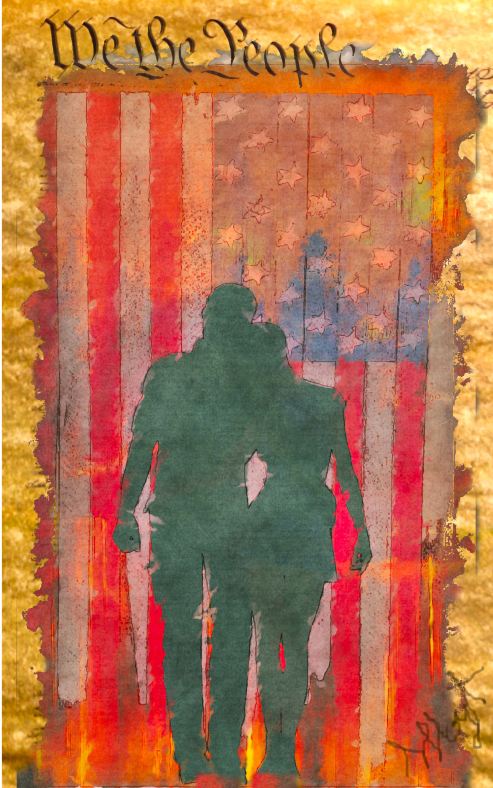
Go Small Young People, Go Small

There is a movement afoot to make our kids content with less.  My sons, both of them, like their parents, unable to comprehend the fact that body and mind have limits, have always dreamed big.  Now mind you most of their dreams are not predicated on “I will own” but on “I will do.”  In that they also resemble us, aka “why we’re not rich”: because while we don’t want anyone to pay our way, our work has always been geared to what we want to do and what we feel must be accomplished than merely to “I must get rich.”

No, the two are not exclusive, and getting rich doing what you feel must be done is the ultimate objective, but my husband has the tendency to refuse advancement which means he can no longer do the work he loves and I… I refused to “sell out” in a way and it wasn’t all politics.  It was also that the books that make you a darling of the industry could put an insomniac to sleep and are, therefore, torture to write.  At least for me, your mileage may vary, void where prohibited, etc.  (And the laugh line in all this is that the books I’d consider selling out and the ones I consider following my drive are completely reversed for the people using those terms.)  As for the activities purely designed to make money, neither of us could ever stay with them for very long.

Which explains why we’re not rich, and why there is a very strong chance our children won’t be.  That is not what the school was preparing them from.  In “job day” after “job day,” my kids would listen then come home baffled with some variation of “My classmates want to be bureaucrats who make a median salary, marry a median woman, drive a median car and have one or two median children.  None of them wants to push, invent, take risks, or make any waves at all.  And I can feel the push to be the same.  It’s what they want for us.”

If this were planned, I’d say it was attempt to make us like Sweden where the world “enough” has double plus GOOD connotations.  I’d say that it was an attempt, in other words, to make the American people suitable to Euro Socialism.

I don’t believe it’s planned.  Not in most of the people pushing for that.  I think it’s part of fifty years of education that pushed “the world is overpopulated”, “humanity is a burden” and “diet for a small planet,” and other bits of insanity.  The teachers and others pushing this point of view honestly think humans are scary and dangerous and if they don’t outright go out and start mowing them down, they try to convince them to do the equivalent of curling up in the fetal position and pretending not to be there.  (And don’t get me started on the pledges not to reproduce pushed at 12 year olds.  Just don’t.  It won’t go well.)

This is not what I mean by going small.  I don’t mean destroying your hopes and burying your ambitions and “leaving light footprints” or any of that nonsense.  I believe humanity has as many rights as any other species to “Grow, multiply, and fill the face of the Earth.”  More, maybe, since we have the means to control our environment that other species lack.  More, because if Earth’s biome ever explands to the stars — its one chance at survival in the truly long scales — it will be because humans took it there.

IOW, growth is what life does and human life is not less than other life.

What I mean by going small is different.

I’ve confessed before that before 9/11 I was an INTERNATIONALIST Libertarian.  This tends to make people who know me look at me as though I’d grown a second, evil head, and I confess those ten years were a sort of holiday from reason and thought.  The fairytale was so pretty I wanted to to work.  Besides, I have friends in a lot of countries who could work in a “one world” sort of thing.

Oh, I knew better — duh and derp — of course I did.  I knew most countries in the world are kleptocracies and this is not just the result of bad politics, but of bad culture.  The culture infects the politics and makes them what they are.  The country I came from still gets its politics from Rome, aka “rule of law? what rule of law?” or “he who has no godfather dies in jail.”  And this is not overcome by selling them slogans.  Their form of government changed at least 3 times (in macro movements) in the twentieth century but “the way things are done” didn’t, as it hasn’t in at least 2000 years and probably more, because that’s culture and the only way cultures change that rapidly is through major trauma, like invasion or mass death and even then never that much (and also there’s a boomerang tendency to revert) as Portugal’s history is example.

But I wanted to believe.  Not in a whole world of brotherwood or a Coke commercial, but in a world of free humans working together.

I read Grumbles from the Grave and P.J. O’Rourke’s all the trouble in the World and Eat the Rich and foreign news and history, but you can picture me with hands over ears going “lalalalalalala.”

9/11 shattered that and at any rate I was always a bizarre sort of internationalist as I was an American patriot and for small governments and didn’t wish national identities to be abolished, only, somehow, for countries to work in harmony for free minds and free markets.  (And for my next trick, I shall make this elephant fly.  Fly, elephant, fly.)

9/11 shattered my “lalalalalala.” It shattered a lot of people’s more serious belief in “one world” government/polity/entity whatever you wish to call it.

This is a very old idea, a very old thought, that people came up with to “prevent war.”  i.e. “if we all were one nation, there would be no war.”  Which is stupid, given the number and nature of civil wars throughout human history, but never mind.

The generation that fought WWI embraced it with the fervor of desperate, shell-shocked children.  This is why so many of the early science fiction books assume it, and so many of the tv series use it not just as a background for humanity, but as part of what makes a world/breed/etc civilized.

This seems more plausible to America than anywhere else because, as noted here before, our states have a very different culture but the same, overlaying structures that ensure easy movement between states and communication between every citizen, as well as a sense of belonging.  It’s easy to think this means we could extend it to the world and make it the same.

It’s easy to think but impossible to implement.  I’ve heard that entire Italian villages moved en mass to NY in the early 20th century.  This might be true but I suspect it’s a bit of an exaggeration.  It’s more “everyone who was young and who had a mind to succeed moved.”  IOW those who came what was then (due to slowness of travel, and expense) an almost for sure one-way trip were of a different mind as those left behind.  They were also, consciously or not, willing to work to shed their centuries of culture and the things that made the land they came from what it was.

This is not the same now, because travel is a few hours and relatively cheap.  We see the problem of this in moves between states too.  Used to be you moved, you adapted to local ways of doing things.  Moves were always piece-meal anyway save for great migrations caused by massive disturbances.  And even then The Grapes of Wrath might have overstated the matter a bit. Now it’s easier to move between states for a job or an opportunity, and that means when states become inimical to job creation, they send vast hordes forth to get jobs elsewhere.  Hordes that bring with them their way of voting that made the initial state inimical to job creation.  Or as we call it around these parts, Californication.

Partly in reaction to that, and partly because it’s obvious attempting to get people to reject their country isn’t working, and partly because we have been pounded for a century, via all forms of media and education with the idea of “identities” hinging on totally insane things like skin color, food preferences and a myriad other incidental characteristics, there is a nativist/racial/statist movement afoot. Now that movement is more plausible than the one-worlders.  I never understood how, having determined that dividing people into economic classes and setting them against each other wouldn’t bring about paradise, the one-worlder Marxists convinced themselves setting people against each other by melanin content and what is between their legs and other more or less arbitrary characteristics would a) yield uniform classes and b) bring about utopia.  I think the underwear gnome was involved in their plans.  And it is also, invariably involved in the “national identititarians” plan.

There aren’t many of them, mind, but like the one worlders they are convinced the world is inevitably going to go their way and they’re the way of the future.  Look, guys, if you find an arrow in history tell me, okay?

And like the one-worlders, their conviction comes partly from the belief humans are widgets.  All they disagree on is what divides one set of widgets from the other.

Unfortunately for them and everyone else who has  sought to impose an arrow on history, humans aren’t widgets, and even if there is such things as an “average” woman or man, worker or intellectual, Masai cowherd or German goatheard, the “average” is a mathematical construction created by statistics and if you meet these people you find that each is highly individual.

And the tendency to view people as “average” and “median” and to divide them according to statistical characteristics is a twentieth century characteristic born of the typical industry of the twentieth century.  I.e. when the watchword of the century was the refinement of the previous century’s “mass manufacturing” and “mass production” one had to know what the average or median person wanted.

Because while people aren’t widgets, it is possible to produce something with the maximum appeal to most of them.  Surveys, statistics, etc, all reveal what’s the most acceptable to the majority of people.

If there are two TV channels (what I grew up with) none of them is going to devote three days to an extended documentary on dinosaurs, because the majority of people would be bored stiff by that, have their eyes roll inward on their skull, and go to sleep.

But if there are 300 channels, one of them can be the “dedicated dinosaur channel” and it will find enough audience to survive.

The technology of the time didn’t allow 300 channels, or personal 3-D printing, or authors to put their own books up for sale, worldwide.

For the two centuries before us, the economies of scale and mass production have tended to try to make everyone as close to the same as possible, so the industry could provide them with the means for civilized living.

And that’s where the one worlders’ dreams came from.  “Make everyone the same and everyone will be happy.”  (Not quite that way, but you get a whiff of this in early Heinleins.  Never that stupid, because the man had a brain, and knew there would be malcontents anyway.

The nationalists’ dreams come from seeing the obvious flaws in that, the persistent nature of culture, the horrors of trying to make many nations one.  Because that never ends well.  And it is aided and abetted by “the future and its enemies.”  Ie. the bureaucrats and other classes that have grown fat on the nation-state and who therefore long to extend and expand their power.  Mind, it’s much easier to be a kleptocrat over a more or less small and homogeneous nation.

And they come too from the fact that nation-states have been sold for what? three centuries now, as a form of uber-identity that replaced religion as Europe became industrialized.

Only nation-states are children of mass production, took off at the same time as the industrial revolution, and are, in the end, wholly artificial creations in human history.

Sure, humans identify with/are designed to identify with a tribe.  And the tribe is, as far as studies can determine, suppose to be about 50.  A couple hundred people, at the most. IOW “Me and my cousins.”

That means when the nation state “stole” tribal affiliation and put it to work for the nation state it had to pervert it.  It had to devote its not inconsiderable mass-media and mass education to make people think of the nation as a tribe.  This was probably (mostly) not done on purpose, though heaven knows I’ve read my shre of books approved of and designed by central states selling the idea of “the Portuguese race” or “the British Race” or even “The German race.”

Even in countries as small as Great Britain or Portugal, the regional differences are vast, the tribal loyalties often vivid and vociferous and the cracks the nation-state papers over momentous.  For “countries” like Italy or Germany, children of the nation state movement, itself, it is about as accurate to speak of a national identity as it is to speak of a Kenyan or Rwandan national identity.  The borders were drawn by bureaucrats, planners (or conquerors) and have bloody nothing to do with the “tribes” underneath.

The only way to keep the nation state cohesive and to sell them on the idea they are a tribe (and thus harness the instinctual need for a tribe) is constant propaganda by mass-media means, and the harnessing of people’s longing for a great tribal leader which was probably evolutionarily sane when we lived in hominid bands (IOW yesterday in evolutionary terms.)

This is why nation states are always and forever looking for the man on the white horse, the father of the nation, etc.  IOW it’s why the twentieth century was the twentieth century.

But the thing to remember is that the nation state on a large scale, itself, was a creation of mass industrialization.  Even the empires of the past were different.  Even the Roman idea of making everyone a Roman citizen was a different thing, because they had no mass media and no way to sell “we are tribe.”  So the Roman citizen might adopt a lot of the identity but it was overlaid on his local identity of Celt or Greek, and the underlying identity was made to work with the overarching one, instead of being crushed by it.

In the same way, even old and on an European scale relatively large countries like France, took centuries to eliminate — by education and identification, and ultimately by force — other linguistic/cultural groups within themselves. Because they couldn’t put on TV programs every morning telling children they loved Big Brother.

What I mean is that the last two centuries of civilized life have been profoundly unnatural for humans.  Look, not complaining.  Natural is sleeping naked in the Savannah.

But the point is that the type of industry and communication that brought about these massive nation states (the bigger the better) with their massive bureaucracies is being replaced by “smaller, more personal, more agile.”

This doesn’t mean the future is ripe for one-world.  On the contrary.  And it doesn’t mean the world is ripe for nation-states.  On the contrary.

Go small, young people, go small.

I’ve been watching this work in my own industry, where the most agile people are the ones doing well, and to the extent that publishers will survive (let alone thrive) it will be the ones who are willing to keep as small a staff as possible, subcontract/pay bounties on individual jobs that need to be done for books, and generally be capable of shedding/adding functions as the market conditions evolve.  (I’m not saying that the big publishers won’t stay around.  It takes a long time to kill a behemoth.  Just that they in no way are suited to the conditions on the ground now.)

It’s sort of the same with nation-states.  Nation states serve some vital functions that smaller groupings (and certainly our individual, tribal groupings) aren’t very good at: mutual defense.  Construction of large scale things, some of which will still be needed, like, say highways, and ultimately the suppression of tribalism.

But Sarah, you just said tribalism was good!  No, I said tribalism is natural, and you have to accept it’s there, and by tribalism I mean the fighting of groups of about 100 people against groups of about 100 people, whether the fight is financial, of words or physical.  We identify with an “extended family” of blood or not, and will defend it against all comers.  It’s what makes humans so admirable — and so screwed up.

The bad side of that is that left on their own anything larger than a medium city would be a nightmare of internecine warfare, and why the one-worlders and “governments will just wither away” people are nuts.

So the overarching government of nation or state is needed to keep the tribal impulses at bay and to guide the entity to the common good.

But what the twentieth century has shown us is that decisions should be made on as local a level as possible, not only because people accept that better, but because people closer to the problem are less likely to think it’s a great idea to sow wheat in the snow or to teach all the kids that the sky is made of green cheese.  Not that as small as possible rule doesn’t also go wrong.  We all know tyrannical families and crazy-cakes small cities.But when polities that small are completely insane, at least the damage is contained, while when an entire country goes batexcrement insane you get WWII.

So it would seem the ideal political organization for what our industry is becoming and what our technology is enabling would be a “nation state” loosely connected and with a relatively powerless central government whose only function would be to prevent inner strife, defend the nation (both in the sense of war and guarding the borders) and oh, I don’t know, provide for the common good by arbitrating those projects that must be large enough to span all the myriad states that otherwise comprise the nation.

And each of such states and each of the entities under them should be as free to govern themselves as possible, each unite, down to the individual, retaining as much autonomy as physically and mentally possible.

Such state would be very agile and able to change itself in an era when technology and industry are changing at an incredibly fast rate.  It would be a chaos dancer, capable of being both very large and very small, and flowing into the future seamlessly.

Of course, such a country would not have survived very well in the nineteenth and twentieth century when the ideas of the mass-industrialized “tribe” nationalistic state were ascendant and what every right thinking person “knew.”  And it would have trouble, being relatively powerless at the central level, countering the naked aggression of those nation-states. So it would change to fit the times.

It is probably pure coincidence that the way it was founded is now more suited to the coming technology and industry.  Or possibly because the coming industry and techonology allow for the emergence of very old tendencies in humans, it was designed that way by people who thought deeply about the nature of humans.

I’m not a materialist determinist.  I don’t believe that the material conditions determine the mental and emotional state of men by themselves.  In many ways not only doesn’t man live by bread alone, but man lives by belief alone, in that he is able to hold on to beliefs contrary to reality even when it destroys everything around a culture/nation/etc.  Look at North Korea or Cuba.

But by and large, and always providing for stragglers, the way the cultures of humanity are expressed, the way people LIVE is determined by the technology/industry of the time.

Thus, mass industrialization birthed the nation state.  And as mass industrialization is tottering, the nation state as we know it (which is not the same as tribal identification/regional loyalty, etc, but is an overarching bureaucratic entity selling itself as a tribal entity) is tottering with it.

This is not to say the one-worlders are right — I can’t imagine a HUMAN world in which they would be right. You can’t just blend all human cultures and come up with anything usable.  The only possible one-world government would be in a world settled exclusively by one culture.  And even there, as the world population grows, it will fragment.

In fact, both nation-states and one-worlders are ideas of the past, brought about by mass-everything.

I expect the world of more individualized everything will bring about a lot of small units — down to the individual — that connect upwards in ever larger/less powerful entities, till at the top of a large enough territory is one that just provides for the common welfare (ie. too big to be done in small scale) and common defense.

Where I differ from other people who see that and see “one world” is that there are common cultures and common geographic areas that must be respected, and people are not widgets.  The importation of say masses of middle easterners into Germany is not possibly while watching out for the common defense and welfare of Germany.  Not that Germany is really an ethnic entity (it is composed of smaller tribes, and since WWII it has absorbed masses of immigrants) but because it is a geographical and cultural entity and you can’t simply move individuals in and out of those.

In other words, I think we need nations.  I just think in the coming era those that survive, thrive and make their citizens rich will be those that are as decentralized as possible at their center, while defending themselves and understanding the cultures that comprise them.

How we get there is something else.  It will happen, because humans always adapt to the changes in tech and industry.

But it’s not straight forward or rational.  Which is why at least half (and possibly more) of the right AND left feeling we’ve gone down a wrong path are reaching back for solutions, but not far enough back, which is why there seems to be a growing consensus for national socialism.

It won’t work.  It’s like the publishing houses trying to solve their problems by pricing e-books higher and giving myriad interviews about how ebooks are vanishing.

The denial of reality is strong in humans and can be imposed for a period of time, but not on the whole world and not without consequences.

The future is small, more fragmented and overall (not accounting for small pockets of tyranny) much freer.

IOW in the end we win, they lose.

Getting there, OTOH, as any great movement in “how we live” in the history of humanity is going to involve convulsions and conflicts and mass-scale dislocations that will at times feel the world is coming apart at the seams.

That’s because it is. But it doesn’t follow, no matter how painful the process, that what results from that is a bad thing.

The important thing is to neither prematurely try to make the world burn nor (prematurely also) reach for a solution of the recent past.  Both of them are normal human reactions, but both of them will do nothing but delay the solution and create devastation and suffering.

In the end, the future is small.  And if we can get there it would enable the biggest and most glorious form of human civilization yet:agile and capable of rapid change and keeping the bad side of the human nature to as small a group as possible, while maximizing human ability to create and prosper.

Go small, young people, go small. And dream big.


A Barrage of Books -Jason Dyck

A Barrage of Books -Jason Dyck

J.M. Ney-Grimm

Sarvet’s Wanderyar

Running away leads right back home – or does it?

Sarvet walks with a grinding limp, and her mountain culture keeps girls close to home. Worse, her mother emphasizes all the things Sarvet can’t do. No matter how gutsy her spirit or bold her defiance, staying put means growing weaker. Yet only boys get wanderyars. Lacking their supplies and training, how can Sarvet escape?

Can dreams – even big dreams – and inner certainty transform impossible barricades into a way out?

Becky Lickiss

Miriam, the wife of Job

Think on this for a while, when was the last time you heard someone cry to God saying, “Why God, why have you given me a beautiful home, good food, and all the things I need? Why give me a husband who is kind, and gentle, and loves only me? What have I ever done to deserve children who respect their parents and follow the commandments?”

You’ve read the story of Job, now meet his wife Miriam. The woman who stood beside him through all his triumphs and trials, and who had tragedies and tribulations that were uniquely hers to overcome. What can an ordinary woman do when faced with devastating failure and unremitting loss? Sometimes surviving until tomorrow is the best anyone can hope.

Also available from Smashwords

Peter Grant

Take The Star Road

The Maxwell Saga Book 1

Nineteen-year-old Steve Maxwell just wants to get his feet on the star road to find a better homeworld. By facing down Lotus Tong thugs, he earns an opportunity to become a spacer apprentice on a merchant spaceship, leaving the corruption and crime of Earth behind. Sure, he needs to prove himself to an older, tight-knit crew, but how bad can it be if he keeps his head down and the decks clean?

He never counted on the interstellar trade routes having their own problems, from local wars to plagues of pirates – and the jade in his luggage is hotter than a neutron star. Steve’s left a world of troubles behind, only to find a galaxy of them ahead…

Mary Catelli

Curses And Wonders

A collection of tales of wonder and magic.
A prince sets out to win his way to the dragon’s lair.
A woman fights a curse on her lands.
A man returns to his castle, bringing a magical sword, and worse things.
And more tales.

Includes “Dragon Slayer”, “The Book of Bone”, “Mermaids’ Song”, “Witch-Prince Ways”, “Sword and Shadow”, “Eyes of the Sorceress”, “Fever and Snow” — and “The Emperor’s Clothes”, which is not sold separately.

Also available from these fine booksellers:

Enchantments And Dragons

A wizard must produce justice enough to satisfy a dragon.
A young man tries to rob a tiger’s lair.
An enchantress tries to keep a court safe while they ignore the perils of misusing her magic.
A lady finds that court intrigues can spread even to the countryside.
And more tales.

Also available from these fine booksellers:

Magic and Secrets

Tales of Wonder and Magic

A woman, sent to a far off duchy, finds a mysterious wolf haunting the forest, and learns there are secrets no one even suspects.

Playing with props for amateur theatricals has more consequences than any of those doing it dream… act with care.

A king’s tyranny sends a woman searching desperately for a legend of lions, there being no other hope.

Also available from these fine booksellers:

Jason Cordova & Christopher L. Smith

Kraken Mare

Sergeant John Manning was a simple Marine who liked spicy foods, big guns, and even bigger explosions- so long as those guns and explosions weren’t pointed in his direction.

When offered a well-paying job after being unceremoniously drummed out of his beloved Corps on a medical discharge, he jumped at the opportunity for good money and the prospects of a bright future. For the first time in recent memory, John had a chance at life.

Then his life turned into a horror movie.

The secret research station hidden on the moon of Titan was not just any government facility. It harbored dark secrets and frightening realities. The scientists here have not only studied more than just the local fauna, but have discovered something far more important. A discovery which would shock the very foundations of the universe. Something out of a nightmare.

The depths of Kraken Mare hid a horrifying truth, and the unwitting Marine stumbled right into it.

Running on Empty

This year has been a long sustained series of shocks.  Nothing serious, meaning no one has died.  People — two of our parents — have been seriously ill, but the people hasn’t been me.  It’s mostly delays/countertemps, confusion, and now extreme uncertainty.

The latest one is that the house we’re trying to buy and have been trying to buy since Jan. 1, might not come through.  Considering how long it’s taken, we were more or less mentally moving into it and all our packing, all our what to sell and what to keep has been aimed at it.  Also it took us six months to find — six months in which “looking for house” consumed most of our time.  (No, we’re not THAT picky, but it’s the time of life we’re at.  We need some rather specific things, including offices and — d*mn it — a place for my art, that most houses aren’t built for.)  We were also looking for that undefinable “good writing place” which really is undefinable, and you have to see it to know.  I mean, even some of the hotel rooms, when we go away on a writing weekend, are far more conducive to productivity than others.  And we’re looking new-ish because of my health.

Unfortunately we’re set to move out of the house we’ve been renting at the end of March.  Not our decision, we were month by month and the landlord wishes to sell.

This leaves us homeless with four cats until we find a place we can buy/move into which, if this house doesn’t come through, means we have to find something in two weeks or less, since the bureaucrats have decided what was REALLY wrong with the real estate market was that loans could happen in a month.  (Rolls eyes.)  So banks are still being forced to take bad credit risks, but now they can take longer to do it.  Yeah. That will solve it.  It’s our government’s normal way of “fixing” situations, the equivalent of seeing a house on fire and promptly dousing it with gasoline.

For the next two months — thank you to everyone who was going to offer, but we’re intensely private people, and wouldn’t be comfortable staying with strangers in close proximity.  You have to to understand, I AM actually an introvert, I’ve just learned to pretend I’m not, but that’s exhausting and I can’t live like that — we’re going to be staying at a friend’s place, kind of like you’d stay at a hotel.  Which means we’re putting everything into storage, and each of us is taking a large plastic bin of clothes and a large plastic bin of work stuff (in my case research books, notebooks and flash drives. Maybe a sketch book and charcoal, if I can find that, which I doubt, as I haven’t been able to in a year, so I might just buy a new pack.

But I don’t want to stay homeless a long time; I need — rather than just want — my office unpacked, not filled with boxes and collapsed shelves and in the dark basement, as it’s been for a year; and I don’t do well with insecurity.  We’d just go ahead and rent again, but we have four cats.  Finding someone who takes four cats takes A LONG time  (and a huge deposit.)  Also it’s about fifty percent again more than the mortgage on a similar house.

So.

So, I faced writing this post and realized I have nothing to give.  There are no emotions.  they have shut down.  (Which is an issue in finishing novel, too.)

And yes, I DO feel like a total wuss because no one died.  I’m just emotionally drained.

And then I realized that’s where we are as a country, and why this election is such a freak show.

No, we haven’t gone through a war on our territory, but we got hit on our territory, which had never really happened before.  The shock of our own vulnerabilty sent well over half of the polity insane, which accounts for the disaster that was 06 and 08.  The democrats didn’t put up credible candidates, but the incredible got elected anyway, because everyone wanted a change (this is the equivalent of buying the house you know sucks, just because it’s there and you can afford it.)  And then as the crisis deepened, each shock just sends more people into the side of “I just want it all to go away.”

And that’s where we are.  Yes a lot of the anger is justified.  Just like I’m angry at the crazy bank who seems to WANT a foreclosure instead of selling us the house a little cheaper.  BUT a lot of it is “things you’ve done to yourself” like handing the legislature over to Nancy Pelosi and Harry Reed because… I don’t know?  The entire country was on magic mushrooms, maybe?

But that’s the thing.  Polities (communities is too small for something the size of this country) get shocked the same as people.  When a number of its constituent parts get shocked and distressed enough, countries behave like scared children.  They just want what they want, and never mind it it makes no sense.

No, this doesn’t help.  Except for knowing both in my present circumstances and in the country’s, this too shall pass.

And hey, we survived sixteen years of FDR.  Yeah, yeah, the world is much more dangerous, or at least smaller, and the country itself is at greater physical danger.  But this too shall pass.  And we will survive it.

Be not afraid.  (As I tell myself.)  We will just have to get through the rough spot.  And the light at the end of the tunnel is not always an oncoming train.

Work, build, be constructive.  The rest will come.


A House Divided – Amanda S. Green

A House Divided – Amanda S. Green


I grew up in a house divided. No, not one where my parents were divorced. Not even one where they stayed together “for the good of the kid” and hated one another. I was lucky there. My parents loved one another and fought to make their marriage work when things got tough. My dad was confident enough in himself that he didn’t feel less of a man when Mom started making more money than he did. Both had good jobs, especially considering they did not go to college.

Despite all that, it was still a house divided. Oh, things were fine except during election years. Presidential election years were the worst. You see, my parents could agree upon everything except – drum roll please – politics.

You wouldn’t know it, looking from the outside in. My parents were of the generation that believed there were two things you didn’t talk about at the dinner table: religion and politics. They were careful about what they said when it came to politics. Unless they knew you well, they pretty much kept their opinions middle-of-the-road. That sometimes meant excusing themselves so they could walk away from a conversation before they said something they shouldn’t.

But, in the privacy of home, we did talk politics. Or, perhaps it would be more accurate to say, my mother and I talked politics and my father talked political party. You see, much as I loved my father and much as I wish he were still alive today, he had one glaring fault. He would vote for anyone who ran on the Democratic ticket.

It’s not his fault. Not really. I’ve mentioned before how Dad grew up in Oklahoma during the Depression. His family, while never destitute – my grandfather always found a way to have at least some food on the table – was never well-off. For much of my father’s youth, it wasn’t close to what we would call middle class. The family, for a while, was split simply because they couldn’t afford to have everyone together.

So they were helped by some of the programs put into place by FDR. That, as well as the constant comments by his family and friends that the country had been saved only thought the actions of Saint Franklin formed his political opinions. As a good Oklahoma Democrat of the time, once he was old enough to vote, he knew his duty. It really was simple. He was to go into the voting booth and vote straight ticket. After all, he had to do all he could to prevent the evil Republicans from taking office. The only time he had to worry about who to vote for was in the primary when there might have been more than one Democrat running.

Mom, on the other hand, had been raised to look at the issues as well as the candidate. What did the candidate place importance on? What was the candidate’s track record? What was his personality like and did she feel like she could trust him?

That approach was also the product of her upbringing. At a time when divorce wasn’t almost as common as marriage, her parents divorced. Her mother, one of the strongest women I’ve ever known, moved the two of them back to Tulsa from Chicago. Nothing surprising there. My grandmother had grown up in Kansas and moved to Oklahoma when she left home. However, my grandmother had grown up at a time when she saw women finally getting the right to vote. Her family, male and female alike, had been active in local and state politics in Kansas and later in Ponca City. Then there was the fact that my grandmother was one of those who never liked being told what to do or how she should think. She taught Mom to look at all the facts and promises – and broken promises – when it came to politics.

Growing up, we never had political signs in our yard or bumper stickers on our cars. There were some discussions when my folks would talk about whether they should vote or not because their votes would simply cancel one another out. In a weird way, I understood what they were saying but it still bothered me. How many people thought like they did? How many people could have been out there voting but not because they thought their spouse or best friend or whoever would simply cancel out their vote?

This was our house when it came to voting until the 1972 election. I was still too young to vote (I may be old but I’m not that old) but I remember that election season. The war in Viet Nam was still going on. Updates from the field were coming in on the nightly news. Protests at home were continuing to grow. But what was so bad – and so very sad – was how our vets were being treated when they returned home. Not that the country cared then.

That election cycle saw George McGovern running as the Democratic candidate for President. My father, who worshipped at the altar of FDR and who thought JFK walked on water and who mourned with the rest of the nation with Robert Kennedy was assassinated, looked at the news in horror. Mom and I knew that particular election cycle would be different for him and for us. Ted Kennedy had been tossed out of the running after Chappaquiddick. Even though Dad didn’t particularly like Teddy, he was still a Kennedy and Dad felt sure he would at least have good advisors. McGovern, for some reason, Dad hated with a passion.

It might have been because of McGovern’s opposition to the war. Dad had been unable to serve in the military but each of his brothers had, serving in World War II, Korea and even in Nam. It might have been because he didn’t trust McGovern to treat the vets as they deserved for serving our country. I’m really not sure. All I know for certain is, for the first time in my life, our household was united politically. My father did not vote straight party ticket. He looked at who was running and, gasp, voted for Richard Nixon for President.

And then spent the rest of his life reminding Mom and me that the only time he voted Republican, the man turned out to be a crook. It didn’t matter to him that Nixon probably was no more corrupt than many of the Democrats he had voted for. Nixon’s biggest problem was that he didn’t have a good team around him and they had hired folks inept enough to be caught and who were willing to talk. Nixon’s other problem was that he had what would never be called a warm personality.

Even so, even though Dad lived to regret his decision to vote for Nixon, I have to wonder how he would look at the race today. I have no doubt he would never agree to support Bernie. Dad might have been a dyed in the wool Democrat but he also believed that you needed to work for what you want. A handout might be needed on occasion but no one should expect the government to support them or give them an education or anything else. I have no doubt that he is spinning in his grave as his beloved Democratic Party moves ever more steadily toward socialist ideals.

As for Clinton? Not only no but hell no. He wouldn’t dismiss her as a candidate because she’s female. Not at all. Where he would look long and hard on her is her history. He hated politicians who went shopping for a district in order to be elected. He would see her move to New York after Bill left the White House as doing just that. But that’s not the only reason he would look long and hard at her.

He would look at the economic feasibility of her plans for the nation. Oh, wait, we haven’t gotten any solid platform from her yet. So he would go back to look at what she advocated while she was First Lady of Arkansas as well as the First Lady of the U. S. He would look at her record as a senator. He would frown and scratch his head and be disappointed by her stands on health care and the military and so much more.

Then there are the e-mails and her actions as Secretary of State. Let’s just say, my father would be irate about her actions, even before Benghazi. The fact she had classified emails on her personal server and cellphone would have sent him into a rage.

Most of all, he would have to wonder how much of an influence Bill would have on her should she be elected. That, as much as anything else, would have him doubting the wisdom of voting for her. He would have no, absolutely no, respect for Bill Clinton. He would have been one of those voices that had called for Clinton’s impeachment even though it would have hurt him to do so. Personal integrity meant everything to my father and he would not see it in either Clinton.

As for Mom, well, she is voicing the same concerns about the Republican candidates so many of the rest of us are. We see Trump running around like the school ground bully and cringe at the thought of how he would act in the Oval Office. The only track record we have to determine how he might act is his business record and, well, that’s sort of an apples and oranges deal. Mom has voiced more than once the concern that, if Congress didn’t work with President Trump, he would make use of executive orders in such a way that every president before him would look like an amateur.

Even though Cruz is our senator, Mom isn’t convinced he is who she should vote for. His record isn’t quite what she would like and, well, she thinks he looks and sounds like a used car salesman. We are both uncomfortable with how he brings religion into the mix – when it looks like it would help him. Still, he has served Texas well, relatively speaking. The downside to him is he isn’t particularly known for working well with others.

Then there’s Rubio. He’s the candidate Mom hasn’t figured out. We both agree that, if Dad were alive, he would probably vote for Rubio. Marco is more center of the road, by a little at least, than the other two, but that isn’t saying much. Then there’s the fact he has little chance of getting the nomination. Like Kasich, who is Mom’s preferred choice, a vote for Rubio is basically a vote against Trump.

And that, it seems, is what a lot of those voting in the Republican primaries who aren’t supporting Trump are doing. It isn’t that they really support the other candidates as much as they can’t vote for Trump. The Donald might claim that he is uniting the party and bringing in more voters but is he really? How long has it been since either party has been as divided as the Republicans are today? How many of these so-called new voters are actually Democratic cross-overs, voting for Trump because they think it will be easier to defeat him than anyone else (or who realize that, if he were to be elected, he is closer to their own ideology than Cruz or any of the others)?

And so, instead of my own personal house divided, we now have a larger house divided. How it will be resolved waits to be seen. Trump hasn’t yet wrapped up the nomination. Sanders continues to stun on occasion on the Democratic side of things. It isn’t going to be an easy ride or a fun one between now and November. All I can say for sure is that we had all better buckle up and hold on.

Oh, yeah, one more thing. To each of those who have said they will leave the country if so-and-so wins, well, I hope you do so. Anyone who has so little love for this country doesn’t deserve to live here. Go try out those countries you think are better than ours. For me, I love this country and it is worth fighting for.

And Then I Popped Him One – A Blast From The Past- 8/7/2013

And Then I Popped Him One – A Blast From The Past- 8/7/2013

I grew up reading Rex Stout books (And all sorts of mysteries, ranging from cozies to the hard stuff. Because my dad read them.)

It wasn’t till older kid started reading them recently (After he told me, “Society sure has changed!”) that I went and looked at them through … well… new eyes.

Yes, a lot of the changes were for the better. What he was talking to me about was how some things seemed so expensive/upscale in those books, but to us are the merest common place. (I don’t even remember what.) But then I went in with fresh eyes and noticed tons of things. Guys and girls would flirt in public and often on first meeting. Yes, yes, the SJW’s would tell us we’re all so much better now, but our interactions, I’d guess would seem rather bloodless to them.

But the thing I noticed the most was interpersonal violence between males. I’d noticed the same when reading For Us The Living.

Popping a guy one for saying something funny about your girl was perfectly normal. In fact, men could punch each other out and then arrive at an uneasy truce, and sometimes even progress to friends.

If those books are an accurate representation – and I have no reason to believe they aren’t – two guys engaging in fisticuffs was a perfectly normal scene.

Ah, but we’re so much better now, aren’t we? We’re so civilized. If some guy punched another guy for being rude to his girl, why, he could be taken in for assault. And if the girl is a ninny she’d leave the guy too, for icky, horrid violence, or something.

This is better, right?

You know – I’m not sure.

I mean generally the trend in society has been towards less interpersonal violence. If one is to believe memoirs and first hand accounts, getting in a duel in the middle of an Elizabethan street was not all that odd. And though other things went into it (like the fact that they could no longer do inter-domain war) duels were such a popular er… pastime that the king had to make edicts against them in the France of the Musketeers.

This might be a symptom of us taming ourselves, as time goes on. We pick for people more likely to do well in a tightly packed society, perhaps.

But at the same time, it seems very far to have come in less than 100 years, from fisticuffs in the street to people being unwilling to speak out against someone else who is doing something heinous.

And we know part of this is not natural. Part of this is the enforcement of the laws on assault, the tightening of the mesh of anti-male behavior, the de-legitimization of the code of chivalry that had obtained in Western Civilization since the troubadors.

Man is no longer allowed to fight for his honor or his maiden fair, even with words or fists. Instead…

Instead we have lawyers. And girls are insulted if someone defends them. And it all rests on the law and government, and little nuisances get magnified to major issues.

Note that this change has greatly taken power out of the lower classes – as in those who can’t afford lawyers – rendering them in effect powerless and emasculated by the “upper classes.”

I suspect, though I have no proof, it has also increased the level of thug behavior to shooting, because, well, just punching someone’s lights out isn’t acceptable.

This has rendered some movies and behaviors completely opaque to today’s teens.

And since the school is teaching them things like not fighting back because all violence is bad even (particularly?) self defense, and to run screaming to the principal instead… the feeling I have is that we’re creating a nation of snitches.

My parents had a simple rule. Yes, you were absolutely allowed to come and tell them if someone was doing something wrong. But then you were a snitch, and you got the same punishment the other kid got. So you’d better be very sure that you couldn’t deal with it yourself and that it was important enough to tell.

To this day I’m thoroughly unrepentant for giving the beating of her life to the girl who threatened to tell my friend’s parents that my friend had failed her dictation again. (My friend was severely dyslexic.) Because in my eyes there was nothing – nothing – more repugnant than the sticky-sweet girls who would simper to the adults that so and so was doing bad things, and could the adults stop it, now?

I can’t help but feel that’s what this change in the standards of interpersonal violence (particularly between males) has done. It took the power out of the individual hands (and fists) and put it in the hands of authorities, to whom you have to debase yourself by snitching. And then you have to wait till they make it all right.

It’s not, you know, that people are less prone to fighting and disagreement. It’s not that people hold fewer grudges. You see them on internet forums pouring out the crazed venom of people who tell themselves they’re too civilized to hit a fellow human.

It’s just that the power of solving disputes quickly (and often physically) has been taken out of the hands of individuals and delegated to the state and, for the very rich, to lawsuits for personal injury.

Reading Rex Stout reminded me how much simpler and more egalitarian it would often be to just pop someone one – right in the nose.

When the king of France forbid his noblemen from dueling it was to concentrate power in his hands. If they could not deal with their own problems, they’d have to come to him.

It seems we’re all French noblemen now.


Men – and Women — of Iron

*This is where I admit that I have no clue where this post came from.  In my — mild — defense, I am running a low grade fever and have an upper respiratory thing going on.  Con crud, from a con with people from around the world.  And I was very tired when I wrote this last night, even though it wasn’t late.

None of which fully explains the post.

Do I expect conditions to revert to what my mother grew up under?  Frankly even if say Bernie won and we went Venezuela we have a lot of infrastructure that doesn’t disappear magically.  Even in the seventies, in Portugal, with infrastructure severely neglected, the worst we got were cholera epidemics in summer.  And I don’t think ANYONE died, just people got very sick and had to go to the hospital.

Antibiotics are not likely to go away, though they might become scarcer and are becoming less effective.

Do I believe we’re about to revert to a time when half the kids — or three in one — die?  No.

Sure we might get a small pox attack — I’m a bit surprised we haven’t yet given how Russians keep samples “safe — but I suspect it will be contained to an area or a region.  If it isn’t, it makes for an interesting SF novel, since I’m one of the youngest people to have immunity to it.  Maybe my kids have some partial immunity, since I actually had it.  But otherwise, it would be a world of old people and an interesting novel.  But a danger?  I’d rate it possible but unlikely.

There could be other pandemics, perhaps antibiotic resistant, but even those would be a one-shot not the kind of walking with death our ancestors did.

So I have no clue why I wrote this.  I haven’t even re-read the Black Tide novels recently and I haven’t read the anthology yet.

I have in the past written posts — and books — where I felt as though the push were coming from elsewhere.  But this one came from nowhere.  Perhaps the fever and tiredness just set my subconscious free.

I’m not going to remove the post, but I want it said for the record that my awake and slightly less feverish self disagrees with it.

And yes, now you’ve seen everything.*

While I was at TVIW Speaker looked it up for me, and I found that I did have small pox as a toddler, or at least it ravaged through the area at that time.  (I wasn’t sure because the common word for small pox and chicken pox is the same, in Portugal.  There is a name for small pox, but it’s a little odd and not normally used in speech.)  However, the mortality rate — it killed the majority of the kids under 6 (i.e. under vaccination) seemed to indicate small pox.

Weirdly, it occurred when I was two, not three, which means the vivid memories I have are either not real or I was forming clear memories earlier than I thought.

Anyway, it didn’t occur to me growing up because it was just part of the background.  I knew my aunt had lost a daughter my age, I knew the farmer across the street had lost her only daughter.  I have a vivid flash of memory of a funeral with a tiny coffin, carried by hand, and about a dozen relatively young people walking behind.  I have a vague memory I saw that from the window in grandma’s upper floor, as I was starting to recover.

But because I was so young, I had no memory of these children who died as ever being alive, and by the time I met these people they had lost their children long ago. Well, years ago, which when you’re five or six is a long time.

I was born in a time of antibiotics, and while we still had a couple of cholera epidemics when I was a teen, we didn’t experience the child mortality — or even the adult mortality — that were part of my mother’s and grandmother’s lives.

I don’t remember any stories of lost childhood friends from grandmother, but I did from my mom, because she grew up in what could be charitably called a slum.  Her stories of childhood would sometimes end with “he died” or “She died at ten.”  And one of her stories that has remained with me is how a friend of hers died while she was watching him, and she noticed because a fly landed on his open eye.

This came to mind yesterday when a student at a university in California was caught with a tiny pocket knife and, immediately, counseling was offered to those who witnessed it or heard of it and were “traumatized” by it.

Was my mother’s generation traumatized by it?  Was I traumatized by all those empty desks in my elementary school?

Possibly.  My mother more than I.  As I said, I don’t remember any school friends dying.

The question is: are humans supposed to go through life untraumatized? Is there some ideal state of humanity where we never encounter anything unpleasant, are never frustrated, never hurt?

Evolution and history would seem to be screaming back a loud “NO.”  Throughout most of history the idea of someone being traumatized by knowing that someone near them had a really ineffective and small weapon in his pocket — which he’d never used to hurt anyone, or even considered using to hurt anyone — would draw a horse laugh.

ALL of us, even the most protected of the special snowflakes, are descended from war and disease, famine and strife, and an insane amount of work.  Because those were the conditions that led to survival in most of history, and we’re descended from the ones who survived, or at least from the ones who survived long enough to have children.

Unimaginably difficult conditions — for us — are very close.  Parents.  Grandparents.  usually not much further.  Someone went hungry more than two days, and not hungry int he sense that all they had was some ramen, but in the sense they had nothing.  Someone watched children die — their own children — and couldn’t do anything, couldn’t even hope to do anything but pray.

We’ve just been so incredibly wealthy, so incredibly blessed that we forgot the common lot of humanity.  Most of humanity still living today, let alone the humanity of the past, would translate to paradise.

So, are we happy and grateful, confident in our marvelous civilization, settling down to raise fat babies and praise our good fortune?

Oh, no.  We lost all confidence in the Western civilization that brought us this untold prosperity.  We are dissatisfied and complaining that things aren’t PERFECT.  Some whine they can’t buy everything they see on TV.  And a lot talk about the evils of capitalism and pursue some imaginary socialist paradise, because they blame capitalism for everything from the fact they don’t have a purpose in life, to the fact that they’re not as attractive as they wish they could be.

And I wonder.  I wonder if this radical experiment of raising kids without any traumas, any hardship is not the worst thing you could do to kids.

It used to be believed — and it was a popular theory in the sixties and seventies — that if you raised kids with absolutely no hardship they would be perfect; that if you raised kids with no violence they would be peaceful; that if you raised kids with self-esteem and praise, they would be confident and productive.

All of those seem to be wrong.  The girls raised to believe that they are as good as any man and actively lied to about things like upper body strength are not confident.  They grow into women who believe men have near supernatural powers over them.  They scream for safe rooms.  So do all the people raised with no violence and no hardship.  Instead of being able to endure minor shocks, they can’t endure any shock at all.

Those theories have existed a long time, and there was no way to test them.  Oh, sure, rich people didn’t endure the same things as poor people, but even rich people died of stupid things.  Even rich people lost babies and childhood playmates.

In the regency, in the very same social class Jane Austen wrote about, every woman who made her trousseau included two shrouds for infants.  Because they’d lose at least that many, and they had to be prepared in a time when everything, even a shroud, took time sew.

So it was easy to attribute the dysfunctions of upper class kids to “they weren’t perfect yet.”

But now, now that we’re all living better than rich people 50 years ago, we can see the result of people raised without any kind of hardship, any kind of trial, are not strong.

Raised in such an unnatural environment, they are weak and pliable, and afraid of the slightest hardship.

The good news — and good is qualified — is that our unnatural bubble of wealth and mollycoddling will shatter.  What can’t go on won’t and when most of the population can’t function as adults, the gods of the copybook headings are just around the corner.

The question is, can we be like those men and women of iron who survived things we can barely imagine to get us here?

Or are we going to scream for counseling sessions and safe rooms?

Now is the time to start prepping for what’s ahead, and I don’t mean putting cans in the room under the stairs.  I mean preparing yourself, mentally and emotionally.

Read biographies, read about other times and places not like ours, and work to be aware of what really was going on, what life was like back then.

Become aware that you are — even if you’ve struggled — softer and more pampered than most of the mass of humanity.  And that humans are, by nature, scavengers.  Scavengers adapt and survive anything except abundance and ease.  They’re not designed for it.

Prepare now, mentally.

If we get very lucky and we escape the crucible, then we’ll at least be more able to understand the past.

And if we don’t get lucky, we just might survive.

We might.

And we’ll have to be strong, because most of the world isn’t equipped to survive.  Soemone will have to be men and women of iron who carry others on their shoulders.

And that’s whoever is capable of doing so.

We’re the opposite of a hardened population.  Being strong is not just how you survive, it’s how your loved ones will survive.

Sursum corda.  We will survive this.


SONS OF LIBERTY VS. NATIONAL FRONT- Jeb Kinnison

didyouthinkitwouldbeeasy
Did You Think It Would Be Easy?

SONS OF LIBERTY VS. NATIONAL FRONT- Jeb Kinnison

Sons of Liberty

I’ve tried to concentrate on the next book, but events conspire to suck me into the current mess re Trump. Like a lot of observers, so long as he was a sideshow I could see his almost-daily newsmaking as colorful and perhaps useful in allowing others to speak more freely some of the things that needed to be spoken. By doing so he was expanding the Overton Window and giving a voice to sentiments held by large segments of the population that had been suppressed by the MSM, like nativism and the desire to see immigration laws enforced.

But he’s primarily a demagogue who tells the formerly voiceless what they want to hear and promises to defend them against the dangers the privileged “respectable” politicians want to cover up while they continue business as usual — managing the decline of the over-regulated economy and spending the tax money of citizens to bring in new dependent populations who will presumably vote to keep them in place. Having mined this vein of formerly-voiceless anger at the sale of their country to outsiders, Trump has used it to gain the lead in the Republican race despite having no apparent grasp of most policy issues and some frighteningly authoritarian instincts. He has been called a Jacksonian man on a horse, which has some resonance with Osama bin Laden’s remark: “When people see a strong horse and a weak horse, by nature, they will like the strong horse.” Trump’s rise has opportunistic pols and job-seekers endorsing him as a strong horse who can take charge.

The US was founded by several different groups from diverse parts of Britain, and greatly expanded by immigration from Europe. There was no control over immigration — everyone was welcome to pay their own way here, try to survive and fit in, succeed or fail as their abilities and luck allowed. Many returned to their native lands, but most worked hard and helped to settle the land, build the railroads, and grow the cities. In the mid-1800s, just before the Civil War, large numbers of Catholic immigrants from Ireland and Italy flooded Eastern cities and were seen as a threat. The Know-Nothing Party gained power in some Northern cities on a platform of controlling immigration of Catholics, who were thought to be culturally unsuited to freedom and likely to take commands from their corrupt and foreign Pope. Riots between Catholics and Know-Nothings erupted; 22 died in a riot in Louisville, Kentucky before a contested election.

Lincoln needed the support of the remaining Know-Nothings in the election of 1856, when Republicans began to pick up their support to oppose the Democrats who supported slavery. But in a private letter, he said:

I am not a Know-Nothing — that is certain. How could I be? How can any one who abhors the oppression of negroes, be in favor of degrading classes of white people? Our progress in degeneracy appears to me to be pretty rapid. As a nation, we began by declaring that ‘all men are created equal.’ We now practically read it ‘all men are created equal, except negroes.’ When the Know-Nothings get control, it will read ‘all men are created equal, except negroes and foreigners and Catholics.’ When it comes to that I should prefer emigrating to some country where they make no pretense of loving liberty — to Russia, for instance, where despotism can be taken pure, and without the base alloy of hypocrisy.

These nativist movements were defused by the tensions over slavery and the approaching Civil War, and the Know-Nothing Party faded after 1856. Irish took over the police forces of most Northern cities, and Democratic political machines used the Irish and Italian immigrants as a base to take over most big city governments. Over generations, these supposedly bloc-voting groups splintered, and the rough and ready disciplines of capitalist employment encouraged integration.

Immigration began to be restricted after a flood of Chinese workers to the West. Congress passed the Chinese Exclusion Act in 1882 which targeted a single ethnic group by specifically limiting further Chinese immigration. In 1907, a “Gentleman’s Agreement” with the Japanese government limited visas for immigration from Japan. Restrictions on the number of immigrants from Southern and Eastern Europe were imposed in 1924, and in 1932-33 immigration was shut off by FDR’s executive order. Democrat FDR coerced repatriation and deportation of between 500,000 and 2 million Mexican Americans, mostly citizens, in the Mexican Repatriation.

In 1965 the immigration law was rewritten, with tight quotas for Eastern and Western hemispheres. Separately, “family class” immigrants were favored outside of the quota system, so one immigrant could settle then sponsor others, who sponsored others, and so forth, allowing entire culturally foreign communities to immigrate over time to create enclaves — which slowed integration into American culture. While intended to be humane, family class preferences did not choose the immigrants that would be most likely to be valuable additions to the country and its economy.

In recent years, immigration has become a political third rail. One side views the US as “social worker to the world” — just as they see it as the duty of government to supply housing, food, and healthcare for poor people in the US, they see a moral duty to accept poor people from around the world, especially refugees from war-torn countries. The other side is partly motivated by the remaining nativist impulse — keep the special privileges of being a citizen for current citizens and deny outsiders work and social welfare spending to preserve these benefits for natives.

As a part-time economist, I support free trade generally, and would like to see a reformed immigration policy that takes advantage of the attractiveness of the US to recruit the best of the immigrant candidates. The current system blocks the immigrants most ready to contribute and tolerates illegals from Mexico and points south. The US loses many highly-beneficial immigrants to Canada and Australia and other countries that are less difficult about legal immigration for the high-skilled, and allows in large numbers who are unskilled and likely to be dependent on social welfare services for at least two generations. The H-1B visas enable employers to take advantage of highly skilled immigrants and use their low salaries to keep down the salaries of US citizen engineers and scientists. The system is rotten from top to bottom and badly needs a thorough reform.

It’s also important that those new immigrants accept the guiding principles of the Constitution and quickly integrate into the polity of free individuals and voluntary associations that allows the US to contain multiple religions and cultures to the benefit of all. There is nothing wrong with screening immigrant candidates for beliefs inconsistent with the principles of Americanism — specifically that no government will enact into law specific religious precepts. Thus devout Muslims who are Islamist (believe government must be Islamic and implement Sharia law) should be barred. It is not a violation of any citizen’s rights to ask all candidates for citizenship to pledge to uphold the Constitution and refrain from imposing their beliefs on others. This point of view would have been seen as mainstream as little as one generation ago, but now is considered politically incorrect by our coastal ruling class.

Donald Trump’s rise is due to the backlash from the bipartisan failure to do anything about the failure of immigration policy. His promise to build a wall and deport the millions of Mexican illegals is viewed as outrageous by the same Democrats who idolize FDR — that heroic New Deal president who started Euro-style social insurance schemes, deported as many as 2 million Mexicans (some of them legal citizens), and interned over 110,000 Japanese-origin US citizens during World War II. Trump’s suggested immigration and trade policies closely resemble FDR’s!

Trump has opened up discussion and encouraged speech from reasonable nativists, but also from formerly muzzled white supremacists and bigots of all kinds. His appeal is similar to the National Front in France: he has attracted nativists and middle and lower class people who have felt shut out by “repectable” social democratic parties. To analyze the commenters of a blog which shall go unlinked, responding to Sarah Hoyt:

[Sarah Hoyt] “Whether we were born elsewhere or here, Americans — those of us who are proud of the name — are rebels, revolutionaries, something new under the sun: a people who believe people should be equal in their right to life, the right to liberty, the right to pursue their happiness undisturbed by either inimical neighbors or oppressive “betters.””

Equality and Egalite are French Enlightenment abstractions designed to finish off the last of the Church, and to rationalize the totalitarian impulses and actions of The Mob . . . people like Sarah Hoyt.

Equality is a satanic concept and provides, in practice, the exact opposite of equity and fairness. Without ‘equality’ people like Sarah Hoyt don’t become successful, much less famous. They become instead what they merit, which isn’t much. They damn well know it, too, which is why they’re so full of vitriol — afraid of losing their vast, unearned privileges. Which they are going to lose, anyway.

Equality, like Women’s ‘liberation’, permits Sarah and her fellow traitors to crush their betters — yes, they DO have betters, and boy do they HATE HATE that — and take over nations under cover of helping the downtrodden and oppressed’. That’d Themselves and their friends, in case you’ve been asleep the past half-century.

Think you have Equality? Sistahood Sarah threatens to punch a mere male, and will not be punished if she does. Try punching Little Miss Virtue Signal and see what happens.

Liars and cowards selling their popular, self-serving lies, while patting themselves on the back for being Brave Rebels who are standing up to The Evil (non-existent) Patriarchy.

This is an interesting mix of “truthiness” and bigotry. Sarah is American by belief and choice, accused of being a “traitor” by people who think their ancestry and presence on the landmass of the US since birth make them guardians of the US nation-state. Aside from the incoherence (how can she be a traitor if she is not a member of the tribe?), the commenter attempts to other her by lumping her in with the virtue-signalling SJWs.

This commenter is sadly unAmerican in his resort to racist and sexist issue framing, completely misapplied to Sarah Hoyt. It’s unfortunate that the loud outpourings of these people, few in number but egging each other on in the fever swamps of sites like this blog-which-shall-go-unlinked, can so easily be used by progressive scribblers elsewhere to tar all dissenters from the Progressive program of thought control as racists, misogynists, and neo-Nazis (or worse!)

Which brings up a valid point these people have made: if Americanism is a bundle of individualist beliefs and attitudes, what about those with deep roots in the US, born and raised for generations there, who don’t accept those beliefs? If tolerance of difference is a watchword, then should those who don’t tolerate differences be suppressed or removed?

Our answer starts with looking at how we got to this point, where government has expanded and encroached on the private sphere of business and social organizations to the point where private action is viewed with suspicion, and a significant percentage of the population believes democracy means subjecting every action of business to the political process and regulation.

Americans were formerly known for their commitment to private charity and self-help organizations; the America of Alexis de Tocqueville in 1835 teemed with churches and private social organizations and lacked the inherited privilege and concentrations of unearned wealth and power seen in Europe. But he worried that “… a despotism under a democracy could see ‘a multitude of men’, uniformly alike, equal, ‘constantly circling for petty pleasures’, unaware of fellow citizens, and subject to the will of a powerful state which exerted an ‘immense protective power’. Tocqueville compared a potentially despotic democratic government to a protective parent who wants to keep its citizens (children) as ‘perpetual children’, and which doesn’t break men’s wills but rather guides it, and presides over people in the same way as a shepherd looking after a ‘flock of timid animals’. He also wrote that “The American Republic will endure until the day Congress discovers that it can bribe the public with the public’s money.”

He was prescient. We have arrived at that state. Half the US population believes they are victims of the “malefactors of great wealth” demonized by FDR; FDR’s experiment in Democratic Socialism was derailed by his own nominally Democratic-controlled Congress by 1938, but enough remained of his expanded regulation of business and greatly-increased size of the Federal government to send the US down the road to permanent bureaucracy and a Deep State that constantly seeks to expand its power and resources. Eisenhower warned of the “Military-Industrial Complex,” but it’s no longer just defense contractors in league with Congress to pork-barrel spend, it’s a much larger group of special interests influencing legislation and regulation to give themselves protection from competition as well as direct access to public money. As governments have increased their control of all sectors of the economy, growth has slowed, prices have risen, and young people have found themselves in debt to an education complex which graduates them with few useful skills, then forces them to buy health insurance at higher-than-market prices to subsidize wealthier old people.

Americans are largely still believers in the principles of Americanism — live and let live, equality under the law, free enterprise, and a civil society that ideally doesn’t discriminate by color or sex. But several generations of public schools, originally introduced on a Prussian model and intended to mold a population to more uniformly accept direction as cogs in a military-industrial machine, have weakened their resistance to collectivist thought. The Wikipedia entry on the Prussian education system says:

Early 19th-century American educators were also fascinated by German educational trends. In 1818, John Griscom gave a favorable report of Prussian education. English translations were made of French philosopher Victor Cousin’s work, Report on the State of Public Education in Prussia. Calvin E. Stowe, Henry Barnard, Horace Mann, George Bancroft and Joseph Cogswell all had a vigorous interest in German education. The Prussian approach was used for example in the Michigan Constitution of 1835, which fully embraced the Prussian system by introducing a range of primary schools, secondary schools, and the University of Michigan itself, all administered by the state and supported with tax-based funding. However, e.g. the concepts in the Prussian reforms of primordial education, Bildung and its close interaction of education, society and nation-building are in conflict with some aspects of American state-sceptical libertarian thinking.

In 1843, Horace Mann traveled to Germany to investigate how the educational process worked. Upon his return to the United States, he lobbied heavily to have the “Prussian model” adopted. In 1852, Mann was instrumental in the decision to adopt the Prussian education system in Massachusetts. Governor Edward Everett of Massachusetts instituted a mandatory education policy based on the system.[33] Mann persuaded his fellow modernizers, especially those in the Whig Party, to legislate tax-supported elementary public education in their states. New York state soon set up the same method in 12 different schools on a trial basis. Most northern states adopted one version or another of the system he established in Massachusetts, especially the program for “normal schools” to train professional teachers.

Americans were especially impressed with the Prussian system when they set up normal schools to train teachers, because they admired the German emphasis on social cohesion. By the 20th century, however, the progressive education movement emphasized individuality and creativity more and opted for a less European-inspired curriculum and lower social cohesion and uniformity. The Progressives faced a major setback with the Sputnik crisis, which led again to more focus on quality education and selectiveness of the school system. The derogatory use of the term may contrast 19th-century pedagogy (see the poisonous pedagogy debate in Germany) with the introduction of new technology into classrooms during the Information Age. While Joel Rose appreciates Horace Mann’s commitment to a public education but is aiming at renewing how to deliver it, authors like Conservative Party of New York State activist John Taylor Gatto and further home-schooling activist Sheldon Richman claim that illiteracy rates in the USA were lower before compulsory schooling was introduced.

Those “normal schools” to train educators are a primary source of the substandard teachers of today, taken from the bottom third of college applicants and trained to promote “correct” social thinking. Big city schools, especially, are run for the benefit of union teachers and not the students.Parents get little or no choice in their children’s education, children get limited instruction, and disciplinary problems detract from study.

But even in the better districts, a uniform Progressive ideology has gradually been impressed on the students. The elementary teaching generation after World War II was still fairly high-quality, and many bright young women went into it as a caring career which would allow children and family interruptions. The advent of both expanded professional opportunities for women and social pressure to go after higher-paid professional careers removed many of the most-competent people from elementary school teaching, and the newer generations of teachers have been trained to promote social ideals over knowledge, with less time for Western classics, civics and history, science, and economics, and more time for environmentalism and “corrective” diversity. As a result, graduating students, while more sophisticated in some areas, lack the basic knowledge of government and history needed for American citizenship. They have been trained in Progressive ideals, including the notion that passing a new law can address every social problem.

Another import from Bismarck’s Germany: State Socialism. Bismarck set up the basic social welfare state as we know it, with state health insurance, pension, and disability programs, in the 1880s. Social Security was FDR’s similar effort to defuse the tide of full socialism in the Depression; by borrowing from the future, it could provide state support for the elderly at seemingly little cost in payroll taxes.

These efforts to protect and provide for citizens via state programs have enfeebled private efforts to save and enter mutual support agreements. Half the population now believes they are owed a good job and a living through government action. Politicians speak about “creating jobs” as if that is their proper role, interest groups unashamedly lobby for more subsidies for their particular interest from the money tree of the taxed private economy, and the common political response to high-priced and low-quality housing in the coastal cities is public housing subsidies, rent controls, and “inclusionary zoning” (the requirement to build “affordable” housing as part of every market-rate project.) All of which drive down supply and increase costs further.

Many people see what’s happened and have tried to sound the alarm. But dissension from the program has been suppressed for decades. And now we have Trump and others feeding off the anger of those who have suffered under a system which rewards the connected and wealthy at the expense of the hard-working, blue-collar citizens not enjoying privileged coastal lifestyles. Our politics has suffered from the sound of silence — the supposed racist and sexist origins of all anti-Progressive efforts, the Conventional Wisdom of the mass media which filters out anything nonmainstream, the gradual corruption of the academy by government funding and directives.

The antidote to this encroaching tribal collectivism is electing representatives willing to focus on the core function of government — defense, justice, and enforcement of contracts. Returning power to decision makers closer to the decision — state and local governments and private citizens — reduces the rewards of corruption and empowers the people to take responsibility for their own and their children’s welfare. Education should be funded by parents and local associations, not mega-school districts and Federal bureaucrats. Parental desires for their children’s upbringing should be respected.

What should not be respected is the “isms” — belief systems incompatible with the Constitutionally limited government that made the US the desirable place to live for productive people. racism, sexism, classism, etc., should never be tolerated in the action of law. Dividing up citizens by skin color and tribe and doling out affirmative action rewards to the favored may have been justified for one generation, but now create more racism and sexism than they alleviate. Islamists and other religionists who believe that government should enforce their religious laws without the consensus of other citizens should never gain a foothold in our politics.

There will always be people living in America who disagree with one or more aspects of Americanism. If they follow our laws and support themselves, the US can accommodate some number of them short of a majority. But we should seek to screen them out when they apply for immigration, and refuse to support them with welfare payments and subsidies. If they find it more comfortable to live in a country that supports their beliefs, they should move there. And we are under no obligation to associate with them, employ them, or be kind to them.

As Sam Adams said on August 1st, 1776: “If ye love wealth better than liberty, the tranquility of servitude than the animating contest of freedom, go from us in peace. We ask not your counsels or arms. Crouch down and lick the hands which feed you. May your chains sit lightly upon you, and may posterity forget that ye were our countrymen.”


JebKinnison.com.

Role Playing – A Blast From The Past From Jan 2013

Role Playing – A Blast From The Past From Jan 2013

The other day I found myself reading this study about overpopulation.  Well, the study was supposedly about overpopulation, at least.  I’m talking about Calhoun’s study on rats in a cage, rats who were supplied with every possible resource and yet, supposedly, when the population went above a certain density, found themselves exhibiting various pathologies, some of which will sound eerily familiar: a period of oversexuality leads rapidly to a period where the rats can’t connect with each other for sex or anything else.  There’s cannibalism, violence, apathy and a general falling apart of rat society.  Population falls precipitously.  Those rats that are left behind are too… socially inept to rebuild.

I can’t remember how I got to the study.  I was sure it was through Instapundit, but a quick search doesn’t show me the link.  Perhaps I’m missing it?  At any rate, the link I followed and the article I landed on said that the author of the study was upset about how his study was used, to create the idea of finite resources and the horrors of overpopulation.  I read the article first with that idea – the idea that the man somehow got clobbered by the anti-human-wave, those who think that any humans are too many.

But as I read it I became aware of something that seemed to have got lost in both the interpretations of the people who took this as the model for an overpopulated human society and even in the interpretation of the researcher himself (unless I missed something.) *

He talks about the point at which population outstrips the roles available to rats.  When rats don’t have a role in society, they disconnect from it.

This made me pause and sit back, because – as you guys probably know – I’m convinced we’re nowhere close to overpopulated, even as we’re displaying many of the rats’ symptoms.  Of course it could be a matter of our brain thinking we’re overpopulated (there is the perception we know more people than we know, due to TV and other media) or even of our being too densely packed together in some areas…

It could be a matter of that, except that another explanation is much, much more likely.

I’ve been talking about the falling apart – no, the tearing apart, the deconstruction – of Western Society since WWI.  And what hit me was this – human society doesn’t depend on population or even on population density to create roles.  Humans can create – or destroy – roles for themselves more or less at random.

The whole talk of the anomie and purposelessness of modern life has been with us since at least WWI and possibly before.  It is in a way a risk of affluent societies – when you no longer have to fight for every meal, you, being human, have time to sit back and ask yourself stuff like “Why am I alive?  What does it all mean?”

But the other part of it has nothing to do with affluence, but with the deliberate ripping down of roles.

No?  Ask yourself: if you’d asked pretty much anyone on the street in the 1910s what it meant to be a mother, or to be married, or to be an employee, you were likely to meet with a set of beliefs that, in them, comprised those roles.

No, I’m not saying that everyone in those days lived according to those roles, or even that uniformity in roles is desirable.  I’m just saying that there was a certain unanimity in the culture about what those roles were supposed to be.  People would then define themselves within the role, within the role but with a twist, or against the role.  (Perhaps the number was smaller, but I’m fairly sure there were any number of CONSCIOUSLY bad mothers, even back then.)

Now imagine going out on the street and asking anyone what those roles mean.  You’re not likely to come up with even a coherent minority view of any significance on what those roles mean.  The roles have, in fact, disintegrated.  Fallen apart.

Which means, humans being social animals, that people simply don’t know who they’re SUPPOSED to be.  They don’t even know what they’re rebelling against, because there’s nothing concrete there to push against.

This solved for me, at a glance, various things that had puzzled me for a long time: such as why people who consider themselves rebels are rebelling against a norm that hasn’t been a “norm” for almost a hundred years.  They don’t seem to realize it’s not there, because they need a role, even if it’s the role of rebel against something.  Finding themselves adrift is far more terrifying that trying to fit a model.

Or why the first thing I noticed about Americans was how much happier they were than Europeans, because, at least back in the early eighties, Americans were involved on a volunteer level with organizations in their communities, at a much higher level than Europeans.  (I wonder to what extent the fact that we now all have to work way to much and that local volunteer communities are falling apart is responsible for the Europeanization of our society.)

Or why science fiction people – particularly those involved in the field as either small gods of fandom, con goers, participants in some science fiction book club, or “just” costumers – are in general less prone to the pathologies of the time.  Yes, yes, we are weird, but we are not a “falling apart” kind of weird.  It’s because, by gum, your role might be secretary of the local SF readers’ club, but you care passionately about it, discuss meetings, prepare food for parties, and are in fact someone fulfilling a role.

Yes, I know, several of you are going to prescribe religion as giving meaning to life – and that is true as far as it goes for those who believe.  For those who don’t believe, unless all of you really want to create a club of passionate heretics and church-haters, it’s best if we don’t consider that route.

However, it also explained to me why people join cults and why educated Western women choose to convert to Islam.  It gives them a role, you see, and a fairly clear role, which is important if you are a person of not particularly passionate beliefs.

Human life must always – yes, even for me – be balanced between wanting freedom and fitting into a role, because that part of us that is animal is a social animal and needs to know where they fit in a hierarchy. Any hierarchy.

The good news is that, without binding prescriptive rules for roles, we can give people guidelines that allow them to find their own roles.  We can define “Adult human being” (the line between adult and child is now being blurred) as “someone who takes care of himself and those who depend on him.”  We can define “good” as a person who lives up to his obligations.  We can define “self-supporting” as a goal to aim for.  We can even define well informed and well adjusted as a minimum of things people should know and do.

The bad news is that to do it we’ll have to fight against people for whom there is no sin except “judging” – people so emotionally confused they fight against the idea of defining even things like “A common language of trade.”

People who are, in fact, engaged in tearing down the very idea of social roles, and who, then, can’t understand why they can’t engage with anything or why everyone is so lost and without purpose.

They, of course, blame capitalism.  This is handy as, taken to its extreme, it allows totalitarians to build a society in which roles – mostly master and serf – are once more tightly defined.  Perhaps they sense this.  Perhaps it is what drives them towards results they – objectively – claim to not want.

But we know better.  If we want to preserve freedom, prosperity and hope for the future – in a word, civilization — we need to start redefining society in terms not so prescriptive that those of us who are odds or very odds are pushed out of the polity, (I’m a libertarian chick.  I’m going to err on the side of freedom) but not so loose that no one knows what he’s supposed to be or where it matters.

Let’s start by affirming that humanity matters; that the future of humanity matters; that “overpopulation” (also known as “the danger of too many humans”) is a bogus fear.  Each human born brings with him uniqueness and the possibility of innovation.

Let’s start by saying the most important role for any adult, free individual is to support himself, to look after those who depend on him, to keep his promise and honor his contracts.

And that humanity, such as it is, neither ape nor angel, is yet worthwhile.  Let’s establish it is worth it to work so that the future is always better than the past – and to dream of new worlds, of new universes, and of wonders yet undiscovered.

We might not live to see it, but it is the duty of every human being to work so our descendants will.

Enough of this rat cage.  It’s time to own infinity.

* Some of these ideas came from a discussion with my friend Bill Reader, and at this point I don’t know which of us came up with what.  He has promised to write his own take on this as soon as work lets up a little.

It’s a Wild, Wild, Wild Promo post – Free Range Oyster

It’s a Wild, Wild, Wild Promo post – Free Range Oyster

Karen Myers

To Carry the Horn – A Virginian in Elfland

The Hounds of Annwn Book 1

NEW JOB, NEW FAMILY, AND IN TWO WEEKS THE END OF A WORLD HE’S JUST DISCOVERED, IF HE CAN’T RISE TO THE CHALLENGE.

George Talbot Traherne is just doing his job on a fine autumn morning, keeping the hounds together for the huntsman of the Rowanton Hunt in Virginia along the Blue Ridge Mountain. Doesn’t pay to get distracted by a white stag in unfamiliar territory, though. Next thing you know, you might find yourself… somewhere else.

The land is the same but not the people. Their huntsman has just been murdered, and George is tapped for the job. It’s an emergency – the Wild Hunt is only two weeks away, and if it doesn’t happen on schedule, the antlered god Cernunnos will take the realm from its ruler Gwyn ap Nudd and find someone who can mete out justice with the Hounds of Hell in his place.

George throws himself into the task, finding strength in the mission and resources he never knew he had. The more he comes to feel at home, settling into his new responsibilities, the more he wants to stay and make a life for himself. He’s finally met someone worth spending his life with, even if she’s just a bit older, a mere fifteen hundred years or so.

Can he keep the Wild Hunt on track despite the attempts to thwart it? Will he be accepted by those he wants to defend who view his timely presence and his human blood with suspicion? Above all, what does Cernunnos want of him and how far will he go? Can he survive the attention of a god?

Currently free on Kobo.

Max Florschutz

Unusual Events: A “Short” Story Collection

Alaskan adventures. Haunted Hospitals. Something lurking under the kitchen … stove?

Nothing is as it first seems in this new collection of ten thrilling tales from author Max Florschutz. Magic intertwines with the ordinary in five new stories set in the Unusual universe, while in the world of Indrim steam and high fantasy intersect. Elsewhere, men struggle against the elements in the last frontier, a reporter delves deep into the mysteries surrounding her city’s heroic figure, and a young man heads off to war for his people.

Ten fantastic tales of wonder and excitement. It’s nothing ordinary.

It’s Unusual Events.

Amie Gibbons

Evie Jones and the Shadow of Chaos

An Evie Jones Novella

Meet Evie Jones, a young witch stumbling into adventures, fighting the rules of her authoritarian government, and bringing the fire to everything from her career to her love life.

In the battle between order and chaos, Evie’s here to take them both down…

Evie’s having a bad day. The Council’s in town for an inspection, every witch is keeping their head down to avoid the scrutiny, and her ex pops in for a surprise visit. She’s almost glad for a distraction in the form of a crazed gunman to take down.

But when a shadow leaving the gunman follows her home, what was a distraction turns into a deadly game of catch the shadow. From scaring to seducing, he messes with their minds. Now, Evie has to work with her crush, her friend and her ex to figure out what it is before it stops playing with them and starts killing.

And that’s before the one thing that could possibly make their night worse shows up.

The War On Competence

There is a war on.  People who can do things, even just the things our parents could do, or less, are losing.

I noticed it first in elementary school.  Not MY elementary school, with a tiny class and an 70 year old teacher who always seemed faintly surprised when someone wasn’t learning.  And who backed her surprise with a wooden ruler when she thought someone was WILLFULLY not learning.  (Yeah, she sometimes misfired on that.  There were obvious disabilities, like the mentally slow girl to whom she was very gentle, but dyslexia and transposing of letters she was sure was a prank someone was playing on her. It didn’t go well for the dyslexics.  I managed my number thing almost imperceptibly, but the friend who just scrambled letters was number one target for a while.)

No, I noticed it in the kids’ public school, when they entered.  Both boys — in retrospect — went to school knowing how to read. (We didn’t know how well the younger read, but well enough to fetch me my book as in “I left my book somewhere, it’s Death on the Nile.  Go find” and bring me the right one in a household carpeted and littered with books. The older, we first spotted he could read before his brother was born, when he was not quite yet 3.  And he was reading middle grade books, then.  By six when he entered school we often discussed Roman history or Heinlein juveniles over breakfast.

A few weeks into the school year, I noticed something odd.  I’d gotten used to the convenience of having him fetch my book, but suddenly books brought back just had a couple of letters in the title in common.  Or when we were somewhere like a museum I’d notice him “guessing”  comparable became compared, say. Also, he stopped reading as much and went into comics.

I finally lost it and asked him if he’d been hit on the head and forgot how to read.  “We’re not supposed to read.  We’re supposed to look at the word and guess.”

I descended on the school like the wrath of me and was informed they weren’t teaching him whole word, oh, no.  That technique didn’t work.  They were teaching WHOLE LANGUAGE.  But yep.  No sounding out, nothing like that.  That was boring.  They had them guess both what the word was and what it meant.

I realized I couldn’t change the school and for various reasons I thought I couldn’t homeschool.  So years of shouting “READ THE DAMN WORD, DON’T GUESS.” started.

The older son recovered almost immediately.  The younger son, being stubborn and really wanting to fit in still has moments — usually when very tired — when he guesses.  And then I shout “Stop sounding illiterate.  READ.”

A friend told me the purpose of this was to have all the kids start at the same level, but what sense does it make?  Kid comes in already doing what you’re supposed to tell him?  Let him do it.

Then comes foreign language teaching.  “Immersion” is a dirty word.  Oh, it works fine (sort of) if you’re really immersed.  I.e. everyone tells me that’s how the secret service does it.  What, two hours a day and never any grammar?  Bullsh*t. Days of immersion and then grammar and translation of some words to correct the patois you’ll pick up?  Sure.

If total immersion worked auto-magically, then Mexicans working here would be absolutely fluent and perfect at it within months.

I hear everywhere Americans just don’t learn other languages.  But that’s not true.  Americans aren’t TAUGHT other languages.  Not in a way anyone can learn.  After four years of watching my son hit his head against the wall of French (which NO ONE EVER in my family had trouble learning) I took his summer away to learn it the way I did it: lists of vocabulary, books of verbs, endless grammar drills, and reading the Three Musketeers in French.  By the end of summer he was fluent.  (We don’t do it much now.  Well, he doesn’t live at home.  But when we made runs to the hardware store or whatever we often spoke in French to each other, (mostly in the car) to keep in practice.)

But there is worse.  Lately I’ve been running into a new category “people who can’t do their jobs.”  And these aren’t just our manual labor imports, I mean, people who supposedly are trained and certified and either can’t or won’t do their jobs.

I know everyone was very impatient with me last year when I was fixing the house for sale, but honestly, there is a reason I do all the manual labor I can.  The reason is the tile wall I paid someone 1500 to fix (it had fallen.  Long story) and which fell in the night, the day after he put it up.  He’d mixed the adhesive wrong.  So he came back and fixed it.  It fell again.  The third time I got a book (this was before youtube) figured how to do it and did it.  This wasn’t an isolated incident.  It just keeps happening when someone comes over to fix something.  So if I can, I do it.

But there’s more serious cases, like the guy who replaced our brakes but didn’t replace the brake cables. Leading to us losing brake power 15 minutes later.  (Thank G-d someone was looking out for us.  We lost it a) when Dan was driving.  I’d have panicked.  Well, he did too, but… he works even panicked.  b) we were JUST outside a garage c) we’d been going very slowly.)  Or the doctor who convinced himself my 13 year old had an STD and wouldn’t listen to the kid when he insisted he was a virgin.  If I hadn’t gone over his head to a urologist, and told the boy to stop taking the antibiotic that was making him ill, my son would probably have died within months.  (Of the problem, which was rare, but not unheard of particularly in early teens.  As in the urologist identified it on symptoms alone.)

I’ve been given completely wrong instructions by someone selling me a machine or a product.  I’ve had ghastly things done to garments or objects taken in for repair because the person who was supposedly an expert on this just couldn’t do it.

And I’ve heard of “programmers” who steal code from sites on line, and cannot actually tell what it does, leading to spaghetti coding that makes no sense.  (A friend of mine is a QA person for such code.  Two friends, actually.  Both have lost a considerable quantity of hair and have dents in their forehead.)

Publishing… well, there’s a reason the houses are floundering. And it’s not just the innovation, the end of push marketing, or the fact they can’t wrap heads around Amazon. That’s all I’ll say.  Every time someone tells me they can’t go indie because how do they know the book is good if no professional has read it, I remember when I was sitting in a panel with the editor of my friend’s book, (professional, one of the big five) and it became clear not only hadn’t she read the book, but she had only skimmed the proposal.  I later watched for the tells and (other than Baen) most of my books were published without anyone but the copyeditor even looking at them.  And the copyeditor often sounded like she (it was always a she) had a high school education, even the ones editing history books.

Movie making.  Director’s cuts are illuminating.  “I filmed that scene, then it didn’t work. I don’t know why” — usually the reason is a gross error in basic storytelling.  One anyone who had read a couples of plotting books could fix.  But billionaires in Hollywood have no clue.  They were never trained.

So, what is going on?

Lots of things.  Look, I’m a science fiction writer.  It’s easy for me to say “There is a conspiracy by aliens, to make sure we never get to the stars.  They infiltrated our education establishment and are destroying competence from within.

Except it’s not just education, and I don’t believe in aliens or that ALL of this is done on purpose.

But Sarah, you’ll say, some of it is, like Bill Ayers redesigning education as a means to bring about a biddable proletariat.

Oh, sure, that might have been how the dumbass conceived it.  It’s not why it’s applied though.  And dumbass?  Yep.  Bill Ayers, like most progressives is a clever fool who thinks society spins on words and theories, and not on basic “can do”.  This is one of the reasons communist societies QUICKLY become hell on Earth. Because you can’t get rid of everyone who is competent without the rest of society collapsing.  The ceiling doesn’t stay up when you remove the walls.  People who’ve been educated beyond their competence, don’t see that, though.

Still, most people who APPLY his poisonous ideas aren’t frankly competent enough to know what they’re doing.  No.  They’re doing it for other reasons.

  • Stupidity – the most powerful force on Earth.
    There are any number of people who’ll do whatever without thinking because someone in authority tells them not only that they should, but that “it’s the new way of doing things.  All the smart people follow it.” And frankly they’re not competent enough to evaluate the “new way of doing things” so they settle for APPEARING smart.
  • Rapid change.
    Even in the village, the teacher often floundered.  They’d added pre-history to the curriculum, and she’d never studied it.  So… her idea of pre-history was the Flintstones.  I came home talking about cars made of stone (I wish I’d had a camera to take  picture of dad’s face.) Mom and dad corrected it.  NO BIG.
    If my kids are maleducated in the same way say, about computers, I can’t fix it.  What’s more, I’m not alone.  H*ll I found out the model of the atom I learned was superseded and that the physics I learned was not at all like what the kids learned (they thought I was nuts.)  AND when Robert came home and told me “We’re sequencing DNA in lab.  When you sequenced DNA–”
    No, it’s not a complete excuse, no matter what they tell you, but it is PART of it.  Not in teachers not being able to keep up, but in parents or even grandparents no longer being able to fill in those deficiencies.
    The same applies to just about any type of work, btw, because the methods are so different now that the old codger who walked to the shop and corrected the new hires?  He no longer can teach them anything.
  • A belief in “natural” things and “natural” learning and that if it’s not fun, it’s not right.  This apparently is the flowering of the student revolts in the sixties.  It is certainly what is destroying marriage as an institution.
    You see, every marriage goes through rough patches.  I probably have one of the happiest marriages in the world, but yeah, there were days, evenings, and sometimes entire months when I’d have traded the whole thing for ten cents and a pack of chewing gum.  It’s just I knew it had been good and would be again.
    The same applies to learning.  I don’t care how “gifted” you are at math or languages or even writing, you are not gifted enough to intuit the whole thing at our present level.  NO MATTER HOW GIFTED YOU ARE, YOU’RE NOT GOING TO RECONSTITUTE AN ENTIRE SCIENCE OR ART WITHOUT LEARNING.  And learning means some tedium, some memorizing and the inevitable patch that is difficult, even though everything else came easily.
    When the entire establishment goes over for “should be fun” you’re going to fail.
  • Fear.
    People who are mal-educated and conscious of it don’t hire people who know more than they do.  Okay, so some do, but not many and those people are exceptional.  This is why the whole “The president can be a dumbass if he hires good advisors” always fails, as we have proof daily.  People don’t want their subordinates to upstage them.  Any of you who EVER corrected a boss knows exactly what I’m talking about.
    So, let’s imagine that this started with the student revolts (it started a little earlier, with the busy parents who came back from WWII not passing things on.)
    Those people hit the market place and hired people my generation who were LESS prepared than they were.  They were AFRAID of being exposed. Then my generation hired people less prepared and then…

 
So what to do about it?

Some of us, and from the comments I suspect a lot of people here, are stubborn cusses who insisted on learning and being competent. We’re doers. Yeah, a lot of it when we tried to learn it was like trying to decipher arcane scrawls on cave walls. Among the things I’ve taught myself are stuff like ironing and how to actually clean a house, not just sort of pretend to. Also, tiling, painting walls, building porches. And it could be argued I taught myself writing. Yes, there are tons of books on it. Most are of the “if it feels good, do it” persuasion. I’m still learning. And while I understand every writer do this, I feel as though I not only didn’t get the basics in school, but I was actively lied to. This is why I TRY to counter some of my learning, like the notion to character is good or clean.

Don’t be afraid of competence.  Correct, clean up, learn.  (The more you learn the more you’ll spot errors.)  Teach the kids.  Work.  Be competent yourself, even if it means being your own mentor.

We’re reaching a critical point where everyone is running on make-believe competency, certainly in any large organization.  This cannot go on.  What can’t go on, won’t.

And when it collapses, we’ll need competent people.

An abundant society can survive incompetents.  A lean society, living close to the bone, can’t.

Are there enough of us to keep things up when the walls collapse?  I don’t know.  Impossible to tell.  Though the proliferation and popularity of youtube videos on how to do stuff from basic to complex would seem to indicate so, as would the maker movement, as would a lot of millenials who can detect bullsh*t a mile away and who want to learn to DO.  And then there’s the fact the human animal is infinitely adaptable and when adaption is learning, it will learn.

Maybe even in time.
Teach your children well and build under, build around, build beside.  Our makeshift structures just might end up uplifting a crushing load.  Maybe not tomorrow, but certainly not far off now.

And the ceiling must stay up.