Vignettes by Luke, Mary Catelli and ‘Nother Mike & Sunday Promo- From the Lair of the Ambulatory Mollusc

Vignettes by Luke, Mary Catelli and ‘Nother Mike

So what’s a vignette? You might know them as flash fiction, or even just sketches. We will provide a prompt each Sunday that you can use directly (including it in your work) or just as an inspiration. You, in turn, will write about 50 words (yes, we are going for short shorts! Not even a Drabble 100 words, just half that!). Then post it!  For an additional challenge, you can aim to make it exactly 50 words, if you like.

We recommend that if you have an original vignette, you post that as a new reply. If you are commenting on someone’s vignette, then post that as a reply to the vignette. Comments — this is writing practice, so comments should be aimed at helping someone be a better writer, not at crushing them. And since these are likely to be drafts, don’t jump up and down too hard on typos and grammar.

If you have questions, feel free to ask.

Your writing prompt this week is: Heap

Sunday Promo- From the Lair of the Ambulatory Mollusc

J.M. Anjewierden

Penny Dreadful and the Clockwork Copper

Viva-3 was built to discover secrets. But they made her too well. She’s the perfect spy: the lethality and persistence of the police clockworks in a body that can pass as human. What the Empire’s police don’t know is that she doesn’t have to obey their orders or her programming. She can think and decide for herself. And she’s doomed if they find out.

Viva is sent undercover with orders to unmask the city’s vigilante hero, Penny Dreadful. She is supposed to stop his one-man war against the criminals of Monte-Ostrum. It will be dangerous, but just maybe Dreadful will be more useful as an ally rather than an enemy…

J.M. Ney-Grimm

The Tally Master

Seven years ago, reeling from a curse in the wake of battle, Gael sought sanctuary and found it in a most perilous place.

The citadel of a troll warlord – haunt of the desperate and violent – proves a harsh refuge for a civilized mage. But Gael wields power enough to create an oasis of order amidst the chaos.

Now master of the metals that flow to the citadel’s weapon forges, Gael rules his tally room unchallenged, until he discovers a theft within its vaults.

Gael loves the quiet certainty of black ink tally marks on smooth parchment, but his search for the thief leads to a maze of unexpected answers, putting his hard-won sanctuary – and his life – at risk.

Where to Stand

I swear every other week, another ad comes across my feed saying “So and so is the new Heinlein.”  Needless to say when I look up their samples, they’re not even the old Heinlein — outdated and sometimes odd, but shining with a brilliance all his own — they’re more like the new newby, all stumbling sentences, half baked ideas and either repeating the new SJW hotness or trying to be its contrary in a self-conscious, little-girl-at-recital way.

I don’t hold it against anyone if their publishers compare them to Heinlein.  That’s not your call, and you can’t say anything.  A few that their publishers have promoted that way have a spark of the master, and you know who they are.

I’ve been compared to Heinlein in reviews, and obviously I’m not going to scream at that.  I always get incredibly flattered, even though I know it isn’t true.  Sure, he’s a major influence in my writing, because he was my favorite writer since I became aware of having a favorite writer.  But I’m not him.  I am but an egg.  And when the egg hatches (maybe, some are duds) I’ll probably be more myself than him, because that’s the normal artistic progression: you outgrow your influences and re-meld them into a new synthesis.

I would not, however, dream of comparing MYSELF to Heinlein.  Why not?  Well, because I am not him.  Every time I re-read his work (once every year or so) I become aware of my short comings.  Every time I learn something new.  To put a thing up saying “I am the New Heinlein” is just inviting all his long-time fans to examine my work minutely and compare it to his.  And that — since I’m one of those long time fans, I know — only ends one way, and that’s NOT with them terribly impressed with me.

However, if they read it without my dancing around saying “I’m so great” fans often say “there is a tiny spark of Heinlein there.”  And his reflected light is so great, that that’s enough to get other people to try it.

I didn’t get this when I was a much younger writer.  I don’t think any young writer (as in recently published) does.  It’s just something that’s not immediately graspable.  It’s made worse by agents and publishers who ask in submission forms (do they still do that?  I realized I’ve been established for ten years and haven’t cold-submited to anyone) “Who is the author you most resemble?

It’s silly, and I think they intend to use it as part of their publicity, but it used to stop me cold “Who the hell do I resemble?”  And the answer was as it is still “no one.  I’m me.”  Particularly considering what I am likely to write at any given moment partakes of the day and what side of the bed I got up on, how can I say that about all my work?  I remember I sent a submission out once and I filled that space with Le Guin, because the work I was submitting was a magic world that involved human sacrifice.  I was thinking of the Tombs of Atuan, of course.  I got back this shouty rejection telling me I was nothing like Le Guin and yelling at me for not writing with my “feminine side.”  It wasn’t till much later I realized they saw Le Guin and read “feminism” while I was saying “deep and dark world with magic and human sacrifice.”

This is particularly true of YOUR work.  When I took my first class with Kris and Dean, they told us that a writer is the worst judge of their own work.  And they were right.  And it doesn’t just mean judge in quality terms.  Sometimes what my fans find to love (or hate) in my work leaves me going “Oh, I guess that’s there.  I hadn’t noticed.”  And sometimes the reason a book (or movie) is popular is something you consider so incidental that it would never occur to you to promote it.  Someday, you should listen to Dave Drake telling how Jim Baen thought he was in the same niche as a bunch of other writers, people he’d never thought of.  The only thread linking them? Mil SF.  From the publisher’s perspective, despite vast style differences, etc, there was no difference.

I’ve never been good at this type of comparison anyway.  I’d have done it if I could when I was a rank beginner, except I always had the feeling that what I saw in these authors isn’t what other people saw.

I used to call attention to my deficiencies in a different way: I used to put lines of poetry at the beginning of my short stories.  This is because reading poetry was (still is) the best way to come up with short stories.  A metaphor will inspire me, or a bit of feeling will catch me, and I carry that into the story.

When I was young and stupid (a conjunction that’s not obligatory, but which often occurs) I used to think that if I put the piece of poetry at the top, it would carry my story along on its back, as it were, and I’d have to work less.

This assumption almost gave Kris and Dean a heart attack at my very first workshop.  Their first fear was unfounded, mind.  Because at the time I mostly read poetry in Spanish or Portuguese, they assumed I was taking someone’s translation and using it without permission. Yes, translators get copyright to their translations.  So if I were doing that, at least more than a couple of words, I’d need permission.  BUT even when I reassured them that I had translated the bits myself (and most of the poems are out of copyright, anyway) they told me it was a bad move.

Why?

Well, it adds nothing to the story.  Not really.  It might be what inspired you, but if you did your job right, the bit that inspired you will be right there, embedded in the story.  And by putting in words that are greater than yours, you’re just inviting comparison.

It goes something like this “if that poet is so great and has such a following you think it enriches your story, are you saying you’re as good as he is?  And if you aren’t, is that a comparison you want?”  … and for that matter, if you are, since I used some poets that wrote in Spanish and which are iconic everywhere in the world (the Portuguese one is less well known, but revered where known) even if I should have been so full of myself as to think the comparison was in my favor, do I want the poets many, many fans who disagree to gloom onto me as having insulted him?  Do I want them to read my work looking for flaws, or looking to become a new fan?

So… I ditched the poetry bits.  And I’d never compare myself to someone like Heinlein, whose typewriter ribbon (well, for most of his writing career) I’m not fit to change.

Yeah, the name of Heinlein catches my eye, and I go in to look at the book.  The problem is that most writers aren’t even passable, and even those who might have a reflection of a spark have got me expecting Heinlein.  And they’re not Heinlein.

To be fair, neither am I.  And I’ll never be.

And the best way I’ve found to do publicity is “the first taste is free.”

I’ve found that every time I put a short story up for free here, my fandom’s involvement and size jumps up.

So, going to strive for a free short a month.  In addition to the novels-in-progress, which yes, I’ll finish.

Because that gets fans hooked on me.  Which is good, because in the end, I’m just me.  And my mind and my ability are all I have to sell.  I’ll never be Heinlein. The best I can aspire to is being myself as hard as I can.


Dark Fate 9 B – In the Dark

FIRST AND VERY IMPORTANTLY, THIS IS NOT CANON.  THIS IS COMPLETELY UNSANCTIONED (okay, not completely.  Larry said I could do this for you guys without his ripping my head off) MHI FANFIC.
Good, now that we got that out of the way, why am I doing this?  Both Grant and Fado Negro (Portuguese Monster Hunters) have minuscule parts in Guardian, the MHI book I’m collaborating with Larry Correia on.  However, obviously the Portugal of Monster Hunter is not the real Portugal (Really, no arcane creatures come stumbling out of the undergrowth there.  If there were arcane creatures, the country would be chock-a-block in them, when you take in account the continuous human occupation since… well, forever.)  And this story gives me more of an opportunity to firm the worldbuilding.  (Yes, it would be MUCH easier to do this with a notebook and noting things down, but that’s not how my mind works, d*mn it.)
Okay, that’s the rational excuse.  The real reason is that d*mn Grant Jefferson won’t leave me alone.  (Always had a thing for men from Patrician New England families.  Ask my husband.)  So I’m torturing him.  Also Guardian won’t come out until I do this more or less at same time (I’ll be sending first chapter of that to Larry soon.)
Will this ever be a book?  Don’t know.  First Guardian will get delivered.  Then, this being finished, I throw it at Larry.  And then it’s his SOLE DECISION. (Which means, don’t you monkeys hassle him.)  It’s his world and his character.  I’m just grateful he lets me play in it in Guardian and here for your amusement.*

For those who have no idea what this is, Dark Fate starts

First chapter is here.

Second Chapter is here

Third Chapter is here

Fourth Chapter is here

Chapter 5 is here.

Chapter 6 is here.

Chapter 7 is here.

Chapter 8 is here.

The beginning of chapter 9 is here.

And yes, I’m going to collate and proofread the preceding and put it in a tab at the top.

I jumped sideways.  I couldn’t see if she had jumped also.  The car continued on a direct course into a wall ahead.  I noted that the plaque above the door read “armador”.

“Merda,” Silvia said.

“What?”

“Shit,” she translated helpfully. The car hit with a bang and everything shook, and I didn’t know where she was but she must be nearby.

“I know what it means,” I shouted back somewhat agrieved.  “I want to know why you’re swearing.”

“The undertaker,” she shouted.

She did it just in time for me to see the front of the “Armador” shop explode outward.  Out of it, lumbering, came zombies.

“Ah, shit,” I said.  I hate zombies. They’re nasty, smelly, and are garanteed to destroy whatever suit you’re wearing when you fight them.

I got the gun Silvia had given me.  It looked like a 9mm, and it was honestly, a simple grease gun, and I didn’t expect much from it.  It felt light and like a tinker toy in my hands, but it was what I had and by damn I was going to use it.  I stitched a line of shots into the two nearest zombies.  There seemed to be a dozen or so of them, and one must have been midway being worked on, because his guts were trailing behind him.  I hit that one first across the neck, not explecting much.

Well, the damn thing exploded, all over the place, sending guts and embalmer fluid elsewhere.  I sighted the second zombie, let it fly, the same happened.  Meanwhile Silvia was shooting also, with the same effects.

“Why are they exploding?” I asked.

“Blessed bullets,” She said.  “Father Frodo blesses our ammunition just in case.”

She could not have said Father Frodo, and I was not going to touch that one with a ten foot pole.  The idea of Tolkien characters in holy orders made my head ache.

I tried to get all the zombies, but in the haze of their exploding fellows, it was almost impossible to see the ones lumbering up behind.  When the submachine gun clicked on empty, there were still four zombies left.

Silvia gave a scream, like the zombies personally offended her, I saw her charging towards the zombies, guitar in hand.  I wondered if she was crazy.

But I had no time to wonder, because a zombie jumped me.  It went from lumbering horror to jumping like a lion, and landed full weight on me.  This zombie had been a heavy, middle aged man.  Either that or he had been stuffed with lead, prior to burial.

He took hold of my neck, with cold fingers, in a vise-like grip, and brought his mouth down to bite me.  His mouth, when he opened it, was stuffed with cotton.  But the teeth were still sharp enough.  His eyes glowed red, and he stank.

It was all so fast, I felt my vision dim, and struggled for air.  Fortunately my body is way smarter than my brain, even when it gets full oxygen.  My hand, holding the submachine gun, rose of its own accord, and landed a blow sideways on the zombie’s head.

It snapped sideways, lolling on its shoulder, and it allowed me to get up.  But it was by no means dead, and as I stood, holding the submachine gun, ready to wack it again, it coiled for a leap.

And Silvia appeared behind it.  She did something I couldn’t see, and the loling head fell off and rolled, while the body fell.

“What?” I said.

“Guitar string.  Good heavens, man, don’t you know better than to let a revenant get a jump on you?”

“Uh… a what?”

“Revenant.”

“Is that what you call zombies?”

She looked at me as though I were mentally slow.  “No,” she said.  “We call zombies, zombies.  We call revenants to creatures that are also called from dead bodies, but who have the full range of movement of a live human being.”  She looked around.  I hadn’t realized how fast the whole battle had happened, except that we were in this narrow street between two and three story portuguese houses, the kind that have no front garden, but have the front wall flush with the street.

We’d fired machine guns, and shouted, and there was a car crash.  How come no one had heard.  I suspected something magical.  And then, above us, shutters opened with a bang.  A white-haired head peeked out, and I wished I had ammo for the machine gun.  But what came out was a creaky, high pitched yell.

“What did he say?”

Silvia giggled, “Go play elsewhere and take the woman with you, you bunch of libertines!”

“Bunch?”

“I don’t think he can see too well.”

Silvia yelled soemthing back, I wasn’t sure what.  There was a sort of growl back and the shutter closed with a bang.

“Let’s see if Miss Priss still runs,” she said.

“Miss what?”

“My car.”

Weirdly, it did.  I wondered if it too had been blessed.  I mean the front was a mess, the windshield was mostly blown out, but she backed it out of the shop, and started off down the street.

“That was interesting,” she said.  “I don’t think I’ve ever got attacked on the way to an outbreak yet.”

“That wasn’t the outbreak?” I asked.

“Oh, nowhere near.”

She seemed very cheerful about it.  I had a feeling things were about to become interesting.  This is when my phone buzzed, with an incoming text.

It was from Franks, and it read “Grrrrr.”


The Children of Now

Sometimes I feel like I’m living in a science fiction novel of the mid seventies.  Humanity has conquered death — okay, not quite, but we have certainly extended life for most people (there were always exceptional individuals) at least another 20 years or so) — and has no real material want, so people never grow up, and live in an eternal now with all the pettishness and foolishness of adolescence.  This was, with variations, a perfectly common plot in the seventies, usually with a man or woman from now going to the future and slowly growing disenchanted with paradise.

Don’t ask me for titles because a) it was the seventies and I was reading in Portuguese, and the title translations are often funny.  b) I didn’t LIKE any of them very much.  I just chain read them because I was bored, and then forgot them just as quickly.

If I were writing this sort of thing, I’d call it “The children of the Eternal Now” and have a cover with dancing little nymphs strewing flowers, and a spaceship in the background.  Or a time machine.  Or something.

But there’s no point writing it, because to a great extent we’re living it.  Sure, we haven’t conquered death, and okay, not everyone has every material good they could possibly want.  But in the developed countries no one starves to death, and in the undeveloped ones, the reason they do has more to do with their kleptocratic governments than with an insufficiency of food.

Weirdly, and unlike the writers of those warnings against utopia, I don’t think the problem with people is that they have too much and are too comfortable.  Oh, some, sure.  After all, if you come from a privileged background and mommy and daddy did all the work for you, including making sure you had good grades, and you never had to fight for anything, there’s a chance — not inevitable, but a chance — that you’ll never fully grown up.  Humans were created for adversity and strife, and without it there are psychological structures and mechanisms that never emerge.

But most people still have stuff they want.  And most people still know adversity, from Mrs. Baker in third grade who hated your guts, to lay offs and being “poor” for a while. (We’ve been very poor at times.  Feast or famine is pretty much how our life has gone.  We have the bizarre knack of being unemployed at the same time, which considering how different our fields are, is amazing. But we’ve never been third world poor, much less 19th century poor.  Hence the quotes.)

But it is those privileged, born with a sterilized spoon in their mouths, never had to do anything but exist and were told how special they were from birth, who are setting the culture.  And they ARE the children of the eternal now.

If it weren’t so sad it could kill me laughing that these people who think they are multiculturalists, and sophisticated and claim the right to judge all the past in the light of their vaunted “wisdom” don’t understand how insular they are, how stupid, and how completely ignorant of anything older than fifty years.

As some of you know, because I was so happy about it a few days ago, there have been several books by Patricia Wentworth released recently.  I don’t know if her copyright ran out (I know it did in England, but then they couldn’t sell them in the US.  Perhaps it’s different when you’re a British author.  Or perhaps the copyrights finally reverted to her family.  What I know is that every week there’s a batch of books coming out.  I’d heard she had hundreds of books, but I could only find the same thirty here, and I read them till they were pulp, then got them in electronic when they were available.

Is she a wonderful writer?

Sort of depends on what you consider wonderful.  Her word craft was sometimes lagging (I think she was writing these at six a year or so.  She was a widow and supporting her kids) and she sometimes recycled plots, but she had the grace of giving them new twists.  What she did really well was bring people to life.  I suspect she started out as a discount Agatha Christie.  But her voice is different and her touch is different.  Just like Agatha Christie is an excellent writer of mysteries, but her thrillers just don’t have “it” (partly because world politics in them are a bit daft) Patricia Wentworth did mysteries, but her heart wasn’t in it.

Miss Silver was the logical equivalent of Miss Marple, but after a while you can tell Patricia got bored with writing cozies, and the answer to any crime Miss Silver solved was “Maud Millicent Simpson is behind it.”  And Maud Millicent was a super villain to end all super villains.  She could disguise herself to look like anyone.  Her criminal connections extended to everything, etc. etc.

As you can probably tell, I rolled my eyes really hard at those books, but I never threw them against the wall, and even re-read them, because the interactions between people were great.

Her formula was hopeless romance+a little crime +a bit of danger+a good bit of late Victorian comfort = fun escapism.

So, I fell on the new releases like an hyena on three days dead, runny zebra.  All the more so since since February a week hasn’t gone by without a disaster.  There’s been big ones, small ones, and ones we can’t do anything about.  (Which is why I am again on Prednisone.  I’m going to be so fat and bald, but I couldn’t endure itch all over my body, or open sores ditto, anymore.)

And then I came across (on a few of her books) a bunch of preening, self-satisfied reviews by the children of the eternal now.

Take this one, for instance, on a book called Will o’ the wisp:

I have read almost everything Patricia Wentworth has written. Her books are eminently readable and entertaining, with happy endings. Yes, they are dated; as such they may have a rare politically incorrect reference. Yet even when making such allowances, this book is simply offensive. In many series from this era men call women of whom they are fond “my dear child.” Men marry their cousins. Couples marry young. However, in this book the love interest of the protagonist is an immature, damaged, twisted teen who is acting out and simply a brat. Her looks are described in detail intimating that she appears but a child in makeup. The idea that a man would marry a 16 yr. old (even to save her), and then fall in love with another “child,” especially one that is being exploited, is offensive to me. Skip this one!

First of all, I’m not 100 percent sure what book this spoiled brat read.  The love interest of the protagonist is the woman — his age — with whom he’d broken up 7 years before.  There is a very young girl who yes, is acting out and is a brat, involved.  BUT for the love of BOB, the protagonist does NOT fall in love with her.  As for being exploited, the girl is a flapper and hanging out with bad boys.

My mom and dad started dating at 14 and 17.  They married at 18 and 21.  The thing is, there’s a picture of them the day they met, and you’d never take them for 14 and 17.  At fourteen mom had been working for 3 years, and dad was also working while going to school.  Their ages of dating and marriage were still normal in my day.  And as for older people marrying younger, no ONE batted an eye at a thirty something year old man wanting to marry a seventeen year old.  If you go further back into the regency those were the NORMAL romances.  At various times in history, men didn’t marry till they were established, and women were considered mature enough to marry at sixteen.

All of which is beside the point, btw, because the protagonist in this book is 25 and seven years ago he married A DIFFERENT 16 year old to get her out of trouble.  So, he was eighteen, and he married a kid who was in trouble (it’s never claimed he was in love with her.)  Even in the states, in our day, that’s only considered statutory rape if you are exceptionally insane.

In this book he’s love with the fiance he was broken up from (by the family) seven years ago.  She’s also 25. And she’s a widow.

Yeah, he does notice how young the 16 year old in the book looks, even as she’s trying to vamp him.  It’s called a man realizing a kid is a kid.

The fact this idiot gave a review without finishing the book, and having misunderstood the little she read is astounding, too.  I know why they do it to me and other authors they disapprove of.  But Wentworth is beyond their wrath.  So doing it CAN ONLY be because they can’t wait to preen on how much more enlightened they are and dance on the graves of their far better predecessors.

And then the vacuous child leaving the review has the nerve to put in something about PW sometimes being politically incorrect.  Bubble brain apparently thinks that political correctness (something Mao dreamed up to OBSCURE truth and make you believe what he said and not your lying eyes) is a good thing.  Because she wouldn’t want any truths to jog her out of her perpetual now and the conviction that the prejudices of her time, and the patterns of her tribe are a law of nature.

Patricia Wentworth died in the sixties, about the time I was born.  She wrote, of course, about the times of her youth.

The people leaving comments (there are other books with this sort of review) about how her female characters aren’t very smart or good, do not understand how a woman operating within a traditional society is smart and good.  It has little to do with the pseudo-male posturing of today’s feminists, little to do with kicking men’s asses (as if that happens often, in the physical sense) and more to do with influencing things, and doing things quietly behind the scenes and sometimes showing extraordinary courage despite incredible fear, like, going down a passage in the dark to rescue a man who might be dead, even though you’ve never done anything so unsafe before.

Not good enough for the children of the perpetual now.  This woman who was, objectively, my grandmother’s generation might as well have lived in another planet, and her books might as well feature a completely different species.

It would be okay if these idiots realized their lack.  The upper classes have always been insular and full of their own self importance, proselytizing the “one true way” of doing things.

However, these lackwit ninnies think they are cosmopolite and multi-culti.  They will lecture the rest of us, who have at least some inkling of history and reality, on “accepting the other.”  All the while they dance on the eternal meadow strewing flowers and looking down their pampered little noses on their far more competent grandmothers.

Hola, you pampered jades of Asia.  Some of us live in the real world and know what struggle is.  Some of us are getting tired of your cr*p.  Every time you tamp down on our speech, you’re just tightening the bung on the powder barrel.

Ca ira.


UPDATE: Okay, I was wrong.  He does marry the “kid” at the end.  She’s 18, not 16.  He’s 25. I’ve seen bigger differences.  I do feel it was a misstep.  As in, I don’t think that’s where she was going to begin with, even if the character is an incorrigible white knight.  BUT there is also nothing seditious or evil about it.  As I said, I’ve seen bigger differences.


What Happened to Spot? A Solar Update By Stephanie Osborn

What Happened to Spot? A Solar Update

By Stephanie Osborn

http://www.stephanie-osborn.com/

Well, well, well. Other people are sitting up and taking notice:

https://www.vencoreweather.com/blog/2017/3/20/1130-am-the-longest-stretch-of-a-blank-sun-since-2010

I’ve been keeping a spreadsheet since late last summer, and here are the results, as of June 6th, 2017. (Quick and easy data source, the daily sunspot image archives from Solarham.)

Year Month % 0-1 0%
2016 Aug 16.1 9.7
Sep 23.3 3.3
Oct 38.7 3.2
Nov 36.7 13.3
Dec 67.7 16.1
2017 Jan 41.9 25.8
Feb 60.7 3.5
Mar 71.0 45.2
Apr 43.3 16.7
May 64.5 22.6
Jun 100.0 0.0


Solar disk as of 6 June 2017

solar disk1
Solar disk as of 6 June 2017


Solar disk as of May 31, 2017

solar disk2
Solar disk as of May 31, 2017

This data (through March; I’ve updated it since then) was posted on Jerry Pournelle’s blog a while back, and it elicited several questions from readers, who didn’t understand the information contained therein. So here is an effort to elaborate on the data, for those of you who aren’t astronomers/ astrophysicists and don’t want to have to keep up with all this stuff.

1) I have been following sunspot numbers for many years now. And while sunspot numbers have been decreasing steadily for several cycles to date, the current dearth is very unusual — especially for this point in the cycle — and, to quote my favorite Vulcan, “Fascinating.” I am definitely continuing to keep an eye on the activity, or rather lack thereof. For those of you who may not be familiar with my background, I am an astrophysicist turned rocket scientist turned author; my graduate work was in spotted variable star astronomy. This IS my principal field of expertise.

2) There is a relatively new model out, the “double-dynamo” model of the solar interior, only about 2 years old, which does a reasonable (though not perfect; it’s still not complex enough, IMHO) job of predicting extended solar minima, as well as the somewhat unusual “two-hump” shapes of recent solar cycles (when sunspot numbers vs. time are plotted). [https://www.ras.org.uk/news-and-press/2680-irregular-heartbeat-of-the-sun-driven-by-double-dynamo also https://www.nature.com/articles/srep15689 ]

The double dynamo flow as depicted

in the model developers’ Nature article, linked above.


dynamo


This model is predicting an extended minimum beginning in about 10-15 years (1-1.5 solar cycles), and this roughly matches my own considerations based on observation. If it is indeed not complex enough (as I strongly believe), then it may be that said extended minimum may begin sooner or later than predicted. The current rather precipitous decrease in sunspot numbers so soon after a solar max — which was itself somewhat paltry — may indicate an early start…or not. We will have to wait and see.

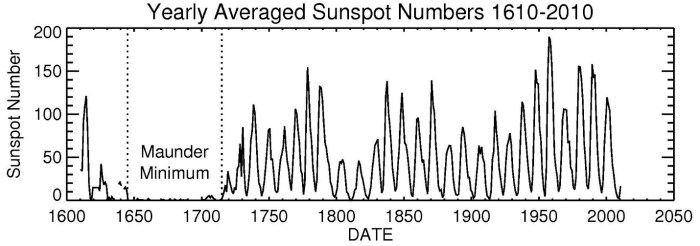
yearly averaged

Image credit: NASA

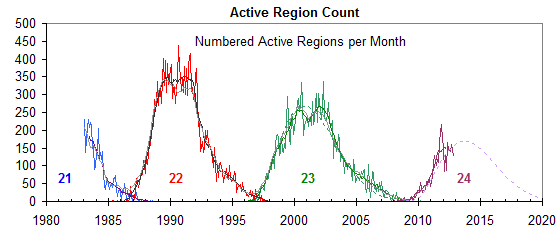
active region

Most recent solar cycles; note data ends in 2014.

Image taken from website Watts Up With That

latter half

Latter half of Cycle 23 plus Cycle 24 to date.

Note: red line was predicted curve, and that was adjusted downward

after the solar max ended so low, and we are still dropping well beneath it.

Image credit NOAA/SWPC


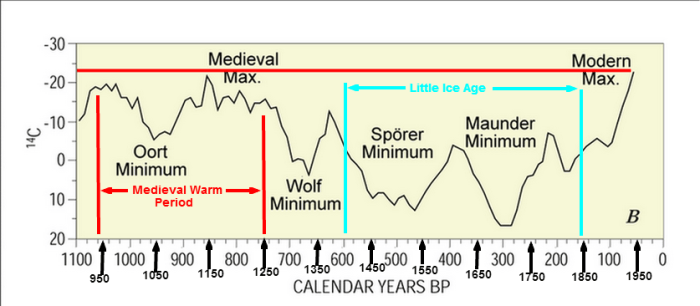
3) The “Little Ice Age” was actually a significantly extended cool period lasting several centuries, and no less than FOUR extended minima occurred during its “tenure.” These include, in order, the Wolf, the Spörer, the Maunder, and the Dalton minima. These extended minima were not all of the same “depth,” in that the minimum numbers of sunspots were not the same across all of them — the Maunder was far deeper than the rest — but there are indications that we are hitting numbers in the range of the Dalton already.

Note that, during the Maunder Minimum, sunspots became so rare that a grand total of only ~50 were observed over 28 years — this corresponds roughly to two and a half solar cycles. In a “normal” cycle, we would expect to see around 50,000 sunspots in that same timeframe, some THREE ORDERS OF MAGNITUDE MORE than were observed during the Maunder Minimum. Entire month spans went by with NO sunspots. Also understand that, when sunspots resumed, they did not pick up mid-cycle, despite the fractional-cycle timeframe; the extended minimum was, effectively, a reset.

Also realize that as observing capabilities have increased, sunspot counting has been adjusted via modeling to ensure that current sunspot data is consistent and contiguous with the earliest sunspot numbers. (In other words, given we can now see teeny-tiny sunspots that might not have been visible in, say, the 1700s, we also now know roughly the percentage of teeny-tiny sunspots that occur relative to the larger ones, and can extrapolate the data so that everything stays consistent.)

In addition, we have learned to cross-correlate databases so that we can use other data, such as Carbon-14 and other isotopic abundances in tree rings and ice cores, to be able to approximate solar activity in earlier timeframes before sunspot observations began, though it is not as accurate. And we don’t get actual sunspot numbers out of ‘em, but instead we get relative solar activity. So, for instance, we know that a relatively “shallow” extended minimum, aka the Oort Minimum, likely occurred in the 1000s AD, though determining specific dates is a bit more difficult. We can thereby extend our knowledge of solar activity back several millennia with relative ease.

the small unlabeled

Note: the small, unlabeled minimum between the Maunder and the Modern Maximum is the Dalton Minimum. Also note the lag between the relatively deep Wolf and the beginning of the Little Ice Age, and a similar lag after the Maunder/Dalton Minima and the beginning of the Modern Maximum. This lag may or may not correspond to the time required for the delta-energy input to work its way through the various coupling mechanisms.

Image credit USGS.


4) The fact that, as sunspot numbers go down, the overall energies output by the Sun also go down is an indication that, in this instance, correlation may well equal causation, at least to some degree. Add in a few large (or many small) volcanic eruptions to complicate matters — and there usually ARE such concatenations of volcanic eruptions in such multi-decadal timeframes, as a matter of course — and it may well prove interesting times ahead, as well as in the past.

5) Data indicate that cosmic ray fluxes are increasing, and this is further indication that solar activity is decreasing, as the solar wind normally tends to provide a shield of some (relative) substance against cosmic rays, which originate outside our solar system, mostly from galactic sources (supernovae, active galactic nuclei, etc). But as solar activity declines, the solar wind also declines, and so too would the cosmic ray flux increase, as the plasma which shields us from its entrance into the inner solar system decreases. (We still have the magnetosphere shielding us.)

[See, e.g. http://news.spaceweather.com/cosmic-rays-are-intensifying/  and

http://www.thedenverchannel.com/news/local-news/cu-boulder-scientist-predicts-increase-in-radiation-exposure-on-airlines-in-coming-years . For the historical knowledge of the solar wind’s influence on cosmic ray flux, see https://journals.aps.org/pr/abstract/10.1103/PhysRev.110.1445 .]

cosmic rays

This is an illustration of why cosmic rays are important and dangerous; as soon as they hit matter — in this case, the atmosphere, but the metal of a spacecraft is even more effective — each “cosmic ray” particle interacts with the particles in that obstacle and produces a shower of particles, gamma rays, and x-rays.

Image credit Francisco Barradas Solas


I’m simplifying all of this, of course; things are always more complex than meets the eye. But given the steady decrease in numbers for a good 3 or more cycles now (with considerable fluctuation for several cycles before that), I will be surprised if, at some time in the next few cycles, we do not enter an extended minimum, even if only of moderate depth. And it really isn’t a matter of “if,” but of when. Many variable star astronomers (and that’s what I studied in school — spotted variables, no less) consider that the Sun is at the very least borderline variable; some consider it outrightly so. I tend to fall in the latter camp; it all depends on the percentage of variability, and we are only now obtaining the kind of data we need to determine that. But it doesn’t actually take much.

So things are picking up steam, and after many years of my talks, blog posts, etc., I am finally no longer the only person in the room standing up and saying, “Hey, folks, something interesting is going on here.” What’s going to happen next? I can’t say for sure. But it definitely bears watching. I’ll keep you posted as things develop, to the best of my ability.


Addendum from Old Uncle Lar:

I asked Steph to work this up from several on-line discussions she and I were a party to as well as a recent general observation from many sources that sunspot activity was way down from previous levels. I will endeavor to badger her into further developments as they occur.

Since I am also her business advisor I am compelled to mention that A Very UnCONventional Christmas, book three of the Division One series, will be available for pre-order on June 13 and sale on July 11. We expect to have print copies from a pre-production run available at Libertycon as well. Hope to see many of you there.


Mothering and Oppression

When Robert was very little, something happened to him that was “the worst thing ever.”  I don’t remember what it was, and it’s entirely possible I never knew.  He was that small, that his explanation might have made no sense.

Lots of things were the worst thing ever at that age.  He tripped and hurt himself.  The water he was about to drink spilled down his front.  He’d started falling asleep and come suddenly awake for no good reason he could figure.

He was crying, mouth open, in absolute grief.  I remember I was in the bathroom, and this must be at the time we were potty training him, because there was a jar of candy on the toilet tank (something our friends found somewhere between appalling and amusing, but it worked.  Pee in toilet, get piece of candy.)  I sat on the tub (I think I was putting makeup on to go out) pulled him to me, hugged him, told him everything was all right, and gave him a piece of candy.

Like that, his crying went from unbridled grief to a big smile.  And I remember thinking “Ah, son, if only I could do that for the rest of your life.  If whatever problems face you could be banished by a hug and a piece of candy.”

He’s 25.  He’s gone through many things I couldn’t console him for, including illness and breakups.  Now he’s very nervous about upcoming exams, and my hugging him and telling him everything will be all right doesn’t clear it.

Younger son is worse at this sort of crisis, because he won’t tell us he’s in trouble, and sometimes he’s not quite sure what is trouble, what things matter and how to fix them, and by the time we figure it out it’s a much bigger mess than it should be.

I think there’s an instinct in humans, particularly in women to “fix everything” for someone else.  We want that magic bullet.  We want to make everything right.  But what actually happens is that when you try to fix someone’s every problem, nine times out of ten, you create another set of problems.

You see, people need to at least know what is a problem, know they need to be got out of them, and need to have some basic skills so they don’t fall into them again.

It’s very easy as a mother to insist on ironing their clothes forever, rather than letting them look like they slept out in the zoo with lions.  But if you keep doing that, they’ll never learn that there is even a problem with going out all rumpled.  Clothes become that weird thing mom obsesses about, and neatness never correlates to how people respond to you.

The same with, for instance, making them eat breakfast in the morning.  If you keep doing it, they’ll never correlate it with how attentive they can be in class during the day, etc.

It’s the hardest thing in the world as a mother.  You have to let them fall on their faces, before they figure out what they’re doing wrong and learn how not to fall.  It’s bad even with friends.  When I was young and stupid, I’d just hand out rent money to friends who were about to be evicted, we’d buy computers for friends who needed to finish a novel, even when it was going to hurt us all month, we treated friends and other relatives as though they were our minor children, in other words.

Even in adults this doesn’t work so well.  You end up with several weird behaviors, the most common of this being the people who come back again and again — we see this with several people who have become addicted to begging on facebook, it seems, and live on the verge of disaster but miraculously always keep going — or what you sacrifice to provide doesn’t get used at all (of three computers we gave people to finish novels, because they needed to sell, only one sold and that was 20 years later) or there is really no perceptible difference in people’s circumstances.

And that’s with private charity.  When you bring in government and the idea you’re entitled to never suffer hardship and never have to sweat towards anything because you were born in a time and place, then you’re really encouraging behaviors that brought people into trouble in the first place.  I think guaranteed minimum income (getting paid for drawing breath) is the sign of a serious pathology (besides never working when it’s been tried, and leading to the infantilization of the population and perpetuation of dependency and ultimately greater poverty for all.)

It’s an understandable impulse.  Few of us like to see people suffer.  But suffering, bit or small, is how humans learn.  If you don’t poke the fire you’ll never know it burns.

The trick with children and with friends, and with strangers at large, is to try to ensure the finger doesn’t go into the fire so hard it burns off the finger, but that it touches the fire enough to feel the burn.

Ultimately, no matter how much you want to protect people, at some point you realize not only you can’t, but it’s immoral for you to do so.  You’re interfering with the choices of adults, and their right to learn from those choices.

I’m not saying you shouldn’t practice charity.  I do.  There are unexpected blows of fate, unexpected expenses, and unexpected disasters, in which those of us who believe in freedom help our friends because we can do it better than any government can.

I’m saying that we need to exert judgement over when how and whom we help.  Even if everyone is crying and just experienced the worst thing ever, it’s important to think through whether this is recurrent, whether it’s a pattern of behavior, whether the person blundered ahead despite many, many warnings. Then you need to figure out whether there is some impairment that prevents people from doing what they need to do to not get in these situations.  If there is, you can’t make it worse by helping, and it’s like helping a child.  Someone has to.

But giving indiscriminately, without thinking and examining all circumstances carefully and keeping in mind “first do no harm” is as bad as never giving at all.

Which is why government is the worst instrument for charity.  And why indiscriminate compassion turns into infantilization and discrimination.


Later

Guys, sorry I’ve been flaky lately, but I’ve been having the auto-immune to end all auto-immunes, and I just gained a SMALL respite with benadryl, but it makes me goofy and sleepy.  I’m going to take a nap.  Post later.

Nursemaids, Minorities and a COMPLETE Lack of Understanding of Humanity

Sometimes I think the only reason I go to Facebook is to keep myself from passing out in the shower by having extremely low blood pressure.  However there is also the side benefit of figuring out how COMPLETELY insane most so called “normal” and “educated” people are.

The sad part of this is that the insanity is not natural, but the result of careful education, nurturing and indoctrination.

Take this article which I found in a somewhat different form on line (more on that later.)

These Profound Photos Masterfully Turn Racial Stereotypes On Their Head.  ANYONE with even a modicum of grounding in reality looks at those and asks several questions: “What racial stereotypes?” and “Good Lord, are you a tri-plated racist?” and “Were you lobotomized at birth to think this was profound?”

But first, there is the first picture posted with these on facebook, and which my husband and I couldn’t trace after several hours of research.  From the style, I presume it’s from the same photographer, who, being somewhat sane (still) chose not to send it to the original article in O.  I also assume it was leaked and added to the facebook post by someone present at the shoot for the purpose of… I’m not sure?  Racebaiting?  Or perhaps showing how profoundly stupid people who fall for this crap are, in a sort of double reverse trolling.  (I want to believe.)

That first picture made absolutely NO sense.  And by that I mean none.  So I looked at the other pictures (and yes, I’ll explain rationally what’s wrong with them, and why my first reaction was those three questions above) just because ti was like a glimpse into a mad house, and I wanted to know what the lunatics were up to.  (I regret to say nothing good, and only something entertaining in the way that a train wreck is entertaining.)

It was this:
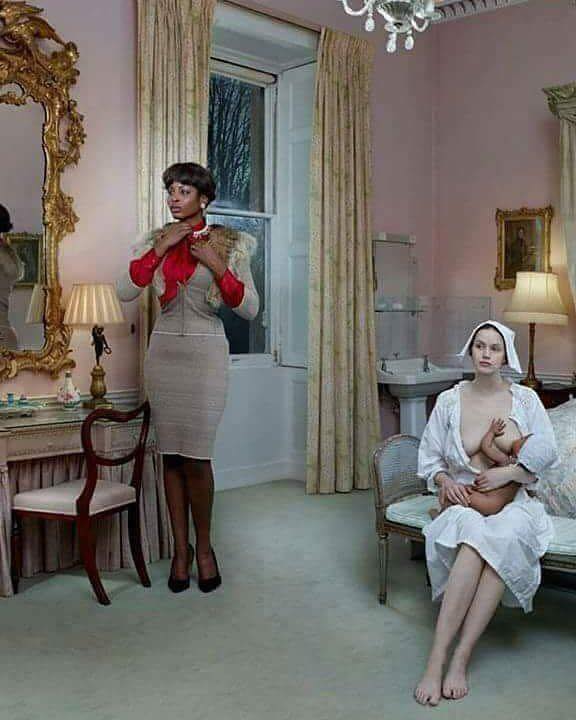
what the actual heck

My husband, being a mathematician and therefore skilled in logic, zeroed in on the principal thing any normal person thinks is wrong with this picture: Why is that baby not wearing a diaper, but wearing a cap?

One of my fans was even more confused.  His comment was “So, it’s a biracial lesbian couple and their baby, but why is the white chick wearing a funny dutch cap, and why DOES THAT BABY HAVE NO DIAPERS?”

At that point I looked and brought my powerful intellect to focus on this picture like something that focuses.  And my reaction was “A nursemaid?  A nursemaid in a — from the clothes — forties nursery? WHY?  Honey?” to my husband, “Didn’t they have formula in the US?”

And then I looked at the other pictures, looking for context to understand this insanity.  Which is when I ran into the original post with hundreds of people of color saying how this reversal of stereotypes made them feel powerful or made them cry.  (More on that later too.)

At this point I decided the Mandela effect must have struck again.  Is it a stereotype in America that black women nurse white babies?  At any time since the civil war, that is?  And if it WHY is it?  I don’t think even the conspicuously rich among us would use wet nurses.  Wet nurses were always a problem.  Read any novel from before the twentieth century.  (And btw, nursemaids were usually the same race as the parents.)  You had to trust a stranger not to drink or eat anything harmful that would pass on the baby (mostly alcohol, but other stuff too) and you had to trust them to stay healthy, and you had to trust them to treat your baby nicely when you weren’t looking, and–

I imagine everyone greeted the advent of formula with much enthusiasm and joy.  And, I just looked it up, commercial formula has been available in the US since the mid 1800s.  By the early twentieth century, it was in wide use.  I dont’ think anyone sane can have a stereotype of black women as wet nurses, unless this is a thing in Arab countries (where slavery is also still a thing.)  But since this was about inverting AMERICAN stereotypes, that first picture mostly struck me as a magnificent piece of insanity, equivalent to … oh, my saying I’m inverting stereotypes by having a picture of a Mediterranean woman nursing a blond baby while a well-dressed blond woman stands nearby.  “Look, at me, look at me, I’m subverting stereotypes that no one even in my grandparents generation would recognize.  Take THAT Ancient Rome.”

This is probably why, when we started googling the pictures, because I wanted to write about them, we found only the other three pictures were published in the original in O magazine, echoed approvingly by the NYT and Puffington Host and the rest of the excreta for brains racists, (no, really.  They have to be to think these are “Stereotypes” that need to be “reversed”) and a bunch of other equally crazy publications.

I.e. that first picture is stupid enough to ring the bells of people who are so deep in their own echo chamber they think the others make sense.

And yet, I want to point out that on the post on Facebook NO ONE raised these issues.  Except for one sane guy (not my husband, but clearly a brother at arms) who wanted the baby to wear a diaper, now.

I also want to point out the post on facebook had tens of thousands of shares.  Which considering the quality of thought and self-congratulatory bullsh*t that went into the other pictures means we should be beamed up.  There’s no intelligent life down here.

I also want to point out someone at Puffington Host called these pictures profound and they weren’t mobbed by people asking them what they were smoking, ingesting or snorting.

All of which means the fight for the culture continues and also that brain damage in this country is far more widespread than you’d think. Or as I used to say when I met protesters during the Bush administration “Yeah, you have the right to be angry.  This is no way to treat the mentally ill.  You should be off the streets and somewhere padded and safe.”
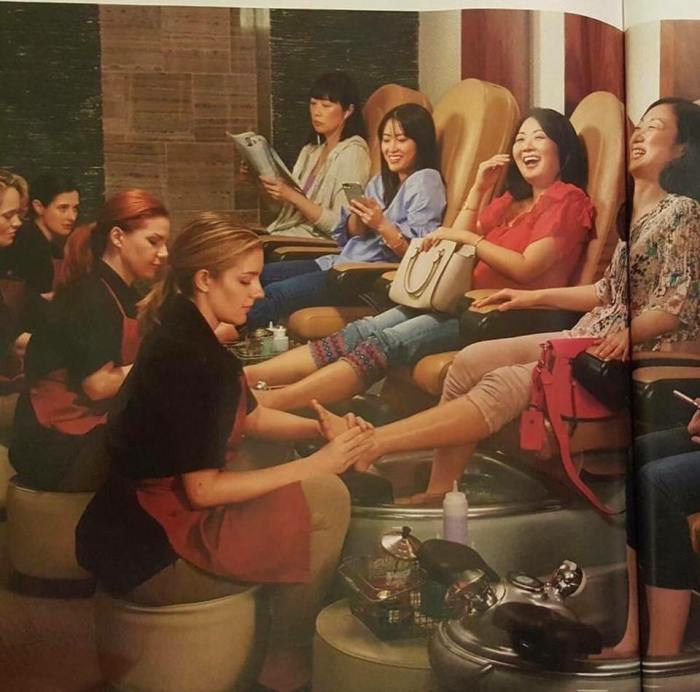
whattheactualheck1

Okay, so…. that first one… Is there REALLY a stereotype that Asians give pedicures?  REALLY?

Hint, before turning a stereotype “on its head” you should be aware that perhaps this is ONLY a stereotype in your part of the country/social class.

Not only I but most of the friends I showed this to asked “What is the point of this picture?” until a couple of my friends WHO ARE ASIAN blew their tops by saying “manicure/pedicure salons allowed Asian women to have their own businesses and provide for their families and climb to middle class.  What kind of bitter racists think this is bad?”

At which point I asked and was told that in some places with high Asian immigration, this is indeed a stereotype, HOWEVER the women are not slaves.  They are paid, often own the salon, and are providing for their children to go further in America than they could go.  In other words, as an example of “reverse oppression” that picture is caca.

Here I will note that the one time I visited South Africa several strangers joked about my opening a vegetable stand.  This puzzled me completely, as not only it wasn’t a stereotype I knew of, but it wasn’t a thing any of my relatives who emmigrated did. However, in South Africa it was a stereotype that Portuguese ran vegetable stands.  Why?  Because the people who first immigrated from Madeira did, and then brought over friends and showed them the ropes they knew to integrate in their new society.  I.e. they showed them how to run vegetable gardens.  Note of the people who joked with me about it, none of them expected me to do it.  Stereotypes exist because of economic/social conditions usually for a limited time.  But only stone cold racists think they’re eternal or apply to everyone of that ethnicity.

whattheactualheck2

This one made me want to go “Help, help, I’m being oppressed.”  Anyone spot what the problem is with this in terms of reverse pictures of oppression?  oooh ooh, I know.  Not finding a doll that resembles you is not oppression.  It is a reflection of the fact that people like you are a small enough minority in the market that there is no point creating dolls for them.

This is not true of American blacks, (no, they are not African Americans.  The usual suspects can take a flying leap.  African Americans is a demeaning appellation for people whose last ancestors left Africa more than a hundred years ago. While we’re at it, most Americans with darker skin are more than fifty percent Caucasian.) who are a solid 14% of the population.  Depending on which part of this vast country you live in, the toy store might indeed resemble the picture.  And the little girl in the picture is not being oppressed.  If she wants white dolls (only people without imagination think that’s a given.  One of my friends growing up had a black baby doll and was an object of envy of the rest of the group, on rarity alone.) she’s shopping in the wrong store, and her mom should take her to another.

I mean, what the heck, actually?  What do the people who think this is oppression want?  Mandate that as many black dolls be made as white, even in a country where black people are a minority (and nowhere near half) and therefore because parents and older relatives lack imagination, there’s a ton more market for white dolls?

Bah.  It must be socialism, when you want to mandate people create a product for which there is no demand, to gratify the whims of the ruling class and intellectuals. This is why socialism was supposed to be “scientific”.

whattheactualheck3

First reaction “Is this a screen capture from a soap opera from Brazil?”  Second reaction, after reading some blather about how the woman isn’t even paying any attention to her maid “Well, duh.  Of course not.  The maid is being paid to do her job, not to be stared at.”  Third reaction, “you know, this wouldn’t be that out of the ordinary in Portugal, where maids are often from beyond the mountains, where entire villages are of Celtic or Germanic Stock.”

Do these people really imagine they live in a society where there are no wealthy Latins and no whites in service professions?

First question: HOW?  Second question: HOW insular are those who control our media that no one told them this didn’t pass the laugh test?

In the end, all three pictures are complaining not about oppression: real oppression would be say people’s genitals being mutilated; slaves being sold by ISIS, people being shot for having the wrong beliefs.

None of those things happen in America, or at least not in mainstream America.  (We haven’t got the message “Fit in or f*ck off” to ever recent immigrant yet.)

So they had to go with the socialist/communist idea of oppression, which could be boiled down to: people have to work for a living.  Only demented Marxists could consider this oppression.

And only demented RACIST Marxists could imagine these stereotypes are universal and inescapable and therefore reversing them will have a powerful effect on everyone, instead of causing sane people to go “And?”

Because what they’re basically saying is “People have to work for a living and therefore fulfill professions we — but not necessarily they — consider demeaning, or make dolls that we think shouldn’t be the majority of dolls bought.”

IOW they’re not at war with stereotypes, they’re at war with the voices in their heads (And they really should take Gone With The Wind off the loop on their TV.)

The people who really liked this were either people of color who have been told if they don’t see people exactly like them portrayed in a way they like, they’re being oppressed, or they are “allies” h*ll bent on proving that people of color are not all like stereotypes, and could benefit from traveling, enlarging their horizons, getting beat up abroad, maybe getting sold as slaves by Isis.  Not that I wish that on them, but they are the epitome of spoiled, rich kids (by the principle that anyone in the US is in the global 1%) who have no clue what real oppression is and won’t listen to anyone when we tell them.

As for the tens of thousands of shares and approving — often barely literate — comments, 60% of them on facebook were from abroad.  Maybe they think every white American has a black nursemaid?  They’ve believed stupider things.  But it is a call for creating some competition to Hollywood who spreads these lies about us abroad.

As for those of our compatriots who believe this…  Keep enlightening them: In fiction, in non fiction, in play and work, make sure you get them out of their deranged comfort zone.

Because if things go upside down, these poor shambling zombies won’t survive.  Their parallel version of reality doesn’t include concepts like “Root, hog or die.”  And in common charity we should save whatever brands we can from the fire.  Those that can be saved should be.

The others?

Well, there’s always pointing, laughing and making duck noises.  As Heinlein said in Stranger in a Strange Land, (paraphrasing) sometimes you laugh because it hurts too much to cry.

I Promise

There will be Grant (Dark Fate MHI fanfic) before Saturday, and then on Saturday again.

This weekend we had an unexpected (well, expected, we just didn’t know when) visit from one of you — someone we only knew on line — who is also a friend of friends, and frankly a friend over my many names online.

We weren’t worried about his visiting, but we were worried about what he would think of us/whether we’d get along.

So, last week was “fun with dishwashers” (we’re getting a working one installed on Wednesday) which ate up our time, both trying to fix the problem and then shopping for the new one, followed by a visit from a friend (I’m not saying who it is, because I’m not sure he wants me to, though some of you know who it was.)  Which meant I spent Thursday and Friday trying to make this house look less like the house of people where two are working three jobs, and one is studying for medical boards (you have NO idea.)

Turns out we like each other (or at least we like him!) as well in person as on line, so there were talks till all hours, and very little got done.  Including posting here and writing, either in books or for PJMedia (I’m working for them again.  Long story.)  Which means I’m now playing mad catch-up because Guardian is late and I need to deliver some columns.

Also, since I’d announced the first-Saturday-Hun-Meetup at Pete’s Kitchen in the diner before I knew we were getting a house guest, yesterday I went out and hung out with eight of you (well, it was a beautiful day, so people were out having fun.  Mind you, meeting was fun too.)  This means I spent today suffering from what I’ll call “introvert flu” which is kind of like con crud, but with fewer physical causes/symptoms.

All of this to tell you why the dog ate my homework.

What I’m going to do about it: Catch up and work like a demon, of course.

But FIRST I’m going to bed early tonight, so I can actually function tomorrow.

So, see you tomorrow, and this week is going to be AMAZING. I promise.

Vignettes by Luke, Mary Catelli and ‘Nother Mike

Vignettes by Luke, Mary Catelli and ‘Nother Mike

So what’s a vignette? You might know them as flash fiction, or even just sketches. We will provide a prompt each Sunday that you can use directly (including it in your work) or just as an inspiration. You, in turn, will write about 50 words (yes, we are going for short shorts! Not even a Drabble 100 words, just half that!). Then post it!  For an additional challenge, you can aim to make it exactly 50 words, if you like.

We recommend that if you have an original vignette, you post that as a new reply. If you are commenting on someone’s vignette, then post that as a reply to the vignette. Comments — this is writing practice, so comments should be aimed at helping someone be a better writer, not at crushing them. And since these are likely to be drafts, don’t jump up and down too hard on typos and grammar.

If you have questions, feel free to ask.

Your writing prompt this week is: Brown

And there will be Grant.  Our house guest left.  I was sorry to see him go.  It was fun.  BUT when you talk till you drop, it’s kind of exhausting.  I’m contemplating a nap. :)  We hope he visits soon again, though.