A WEE Snip of Darkship Renegade

*Yeah, I know it’s a tease, and I do apologize. I’ll try to post in the evening, but today was a long day of writing, and tomorrow (Friday) will be another, so I need to go to bed.*

   Several things happened, almost instantly. One, the fresher door opened.
    It would have taken Cat speed for Kit to open the door to the fresher that quickly, let alone to turn the shower off – it wouldn’t let him open the shower door otherwise – and then open the fresher door and rush out.
    But Cat speed or not, he forgot he was hurt, and plunged forward towards me, at what would have been a run, except his left leg gave out under him, and his knee hit the floor with a sickening thud, as he bent over his leg keening in unreasoning pain.
The next thing was the woman’s voice, from the door to the cabin, sounding very cold, very clear, “Stay down. Do not go near her.”
    I turned around. Zen stood in the doorway, in the posture taught in every shooting class, feet slightly apart, arms braced, holding the burner pointed at… Kit.
“He didn’t do anything!” I said.
    “No?” she said, but didn’t stop pointing that burner

The Robert Story

Twenty years and a few hours either way ago, I was as close to death as I’ve ever been. You see, I’d been in labor for three days, the baby was crowned, but there seemed to be no power on Earth that would make him actually come out.

This was a special baby – special for us, of course, as his parents. Special like every baby is to his parents, but more so because we’d waited six years for him and had thought we were never going to have any children.

And then I found myself pregnant. It’s funny because we never got told what gender he was. We had no particular objection to knowing, but at that time ultrasounds were not ALL THAT clear, and I didn’t want to be set on one gender, then have the other.

At any rate, it was all very much besides the point because I knew the minute I got pregnant and knew it was a boy. I also knew what I wanted to call him – had known for the last five years or so. The boy was Robert Anson Hoyt, after Robert Heinlein.

To make the story of that very long night short, we ended up in emergency caesarean, with three doctors in attendance, because he was crowned and it was all very difficult. And he was born.

Immediately after he was born, I passed out or fell asleep. I’m not sure which. I didn’t wake up for 18 hours, so I woke up to a very hungry little boy.

It was only when I was nursing him that my husband pointed out – not that he remembered, in the fog of battle, my brother had to remind him – that Robert Anson Hoyt had been born on Robert Anson Heinlein’s birthdate.

Robert turns twenty today and for the first time we’ve been unable to arrange to be with him on his birthday. He’s down in North Carolina working in a lab for the summer before returning to resume college this fall.

It seems like just yesterday he fit in my arms, but now he towers over me and is a full grown man. And yet the Robert story is only starting.

“Unka Tom? Tell me the Poddy Story–”

“At your age?”

“Please? I crawled up on his knees. “I want to sit in your lap and hear it once more. I need to.”

“All right,” he said, and put his arm around me. “Once upon a time, long, long ago, when the world was young, in a specially favored city there lived a little girl named Poddy. All day long she was busy like a ticking clock. Tick, tick, tick went her heels. Tick, tick, tick went her knitting needles, and, most especially, tick tick tick went her busy little mind. Her hair was the color of butter blossoms in the spring, when the ice leaves canals. Her eyes were the changing blue of sunshine playing down through spring floods, her nose had not yet made up its mind what it would be, and her mouth was shaped like a question mark. She greeted the world as an unopened present and there was no badness in her anywhere.”

“One day Poddy–”

I stopped him. “But I’m not young any longer… And I don’t think the world was ever young!”

“Here’s my hanky,” he said. “Blow your nose. I never did tell you the end of it, Poddy; you always fell asleep. It ends with a miracle.”

“A truly miracle?”

“Yes. This is the end. Poddy grew up and had another Poddy. And then the world was young again.”

“Is that all?”

“That’s all there ever is. But it’s enough.”

Robert A. Heinlein Podkayne of Mars.

Know When To Fold Them

(To begin with a word from er… me.  Since my life is a cartoon script, getting word that I won the Prometheus had to be mitigated by something.  What it was mitigated with was a sore throat, a blinding headache and a touch of fever, which is why after a certain point I stopped answering congratulations here.  [Though I still managed “thank yous” on FB because shorter and easier to deal with.]  I’m better today, though not 100% well yet — honestly, I think it’s allergies! and what follows is my regularly scheduled Wednesday post.  This is the day I post at Mad Genius Club and cross post it here, so it is a book about writing and writers.  I just want to assure people I did NOT forget I won the Prometheus and that I’ll have more to say about it, hopefully tomorrow.)

First of all calm down. This is no statement of intent. It is instead an exploration of something I first read about in a how to write book – the importance of giving up and of knowing when to give up – and how impossible to navigate most of the traditional “career road maps” have become.

I first came across the concept of there being a right time to quit writing – or at least writing as a career – in one of the first “how to write” books I read, which means either Damon Knight’s or Orson Scott Card’s. (It’s been a while. But theirs were the first two I read.)

The advice went something like this: know when you don’t have enough talent/persistence/ability to learn craft to give up. I’ve seen marriages, careers ad children ruined by the determination to persist in the face of all obstacles.

At the time this advice seemed eminently sensible to me. I was, remember, very young and still believed natural talent was the most important thing in getting published, (or any artistic endeavor.) And I didn’t know you could learn, because I’d just started trying to.

In fact, at the time, it all seemed perfectly clear cut and accorded with the concept of an “artistic life” that I’d grown up with. It went something like this: if you’re an artistic genius – and if you’re not, kindly stop cluttering the field – you’ll be recognized on sight by the first professional recruiter (talent scout, editor, gallery owner) who sees you perform your art – or even just sees you because, yeah, talent is that obvious and you know, usually accompanied by madness or artistic temperament – and they’ll immediately bow before you and take you to the top of your profession. At that point, as long as you avoid drugs, sex and suicide (no word on rock and roll) you’ve got it made.

This concept by the way was why I was so distraught at my first rejection, even though it was personal and – in retrospect – almost abjectly fawning. Because clearly I wasn’t a genius. This concept too, was responsible for my not sending anything out again for another four? Six? Years.

Anyway, so when I read that book, it made sense. It has since come back to haunt my mid at intervals. Those who were in my writers’ group when I started out used to laugh at my decision to call it quits. (To an extent they had point. I think the longest I stayed away from writing was two weeks.) Mid you it made some sense, since I think the original advice pertained to getting published, and when I passed eight years of trying, maybe it was sane to give up.

No one said I was sane.

This didn’t change much after I was published. Perhaps this was due to the fact that I broke in in 01. I found it enlightening to read Kris Rusch’s latest column, if nothing else for the fact that she talks about how crazy things have been in the last ten years which is, in fact, my entire time as a published novelist. (I sold my first short in 94, but didn’t actually sell a story that got published till 98, so my extent of time “in the field” is not much longer.) Made me feel a little better, because at least I knew I wasn’t the one who had gone crazy, but the entire field. (Yes, it was a “Oh, so it’s crazy in here, it’s not just me.” It also made me feel better because I’ve had that exact conversation she quotes – in variants – three times in the last two years, and it was good to know it’s not me, they’re doing it to everyone.)

In fact, when I met Dave Freer, I was considering whether the game was worth the candle. My first series had come out to unspectacular (to put it mildly) and perhaps even truthful (after reading that article, and in retrospect, who knows?) numbers, and I’d been told I’d never work in this town again.

It seemed, at the time, like a curiously stupid way to fail. First, because “try for sixteen years, publish a trilogy that fails to sell, walk away” sounds like giving up too easily. Second, because the trilogy wasn’t even within my “typical” type of writing. I’d spent most of those sixteen years writing space opera, and the trilogy was literary Shakespearean fantasy. (No, I’m not saying I wrote it just to get published. Okay, maybe a little. To the extent I loaded it with quotes it was at the publisher’s request. But writing about Shakespeare and elves were just outgrowths of having read a lot about the subjects lately. As you all know, I’m likely as not to write about whatever crosses my mind at the moment. In fact the words “I’ll never write xyz” in this house have the same karmic signature as danging around holding metal poles during a thunderstorm of – to quote Pratchett – calling yourself “Vincent the invulnerable.” However, literary fantasy had never been the pinnacle of my ambitions or the aim of my career.)

It was that”well, if I’m going to fail, at least I’ll fail at something I do more often” that kept me lurching forward through bewildering… some things that might have been successes or failures or “yes.”

Which brings me to my current position. You see, somewhere along the line the “know how to fold it” became very definite, because I – and most of you – have met people who didn’t. These are usually people who have attained some modicum of success: a book or two published; a semi-successful series. Then something went wrong and they stopped getting published by the big houses. But they’re still published by the little houses or – sigh – self published. It’s been twenty years, but they still come to all the local cons and insist on being called “a professional” and give advice to new authors on how to break in.

Most careers in SF/F don’t last forever, you see. When I broke in, Kris Rusch told me the average career lasted ten years, and most of the time the authors just gave up and disappeared back where they came from.

This seemed to me preferable, more dignified, than the living-death of minor publication and the demand of a status one no longer held. You see, in case this isn’t obvious, I have the devil’s own pride.

So, what can the problem be? I mean, I’m still being published by professional houses, but surely when I stop, then….

Well, no. Why no? Because the markers have moved. When people who are self-published are making a million dollars, when people who are self-published are getting better reviews/awards and going on to sign with a house for better careers than those of us who came up through the normal channels, the goalposts haven’t only moved, in fact. They’ve grown tentacles and are dancing a jig.

So… when is the time to pack it in? Danged if I know! I don’t even know – any longer – if that advice was right and if there is a time to pack it in. Now the whole process of publication has become, instead of an identifiable career a try-fail try-succeed sequence like the initial efforts to get published. Yeah, you might have put out twenty books with Amazon and sold ten copies a piece, but if – and this is very important – you’re TRYING and working at it, improving and studying the market, your next one could become a success.

And so it goes.

For me the marker is a little easier. You see, I don’t do this for a hobby. Writing is my job. As long as I can make from it what I could make from jobs I can easily get at my current state of abilities/being out of the market: say, teacher’s aid, or secretary – I’ll continue doing it. (Yes, I could make considerably more from free lance translation or free lance language teaching, but both of those would require an amazing amount of effort/time to get off the ground and then we’re back to “but writing might do that as well with the next book and it’s something I want to do.”) At the point that teacher’s aid or secretary becomes more profitable, writing becomes a hobby, which is given only a fraction of my time and attention.

This year will not be that year, and probably neither will next year.

So… of course, you probably agree with me that one shouldn’t harm ones family, livelihood, or children in order to keep trying. (At least I hope you do.) But after that, is there a point at which you think one should call it quits at whatever phase of one’s career in this strange new world of publishing? And if so, when would you say it is?

At which point do you, in the words of Simon and Garfunkel, cry “out In his anger and his shame,
“I am leaving, I am leaving.”” And does the fighter still remain?

For The Win

I don’t know how many of you know I’ve been nominated/a finalist for half a dozen awards or so over my career.  My very first book was a finalist for the Mythopoeic, and Soul of Fire AND A Death In Gascony were finalists for a Colorado Book Award.

This is why I didn’t get too excited when I heard that I was a finalist to the Prometheus.  Oh, it was an honor — sure.  But looking at the list of other finalists I counted myself as the least likely to win.  In my head, I knew who would win, and who the second and third would be, and I was prepared to be gracious.

Imagine my very great shock upon receiving an email informing me that: The winner of the Best Novel award is Darkship Thieves, by Sarah Hoyt (Baen Books). The Hall of Fame award was won by Animal Farm, a short novel written by George Orwell in 1945. Sarah Hoyt will receive a plaque and a one-ounce gold coin, while a smaller gold coin and a plaque will be presented to Orwell’s estate.

I didn’t really believe it until I found it here http://www.lfs.org/releases.htm  and my name added to the list of winners in Wikipedia.

I am honored and humbled.  I’ve told you all — many times — that I don’t write to send a message.  It is nonetheless impossible for any author to divorce himself/herself from his/her deepest beliefs while creating a world.  And it should be obvious to anyone who has read my blog for any time that individual liberty is possibly my most cherished value.  So it tends to be the most cherished value of my characters — at least the good ones!

I will have more coherent things to say about this, later — for now I’m glad it won, and I’m glad THIS book — dedicated to Robert A. Heinlein — won.  I view this win as proof he — through his books — done brought me up right.

Update for those who prefer electronic books — electronic versions of Darkship Thieves are available directly from the publisher:  http://www.webscription.net/p-1102-darkship-thieves.aspx  They are non-drm and in all the most common formats, including Kindle.  (Thank you to Francis Turner for the link!)

*Crossposted at Classical Values.*

UPDATE: ‘lanched.  Welcome Instapundit Readers.  This is an author blog with occasional outbreaks of relevancy.  I’m particularly fond of yesterday’s post, but feel free to poke around wherever you wish.


Pursuing Liberty


The United States of America is the most revolutionary land based on the most revolutionary idea in the history of mankind.

A year before I married my husband, my best friend from childhood married a Frenchman. She became a French citizen the year before I became an American citizen, and for her that meant that – in her little town – she got to open the Bastille-day ball by dancing with the mayor.

I remember being happy for her but, at the same time, both feeling the vast superiority of my journey to becoming an American citizen (even if I never danced with a mayor) and the vague uneasiness of celebrating bastille day.

Because America was founded in a revolution and because most people writing our entertainment are historically illiterate in that way that only Americans (prosperous and secure [still. Relatively] within a vast country can afford to be) movies and many books tend to resonate with sympathy for other revolutions: the French and the Russian revolution foremost.

They should not. They should not even if the temptation is understandable and even if some of the founding fathers were at first sympathetic before turning away in horror at the results.

Oh, I’ll grant you both revolutions looked similar up front. They were both the work of the educated middle class (the sans culottes were a blunt weapon, not the real revolutionaries) and they both originated on the ideas of the Enlightenment.

The similarity ends there. The French revolution, the Russian revolution and the endless revolutions throughout most of the twentieth century are of a kind and kin with much, much older uprisings. Regardless of the clothes they wear and the names they partake, they have more in common with what the iksos did to Egypt or what the Germanic underclass did to Rome. (An invasion? Well, kind of… only we’ve found that this is not necessarily true. Actually, in Rome’s case at least, it had been trickling over the border for centuries.) It was an uprising of the “formerly powerless” and what they wanted was to seize the place of the upper classes and rule as the upper classes had ruled. This always ends with the new upper class devouring each other and rivers of blood drowning all vestiges of civilization until a dictatorship takes over to impose order.

This is because the revolutions are fights over power – not fights over liberty. As with most human trouble, it starts with the words. The words at the beginning.

The French – and most other revolutionaries – fought for ideals of an abstract and high nature “Liberte, fraternite, egalite.” It doesn’t seem to have occurred to any of them – Lafayette included – that by mandating fraternite and egalite they were denying the liberte. And the fraternity and equality one being a lofty feeling, and the other an absolute measurement always prone to more and finer adjustment, both could be used as levers for the new upper classes to get more and more tyrannical power, until you could be executed as an “aristo” because you knew how to read or you wore glasses. Or you had one plate more than your destitute neighbor.

Americans, on the other hand, based their revolution on life, liberty and the pursuit of happiness. You are free to pursue happiness. You have equality under the law on your right to pursue it.

No one guarantees you will catch it or that you’ll be happy when you do it. Well, at least we didn’t use to. In the twentieth century the statist excesses have infected even the US, and we’ve regulated more and more how equal you have to be and how much happiness you can attain and how much is “good for you.” This is a wrong path.

It’s impossible to look at this and not think of a quote from Heinlein, in The Moon Is A Harsh Mistress. It should surprise no one I can’t find my copy, because that book moves all over the house, though I own something like five copies of it, I swear the kids are playing smuggler (from Canticle for Leibowitz) and burying them in the background against the hard times. However, I read it recently.

After discussing the Luna declaration of independence, Prof Bernardo de la Paz admits he stole the words from Thomas Jefferson and asks Manny if he remembers who that was: “Yes,” Manny says (I’m not quoting exactly) “He freed the slaves.” Prof responds, “Could be argued he tried to, but they caught him at it.*”

The difference between life, liberty and the pursuit of happiness and liberte, equality and fraternity is the difference between being a wild-eyed revolutionary or simply playing one (or being manipulated into becoming one) to get a new class into power.

Because once you mandate equality, you fall into the trap of another Heinlein quote. You see, men weren’t created equal, and as I’ve pointed out at length there is only a creative minority and of that minority there is only a minority actually willing to work hard. But it is those minorities that advance civilization. The genius of America has always been to let those minorities do the work. This revolutionary arrangement has led to the freest and most prosperous nation in the history of mankind, a nation that has lifted the whole world out of poverty.

Good job. Now don’t get cocky. Remember:

Throughout history, poverty is the normal condition of man. Advances which permit this norm to be exceeded — here and there, now and then — are the work of an extremely small minority, frequently despised, often condemned, and almost always opposed by all right-thinking people. Whenever this tiny minority is kept from creating, or (as sometimes happens) is driven out of a society, the people then slip back into abject poverty.
This is known as “bad luck.” (Robert A. Heinlein.)

Happy Fourth Of July. Keep on Revolting.

*anyone bringing up nonsense about Jefferson and Sally Hemmings is subjected to the penalty of having Lin Wicklund explain the facts of life to them. If you don’t know who Lin Wicklund is, you’ll find out. Also, judging great men by the standards of a much later time is a device of midgets on stilts, trying to piss on the heads of giants. You only make yourself small.


*Crossposted at Classical Values*

Red White and Blue For You

There will be a more coherent post later — hopefully. So, yeah, this is the dog ate my homework post.

Mostly, I’m going to try to get in some relaxing time before tomorrow, when I start preparing for the fourth.

You know the way other people feel about Christmas? or perhaps their birthdays? Yeah, I feel that way about the fourth.

My older son Robert was due on the fourth of July and has only been forgiven for missing his due date by three days because he then had the good sense of being born on Heinlein’s birthday. (Okay, so he kept me in labor for three days to achieve this. I know he planed it!)

This is probably a reflection of the fact that some other people love their country – I stalk it, hide love notes in its drawers, and sometimes (in an excess of zeal) call and breathe heavily on the phone at her. But then I spent so much time looking through metaphorical binoculars across the sea and thinking I could never have her…

For someone raised in Europe, the fireworks and unabashed patriotism of the fourth should be cringe inducing, but it is instead very liberating, like a post-modern boyfriend daring to tell his café buddies “yeah, I love her more than life, what of it?”

And if I ever fail to tear up at “the land of the free and the home of the brave” bury me. I don’t care what the vital signs say, it’s a sure indication I’ve died.

The Last, Forlorn Hope

Today I’m going out – on the forlorn last hope of an office-ish. It’s too complex to explain, but if this works, I’ll have an office three/four times a week. We’ll see, right?

Unfortunately for this to work, I must go in with my husband, this morning, on his schedule, and frankly I’m not awake enough to write a coherent post yet. So you’ll have to make do with an incoherent one…

It occurred to me after people started babbling that that dream would actually fit in rather well in the novel Witchfinder, only the devices wouldn’t exactly be i-pads.

Go read this: http://kriswrites.com/2011/06/29/the-business-rusch-you-are-not-alone/

She didn’t have my input on that conversation, but I’ve had it at least three times in the last two years. Reading it, I realized that I – indeed – wasn’t alone. And that maybe it’s not my fault.

What she says near the end, though, about being able to think and write what you want: I’ve been slowly making that transition for the last three years, realizing that if the publishers won’t take it, I can publish it myself. It’s very freeing.

Yes, I’m worried sick about the traditional part of my career, but on the other hand…

This is hard to explain but three years ago I was living in a pit of black despair. I’d have an idea and be all hot on it, and want to write it NOW. Send it out. Take a year or a year and a half till it was due at the publishers. (I sold ALMOST everything, but…) So I was continuously writing things that I was forced to write THAT month, not necessarily things I wanted to write that month. And the hot new ideas cooled in proposal form and…

I know it sounds like whining, but after book, after book, after book written under forced deadline at a time when my head wasn’t in that series, it felt like aversion therapy. Which is why I took the last year off and wrote Sword and Blood, which is completely different from everything I wrote before (or since.)

That seemed to fix the horrors, and now I enjoy writing again. If I can stop worrying about the traditional part of my career and money, maybe I can even finally finish Darkship Renegades and send it to Toni, then finish the other almost-done space opera and ditto, and meanwhile start the subscription thing.  And then write all the things I set aside because agents/editors were less than enthusiastic about them — or at least write those that are still alive and clammoring.  (Witchfinder is one of those.)

Speaking of the subscription thing – any shorts you people would particularly like to see? I’ll put them in the idea-archive.

And now, I’m going to see a man about an office.

I’m At Almack’s Tweeting On My iphone

I’ve known for some time that I’m a sort of snob. Sorry kids. No, I don’t particularly like it either. I like to think of myself as one of the people and common as muck.

And I’ll grant you, I don’t stand on ceremony for pretty much anything; I don’t believe birth or money or credentials grant you any sort of superiority (note I said credentials, not knowledge or experience); I have no clue of how to do what my mom used to call “give yourself to your respect” which I think meant acting like I was very important and people should bow to me; I can enjoy a greasy spoon as well as a gourmet restaurant (if each is good of its kind.) I have friends of all classes and most occupations (okay, I use them for sources. Sue me.) I was the devoted apprentice of my carpenter grandfathers. No handyman comes to the house without my standing around looking at how they do it, and talking with them – and yeah, I can talk to them and make them feel like they have special knowledge (which they do) and I don’t, so they’re worthy of my respect. (Yes, I also get info out of them for books. Sue me.) And most of the time, I wear jeans and t-shirts and don’t even insist on jeans of any particular make.

But I’ve confronted the fact that I’m a snob when it comes to entertainment LONG ago. I think about ten years ago, when we first had money to buy movies, and I got, let’s see, the Jane Austen mini series, the whole series of brother Cadfael mysteries and a lot of documentaries. It’s not that I don’t enjoy other, more popular movies, but what I WANTED was that. Most of the music I buy is classical. Most of the books I buy are non-fiction historical.

It’s not that I LOOK for refined entertainment, it’s that in whatever venue I enter, I immediately become one of those annoying purists. It’s like it’s in the DNA or something.

Take when I joined Austen fandom. Within weeks, I was sure that all these contemporary retellings of P &P were just wrong, and I was mentally crossing off authors who were blatantly a-historical in the historical mode. And all the time feeling guilty, because it meant I was a snob.

I’m the sort of person who, if she became a graffiti artist, would immediately intuit the “classical” form of the genre and be able to speak, nose in air, about how these young taggers just aren’t doing it right.

It’s a curse, I tell you, particularly when, for reasons of being very busy, very tired and very out of it, I’ve been chain-reading regencies. Why?

Well, most regencies are not that bad, truly. I mean, yeah, they have people behave in a more modern manner than they should, but most of the time they do “explain” it. They have a girl who was an only daughter and whose father treated her as a boy, so she reads more “modern” to us. Or they have people who are “enlightened” due to events in their lives. But they stay KIND OF within the parameters of the time. Some more than others. Heyer was, of course, the master at bridging then with now without making then seem alien, but it’s hard for mere humans to replicate the feats of genius.

But every once in a while, you come across a regency where, other than wearing period clothes (and most of the time not much of them) not only the main characters but EVERYONE behaves as though they were TRULY moderns.

When a girl in the regency told her father she’d sleep with whomever she wanted, and she doesn’t intend to ever get married, because she’ll get a job and support herself or when the prince regent makes a young woman post mistress of England, you KNOW – you KNOW – that there is a strong disturbance in the force.

I put those books aside very quickly, but apparently my inner snob disapproves and decides to punish me.

Last night I dreamed I was at Almack’s, the assembly rooms par excellence of regency England. Everyone was in period garb and being very proper. And then a row of debutantes up against the wall, took out their iphones and started tweeting….

I wake up screaming.

Cover Her Face, Mine Eyes Dazzle*

Recently, through a series of unconnected incidents, including discussing the cover for my upcoming Sword And Blood (as Sarah Marques, from Prime Books) I became aware that not only are covers still important, but what’s a “good cover” has changed dramatically over the last few years.

Or perhaps it isn’t a good cover that has changed but my perception of a good cover.

When I first sold my Shakespeare Fantasies, my idea for the cover was that it would show a young Shakespeare meeting a lady in the forest. It might have done well. Instead I got what many small presses are resorting to these days: out of copyright art from Sandis, utterly nondescript, even if gorgeous.

This probably would have been salvageable, if the cover said ANYTHING about “fantasy” or even “Fiction.” But it didn’t. Rumor has it that it was supposed to have the big marketing plan that is limited if one restricts the audience to “those who read fantasy.” Anyway, speaking of slips betwix the cup and the lip, that got lost… somehow. So what bookstores were faced with was this book called Ill Met By Moonlight (Until M. Lackey reused the title, the only book by that name was a WWII non fiction, btw) with a classical painting on the cover.

Children, that book got shelved EVERYWHERE except… where it was meant to be. From Art to Shakespeare Biography to Theater, the book went everywhere… and no one could find it.

This was when I learned that a cover was not just a piece of art to put on the outside of the book and make it pretty – it wasn’t even, at any level – an attempt to represent what was in the book. Rather, it worked like those drawings on the outside of packages to grab the attention of the distracted shopper. (Those can misfire too. Once in Germany I spent my precious last money on a container of lard, thinking it was ice-cream. Yeah, I knew German – two years – but not enough. I saw the word “creamy” and the drawing looked like ice-cream.)

If you’re selling, say, crackers… do you have a drawing of a beautiful, laughing baby? Why? You might have that in teething biscuits, mind, but it best have a large biscuit superimposed. Trust me, as an often distracted shopper, I often grab the wrong thing because I forget to read. However, even if the best thing about your teething biscuits are oat flakes, do you have a drawing of a bowl of oatmeal too? Well… no, that would confuse people. Particularly if it’s the only thing you have.

For books this is even more tricky. You have to look at it, pretend it’s not yours and analyze what it says. The cover from Prime, on first iteration, had a sword with a big polished shield behind, ghostly wings coming out of the shield, and a chain around the top. There was also some dark stuff that might be lace, but what I got was the type of cover that should grace a title called “the Sword of the Conqueror.” With Sword in the title, nine out of ten people would look at it and go “military fantasy” or “historical military” and never even notice the black lace. After I talked to the editor, it came back with a heart where the shield had been, which signals “romantic fantasy” and perhaps even “vampire”. I hope. The black lace seems more obvious and serves notice the book has… not exactly uncomplicated sex within its pages.

I will tell you in all earnestness, though, even two years ago, I’d have been appalled at the cover. It’s too simple, too Symbol filled, with too few human figures. But now we’re in an age of ebooks, and in a thumbnail, the sword, the heart and the chains will be very visible, and perhaps lead people to click on it, which will then reveal the wings and the lace. I think it will work.

Frankly, even the debacle that was my Shakespeare series didn’t fully open my eyes — the second book shows a woman in historical costume wandering the streets of London carrying a lantern. Very pretty. However, there’s not even a flying fairy to give the idea that this is not an historical romance. And btw, in the book, they used mage lights, which might have served as more of a warning. The third does have centaurs – in the distance. So tiny you could barely see them. Behind the large woman, holding a lantern.

Note that NONE of these said “this is fantasy with fairies and Shakespeare. You’d think it would be easy, right? Have the iconic Shakespeare image somewhere, even if you prettify him and youngify him. Have an elf or a fairy, or something. Nope.

Strangely, the people who bought the book, unless they’d read a review, weren’t looking for fantasy or Shakespeare. It took years for word of mouth to get started, and by then the book was out of print, and I was getting no royalties, though for a while (until two years ago) boxes of the book were apparently discovered in the publisher’s warehouses and thrown into circulation. (Yeah.)

Fast forward to my first book with Baen. I don’t know what Jim was thinking, except that he was very ill at the time, which is the only possible excuse fo the cover of Draw One In The Dark – the hard cover cover – which managed to go one better on the first Shakespeare cover. Not only didn’t it have almost anything to do with the book, but it signaled all wrong as to genre and style and, oh, yeah, it was repulsive to look at.

Children, while a pretty cover won’t sell a book, a horrible-looking cover, no matter if it is accurate, won’t sell your books. (The exception will be some zombie anthologies.) I mean, if you wouldn’t want to be in the same room with that picture on the wall… it’s not a good cover. It has to draw the reader forth.

The cover has been described as “A zombie with an udder fetish.” For reasons semi explicable, he stands in front of a castle. For reasons even less explicable, the castle is called The Athens. The only element that rings true are the dragons behind the castle… but they are… uh… strange looking.

In the context of the castle, the dragons and the zombie, what you think is “uh… historical fantasy with dragons. VERY dark fantasy. Possibly set in Athens.” Actually, the story is light urban fantasy with shape shifters set in a diner.

Because the book cover is executed at middle-school skill, you will also – probably – assume it’s a YA. A… uh… horror YA.

I was VERY happy when the cover was changed for the paperback, and I’m still grateful to Toni for changing it. She got me Tom Kidd, an artist I love, too. The cover shows a city street and a Chinese dragon. It’s not quite… I mean, it still looks dark and all. But it is a nice cover as opposed to a “Good gracious, what’s that?”

For the sequel, Gentleman Takes A chance, the cover shows the diner on which the plot centers, and on the roof of it a dragon, a panther and a lion. It looks nice and inviting.

Being a writer, I just thought “well, they’re both scenes from the book.” And “Nice.” And it didn’t hit me that the covers weren’t doing their job until I was at a convention with Ilona Gordon, (half of Ilona Andrews) and we were signing at the same table. She picked up my books and said “What are they?” I said “Urban fantasy” and she said “I’d never have guessed.” And proceeded to instruct me on urban fantasy covers. They always have a hot girl or sometimes a hot guy, with a tattoo or a weapon or a hint of danger. Yes, it gets monotonous, but in the quick-signage game it works like a dream. People who like urban fantasy will pick it up immediately, and give it a chance.

(BTW, my instincts were right even if I knew nothing, because what I wanted for the first cover was something that resembled Tattoo by Boris Valejo and for the second, I had the vague idea of a woman in a short skirt, leaning against a lamppost in noir style, while a saber tooth jumps at her. Ah, well, maybe for the third book. And no, I don’t blame Toni for the mis-signaling on the covers. I didn’t know any better, and I DO read UF, which Baen isn’t known for – well, okay, not traditional UF.)

My Magical British Empire series, again lovely covers. But except for the details (a ship flying in, a flying building and a dragon) they could be travelogues, rather than historic fantasy with a hint of steampunk (i.e. magical machinery is big in the stories.) What could they have done to show that? I don’t know. I’m not a cover artist. Perhaps put goggles on the dragon? (G)

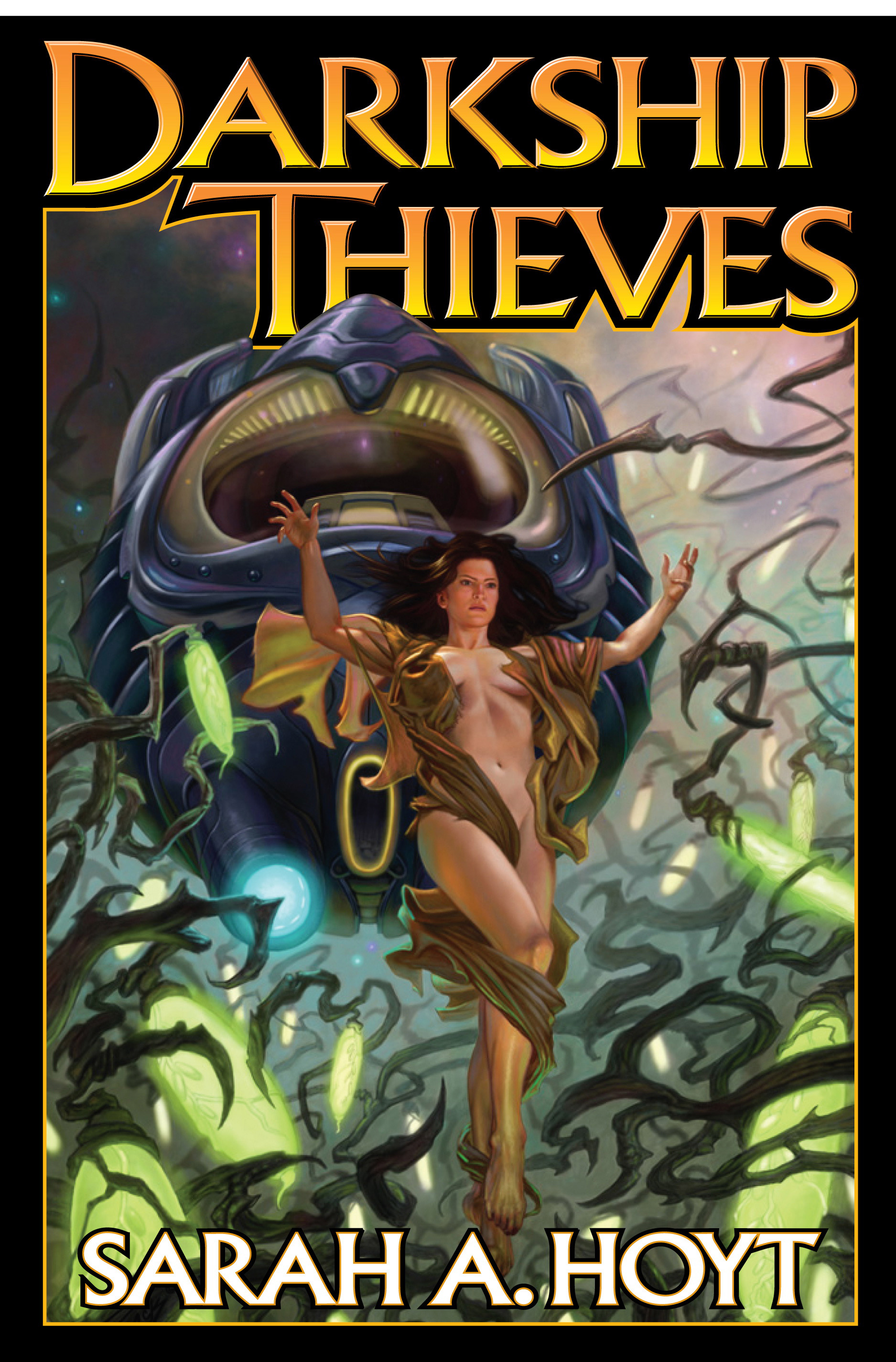
Frankly, the cover I like best, so far, is the Darkship Thieves cover. It doesn’t show a scene from the novel, but it evokes the novel beautifully. First there’s Athena, unclothed and looking like she’s quite sufficient onto herself. behind her is a spaceship and the powerpods twine around her. It has a “Heinlein” feel, says science fiction, and says it’s about a woman. The “sexy” bit suggests romance, which the book does have. Forget that the scene isn’t anywhere near the book (you can’t walk naked in space, okay. No, not even Thena) it’s perfect signage.

And now you know, I think, why romance always has some beautiful half clothed woman in period clothing/not and often being held by a brawny man (but not always.) Because the signage says “Romance” and that’s all. After that people go with title and blurb. SOMETIMES they will also go with “how nice is the cover” which hints at how good the company thought the book was. But that’s all. I can pick out regency romances based on clothing alone. (And do.)

So, how has that changed for the net? I’m seeing a lot more – even in Romance – of just partial shots of a woman in luscious clothing, or a brawny man supporting her. In the seventies and even recently, it would show man, woman, their faces, the ducal mansion, a horse, a butterfly and three kittens. (I’m exaggerating, but look up the covers at smart bitches.) Now it’s tightly focused and uncluttered. Why? Ebooks. Thumbnails.

One of the small publishers, who is trying to go with the “scene from the book” approach has a woman sitting on a buckboard wagon. From the position, in the thumbnail, it looks like she’s doing what bears do in the woods. Okay, it got me to click on it. For all the wrong reasons.

Take the cover for Death Of A Musketeer with Naked Reader. If it were still the market we had two years ago, I’d hate that cover. It’s just a hand, with a frilly glove, holding a sword.

I’ll grant you that mystery covers are in general more sparse (unless it’s funny mystery. No, don’t ask.) but that, on a shelf says “historical book on swords. Non fiction.” On an ebook it says “Hand, sword. What? Oh, Death – ah, mystery – of a musketeer, ah historical mystery. Okay. maybe I’ll download sample!” In other words, for a book I expect to sell MOSTLY in electronic format, it’s perfect.

Do I have a handle on this? Well, no. Cover artists and designers make a living from this. I wouldn’t take over their craft anymore than I would expect them to take over mine. Do they backfire? Sure. They’re human. The problem is, until recently everything depended on the cover. Now, it sort of does. The cover needs to signal the right genre, the right feel, and be intriguing enough for people to pick up the book. It also has to be clear in black and white, which is all the kindle (still by far the largest ebook platform) displays.

This seems to be leading to clear/concise signage and just enough visual interest to encourage download.

What are you feelings, both on cover and on how it’s changing?

*Yes, I HAVE been reading Agatha Christie’s Sleeping murder, again.

Crossposted at Mad Genius Club

The Sum Of Their Parts

One of the things that fascinates me about the world we live in – a world so dominated by media and “reportage of real events” is the often complete divorce of reality and things people “know.”

Let me put this another way – when I was a kid, I would get up in the morning, go out back, tell what the weather was. The facts that mattered for my day: whether grandma would allow me to go get rabbit grass with her; how the cats were doing; if the fish monger had come, were all things I could ascertain. From those I deduced certain patterns, like, I could go grass-gathering with grandma if it weren’t raining. I could count on the fish monger on Tuesday. From that I could extrapolate larger patterns.

This is how our ancestors gathered information, I think, plus the elders of the tribe would say something like “Don’t pull tail of sleeping lion.” In every generation someone would, and it would get its reward, and they’d KNOW it was true.

Unfortunately we live in a complex and rich enough society that this is no longer true. Most of our perceptions of how things work come at two or three removes, starting with the school where the teachers get their perceptions from the people who taught him who often got them from some theorist who had a lovely idea that he didn’t allow facts to clutter.

And then there’s narrativium. Some concepts just work great for stories, even though they’re false. Like, the idea that criminals are victims or suffer from low self esteem. It allows for such a climatic turn around on the book.

The problem is we read it over and over again, and at some level start believing it. And then we try to apply it in reality, and it fails, and we keep trying. (Lack of self esteem creates neurotics and paranoiacs, not criminals.)

The other myth is team work. My own experience with group work is that in very rare occasions when each person takes the part of the project they’re best in and each of them is very good at it, it’s a thing of beauty. Most of the time, it’s sharing of ignorance and kowtowing to the biggest personality, not necessarily the best knowledge/ability.

But my son, Robert Hoyt, says it so much better than I could and relates it all back to writing, too:

Teamwork – by Robert Hoyt

As I made breakfast this morning, I was thinking about the nature of a team. More specifically, I was thinking about how teams are applied, or more to the point, misapplied, in fiction.

I’ll be honest, up front. Most everything people typically say about teams has always sounded entirely wrong to me. The idea that the whole is greater than the sum of its parts has an application, I’ll admit that. But for me, it isn’t here.

I say that because every team is dependent on the individual worth of the members. And the maximum amount of talent any one individual in the team has is, for all intents and purposes, the maximum amount of talent the team has in that area. One million dime-a-dozen modern artists, even united in such an efficient way that they could all have input without trampling each other, would still never touch a single Van Gogh or Da Vinci. All they can do is magnify their lack of ability to eleven.

I’m not saying that a team has equal effectiveness in dealing with something as each individual member of the team sent out one at a time. But that doesn’t say a thing about the strength of a team. The function of the team in this instance is rearranging existent strengths so they coincide. It is akin to parallel processing. It is not that any of the functions I called became any better because I spun them off to separate threads and calculated them simultaneously. The overall result is better because I arranged the functions themselves to do everything at the same time.

I realize this is a generalization, of course. Certainly, it depends on what the team’s goal is. Where each team member must act to maintain the safety of every other team member, and thus input from all the individuals is necessary for maximal efficiency of one individual, I understand how many would feel that the team is a source of strength. On the other hand, that requires qualification. The fact that they are in a team is not adding strength, it is distributing a task each member would otherwise have to devote a larger amount of mental space to across all the members. It thus frees up strength that would otherwise have been inefficiently used, because the task has been made partially redundant. Contrary to nearly every 80s underdog sports film, working effectively as a team will not remedy your problems if no one in the team has the necessary skill.

It was this thought, in turn, that lead me to the nature of a team in writing. It is often said that a team is a team because each of the people involved have a common goal. But that does not mean they all believe the goal worthwhile, necessarily, nor does it imply that they have common motives in seeking the goal. People may work towards a common goal because they were forced to, because they have no reason not to, because they had no other goal at the time, or because the goal is better than the alternative to achieving it.

With that comes the distinct theoretical possibility that every single member of a team is seeking a similar goal for different reasons. On the surface that may seem so obvious it doesn’t even bear mentioning, so let me illustrate the meaning of that a little further with an example.

In the Wizard of Oz, you might be tempted to say that there are four different motivations driving the main characters to seek the assistance of the wizard. If you think about it, however, you’ll realize there are actually two, at most. Despite the different manifestations, the tin man, the scarecrow, and the lion are all driven by a conscious desire to fulfill some personality defect from the beginning. Dorothy is a little more complicated. She is more or less an archetypical Campbellian hero, and her express quest is to return home. In order to do that, however, she must complete her secret quest, which is, like the others, to overcome a personal lack. In this case, it is something that she demonstrated at the beginning of the book but is unwilling to even recognize: she is prone to running away from her problems rather than facing them. In some sense (and probably this is why I’ve never liked the story much), her awkward traveling companions are far more self-aware than she is. On the other hand, her quest is distinguished from the others because the trait she seeks she must actively develop, while the others already have the traits they desire and lack only awareness.

But in reality, the extreme unity of purpose in the Wizard of Oz is very much an exception. Especially because different team members cultivate different skills and, often, have different personalities that drove them to cultivate those skills, the idea that they would all have a common motivation in seeking a goal is almost absurd.

Again, to provide an example, even something as bland as a typical RPG quest to destroy a great evil can entice a plethora of heroes with myriad motivations. A person may seek to destroy a great evil because it hurts other people, and they therefore are morally opposed. A similar motivation that leads to a totally different dynamic is the person who does it because it has hurt them, or someone they love, and they are seeking revenge. It could be threatening to cause them harm, and they are going on the defensive. Or perhaps the evil is hoarding something valuable, and someone is along because they want a cut. Maybe a person is fighting because another person is fighting, and they have an intrinsic trust of that person and their judgment. Or perhaps the motivation is much larger, and the character’s problem is political, or philosophical. A character may even fight because the great evil is unwanted competition. And the list goes on.

All these motivations could be paired with an infinite array of different characters and personalities. The personal challenges that characters face along the way, and their ultimate quests, will vary according to these factors and many others. And here I’m admittedly taking a page from Dwight V. Swain: these goals may be real or imagined, and it is not necessarily the case – indeed, it is very rarely the case – that this is the true problem they must face. Almost any other goal could be the true obstacle they must overcome to complete their quest, otherwise known as their “secret” goal. A hero may be using his righteous anger at evil in general to mask the desire for revenge to a personal slight.

With that in mind, I’ll admit to a low tolerance for a team of cookie cutter heroes off to save the world because they all dislike evil. My problem with it, and the whole reason I’m writing this article, is that it treats a team as a character, rather than as a group of characters. Not only does it read as strange and two dimensional, but it ignores a world of possibilities for character interactions as characters debate and discuss the relative merits of their personal motivations, or bump heads because these motivations lead to different approaches to solving obstacles.

That’s why, certainly from a writing standpoint, I ultimately feel justified in asserting that a good team is not the fodder of Nike ads. A good team is not made by people with the same motivations all taking the same preset approaches. A good team is not a character in its own right that supersedes all the personalities that constitute it. A good team is, at its heart, an organization of individuals who all have distinct and valuable contributions, and needs to be treated as such. The best teams are groups of characters that bring different motivations, and therefore approaches and values, to a problem. This both provides the philosophical meat of a story and simultaneously prevents redundancy among characters, making the contributions of each character more necessary. And that helps keep your story interesting, as well as giving your reader something to think about when they finish reading.

So can a team be greater than the sum of its parts? Well, yes and no. The ability to bring different strengths and weaknesses will get all the characters farther than any individual could have gone. In that sense, the team is more than the sum of its parts. But in order to make it more meaningful than a predetermined “Chekov’s Team”, the team can’t start that way. A team has to start as slightly less than the sum of its parts. They are more interesting, their success is more meaningful, and the individual character growth more believable, when there is always the tiniest bit of friction between the characters and who they are.

In other words, for a team to be greater than the sum of its parts, all the parts have to be a little too big to begin with. By the end of the story, when they’ve all had their rough edges knocked off by each other, every character will be exactly as big as they can possibly be while still remaining in a team. In the end, that will make them a stronger and more capable team than a team of like-minded yes men who set off on a quest together. And thus, they will be better able to take advantage of those benefits a team provides.

Crossposted at Classical Values.