Between The Night And The Morrow — Austen Fanfic

Look here for the beginning of this story:
VI

Oberon’s private chambers were vast and glimmering.  Silver columns supported a distant shimmering ceiling, deep blue like the summer sky and sprinkled with golden stars.  Here and there, near the ceiling there was movement of golden winged fairies and around the silver columns, the sparkling furniture, other movement showed where other elves and fairies lurked, ready to attend to the king’s needs.

But Oberon opened his mouth, and bellowed, in the tone that made the thunder halt mid clap and brought frozen rain onto the most brilliant summer sky, “Out.  Out, everyone of you.”

For a moment, for just a moment, nothing happened, then, from every nook and cranny of the room, from behind furniture and column, from up the ceiling and walls, fairies came pouring, running in mindless terror towards the door of the room.

It seemed to Prince Darcy that the wind of their passage left him chilled and he retained no more than a vague impression of wing, of fleet foot, of golden hair.  One elf dropped a small gold harp, which tinkled to the floor in discordant tones.  He dove for it and got it just as the throng of his fellows was past, but this was enough to earn him another , “Out!” from Oberon, and the elf was gone so fast it seemed a miracle his golden hair didn’t catch fire.

Oberon stalked after them and slammed the door himself, leaving his chamberers on the other side.  Then he turned on Darcy, “That you should presume,” he said.  “That you should presume to question me, and in my throne room, too, in my assembly, that you should question me about mine and your grandmother’s private affairs.  That you dare confront me.  Do you think, then, Darcy, that you have the power to face me, should I choose to crush you.”

Darcy should have been – perhaps was expected to be – as frightened as those elves who had gone skittering out the door.  But he was not.

He could feel the not inconsiderable magic that his grandfather poured fourth with his speech, of course, in an attempt to make everyone in his path cower.  But Darcy had enough magic of his own to block that, and instead to hear to the king’s speech as words, and to look into Oberon’s eyes and see there…  What?  Fright surely, and something else, a sense of horrible loss, Darcy thought.  But loss at what?
“You will speak to me,” Darcy said.  “Because I must know.  That you told me, in all the storied years of your existence, you had one child only, my mother, and my mother died in childbirth, one of the few deaths that can blight our kind.  And therefore I am your heir and Georgiana after me.  I know you’ve had other children both of you, separately,” he said, as Oberon started to open his mouth.  “I am not so foolish as to think you hold to human fidelity.  Not when you live nearly forever.  BUT in those years, you had only one child the two of you.

“You told me so and so I believed.  But now I come across a woman who is descended from both of you.  So, unless my mother had a child before she died, a child with a mortal man…”  He paused.  “But I understood she never lived that long, and this young lady is descended from one of your descendants centuries ago.”  He looked up and saw that the pain was stronger than ever in the king’s eyes.  “I will not be fobbed off,” he said.  “I will not be condescended to.  I know one does not shout at kings, and yet I did.  I know one does not question kings and yet I must.  Can’t you see, grandfather, that if I must fight the traitor in the world, I must know as much as the traitor knows and more.  And it is clear to me the traitor knows more.  He said…  He gave as one of his reasons for deserting that fairykind was overtaken with half-bloods.  Grandfather,” he said.  And in his mind was those memories that had assailed him while dancing with the Bennet girl.  Till now he hadn’t thought of it in words, but now he realized what it must mean.  “Grandfather, it was not just Carolus Bingley he spoke of was it?”

The king’s lips compressed tight.  The king growled a half barked, “No,” and then added, “That he would dare, the impudent pup, as though he had it in him to comment on what his betters–”

“He dares, grandfather.  And I must know.  What does he speak of?”

Now Oberon stopped and looked at him.  “It will hurt you.  I would go a long way not to hurt you.”

And Titania clasped Oberon’s arm, and said, “And yet, I think we must tell him.  And also telling him, perhaps, my lord, will help prevent the same from happening yet again.”

“The same?” Darcy asked.

Oberon sighed.  He started pacing the room, his hands clasped behind his back.  “You know we’ve lived for millennia.”

“Yes Grandfather.”

“We are not as fertile as the mortals, and it stands to reason,” Oberon said.  “Since compared to us they’re like the mayfly, born only to die before the day is through.  If they had children only when we do, then their entire race would have died aborning.”  He sighed.  “But we do have children, and over the centuries, your grandmother and I have had six children.  Six princes and princesses of fairyland.”

“Six?!”
“And yet we have no heir.  Because lo, every time one of them comes of age, he comes in contact with human kind.”  Again Oberon sighed.  “I cannot tell you that I never felt the attraction of the mortal.  They live shortened lives, and therefore are they full of fire and passion, which we lack.  But they are not of us, and I do not understand why all of our children have chosen mortal love over immortality.  Leaving me without an heir.”

“Leaving us without descendants.  In fairyland.”

Darcy felt as though his legs had suddenly turned to water.  One thing was to think, another to know.  And he’d only thought vaguely and at the edge of his mind that perhaps his father was a mortal, while for years, for his whole life – the memory of being a child in the mortal world intruded and he amended – near his whole life, he’d known he was a pure blood.  A prince of fairyland spun of air and magic.  Now he found he too had coarse mortal stuff in him.  He backed onto a dainty chair, and dropped into it, heavily, as his legs gave out.  And hoping against hope, he asked, “My mother?”

“Your mother fell in love with George Darcy, a gentleman of private means who owned a property in what the mortals call Derbyshire.  Nothing to compare to my estates, nothing…  I don’t know what she saw in him, but she started haunting his lands when he was no more than a lad, and by the by she gave up her estate and her powers to marry him.  And she had two children.  And she died of birthing Georgiana.”  He took a deep breath.  “We’ve gone through this in the past and seen our beloved children go out into the world of mortals and die, and have children that die.  We could not bear it.  And so, we sent our agents to collect you and Georgiana and bring you home to us, where you could be brought up as your own kind and where you could still learn to use your magic, while young.”

Darcy sat a long time, as he absorbed this relation.  His head hurt, an unaccustomed weakness.  Didn’t only mortals heads hurt?  Was it his mortal half that hurt?  He felt tears prickle at his eyes and elves didn’t cry.  Not really.  He felt cold and hot by degrees, and totally unlike himself, only he could not remember what himself was.

From his lips, in a voice that was not like his own at all, came strangled words.  “Alas.  My entire life has been a lie.”

Free Novel — Witchfinder, chatper 13

UPDATE:  A SLIGHTLY EDITED AND PRETTIED UP COMPILATION OF ALL CHAPTERS UP TO A WEEK OLD IS HERE

*This is the Fantasy novel I’m posting here for free, one chapter every Friday.  I’ve been posting director’s commentary at the end of chapters, but I think it detracts from the experience, so I’ll do that on Sunday, instead, for the previous chapter.  If your conscience troubles you getting something for free, do hit the donate button on the right side and down.  Anyone donating more than $6 will get a non-drm electronic copy of Witchfinder in its final version, when it’s published.   And, oh, yeah, the cover sucks, but I haven’t had time for a new one.

Oh, this is in pre-earc format, meaning you’ll find the occasional spelling mistake and sentence that makes no sense.  It’s not exactly first draft, but it’s not at the level I’d send to a publisher, yet.*

For first chapter, look here

For 12th chapter, look here

Changeling

Nell clutched the blanket tightly around herself and wondered what madness she’d fallen into.  The entire night – indeed, the entire time since her interview with Sydell had acquired a feeling of unreality.

She had to be dreaming.  Antoine could not be dead, lying cold and pale on the floor, on that makeshift pallet, staring at the ceiling with unseeing eyes.  Antoine had been…

In her mind she remembered the first time she’d seen him, dressed in jeans and a pale blue t-shirt and looking very much like a twenty something year old computer repairman.  Which was what he’d said he was, that first time he’d taken her out for coffee.  But then there had come the hints that not all was as it seemed, you have great power he’d told her, and, by the time he’d shown her how to open a portal, by the time he’d given her a glimpse of other worlds, it had become obvious to her that he didn’t mean this as a metaphor.

Perhaps the dream started then, she thought.  Perhaps if she closed her eyes and believed really hard, she’d wake up back at her desk, in front of a computer running some routine.

“Caroline,” Darkwater said.  He spoke very softly, his voice all the more terrifying for seeming so unnaturally calm.  “What do you mean by a changeling?”

Nell didn’t want to know what he’d been doing, or what had been happening in this household since she was last year.  It was clear to her that though Seraphim had recovered from his near-brush with death – or at least this time Gabriel Penn didn’t seem to be making desperate attempts at reviving his half-brother, he still looked near death.  He was pale, his green eyes surrounded by dark circles, his lips looking dry and colorless.  And the aura of magic around him looked faded.

This was all the more puzzling since Nell gathered that more than a day had passed since she’d been here.  His power should have recovered more, unless–

Unless something else had happened to make him lose strength.  She remembered the talk by the lake, about how someone had attempted against Seraphim’s life.

The gardeners, the under-gardeners, and for all she knew the stable boys, all those men who had been on those boats, in the lake, had been – if what she understood of their talk was right – trying to record the event, so that Seraphim would not be condemned for murder.  But that meant that he had been attacked by Antoine.  Or at least he thought he had.

She felt vaguely sick.  She didn’t know when she’d stopped being in love with Antoine, but she’d never suspected him– No, that was not true, either, over the last months she’d suspected him of perfidy often enough.  She simply had never been sure enough of it to consider doing anything that would endanger his life.  It seemed like a very foolish thing to condemn a man to death simply because he might not have been straightforward with her, or because he had deceived her by telling her he loved her.

But she had suspected he had lied to her, and more.  First, because it seemed very unlikely that he’d come to Earth in search of her power, her aura of power, as he called it, guided through different worlds by the call of it.  Since she’d been in Avallonis, Nell had gathered that her power was indeed strong, and indeed large.  But to call someone between worlds?  That didn’t even make sense.  Even the stronger magicians, even with scrying powers, had to be looking for something specific before they homed in on a pattern among universes.  Simply having a strong pattern didn’t call anyone.

Second because she’d seen for herself that Antoine was strong and accomplished, and knew his way across the multi universe.  And if that was true, how could he be so foolish as to transport into Avallonis without a care, and let himself be caught in Sydell’s trap.

No, there was more there than he’d told Nell.  He had come here for some reason, and if it hadn’t been to fall into the trap, still it had to be for some reason more important than that he found the world fascinating and wanted to show it to Nell.

But still– But still Nell didn’t think that Antoine deserved to die, and now, she couldn’t think or believe that Antoine was an assassin.  Myriad ideas combated in her mind.  What if this weren’t real Antoine, but a clever simulacrum?  What if this was all designed to make her break and tell all to Darkwater?

Except Darkwater wasn’t even looking at her, but at the intense dark haired young woman, who looked so much like the Dowager Duchess.  “How do you know it’s a changeling, Caroline, and not simply Michael in a trance?”

The girl they called Caroline shook her head.  Her hands pleated nervously at the skirt of her robe.  “It’s not Michael,” she said.  “It can’t be.  Even in a trance he would wake up when I came in.  He would react to my magic.  Seraphim, he is all pale and his eyes are blank, and he looks… well, he looks more perfect than any normal human can look.  And …  And…”  Her voice rose in a wail of distress.  “Mama says it is a changeling.”

After her outburst, she took a deep breath and exhaled forcefully, and thrust her head and chest a little forward, as though she expected her brother to challenge her.  Darkwater didn’t challenge her.  He opened his mouth then closed it, then opened it again to say, in a voice that was little more than a whisper, “Mama?”  He looked up and to the side, to where Gabriel Penn stood beside the sofa, seemingly keeping guard over his wounded master.  The two men exchanged a glance that contained in it volumes of information Nell would give something to acquire.  Both of them looked grave, and whatever wordless communication between them, it didn’t dispel their fears, as both looked even more worried after it.

“One moment, Caroline,” Seraphim said.  “I will come with you, in a moment.”  He glared over his shoulder at Gabriel’s exclamation, and Nell could see Gabriel making an effort to prevent himself from further outburst.

Darwater turned away from his half-brother, and to the two men with the pallet on which Antoine lay.  “Take him to the cold room,” he said.  “We must notify the coroner of the death.  Send Jem, on a fast horse.  Tell him I will be available for interviewing no later than tomorrow afternoon.”  He looked back at his sister, “And now, Caroline, I shall come with you.”

“Your grace,” Gabriel said.  “You are not well enough to–”

“There are duties,” Seraphim said, ostensibly talking to no one in particular.  “Which one cannot delegate, no matter how tired or ill one is.”  He made an attempt to rise, supporting himself on his cane, then turned to look at Gabriel.  “Give me your arm, Penn.  I believe my strength is not equal to what I’d like it to be.”

His strength was not in fact equal to much of anything, Nell said, as she noticed how Gabriel Penn not only allowed the Duke to hold onto his arm to rise, but put his arm around the Duke’s waist to support him.  How ill was the duke, and why?  Had he really sent the killing bolt that killed Antoine?  She shivered at the idea, and, as the gentlemen who’d brought Antoine’s corpse in prepared to take him out again, she realized she’d been forgotten.

The Duke and Penn were following Caroline Darkwater out of the room and Nell thought she could stay here, until Darkwater had solved whatever problem had now visited his house, and came back to his room, and remembered Nell existed.  Or she could go with Antoine’s body and keep up some sort of vigil in the cold room – perhaps try to discover if that truly was Antoine’s corpse or some contrivance that looked like it.  Or…  Or she could follow Darkwater and Gabriel Penn and find out what had happened to the Duke’s younger brother and what else might be behind the turmoil in this household.

She pulled her blanket tighter about herself.  It truly didn’t make her any warmer, because her hair was dripping wet.  But it made her feel somehow more protected.  And then she started behind the Duke and his half-brother, as though she had every right to follow them.

The gardeners were waiting, with Antoine’s body, but she thought that the maids, stationed on either side of the door might stop her.  So she threw her head back and looked very haughty indeed as she went by them.

The maids didn’t move.  They didn’t even look at her as she walked past.  She’d have suspected magic, only she’d learned in Avallonis the value of a good pretense and a good display of arrogance surpassed all logic.

The maids didn’t even follow as she walked after the Darkwaters and Penn down a long, marble-paved hallway.  Really, the one thing about this world that kept astonishing her was how the houses of the noblemen looked more magnificent than anything she’d ever seen on Earth.  Take the way the hallway ceiling arched above, painted a deep blue and sprinkled with gold stars.  It was like something out a theatrical set, rather than something you’d find in real life.

It would testify in favor of this being a dream, except that in dreams one’s feet didn’t ache with cold and slosh in shoes that felt like they’d fall apart every time she took a step.  And in dreams it was very rare for one’s hair to drip down ones back in a disconsolate, icy dribble.

They walked down the hallway, then up a curving staircase, then down another hallway.  As Nell tried to orient herself, she realized they were going towards the southern wing of the house, and, from what she remembered of the house’s exterior – which wasn’t much as she’d only ever seen it from the back, while approaching it, the other two times she’d magically transported into and out of it – to a little tower that protruded out of it at that corner.

She knew she was right when, ignoring the hallway to the southern wing, Seraphim, instead, opened the door to the tower.

The Darkwaters, followed by the quite disregarded Nell, entered a huge, circular room.  The tower might look small from the outside, but that was, Nell judged, because it was dwarfed by the other elements of the massive Darkwater house.  Inside, the tower was one vast room.  Vast enough that on Earth it could have passed as the lobby of a very large hotel.  Its architecture too resembled something one might find in a hotel lobby, being largely unimpeded: just one vast circular space, going up far more than one story to–

For a moment Nell looked up, disbelieving because it seemed to her as though the tower had no roof, but, instead, were open to velvety dark summer night sky, with naught but a golden spider web of some sort, between them and the night.  Then she realized the golden spider web was a framework for glass, and that the tower was one vast observatory or perhaps some sort of conservatory.  And that roof had to be held together with magic, because with the technology of this world there was no way to keep that much glass up with so little metal.

Then she looked down and realized that there was more magic at work here than the roof.  The space might be free of architectural abstractions, but it was filled with machines, and … contraptions, for which Nell had no name.

In the way of this world, these machines, no matter how utilitarian they tried to look, were made of polished brass and leather and wood, and their rounded shapes couldn’t help but looking pleasing.  And they were animated.  Arms moved, gears turned.  Something that looked like a giant telescope pointed at the ceiling, gyrated slowly on a frame, clicking gently in a steady rhythm, while a mechanical arm attached to it wrote steadily with a quill on paper.

In the middle of all this, perched on what looked remarkably like a high barstool made of brass, sat a young man, probably Caroline’s age or a little younger.  He was so young, one might still be able to call him pretty without offending too badly.  He looked like a version of Darkwater, or perhaps of Gabriel Penn, made of clay that had yet to harden, or like a sketch of one of them done hastily and left too smooth and soft.

He didn’t turn to look as the party approached.  The Dowager Duchess, who stood next to him, looking at him, intently, as though he were an object that must be puzzled out, did turn to look at them.  “Seraphim!” she said.  Then she hastened towards them, hands extended.  “You shouldn’t have come.  Indeed, you look very ill.  And there is nothing you can do here, you see.  Michael has been taken.  They’ve left this in his place.”

“Mama, are you sure–” Seraphim said, and stopped.

Nell was sure he had stopped because, like her, if he unfocused his eyes and brought his mage sight to bear, he could see that the thing on the stool was not and had never been a human adolescent.  It was more akin to an animated sculpture made of ice, or perhaps intersecting nodes of light and power.  Something that could only impersonate a human for those with no mage-sight.

Changeling.  That was a thing the elves did, wasn’t it?  Was this creature an elf then?  Or merely a construct the elves had left behind?

A Very Personal And Localized Insanity

UPDATE: answers at bottom.

It is said that friendship is forged of a fund of common jokes that might be QUITE opaque to strangers.  If this is true, my family is very friendly with each other, as we by and large all like the same books, movies, comics and various other things and have collected the same fund of jokes.

1- Tonight my older son told me he dreamed he was in a restaurant and couldn’t find the egress.  To which I told him, “Of course not, you don’t eat _____    _______ .  I think they’re on the protected species list.”

2 -The correct reply to a family member saying “I’ll have something light on a cracker” is “Like for, for instance, this ________  ______”

3 – “Lacking in practice, Monsieur D’Artagnan had a most extensive _____”

4 – When someone in my family says “this is called bad luck” they’re referring to ___________

5 -Beware of strong drink because?

6- And without garlic they taste like?

7 -If you tell someone at the table that you’re under a geas, the correct answer is “Funny, I don’t see any __________”

8 – While I might have a certificate saying I’m sane, WHO has a character saying he’s human?  (And should my younger son have one?)

9 – “Bzzz Bzzzzzzzz” is a quote from which famous poet?
The appropriate answer to “I now understand English?” is?

10 – From whence comes my husband’s favorite response when, usually late at night and in a snowstorm, the rest of the family decides we MUST go to Denver and have dinner at Pete’s Kitchen?   The response is “And yet, I am unmoved.”

11 – When your computer breaks down and you’re an SF geek, regardless of your religion, the appropriate response is “Saint ______________   ora pro nobis.”

12 – When my husband says “Mrs. Hoyt, Life holds few distinctions, but I can say here sit two of the geekiest boys in the US” he’s referring to?

13 – Hint, it is the same thing I’m referring to when I’m tired and trying to convince my husband to go to Denver for a weekend, and say “I want to go to BRIGHTON!”  (Usually followed by “And yet, I am unmoved.”)

14- If it weren’t nailed to its perch it would be?

15 -“Lord,” groaned Don Camillo, clasping hands and looking up at the crucifix, “My hands are made for blessing but ____  ____ ____”

16 – A truly easy one: “he is only mostly ______”

17 – Also, when speaking about my politics in conjunction with my career, quasi ante, when it all had to go through the establishment, my kids were likely to break into which which Monty Python skit?

18 – AND for bonus points, and those of you who have read Kate Paulk’s ConVent, when I’m shopping for clothes and my older son tells me, “No, mom, no DEMON wear” what am I trying to buy?

1-female eagles (Pratchett)

2 – wild boar (Asterix)

3 – theory

4 – Throughout history, poverty is the normal condition of man. Advances which permit this norm to be exceeded — here and there, now and then — are the work of an extremely small minority, frequently despised, often condemned, and almost always opposed by all right-thinking people. Whenever this tiny minority is kept from creating, or (as sometimes happens) is driven out of a society, the people then slip back into abject poverty.
This is known as “bad luck.  (Robert A. Heinlein.)

5- It can make you shoot at tax collectors.  And miss. (Robert A. Heinlein.)

6 – snails (Pratchett.  I shall wear Midnight.)

7- Beth got it close.  “I don’t see any geese around here.”  (Pratchett)

8 – Speaker has it, it is Pratchett.  Nobby has a certificate saying he’s human.

9 – Shakespeare (Hamlet.)  Right up there with “Now, die, die, die, die,” from Midsummer’s Night Dream

10 – Pride and Prejudice by Jane Austen, though in the A & E mini-series format.

11 – Saint Leibowitz, ora pro nobis.  (Canticle for Leibowitz.  He was the patron saint of gadgets.)

12 – Pride and Prejudice.

13 – Pride and Prejudice again.

14- pushing up daisies.  (The dead parrot skit, Monty Python.

15 – but not my feet.  (The Little World Of Don Camillo, Giovanni Guareschi.)

16- Speaker has it again “mostly dead.”  (The Princess Bride.)

17 – The albatross skit.

18 – Oddly no, Drak.  You see, demons have no fashion sense and whey they try to dress fashionably, their taste gravitates to sequins and spangles.

Everybody Knows

“There were so many people you just had to meet, without your clothes.” Leonard Cohen

The title of this blog post (and the tag line) were suggested by my older son, as we were talking about how fast, how strangely, and how unbelievably the “truths of a publishing career” are being overturned.

Mind you, this sort of state is “normal” in the society we live in.  I suppose once upon a time it wasn’t?  I mean, I suppose back in the middle ages, you actually knew what was truly approved and disapproved of by the establishment, and it stayed like that a good long time.  Oh, no doubt there were unspokens and double reverses, but it – in the end – was fairly easy to follow the game and everyone knew the score.  (Of course, not knowing it or mouthing off a little too early in the change of guard could get you killed.  Quite possibly what happened to Christopher Marlowe.  Even though he lived in the renaissance and, of course, in a time of great change, what with the religious “in” side flipping every few years.)

My adult life has been more of a theater of the absurd, when it comes to being in and out of favor with the establishment.  For instance, when I first came to the States, as an exchange student, my brother carefully went through my books and tapes, in case I had a communist in the lot (not many.  Couple of French musicians) because we all KNEW communist books/songs weren’t allowed in the US and the establishment was strongly anti-communist. …  While when I arrived here I found a sort of chic fellow-traveler-ism prevailed amid the intellectual and the upper classes.  I could not only have proclaimed myself a communist without being in trouble – I would have been lionized.  In fact, a certain amount of moral equivalency was necessary at the end of the cold war to be considered “smart” and intellectual.  (And in many circles it still is because of the abject dereliction of duty of our press and historians and publishing establishment in reporting the true realities of soviet life.  Never mind.  This is NOT about politics, but about what is perceived and what really is.)

Leaving politics aside we get to publishing, which is what this is about.

Part of the reason this happens is because humans are designed to fit in to a group.  They tend to establish their group credentials in adolescence, and after that have difficulty perceiving if things have changed.  This is why in every human society there’s always been an “old guard.”  And that changes very slowly.  In the modern era, say, since printing became cheap, people are “educated” by a generation too far.  We read “children’s classics” which inculcate us with the perceived groups and cliques of a generation past.  The same for movies and TV.  This explains why often you talk to people who seem to think “establishment” and “anti-establishment” are frozen circa the 1950s.

This is how come writers think they’re being edgy and “countercultural” or “speaking truth to power” while advocating such things as female liberation, religious dissent or sexual freedom: all of which are the stuffiest and most approved-of notions in publishing.  In fact, if you’re advocating any of those, YOU ARE the establishment.  Advocating the opposite might cost you your career, or worse.

We’re simply not adapted to a society where things upend in between generations.  It’s startling and a shock, and eh, leads to very funny commercials where someone informs an old boomer he is “The Man.”  While there have been generation gulfs and cultural contrasts in generation handoffs for centuries, they’re usually not as stark as now.

Part of what causes this is the acceleration of tech innovation, which is hitting all groups, more or less, and has now come home to beat up on writing as a field.

With the advent of e-readers and the subsequent burgeoning of ebooks, and the possibility of a living, if not a fortune, from indie publishing (so far I have only shorts out, but I’ve made more this month from my shorts than my novel royalties.  Something to think on) our world is not only upending, it is twirling round like a windmill in a hurricane.

So.  It’s not so much a matter of “people perceive things as they were fifty years ago.”  That is, at least, usual for humans.  It’s more of “people perceive things as they were everywhere from fifty years to last month and they’re ALL outdated already.”  Even I, who have been trying to retool my mind to this since … oh, June or so, am having trouble adapting to what’s actually happening instead of what I’ve known “was happening” since I started in the field.  I mean, there are sooo many little adjustments, and so many things I never thought would change, and other things I didn’t even realize I thought until I came up against the hard fact that “this is not so anymore” and then I realized it had been so.  This is not an exhaustive list, but simply what occurred to me as I type.

First, what I thought was set in stone, and has now changed:

1 – Self publishing is always a bad idea and will taint your name forever.  Ah! Ah ah ah ah ah ah ah!  Ask that to Amanda Hocking, or for that matter to Larry Correia whose first book was self published.

2 – The real money, the real recognition and the real professionalism is with the big houses.  Again, we’ve had enough professionals now making a very good living and get recognition and professionalism through independent publishing in ebooks.

Second, what most people still think is so, but… not so much

1 – you’ll get guidance and your talent will be developed by a big publishing house.  Pardon me while I laugh with multiple exclamation points!  Not for the last couple of decades.  The closest you’ll get to this is Baen and they’re not really “big.”

2 – If you write a great book, you’ll have a great career in traditional publishing.  Uh. uh.  Yeah, IF you have the right connections, the right look, the right… yeah.  AND if you’re lucky, even with all that.

3 – If you’re insecure, you should always go with traditional publishing, because you’ll get the affirmation you need.  You’ll know you’re good if they take you.  (Uh, uh.  sure thing.  Only, uh… be ready for the series of kicks in the teeth that come from being treated as disposable.)

The less obvious, which I’ve come to terms with

1 – One no longer needs to lay low for fear of saying something that will offend the establishment.  For one, they have troubles of their own and are unlikely to have time to beat you.

2 – Where it used to be (see the Leonard Cohen quote) that you couldn’t talk back of even defend yourself (yes, Dean W Smith said we should demand our professional dignity, but up until recently, those of us who came up in the last ten years simply couldn’t.  I saw people being shut out for objecting to mistreatment.  EVEN when they were patently right.  NOW you can complain.  And you should.  You’re not an indentured servant in a company town.  You’re a professional.  Ask to be treated as such.

3 – I don’t
Have to take a contract with a clause I can’t stand.

I don’t have to make nice to editors or writers I detest (the good side of this?  If I’m nice to you, you know I like you. Possibly quite a lot, since by disposition I don’t go out of my way to make nice.)

I don’t have to put a book in the drawer because no one will buy it.

I don’t have to write proposals and send them out.

I don’t have to write books I don’t want to write.

I don’t have to twist my books to make them acceptable to someone.

4 – I can

I can now write books from the heart.

I can make a living (probably) writing exactly what I want to.

I can slant my writing exactly as I wish.

I can bitch when I get a bad edit; bad cover; bad marketing.

I can try other routes and other options.

And I can fail, but fail on my own terms.

And the ones I’m having trouble twisting my mind into accepting

1 – I don’t need to aim for the “big” novel, where big is defined by what will do well in traditional publishing.  (Or what people think will do well.)  Instead, my progression can be individual and to what I consider “good.” The ladder to success is now a staircase, and it’s my staircase and I can climb it sideways, if I wish to.

2 – I don’t need to tell anyone if I decide to write under a closed pen name.

3 – I don’t need to travel to cons when I don’t want to, to meet editors or agents.  (I will travel to cons I like.  And I will sometimes go to cons to meet fans.  That’s different, though.)

4 – Contacts with peers are as important as contacts with those ahead and in power over you.  Because the road is being forged as we walk it, having a group along to point out the pits with stakes at the bottom and to tell us when the lion is lurking behind the trees is a good thing.

So, is everything beautiful in the garden?  No.  Note my “I think” before things like making a living.  I think I can.  I think this will work.  BUT things are changing so fast and so completely no one knows where they’ll be in a year or two.  Heck, in a month or two.

However, for now, and unless some catastrophic event intervenes, the direction seems to be for more freedom for the writer, and more ability to forge our own path.

And it’s a beautiful feeling.

The Three Hanky Dance

Or how to make your readers cry floods of tears.

Yeah, as if I know that.  Well, I can give you a lot of tips and hints, but in the end I find that though readers do cry at some of my scenes, they also cry at scenes that I never intended as crying points.  However, I’ll try to give you a few tips I’ve hard-earned along the way.

1 – Don’t be afraid to tug on the heart strings.  Believe it or not, readers are not in general reading your shining prose for sparkling language, historical information or a fiendish puzzle.  Oh, some of them might be, but think on it.  The books you remember are not the ones that taught you something or where you learned a new word.  At least not the FICTION books that you remember.  For that you read non-fiction or, for the puzzle, play games.

As someone noted in my comments, a novel is an emotional experience.  (A short story too.)  It’s the closest you can come to experiencing someone else’s life.  (Yes, more than movies.  There you just SEE someone else’s life.)  I suspect as the stigma and brownie points of being seen with a book fade away, you’re going to see more novels succeed that go, unabashedly, for the highs and lows of emotion.

So, don’t be afraid of those.  Set out deliberately to create the situations that will test man’s souls (or women’s.  Or small fuzzy animals.  Or dinos.)  I recommend you study deeply upon Shakespeare, who never forgot to take the viewer’s heart and TWIST.  When does Romeo kill Juliet’s cousin?  Why, while she’s waiting to consummate their marriage, of course.  And does she find out about it before Romeo comes in?  Oh, yeah, of course.  For that matter when is Romeo forced into a duel with her cousin?  Why, as he comes from church, from marrying her.  Study Shakespeare, he never let the trying things undone.

2 – Don’t cringe at corny.  This one is hard for me, because I come from a stiff-upper-lip tradition.  We’re very good at reading emotion in a lifted eyebrow, an upturned lip, or even a silence.  But remember the objects in the mirror effect of writing on the page.  It’s amped down a bit.  You won’t feel it as strongly as if you saw it in real life.

My husband recently was reading a story where the culmination of it was that the man this woman had finally fallen in love with was the same one who’d sent her comforting postcards when she was a litle orphan with no one to love her.  AND after that lip-trembling revelation, the author piled on with something like “So, you see, you’ve always been mine to look after.”  My husband’s reaction was “I could see her tugging at my heart strings, but it still worked.”

Shakespeare is also a good guide here.  Does Lear just carry his dead daughter or whatever?  No, he laments and his lament is heart rendering.  Corny it up.

3 – Pile it on.  With a shovel.  Your character just lost his entire family and remains unbroken?  Have his faithful dog crawl out of the wreckage of his house (brief moment of joy) only to expire at his feet.  Go on.  I DARE you.

4 – Never let a death go to waste.  No matter how minor a character you’re killing, make them important/valuable or hapless before you kill them.  Make their death unexpected, unfair, just plain cruel.  Clifford Simak made me cry floods of tears over the death of a stray dog, simply by having him cross the street, wagging his tail, happy-doggy to go lie in a patch of sunlight, before a ray tears him apart.  It made me cry because the dog had been all happy, hadn’t been expecting death and it was UNFAIR.  I.e. the death had nothing to do with him, but was an alien invasion.  He couldn’t have avoided it, and he’d been so HAPPY.

5 – Have your character’s noblest act be misunderstood and punished.  The instinct of fairness is very deep in humans.  A situation like that WILL make us cry.

6 – Sock them with a happy ending when they least expect it.  The hero that crawls out of the blazing inferno is such a cliche because it works.  But you don’t need that, or even a coming back from the dead.  Just anything unexpected and suddenly good, after relentless struggle, will break your reader’s defenses and the floods are likely to come.

And that is the sum of what I know.  Sometimes it doesn’t work.  And sometimes what you don’t expect does work.

Go forth and make them wring their hankies.

A Tsunami Of Bath Sets

I swear this is about publishing, so bear with me.

A quick post, as I slept very badly (for reasons having nothing to do with anything emotional.  Just one of those nights.)

I hate having people give me gifts.  I’ve mentioned this before, right?  Oh, not everyone.  There are exceptions.  My husband, for instance, is one of those supernaturally good gift-givers.  His gifts to me have ranged from a little glass owl to two pounds of cold cuts, and in each case they were exactly what I wanted.

On the other hand, the man has an ace in the hole – he can always give me a red rose and I melt.  So… hard to go wrong.

There have been other superb gifts throughout my life, but most gifts fall in the category of the ones this guy blames on (and might be) Aspergers.  Even when people know me – I think – relatively well, I find myself looking at something that , at best, I wouldn’t have looked at twice in the store, and feeling like I failed a test.  Why feeling like I failed a test?  Because… what did I do or say to give them the impression that I…  Etc.  When people don’t know me it can be worse.

I’ve found, for instance, that people latch onto something about me – not just in gift giving – and they seem to think that’s all of me.  Like, conferences STILL put me (sometimes exclusively) on the “Shakespeare panels” or create them just for me, because they think it will please me.  Do I like Shakespeare?  Sure.  It was one of my favorite things in college.  To be honest, though, partly it was to escape reading the more modern stuff.  Also, the study of his biography is fascinating.  But I also enjoyed Jane Austen, I love Dumas and I did my master thesis on Flannery O’Connor.  None of which, btw, compares to my obsessions with Heinlein, Simak, Pratchett, or even Rex Stout, Christie or Ellis Peters (And we won’t mention the Lord Meren series which I wish the author would self-publish and finish.)  So, you know, it’s not like Shakespeare is the all consuming light of my days.  And as for my trilogy on Shakespeare, well, it was in another publishing “country” and besides the series is dead.  I might go back to it, but it’s about as relevant to my work life as Dumas and arguably less so than Heinlein.

So, you see why I have issues with receiving gifts?  Not that I’m any better at giving them.  Gifts I give fall into three categories: the gifts I KNOW the person needs.  This is usually only my closest friends and relatives.  Like, say, I know one of the kids needs new slippers.  Then there’s the gifts I think people will like.  Again, I’m only good at these if I know you REALLY well.  Like, we’ve been friends for years with someone and know that this particular sparkly or that particular statuette is just right, or perhaps JUST ties in with something they’re writing.  Or I know the type of chocolate they love.  That sort of thing.  Of course, it also helps if the person has a prominent hobby-interest that consumes their free time.  Like knitting, or cooking or something.  A lot of people do, but writers and my family tend to be more eclectic.  After that there are “broad category gifts.”  These work best for kids.  If you buy a set of blocks, chances are a two year old will find a way to play with them.  But after adolescence it becomes iffy.

I’ve never fallen into the “give someone something you want.”  Well, not since I was ten and gave my brother the complete book of dinosaurs because that’s what I wanted.  (He’s ten years older and was in college, in engineering.)

I’ve always assumed these gift dysfunctions, both giving and receiving, were peculiar to me, however, studies show that in fact, about 80% of gifts people receive fall into that “OMG, what am I going to do with this?” category.  I think this is why there’s this rise of near-generic gift sets: bath sets with nice-smelling soap and cute towels.  Or coffee sets, with mugs and a couple of generic-brews and biscoitti.  That sort of thing.  (And I shudder to think how many times the non-food ones [one hopes] change hands before finding someone who really, really wanted them.)

Which brings us to the publishing industry.  I TOLD you we’d get there.

I will grant you that I’m not the best informed on the history of the business workings of our field.  However, from reading biographies about the pulp days, it seems to me there were various niches.  People who liked a certain kind of horror tended to read the output of a certain publisher, say.  Same for sf and f.  The closest we have to that is Analog, which could be called “science fiction for geeks.”  (Guilty as charged.)  And Baen which could be called “We’re okay with character, we like science/history accurate, but no plot no sale.”  And that’s fine, too.

But both Baen and Analog have had fairly clear personal directions and hand-offs, while the rest of the field has been a fest of mergers, short-lived under editors (short lived in position, mind, not saying anything about lifespan) and such.

And the selections of the other editorial houses has been much like the result of getting gifts from strangers.  I mean, most publishers these days have under-readers who are (beyond overworked and stressed) not of the field.  They might have edited romance last week, they’re editing sf/f today. Most of them have never been to a con.  They don’t know us.  And then, it’s not just editors.  In the major conglomerates these days, you can’t buy a book without “buy in” from the sales persons.  And then after that, the sales people/distributors decide what they’ll push.  To the extent that bookstores still get any say, they decide what to unpack or not.  And most of the time, these people are not of us.

This seems particularly important for sf/f, but mind you, mystery readers have their quirks too.  Romance is more of a broad church and might be easier to serve, or at least it has well known niches, which is kind of like a giftee having a hobby.

So, the kind of books that keep getting “push” and which used to be hits just by virtue of distribution – since both publishing and bookstores became conglomerates – were:

1 – the generic – i.e.  “Spaceships/dragons, decent grammar.  Those sf geeks will love it.”

2 – the repetitive – i.e. “It’s just like that Rowling chick we published last year and they loved that.”

3- catering to hobbies – i.e. “Well, I know tons of people like knitting.  Let’s do knitting mysteries.”

4 – catering to fads – “there’s that series on TV about chicks, sex and shoes, let’s do all our mysteries about chicks, sex and shoes.”

5 – catering to general categories “this book will appeal to all the sexually frustrated middle aged housewives.”

6 – and finally “what I would like to read” – which works great, if you are a graduate from an Ivy League school about twenty five years old and interested in impressing people with how high brow you are.  For the rest of us?  Not so much.

And this is my answer to the “tsunami of crap” – crap by whose definition?  Why do you think what’s crap to you is crap to other people?  I tell you kids, reading romance has been an education and no, I’m not being snarky.  More romance is competently written than sf or mystery, I hate to tell you.  But because I’m a stranger to the field, I’ll pick a lot by the stuff that says on the covers.  Like “Bestselling author.”  And, OMG.  Some of those books don’t rise to the level of “crap” to me, just on the historical errors.  (Yes, I have a very specialized form of insanity.  Why do you ask?)  BUT they’re mega bestsellers, whose numbers would make an sf/f writer faint.

So… qui flusheth the crap?  Who decides?  WHY would you want someone to decide for you?  Look, given my obsession with dinosaurs, give me a book on sentient dinosaurs, and I’ll forgive a multitude of sins.  Are there enough of me for someone to make a living off it?  Probably.  Enough for a major house to make a profit when they have to print, distribute the book and MORE IMPORTANTLY convince the bookstores to carry the books?  Probably not.

It might interest you to know that the same study on how inefficient people buying gifts for others were, also discovered that people buying for themselves were nearly 100% efficient.  So, now that technology allows us to buy for ourselves, why shouldn’t we?  And why shouldn’t we write/publish what we want to?  Yeah, okay, that falls under giving people the gift you want.  But look, you’re not that unique and you’re facing a VERY LARGE potential pool of book readers.  (If I had a thousand brothers, say, and I gave each one the book on Dinos, it’s guaranteed that a few – maybe even a hundred – would have loved it.)  You’re NOT that unique.  So write for the people you know best – those a lot like yourself.  And chances are you’ll be rewarded.  Doubly, because you’ll be writing for enough people to make you rich, and because you’ll write what you want to.

And please don’t come back and say “but what about the books written in crayon and drool?”  What, you think that doesn’t get published now?  I remember a bestseller in the eighties that was bought even though it came to the publisher written in crayon on wrapping paper, and yes, I read it, there must have been drool on the edges, and probably obscene drawings.  Publisher thought it was “refreshing.”

There is no OBJECTIVE standard for what’s crap in literature.  If you think there is, you bought what they sold you in lit classes.  And it wasn’t worth what you paid for it.

The standard for good is “what sells” in ANY form of entertainment.  Might not be to your taste, but clearly it entertains other people.  So, what business is it of yours.

And as for the famed tsunami, having experienced “Mega bookstore and not a book to buy” many, many times, I tell you “I’ve seen the tsunami, and it’s traditionally published.”  Doubtless it will be indie published, too, as far as I’m concerned.  But I’ll just hie my way among it, picking up from the muck those things that are diamonds to me.  Now, you shut up and do likewise.

Fine Old Cannibals

(Forgive the length of this, I’m mid-rewrite and trying to edit an antho, too, which is way overdue, and I don’t have the time to make it brief.)

What prompted this – proximally – was Joe Konrath’s very funny analysis of the Hachette memo and my older son’s reaction to it, which was “they’re all feeding on the poor, underpaid writer, and they don’t understand they’re driving most writers to despair, block or just plain starvation.”

He’s right.  That goes without saying.  That goes right into the “they don’t know how angry the average writer is.” (They also don’t understand how tired, how sick, how poor the average writer is.)  But wait, there’s more.

The other side of this was Dean Smith’s article about “what industry treats its suppliers this way?” talking about getting a form rejection two years after sending in a query,  (btw, Dean, I once got a form rejection, SIX YEARS AFTER ASKING FOR GUIDELINES.  No, not submitting.  JUST asking for guidelines.  Well respected house, too) and blaming writers (in part) for letting the publishers get away with this.  I agree, and I don’t, because, wait, there’s more.

This week I heard of an agency which didn’t use to have an agency clause coming up with a new and improved agency clause that not only gives them part of your income on that property forever, (yes, even after it goes out of print and the writer himself resells it again) but also with a clause I’ve never even heard of, which requires writers to pay 15% of his or her income should the writer self-publish.

That people are signing this feeds into Dean’s “because writers let them”, but I’m going to bring out the extenuating circumstances.

Writers let them because most writers still don’t realize they have any alternative.  And because for years – decades? – now, writers have not just been used to this treatment, but they’ve known they had to take it, because the alternative was not working.

It started with the basic setup of the field.  Every writers’ group, every conference, every single older pro told you you had to act professionally and behave like a professional.  This was true.  It was essential for survival in the field.  I think every writer who was trying to make this a full time job was also aware of how ridiculous it was.  And every writer lost a little bit of self-respect every time he acquiesced to this ridiculous game of pretense.

Okay, you don’t think it was ridiculous?  Let me put it to you this way: you get a new job.  You’re required to show up on time.  You’re required to do absolutely everything pertaining to the job to the best of your ability, on time and while looking good.  But the job, while taking up 40 hours a week will pay you five thousand dollars a year or, if you’re very lucky, ten thousand.  Oh, yeah, to keep this job, you’re required to go to conferences and events at your own expense and on what should be your downtime.  When you complain you get told the door is there.  And you get laughed at for expecting to make a living at this because, well, no one does.  You can always get a real job on the side.  If you’re like me, you survive by doing three or four of these jobs at once, but most people can’t.  And meanwhile, all the time, if anything at all goes wrong on this job, you get blamed, even if it was their machinery that failed.

How ridiculous is that?  And how ridiculous is it that not just the publishers, but the other pros and all the fans enforced this “you’re a writer, you have to act like a professional.”

The publishers enforced this because, of course, it served their interests.  Also, for them, it was a job and they were professionals (they made far more than ten thousand a year, mind.  And they made far more on each book, too.)  Fellow pros told you this, because you had to.  It falls under “it’s the only game in town.”  Also, you didn’t talk about it.  The code against discussing advances and pressures was strong, and if you griped at all it was only with your closest friends.  To do it elsewhere risked it getting back to the publisher and destroying your income source, such as it was.  As for the fans – most of them have no clue.  Again, writers don’t talk – or up till now didn’t talk about this.  What fans heard about were people like Stephen King and J. K. Rowling.  And while they might be aware that people like me don’t have that kind of dough, or that they hear about those cases because they’re exceptional, so they imagine people like me make whatever they consider average money per book – probably anything ranging from $30 000 to 100 000 depending on what they think is average money for a white collar profession.  I know way back in the eighties, when I was just a fan, I thought books paid about $20000 a book.  I was already wrong, then.  They paid $5000 to $10000.  They still pay $5000 to $10 000.

Someone complained before because I called the old, traditional publishers  a cartel.  I got the same old tired speech one always gets about “wanna be writers” that don’t make it in this field, and how in every artistic field only a very few at the top make a living.

Bullshit.  What’s more, bullshit with more bullshit sprinkles on top.  Pardon the language.  Yes, most of the “wanna be writers” in this field don’t make it.  We once sat down and estimated – back of the envelope – the percentage of novels that get accepted.  We had several major editors and authors around a table at a con, so we had rough numbers.  I think the percentage we came up with was that 3% of the novels ever get accepted at any level, including the “pays in copies” level.  IF we’re going with pro level add a zero to that.  Three in a thousand, maybe. Most wanna be writers write more than one novel, of course, so let’s say that five percent of wanna be writers ever get a novel accepted.  That’s ninety five writers who either give up or write novel after novel and never get anything sold.  (And yes, most of these will be painfully bad.  But not all.  Sometimes it’s a matter of really ‘not fitting our requirements’ and given the time it takes to read anything, and the fact we were told to submit to one house at a time, it’s quite possible to write five novels and have them all “rejected” without ever being read.)

So much for the “wanna bes.”  Now let’s take the beginning professionals under the old model.  They’re taking 5k advances, (or I hear now the average is 3k advances.)  BUT they get a chance at the big time, right?  And it’s based on how good and how marketable their writing is, right?  And the more books they write, the more chance they have at breaking out, right?

Ah!  No.  To begin with most of those beginners crash and burn in two years, due to nothing but publisher error: bad covers, bad marketing, just total lack of interest.  The sane ones, too, realize they’re being treated like cr*p and walk away to do something more pleasant, like, say, sell their bodies on the street.

Those who remain?  MOST of them – because if you’re one of the ‘cool kids’ and picked out of the crowd for extraordinary promotion and special treatment, usually due to the fact you know someone or the publisher finds something about you (not your book) “exciting” or “sexy, you’re picked out on the first book.  And usually (only one exception I know of) you didn’t get the beginner advance – will write book after book after book for something between 5 and 10k a book.

Now, an exercise for the class – we are told, over and over again that publishers lose money on these 5 and 10 books.  Mind you what they use to back this up is that the writer often doesn’t “earn out” and start earning royalties on their book, meaning the advance is never paid off.  Here’s the thing though – most writers only accrue between 6 and 8% royalties on each book.  Normally on the book’s discounted price.  So, if you bought a book for $12 on Amazon, you just gave the writer the princely sum of 75 c for that book.  (And likely the writer paid 15% of that to an agent.)

Yes, yes, the publisher used to have to pay a certain sum to produce and distribute the book.  But look, economies of scale and all, it normally wasn’t that much.  The fantastic sum of something like 100k per paperback book (not per unit, in aggregate)  is floated around and young writers believe it, but the rest of us aren’t that dumb.  Yeah, I’ve seen the list of prices for other artists’ and professional services that go into producing your book, and I find it astonishing that the only one that’s paid less than the average writer is the copy editor.  And it’s not that much less, by the way.  Yes, I am even willing to believe that it was once upon a time very expensive to produce a paper book.  Say, thirty years ago.  But hey, I was a small press publisher once, and I can tell you, the expense per book decreases with the number of books printed, even if they’re not the same thing, and print on demand technology really made all this much cheaper.  I think 100k always – ALWAYS – included things like publicity, which midlisters got nothing of, the price of a high-paid receptionist to bring the chief editor coffee, offices in downtown Manhattan, etc.  Now, even if you throw that in, you’d have to also include personal massage and the chief editor’s starbucks bill to reach half that sum.

And then, whether the book “earns out” the authors advance or not, I’ll point out it strains even my eager and credulous spirit to believe that they would keep buying book after book after book after book, if the publisher weren’t earning what they put into the book and a considerable markup besides.  (Hint, I’ve done the math, and yes, they are.)

We put up with it.  We put up with it because we had to.  Did publishers en mass blacklist you, or get together and conspire against you?  They didn’t have to.  It was a very small industry and without them you couldn’t get on shelves for enough people to see you to buy you.  They all got together at coffee shops, a bars, at parties.  A word in the right ear about your being “difficult to work with” – true or not.  I watched a high powered agent destroy a promising career with this sort of innuendo, and it wasn’t even true – and you’d find all doors closed.  After all, they had – they thought – unlimited supplies (and they never got that one writer wasn’t like the other, btw) so why put themselves out for what might turn out to be an unpleasant experience.

So, let’s say you’re as stubborn as I am, and by dint of working yourself into the ground, you managed to make a living from the salt mines – what kind of things did you put up with, while smiling and looking professional?

We’ll pass on the accidental, casual messes: the horribly inappropriate covers, for instance (and no, I’m not talking about Baen.  Actually Baen is much better than average on all this, including tolerating a certain amount of back talk.  Baen was the only house EVER to admit to me THEY messed up – the cover of Draw One In The Dark – and to make up for it by giving me a new cover and, oh, yeah, by buying more books, even though that one did crater due to cover), or bringing books out four months apart, without the slightest effort at getting them on the shelves, or insisting I change stupid things in the books, thereby making them less marketable.  Almost all these offenses are non-intentional and big companies drop the ball sometimes.  My husband used to work for large corporations and he ran into the equivalent, often.

No, when I think back, under “soul killing” what comes to mind was an event nine years ago.  Out of the blue, my publisher, who had NEVER done any promotion for me, calls and tells me they’ve booked – and paid – for me to attend a conference across the country.  Do I want to stay two extra nights?  They’ll pay for them.

This was roughly the equivalent of a fairy godmother materializing in your living room and offering to turn your pumpkin into a carriage.  So, why am I complaining?  Oh, you just wait.

First, even if I’d been inclined to take a two three day vacation without my husband (I wasn’t) there was a small problem.  I was told of this a month in advance and, oh, yeah, the night I was required to be there (panel early morning) was my fortieth birthday, for which we’d planned (duh!) a celebration.  Worse, my son’s eighth birthday was five days later, and we’d already invited kids to a big party at our house.  A party for which I was doing most of the work, of course (remember how much I get paid.)

Still it was a nice idea, and of course companies require this of employees too (though as I’ve said, they pay somewhat better.)  And heck, maybe they were finally doing something for my books.  Also, saying no wasn’t an option, if I ever wanted to work in this here town again.

So I went.  I had my doubts, mind you, because this was a conference for middle school English teachers, and the books that my publisher wanted me to promote were my… Shakespeare series.  A series that’s written in a language that half of my college-graduate friends say it’s “too difficult.”  I’m not sure about that, but it sure as shooting is too difficult for a middle schooler.  Yeah, okay, my older son read them at 12.  BUT he also read Roman history for fun when he was 6.

However, the best was yet to come.  I sat on this panel with twelve other writers all of whom had books actually appropriate to and marketed to middle schoolers or their teachers, and something became obvious: I was the only one who’d been sent without promotional materials.  (I was also the only one whose book included oral sex on the kitchen table, but the publisher might not know that.)  Everyone else had PUBLISHER PROVIDED (must emphasize this) brochures, hand outs, book marks and coupons for discounts on the books at all major retailers.

On the way out of the panel I went by my publisher’s booth, which was giving out “samples” to the teachers.  I’d been instructed to, so I could sign stock.  Guess what?  Yeah, I know you’re surprised.  Not only had they no stock, but they had NO IDEA I was there or why (I was starting to wonder about that second one myself.)

But wait, there’s more.  I got home – flew back immediately after that, so I could do preparations for the kid’s party – dead tired, and I found out that WHILE I WAS GONE notices had arrived in the mail telling me that series – yes, the series whose promotion was so important that I HAD to be sent out of town on my fortieth birthday (and yes, I told them that when they first told me) – had been taken out of print about a week before my trip.  Because, yes, those letters had been mailed before I went.

Screwup?  Sure.  BUT note that I NEVER got so much as a “I’m sorry” from the people who organized this screwup, even a passing and grudging one.  Note also that they probably to this day say “we gave you all this publicity and it never took off.”  In fact, that was probably the entire purpose of the trip.

So, did I complain and move on?  Move on where?  Well, sure, I started working for other companies.  (Months later, I got Baen, which I’m still happy to work with.)  BUT it was the same industry and I still had to be nice and “grateful” for the “promotion opportunity.”  (Which might have been marginally useful if I HAD at the time written anything else that might be suitable for middle schoolers.  Heck, technically I still haven’t, not suitable for teachers of middle schoolers, at least.)

And that’s the explanation for Dean’s oft repeated “writers are stupid” and “writers let them.”  He came in twenty (?) years before I did, when the field was not as monolithic, so he never got the spirit beaten out of him as badly.

HOWEVER now we have alternatives.  Oh, sure, everyone tells you that indie publishing doesn’t pay much, but look, it’s a game of numbers, and numbers I can do.  I was trained for this (at the end of the publishing whip.)  And there are a few others, like me, who have seen the open gate and are running for the hills.

And this is where I come upon another point of disagreement with Dean Smith.  I could be wrong.  I might very well be.  Horrible man for being right, Dean is.  Makes an habit of it.  But I don’t think I’m wrong.  I think he’s not seeing the whole picture partly because writing divides by “generations” (they’ve nothing to do with age, but with when you broke in.)  I don’t think he knows how bad it got for my generation, and therefore he doesn’t know how STUPID publishers have got and how convinced of their own infallibility.

He says publishers are making an extraordinary amount of money in ebooks, and this is of course true, even though they hobble them with all sorts of price increases and delays in publishing.  He says they’ll do very well in the future.

This is where I cough and raise my hand and point out cannibalism is a horrible vice and once it infests a society that society is, in fact, doomed.  It might subsist for a while, though there are checks on that (which I will explain later) but the minute an alternative opens up, either through new lands opening for colonization or through invasion, that society is doomed.  If publishing were a tribe, it would have gone cannibal years ago.  EVERYONE in the chain feeds on the writer.

The check on this process is built in.   Not only are there only so many writers, but these writers can only produce so much and – more importantly – can only produce so much at a certain level.  What I mean by that is that not all writers are interchangeable.  For the last twenty years or so, the two-books-and-out rule has burned any number of what could be major talent – talent the publisher had done nothing to develop and which was handed to the publisher fully formed and for free.  Sure, there’s talent the publishers could develop, out there in the weeds, but publishers are neither designed nor know how to do that.  Again, see what I said above.  They think they’re dealing with an unlimited supply of writers, and that a writer is exactly like the other.  It’s all on how you market them, after all.  And their experience has borne it out, to an extent, because when you have a monopoly on getting books on the shelf, how many are on the shelf does make a huge difference on what even sells.  Let me put it this way, if the reader can only choose from Mr. Cr*p and Ms. Slightly less Cr*ppy, Ms. Slightly is going to be a bestseller, because some of us have a wicked reading habit and WILL read, unless it becomes unbearable.  In recent years, my standard for adding someone to my “buy” list was “Doesn’t make the throw book at the wall more than once.”

But, what’s that?  Can you hear Dylan?  Yes, the times they are achanging.  And as I said, some of us are making a break for the hills.  Not many yet.  I’d estimate the number of midlisters who weren’t dropped and are choosing to go indie at something like 2%.  However, I’d bet you we are some of the highest-producing mi-listers (which is why indie at this point makes sense for us.)

I suspect it is already affecting the publisher’s bottom line.  Either that, or they’ve grown so dumb and full of themselves (because no one could talk back) that they’re trying increasingly crazier stuff in contracts, so we can’t run away.  Agents… poor bastards, agents.  We won’t even go into that.  They’re screwed, they know they’re screwed and the only thing I hold against them is that those who are putting out the idiot clauses aren’t choosing to go down with their honor and dignity.  It might be all they have left in the end.

BUT there’s an indicator that Dean, by moving in different circles, is in no position to see, but I am.  Publishers are starting to court the “no hopers.”  What are the “no hopers”?  They’re a group of wanna bes who are usually more assiduous than the pros in going to cons and in promoting, even before they sell.  You see them at con after con and if you’re a newbie or someone like me who is known to mentor, you get to know half a dozen closely and personally.  Most of them are nice, nice people.  You wonder why they aren’t selling.  And then you read them.  Let’s just say for most of these people, there’s only time to either work on writing or work on selling yourself (most newbies strike a balance.) And most of these people are unreadable.

Now, despite my name for them, some always moved out of this circle and into “published” or even “pro”.  Miracles happen and a lot of these people had not inconsiderable talent.  Given a good writers’ group, or a good mentor and a willingness to learn, some became publishable or even good.

But now the publishers are courting them en masse.  Now, I can see what Dean would say “Well, Sarah, these books will be in print forever, and they don’t have to be good to sell a minimum per year.  Since almost all of this minimum goes into the publisher’s pocket, publishers will be doing very well.”

Maybe.  Perhaps.  But I don’t think so.  This is sort of like saying “we lose money on every sale, but we make it up in volume.”

Dean is not taking in account the reader.  Right now, there’s still a certain amount of fast-diminishing stigma attached to indie.  But if what the publishers are rustling up, in their absolute belief in their infallibility, are the “no hopers” that stigma will flip.  After all, any no-hopers who are doing well enough will be making a break for indie, themselves.

So, traditional publishers will make a lot of money for the next five/ten years, after which they’ll become the market equivalent of Publish America’s offerings.  How many people voluntarily want to read Atlanta Nights over and over again?  Okay, fine, but how many English speakers?

Cannibal societies never prosper.  For one, it’s hard to be really loyal while you’re afraid you’ll be lunch.  Oh, sure, you’ll be nice to the chef, because you want to be the one eaten last.  That is, until you see the possibility of getting away and surviving on your own.  Once enough of the eaten get that, the chef is likely to end up with an apple in his mouth.  Or elsewhere.

Me?  I’m for the hills.  You?  Don’t be eaten.

Anthologies and bit more of the Austen fanfic

So I got up really late.

Before I give you the last bit of the Austen Fanfic, (before I do new stuff not up on DWG) let me do a public service announcement:

I have collections of short stories up at Amazon, smashwords & Barnes and Noble for $2.99 a piece.

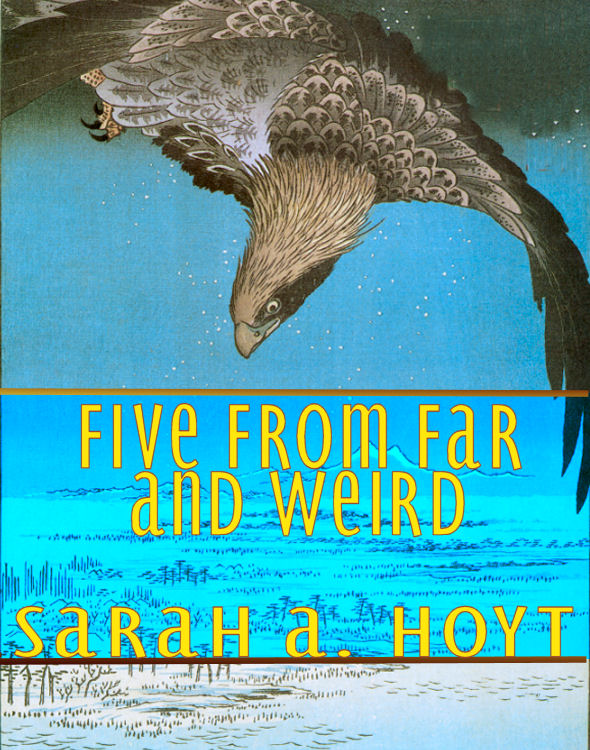
Five From Far And Weird

it contains  the short stories

A Grain Of Salt – When a Man wakes up in Chinese hell accused of defaulting on his tomb payment, he must wonder — and does — what has been going on since he died.  More than he can guess, it turns out.

Scraps Of Fog

The ghost of a Portuguese King comes to lead a girl to her own happiness.  I’ve been away from Portugal for so long, I think at this point this is a Portugal that exists only in my mind.  So, consider it as such.  As for the legend of Don Sebastian, that was one of the first I ever learned, though his being helper to the lovelorn never came into it.

The Girl With The Golden Lute

A girl, a mysterious pilgrim, crusaders, a curse…  This too is  based on a Portuguese legend, though I don’t think time-travel was ever considered.  Oh, I’m fairly sure I messed up Portuguese geography here.  Never mind, roll with it.  I was sick for geography (all of it.)

Magician’s Throne

There is a magical league that extends across all universes, including ours.  Here the place of magical gathering is a coffee shop called Magician’s Throne.  The story concerns a quest for the Arthur — i.e. the true king — and it badly wants to be a novel (with more characters, etc.)  I’m not sure.  As is it’s funny and short.

Dragon’s Blood

When an errant knight’s son goes looking to make his fortune in dragon’s blood, he ends up finding something quite different instead.  Quest fantasy with a twist.

Five Far Futures

contains

We Span The Night

This story was part of a challenge to write  a future diner.  I always loved Simak’s stories of sentient diners, and this one is an homage.

With Unconfined Wings

You’ve heard of warrior monks?  Well, the Nun’s of St. Lucia of The Spaceways are the distaff side.  They go to the frontier planets, deliver babies, comfort the dying, look after the poor and shoot the evil doers when needed.  Eventually there will be a series of stories about this.  RIGHT NOW it’s my bestseller by magnitudes, of the shorts and collections with Goldport Press.

To Learn To Forget

This is a combination of what happens to our minds if we hyper-age beyond what any human has ever done, combined with “in a space traveling future where we need every human, to what length will we go to rehabilitate criminals?”

Castor

This one is set in Athena’s (Darkship Thieves) universe about three hundred years earlier, just before the turmoils.  It’s one of my favorites, even if it’s a “war story.”

Yearning To Breathe Free

You know how you always hear the aliens are coming to tell us how to live our lives, etc?  What if it’s all wrong?  What if in all the universes only we came up with the idea of personal freedom and value to sentient life.  And what if we get flooded with REAL illegal aliens?

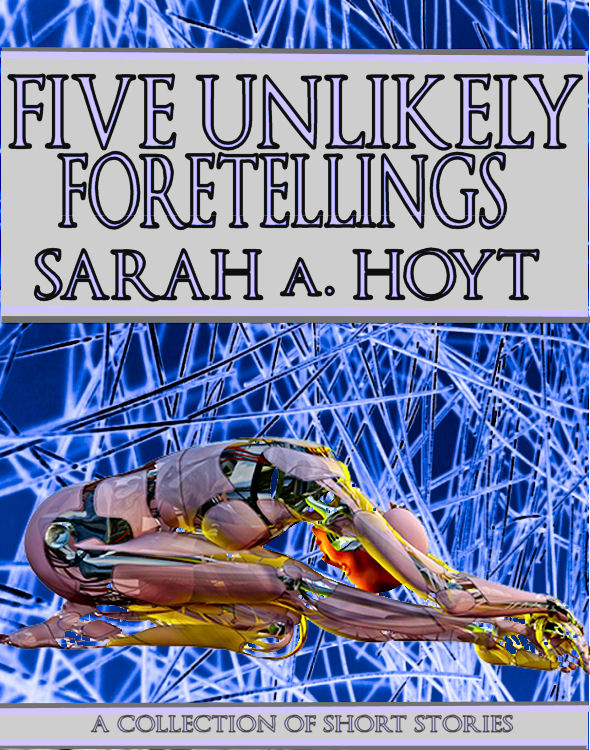
Five Unlikely Foretellings

Well, what can I say?  When I was trying to gather my stories in a rational way, I decided to do a collection of my most unlikely stories.

This one contains:

HOT

a retrovirus creates shape shifters.  A detective-shifter solves crimes in shifter community.

CREATED HE THEM

I got a call out of the blue from an editor friend.  She had a hole in an intelligent design anthology and wanted a story.  It was, of course, a mine field, but I tried to make it non-offensive.  It’s all about the next big thing.

ALL WHO ARE THIRSTY

And since we’re picking on religion…  What if we are the only people in the universe who have religion, and aliens are coming here for their fix?  I thought “Who would this bother the most?”  So I have an atheist working in a New Age Store.  (Evil grin.)

LOST

Would we know if there were aliens among us?  Let’s suppose they’re aliens in the same way star gate posited (this was written before.  It was one of my first short stories, somewhere in the late eighties.) They’re humans from parallel worlds.  How would we know?

TRADE WINDS

Carthage won the war with Rome.  Yes, the future DOES seem rosy, but kindly remember it’s from pov of a Carthage apologist.  OTOH, they DO have space travel.  (Sigh.)

And here’s the end of the Austen Fanfic, yeah, it’s short.  After this, I’ll just post the link to the beginning, then continue it on Saturdays.  The previous chapters are here and for those who read A Touch of Night, NO, I do NOT have a thing with rhubarb — what of it? :

“Come and look, Lizzy,” Lydia said, erupting into her older sister’s room, where she’d been talking with Jane, trying to understand the very odd events of the evening. “Come and look. Such a sight to see out of my bedroom window, you’ll never believe it.”

Lizzy traded a look with Jane. Jane had been telling her how much she’d loved Mr. Bingley, how he’d confessed to her that he was the man riding through the fields at night. That Jane didn’t seem to see anything wrong in riding about the fields in the moonlight in antiquated dress – that Jane could not seem to care that there was something very peculiar about these people – made Lizzy amazed.

And now she fully expected to see Mr. Bingley and Mr. Darcy riding through the fields on the other side of the house. But she didn’t want Lydia to suspect it, so she spoke, instead, in a light hearted tone, “What will I never believe, Lydia? Did the pig get out and ravage the rhubarb?”

“No, no,” Lydia said. A well-grown girl of fifteen, in her nightgown, her dark braids half-loosened, she turned around smiling and half dancing. “It is a detachment of red coats!”

Lizzy and Jane exchanged a look, and Lizzy said. “Impossible. There are none–”

But Lydia pointed at her open window, at which their sisters Kitty and Mary were leaning, looking down… At the fields, through which a detachment of red coats were riding. Not that it made any sense, Lizzy thought, because they were not hussars, and should they not be walking, and not riding upon such beautiful, glimmering horses?

But that they were soldiers could not be denied, and that their coats were red, it was impossible to deny also.

However, leaning from the window, it was easy to see this was no normal detachment, such as was often quartered in English towns. For one, they weren’t in the habit of issuing silver bridles for their horses, she thought – particularly not silver bridles festooned with countless little bells which made a merry sound in the summer air. And for another, even if a company of human soldiers might proceed singing, Lizzy doubted that their song would be so beguiling, such a perfect harmony with voices that seemed to be like light woven into the blue night.

Even their movement seemed to spark. And their leader, a tall man, with glimmering blond hair, and features that were more perfect than Mr. Bingley’s or Mr. Darcy, looked majestic and poised. Like the statue of a great leader come to life.

“Oh, look,” Kitty said. “They are riding straight at our house.”

Too late, Lizzy realized they were all clustered at the window in their nightgowns, looking down at a battalion, like common hussies. “Step back, step back,” she told her sisters, in a confusion of embarrassment. “Step back. Oh, Lord, they’ve seen us, they’ve seen us.”

The cavalcade had halted behind its leader, who had stopped almost beneath the window, and who removed his hat, which looked more like a coronet than a hat, and bowed, then smiled upward. “The fairest of them all,” he said.

He kissed something, then flung it. Lizzy’s hand shot out to hold it, before she knew what she was about. It wasn’t till after her hand had caught a green stem, till her thumb had got lanced by a treacherous torn, that she realized what she was holding was a glimmering rose, gold as the sunshine of a perfect afternoon.

Witchfinder — Free Novel — Chapter 12

UPDATE:  A SLIGHTLY EDITED AND PRETTIED UP COMPILATION OF ALL CHAPTERS UP TO A WEEK OLD IS HERE

*This is the Fantasy novel I’m posting here for free, one chapter every Friday.  I’ve been posting director’s commentary at the end of chapters, but I think it detracts from the experience, so I’ll do that on Sunday, instead, for the previous chapter.  If your conscience troubles you getting something for free, do hit the donate button on the right side and down.  Anyone donating more than $6 will get a non-drm electronic copy of Witchfinder in its final version, when it’s published.  This also allows us to buy the very expensive food that Euclid (upon whom Pythagoras, aka Peesgrass of the refinishing mysteries is based) seems to need.  And, oh, yeah, the cover sucks, but I haven’t had time for a new one.

Oh, this is in pre-earc format, meaning you’ll find the occasional spelling mistake and sentence that makes no sense.  It’s not exactly first draft, but it’s not at the level I’d send to a publisher, yet.*

For first chapter, look here

For eleventh chapter, look here

For tenth chapter, look here

Lady In The Lake

Seraphim sat in his sofa, wrapped in a dressing gown which made no more than a pretense of keeping out the cold, but did so magnificently, in shimmering green silk with a pattern of flying dragons.  He’d asked for his cane with the silver top.  But even such an obvious means of support hadn’t convinced Gabriel to let Seraphim get up and be about his business.

No, instead, Seraphim had to sit on the sofa, his hands atop the dragon-head top of the cane, his mind trying to follow, by sound, the very strange events in his household this evening and, more difficult, trying to make sense of them.

And Gabriel…  Gabriel had entered what Seraphim, with the cruelty of an older brother, even if he was in fact the younger, had been known to call his housekeeper mode.  He had marshaled the housemades to remake the bed, he’d got someone to bring in a bowl of sweet and magically harmonious pot-pouri to disguise the stench of burnt feathers and scorched broth.

He’d threatened to have more broth brought in too, but Seraphim had negotiated that distressing sentence down to a glass of cold milk, which he supposed must be making its way from the kitchens.

And Gabriel had set the gardeners down in the lake, with crystal balls affixed at the end of lanterns.  The attack had come from near the lake, or at least the would be assassin had been found near it.

Seraphim should have thought, as Gabriel obviously had, that any body of water that large, around which serious magic was made, would have recorded the sequence of events and the strength of the attacks.  And since it would come to a high court, the least Seraphim could do was make sure that there were crystal balls imprinted with whatever had been recorded in the water, to present to his majesty when the time came.

But Seraphim hadn’t thought of it, and Gabriel had, which was probably why Gabriel was the one to whom word was brought of whatever the new disturbance was.

The first sense of it the duke had was a shiver across the surface of his magic, as though someone had opened a portal between words nearby.  But it could not be a full portal between worlds.  It was something more attenuated and lighter.

Then there had come a knock at the door, and Gabriel opening it and mumbling something to a man outside, who mumbled something in response.  And then Gabriel started to close the door, and Seraphim had had just about enough.

“Penny, open the damn door and let the man speak to me.”  He understood well enough – perhaps better than other people in the household – Gabriel’s penchant for taking charge, for being useful.  He remembered – and wondered if anyone else did – what Gabriel had looked like when he’d been brought in, as Seraphim had then thought, as Seraphim’s birthday gift.

Though older than Seraphim, and obviously very similar to the heir of the Ainslings, Gabriel had looked gaunt almost to infirmity, his face had been bruised and he’d appeared terrified.  As though he’d been threatened with something even worse than the hunger and the violence he’d endured so far.  Seraphim had seen the look on Gabriel’s face as he encountered each of the features of life at the Darkwater estate: regular food, toys, a warm and secure bed.  He remembered Gabriel’s delight at the roaring fires in the hearths that first winter, his amazed joy at the sweetness of fruit in winter.  And he knew Gabriel tried to make himself useful, because at the back of his mind, somehow, he still thought the Ainslings would send him back where they’d found him.

He’d been afraid of being sent back after that bad business in Cambridge too, though if Darkwater had been asked – he hadn’t – Gabriel had been more sinned against than sinning, and the fault lay with that damned Merlin fellow, who hadn’t lasted much longer before crossing over to the dark arts, either.

But as much as Seraphim loved and understood his half brother, this was the outside of enough and he would not stand for it.  He would not be treated as a cross between an excitable maiden aunt and an invalid grandfather in his own house, “Penn,” he said, in a warning tone, as Gabriel hesitated, his hand on the door.  “Let the man in, I said.”

The man came in.  He was one of the older gardeners, and Seraphim felt peevish annoyance that he couldn’t remember his name and that Gabriel probably knew it by heart.

The man wore a crushed felt hat, a dingy coat, and pants that were obviously worn while working, judging by the clothes of dirt adhering to them.  To this was joined an overall dampness, and scraps of what might be aquatic plants here and there.  He removed the felt hat – he should have done so on entering the house, of course, but even in a duchal house, the garden personnel was sometimes insufficiently educated in manners.  Clasping it in his hands and turning it over and over as he approached Seraphim, he bowed, “As I was telling Mr. Penn, sir, it is the lady in the lake, and a right mess she caused with our recording of the magic sir.”

This speech caused Seraphim to wonder if the reason they were treating him as a doddering and senile grandfather was that he had, in fact, gone around the bend.  Because none of this made sense.  He had to admit ignorance, of course, but he admitted it in the most haughty manner he could conjured.  “What are you speaking of?” he asked.  “I do not have the pleasure of understanding you.”

“The lady in the lake,” the man said, as though the matter were obvious.

“Unless she brought a sword with her, then it is unlikely it is the lady in the lake as such,” Seraphim said.  “And even if she brought a sword with her, she would have to be an impostor, as I’m sure Arthur’s sword is still where it resides, in the royal armory.  So, kindly explain.”

Gabriel huffed.  It wasn’t very audible, and the gardener probably missed it, or else, if he heard it he would have thought nothing of it.  But Seraphim heard it clear as day and knew exactly what it meant: that “huff” was Gabriel’s way of telling Seraphim to stop terrorizing the servants and being hard to please, and close upon it, Gabriel lost what patience he’d tried to summon.

As the gardener continued to twirl his execrable hat in his filthy hands, and stammer something that never amounted to a full word, Gabriel interrupted, “if it please your grace, what Marson is trying to tell you is that a woman fell into the lake, as they were using the magic recorders.”

“Fell from where?” Seraphim asked, turning his inquisitive glance on Seraphim.  “The trees?  And is she a woman or is she–”

“She is Miss Helena Felix,” Gabriel hastened, cutting what he presumed – truthfully – was Seraphim’s question about the magical nature of the intruder.

“Ah,” Seraphim said.  “The capable Miss Helena.  She stayed behind, then, while I was ill?”  He was trying to imagine what Gabriel must have told his mother to justify such a thing.  Good heavens, by now he might very well be engaged to the woman.  He started to open his mouth, then closed it, because he remembered suddenly that he didn’t even know if he was in fact engaged to Honoria.  He had to get Gabriel alone and ask him a few home questions without being attacked by maniacs with bolts and spells.

“No.  It appears she found occasion to come to us again, though,” Gabriel said.  “Marson has taken her to the housekeeper’s rooms, to change out of her soaked clothes and get a cup of tea, while they finish the recording in the garden.  And he’s given orders that the gentleman who … ah… got unfortunately killed by the bolt you sent out in self defense be put in the ice house, till royal officers can take charge of–”

“No,” Seraphim said.  And looked at Gabriel’s surprised face.  “No.  I must see them both.”

Gabriel’s eyebrows shot up.  “Both?  Miss Felix and–?”

“The dead man,” he said, and continued.  “Penn, if you please send one of the housemaids to tell Miss Felix I require her presence immediately.  And Marson, kindly have four under-gardeners carry the deceased gentleman up.”

“What?” the gardener said, clearly shocked.  “To your grace’s room?”

Seraphim allowed himself a smile.  “If I were feeling more myself,” he said.  “I’d go down and look at the corpse myself.  As is, though, I don’t feel up to taking the flights of stairs down, yet.  And the description I was given of his being a gentleman of average features, with dark hair, and richly dressed, you must understand it tells me very little about who he might be or whether I know him.  As such, I’ll thank you to bring him up.  You can carry him down again, and fast enough.”

“Yes, sir,” Marson said, but left with the sort of haste that betrayed his suspicions about Seraphim’s sanity.  His haste did not escape Gabriel.  As both the maids and the gardener left, he closed the door softly and turned to Seraphim, “I hope you’re satisfied, Duke.  Your servants will now think you have gone irrational, or perhaps that you intend to dabble in necromancy.”  But it was obvious it was just a joke, and, his face sobering, Gabriel told Seraphim, quickly, everything that had passed between the time of his coming back from the pyramids and the present.

“And you claimed Miss Felix was your fiancé?”

“You see how important it was to know what your mother knows about me?”

Seraphim sighed.  “Knows, nothing.  Understands, I suspect near all.  You know she always detects you in falsehood.”

“Perhaps,” Gabriel said, trying to appear unconcerned, but he bit the corner of his upper lip, something he only did when he was concerned.  He opened his mouth as though to say something, but at that moment there was a knock, and on Seraphim calling “come,” the door was opened by two maids who curtseyed then stood one on either side of the door, looking like statues.  In between them, a woman walked in.

She wasn’t ugly, Seraphim realized, now that he saw her without either anger or fear distorting her features.   She looked concerned, she was soaked to the skin, her hair clinging to her head like a dark bonnet.  And she was wearing a voluminous grey blanket draped over whatever clothes she’d worn when she’d fallen in the pond.  But through it all, it was obvious her features were good, and that she had grace and poise worthy of a princess.

Miss Felix made that blanket seem like a trailing royal cloak, as she walked in to stand a few steps from him and curtseyed.  “I was told your grace wanted to see me,” she said.

“I did,” he said.  “I would like to know how you came to fall in my pond.  I presume it was not simply a matter of leaning too far over a branch.”

Miss Felix looked over her shoulder at the maids by the door, then back at him.  Seraphim nodded.  “I believe, madam, he said, that inconvenient though they are, your chaperones must stay.  You can’t be in a room alone with two men.”

She looked impatient.  He’d swear she rolled her eyes, and he could not reconcile her air of obvious quality with this unconcern or ignorance of the social rules.  “Very well,” she said, at last speaking in an undertone.  “But the thing is, your Grace, that I don’t know what to tell you.  To own the truth, the secret I could tell is not mine, and on it depends the life of someone whom I once thought–” She stopped.  “No.  On my silence depends the life of someone who might have his deffects of character, but who, I’m sure, has done nothing to deserve death.”

Which, of course, was when the second knock on the door sounded, and on Seraphim authorizing entrance, as Nell stepped a little to the side and turned to look, Mr. Marson came in, leading four strapping boys, who carried, between them, a pallet on which was a form covered in a blanket.

The pallet was lowered in front of Seraphim, and the blanket pulled back at the same time a lantern was brought near that he might better examine the face of the deceased.

Seraphim saw a face that looked wholly unknown, and much as had been described to him: dark hair, regular features, a certain appearance of gentility.

And then Helena Felix leaned forward towards the corpse and gasped.  “Antoine!” she said.  She sounded more shocked than saddened.  “It is Antoine.”

Before Seraphim could ask her what she meant, and who Antoine might be, he heard running steps and someone burst in through the door, without asking.  It was his sister Caroline, her dress rumpled, her hair in a mess.  She curtseyed hastily, and looked around as if shocked at the mass of people in the room.  Her gaze raked the corpse on the floor, but she seemed not to be at all surprised, more annoyed, as though all these people were here for the purpose of annoying her.

“Seraphim,” she said, in a scolding tone.  “Seraphim, it is the most unlucky thing for you to have everyone here, because you must come with me right away.”

“Caroline,” he said, and was about to scold her on her lack of manners.  He had no time.

“Yes, yes,” she said.  “I know I’m being very shocking, and it’s all very bad, but Seraphim, we think Michael was taken by the elves.  They left a changeling in his place.”

Mr. Shakespeare Is A Whirligig

Psst, guys.  Can we talk about the English Language?

Yeah, I know it’s your native language, and I am very grateful that you allow me to use it, really.  I love the heck out of it, finding it far more bendy than Portuguese, the language I first learned, or even French or German or any of the languages I learned after.

The truth is that before I fell in love with the US, before I fell in love with my husband, I fell in love with the English language.  By the time I’d studied it for two years, I was thinking in English.  Sometimes even out of class.

Oh, I’m not going to say I don’t make stupid mistakes in it, most of them due to what I’ll call “auto-complete” fingers and “Sound typing.”  What this means is that often I type in the first letter of a word and my fingers auto-complete the rest.  For instance, going over Darkship Renegade for the tenth time or so (I swear) I noticed the sentence “The first time he’d killed me” – yeah.  Yes, it should be “kissed” and don’t even ask me why my fingers think kill is more likely than kiss in the stuff I write, okay?  I don’t want to know.  As for sound typing, this manuscript is awash in way instead of weigh (and, weirdly, vice-versa) and more distressingly, because my accent is worse in typing than in speaking (yes, I know) leave instead of live.

Mind you, I know the difference between all of those words, and it would not occur to me to confuse them in the cold light of day.  It’s just while I’m following a thread of emotion or concentrating on describing a scene, the fingers go on their own and they’re remarkably dumb fingers.  And of course, I’m the world’s worst proofreader for my own stuff, unless it’s about ten years old.

I also have some genuine English As Second Language mistakes – most of these relate to never knowing if something is on or in (stop giggling you!) because English uses those in idiosyncratic ways.  Also I’m never sure idiomatically when to use “the” or the possessive.  Like… “She moved the chair” or “she moved her chair” I can usually figure out the nuances of, but if you get to body parts…  Is it “He moved the arm that had been restraining me” or “He moved his arm that had been restraining me”?  (Yes, I know that’s the world’s most awkward phrase.  It’s six am, I’m uncaffeinated and I was kept awake an hour in the night by some teen who stood in the middle of the street and yelled crazy stuff.  – No, not my teens.  I checked.  I counted them.  Why?  Because they sleep walk, and sleep-shouting wouldn’t be past them.  But they were both snug in their beds.  Probably not with visions of sugarplums, but I’m not swearing to anything.)

So, okay, I’m not without sin, and I’m not throwing stones, but listen here, lately y’all have been torturing this poor language, and I don’t like it.

When I taught English before I got married, I made a little cardboard model of a coffin, which I mounted on an axle, suspended between two supports, kind of like when you spit-roast something.  Then I put a handle on the top.  Then I told my students this was William Shakespeare’s coffin.
When my students butchered the language in particularly egregious ways, I used to grab that handle and give them the visual of Shakespeare spinning in his grave.  (What?  Well, they all gave me gifts and stuff when I quit to get married, so they must have LIKED me, right?)

Ya’ll routinely do stuff to the language that would grant a half turn on that handle.  Half turn because I figure it’s your auto-complete fingers.  Or perhaps your sound typing.

So, I’m not going to beat you about the face and head over things like alter instead of altar.  I will confess that it drives me beyond nuts, because of the image.  For some reason when I read alter I see the table at the veterinarian clinic.  If this is in a story I’m judging and on the first paragraph, you’re going to have to work hard to remove that image from my mind.  Just remember, if what you mean is altar — an elevated place or structure, as a mound or platform, at which religious rites are performed or on which sacrifices are offered to gods or ancestors – you shouldn’t be able to put ation in front of it and have a real word.

In the same way I’ve grown resigned to y’all using capitol instead of capital.  Yeah, it’s annoying, but I figure it’s because you have a capitol in your capital, and against that a mere ex-English-teacher cannot stand.  Remember capital is where government is, and therefore it’s spelled with to as, because it’s a as in a*s.

But then there’s the stuff you guys do that no human being should to a language which hasn’t done them any harm.  You take words and make them mean the opposite of what they should mean.  And this is when I reach for the handle of the coffin to make it spin.

Take, for instance descendants.  According to dictionary.com which, before you ask, is in fact RIGHT, it means:  a person or animal that is descended from a specific ancestor; an offspring.

PLEASE read that and memorize it.  Please stop telling me stuff like “my descendant in the twelfth century was an earl” because I’m a science fiction writer, and when you say stuff like that I immediately see time travel and it causes terrible disorientation.  The word you’re looking for is ANCESTOR (a person from whom one is descended; forebear; progenitor.)  If you need a way to remember this, please keep in mind that many cultures practice ancestor worship, while we might be the only one, in certain sectors of society where people have one single kid far too late, that is on the edge of descendant worship.

And while being on edge – yes, my darlings?  What?  Look, I’m female and I’ll be fifty next year.  I think at this point, if we could weaponize me, the world would tremble.  So listen – note I did not write that we’re on the precipice of descendant worship (though in this case it might be, in a moral sense, apposite.)

So, why didn’t I say that?  All the hip people say that.  Yesterday, some serious article, quoting some serious economist informed me that we’re not yet on the precipice of job creation.  The odd thing is that he didn’t mean this was good news.  A president who shall remain unnamed because I was preparing to send rescue parties to the earthquakes around Stratford-Upon-Avon told us we were on the edge of a precipice of achievement.  (Okay, then, he might have meant what he said.  I’m so not going there.)  And tons of other, exquisitely educated individuals among you have started using this.  STOP it, just STOP it.

Since then I’ve seen this usage crop up everywhere and I’m getting REALLY tired of it.  Yes, it’s a long word and it sounds learned.  But if you feel like using it, please remember according to dictionary.com, which is somewhat unclear, precipice is: 1. a cliff with a vertical, nearly vertical, or overhanging face. 2.a situation of great peril: on the precipice of war.

Number two gives you the clue for how number one is meant.  You guys are thinking of it as when people are riding in old west movies and come across a wall where the terrain goes up, right?  Well… blame it on old dictionary.com.   But the second gives you a clue to how they actually mean it.  It’s more like the coyote in Road Runner cartoons.  He’s running on the road, runs off the edge, and then realizes he’s running in mid-air and phuit, down he goes, a huge distance.  That, without the sound effects or coyote is a precipice.

So, trust me, you don’t want to be on the precipice of great achievement.  And you certainly don’t want to be on the precipice of job creation (though we sort of are.)

Stop saying that.  Or not.  I hear that Great Britain has hooked Shakespeare’s coffin into the electrical grid.  It’s powering London.