It Is Clear There Will Be No Post Today

For obvious reasons of Holiday and family.  In fact, posting for the next week will be irregular.  BUT for now, there will be the Free Short Story posted today.

It is the closest thing I have to a Christmas story, (though I suspect those dang Nuns of St. Lucia of the Space Ways will inflict one on me sooner than later)  so I hope you enjoy it.

The story is here — or just click on the Free Short Story tab at the top of the blog.

I’ll be back sometime tomorrow.

Free Novel — Witchfinder Chapter 14

*This is the Fantasy novel I’m posting here for free, one chapter every Friday.   If your conscience troubles you getting something for free, do hit the donate button on the right side and down.  Anyone donating more than $6 will get a non-drm electronic copy of Witchfinder in its final version, when it’s published.
There is a compilation of previous chapters here and I will compile each new chapter there, a week after I post.  When the novel is completed and about to be edited the compilation page will probably be deleted.

Oh, this is in pre-arc format, meaning you’ll find the occasional spelling mistake and sentence that makes no sense.  It’s not exactly first draft, but it’s not at the level I’d send to a publisher, yet*

The Duke’s Duty

And now this.  Seraphim stared at the thing on the seat.  Were it not for his ability to unfocus his eyes and to look just so at that he would think it was Michael, but it was not.

The question was, how long had his brother been missing?  Would this sculpture, this animated construct always have been like this, listless and unresponsive?  Or was there a way it could have acted like Michael and Seraphim not have known, or – more importantly – the household not have known, while Seraphim was unconscious?

He looked towards the Duchess and narrowed his eyes, “Mama, they’ve always told me… that is… I’ve always heard it tell that you knew about changelings, and that this related to something in your childhood, but no one ever told me what?  It was all whispers and then ‘well, you know, because of her childhood’ and when I pursued the information they told me I was not to speak of it.” He looked steadily at his Mama, hoping that she wasn’t about to tell him this was not to be spoken of.  He knew he was making poor Penny damned uncomfortable.  He could tell without turning to look, without Penny saying a single word.  He knew whatever the mystery with changelings in Mama’s childhood was related directly to whatever and whoever Penny was.  That Penny would not in fact be here today but for mama and whatever had brought her in the presence of elves in her childhood.  “How did you know, Mama?  What is it with changelings?  Have you seen one of these before?”

The Duchess looked at the thing on the stool and sighed.  “It is not,” she said.  “A changeling like the one they left for me, when they stole me to fairyland as a child.”

A long breath, with a sound on the edge of keening escaped Penny, but Darkwater didn’t turn to look, and instead kept looking at his mother, who spoke like one in a dream.  “This is a construct, animated.  It looks like, and probably is, ice.  Water that someone poured in the rough shape of a young man, and then left overnight to freeze, then animated and gave your brother’s look by magic.  It is not alive.  It has no feelings.  It–”

“Stop,” Gabriel Penn said.  And what was so strange was that Penny had told the Dowager to stop, something he’d never done before.  “Stop, Your Grace,” he moderated, and sighed.  “It will not do.  We should discuss it, yes, but not here.  Not in … its presence.”  He waved towards the changeling, who remained, impassive, on his stool, looking blankly at the world.

“But Mother says it’s not animated,” Caroline said.

Penn sighed again.  “No, but still.”

“What should we do with it then?” Darkwater asked.  It seemed to him foolish to leave the thing alone, as though it might get up to mischief on its own.

“Nothing,” Penn said.  “It is losing its magic and will presently melt.  But if you feel better, Duke, we shall lock it in the closet.”  He took the creature’s arm and led it, and it let itself be led, to a cupboard in the wall, where Michael kept his chemicals and his vials.  Penn pushed the creature in there, closed the door and locked.  Then closed the closet to sight and sound with a carefully aimed spell.

Then he turned to the room, “Shall we speak, now?” he asked.  “This is one of the safest rooms in the house to discuss such things in, since Michael has hardened it against magical interference, so no rival houses could see his designs.”

“But that thing got in,” Caroline said.  And Penn smiled at her.  “Yes, Caroline, it did, but not through here.  My guess is that Michael has been gone for days, perhaps before Seraphim was injured.  These changelings have a certain programing and seem more real and solid, and interact with everyone normally for a few days, and then wind down and become whatever material they were.”

“Then why didn’t you allow us to speak in front of it?” Seraphim said.

“Because sometimes they are rigged so as to transmit sight and sound to whoever made them.  I have shut it in the closet and blocked all sound magically.  We are safe now.  And I believe,” he said.  “First I will let Her Grace tell us what happened to her in childhood.”

It occurred to Seraphim, for the first time, that Penny spoke as though he knew what it was.  He said so, and Penny pressed his lips together.  “Indeed, Seraphim.  Perforce I know.”  And though Seraphim didn’t know why perforce, in fact couldn’t think of any reason for Penny to know, save that, of course, his mother was an elf, and changelings were connected to elves, he kept quiet.

“I will tell,” his Mama said.  “But let us sit.  Seraphim should not remain standing long.”  He allowed his mother to lead him to a little sitting area around a large, glimmering sphere whose purpose Michael had never succeeded in explaining fully, but which seemed to interest the heads of several magic houses.  There were three straight backed chairs, a chaise and a sofa.  He refused to lie down on the chaise, but allowed himself to be led to the sofa and sat down on it, glad only that no one had brought an invalid’s shawl to drape around his shoulders.  Mama sat in one of the straight backed chairs.  Caroline half-reclined on the chaise.  Penny remained standing, but Seraphim wasn’t about to challenge him, suspecting it had to do with his idea of preserving the appearance of his position, while in public.

Then he realized there was someone else with them.  They’d been so absorbed in their conversation that he hadn’t noticed her before.  Miss Helen Felix had come with them, trailing her grey blanked.  The woman must be freezing, even with the blanket, and indeed looked very pale and tired.  He looked at her, “Miss Felix?  Should we have private talk in front of you?  Two whom do you report?”

She gave something that wasn’t a half laugh.  “To no one, Your Grace,” she said.  “Up until this mor– No, up until the day I left here, whenever that was, I worked for Sidell, spymaster for the king.  Then I would have said I reported to him.  But all that was severed first by his betraying me, and then by his killing the man he was holding hostage for my good behavior.  I am now, Your Grace, entirely a free agent, and as a free agent, I confess I’d like to do what I can to bring your brother back.”

Seraphim didn’t know whether to believe it.  After all, the king’s spies were trained and paid to lie.  He hesitated.

“She can hear my story,” his mother said, quietly.  Seraphim noted that the Duchess didn’t protest that Miss Felix was Penny’s fiancé.  “It is nothing so secret that she can’t find out the general outlines of it simply by talking to anyone old enough to have listened to gossip or practiced magic when I was a child.  It is not normally spoken of, because people are afraid to give me pain, not because it is not known.”

Seraphim looked at Penny, “And you?  Since I presume you’ll be talking, also?”

Penny looked surprised, then glanced at Miss Felix and shrugged.  “Oh, she can hear mine too.  There is nothing in it that cannot be gathered with some sleuthing, and I suspect the king’s secret services know it well enough.  If I’ve kept it secret at all it was to spare your family shame by association, but I judge in the trouble we face that is the least of our worries.”

“When I was five,” the Duchess spoke.  “I was stolen away to fairyland.  No one knows why.”  She spoke a little too loudly, a little to cheerfully, as though trying too hard to sound normal.  And she’d barely let Penny stop talking before she started.  “I had magic, of course, but no more than my brothers and sisters, and no more than a hundred other children in the immediate vicinity of my parents’ estate.  But whatever it was, and for whatever reason, it was a well planned thing.  You see.”  She looked up at Penny, and her eyes unfocused.  Not as though she didn’t want to see him, but more as though she knew what she had to say would touch him very nearly and were trying to pull herself away from it, and not to dwell on the pain she was giving.  “You see, the changeling they left in my place was not a construct, but a little girl.  A little elf girl they had to have shaped from very early on to look exactly like me and behave exactly like me.  For days – weeks – my parents didn’t know I was missing.

“For myself too,” she said.  “It was hard to tell.  I lived mostly in the nursery, with nanny and the nursery maids.  My life was surrounded by toys and I was an imaginative child.  As such… Well, I thought simply that my toys were more alive than before.  For a long time, I didn’t notice that I was in another realm and then…”

“And then?”

“And then I started to feel cold.  Not physically.  I don’t think fairyland is any colder than here.  It is, after all, like another world in the multiuniverse, just one that never fully separated.  So while it is in a way attached to our world, it is also a copy of it.  It has the same climate at the same time.  But there is… Everyone in fairyland is cold.”  She shrugged.  Penny was walking back and forth across the little sitting area, as though he couldn’t sit still, but he nodded when she said that.  “It’s not that they don’t show emotion,” she continued.  “It is that they don’t know what emotion is.  They are like humans without the…”  She shrugged.  “I’m sure Gabriel can explain it better than.”

“Yes,” Penny said.  “Yes.  But not just yet, pray go on.”  He paced.  She looked up at him.

“I realized that I was in a way absolutely alone, like… like a child raised by wolves would be alone.”  Penny shuddered, as though in response to her words.  “But I was too young to know what had happened or to seek to escape captivity.  I could not, and as such, I would have remained forever captive in fairyland, but…  But my parents had an hostage.  And they did what has always been done when a real changeling, a living one is left behind in place of the child taken.  They tortured her.  They subjected her to various discomforts, until I was brought back.”  She took a deep breath.  “I’m sorry Gabriel.”

He paused in his pacing.  For a crazy moment, Seraphim wondered if the changeling had been Gabriel, such the tone of his mother’s voice.  Could elves change their gender?  He’d never heard tell of such a thing.  And besides, Penny was around his age, was he not?  Could he have been kept in some stasis, so he didn’t grow?  But no, Penny was Seraphim’s half brother.  He had the Darkwater look, the Darkwater magic, and Seraphim’s own father had recognized him as such.

“What is there to be sorry for, Your Grace?” he asked, pausing in his pacing to look at her.  “Oh, perhaps, yes, perhaps it was that torture, which, though, from what I heard was very mild, at least for an elf, which led her to never quite fit in fairyland again.  But I don’t think so.  I never told you why we were thrown out, she and I, have I?  I told my father when–” He shook his head.  “I beg your pardon.”

“You beg my pardon?  For admitting the duke was your father?  Or for mentioning it in my presence?  Of all the things your father did, Gabriel, siring you was probably one of the most worthy.  Don’t scruple to admit it.  He admitted you openly, even if he never changed the name your mother gave you, since nothing could be gained by saddling you with Ainsling, when no title and no fortune accrued with it.”

Penny only nodded, though Seraphim wasn’t sure to what.

“My mother was the changeling left in place of Her Grace,” he said.  “She was also the child of the deposed king of fairyland.  No, don’t ask me how or why.  There are revolutions in fairyland, and civil wars, just as there are here.  And I think at the end of the last such war, when my… I suppose, my grandfather, the then sovereign of fairyland was deposed, he left behind his young daughter.  It was thought that by sending her as a changeling to the world of mortals, it would dispose of her, I think – though the thinking of elves is not the same as ours and it is hard to fathom at times.  However, in the time she was away, there was another revolution and my… I suppose my uncle, became the sovereign of fairyland.  he could not allow a princess of fairykind to be tortured in the world of humans and therefore, reluctantly – and I do feel it was reluctantly, though I can’t explain why – he gave Her Grace back to her parents and took my mother back.  But he had children of his own to inherit after him.  And my mother was ever odd.  Oh, I don’t think they did more than threaten her and make her uncomfortable, and perhaps make her work – the things that legend says one should do to changelings, though some people make the poor creatures sit on live coals or worse – and strangely, from what I know of my poor Mama, I don’t think that’s what changed her.

“Just like Her Grace could not survive in fairyland, not without noticing the exceptional coldness of elves and would have been changed beyond repair had she stayed in there longer, my mother had experienced the warmth of humans and it had changed her, so she no longer responded like a real elf.

“And she could not live in fairyland, not fully.  Instead, she would escape to the world of men.  Which is how she met with Arden Ainsling, Duke of Darkwater.  And she returned to fairyland expecting me.”

“And meanwhile, Darkwater found me, was enchanted by my resemblance to his vanished elf love, and started courting me,” the Dowager said.

Penny hesitated, looking like he would apologize, then inclined his head.  “Only I fit in even worse than my poor Mama.  I was more human, you see.  There is… there is sport the elves engage in.  They will capture some child out of doors on a dark night, or some lost creature, and they will torture it.  When I was three or four, I tried to rescue a puppy that was being tortured for the amusement of the court.  My mother and I were flung from fairyland and unworthy.”  He was silent a long while.  “When my father found me, we were living in a tenement and Mama…”  A long, deep breath.  “I begged to supplement our income.  It wasn’t until I had lived in this house for two years that they tried to reclaim me, and only because they couldn’t allow me to live as a commoner among humans.  They didn’t want me to keep me.”  He looked up, and a sudden fierce light burned in his eyes, such as Seraphim had never seen.  “They didn’t want me for me, or because they cared for me, or even because they honored me, or my lineage.  They’d probably have killed me once they’d got me back to fairyland.  But they didn’t want me to live among humans and perhaps come to value my human heritage over my elven one.”  Another pause.  “I don’t know why they took Michael or what for, but I swear to you, all of you, that I will do my outmost to bring him back, and – if I can – to bring fairyland down with it.”
Witchfinder Compilation Up

In new page — here https://accordingtohoyt.com/witchfinder/

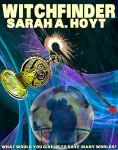
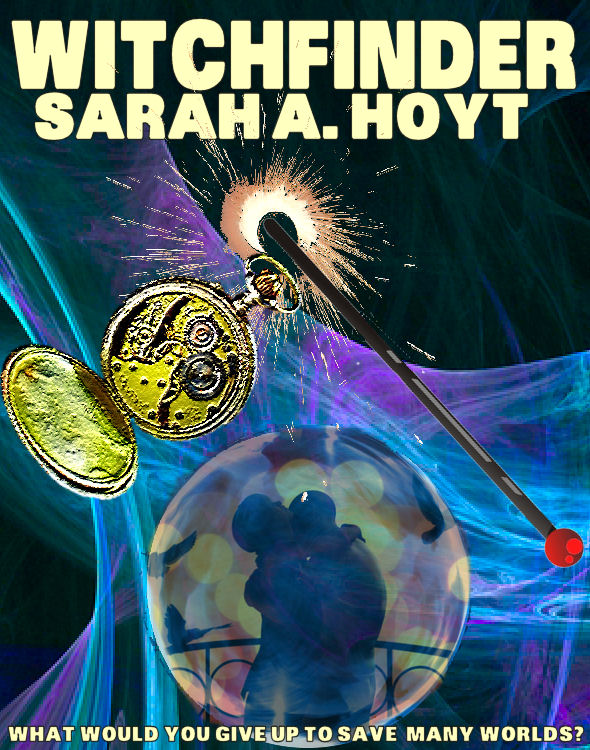
And a new chapter will go up in a couple of hours.  Sorry, it’s been Murphy’s day including an hour spent on the phone tracking something that should have arrived today and corrupted files, including the — sob — new cover for witchfinder.  I’ll track that down soon, and prettify the whole thing, but for now I need food, then going over chapter.

Again, sorry I’m so late.

Witchfinder Delay

Update — Witchfinder new chapter is now up here https://accordingtohoyt.wordpress.com/2011/12/23/free-novel-witchfinder-chapter-14/

And there’s a compilation of all previous chapters here https://accordingtohoyt.wordpress.com/witchfinder/

he installment of Witchfinder will be late.  Oh, not by a day, probably no more than a few hours.  But it’s all good (other than the snow which meant I lost most of the day doing shopping/errands that should have taken a couple of hours.)  Update: Okay, definitely by 5 pm Eastern  MOUNTAIN time — says she who must wrap.  And if you want to know why — gahhh kids, cats, post office.  This week is very bad.  I promise this won’t happen again.)

This shift means a clean up and a change that will make it easier for you to follow the posts.

Here’s what’s happening — and this is part of the “editorial commentary.”  When I write, I do it in a sort of trance.  You know the thing about being mostly plotter, but a little bit pantser?  Well, what this means is that lots of things drop into my plots that I hadn’t meant, and others were in the plot all along, but shift position/fall into position as I write.

The result is that about a third of the way through the book, I’ll have accumulated enough errors that I need to go back and make the narrative coherent before I can power through to the end.  I’ve reached that point now, so I’m doing my “first edit” in which I clean up incoherent plot signaling, bits of worldbuilding that stick out and that sort of thing.  It is by no means the final edit, but it gets the novel tow here there’s some sort of coherent story I can follow.

Reading over the novel also allows me to see where pieces fit that I hadn’t figured out when outlining.  Like… the lion boy.  I know who he is, and what part he plays now, other than being a rescued kid.  Same with the elves, which dropped in without being in the outline (but which answered “who is Gabriel Penn?”)

I now have a fully marked paper manuscript up to this point, but need to enter the changes and post, which will take a couple of hours.

Also, on the “mechanical” level, it has occurred to me posting a work this length makes it come across as very fractured and difficult to follow.  I’m going to take a page from the Dwiggie website, where I post fanfiction, and take all chapters up to this point and “archive” them in a “page” where you can read them consecutively and more easily.  This makes my life easier too, allowing me to link only one chapter every week.

Of course, once the book is ready to go up that free version will probably be taken down.  Or not.  Depends on how much final “clean up” I do, and how different the end is from that version, in which case I might leave that version up as advertisement.  We shall see.  At any rate, the page will make this easier to read and easier for me to post.

I promise to have a new chapter up by midday, as well as the archive live.  I’d like to promise you a new cover too, but miracles have limits and I still have sinfully late gifts to ship and the family gifts to wrap.

All I want for Christmas is a time extending machine!

May You Write Interesting Books – 4

I’m writing this as a series.  When it’s done I’ll compile it, clean it up and put it up for download in a few formats, for something like $3.99.  Might throw it on Amazon, too, if it looks worth it. Needless to say if you want to hit the donate button instead, and make a note on the paypal field
that it’s for May You Write Interesting Books, I’ll send you a copy when cleaned/compiled.  Oh, btw, I’ll also be taking suggestions for other seminars on writing.  I’ve considered doing something like a “self directed workshop” with suggested exercises you can do on your own or with your writing group.

Eat This Note When You’re Done Reading
I hear you screaming whining and stomping your feet.  “BUT” you say “What if my reader really needs info up front?  What if he needs to know that all the characters in the novel have three eyes?  Or are squid?”

Yes, I heard that other thought too “I know.  I’ll do a prologue.”  Put that thought down.  Possibly by shooting it through the head.  I think I’m the only reader left in the wild who actually reads prologues.  So if you really need to give that information, you need to make it part of the beginning and make it interesting.

Unless you’re Mark Twain, Heinlein, Jane Austen and the second coming of Shakespeare rolled into one, and unless your book is so incredibly odd it necessitates “level set” right up front, I wouldn’t in point of fact try to put the infodump RIGHT at the beginning.   I’d give the reader something to bite into first, before you reel them into your world and history and your rich social design.

But let’s say at some point you need to do an infodumpus of, at a minimum, two or three pages.  Sometimes it happens.  Like, if you’re writing a sequel and you can’t be sure your newly-landed reader has read any of your previous work.

The good news is that this happens to all of us, sooner or later, so you don’t have to reinvent the wheel.  There are several ways to do it.

The first, and much simpler one is to bull through.  Sometimes the least obtrusive way to do things is to do them right up front and be done with them.  So, if you have to give the general plot of your last novel, do so, and quickly, then move on.

Of course, if you’re going to do that, it helps if you make the tone at least interesting or ironic.  Say, Tom from Draw One In The Dark could say something like “It wasn’t the first time I’d died, but…”  The words draw the reader in, even if you’re just infodumping.

Something else you can do is have the information you’re giving be a point of contention.  Say we were invaded by the Martians in 1940.  Make it be like our world, for instance, where we don’t know we were invaded by Martians in 1940.  Some guy says “Hey, we were invaded by Martians in 1940″ and the other one says “you’re crazy nuts, Bucko.  Never happened.”  Then reveal everything as arguments pro-and against.  This can sound like maid and buttler if done clumsily.  So, don’t do it clumsily.  Have the argument matter and be about something not just sound and fury.

The other option is disaster.  Make something happen that necessitates the information.  “Oh, no.  My house burned down, and I lost all the info on the Martian invasion.”  (Yeah, okay, lame.  Deal.)

Then there’s danger.  “John.  Eat this note as soon as you’ve read it.  We were invaded by Martians in 1940, but no one remembers it.  I shall explain as soon as… Quick.  Forget I said anything.  We’re in danger.”

Again, you have to make the danger real and make it matter to the plot.

Next is the ironic narration.  This is a variant on just hook them with words.  Think noir movie narration.  “I knew I was in trouble when I realized we’d been invaded by the martians in 1940.  But we haven’t been you say?  Oh, listen buddy” etc.  Of course, this means you have to do it through the ENTIRE book, or pretty close.  I almost or more or less did this with Darkship Thieves, less so with A Few Good Men, weirdly.

If all else fails and you must have a business meeting have the pope in the swimming pool.  This is a variant on the Pole dancer (when the Pope was a Pole, of course) or the poll dancer, and might be more effective at least for women.

I’ve explained Pope in the swimming pool before.  It’s a classical example.  You have your character have a talk with someone, but your character (say this is a hotel) is facing a window, while the other guy isn’t.  While the other guy is giving him all this information, your character is looking out the window at this BIZARRE scene, where the pope arrives at the swimming pool, undresses and goes for a swim.  And your character is thinking “uh?”  Of course, you’d have to explain it later.  Say a convention of Pope-impersonators is in town…

Needless to say it doesn’t have to be a pope.  It could be a poll dancer.  Or the Chimpendales guys en parade, or a dinosaur running across.  Or …  Think about it.  Just enough to keep it interesting.

Okay, this is fast, and tomorrow is Witchfinder but I’ll try to do a post demoing this in the style of my dialogue post.  Now I have to go mail gifts.

And d’ahlings, the most important thing?  Never say boring.  No, seriously.  We’re a people of words.  If your character thinks “this is boring” your reader just put the book down.

May You Write Interesting Books 3

I’m writing this as a series.  When it’s done I’ll compile it, clean it up and put it up for download in a few formats, for something like $3.99.  Might throw it on Amazon, too, if it looks worth it. Needless to say if you want to hit the donate button instead, and make a note on the paypal field
that it’s for May You Write Interesting Books, I’ll send you a copy when cleaned/compiled.  Oh, btw, I’ll also be taking suggestions for other seminars on writing.  I’ve considered doing something like a “self directed workshop” with suggested exercises you can do on your own or with your writing group.

Jump In The Middle

Wouldn’t you know it?  The minute I start talking about ridding the beginning of your book of boring, everyone jumps in to tell me about In Media Res, which is starting in the middle of the story, of course.

I’m rather proud of having invented this concept myself in or around fourth grade.  Not that this prevented me from failing at using it several times when I should have, as a fledgeling writer.  In fourth grade I had very important reasons to invent it.  You see, student composition in Portugal was prefaced with the words “Once upon a time” in the same way that some invariable law of nature makes every folk song be prefaced with a long, plaintive note, and for the same reason (Pratchett being the one who figured out the reason for folk songs) – to give anyone within hearshot/reading shot a chance to get clear away.  Having figured this, I thought I’d ambush my teacher by starting in the middle of the story, so she was totally wrapped in it by the time she thought to get away.

The degree of success of the technique varied, by which I mean it might have worked had my spelling been even mildly understandable, my punctuation following any degree of rationality and had I not dropped more blots than shaped letters.  (I did tell you I wrote with a quill in elementary school, right?  No, not joking.  It was believed permanent ink pens or heaven forbid, ball point pens would forever ruin our caligraphy.  I wasn’t allowed to use a permanent ink pen until I was in fifth grade.  Yes, I was brought up in Elizabethan England and next door to Hades, why?)

Anyway – coff – resuming the thread of our interrupted thought, here it goes: though your prose might not be (I hope it isn’t) as bad as mine at ten, the principle still applies.  Beyond the fact that most of what you would drop into a long disquisition on the world, your character’s back story or whatever else you think is needed to get on with this, is in fact totally unecessary and probably the greatest soporiphic ever written (since war and peace) there is the fact that it gives your reader time to get away.

In an ideal world (and now I sound like Scott Edelman’s rejections when he edited SF age) your reader would be so invested in your book when he starts reading that nothing, not even your including a dictionary for your invented language, can make him/her give up and go find some thing more interesting to do.

In the real world, people not only have computer games and movies that they can turn to, which require far less effort, not to mention books that don’t require them to memorize stuff, but they have real lives.  I read for entertainment by preference (meaning a movie or game needs to be amazing to get my attention) but I – and everyone else I know between the ages of thirty and sixty or later – am insanely busy.

Time spent with a book is either snatched as a guilty pleasure, which only happens for people on my “drop everything and read” list, (and these days, often, note even for them, which is why I LISTENED to the latest Pratchett rather than read him, because I could do so while walking) or is read while I’m doing under stuff, ranging from cooking to ironing.

This means if by the end of the first page I’m not riveted to the story, the character or the situation, your chances of my reading the full book are getting slimmer.  By the end of the tenth page, if all you’ve dropped on me is back story and worldbuilding (UNLESS you do it in a very amusing way) I’m going to wonder off in search of something more fun, or just give my full attention to the task at hand, instead.

So, start in media res, that is, in the middle of the action.  This doesn’t mean necessarilly starting in the middle of the story (though it often does.)  For an example of starting at the beginning in media res read Larry Correia’s Monster Hunter International.

And if you’re going to say “But Larry doesn’t have to build the world before that.  He starts in our world, when his character first becomes aware that it is not as ordinary and non-supernatural as he’s been led to believe.”  This is true.  And a lot of other books that start in media res have this exception built in.  Perhaps most of them.

But not all of them, and certainly not any science fiction book set more than a few years in the future or any science fiction book set in a parallel universe.  Or any fantasy book set in a parallel universe, for that matter.  (I’m sure I could do it better now, but if you stumble on a copy of my Soul of Fire, read it.  It starts in the middle of the action, in a world with a completely different history, and I never stop to explain it, though I give you a line here and there.  Also, Soul of Fire is the middle book, but if I did my job right – I think I did – you don’t need the first or the last book to follow along.

Of course, I recommend that all of you – even those who thinks the man has cooties – find a copy of Robert A. Heinlein’s Friday and read the first five or six pages for the consummate in media res start in a world that’s as different from ours as humanly possible and a character who is very different.  Again, he never stops to explain, but everything is there to build your picture as you go along.

I also often hear C J Cherryh’s Alien series cited as an example of this.  I’m passing it along for free, which is the price I got it at.  Myself, I could never get into it, so her technique for drawing you in failed with at least one reader.  But I’m a lazy reader and not willing to work even medium-hard.  Your milleage may and clearly does vary, considering how many people give this series as an example.

To bring together an article that feels rather scattered (and I apologize, and yes, this is one of those that will get edited before being collected) let’s take the plus factors of a media-res start:

1 – It drops you in the middle of the action.  If your action is riveting enough, we will stick around even if we only understand part of what is going on.  Don’t believe me?  Have you ever experienced a rubber-necking induced back up?  Yeah, when people see an accident, or some interesting enough event, they’ll look on.  Part of the attraction is speculating about what happened.  Same with your book.

2- It doesn’t give people an excuse to run away.  Oh, you can get away with glossaries, long prologues or even business meetings if you are an established writer.  You’ve delivered for the reader in the past, and the reader will give you time and space now to establish your world and start booking.  But as a newby, anything that seems like work will get your book set down and more or less forgotten.

3 – It might make you realize you only need minimal info anyway.  This type of mind game is important, since you’re essentially pretending to be the reader you tell the story to.  So if you’re stuck in “but there’s so much more to that world” you might not figure out how NOT to put it all in.

Disadvantages, or things you have to work around:

1 – But I don’t like flash backs!
Sometimes when you start in media res you need a flash back to bring you back to the point you started at.  And many people with good reason dislike flashbacks.
Now, the reason most people dislike flashbacks is that those tend to be LONG detours from the story, and a concentrated dose of the boring.

Most of the time flash backs are not needed (see below.) IF they are needed there are ways to do it that are not heart-stopping dull.  I had to do a flashback in Darkship Renegade, because trying to Heinlein it distorted the narrative and made it dull.  So…  What I did – and recommend – is: make it sassy.  Or angsty of course, or whatever your character voice is.  Thena is sassy (and homicidal) so that’s what the flashback is.  Also, make it short.  I recap the RELEVANT parts of Darkship Thieves in a page and a half double spaced.  You don’t need to know as much as you think you do, and besides I still want people to buy Darkship Thieves, with no undue spoilers.  (And for my betas, no, that is NOT the version you read.  That is what ate the first five days of this month.)

Another common use of flashbacks is to make the story a circle which if done badly reads like the entire novel is a boring flash back.  Start at the climax battle (not AFTER, particularly if your hero loses!  And yes, I made that mistake too.  See Pre-Minoan fantasy) and wind the narrative around to take us there again at the end.  This stops being a problem if you don’t spoiler yourself with the starting scene AND if – like Heinlein – your story involves something like coming of age that requires starting with a young protagonist.  The media-res start allows you to indicate this will NOT be YA, and then you start with the young protagonist.  Normally I don’t recommend these for novels, unless you are very, very good.  Perhaps I’m biased, though, since the only time I did it, I did EVERYTHING wrong.

2 – But then how will the reader know my wonderful world?
Keep in mind your reader only needs to know those parts of your world that allow him/her to interact with the characters/understand the action.  For instance, with Darkship Thieves, half the people got the “future history” it’s based on just about bass ackwards.  Does this mean they didn’t enjoy the story?  Well, no.  Most of them became rabid fans.  Do I care if they think the seacities came about because of Climate Change?  Pffff.  No.  Why should I?  As they read more in the series they’ll change their minds.  Or not.  Do I care?

3 – But then I’ll have characters acting in fog, doing things for reasons no one understands.

No, you won’t.  There’s this thing called Heinleining.  Think of it as “just in time” supply for details.  For examples see beginning of Friday, Puppet Masters or The Door Into Summer.  In fact, I recommend you get a note pad and read over those while making note of the things you’re being “told” without stopping the narrative.  Alternately, try Pol Anderson’s Operation Chaos.

4 – But my world is too complicated!

Yeah?  Well, again, read Operation Chaos.  Again, your reader doesn’t need to know everything about your world to follow the story.  He might need it to appreciate how much of a genius you are, but if you don’t get them to read this book and the next and the next, and the next, then you won’t ever be a “sung” genius.  So, don’t bore them, okay?

5 – But I AM an unsung genius!

Good for you.  From living with one of those, this probably means you have absolutely no clue how normal people work (well, our own pet genius is getting better, but it took very careful upbringing) so if you wish to write only for people like you, carry on.  If not, consider writing for normal people who are the vast majority.  Unless, of course, you’re in this for the accolades and not the cash.  In which case I hope you’re the right age, ethnicity and political color all of which are needed to be considered a “genius” these days.  If not, again, learn to entertain.

Tomorrow we’ll take on “when you absolutely DO have to give them the info” ways to make that info less boring, including but not limited to: dissension, disaster & danger, pope in the swimming pool, the ironic narrator, etc.

I’m blogging today  over at Mad Genius Club.  Different post.  Celebrating the Solstice.  Drop by for doughnuts and coffee!

May You Write Interesting Books 2

*Yes, I AM keeping holiday hours.  All the guys are home on vacation.  DEAL.*

I’m writing this as a series.  When it’s done I’ll compile it, clean it up and put it up for download in a few formats, for something like $3.99.  Might throw it on Amazon, too, if it looks worth it. Needless to say if you want to hit the donate button instead, and make a note on the paypal field
that it’s for May You Write Interesting Books, I’ll send you a copy when cleaned/compiled.  Oh, btw, I’ll also be taking suggestions for other seminars on writing.  I’ve considered doing something like a “self directed workshop” with suggested exercises you can do on your own or with your writing group.

It’s Dead Jim

So, you finally finished you magnum opus, with a thousand elephants, flawless world building, characters that are so real and raw that it makes your throat close up with unshed tears every time you think about it.  You have proofread it till the wax melts in your ears when you read the beginning paragraph.  You give it to your first readers (you do have first readers, right?  If not hit some random first readers on the head, drag them to your evil lair and subject them to your experiments.  A piranha tank helps. They learn right fast when it’s becoming good first readers or being skeletonized.  Just saying.)  You wait with baited *1 breath (we really need to talk about your three earthworms everything morning habit) and…

And they all come back and tell you “I couldn’t get past the first fifty pages, I kept falling asleep.”  Or worse, they don’t tell you anything.  There’s been an epidemic of sudden hair hygiene among your first readers, and shampoo consumption is through the roof; everyone’s aunt Minnie felt very sociable, suddenly; they all suffered mysterious medical ailments involving sleeping sickness.  Etc.

Now you’re sitting there, at the kitchen table, looking at all 1200 printed manuscript pages (yeah, this is autobiographical, deal) crying into your coffee and wondering if you’ll ever have what it takes to write with the big boys and girls and – this being science fiction – all the people who have to look in their pants every morning to figure out which one they are (notthatthereisanythingwrongwiththat, and let the one of you who is without oddness cast the first stone.)

Don’t worry about it.  We’ve all been there.  I’d be willing to bet you cash money that Shakespeare, at some point, knocked on Marlowe’s door and went “I read my first lines at the Mermaid last night and everyone fell asleep.  Oh, no, what do I do now?  Will I ever be a writer?  I mean, one who doesn’t put audiences to sleep?”  (To which Marlowe answered, “What you need is more boys and tobacco” but that’s besides the point.)

Sure you will.  Let’s get you fixed up.  First, stop crying into your coffee.  It makes it taste terrible.  Unless you’re drinking Folgers decaf, in which case anything might be an improvement.  Now, dry your tears and listen up.

If you’re putting your audiences to sleep that quickly, you are starting that book wrong.  Look, I’ve been there.  I occasionally still am.  This is bound to happen PARTICULARLY with well-researched/thought out books.  When you have an entire world in your head, particularly if it’s truly an original world that you can’t figure out from having read a thousand like books, you feel like you need to level set the character first.  To an extent this is true, of course.  To another – oh, bother – you’re overthinking it.

The “oh bother” above is that I just realized this post will be at least two posts.  Never mind.  Carry on.  Not your fault or your problem.

I’ve been where you are, and I’ve started books with fifty page infodumps.  Nowadays when I do that one or the other of the critique coven will hit me hard on the nose with the 2×4 with the rusty nails.

If you’re tempted to do this, consider the following:

1- How much does your reader need to know on page one?

Okay, so your entire world runs on “magic” that is actually the effect of an alien symbion, who melds with a certain type of person, and who can be fed via blood sacrifice (the alien, not the person.  Well, the person too, but my characters prefer their flesh cooked.) Over the years a religion, full of symbolism and ritual, with gods that are the equivalent of animal avatars has grown around this, and the entire social system revolves around it.  Then there’s the history and the mad king and… (Stop laughing.  That’s the pre-minoan fantasy.  Shut up now.)

Does your reader need to know all this in the first chapter?  It might seem to you like he does, because then you can tell the story without worrying about bringing the narrative to a stop to explain.  But if you do it right, you won’t anyway.  And if you start with the infodumpus, they’ll never get to the action.  REMEMBER that they don’t HAVE to read your book.  It’s supposed to be fun.  (If you can get a school to assign your book, that’s all up, of course.  Be as boring as you wish, then.)

All I needed to start that book was two of the main characters sacrificing a bull, the evocation of the supernatural “other” they both host, the reason they’re doing it (scrying.)  The rest gets explained along the way, or rather, explains itself.  Like, when the main character heals a dying prince with the help of his symbion.

Part of the psychological mechanism to make that transition involves:

2 – How much do you need to control what your reader sees?  Oh, sure, you know, you have a picture in your head, and you want the reader to see the same picture, but is it NEEDED?  Does it matter, if it involves nothing in the plot, if your character is a ravishing blonde or a plucky brunette?  Yeah, most of us feel the need to make sure that AT LEAST our readers see our main character properly, but is it NEEDED?

My friend Becky (Rebecca Lickiss) in her excellent Eccentric Circles  never describes the POV character.  This doesn’t in any way detract from enjoyment of the book.  Daphne de Maurier never NAMES the POV character of Rebecca – this is still one of my favorite books.

But if you feel a need to describe your character, do it.  Just do it quickly then jump out of the way (I do so) but consider, seriously consider how much description do you need?

Do the readers need to know the kitchen floor is linoleum (unless you’re setting the scene in a particular time) or will “the yellow floor” do?

If you’re like me, you like to form a picture in the reader’s mind, but does that picture need to be the exact same as in yours?

In this beta readers (UNTRAINED ones – remember the piranhas) are often a bane, because they think their job is to find something wrong, and therefore keep coming across things “you never explained.”  These are things no reader in their right mind would need explained or even notice are missing.  The mind just fills out the details missing.  BUT the beta reader looking for something to say in order to sound useful and intelligent will tell you things like “In the lifeboat bay, you never say what color the lifeboats are!”  Or “You don’t say how the lifeboat opens” or even “you don’t explain why it’s cheap to have these, but they can’t be more sophisticated.”  ALL of these were betas on DST when I was so young and stupid (conditions that often occur concurrently) that I TOOK them.  The result was twenty pages of bloat per ten pages of the existing Darkship Thieves, and a book that could kill people with boredom.  Before I sold it (thirteen years later!) I removed all that crap and went back to first version, then applied what I had learned since.

Be very careful on “do the readers need to know this?” or “Am I the boss of the readers?”  Remember, your purpose is to entertain.  If in their mind your deformed redheaded dwarf is a seven foot Adonis with black hair, perhaps they need that to stay with the book?  Mention it once, but don’t insist every reader remember it.  UNLESS it’s essential to the plot.  (As is in the one case I’m thinking of.)

Okay.  More tomorrow.  For now, meditate on what your reader REALLY needs to know.  And remember you’re not allowed to give quizzes.  Also, stock up on piranhas.

*1 this word intentionally misspelled because the author finds it funny.  Stay your criticism of the writer’s spelling.  Feel free to let loose with your criticism of the author’s sense of humor.  Be aware that you answer WILL be “thp.”

May You Write Interesting Books, part 1

I’m writing this as a series.  When it’s done I’ll compile it, clean it up and put it up for download in a few formats, for something like $3.99.  Might throw it on Amazon, too, if it looks worth it. Needless to say if you want to hit the donate button instead, and make a note on the paypal field
that it’s for May You Write Interesting Books, I’ll send you a copy when cleaned/compiled.  Oh, btw, I’ll also be taking suggestions for other seminars on writing.  I’ve considered doing something like a “self directed workshop” with suggested exercises you can do on your own or with your writing group.

Part One

This is prompted by a lot of my acquaintances who are beginning writers telling me the most common comment (or feared comment) on their writing is that it is boring.

I’ve been hesitant to do any series on writing, because I’ve realized half of the how-to-write books on my shelf are obsolete.  They were designed to guide a beginner into the safe harbor of a publishing establishment that no longer exists.

I’m not saying traditional publishing will go away, mind you.  I don’t think it will, though undoubtedly a lot of houses will.  I’m saying that it will go away in any form we understand and particularly in any form understood five/ten years ago when these books were written.

I don’t know what the entry ritual into traditional publishing will be in the future, but I doubt it will have anything to do with running the gauntlet of slush at a publishing house (which hasn’t existed in most of them for decades) or agency that marked the passage from newby to pro in my day.   Since a lot of those books had to do with getting past the prejudices and foibles of first readers or the editors who supervised them.  And that has all gone away as if it had never been, burned up before our eyes, leaving us with a new Earth and a new Heaven.

Poetic language aside, I realized being boring is still a cardinal sin.  Whether you’re trying to convince an editorial house that you’re the next coming of J. K. Rowling, or throwing your story on Amazon for the reading public to buy – or not – if your readers collapse in a heap of snores by paragraph two, you’re not going to make a sale.  And if your readers come to the end of your story and say “that’s all very well, but” you’ll either not make a traditional sale or you’ll find that the readers don’t go to Amazon and search frantically for your next offering.  Both are bad.

So, we’ll start by defining boring, shall we.  There are at least three types of boring when it comes to books (there are probably many more but for the purposes of this seminar, we’ll go with three) all of which have different cures.  I’ll define the different kinds of boring, then the cures.  Then I’ll take them in order one by one.  This is as much for your benefit as for mine, as I’m writing this the week before Christmas and am unlikely to keep any sort of structure in this if I don’t do so.

1 –
Diagnosis – Stone Cold Boring – this work is so boring that you’d chew your limb to get away from it.  By the third paragraph, you feel if you’re forced to keep reading it, you’re going to collapse and sleep like Sleeping Beauty for a hundred years or so, until revived with the kiss of a good thriller.

Reason for the affliction – most of the time this is just not knowing how to start a book.  You have all this information and proceed as though you were teaching elementary subjects to a class of slow children.  You can practically hear the pencils scratching on paper and smell that school room smell.  (Or the planners opening at a business meeting.)

Treatment – Start elsewhere, learn to Heinlein details, flashbacks are your friends, don’t be afraid to show yourself. [I’ll take on HOW to do these starting tomorrow.]

2- Diagnosis – The Boring Is In The Middle

This is a book that starts promisingly, and you’re going along fine, and then you hit the middle.  If you’re a reader, you know exactly what I’m talking about.  This is the point at which you remember you forgot to call your dentist.  Or that you really should put a new load of laundry in.  Or even that perhaps you should start cooking.  The book gets put down, face down, open, so you can return to it easily.  (Don’t do this if you own a kindle.)  Only you never do.  Three days later, when you’ve started reading another book, you come across this and frown distractedly, before closing it and putting it in the donation box.

Reason for the affliction – usually I call this “something happenitis.”  It come from three reasons.  Either you didn’t plot well enough that the events in the middle are inevitable; you plotted well enough but you shoved all the character development/slower bits to the middle; you seriously overextended the story trying to meet some imaginary length “requirement.”

Treatment – learn to plot (yes, I’ll explain); hot it up (make your slower bits more interesting.  And yes, I’ll still explain.); write it the length it needs to be (I’ll explain this as far as I can.  But some of it is learning to feel how long is long enough.)

3- Diagnosis – It Is ONLY Mostly Boring

This is a book you read cover to cover, but when you put it down you go “well, that’s nice.”  You don’t go “Uh, this rocked my world.”  You don’t even go “this was good enough I want to read the next one.”  No.  You just go “this was painless.  I can live with it.”  Which means that you will NOT look for the next book by the author.  Particularly in the new market place this can be death on sales.  In fact, you might not remember the author’s name even if you are at lose ends and want to look for it.

Reason for the affliction – There are at least three reasons for this.  One, you’re writing someone else’s book (by which I don’t mean you’re a plagiarist, but only that you’re not that interested in this book.  It’s not your hot subject/character/topic/plot.) something that’s quite common when trying to break into the traditionals.  You’ve been told books of “x” type sell and you’re trying your best to write that book.  But your heart isn’t in it.  It can be quite competent, mind, but blah.  (Not that writing to order is always that.  I pretty much got told to write the refinishing mysteries.  I just made them mine.)  Two, you like the genre so much and took so many elements from it that your book should be packaged in a white container with a barcode and sold as generic.  Three, the topic, character, subject, plot are so intensely yours and cut so much to your heart you’re protecting yourself by not putting it on the page.  (I spent years doing this and The Brave And The Free was shelved until I could take enough of a deep breath to get into it again, which I’m doing now in my copious spare time.) A variant of three, of course of course, you think it’s obvious so it’s mostly in your head.

Treatment – One -There must be fifty ways to leave that book, and write what you want to.  (More about that, which will imply going into the new new market again.  Two – make it yours.  Come up with an interesting twist.  Yes, I’ll explain this.  Three – Open a vein and bleed on the page.  I’ll explain psychological tricks to do this.  Variant – how to determine if it’s too much in your head, and what to do about it.  (This necessitates a trusted helper, usually, unfortunately.)

I shall pick the topic up again tomorrow.

Pimping Your Friends

For fun and money.

Well, okay, I lie on the money, though hopefully it is money for them.

When my husband first started working for MCI (not now, of course) and we moved to Colorado Springs, we were under a mountain of debt.  This is because we came off unemployment and paid on two houses (then a house and an apartment) for a year and a half.  We had twenty thousand dollars in unsecured debt and no savings.  We paid the debt off in two years.  Yes, part of it was due to squeezing each dime so hard it squealed.  (We also gained massive weight by living on Russian Peasant Diet, but never mind.)  Meat, if we bought it, would go to flavor the stew and then for Robert.

But we got a considerable help paying off the debt when we discovered that if he recommended a friend who got hired, he got a bonus (I don’t remember how much.  Maybe $500?)  Well, we knew tons of unemployed and underemployed people in the Carolinas.  And every time Dan got one of these bonuses he would go, “I feel so guilty.  Like I’m selling my friends.”

Of course it doesn’t apply, since I’m not getting a bonus (looks pleadingly at friends, particularly older son) and though I have an interest in Naked Reader Press, it is so far from paying off initial investment this hardly counts.

However, Naked Reader has some books out I would like to make you fine ladies, gents and smiling dragons aware of.  No disparagement on the other Naked Reader books, and you should totally go nuts on their catalogue, but I’m highlighting some, for various reasons which I’ll try to give in the text.

First up, ConVent, (that link goes to Naked reader, this one to Amazon, this one to Barnes and Noble) by Kate Paulk.  Kate first wrote this as a fun thing for the bar.  It was then more… well…  She involved almost everyone at Baen, often in unflattering ways – hey, I’m a succubus, so cry me a river – but when it became obvious it wouldn’t be a Baen book, and if it were it would get her burned at the stake, she made some changes.

So, what it is – It is the story of a vampire who attends SF conventions.  Oooh, exciting, right?  Well, actually, yes.  First of all, Jim is the daddy of all sarcastic, biting (pardon the pun) vampires.  And of course, your average SF con has a lot to be sarcastic about – though it’s done with the sort of touch that means he’s one of us, not a stranger sneering at our foibles.  Second, while she extended the “authors” present to be from every house, and also blended them, so you’ll never know who is who – because they’re not a person, but several in one – there is still a feel of roman a clef to it, and it’s like looking through a keyhole at the closed parties and gossip of the sf authors circuit.  The only people left un-blended were those who gave Kate’s permission to use them, so you can probably identify without much strain my family and a few other characters from Baen’s bar (often as victims.  Virgin sacrifices, to be exact.  And some of them will make you swallow your tongue at the idea of their being virgins.)

Third, there are murders, and character growth, and…  Try it.  If you liked Zombies of the Gene Pool and Bimbos of the Death Sun, you’ll love this. When a vampire, a werewolf, an undercover angel and his succubus squeeze are the good guys, you know it will be a fun ride.  And oh, yeah, yours truly did the cover.  Don’t sneer too much, I had an afternoon to do it, after the lined-up cover had to be pulled for copyright issues (the artist’s, not ours.  Someone was selling as theirs art that… wasn’t.)  But though it’s damning with faint praise, it could be MUCH worse.

Next up, a very different type of book: Nocturnal Origins, by Amanda Green.  (Amazon here, Barnes and Noble here) (Yes, that cover sucks.  It sucks more than my cover for Witchfinder, and I am trying to persuade Amanda to let me draw a new cover.  Yes, again, that’s sad, when I’m better, but can the peanut gallery pile on, please?) I don’t know how many of you out there are both mystery fans and urban fantasy fans.  Yeah, I know the urban fantasies often pretend to be mysteries, but you know and I know it’s not true.  Not in most cases.  I read both genres, and I should know.

Nocturnal Origins on the other hand, is the real deal.  Part of the reason Amanda chose to go with Naked Reader, though she had interest from at least one traditional publishing house is that she thought that the traditional houses would have clue zero what to do with it, and she is probably right.

I mean, take your accurate procedural (and right now I’m blanking on the procedural writers I like, though Jill McGown is always a good one) and blend it with an urban fantasy involving werewolves and other shape shifters, all with solid world building and well-though-out rivalries, and that’s what Origins is.

MacKenzie Santos has a problem.  Since a brutal attack that left her dead, she’s been well, it starts with alive, right?  Not that she’s complaining, but she’s really not supposed to be alive, and for a woman with an organized mind, the incongruency bothers her.  And then she starts shifting shapes into a Jaguar…  And her life is completely upended.  The book is both a journey of self-discovery, as she becomes used to her body’s foibles, and discovery that there are more like her around.  Then there is the rivalry between the Pures and the Lycans – i.e. between hereditary shifters and made ones – and a series of gruesome murders by an out of control shifter.

Poor Mac is up a creek without a paddle, and if she had a paddle, she wouldn’t be able to hold it, since her shifted form has no thumbs.  Of course, she’s not going down without a massive and interesting fight.  Consider Amazon gift options, if you’re giving a brand new kindle to that Urban Fantasy or Police Procedural buff on your list.

Then there is Cat’s Paw  (amazon and barnes and noble).  This hits close to home, being by my son, Robert Anson Hoyt.  Those of you who’ve read Robert’s Christmas Serial, or, for those of you with a flexible mind, his ultra bowl reports, won’t be surprised to know that this book is seriously weird.  I mean, seriously.

It came about because before we sold our old house Robert and I had to build a balcony.  Uh… like this, the roofers who were supposed to LIFT the balcony and repair the front porch roof under it, and whom we hired specifically because they said they could do that, instead hacked it to pieces and threw it on the front lawn.  The offer on the house, of course, included a functional balcony.  So, that fine August, Dan and I bought wood, Robert – then thirteen – and I got our tools and off we went to the house we’d left, to build a balcony.  Dan, Marshall and our friend Charles joined us in the evening but (though I no longer remember WHY) Robert and I were the only ones who had our days free.  And Robert’s price for helping was for me to help him plot this novel that had been bothering him.  Picture us in short sleeve and caps, under the August sun, sawing and using nail guns (nail gun, yeah!) and plotting furiously.

His conceit was this: there is an entire fantasy world within our world.  It involves magic.  We know nothing about it, because only cats do.

You know the metaphor about the bird who sharpens its beak on the mountain?  And when the mountain is worn down, the universe will end?  Yeah, well…  The mountain is down to where one last beak-swipe will finish it.  The bird, Happy, is getting ready to do the deed.  Its ancient opponents and guardians of the universe, the cat royal family, are all dead.  The universe is as good as gone.

Enter Fluffy, the world’s smartest dumb blond, pregnant with the litter of the last prince, and Tom, a drunken cat, raised in a dumpster behind the bar and a Heinlein hero on his father’s side and, oh, yeah, Guinevere, a well-read cat who lives in a library and named himself – he thinks – after an Arthurian hero.  IF ConVent has the least likely set of heros, these are the next unlikeliest team.

Yeah, okay, the cats drink tea and use weapons, but for heaven’s sake, these are magical cats.  If you’re not gagging at that, you really have no business gagging at the implement-using.  Perhaps they gave themselves opposable thumbs.  Besides, in context, it makes perfect sense.  Try it.  Go on.  You KNOW you want to.

And by way of insanity we come to B. Quick.  (Amazon and Barnes And Noble) B. Quick is a cozy mystery.  Full disclosure, its characters are gay males.  Well, the voice character and the love interest are.  If this bothers you, read no further.

It’s probably the only cozy mystery that ever started with the VERY unlikely hero saving someone out of a raging river.  The unlikely hero is drunkard with a college professoring problem.  Bill Yates is soooo far down the slope of despondency and self-doubt that on a good day he can sort of see a glimmer up there.

A great part of the fun involved in this mystery (and the next, Quicksand, which I had the dubious honor of helping edit – dubious because C.S. Laurel is a friend, and being a friend feels entitled to fighting me over every precious word (argh) ) is that you get to live for a while in Bill’s mind.  Bill’s mind is the sort that, having rescued a blond out of the waters decides that throwing him in was the work of the Society for The Elimination of Good Looking Blonds.  He has the sort of mind that imagines there are kraken (and possibly submarines) in a Colorado river.  He has the sort of mind that lives crosswise to the world, and makes the intersection either funny or tragic, and often both.  Often at the same time.

Throw in a politically correct faculty, a rapacious ex-wife, a confused would-be rival to the love interest, and life gets really interesting really fast.

Now, go forth and take a look at these fine books.  Me, I’m going to go feed my guys breakfast and then I’m going to write a book review.

If you guys like this sort of thing, I might pimp some more of my friends in the future.  (The problem is putting fishnet stockings on the guys.  Yeah, even Cliff bitches about it.)

Of course I’m not pimping Dave Freer.  You guys don’t need that, right?  If you haven’t read Dave Freer DO.  Run, don’t walk.  Buy him in every form, by every publisher.  He’s simply, after Pratchett, the best author working in our field today.  And, unlike Pratchett, he needs a lot more recognition.  So read, pass around, recommend, send money in small unmarked coins (to him, not to me, you sillies.  Well, to me too, if you insist.  But to him FIRST.)

Go have fun.