If They Ever Change At All

One of the ways we lie in fiction is to make change quick and hinging on a pivotal event.  This is needed — or course — because the whole point of fiction is to make sense out of the otherwise unorganized, multiple inputs the real world offers.  And the change, the climatic, all important change to society, to the evil kingdom, to a love affair, to… has to be such that fits within the confines of a book or the much tighter confines of a movie.  And the clues to that pivotal event, and to what is causing the problems, have to be so large, so magnificently prominent, that were this real life your character would need to be deaf and blind not to see them.

This is not real life. It’s fiction.  It’s entertainment.  So sue us.  We get paid for lying.

Sometimes writers try to portray a more gradual change, a more realistic transformation of character and circumstances.  These books get called atypical and while cherished by a few crazy people, like yours truly, they usually baffle normal readers.  Take Georgette Heyer’s A Civil Contract.  Love develops there, but not in the way it develops in most Heyers — through high adventure and suddenly — but rather daily, by quotidian domestic contact and a myriad small sacrifices on the part of the one who loves from the beginning.

It doesn’t seem to be most people’s favorite Heyer.  It might be mine (followed  or preceded closely by Venetia, which manages the business by galloping bounds by using a pretty unlikely coincidence in the middle.  [One of the best arguments for the use of the one coincidence allowed rule is that it mediates the middle ground between realistic and fits within book.]  Arguably, in the unlikely event I ever have the naming of a baby girl, by birth or adoption, I shall name her Venetia and not A Civil Contract, but that is entirely different, surely?)

Heinlein, also, in The Moon Is A Harsh Mistress tried to give us a more “realistic” view of revolution than is common in science fiction books.  To do so spans not just a political transformation, but also several years.  The only way to manage it, particularly in a first person narrative, is to have your character out of where the action is for large portions of the war/fighting/maneuvering and to report it in “memoir” mode.

I found this was a narrative necessity when writing A Few Good Men, where I take “reality” a small spot further, by realizing that no, in fact there wouldn’t be a revolution all over the Earth, but multiple revolutions, and only one of them would in any way resemble the American revolution at lest in spirit.  (I still don’t know how it plays out in terms of government, but I daresay I’ll find out over the course of the series which might run to ten books.)  And that, is the author pushing the odds as is.  Think of all the revolutions of the 20th century, a lot of them from colonies throwing off colonial powers.  How many of them resulted in anything close to our system?  Right.  And how many of them turned really nasty, really fast?

(I still have no clue how that book will play, btw.  I’ve heard there’s an editorial letter for it, but I have no idea if it’s an editorial letter with an offer or an editorial letter under the guise of “friendly advice.”  Quite possibly the later.  As I said, it’s an odd book. A pity as if it goes Indy it might take years to find an audience.  OTOH, I wrote it because it had to be written, so it’s probably all academic whether it’s bought by a publisher or not.)

Anyway, I found the memoir tone annoyed some beta readers, though most of them only disagreed with the parts that made it clear some characters survive.  There is no indication that the revolution is won till almost the last chapter and at that, it’s not even very clear.  Only that it’s considered an historical building.  But it didn’t matter.  I couldn’t do it any other way, because in the same way my character can’t go to war because I CAN’T read enough about war to make it believable, I can’t cram ten years into a book first person and not bore the reader to crying fits.

(Some identified the mode as coming from TMIAHM but it’s not really — if there’s an Heinlein Ancestor to the book, it’s If This Goes On — it’s more that similar narrative necessities create similar narrative outcomes.  The writerly equivalent to parallel evolution.)

The problem is, as I’ve noted in the past, that reading fiction is not JUST a pasttime.  We might think it is.  But the way the human brain is built, we can’t help bur recall vivid emotional experiences (which good fiction provides) as things we lived through.  Which means we are stuck in a rut of expecting things to change suddenly.  (We also expect ever after, which I think accounts for a lot of divorces, since fiction, mostly as movies, has become more and more prevalent in society.  Because ever after happens in intermittent patches, not as continuous and unalloyed bliss, but our “trained” brain tells us we want the latter, not the first and that it’s possible.  We’ve lived through it before, surely?)

What is this in the name of?  This is in the name of the relationship between publishers and writers.  And also between writers and market.

In the previous thread, in comments, Tolladay told me to impose order on my schedule by dictating to the publishers.

You have no idea how appealing that sounds.  And how impossible.

Yes, yes, there will come a day when the power is all with the writer — not yet.  Note my advance mourning at the idea [gathered from the tone of the email and the fact no offer is attached] that AFGM will have to go Indie.  It will go Indie, and I trust over time it will find many readers.  But it doesn’t compare — yet — to the power of a major house putting it out.  Oh, in money… probably, over two or three years.  But in dispersion?  Not so much.

But why you say?  Can’t readers find it by word of mouth?  Sure they can.  But some astonishing number like 80% of people still prefer to read on paper, regardless of how bad the industry and what’s available has become.  So why do they do it?  Habit.  It’s engrained habit.  And that changes slowly.  VERY slowly.  It won’t change fully for about ten years, when I suspect it will flip.  To flip earlier we need one of those “coincidences” — something that makes paper books infinitely worse, or ebooks infinitely better.

And you know what, even if it were 50/50, it will take even longer for publishers to ACCEPT that writers now have power.  Worse, it will take the writers YEARS to accept they have the power.  The relationship has been set in stone forever.  A generation will need to retire and another to come in BEFORE that changes.  So, my trying to dictate to publishers would simply get me pushed into going completely Indie before I’m ready.  Things don’t change that fast.

[And by the way, I’m not repining on having to take AFGM indie, if that’s the case.  I have complete faith in that book, odd though it is.  While I can see the publisher might hesitate or even balk at it, I think it will sell, and I think I’ll make considerably more than I can make from traditional publishing within five/ten years.  But the nature of the book make me wish it could have a more traditional birth.  Neither here nor there, I’m grateful to have the alternative.]

So, do I expect indie to triumph and writers to have a lot more power in the future?  Sure I do.  But it takes time.  I doubt I’ll see the full transformation in my lifetime, even if I turn out to be as long-lived as my ancestresses plus a bit more for better tech, and come to touch or near the full century.

It doesn’t matter, since in the meantime I should be able to make a living and to have somewhere to put properties that MUST be written, but which the houses won’t touch.

It is sometimes helps to remember that the pivotal event might have happened (In the case of ebooks SEVERAL pivotal events.) but that change still creaks in slowly and through the back door and not suddenly, in a great climax of sound and light as it does in fiction.

And it helps to get used to this idea and realize small, incremental changes are often worth our entire devotion and our entire life, because they set off other changes, which eventually lead to a whole new world — in the future we might not see.

(And now I think about it, that too is the theme of A Few Good Men.)

Now I’m going to make a large, obvious change to the cat boxes, then move dust around a bit and make the house fractionally cleaner.

Whooshing By

When I got in this business – by which I mean, when I actually sold – I was so scared of deadlines that I tried to finish books three to six months ahead of time.

This is relatively easy when you have one book a year, or even two.  Because I write every day – or everyday there isn’t some crisis going on.  Um… okay, half the days – I was always early with books and developed a reputation for it.

Then came a time when I had to take three/four contracts a year.  And I started slipping a little.  Yes, I write very fast.  Yes, given a quiet day and eight hours, I can do twenty thousand a words.  But a novel is not twenty thousand words and cap it.  A novel is coherence, an idea that forms before hand, and in my case, SF or historical or even “just” fantasy there’s research and worldbuilding.

Some of this overlaps writing the last book, but it’s difficult.  Say, you’re in the twenty fourth century and reading everything about Tudor England.  Language leaks in, if nothing else.

Also, I always wondered if Misty Lackey was talking about writing when she came up with the magic for Valdemar.  Trust me, when you write books back to back without down time, or – worse – using the downtime to catch up on editing and shorts and stuff, you get the sense that your “channels” have been “stripped.”

When you are, as I’ve been for most of the last five years (yes, yes, you don’t know, because a lot of those are closed pen names or other type of work) on six books a year, well…  All it takes is one cold, and it pushes everything else forward, and suddenly you’re two years behind on a series (Noah’s Boy for the Shifter’s series) and wondering how the hell you got there.

Because, you see, this writing thing is not just writing.  At least not for traditional press work (though I’ve found also not Indie.  I’ll explain later.)  You write, then send it out, then it comes back, usually, with an editorial letter of some sort.  Then it goes back and comes back with copyedits.  Then it goes back and comes back as page proofs.

Each one of these is GUARANTEED to come when you’re in the middle of the trance on another book – the part of the book where you’re eating, breathing and sleeping the characters and the situation.  It stops work on the new book AND makes it difficult to “tune in” to the book under revision.  Oh, and if it’s a messy revision requirement, it’s bound to come with “ASAP” stamped on it.  Did I mention you have no control over these, which go at the house’s pace?  Yeah.  Once, I decided to go to the front room of our house to get something as the taxi that would take us to the airport and for a two week vacation in Portugal pulled up.  While picking up whatever it was (I THINK a book) there was the “thunk” of a package on the front porch.  Fedex.  Revisions and mark upon one of the musketeer’s books, which had then to be accommodated in the suitcases.  (Let alone if it had been five minutes later, it would have had to wait two weeks, which it couldn’t, by house schedule.)

Now that is one part where I can see Indie helping.  Yeah, I know, I’ll still have edits and “revisits” to the book, but since it’s on my schedule, it’s easier to control.  And maybe I can get a handle on this.  OTOH as I’ve pointed out, for the foreseeable future I’m living in two worlds.  (When I was little, I saw this act in a circus where a pretty girl stood with a foot on each horse, galloping side by side.  I still have no idea HOW she did it, but I guess I’ll have to learn.)

What this means in practical terms is that on top of the madness above (and I have three books due at traditional presses this year – two overdue, which IS a full schedule for most authors, as well as a book overdue at Naked Reader and two more novels with them (Orphan kittens which already has cover, and a fantasy one and a collaboration with Amanda Green [Rye Crisp – a paranormal mystery]) and a few short stories too and a few books I want to finish for Goldport.) I also have to keep on top of software and the changes in platform at various retailers.  And I have to SOMEHOW redesign my web site.  And, oh, yeah, a bunch of the short stories I have set aside for Goldport Press need a rewrite.  And, oh, yeah, the Marlowe mysteries short stories are doing well for me, and I’d like to finish the novel and give it a chance, but – as with the Red Baron one – this almost requires my going away and hiding so I can immerse myself in the time period.

And through all this, rewrites requests will continue to come, and requests for submissions, and page proofs and…  And my health seems to be even more … uh… amusing than it’s been for years.

Who, complain, me?  Did I ever say I didn’t want to live in interesting times?

If you need me, I’ll be under my desk, braiding my hair and studying a rewrite letter.  Then this afternoon, I’ll be working on one of the late books.  I have a nervous breakdown penciled in for 2020, and I intend to enjoy it thoroughly when the time comes.

It might be the only way to get some rest around here.

What A Writer Has To Do

Over at Mad Genius Club yesterday we got into what good editing was worth.  Oh, okay, Dave Freer (aka Doctor Monkey) did.  But I got more into it in comments, because – and this is not JUST me – in this age of turmoil and strangeness, it seems like editing is becoming a point of contention.

Perhaps it always was.  The bad edit not only shall always been with us, but you bet your bottom vowel it has always been with us, now and forever, world without end.  Part of this is that publishing houses (and in my time in working traditional) and agents had a vested interest in “making it more marketable.”  (We won’t go into how “marketable” when it comes to books, in my time, mostly meant “I want to appeal to the two or three reps who determine if it goes on shelves.) This of course might or might not have anything to do with the writer’s vision or what the writer is trying to get across.

Look, I’m the first to say, speaking as a variety of writers, genus compulsive, sub-genus intuitive, that my people aren’t the most rational things around.  Our relationship with our ideas is mostly that of cats with a fast moving object across their field of vision.  We cannot help but follow, and we will eat it even if it happens to be a roll of string, and not the tasty earthworm we thought it was.  Guilty as charged – to an extent.  I’ll also admit that my people, collectively, have the sense of business that G-d gave a gnat.  A gnat who has gone bankrupt several times.

But now that we’re done talking in general, let’s talk in specifics, shall we?  I’ll admit I fit some of the “artistic” stereotypes.  No, not by choice, but as my grandmother used to say “we don’t make ourselves” which is true either case, whether you believe the divine (or, er… the other side) had a hand in, or whether you think that we are the result of nature plus nurture.  There are things you can’t eradicate, even if we try.  And I’ve realized at some point that getting rid of the irrational compulsion to create would also get rid of the writing altogether, which, considering how central it is to my personality, might lead to a nervous breakdown or worse.

So I have a compulsion to write, and sometimes I have a compulsion to write things I know will never find a market.  Listen, I have written things that not only aren’t marketable, but which will never be shown to anyone, my closest friends and my spouse included.  They were in head and that was the only way to get them out.  (And if the kids try to publish them after my death, hauntings WILL be real.)

HOWEVER – and it’s a big however – aside from that compulsion and other minor stuff I can’t control about the writing — I’m a rational, not to say a hard nosed person.  Which is good because – this is still part of that however, as it applies to my entire generation of writers – I came up during REALLY tough times.  Your chances of getting published at all were minimal, and your chances of continuing to work — as I am to this day — past book three, or even book two, were well…  In this environment, I’ve been continuously under contract (save for a few months in 03) for ten years.  If you think this was dumb luck and chance, let me tell you you’re dreaming.

It isn’t that I’m so smart, either, but I’m good at knowing “what will sell” – that is, I’m good at knowing where my insanity intersects with that of the people I’m aiming to sell to.

And that’s what’s changed.  I have – for years now – learned to sell to agents/editors/publishers.  In the last two years, I’ve been tuning to how to sell to the public.  Which, no, is not the same as selling to publishers/editors, because well… THEY’ve been selling to reps and not to the public.  And most of them still are.

This is where we get back to the matter of edits – you knew we would, right? – by a circuitous route.

I’m not a prima-donna, though I can default to prima-donnaish attitudes as a reaction/defense.  Let me explain: when I started in the field I rewrote everything the way they told me to rewrite it.  Rational.  Without passing the gatekeeper, I could never get read.  Besides, I never think I have the ultimate answer, and while I admit to some artistic quirks, I’m more craftswoman than a’tist.
So, when my second agent said “rewrite this” for All Night Awake, the middle book of the Shakespeare trilogy, I did.  And I wrote it to his specifications.

Not only did I hate the result – which he loved – but people who read my stuff/liked my first book, hated it too.  Of all my books even the other-name-deep-secret-small-press ones, that one sold the absolute worst.  Was my original version better?  I don’t know.  Both are available in one volume from Baen Webscriptions, so if the question bothers you, go find out.  BUT I know the original second one is more my own.  It might have needed editing, but it didn’t need a radical plottectomy and formula transplant, which is what it got.

This has served as an object lesson.  Since then, even when it meant alienating a publishing house, I draw the line when the editorial letter starts by telling me how much they love the book, then asks me to change it… in a way that requires I scrap everything but a few pages and write it again from page one to make it a different type of book.

Around the house the guys have learned to read my expression when I receive one of those letters and they call it (from the Code Monkey song) “Maybe editor wants to write g*ddamn book herself/Novelist does say it, outloud/Novelist is crazy AND proud.”

I’m perfectly aware this might come across to some people/houses as my being primadonnish.  And that’s too bad.  It’s not that I think my book is perfect – most of them aren’t, mine or others – it’s that I’ve learned through my own experience that people who buy my books want… well… my books.  While a book by someone else might sell way better, it won’t sell way better if it’s a book by someone else written by me.  For instance, All Night Awake got a thriller plot shoved in.  Have you guys noticed the distinct lack of thrillers in my line up?  Yeah.  That’s because while I read them (I read everything, including want ads for professions I don’t know) they’re not… vital enough for me to want to write them.  They just don’t INTEREST me enough.  So, when I write them, they come out second best, at best.

Remember that thing I did, way back, about some ideas aren’t yours?  Well, the fact that it’s your publishing house telling you that this idea is what your idea should be does NOT make it yours to write.  And look, while Sarah A. Hoyt might be a niche brand, while J.K. Rowling or Stephen King are massive blockbusters, I can write D*MN good Sarah A. Hoyt.  I can at best do subpar J.K.Rowling, and I doubt I could do King at all.  (Throws book at head of giggler on back row.)

There are other things I’ll stick at.  I’m not a pantser.  I think I’ve mentioned that.  However, some pantsing bits always fall in to my writing.  For instance, while needing to make my character do something relevant with communications, I found out I’d already seeded that detail in the first book, in a throwaway line I put in without knowing why.  This could be said as “the subconscious has reasons the mind doesn’t know.”  So when an edit wants to remove a detail and that feels WRONG, I’ll put both feet up against it and say “NO.”

So, do I take any edits?  Sure I do.  Toni Weisskopf told me to add a whole section to Gentleman Takes A chance, and the minute she said it, it was like the skies opened, etc.  Also, with Darkship Thieves, it felt fractured till she told me it needed to be divided into sections.  And then it made sense.  (Does this mean she’s always right?  Probably not.  She’s not me.  Ultimately I’m the best judge of what I was trying to say/do.  Also, after 21 books I’m the best judge of whom I appeal to, and more importantly, whom I CAN appeal to, given ideal circumstances.  People who read Doc Travis or Ringo might like my stuff too, but they would be very put off if I tried to BE them.)

Also, a friend of mine who is possibly the best editor I have ever worked with, does edit some of my books and stories.  I listen to him very closely, partly because he’s not intrusive at all, and never tries to superimpose his own ideas of what the story should be.  Instead, he tells me when I’m repeating myself, or when my meaning is not clear, or suggests I make something more obvious.  And I take it.

He also copyedits.  This is what most people call “editing” but it’s not.  It’s at the word level.  He’s very good at that too, and can make my clunky sentences sing, while keeping my style.  I’ll confess I’m if anything overeasy on the copyedits.  Most of the time if you want to use flare instead of flash, I go “whatever.”  It takes a lot to make me scream on those (a recent copy edit on an historical managed it, but it was only the second book in my career to do so.  I mean, there have been the occasional spit-takes on the occasional line, but only two that I said “Not only no but h*ll no” to most of it.)

In fact, lest you think I REALLY am primadonnaish, out of 21 acknowledged books and – mumble – unacknowledged ones, there have been exactly three rewrites I’ve stuck my feet in the dirt and said “you can’t make me.”  One of them I ended up doing, anyway, the aforementioned All night Awake – and lived to regret it.  The other one I did the Code Monkey variation and killed my relationship with that house, possibly for good. (BUT — and this is important — the book sold much better than ANA.)  And the other one … eh…  I’ll tell you when the ulcer subsides whether compromise is possible.

But the thing is, both the edits and the copyedits I’ve got recently are tipping the scales of “we want something else completely different” and from what I hear through the grape vine, so are everyone’s.

How come?

Well, I think the reason is twofold.  First, houses are running scared.  They are now not marketing ONLY to the reps, and they simply don’t know what to do.  So they’re doing everything.  At once.

Second, houses are running scared.  Writers are jumping ship to indies.  They realize that for years, they’ve done nothing for writers but get them on shelves, and now they can’t do that reliably.  So they want to offer something, and they can offer – they think – quality editing.

To quote The Moon Is A Harsh Mistress “Oh, Bog.”  They’re doing the exact wrong thing.  Because they don’t know how to sell to the public better than the writer – particularly if the writer came up in the last ten years and have learned to psych the buyer, be that the public or the publishing house – and they surely don’t know the writer better than the writer knows him/herself.  All their panicky effort to make everyone “better” by making them more like other writers will do is… frustrate a lot of writers into going indie.

As I’ve said, I don’t intend to be under contract again, if I can help it, and I don’t intend to do drastic rewrites on any books not under contract. If a drastic rewrite is required, book goes to my friend to edit, and then goes indie.

Does this mean I’ll be digging my own grave?  I doubt it.  Yes, we’re all familiar with writers who should be edited and aren’t.  Weirdly though, they usually sell very well, nonethless.  Which, I think shows that it’s better to be a better yourself than an ersatz someone else.  (And besides, I’ll be edited.  Just not “reshaped”.)

However, even if I fall on my face, at least I’ll fall on my face under my own power and through my own hand, and not because I was trying to be what someone else wanted me to be.

(And,  under this, is Mika’s Grace Kelly.  I first heard this song when my kids were playing it and I was going through heck with the mystery house who wanted me to change my name, yet again and write “a craft mystery.”  This was the third name change, and that song resonated.  Under that again, is Leonard Cohen with Going Home.  It’s from the new album Old Ideas.  I’ll completly admit Cohen is an acquired taste.  I have acquired it.  This particular song baffled a reviewer as in “who is speaking to him?” and “what does he mean he has to say what whoever it is wants, even though it isn’t welcome.”  This reviewer, my dears, is NOT a writer.  Or at least not my kind of writer.  We often write what has to be written, not what we want to.  Which is why edits can be so jarring and so wrong, even when they don’t seem to be…  From the outside.  Which is all that editors have access to.)

Why I Write Science Fiction

*Sorry to be so late, and hopefully the post below makes sense.  It’s one of those days when there just ISN’T enough caffeine.*
One of my friends recently told me he knew why I wrote science fiction – it was so I could write about people as they should be, instead of as they are.

It took me a while to think my way out of that one, because there’s some truth in it. Not about Science Fiction, specifically.

Writing – story telling of any kind – is a way of imposing on order on a reality that is essentially disordered.  I don’t mean that actions don’t have consequences, of course.  Of course they do.  But society, like the economy or the weather, is a chaotic system.  As such, its inputs are so many and so varied, that, in the course of living one’s life it is sometimes hard to impose a logic on it, much less a satisfactory logic.  So, part of what the writers do is impose logic and order on reality.

Of course, that’s not the reason I write as such.  It’s certainly not the WHOLE reason I write.  My writing mostly falls under the first three reasons Heinlein wrote:  I write for money because I have a household to support and in order to earn that money I must entertain the reader.

I grant you the contribution I make to the household is negligible, but it is the difference between us living so close to the bone it occasionally cuts into the bone, and our being able to take the occasional (four times a year, usually) weekend in Denver, and maybe set a little aside for when my thirteen year old car needs replacement (it’s making some very funny noises.)

But is there more to it then that?  Well, of course there is.  I could make the same money, just about, as a secretary and at this point the kids aren’t young enough to NEED me in the house 24/7.  And being a secretary would not make me travel over half the country (I hate flying) and it wouldn’t make me work weekends, either – at least not most of the time.  And heck, I could start a house-cleaning or even a furniture rehabilitation business and make more money than either writing or as a secretary.  And sleep better at night.

Given that, why do I write at all.  Is it the prestige?

Sorry.  Sorry.  Choked on laughter there for a moment.  Yeah.  Prestige…  When people are being nice, they call me a hack…

No, the reason I do it, the reason I write at all is that it feeds some need within me.  I think in stories, would be the easiest way to tell it.  When I face a trauma of some sort, I make a story around it, so I can process it.  (No, this doesn’t mean that I lie about it.  It means I take the feeling, or the events, or whatever I’m having trouble digesting, and set it elsewhere and live it again through the mind of a character.  This allows me to think about it in a rational way that’s impossible while I’m in the middle of it.

And see, I think that other humans work that way too; even if they cannot make up their own stories to process their own trauma.  (And they can’t.  At least most of them can’t; not cogently.)   We are discovering that you can derive almost the same benefit from “living through” a vicarious experience, in someone else’s “shoes” as you can by living it yourself – of course, with a lot fewer bad consequences.   So, by writing, I can help people process various issues confronting them – WHILE helping myself and getting paid, it seems like a pretty good deal.

BUT why write science fiction?  We know now that most likely the future will not be as we imagine it (In fact, I’m finishing an article about that for Otherwhere Gazette) so why write about societies and worlds that have never happened?

My friends on the left will tell you that it’s as cautionary tales, or as social criticism, or some other of those reasons they are so very fond of.  I utterly reject the second motive.  Societal criticism, qua societal criticism might serve a purpose, but mostly it seems to add up to a cult of victimhood and a hatred of any success that ultimately leads to a hatred of the human race.  Criticism as such and stripped of anything else is just the ravings of society outliers (which most sf writers are) and lead one to ask “and what qualifies you to say that?”

Do I criticize current society in my science fiction?  Of course.  But it is sort of a by-product.  Because what I do in my science fiction is a continuation of what I do in my historical fiction.  In my historical fiction, I try to take the current reader and set him in a world where his assumptions that can change all change.  How women should be treated is different, for instance.  And also how one presumes man relates to his world.  Language is used differently, too.

By writing historical fiction, I strip human nature of the incidentals, and show you where we came from, what has changed and perhaps what can change again, so hopefully the reader can look at the mores of his own world with appropriate detachment but also not think man is infinitely pliable.  (He is not.  And she is not, either.)

However, historical fiction is limited.  I can’t show you the past as it truly was.  No, seriously, go and read Dumas, as opposed to my elaboration of it.  All the servant-beating, horse-killing…  If I wrote my musketeers like that, the reader would shut his mind against it utterly.  And there would be people who disputed it and who, without reading the original (or in the case of other historic fiction without researching the past) would condemn me for painting these people as unpleasant for my own nepharious motives.

Enter science fiction, where I can adjust all of the society around so even a wife-beating, horse killing “hero” can be good in comparison.  (Not that I intend to write one of those.)  Enter science fiction where I can extrapolate some of our assumptions that we don’t think are assumptions way into the future and into their most ridiculously exaggerated, and show to myself how it would turn out.

Not social criticism, as such, but sort of a social math, where I take the factor sand project them, then can come back and see if my premisses were wrong to begin with.

But there’s more.  You see, when I was young I loved strolling by the sea.  At some level I knew the sea had always been there, would be there centuries uncounted after my death.  This made the whole span of my life, let alone the little problem confronting me at the time – whatever it might be – seem inconsequential.  You could argue my visits to the natural history museum have the same effect.  I can look at fossil trilobites and know my time and my worries are a blink – a moment in the present, barely registering in the history of Earth, let alone of the universe.

For me this feeling is a good thing.  It puts it all in perspective, and keeps me from overdramatizing.

In a way science fiction is like the sea.  It makes it real to me – and hopefully – to the readers that there will be a future long after we gone.  And it makes us okay with it.

Insofar as writing and reading fiction are ways to make sense of the world, science fiction reconciles us to the idea of our mortality – perhaps the hardest things for humans to believe in.

Is this the full reason I write science fiction?  No, of course not.  Among many others, some of which I’m probably not even aware of, there’s that moment, back in pre-history, when I stumbled upon a copy of an sf book, and my brother explained to me “it’s like an history for the future.”  It was then I realized what it REALLY was: the collective daydreams of humanity in our time and place.

Day dreams are rarely expected to be true, but they are often what keeps us going from day to day, through the hard times in our life.  I think science fiction does that too.

So the answer to my friend is: I try to write about people how they are even if I have them doing what they SHOULD.   Because one can always day-dream that in the future, they will do so.

( And for those who know of my son’s peculiar habit of writing a report about Ultra Bowl — which is Superbowl in a parallel, supernatural dimension, this year’s report is up.  If you like it, consider donating for the kid’s college books, or hiking on over to Amazon and buying one of his stories.)


Oh, yeah, also, I posted over at Classical Values today.  Please, be aware these are my “Political” posts — though this one is more social, and if you don’t want to know, don’t go there.  Heaven knows I wish a lot of writers I like as writers — particularly in mystery — would never mention politics, particularly in the books.  Also, as a caveat, because I am proud to blog at CV it doesn’t mean I agree with EVERY post.  We are a loosely bound group and Eric is truly libertarian in feeling, in that he lets each of us express ourselves, without restricting what we post.  It’s an admirable case of practicing what he preaches that often startles me.)

Cover Me! I’m Going In

Over at Mad Genius Club, my group writers’ blog, Amanda Green has been doing a series on Digital Publishing how to.  It’s an amazingly good series, so go look at it.  She asked me to come in and do the segment on covers, possibly because she got tired of hearing me moan about the covers some of my mentees put up.  So… keeping in mind this is not my metier, but a trade I’m being forced into, I’m echoing the post here:
Cover Me! I’m Going In!

I was brought in by Amanda to do the segment on covers because I’ve more or less taken over this duty at Naked Reader. The various people who did cover design and art selection/direction before were sweet and about as clued in as I was. In fact, one of my first things out with Naked Reader Press, I did the cover which is now up to be redone, because it was wrong, wrong, wrong, miles and miles of wrongitude. That was A Touch of Night, which I’d drawn the art for, too (so, sue me.) I might actually keep the art, since it could be worse [Grin] but that blue border and the lettering… How bad is that lettering? Can you read it? No, I didn’t think so.

The A Touch of Night cover just screams “amateur.”

So, how did I come to make this mistake? Oh, very easily. I had been trained by years of covers. What do I mean by that? Well, take the book that was on my bedside table this morning, Georgette Heyer’s Frederica from 1965 (when I’m not feeling well, I not only read stuff I’ve read before, and often light stuff, but I tend to read only the — happy — ending.)

Now, we can all agree, right? that whoever designed this cover did not intend to scream “Amateur”. But the sixties book market was quite different. I don’t actually KNOW as such, since — though I learned to read at four, that was a year later than this and — I wasn’t reading, much less buying, romances, but from what older friends have told me, you bought books from the corner store often from one of those spinning racks. With the book about at your eye level face out — and if not, you knelt, I think, or at least I used to — that cover is great. The author name, which is the important thing, is still readable. But the title just doesn’t quite come across in the digital age, does it?

These are the books we grew up looking at and loving and they formed our idea of “good cover” only, of course, times have changed.

How much have times changed? Oh, boy… well… First they changed so that you had to see something that caught your attention spine out on the shelf of a megastore, and picked it up. This led to any number of wrap around covers and what I call “brocade and embroidery” particularly for what they considered a “prime” title or a “classy title” covers. The publishers were going for feel and impression, rather than in any way representing the book:

And for a slightly different feel, something from the thriller isle which still shows that concern with “let’s get the customer to pick up the book and give it more attention” — here’s the first Repairman Jack I read (we’ll return to this.)

Hosts is a little better, because it’s from a slightly different era. It was given away for free at World Fantasy 2001 — which means the publisher was pushing it.

Unlike the other two, which came in around that time, too, and quite unlike Frederica, the cover for Hosts takes in account a new reality — Amazon. While most of the books were still sold in paper (correction, most of the books still ARE sold in paper) Amazon was coming up from behind to become a leading outlet for those, which meant how things looked in thumbnail mattered, at least if your publisher had a clue. (Many publishers STILL aren’t Sherlock Holmes.) So you see on that cover that you can read the title and the author’s name in high contrast. But you can also tell the title was foiled (covered in foil, not “curses, foiled again” in a way that makes it harder to read electronic. that was because electronic was a negligible market and that short of shimmer and fade on the title meant it was foiled, which is an expensive process and therefore signified to your mind “pushed.”

In fact, you should go to the Repairman Jack site and look over the cover retrospective. In particularly, look at the Young Repairman Jack series which came out wholly in the electronic age and see the difference. But, you’ll say, the difference is also that it’s YA. Right… but no. Look at the very last of the Repairman Jack titles, Night World — that’s a title fully in the electronic age and they finally got the message. See how the title is HUGE and the art recedes in importance? Right. That’s part of what’s happening. Let’s do a quick retrospective of “highly pushed titles” (Pushed = what the publisher paid big bucks for and wants you to believe is the best thing since sliced bread) over the last few years, shall we?

Do you see how the covers become more and more “inconic” and stripped down, till all that is left of the art is usually a highly memorable image, having more to do with logo-making and image-making than with actual “art” as we used to think of it for a book? The contrast is particularly great if you compare it to the brocade (or small details) era of just ten years ago.

Now mind you, not all publishing houses have got the memo, and a lot of them too, aren’t doing a lot of their selling in ebooks,(Yet) or — the idiocy — are trying to discourage selling that way, under the belief if they keep their fingers over their ears and scream “there’s no place like home, auntie Em” they’ll be back in the — for them — halcion days of the nineties. As sad as that is, most of the houses HAVE got the memo and as you can see the covers of  their headliner books have changed a lot over the last ten years.

Now, for a snapshot of the amateur leagues, let’s head over to smashwords, where most of the books are self published. I am NOT picking on these people — my early covers for Goldport press were as bad or worse. Here are some books up on the first page when I looked this morning, while writing this post:

Okay, is there any chance, no matter how remote you’d think that was a traditionally published book? Well… no. First of all the book “orientation” is wrong. It’s wider than it is tall. And while you often see that in printed children’s books, the rest of the cover also screams “amateur.” The type is so small you can barely read the title. the author name IS there, but runs off the page on Smashwords, and I guess it didn’t copy. And while the cover is a gorgeous photograph, with tons of visual interest, and has a doggy on it, it is a photograph, which almost by itself, these days, screams “self published” (except in some sub-genres, though I’ve found even including a photograph as PART of the cover seriously brings my sales down in GP. Go figure. People are internalizing the new signaling, I’d guess.)

I’ll confess to you I didn’t check if the next book is self or traditionally published. It might VERY WELL be traditionally published, because it’s poetry, where covers are always screwy at best. However, as a cover it screams “amateur” — that is, if you can read it at all.

I can’t. Oh, it’s the right aspect, though it came up poster size, taking up the entire window, and when I reduced it, I might have done it violence, and it’s a painting or someone at least treated a photograph with one of the “brush stroke” simulating programs, to look like a a painting. But that title and the author’s name… what is that, exactly?

So, so far, let’s go with our lessons, shall we? “no fonts so fancy you can’t read them,” “No fonts so small you can’t read them” and the right aspect for books. (Aspect meaning orientation and size. Set your program for nine inches by six inches, the size of a trade paper back. Unless you’re using sigil where Amanda tells me, at least the cover to go on the inside needs to be 590 pixels x 750 pixels. I recommend making a different one for the inside, then, because otherwise the “aspect” instinctively says “textbook.”

More random examples of covers up on Smashwords this morning:

Photograph AND the title and author’s name sideways. I’m not sure why but… oh, no. Also, the contrast makes both almost impossible to read and they’re WAY too small.

And this last one: The picture actually works, for what it is, though to me it says “WWII fiction” instead of a contemporary article.

Yes, I know if I look at details I can tell it’s far more recent than WWII but the faded look first gives that impression. HOWEVER the letters are still too small. FAR FAR too small. yes, they can be read, which is good, but they trigger our mental “self published” triggers.

None of this is written in stone, okay? You can still look in the kindle paid bestsellers and find astonishingly “antique” looking covers. The Help’s cover comes to mind. But then if you step back and ask yourself what THAT marketing strategy was you think “movie + marketed to ‘literate’ people” and you realize it might very well look that way on purpose.

I’ve found that the covers that do best for me (by and large) have the following characteristics: relatively simple art (I’m no advertising maven, and I have so far fallen short of finding a “branding” type image. Large type,usually in Times New Roman or one of the other simple fonts (remember fonts are copyrighted. You can’t just pick one up off the web without making sure you have the rights to it. OTOH if you’re using a program to make the covers and the program is freeware OR licensed to you, you’re fine.) Large enough that it can be read from a distance, or in thumbnail side. No tilting, funny fonts, running blood or anything of the sort, unless VERY EXCEPTIONALLY because of the book it is. (I tilted the title of ConVent because it is supposed to be a convention banner, also, italic — PROVIDED IT’S LEGIBLE, which a lot of it isn’t — can work for romance.) Usually a tag line somewhere there — which is too small to read in thumbnail but readable if they click on it. Don’t ask, but this gives the impression that it is a printed book, even when it isn’t.

When I can, I use a drawing rather than a photograph, though photographs are de-rigueur for certain types of books — just go look at the books that have done well in your subgenre FIRST — that, btw, NEVER includes SF or historic romance.

So, where do I find this art? Do I just take it off the web? No. Art is copyrighted, and I try not to steal others’ work. Do I commission it? Well… this is a little difficult. If I end up bringing novels out with Goldport, I probably will commission the art, unless, of course, I happen to find art that fits so wonderfully that there is no point (It happens. My collection Five Far Futures is one of those — look below.) However, for short stories, it’s a numbers game. I get most of my money from QUANTITY not from individual shorts (tons of people don’t buy shorts, etc.) So… Well… go here and you’ll find any number linked, including public domain sources. Most of my art comes from Dreamstime because it’s a large enough site to have a lot of things and their search engine is actually pretty good once you understand the logic of terms used (which might make you cry for the general education or psychology of the users, but that’s something else. For instance, if you search for handsome man, you come to realize most photographers have no clue what that word means — occasionally either of those words.)

If you’re publishing only in ebook, you can usually get away with buying the extra small size because your eye simply can’t see details past a certain point, not on the screen. So, go for it, then expand the image to the size you need. Now, if you’re printing, you’ll have to buy the larger size or resign yourself to extreme pixalation (which sounds like a reality show.)

Keep in mind a few things: first, if like me you have a bunchaton of covers to make, you’re not always going to hit a homerun. In fact, if most of your covers are meh but professional, you’re ahead of the game. The cover doesn’t necessarily have to reflect the content. In fact, if Baen rejects A Few Good Men (I hope not, but they might. It’s a “risky” book — not risque, but risky — for many reasons, the cover I’d like is a man in a tattered shirt (war tattered, not romance-tattered) holding up an arm, which holds a futuristic weapon. From his wrist hangs a broken manacle. Behind it, a tattered American flag (very tattered, I found a nice image of it practically in ribbons, which I am saving to show artist) and there might be a flying car/air-to-space in the distant horizon. Now, my character was never shackled, but he was imprisoned for fifteen years. Symbolically that works. (On other levels too.)

Keep in mind too, that you’ll get better with practice (save for those days you’re “off”) and just keep doing it. And keep in mind that as long as it’s electronic you can always mess with it. For instance, I need to go do something about the cover of Nocturnal Serenade because it doesn’t come across at all that there’s a sexy woman silhouette behind the letters. Amanda is going to kill me, but I’m going to muck with it next week, sometime.

The only other advice? If you think your title and author name is large enough — bump it up a little. This is where most of us err. Also, for the love of heaven, make your name either the same or close to the size of the title. Name of author has been used for so long to indicate “known, well selling author” that people look at little ones and the back brain goes “ignore” — so, make yourself a lead author. Go for it. You have my permission.

Okay, now some of the covers that I made which PROBABLY don’t suck:

The Problem Of Saturdays

Okay, the fanfic is on hiatus for a while, mostly because I realized the version I have is not the public one at Austen, and I need to read that one, to figure out how to continue without bogging down in contradictions.

OTOH Saturdays are a problem.  They pretty much just are.  I’m going to declare Saturday not exactly a day of rest but a day of fun of fluffy stuff at ATH, so that I can … well, do the other stuff that’s not writing.  Like proofing and putting stories up.  Or ironing (on the slate for today) or art.

So, today the inanity is Which Jane Austen Character Are You?

Apparently I’m Lizzy.  I know you’re shocked, right?  So, who are you?  (And I was in fear I’d be Mr Darcy, btw…)

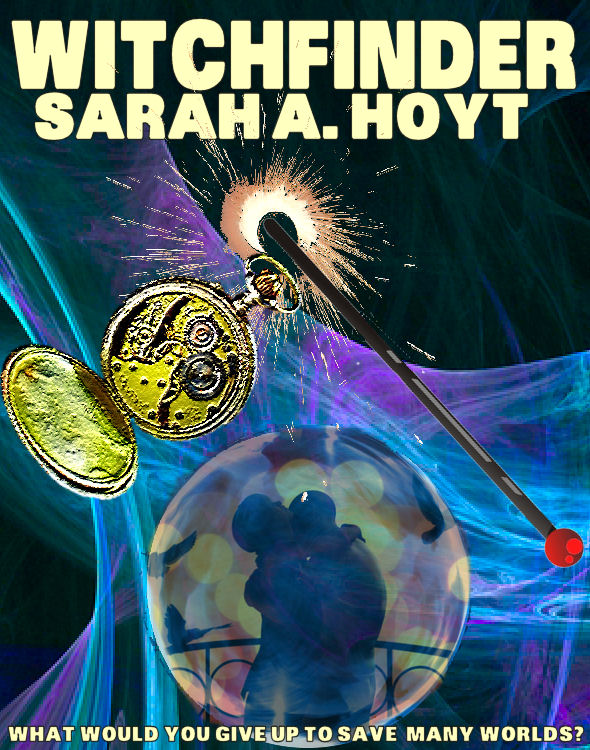
Witchfinder — Free Novel — chapter 19

*This is the Fantasy novel I’m posting here for free, one chapter every Friday.   If your conscience troubles you getting something for free, do hit the donate button on the right side.  Anyone donating more than $6 will get a non-drm electronic copy of Witchfinder in its final version, when it’s published.
There is a compilation of previous chapters here and I will compile each new chapter there, a week after I post.  When the novel is completed and about to be edited the compilation page will probably be deleted.

Oh, this is in pre-arc format, meaning you’ll find the occasional spelling mistake and sentence that makes no sense.  It’s not exactly first draft, but it’s not at the level I’d send to a publisher, yet.*

For previous chapters, look here:  https://accordingtohoyt.com/witchfinder/

After The Bird Has Flown
There was no worse feeling, Gabriel thought, than arriving to close the door of the birdcage a moment after the bird had flown.
Not that Seraphim and Miss Felix were birds, or that the odd portal – was it a portal?
– to another world was a cage door.  For one, Gabriel was almost sure that neither Seraphim nor Miss Felix had meant to go through it and into– Where?
And then, in that split second after he realized he’d lost track of his legitimate brother, the head of his house on whom,  in fact, his entire family depended, he realized that he had a bigger problem
The corpse was shambling towards him.
He’d had some experience in Cambridge with reanimated corpses.  He wouldn’t say that was what had put paid to his one and only love affair, but it had certainly exploded the whole thing into the public eye and had forced him to leave Cambridge in disgrace.
Normally the only way to kill a reanimated corpse was to get the person who’d first animated it to help.  That had been the problem, really, back then, though perhaps Gabriel hadn’t dealt with it as sanely as he should have.
But now, ten years later, he still had no idea how to deal with it.  You couldn’t put an animated corpse down without the collaboration and the help of the person who’d reanimated it.  Who could have animated Antoine?  It had to be someone in the house?  But who would have done it and set him up as a magical trap to send Seraphim and Miss Felix– Where?
He backed up as the corpse shambled forward.  He raised his wand.
And then, as if a switch had been turned, Antoine’s corpse closed its gaping mouth, swayed, and fell, forward, with all the grace of a sack full of sand.
Gabriel realized he was shaking and sweating, standing alone in the empty guest room, staring at a dead man and wondering where Seraphim and Miss Felix were.  Always, that question came back.  What had happened to Seraphim and Miss Felix?  And what would happen now?
Gabriel backed up, until his back hit the wall of the hallway, opposite the door to the room.  For a moment – for just a moment – he thought he’d go back in and pull the bell pull and call for help.  But what help could he call?  The Duchess?  Already fearing for the life of her younger son, and perhaps for his sanity, lost in fairyland, what could she do about the loss of her older son?  Caroline?  Caroline was a mere child.  Oh, precocious beyond her years, but how much help could she be?  Worse, how much help should he ask of her.  They were very likely to be dealing with forbidden magics here, before it was all said and done.  Travel to other lands, for sure, and probably meddling in their affairs too.
Worse, he realized, with a feeling as though a leaden weight had settled on his stomach, some people – perhaps even the duchess, almost certainly not Caroline, but surely every servant in the house – would suspect him of having done this.  The magic was so odd, the animation of the cadaver, the portal.  Fairy magic, they’d say, and they’d talk about him behind their hands.  He’d once again meet the odd looks that focused on him for a moment, then slid sideways, and know, know as he did in his first days in the house, that behind their backs they held their fingers crossed, an impotent attempt at stopping the evil magic he had no intent of using.
What could he do?  He couldn’t leave Seraphim lost.  Or Michael.  Or possibly even Miss Felix, if she was innocent in this.  His mouth went dry in a panic, and at first he thought the loud banging was coming from his head or from his heart.
Then he realized it was coming from the front door.  Someone was pounding on the door, loudly, and shouting something.  Sound of running feet echoed through the house, and distantly, Gabriel heard the front door open.
There were shouting voices, one of them almost for sure the buttler’s.  Here, in the guest wing, where every room was unoccupied, there was a great silence, but the shouting voices continued, and now there were many people coming in, at least if Gabriel was interpreting the voices correctly.
Gabriel was the only son left in the house, even if he wasn’t a son of the house, properly speaking.  He must protect the dowager and Caroline.
He ran towards the noise, but before he got there met with a maid running in the other direction, towards the family wing.  He stopped her, daring – an unwonted familiarity in him – to put his hand out to her shoulder.  He couldn’t remember her name, though he was sure he knew it.  Bessie or Annie or something like that.  All their names swirled in his head, and what came out of his mouth was, “Please, you must tell me.  Please, what is happening.”
If she was shocked at being touched, she didn’t show it, though she did drop back and drop him a courtesy.  It seemed to be unspoken etiquette of the house to treat Gabriel as an upper servant and to give him the deference they gave the butler and the house keeper, just short of the deference they gave Seraphim or the family.  “Sir,” she said.  “Sir.  It is the constables.  And the king’s magical police, and they want His Grace.  They said as he done murder, and the murdered man, killed by magic is in the house!”  Her mouth worked and no words came out.  “Sir.  And they say as you helped, sir.”
There are moments when a man’s life hangs on a thin thread of decision.  Gabriel was the only man left in the house, the only male descendant of the late Duke of Darkwater, who might protect the women in family.  But he was also half fey, easy to paint as a villain in this tale that had spun itself out to ensnare his family.  Not that he minded, or not too much.  He’d grown used to it, if not easy with it, over the years of living amid the mortals.  But in this case, what he was, who he was, could be used to taint all of the Darkwaters.
If they were going to argue that Seraphim had killed this stranger for no good reason, they’d need to get the closest witness out of the way, and that was Gabriel.  Who also happened to be the only witness to the fact that Seraphim had disappeared against his will.  And Gabriel would on top of all, make people mistrust the family that had harbored him – his family.  After all, people that took a half-fairy child into their home, would surely do any sort of stupid thing, any sort of criminal thing.
Gabriel swallowed hard.  He put his hand out again, and this time held onto the girl’s arm.  Given how leery he was, usually, of touching anyone at all in the house, it should have alarmed her but it didn’t.  Instead, Gabriel found her gaze fixed intently on him with a sort of puzzling expression.  Was it hope?  Did he add to all his sins the broken hearts of housemaids?  He removed his hand slowly, and raked back his hair which somehow had fallen forward over his face, “Listen, Annie,” he said, and in that moment knew the name was Bessie, but didn’t want to correct it.  “Tell Her Grac– No, tell Caroline, Miss Ainsling, that I’ve gone to… to avoid the… my presence can only hurt them.  Tell Caroline that Seraphim was pulled into another world, and I’m going in search of him and find him or die trying.  Tell her and then…” he thought, and suddenly realized for the girl’s protection itself, there was only thing he could do.  He put magic behind his order, to make both parts a compulsion.  “Tell her immediately, and then forget it.  It never happened.  You never saw me.”
He let the girl go, and watched her walk – no, run – towards the family wing in that half-mechanical gait of people under a compulsion.  And then he ran the other way, towards his room.  He ran faster than he’d ever run.  He ran as though the fires of hell were burning at his heels, the hounds of hell pursuing him.
He could hear the voices of strangers in the house.  He could hear the tones as the Buttler tried to keep them from coming in further.  He’d have to use a spell to leave.  That would leave a signature, but never mind.  He’d go to London, where the magical trace was harder to find, and then he’d transport from there.  And then he’d stop long enough to figure out how to find Seraphim.
Blindly, he pulled his luggage from under the bed.  Blindly, he threw clothes into it, both from the trunk at the foot of his bed, and from the peg on the wall.   There were steps on the corridor, and his mouth was dry, and his heart was pounding.  And now there was a knock at his door, and a voice calling out, “Mr. Penn?”
And the voice was not one he knew.
Without looking, without turning, he lifted his hand and threw a lock spell at the door.  It wouldn’t hold any sort of constabulary for long.  Not if they had a magician with them, which they would.  Surely, they would.  But it would slow them down.
He looked down at himself and realized he was still wearing only his underwear and his dressing gown.  His feet were bare.  There was nothing he could do about that, and it was almost funny that he should leave this house as he had entered, grossly underdressed for the weather.
He lifted his hand and with a pass, opened a portal, and found himself, between one breath and the next, in the betweener, and then, suddenly, again, on an alley in London.  Nearby, a baby cried.  Somewhere, further off, a woman laughed, a full throated laugh that reminded Gabriel of his mother.
London was a criss cross of magical comings and goings, and it would take them a while to track him here, but how long was a while?
In his mind, the events of the last day had assembled.  Someone had tricked Seraphim into committing what could be construed as a crime, and then they’d taken him away, so he couldn’t demand king’s justice.  They’d taken Michael too.  And now he, himself, had had to leave.  Why?  What did they want?  Access to the house?  Possibly.  Or just to destroy the family?  Possibly also.
But whatever they wanted, and whoever they were – perhaps the shadowy cabal he and Seraphim had encountered in distant worlds and nicknamed The Others – they would not be stopped by something like the difficulty of tracing someone in London.  They’d barely be slowed down.
In his mind’s eye, he saw his room’s door smashed down.  Now they’d be tracing him… now.
There was only one place he could go; only one place he could hide.  Marlon, curse him, had a tight enough lock on his lodgings that in ten years of living outside the law, no one had caught him, nothing had emerged about his wereabouts.
And Marlon, curse him, would take Gabriel in, though the price would be more than Gabriel would ever pay for himself, by his own choice.  But to save the only family he’d ever known?  There was no price too high.
He lifted his hand and, loathing himself, loathing his necessity, opened a portal to secret coordinates he’d promised himself he’d never use.

The Matter of the Apron

Sorry this is so terribly late, but today I’m feeding the robot-building team at my son’s school, so before I sat down to write, I had to put four massive loaves of Italian Semolina bread in the oven.  Then I had to come up with a one-paragraph pitch for Dead As A Doornail for the fourth Dyce mystery.  The fourth Dyce mystery, you say?  But I thought you were going indie with that.

Well, ’deed I was, but there’s this thing called an option clause, see.  And if they come up to my price, I might yet write DAAD for them.  I’m not doing it for 5k is all I have to say.  It’s not practical.  I could write a novel for Baen for 12k in the same time, so what’s the point?  I have to live to.  And I can do DAAD indie and have it out for xmas for all of you Daring Finds fans, only three months after A Fatal Stain.  BUT before I decide or do any of that, the paragraph had to be sent out.

Then I had to send a novel to a second round of first readers, to figure out if I’m going nuts.  (Long story.)  And now I’m going to go make meatballs (a huge batch.  It’s fifty kids! Teens.) So they’re ready to go in oven when bread comes out.  (They cook in sauce.)

Why am I the one doing this while trying to work?  Why doesn’t my husband do it?  Well, first because I volunteered.  And second because he has to work outside the house most of the time.  Third because he makes more money and not because of “sexism” but because he took a degree that’s more profitable.  (At least short term.  My work is the retirement plan.)  I can work in the house so I can fit in cooking for fifty.  ALSO because I cook better meatballs.  MUCH better meatballs.

Which brings us to… sexism in Heinlein. (You see what I did there?)

I am forever puzzled by the accusations of sexism swirling around Heinlein – and ONLY Heinlein of the authors of his era.  But the accusations I heard at Cosine managed to be either new to me or framed in a way that was new to me.

First apparently what’s wrong with Farnham’s Freehold is that it’s sexist.  (WHAT?  I could list several things wrong with it, starting with the rather bitter tone of the main character.  Okay, not wrong, but not my favorite book, ever.  I prefer Sixth Column which does have racist hints (though Heinlein softened that by having Asian-American characters on the GOOD side) because it has a buoyant can-do tone.  Again, I would not presume to criticize the master, but it will never be my favorite.)  This because you know, in the book “some women prefer to live in harems.”

That sound you hear is my head hitting the desk repeatedly.  Maybe if I get dizzy enough I can start thinking that way too.  Look, tell me straight, are American-born-and-raised women TRULY this self-centered and filled with penis envy, or did they have to work long and hard to become this way?  (Okay, update, I’ve simmered down and I apologize.  I don’t mean ALL American born-and-raised women.  I haven’t even MET them all.  I mean the substantial portion of college educated bien-pensants who believe this nonsense.)  My American born female friends aren’t this way, for which I SHOULD be grateful, I suppose.  Of course, I’m selective.  I try to pick people who think for themselves.

Let’s start from the top, okay?  Yeah.  Farnham’s Freehold, the civilizations that survived were those MOSTLY in Africa.  I.e. Islam influenced.  OF COURSE THEY HAD HAREMS.  DUH.  Double DUH with sprinkles.  And of course women “liked” to live in harems.  If you’re raised to believe that’s your rightful place, you believe it.  I guess people here have read one too many fantasies where women in a mysogynist society suddenly, out of nowhere are heros and sword fighters and everyone follows them.  Is that it?  Right…  The truth is Heinlein was more multi-cultural than the multi-culturalists.  He didn’t as a matter of fact “clean up” other cultures.  He just took them.  (The cannibalism I could see them objecting to.  The harems?  How vagina-centric do you have to be that THAT’s the objectionable part?  And the cannibalism, though I wouldn’t have put it in, is understandable/excusable in the context of a post-apocalyptic world.)  Humans are infinitely adaptable, and they can be raised to like practically anything.  That’s why sh*tty regimes subsist sometimes for centuries.  In this same society male slaves who are too tall/big are castrated.  BUT you don’t see any slave revolt so the males apparently have adapted/view it as a price of success.  Should you say it’s sexist because males like being castrated?  It’s as valid as saying it’s sexist because females like living in harems.

Yes, his ex-wife does love being the favorite of the local lord.  I have news for you, some women do.  I never understood it, perhaps because I’m put together wrong, but a lot of erotic romances and woman-porn concentrate on women in the submissive or owned role.  And these are FOR women.  Also, btw, I know several women who share a man and seem to think this is liberated.  (It’s always a lousy man, too.  Go figure.)  And his wife/ex-wife is ALWAYS portrayed as damaged goods from the beginning and a serious case of passive aggression.

Don’t tell me, we’re not allowed to write women unless they’re perfect.  Well!  That’s going to make reading interesting.  Not.

Then there was the critique that well, Heinlein was sexist because his women of the future wear aprons and enjoy being homemakers.

I have news for the generation before me.  SOME women – perhaps a sizeable number – ENJOY being homemakers, at least while their children are small.  In fact, this seems to be one of the major complaints of boomer females who decided that this means we’re “losing ground.”  Listen – female liberation is the freedom to be what you want to be, not to be ersatz men-manque.  I enjoyed being home with the kids.  I simply used it to get my career off the ground.  Would I have preferred it to be easier?  Sure.  But it was my choice to make.

As for “letting women down” or going back, again, listen, the gains made are technological and hinge heavily on the pill.  The ONLY way we’ll go back is if we court societal collapse.  And/or deny women alternatives so that some of them go running back into feudal servitude because it’s better than being forced to be what they’re not and don’t want to be.

And having intelligent women stay home and pursue non-traditional career paths is definitely better than the feral children raised in some of our bottom-rank child care facilities.  Live with it.  Besides, the same tech that gave us real liberation in the form of reliable contraceptives – well, its cousin, in electronic tech is going to have everyone working at home – if they choose – in the next ten years.  In fact, Heinlein has that in The Rolling Stones.  And that, IMHO is the best possible world.

Newsflash: Hormones matter.  Yes, women will go gooey over babies and want to spend time with them.  It has nothing to do with intelligence or capability.  It has to do with tens of thousands of years of evolution.  I am probably the least maternal of women except in my mama-bear form.  I never thought I’d marry or have children, see?  But having Robert was a revelation.  If he cried, I stopped being able to think until he stopped crying.  My husband?  He could shut it off.  I couldn’t.

Is true equality possible?  Of course.  First, change the hormones.  But then you TRULY have men with vaginas, and who the heck wants that.  I, for one, enjoy the living daylights out of being a female and not just in the horizontal planes.  The fact that I can put on make up and make male-brains gooey is my revenge for the baby thing, okay?  Yeah, as Heinlein said, the game is rigged, but it’s the only game in town.  Play to win.

Next up – aprons – and this is where I cry.  Listen the only reason women don’t wear aprons now has NOTHING to do with female liberation.  What the heck is the thing with aprons, anyway?  Is it that boomer women think the world started in the fifties and therefore when they think aprons they think heart shaped and laced edged?

For most of the history of the world men and women have worn something like aprons.  My grandmother lived in an apron, and btw I’d have paid to have someone tell her that meant she was enslaved.  (My grandmother was a lot like the grandmother in Pratchett’s Tiffany Aching series, except she didn’t smoke.)

Aprons are what people wear when engaging in dirty, clothes-damaging occupations.  And the only reason I don’t wear them that much – besides forgetting to put one on – is that clothes are cheap.  At least used clothes.

Even the amount of normal house-stuff I do on an average day (when not cooking for fifty) is heck on clothes.  Even light cooking.  Flour and water Eat some fabrics.

If you read Patternson’s bio, you’ll find that Heinlein wasn’t used to things being cheap/disposable.  Also, in his future there were a lot more people, and that meant scarcer resources.

I’m not saying Heinlein was NEVER wrong.  He was wrong on population.  And there are decisions he made in his future history I don’t like.  That’s just life.  But he wasn’t sexist.

Anyone who can decide Heinlein was sexist because future women wore aprons has one of two problems: Either they took one look down at age two and have ever since been screaming in mindless rage because they don’t have what their brothers have; or they have been sold a bill of goods and bought it cost.

If Heinlein is “sexist” what do we call other writers of the period.  Say, re-read Asimov’s Liar, where apparently professional women are always repressed and easy prey for males in the lab.  That’s NOT sexist?  But Heinlein is?

Or perhaps some movements that sell victimhood hate Heinlein’s message of individualism, individual responsibility and individual freedom.  And are trying to poison the well before you drink.  I don’t know… as far fetched as THAT hypothesis is – because who, making a living out of victimhood would hate for the victims to walk off the plantation, after all? – it just MIGHT be true.

“When any government, or any church for that matter, undertakes to say to its subjects, “This you may not read, this you must not see, this you are forbidden to know,” the end result is tyranny and oppression, no matter how holy the motives. Mighty little force is needed to control a man whose mind has been hoodwinked; contrariwise, no amount of force can control a free man, a man whose mind is free. No, not the rack, not fission bombs, not anything — you can’t conquer a free man; the most you can do is kill him.”  Robert A. Heinlein

“Let it be said that I believe in the quote above man means woman also, by the rules of anglo-saxon grammar.  And that in addition to governments and church, one should also consider any MOVEMENT who tries to restrict what you read as part of tyranny in the forming. Go you therefore and dare to read and think.”  Sarah A. Hoyt

Running In The Hamster Wheel Of The Mind

If all I do is write, why am I so tired?  If all I do is write, why do I get so hungry?

This has been brought home to me as I’m recovering from a severe ear infection, and today, at the end of ten thousand words, I woke up, having fallen asleep in front of the computer.  And it wasn’t that I was bored with the story – on the contrary.  I kept writing way past the point where I felt a little tired and out of it because I was interested in the work.

What is so tiring about typing?  How can sitting in front of the computer waggling my fingers tire the living daylights out of me?

And yet it does.

I first came across this effect when I was writing the Minoan fantasy (yes, yes, I do get that eventually I will have to rewrite that thing just to satisfy all y’all’s morbid curiosity.)  After … many pages, bringing the thing to a close was a trial, particularly since my character had had so many walls dropped on him, he just sat in the middle of the pages like a passive-aggressive Job or perhaps an uncooked lump of dough, refusing to do much of anything.  So I made it a point of finishing it in a month.  For that month, I’d sit down after breakfast and write five thousand or so words.  At which point I realized I was starving.

It got so bad that I – who hate pizza and who can cook – would forego the extra trouble of cooking, because I couldn’t concentrate on cooking while starving.  For a month, I ordered a small pizza at noon every day and ate most of it before I could think again.

You see, those last few chapters (okay, fifteen or so) were the battle scenes. The worst day was after writing a scene where my heros (ten or so of them) cross a ravine by the force of their arms on a rope stretched across.

Since then, I’ve noted that effect many times.  Trying to push on writing (and editing, being detail work is worse) while I’m sick or just recovering, or otherwise depleted is impossible.  I know that I’ve sometimes had to rest or snack before I could write a big epic scene.

Now, I’ve done real work – hard work, under the sun, like planting potatoes with the aid only of an old fashioned hoe, or building decks, or even distance-hiking.  And I’ve done intensely physical, boring work, like ironing for twelve hours a day.  I can tell you right now that this writing stuff is easy, soft work, a gig done indoors and on a cushy chair.

And yet… and yet, the phsyical effects – the tiredness, the hunger, the occasional muscle pain are very real.  Are they only psychological (is there such a thing as only psychological?)  Or is there something more at work?  There have been studies that seem to prove that you can increase your muscles by thinking of exercising, provided you think intensely and in detail about exercising.

Of course, to write action scenes, we have to think each action intensely and in detail.  So it makes a certain amount of sense.

Does anyone else experience this?  Or am I alone?

I’m taking my tired self to bed.  Tomorrow I have more actions scenes to write.  I just wish I knew if I’m insane (beyond the normal run of writers, that is) or truly, truly a weakling that I can’t recover from whatever the heck this was and write at the same time.

Surprise!

(And no, it’s not just the fact that I’m posting and in the morning.  Shut up, wretches!  No comments from the peanut gallery.  WHO threw that orange?)

Back when we were doing a short story a week for my writers’ group, I used to outline the short stories extensively before hand.  What I found when I don’t do that is that I hit the deadline and stare in angst at the paper, wondering what this story is going to be.

So, if I want to do a short story a week, I plot it before hand.  (And no, I haven’t done a short story a week lately.  Though I might, once Witchfinder is done, should I decide it’s not worth it doing another novel in installments – and btw, I think I need to make the installments longer, because I get into it, start going full throttle and it’s hard to pull away and then get into it again.)

If I’m just hit with “Sarah can you do a short story on?” and they give me the theme, the sheer panic of having to write something in two hours usually keeps me running towards the goal.  (It is perhaps sad that most of my BEST short stories were written this way.)

As a random, tangentially related observation (I had too much caffeine and I haven’t slept enough so right now I’m sort of like a cat with ADHD.) about fifty percent of my short stories are not actually short stories, but first chapters.  I work up till the world build is clear, then chop.  For the record, I wasn’t aware of it when I was doing it and also in retrospect, it was the ticker in my head doing it.  I knew that anything over six thousand words would be hellish to sell, so I would have a ticker going tick, tick, tick, close to six thousand, CHOP.

Now the two stories I’ve written without length constraints both ended up around 11k words.  That might be my natural length and I’m thinking of redoing a lot of the older ones.  (Also that would allow me to make endings happier.)  Yeah, yeah, I could redo them so they ARE first chapters of novels, but in what time?  There’s only so much I can do, and if I can shove these ideas into short stories, most of them will then shut up.  As for you – shut up wretches – you’ll simply have to understand I CAN’T start a hundred series, or I’ll never get around to your favorite one.  (There, there.  Don’t cry.  I’ll change the free short story later today.)

Anyway, one thing was inevitable in those short stories, and seems to be inevitable in my novels too.  No matter how well and how detailedly I plot in advance, when I’m writing, the short story or novel will suddenly lurch sideways and backwards on me.

Right now, as I’m doing the final on Blood Royale, the second of the vampire musketeers, I just realized one rather aimless chapter needs Buckingham to arrive in England.  Unfortunately this means that I need to thread him through the entire novel and he must be relevant, and I’ve got no idea WHY he’s there, or why the chapter insists he must be in it.  I am sure he must, though.  Go figure.

In other words, stories throw surprises at me in all phases, from first thought to revision.  I’ve learned that if I refuse the “surprise” the novel or short fails a bit, and often I have to capitulate, occasionally (Darkship Renegade!) after delivery (Though Darkship Renegade was only one I did after editor had started READING it.  That has to be some sort of boneheaded record for me.)

I wonder what causes this.  Does my subconscious want me to live in interesting times?  Do I secretly hate myself and want to make life difficult for me?  Or is it simply that until vision is almost realized, I can’t see every corner of it?