Lenin’s The State and Revolution – An Introduction – by Amanda S. Green
Last night, I talked with Sarah about today’s post. Unlike last week’s post, or even the series on Clinton’s What Happened, this post simply wasn’t coming together. I finally had to put it aside and tell her I’d get her the post this morning. I needed to sleep on it and, hopefully, inspiration would strike. In the light of day, I’m not sure inspiration struck, but I realized what the problem was. Simply put, the 1933 edition I was reading was, while my preferred edition, like wading through molasses on a day when the temperatures were below freezing. It wasn’t the subject but the translation. It flowed like the original Russian text. The problem is English isn’t meant to flow that way, not any longer. Or maybe my brain just doesn’t flow that way, not for quick reading, any longer.
So, I went trolling the internet for a different version. As I did, I kept my 1933 edition at hand as well as my Russian text of the pamphlet (which I finally found this morning). Using the preview function on Amazon and even checking out some free PDFs of the text, I finally found one I like.
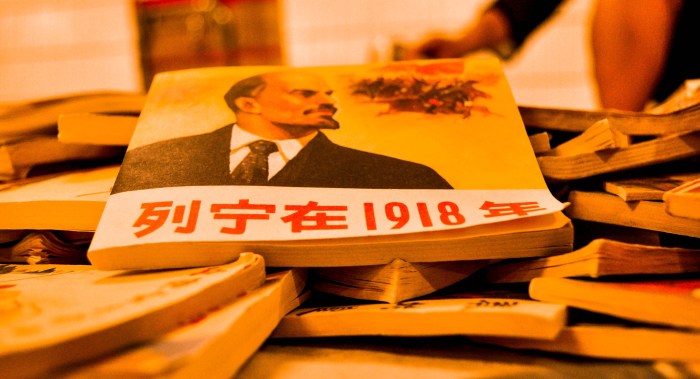
The State and Revolution (Penguin Twentieth Century Classics) will be the version I mainly use for the purposes of this new series of posts. Yes, the text is slightly different from the translation I prefer. But, checking it against the 1933 edition and the original Russian, it is (at least so far) accurate. The language has been updated slightly for easier readability but the meaning is still the same. Better yet, the introductory notes give not only information about the book (or pamphlet as it was originally called) but also the history of Russia and of Lenin’s life.
Many Westerners know little about Lenin the man. We think of him as the founder of the Soviet Union. We remember the images of him addressing the masses or on propaganda posters. We even remember the pictures of what was supposed to be his body lying in state inside Lenin’s Tomb in Moscow not just years but decades after his death. When I visited the tomb, more than one person did a riff on the old Memorex commercial’s tag line, changing it to, “Is he real or is he wax?”
But we know little about the man himself, much less about this particular work.
Lenin’s history as someone working against the Romanovs started when he was a young man. He joined anti-Romanov groups and by mid-1890’s “was a leading Marxist ‘underground’ revolutionary in Petrograd.” (TSAR, p vii) In 1896, he was arrested. 1897 saw him being exiled to Siberia. After serving his sentence there, he immigrated to the West in 1900. In 1903, he came to prominence during the Second Party Congress by becoming the leader of the Bolsheviks after their split with the Mensheviks. The Bolsheviks, also known as the Reds, would not only defeat the Mensheviks and others in the Russian Civil War (1917 -1922), they would also become the Communist Party of the USSR. Lenin led them throughout this time, both as their spiritual leader and as their figurative.
But, back in the summer of 1917, Russia was still in turmoil. World War I continued, draining Russia’s already strained resources. With Nicholas II overthrown in February of that year, Lenin and other “revolutionary figures” began returning to Russia. Lenin, who has been in Switzerland during the war, found himself facing a number of hurdles in his attempt to return to Russia, however. Russia’s allies, knowing of Lenin’s opposition to the Tsar, blacklisted him, preventing him from traveling to Petrograd via France and the North Sea. Because of that, Lenin had to travel through Germany, with approval from Berlin. That route, along with Berlin’s approval, led to the accusation of him being a German agent.
The Provisional Government leveled the charges against him, charges he denied. Very quickly, he became a leading figure in the opposition against the new government. He proclaimed “that the emergencies of war and economic disruption were resolvable only through the installation of a government of soviets.” (TSAR pg xiii). To do this, the Bolsheviks began their “campaign” to “convince the working class, the soldiers and the peasants that the party’s representatives should replace the Mensheviks and Socialist Revolutionaries in the soviets.” (TSAR pg xiv)
Long story short, Russia was a mess at this point. In May, a newer coalition government was formed. The Bolsheviks still didn’t hold the power they wanted and they used the upheaval to foment more dissent. After the government banned a protest in late June 1917, the demonstration was met with force from the government. The government held Lenin responsible, even though he hadn’t been in contact with Petrograd at the time, and ordered his arrest on the charge of being a German agent.
For Lenin, this meant once again going on the run. During this time, he began writing The State and Revolution. What is interesting is realizing that it wasn’t written for those in Russia he was supposedly fighting for. It wasn’t even written for most of those in the Bolshevik Party. It was written for the well-educated, for those who could go out and debate and spread the intellectual aspect of Lenin’s beliefs.
Many don’t realize he never finished the pamphlet even though he lived 7 more years. It was supposed to have had one more chapter. Also, as noted in the preface to the second edition, written in 1918, Lenin added a new section to chapter 2.
Lenin believed The State and Revolution was his most important contribution to the political debate. He worried it wouldn’t be finished before his death and, while on the run from the government, asked a friend to make sure it was published should anything happen to him. Yet, do you know why he didn’t finish it? In a postscript to TSAR, he wrote, “It is more pleasant and useful to go through the ‘experience of revolution’ than to write about it.”
Preface to the First Edition
The opening paragraphs make clear Lenin understood the turmoil of World War I, following upon the problems Russia faced after the 1905 Revolution and the Russo-Japanese War (1904-1905) made a fertile ground for a new revolution. In language similar to what we heard from certain parties during the 2016 presidential race, he did his best to stir the pot of inequality.
The imperialist war has brought about an extraordinary acceleration and intensification of the process of transformation of monopoly capitalism into state-monopoly capitalism. The monstrous oppression of the laboring masses by the state, which is fusing itself more and more closely with the omnipotent associations of the capitalists, is becoming ever more monstrous. . . The unprecedented horrors and miseries of this protracted war are making the conditions of the masses intolerable and increasing their indignation. (pg 3)
Translate that into Bernie-speak or even Hillary-speak and doesn’t that sound familiar. Capitalism bad. Money and power are in the wrong hands. The oppressed are tired of being second-class citizens. We must rise up and take control.
And the imperialist war is nothing other than a war for the division and redivision of this kind of booty [enslaving small and weak peoples, holding power for the state, etc –asg]. The struggle for the liberation of the laboring masses from the influence of the bourgeoisie in general and the imperialist bourgeoisie in particular is impossible without a struggle against opportunistic prejudices on the theme of the ‘the state’. (pg 3)
The “state” is all about the “state” and to hell with the individual. Sound familiar? As for the “laboring masses”, I can just picture Bernie making that speech. Even though this is only the preface to the work, I have to wonder what sort of world Lenin really imagined. Sure, he will write that, in a true socialist existence, the state will eventually cease to exist. But I have to wonder if he really believed that or if it was all a con. After all, he’d seen the best and the worst humanity had to offer. Was this all a big con? The irony of what he professed compared to what he wrote and what the great Soviet state turned into shouldn’t be lost on any of us.
TSAR is split into three sections. I’ll deal with each section in a single post (at least that’s the plan). Lenin’s description of the sections shows his disdain and contempt for those who didn’t view Marxism as he did. (pg 3)
- First . . . we examine the doctrine of Marx and Engels on the state, pausing to give specially detailed attention to aspects of this doctrine that have been forgotten or have been subjected to opportunist distortion. (And I will try to point out how Lenin himself fell victim to this “opportunist distortion.”)
- Then we deal with the main representative of these distortions, Karl Kautsky, the leader of the Second International which has suffered such a wretched bankruptcy in the present war. (A charge that most definitely could be leveled against the USSR, especially after Lenin’s death.)
- Finally, we sum up the main results of the experience of the Russian Revolutions of 1905 and particularly of 1917. (The latter of which is an interesting comment, especially considering the “revolution” was ongoing at the time Lenin wrote this. Yes, the Romanovs had been deposed and later murdered by the “revolutionaries”, but the Provisional Government maintained power until the October Revolution. The preface was written in August 1917. So the revolution had yet to see the end of its first phase.)
He closes the preface with the following:
Thus the question of the relation of the proletarian socialist revolution to the state acquires not only a practical political importance but also the importance of a most urgent current problem: how to explain to the masses what they will have to do in the very near future to liberate themselves from the yoke of capitalism. (pg 4)
As we go forward with this series, I’d like each of us to keep this last quote in mind. TSAR was written as a road map for the leaders of the Bolsheviks, to help them manipulate the masses to their side. Remember it when you listen to any politician, but especially those who talk about redistribution of wealth, of taking from one group or class in order to give to another. Look for the similarities and, when you see them, be prepared to counter with factual evidence of not only how this plan worked in the Soviet Union but also how it would impact our country.
Marx started us down this road during the “modern age” with his “From each according to his ability, to each according to his needs” bullshit. Lenin took that and ran with it. The reality, ignored by all too many, is that the producers of the world would become the slaves to the takers. We aren’t talking about reasonable welfare programs here. We are talking about a state of existence where the State tells you what to do, takes the results of your work and distributes it to everyone. Most humans don’t work well in that sort of existence. After a while, resistance and resentment build. If revolution doesn’t occur then resignation does. The desire to work hard and to innovate slowly atrophies and dies. Is that the kind of life you want for your children or grandchildren?
I don’t.
The best way to fight the Bernie-bots of the world or the more subtle Clintons and Obamas of the world are to recognize and understand not only what their goals are but the basis for them. Am I an expert on this topic? Hell no. But I continue to work hard to become one because it is only by understanding the historical implications and applications of their beliefs that I can help fight the current day attempts to send us down the path to socialism or worse.
[For raising the tone of this blog — ATH is culture! — and helping me with the exposing of the roots of the current mess — in her case with more facts! — if you decide to send the woman a drink– And her Amazon author page is here -SAH]