Let There Be Candle Light By Orvan Ox
After the last post about the simpler (no pressure or mantle) kerosene lamps and lanterns, someone suggested a post about candles. This seems a bit strange, at least initially. Candles are rather simple things and who has not used one or at least seen one used even if merely for a few moments atop a cake? And yet… there are various sorts of candles, some better for light and some better for heat, as well as various holders and lanterns. And even so, while the modern era might go on about lumens for brightness, it’s candlepower that seems more readily understandable.
There are certainly many sorts of candles, but for “grid down” the purpose is light, heat, or both. It’s not about ambiance, entertainment, or who knows what else. This constrains things. The “birthday candle” doesn’t last long enough to be practical. The scented candles might be alright now and then, for some, but for any duration they can get overpowering. The big pillar candles might be alright for a while, but are subject to having the outside become a light-filtering wall as the center burns down. If they have multiple wicks, though, this might be mitigated and allow for a bit more light.
What it comes down to, at least for me, is unscented tapers, thinner pillars, and tea light candles. The tapers fit into various candle holders and even candelabras and, like the thinner pillars, are for providing light. Tea lights are made to keep things warm, and some can last several hours. Tea lights do provide some light and there are camping lanterns that use such. These are rather small and so the wall of the thing is close to the flame, thus it gets quite hot.
A few examples:
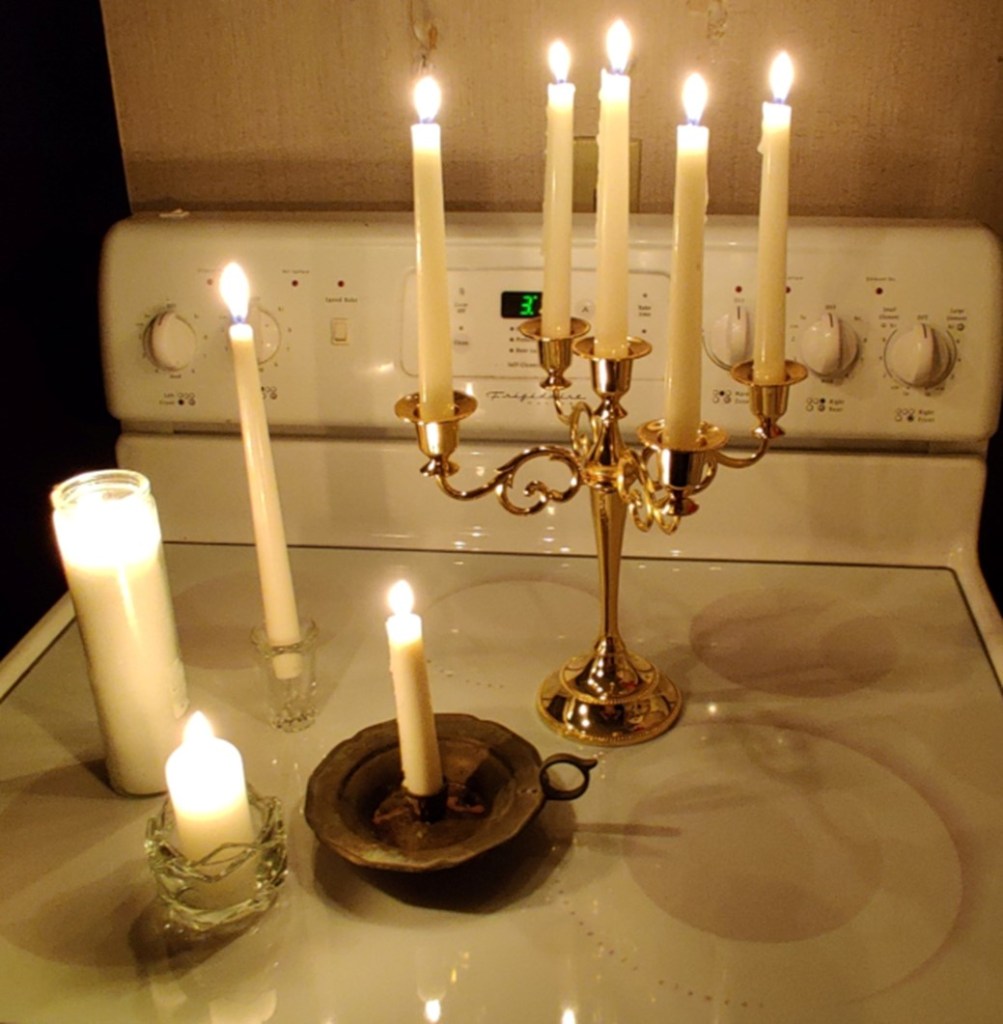
First, the tapers. A nice looking candelabra, with five candles so plenty of candlelight. And in the back a very simple candle holder. These are both “set it place and leave it alone” sorts of things. Moving them means the liquid wax at the top of the burning candle is apt to spill… possibly onto you. For paraffin and soy waxes this is annoying enough. Beeswax has a higher melting point/range and burns are all too likely. The ancient looking holder with the finger ring lets one carry the candle and any wax spills are caught by the brass, not the hand or arm.
The pillar in front is another simple holder, meant to be left where it was set and lit. The pillar contained all in glass can be readily moved around, just only grip well under the flame. The candle with the glass envelope does flicker some, but surprising little much of the time. It also seems to last quite a long time.

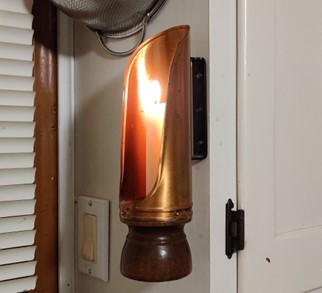
A couple candle lanterns. The one with the glass chimney is nice, but the lack of air intake (as manufactured) other than via the top of the chimney means it flickers quite bit. That’s unmodified. It was not unusual for a person to (with chimney removed!) poke a few nail holes in the base to let air in. One could also drill holes, of course. The other is a sort of “flashlight” and with the design of the handle, it can be hung on a nail or such. That’s a nice, fancy(-ish) thing made to look fairly nice. A larger soup can and some time with a metal snips and a bit of work to deal with sharp edges and it might not look as nice, but would also serve.
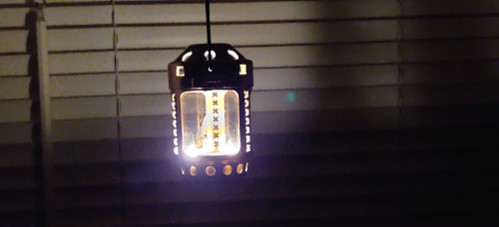
A tea light lantern. It’s not super bright (what candle is?) but there is some light.
But where the tea light really does well, is to provide heat, even if not very much. But if one provides some heat, more than one can provide more heat. An ideal heat source? Not really. Right, proper heaters certainly do better. But in a pinch something like this “dubious slapdash heater” might be enough to keep a small room if not comfortable at least tolerable.

This is a 5 by by grid of tea lights on an old cookie sheet, with a ‘cooling rack’ holding up a copper plate and a heat-powered fan to spread the heat around the room. The copper plate is admittedly expensive (fancy thing for using cast iron on a glass top range without worrying much about it) but aluminum is also a good thermal conductor – if it was not, why are most heat sinks aluminum?
There are some specialty tools for dealing with candles, which are not really necessary, but I’ll be complete and mention them. There is a wick adjuster, a wick trimmer, and a snuffer.
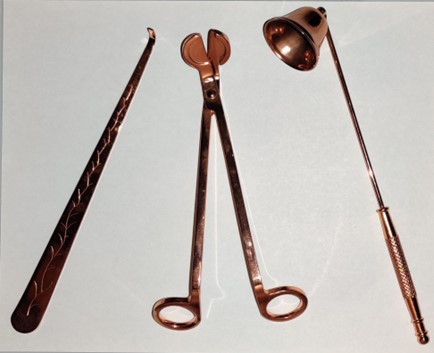
The wick adjuster might seem to be something to keep a wick straight up, but that can be the wrong thing to do. A taller flame is a brighter flame, true. A too tall flame is a sooting flame, however. Self-trimming candles have wicks that curl some and thus the end of the wick is burned away. If the candle is not self-trimming, adjusting the wick to have it burn off might be called for.
The trimmer is a fancy scissors that can catch the trimmed wick. Trimming is done before the candle is lit (or after it is extinguished). The wick should start about ¼ inch high.
And the snuffer is just that. A little bell to cover the flame and snuff it out. This has the advantage of not getting burnt fingers from pinching out the flame, or possibly spattering wax from blowing out the flame.
If you really to delve into things candle, there are plenty of texts on how to make your own or how they are made. For “what’s going on” there is The Chemical History of A Candle by Michael Faraday. You can find that on Project Gutenberg.






















































































































 According To Hoyt