Quicksilver here feels this is an important enough point that she actually held still, almost, for a photo last night! She’s an aptly named kitty.
Quicksilver would like very much to inform you that her big brother Indy and big sisters Muse and Circe, and courtesy Uncle Havey, need you to please drop a few bucks in the annual blog fundraiser for churu supplies.
Sarah is in fine shape and off doing Sarah things with her Dan, and I am updating the blog so you know she’s still alive. (We know you: you start to fret.)
I can’t say that there’s much to report on our front except for this being the worst year yet for growing food. Wildlife, however, has delivered on entertainment. We had two sets of magpie nestlings, and watching the parents try to teach the dozen or so youngsters how to magpie is fun. “You expect me to CATCH a grasshopper? How about I just open my beak and you stick one in?”
We also have baby hummingbirds again: haven’t spotted the nests, but the babies are coming to the hummingbird feeder, zipping around as they do. Last year was a bad year for the hummers, almost none returned from migration. This year they’re rebuilding numbers, probably because we’re all dedicated to feeding them, because with the ongoing drought there are few flowers.
The does are teaching the fawns to cross the road: caught one showing her fawn to look both ways before crossing and wait for my vehicle before they did this morning. We’ll see how many survive.
Watching national politics has also been entertainment these last few weeks–McConnell? Platner? Seriously? Not sure which party is more . . . absurd here. Local politics are humming along as murkily as usual, tiny pond, moderately sized fish, lots of mud. (Tiny pond? A friend lost her primary by 40 votes. That tiny.) All in all I prefer rural politics: few participants, you know them all personally, and they all have to live together win or lose. Also if someone’s in the hospital you know, and probably took his family a casserole.
I believe I have managed to attach Sarah’s fundraising links, so go ahead and do that, thank you. Pretty Silvy wishes you to keep her kin in churu. You wouldn’t want to let that sweet face down, would you?
If you wish to donate: There is a Give Send Go fundraiser for this specific fundraiser set up. Here is a Paypal Me Link if you prefer that. (Yes, I know. Paypal, but for now, they’re behaving.) If you have a monthly donation setup to the permanent Give Send Go, that is still working and thank you! There are also two substacks you can subscribe to. One is on the side bar of the blog, the other is supposed to be a newsletter, as well as giving you chapters of the current work in progress if you become a paid subscriber. It takes cards. For snail mail: Sarah Hoyt 304 S Jones Blvd #6771 Las Vegas, NV 89107
The purpose of this post isn’t to complain about Grokpedia. Look, I wont’ deny there’s a mini rant on that, because it unwittingly called me stupid and WORSE it called me OLD which at my age is VERY sensitive. It also utterly failed to get real cultural differences. However the point is where Grok learned this nonsense, which is US. And also how this nonsense causes problems and poisons minds.
So — does a little dance — rant first, explanation after.
My husband, who for some reason believes annoying me is as good as exercise by raising my heart rate, went trolling Grokpedia, which I’ll grant it, is less biased than Wikipedia. What it is is a fabulist of the first order, creating “facts” by taking things out of context and weaving “just so” stories around them.
For instance, it confidently assures all and sundry that my biggest influences were Ursula Le Guin, Joan Vinge (!) and a third woman whose name I can’t even remember now, and whom I might in fact never have read, just due to the vagaries of when books were available.
Okay, fine, all of you who are groaning and saying “Ursula Le Guin is responsible for you being a science fiction writer, woman!” are ABSOLUTELY RIGHT. But not the way Grok intended. Look, annoying someone so much they become writers is not the same as influencing how they write. None of that makes any sense.
Do I know where Grok got that bullshit? Well, yes, yes, I do. You see, it made up a little just-so story to go with it. According to it, my brother had me read these women so that I knew it was okay for women to write science fiction, and to encourage my ambition to write which was not a profession for women “under the Salazar regime.”
PEOPLE. That gigantic groan that just made the entire Western US tremble was not the ghost of dinosaurs, screaming from their fossil formations. That was in fact me, myself and I.
How and where do I start? That story above is so wrong it’s not even wrong. It’s a parallel reality where the moon is made of green cheese and Indy plays the violin in an orchestra.
First, my brother was NOT trying to encourage me to read science fiction. (Much less write it. My family had long accepted that I would at some point write, but they expected I would, like the rest of the family, write POETRY, which is an acceptable hobby for everyone in Portugal. The country doesn’t have a large enough population to sustain FICTION writing as a profession, so hobby was what they expected.) He was in fact — poor man — trying to hide science fiction books from me as at my age (the person who loaned him books reminded me recently — he found me on FB — that I was 9 not 11 as I’ve been ASSUMING) he thought they’d confuse me. (They did. But not more than history books or adventures in other continents did. It was glorious.) Also, because some of them were… uh…. spicy. (I didn’t get most of the spice. Like kids don’t.)
When he failed at this endeavor, he tried to control the books I got my greedy little mitts on, by not bringing the spicy/weirder ones home. By then it was much too late because I’d started taking the train to the city and READING SCIENCE FICTION BOOKS BY STANDING UP IN THE BOOK STORE NEAR THE SPINNER RACK UNTIL CHASED OUT. Then coming back the next day.
By the time I was twelve, I was blowing my birthday money on science fiction unless mom caught me first and spent it on useless stuff like shoes. By the time I was fourteen and engaged in various low-paying but paying gigs, my brother gave up and went halves on me on books, when we were both semi-broke. (Yes, pooling your resources to buy the equivalent of a $5 book is pathetic. Thou shalt most certainly DEAL.)
But…. did he then try to encourage me to read female science fiction authors?
Uh….. so, this is where Grok thinks I’m stupid and need to see someone like me doing something before I try it. This is the kind of bizarre affliction I never even UNDERSTOOD. People, I did things because I was bored. I often tried things I didn’t think were possible at all. Because they looked interesting.
Does the woman born in a small rural village in Portugal who came to the US and became a fiction writer in her THIRD LANGUAGE look to you like someone who sits around waiting to be “represented” in an endeavor so she knows it’s societally approved of and she can do it?
In fact, ladies, gentlemen and small pterodactyls, do I look like I ever gave a fig about whether anything I wanted to do, from whom I married to how I dress, to my hobbies, passions or profession, was something society — ANY SOCIETY — approved of?
Look, if I’d done what was approved of in Portugal when I was a kid, I’d be much better at crochet (my one womanly gift. Okay, crosstitch too, though that might fall under therapy against anxiety), I’d be passionately interested in telenovelas (they were radio novelas, but trust me, same same), I’d engage in a lot of celebrity gossip. Oh, and I’d have MAYBE because I was “smart” gone through ninth grade, then got out to do something societally approved of like secretary or clerk, until I married someone who lived not very far away.
This had nothing to do with Salazar (more on that later) in any way, shape or purple nothing. It has to do with Portuguese culture. The EU has made a lot of it go underground and it’s not spoken of openly, but I’d be shocked if women are considered as smart as men. And a bookish woman is an abomination. AND a woman who is interested in geeky stuff will find a way to disguise it, because she’ll be under suspicion of not being quite straight. Now in my time, before heavy indoctrination by the EU, this was more so. With bells on. I ROUTINELY got told by people including family members and teachers that I was in no way as smart as a boy and would only hurt myself trying to be. (People like my brother stopped saying it after a while. My dad never did. And mom advised me to PRETEND not to be as smart as boys because otherwise I’d only invite trouble.) I didn’t care probably because of a touch of the tisms, but also because I WAS BORED and just wanted to do things that looked interesting.
This gets to where Grok is calling me old. People, I was SIX when Salazar died. I was 11 when his successor was toppled by the international socialists. (Some other AI thought I approved of the Salazar regime because I compared it to FDR’s. THAT was a leap. I did compare it to FDR’s (without the minimal holding back FDR had due to our system of government) because he cribbed FDR’s speeches, even, for crying out loud. In no way did I mean to imply that made it non national-socialist or good. As far as I’m concerned both Salazar and FDR were national socialists and to hell with them.) This doesn’t mean I approved of the international socialists that followed, on account of they sold out millions of people in the Portuguese African colonies to the USSR and their Cuban mercenaries, and filled mass graves (As communists always do) and also made my teenage life a misery, due to my tendency to say exactly what I think to teachers who are spewing indoctrination. The later is a minor issue compared to the other crap they were doing, but very close and personal.
Now do I know where Grok got all this load of crap? Oh, yeah. I know. Because during SP I pointed out I’m tired of people trying to claim that women weren’t in science fiction till yesterday, and pointed out I knew these female writers from early on when I WAS A KID. Which it then confabulated with my complaints about sexism while I was growing up (to the extent I noticed it, which to be fair, wasn’t much, it bothered me. I tended to bowl over any discouragement or even shouts to stop, but it bothered me) and with the fact my brother introduced me to SF/F (more or less inadvertently) and wove it into this just so tale. The Salazar thing is probably because the idiots on the left attribute all sexism to right-wing (which Salazar wasn’t anymore than FDR was, not AMERICAN right wing. Though granted European right wing) regimes and to the fact some bright bulb thought I’d come here to “escape” when the national socialist regime fell. At eleven. By myself. (What can I say. I’m precocious. I headed to the beach, got some duck-shaped water-wings, and floated all the way across the Atlantic. Needs must, because I STILL can’t swim.)
(Note, I’d be proud and happy if Grok reported this as the way I came to America. Mostly because it’s absurd.)
Before I get to the point beyond the rant: the first woman writer that had ANY impact on my reading (I don’t know how much impact she had on my writing, if any) was Anne McCaffrey, because I was of an age (late teens early twenties) when she was published in Portugal to fall headlong into Pern. Before that I read women like I read men or small purple dinosaurs. I didn’t care, so long as it was words on the page. Heck, I preferred science fiction, but I read everything else too.
In fact, if you’re going to be keeping score, the female writers I read most in my early to late teens were Pearl S. Buck and Agatha Christie, one slowly giving way to the other, neither in science fiction and only Agatha Christie rivaling the spaceship on the cover books.
My favorite authors for the largest part of my growing up were, to no one’s surprise, Robert A. Heinlein, followed at a slight trailing distance by Simak (look, deal) and Bradbury, and at a longer loping distance by Poul Anderson and Phil Dick. Further back and mostly falling under “I’ll read their book if available” were Van Vogt, Asimov and a dozen people I can’t call to mind RIGHT NOW because coffee still hasn’t had any noticeable effect, for some reason. (A very busy weekend is my guess at the reason.)
Biggest influences? Robert A. Heinlein. And as an adult, a bunch of other people, including Pratchett. (And Pournelle.) My reading has always been wide and varied and I steal story telling tricks from everyone, including real history.
Right, now the relevant part of this: Why did Grok create this bizarre just-so story out of a reality that didn’t even vaguely corresponds to its story? Because Grok learned confabulation from humans. When faced with dispersed and unclear facts, it constructs a just-so story. As humans do.
So, you know, Portuguese born science fiction writer mentioned her brother introduced her to science fiction, and she mentions these female writers. Also, the other side says she ran here when Salazar’s regime fell. AHA! this was why her brother introduced her to female writers.
People do this ALL THE TIME. Continuously. With relish (and sometimes mustard.) Not just the left, but every human does it. About things that are either obscure, or which they don’t want to spend months researching. We get hold of three or four disparate facts and run with them into a “just so story” that explains EVERYTHING.
This is how we get people assuring us that say Neanderthals had no sense of direction at all. Now I know that’s partly from brain structures, but as older daughter in law pointed out, they colonized all of Europe for a long time, and surely they couldn’t have moved around as a vast pack, afraid to lose the rest of the tribe. They had to go hunting and then come home after all.
This is how Marija Gimbutas invented an entirely female paradise before men dastardly invented patriarchy. The entire story falls to pieces if you poke it and not just because she confused bull’s heads with uteri, but because it has no internal psychological sense (like, if a matriarchal society was so perfect, why did men overthrow it? It’s not like they were a separate species.) Sure all of it is based on shards, misinterpreted figures and a lot of wishful thinking. BUT it’s a just so story and it made people who wanted to believe in mythical women who were communal, giving, and not in the slightest human, very happy.
This is how, of course, Marx constructed his theory which had nothing to do with real economics, and was 99% the wishful thinking of a grifter consumed by envy.
This is how Antonio Gramsci retconned Marxism to apply to people who could tan and who, unlike those traitors of the working class who chose country over class in WWI were NATURAL communist, and therefore the future.
None of it makes sense, if you think it applies to real humans. Real humans don’t think a certain way because they tan a certain color.
BUT they’re just so stories and because humans like just so stories, they eat them up with a spoon. Each of these bits of nonsense confuse a lot of people and make them believe horrible things and commit murder and worse (yes, there is worse) under the grip of just so stories.
90% or sometimes more of what I do here at ATH is poking holes in just-so stories that are being pushed as psy-ops to make you act in ways that aren’t good for you (or the world, or anyone.)
Every time you’re presented with a story, be it for why you shouldn’t allow data centers, why AI is going to take all your jobs, why the socialists will win forever, why we’re all gonna DIIIIIIIE, etc. etc. etc. ask yourself “How would this story play if happened to REAL humans who are actual individuals and don’t act in prescribed ways?” I mean I won’t request that you imagine everyone in the story is like me, because that’s highly unlikely. But I hate to tell you how much even one person with a touch of the tisms and no idea of HOW he/she’s supposed to act, let alone any intention of obeying can screw up a just-so story. And my brothers and sisters in tism are everywhere in the world and everywhen in history.
The left routinely makes the mistake of assuming people are vast groups of widgets. The right does too, until someone points out it makes no sense.
Because humans and clankers have a lot in common when it comes to Just-So stories. And all of it p*sses me off. Which must be my justification for this rant.
That and telling you to do what my mom complained I always did: When a story is too perfect, for the love of heaven, poke holes in it. The life you save might be your own. The liberty you save might be all of ours.
ARGH. UPDATE: I forgot to mention I’m conducting this blog’s fundraiser till the 15th (which will be fun since it’s a day after surgery. Never mind).
DAY SIX OF ACCORDING TO HOYT’S ANNUAL FUNDRAISER.
(Note there wasn’t one for Christmas last year, as NML did well enough I skipped the thing that makes me uncomfortable.)
Jerry Pournelle was the first person to insist what I do here has value and I should be paid. I ignored him because it makes me uncomfortable. However, as this blog and responsibilities associated with it have grown, my family thinks I owe it to them to allow it to pay at least a fraction of what a job that eats this much of time would.
So, if you find value in the blog, please contribute commensurately, understanding this has cost me not just in time and worry (not so long ago credible worry I’d be debanked or worse) but also in exposure to some very nasty people for both me and my entire family. (As I pointed out sometime ago when people were complaining that Glenn Reynolds doesn’t “need” money and shouldn’t fundraise, every blogger, large or small, to the right of Lenin has paid a price for what he or she does. And some of it is monetary. The rest is honestly probably ultimately medical. Fundraising can’t compensate for this, but it at least helps our families cope.)
If you wish to donate: There is a Give Send Go fundraiser for this specific fundraiser set up. Here is a Paypal Me Link if you prefer that. (Yes, I know. Paypal, but for now, they’re behaving.) If you have a monthly donation setup to the permanent Give Send Go, that is still working and thank you! There are also two substacks you can subscribe to. One is on the side bar of the blog, the other is supposed to be a newsletter, as well as giving you chapters of the current work in progress if you become a paid subscriber. It takes cards. For snail mail: Sarah Hoyt 304 S Jones Blvd #6771 Las Vegas, NV 89107
If you wish to send us books for next week’s promo,please email to bookpimping at outlook dot com. If you feel a need to re-promo the same book do so no more than once every six months(unless you’re me or my relative. Deal.) One book per author per week. Amazon links only. Oh, yeah, as an Amazon Associate, I earn from qualifying purchases. By clicking through and buying (anything book-related, actually) through one of the links below, you will at no cost to you be giving a portion of your purchase to support ATH through our associates number. A COMMISSION IS EARNED FROM EACH PURCHASE.*Note that I haven’t read most of these books (my reading is eclectic and “craving led”,) and apply the usual cautions to buying. I reserve the right not to run any submission, if cover, blurb or anything else made me decide not to, at my sole discretion. Remember though all of these submissions are from people willing to be associated with this blog. So if you’re trying to buy from people who don’t hate you, this is a good place to start.– SAH
FIRST OF ALL WITH A THANK YOU TO DOC N, FOR BEING A GOOD SPORT ABOUT MY USING ONE OF HIS COMICS AS A MEME: His webcomic. And his scifi story arc.
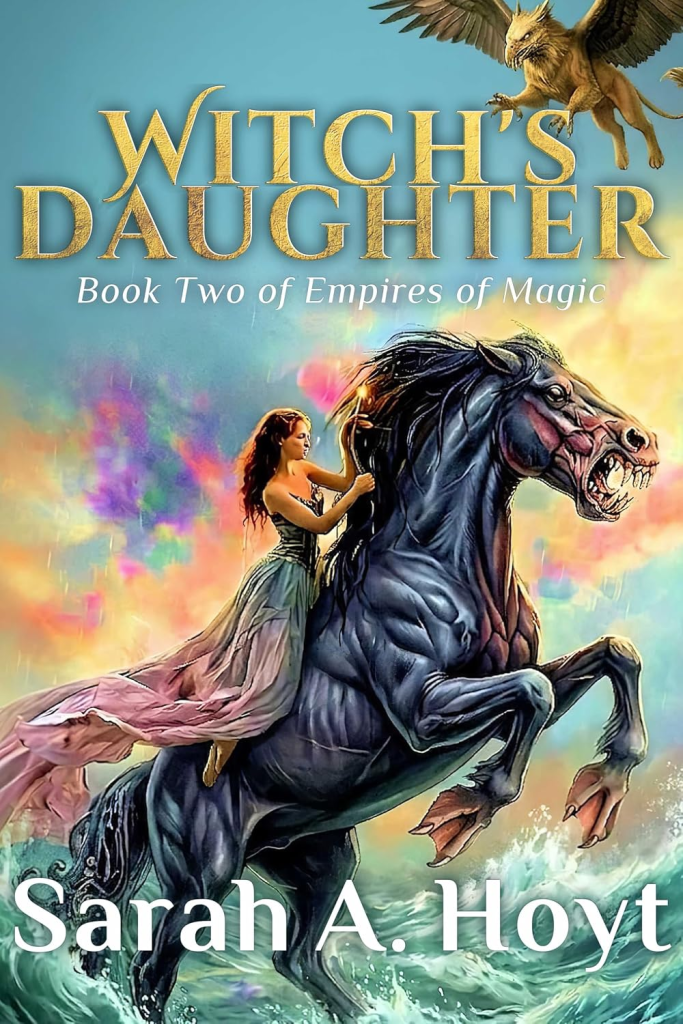
Some letters come from the living. Some come from the dead. This one comes with a formula that turns a rowboat into a miracle.
Seventeen-year-old Lord Michael Ainsling — youngest brother of the Duke of Darkwater, builder of mechanical marvels, survivor of fairyland — receives a letter from a man sixteen years dead. The inventor Tristram Blakley has not perished; he has been imprisoned by his own genius and begs the one mind in all of Avalon brilliant enough to understand his work to set him free. All Michael has to do is find seven missing brothers first and walk a magical path..
Fifteen-year-old Albinia Blakley has spent her whole life under her mother’s iron thumb — and her mother is a witch. The day Al finally escapes down a rope of knotted sheets, she lands in a world she doesn’t recognize, with no money, no magic kit, and no idea that the stranger who catches her is about to become her greatest ally.
Together, a girl with more secrets than she knows and a boy who builds machines that try to murder him must outwit a sorceress, navigate the treacherous courts of Fairyland, and unravel an enchantment years in the making — before a family is lost for good.
Witch’s Daughter is a gaslamp fantasy brimming with wit, warmth, and wonder, for readers who love their magic wrapped in velvet and their adventures served with morning tea.
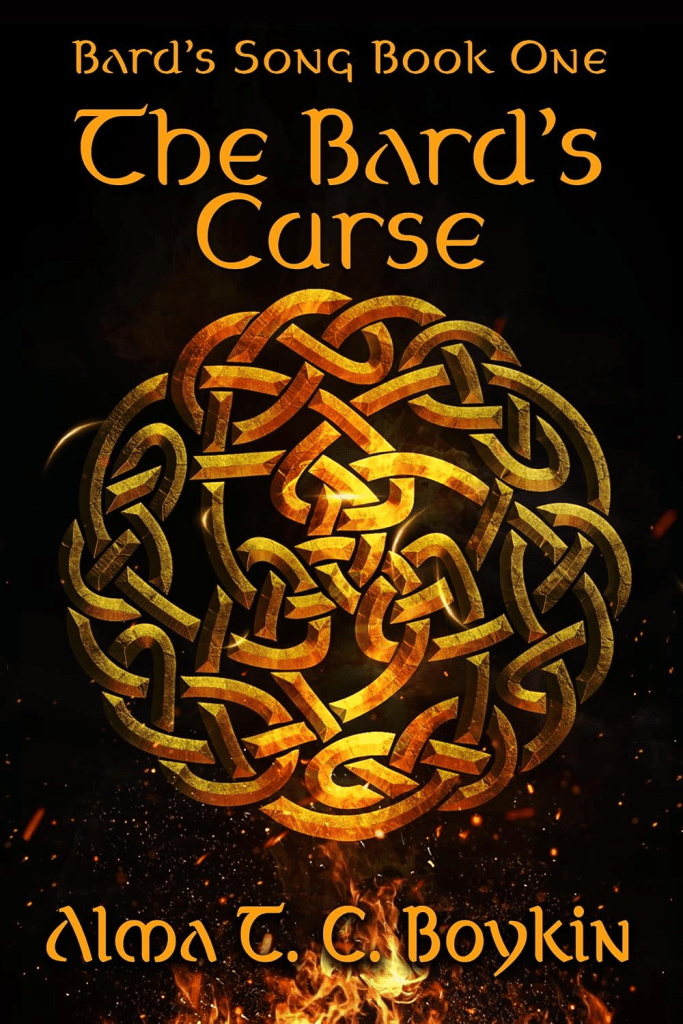
In a world where words are power, a bard’s curse weighs heavy on those who draw his wrath.
Tuathal, master bard and prince of two realms, journeys north to his half-brother’s court. When Pyder of the Ford breaks the laws of hospitality, Tuathal’s satire brings ruin in its wake. But more than just righteous anger moves over field and forest. What began as an insult reveals far darker things moving in the realm Fiachta NoDomnail, low king of the Dunalaid.
A wandering bard and prince, Tuathal faces a war that will burn down all that his kindred have built. To stop it and lift a bard’s curse may cost more than he is willing to pay.
Words have power, but darker powers than those of man also have a say.
When the body of Maire Beaufort, society’s adored “Angel of Waldfeld,” is found propped against a canal wall in the city’s most fashionable quarter, her death is more than just a tragedy; it threatens to ignite a diplomatic crisis.
Captain John Recht, former intelligence officer, is summoned from retirement to investigate on the heels of burying his wife. What begins as a straightforward murder quickly unravels into a labyrinth of deception, ambition, and betrayal. Powerful families are at odds, the palace whispers of scandal, and the Angel is at the center of it all.
As John and his trusted allies pursue truth through the salons and alleyways of a city built on secrets, they discover that the crime is only the first move in a much larger game—one that could topple governments and destroy the beginnings of John’s new life.
Set in the richly imagined city of Waldfeld, John Recht must discover just who is responsible for A Death In Good Society.
For readers of Patrick O’Brian, C.J. Sansom, and Dorothy Sayers.
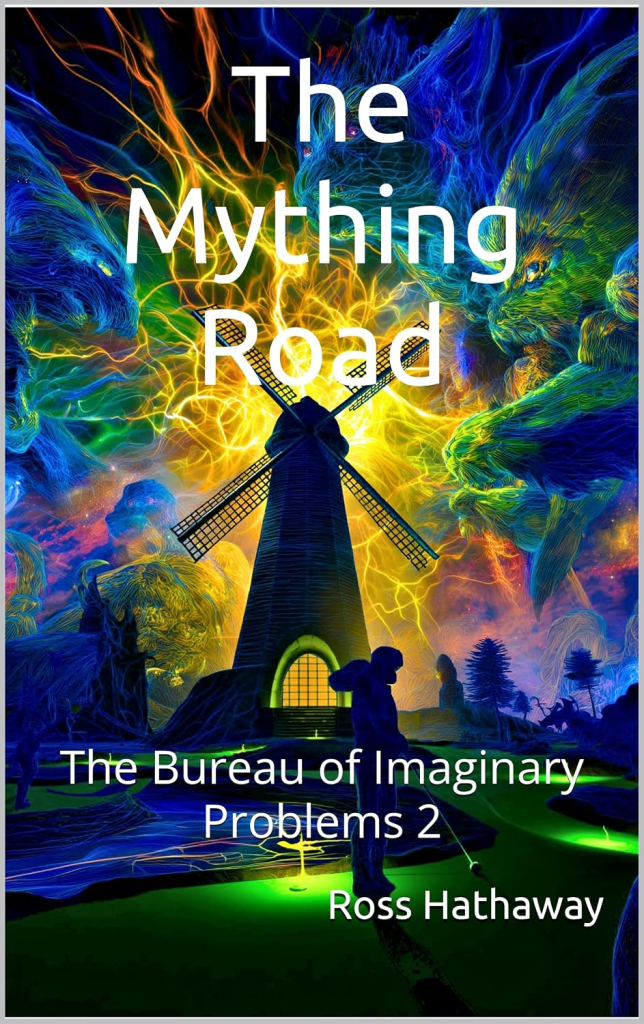
Reality is held together by stories. Someone just put them up for a vote.
Agent Mara Quill expected paperwork, containment protocols, and maybe a mildly haunted bridge.
Instead, she found a miniature golf course running a continent-spanning network of cryptids, myths, and living infrastructure—controlled by a windmill that requires her to vote on reality itself.
Each decision expands the system. Each connection strengthens it. Each story becomes part of something larger.
And it’s working.
Forests answer. Rivers align. Mountains approve. Creatures once dismissed as folklore take their place like they’ve been waiting for someone to start the meeting. Because they have.
Then something notices. The Devourer does not attack cities or armies. It consumes structure. It erases meaning. It unravels the connections that make reality hold together.
And now it has found a network built entirely out of those connections.
Humanity’s response?
Deploy everything.
Ancient myths once carved into stone. Legends whispered across generations. Cryptids that refuse to be forgotten.
And, because this is still technically a government operation—Forms.
Thousands of them. Binding. Defining. Weaponized paperwork that can anchor reality just long enough to hold the line.
As interdimensional networks begin to connect, foreign agencies scramble, and something cold and ancient steps through to observe, Mara Quill realizes the truth:
This is not a new system.
This is not a new war.
This is something humanity has been building, defending, and remembering for longer than history admits.
The bridges are not roads. They are conversations.
When the Cough starts dropping people in the streets, most folks panic.
Jackson “Jack” Harlan and his wife Raych make coffee.
Retired Army Sergeant Major Jack always knew something like this could happen. While society unravels overnight, he and Raych load the white 4Runner, fire up the Coleman stove, and stick to the plan: proper percolator coffee, hot ham and beans, and controlled violence when necessary.
Armed with enough guns and ammo for a small army and an ironclad commitment to not becoming savages, Jack and Raych fight their way out of the suburbs, pick up fellow survivors, and lay down the golden rule that will define their apocalypse:
“We shoot the Walkers… then we go back to the beans.”
A serialized military-flavored post-apocalyptic pulp story with World War Z realism, Zombieland humor, and stubborn civilization in the face of collapse. Because even when the dead start walking, breakfast doesn’t cook itself.
Amanda Colt and Marco Catalano’s original honeymoon has been extended by an all-expense paid trip to Rome. After fighting off vampires, wendigos, elves, necromancers and mad scientists, the Vatican Ninjas have decided to add to their training.
There is one other students will cross their path: NYPD Detective Thomas Nolan. He has had his own share of nightmare encounters with the forces of darkness.
But devilish things are afoot in Rome. Noises are coming from the catacombs. A film crew is afoul with monsters.
When these three cross over to join forces, they just have to make certain they’re not going to cross over for good.
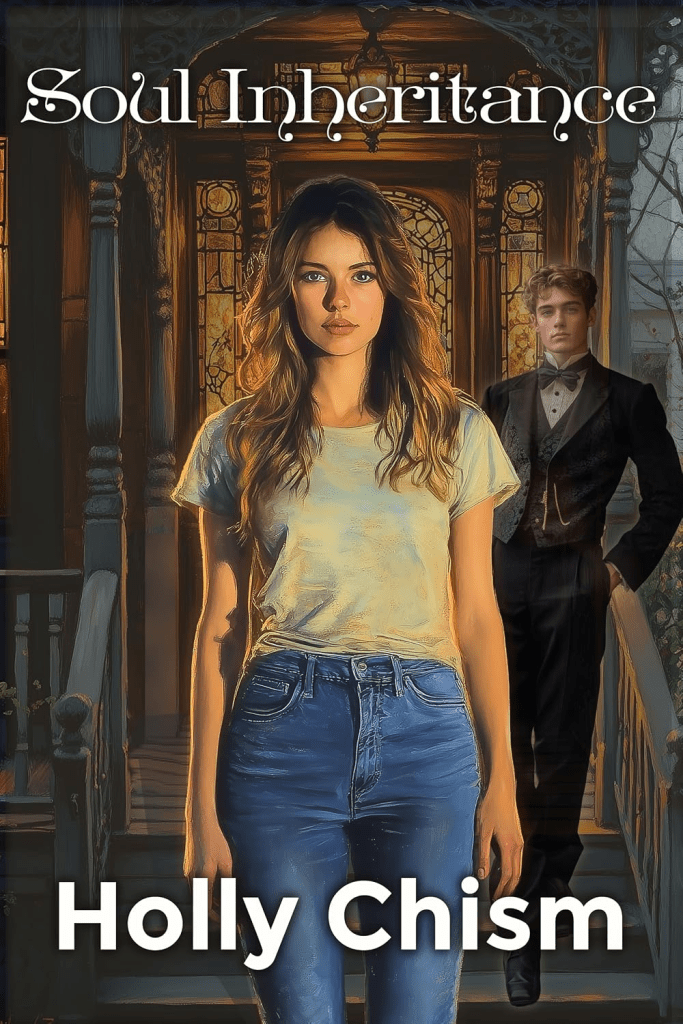
Fresh out of college, Evelyn Alexander’s first order of business was finding a place to live. One she could afford on her small inheritance before her job started. None of the local rental agencies had anything in her price range, but…she found a small Victorian house for sale, the only one mostly untouched in a decaying neighborhood of subdivided rental houses.
Complete with a ghost. A very attractive ghost. A very attractive ghost with a strong dislike of the idea of anyone changing his house. So, of course, she bought it. A cranky ghost for a roommate was still a better option than the tiny studio with criminal neighbors.
Between working to restore her new house, embezzlement at work and a murder next door, Evelyn has her hands full. As she works to get on her feet as a productive adult (and not fall in love with a ghost she can’t have), the problems start to snowball. And it’s only compounded by learning that her house has far more secrets than just a single, cranky (attractive) ghost…
Nancy White they called her, a good, solid name for a troubled girl. But she knew her father had called her by another name, before he disappeared through the gate into another world of strange stars and stranger moons. No matter how hard the staff of Hildred House try to force her to forget, she remembers. And longs to reopen the gate, to rejoin her father on that alien shore where cloud-waves break.
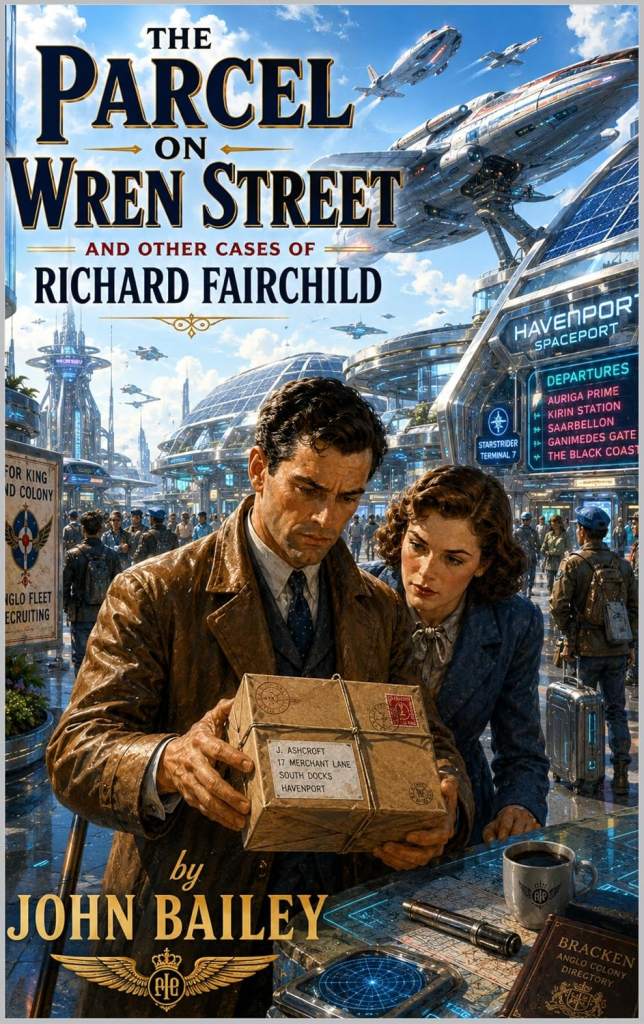
Commander Richard Fairchild thought retirement would be peaceful.
After a distinguished career as a fighter pilot in the Anglo Fleet, a war injury has left him grounded and living quietly with his sister Margaret. Quietly, however, is not the same thing as peacefully.
When a parcel addressed to another man arrives at the Fairchild residence, Richard notices several small irregularities.
Before the package can be returned, the intended recipient is murdered. What begins as a simple curiosity soon develops into a far-reaching investigation involving secret courier routes, hidden communications, and enemy agents operating throughout the region.
Across twelve interconnected adventures, Richard Fairchild and his companions uncover: • A mysterious parcel containing hidden star coordinates • A woman using false identities to gather intelligence • Secret transmitters concealed in an abandoned manor • A murder among former military aviators • Smuggling operations hidden behind legitimate commerce • Coded musical performances used for espionage • A passenger who vanished from a starliner without a trace • The mastermind behind an extensive spy network
Assisted by his practical sister Margaret, the capable Dr. Alice Merriweather, and the increasingly tolerant Inspector Geoffrey Pritchard, Fairchild finds himself drawn into mystery after mystery as clues slowly reveal a larger conspiracy. Written in the tradition of classic detective fiction, The Parcel on Wren Street and Other Cases of Richard Fairchild combines fair-play mysteries, memorable characters, gentle humor, and science-fiction adventure into a series of puzzles where observation matters more than violence and intelligence proves more valuable than force.
Vignettes by Luke, Mary Catelli and ‘Nother Mike.
So what’s a vignette? You might know them as flash fiction, or even just sketches. We will provide a prompt each Sunday that you can use directly (including it in your work) or just as an inspiration. You, in turn, will write about 50 words (yes, we are going for short shorts! Not even a Drabble 100 words, just half that!). Then post it! For an additional challenge, you can aim to make it exactly 50 words, if you like.
We recommend that if you have an original vignette, you post that as a new reply. If you are commenting on someone’s vignette, then post that as a reply to the vignette. Comments — this is writing practice, so comments should be aimed at helping someone be a better writer, not at crushing them. And since these are likely to be drafts, don’t jump up and down too hard on typos and grammar.
If you have questions, feel free to to ask.
Your writing prompt this week is: FLAG
DAY FIVE OF ACCORDING TO HOYT’S ANNUAL FUNDRAISER!
This blog is running its annual fundraising drive, so that I can quiet the voices in my head that tell me I might as well do macrame or perhaps take an interest in tiddly winks. (Also because Jerry Pournelle tried to convince me to do this for years, and yeah, I miss him.)
There is a Give Send Go fundraiser for this specific fundraiser set up. Here is a Paypal Me Link if you prefer that. (Yes, I know. Paypal, but for now, they’re behaving.) If you have a monthly donation setup to the permanent Give Send Go, that is still working and thank you! There are also two substacks you can subscribe to. One is on the side bar of the blog, the other is supposed to be a newsletter, as well as giving you chapters of the current work in progress if you become a paid subscriber. It takes cards. For snail mail: Sarah Hoyt 304 S Jones Blvd #6771 Las Vegas, NV 89107
Yes, there will probably be memage later, supposing I don’t get distracted by food (I’m highly food oriented, sorry) or watching the sacred musical, but until then, I woke up this morning with a weird thought, because I read a headline last night (I no longer remember what the headline was) and the back brain fermented it, somehow. If I get distracted, you get memage AND promo tomorrow. It’s a bountiful day.
This is what I realized: I’m not going to say “diversity is our strength”. Diversity as presently understood is a weakness. That’s the old Marxist game of dividing people into separate and mutually hostile groups which compete for benefits from the bountiful teat of master government.
That type of diversity is the polar opposite of the focus on the individual and life, liberty and the pursuit of happiness that our declaration promises and our Constitution ensures (if followed. Look, that’s been a struggle since before the ink dried.)
But besides those secured promises which of course shall remain and be true, even if the sun and the stars pass away leaving the universe in utter darkness (In this I am an absolutist) this country has achieved something quite wonderful and new in the history of the world, something you might not be quite appreciate, unless you were raised abroad and saw how nationality and culture works abroad.
What America managed, before the Marxists got a hold on our institutions, was to seamlessly integrate people of vastly different cultures in two or three generations with barely a hiccup.
Note that what I am speaking of isn’t even what WE consider different races, but what everyone else has considered different races, and definitely since the founding of this country (and before.)
I was reading a story from the settling of the west, and the notable thing was how Swedes, Germans, English, and Americans met, worked together and the foreigners gradually (and sometimes very fast. I mean I’m not unique. Sometimes it happens in a couple of decades for the original immigrant. Leading to our sacred liberties being loudly defended in weird accents) became as American as anyone else. It wasn’t that people were blind to differences, but that they assumed EVERYONE could be American and would become American, because of course that was the superior way to live.
On the way there, Americans acquired the best habits, words and ideas of the foreigners, while subsuming them and using them in the service of being AMERICAN. This happens nowhere else. Or not easily. When I traveled on European trains in my teens and young twenties, you could still not only tell the independent cultural groups, but also there was considerable animosity between them. I don’t know how it is now with the EU, but when I visit I still see the old divisions and animosities. There is no melding together into one people. Which it still happens here, almost without notice, provided we get the Marxist hold off the heads of the “educated” and the laws and institutions of our nation.
This sets us apart from the history of humanity, and makes us something quite new and wonderful, a promise that humans can eventually go to the stars however many and from wherever we need to be, and form a new polity, or more likely be absorbed into the new polity of America In the Stars.
In a hundred years, let’s look forward to the fireworks display to celebrate the historical independence of the Mother Country and the establishment of the Declaration and the Constitution, those words that set people free. This is why people all over the world want to be Americans and either try to move here or adopt a dog in the manger hatred of America that’s not even plausible, much less realistic. They love us, they hate us, they obsess on use continuously, and can’t believe we never think of them at all.
We never think of them, because we’re busy with more important things. To wit, we have great things to do. Because the future comes from America.
Americans: A people on the way to the stars.
It’s already great and it’s going to be glorious!
THIS BLOG IS HAVING ITS ANNUAL FUNDRAISER: For Give send Go, go here. For paypal go here. For more options and a long explanation of why I fundraise (the last few years, after 15 years of not) other than just “Because Jerry Pournelle ordered me to” and “So my family grumble a little less at early mornings, late nights and working on weekends” (Though that’s part of it!) go here: Toss A Coin To Your Blogger, Oh Readers of Plenty.
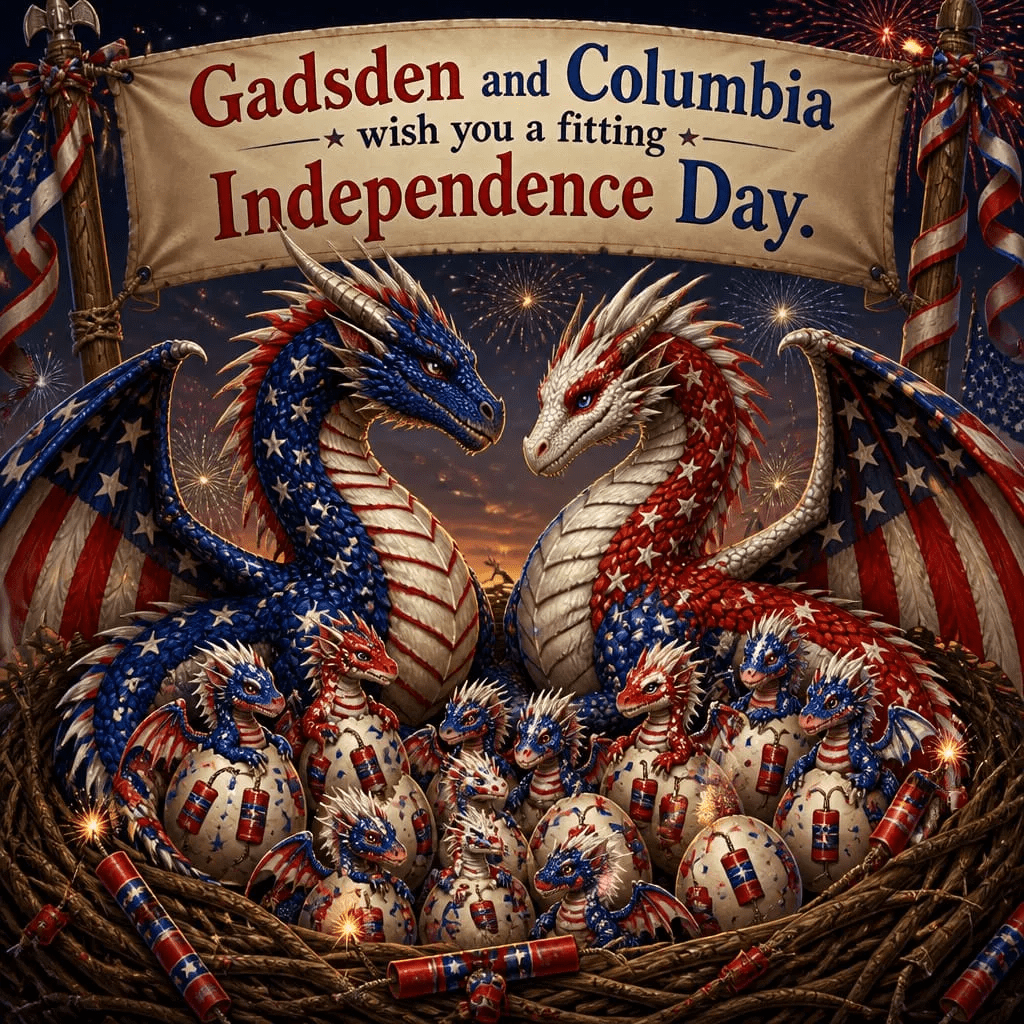
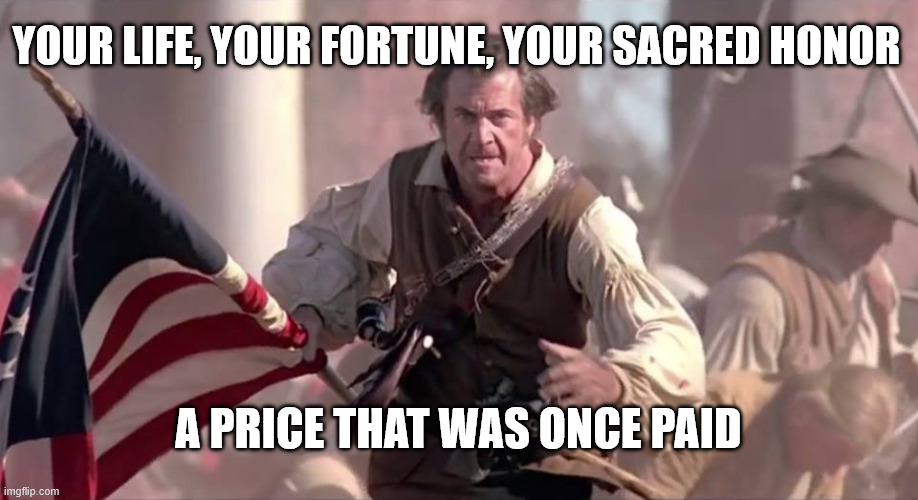
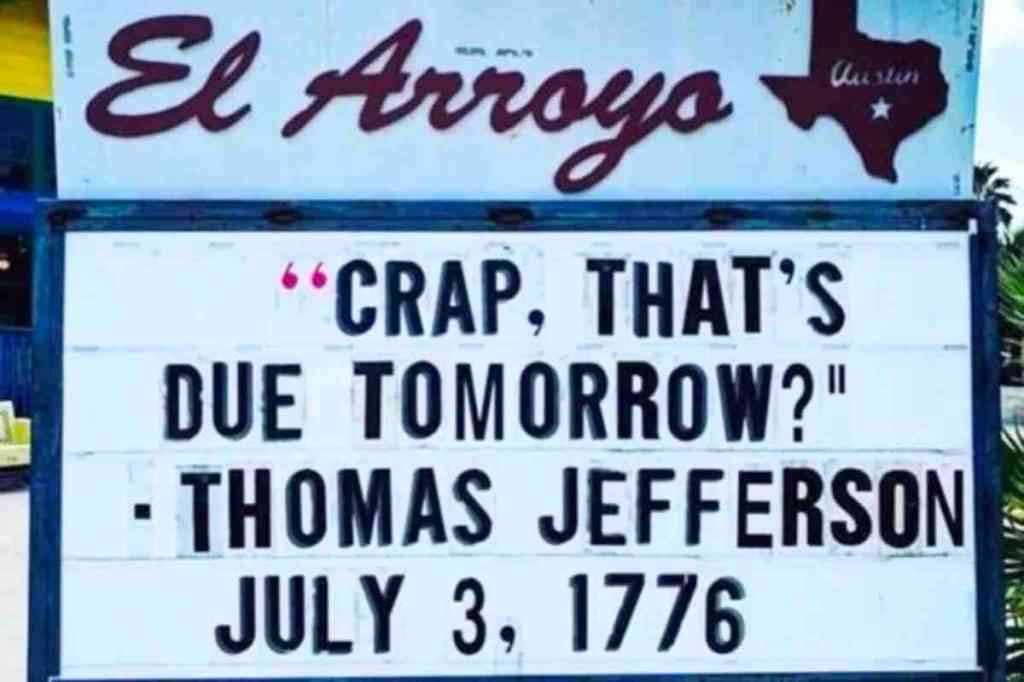
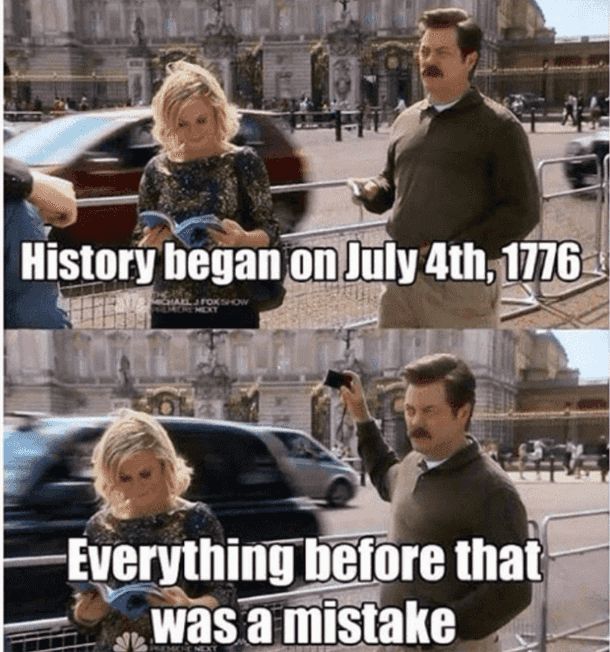
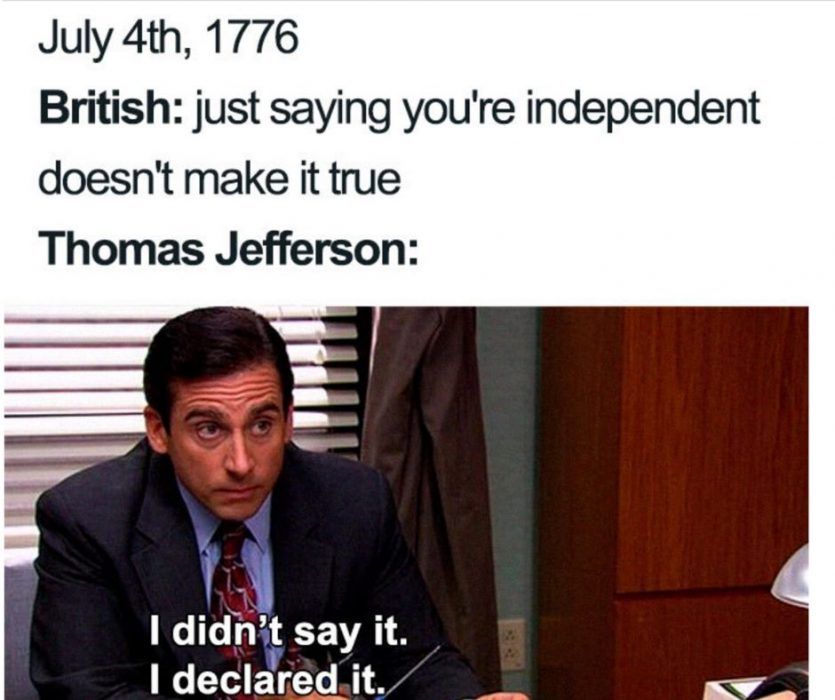
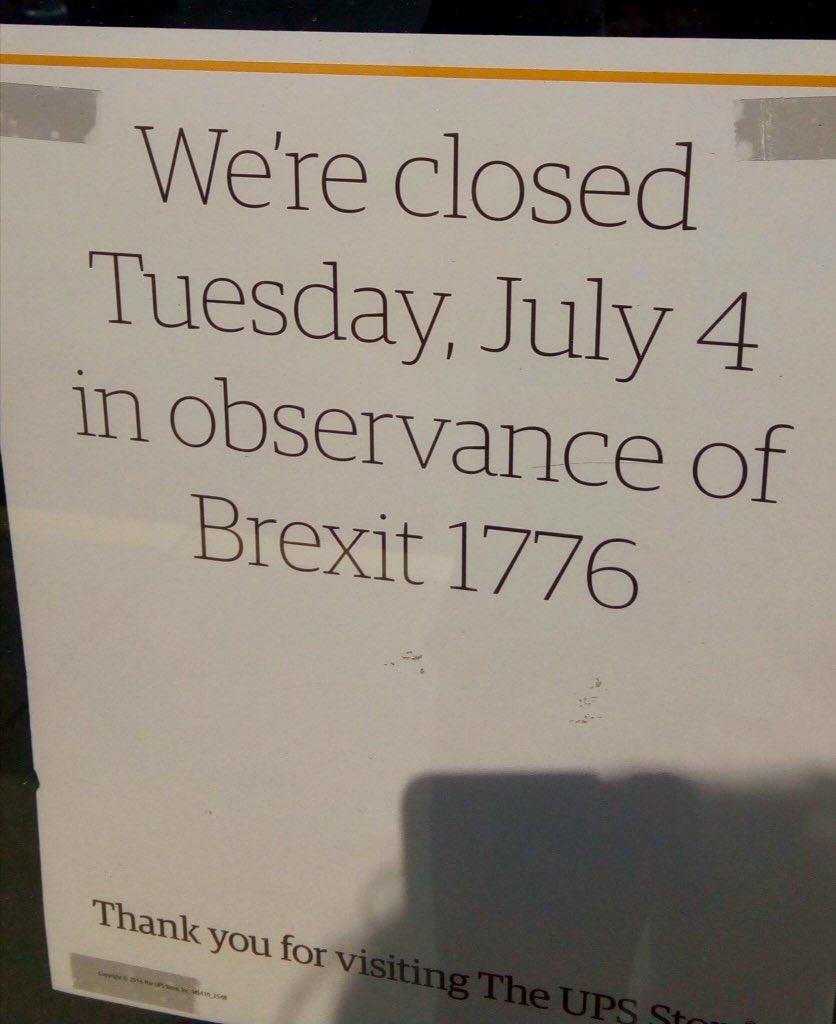
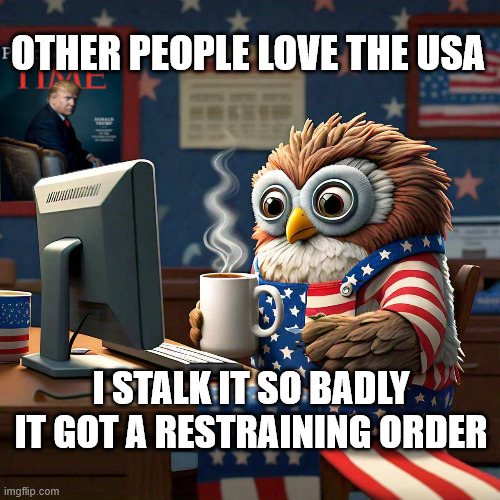
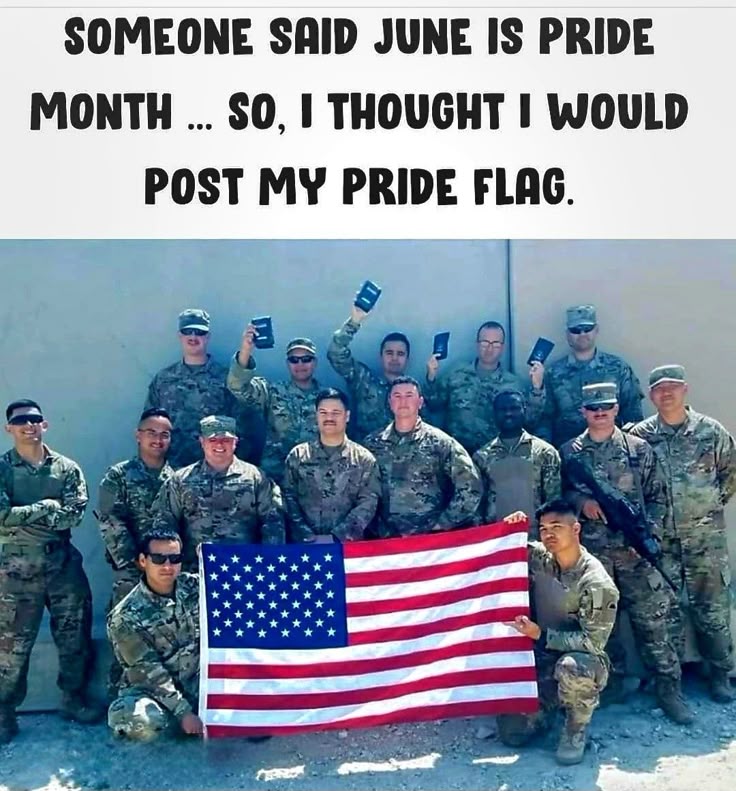
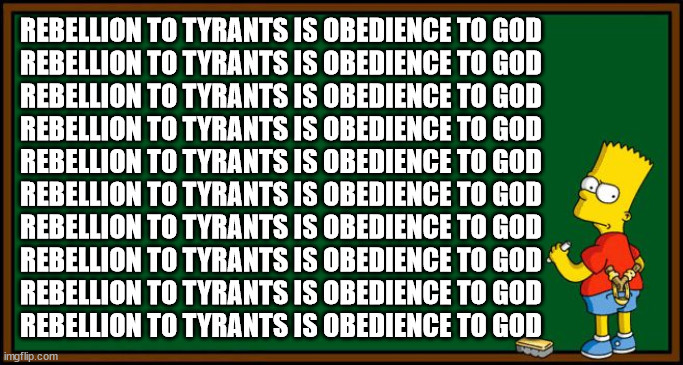
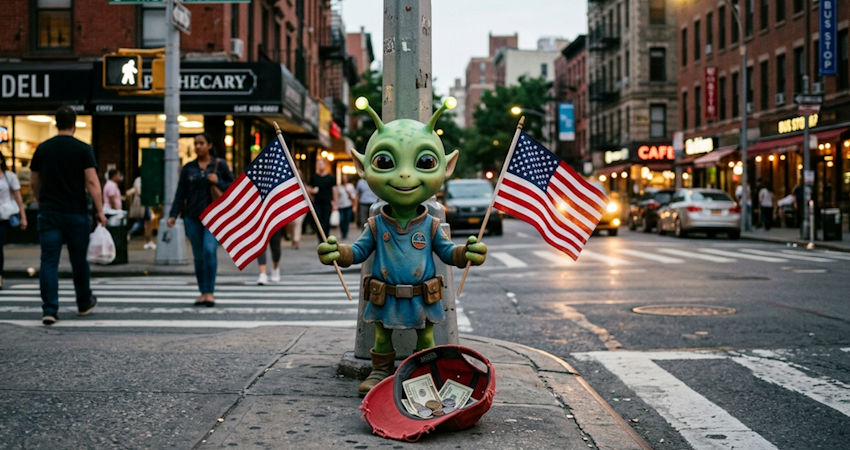
Posting 4th of July memes a little early, so you can share your favorites tomorrow! Tomorrow there might be a regular meme post…. or something else entirely. We’ll see how I greet the day after coffee tomorrow! – SAH
DAY 3 of this blog’s annual fundraiser.
For Give send Go, go here. For paypal go here. For more options and a long explanation of why I fundraise (the last few years, after 15 years of not) other than just “Because Jerry Pournelle ordered me to” and “So my family grumble a little less at early mornings, late nights and working on weekends” (Though that’s part of it!) go here: Toss A Coin To Your Blogger, Oh Readers of Plenty.
Food for the Great Anniversary Festival by Jerry Stratton
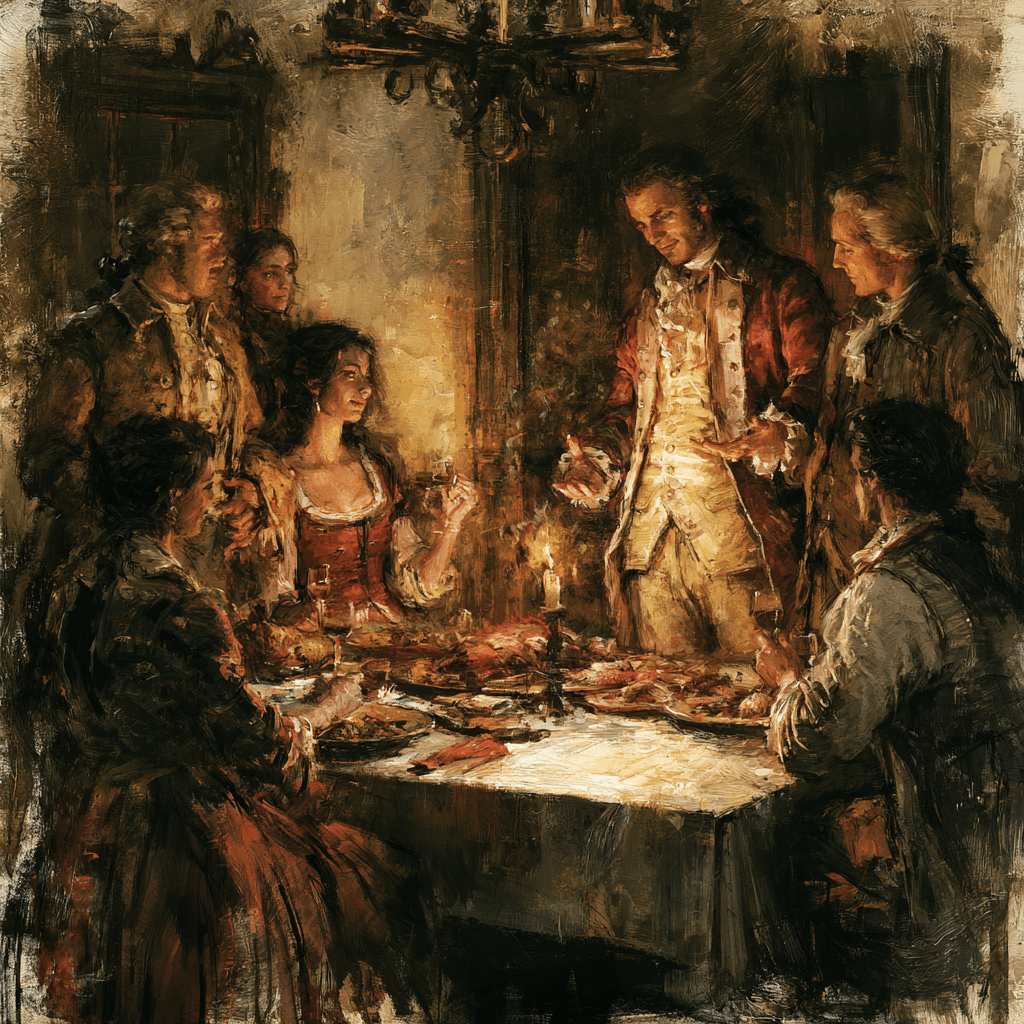
The day is passed.—The 4th of July, 1776, will be a memorable epoch in the history of America. I am apt to believe it will be celebrated by succeeding generations, as the GREAT ANNIVERSARY FESTIVAL!
That’s how the Morning Chronicle of July 13, 1826, quoted John Adams’s July 3 letter to his wife Abigail. It’s a slight misquote: Adams thought the day of celebration would be July 2, when the Continental Congress voted in favor of independence. Instead, people chose July 4 as the anniversary to celebrate. That was when the Declaration of Independence was approved announcing our independence in terms that were as revolutionary as the revolution itself.
A hundred and fifty years after that misquote, and two hundred years after Adams wrote that letter—that is, in 1976—I and my brothers dressed up as Uncle Sam for our small town’s Independence Day parade. That same year saw the first cookbook I remember my mom using: America’s Bicentennial Cook Book, by the St. Mary’s Altar Society of our church.
Do an eBay search on “bicentennial cookbook” or “1776 1976 cookbook” and there are hundreds of these, for communities across the United States. At the moment I’m writing this I see a wide variety of organizations, from the Conway Junior High PTA of Orlando, Florida through the Hartford (Connecticut) Courant newspaper through the Holy Family Altar Guild of Poland, Ohio—and yes, it’s heavily Polish-influenced, filled with wonderful-looking recipes—through Snyder, Nebraska; Dallas, Texas; the Saint Louis Symphony; the Oklahoma State Fair; the Georgia Power Company; and the Yakima Valley (Washington) District Federation of Women’s Clubs.
Several senior citizens centers, hospitals, even the Congressional Club of Washington, DC, all got into the spirit of ’76 by publishing cookbooks.
One of my favorite snacks in 1976 is also one of my favorite snacks today: oatmeal no bake cookies. Everyone had their own recipe, so I can’t guarantee that my mom used this America’s Bicentennial recipe from Adele Yob at our picnics and reunions that summer. But it is the recipe I use most often today.
Adele Yob’s No-Bake Oatmeal Cookies
½ cup butter
2 cups sugar
4 tbsp cocoa
½ cup milk
3 cups oatmeal
1 tsp vanilla
Mix the butter, sugar, cocoa, and milk in a saucepan. Bring to a boil and boil for one minute, then add the oatmeal and vanilla. Drop quickly from a spoon onto waxed paper.
I’ll be bringing some of these to LibertyCon.
Two years ago for LibertyCon 36 I was inspired by Les Johnson’s LibertyCon 35 side comment, about foods that emit the most positrons, to adapt one of my favorite fudge recipes. Per Les Johnson, I used bananas and brazil nuts, both high positron emitters. The original recipe called for pineapple and pecans, and appeared in the Potter County Home Demonstration Council Bicentennial Cook Book courtesy of Mrs. C.D. Baldwin.
Potter County Hawaiian Fudge
2-½ cups sugar
1 cup cream
8 oz crushed pineapple
1 cup pecans
green coloring
Bring sugar, cream, and pineapple to a boil over medium heat, stirring until blended. Cook until mixture reaches 234°-240° (soft ball).
Remove from heat, add pecans and a few drops of food coloring. Let cool slightly, to about 195°. Beat until creamy. Spread into a buttered or lined 8×8 pan. Score into squares while still warm, and cut when cool.
Whether Hawaiian or Positronic, this is a wonderful fudge. The food coloring is optional, but the fudge is an odd color without it due to the high-temperature cooking of the fruit.
I don’t know how much the country as a whole celebrated the Centennial in 1876. We weren’t that far from the end of the Civil War and were only six years from the last Confederate state’s readmittance to the Union. A search on “1776 1876 cookbooks” on eBay unsurprisingly brings up very few results from that era—such books would be 150 years old this year.
But it was definitely celebrated in Philadelphia. If the various promotional cookbooks of the era are to be believed, everyone involved with food, at least, entered into the competitions that were part of Philadelphia’s 1876 Centennial Exposition, and used that in their promotions.
A search on newspapers.com for “centennial cook book” finds a few advertisements for celebratory collections. Most of them are for Mrs. Ella E. Myers’s Philadelphia-centric 403 page cookbook “and general guide”. Nearly the final hundred pages are dedicated to a pictorial history of Philadelphia with a special focus on locations significant to the Revolution…
…to give each purchaser of this book a little souvenir of our nation’s “Centennial Birthday;” something that may be retained by future posterity as a memento of the grand celebration of this “Centennial Year, 1876.”
I have a copy of this book. It would have been and is an amazing souvenir. It’s also filled with wonderful ideas for food. If you have spare space on your grill, for example, you might take a few tomatoes, cut the stem end out to leave a small divot, and fill the divot with butter, salt, and pepper. At 350° it needs about 50-60 minutes. On a closed grill, adjust to your grill. This is very, very good made in an oven, but it is phenomenal infused with the flavor of grilling over charcoal.
Of interest to food historians, Myers also included an early version of “Saratoga Potato Chips”. But because I enjoy my sweets, one of my favorites from this book is her very quick-to-make German Biscuits.
German Biscuits.
TIME, SIX OR EIGHT MINUTES.
Half a pound of dried flour; five ounces of butter; seven ounces of sugar; two eggs; two dessertspoonsful of cream; peel of a small lemon grated.
Beat five ounces of butter to a cream, and mix in the loaf sugar pounded the grated lemon peel, half a pound of dried flour, and the cream and well-beaten eggs, to form a nice light dough. Mix all well before kneading it, roll it in thin, long, narrow strips, and bake on a tin in a quick oven.
Volume measurements in this era, as opposed to weights, were not generally standardized. For dessert spoons I usually start with two teaspoons as the equivalent. Flour, too, while it is often given in amounts by weight, tended to vary even more than it does today with regard to how much liquid it soaks up. Further, “dried flour” is likely a special kind, perhaps a new kind of packaged flour. The term is only used three times among the hundreds of mentions of flour in Myers’s book.
This is my interpretation of those cookies—and they are cookies. Myers uses the terms “biscuit” and “cake” for what we would call cookies.
German Lemon Cookies
7 oz white flour
4 oz whole wheat flour
5 oz butter
7 oz sugar
2 eggs, well-beaten
4 tsp cream
grated peel of one lemon
Beat butter until creamy. Beat in the sugar and lemon peel. Stir in the flour. Add the cream and eggs and mix to a light dough. Drop by teaspoons onto greased baking sheet and flatten with a wet fork. Bake 6-8 minutes at 425° until golden.
I took a few liberties with it; while I don’t know specifically what “dried flour” was, most flour called for in 1876 and even in the late 1700s meant a flour that was closer to our white flour than to our whole wheat flour. I just happen to like whole wheat. For historical accuracy, replace the whole wheat flour with however much white flour you need to get a cookie or biscuit dough consistency.
The women of the First Congregational Church of Marysville, Ohio, also got into the celebration with their Centennial Buckeye Cook Book. This is the second-most-commonly advertised “Centennial Cook Book” in newspapers of the era, at least as archived on newspapers.com. The Women featured this quote on their book’s indicia page:
“Bad dinners go hand in hand with total depravity, while a properly fed man is already half saved.”
Of particular interest from a Centennial perspective is the chapter with “a recipe from the households of the President and each of the Centennial Governors of the States and Territories”.
That was the plan. They received only twenty-six responses, not all of them recipes, and nothing from the President. I have not tried any of them, but looking at them right now Massachusetts Governor Rice’s Rice Cake looks both interesting and indicative of a sense of humor.
What I did try was a heavy-on-black-pepper coleslaw from a Mrs. Hawkins.
CABBAGE SALAD.
Mrs. Hawkins.
Two quarts finely chopped cabbage, two tablespoons salt, two of white sugar, one of black pepper, and a heaping one of ground mustard; rub yolks of four hard boiled eggs until smooth, add half cup butter slightly warmed; mix thoroughly with the cabbage and add teacup good vinegar; serve with whites of the eggs sliced and placed on the salad.
I tend to go lighter on the salt than the original. But then, I have a refrigerator.
Ohio Black Pepper Slaw
2 lbs shredded cabbage
1-2 tbsp salt
2 tbsp sugar
1 tbsp black pepper
1 tbsp ground mustard
4 hard boiled eggs
½ cup melted butter
¾ cup vinegar
Mix the cabbage, salt, sugar, pepper, and mustard. Mash the egg yolks smooth and mix the butter and yolk thoroughly to make a creamy paste. Stir the yolk and then the vinegar into the cabbage.
Slice the egg whites and toss into the salad. Adjust vinegar, salt, sugar, and pepper as desired.
Also for the Philadelphia Exhibition, the “Women’s Centennial Executive Committee” of Philadelphia solicited recipes for and published, The National Cookery Book of the International Exhibition of 1876. The book is disappointing in that it does not attribute most (or any that I saw) of the recipes. But the solicitation, as printed in the December 2, 1875, Beloit (Wisconsin) Free Press is worthy of remembrance:
It is designed to make this work purely American, excluding, as far as is possible, the receipts common to all nations. The products of our country are more varied than those of other lands, comprising numerous articles in common use at our tables, partially, if not wholly, unknown to the inhabitants of the old world, or used by them only as luxuries. The varieties of climate give to each section its own peculiar products, but the facilities for transportation, which bring to our doors even from far-off California its delicious fruits and vegetables, render the resources of the table common to all, and therefore National.
…
No receipt will be considered too homely, if characteristic of the country. Dishes peculiar to rich and poor—to hunting, fishing, or exploring expeditions, or to camp life, &c., &c., are desired. If comical, and at the same time good, so much the better. Our aim is to give the true savor of American life in all its varieties.
There are several recipes for brown bread in the book, but the recipe submitted by “M.S.A.” by way of the Niles (Michigan) Democrat of January 15, 1876 does not appear to have made it in.
I have been requested to furnish for publication the following recipe for making brown bread. Having used it in my family for years, I pronounce it unapproachable in simplicity and excellence, and am satisfied that every good housewife will number it among her choice recipes. It is certainly worthy a place in the “Centennial Cook Book:” — M.S.A.
3 pints Graham flour; 1 tea cup, or less, of molasses; 1 teaspoon of salt; 1 teaspoon of saleratus; sour milk sufficient to make a stiff batter; steam three or four hours; bake in moderate oven to give a light crust.
I have not tried it; but if you do I’d suggest starting with ¾ cup as the equivalent of a tea cup; and a 1:1.25 ratio for saleratus:baking soda, thus, 1-¼ tsp baking soda—unless, of course, you have saleratus on hand.
M.S.A.’s submission is followed by a notice that it isn’t just fruits and vegetables making their way east from “far-off California”.
A stamp mill with two hammers weighing 200 pounds each has just been put in place for use in the metallurgical department of the Michigan University. Three tons of gold and silver ore are now on the way from California for use in the department.
One of the companies advertising their participation in the Philadelphia Exposition was the Rumford Chemical Works, and their Horsford baking powder. They didn’t call it baking powder except in their awards listing, which included an award from the “Centennial Exhibition, Philadelphia, 1876.”. They called their product a “bread preparation”. It contained a soda and an acid separately, which were mixed together at the time of baking using a special two-sided measuring device that had one side twice as big as the other.
A recipe that grew on me in the few days after I made is not quite as American as apple pie. I was a little disappointed when I first made this apple custard pie. I had it for dessert, and—for someone with my sweet tooth, at least—it’s not really a modern dessert. But it turned out to be a great breakfast treat with a cup of coffee.
APPLE CUSTARD PIE.—Peel sour apples and stew until soft and not much water left in them; then rub thorough a cullender; beat three eggs for each pie to be baked, and put in at the rate of one cup butter and one of sugar for three pies; season with nutmeg.
Less eggs and butter will make a good pie not as rich as above recipe.
My version makes one pie:
Horsford Apple Custard Pie
2-½ lbs Granny Smith apples
⅓ cup butter
⅓ cup sugar
3 eggs
½ tsp nutmeg
2 9-inch pie crusts
Peel, core, and purée apples in food processor until smooth. Stew over medium-low heat until no water pools at bottom when stirring. Or, consider baking the apples whole and using a food mill to get the meat without the core and peel. Let cool.
Blend the ⅓ cup butter into the apple. Blend in the sugar and nutmeg. Beat in the eggs one at a time.
Fill bottom crust with the apple mixture. Layer top crust over, and cut or poke holes for steam vents. Bake at 375° for 45-60 minutes. Cool to room temperature before serving.
Any pastry crust will do. Horsford, of course, wanted you to make their own pie crust, using their baking powder, and you can download the full Horsford Cook-Book as a PDF from my Centennial Meal page to see it. But if you want a pastry from the Founders’ era, “Amelia Simmons” has several in her American Cookery. I especially like her puff paste number 3, although I’ll be using her Royal Paste (number 9) for the cranberry tarts I’ll be bringing to LibertyCon.
Puff Pastes for Tarts.
No. 3. To any quantity of flour, rub in three fourths of it’s weight of butter, (twelve eggs to a peck) rub in one third or half, and roll in the rest.
A later edition amended this recipe:
ERRATA.
Page 29. Puff pastes for tarts, No. 3; for 12 eggs read 6.
In Pastes, the white of eggs only are to be used.
Incorporating the errata and sizing it for a double-crust pie, this is how I make it:
American Paste Number 3
10 oz flour
8 oz butter (cold)
1 tsp salt
1 large egg white
Combine flour and salt. Cut in four ounces butter. Mix in egg white by hand until dough barely holds. Form ball and wrap in plastic wrap. Refrigerate one hour along with rolling board.
Flatten dough into rectangle. Divide half remaining butter into six pats, laying three on one side of rectangle. Fold over a third, and lay the remaining three on top, folding the remaining third over.
Roll again to rectangle and repeat with remaining butter. Divide into two squares, wrap, and refrigerate one hour. Press one into disc for 8- or 9-inch pie pan. Fill, and flatten remaining dough for top.
Because it calls for a single egg white, if I only need it for a single-crust pie I store the extra dough in the freezer until I need it. It’s rare for it to need storage for longer than two weeks.
American Cookery was published in 1796, and is the first American cookbook. No one knows who Amelia Simmons was; the only information we have is what is on the cover of American Cookery, and what can be inferred from the text of American Cookery, which is a bit circular from the standpoint of historical evidence. Whenever I read historians trying to describe who Amelia Simmons was, I get the feeling she may also be our first fictional food spokesperson. But regardless of Amelia Simmons’s identity or existence, the opening text of the book is remarkable.
The orphan, tho’ left to the care of virtuous guardians, will find it essentially necessary to have an opinion and determination of her own… It must ever remain a check on the poor solitary orphan, that while those females who have parents, or brothers, or riches, to defend their indiscretions, that the orphan must depend solely upon character.
My metaphor alarm may be overly sensitive, but this sets it off every time I read it. This is as much a description of America at the time—just seven years from the Constitution and only five from the completion of the Bill of Rights—as it is of a generic “poor solitary orphan”.
Also of interest is how different the methods in this book are from modern ones. If you don’t, as many refrigerator manufacturers did, consider refrigeration to be cooking, then cooking changed far more between 1796 and 1876 than between 1876 and today.
One of those early advancements was just beginning to play out. Four of her recipes, two cookies and two gingerbreads, are among the earliest recipes that call for pearlash, an early baking soda-like leavener. You can generally replace pearlash 1:1 with baking soda.
Another of my favorites from American Cookery is, sadly, not one of the nicest looking of the recipes in this book. But I love old-school puddings and I love cornbread. Her “Nice Indian Pudding… No. 2” is, at least as I make it, a bit of a cross between a corn pudding and a custardy corn bread.
A Nice Indian Pudding.
No. 2. 3 pints scalded milk to one pint meal salted; cool, add 2 eggs, 4 ounces butter, sugar or molasses and spice q.f. it will require two and half hours baking.
Note that if you choose to make the third “nice Indian pudding” rather than the second, there’s an entry in the errata for it.
I use molasses for the sweetener. If you can find a source for sorghum molasses, I strongly recommend it. It’s often available at specialty nut shops and at Amish-style groceries.
A Nice Indian Pudding
3 cups very hot milk
1 cup cornmeal
½ teaspoon salt
1 egg, lightly beaten
2 oz melted butter
½ cup molasses
¼ tsp nutmeg
Mix the cornmeal and salt. Stir in the hot milk. Cool to room temperature.
Beat egg into batter, stir in butter, molasses, and nutmeg, and pour into a two-quart baking dish. Place into a larger dish and pour hot water around it to about ¼ inch.
Bake for about 90 minutes to two hours at 300°.
It’s a bit clichéd to call Thomas Jefferson the first American foodie, but he really was. He’s famous for introducing French and Italian food to the United States. Less well known is that he also worked hard to introduce the French and others to American food, even growing American corn in his garden when he was the ambassador to France, to serve corn on the cob to his French guests.
Like Benjamin Franklin, he thought that American Pippin apples were superior to any apple in Europe.
Unfortunately, while some of his recipes are publicly available in their original form, such as his wonderful biscuits de savoye and his famous ice cream—both in his own handwriting—most are only available in archives far from Texas. For these recipes I used the 1976 University of Virginia edition of Marie Kimball’s 1938 Thomas Jefferson’s Cook Book.
Thomas Jefferson’s Cook Book is a wonderful resource, but it has two serious flaws. The first and most obvious is that it provides interpretations of eighteenth and nineteenth century recipes through 1938 eyes, without presenting the original text. The second is that it doesn’t tell us exactly where the recipes come from. Kimball appears to have used the notes of Jefferson’s granddaughter Virginia Jefferson Trist. Trist’s collection was a family collection, and contains recipes from well after Jefferson died.
Martha Jefferson Randolph, however, was Thomas Jefferson’s daughter. So it is entirely possible that her Fish Potato Pie could have graced the White House table while he was president, or that he could have enjoyed it in his semi-retirement afterward.
Martha Jefferson Randolph’s Fish Potato Pie
1 lb trout or whitefish
1 lb mashed potatoes
2 tbsp butter
¼ tsp nutmeg
⅛ tsp pepper
½ tsp salt
2 tbsp brandy
cream or milk
9-inch pie shell
Steam fish just enough to shred. Mix with mashed potatoes made as you like mashed potatoes. Mix in butter, nutmeg, pepper, salt, and brandy. If too stiff, thin with cream or milk. Turn into pie shell and bake at 375° for about thirty minutes, until set.
Whatever the provenance, Kimball’s/Trist’s collection of recipes includes early examples of two classic southern dishes: gumbo, and rice and beans. The rice and beans are attributed to a “Baron de Brise”, who may be the most obscure of all of the attributions in Kimball’s book. Morton Gill Clark, in his French-American Cookery from New Orleans to Quebec, attributes the “Podrilla à la Créole” as “a great favorite of Thomas Jefferson, the recipe for which he got from his friend the Baron de Brise.”
That’s pure cookbook history, with no reference and nothing to back it up. It’s also pretty much the only reference to Baron de Brise I could find. I would expect a Baronial “friend of Thomas Jefferson” to have left more of a mark in historical documents. But if Clark is right, this recipe is contemporaneous with Jefferson.
The Baron de Brise’s Rice and Beans
Beans
2 cups red beans
¼ lb salt pork
salt and pepper
seasonal herbs
Soak the beans overnight in plenty of water, and drain. Cover again with water according to the instructions with the beans, add pork, salt and pepper to taste, and chopped herbs.
Rice
1 cup rice
salted water or broth
2 tbsp butter
salt and pepper
Boil rice in salted water and/or broth until light and tender, according to the instructions with the rice. Add butter, and salt and pepper to taste. Press into a ring mould. Bake at 350° for ten minutes. Turn out, and fill with beans.
One of President Jefferson’s most famous acts was the Louisiana Purchase in 1803. It wasn’t an impulse purchase; he’d been worried about the security of our western borders well before the Purchase, both in matters large and small. In 1802, he appointed Hore Browse Trist, Sr., to a position in the Mississippi Territory, which bordered the French territory and so needed customs officials.
One of Hore Browse Trist, Sr.’s sons was Nicholas Philip Trist, who married Thomas Jefferson’s granddaughter Virginia Randolph on September 11, 1824. His other son was Hore Browse Trist, Jr., who remained in the Louisiana area. Mrs. Rosella Trist, to whom the Gumbo is attributed, was Hore Browse Trist, Jr.’s wife, although it’s unclear when they married. Depending on that date, this recipe, too, might have been enjoyed by Jefferson.
If he did, I expect that he considered gumbo a major benefit of having acquired the Louisiana Territory for the United States!
Mrs. Rosella Trist’s Gumbo
2 tbsp butter or lard
1 tbsp flour
1 tsp chopped parsley
½ onion minced fine
3-4 lbs chicken parts
2 quarts water
salt
black pepper
red pepper
2-3 tbsp sassafras powder
Melt fat in a large pot. Gradually stir in flour, parsley, and onion until flour is brown. Add and brown the chicken, then add the water and season to taste with salt, black pepper, and red pepper. Boil gently for 90 minutes. Reduce heat and stir in sassafras, stirring constantly without boiling.
This is not at all what I expect to get if I order gumbo in a Louisiana-inspired restaurant today. But it is an absolutely lovely chicken stew, simply flavored. If it did arrive in time, it could have made a wonderful soup for an ailing ex-President.
I’ve made a PDF of all of the recipes I’ve featured here, formatted to print three 6×4 cards per page. You can print them on normal paper or on cardstock. Obviously if you have your own favorite format you can just copy and paste the recipes from this post.
I have many more Bicentennial, Centennial, and Founders-era recipes on my Meals for the Sestercentennial series that I started in 2023, including both the Eye in the Biscuit and the Jellied Guacamole. That series led to my Sestercentennial Cookery which is available in print as well as a free download.
I’ve been doing a few non-food Sestercentennial Year postings starting with the Battle of Bennington last August. Researching those is where I found the opening and closing quotes for this post.
All of the cookbooks I used as references from the Centennial and earlier are available online. If they weren’t available online before I wrote about them, I scanned them in myself and posted them on my web site. They’re linked in the body of the post, but here they are again all in one place. They’re all fascinating.
There are some differences between the 1976 version of Thomas Jefferson’s Cook Book that I used and the 2007 version available for checkout on the Internet Archive. I haven’t noticed any differences in recipes, but I also haven’t looked, and I just now noticed that the 2007 Archive reprint titles the rice and beans as “Podrilla là Creole” where my 1976 reprint titles it “Podrilla à la Creole”. Having not seen the 1938 original, I can’t say which matches it.
There are restored versions of American Cookery in print. I especially like the one from Colonial Printer & Bookbindery, available from their website and from places like Townsends. It’s a quality facsimile without embellishment, made in the U.S.A.
Each coming festival shall bring to memory’s view their noble end
And blessings on each honor’d name shall from the patriot’s lips ascend.
—“Lines on the Deaths of Thomas Jefferson and John Adams”, by A Lady of Richmond, E.L.S., July 14, 1826.
Or maybe not so quick. . . so, the Dragon Awards are open for nominations. And it would be kind of cool, don’t y’all think, for Sarah to be nominated? No Man’s Land for science fiction.
But also, there are lots of other deserving creators this year, a number of them from the weekly and special promo posts. Some of our number don’t even stick to books: you may or may not be aware, MCA Hogarth wrote a game!
The best part about this, from my “creators get paid” perspective, is that Finalists get publicity. Winners get publicity. Publicity gets sales. Sales pay creators. Everyone wins!
So please, no fuss or drama, click over and nominate.
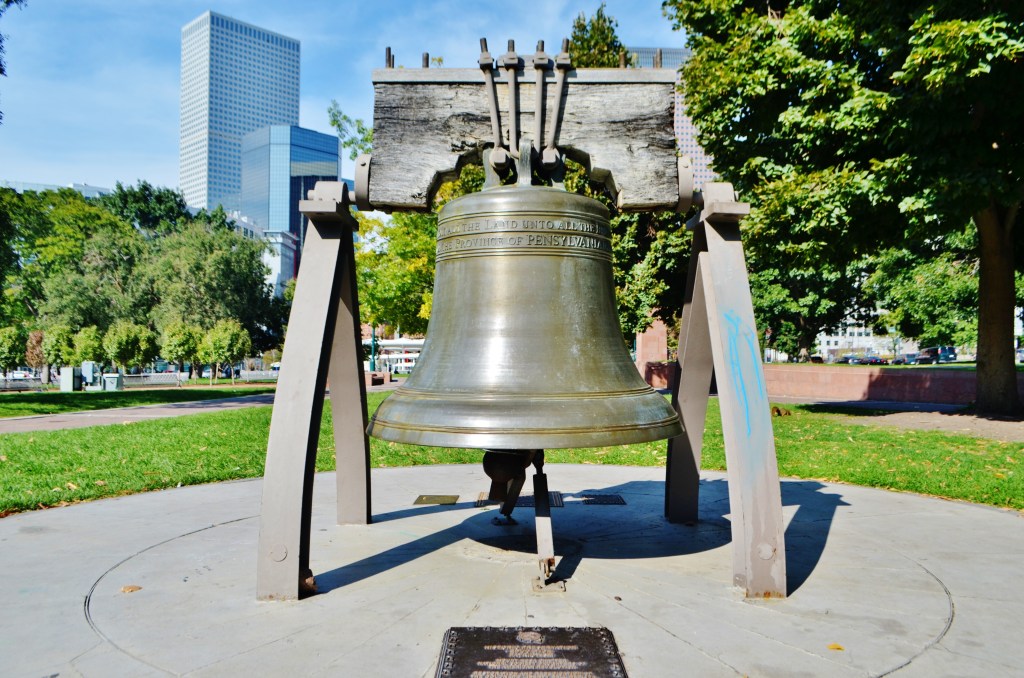
At the height of the Obamanation, there was a con in Philadelphia, and — of course! — we took a chance to visit the holy sites.
At the time there was a legend rampant that if you rang the Liberty Bell, there would be a second American Revolution. Dan caught me trying to lean-not-lean on it and told me to stop it. And I’ll give you the poor thing is strapped down five ways from Monday to the point that it would take a five point Earthquake to move it.
Look, by disposition I seem to always be on the side of chaos and upending. It is a very funny — not funny — joke of the Author that He then requires me to be the sane one, holding the reins and saying “it might eventually be needed. But not yet.”
Weirdly the “revolutionary Fed Speak” has propagated frantically on Twitter, and i want to tell you, it’s an ops, and it’s not an ops for OUR side. (It rarely is. The individualists as always fail to organize.)
Yes, the “socialists” have got some wins in jurisdictions where the voting is so corrupt they could run Mickey Mouse (instead they chose to run Goofy, of course) and win. But that doesn’t mean much for the country at large. I always roll my eyes when I read something about how people under thirty think well of communism/socialism. I’ve been reading this headline my entire life, which means at one point it was my generation they were talking about… on our way to becoming, as a generation, the most irascible constitutionalists on the block.
Not only does socialism sound great when your only experience of life is school and parents looking after you. Once you enter the working world and acquire responsibilities and rights, the socialism peels like snake skin, allowing the individual to grow.
Add to that that a) the kids have been told that anything requiring community is “socialism” including roads and schools. I’ve had someone argue that with me in the past, and thereby class the ROMANS as “socialist”. Then there is the fact that their acquaintance is mostly from school and the teacher probably told them socialism was great, so they’re afraid of letting the classmates know they don’t buy into it.
Anyway, I don’t see any great deviation from norm in the kids, except maturing a little later.
And honestly, the beginning of the twentieth century was more reliant on collectivism and central planning of all sorts. It was back then just the “sensible position” because of the way that industry had been reorganized by central planning and made so much more efficient and prosperous. It seemed logical and obious it would achieve the same to organize government the same way. (I remember the remnant of it in my high school economics class where they talked about how hard it was for the mixed economies to catch up with socialist/communist ones who were eliminating all inefficiencies, by nature.) If you don’t believe me, read early SF and you’ll catch the whiff everywhere. Which is why FDR and the other “progressives” got away with so much.
Now, in the post covidiocy era, we’ve become more jaded about the whole central authority thing. No, not all of us. (For is it not written, the custard heads thou shalt always have with you.)
Yeah, “Socialists” are winning in places where a cat would win with a D after its name, mostly because the fraud machine is that efficient. And btw that means they’re convincing themselves that running to the left is the way to go. Will it work? Well, it depends on whether the “socialism” is the real draw (it won’t work) or they have the fraud that set up that this is just to give cover to the fraud (“see, we told you they wanted socialism. That’s why we won.”)
How do I know that socialism isn’t what people want? Because the left has been trying to sell this since 08 and everywhere that it’s not a safe space for crazy left, it bounces like a weaponized rubber ball. Because people picked Trump. Twice. And not all the promises that “There will never be jobs again, but government will take care of you.”
I think coming out as socialist is their last attempt at appealing tot he masses, which in their head (arrow of history) are of course socialist. Like Occupy Wall Street, which was in the same category, it won’t work. because the masses are not socialist. They might think that’s the name for anything cooperative, but they’re not in point of fact socialist. And the things the crazy socialists say repel.
Anyway, we might yet lose control of the country. We might yet need “a second American revolution.” Heinlein believed it, and you know, I have one, at the end of the USAian arc in DST.
But today is not the eve of that day. Today this is in no way needed. The screaming voices on Twitter are trying to get us to move because that is, in fact, their last chance at winning. (And even then their chances are low.)
So, go out and celebrate the fourth with an absolute clean conscience and happy soul.
Yes, the country got very far down the path to “Progressive-possessed” before any of us were born. But we’re clawing it back, and things are in point of fact going our way.
We are winning this, without the need to roll the dice in a revolution. Which is the best kind of win, I might add.
Note I’m not saying it will be easy — if it were easy, it wouldn’t need Americans — or that we won’t have loses. I’m just saying we will win without massive loss of life.
Be not afraid. As for me and mine, we’re watching the sacred musical (1776) and then blowing up stuff, as it should be. There is 100% chance of wretchedly rendered but very fervent singing of the Star Spangled Banner, too.
May it always be so.
2026 FUNDRAISING APPEAL. If this is one of your regular stops, please consider donating! Because Jerry Pournelle told me I should be making 100k from the blog, given readership and how often I blog. So far I’ve never made more than about $30k per year, but then again, I’m not Jerry. I think he was assuming HIS value add. :D Whichever. he said to fundraise annually and I’m doing it. It helps convince my family I’m not insane when I got to bed late and get up early to keep the blog fed. (Today? today it’s a matter of doctors. Sorry.) The full appeal is here: Toss A Coin To Your Blogger, Oh Readers of Plentypaypal link in it is broken (fixing but also here) and forgot to give the snail mail which is Sarah A. Hoyt, 304 S Jones Blvd #6771, Las Vegas, NV 89107.
Oh Readers of Plenty It’s that time of year where I show how obedient and what a good listener I am, and ask people who like what they read here to kick in a few bucks, if they have it to spare.
Your contribution can knock out the rats in my head who insist that this is a waste of time!!!
I have been told, repeatedly, by several of you, that it also helps the rats in your head that do not like feeling like freeloaders.
This is not an emergency appeal, this is not a matter of life and death, (or even death and ice-cream), and I will throw my shiny new chinchilla of hope at you if I realize you’ve hurt yourself to send me a few dollars of thanks.
That said, a workman is worth his hire, and I think I feel Jerry Pournelle glaring at me from heaven since he cannot give me the lecture about how my work has worth and I need to respect that value. So, if you find value in this blog’s work, and you won’t hurt anything by doing so, toss something into the hat!
There is a Give Send Go fundraiser for this specific fundraiser set up. Here is a Paypal Me Link if you prefer that. (Yes, I know. Paypal, but for now, they’re behaving.) If you have a monthly donation setup to the permanent Give Send Go, that is still working and thank you! There are also two substacks you can subscribe to. One is on the side bar of the blog, the other is supposed to be a newsletter, as well as giving you chapters of the current work in progress if you become a paid subscriber. It takes cards.
For what is going on: I am actually doing quite a bit better since multiple people have taken it on themselves to nag me into going to the doctor before I am nearly dead.
On the down side, as a result of that I am in the position of waiting to see a specialist (mid month) for a something which responds to antibiotics but comes back when the course is finished, and has the normal doctors saying “huh. I’ve never seen that before.” I am sure I don’t have to explain to everyone here how not reassuring that situation is, but it is being handled.
There are several non-book tasks I intend to get rolling this year- among them putting the clanker songs on Spotify so various Hunlings will quit asking if they are up yet, and another of which will need to be further along before I open it up. It will be site for all things geeky and also hopefully a good promo site for indies. (Can you feel the anticipation?).
If I can stop throwing out “interesting” symptoms and becoming a medical curiosity, I should be able to finish Rhodes to Hell and move on to the next Dyce. Needless to say I’m also working on Orphans of the Stars, the second book of Chronicles of Elly.
And that’s all for now, throw a handful of hundreds in the hat, (go ahead! Make my day!) and lets get back to playing!
Yes, I do think the Supreme Court’s decision on birth citizenship was wrong, and further it was dangerous, because I believe Clarence Thomas over the lot of them. His scholarship is superior to all of theirs.
The truth is that we’re facing a new form of attack. As I said before, when the borders were open, the world cannot win against us militarily but they found they can attack us by sending the most wretched, uneducated and frankly hostile to us (In the Americas and I suspect the rest of the world, they heavily recruited communists for the caravans) people they could find over the border in massive waves. That this had the advantage of lowering our wages, raising costs of living and draining the body politic dry, while presenting us with scenes of squalor was an advantage.
It was an attack by human wave, no more, no less. They’ve done the same to every Western nation. Successfully, in terms of more or less destroying the countries.
It has abated now, and largely stopped. Except for H1B visas, which are a different problem, but not by much, and which this administration is failing to curb.
BUT the human wave attack has taken another form. Not only women performing birth tourism, but in China’s case doing that factory style. And in many ways, too. There have now been found more than one literal “factory” where Chinese citizens are having children via surrogate and raising hundreds of kids in various institutions throughout the land.
This is innovative, technically legal, and evil.
The supreme court ruling against birth citizenship would be an easy solution, of course. but please keep in mind that what we have now is exactly what we have had for the last two or three generations. NOTHING has changed. We just hoped it would.
It doesn’t mean we can’t combat this by other means. Sure, getting the supine congress to act might be a forlorn hope — which is why we must win in November. I don’t know what to do for it other than pray, but we must — but they might. Miracles do happen.
And I bet you anything that Trump is already plotting how to make them act, because he has seen the size of the threat (now if someone can clue him in to H1Bs? I’d appreciate it.)
Probably the absolutely easiest way to combat this threat is actually within Trump’s reach, though it will bring law fare, as well as crying and gnashing of teeth.
NOTHING in the constitution allows us to tolerate dual citizenship. NOTHING. The oath I took at naturalization required that I renounce all allegiance to foreign nations and potentates.
And yet, most Americans today think nothing of someone having or assuming dual citizenship. If that weren’t possible, the baby factories on US soil might not stop, but the having a kid and taking him “home” to be raised would. Because in the parent’s country of origin he’d have no status and no right to any services. And it would create an intolerable situation.
Yes, i do realize it would put a lot of people in uncomfortable positions. But the law is the law. Choose a country and cleave to it.
After that there are various legislative situations. The lowest probability one is the congressional amendment. Sure, try for that too. Try for EVERYTHING. But do not go into lamentations and rending of garments. You are not any worse off than last week.
It’s just the easy solution has been shut off. We’ll have to do it the hard way.
Be not afraid. And keep fighting to the extent you can, even if (just) with words.


























































































 According To Hoyt