Hi, folks, this is Amanda. Sarah called this morning to report that she has a very sick computer and to ask me to let everyone know that today’s post will be delayed. The house tech guru, AKA Dan, is busy trying to fix whatever the problem is but she doesn’t know how long it will take. So, keep checking back. She’ll post just as soon as she can.
Category: Uncategorized
Victimhood And Its Discontents
When my older son was four, as tall as a ten year old and as wide as he was tall, he was cast as an elephant in the kindergarten play. My husband and I – not in front of him – said “It’s type casting.”
You see, we weren’t particularly worried about his weight or his self esteem. Most of the males in my family start out what can be kindly called “hefty” and slim out in adulthood, when they also become be broad shouldered, narrow-hipped and too damn handsome for their own good. We figured a little knowledge of how the other half lives would inoculate Robert against thinking the world existed for his amusement.
He made a good elephant in the circus, with cloth ears and trunk, and he still loves elephants. If he’s depressed a visit to the zoo to look at elephants usually fixes the problem.
So, the other day we were talking about elephants and he said something about the kindergarten play. I said “It was type casting.” He laughed and said, “You know, in retrospect, the teacher looked a little nervous about that role assignment, which the other kids decided. She kept asking me if I was all right with it.” “Were you?” “Oh, yeah. I was much bigger than the other kids, couldn’t get in on the tumbling or other stuff that could hurt them, but I could pretend to be a tame elephant and the girls pretended to be tamers, and everyone applauded.” Then he paused and said something that got my brain going. “You know mom, there are so many things you can’t say and can’t do and can’t think these days that it’s like everyone is watching himself ALL the time. And my classmates? It’s like they came into kindergarten with a long list of things that they could be offended about, or they could misinterpret in order to be offended by. Or that they could be offended by due to some portion of their history no one knew about. I’m glad you and dad never did that to me. I think it must be emotionally exhausting to always feel like you’re a victim.”
And then I thought particularly about two things. My post on Writer Stockholm Syndrome and one of the reactions, from Passive Voice commenters.
The first one is obvious. Did that post come across as though I felt like a victim? Of course it did, I did feel like a victim for… 12? Years. Being paranoid is a perfectly normal reaction to living in hell. Was it emotionally exhausting? Oh, hell yes. I think, honestly, it was part of the reason I kept getting ill – I was living my life on the verge of a nervous breakdown. And I saw no way out of it. But the post was “I’m out of it now, one way or another. They can’t drag me back” which sort of mitigates the whine, I think.
(My commenter yesterday who said that the market would eventually solve the ills of early capitalism was right, of course. What he was wrong about was the several lifetimes it can take for that correction. As someone who was stuck at the tail end of a system where I couldn’t get out and couldn’t win and it had got so dysfunctional there was no good in it – still is, but now doesn’t care so much – I admire the early labor leaders who actually put something on the line to try to get out of untenable situations. In some industries, they’re still doing that. One can’t always count on technology riding to the rescue. The fact that they let their movement be co-opted by one of the most evil regimes ever to mar the face of the world is a separate and later development.)
So, who am I to complain about people who claim victimhood? I’ll point out while there was not a way out, I shut up and took it (in public, at least. My poor friends. What they heard.) and worked on creating escape hatches. Some of them are half-completed and would have worked without the technology change. The other ones were made much easier by the tech rescue. But I didn’t imagine I was special and/or sainted because I was getting screwed to the wall. I knew – writers talk to each other – that as screwing went, mine was fairly gentle, and at least they’d supplied the grease. There are people in much worse straits than I and far more inexplicably. (Let’s talk about my friend whose second book outsold its printrun FOUR TIMES and who was never accepted by the house again. Why? We don’t know. Worse, she wasn’t accepted by the house while in dire financial trouble which the house KNEW about.) And besides, I could see the incentives in the system that created this – it wasn’t personal.
That meant, as bad as it got – and it got very, very bad – after my first disappointment and my first heartbreak, I didn’t even bitch about it every day. What I did do was spend time thinking out ways to break out of it. It was still exhausting, it was still upsetting. But it wasn’t destructive.
Then comes the other side of it. The commenter at the Passive Voice (I’m not picking on the Passive Guy. He wasn’t the commenter and I have a little colleague-crush on PG. He’s good and he’s providing information we desperately need.)
This is something I’ve run into again and again and again. I’d call them the defenders of victimhood. They not only get to be offended on behalf of other people’s victimhood, they get to pick who the true victims are and tell you what you can say and think about them.
Knowing nothing about me other than maybe the – not very representative, I photograph horribly – picture on my site, he immediately decided I didn’t have a right to claim any victimhood, and oh, yeah, I was insulting designated victims. So he posted something like “Is she saying it’s easier for people of color to break into the business? Right!”
Of course, this required a willful misinterpretation of my post. (Or perhaps I’m horribly opaque.) If anyone needs a clarification, I said that if you were white bread and had nothing special about you, you’d get consigned to the midlist. HOWEVER if you had something special about you – and I did. Most people perceive me as “latina” which (rolls eyes) the Feds say I am, though they only say it recently. One of my employees long ago was convinced Portuguese was the same as Mexican. Yeah, he was a dumb *ss. But I had a materially difficult childhood. Yes, I learned English at 14. Yes, my husband and I got engaged when we hadn’t seen each other for 4 years and had never dated. All of these are “special” and “interesting” as far as the publishing establishment is concerned – they will only push you IF you want to write about that. As I said, after my first series crashed, the publisher thought the only way for me to have a career was to write about growing up in Portugal and my marriage as all, as an autobiography.
That is, my path to staying employed was HARDER than the “stereotypical American suburbanite” because they wanted me to “use” parts of my life that were so private as to defy imagination.
Worse, having gone to a very good liberal arts college, I KNEW what type of “autobiography” they wanted. They wanted a “poor me” autobiography, in which I was an heroic victim. For bonus points I should blame the US for anything bad that happened in my country when I was growing up.
They weren’t going to get it.
I know what real victims are. I’ve read stories of people growing up through the cultural revolution. I’ve read stories of Saudi princesses’ (PRINCESSES!) childhood. And I NEVER experienced anything that bad. Besides, I did okay and I managed fine, and memory is a slippery slope. How much of it was the outside imposing on me, and how much of it is the fact that my personality is crosswise to the world?
As for the US being to blame for the insanity in my country? Brother! I’m told by someone who worked for a secret service as a translator at the time that they DID know about some of the things the average American doesn’t know. But the worst the US did was NOT intervene while the USSR (and China, briefly!) made their (often bizarre) power plays.
Now that I’m an American, may I say I completely understand not running off and getting involved in every flare up in the cold war, even if it looks to people here like we did? May I say that as bad as things were they could have got much worse? May I say that Portugal is a grown up country and can pull up its big-boy britches and figure out its own messes? (They seem to be doing so, at any rate. It just takes time. But perhaps Lloyd Biggle Jr. was right and perhaps Democracy Impose From Outside Is The Greatest Tyranny. I think it’s more that if you keep cleaning people’s room for them, they never learn to do it themselves.)
At any rate, and again, my victimhood wasn’t very victimy. I never FELT like a victim. I always gave back as hard as I got, and found ways out of my binds. Yeah, okay, the Portuguese teacher told me she’d not give me an A unless I joined the communist party. It’s been thirty five years, and I’m a successful writer, and she, presumably, is still communist. I don’t think I’m the victim here.
And besides, if I wrote the truth my publishers wouldn’t like it. It wasn’t THEIR version of the truth.
So I bowed and said “no thank you” and instead sent them a proposal for an historical mystery series. And they bought it. And then I started working with Baen and they couldn’t care less about my victimhood creds, so long as I could write a story with a plot. As for the other publishers, I just got relegated to what I think is a special hell called “She has victimhood and refuses to use it.” Which is just below the hell reserved for white bread suburbanites.
(Now, if the commenter had said I was saying it was easier to get published for skinny white girls willing to trade on their looks, DUH. Yes, yes it is. They still need to know how to write, but it’s easier. No matter. It equalizes. Looks don’t last forever. Ditto, people with “contacts” – if they’re not good they don’t last anyway.)
So, why are people so fascinated with victimhood? Why do some people abrogate to themselves the right of defending supposed victims? Why – and I’ve seen this more than once in books – is being a victim considered to make you morally virtuous and worthy?
To an extent this is a very old idea. I think it started with the martyrdom stories back in the middle ages. People went through unimaginable suffering for their faith, and earned paradise forever.
Somewhere along the line, in going from a religious culture to a secular one (not complaining. Americans [born and bred] can’t even understand the stultifyingly religious nature of the middle ages. It was as suffocating as the victim thing is now. Perhaps more so. Even your naughty art had to be couched in religious terms) we forgot that what made the victims virtuous was NOT the suffering, but the fact they refused to give in to their evil torturers. NOT the fact they sat there and took it.
Victims who fight back makes for great literature. Particularly if they’re fighting back not against their being victimized but against SOMEONE ELSE being victimized or both. Victims being pulped and hating everyone who does it to them and complaining for 400 pages just make me nauseated (they also get assigned to my kids to read in school, thereby confusing another generation.) The claimers of victimhood for others aren’t good for my digestion either. If your whole purpose in life is to tell someone that they can’t talk about a victim that way, get over it. If you really think these people are victims DO SOMETHING ABOUT IT. Something that doesn’t involve talk, and something that costs you something. Talk is cheap and no one is going to believe you’re virtuous just because you’re always riding to the defense of someone suffering under the heartbreak of psoriasis. Oh, wait. YOU’ll believe you’re virtuous. But you’re wrong. You’re just whiny and jealous that you can’t be a “victim” which you think has some sort of spiritual power.
This is not social problems get solved. And they’re never solved if you can’t talk about the other factors involved. Yes, some victims bring it on themselves. I know that’s heresy, but it’s still true. The reason I was stuck in midlist hell was because I was too stubborn to give the editor what she wanted. Yes, what she wanted was unreasonable as far as I was concerned. But I knew what it was, and if I’d given it to her, she’d have made me a bestseller. So, I was in hell because I wasn’t willing to pay the price to get out. And while my position was horrible, someone saying “Listen here, you dumb *ss, I don’t even have that option” would have been PERFECTLY justified.
Other victims are helpless – abused women and children. Women in countries where they’re chattel. People in countries where their skin color or their religion bars them from certain jobs, or can even get them killed.
HOWEVER even while they’re victims, it doesn’t mean it’s because the other side is mean and evil. Only four year olds think that way. Usually there’s something in the system creating it. And you need to talk about it FRANKLY to fix it. You can’t stand in front of the subject yelling “you can’t talk about that. You’re not a victim.”
If you treat victims like some sort of religious symbols and can’t talk about them except in hushed, religious-like tones, you’re not going to look at the situation dispassionately. You’re also going to create incentives for being a victim. You’re going to in fact, keep the victim where he/she is for your own satisfaction. AND you’re going to feel good doing it. Take a good look in the mirror. There you are. That’s what you are. You’re using others suffering for your moral preening. Don’t look away. As long as you keep doing this, you’ll keep others suffering, so you can be virtuous. And you won’t discuss WHAT in the system is keeping people as victims.
For the record what did this in publishing was the winner take all system where to give you publicity and get the reps to distribute your book to the point where it wouldn’t sink out of sight, they needed to have SOMETHING beyond “it’s a good book” – reps by and large didn’t read the books – to make it “hot”.
It could be a tie in to a recent movie, but having something like “the author is…” worked better. And “the author is foreign born and…” worked best. But you have to be able to look at it and go “they give those who are willing to play victims a leg up.” You had to be able to say it. You had to be able to THINK it. You had to be able to realize that those who were victimizing the author were not the ones the author would have to complain about to get the benes.
And then you’d have to think of what was causing it, and that the publisher/editor were not evil – thank you commenter yesterday! – moustache-twirling villains, but just part of a system that worked that way.
And then you could figure out how to get around the system ITSELF.
But to do that, first you needed to have a free mind. You can’t be hemmed in with “I can’t say this. I can’t say that. I have no right to think that.” As Heinlein said (even if he doesn’t mention “peer pressure” read it as being there): When any government, or any church for that matter, undertakes to say to its subjects, This you may not read, this you must not see, this you are forbidden to know, the end result is tyranny and oppression, no matter how holy the motives. Mighty little force is needed to control a man whose mind has been hoodwinked; contrariwise, no amount of force can control a free man, a man whose mind is free. No, not the rack, not fission bombs, – not anything – you can’t conquer a free man; the most you can do is kill him.
Disorganized Labor
I could post about Labor Day, except that all that comes to mind when I think Labor Day is the Red Army passing in front of the Politburo on Red Square.
Yes, I do realize that was the First of May – when Labor Day is celebrated in the rest of the world – not in the US.
In fact, the uncoupling of Labor Day from the rest of the world has always been, in my opinion, part of the genius of the US. That way Americans don’t need to associate Labor with the Politburo. They don’t even need to associate Labor Day with Organized Labor. And by and large, as time goes by, while making nods towards the achievements of organized labor, most Americans don’t.
More importantly, the US got to miss on the “joy” of labor day for the rest of us, which came in two parts. One was watching the organized parades to figure out who was in and who was out at the Kremlin. Okay, I suspect this was not a part of it for, say, the British. For the French? Probably, at least to some extent, because they had a large communist contingent who openly took orders from Moscow, and a massive socialist contingent, some of whom more or less openly took orders from Moscow. Who was in power in Moscow meant how likely you were to have the trains, the mail or the garbage collection strike on you. (No, you say? Portuguese went on strike against Reagan’s development of the neutron bomb, a Moscow objective, not a labor one.)
The second was waiting to see whether there were any shenanigans planned for the day. Things like attacks on the police/military headquarters were not out of consideration. Nor were riots and general “demonstrations” of Labor’s power. What power, you ask? The power to scare other people. That was about it. It was enough.
I’ll say right up front that I’m leery of unions because in the late twentieth century, in western countries, they were Moscow’s stooges in the cold war dynamic. However, I must qualify that by pointing out that I’m leery of all organized groups and that in Eastern countries the unions proved they were double edged weapons. Where would Poland be – or the whole Eastern block, or even us – without Lech Walesa?
But even their behavior in the west, in the cold war, does not stop me from honoring their achievements in dealing with the labor situation as it existed at the end of the nineteenth century and the beginning of the twentieth.
I could tell you – it is true, as far as I can tell from research (which is always iffy) – that the life even in most grimy industrial towns, with around the clock labor was better than life in rural hamlets. Why can I tell you that? Two reasons: people immigrated to the cities to do that labor. (Still do in countries stuck at that level.) And famines became rarer and rarer and eventually stopped altogether.
This does not mean that organized labor was unnecessary. In an era when laborers were unskilled, easily replaceable and after a while wholly dependent on their employer (farming is a skill. People born and raised in the city could not just go back and become tenant farmers, even if they wanted to. Not without learning first, and most of them had no resources to.) employers had all the choices. They could have pressured governments and kept their dominance over a labor force that became little more than feudal serfs. Individual workers could do nothing against employers. So it took organization and a group. The equation went something like this: each one of us is powerless against you. But all of us, together, are powerful.
Unfortunately people tend to take these lessons, and then try to apply them to everything. Kind of like the tale of the man with the hammer.
Lately, some science fiction fans, on being told all the things writers don’t have any control over, came up with the idea that it was time for a general strike or something.
Which brings me to my people and their situation.
First of all, let’s dispense with arguments over what we do and whether it is labor or not. I don’t know about you Tovarish (Yes, I’ve been reading The Moon Is a Harsh Mistress again, why?) but writing my books is closely akin to giving birth and I have it on good medical authority THAT was labor.
However, if we are labor, we are, at best, unorganized labor. And no, organizing us won’t work. To evoke TMIAHM again, this is no time for shoulder to shoulder.
While we don’t have to deal with air locks, etc, we do have to deal with other realities.
1- We’re as different from coal miners or steel workers as is possible to be. No? How not? If each of us labors for ten hours a day, our output will not be more or less the same quantity of usable product for more or less the same purpose.
This comes from the fact that we’re all educated – differently educated, mind you – and each of us writes differently. Our personality influences not just the quantity but the type of output.
You can’t negotiate a collective contract for product with such different audiences as Science Fiction and Romance. We won’t even go into non-fiction. How much should sex manual writers be paid in comparison to erotica? Is a two thousand word sex-tale the equivalent of a ten thousand word novella? Yeah…
2 – Not only would we continue writing for fun – while I’ve never heard of a coal miner or steel worker going to work for fun on their days off, or doing it obsessively after their paying job – but other people, now unpublished, would and do write for fun. So, if every published writer went on strike… Yes, you see it as well as I do. Publishers could buy from a bunch of newbies.
3 – Even supposing you could get every one to strike – and to have power, this would mean the bestsellers would need to strike, as well as the beginners – how are you going to enforce it? We’re not all in the same geographic area. Which of us is going to go tell Stephen King he’s being a fink, if he breaks strike? Who is going to travel to England and tell J. K. Rowling to down keyboard? More importantly, how do you know if someone broke it? Manuscripts in various stages are always in the pipe line. HOW can you tell who broke it and how?
4- aha! You say. We’ll do what the screen writers do. You can’t sell to the publishing industry without being a member of the union. Yeah? You and whose army? WHY would the publishers agree to this? See above. How are you going to make them? Strike? Right. Hollywood has the advantage over us of being geographically concentrated, not just as to management (which publishing still is) but as to labor. Also, producing movies is VISIBLE. Editing manuscripts is done in privacy.
5 – How are you going to eat while you strike? Writers organizations? Dears, they can’t even organize enough to get us health insurance. Most of them – even the largest – refuse to defend writers against such abuses as publishers bringing out in ebooks books first published in the seventies, when those rights weren’t even in the contract.
6-if publishers kicked us over, they could replace us wholesale. And I don’t even mean from the anglosphere. I’m living proof they could hire from all over the world. Need I remind you that in many countries 4k a year IS more than living wage? And people will be happy to get that for sit-down work?
Fortunately for us, there are other methods. We can be what we are – the ultimate loners – and work as unorganized labor to fight for our rights.
There is technology that allows us to tell the publishers, “Scr*w you guys, I’m going Indie.” Yeah, it’s in its infancy, it won’t support most of us, yet, but it’s already having an impact. And that means that for the first time we have some power on our side as well.
Every writer who can should at least have one or two Indie books, just to strengthen that transition, and to dip his/her toe in the pool and see what it’s like. Every writer should inform himself of this transition. (Most of us are. We’ve added three hours of intensive blog reading to our daily work, from what I heard at Worldcon.)
If you’re a writer and you’re not reading Kris Rusch, Dean Wesley Smith, The Passive Voice and a bunch of others, you should be.
Think of it this way: Organized labor worked, back in the day. But today, most industries are moving to become more like us – not cohesive; dispersed; employing highly skilled workers; many of them labors of love.
These are good things, but they also allow for a lot of abuses from those who hire said workers. Abuses that not only can’t be corrected, but in some cases will be made worse by old-style Organized Labor.
So, it’s up to us to show other industries how to work through this.
Unorganized Creators of Content – on the count of three, stand up and do your thing!
The Future Is Ours.
Hammering The Tall Poppy
When I was a kid in Portugal, under the newly instituted socialist (I have no clue what they calle d themselves, but the majority were socialist) regime, individual work was considered a little suspect. It was not exactly frowned at, but everything possible was done to dilute it. For a while we were graded by the class, for instance.
This happened in 5th and 6th grade. I never fell far below a B mostly because, well, they knew what would happen to them behind the bike sheds after class. And we didn’t even have bike sheds. Ashamed of myself? Not even a little. I usually had straight A tests, and I’d seen too many of my classmates with similar grades get pulled down to Cs and others with Ds end up with B because “they’re oppressed and they don’t have pretty clothes” or something like that. I won’t go into this at any more length. I’m not bitter about it. It worked for me. Of course, it would have worked for me if I had Ds normally too. It was called reign of terror. But it added up to “I had a problem and I solved it.”
For more serious effects of this type of “crowd decision”, read anything about the terror in France or the Cultural revolution. And no, I’m not comparing what happened to me to that, only saying mine is in the kindergarten level of that continuum, while those are at the post-graduate level, but they’re manifestations of the same “curriculum.” This is simply a way of explaining how my opinions on certain situations were formed.
In the same way, everything that could be done as group work was done as group work, including writing and art projects. The epitome of this was when we’d arrive at the school, ready for a normal day and got told all classes had been cancelled, here are paint pots, go out front and paint the school’s facade.
What we did to the front of that school stayed that way for about a year, and then another crowd of students did it, and then again. I don’t know what the school thought they were achieving. Savings on professional painters? Or just giving the students a sense of ownership in their school? Whatever it was, and regardless of what my teacher called it, it wasn’t art. Perhaps a clash of conflicting graffiti would be a way to describe it. Some of my classmates, mind you, were astonishingly gifted in art. But they’d be next to a guy who was just drawing private body parts, over and over again. Anatomically incorrect body parts. Or the girl who was just doing little hearts and flowers of the kind you doodle on the side of your notebook when you’re bored in class.
To call the result an eyesore would be an insult with eyesores everywhere. It became sort of an eye-crossing horror that you instinctively looked away from. And when the revolutionary fervor abated, the facade got painted an innocuous grey, which it still is today.
So when Travis Lee Clark in the comments, on He Beats Me But He’s My Publisher suggested that writing would move to a more “crowd sourcing” type of situation, where a novel would be put out as, say vs1.0 and then updated according to comments, my immediate and instinctive reaction was “oh my G-d, no!”
I hate to say it, but my reasoned, thought out reaction is STILL “Oh, good G-d, no!”
At least this is still my reaction for MOST type of projects, most situations and most writers. There are exceptions where this can work exceptionally well.
I found the comparison of this to reading on a computer as a generational thing funny. No, of course I never thought that people would refuse to read on a computer screen. I know it’s a matter of habit. I don’t have issues adapting to new trends. Look, I started out writing by hand, in exercise books, moved to a typewriter at fourteen, wrote my first novel in the first electrical typewriter I found, and I now work almost exclusively on computer (save for editing – the kindle is better for that – and plotting, where I do it by hand to save time.) I’ve tried every possible gadget to make my life easier, including a scanner pen for research (sucks) and Dragon Naturally Speaking (works, but it seems whenever I get it trained the computer dies, and then I don’t get around to training it again for years. Also, dictating what I write into a recorder while walking where there are ANY people can get the police called on me. [You think I’m joking.])
I started reading fiction in books where you had to cut the pages free (they were folded over and the edges and the book was bound that way.) Now I read mostly on the kindle. It’s not even generational. It’s habit. And habits can be formed.
But what stands in the way of crowd sourcing – again, in most cases, and for most authors – is more something in the immutable nature of the human mind.
The first characteristic of the human mind is that most of us – having evolved as social creatures – prefer to be part of a group to actually, you know, succeeding on our own. And if you’re nodding appreciatively and saying “But that’s why crowd sourcing for art is so great” think again.
Rick Boatright suggested, in the post on editing, that newbies post to the 1632 group, where people stand ready to shepherd you to publication. This is true and they are one of the exceptions, for reasons of being a shared world and one that’s becoming mind numbingly complex as you go. So if you want to write for 163x series, this might be a good thing. They and in fact the whole 163- phenomenon will be treated under exceptions. (Yes, I’m afraid this is one of those LONG posts.)
But I stay away from most anonymous online critique groups like poison, and I advise all my fledglings to do the same. Why?
There are several proverbs, in several countries, and they all agree. “The poppy that stands out shall be cut down”, or perhaps “The nail that sticks out will be hammered in.” Or “the forest grows, top on top.” They all mean the same. It means that in any group, if you stand out you’ll be pulled down. What’s more, if you are a normal human being you’ll try to fit in, and you won’t NEED to be hammered.
This is a post in itself. Or at least, if you don’t understand what I’m saying, by now, I’d need a full post to explain it. Something like “swallowing the poisoned apple.” But let me recommend you read Terry Pratchett’s unseen Academics and pay close attention to the metaphor of the crab bucket.
Let me also point out that I have over my ten years as a published author judged umpteen contests. I can tell, without being told, whether the entries were culled by “peer group” before going to the professionals. When they haven’t, there will be some that make your eyes cross, and some that are astonishingly professional and all you can do is say “send this out. It will sell.” When they have you get a kind of low-level Schrecklichkeit, a horribleness that screams “look how pretty it is and I made it all with my own thumbs.” And all entries will be at about the same level. (The last contest I judged is an exception to this, and I’m not sure why.) And when I was reading slush, I could tell the entries that came from the same group easily enough. Other editors could too. In fact, our writers’ group bucked that trend so spectacularly that we caught Stan Schmidt’s eyes for that reason alone. (More on that later.) They might all be good. They might all be bad. But mostly they were all boiled oatmeal and about as tasty.
That is one effect of crowd sourcing ANYTHING. Did the kids painting the mural next to the girl who painted like DaVinci feel like they needed to make their parts especially ugly to bring it down? Probably not consciously. But despite most of the great religions preaching against it (except for the dark times, when they encourage it) envy is not just a sin – it is arguably, evolutionarily what kept our ancestor-bands together and thriving. Group cohesion was important to survival, and therefore outliers at both ends of the spectrum had to be pulled down or up to meet that level. So it is part of all of us. We’re not angels. We are at best the place “where falling angel met rising ape” as Pratchett said. Some of the things useful to each of those are a pain to us, in this our in-between state. Deal.
I have been – in case it’s not obvious from my er… educational circumstances – in more group projects than I care to mention. (Being enamored of group work subsisted all the way to college and beyond. It was supposed to iron out inconvenient individualism and make us ready for the socialist future. (Look, they’re talking of revising their constitution now, so it doesn’t say they’re a democracy on the way to socialism. but while I was there, this was gospel.)) The only ones where I didn’t blush for the results happened in the following circumstances: A group of well-matched people, all at about the same level of intelligence, but with WILDLY different interests and talents; a project we could distribute so each one did the portion that suited him/her best.
If you look at the successful crowd sourcing projects – say the 163x or even Austen Fanfic as Practiced at Derbyshire Writers Guild or a dozen other “shared world” endeavors – you’ll find that they share these same characteristics. They are/attract people who are at about the same level FOR THAT ENDEAVOR but with wildly different specializations, which means they’re not competing for the same thing – in most stuff.
Yes, both of those, which are the only ones I know closely, do take beginners and help them. But that’s because you can absorb a beginner or two when you’re a massive group. It’s another version of the Tall Poppy, but more like pulling it up to the same height. And both start – self select – for interest in a type of lore that takes catching up on. (163x or Austen’s work.)
I also want to point out that this “pulling down” is not the result of CONSCIOUS envy. Oh, there are exceptions, yes. There are the people I call “the gods of workshops” – i.e. people who forgot WHY they started going to workshops (presumably to get good enough to be published?) and started deriving their power and prestige from the workshop itself, and their place in it. You usually know them as the people who pronounce, in an imperious air “Oh, my dear, you’ll never get published like this” – when they, themselves, have zero credits. But those are, thank heavens, few and far between. MOST people do this instinctively. They will find the flaw in your otherwise far-above-them story and attack it mindlessly, because some part of them is hurting that they’re not even aware of. G-d help us all, they’re HUMAN. In any human group, it won’t be just art – it will be personalities, friendships, pet hatreds and most of all cohesion that rules the day.
The other thing to take in account, even when a group is all at the same level of talent (almost impossible, but feasible, by sheer luck. Our writers’ group was pretty close) is the different rates at which people work and how fast people progress. In other words, experience changes how you write.
Let me put it this way. This weekend, as a challenge to myself, I’m trying to finish a started novel. I doubt I can – though I expect to get halfway through and maybe finish next weekend. It’s a novel I started three years ago. Yes, three years ago when I had… seventeen? Novels sold. And yet, reading it, I’m going “Oh Heavens. Did I know how to plot at all? There are lose ends all over the place.” This is part of the reason I haven’t been in a writers’ group in years, even though I tried recently. It’s not that I’m smarter or better than other people (unless you assume I’ve gained IQ points in the last three years, which I doubt) it’s that at this point it’s hard to find someone at my level of experience, or a little above who can see my glaring mistakes (even if most people who know me and my output don’t try to pull me down. They still don’t help.)
This brings us to where the commenter (I’m really not picking on Travis. They are good points, even if I disagree with most of them and I’m grateful to Travis for bringing them up) went on to say that really, she was sure things would change with e-editions mostly in control of the writers.
On that she is absolutely right. There are several things I can see – one of them is writers revising their work every few years, not so much in reaction to what the crowd said, but because they got so much better.
Another one – and she quotes something similar – is people showing their work to the intended audience, in the beginning, then adjusting their pitch so it hits better. I did this with the last re-write of Darkship Thieves and also, in case no one has noticed <G>, I tend to read stuff not yet published – often not submitted – at cons, to get people’s reaction. The net and writers’ online conferences makes this MUCH easier.
Another one is shared worlds. These always existed, and for these different rules apply, since they’re really a monumental work – a triptych in heroic proportions, done by a thousand hands – and some direction needs to apply (otherwise you end up with my class’s painting project.) These are now MUCH much easier, and I expect to see a lot more of them. In fact, I expect to see “pay for play” type of shared worlds that have music, stories, etc.
Also, lest it be believed that I’m smacking writers’ groups around, I’m not. I only started really progressing when I joined one, as a beginner. I’m just saying that these work best if all the authors are at same level of learning to begin with. (Yes, blank slate, like we were is the same level.) And also if they consciously TRY to diminish the Tall Poppy syndrome. We did this several ways, one of them being by making “Copyedits written only. You don’t read them aloud. Critique only two minutes, by the clock. Don’t repeat what someone already said. No discussion of manuscripts outside the group. No written, anonymous critiques.” This made it harder to beat down the tall poppy. The fact that we were all, to begin with, wildly different in personality and outlook also helped immensely. And even then, it won’t last forever. Know when you’ve outgrown them or they’ve outgrown you. Bow out gracefully. Come back for the parties.
But for novels as novels – or short stories as short stories – I continue to believe that Pratchett’s advice for witches holds: Try to be yourself, as hard as you can. I don’t think Heinlein, Pratchett, F. Paul Wilson, Austen or even Agatha Christie could have been improved with “crowd sourcing.” And I can just see what crowd sourcing would have done to someone as idiosyncratic as Jorge Luis Borges “What’s this thing you have with libraries and labyrinths, Jorge. Honestly. Make it more commercial. Throw in a werewolf and a hot girl.”
As for me, while I don’t belong in the group of luminaries, I’m simply too curmudgeonly to want anyone looking over my shoulder as I write. I have trouble enough working with the young twit I was a few years ago. Honestly, she couldn’t see the forest for the trees.
And speaking of trees, there is a Reiner Kunze poem, which I only imperfectly remember. Unfortunately, I can’t find the book, which I think is in a box in the attic. According to what I can find on line, the English translation starts “The Timber Forest educates its trees” which is not how I’d have “translated” it, but that’s life. It’s about the fact that trees in a forest grow top on top, and all get about the same light.
He ends with “To the wind they all whisper the same.” And that … homogenizing effect of crowd sourcing in most cases is what prevents great art from emerging from it.
Your mileage may vary. Which is of course the whole point.
The Caturday Post
We shall return to your scheduled, possibly incendiary post on Sunday, but today I’m introducing you to some of the reasons why I write — or at least the reasons I write for money.
Heinlein said that he wrote to feed his family, including his cats. Well, the same is true here, though my husband makes most of the money for “feeding.” I make vaccination, surgery after getting out and getting run over by a car, medicines and replace the sofa they had a p*ss war over money. However, these are still some of the family members who keep me working.
This is D’Artagnan. He thinks his name is “Little Cat” which is kind of endearing as he tips the scales at close to eight pounds. Mind you, that makes him the lightest male in the house, which is not saying much when the house contains 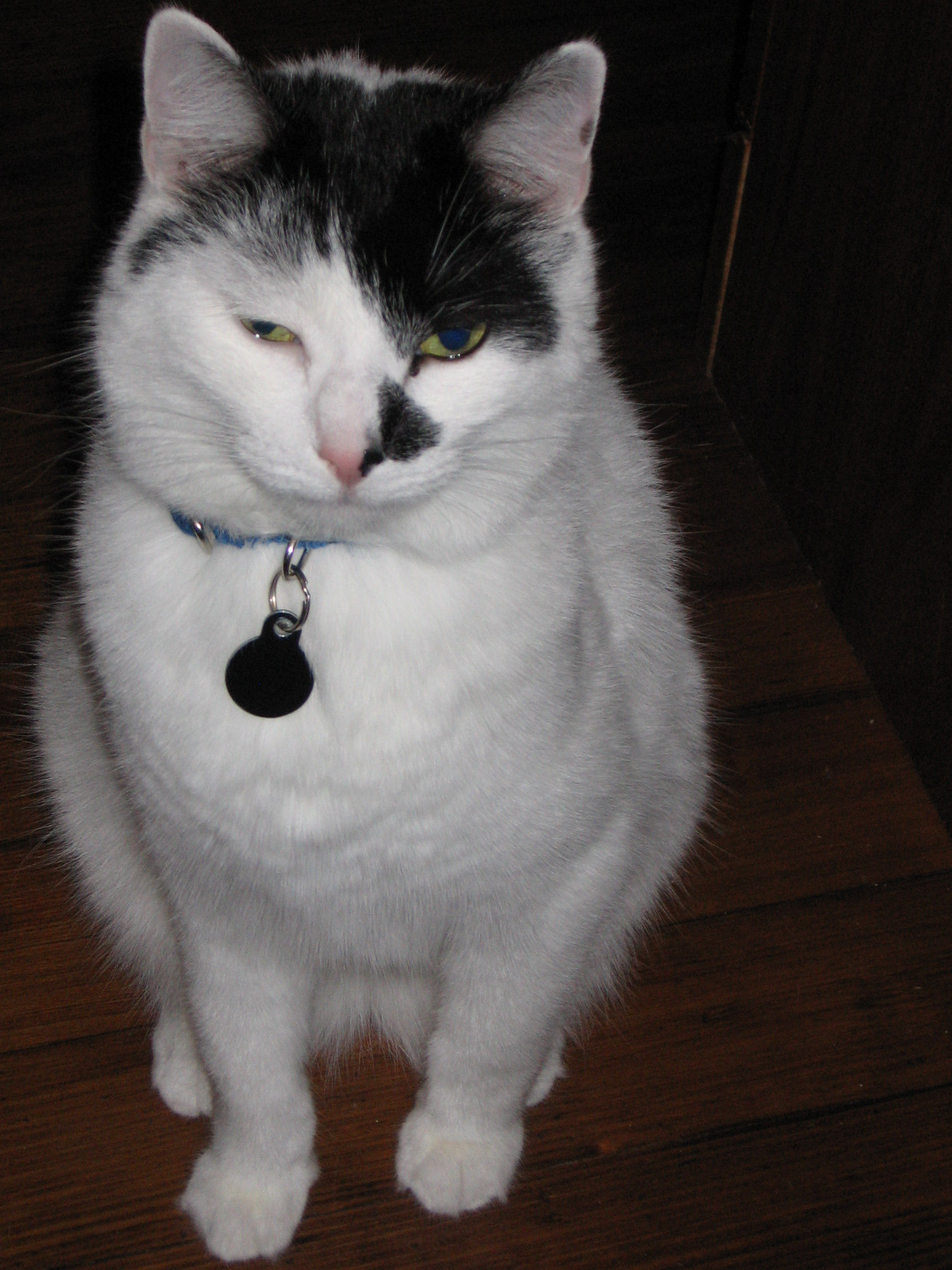 Euclid and Havelock. D’Artagnan wandered in at all of eight weeks, at the beginning of a Colorado snow storm. It was Marshall’s birthday and the guys were unloading groceries. D. rubbed on their legs, walked in, ate the chow, cuddled with Euclid. He’s been with us every since. His nose turns INTENSELY pink when he’s done something wrong, leading to his nickname, “Monsieur de pink nose.” H
 is names include butter pat (he feels like one.)
I’ve done a pastel portrait of Monsieur de Pink Nose.
This is Euclid (psst, the one on the left.) He’s a beautiful black cat and weighs fourteen or fifteen pounds. If we could just convince him to stop pulling all the hair off his legs and belly, he’d be gorgeous. (And yeah, we’ve checked for allergies, we’ve tried kit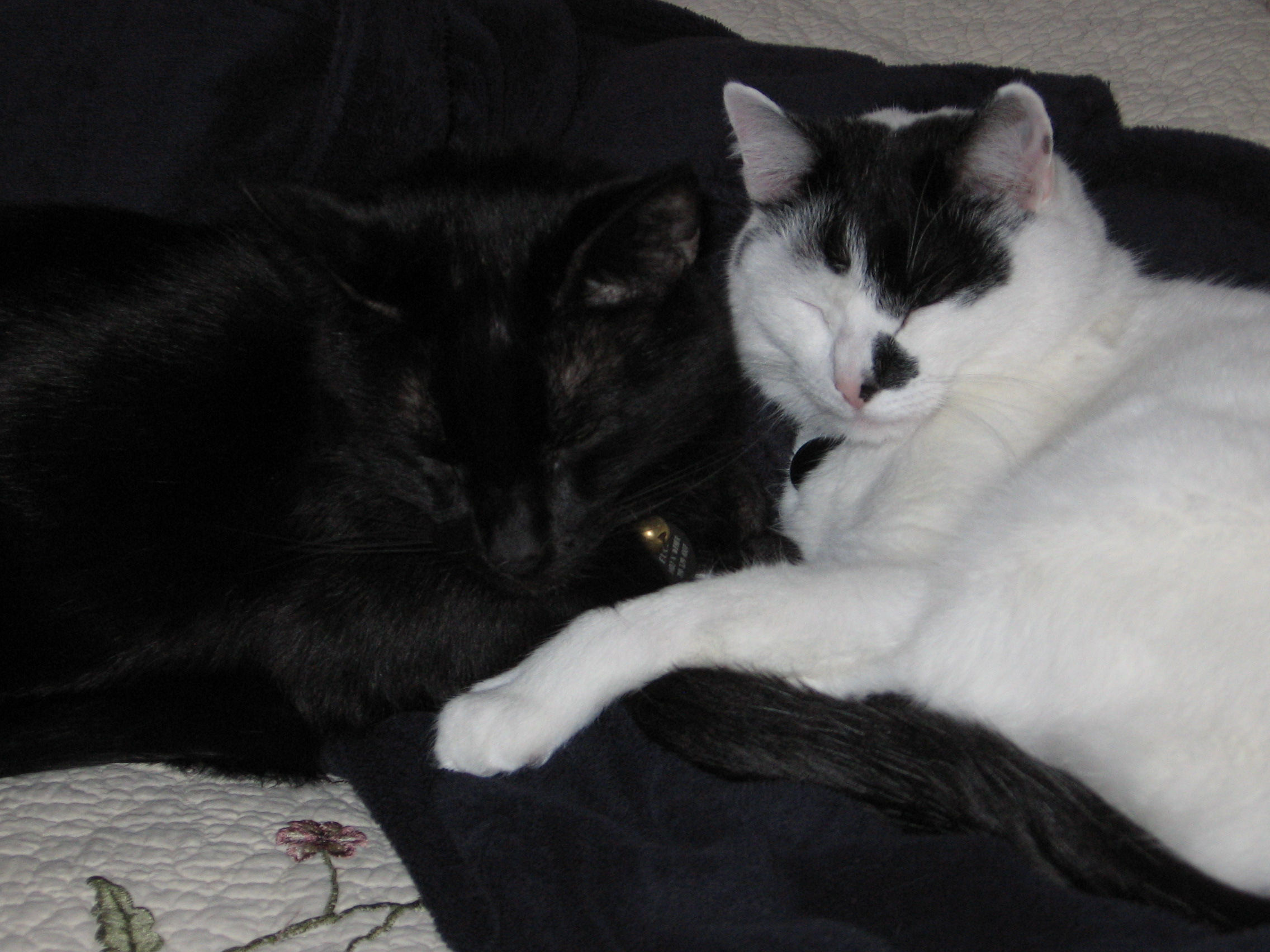 ty valium. Nothing works. As far as we can tell he thinks he’s a poodle. Also, valium exacerbates his alien-tail syndrome. He’ll fight his tail for twenty minutes and lose. It’s sad. And funny. But mostly sad.)
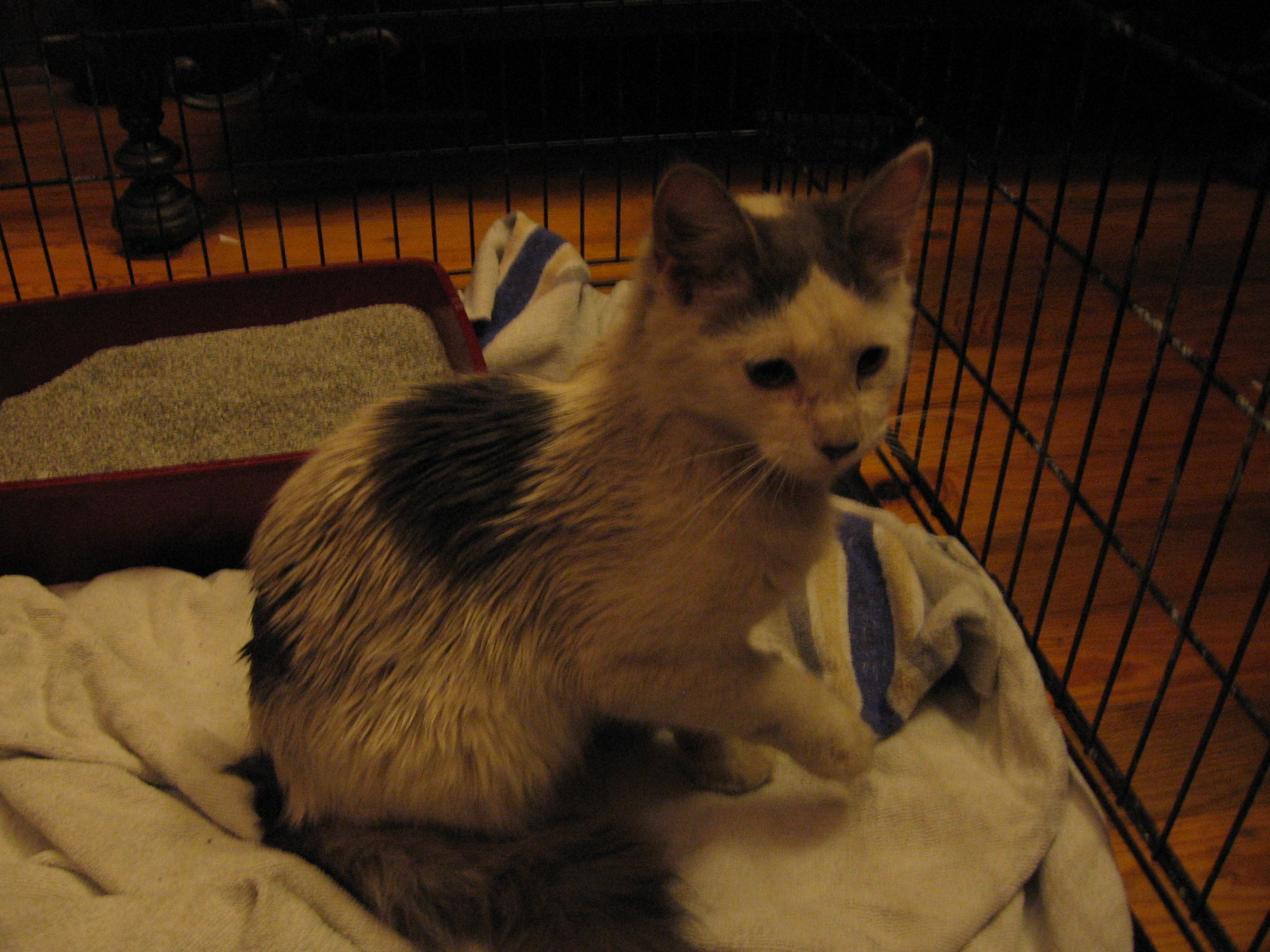 This is Havelock Vetinari Hoyt when we got him. As you can tell he was a sorry sight. He was living on our favorite mini golf course (yes, we play mini golf. We’re very thirties-retro) as far as we can tell living from bugs and feature water. He was also getting chased and hit with clubs because he messed people’s plays and some teen males (not mine) are dangerous idiots. I do a lot of cat rescue. we couldn’t resist. Besides, since he seems to be a Turkish Angora we thought some family MUST be looking for him.
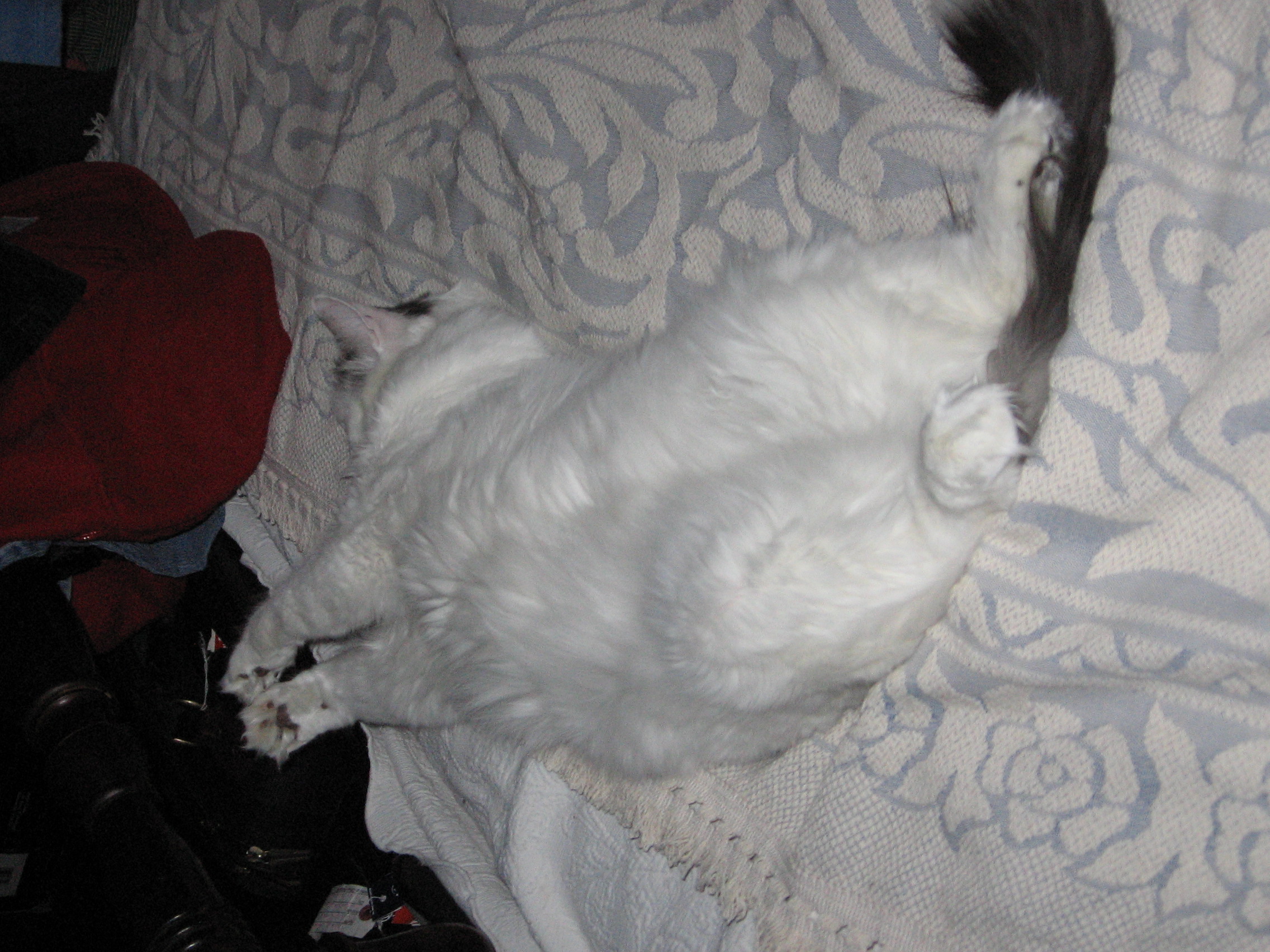 And, as you see, his family found him. Or… er… he found us. He’s still a very good cat, and tries to talk back if you talk to him. But he’s clearly no longer a lost waif.
This is Miranda, who is helping us bring up our younger son, as you see.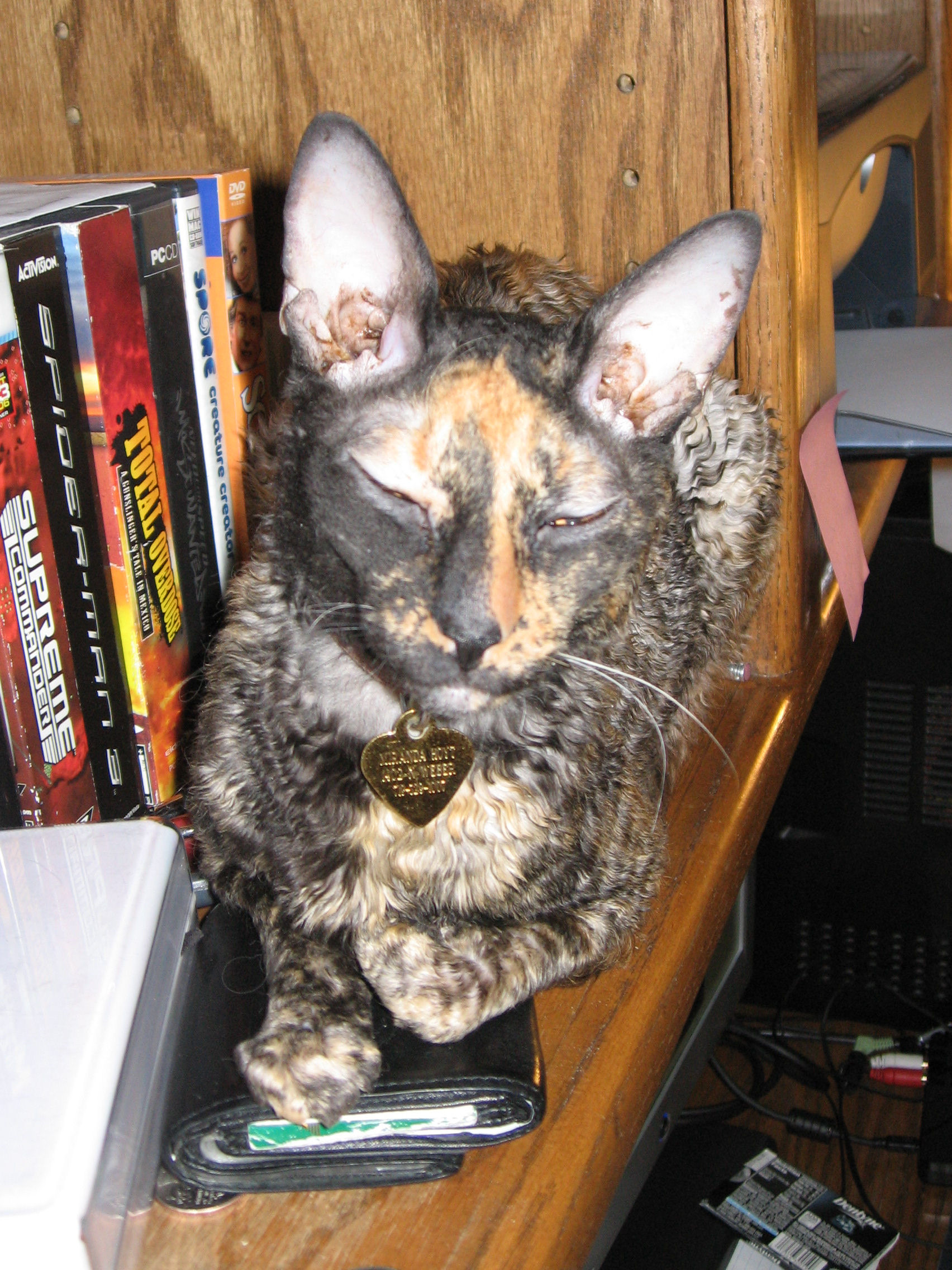 Here you see her holding is wallet and wondering if he REALLY needs another video game. She’s a Cornish Rex and the only cat we ever paid money for. She’s a little smarter than the others and rules us all.
Yes, yes, one Rex to rule them all…
No, the Caturday post is not a normal feature. Yes, I will try to update later in the day with something mroe… grown up. But right now I’m feeling queasy (you know you shouldn’t watch news in the morning!) and I’m going to get tea.
Let My People Be Weird
Yesterday my husband and I went out with two of our oldest writing friends – Rebecca and Alan Lickiss. Oldest as in “we met them when we didn’t dare tell anyone we were writers in public and they were about at the same stage.” Writers need to socialize with other writers because they need to convince themselves they’re not insane.
Writers limit the instances of actual socialization to no more than once every few months because they’d rather spend their free time holed up, creating people in their head and writing. In other words, because writers are insane.
You see the problem there, right? Yeah, I do too. It might be completely unsolvable. Which means writers will continue to cluster together, but not too often. It also means to the outside world we’ll continue being mysteries wrapped in an enigma with a dash of strange, and most of what we do will continue seeming like weird rituals of crazy people.
This is probably not encouraged by my little rants. The post two days ago got linked in a non writing blog, and an – obviously – non-writer thought I was just being whiney. As a mark of how divided writers and non-writers are, I note that no writer thought that, though one writer (?) over at the Passive Voice thought I was being racist (Is white bread an arcane expression? I just checked to make sure I didn’t type white bred. Heaven knows what my fingers can do. But I don’t seem to have. And for the record I think the problem with being a minority – according to our government I’m Latina. Eh. I think my sons are perceived that way more often than I, but I know I am too. I get asked about my Spanish heritage ALL the time. Such ignorance. My ancestors were from the GOOD side of the border. Friends like Jason Cordova were not so lucky poor things. (Runs) – is that the only time having an “interesting”characteristic, like a different ethnicity does anything for you in writing career is if that’s ALL you want to write about and you want to play the victim. [And even this is usually only true in mainstream, not among us genre wretches.] Those who know me know this p*sses me off at the writing establishment. I don’t believe in restricting people’s creativity. And I am no one’s victim. You can victimize me. Doesn’t mean I’ll stay that way.)
I suspect it’s also not helped by my tendency to wander around the neighborhood in a fog. I’ve more or less cured myself of the sudden exclamations of “So, that’s what I do with the body!” but even so, my next door neighbor warn– er, tells everyone who moves in that I’m I writer, I suppose in an attempt to prevent their calling the police or thinking I’m doing heavy drugs.
So in the interest of my community, or, as I call them when talking to non-writers “my people” (No, I don’t say “Let my people go” to the publishing establishment. They do that with WAY too much relish. But you must admit in another year or two they’ll be pursuing us in chariots, as we walk dry-shod through indie publishing. And we all know how that ended) I decided to explain a few things that might puzzle you.
First and foremost, not all writers are rich. Yes, I know, I know. J.K. Rowling! Stephen King! Pratchett bought a castle! And, and, and… Yes, darlings, yes. But those you hear about splashing money are maybe 1% of the writing community. And that’s writers at ALL stages of development. The larval stage writer – as it were – while we’re trying to break in – a process that might be shortened by Indie, but I suspect not by much – if lucky enough to not work outside the house, will usually live very frugally. I stayed home after our first son was born, because after six years of infertility I was NOT handing him to anyone to spend most of the day away from me. To convince me that this was all right, my husband said “you can try to publish, at last.” I did. Robert was seven when my first novel came out. To contrive in the mean time on one salary, I bought our furniture used and refinished most of it. I did an awful lot of the sewing, particularly for the household (if you ever come over don’t ask why every curtain is a different length. I get touchy.) I cooked everything from scratch and as cheaply a possible. When I started selling, I made about 5k a year. I’m now making barely more than I did when I quit to stay home twenty years ago. Glamorous, our life isn’t. (But, hey, at least we scare the neighbors!)
Is this a complaint? No. You lays your money and you makes your bet. To put it bluntly I wanted to write FAR MORE than I wanted to be a multilingual translator (or a multilingual secretary, which is what I was at the time), which paid okay as a beginner and would make a lot more money now, twenty years later. Also, we always expected my writing to be our retirement plan more than any immediate money. (And how is THAT working for you Ms. Hoyt, as the industry sinks like the Titanic? – Well, so far so good. I’m atop the grand piano and afloat.)
It’s just that if you meet one of us working your local convenience store and say something like “Ooooh. You’re doing this for research, right? Because writers are all rich” make sure you do it while we’re not drinking or eating. I hear the Heimlich can crack ribs, and most of us don’t have insurance.
Second – we’re not romantic artistic types. Well, perhaps main streamers and poets are. But us, inkstained genre wretches are mostly crafts people. We have to be, as most of us – to survive – have to write two to three book a year. (And some of us are into Extreme Writing. To be fair, I also do extreme house cleaning and extreme ironing.) Again, if you MUST say stuff like “Oh, I bet the view of the mountains inspires you” or “Wouldn’t you love to write by the sea and drink in all that beauty” or “Do you dress up like your characters in order to get into the spirit to write?” make sure the writer doesn’t have anything in his or her mouth. Look at the previous paragraph as to why. (And I’ll admit I often dressed like Athena – naked – while writing Darkship Thieves, but only because I had an idea in the middle of the night and had to write.)
Third – Yes, we do work from home. Yes, we often seem to do something else all day, like wander around the yard, randomly moving stuff; painting; drawing. Do not assume this means it’s a good time to interrupt us. You have no idea what our mind is doing. If we encourage talk, go ahead. If we don’t, don’t think it’s personal. I’ve lost at least one friend who couldn’t understand that “you need to take a break” MIGHT be true, but it had to be on my schedule, not hers, and calling me halfway through the morning and expecting me to talk for hours was just not a sane assumption. (A variant on this, which never happened to me, probably because of weird accent or what have you, [the what have you being the kids who quoted Shakespeare, argued math and played an endless make-believe game as space explorers, for which they created their own world and society] is getting kids dumped on you to babysit, because you’re home anyway.)
Fourth – if someone tells you he’s a writer, believe him. This is more important as we go towards indie and self-published. I remember parties at which people asked “So, what do you do” and when I said “I write” they’d say “so, what have you published” and when I said “nothing yet” they answered “So, you’re just a housewife.” This is strange and wrong. It’s also quite normal. It is also driving a lot of new writers into really bad contracts, because they need that validation. Writing is a profession with a lot of ramp-up. If writing is what you do all day or in almost ALL your free time, then you’re a writer. You might not be publishing (or selling really well) yet, but that will come. And people should understand that. Would you tell a painter “so, you’re basically a housewife” because they haven’t had a show yet? Or haven’t sold for what you consider a decent sum? No. At least I’ve never seen anyone do it. Perhaps because painters work with brushes and canvas and have something to show for their work. Well, give us the benefit fo the doubt… We do produce a lot of paper dirty on one side. And sometimes, there might even be a novel on it.
Fifth – There is no “magical key” and I have some doubts that genius exists. So even if you know a writer who is so painfully bad you have to hide from his/her first drafts, treat him/her gently. A lot of this is ramping up and learning. I have seen a lot of people I considered hopeless have since got published and passed me on the ladder of success.
So, be kind to us writing lunatics. Ignore our odd tribal dances. We might yet furnish you with lots of stories you’ll enjoy.
We Also Don’t Walk Dogs
In traditional publishing there are things writers don’t control. In this case, this is not a complaint, so much, as “My fans should be aware I can’t do anything about this, and it’s no use at all to complain to me.” Yes, I’ve had complaints about all the things below. Now, if you’re a writer and contemplating publication you should also be aware that if you go traditional you are giving up these choices when it comes to marketing/packaging/distributing your books. Yes, you might be able to negotiate a say over some of these, particularly if you go with a small or medium publisher (those tend to be more accommodating, anyway) but for the large guys, foggedaboutit.
I’ve done this sort of post before, and talk about it at cons (except this post might be a wee bit more frank, since I’ve decided my trad publishing ventures will be limited in future) but yesterday a post by Sharon Lee, in the Baen Bar reminded me I need to repeat it periodically. For most people it’s so nonsensical that writers don’t control these, that they keep “re-setting” that knowledge.
So, from the top. Things traditionally published writers don’t control:
1- The cover.
You might get something called “cover consultation” which means you can give them ideas, and tell them if the cover they want to saddle you with stinks on ice. However, consultation is NOT control. You might wonder why in heavens name there’s a zombie with an udder fetish on the cover of your urban fantasy, but you can’t stop it being there.
2- Author bio/picture
The Author doesn’t even decide if there will be one there. And if the writer does, he or she can’t pick the picture. Yes, I do know in the one picture I have out in the back of a book I look like a right twit. In defense of my publisher, it was the best of several hundred. I do NOT photograph well. As for the bio – most of the time I get to write it. Sometimes I don’t. Sometimes the publisher is crunched and goes with an out-of-date bio. Sometimes they carefully excise all references to other names/genres/publishers. It’s their cover and it helps if you think of it that way. For more up to date and accurate info on me, try my website at http://sarahahoyt.com (Though not too accurate, as it seriously needs to be redone and I’m trying to find time. It’s unlikely to happen till after November, when the traveling stops.)
3- Copy editing
Okay, so I’m responsible for some typos. I’m sure of it because well… guys, just read my blog and be aware that I do proofread these posts. The mind that can’t keep letters straight has been through learning seven languages, which means the rules for doubling letters or not are a big scramble. This same mind, btw, tends to dictate too fast for the poor, stupid fingers, which means that they will completely forget half a sentence in their rush to catch up. Entering changes, once I’ve identified the need to, gets even more fun, as I’ve been known to erase the wrong word or type the new word somewhere completely different (sometimes both.) And I’m registered as a frequent offender in the Society Against Comma Abuse. However, with all that – my books do get copyedited when they come out through traditional publishers (or small ones. And in the future, when I bring them out myself, too.) Quality of copyediting seems to be going down across the board and recently a publisher took umbrage at an intimation that it shouldn’t JUST publish the manuscript as it came in. Yes, it was one of the big five. No, I don’t like it. but ultimately how well copy-edited it is is not in my hands, and they don’t pay me enough for me to hire a copyeditor on my own. (Though my assistant does go over the manuscripts most of the time just so I have a second pair of eyes on it.)
3a) sending me typos is totally useless if the book is already out in mass market paperback. Mass market paperback is usually the LAST stage. There is nothing I can do at that point. Yes, there is an off-hand chance an omnibus and/or second edition will come out, but unless you hear it announced, assume it’s not. So, sending me typos is sort of like teaching the pig to sing. Won’t do anything but annoy the pig. It also might make me hyper conscious about typos and slow down the writing. Which I assume would be a no-no for most of my fans.
4- Title
Please, please, please don’t ask me why I decided to change the style of a title mid-series. It’s not mine to do. Yeah, I can suggest it, but usually something of that magnitude comes from above. In the case of the musketeers changing book four to A Death In Gascony from The Musketeer’s Inheritance got me more angry letters than I care to mention – and it had been done against my will. I think it also helped tank the series (there were other issues.) So… Death of A Musketeer is now out with Naked Reader Press (http://nakedreader.com/storefront/index.php?route=product/product&keyword=Death+of+a+musketeer&category_id=0&product_id=61 — apologies, but for some reason WP is not letting me embed links unless I manually code the html which I dont’ have time for.) When I resolve a wee little dispute with Prime Crime over the next four titles (as in, they’re out of contract, ACCORDING TO THE CONTRACT but I might need to use a cast iron skillet to get the publisher to admit it.) they’ll all come out with Naked Reader Press. Because they’ll be extensively edited (long story, but I was having health issues that affected my concentration) and because they’re mine, dang it, I’ll change the titles back in line, so the order will be Death Of A Musketeer, The Musketeer’s Seamstress, The Musketeer’s Apprentice, The Musketeer’s Inheritance, The Musketeer’s Servant and (upcoming), The Musketeer’s Confessor, and The Musketeer’s Folly.
5- Byline
This means the author’s name on the story cover. What it boils down to, is right now I’ve used/am about to use four names (not counting a house name): Sarah A Hoyt, Sarah D’Almeida, Elise Hyatt and Sarah Marques. Of those, I’ve chosen to use Sarah Marques. I have intentionally chosen that as opposed to my real name because the novels (coming out of Prime Books sometime next year) are so STARTLINGLY different from my normal novels (how startlingly? Vampires. Historical. Sex and sexual tension. WEIRD sex and sexual tension) I’d prefer not to give my readers heart attacks. Also the main characters are the musketeers, but the musketeers themselves are not like my mystery characters (unless you strain them through hell first) and D’Almeida is associated enough with my main name (should be. It’s my maiden name) that it helps to have some distancing.
But all the other pen names were imposed by my editor. I don’t know how much of it was imposed by the publisher. She thought because the previous series had crashed, I should change my name, so the bookstores would stock me. Does that help? Not markedly. Nine years ago Jim Baen told me the bookstores (not being stupid) went off the copyright page. And yet I had to fight them over wanting to change my name for No Will But His. The one that upset me most was when they told me the name for the Daring Finds Mysteries had to be “white bread” because, you know, Sarah Hoyt is wild and exotic. And it couldn’t be Sarah. Hence Elise Hyatt, which is the name most people don’t associate with me. OTOH she has her own fandom and she’ll be bringing out an exciting (TM) series of Orphan Kitten Mysteries via Naked Reader Press. Watch this space for an announcement.
6- Distribution
Do I need to tell you I don’t control that? You’d not think so, and yet I get emails saying “Why are none of your books available in my local bookstore/in all of my county?” The temptation to write back “Because I hate to be read and make money” is enormous, but someone would believe me.
Distribution is a cluster– that is, is a complex mechanism, and about to become more so, now that Borders died. If you think of it as a Darwinian competition between bookstores and publishers, it might make some sense. The publishers’ goal is to put as many of your books on the shelves as possible. (Well, in theory. For some of them one wonders, at times.) The stores’ goal is to stock only books that will sell. Now, remember, children, regardless of what you think of the evolution of life, there is no intelligent design in publishing. There isn’t even inate wisdom of markets. Because of the war, both sides of the equation adopt measures that make absolutely no sense. Unless you’re them.
For instance, the name change gets countered by looking at the copyright page. But this assumes that authors are the ones responsible for the tanking of the book, which is built into the computer-numbers game that Borders initiated (for which they had their reward.) It also assumes that writers never change writing style and/or field and write the same book over and over. Never mind. Then there’s the fact that bookstores culled books every six months, so publishers started getting books published every three months, because it would then show as “more books on shelf” and have a chance of having the whole series up at once (unlikely, but publishers dream too.) So bookstores started culling books faster, which means you now have like four weeks on the shelf to sell your books – if you come out with no publicity and have two books per store, your chances of selling are about the same as of winning the lottery. The latest twist seems to be a refusal to special order the book, even if you pay for it in advance. How this gives them a leg up on Amazon is beyond me. No, seriously.
The inate wisdom of the markets is manifesting itself in the fact that the system – having become nearly non-functional – is now being replaced wholesale with Amazon/ebooks/indies.
Meanwhile, it’s not my fault where my books are stocked, where they aren’t, and whatever else publishing houses/bookstores do to each other in their games.
7 – Scheduling
This might or might not be the author’s fault. I’ve been known – oh, so rarely – to be late delivering. But I readily admit to THAT. If you are waiting for Noah’s Boy, third of the shifter series, I will be delivering it soon. It’s been delayed due to other more pressing projects. One advantage of my going mostly indie is that the publishers I still work for will get more regular deliveries. OTOH I delivered the third of the Daring Finds Mysteries in February and it’s not even scheduled yet. AND they took a year to buy the third after the second came out, and I had other things to do, so I didn’t write it on spec. This delay is not my fault. But it is why Elise Hyatt is about to start an indie series. (mwah ah ah ah ah)
8- DRM and ebook pricing.
I don’t like DRM. This is well known, right? I will not sign on with a small publisher that uses it. OTOH I have ZERO control over it when I sign with big publishers.
As undeserved as this might be (grin) I don’t have the name/sales/pull of say, Stephen King or J. K. Rowling. You need that kind of pull to make publishers take that nonsense out of the contract. Until then, you endure. Ditto for prices. Yeah, most ebook pricing is ridiculous and as a reader I’m 100% behind you. But it’s not my decision and not my fault. Yeah, I can go indie, and I suspect I’ll be doing so more and more. But babies need college fees and periodically the cars need fixing. I still need to earn a living, until indie earnings come on line. I’m sorry if you’re inconvenienced. I sympathize with you at heart. But there’s nothing I can do.
(IF I can’t get them to let me have the rights back to the musketeer mysteries, rights that are clearly mine as per contract, without invoking a lawyer, what makes you think I can make them dance to my tune in their pet delusions like DRM and ebook pricing?)
I’m sure there are other things that are not my fault. (I did not steal the cookies; I did not kick – well, trip over, but he thinks I kicked him – the cat; and I did not say a swear word in front of the kids – or maybe I did, but it wasn’t my fault, and besides the word was in Portuguese. Also, the sun was in my eyes. Besides, I was never there and I was led astray by evil companions.) But I think this pretty much covers the essentials that a writer loses control of when traditionally publishing (caveat scriptor) and what readers shouldn’t blame writers for (we’re all packages of frustration, fear and confusion right now, so try not to push us towards heart attacks and premature death. Our other fans will thank you.)
He Beats Me But He’s My Publisher
First let me point out no one beats me. Not literally. For those of you who’ve read Athena (Darkship Thieves) this should not be an incredible surprise.
The title is denoting of the relationship existing in traditional publishing between the writer and the publishing house. It is also the sort of thing I heard many women say about their husbands in the village where I grew up. Portugal, like most countries whose cultures were strongly influenced by Islam, had a streak of wife-abuse running through the poorer or more culturally backward classes. Since in the village where I lived my dad was one of the very few white collar workers, this meant my mother and my grandmother were forever saving women who ran away from home when they were two steps from landing in the emergency room… Only to see them go back to their husbands because “He beats me but he’s my man.” Or “He beats me because I’m not good enough.” Or “He beats me because he loves me so much.” Or even “Whom should he beat but his own.”
Needless to say, the one thing my family told me, from – I think – before I could toddle (I could talk before I could walk. No. Don’t ask.) was “If your husband ever so much as slaps you, you leave. That day. And you don’t go back.”
Unfortunately my family never knew about publishers and the status of the mid-list author.
I wasn’t going to talk about any of this. I wasn’t. I like at least one of my publishers immensely, and I do understand how their hands are tied. On the other hand the last few days have been very trying. First, is it my impression or are all the establishment’s blue eyed boys going out of their way to tell us how we’ll starve in the gutter without traditional publishing? They remind me of my first agent, who btw, ONLY made official the sale I had already made to the publisher, and who then told me I’d die in the gutter without her, when I fired her. (Yeah. That… didn’t work as she thought, curiously enough.)
But then yesterday, in the Baen bar, someone posted that he sent letters to WRITERS complaining about their publishers’ DRM policies and pricing for ebooks because, I don’t know, the Kool-Aid man is red? Oh, wait, no, it’s more nonsensical than that. Because and – clears throat – I am quoting: writers choose their publishers. I want them to choose publishers who don’t do these things.
And that pushed me over the top. Call it hormonal, all right? I’m getting to be the same age when my mom was more likely to take off with the cast iron frying pan to talk to one of the abusive husbands than she was to simply bandage the woman’s wounds.
So, to begin with, let me tell you right now that the chances of a midlist author dictating terms to his/her publisher are about the same as those of a village working class woman finding a man who doesn’t beat her. She might get lucky. She MIGHT. But she can’t count on it. In fact, a village woman once told me “If you think you’ll find a man who doesn’t beat you–” (And let me say, yes I have.)
Heck, as some of you know I have a lot of friends who are bestsellers. The way the market is right now, the chance of a bestseller dictating terms to his publisher are close to nill as well – unless he’s one of those blockbuster bestsellers that defy all classification. In our field you can probably count those in the fingers of both hands and have some fingers left over. And unfortunately none of them are close enough friends for me to ask if they, too, are worried.
Now, let me describe to you how much power the typical author has. Let me tell you how traditional publishing works for the unconnected, the non-fashionable and the doomed.
First of all, it’s a buyer’s market. Since the mega mergers of the eighties, there are five overarching houses. There might be more imprints, but, at least when submitting through an agent, you can’t submit twice to the same house. (Well, at least not using any agent I’ve had.)
Second, for each slot available on the publishing schedule there are thousands upon thousands of submissions. Even assuming the vast majority of those are either horrible or “don’t fit” the publisher’s “needs” there have to be at least ten books that would fit the slot at any given time.
So, let’s say YOUR book takes the editor’s fancy. Or maybe they owed your agent a favor. Or maybe they liked the title better than the other ten. Who knows?
You’re a brand new author, and they pick you out of slush. Oooh. Oooh. You’re in the money now, right?
Um… maybe. But first let’s talk about the important considerations: how powerful is your agent? How much does he/she believe in you? And do you know anyone in a publishing house? If all those are negative, you have one more chance at the big money – are you a “sexy package”? Part of this is literal. Are you cute and young? Can they count on displaying you and having people tumble over themselves? Part is metaphorical – do you have a hard luck story? Do you have something interesting about you? Do you perhaps have a well-followed blog? Or are you a politically correct refugee? (When my first series tanked the publisher told me she would buy me again and “make me a bestseller” if I wrote an autobiography. I was thirty eight. I’d done nothing but get married, have kids and write three failed books. So… she wanted me to write about my childhood in Portugal and make it “sexy.” No, I didn’t. What, am I stupid? No. I respect my family and friends there too much. I want to sell my books, not my unremarkable self. Also there are other reasons which are none of their business. Or anyone else’s.)
Let’s suppose you’re either white-bread American and unconnected to the publishing industry in any way. (Or you’re not white American but are stupid or honorable enough not to let them make a big deal of your life or treat you as an oppressed minority.) Let’s also suppose you wasted your twenties trying to break in, and in your thirties you’re blousy, somewhat overweight, with two small children.
Ah, my dear, welcome to hell. Here’s your accordion.
Having looked at this, your editor “forecasts” your numbers. I have it on good authority this doesn’t involve the bones of sacrificed animals. What they do is go “White, American, unremarkable and not sexy.” And you get the standard beginner’s advance. It used to be the princely sum of five thousand dollars (what, you can’t live on that for a year? Foolish you. Appliance boxes are free, and there are some nice underpasses. You can write at the library.) It is now three thousand.
Now the book and its advance pass on to the marketing department. Who… barely glance at it. To get back the money they invested in you, they don’t really need to do anything. No, look, I know what you’ve heard. They say that printing the average book costs 100k or some fantastical sum. But that’s because they’re charging to every book the same percentage of editor/publicist/secretary/etc salaries. (Many books at this level, if bought on proposal, never get READ in full. Except presumably by the copyeditor. That’s how much time you take of those salaries.)
Next, you get assigned to someone – probably someone’s secretary – who procures a cover for you. Usually you get a beginner artist (and some are darn good) but they might also use some form of out of copyright art – like my first three books. And then… and then you go to copyedit. And thence to the marketing department again.
I’ve been privileged to listen to a book reps spiel back before I was published, at my favorite independent bookstore, while I was waiting to ask the manager a question. Back then this was done with a huge catalogue with covers, and one or two books in actual advance printing. First these came up. They were either bestsellers or those the publisher had slated as bestsellers. They got handed to the bookstore manager and the manager was told “Well, we have strong confidence in these books. You’ll want to take…” twenty of each, I think, at a minimum. Might have been fifty. It’s been a long time. Then came the books in “second slot” for that quarter. For these the rep had the covers. He’d hand them over, do a little song and dance, and say “you want to take” – five or ten of these. He’d tell you how the publisher was promoting these books this way or that, or how interesting the life story of the author was, or what have you.
AND THEN, at the end, he’d say “You also can take these.” THAT, Mr. or Ms. Whitebread, is where you are. And if your cover is exceptionally pretty or the manager recently watched a movie that sounds somewhat like your book, they might take one or two.
At that point, you’re in the midlist zone. You’re also more than likely in the sales death spiral (no, I’m not going to explain that. This would run to ten pages. Google Books and Death Spiral.) After that, any book you sell, those numbers will be brought up. Can you escape the midlist, once you’ve been cast into it? I don’t know. One hears stories, but those are usually from before the computer number system. Perhaps, as with hell, you can swim out of it but I doubt it’s on a sea of tears of true repentance. More likely you’d have to marry a movie star, or perhaps run for president.
Note that SO FAR the writer has had exactly zero choice. Oh, he can chose NOT to sell his book and remain obscure forever. Does how good his book is influence anything? Well… it could. Supposing that word of mouth got going among readers. Except that, for all but one of my publishers (yes, you know which one) until very recently, it was one print run, one time, it sells out and the book is no longer available in any format. Too bad so sad. One of my publishers until the last two books made it a point of taking the books out of print at the year mark or when the book started earning royalties.
This meant the chances of your being discovered in back inventory were… you’re right. Zero. (I know through my fanmail a lot of people are NOW discovering my Shakespeare series which came out eleven years ago. I get no money for those, because they’re out of print and either used or remaindered. I don’t even get statements for them anymore. And there weren’t enough of them printed, so even if they all sold twenty times, my name recognition would be limited.)
In fact, if your book had been completely blank, or a compilation of nursery rhymes, it would have got exactly the same distribution and sales as it got with your words in it. You didn’t choose the cover. You didn’t choose the price. You didn’t choose the push. You didn’t choose the distribution.
More importantly and more than likely, the person who chose these things chose them NOT based on the book – which they might or might not have read – but on YOU and their perceived marketability of YOU. (And let me tell you, as a reader, that’s many shades of wrong.)
Most people don’t know your book even exists, and therefore they can’t ask for it. And if they do, they might get told it can’t be ordered.
And then… and then the fun starts. When the numbers are in, you’re told your numbers are only “midlist” and barely good enough (if you’re lucky) for them to buy the next one. And the next. they all get the exact same treatment. You might grow your fans, but it will be very slow. And even if you sign with a publisher who wishes they could do more for you, at that point the publisher is hamstrung by the numbers in the computer about your previous distribution.
You might (or might not) be asked to change your name again and again and again (one of my publishers has a fetish for this.)
And all along you’ll be told the fault for your lackluster sales is … yours. Yep. You wrote the book, and if it doesn’t sell, it’s ALWAYS your fault. No matter how demonstrably it ISN’T.
And under the old model, you swallowed and took it. You did what the village women did when I was a kid. You bandaged your worse wounds, and you made up stories. “I fell down the stairs.” “I bumped into bad sales figures in the night.” “I am so clumsy.” “It’s all my fault.” “They beat me because they love me.” And you crawled back. Because the alternative was unthinkable. The alternative was to never publish again.
And if you complained – if you so much as opened your mouth and said something along the lines as perhaps the crash of the books wasn’t ENTIRELY your fault (I’m not a conspiracy theorist, for instance, but I’m100 % sure that the crash of my first book was exacerbated by coming out exactly one month after 9/11 and while I’ve done many weird things in my life I’m SURE I never committed any terrorist attacks. But those numbers were SOLELY my fault, as far as the industry was concerned.) you got told how grateful you should be to the house for continuing to publish your worthless self, how each of your no-good books cost them 100k to get to the printing stage, and how they only did it out of the goodness of their hearts. And you had to swallow it, no matter how nonsensical it was.
THIS model. THIS MODEL is what the bright eyed harbingers of the establishment, the blue eyed boys of privilege want me to get maudlin about. Both as a reader and as a writer, let me say RIGHT NOW that I’m not going to.
No, I don’t know where the buck will stop in digital publishing. No, I don’t know what will emerge or what shape it will take. I do know just being able to say “It wasn’t my fault. I’m not the world’s best writer, but there’s something mighty weird with the system.” Or “I will not be grateful for hind teat” is good enough for me.
A biography of Marlowe claims that among his last words were “Just to tell the truth once, would be worth dying for.” This, it turns out, is also true when the result is the metaphorical death of a career. Particularly when there are alternatives.
No, I will not eat what’s put before me. No, I’m not the world’s most wonderful writer – every year I look at what I wrote the year before and cringe, so I know there’s room for improvement – but I KNOW I’m not a million times worse than J. K. Rowling. Sorry, that’s not just impossible. That’s obscene. I also know that until Pratchett got a new agent and editor, he was lost in mid-list hell in the US while a bestseller in the UK. His writing did not change. His marketing did.
Will I continue selling to big houses? Only if I like them. I write for a house I like, and there’s one other house I wouldn’t mind writing for.
As for the rest of them, they can go to hell. I’m going Indie.
*Crossposted at Mad Genius Club*
Welcome Vodka Pundit Readers. Thanks to Stephen Green for the link. Poke around. We don’t have Vodka, but we have Port. (Have to. I was born in Porto, Portugal.) It’s in the decanter over there. Go easy on it. It’s stronger than it looks.
You Say Editing, I Say Proofreading
Yesterday’s post at Mad Genius Club* (Yes, Dave, that was amazingly concise when I can’t say things in less than five pages) as well as Bill Quick ’s on the roughly same subject – that the establishment is trying to convince ebooks will be the death of all books (what they think we can do about it, even if it were true, is beyond me. They do know, right, that tech can’t be put back in the bottle?) – has led me to think about editing, copy-editing and proofreading.
Why has it led me to think about that?
Because Dave’s comments turned to the art of editing and because of Bill’s exchange with a commenter on his blog who said the country is awash in talent that simply didn’t fit the old model. Bill said that no. He’s read slush, and most of it is painfully bad.
He’s right of course. And so is the commenter.
Which brings me to the first point of this post. Writing is an art, true. Writing is also a craft. The country might be awash in art – it is not awash in craft. It will never be because craft is work and not everyone who is artistically gifted is willing to work at it. Or even has any clue in which direction to work. This is sort of like saying the country is awash in people with talent for sculpture. It might be true, but it doesn’t mean that every barn and every garage shelters the equivalent of Michael Angelo’s David.
This is the point at which, usually, my colleagues start running in circles like their head is on fire and yelling “oh, no, my precious gems will be lost in showers of sh*t” and “readers will never wade through slush.” These might be true for some people. I have heard some readers will no longer buy independent works at 99c because they assume it will be raw slush. It’s not true for me, though, and probably not for a lot of other people, because a) I’m cheap. b) I will read three paragraphs and if the writer is not competent enough to draw me in, I set it aside. And this happens as mucht o independent books as to well-published ones.
No, what worries me about every beginner being able to publish himself is not that my gems will get lost in the muck. There’s word of mouth. And there’s other considerations. I’ve made a post about it here: http://accordingtohoyt.wordpress.com/wp-admin/post.php?post=918&action=edit. The establishment (or even one of us when we read slush) cull for all sorts of reasons that have nothing to do with quality. Like “does it fit the publisher?” Or “will it sell enough to justify investment?” And independent publishing has the potential to free up a lot of talent that otherwise would have no outlet.
What worries me and has worried me since I heard a self-published author read five years ago, is more the Michael Angelos who will be lost because they had no clue how to learn or that their sculpture wasn’t perfect and – having shown it to the public – it didn’t do well.
Both as a once-upon-a-time clueless writer and as reader, I don’t like to see that talent wasted.
This was brought home by reading for a contest. I’ve done this over the years for contests ranging from sf to mystery to romance. Not a single entry in a contest was publishable as was, though several of the people I judged and encouraged (hi Connie!) have gone on to be published. And though this is hard to judge, I’d say 90% of the writers are more talented than I am.
What they lack is craft.
Now, this is the point at which my colleagues start running around in circles, screaming “without editing we’re lost, lost, lost.” Okay, all I can say is that these colleagues either came into the field much earlier than I did, or they’re G-d’s little precious snow flakes.
I didn’t even know what in heaven’s name they were talking about when they threw these hissy fits. Because, look, most of the contest entries – most of slush too – is grammatically correct and properly spelled. The exceptions, like the mention of a copulant face (they meant corpulent, and yes, that would be wrong too) on the first line, were easily fixable.
And then I read Heinlein’s bio by Patterson, and about how Campbell worked with him, sometimes sending things back for rewrite three or four times. All you have to do is read Heinlein’s short stories of the time in sequence to see Campbell taking him from a raw beginner to a master.
Children, if this has happened to anyone in my generation, it wasn’t to those of us who were thrown into the mid list to sink or swim. And I doubt it happened to very many people for one reason: there weren’t enough editors. Oh, one additional reason: the editor who can do this is rare. When you have fewer editors the chances of one of these are… zero.
I came in the hard way, by getting rejected so much any sane person would have walked away. In between, I read how to books, most of which are of course useless and a few of which are invaluable. At some point I started getting nuggets of editorial wisdom (not always from editors) which did help. Like my first agent told me to forget about coincidences as plotting devices. Toni Weisskopf at Baen told me I had to get past the “there’s a secret to be discovered” plot. (This was true and false. It’s a type of plot, and a type I like, so all my books have a “mystery” in them. But I had a tendency to try to play keep away with all knowledge and that was wrong, wrong, wrong.) But mostly I learned on my own.
The thing is, I learned because I wanted to get published. Will self-published authors do that, or just give up? I don’t know. I do know that I would love to find an editor like Campbell. And that I feel bad for newbies who are paying for “editing” and getting proof reading.
This is not a scam. It’s just what most people understand for “editing.” It’s what most writers’ groups obsess about. It’s what most first readers THINK they’re supposed to do.
I don’t know where this comes from. Perhaps it is because proofing is hard and fast and we all learn it in school. Editing, OTOH is an art as well as a science, and it requires not only that one be a voracious reader, but that one be a voracious reader who can extrapolate why things work and why things don’t.
Most writers who came in the hard way and had to edit themselves into success can do it.
Whether they WILL do it is something else. (I can do it, and do it for my mentees and my kids. I also hate it with a passion. Yes, this is why I’m the world’s worst mentor, and if you send me something to read, you have to KEEP on me, or I’ll forget it.)
Again – most of what I’ve seen in contests and slush could be salvaged with expert editing and a few rewrites. And none of it had anything to do with proofing. Proofing is easy. Any monkey can do it, editing is very difficult and you need a good match between writer and editor, or it will only get worse.
So, a quick, handy guide:
Editing – if you are a beginner writer and you can get good editing, you should definitely do so. How do you get good editing? Oh, search me. Here is what you should shop for: someone who has experience making books marketable. Here is what you should beware of: someone whose experience making books marketable has been thoroughly directed to making them fit the old model. That might no longer apply and it might be counterproductive.*
One of the best editors I’ve had, I paid to copy-edit/proofread, and was shocked he was also tightening my sentences, pointing out where the plot went weird, and tweaking scenes.
What was shocking about this, is that he’s GOOD at it. Though perhaps I shouldn’t be so surprised, since he’s a voracious reader, an introspective one, and has worked as a non-fiction editor for years. (Yes, that helps, because he’s used to making things sound clear.) He’s also the Seneschal of Snark, but you take the bitter with the sweet.
So, editing involves telling you when your plot gets incoherent within a chapter. It involves telling you things like “if your character is allergic to oak trees, why does she live in an oak forest?” For a very gifted editor, it might mean also telling you how to fix it without ditching the whole plot “she’s under a geas that makes her cleave to the oaks.”
To figure out what editing IS you should go out and buy Self Editing for Fiction Writers. It will at least point you in the direction of what editing is and isn’t, and maybe even get you to edit yourself into publication.
Chances you’ll be your own Campbell are minimal, but miracles do happen.
Copy Editing – copy editing is something completely different from editing. Yes, I know it says editing in the title. Note it also says “copy.” Copy means the story has been accepted and is being prepared for publication. In old newspaper parlance, articles are “copy.”
One of the reasons that writers groups and first readers harping on the copy edit drives me nuts is that in most traditional publishing this is done, anyway. So, unless it’s really, really, really in your face distracting, you shouldn’t bother, because it’s going to happen and it’s going to happen by people who are trained to do it and who know “house style.” (For instance, most houses use FAR fewer commas than are strictly indicated in grammar manuals. Some houses – I’m looking at you Berkley! – try to remove the subjunctive. Etc.) There’s a good chance what you’re doing to the book is going cause more trouble in the long run and browbeating the author in the process.
Proofing – I view this as a different stage from copy editting, though feel free to consider it the same. Proofing is that last, last, just before print stage you go through to make sure your search-replace didn’t get funny, and that you didn’t enter a word wrong after copyedit.
All works, whether indy or traditional should have all three stages – Editing, copy editing and proofing. For years now, the traditional have only had the last two, but the publishers kept out those that needed heavy editing. Now, that’s each author’s responsibility. And figuring out what editing means is a good beginning.
*A bad editor is worse than no editor. Actually where I see this the most is where writers’ groups or first readers think they’re editors and the writer is too green to know better. The reason first readers come in bunches is that the writer is supposed to FILTER the comments. For instance, if less than three first readers have a problem with a scene (for a group of say ten first readers) you ignore it. No matter how vehement the first reader was. I am currently editing a friend’s book which has been glopped into an utter mess by integrating in explanations for everything someone failed to get. So, in case you need to know this, first readers are ALSO not editors. They are useful, but only if corroborated.
A Flight Of Outline
A fan of mine, and someone who is one of my favorite people online, recently asked me how to outline a story. I don’t know if this was a short story or a novel. The outlines are vastly different. However, I thought I’d give him a quick overview of my process. You non-writers hum along with the tune or something. (Actually I think it would be fascinating as a reader to know how a writer one likes plots/outlines. I know it fascinated me to find out Terry Pratchett can reach the end of a novel with no clue what the closure incident will be.)
A few things to keep in mind before we start – think of this as our pre-flight announcements.
1) Everyone’s process varies. Kevin J. Anderson would no more reach the climatic incident of his novel with no idea what it would be than he would set his hair on fire. Clearly HIS process works for him, and Pratchett’s works for Pratchett. If your process is completely different from mine, it probably just means you’re not Sarah Hoyt. This is a good thing, now I think about it. The world is rather overfull with Sarah Hoyt most of the time.
2) A working outline is different from a proposal. Both are different from a synopsis. And both are yet again different from a concept. A proposal is made to read pleasantly and slanted for the house you’re sending it too. It is written in the present tense. It must start with some sort of hook paragraph, and you must have sort of a general road map before you go into what happens. Say, the proposal for DST should start with “It is the 25th century.” That level sets the editor reading it. A synopsis is sort of the same as a proposal, but often sketchier, more condensed for shorter attention spans. (At least that’s what I call it. This term is not absolutely nailed down. Some people call a synopsis + 3 chapters a proposal.) A concept (And so far I’ve sold three books on concept) is something much shorter, often no more than a paragraph. Say “Urban Fantasy in Space with tough girl and gene-modified man with a hard past.”
3 – For the purposes of this post, I’m talking about a working outline: a road map to your story, which you create to help you figure out where you’re going. Kevin J. Anderson says to think of it as looking up the road ahead in a map. It doesn’t mean you won’t stop at lookout point or take a picture of the pretty wild flowers. It just means you’ll have some idea where to turn and which exit number you’re aiming for.
4 – I won’t simply post one of my working outlines because a) they’re usually written long hand – that, editing and trying to find a voice are the only things I still do long hand. b) they would make no sense whatsoever to anyone else, not even my nearest and dearest. I will forever cherish the image of my husband having stumbled on the working outline for one of my unpublished novels while I was writing it, saying in a totally puzzled voice, “Allyra is a banana tree – WHAT THE HECK DO YOU MEAN?”
Now, ladies and gentlemen, tighten your seatbelts, and bring your seat to its full upright position. We are in line for take off.
So, where do we start? That is often the big stopping point. Unfortunately, I can’t help you with it. Where you start depends on who you are, and the little snag is that I’m not you. (Yes, I know, it vexes me immensely, too.)
It all depends on how ideas come to you. For most men, they seem to come as story. As in “I have this story about this guy who steals a spaceship, and then the space police is after him and…” For most women, it seems to come as character. As in “There’s this guy, and he’s really desperate. He’s lost his job and his woman and… He has to do something. So, he steals a spaceship–” Your mileage may and will vary, but I found this held startlingly true for middle schoolers when I acted as advisor a young writers’ club.
Both of those beginnings will carry you through the first chapter. The slant will be slightly different, but they will get you there, and perhaps part of the second. And then your grind to a halt. You’ve run out of the spark that motivated the story. Now what?
(I’ll note often when I get ideas I write down the first chapter and a half to get them to leave me alone. Unfortunately they’ve gotten really cunning and now make me write an outline, too. Yes, I have an ongoing fight with ideas. Yes, they seem like foreign entities. Yes, it is entirely possible I’m insane, why else would I be a writer?)
Now you sit down and think about it. Unfold that map.
There are two ways of maping the story depending on how you got it.
If you got the character, figure out how you want him to change. Then figure out what incidents will be needed to make him change. Backwards. I.e. figure out who you want him to be at the end of the book, and then figure out how he sees the error of his ways.
For instance, take our scrappy spaceship thief. First we need some background for him. Let’s say he is the son of a wealthy man who ran away to establish himself in this casino planet. (What, I was in Reno last week?) His father has found him, got him fired, got some big wheeler to seduce the girlfriend for whom Scrap McThief was doing everything. He has no money, and he must do something.
At the end of the book, say, you want him to have found true love (not that tramp he was hanging out with in the beginning) and have discovered that his father only did what he did out of concern. Also, he’s figured out he’s a lot like his father and ready to assume his position at McThief’s inc.
Okay. So, to get there… Scrap needs to start off trying to find his girlfriend, but things need to happen along the way to make him change. Um… why is he the way he is? Well, let’s say (a lot of this is arbitrary but since you want him to grow into responsibility it makes sense to start out at the other end) that Scrap has been raised by his indulgent father to not have a sense of responsibility. So, being responsible for himself would be an odd experience. Being responsible for someone else…
So, when Scrap steals his spaceship, and while he’s on the run, he comes across a young girl, stranded on an asteroid.
Okay, from here on I can’t get more detailed without writing the whole d*mn outline and making this ten pages. So, you take it from there. What incidents does he need to learn what he needs to learn to get to the end? Keep in mind that all the time he’s chasing his lost love, and being chased by intergalactic police.
What is the culminating incident where he has the dark night of the soul and has to change? Once you have those in place, writing the book is a matter of going finer-grained on events.
You’ve reached cruising altitude. Now go!
Now say you start from plot. You know that Scrap McThief will be on the run from the police the whole book, or just about. And that he’ll be chasing his wayward girlfriend. You know in the end he is in a position where the police can’t touch him and his girlfriend is punished. But all you have in the middle is this hazzy feeling of a loooooooooooong car chase in space. And you have the sneaky (and correct) suspicion that the reader will get bored.
(Understand I’m gaming the system here to get more or less the same plot. Yes, these two could end up as completely different stories. But it’s easier for me if they don’t.)
All right, then, Scrap-boy needs to up his jeopardy. There’s this girl abandoned in an asteroid, and she’s running away from something terrible. He has to take her up, but he has no idea exactly what she is, or what taking her up will mean. And it’s clear there’s another set of bad guys after her as there are after him.
What type of incidents would make this interesting? Well, as they land in a world, she seems to have connections. She acts in unpredictable ways. She puts them in danger, until the time she saves his *ss. He can’t drop her now, but she seems to put them in yet more danger. And all the time they’re chasing the tramp.
It ends up in a confrontation in McThief’s headquarters and the girl, in addition to the eventual true love, is a police spy/mole who got figured out by the bad guys in the casino, who are chasing her and who find that… Anyway, in the end, she justifies McThief to the police, speaks highly of him to his father, and voila!
You too have reached cruising altitude. Now it’s all a matter of finer-graining and going chapter by chapter.
If you get the sense using both approaches would make for a better story, you are indeed correct. It’s something I’m only slowly learning. (How slowly? Well, outlines from ten years ago seem really bad. From five years ago they merely seem insipid. I’m sure in ten years today’s will seem horrible.)
Anyway, I hope this answered at least some of your questions about outlining. Thank you for flying Crazy Writer Airlines, and I hope you think of us for all your future story needs.

