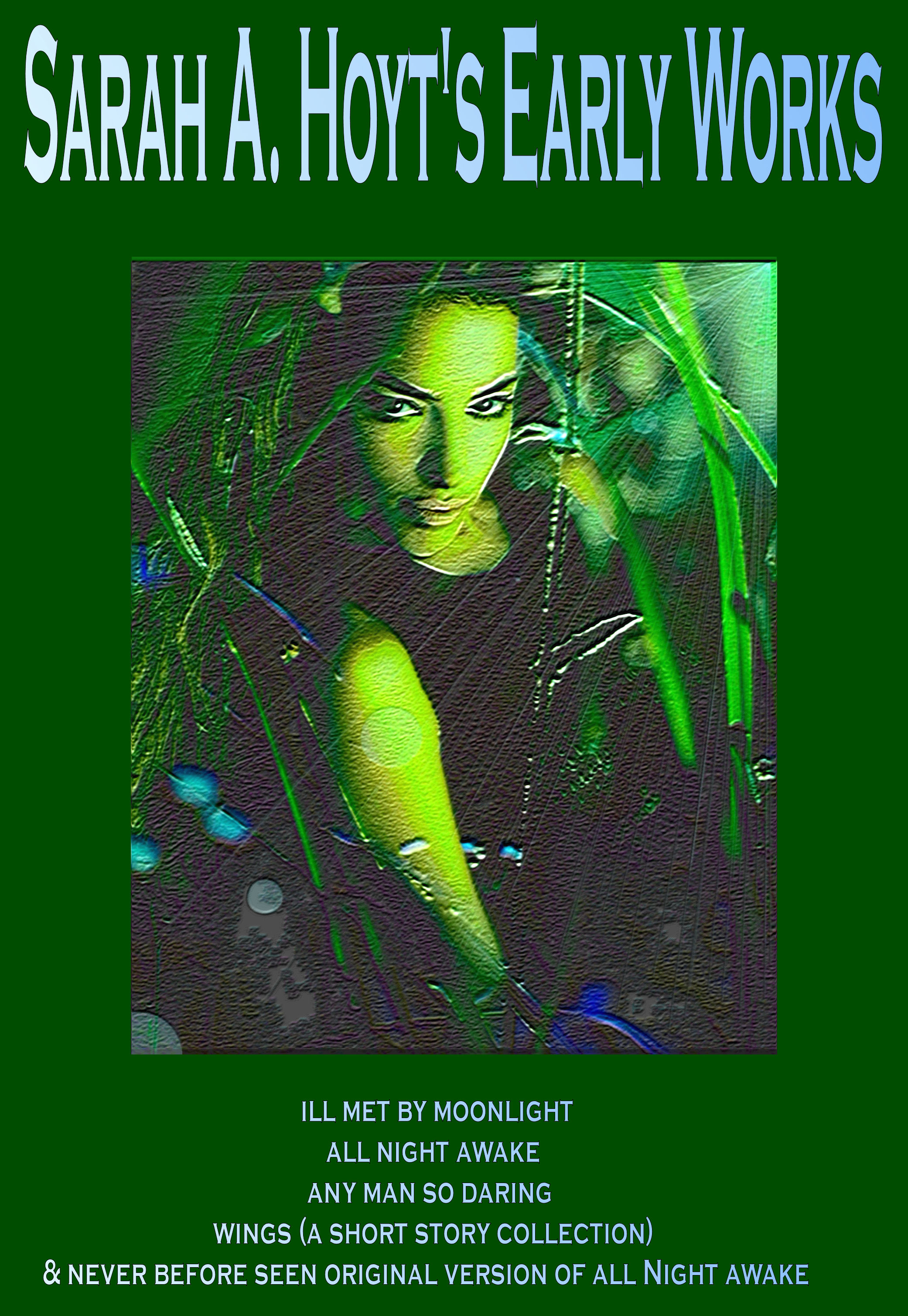
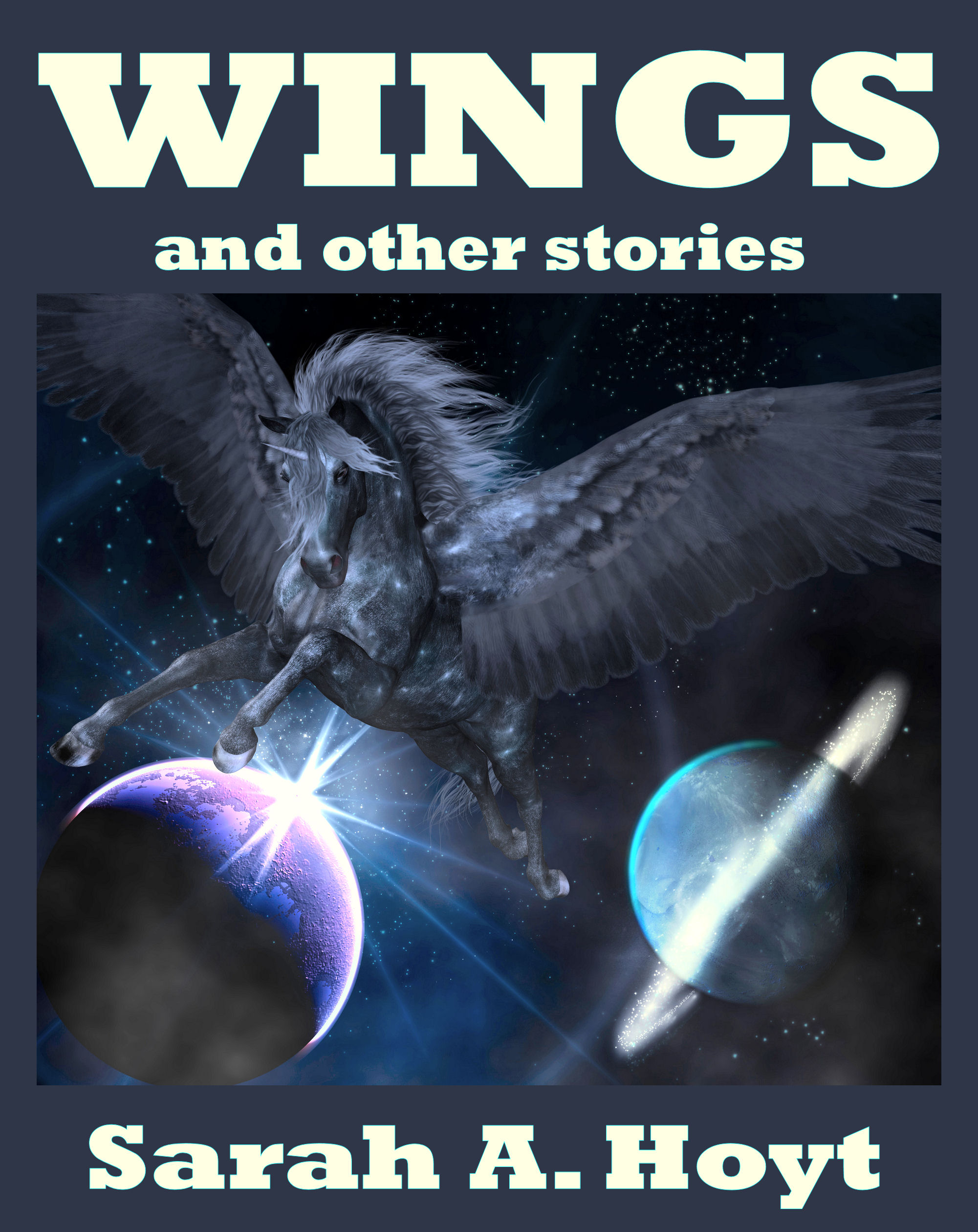
My First Trilogy is Out As E-Books

I know I’ve annoyed people who like it by saying that my first trilogy is really difficult to read. All I can say is that the people who like it have greater linguistic facility than 99.9% of the country and more than I have unless I’ve worked up to it.

I had been reading almost exclusively Elizabethan stuff for six months when I wrote this, and my younger son had memorized half of Shakespeare (at two. Because I played it constantly on TV and audio) so I think I went a little crazy on the style. OTOH it was the style I’d been ASKED to do and also, it has a certain charm of its own, if you are in the mood for that kind of language, or if you’re a die-hard Shakespeare freak.

Now, I know I’ve said at the time I couldn’t plot with two hands and a seeing eye dog, but the truth is that this is not a worry for these novels. I stole the plots fair and square, then changed them to suit me. So, they do have plots. Okay, they’re not connected to the level I can do now, but heck, neither is Darkship Thieves. Nor Darkship Renegades which I turned in a month ago. And probably in ten years, I’ll think me now couldn’t plot AT ALL. The novels are probably more tightly plotted than the average run of the mill fantasy. (Note the two ll. Run of the mil fantasy — hi Larry Correia! — tends to be very well plotted indeed.)

Anyway, all this is in name of Baen brought them out as an e-bundle in their webscriptions. If you click on the covers, it will take you to the place to purchase and you can buy it as a bundle or as individual books.

There’s bonus material with it. One of the extra books is my collection, Wings, which contains short stories published in Asimov’s, Analog, Weird Tales and other venues.

The other is a little harder to explain. You see, when I first finished All Night Awake and sent it to my agent he told me it was horrible, terrible, and I needed to rewrite it according to this… well… formula he had. Anyway — I was young and stupid. With my friend Rebecca Lickiss (I owe you one!) and my husband both screaming “nooooo. Don’t do it” I went ahead and did what he wanted, abandoned my book and wrote the book he wanted me to.

Was the first book better? I don’t know. I know All Night Awake, as published, sold the least of any of my books. I also know that though he gave me a useful pointer “have internal action mirrored by external action” so the first might be way more introspective, the first is also likely to be more in line with Ill Met. So those of you who didn’t like All Night Awake, after liking Ill Met will be glad to know that aggregated with the published All Night Awake, Baen brought out the “forbidden edition” too. It’s completely different except for about thirty pages. Of course, it doesn’t fit in with Any Man So Daring, but it might still be of interest to my die hard fans (Yes, yes, I know who the six of you are [grin].)

So, there it is, it’s now available in ebooks, without DRM and at a reasonable price and those of you who read my sf might get a chuckle at how “literary fantasy” I started out.

The secret, of course, is that I can still do this. It’s actually much easier than doing the action-packed stuff. So, I’ve traded up for a more challenging craft… much to the despair of all my agents and almost all my editors. But I feel less depressed doing it.

And for those who are link impaired as I am, here’s the links, again.

Bundle —     http://www.webscription.net/p-1506-sarah-hoyt-bundle.aspx

Ill Met By Moonlight —

http://www.webscription.net/p-1507-ill-met-by-moonlight.aspx

All Night Awake –

http://www.webscription.net/p-1508-all-night-awake.aspx

Any Man So Daring-

http://www.webscription.net/p-1509-any-man-so-daring.aspx

And Wings:

http://www.webscription.net/p-1510-wings.aspx

When the Writing Won’t Obey

My outline said “Lucius wakes up” — that’s all my outline said. Then after that was the rather risky subversive group getting together. So, what came pouring out of my unsuspecting fingers?

I woke up with my curtains being opened, the light coming in to shine against my closed eyelids.

Before my eyes opened, before my conscious mind connected this with the events of the night before, my hand was under the pillow, grabbing the burner, and I’d brought it out, pointing it in the direction of the voice.

“Patrician!” the voice was outraged, rather than shocked, and there was a tinkle of glass, a noise of porcelain, and I opened my eyes to see a man I only very vaguely recognized pouring out coffee into a cup – I knew it was coffee because I could smell it – and setting out toast and who knew what else.

Then I realized the room was full of people. And by that, I mean exactly what I said. Full of people. People swarmed in every possible corner, doing things I only half understood. A team of three people, for instance, seemed to be removing all the suits from the closet, even the stuff that had been Max’s from the drawers.

I turned my attention and – mindlessly – my burner on them. “What are you doing?”

The nearest man, holding an armful of suits, dropped them on the floor. He might also have pissed himself. I don’t know. I didn’t look. But his face had that mortified look, and his eyes crossed slightly as he looked at the burner. I turned the burner safety on, and put it back under my pillow, then crossed my arms. “I said, what are you doing?”

“T-t-t-” the man said.

“Taking your suits, Patrician,” the man behind him said, looking somewhat doubtful. “I mean, your predecessor’s suits. I mean, Mr. Remy said–”

“Where in hell is Nathaniel Remy?” I asked, because I hadn’t seen him in the crowd, and realized only now that this seemed odd, since he’d fallen asleep in front of my door. I snorted. His master’s door indeed.

“Nat- Nat- Nat-” the man who’d dropped my suits said.

“Do you wish to speak to Nathaniel, Patrician?” Sam’s voice from near my bedside table. I turned to see him holding a bunch of those papers that could only be signed by the touch of the thumb with the right genetics, the kind of thing my father seemed to always be doing.

“I want to know why he’s interfering with my clothes!” I said, and then realized that I was yelling at a man who was twice my age, who looked incredibly tired, who’d spent half the night up helping defend the house, whose underlings had got wounded and possibly killed, and who had always been kind to me. I said immediately, “I’m sorry, Sam. I’m not a morning person.”

“Do you wish to keep those clothes?” he said. “Nathaniel didn’t make those decisions. I did. I noticed that the clothes you were wearing don’t fit you, and I presumed from the fact that you were wearing what the last Good Man wore before ascension that you didn’t like the more… vital suits he chose afterwards? We had some clothes made, though far from a complete wardrobe, and I thought–”

I waved my hand. “Sorry.” I looked at the terrified man, and waved at him, “Carry on, never mind me.” Then turned back to Sam. “Who are all these people? Why are they in my room this early in the morning?”

Sam cleared his throat, “Those people,” he pointed. “Are making sure that your windows are secured, and the balcony door too. Last night, they used a disrupting device that unlocked the back door. We must make sure–”

“Fine, fine.”

“Those people are making sure that any drinks in the drink table are replenished. Those people,” he pointed to five people by the window. “Are merchants of the seacity, whose business is disrupted by our present… situation, and they would like to talk to you. And those people,” he said, pointing to four men by the entrance to the bathroom. “Are waiting to help you bathe and dress.”

I opened my mouth. Then I closed it. I’d read about rulers in the middle ages and shortly after. I’d read about rituals called the levee, in which everyone who had business with the king came to see him rise, and talk to him while he went about the necessary wakening things. I remembered being highly amused by stories of how courtiers would loiter around while the king answered a call of nature, or turn a blind eye while the king’s latest fling slipped out of the king’s bed and through the door.

It wasn’t so amusing to be in the position of those poor kings, though I supposed, now that I thought about it, that the government of the seacity and its territories was much like the government of one of the medieval countries. Certainly I was the ultimate and absolute ruler. I didn’t know why I was surprised. But I knew why I was upset. I’d be damned if I’d wake to this every morning. Perhaps my fath– whatever the hell he’d been to me, had enjoyed it. Perhaps it made him feel how important he was. Maybe he liked that.

I wanted privacy to take a leak. I wanted a cup of coffee. And I’d be damned if I was going to have four men help me bathe.
Sigh. I need my head examined.

Sweet Liberty*

I have some experience with revolutions, partly because Portugal never believes a thing worth doing is worth doing only once. I get PTSD at the sound of Green Acres because Porto had one reel in its local broadcast station. Green Acres. When Lisbon got cut off, they played it back to back. This meant that someone had taken over the main broadcasting station in Lisbon.

(Okay, here I should explain that Portugal had two broadcast stations. Yes, I had a deprived childhood. [Yes. I spelled that right. I’m quite sure it’s an I.] Only one of them broadcast during the day at all, and that limited hours. So usually my experience was come home from school and watch something on lunch break and… ack… Green Acres. I wonder who is in now.)

For those who wonder why I’m “obsessive about my Portuguese background” – I’m not, but this kind of childhood experiences mark a person. I think this is why I’ve always been fascinated by revolutions. The ones that go right. The ones that go wrong. And the ones that go very wrong.

I read obsessively about the French revolution, the American revolution, the Russian revolution, and other, less obvious, revolutions. Like… The industrial revolution, or even the agricultural revolution.

Societies don’t change easily. People don’t change easily. Societies are worse than that. They’re slow to change like dinosaurs whose signal has to travel from head to tail and if it’s in full careen, it’s going to take a while to stop, let alone turn around.

One of the things I’ve noticed, in recent times, is that revolutions have another issue, particularly social revolutions of the non-bloody kind. Knowing you’ve won. Knowing it’s now, not thirty or fifty or seventy years ago.

Often when I’m talking to people, particularly people of an academic bend, I find myself wondering what world they’re talking about. It’s the silly little things, like “Oh, a woman would never dare say/do that,” when I saw women do it just that morning. Or “the neighborhood will get upset if there’s a non married couple” – what, like that one, that one and, oh, yeah, that one?

I will grant you that every once in a while, one comes across a person or persons who seem to be a blast from the stereotypical past, but my kids schools’ have more trouble with unwanted pregnancies than with girls being sent home to put on a longer skirt.

One of these effects of “delayed realization you won” keeps annoying me. Lately there have been any number of women writers complaining that they’re not proportionally represented as science fiction writers. They’re not being taken seriously and this is because they have vaginas. Etc. etc. etc.

Now, I’ve been this field for ten years as a published author. First of all let me get out of the way that there are some prejudices in this field, usually evinced by people you wouldn’t expect. For instance, I was pushed rather strongly fantasyward, in part because I had the v word. (Yes, verve.) And a friend of mine who is a physicist, was told that she should write fantasy, not science fiction, because she was a woman and therefore had the heart of a fantasy writer. (To which Rebecca Lickiss answered that yes, but it was in a locked drawer, and besides the statute of limitations had expired.)

There are other, more subtle prejudices. Some people told me they never read women writers, because they can’t write action. Weirdly, when they read me, they have no problems. I don’t worry about it. I just wait till they come around.

And btw, any male writing in romance or a romance-germane field, like certain forms of urban fantasy gets the opposite pressure, I’m sure. It’s all part of no one having a perfect life, and other people having certain expectations. My husband, for instance, had trouble placing his space opera (still hasn’t) because it’s character development oriented. (Yes, he actually got rejected by someone who told him it read too much like Bujold. No, I’m not joking.)

However, claims that women are discriminated against in fantasy always make me laugh. And claims that women as writers are discriminated against make me laugh even harder. And then there’s the post at MGC two days ago, and the comments – my Lord, the comments. Part of what got to me was seeing my friend Dave Freer getting attacked for making a perfectly reasonable and polite comment. Well, I was brought up to think part of my job was to give voice to those who didn’t have one, whether they be battered women in Portugal or silenced and demonized males in the US.

First let me establish there was a time I called myself a feminist. This is because I believed in the equality of women. I still do.

This doesn’t mean that women should be exactly the same as men. Or that they should behave exactly the same way. In fact, any such notions were pretty much dispelled by the time I came of age in the seventies. The average man and the average woman are very different creatures. And I strenuously object to such things as the fire fighters tests being rewritten so that you don’t need to do a fireman carry to pass. OTOH I heavily endorse any woman who is able to pass non “rewritten” tests being a fire fighter if she so wishes. And that’s because the median of anything is not the only person – there’s also the extremes. For instance, bad as I am at spacial reasoning (sad that) I am miles better than some males (okay, none that I’ve met, but I’m sure there are some. Maybe they were hit really hard on the head.) In fact I pretty much occupy the far outlier extremes of a bunch of categories (and I’m not saying which extreme.) As such, I am sympathetic with outliers. And I think letting people do what best suits them, without judgement, censure or barriers is best for everyone.

I believe in equality before the law not equality of results.

I still believe the same things, but I’m not calling myself a feminist, partly because the word has gotten corrupted. A lot of people seem to think the only way to elevate women is to degrade men. Others seem to be on a permanent hunt for offense, including attacking perfectly innocent words – no, history does NOT mean his-story. Please, study some linguistics.

This is many flavors of wrong, for many reasons, but the main reason is that it leads to a sort of permanent revolution. This reminds me of when the French revolution had got rid of every aristocrat either through beheading or immigration and had started attacking as aristos people who could read. Or people who dressed better than the others. Or people who used the word “roi.”

This is the sign of a revolution that has become its own reason to exist, and which will consume its own partisans, until it all ends in a sea of blood or until it’s stopped at last by a “strong man” of some sort, and suppressed for good. And at that point no one complains, because, frankly, it’s a relief.

Part of what disturbs me about this is that the justification for the “permanent revolution” is that we “could lose all the gains tomorrow.” You know, like if we don’t jump behind the latest harebrained “offense” campaign, next thing you know we’ll end woman suffrage (and good riddance, women have suffered enough! – Yes, yes, it’s a joke. And yes, I’m aware there is no joking in feminism. Another reason I no longer use that word.)

But the advances are fragile in another way. Much as I hate to say this, women’s gains rest on two things – one of them is safe contraceptives. The other is a stable western civilization. (No, I’m not even going to argue that. You want to live anywhere else in the world, be my guest. I wouldn’t, though.) And both of them can be lost more easily than you think.

Western civilization can be demoralized and subverted from within by a contingent of males who feel like women exist to punish them. Males who have been treated as criminals or morons or both from kindergarten on. Males whose education and employment figures, if reversed (i.e. if women had the same stats men have in the US today) would be a real offense and a call for investigations and remedies. Males who, btw, have never discriminated against anyone (most of them, at least) and whose fathers and, for that matter probably grandfathers, never discriminated against anyone.

These males can very easily see how women are treated in the rest of the world and, if pushed enough, form a concerted effort to subvert the current rules of behavior. (And no they haven’t done it yet. They haven’t even THOUGHT of doing it, yet. Again, don’t get me started. I lived in a country that is Western but only just. I know what discrimination is better than most people my age or even slightly older.)

I love the women who say it’s just the way the pendulum is swinging and that it’s right for it to go to far in the direction of privileging women. Let me enlighten you – if this is a pendulum, it’s one that has men as its favorites. Men are physically stronger and more aggressive. Any devolution from civilization to barbarism, or even any prolonged disruption in the economy that, oh, say, interrupts the production of contraceptives, and men will have to be very, very good not to be in charge. And if you’ve been pushing your little pendulum with glee and joy, don’t be surprised if they push it as far as they can the other way, till you’re in a world out of your worst nightmares.

You’ve won the revolution. Do you know what the mark of a GOOD revolutionary is? He knows when to put down his musket and go back to his farm. He knows when to shake hands with his neighbor who was on the other side. He knows when to make his rule so just, so fair that no one would contemplate returning to the former rule.

And he does not look for counter revolutionaries under ever bush and hallucinate that the war is still ongoing. Because then they just lock him up and beg the old regime to take over once more. Or start looking around for a Bonaparte.

Since I and my sons and my potential grandsons and maybe even granddaughters have to live in this world too, I beg you to come to your senses.

*http://www.youtube.com/watch?v=NdT9oq7VBDA

Mother I’m Frightened, The Thunder and the Lightning

Years ago, when I was just starting to figure out the writing thing, I attended Kris Rusch’s and Dean Wesley Smith’s Master Class (which they no longer teach, though they teach other classes, useful in the current situation) in Oregon.

One of the things they told me which I didn’t fully believe was “You never outgrow problems, in writing. You just trade in for bigger problems.”

This seemed like duck speak. I mean, at some point you become a professional. That problem you have, on how to start a story? It goes away. And besides, you’re selling practically everything you write. What can you possibly worry about?

Perhaps my biggest fear at the time was that I wasn’t a real writer. No, please, don’t ask me to explain. It doesn’t make sense to me, even now. Perhaps it was that so many people at parties, so many arbiters of other people’s lives informed me “you’re not published, so you’re not a real writer.” Perhaps it was my mom’s more or less constant refrain of “when are you going to quit the writing non sense and concentrate on something real?” Perhaps it was that when I was little writers were some sort of heros. They lived in another country, and you know, everything was easier there.

It never occurred to me, to be honest, that any of the people I admired were once, themselves, unpublished and that some of them – Bradbury – wrote a lot before he could break into publishing. No. In my mind, the “real writers” always knew how good they were. Which left me as a fraud and a put-on. And so no one was ever going to buy me.

Nineteen years ago, when the older boy was little, I used to go for walks with him in his pram, and think about stories, but also day dream about the day that would never come, when I was published, and no longer had to worry about whether I really was a writer. I remember vivid wishing that myself from the future would just come back and tell me I was published. It would make everything so much easier, without the constant doubt.

Shortly after that workshop (actually at the workshop, in the editor-pitch-session) I sold my first book. So, did the heavens open? Did the angels sing?

No. I knew it was a mistake. Not mine. Theirs. They’d made a horrible mistake, I was a fraud, and soon they’d find out.

Weirdly what cured this was my first series collapsing. Here is was. The worst had happened. When, despite that, I kept selling, I coined the term Zombie Career TM and forged on.

But the fear was always – as has been for most midlisters for the last ten years – that I’d never sell again. The only way to keep writing involved not thinking about sales, but thinking instead about the things that mattered: how well written the book was; how much promo I did (I did a LOT for Darkship Thieves, for instance); cherishing the fan letters and the fans in my conference.
The fear of not selling again is gone. Or rather, it’s oddly twisted, sideways and backwards.

I think at this point, ten years in, and with some regular fans, what I should be worrying about is never making it to bestseller. Or perhaps that my particular brand of writing will stop. (Okay, guys, yeah, that’s silly for me, since I write so many different genres, but it is vital for many people. When Horror collapsed it left a lot of stranded writers.)

But instead, here are my fears right now and what I’m doing to counter them. (Is it enough? Who knows. I’ll do more as it occurs to me.)

1 – That I’ll never be a bestseller because there won’t be such a thing as a bestseller list.

Answer: Who cares? Some bestseller lists, done a certain way, are real measures of success. However a lot of bestseller lists are cooked and reflect either laydown or customer confidence. So, who needs them? The only real bestseller list is reflected in bank accounts. Which brings us to:

2- What if my name recognition/fan base/publicity efforts aren’t enough, and I end up not being able to make even the little living I’ve made at this for the last few years?

Answer: Other people are making a living, so there’s a way to. Promote more. Research the market more. Write more. Establish different sources of income. Subscriptions. Donation buttons. Non fiction. Anything else I can think of. Meanwhile cherish the publishers I mean to keep working with, and keep my fingers crossed behind my back. Finding a way not to sleep or to write while asleep would help, too.

3 – What if my favorite publisher goes under? What if my favorite novel-under-contract gets trapped in publishing h*ll due to bankruptcy or lawsuits? What if something horrible happens and I can’t possibly self-publish or go small press? What if traditional publishers somehow pull a double-reverse and they’re the only ones that survive, and we’re back to the state before all this, and I’ve blown it by firing my agent and going indie?

Answer – The unknowable is the unknowable. And right now no one KNOWS everything for sure. Yeah, we could all die tomorrow, buried in ash. Or publishing in all its forms could stop existing, which means I can default to cleaning houses for a living or something. Meanwhile, I do the best I can. I keep up with changes and try to second guess the best I can. And if it all goes wrong? Well, I’ve been at the bottom before. I’ll come around again.

And what would I tell my younger self, if I could go back? Would I tell her that I’m published, I’m a real writer? Would I tell her not to be afraid?

No. Who knows? Perhaps my/her fear was necessary to keep writing.

Would I give her specific advice that worked then? Like, “do more cons.” Or “participate in Genii boards online”? I don’t know. If I’d gone that route, I could have ended up in a different place career wise. Yes, yes, I could have been amazingly wealthy and successful. Or I could have been unpublishable and blacklisted years ago.

So, what would I tell my younger self? If I could, I would send back in time the print outs that I have pinned to the corkboard to the left of my desk. One of them says “If you must walk on thin ice, you might as well learn to dance.” The other has a General George s. Patton quote: “Success is how high you bounce when you hit the bottom.”

Quick, Read This!

Keeping the pace up in fiction is not as easy as it sounds. I know I’m not always wonderful at it, though I (hopefully) am getting better at it. If you read my Shakespeare trilogy (soon to be available from Baen books webscriptions) this was perhaps my greatest failing. (Well, it’s either that or the fact that I went after near-authentic Shakespearean language. No, don’t ask. It seemed like a good idea at the time. It was fun.)

In fact, before the Shakespeare trilogy, the last unpublished big book I wrote got rejected by an agent saying that my issue was timing (aka pacing) and that this simply can’t be taught. He was right, my issue was timing. This came from the fact that I couldn’t find a plot with two hands, a cane and a seeing eye dog, not even if said plot were, at the time, biting me on the posterior. (What, your plots don’t bite? Lucky you.)

He was wrong that it couldn’t be learned. Almost everything in writing can be learned. The idea of genius – the myth of someone who is born with all the abilities he or she will need to make it in this field, is wrong. (In fact, the older I get and the more I write, the less I’m sure there is any native component to writing, save the compulsion to tell stories.)

Start as you would with anything else. Read books that have great pacing. Laurell Hamilton’s first three books are three of those. But if you wish for something more sedate, but which still keeps the pages turning, read mysteries. At least, read highly structured, traditional mysteries. I recommend, of all things, the ones in which I stumbled onto one of the essential mechanisms: Elis Peter’s Brother Cadfael.

Of course, to begin with you need a coherent plot that’s long enough for the book. What do I mean by that? Well… that’s a subject for another post, but let’s just say you need to make sure there is enough to the plot that we won’t get to the middle of the book and wonder why we’re still reading. Okay, let’s put this way: theft of diamonds – probably enough for a novel. Theft of lollipops – probably enough for a short story. (Unless the lollipops are laced with arsenic and people start dropping like flies, one a day, and you’re trying to trace it before the next person dies.) Colonizing a planet – novel. Colonizing a bedroom – unless you’re a microbial life form, probably enough for a short story.

Second, make sure your character’s actions are LOGICAL. If your character takes a break, while trying to find the bomb, to go window shopping, I just lost my interest in your character.

The first, most important “sense of timing” mechanism is the obvious:

Have a ticking clock.

Sometimes these are real clocks. “There is a bomb somewhere in the city. You must find it before the clock reaches midnight.” This is often a timing device of thrillers.

However, there are other timing devices that don’t tick – though they can tick, if you really want to – the most important of which is: We have to do X before something terrible happens. This too is often the timing device of thrillers. “We have to find the lollipop before my child eats it.” And of romances, “I have to interrupt the ceremony before she marries that jerk.”

There is also the timing device who is literally a person: “We have to solve the murder, before John turns himself in.” Or “we have to figure out this designer plague before Bob becomes a werewolf.”

Now, with timing devices, you have to show them. You can’t just set up the clock at the beginning, then let it run in the background and never remind the reader. You have to show it, intermittently throughout the novel. The child inches closer to the poisoned lollipop; the bomb ticks; the woman gets into her wedding gown.

“But I don’t want to have an obvious timing device” you say. “My plot is loser than that. I don’t want a definite timing device. I want something more unstructured.”

Well… you can always have – the great chase. Someone wants to kill your character. They’ve started adding these to romances, I think to keep them more interesting. It’s also a great way to add spice to cozies, though the person might only be THREATENING the character – but the character doesn’t know that.

In plots structured this way, I ALWAYS try to have two people chasing/attacking the character. That way, when things get slow in one plot, I throw in a guy with a machine gun. (Well, not literally, but you know what I mean.)

Three caveats for that type of plot:
1- Have it make sense, when you turn it around to the villain’s pov. Even if the villain is mistaken or silly, the actions must make sense for the villain. You can’t have the man with the machine gun come LITERALLY out of nowhere. The villain has to have sent him over for a reason. Something provoked it right at that moment.

2- It has to escalate. The violence, chase, whatever has to get more severe each time. You can’t just keep repeating the same action, every time. Also be very, very, very careful of repetitive scenes.

3 – It has to matter. Unless the threatened character is likeable and you’ve done enough to make us like him, it will not fly.

Another way to hide tension and therefore make the pacing faster is to make us care desperately about the character and want the character want something he/she just can’t get easily. That’s what I used with Darkship Thieves, interspersed with “chase scenes.”

The Don’ts are as Important as the Dos, so try to remember – Don’t have your character stop to do her nails. Don’t let her sit around thinking about that beautiful summer day when she was a kid. (Unless you keep it short, and it ends with an explosion she almost fails to duck from because she’s reminiscing.) A down-time is fine – think three guys in the car in Draw one In the Dark, or the time they have while “hiding” in the hotel room – but don’t have them forget they’re running. Give them bad dreams, or something. They can get comfortable at the end of the novel. Until then, keep the pointy boot at their behind.

Moving My Eight Legs

In which the gentle reader gets to watch the writer in a fight with her unruly subconscious. Or How the Devil Is In The Beginnings
Of all the mistakes a writer can make, the one I find most annoying and recursive – for me, at least – is figuring out how to start a story. No, seriously. Yes, sometimes the voice comes, like trumpets from heaven. I wake up with the character in my head and the opening lines.

Other times… other times, it’s like pulling teeth. I have everything about the story in mind, but I don’t have an “in.”

Lately I’ve found myself making a truly beginner mistake, one that I thought I was exempt from because I never went through it as a beginner: starting the story well before the story starts.

One of my fledgelings is prone to this. And that’s fine. As long as he knows that he’ll have to discard two to three pages off the beginning of his story that works. Because, you know, there could be worse curses, like never beginning at all.

But I used to have this down to an art. I knew, if not the voice, at least the moment when the story started. Now… now, I find myself floundering around in molasses for pages and pages and pages, until finally something kicks up and I go “Oh. So, that’s how it finally starts.” This is particularly annoying since I SHOULD know better. I’ve done better in the past.

Unfortunately writing is only partly conscious for me. Most of it comes from somewhere at the back of the Jurassic brain, where dinosaurs fear to tread. And for some reason the beginning has turned into the La Brea tar pits.

So, as much to help myself as to, hopefully, help the rest of you, because I CONSCIOUSLY know the rules of how to start a story, I’m going to list a series of questions that should give my back brain a hint of how to find the beginning of a story. It goes something like this.

1 – Identify the main problem of your story, then

a) start with a problem that leads directly to the heart of it.
b) start with something that mirrors the problem in the story, or foreshadows it

2 – Identify the characters main strength
a) start with a scene that demonstrates it in such a way that it makes us immediately determined to follow that character through hell and high water.
b) start with a scene that shows his strength failing, in a way that we know this is a surpirse.

3 – Start with a scene that doesn’t contain your main character but which
a) sets up the world and the world’s problem
b) sets up the main villain
c) sets up the limits of the danger your character will face (the answer is “very high” and this is usually done for thrillers.)

4- For extra points combine all three of the above in some form

5- follow the rule of the tangled skein of string, if you can’t find the beginning, cut through and start somewhere.
a) deal with the past via short flashbacks.
b) remember to keep it moving
c) make sure your entry point sounds startling and interesting.

Okay, so now you – and I! – should have some idea where to start. HOW do you start? This sounds obvious, but it’s not.

Look, nine times out of ten, when I read entries for contests or slush for publishers, the main reason I stop reading without finishing the story is that I’ve gone some distance – a page or two, usually – and I still have no clue whose head I’m in; where they are; what the goal is.

So, here goes: You’re there at the beginning, and your character is something and doing something. Try not to make that beginning sound like the sentence above.

Right up front, try to remember to tell us:

1 – Who your character is. Not just the name. Many times the name won’t even tell us the gender of the character, but in whatever order: name, gender, occupation, main characteristic as pertains to story.
Compare these two openings:

Edgar was there. He was doing what he’d come there to do. He’d tried so long to get there and now he was there. And he was going to do it.

Edgar was back in the sacred groove, and he was going to kill the high priestess, if it was the last thing he did. He’d had to fight dragons and mow down entire groves of sacred forests. Now he was going to kill her.

Which story gives you a clearer idea of what’s happening? Which one would you read further on? And no, I’m not even exaggerating with the first example. I wish I were.

2- Your character has a body. Nothing gives more “solidity” to a character than a touch of humanity. His underwear chafes. She has a blister on her thumb. She’s sneezing because she’s allergic to polen. He’s wearing a new shirt that feels uncomfortable.

Make it work in the service of your story, or at least sink it in unobtrusively, and if possible make it work to define the character and/or the time period. However, giving the character something to wear, or something to do with his hands is always good. And it can do double duty. If your main characters is wearing a kirtle or carrying a banjo, you’ve at least given us some hint of a clue of a vague direction to where and when we are. Ditto if he’s wearing jeans and turns on the tv.

Imagine you are in your character’s head. Now look down. What is the character wearing? What gender is he/she? And where is he/she?

Don’t write it in that form, but try to include it soonish, so the reader is grounded.

3- Use props to avoid infodumps. If your character is holding either a violin or a teddy bear, it tells us something about him/her and might postpone informing the reader that this thirty year old has anxiety issues and sleeps with his teddy bear… Who plays the violin.

And hopefully this will help you, out there, and also stop my subconscious from spinning in circles around itself. Honestly – its’ like all of a sudden I grow six extra legs, and I can’t remember how to walk.

So… here we go. Move one leg forward, then the other… one, two, three, four, five, six, seven, eight…

Next Time The Fire

I usually do a nine eleven post. It has now become fashionable to apologize at the beginning of these. I have no intention of doing so. No, I have not gotten over it. No, I don’t think I ever will.

Nine eleven was not a sudden, cataclysmic devastation of the sort that comes out of nowhere, tears your life apart and leaves you to rebuilt and get over it. Nine eleven was a sudden cataclysmic devastation that came out of somewhere and left us to deal with rebuilding and with questions, moral and emotional on how to prevent its like again within the limits of the future.

The difference between the two should be obvious but it doesn’t appear to be. Take Hurricane Hugo for instance. It marched from the coast, up the beach roads to Charlotte NC where I lived at the time. It changed our landscape within a night. We were fortunate in that our little cul-de-sac neighborhood lost power only for the 11 hours. But people lost houses, people lost lives, and people lost livelihoods. One of our favorite antique markets was made into kindling, destroying the livelihood of the family who owned it. It was, at the time, a sudden, devastating tragedy. Afterwards, we got T-shirts that said “I survived Hurricane Hugo.” I don’t know what eventually happened to those, because, you see, we got over it within a year or so. What else was there to do? It was the weather. You can’t say “this will never happen again.” Or rather, you can, but who will listen? The weather will do what the weather will do.

Nine eleven is a different kind of tragedy. It was brought about by men – by the will of men, the brain of men, the malice of men. Nine eleven was preventable – if we’d known it was probable (our security can’t prevent “possible” – we’d have to have the whole country in uniform for that.) More importantly, further nine elevens should be preventable by men and women of good will and with a bright enough brain.

Have they been prevented? Oh, please. Of course, yes, we’ve prevented a few of them mostly through intelligence work, and a few more by our determination to be a mob, not a flock. This is good. But mostly, mostly, we’ve hamstrung ourselves with stupid kabuki travel theater, have turned on each other over what brought nine eleven on and have accused each other of unspeakable (and unimaginable) nonsense.

The one thing that Hugo and 9/11 had in common, the one thing that made me fall in love with America and continue to be madly in love with it (I wasn’t born here, but I got here as fast as I could) was the… empowerment of the individual. Barely had the wind stopped blowing, after Hugo, and our neighbors were gathering, helping each other cut down trees that threatened to fall, helping each other patch roofs and, later on, when our electricity came back and other people’s hadn’t and didn’t for days, my husband and I spent the next several days making ice and taking it in coolers to our friends, and cooking massive hot dinners, where friends could come and have a meal. Our showers too were used around the clock. Everyone else had similar experiences. If you’re shrugging and going “of course” pat yourself on the back. You’re an American. In most countries, you’d stand around waiting for the “qualified aid personnel” and then complain if the aid was late, instead of taking your hand to what was there and doing what you could.

Nine eleven – well, I know people who crossed the country to help search the ruins, and I think ALL of us wanted to. Instead, we did what we could, even if it was just becoming a check in point for friends in NYC or donating blood.

But the different nature of the disasters revealed itself almost immediately. No one in Charlotte stood around scratching their heads and saying “Why did Hugo attack us?” But almost immediately there were people beating their chests over 9/11 and going “it’s our fault. It’s all our fault.”

Again, this is a very American thing to think – almost endearing in its Americanism. It is the other side of “what can I do” it’s “what can I stop doing so it won’t happen again.” Americans – and I’m talking here of you who grew up here – also tend to overestimate how much influence their actions had in the world and what they could do or not do about it. In American Culture, in Portugal, I was required to read a book, written by an American, about how everything that went wrong with modernity was America’s fault. This book, also used in our universities in the US, is hilarious in its naivite and inverse-hubris. Children, until 1913 or so, the US was a rural backwater, of little importance to the fulcrum of the world, which at the time was located, firmly in the middle of Europe.

It’s just that we’ve grown so powerful and so rich, and those around us have failed to catch up, and we feel – like Hollywood starlets elevated to riches we’re not sure we deserve – that we’re both the center of the universe and that we must have done something wrong. Relax. We haven’t. Not any more than any other country (more on this later) and in fact, considerably less than most countries of any importance. And stop flapping lips in an idiotic manner. The rest of the world would like nothing better than believing we’re to blame for everything, and thereby exonerating themselves. This, you see, makes it easier for them to do nothing about their problems. It makes it easier for them to take our subsidies and not feel an ounce of gratitude. And it makes it easier to hate us.

And that’s the one thing you’re going to have to face. Yes, they hate us. Yes, they will always hate us, until they bring us down. Should they manage that, they’ll spend the next two thousand years trying to deify us, portray themselves as coming from us, trying to imitate portions of our culture, and claiming no part in our downfall.

We are, in fact, in a very similar position to that of Rome in the ancient world.

Why do they hate us:

1 – Envy. Our own theology identifies this as the first sin leading to the first murder. Yes, yes, I know, half of America is afflicted with the heartbreak of psoriasis, (in my case eczema, but never mind. Our heartbreak is often overlooked,) the other half is broke and unemployed. Our children aren’t learning and our dogs scratch themselves too much. Forget it, okay? Our lifestyle is not only far and above more… comfortable than that of your average European (and we EXPECT that) but even our homeless live better than the poor in other countries. When is the last time you’ve worried about your next meal. Really worried? Worry about losing the house, sure. The job, even more sure. Not being able to buy cat food, of course. Problems sending the kids to college, of course. But worry about not eating for days? Please. Even our poorest of the poor have soup kitchens.

In a dark time in my life, in what is considered a first world country – even if the poor relative of the family – I went for three years without new clothes, because we simply couldn’t afford them. Since this was between the ages of 11 and 14 and I grew about a foot, even given my mom’s abilities with remaking clothes, I’ll leave you to imagine what I looked like. Here, even while very broke, we never let our kids go without suitable and appropriately sized clothes. And it wasn’t that hard. The thrift store near us often holds dollar-days where each piece of clothing is a dollar. And though it meant pancakes for a week, at times, we were NEVER so poor we couldn’t spend ten dollars and get the kid sweaters and a coat.

We’re better off than 95% of humanity. They envy us madly. Why shouldn’t they?

2 – Fear. No, not of us. (One of the things Pratchett is wrong about is the whole “if you want war, prepare for war.” It’s not true, it’s never been. Not blaming him too hard, though, I learned this in school, too, and it’s part of what Europeans believe. They fasten onto the mad militarism gripping Prussia on the run up to World War I and the answering militarist thinking in the other countries, and think that’s what CAUSED World War I. Was it? No. Go back and read about the geopolitics and the pressures of growing civilizations. But this is the explanation you’ll find in most books. Because it’s facile. And because it’s easy to avoid. “I just won’t think of war–” Europe should do itself a favor and start really looking at itself and its fracticidal tendencies, and stop trying to diagnose a country they know as little about as we – often – know of them.) Yes, they project it onto us, but what they truly fear is modernity. And, for those who’ve never lived abroad, everyone knows modernity comes from America.

In the summer of 2000 I found myself in a panel at a conference, where they were talking about how wonderful the future would be. How the whole world was now connected. How everyone lived in one big village. And how wonderful this was. And I suddenly felt disconnected and lost, because I could see the other side. Look, I’m not going to claim Portugal is particularly backward, or particularly hateful. It’s not. As countries go, Portugal is the nice guy in your office who keeps his head down and does what he thinks he’s supposed to. The idea of a Portuguese terrorist (or assassin!) could only take root in the mind of a novelist who disdains research. But Portugal is, by culture, a lot more traditional than the US – everywhere is, pretty much. Yes, there are reasons for that, but no room to discuss them – and it clings to “how things are done” a lot more. At that, it’s not the worst such country.
However, I recall people who reacted with irrational gibbering fear turned anger to each wave of technological innovation no matter how small, from new ways of lighting, to piped water. Reactions to behavorial changes are even worse. When I say I grew up between Elizabethan and Victorian England, I mean I was taught not to do things such as stand at the window, because that was shameless and looked like I was trying to attract boys. Yeah. Try to figure out how old that rule is.

So I thought of people more attached to their ways than Portugal, perhaps with the same view of their own supremacy, meeting the wave of the future. Of course they would turn to sabotage and terrorism. The result, Traveling, Traveling, was published in Analog in 2002 and is the free story (free story tab on my blog) for this week. It was the only time I was semi-prophetic, and I promise not to do it again.

Like it or not, the US is modernity for most people. When they want to stop the future, they’ll hate us and attack us.

3 – We’re safe to hate. We don’t defend ourselves. Not in words, not in movies, not in our fiction. Partly because we never cured ourselves of that colonial affectation of our upper classes aping Europe. And partly because we feel vaguely guilty about being better off than other people and a newer nation too. We revere age and tradition. And so, we ape their hatred of us, too. Or at least our artists do. So what they get from Hollywood and even from our literary lions, makes them go “See, it’s their fault. Even they say so.” (The fact this soothes their pride, helps too.)

I remember being in a car with a rabid anti-american when I was about 12. He was going on about how the only reason Portugal wasn’t the leading computer manufacturer was that the US wouldn’t let them. Even at 12, I thought “Oh, so, the long vacations, the lack of capital and, yeah, the fact that our tech education prepares people for the early twenty first century has NOTHING to do with it” and also “HOW does America stop us? And why would they care?” But the rest of the world believes this stuff.

It also, for the record, and because of our movies in part, believes a lot of other crazy stuff: like, that our barely competent secret services are some kind of supermen. That they have operatives everywhere, know everything and secretly control everything. It even seems plausible, from over there, given America’s wealth and the movies we see, in which of course the CIA is often the culprit and often superhuman. For Europeans there is a CIA agent behind every door and under every bed.

And yet, no one ever gets killed for spewing anti-American bilge. We’re the world’s most pussy-cat “empire.” In fact, we’re not an empire at all. All our soldiers want to do is go home. Do we punish people when they attack us? Well… sometimes. Late and usually reluctantly. Yes, 9/11 sent us to war. And then we stayed to rebuild the countries. Let me tell you, children, no other country does that. No. Truly. No other country does that.

In the seventies, I sat with friends around a café table in Porto and tried to scheme how to get the US to invade us. Because Portugal could use the rebuilding.

We’re safe to hate.

Given these three factors and the preponderance of traditionalist, triumphalist countries in the world, the amazing thing is not that 9/11 happened. What’s amazing is that it doesn’t happen once a year.

So, what do we do about it, you say? Let’s take it in order:

1 – You can’t get rid of everything you have. No, you wouldn’t be able to. Despite the beliefs of most college professors, world wealth is not finite, and it’s not a matter of a country playing rob-the-ball from the other. (In fact, at the root of all this, is also the fact that the very, very, very erroneous theories of Marxism have taken over both here and the rest of world, possibly because they’re facile and they make college professors feel virtuous.) Wealth is produced. Wealth grows. And the US, given who we are, and our tendency to roll up our sleeves and get to work, can’t help becoming wealthier. In fact, al the hardships our politicians put us through, which might or might not, be designed to make us look more humble to the world, only make us discover new ways to create wealth. Mind me, we’ll emerge from the great recession a completely different country, but yet wealthier, by an order of magnitude than the rest of the world. I’ll take bets on that.

2 – You can’t make people stop fearing. There is no way, there is no possible way to do that. Even here, right now, as change accelerates, a lot of us are afraid of what’s coming. We have perhaps a little more reason, because we don’t know what the future will look like. They should have an easier time. Except they don’t. A modernity of few children and shattered families is scary to a great deal of the world, but so are things that no one should find scary: mobility, representative government, women who don’t cover their ankles, equality of sexes. It goes on.

The second one alone, though paid lip service in Portugal excites much fear and does not prevail in most homes. And again, Portugal is a modern first world nation. Technically. Imagine the other countries.

This doesn’t mean we should cover our women, stone our gays (sorry, guys, you’ll have to buy your own pot) or make women stay in the home against their will.

Unfortunately, what we do do after we conquer countries – the forcible dragging into the twentieth if not the twenty first century is going to make it harder. Much, much harder. It’s akin to invading a wild species habitat. They’re not ready for it, they don’t know what to do, they just want you to stop.

3 – We can stop looking like the patsies of the world. We can stop being so easy to hate. That starts one on one, and person on person. You do not let foreign friends, in fact or online, talk about the US as being responsible for their plight. You just don’t. You man up; you woman up; you adult-it up. You educate yourself and you come back with facts. You tell them the truth and shame the devil.

First, for those of you who have only read histories of the sort that beats their chests and blames everything on America – find some of the popular but deeper histories on, say, Rome. Or Greece. Or before that. Find out how nations operate. Nations that aren’t the US (the vast majority of nations aren’t, you know?)

Read about other nations that existed in a unipolar world. Rome, for instance. Yes, Romans were Hell’s Own Bastards, the most evil civilization at their time and place – snort! – oh, you swallowed Spartacus whole? Children, children, children, the rest of Europe at the time were as much gentle pastoralists as the tribes of South America when the conquistadors arrived were noble savages, talking to the birds.

Yes, the Romans were scary-mean and addicted to violence and… Yeah. So were the other tribes. War was the normal state of humanity. Despicable practices, both civil and religious were the norm.

Rome distinguished itself only by being, for a brief time, capable of generating more wealth, more innovation and a better life for its citizens than the rest of the world at the time. And it was hated for it. The methods it used to stay on top were horrible and crude. And they worked. Because what came after Rome was 2000 years of darkness that made its earstwhile enemies claim to be its friends.

But after Rome read about the age of empires. Do try to use a book not infused with Marx. Those are always at best unrealiable and at worst laughable.

Read about how nations act. You need to know this, because Americans don’t act that way. And they tend to think other nations are like America. So we let them hang our few “sins” around our necks: the supporting of dictators to stop our enemies; the disproportionate force attacks on those who attack us and the – snort – despoiling of the “native” tribes. Read the age of Empires. I don’t have time to teach you history here. America is a babe unborn compared to ALL European countries, event he most backwards.

And then sit back and wonder, given you can’t do anything about the top two, what can you do about the last factor. Well, you can’t gag Hollywood, either, not without violating who we are. And I doubt you can make most of them study history. And they’ve rather proven they can’t be shamed.

So what can you do? You can be feared.

I say this with much, much trepidation. In 2004 I had an argument with Jerry Pournelle in which he took this position and I told him no, we had to be loved.

It’s been six years. I’ve grown up. He was right. IF another attack happens, we should make sure the response is of the sort that makes children cry in their beds in future centuries, for fear the Americans are going to come get them. We can bind their wounds afterwards, if we so wish, but first we have to respond harshly enough that they are afraid to fight back as we drag them to modernity.

Yes, I’m recoiling, even as I type that. I don’t want to see innocents suffer, and war, even a “small, surgical” war is suffering. Yes, even if we do the type of high level attack that really upsets their leaders (government centers, religious centers, monuments) we’re going to kill some innocents.

But look at it this way, our proctracted “drag them to the future and force them to love us” strategy is causing them to suffer too. And we didn’t go out there and hit them. They hit us, again, and again, and again, until one hit was large enough to make us attack back.

It’s time we make it known it’s not SAFE to attack us. We’re the crazy bastards who would as soon nuke you as look at you. We don’t want war, but we must prepare for it.

And then, after one or two of these, they’ll realize that they can throw fits over their own version of modernity; they can sit back and design it; but they can’t stop us by attacking us. That only makes them hurt more. And then they’ll stop attacking us, and forcing us to hurt them. They’ll stop hurting our women and children. We’ll stop hurting theirs. The future can be peaceful. We WILL help them rebuild.

So, if there is a next time – and yes, I pray to G-d there isn’t, but pardon me, I read history – hit back twice as hard.

Do it for the children.

Being Human

Apparently, years ago, without meaning to, I repeated an argument for limited government first made by James Madison (I’d originally put Thomas Jefferson, since I read both of them back to back. Thanks to Paul Howard for the correction.) It went something like this: “If we could get angels to govern us, then it would make sense to let them rule our every action. But since the people who govern us are still human and prey to the same desires, flaws and foibles as the rest of us, it is best to keep their power as small as possible.”

I’m reassured that my mind, in my early thirties, was running on the same track as James Madison. I’m also afraid that I’ve changed my mind on that. Oh, not on keeping government small and as powerless as possible. I don’t like authority – I think I’ve mentioned that – and I have no interest in making my friends and neighbors “do the right thing.” (Exceptions are made for when people wake me up at three in the morning because they’re having some awful crisis and/or for people who are my kids. Then I will make them do the right thing, so that they leave me the heck alone, which is the ultimate goal of my existence: to be left in peace, so I can write.)

However, having written Darkship Renegade, I’ve changed my mind about it being better for angels – or saints, or supermen – governing us.

Yeah, it is one of my peculiarities that I only reason by writing fiction. What I write in non-fiction has usually been worked out in fiction first. No, I have no idea why. It’s like when I’m writing a novel, I’m putting all my chess pieces in place, then playing the game to figure out which is strongest.

Anyway, having written Darkship Renegade, I can’t imagine anything more terrifying than having someone who thinks it is his duty and who was created to do the best for the mass of humanity no matter what. Because what such a creature imagines is better for everyone, might be. But he’ll know precious little about what is better for each person. (No one can.) And that’s because humans are not, nor should they be perfect. And trying to make humans perfect – or perfect anything, like perfectly happy or perfectly good – has resulted in some of the most evil regimes in history.

And before I veer off into theology, which is always a danger this early in the morning and without my coffee, let me cut that short and say this is not a post about politics. It is not even a post about humans. Though it is about both of those, tangentially, because it is about fiction and the purposes and functions of fiction. Which of course, ideally involves both humans and politics, and a lot of other things.

As most of you know – because I keep talking about it – I’ve undertaken for the last year or so, a rigorous regime of walking about an hour a day. The problem I have with exercising (or house cleaning, or most things – except weirdly furniture refinishing – that don’t involve putting words on paper – or screen) is that it’s boring. My body is doing stuff, but the mind is free. Sometimes, depending on the mood, I can write in my head while I’m walking. Unfortunately that usually results in my wanting to come home early so I can write it down, and I find my walks get progressively smaller, as I train myself to think of writing while walking. (This can be solved by having a walking buddy with fascinating repartee, but mine is not available all the time.)

So, to keep myself walking (well, down from a size 24 to a size 16, thank you so much. Four more sizes to go. Sigh.) I started listening to audio books. This led me to make several fascinating discoveries, such as that while I love reading Repairman Jack (by F. Paul Wilson) I can’t LISTEN to the books, or I’ll have nightmares all night. Also that some books that are too ‘clangy’ language wise for me to read, are perfect as audio books.

But, most of all, I’ve found myself making observations on literary theory and “why this book works” while walking and listening to the book – particularly when it’s one I’ve heard before. In this particular case, it was while binging on Pratchett, after a binge on Heinlein.

It suddenly hit me, with sudden, scouring certainty that the reason both of them appeal to me – and are immensely successful in appealing to most people. Or “were” in Heinlein’s case – is that they both write characters that are profoundly flawed.

Now, there’s a danger in this. Characters are not, nor should they be, real people. Real people are too mixed to come across clearly on the page. No, I’m not even talking about moral definition here. I’m talking about getting an entire complex personality on the page.

Coming from a literary (I’m so sorry) background, I used to think this was the goal of writing. Writing “real people.” Until, that is I – fortunately – got exposed to Marlowe (I know, and he four hundred years dead. Zombie Marlowe. Yep, yep, THAT was the flasher haunting my university gardens for about a year) and realized that he came as close to writing real people as he could. And that was what made his plays infinitely worse than Shakespeare’s who dealt in “flawed archetypes.” To put it in blunt and simplistic terms, Marlowe left us with no one to root for and no one we want to see dead.

So which one is it? The archetype or the real human? Both, of course. Most people have the defects of their virtues. The brave man is often foolhardy and the strong woman prone to flashes of anger (not that I would have dealt with this in Darkship Thieves.) The man who is controlled and careful in his life, might think everyone should be so and nip in the bud the exuberance of a younger person under his control. Etc.

But there is more than that to being human. More than virtues and faults, balanced and presented so that we see the good character struggling with his evil tendencies, or an occasional flash of mercy in the villain, for which he feels he must atone.

To be human is to be in pain. To be ground between two states. Again, Pratchett’s metaphor serves here: falling angel meets rising ape. But it’s more than that. We’re creatures who live in the world, but who can imagine a perfect life of spirit only. Who can imagine a life without want or fear or pain, but at the same time must deal everyday with that corporeal reality that on this side even the most pampered little princess can get her finger stabbed on a rose torn.

Worse than that, it’s the … patterns that come with that corporeality and how the body influences us. I can imagine a perfect day of writing, with a break for lunch, then taking of at six pm to spend time with my family. But half the time the words won’t come till five pm and I end up writing through the evening and not spending time with the guys. And being cranky and feeling I failed them and myself, to boot.

It is that aching for perfection while enduring the slings and arrows of what, for most of us, in our time, is the piddling calls of every day corporeality, that makes us human. Being human means dealing with that, every day. It’s amazing as a species we’re not crazier than a squirrel on speed. Or maybe we are. There is such a gulf between the perfection we imagine and what we can attain, both in terms of fighting the body and fighting our own inclinations that probably come from the fact we have a body (pesky bodies) that the two can barely meet in the middle somewhere.

That is the unacknowledged ache at the heart of every human who ever lived. Unacknowledged because, well, we know it’s normal and we feel like whiners complaining about it. And that’s if we’re even aware of it, since it’s been there always and we know it always will be.

The writer who touches that, no matter how he or she does it, will be popular, because it will give us the sense we’re not alone, and it will make us, for the moment, more at peace with the odd mass of contradictions we are.

And that is (at least one of) the functions of fiction.

Another Way In

Sometimes writing books surprise you. I confess the only reason I bought The Art Of War for Writers was that gimmicky title. Then it arrived about three minutes before I left for a con, a couple of years ago. And then … I forgot it. It languished on a shelf for all these years, until I started culling books to donate/sell.

Most of these aren’t in my office. I’m keeping 90% of the books in my office, unless I have duplicates. (You’d be amazed. Sometimes it’s my “wonderful memory” striking. More often it’s my finding a book at a thrift store or a garage sale and going “so and so needs that.”) But the books in the office tend to drift around on a sort of unpredictable tide, and they were all piled in such a way I couldn’t find anything. So, I cleaned and sorted, and found The Art Of War.

It’s now become the bathroom book, read a chapter at a time whenever. (Bathroom books are interesting in a household of writers btw. My older son said “That book you have in the bathroom. He’s up a creek on plotting.” I said “What? The Art of War? I thought he was pretty solid so far.” “No, no, the other one, with the pink cover.” Turned out we had three how-to-write books in the bathroom and he read the first one that came up. It’s like your very own insane workshop all the time.) I’m on page ninety one and so far he seems well… a writer after my own heart.

Writers had different styles and approaches and it doesn’t matter how successful a writer is or how much you admire him, it doesn’t mean you can follow his advice. Sometimes reading an how to book by an author you really like can stop you completely.

For instance, from Heinlein’s biography, I’m very glad he never wrote a writing book. I’d have tried to follow it, and it would have ended in tears because how he approached writing – how he plunged into it – was completely different than my own process. His books were far more planned than mine, and he left a lot less to sudden inspiration from the subconscious. Perhaps that meant he was a more mature writer than I, but I don’t think so (I mean, yes, he was a better writer than I, but that’s not what I mean. I mean mature in the process of writing, meaning, if I write another ten years I’ll get that way.) I’ve done the plot every single step and the only thing that happens is that my subconscious veers off and adds on. The interesting thing is that afterwards, unless I look at the outline, I can’t tell which parts were added on on the spur of the moment. They often fit character and world far better than the ones I planned carefully and positioned with laser-like precision… Some of which end up having to be removed.

Mind you, the part where he lay on the sofa and moped because things weren’t write with the writing is exactly he same as mine, only I tend to stalk around the house obsessively cleaning and/or paint walls and, occasionally, growling at boys or cats.

Anyway, I found that the Art of War fits the way I think. (Possibly not surprisingly.)

Today’s lesson from page 91 gave me something that I’d been missing in the current plot. Oh, I know it. I just hadn’t brought it to bear on the current plot. And that was “Who does the Lead need to be at the end of the novel, in order to be whole.”

It occurred to me this provides yet another way into the plot for those of us like me who start from the character showing up. We know the character needs to grow in a certain way for the reader to be happy. We know that the character is broken. (Well, mine usually are. They show up with these gaping emotional wounds, usually.) In what way does it need to get fixed (or worsened) so that at the end of the novel the character isn’t fighting anymore and the reader is satisfied.

Figure that out, then figure out what needs to happen. Then trace it backwards.

BTW the page before says to keep track of action on two levels – I used to have trouble with this while doing my first novels – and I usually do, but he suggests the following framework to plot to:

Outer: action; Inner: reaction; Outer: Motion; Inner: emotion; outer: goal; Inner: growth; outer: attain; inner: become.

I confess I have never done this to that frame work and I wonder how it would work. Might be a little too precise for me. I suspect though that at this point I do it instinctively. (The hardest thing is keeping track of what you do without thinking at this point in your writing apprenticeship – and it’s always an apprenticeship.)

Anyway, until I finish the book I can’t say if I recommend it. But for now if you find yourself in a store with a few coins burning a hole in your pocket, go ahead and get it. Then tell me how it helped you, if it did.

I can’t say I’ve learned anything new, but I’ve reinforced stuff I’ve been doing for years that I didn’t have a name or a precise process for. (Like the plotting from the lead.)

And now I’m going to officeish and work.

False Preferences and Real Coin

Yesterday, while I was gone* Pam Uphoff posted a very interesting question over at Mad Genius Club.

It is a topic that has been treated before** but one that I feel is so, pardon the term, “mind blowing” that I, myself, keep having little shocks when I turn to do something that has been part of my life forever.

Pam’s question was something like “Should I just write my idea as it comes to me [no, you never should. IMHO you should use your conscious mind to shape your subconscious impulses. BUT that might just be me] or should I tailor it to what is selling well now?”

This is as old a question as “should I be a plotter or a pantser”? Almost every conference I’ve spoken at, I’ve got the question “Should I write what want to, or what will sell?”

And at almost every conference, I’ve given the same answer, “Write what you want, but be aware that if what you want to write is what is selling madly right now, the publishers will probably be full up on it by the time your novel even hits their desk.”

However, as with plotter and pantser, I have to say this is a question without a real answer. My answer could be and often was contradicted by others: authors, publishers, agents – people who’d made big sales or bought “big books” by going with what was trendy; by shaping their work to what they thought would sell.

So, yesterday I looked at Pam’s question and prepared to answer, then had one of those moments, like the ones that we often write about but rarely see, you know “it was as though the sky and the Earth had been swept away, leaving behind a landscape that xyz didn’t recognize, a new world in which he was completely ignorant of what to do.”

I’ve been in this business for over ten years, and I’ve been successful for a certain measure of successful. No, I haven’t become incredibly rich. But I’ve sold over twenty books, which means I must be doing something right. So, I know how to do it, right?

Well, yes. I know PERFECTLY WELL how to sell to publishers as they existed ten years ago.

And there is the rub. I looked over my writing how-to shelf, and most of them are designed to teach you to write the book that will stand out to publishers – the book publishers will like and take out of the slush pile and/or the midlist hell, and promote the heck out of. They say things like “make sure you have a social point” – only usually they say it more subtly – and “use important people as characters or tie to big events” and… stuff like that. They might also give you advise on how best to fit a subgenre that’s selling. No, I confess I don’t own something called “How to write the perfect urban fantasy” which should surprise no one who has read my Shifters’ series.

These books were good – and good advice – on how to write to get the publishers to notice you and promote you.

But here’s the problem, children – even if you’re not intending to go totally indie (I’m not, for one, because I don’t know when the music is stopping in this game of musical chairs, so I like to have a foot in each chair. So to put it. For the purpose of this metaphor I am, of course, an octopus.) you (and I) can have no idea if that publisher you are targeting will even BE there in the next year or two. Hell, even if he is there, you don’t know how he’ll be acting and/or what he’ll be buying. Worse, you don’t know if that heart’s blood book you just turned in (uh. Good title) will ever see the light of day or disappear into legal hell in a publisher’s bankruptcy.

So it would seem the safer thing would be to write what you think will sell to the PUBLIC, only no one knows what that is. No, not even the traditional publishers. Or particularly NOT the traditional publishers.

Yes, they did market research. But their market research was as distorted as ours. They were, of necessity, researching what bookstores would stock and what book reps would get enthusiastic about. (Part of the reason all promotion went to bestsellers, which is counterintuitive.)

And all of this, the publishers and the distributors and even to an extent the bookstores were getting their opinions distorted by something that Timur Kuran calls Preference Falsification in his Private Truths Public Lies.

Yes, the book deals mostly with tyrannical politics and how it creates that, but any regime enforced from the top and running without check, even if it’s a regime that engenders only “prestige” or “social approbation” creates that to some extent.

And when you’re talking about the publishing system, it is a system that tied money to prestige and social approbation. I’ve covered before how the feedback loop on sales numbers got vitiated by a virtual monopoly on what got on the shelves, and the readers of course not buying what they didn’t even know exists. The sales numbers, ultimately, didn’t act as a check on anyone’s career in publishing. (Well, the author’s, but that’s not what we’re talking about here.) So the route to be appreciated and promoted was to publish books your colleagues – most of them fairly insular by upbringing, education and residence (literally insular) – approved of and considered “hot.”

That this had buggerall to do with what Joe and Jane six pack was obvious, both from the fact that stocking in distribution centers often covered three very different states in the same exact books, and from the fact that we got told “they just don’t read” – and by and large, more and more, this was true as they couldn’t find anything they wanted to read.

Meanwhile, the people these publishers socialized with, or those who wrote reviews, were usually driven by the same values system and wanted to stand out as “smart” or “sharp” or “concerned” or “aware” or whatever it was that was hot at that time. So, the echo chamber told the publishers and editors exactly what they wanted to hear. (Excepting Baen where people, in the bar, felt comfortable enough to gripe and bitch.)

So I look over my shelves, on stuff like “make your romance stand out by treating the injustices of the Regency seriously” and I think “why?” No, seriously, why? The injustices of the regency, including child labor and a strict class system have nothing to do with our current life. Worse, they’re not even vaguely controversial. Of course I’m not saying you should be non-historical in something like that. Or that you should enthusiastically approve of the conditions. I’m saying your main character doesn’t need to be a crusader against poverty. And while it’s normal to make noises in the regency romances about the iniquitous treatment of women, I treat it as duck speak and pass over it. No women in the regency would TALK like that. No matter how they felt. Or if they did, they were so few and far between that it gets REALLY tiring to find them in every book. Ditto social reformers. Remember the kind-hearted people who ran orphanages raised the kids to go into service at twelve or thirteen. And meanwhile, they often worked. To have orphanages where they learn Greek and Latin or worse “just get time to play” is so a-historical as to make me spit out my coffee. Letting alone that it would be an unkindness in those days, preparing the kids for a world that wouldn’t exist for another hundred and fifty years.

Does your reader know and care about this? I don’t know. (Younger ones won’t, and will think the world was always a place where “crusading” for “these obvious goods” was rewarded. I will just quote Leonard Cohen here: “You shouldn’t lie. Not to the young.”) I know that Georgette Heyer doesn’t do any of this and is a perennial bestseller. As are others from before the publishing/bookstore shelves hegemony took hold. Most of them are despised by the current system as either preposterous or “fluffy” and yet they STILL sell. Agatha Christie and Heinlein come to mind.

The thing is, though, that times HAVE changed since those people were popular. And the reading public has changed too. My kids find Heyer’s too authentic regency speech difficult. For that matter, I now find Dragon Riders of Pern – much more recent – reads as a “dated style” in the era of internet posts (which are usually MUCH shorter than mine {G}) and tech-speak.

So – where do we go from here? No clue my friends. The road is as unknown to me as to you. Worse, it’s dark and we can’t see whether it winds through a forest or runs off a cliff. And it’s quite likely – in fact, I can practically promise you – there are rodents of unusual size ahead and that things don’t mean what we think they mean.

Fortunately, I have a couple of flashlights I found. I don’t know how much good they’ll be, but they might help us find our feet. That one I just handed you is called “what worked before.” Yes, Agatha Christie, Rex Stout, Heinlein, Simak, Anderson, Heyer, even Austen. Followed judiciously, in trend if not in style, it will show you where there’s firm ground to step on. This other one is called “what I want to write” which is often what one wishes someone would write.

We proceed cautiously, as the ground reveals itself. There’s gold in them there hills. We just need to create a road to them. It’s a little scarier, but far more exciting than what we had before.

Let’s forge forward into the new Earth and the new Sky.

*(I’m sorry I missed yesterday, particularly since it was my day at Mad Genius Club and I take my commitments very seriously. In passing, it was the worst possible day for this to happen, since it was my husband’s birthday and since I’d planned to go to officeish. I did go, but it caused a major disruption before I got there, and got me all out of sync, which meant I was making birthday lemon meringue birthday pie [can’t buy it. They don’t sell low carb that works for us] at five pm. Also, in passing, thank you to Amanda Green. Greater love has no woman than she who is awakened at seven am by an hysterical writer – who was at the same time trying to dress for officeish – screaming she can’t get into her blog, and can Amanda do SOMETHING. And then takes instruction and does it. AND forebears to post something like “Got called by crazy b*tch who sounded like her head was on fire.” Thank you, my friend. I owe you one.)

**http://kriswrites.com/2011/07/13/the-business-rusch-popcorn-kittens/