The Excuses I Will Not Give

I don’t feel like blogging today and I’m not going to. So, what is this post about, you wonder?

Well, it’s a list of the excuses I’m not going to use.

1st – I’m not going to tell you the hurricane ate my homework. Though it seems a bit odd to blog about something frivolous while Irene is beating the living tar out of the eastern coast. So I won’t. Clearly my subconscious is far more concerned with Irene than I am, btw. I have no clue what I dreamed last night, but I woke up convinced our windows must have blown up due to wind. Go figure.

2nd – I’m not going to tell you it was because I was without internet access till late in the day. It’s probably true. Our internet is flakier than a croissant wrapped in philo, but the truth is that I got up late and only connected now.

3rd – I’m not going to tell you that I need to do a quick dusting, or at least riding the house of cat hair (Specifically Havelock hair) though that’s true too.

4th – I’m not going to tell you I have mount laundrymanjaro to do then iron – though that’s true too. I did almost no laundry last week, so I have it all to do.

5th I will not tell you that the great book culling of 11 demands my attention, though it does.

6th I’m not going to tell you I have stories to judge for a contest

7th and I’m not going to tell you that I have a novel to go over with a fine tooth comb and an outline to finish.

I’m not telling you those, not because they’re not true, or they’re not sufficient excuse not to blog today, but because if I wanted to blog, I’d still have done it, anyway. I do most days, and that list is not atypical of my normal day, only on school days I have to make sure everyone is out of the house on time, too. This is kind of like writing – the kind that pays. There are always ten thousand reasons I don’t have time to write any given day, but it still happens, anyway. So they’re reasons, but they’re not excuses.

Mostly, I’m not going to blog because they thoughts are scattered and unfocused and the themes I really want to hit are too big to do today, when I don’t feel like my head is fully screwed on.

So, you’ll have to be patient till tomorrow. And now, ladies and gentlemen, I’m going to see a washer about a load of laundry.

Ten Ways To Ensure You Never Have A Writing Career

I was going to write this seriously and reassure those of my fledglings who are of a nervous disposition that they really, really, really didn’t ruin their chances of a future writing career by — say – sending a submission to Analog with the address printed upside down on the SASE (stop laughing. Yes, I’ve had one fledgling in a tizzy over that. And that’s not the most puerile thing my “writing children” have chosen to be scared over.)

So, instead, I decided to write a guide on how to ruin your chances of a writing career. Mind you, all of them but the first fail to be foolproof, so you’ll probably have to use all ten if you really want to ensure all your chances at making a living from writing are THOROUGHLY dead. After all, I did at least half of them. (I’m not telling you which half.) And even if you use nine of them (the first is almost fool proof, unless you hit a psychic editor who sends you a check for something you’re only planning on writing. This only happens to my husband, so you’re fairly safe) if you have extraordinary talent it might not work. So, mind you, if you have extraordinary talent, come up with some new ways to put the knife through the beating heart of your career.

1- Never write anything. Talk about writing. Make poses as a tormented writer. Let everyone know that you could have been the best of the best if only. (We call this the Lady Catherine de Bourgh method, after the character in Pride and Prejudice. “And if I had ever learned to play, I’d have been a true virtuoso.”) If your name is not Dan Hoyt, you’re safe. (And even Dan Hoyt only got the call from the editor wishing to pay him for something not yet written or even planned, after he published a dozen pro short stories.)

2 – Write furiously, but never send anything out. This strategy is a little more risky than #1. I employed it myself with success for some seven years, but eventually you’ll want to send them out just because there’s no more room under the bed and even though you keep breaking the sofa legs, you don’t need any more manuscripts to prop them out. Also, you should make sure that no prying relatives or friends find the manuscripts and send them out. Remember Gone With The Wind.

3 – Write on butcher paper with crayon and illustrate the material with your hand-drawings of the characters. Make sure you’re not better than a first grade kid. Be careful to employ this with strategy #2, though. If you send it in, you might have the misfortune of stumbling on the one editor who finds it charming or refreshing and find yourself with a giant advance check, particularly if the book is of a disgusting nature and about the life of people whom the NY establishment imagines hold up their pants with bits of string and copulate with their own sisters. There was an author who tried this strategy in the early eighties and succeed became – briefly – a bestseller by dint of pushing.

4 – Violate every rule of spelling and grammar you can think of. Beware this is not a foolproof strategy. Some of the stories I sold on first try seem to have been reverse-copyedited before I sent them out. (What can I say, I have a tendency to “read” what I meant to write.) More carefully spell checked ones take longer to sell. Not sure why. Perhaps editors took pity on me? DO NOT combine with #3 which will only guarantee you’re considered more quaintly interesting. DO NOT employ this strategy in Portugal, particularly while carrying a communist party card. It will get you a Nobel prize, and then you’ll never kill that career.

5 – Be loud, obnoxious and boastful at cons. Before you publish a single line, tell everyone ad-nauseam how great you are and how you dwarf all the greats of the past. Be VERY aware this can backfire. You see, science fiction nerds don’t have much self esteem, and if you come across as self confident enough, they might take you at your word, and give you extremely large advance checks.

6 – Hold political opinions held in disdain by anyone who knows history and whose proponents are responsible for the death of millions of people. Expound on them at length both in public and private and in your published works as well. Please keep in mind this works if your views are those that once flourished in Germany. Not so much with any others. In fact, wearing a Mao shirt to cons might result in your having to build new shelves for all your Hugos and Nebulas.

7- Get in a huge hissy fit argument with your editor over nothing. Not a foolproof strategy. Laurell Hamilton tells everyone she did this with her first bought work. No, it was never published, but she sold the Anita Blake ones a few years later.

8 – Make fun of all the greats of the field in public. Tell everyone you never read them. Be careful, though, unless these people are living “greats” of the field, you might simply be echoing what most bestsellers say. This will just ensure you become a bestseller.

9 – A variation on #8 – gore all the sacred cows. Be careful though to be up to date on sacred cows. The real sacred cows are the ones that are never mentioned. The ones continuously mentioned stopped being sacred cows somewhere in the sixties. If you gore THOSE you’ll just find yourself building additional shelves for awards AND possibly considered literary. Think of the banquets you’d be invited to and the weight you’d gain. No, you must be very careful to gore LIVING sacred cows. Like, say, the idea that sex is some sort of universal panacea and there’s no virtue ever in abstinence. That one by itself should ensure your career is dead aborning. There are, of course, several other shibboleths you can mock. Investigate for yourself.

10 – Completely lose it and hold an editor (or more) hostage while you force them to read your stories. This comes with several caveats: Make sure said editor isn’t drunk, in which case he/she might find the escapade funny and/or get amorous; make sure editor understands he/she/it is being held hostage, not merely besieged; make sure the work you show him/her has no spark of talent, imagination or craft. At least one well known (mainstream) writer actually did this and ended up a bestseller. We still don’t recommend this strategy under any circumstances. It’s more likely to land you in jail. And then someone will buy your prison memoirs.

The Neverending Quest

Someone should write Science Fiction And the Search For Literary Respectability. It won’t be me, though. I don’t string readers on across an entire novel plus only to end badly. And this would be one of those grand – literary – novels in which the main character gives up everything that makes him great and happy, while in search for the glamour it can’t get. And then he dies.

Okay, I realize this is a gross simplification. There are many currents in the field and out killing science fiction. But, as perhaps because for my sins I have a literature degree, (It’s a long story and complex, and I wanted engineering, but… You can’t always get what you want.) I keep running into the “we want to be literary” crowd and into the “science fiction is not real litcharatchure” crowd.

And in case you think it’s not a direction one is pushed in, let me tell you that every agent I ever had and every editor I had save Toni (Yay, Toni) Weisskopf at Baen fought like living heck to get me pushed in a “more literary” direction. Worse, they did that without consulting me and finding out if that was where I was aiming. It was simply and tactically assumed that since I could do it – proved it with the first Shakespeare series, more or less – that must be what I aspired to.

It’s entirely possible – of course – that I’m special, but I don’t think so. I think “literary” is what these people are all aiming for, right or wrong.

Part of the problem, as someone pointed out in the comments of the post yesterday (I’ll respond tonight. I’m going away to office-ish all day) the field is flooded with liberal arts degrees.

I’d like to point out that I never felt as out of place – in a lifetime of feeling out of place – as I did while taking my degree. Part of the reason I felt wrong is that studying “modern literature” is just… silly. To an extent all study of literature is.

Oh, sure, there is a lot to study in Shakespeare or Austen. Even Dumas (who was as sloppy as I am) can teach a lot particularly to a budding writer.

But the problem is these people by and large weren’t budding writers. (Or readers. One of my friends in college read ONLY comics. Disney comics.) And they had no clue what to study about literature. My classes ranged from the useful to the appalling, their aim shifting from technique analysis to indoctrination. (Though even that doesn’t explain what in the name of sweet Daphne my German Literature Professor thought he was doing when he made us memorize Wagner’s libretos.)

The useful did what fits within the study of literature as an art – study the techniques the writer used. How does Shakespeare make us feel Cordelia’s death? That type of thing. The appalling looked for “social protest” in works. Or dug through with Marxist analysis to turn the book into something it never was. (Does Marxist analysis work? Sure, up to a point. But it’s sort of like the fact that you can sing all of Emily Dickenson’s poems to the Yellow Rose Of Texas. Just because you can fit an author’s output into a pattern, it doesn’t mean the author meant it that way or that the pattern reveals anything useful. And in the case of Marxist analysis, it also fails to connect with reality at any point. At least The Yellow Rose Of Texas has the utility of being a catchy tune and allowing me to shock my kids when I sing Because I Would Not Stop For Death.)

Anyway, all of this is sillier when it comes to modern literature – i.e. contemporary with us – because you can’t tell what is going to be considered “literature” a hundred, two hundred, a thousand years from now. By definition – well, at least my definition – literature is that which appeals to humans across time because it touched something fundamentally human.

We have no way of knowing what of today will appeal across time. Sure, popularity has something to do with it, but not always. For instance Austen is much more popular (and readable!) today than the Bronte sisters. And while Shakespeare was a Mega Block Buster, not all of what we revere today was.

For the record, I don’t aspire to literature. I don’t even think about it, except to enjoy it. In four hundred years there’s a very good chance I’ll be dead. What my great great great grandkids think of my writing is a matter of profound and unaloyed unimportance to me.

BUT there is a strand of things that people think are literature. Part of this is that they fit Marxist analysis so well, and also they’re a little difficult to read, which of course, every liberal arts graduate knows it should be. (Of course. If it were easy, you wouldn’t need a degree to read it.) And needless to say they bow rather obsessively towards all the sacred cows of our culture, while goring the sacred cows of the now safely disapproved of past. (No? Yeah. When is the last time a darling of the literary establishment wrote a book suggesting men and women neither are nor should be absolutely alike – or the women superior – in ability and achievement? Really? Why not? Aren’t we supposed to challenge convention? Right.)

In other words, they’re the perfect read for the smug and comfortable. If your purpose in reading is to reassure yourself again that you are smart, that you are special, and that only you understand the heartbreak of psoriasis (joke from last post. There will be a quiz) then these books are perfect for you. For me, life is too short. I don’t care what people think of my reading material and I don’t discriminate against the amusing parts of the written word. I read for fun. Yes, that does sometimes mean Borges (so, sue me, I’m weird.) Sometimes it means obscure Portuguese poets. More often it means science fiction, fantasy, mystery and the occasional romance.

I don’t know why or how SF decided to aspire to literature. I suspect I’m not old enough. But to me it looks like a nouveau rich thing. Science Fiction was selling well, so it decided to go for social acceptance. I suspect a lot of involved the boomers, too, but that’s because, hey, you guys, I came right after you, and you have no idea how annoying the view is from where I stand. From where I stand (born in 62 and no, we’re not boomers. I’d put the cutoff date around 53 or so, but never mind the side discussion) ya’ll were some smug sons and daughters of a boom. Ya’ll were SO MUCH smarter than the old man (and woman.)

I suspect ya’ll were involved in this, because I’ve seen the fingerprints in the way you guys refer to the greats of the past, including Heinlein. It’s all “Oh, but they weren’t real litchratchure.” (Besides, of course, standing accused of not being enlightened.)

Anyway, at some point SF decided it wanted a seat at the “literary” table. So…

So, being full of liberal arts graduates, it started aiming for what it had been taught was literature: very compatible with Marxist analysis, a little difficult to read and, oh, yeah, careful not to tread on the toes of any accepted shibboleth.

Weirdly, this didn’t sell even though it was marketed and promoted like the next best thing. Even more weirdly, reader interest moved into the fields that were beneath the touch of literary critics: fantasy first, till that too started getting taken over, and then to the sort of Urban Fantasy that might as well be Paranormal Romance.

Mind you, given enough time, and the establishment retaining enough power (I don’t think it will) they’ll come for Urban Fantasy next. Perhaps they already are. (I don’t read it enough to know.)

But at least science fiction is now respectable, right? We’re accepted as literature?

Oh, sweet heavens, NO! If I had a dime for every time I come across – in an how to book, in a magazine, in a social discussion – the recoil of horror of the “literature crowd” at the mention of science fiction, I could sculpt Versailles in dimes.

Perhaps in a fitting punishment for the fact that SF “challenges” a long dead establishment, literature people view us still as the sf of the fifties. “Oh, you guys write rockets and big-bosomed women.” (Guilty! I like writing it too. AND muscular men!)

Do some of our people – particularly our more literary people – make it to mainstream and/or literary respectability? Sure they do. But then they’re very careful to tell everyone they’re not REALLY SF or even Fantasy. “My family? Never met them. I’m a lost prince. I was found under a cabbage leaf on a spring morn.”

So, what do we take from this sad tale, other than the end of the Romeo and Juliet that “all are punished?”

I don’t know.* I know that it’s got to change. It’s got to change because I like SF too much to watch it die, and because, as Dave Freer said, we need it now. We need to believe the future can be better than the past if we just put our back to its and push.

So, what are you waiting for? Roll up your sleeves.


*Though my friends Charlie Martin and Patrick Richardson and I are going to start a project.  More on this later.

Honey, I shrank the Science Fiction

As we all know the ticket to fame, fortune and er… whatever it is we get from writing is to write fantasy. At least I was told as far back as the early nineties that science fiction didn’t sell.  As well as being told as soon as I broke in that ladies wrote fantasy. (No use telling them I wasn’t a lady. At that I escaped only lightly insulted. My friend Rebecca Lickiss was told she had the heart of a fantasy writer. She says she has the keys to that drawer and she can’t figure out how her agent knew.)

My clue to why science fiction isn’t selling came both with a review that insisted there was nothing new and no big idea to Darkship Thieves and therefore it wasn’t “important” and when a reader at Mad Genius Club – Hi Synova! – told me that she liked Darkship Thieves because it was science fiction as it used to be “before we made ourselves small.”

Before I proceed – and because this isn’t about me – the big idea in Darkship Thieves is that laws can worsen the problem they’re trying to control. Yes, I know the idea of growing someone as a spare body or spare parts isn’t new. You think I’m stupid? But I got sick and tired onto nausea of this being portrayed as an evil of OPEN and free market societies and “there ought to be a law” being recommended as a remedy for it.

Quickly – I’ve been told by no smaller authority than my son that these posts run way too long – laws don’t stop things. They certainly don’t stop technology. They just make it go underground. And in an open, free market society growing a full human being for parts or as a replacement body is inane. Humans are EXPENSIVE to grow. No matter what you do, you still have to feed them, clothe them, educate them at least enough to control them. In a society that doesn’t restrict science with stupid laws, ways will be found to grow the needed organ. Probably a lot faster, too. And anyone trying to grow a whole human as a replacement body will at the very least get shunned. (It is still murder!) OTOH in a society in which the IDEA of cloning has been forbidden for so long it’s literally unthinkable, people with money and power can have an “heir” grown as a spare body.

Unfortunately science fiction – excepting Baen, of course, (though that gets dismissed as “mostly military sf”) and a few non baen books that managed to get through the gauntlet – has devolved to a state in which two types of science fiction are accepted: 1- Hard science fiction in which the “new idea” has to be something startling, different and never used (this btw, is insane when it comes to readers. Readers don’t demand that every fantasy novel come up with a new, startling, totally different form of magic. The exploration of tropes happens incrementally, not by startling, totally new, never before voiced ideas. All of us, as readers, like the familiar with a new twist.) And 2- sociological science fiction.

For some reason to count as the second you have to pile on some social “issue” or danger that has been discussed to death in liberal arts courses in the last forty years. The anomie of modern society say. Or the aching pain of gender differences. To my knowledge the only reason the heartbreak of psoriasis hasn’t been mentioned is that liberal arts professors have yet to take it up. (And why should day? Eczema is a much more achy breaky hearty thingy. I mean, I have it, and this is ALL about my belly button, right?)

So, how was it different, before we made ourselves small? Well… Heinlein wrote about slavery and its social consequences in Citizen of the Galaxy. You don’t get much bigger social issue than with a young man being sold at the very opening. Stripping it of the racial overtones it has mostly in the US allowed him to analyze the institution in its full peculiarity (and irrationality) as well as the conditions that allowed it to occur. Ditto in one of the stories in Green Hills of Earth, whose name escapes me now.  Starman Jones?  A society controlled by guilds and unions.  Podkayne of Mars? Treat your children as commodities and see the results. Stranger? What the meaning of being human is. Is it genetic or inborn? The Lazarus Long cycle? What happens when our taboos meet life that’s prolonged beyond our wildest dreams.

Let’s take someone else – Clifford D Simak. They Walked Like Men. The big idea? Is fiat currency a good idea? City? What happens after Man and what is unique to Man? Way Station? Can a man live on out of his time? The werewolf principle? Can star travel change us to the point where we can’t be human on Earth anymore?

 Other big idea books and series: A canticle for Leibowitz; the World of Tiers; anything A E Van Vogt wrote (the man threw out three big ideas per page,) Foundation and a ton others which I’d tell you if I weren’t too lazy to walk over to my science fiction bookcase this early in the morning.

What do all those have in common? Shout louder, I can’t hear you!

Oh, yeah, I KNOW! They were fun.  People enjoyed reading them.  They sold.  The ideas were wrapped around an adventure, something that made it fun. And they were written in such a way that people in hopeless situations knew they could get out, if they worked hard enough and had just the right breaks.

Polyanish, you say? Oh, sure. It’s so much better to pound into people’s heads, over and over again that they’re victims, can’t escape and are ultimately doomed. What are you? The guardian of Hades? “Abandon all hope ye who enter here?” Or do you abrogate to yourself the power of pulling people out of their hopeless situation through your “art” or perhaps the power of “advocacy” so “government” can intervene and save them? (Flash – government is composed of people too. If the individual can do nothing, government can do nothing too – only they do it faster, harder and with somebody else’s money.)

At the end of this we’re seeing science fiction which SERIOUSLY advocates that all our destiny and actions on Earth are set by our genes (oh, I kid you not) and that this is a “good” thing, and science fiction in which good aliens come to save us from ourselves (because they have nothing better to do with their time?  Save two humans and get an interest rate of a human per millenium.)

And then people are astounded – shocked, shocked, I tell you – that this stuff doesn’t sell well. Because you know, people are a) dying to hear again all the sad stories that were pounded into them in college. b) people like to be told they can’t do anything and are without the ability to save themselves. c) hard luck sob stories that don’t end well always are good sellers. This is why people stop to read the cardboard of beggars by the side of the road. “Homeless; parents died in a fire; dog got run over; have seizures; child has the gnats; can’t work.” Riveting stuff that. And totally plausible.

Will the future bring us big problems? I should hope so. The past had big problems too. Will we be able to solve them? I should hope so. After some truly horrible interregnums we have by and large solved the problems thrown at us.

To face the future we need to think about the future. (I have nothing against fantasy. I’ve been known to write fantasy. But a different muscle gets used for that. And it prepares for different things.) To have the confidence in what is right, we need to know what is right and not continuously berate ourselves and doubt our judgement because of what distant ancestors did before our grandparents were born. But to solve big problems, we need to be big.

Training a telescope on one’s own belly button will only reveal lint. You like that? You go right on staring at it. I prefer looking at galaxies.

Art And Craft — Can this Marriage be saved?

As I’ve said before, right now there is a novel dictating itself to me, hampered and slowed only by the time I take away to do research.

Why research if the novel is dictating itself?

Well, because for me at least, it doesn’t work effortlessly. Actually, I don’t think it works for anyone. The character of my novel is not a writer. He knows his story, but he doesn’t know how to tell it. Or if you prefer – I prefer too, if it keeps the men in white coats from knocking at my door – my subconscious has latched onto this story, this voice, these large movements of events and characters, these principles that guide the characters. But my subconscious hasn’t spent the last twenty years carefully analyzing the techniques writers use to get a story across.

I’ll grant you my subconscious is along for the ride when I’m reading – of course – and it is what gives me the indication of what thrills me and what speaks deeply to me (which is very important. I’ll why explain later). But it doesn’t go “oh. Look how she avoids going THERE and fully explaining what happened as he died, to keep it sad and not gross.” Or “Ah, that sentence is enough to tell us he’s noticing the woman. More would be a plot-slowing infodump.”

My conscious knows that. My conscious knows more things too. It knows that I can’t write a book in which the characters consciously and in very different circumstances try to recreate the American revolution and finish the revolution in one book. Look, beyond the initial impetus, there were wars for independence over years, and the system of government wasn’t really stable for a long time (some would say till the Civil War but I’m so not getting into that argument, particularly since I have very definite – and if you know my politics – predictable ideas on centralized government and it’s a pointless argument and one that in fact that was mirrored at the founding of the nation. I can do it better with fiction.) And the American revolution was taking place in thirteen small (population wise) colonies, which had no real experience of self-rule in terms of nations, even in a limited sense for the last few thousands of years. While my book takes place in all of Earth, administratively united but culturally and even politically fractured.

Realistically? This revolution will take centuries to work itself through the system. It will go well in some places and very badly (as in buckets of blood) in others. It will end in freedom in some places, economic freedom in others, and in insanity in not a few. Other places will devolve into dictatorship, even while the stragglers are still freeing themselves.

How do you write that? Well, you do it only in portions. The struggle of people we don’t know anything about is as interesting, of course, but as humans we care most about ours and our friends’ struggles. So it starts there. Pick – to begin with – an interesting place and an interesting character – preferably one who can’t help fight the current regime, because otherwise he’s going to be dead. Then have him free as much of that area as he can reach. Then let the dominos fall. Take one of his associates from quite a different area. Push….

My subconscious however, thinks in terms of “and then they killed the bad guy and the whole world rejoiced.” My subconscious has watched too much Star Trek and fails to understand that whole worlds are too complex a thing.

So I’m sitting here, studying strategy and approaches, and it is merrily dictating along. And I’m slowing it down enough to let me study.

This is btw where the legal pads come in. I can’t write in them, long term, because my mind goes much much faster than my hand in handwriting. OTOH I can write in them for three pages or so to get a voice that’s not flowing right or to find just the right words to open a book or a chapter. And I DO write, draw and sometimes doodle on them while trying to get the PLOT right. I do also make notes along the lines of “Make sure there is a similar incident to x” while reading for research.

Anyway, art and craft intertwine for me. Art is the rush of excitement and interest when an idea first appears. I can’t explain it. It’s a little like falling in love.

Sometimes the idea isn’t even clear in my mind. I don’t know who the main character is, or what he wants. I have clue zero where she lives. I don’t know if it is even human. BUT I get a feeling for the character, a sense of what he/she/it is trying to do or overcome. It’s like… glimpsing someone across a crowded room and catching the movement of the head, the sweep of the hair and thinking “wow.” Then you start crossing the room to meet the person or start allowing the idea to shape.

Does it change sometimes, and do you lose interest after a while. Sure. Sometimes the person isn’t for you. Same with ideas. One of the things that seem to be universal is that not everyone can stay with an idea no matter how good. I used to write down all my ideas when I first started writing. After about a year, with some experience, I realized about half weren’t for me. Oh, they were my ideas, I’d just never write them. And if I wrote them, I’d never make them good because they didn’t make me that excited.

This is like teenagers who fall in love with everyone. It is only when they start considering people in terms of marriage or at least long term relationships, that they realize a lot of those people simply aren’t compatible. Or they don’t like those people enough.

Take me for instance – in my ten years as a professional I turned down exactly one assignment, even though I wasn’t doing anything else at the time. Yes, it was write for hire. Yes, I’ve done very few of those. But if that book had been something I could do, I’d have taken it. You see, I had a refrigerator to replace.

But the book took place in DC corridors of power. It was all about lobbyists and ambassadors and what not.

So, Sarah, you say, you do books set in Tudor courts. Why couldn’t you research the power machinations in DC? Because they don’t interest me that way. They interest me passionately in terms of “what are they doing to us?” and “How fast are the founders spinning in their graves?” but not in terms of writing. I hate books set in that type of place with that type of plot. I don’t read them. Forcing myself to write one would be torture. And it would show.

There are other books I can read but not write. I’m not saying which because they’ll attack me and try to make me write one. (NO, I’m not crazy. I’m just a little unwell. Or I’ll be after writing a fashion mystery, say.)

Anyway, so a year or so of writing practice rendered half of my list moot.

I watched a lot of my fledgelings go through the same process and I can tell you it seems to be universal. There are some characters and settings you can’t write, or at least can’t finish because you don’t care enough.

In the same way there are characters each of you finds irresistible. Mine seems to be the Fallen Caryatid type of character as per Heinlein’s quote: This poor little caryatid has fallen under the load. She’s a good girl—look at her face. Serious, unhappy at her failure, not blaming anyone, not even the gods…and still trying to shoulder her load, after she’s crumpled under it.

But she’s more than just good art denouncing bad art; she’s a symbol for every woman who ever shouldered a load too heavy. But not alone women—this symbol means every man and woman who ever sweated out life in uncomplaining fortitude until they crumpled under their loads. It’s courage…and victory.

Victory in defeat, there is none higher. She didn’t give up…she’s still trying to lift that stone after it has crushed her…she’s all the unsung heroes who couldn’t make it but never quit.

They can be male or female, but they tend to have at least a little of this in them. (Yes, even Athena.) This is not volational. It’s simply the type of character that makes me interested and passionate.

My son, Robert, seems to go for… well… weird. He’s written intelligent cats who drink tea. He’s written intelligent pterodactyls. When dealing with human characters he pits them up against … zombie dinosaurs or intelligent vampire shopping carts. Weird is his muse and what makes his heart sing. (Yes, I do live in fear of the Weird-in-Law I’ll inevitably land.)

My friend Kate Paulk, otoh, goes for evil sobs. I’m not going to say they’re lovable evil sobs, or even redeemable (though some are) but that she makes you interested in them even as you’re thinking you need to take a shower.

And I think Amanda Green invented strong women. Or if not at least she makes it sound like she did. And look you, they’re real strong women, not the shrews screaming their way through plots that most of Hollywood thinks mean “strong.” They’re strong despite their vulnerabilities and they take honor as seriously as any man.

Dave Freer … well, Dave writes outliers who steal your heart and misfits that make the whole work for the non-outliers. And he writes good people. Good but not sappy. (Yes, there is a difference.) You can be good without being nice. And he layers them. And uh… I’m just going to stop there because I shouldn’t be required to analyze the work of someone that far out of my league. It’s cruel and unusual and I’ll decide I am a hack who shouldn’t even be writing, if I try.

I could take one of their character types on, I could – but it would just end up as another fallen caryatid.

The same goes for every element of story, from setting – I tend to the Mediterranean type setting. Look, it’s what I was surrounded with growing up. If I say “Wall” in my mind it’s a stone wall, a little cracked, with plants growing in the cracks. It was a shock to me to see Elis Peters mysteries on TV because they had so much wood where I expected stone. Other people’s preference varies. My futures tend to have gritty sides of town and people who live by manual labor, because I like cities, and I like the working class part of cities, not just the scenic for tourist parts.

So, when a story starts circling, first I determine if I love it enough to stay with it till the end. And then… And then I start trying to figure out accommodations and ways we can live together. “No, I’m not writing a hard science fiction story about the moon landings. I’d have to study it for three years to get good enough to fool the experts. So… we’ll set it in an alternate world. There will be… humans on the moon. And…”

Sometimes in the middle of that, as in A Few Good Men, a character emerges from the swamp of my fervid mind, and is definite and strong enough to feel like “someone else” and to start dictating. And in this case, Lucius is very definite that he knows his story and why am I dawdling. Then the trick is to write just enough to keep him going, but not enough to overrun what I know I need to research, fix and plot.

And that is what I’m doing this week. (Which explains the lame but rather long post.)

And don’t send the men in white coats. I’m too busy writing. Besides, Lucius is one bad dude, and I can TOO send him to deal with them. See if I can’t. Then he’ll leave me alone long enough to figure out the secondary inciting incident in the story……

*If It’s Wednesday, this must be crossposted at Mad Genius Club*

The Con And The Lonely Writer

Before I start explaining how cons have changed for me (and I for them) over the last several years, I’d like to tell you about what happened when my older son told a college friend about cons and going to cons and how attending these cons was a family affair. I don’t know how Robert said it. I first sold when he was three and he grew up in the business, so to him a lot of these things are “how life happens.” But after a while his friend asked, “So, these cons your family pulls – on whom do you pull them and have you ever been arrested?” Which of course is when Robert said “What? No.”

For those similarly unenlightened, by cons I mean conventions, specifically science fiction conventions. (I’ve also attended Romance, Mystery and Writers conventions which are very different. I had to explain to my son, after his G_d is a pantser post that sf cons are NOT writing cons as such, it’s just where our people gather.)

I am somewhat of an aberration for an American sf/f writer. Most of them seem to have come up through fandom and started attending cons either in diapers or as soon as they could get away from their parents, if they had the infelicity of being born to a non sf family.

Me, I didn’t know organized fandom existed. It didn’t in Portugal when I was growing up – though it might now, as a lot of other countries have fandoms in imitation of the US. (Though knowing Portugal, and I reallly DO say this with the deepest possible affection, as it’s one of the traits I can’t expunge from my character, I can confidently say it is at best a SEMI-organized fandom.) In a country that prizes its place in world lit’chature SF was a shameful habit, somewhat less objectionable than heroine, but more shameful than pot, and we addicts would gather in the grey light of morn outside bookstores on the days when a popular release from the single SF imprint – Argonauta – brought out a popular writer, so we could snag one of the books of the – limited, no reprints – print run. We rummaged hotel trash bins for books discarded by American tourists. Strung out and shaking with our dreadful need, we’d sometimes plunge into the backs of closets of our friends parents to find a pittiful half dozen Simaks or Heinleins hidden away beneath the porn. (You only think I’m joking.)

So the idea that I could gather with like addicts, in the bright light of day – or at least of hotel conference rooms – and discuss the intricacies of our shameful vice took a while to penetrate my admittedly thick skull. I started reading Locus sometime in the late eighties, to put faces to the names I read, but it took much longer than that for me to even look at the con listings. I THINK I attended a Mile Hi Con when all I’d sold were a couple of short stories. I THINK, but I’m not sure. The first major con I attended was World Fantasy after I sold my novel, and I went there to shop for an agent. (Got him, too, for my sins.)

For the next few years we attended both World Fantasy and World Con. World Con was daunting. No one had ever heard of me, I had no fans to meet and because the editors were busy with much bigger names – and fans – I got no business done. World Fantasy, OTOH, which is a business con in fannish trappings, allowed me to talk to editors and agents, and I almost always “did enough business” there to pay for my trip and more. So we attended WF for … seven years, I think, and World con sporadically.

I can’t mark when World Fantasy stopped paying off, but I’d say somewhere around 07? Part of this was because my career had taken a sharp turn away from the more literary fantasy and towards the more popular kinds. The other part was that WF had taken an even more so turn the other way (It was always a bit on the literary side.) I was mostly writing spec fic for Baen, which wasn’t even at WF.

So we stopped attending that too, except for last year, when we had business in Ohio at that time anyway. Of course we attended Denvention World con, though, because well… it’s in our backyard. At the time I was surprised at how different the con experience was for a mid list writer than for a raw newbie.

I still didn’t do business with editors/agents in the sense of getting work/assignments, but then to be honest, I was booked up to my hair roots, so that wasn’t even a consideration. OTOH I got to see old friends and people I’d lost touch with and go to dinner with other pros, and discuss what was going on. It was fun and interesting. Also, I met a LOT of fans. People who’d come from across the country or across the world, clutching my books to be signed. (Well, many of them probably packed them, but you know what I mean.) And I wondered if I needed to do more worldcons, just for the fans.

After this year’s world con, that question is still up in the air. I didn’t have the lines I had at Denvention, partly – I think – because I was a late addition to the program. Judging by the people approaching me in hallways and saying “I wish–” a lot of people didn’t know I’d been there. But I was accosted every ten paces in the hallway by fans, some of which were raving. (Mostly about Darkship Thieves.) Between that and running into old friends we hadn’t seen in a LONG time, it took us three tries to get through the art show (which I always love to look at even when I can’t afford it) and we never did make it through the huckster’s alley. (I always confuse this with hustler’s alley, which of course would make cons FAR MORE exciting.) On the sad side, some of the fans I know from my conference and wanted to see – like Chris French – I only got to drive by hug (to compensate, I’ll need to have him in A Few Good Men).

So… I still don’t know if Worldcon is worth the travel and the expense. I should point out that I don’t “like” cons. Oh, I love meeting fans. And I love talking to my colleagues. The problem is that instead of having an immune system, I have a velcro layer. Anything ANYONE brings to a con, I catch. (And if you saw me throwing up into a trash can at Reno airport at six am, no it wasn’t because I’d drunk too much. I had a glass of wine and a sip of Port ten hours earlier at the Baen party. It seems to be a stomach bug.) This means that a weekend con will in fact cost me three to four weeks. And you guys know I really like to write, and I’m impatient of ANYTHING that slows me down.

The other part of this is that I work seven days a week. I usually take my birthday and New Years off (and sometimes half of Christmas. Most of the time all of it.) We eat out at Thanksgiving, so I can come home to work afterwards (and work before.) I DESPERATELY need a vacation, most of the time, and don’t get it. Now, cons are like a vacation tease. The fans are in vacation mode, and I feel like I should be, only… of course, it’s work for me. I’m “on” all the time. (The exception to this was the Discworldcon before last, where I DID go as a fan and have a blast.)

Liberty con, in Chattanooga TN is my (adopted) home con because it’s more relaxing than the others. They bill themselves as the World’s largest family reunion – and they are. And frankly, I get to see most of my core fandom there. When I can afford it, I also do Constellation where I see the other half of my core fandom. I am booked for Fencon this year, and if I continue going to Dallas around that time of year, (for other reasons) I’ll continue doing it.

As for the big cons… I don’t know. All my peers tell me I need to do Comicon, but I’m afraid it will be like my early exposure to worldcon. I’ll just get lost. I keep meaning to do Dragoncon and will probably try next year.

I don’t want to be one of those writers no one ever sees, and frankly rubbing elbows with my colleagues and seeing my fans helps keep me human. With things moving in a more indie direction for all of us, knowing the fans are out there, eagerly waiting REALLY helps. And with things moving in a more indie direction for all of us the comparing of experiences with other pros ALSO helps. (I found for instance that nine out of ten pros are following The Business Rusch VERY closely indeed.)

As far as promotion and networking, though, which used to be the really important things in cons, I’m not sure how much it helps. My friend Kate Paulk has found these useful for getting word of mouth going on her books, but my friend Kate Paulk lives in the North East, which means there’s a largish con every weekend over summer, and half a dozen during the week. For me … I have two or three mediumish cons a year that I can make I to without braving the dreaded airline juggernaut (Our flights were fine and on time this time, btw.), without breaking the bank, and without taking way too long out of my schedule.

Most networking and promo I do online. So…

I don’t know. I’ll keep you posted as it goes. Meanwhile something I’ve decided to do is print the slightly bigger bookmarks – rack cards, actually – so I can sign them when people can’t fly with all their books (like us. We fly with only carry on, of course, if we can help it.) Also so I have something to sign for “ebooks.” And I think I’ll do chapbooks with some of my indie collections/novellas (no, not yet, but there WILL be some) which I can sell at cons for 99c, not so much as a money-making thing but as a “start the word of mouth rolling” move.

And then I’ll report back on these efforts….

The One Who Watches

Of course, we know that Pratchett was talking about witches when he said they’re the one who watch and the one who does.

At the same time he was, of course, also talking about writers, because I don’t know if he’s ever met a witch as they exist in his universe, but I know he lives full time in the mind of a writer.

The mind of a writer is a terrible place to live. Mostly, because you can never live something fully. You can never immerse yourself in the moment. Worse, you go through life suspecting yourself of insincerity. How can you suspect yourself of insincerity? Easy. Say, your beloved grandmother just died and you’re plunged into darkest grief (actually started to understand the mourning clothes thing, since any bright colors made me feel distraught.) At the same time, you notice yourself observing yourself grieving. And making notes.

It’s hard not to despise yourself in those circumstances, but I have it on good authority that every writer does this. Or at least every writer that’s even halfway as obsessive as I am.

This intrudes on every moment of life. I believe when giving birth I lectured everyone on the fact that pain was essential in the process of attaching to your child.

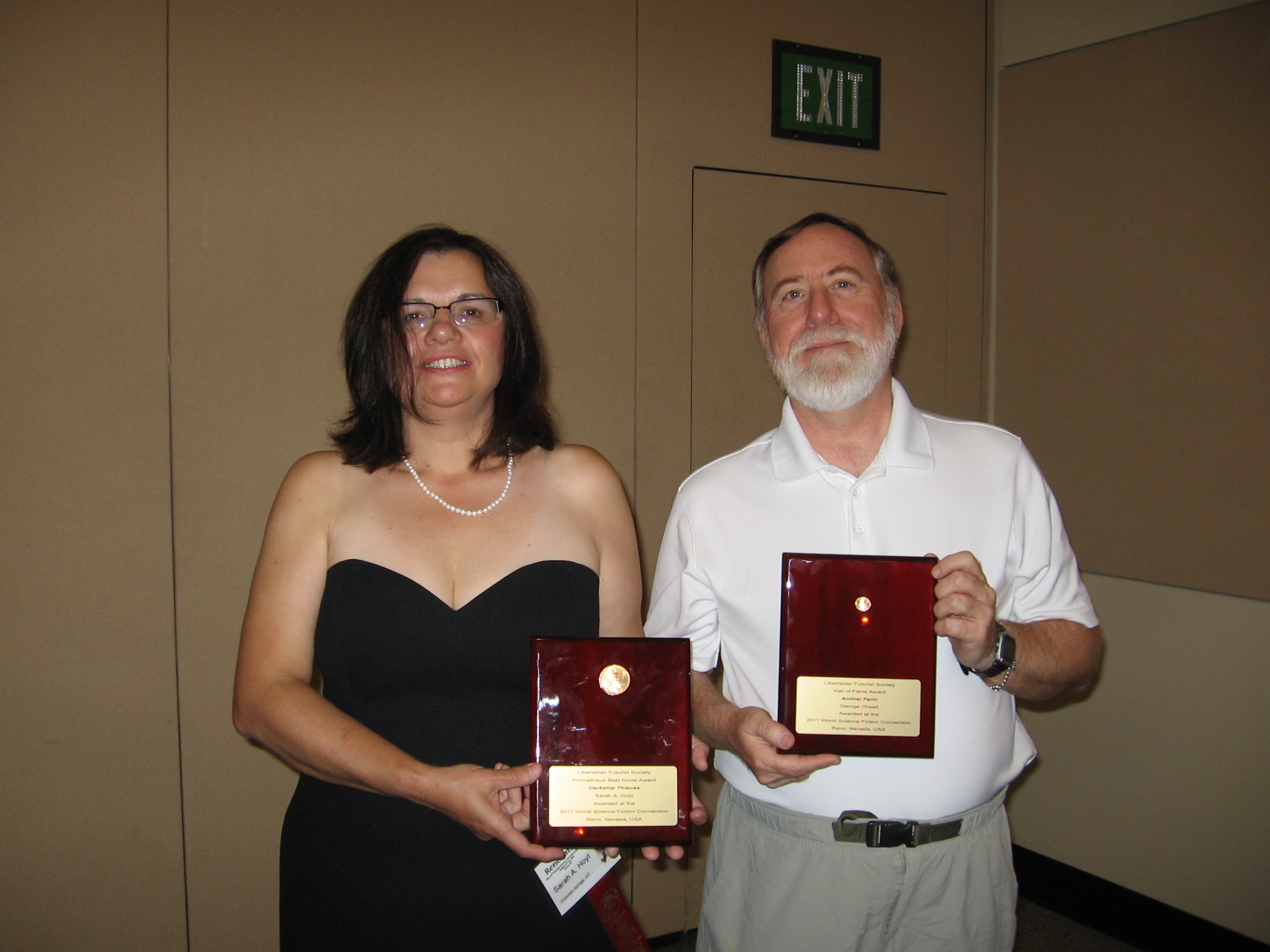
It also intrudes – sigh – on winning awards. It felt unreal and strange. I was the one who would be receiving the Prometheus but at the same time I was the kid growing up in Portugal, who knew she could never be a writer, much less win an award.

What this does, however, is also give you a sense for… the dignity of the occasion. I’ve posted here before about what I chose to wear. And part of it absolutely was “well, it’s my chance to dress up” but the other part was more than that. I’ve seen Heinlein give speeches when he was the guest of honor here and there. I’ve listened to them as it’s my only chance to hear the man, barring time-travel.

Now, I haven’t gone so completely around the bend delusional that I think that I am Heinlein. But I do think that my kids or grandkids, or even perhaps great grandkids might listen to this speech someday. You wouldn’t want them to think I was a slob.

Beyond that, there is … how do I put this? What you owe the award itself. I am a winner, in a chain of winners. Yes, it is a Libertarian award, which means it’s amazing no one has shown up to receive it naked. But in the same sense you dress up to attend someone else’s wedding (and for a given meaning of dress up, depending on the groom and bride. New jeans might be dressing up) not because you couldn’t attend it as well in your pajamas, but because you owe it to them and their occasion to look nice and like it’s a special moment – I felt like I owed it to all past winners and all future winners to translate into my attire how important the occasion was to me.

And now, I look at the pictures and I think “Gosh, that’s not me receiving that award. That’s clearly someone important.” So, there is that. I think my speech was incoherent, as I forgot half of it. I might have said that it was a bad thing to legislate equality, instead of specifying that equality before the law was fine – it’s equality of results that’s bad to enforce. BUT at least I looked the part and future people won’t know how scared I was.


More on the convention and the friends I got to see again for first time in years later. For now, I’ve got to go and clean the house which is drowned in cat hair and finish painting the fence (no, no neighborhood kids want to pay to do it. They’ve all read Tom Sawyer.)

And that’s the other part of being a writer. Reading Grumbles From The Grave I kept gritting my teeth and going “Okay, then. WHY was he building these water features, instead of writing another book? Didn’t he know he had limited time?”

But of course it is doing these other things that feeds the writing. If you sealed us in a chamber that took care of al our physical necessities and made us write, we’d soon stop, or go insane.

After all, my characters clean house, change litter boxes and paint fences too.

And I’ll be taking notes.

The Flying Con

As you’re reading this, I’m not here. I am still here (of course) as I write it on the 18th of August. I have packed and I think this time I haven’t forgotten anything. (In the past I’ve managed to fly without, in order of direness: glasses, nightshirt, clean underwear, makeup and jewelry. Not all of those at the same time, but one per trip.)

I debated taking a laptop with me, but given how short our trip is (we’re only there two full days: Friday and Saturday and back again very early in the morning on Sunday) and that we’re flying only with carry-on (yes, we do learn) a laptop becomes cumbersome. I’m taking a notebook, (no, the paper kind) and have downloaded the stuff I need to read for the next book.

So, you’ll have to make do without me until late on Sunday, when I’ll post something to tell you I landed back safely.

If you’re at World con come to the Prometheus Award ceremony on Friday at one. I can’t promise the speech will be worth listening to (I’m still working on it. It’s on the idea that the future is free [with the purchase of another future!]) but I’m wearing a decolete black dress with a slit skirt. (I couldn’t find the black and silver. Sigh.) And I have truly wonderful black lace stockings. I’ll be sure to flash them. (What do you mean vapid? I aspire to vapid, most of the time.) So, there’s that at least.

I’ll report back on Sunday evening.

The Plotting Soup

The most difficult writing question I was ever asked was at a party at Romance Writers of America annual meeting, three years ago.

Like that, out of the blue and without anesthesia, a fellow writer turns to me and asks, “So, are you a plotter or a pantser?” There was a small ring of people nearby, listening. And I froze badly.

Finally I managed to blurt the truth which was “Yes.” And when people proceeded to tell me that was impossible (ah!) other people said “I think that’s more common than people admit.”

To make things clear, though, if the plotters and the pantsers were enemy clans, I’d stand and fight with the plotters (except I never would because my friend Kate is on the other side, and frankly that’s one scary woman to fight with.)

I’d stand with the plotters, because I need the structure and the support. Think of my plotting as a map, but not on a GPS or at least not on a GPS that’s been updated in the last three years. Or perhaps it’s a map of Portuguese roads, where often a beautiful unconcern prevails about the common details of road turns and intersections. After all, a road with fewer, larger intersections looks better on the map, and surely you’re not such a ninny that you won’t realize you can get to the larger cross street by taking that alley over there, so tight that the mirrors of your car will scrape the walls….

I’d still need a map to get anywhere – children, I need a map to find my way around my living room, such my sense of direction – but you can’t trust it when you come to the fine work.

So I start writing with something like twenty to fifty pages outline (these days, usually, handwritten, but when I needed to send in detailed outlines to sell, they used to get typed up.)

And then I take that outline and pin it up somewhere, take one of my legal notepads (I buy a package of this per month or so. If I amount to anything, when I die, I wish my biographer good luck. Into these goes everything and anything from plot notes, to notes about character appearance, to phone numbers of whoever I needed to talk to while writing. Sometimes finding someone’s phone number involves going “So, what was I writing, at that time?”) ) and plot more finely and usually for the next ten chapters.

Say the first movement of the novel is “Nell sets off on her ship to the lands beyond the sea” (I’d like to insert a disclaimer that this character, these lands and this ship exist only for the purpose of the example. Please don’t get attached to them and demand I write them!)

In my head, it might have been clear that the book started before Nell went off. I need to have the reason she’s pushed off her native land, wherever that is. Say a messenger comes and tells her that her younger brother, Giles is about to be hanged for piracy. She must go free him.

So in the notebook, the chapters get outlined in bullet points, somewhat like this:

1 – Nell receives messenger telling her that Giles is about to be hanged for piracy in the distant and terrible city of Leoniba, where her older brother also met his end.

2- Nell’s decision to go rescue Giles, and argument with Mira who does not want to be left in charge of the house – and who might wish Giles dead so she can remarry.

3 – Convincing Michael to captain her ship. He’s none too sure she should leave the trading house in Mira’s hands and besides he’s not sure he wants a woman on board giving orders.

4 – Nell uses Michael’s secret to blackmail him into captaining her ship.

As I write them, sometimes the chapters mutate slightly, still, or have “kittens.” Say 2– Nell might see a man leaving Mira’s chambers and run after him to find out who he is. He might be Michael’s brother Steven, which then gets used in chapter 4.

By the time I’m ten chapters in, I usually need to write the next series of chapter bullet points. By then I’ve come across an intersection that wasn’t in that general and imprecise map, or I have a wild hankering to go see if there’s a castle beyond that hill on the side – metaphorically speaking. The plot has deviated enough from the written one that more chapters might be needed to keep the story on course, generally speaking.

It is very rare – though it has happened a few times – that the story deviates so much that I end up somewhere different than where I set out to be and/or that I don’t hit the major plot points I planned along the way.

On the other hand I’ve never written anything that doesn’t deviate and take excursions of brief to medium duration. Or that a character meant to be a villain isn’t after all a very flawed hero. (Or vice versa.) Mira, for instance, might have been trying to rescue her husband herself, intends to set off on a ship captained by Steve, and doesn’t want to manage the house while Nell is gone. That’s all right. It means an extra dramatic confrontation at the end, and the women fighting side by side to rescue Giles, but the part of the plotline that says “They fight the bad guys” is still the same.

You’re probably wondering why I do this the most complicated way possible. Well… there are two reasons. The first one is that if I don’t plot at all, with my attention span, I tend to go haring off over every hint, clue and bit of interest that drops into the soup.

Nell would see someone come out of Mira’s chambers, the someone would go by a jeweler. Nell would go into the jewelers and find the diamond that belonged to her grandmother. Talking to the jeweler she’d find the diamond is actually the twin of her grandmothers. It has magical properties and was given to her great aunt, who–

Even if I get back to the story ten chapters later (and I probably would because I’d have in my head the story is Nell rescues her brother) for the first ten chapters, this would have been a book about magical diamonds. By the time I snap back to ships and rescuing brothers, the reader is likely to get whiplash or a broken neck.

On the other hand, if all I have is the very general outline, which does keep me on track, I have trouble imagining the story in enough detail to be interesting. I don’t know how to explain this, but my first approach to a story is always as though I’m floating above it. I need to pull myself close enough to even see what’s going on, and then I can decide where to drop in and which alleys to describe, which cobblestones to walk, etc. If I try to write directly from the general outline, you get something like “Nell walked down to the wharf and hailed the first ship she came to. “Hey,” she said. “I want to sail to Leowhatever where my brother is going to be hanged for being a pirate.” It won’t even read like an outline. It will read like insanity.

Except, since my subconscious has fail safe mechanisms to keep me from being terminally stupid, what ends up happening is that I actually can’t write at all. I stare at the general plot and at the keyboard for days on end. (This sometimes happens when I try to do it. Why do I try to do it? Because I’m terminally stupid. Or can’t find a legal notepad.) I moan, yell, sob, and make all my friends consider offing me rather than putting up with my nonsense. And then I get a legal notepad and plot in bullet points.

So, have I always plotted this way? No. Only since about Draw One In The Dark.

The problem is that, before that, I had the general outline, then sort of forced myself to write from that, then went back and ruthlessly uprooted all deviations and side-excursions.

I’ve told people often enough that it shouldn’t surprise anyone that each of my first three books was actually twice the size it ended up. (For Ill Met probably three times.)

In Draw One In The Dark I plotted via notebook, but still things fell in that weren’t in either outline. And when I was revising I came to the scene with the three guys in the car and considered cutting it out. And then I made a decision to leave it in. It doesn’t advance plot, but it advances character development. Best decision I ever made. I get more fan mail on that scene than on all the rest of the book. Over time, I’ve come realize the scene is essential for character development, I just couldn’t see that in the overarching outline.

And that’s why I decided, since then, to allow things to fall in.

However, the plotting soup is a scary thing. I’m forever in danger of ending up with ten first chapters about diamonds in a book about ships. Hence, I still need the general outline to keep me on track as to where I’m going, why, and which plot points need attention and which can be downplayed.

This later mistake of throwing in everything that crosses your mind is a beginner thing (Guilty as charged with the thing called Mirrorplay, aka the doorstop, which will eventually be a six or so book series.) The problem with it is that you end up dragging the reader in odd directions, until the reader loses all interest. (The other problem is that the book becomes six hundred and fifty five thousand words long, and, in printed form, can be used to insulate a mansion with forty bedrooms.)

My mother used to make a “Whatever” stew, into which she threw whatever leftover meat she had around, whatever veggies were in danger of going bad, and whichever condiments struck her fancy. Note she didn’t throw in grass, a vase of flowers and some fur from the cat just because they were around.

So I let the plotting soup in only with a baster and in controlled circumstances. And generally Nell does get there and rescue her brother.

Will it work for you? Who knows? Worth a try if nothing else does. But whichever way you find to both unlock the subconscious and not let yourself get drowned in the plotting soup, is good.

Just hold on fast to the plotting line, and you’ll come to your destination by and by.

Deaf and Blind

Yes, I’m doing a series of craft and “stupid things writers do to themselves” posts. Partly because as I am packing and getting ready to go to World Con I’m not reading as many field blogs as I should. Partly because for the last week I’ve been running into people who are – I think – doing things I once did. (Or tried to do, like the idiot high expectations game that wouldn’t allow me to write at all.)

I’ve often say that I’ve made every possible mistake in learning to write, and actually came up with one or two that should be impossible, and I swear that’s true. But this one is one that SHOULD be impossible, particularly for people who’ve read a lot, but that I’ve seen practically every one of my fledgelings make – particularly those that fall into the category “So sharp you cut yourself, uh?” And yeah, I managed to make it too, though I have no explanation for that.

Imagine you are reading a story that starts like this Myol strapped the deolins to the kzart and said “It’s a fine day to parralt.”

If you’re me, you’re probably going to read another two or three sentences, right? I mean, that first sentence doesn’t exactly give you anything, but it might make your eyebrows go up and you go “Well, now…”

But what if the other three sentences or four, or the first three pages are exactly the same? Oh, wait, someone named Kyar will join Myol, and they discuss the coming parralt at length, but in the end you still have no clue what this parralt has. For that matter you don’t know if Myol and Kyar are boys, girls, yes, or fish. You have no clue if the deolins are lasers, swords, horses or ribbons. And you truly have no idea what a kzart is and if animated or not.

At this point, if this is a writer you know and who has delivered for you in the past, you MIGHT keep reading. Particularly if you know this writer is known for high fantasy, say. Or science fiction. BUT even with a writer you know, by page three you’re working way too hard for the story to be enjoyable.

Why you say?

Well, sweet child’ o’ mine, because I know in your head Myol is a young warrior, who is strapping his (specialized) sabers to his tribal belt and saying “It’s a fine day to carry a complex message that could mean war or peace to my mother’s tribe.” BUT YOUR POOR READER WAS DROPPED HEAD FIRST INTO A WORLD WHERE HE’S CAREFULLY KEPT DEAF AND BLIND.

And if at this point you’re feeling very smug and going “Well, I don’t use weird names for things, so I don’t have that problem, let me enlighten you, sonny (or daughtry :) ) It is not only possible but quite easy to make the exact same mistake without using made up words. (And for your information, no, I don’t recommend made up words. Ever. Don’t call a rabbit a schmerp, don’t call a saber a deolin and don’t call yourself Sherley Unless that’s your name or pen name.)

Take a story submitted by someone who should know better to my writers’ group about ten years ago. It went something like this:

Nyopar came running up the verdant hill and at the top looked at the city below.

And it went on. For FIVE pages. At the end of the five pages, you didn’t know if Nyopar was male, female, yes or cabbage. You had no clue if he/she/it had the normal humanoid body shape. And you had no clue if this city was a medieval keep or a splendorous future dome city. To give the writer her due, we DID know the hill was green, that Nyopar could run, and that there was a city presumably (though not for sure) of his/her/its kind there.

We read it because we had to, and by the time on page six we found out that Nyopar was male, that the city was a keep, and that we were dealing with high fantasy, most of us had already tried to make up surroundings for the poor … turns out guy, so that most of us got whiplash being wrenched into the place the writer wanted us.

I know, I know, you’re thinking “Golly, that sounds like it would be hard to do.” Yes, it does. Guess what, it’s not. In me, and in the writers I’ve mentored, it tends to be the mistake of people who’ve created their world SO vividly and who can see everything SO clearly that they never realize what they’re doing to the reader. It also tends to be one of the last “beginner mistakes.” By this I mean, your structure, plot, character, etc. are all already well above average. You’re just playing silly buggers with the reader. Once you stop doing that, you’ll probably be “there” writing level wise – a professional who can spin a tale everyone wants to read.

Most of the time I wasn’t QUITE as bad as that, I’ll confess, but I also didn’t remember I had readers. (And as a consequence, I didn’t, most of the time.) I just threw things at the page in the order that seemed logical to me, and left the poor reader to lope behind or not as he or she could.

To let you know how LATE in my development this happened, I had already published three short stories (got lucky on those and had the necessary info) and I’d written eight novels. I’d also been two levels of finalist on the Writers Of The Future Contest. And then one day, blindingly, I realized “someone will read this, or at least that’s why I’m writing it. Why don’t I make it EASY for them to do so?”

In my case and in a lot of others it is tempting to say that Heinlein has a lot to answer for, but that is not true. Yes, Heinlein “Heinleined” the information in without vast infodumps. And yes, various how-to-writers have talked about this. And you want to be able to do this, because you’re that smart, that cool, that…

Okay. IF like me that’s where you got this, go and read the first ten pages of Heinlein books. Juveniles probably work best (I don’t know how careful he was in the later books) but Friday is a thing of beauty for this. Take a notebook with you. Note down every time he gives you information. Either do it now, or do it after you finish reading this. But do it.

Yes, Friday, for instance, starts with her coming out of a capsule and killing someone. BUT he gives you information EVERY STEP OF THE WAY about when and where it is, what she is, and what the world is like. Look, even her reaction – seemingly spontaneous – to killing someone tells you she’s a professional in a related line to contract killing.

However, I will note that even with Heinlein and Friday, and even though he DOES give clues before that, I got to the rape page convinced the main character was a male. And then I went “Whoa, Nelly.” and got whiplash when they call her Miss Friday. That is an example of leading the reader into error unwittingly – a specialized one. If you are writing someone of a different gender (I only started writing female characters around the time I figured this out. Up till then all my main characters were male. No, it had nothing to do with patriarchal oppression. I like male heads better, possibly because I’ve observed men more closely. Sue me.) You really need to hit the reader over the head with a clue bat. I had people NOT get it, even when I came outright and said “I was a young boy.” No, seriously. You need like three “clue bat wit’ nails in it moments in the first page. Then hope your reader paid attention.

However, listen to me, because I don’t have time to tell you this three times: if you’re not capable for either reason of craft or of plot to work all that in SUBTLY into the first three pages, then it’s best to give as much information to your reader as you can, BLUNTLY. Save the subtlety for another time, but tell them where they are, in whose head they are, what type of story this is, and what the problem is.

And don’t bridle on my saying you might not be able to do it, craft wise. Look, when Heinlein wrote Friday he’d written how many books? In some of them he was fairly blunt about positioning you in time and space and giving you the problem.

I still have times when I’m starting a novel or a short story and can’t figure out how to do it subtly or want to get you there as fast as possible. Sometimes I later go back and fix the opening, but sometimes I let it be. (Yes, I’ll give examples and when I wrote them below.)

For now, I want you to remember this, when you’re writing a first page of a story. Your reader was just dropped dumb, deaf and blind into the body of your character. (Even if this is not first person.) In sf/f he has no idea WHAT that character is, and even in Romance or Mystery, he’s clueless on gender, historical time period and location. That’s because he was just dropped head first, into your world.

If you want the reader to stay, give him clues as quickly and painlessly as you can manage. Yes, in books your reader will have a cover and cover copy, and maybe title. But, and this makes it more imperative in the new world of publishing, this is not always true in either short stories or ebooks. And at any rate you should never, ever ever – if going traditional – count on your publisher cluing your reader properly. Someday, at a con, buy me a drink and I’ll tell you how that can go DISASTROUSLY wrong.

In fact, if you KNOW you’ve mastered the craft almost to perfection, but your snippets or self-published ebooks are getting no bites at all and your friends find excuses (“but I really have to strap my deolins tonight!”) not to read your stuff, this is probably the mistake you’re making. Most laymen will not be able to tell you what the problem is, only that “I didn’t finish” or “I couldn’t get into it.” A pro can, but most of us try to avoid reading people’s manuscripts unless the people are close friends or are holding our cats hostage [Don’t get ideas. It would be the Ransom of Red Chief. Except with Euclid. He wouldn’t realize anyone was holding him anything. Most of the time he thinks he’s a teapot.)

So, pull out your stuff, and look it over. In the first paragraph – as those of us who were journalism trained know – you must tell us who, what, when and possibly why.

You must not tell us TOO MUCH information, mind. We don’t need to know your character chipped her tooth at five, unless of course, that’s integral to the action later and you want to open with that for whatever reason (Write fiction for dentists much?) The first paragraph needs very little beyond “male female, yes, or cabbage?” “Age?” “General temporal location – past, present, future or alternate.” and “problem”.

The rest can trickle in over the next three pages, and you can work at making it sound natural. And keep the infodumps and/or clues no longer than a sentence at a time, if you can. Or at least do it with style.

Remember to emphasize and/or hang a flag (not literally! I mean do it in a way that calls attention to it!) on the most startling details. Which means if your name there on the page is Mary Hadalittlelamb and your main character is Mario, you’d best make d*mn double sure that people know his gender. And having him think he needs to shave might not do it. (Hey, us Mediterranean women of a certain age use all sorts of depilatory products. Else, we’d be like Helen of Troy at fifty: blousy, grey haired, with a little beard.) It also means if your character is a walking cabbage, you’d best make sure we know he has issues with his inner leaves and his leg-stalks aren’t doing so well. Because the default in our heads is the same thing as when you sign on at one of those blogs that have generic “male” or “female” shapes for icons. The reader sees one of those, usually in the author’s gender. Sometimes in their own gender (which the author controls even less.)

Yes, it takes effort and at first will take you a lot of revision, but believe it or not it will become second nature. I managed to do some of these more or less by accident when I was learning. The opening to Thirst, below, is one of these though the first page is mood setting, and the second gives you the info. Sort of. There’s info in the first paragraph, but not he one you’d expect. Then I spent years doing them on purpose. Now it more or less happens but only because you can get used to ANYTHING, just about and trained into anything so it becomes second nature.

See the examples below, then go and look at your first two pages of any story. The beats should be like this, at least for a short story: First paragraph – species, gender, general setting (past, future, present? For bonus points, city, country or wilderness.) Second paragraph – if not first. This is a “by” not a “not until” – problem facing character. This might not be the main problem of the story but it should be enough to keep the reader reading. Third paragraph, if not earlier, what type of story is this? First page, if it’s a short story, you should know what the main problem of the story will be, or at least have a clue. By page three your character should have a past, even if it’s just “I wasn’t born in space. I was born in Iowa. I only work in space.” (Yes, I love that line, and of course, looking at the reboot now, it was wrong. ) Born on the first page syndrome makes your character less human (or cabbagy, natch) and therefore less interesting.

For a novel, you have slightly longer to introduce the character’s past. You can for instance hint he had an unhappy childhood, but we don’t find out details till page 300. (Or in the musketeer mysteries case, book five, where I discovered why Athos was so tightly wound. If you read the series, look up the chess set scene with his father.) BUT we still must know up front if he’s vegetable, mineral or animal.

It helps to ask yourself questions, like – you’re in the character’s head. Now look down, what are you wearing? Look around. Where are you standing? And what is your problem?

Get that in, and your reader might still hate the story (or you) but he/she/it/cabbage won’t be deaf and blind.

Okay, here are some examples, now, so you know what I’m talking about.

Thirst, 1991. This one is imperfect. I had no clue what I was doing, so there is almost a page of “mood setting” where I make the reader work MUCH too hard for the info. It has some info, but not the obvious. It’s like dropping someone into a new world and telling them how great the food is, before they know if they have a mouth.

It opens like this: Sometimes I wake up in the evening and think them here, immaterial wisps of dream in the cold twilight air, and yet undeniably themselves: the Emperor and the boy he loved, etched by time into heroic figures without flaw.

The Emperor wears his purple, and the boy stands in one of those sweet, head-drooping postures immortalized in his countless statues.

It is not until the end of that page that, apparently tired of playing games, I decide to drop in all the info. It’s like I’ve been holding the ball above my head and refusing to play, and now unbend and go “oh, fine.”

Hylas is my name, or was my name, when I was a mortal among mortals, a living, breathing being in the sun’s embrace. A Greek name for a Roman boy born in the Suburra, raised in that maze of smelly, noisy streets that was the pulsing heart of Rome.

Ideal? No. But good enough to be my first sale.

Then Super Lamb Banana from 2003 (I need to file my short stories in a rational manner. I’m having trouble finding stuff.)


John Lennon thought he was going to be mugged.


And it shouldn’t happen here. He was at Liverpool docks where the tourists were as thick on the ground as muck in a back alley. He thought he’d be safer than near his rent-subsidized flat. But these days there was nowhere safe.

And then there’s last week, the opening of (in my defense) a novel. As you see, I’m still enamored of mood-setting paragraphs, but at least these days I tell you all the info by paragraph three. (Oh, you’re NOT going to count one line as a third paragraph are you? Fine, then. Paragraph four. Gee.)

The world celebrates great prison breaks. The French territories still commemorate the day in which the dreaded Bastille was burst open by the righteous fury of the peasantry and disgorged into the light of day the innocent, the aggrieved, the tortured and the oppressed.

They forget that every time a prison is opened, it also disgorges, amid the righteous and innocent, the con artists, the rapists, the murderers and the monsters.

Monsters like me.

My name is Lucius Dante Maximilian Keeva, Luce to my friends, though I killed the last one of those fourteen years ago.

Now go and read your own beginnings and figure out how hard you’re making the reader work to remove the ear plugs and blindfold!

*Crossposted at Mad Genius Club*