Nanowrimo Writing Dates and Synergy

Back when I was a beginning writer we used to do something – and we got the idea from stories Kris Rusch and Dean Wesley Smith told.  (No, this does not mean we killed our secret pen names in a love triangle murder suicide, though – given mine – it’s something I have considered on occasion.  Well, I’ve considered killing them, and a love-triangle murder suicide is JUST what they all deserve.  I’ll make it in sordid circumstances!)

First I must explain that much as I hate to admit it, we writing couples are different.  Sorry.  We’re wonderfully, amazingly, extraordinarily more… dorky than anything you non-writing couples can imagine.   Starting in the mists of time, when the kids were toddlers, I heard of other couples having “date nights” every week.  This seemed a little odd, since we got in our dating time the first year of marriage, like we were supposed to (at least like we were supposed to, because we never dated before marriage, due to the Atlantic Ocean being in the way and never moving out of the way, not even when we nudged it with our knee.)

But we did have our very own equivalent of date nights.  Since waaaay back then we didn’t have a writing group and the very concept was somewhat alien, and since I spent my writing day surrounded by non-verbal people, sometimes I just needed to talk a plot point out.  So when Dan got home I’d already have called our friend who would babysit for us (not afraid of way too smart kids – hi Charles!) and be ready to go.  We’d pick some place with slow service, a quiet atmosphere and servers with nerves of steel.  The latter was very needed since otherwise they panicked when they heard us discussing body disposal methods.

Well, Kris and Dean talked of something similar – the intensive writing retreat.  We tried it twice, with our friends, Rebecca and Alan Lickiss.  In the form we did it, we got the kids out of our house (and into theirs, with a trusted sitter – hi Charles!) Then we set up writing areas for each of us in our house.  And then we wrote from mid-Friday to mid-Sunday.  When taking breaks, for coffee or water or something, we tossed whatever we’d finished so far on the larger coffee table.  Other people could add, or sit down and read, because late on Sunday there was a critique session before they went home.

I think the lowest wordage for those weekends was 15k words.  The highest was 40k.  And since we inevitably went out to eat on Saturday night and took a bit of time, plus there were talks in the kitchen late at night, it wasn’t bad at all.

We could never replicate it on our own, not even when we had an internet one.  There is something about more than one writer in a house, concentrating only on writing, at the same time, and doing nothing else, with no distractions.

It’s better than one writer in one place, concentrating only on writing, even.

Some of you, who have had occasion to call me or email me, know that I do this sometimes, when criminally late – I find a hotel with really cheap rates and hole up for a week or so and just write like a demon.  It works.  I mean, it’s better than being at home with the kids, the cats and the telephone.  (Better in the sense of my writing more.  I rather enjoy the kids and the cats.)
But it is not the same as having a group, all pulling at the same time, in a small space.  This is why if I could and had other writers in the city I could do this with, I’d rent a communal office to do it in.  I think the same synergy would develop.

Nanowrimo of course is not the same synergy, or not quite.  There’s also the fact that if you are connecting through the Nanowrimo site, you end up talking more than you write.  Some people there, I swear, live to talk.  Which is why I don’t do official Nano site anymore.  BUT Nanowrimo connecting with a small group who reports in, really seems to help.

Still not the same.  We also tried to do writing weekends where we connected via the net and it didn’t seem to raise the same feel.  Real life still intrudes.  So 60k words in a month are okay, but 40k in 48 hours are beyond us.

However, we found out by accident, on the weekend of a con when both of us had stories due for an antho, that the same synergy develops when Dan and I go away Friday through Sunday alone and both of us write.  It’s actually romantic, because (around the con) we got a couple of meals out alone in.  But even with those and the con panels, we wrote as much as we did at those long-ago writing retreats.

Since I found this out, I’ve had this dream where we get to do that about once a month and I get ahead of my schedule.  The problem is that it’s never been possible.  When I first wanted to do that, we’d just moved to this house and were paying on both houses, so I thought “when the house sells we’ll start doing it.”

When the house sold, there were a few other emergencies, and now there are college tuition costs.

So, I’m thinking…  If the donation button on this site raises only enough to pay for a weekend for us (two nights) away at a hotel per month (we’re cheap dates.  No, not as cheap as the hotel we first stayed in for Liberty last year, before moving to the con hotel.  I don’t like worrying about rats) it will have conferred an incredible boon on us.

See, it’s always been for writers that the more you wrote the more you made.  But under the new model that’s much more so.  Instead of fifty percent of your stuff being published (and the rest often waiting years, not on quality – I sold some of it years later, and at least one story that took me eight years to sell was a year’s best fantasy and horror honorable mention – but on “it doesn’t fit our needs” or rather it didn’t fit what they were looking for [I never managed to sell any of my future history short stories, set in the same timeline as Darkships because ‘your future history is not logical’ – ah!]  And I have all these series started: the musketeers mysteries, the refinishing mysteries, orphan kittens, the Shifters, Darkships and the rest of the future history stuff.  I have fans waiting for each of those, and, of course, I can only write a book at a time.  But if I get that weekend away I’ll do them faster.  And weirdly I always come back from that type of experience felling energized (Yes, I’m broken.  Deal.)

At any rate, I think the button has done that this month, for which I thank you more than I can say (though we might postpone the onset of these till January because November is a holiday and two birthdays in this household, and then we hit the holiday season.  Or maybe not.  It occurs to me that a weekend of writing is a wonderful birthday present for self.)

Hopefully it will continue and be one of those self-feeding things: the more I write, the more I can afford to give away on the site as a loss leader, the more donations I get, which make me write more/faster, which means more properties I can either write-in-public or give away under the free short story tab (story changes every week.)

So, again, thank you to everyone who has hit that button.  It will be used to promote writing (so I don’t need to steal the kitty kibble money) more and faster and hopefully better.

Meanwhile, it’s time I got out of here and went to officeish.  I have two novels to finish.

Quick, Get Me A Flashlight

My friend Dave Freer posted on Monday about writing what sells… for the new market.  As so often happens, we were in a similar place mentally.

Monday morning in the shower (yes, I think in the shower, deal) I found myself thinking about how we don’t know what sells.

Now, we might know what has literary merit, but literary merit is a matter of opinion.  I read someone today talking about how Harry Potter is totally devoid of it, which it very well might be, but compared to what?  The comparisons this person pulled up were Dickens and Tolstoi.  Dickens wrote by the frigging word, so what principle of literary value are we applying?  And as for Tolstoi, I treasured his work and kept it by my bedside for years.  You see, I suffer from insomnia and I could never go more than fifteen pages without falling asleep.  So, I’m willing to concede it’s very important to the history of literature.  At least I hope so, or I’d hate to think of all the trees that were killed to print it.  Just don’t make me read it.

Frankly, though I gag at the idea that Harry Potter is the most inventive piece of fantasy evah – it’s rather like Enid Blyton boarding school mysteries with magic – I gag even more at the idea of people putting it down because it doesn’t “illuminate the human condition.”  I don’t know about you but when I want to illuminate the human condition, I get a flashlight.  (Wait, that’s the human basement.  Never mind.)

Doesn’t matter anyway.  Literary value is a will o’ the wisp and has been used for centuries by those-who-know-better to tell the masses what ’orrible little people they are and what ’orrible ’horrible taste they have.  (Shakespeare.  All that blood.  Ghosts.  Inaccurate history.  Rotted the mind like cheap candy.  A favorite of truculent apprentices and low brows.  Why, he had the violence happen right htere on the stage, while all the well bred people knew the way to do it was to have a messenger come and announce it.  In the more fraught plays, messengers crossed back and forth on the stage, but it was good taste.  Everyone knew that.  As a literature major I’ve had to read those plays.  They’re very illuminating of the human condition.  Like Tolstoi.)

What literary value is not is a predictor of sales, unless you are talking ONLY sales to a small subset of status-insecure people who want to show how intelligent they are.  Now, there are any number of those and there are scam– er… authors who make a living off them, but I am not an artist – I work for a living – and I’d rather sell stuff people genuinely enjoy.

The question is… what is that?

Until recently, if you wanted to be read by the largest number of people, the path was easy.  First, you had to impress the gatekeepers.  Fortunately the gatekeepers were a small clique living mostly in NYC and all attending the same parties and reading the same books or – more likely – watching the same movies.  And they weren’t shy with their opinions, either.  They talked all the time, because you see, living in an echo chamber, they viewed their tastes and opinion as symbols of their status and intelligence.  So, attend one or two conventions, and you could psyche them.

Failing that, there were slews of books, seminars and workshops that taught you how to think the way they did, for the purpose of creating stories they’d love.  Then they’d make sure your book got in all the bookshops, and then, if you were lucky, a miracle occurred and your book appealed to the public also.  But that was secondary because a) first you had to catch your rabbit – or editor – and b) the public selection was limited, and often constrained to the current fad.  So if all editors wanted purple swans, (shud up you.  Actually it’s barely less plausible than things they did want: romantic inoffensive vampires; female detectives who thought only of shoes, etc.) you wrote purple swans and if your purple swan was a little better than average you were gold er… purple… er… the purplest of them all.

Recently, while trying to cut down on the number of dead tree tomes around the house, I went through my how-to-write-shelf and realized most of those books are now useless.  All of them, openly or not, teach you to write the book the gatekeepers will love.  So other than the grammar books and the Swain (which you’ll pry off my cold dead hands) they’re mostly useless.

This was confirmed for me when a writer of far more experience told a group of us to “Put it all out there, even the things you think are bad.  Don’t judge your own stuff.  Writers are horrible judges of their own stuff, and these days we just don’t know what sells.  We don’t know what people want.”

But the thing is, I’m a wussy.  Oh, not in most circumstances, but when it comes to my writing.  I sent stuff out DESPITE my fear it sucked and kept sending in the face of rejections because I’ve got a quitting dysfunction, not because of any self confidence.

I hated having to jump through the hoops of the gatekeeper’s opinions, but at least I could study the books, and know I was getting better, as defined to ‘closer to the goal.’  Now, it’s like… gravity is gone, we’re all floating free and, like Thena, in Darkship Thieves, my internal sense tells me I’m always upside down, no matter how I turn.

And awards are no indication of what is good or what will sell.  SF writers are horrible at judging their peers.  It devolves to either status seeking or personality contest.  And fans are only slightly better because the fan awards usually are voted on by only a subset of fans.  (The Prometheus is perhaps the best predictor of sales, and I say that, not just because I got it, but because I know people who read every winner as a matter of course.  Of course, I run with that set of people, so my opinion is biased.)

And I’ve already disqualified myself from literary merit.  So, what remains?

Funny, but Dave and I both arrived at the same conclusion more or less at the same time.  Go back to the beginning of the field, to the things that caused the explosion.  Many of those are now marred by archaic language and style.  But any person with half a brain can tell the things in the story that appealed to people.  Well, I can tell you some of them that appeal to me: Resourceful and daring heroes; strange lands; bravery; larger than life characters.

Mind you, I don’t know if my tastes are universal.  But I know what I like.  And I’d bet you there’s at least ten thousand people out there who have the same tastes I do.  Probably, more like a hundred thousand.  And although it might take time, the new market place gives me a chance to find most of them – or for them to find me.

The new net of friendships between kindred minds spans the globe, so if I find someone who likes me, and they talk to their like minded friends… well…

Will this make me as rich as Rowling?  Who knows.  Probably not.  Besides, I can’t have everything (where would I put it?  Who would dust it.)

Making a comfortable living writing the stuff I like for people who like it sounds like paradise to me, compared to the last ten years of competition contortionism to fit the square peg into the round hole of expectations.

It’s good enough.  It will do.  And it’s enough to aim for.  (And illuminating the human condition can wait for the flashlight.)

Nanowrimo Ate My Homework

I am going to officishing today, which means I should have written the post last night, instead of which I spent time preparing for Nano wrimo.
So, watch this space.  Something will be posted after work.  Now, whether that will be sane or coherent, it’s something else.

Hunting the Wild Subplot

Let’s start with what a subplot is – at least for me.  For other people it might mean different things.  It is one of those things that writers, living by the word, tend to give terms so many different meanings, depending on writer, time of career and sometimes mood, that you can find personal definitions for all of our professional terms: synopsis, outline, concept, subplot, character arc, etc.  (I think this is also a result of a profession where apprenticeships are kind of individual, self-created and depending on either what books the writer finds on his way to learning, or which pro he can gang press into helping him.  It might be true that when the pupil is ready the master appears, but in writing it often seems to be more under the heading of “first find a few masters.  Then pick bits of each teaching that suit you.”)

For me a plot consists of the events that serve the central theme of the book.  Say you’re writing a book about growing mutant chickens (shut up you.  It’s early and I’ve had no caffeine.)  The plot would be buying the eggs, building the incubator, possibly the money aspects of this, where you have to mortgage the farm to buy the eggs and the incubator and then through the try-fail sequence, you worry about you and the mutant cows being thrown out of the farm because the mutant chickens won’t hatch.  Then at the end your mutant chickens hatch, but they fly away (I did say they were mutants, right?) and you think all is lost until the mutant chickens come home to roost.

A subplot would be the farmer’s relationship with his younger brother who thinks they should grow pterodactyls instead and his aged grandmother going off in search of a priest to exorcise the incubator and, on the way, finding her son whom she thought was eaten by mutated sheep as a toddler, living as a prosperous witch doctor in the next village.  This will tie in, of course, with fixing the incubators, but it’s also an entire if smaller and less important plot arc.  (Yes, it’s a weird world.  LIVE with it.  Early.  No caffeine.)

Let me start by saying your novels don’t really need much in the way of a subplot.  Not if they’re going to come in as what might now be a viable length of about sixty to seventy thousand words. For this length the inevitable subplot like the relationship between the characters is enough.  And there is always a relationship between the characters, even if it’s the fact the farmer’s wife thinks mutated sheep are unnatural, not like those nice mutated cows.

Then I can – I think – explain that I don’t think I can write a novel without subplots.  Sometimes even my long short stories develop subplots.  It’s just the way my mind works to complicate things.  (Yes, live with THAT either.  Why not?  I have to.)

Also this explains my… difficult relationship with plotting vs. pantsing.  I can do a detailed outline.  Have in the past, mostly because agents or editors demanded them.

Turns out it might not be the … best thing for someone like me to do.  Why?  Well… take the outline to Heart of Light.  (Please!) When it was done, it was 50 pages, typed, and I listed every incident (I thought) that would happen in the book.  The problem?  I hadn’t listed every incident that would happen in the book.  When a plot gets in motion, my subconscious gets fully engaged.  And when my subconscious gets engaged, it produces subplots like bad chilli produces gas.

So what happens with something like Heart of Light – and btw, to generate an outline THAT complete, I’d needed to take several runs at the outline, over and over again, which took me the best part of six months because I needed to get to know the characters, whence all subplots come  – that is outlined till it’s about a quarter of a novel?  Well… it develops more subplots.  And then you have to weed them back.  Possibly with a machetti.  Or what you end up with is in fact soup.

Now, for the longest time, like when I first got published, I used to plot like that, on paper, anyway, before I wrote the novel.  This is because I didn’t trust my subconscious, which, let me tell you, is a wily and cunning beast (possibly a mutated chicken) to give me subplots that tied in to anything, much less my main plot.  And if I came to the end with a bunch of plots that pointed to nothing at all and could no more figure out how to tie them together than how to give a fish flying lessons, I’d have wasted the six months or so of writing the d*mn book.

So, what did I do?  Oh, I wrote a book three times as long as it needed to be.  (If I was lucky.)  And then I sat down with the scalpel and the sewing needle, and cut it to about 1/3 to 1/5 the length, keeping in only the relevant stuff.

I don’t do it like that anymore.  What changed was the way the field, which was collapsing under me as I broke in, interacted with another of my characteristics: the inability to give up once I start something.  You see, round about 2003 I had to make a choice.  I could admit I’d made a mistake in aiming to be a writer most of my life and working like crazy to get published, because there was no way to make a living from this or (worse) at least no way I personally could make a living from this.  Or I could find a way to make a living from this, including but not limited to, doing the work of four to six writers.

See again how I cannot figure out how to give up on something.  Blame it on parents who emphasized follow through and persistence.  Or blame it on a mind that, when I was seventeen, earned me a certificate saying I was perfectly sane.  (Pauses to let the idea of WHY one would need such a certificate sink in.)  I could give up.  I could also levitate.  Theoretically.  Not that I’m willing to test either theory.

The advantage of becoming several writers at once, is that it taught me to trust my subconscious, because I simply didn’t have the ability to write twelve to twenty novels a year (well, I’ve never tried, to tell the truth.  But at the time, the kids were YOUNG and needed a lot more watching.)  So I had to outline the plot and let the subplots take care of themselves.

For someone of my disposition, this is sort of the equivalent of learning to swim by being thrown into rapids.  (I don’t know how to swim, btw.  It’s hard to write under water, so I was never much interested.)

The first book that I did this with was Draw One In The Dark, and, to my surprise, not only did all the subplots tie in, but they tied in at the right time and in the right way.  And then it happened again, and again, till I’ve had to come to the conclusion that my subconscious knows its business, often better than I do.

So, my current process is I write the general outline, (say ten pages, double spaced) then let the subplots fall in place.  This can be distracting to publishers like Baen who emphasize plot.  I think Toni is getting used to the idea that the outline she gets might sound thin on plot, because I write better novels than I do outlines (I think.)

There are two drawbacks.  In the space operas, this plotting by sudden fits of brilliance (Ah!  I see, so that’s what happened a hundred years back!) has played holy havoc with my future history, which in turn affects other stories in the line.  I’m trying to fix it so I can do a couple of novellas in the Thena Verse, but that’s something else.

The other is that I NEVER KNOW if my subconscious will deliver the goods or not.  Okay, so it has done so for the last fifteen books, but that doesn’t mean a thing.  It could fail me tomorrow!  So I live in a constant state of terror of what lurks in my own mind.  (I really don’t appreciate that low whistle and “so you should, sister.”  Mind your own mind!)

And yet the other is that when I write a novel in public – Witchfinder – people ask me questions and say “I didn’t realize this from the beginning” and I have to say “I hadn’t either.”  Or “I might have had a misleading paragraph in there, because I thought it was so.”  I’d like to point out the truly bizarre thing is that I don’t usually have too many wrong-pointing paragraphs anymore.  Towards the middle of the novel, I’ll make a note saying something like “Make sure on revision that S and G haven’t been doing this that long.”  And I’ll go back, hunting paragraphs that say they’ve done it for five years or whatever.  (There might be one.  Haven’t looked.)  Nine times out of ten, it’s not there.  I.e. the subconscious took care of it, already, even though the conscious had no clue.  Often, towards the end of the novel my desk (roll top) looks like a postit note porcupine with “Go back and make sure” and “Drop a hint that x is y back in chapter three.”  BUT the funny thing is about half of those are already there, somehow.

I wouldn’t dream of writing a novel without ANY outline.  But I also wouldn’t dream of outlining EVERY detail of plot, because then my subconscious will just come up with subplots to the subplots and then… well… 650k word book.  Nicknamed doorstop.  Manuscripts kept in case we ever run out of fuel in the middle of winter.

Is this a sane way to work?  Sure it is.  Brother, I have the certificate.

Is it the most efficient way to work?  I don’t know.  It allowed me to make a living in the most messed up state the field ever got into.

And the lesson to take away?  Find your process and trust it.  Don’t listen to me or to any other pro in “I do it like this and so must you.”  Ignore the plotters who tell you you need graphs, charts, maps, and a step counter.  Ignore the pantsers who tell you that you must stare into the void and leap into it without a parachute.  Do as YOU must.

When the writer is ready, the personal method appears.  Now go hatch your own mutant chickens.

We Band Of Writers

I think all of us came into the business with a mental image of that great camaraderie between writers, particularly writers of sf/f, which seemed perfectly natural.

After all, each of us grew up feeling profoundly weird, just on the writing thing (the only reason I didn’t get pounded for going “oooooh” in an ecstatic way when a story or essay was assigned is that I was twice as large as the other kids in the school – Portugal in the sixties and seventies wasn’t known for tall people – and because, frankly, I was the one people were scared of. [Never without provocation but though this might not be obvious from this blog, I have a TEENY temper.]) but also on the science fiction thing.

So I always figured out that though I was like a squid-headed (Take THAT Margaret Atwood) alien among humans, if I could go into a group of my own kind – which to me always implied being published in the traditional way and having credibility and all – I’d be received like the prodigal daughter and welcomed…

Only, it didn’t work out that way.  To some extent, I think it did in the days of pulps – note, I said to some extent – and after that too, at least in groups.  Yes, SF/F is known for the kind of epic feuds where people don’t speak to other people for years “because of what he said at the WF banquet in 1976!” but that in itself is almost heart warming.  All big families have these riffs, and come on, it’s not any different than having a big feud over “what they said about our Maudie.”

But by the time I entered – and, again, I was gratified by noting that Kris Rusch has identified the time I came in as well into the “crazy years” of publishing.  I mean, the poison of misapplied statistics “numbers” started almost ten years before I broke in – it had devolved into something bizarre.

It was – I’ve been reading a lot about the Soviet Satellites during Soviet rule (Well, there is a reason, relating to the next novel I post here in installments – at least if the gamble on this one pays off in both contributions and advance word of mouth for the piece, the second being more important than the first) – a lot like the terror regimens that always seem to follow the French/Soviet style of revolution.

It makes sense in a way, because it’s what happens when things start going disastrously wrong on a society with utopian aims, (and most people involved in publishing are academic-utopians of a form or another) and it crashes head first into human nature in an undeniable way.  Then the idea that human nature must be suppressed, worked upon and elevated becomes the value, since you’re not going to achieve nirvana anyway.

And publishing was running bad when I came in, in the same way early utopian revolutions run bad.  Yeah, you have your great slogans, but the money is running dry.  So, of course, the people at the top decided that what they should do was pick winners and losers, since, meh, the numbers the way they were being used were rife for manipulation.

This is much like a tyrannical regimen picking winners and losers, particularly when you consider that most of those picks were “for agreeing with the editor” though editor-politics are often odd, as they’re often single-issuers.  (Unfortunately for most of those editors the single issue is misandry, in which I cannot concur.  In fact I can’t even pretend and still look at myself in mirror every morning.)

Of course, editors and publishers couldn’t have you killed and all your wealth confiscated, but they could block you from publishing, which for a lot of writers is worse than death, and make sure no one saw your books, ever.

And while some of the books that made it to the top were good, no one who saw how the sausage factory worked on the other side, can have the slightest belief that these workings are in fact even vaguely “fair” or that traditional publishing is in any way a meritocracy.

In fact it was more like a “Meritrocracy” in which we meretriciously tried to ingratiate ourselves with the powers at the top, who could make or break our career even while resenting their power and often insane decisions.  Because we couldn’t do anything about them, we often turned on each other, both as a way of competition and because we had to take it out on SOMEONE.

The field has always run on gossip, but now it was gossip on steroids.  I know there are several people in the field who plain won’t talk to me, and I have to assume it’s because someone told them I said or did something about their Maudie, and I have no CLUE what.  (In the same way that some people, as I came into the field went out of their way to attack me, even though I was in no way in their way and could in no way affect them.)  This kind of crazy-making and paranoia leads to spying, friend telling on friend and the opposite of fellowship and camaraderie.  You were jokeying for position in the field, always afraid that having friends in the band that editors didn’t like would make you one of the d*med.  Yes, people dropped friends because the friends were not in good odor with publishers.  Yes, people had massive fights because they SUSPECTED (on the flimsiest evidence) other writers of messing up their relationship with a publisher.  And that was among beginners and midlisters.  I have enough bestselling friends to know that at their level, behind a facade of comity, it could get WAY worse.  And yes, we all engaged to some extent in double think.

Look, I used to think that was my experience.  That I was the only one who felt cut-off, paranoid (always a tendency for me) and engaging in double think so I didn’t throttle the living day light out of people whose power over and indifference to my career drove me batty.

Turns out, as the gates are inching open, no.  Not so much so.

And though it’s very early days yet, as the possibility of having a career without jumping through crazy-making hoops, is starting to dawn, I’m starting to see relations between writers change.  Instead of the insane competition and trying to avoid being near those who are slated for career-death, we’re starting to cooperate in small ways and go “Hey, you know, if you use this editor, he’s cheap and good” or “hey, this program works better for the conversions” or even “Would you give me a blurb for my indie book?”  And we’re starting to relax a little around each other and admit that yeah, our real anger is at the publishers – all of us, even the ones who are doing well, know someone who was screwed over for no rational reason – not at each other.

Of course, up from that – and a while from that, I suspect – there will be a time when the publishers too see that there is a gate out of the way the system has entrapped them, because they too had to do things in a way they’d rather not, because of distributors, mega chain bookstores, etc.

What’s really heart warming and startling is seeing writers of different political stripes collaborate in trying to figure out the new model.  I’d always assumed crazy politics were a part of my field, but maybe it’s more that because the publishers and editors cared we had to, also.  Heaven knows in other professions people are friends across political lines.  But we were in mode “must not be seen with x or will be sent to publishing gulag.”

I’m not saying that traditional publishers will ever completely reform (or that all writers will become buddy-buddy).  But I think it will become more of a meritocracy in competing with a more open system.  And that’s enough (most of us can at least stop the gladiatorial combat.)  Oh, okay, when dictatorial regimes fall anarchy follows for a while, but afterwards there is at least the chance of “Something better hereafter.”

And we’re living right at the cusp of it.  We few, we happy few, we band of writers…

In Which I Rape Literature

I don’t know why people are so surprised I write Austen fan fic.  And there are ALWAYS surprised people in the audience when I say that.  It can’t be they’re surprised that I decided to rape Austen.  After raping Shakespeare and Dumas, surely they don’t think Austen would be safe from me?  (Perhaps they think I would have respect for her maidenly status?  Who knows?)  So it must be shock there is such a thing as Jane Austen fan fiction.  Mind you, there shouldn’t be.  Most of it is based on the A & E mini series.  With me, well, books were to me what movies are to the readers today, so, bah, of course I rape it.  You should count yourself lucky I don’t do slash Austen fanfic.  (Actually I wrote one slash story, once, not in Austen, and in one fandom I won’t admit to.  It was done to see if I could.  I could.  You will never know where.  Mwah ah ah ah ah ah.  Which is good, as I could write it but I couldn’t read it.  It’s ick.)

Anyway, today I woke up feeling like living-dead crud.  For one, I normally have trouble staying in bed past six am, and today I slept till nine thirty.  For another, I feel like what I should do is go back to bed and sleep the rest of the day.  Unfortunately, I have too much to do, both house and writing.  This is what being the mommy is.  One girds one loins (as opposing to girddling them, which is what I used to say as a newcomer to the US) and one goes on.  That’s life.  But that means I DO NOT post the how-to-write subplots thread I wanted to do (figured out what bothered me about Gabriel’s mother, btw.  Hint, there’s a reason he looks so much like Seraphim. :)  No, no, not telling till chapt… nine or ten, when that scene hits.  And NO she’s not the dowager duchess.  Or her sister.)  If I did, it would come out all muddled.  Instead, I’m going to expose you to my Austen Lunacy in its full glory.  This is the story currently unfinished (maybe by posting here, I’ll get myself to finish, if I do one chater at a time,) over at the dwiggies site and what my austen fan-fans call Elf Prince Darcy.  Those of you who are literature purists may leave the room now.  You have my blessing.  The rubber neckers who want to watch the rape, look on:

Between The Night 

And The Morrow

“They’re trooping at Netherfield again,” Mrs. Bennet told her esteemed spouse over breakfast one fine Spring morning.

Mr. Bennet, engrossed in the perusal of the – only one day late – London news looked over the corner of his paper, an amused expression on his face. “Who are they my dear?” he asked. “I do not have the pleasure of understanding you.”

“Why, the Good Neighbors . Everyone knows that they used to haunt the mound in Netherfield Park.”

The paper rustled. “You must indulge my ignorance, but who is everyone? And who are these Good Neighbors? I would say all our neighbors are good.”

For just a moment, Mrs. Bennet was speechless, an occasion rare enough that it caused the rest of the table to fall silent and the titter of her youngest daughter, Lydia, seated at the other end, to echo unnaturally loud. Jane, the oldest daughter, and Elizabeth, the second oldest, directed looks of reproach at their sister, and Lydia clasped her hands over her mouth to keep herself silent. The next youngest, Kitty, hid her own laughter behind a cough. And Mary, the middle daughter, looked at them over her glasses, with the puzzled expression of a person awakened from a dream – or in this case from the book, hid on her lap, half-under the table.

“The… Good Neighbors!” Mrs. Bennet finally exploded. “You know. The Fair Folk.”

Before Mr. Bennet could open his mouth to tease his spouse further, Mary interjected, “We are to understand that the local people – prey to the most vile superstition – believe that there are creatures who inhabit old mounds. They call them the Good Neighbors or the Fair Folk to avoid calling them fairies or elves. All nonsense of course. Fordyce’s makes it very clear that no such creatures exist, nor…”

“Thank you Mary,” Mr. Bennet said, in repressive accents. “You have enlightened us all.” Then turning to his wife. “From hence do you have this… fairy tale, Mrs. Bennet?”

“Why my sister Phillips says she saw them with her own eyes, riding their prancing steeds over the dark fields at midnight. All arrayed in cloth like spider-webs, and wearing bells.”

“It seems to me they’d catch their death of chill, if they’re riding in spider-webs in the moonlight. And besides, what was your sister Phillips doing up at that time?”

“Well… I daresay she could not sleep. She has nerves, you know, though I’m sure she doesn’t suffer like I do.”

“No one suffers like you do, my dear, but all the same… How do you know your sister Phillips didn’t dream the whole? And if she didn’t, what should it matter to us if the elves come back to their mound? You said they’ve been there before.”

“But not for a good fifty years Mr. Bennet. As for what it matters, I think it should be obvious. It is very likely, you know, that they’ll kidnap one of our daughters.”

“Is that their purpose, then? In coming to this region? To kidnap one of our daughters?”

“Their purpose! Don’t be ridiculous. But they are likely to see one of them and enchant her, and then how are we to recover her? We shall be ruined. And turned out to starve in the hedgerows.”

“Oh, I don’t know,” Mr. Bennet said, looking over his paper. “With five daughters to marry and my estate entailed away from the female line, we can’t be choosy, can we? Anything that comes in shape of a son-in-law must be accepted.” He grinned at his daughters, over the paper, “What say you, Lizzy, would you like to marry an elf?”

“Indeed, no, Papa,” his second-oldest daughter, who had a lively sense of humor said, with every semblance of propriety. “Too grand by far for me. And I prefer to take my walks in the daytime.”

“I see,” Mr. Bennet said. “This is what I suggest, Mrs. Bennet. We should send all our daughters – and perhaps you, yourself since you’re as handsome as any of them – walking around the mound in the dark of night. I’ll send a note with you saying the elf can take whichever he pleases and then–”

“Oh, Mr. Bennet,” his spouse interrupted. “I pray you will not tease me so. It is very ill to joke about these subjects. Indeed it is.”

“Mama is right, Papa,” Mary said.

“But why, if you just said it is all superstition?” He rose from the table. “Recommend our sister Phillips not to eat lobster patties before bed, my dear,” he told his spouse. “And you’ll see that the elves vanish altogether.”


“Do you think there are such things as elves, Lizzy?” Jane asked in the bedroom they shared that evening. She was the oldest in the family, a blond beauty with perfectly regular features set in an oval face. In her white linen nightgown, her knees drawn up and her arms around her knees, she looked like an angel.

Her slightly darker sister, Lizzy, whose face was more impish than beautiful, turned back from where she’d been hanging her clothes. “Ah, Jane. You know better than to believe fairytales. You are almost two and twenty, after all.”

“But… Wouldn’t it be lovely…” She trailed off.

“Wouldn’t what be lovely?” Lizzy asked, gently. Jane was a kind soul, determined to go through the world thinking the best of everyone who crossed her path. To casual observers, she might appear superficial or not very smart, but her sister knew that there was a dreaming, romantic nature beneath the smiling face.

“Oh… just to think that there is a world where dowries and connections do not matter – where… where it’s all moonlight and shadows and…”

“I’m sure,” Lizzy said. “That if there were such a world, the dowries and wealth would matter too. It might be fairy gold, but no doubt, we’d need to amass a quantity of it before we could marry an elf of birth and substance. And then,” she said. “Imagine how their nobility and gentry would look down on us. You want to marry a mortal? How shocking.”

“Stop it, Lizzy,” Jane said, giggling. “Do you never take anything seriously?”

“Very little,” Lizzy confessed, rounding on her sister with a smiling face. “Being one of five daughters, with no dowry and no connections, I can choose to go through life crying or laughing. And I dearly love to laugh.” As she spoke, she was opening their window to let in some of the still cool but refreshing spring air.

“Wouldn’t it be wonderful, though,” Jane said. “If we were to meet someone who loved us for ourselves?”

“Very wonderful,” Lizzy said. “As in a rare wonder which I don’t expect to see– Oh!”

The oh was rung from her, seemingly all unwilling, erupting with force from her lips.

“What is it?” her sister asked, rising to look over Lizzy’s shoulder.

“Nothing. I’m sure it’s nothing,” Lizzy said recovering. “Just some lights in the little wilderness next to the park, which–” She stopped.

She stopped because under the moonlight, the lights that had been coiling through the little wilderness next to their house – a train of lights, really, a very odd phenomenon – resolved itself into … a group of riders in the moonlight.

There were two ladies and three gentlemen, riding in the silvery glow of the full moon. At the front, mounted on chestnut steeds of a grace and elegance such as Elizabeth had never seen, were two men – one dark and one blond. The dark one looked slightly taller than the other, and rode slightly ahead. As he turned his face to say something to his companion, the moonlight hit his face in full – displaying a straight nose, a square chin, full lips. Something to his expression attracted Lizzy, and she leaned forward, from her window, captivated.

But he never looked at her. He wore antiquated clothing, of the sort that men wore in portraits from a few hundred years ago. Short breeches displayed a length of stocking-encased leg, ending in ankle boots. A doublet outlined broad shoulders and a waist that could not be as small as it looked. On his head was a green cap, with a green feather. His hair, tied back, flowed behind him as he rode. “Oh,” Lizzy said, wondering if she was seeing a ghost. For who else would ride in that strange a costume through the neighborhood at night?

But if she was seeing a ghost, then so was Jane, whose hand clenched on her arm, as the riders below pointed in the direction of Netherfield, turned that way and… vanished into the night.

Elizabeth took a deep breath. “Dreaming. I must be dreaming.”

“Oh no,” Jane said. “We saw them. They were… I’m sure they’re elves.”

“More likely London gentlemen and ladies playing a prank,” Lizzy said.

Jane hesitated, but at last said, “I daresay you’re right. People have such lively senses of humor.”

But later, when they were both in bed, Jane spoke, in the dark, “Lizzy? Did you see the… the blond gentleman? I daresay it was the most pleasant face I’ve ever beheld.”

Sticks And Stones

(For those of you who came looking for the weekly installment of Witchfinder, I posted it yesterday.  You see, I thought it was Friday yesterday.  Stupid time machine is on the blink again.  Page down or click here for chapters five and six — a double posting.)

As a lot of you know, I don’t read my Amazon reviews.  Why don’t I read my Amazon reviews?  Don’t I want to know what readers think?

Yes, I do want to know what readers think.  No, it’s not that I think I’m so wonderful that I can’t take criticism.  I do take criticism from chosen beta readers, in controlled circumstances.  From the public at large and without my knowing their background?  The problem is that I have this unerring ability to take 100 good reviews in stride and then believe the one awful review I get.  It’s a gift.  I have the same issue with comments on snippets, which I suspect sometimes causes me to come across as defensive or cranky.  Because I have a way of obsessing on the stuff someone hated/didn’t get and then proceed to turn the entire book into hamburger by trying to avoid whatever they saw.  Which nine times out of ten no one else saw.

To level with you, the successful author with 20 novels traditionally published and a few more under contract, not counting the indies and experiments, is someone who shows up at cons and occasionally at readings or signings.  The rest of the time I feel much like I did when I first moved into the area where I now live: almost thirty, read a lot, wrote a lot, couldn’t give my stuff away for love or money.  When I’m walking along the streets where I pushed a baby carriage around here twenty years ago, I feel like exactly the same person, and still don’t know if I’ll ever be “good enough” to be a writer.

Negative reviews go into that huge crater of lack of confidence and do nasty things that often end with me blocked for three or four months.

So, I don’t read Amazon reviews.  I pretend they don’t exist.  I can’t afford the silence.

Which is why I was probably the last to know there were comments on A Touch Of Night complaining of homophobia.  I heard about it when several people bragged of defending me (thank you guys, you’re all nuts but I love you.) I’ll confess I haven’t read the comments yet, and don’t intend to, so what I have is at a remove.

However, the “homophobic” comment bothered me.  It bothered me a) because it’s the sort of mud that sticks.  b) because it’s so far from the truth it’s almost insane.  c) because I don’t remember what language I used in that book, and when I’m being period-accurate it can get bad.

The background on the piece – it’s Pride and Prejudice set in the world of the Magical British Empire.  This means it’s Regency England with dragons and other shape shifters and some magic.  Shape shifters are illegal and will get executed on sight if found out.

We wrote it, my friend Sofie Skapski and I, because we wanted to write something together for the Derbyshire Writers Guild website and because at the time we started it looked like my MBE would never sell.  (It took eight years from first proposal to placing it.)  Because we were both very busy writing/posting on it was irregular and it took us years to finish.  Then, years after we finished, I kept running into reviews of it, talking about how they wished someone would edit and bring it out properly.  So, we did, with Naked Reader Press, and it’s selling very well for us (or it was, until we took it free, which it might still be.)  (Yeah, the cover is appalling.  I designed a new one for it yesterday.)

As a minor plot point one of the characters – trying not to do spoilers – a delicately brought up young girl, finds two male characters naked in the rhubarb patch, and thinks they were engaging in a bit of snogging.  She is horribly shocked and thinks it revolting, etc.  (To be honest, she probably would have thought the same were it hetero snogging in the rubharb.  It was the spirit of the time.)  It never occurs to her that they were shifters and had just shifted back to human.

Now, part of this was that I was in the spirit of the times and I wanted to show how scary/shocking/revolting she found the snogging, because I wanted to emphasize that with all that, she still thought it was better and easier to accept than shifting.  Even though she, herself, feels sympathetic to shifters, she has acquired prejudice through her upbringing, which make that idea unthinkable to her.  Beyond the pale.

When I’m in that sort of “building the world through language” mode, I can forget that I’m writing for modern readers.  I understand one of the reviewers objected SPECIFICALLY to homophobic language though because I haven’t read the comments, I don’t know if this means that there’s anything stronger than “unnatural.”

Sigh.

So, is this where I defend myself?  Bah.  No.  It is however where I give some context.

For better or worse, I am not homophobic.  Yes, my religion has opinions on it.  My religion also has opinions on judging others, a prerogative not reserved for mere humans.  I do have any number of gay friends of both genders and, what’s more important because more personal and closer to ME, I have any number of gay characters.

Not on purpose in either case. I pick my friends for their minds, and who they sleep with is a matter of profound and complete indifference, except in the sense of figuring out whom we need to invite for dinner or in the sense of worrying about those of them of any orientation  (you know who you are) who pick boyfriends/girlfriends like saner people play Russian roulette.

The character thing is a little more complex.  Those of you who have followed my blog for a while know that characters are the part of my writing I get for “free.”  I.e. I don’t work on them consciously, and they only work if I leave them alone.  I have colleagues who base characters on people they know.  I have others who build them from blocks, or audition them for parts.  I can’t do that.  The characters are as though they were hired by another department (Subconscious inc. the subcontractor.)  A cranky contractor who will only give me a choice, and if I tamper with it, that’s it, I have to cancel that job.  If I go with it, I end up finding that the characteristics that drove me nuts were the ones I need for the story.

Unfortunately SI has a very aggressive affirmative action policy for gay characters.  I get them all out of proportion with population.  And before you think that “unfortunately” means I have something against gay characters (rolls eyes) no.  I’m just always afraid that they’re not marketable.  This doesn’t seem to be true, btw.  At least even very conservative people don’t seem to be put off by my gay characters.  The fear everyone will hate books with gay characters seems to be an obsession of traditional publishing.  As I said  publishers get in my mind.  It’s a problem.  Not all the bleach in the world can clean up afterwards.

And I hope that traditional publishing is wrong on that, because I find myself in the middle of a novel with a gay main character.  (No, not Witchfinder.  Seraphim is straight, his indifference to Honoria notwithstanding.)  I believe they are indeed wrong.  So far no one has complained about the fact that Ben is the only grown up in the Elise Hyatt books.  Or that Nat, for all his faults, is a true hero in Darkship Thieves.  And I found Billy Blacklock rather endearing in Soul Of Fire, and no one, not even my most conservative readers, have complained about him.  Even though that’s as close as it comes to my having written snogging on screen/page.

The thing is, I don’t write my gay characters as walking agendas.  They come to me and I write them as people.  Some of them are unbearable (Ben’s boyfriend in Dipped, Stripped and Dead) and a lot of them are very decent people.  A few are even heroes, often despite themselves.

And I write the other characters as people too.  Which means they often have the prejudices of their time and place.  More so when I need it to emphasize world building.

Am I suddenly afraid that my gay friends will read the book and find it offensive?  Oh, heck, yes, particularly since I know one of my straight friends sent one of them a copy (Yes, we’re very bad in my group of friends.  No proper apartheid observed by orientation and color and all.)  On hearing it had been sent my first reaction was to be afraid the language (which I don’t remember, so in my head it’s very bad indeed) that the character uses to think of homosexuality will hurt my friend.  Oh, this is not rational on my part.  He’s an intelligent man with a good grasp of history and he’s more likely to be offended by my raping of Austen than by some stray slurs.  On the other hand I know that after a while one can get over sensitized (hey, kids, I went through middle school as a ‘brainy’ girl whose eczema – back then mostly on my face – often made her look hideous.  I know from slurs.  And from oversensitization) and it hurts even when we know it’s not supposed to, particularly when it comes from someone we know is a friend.

I don’t like hurting my friends.  I don’t like hurting people I don’t know, much less people I know and like and much, much less the people I like enough to let into my (largely unprotected) inner circle, where they get to know the insecure newby inside, and not just the multipublished author who shows up at cons.

So, if I were writing it now and had thought of this, would I change what I wrote?  I don’t know.  If I’d known that people would flinch from it, I might have softened the language or put in a contrary thought about how they can’t help it or something.  (Though she obviously thinks they can’t help it from the conversation she misinterprets.  Very forward for her time.)  I will note that though she’s shocked and reacts weirdly, she doesn’t denounce them to the authorities.  I will also note later on she’s very concerned for the feelings of one of them should his supposed lover marry.  As an added explanation, she got her information on homosexuality from stories about the decadence of Rome, which is plausible for the time, and also would be not the best light.

But it never occurred to me that people would take the words/thoughts out of context and be hurt by them.  And I didn’t think of the oversensitization aspect.  If anything, over at the fan group, I got dinged because a) she shouldn’t know what homosexuality was (yeah, raised in the country and all) and b) she wasn’t shocked ENOUGH. (I figured if her father let her read about Greece and Rome she was a tad more broadminded than your normal Regency miss.)

But though I might have “softened” or soft lighted her reaction – and I might have.  Again, I hate hurting people without need or purpose – there is only so much one can do.  She WAS a Regency Miss.  One can’t backward-rewrite history and in fact, in my dipping a toe into reading romance, I’ve found that nothing gets the book thrown across the room so fast as regency characters with shockingly modern attitudes – about women, about orientation, about the poor, etc.  Now, there were more tolerant opinions, for the time, but for the record, even the do-gooders who lived to improve the lot of the children of the poor didn’t train the little ones to be lawyers or doctors, and made sure they worked for their keep, just as they would in a working class house.  To have the character bridle at the idea of having children work makes book take flying lessons.  And the same, I suppose, if a REGENCY character thought “Hey, gay people should be allowed to marry.”  Or the like.

I honestly don’t remember how strong the language I used was.  I presume it wasn’t terrible because neither the fans who answered on the unedited novel, nor the editors called me on it.  (Of course, it’s entirely possible they were immersed in the time period.)  And I doubt I’d soften it much if I went back now.  I certainly can’t/won’t soften the historical attitudes.  It’s important we know how fraught things were back then, because otherwise we start imagining it’s all bunnies and butterflies and everyone always agrees on everything.

On the other hand, might I have softened it by having the character have a wee flash of understanding?  Probably.

But here’s the thing – you never know how people will react to your book.  Some of the controversial things you put in, people never notice.  And then they’ll get offended because your young girl character wore blue and “Studies show that girls don’t like blue.”

What do I do about the “homophobic” charge?  Nothing.  I take a deep breath and trust in my collection of work and, more importantly, in how I live to defend me or not.  I apologize to my friends, if I make them flinch.  Because I LIKE them and don’t like hurting them.  But to the public, at large?  I will not let them in my head any more than I intend to let editors in, ever again.

If I wrote books guaranteed not to offend anyone ever, they wouldn’t even have words.  Or any pictures, either.  Or color.

I write the best I can.  You take me as I am, or you don’t take me at all.  But you don’t get to dictate my thought process or my opinions.  If it ever comes to that, I’ll go and dig ditches for a living.

Time Displaced Again

Once more, I got ahead of myself.  All day yesterday I thought it was Friday.  Which is why I published Witchfinder’s new chapters… Yesterday.  Feel free to smack me when I do this.  For now, if you’re looking for Witchfinder, page down.  I suspect I’ll be a little late posting in the morning, as I was up till past midnight (when I’m writing this) going over page proofs.  That doesn’t bother me.  The time displacement does.  I guess I should have the younger kid calibrate the time machine… again.

Witchfinder, Free Novel — Chapters 5 and 6

UPDATE:  A SLIGHTLY EDITED AND PRETTIED UP COMPILATION OF ALL CHAPTERS UP TO A WEEK OLD IS HERE

*I’m posting this novel here, free, one chapter at a time.  I reserve the right to put in more than one chapter, as I did this time.This is being posted as I write it, so it’s in pre-earc (for those from Baen) or in close-to (but not quite) -first draft state. Once it’s finished it will undergo editing and then it will be published in some form. I’m going to put this up with its own category so you can find it.  For those interested in throwing something in the storytellers bowl, there is a donate button on the right hand side of the site.  Anyone contributing $6 or more will get an electronic (non DRM) version of the novel upon completion.  Of course, donating is not mandatory, nor even required in any way.  I hope you enjoy the chapters.  (And sorry if there are typos.  I’m having trouble staying focused today.)*

For first chapter, look here:  here

For chapter four, look here
For chapter seven, look here
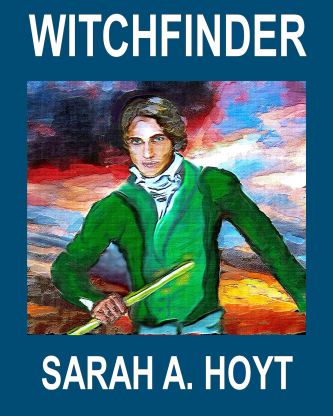

The Trouble With Heros

Seraphim Darkwater could feel the spell assemble behind him, tendril by tendril.  The woman’s magic was odd.  Avallonis in origin.  He’d swear to that.  He’d known enough power from other worlds to identify the markers of Avallonis.  But the magic had odd overlays, as though she’d learned it in some barbarous, ignorant place and had reinvented the whole discipline from the ground up.

A part of him, the part that had been a studious young man, rivaling the knowledge of many of his professors at Cambridge when it came to history and theory of magic, wanted to turn around and watch the strands of magic being woven in the air.  But he could not.  Seraphim had been trained – born – to protect those who couldn’t protect themselves.  And right now, he was the only one in possession of a mage-charged stick.

He shot at a soldier running towards him from behind a rock.  Then he shot again.  And again until he hit the man, who screamed and fell, spasming a little as the magic charge hit him.

The soldier wouldn’t die.  Seraphim never charged his mage sticks a lethal amount, mostly because he never knew when the people he might defend himself against might not be the agents of his majesty the king, enforcing the just laws of Great Britain in his native world.  A lot could be forgiven a high born and high spirited young man, even minor assault on an officer of the Empire.  But, should he let those high spirits carry him so far as to commit murder, that would be a trespass too far.

As the man fell, twitching and spasming, Seraphim stepped back.  And all at once he realized two things.  The man had been a decoy, likely a volunteer sent to run at his mage stick and keep him fully occupied as a party of guardsmen sneaked behind and around the rocks to his left.  Now he caught a glimpse of golden braid in the gaudy uniforms, and realized they were too near, and there were two many of them.  And one of them was pointing a magical gun at them, of the type that could disable witches and warlocks, but could kill shifters.  The boy-shifter.  Seraphim must protect him.

He turned around. There were too many of them for his stick to be an effective defense, so he must take himself and his charges out of here, and take them out fast.

The woman behind him had set up almost the entire spell.  Only the capstone lacked, and the coordinates.  Perhaps she couldn’t have set the coordinates from his arrival.  Perhaps her odd learning hadn’t taught her that.  Or perhaps it was all part of a plan to trap him.  Seraphim didn’t know, and, right then, he couldn’t care.  Instead, he poured his own magic into the working, and set the capstone on it, with the coordinates of his bedroom, coordinates as familiar to him as the back of his own hand, or the sound of his own voice.

The portal opened, gaping, and Seraphim, realizing the impossibility of throwing a lion through it, poured more of his magic at the young shifter to make him shift back into human, out of the lion form.  The child shifted and twisted, writhing and moaning in the pain of changing bones and flesh, all at a speed that would never happen naturally.

Barely had his form stabilized, and Seraphim was grabbing his skinny arms and throwing him, bodily through the portal.  Seraphim knew, in doing so he was hurting his own shoulder and arm, but he couldn’t feel pain.  Or anything but the urgency of getting them all through the portal and onto safe territory.  Through the portal he could glimpse Gabriel and hear faint echoes of his talking to the boy.

Seraphim reached for the woman.  She stepped back from him.  “No,” she said.  “You go first.”

“They have magic guns,” Seraphim said, keeping his voice restrained, but letting urgency leak through.  “They are near-lethal.  You go, then I after you.”

But she shied away from him, tried to step in between him and the moving ambush.  Stupid on her part.  She wasn’t armed.  He took a deep breath and mentally apologized to his mother and to his nanny who had taught him that a woman’s body was sacred and not to be touched without permission.  Then he grabbed her by the waist and, deftly avoiding her kicking feet and ignoring her voice saying, “Let me go,” he tossed her into the portal and – as far as he could see through his sweat-stung eyes, more or less on top of Gabriel.

The portal wouldn’t stay open much longer.  But it didn’t need to.  Seraphim took a step towards it.

The ray of the magic gun hit him in the shoulder.  Pain shot through his body, seized his mind.  His body shuddered, one long shudder, as his heart seemed to lose the rhythm of its accustomed beats.  He heard a hoarse scream, and was sure it was his.

The fall across the treshold of the portal, one half on either side, jarred his shoulder further.  He gritted his teeth against the chattering that threatened to bite his tongue in half.  He forced his shivering, shuddering body to obey him.  He ignored the pain that coursed through his veins like fire and bit at his nerves like the edge of a well-sharpened sword.

The portal was going to close.  He must get into one world or the other, or his body would get sliced in half and end up one half in each reality.  He must crawl across the portal and to the safety of his room.

For long moments, his body did not obey him.  His hands made frantic motions, but failed to push against the ground, his knees wouldn’t stay under him.  it took a superhuman effort to get them under control, to get them to pull him along the floor. He pulled himself forward one step.  Two.

He felt hands at his ankles, and heard a triumphant scream from behind.  He didn’t turn to look.  He could feel the portal starting to close.  He keened with frustration and told himself he would not cry.  He would die like a man.

From the fog clouding his senses, somewhere ahead of him, he heard a woman’s voice say, “Oh, please, you must help him.”

And he heard Gabriel’s familiar voice say, “Damn you Duke,” then. “Here, take this mage stick.  Lay into them at will.”

Seraphim tried to reach for the mage stick, but he couldn’t even see it, and his hand would not obey him, and he could feel the mage-field of the portal pressing against his middle.

Then strong, warm hands grabbed his hands and pulled.  Seraphim screamed as the pain to his shoulder increased a hundred fold.

Then darkness engulfed him.

The Price of Heroism

Nell hated heroes.  Years ago, when he’d first rescued her from Earth, Antoine had told her that he despised heroes who were men who would give themselves airs, and throw themselves in the breach with great pomp and circumstance, for the pleasure of pinning medals on themselves, no matter how many people died for their glory.

Her fury and surprise at Seraphim’s taking the spell from her and putting his own capstone on it was nothing compared to her fury at his insisting on her stepping through first and on protecting her with his body.  Her entire upbringing on Earth rebelled against letting a man, any man protect her.  And her months in Avallonis, chafing against the arrogance of noblemen and gentry, made her want to scream at his assumed gallantry.

None of this was improved by his throwing her bodily across the portal and on top of a tall man in neat, understated attire.  Disentangling herself from the man who was blushing furiously and who looked past her at the portal with an horrified expression, she didn’t see Seraphim get hit.

But when she turned around, there was no doubt he’d been hit by a magic gun.

She’d never seen one of these in action.  They were illegal in Avallonis, and of course, of no use at all on Earth.  Or at least not that anyone knew.  But she’d heard of them, and Sydell had once shown her a confiscated cache of them and described their effects.  She could still hear him in her mind as he told her how the gun’s discharge would kill a shifter at the barest touch, but was survivable to a mage, provided he or she was in good shape and got treatment immediately.

Only Seraphim wasn’t getting treatment.  He was fallen half across the portal, whose shifting light indicated it was about to close.  Around his body shimmered the blue-yellow lights of a disturbed magical pattern, as clearly visible to her mage-sight as his outstretched hands scrabbling in vain at the oaken floorboards.

He made inhuman grunts as he did so, grunts that seemed like the result of effort beyond his capacity.  All the while – and it seemed forever to Nell – the man on whom she’d fallen, was standing there, his arms akimbo, staring, his mouth open, at the duke about to get sliced in half by a portal.

Seraphim’s hands found purchase at last, and he pulled himself, a minute amount into the room, and then the men on the other side reached him, grabbed his ankles, and pulled him back far more than he’d pulled himself forward.  She had heard of those step pyramids in that world.  She’d heard they performed sacrifices there.  And besides, they’d shot him.

She found her hands were beating frantically at the impassive arm of the motionless man near her, “Oh, help him.  You must save him.”

As though her words had rushed him to action, he stared at the scene before him, and said in a tone of true rancor, “Damn you, Duke.”

When he reached into his vest and pulled out a mage stick, Nell had a moment of frozen certainty that he was going to shoot Darkwater.  But the man handed her the stick instead, and said, even as he bent down to grasp Seraphim’s hands, “Lay it into them, good and hard.”

She obeyed, almost without thinking, mowing down the soldiers grabbing Seraphim’s ankles and feet, while the stranger pulled the duke into the room by his hands.  A guardsman from the other world tried to plunge in just behind him, but Nell shot him with a bolt of magic, and he fell back twitching.  None too soon, as her mage stick was spent.  And the portal closed.

She let it drop from a nerveless hand and turned– To see the stranger taking a knife to the Duke.  The sound of his voice saying “Damn you Duke,” came to her.  She didn’t pause to think or to consider the consequences of her actions.  She raised a foot, high, and only slightly hampered by the dress and under dress, kicked with all her might at the knife wielding hand.  The knife went flying, and Nell dropped back, hands raised, ready to grab furniture or books or something to defend herself.  Or to send a magic spell against the man, when he came after her.

He didn’t come after her.  He didn’t even seem to notice her at all, though he looked dismayed when the knife went flying from his hand, and he shook his hand, once, twice, as though to rid himself of pain.

But then the took his hands to the duke’s coat, and pulled.  The coat tore down the front, to reveal a shirt all covered in blood.  And Nell realized the man had been about to cut Seraphim’s clothes away from him, so he could minister to the duke.  At the same time, the realization hit that this stranger looked a great deal like the duke and might very well be one of his brothers, though Nell had believed his brothers were all much younger.

She walked to where the knife had fallen, by a blue-velvet covered table stacked high with books, and noted without giving it much thought, that the covering was a little lifted and anxious eyes were peeping from under it.  The eyes were familiar.  It was the boy-lion.

Without a word to him, she retrieved the knife and walked back to the man kneeling by the duke and now trying, ineffectually, to tear the blood soaked shirt.  She handed the knife to him, handle first, and he said, “Thank you, Miss,” as though this were an every day occurrence.  She watched him cut the shirt to reveal, beneath it, a chest criss-crossed in blood-saturated ligatures.  The man said, under his breath, “Oh, the damn fool,” and Nell found herself agreeing.  Only a fool or a madman would take it upon himself to go into another world and get into a fight when he had suffered what appeared to be very serious injuries.  And most injuries were serious in Avalloni, whose magic could at the same time perform healing feats that would startle Earth, and be totally ineffective against infections.  People might regrow an  amputated limb, but they would surely die of the infection, if the amputating instrument hadn’t been properly sterilized.  And she doubted the implement had been properly sterilized before it had made those gashes, now revealed on the Duke’s chest and shoulder, as the stranger cut his ligatures off.

“I…  Is there anything–” she was about to ask if there was anything she could do, and then she realized that the stranger was muttering under his breath, a steady stream of arcane words.  As those assembled in her mind, she realized what they were.  A resurrection spell.

Her eyes opened wide, as she stared at the duke with her mage sight.  He wasn’t dead.  But the force of life around his body had ebbed so low it was like a flame that a careless breath might extinguish.  Used in these circumstances the resurrection spell, forbidden otherwise, as after death it only brought life to a soulless body, was much like the paddles with which, on Earth, people tried to stimulate a failing heart.  Except that it took a massive amount of life-force from the one administering the spell.  And she could do nothing but stand there, clutching her skirts, and watching as the stranger poured a not inconsiderable amount of magic into Seraphim Darkwater, in a desperate effort to save his life.

The stranger himself must be a considerable magician.  Either that or he would end up in almost as bad a shape as Seraphim.

One time the spell was said.  Twice.  Its force flared and fizzled, pale blue against the dying flames of Seraphim’s life which had ebbed down to a dirty sort of orange, like flames that have fed on oil and are almost spent.

Once more, and the force surrounded Seraphim’s body, and it looked for a moment as though it would re-light the force of his life.  But it died down yet again.  The stranger’s face grew stern, his features seeming to become all sharp planes and angles.  He looked more than ever like Darkwater, a Darkwater determined to be brave and strong against all costs.  Yet another damned hero, Nell thought, and it seemed to her she heard Antoine’s derisive tone in her thoughts.  And yet, she couldn’t bring herself to dislike or despise this man who was pouring his magic and his strength so unstintingly into the dying body of … his master?  His brother?

The stranger raised the spell yet a fourth time, and Nell told herself she’d take it next, rather than let the man commit suicide through generosity.

But this time, as the blue flare went out and surrounded the duke, the orange, dying flame of Seraphims life, caught and sparked, then grew into a pale yellow-white flame.  Not quite healthy life, but abundant, reigniting his vitality fully.

In the dead quiet of the room, she heard the Duke take one breath, then another.  And then his rescuer took a breath, which curled upon itself in a sob, which, in turn, quieted abruptly, as if – hearing himself show a sign of weakness – the man had cut it off.

He lowered his head and shook, still taking painfully loud breaths, like a man at the end of miles of running, and Nell found that she, herself, had not breathed in too long a time, and took a gasping breath.  Then she thought that the man looked very ill, waxen-pale and shaking, with the effort and reaction of a resurrection spell so oft repeated.

It wasn’t even that it took a lot of magic, a lot of power, a lot of strength.  No.  It was more than that.  When using such a spell there was always the danger that between sending it forth, and its hitting the target the target might die.  And if such a thing happened, then the mage’s duty was to kill his creation immediately.  In fact, in Avallonis not to do so was punishable with death, though she’d heard that the law was rarely enforced.  But it was certainly punished with exclusion from all society and magical association.

The stranger shook, and his dark hair was pasted to his head with sweat, and Nell surmised that he would not want her to see him in this state.  Men were proud everywhere, but in this world more than anywhere else – particularly the gentry, which this man might very well be, as much as he looked like the Duke.

She fell back on the expected role of women in this time and place.  Going to the wash basin set in a corner, she was relieved to find that it was supplied with an ever-filled ewer, the water magicked in – probably from the well of the estate – as soon as it was emptied, and kept warm in the container, by means of a spell.

She poured it into the basin, and grabbed a bar of soap and a pile of the folded linen towels left by it.  With the towels under her arm and the soap caught her under chin, she walked back carrying the delicate porcelain basin, with the pink and blue roses painted around the edge, and set them on the floor next to Seraphim, who still looked dead, but who was breathing regularly.

She dipped a towel in the water and, very gently, started swabbing at the Duke’s blood-covered chest.  She was relieved to find that he was not nearly as torn apart as it looked from the blood.  His wounds were, in the main, two, one in his chest and one on his arm.  Not that it mattered.  In Avallonis, you could die of a scratch if it were not sterilized in time.  And the Duke’s wounds were no scratch.

“Thank you, Miss,” the strange man said, in the tremulous, breaking voice of a man pushed beyond physical limits.

She didn’t look up.  Instead, she smiled a little, while wiping the blood from Seraphim, and noting those wounds had once been sewn together, though the stitches had now been torn out.  “My name,” she said.  “Is Helena Felix,” she said.

“Miss Felix,” he said.

“But no,” she said.  “You must call me Nell.”  And sensing, even without looking up, his shock at being invited to call her not just by her first name but by a nickname, she smiled again.  “We have fought together.  You would not call a comrade in arms by his last name would you?”

His breath skipped showing an hesitancy.  She looked up to see him open his mouth, then snap it closed.  “I might,” he said.  “If he were well born.  You see, I don’t know what you– That is, you must know my name is Gabriel Penn, and I’m his Grace’s of Darkwater’s valet.”

It was Nell’s turn to be shocked.  She fought having her mouth drop open in surprise, and instead managed to say in a creditable show of composure.  “I see.”  But the truth was that she didn’t see at all.  Not only was the man an enormously powerful magician – she herself doubted she’d have the stamina to do the resurrection spell four times in a row – but he was undoubtedly trained.  And while there was all chance of byblows, men being what they were, and therefore of a servant having some form of magical power, bastards never – at least in Nell’s experience – had as much power as this man had.  And those who did were never taught.  At least not the riskier spells.

Who were the Darkwaters?  Seraphim went looking for fights in worlds where he had no business, in direct contravention of his majesty’s laws, and this other man who looked so much like Seraphim, but who was a servant, used spells no one but a Gentleman could have been taught to wield. Or have the power to manage.

“I see,” she said again, and cleared her throat.  “I shall call you Gabriel then.”

He opened his mouth, then seemed to think better of it, and got up to go to the drawer in the dressing table.  When he returned, he carried a box which, when set by the side of the Duke’s unconscious form and opened revealed needle and thread and what looked like a complete surgeon’s kit.

“You might want to look away,” Gabriel said.  “Miss.”

“No, I don’t believe so,” she said.  “I’ve seen blood before.  You’ll want to disinfect the wound first, though,” she said.  And realized he’d already laid hold of brandy and was pouring it over the Duke’s wounds.  She was about to tell him pure alcohol was better for that, when she decided the man knew his business as well, if not better than, her.

Instead, she watched as Gabriel sewed the first of the Duke’s wounds closed, then started to slather it with a thick grey ointment that seemed to be infused with healing magic.  “Give me the ointment,” she said, firmly.  “I will do that while you sew his chest wound.”

He inclined his head, saying nothing.  “You’ll pardon me,” Nell said at last.  “But what business had he to go about like that when he was this seriously wounded?”

The man made a sound that might have been an hiccup, the beginning of a laugh, or a smothered sob. “None,” he said.  “But no use trying to prevent him.  When he thinks something is his duty– A great one for duty is the Duke.  If you knew how many times– Oh, never mind.”

But Nell had caught both the exasperated affection and the mingled admiration and anger in Gabriel’s voice, and realized it was the feeling of an older brother for a younger brother who was inclined to biting off more than he could chew.  The Darkwaters were unusual indeed.  Clearly Gabriel knew these spells because he had been educated in magic.  And given the aplomb with which he used them, he must have been educated in Cambridge, alongside his legitimate brother.

Because she knew better – had learned better over her time in this forsaken world – than to question legitimacy or the bond of blood between men of two such different classes, she said, instead, as she slathered the newly-sewn wound, and Gabriel finished cleaning the duke – or as much as he could clean him given the inability to submerge him in water, “The young man who came in with us is under the table there.”

Gabriel nodded.  “Good.  I hope he’ll stay out of the way till I can call the housekeeper to get him clothes and, hopefully, to take him to her cousin’s cottage for a spell.”

Nell hesitated.  “He…  That is, he is a lion shifter.”

Gabriel nodded again.  “A lot of the rescues are from that world.  Seraphim usually pays their way into a shifter seminar in Bath.  There are two, one for young ladies, and one for young gentlemen.  All the teachers are shifted and therefore equipped to train the young people in the ways of control of their magic, and in the ability to shift at will.  But I understand they teach them other trades, usually as clerks or secretaries or the like.”

Nell shook her head at the idea of a shifter secretary.  Back in the day when she’d worked in computers, their group’s administrative assistant had looked much like a weasel, but she supposed here it would be more obvious.

“And the housekeeper knows about this?” Truly the conspiracy to breach the sovereign shields of other worlds was extensive.  And law said all of them were due death.  She couldn’t imagine denouncing Seraphim or Gabriel and seeing them beheaded and hung respectively.  No. She had seen Seraphim almost die.  But if she lied on her report and they found out, surely they would hurt Antoine?

“She’s my godmother,” Gabriel said, as though that meant something.  “Now, Miss, if you’d step aside.”

Miss stepped aside, wishing in an annoyed sort of way that the proper Gabriel would call her Nell, a feeling that was dissolved into shock as that man who had just done four resurrection spells, lifted Seraphim in his arms and carried him to the bed.

Oh, the bed was only three steps away, and Gabriel did totter under the weight of the duke, but that he could lift him at all – when both were well-matched for weight and height – much less after the ordeal Gabriel had inflicted on himself, was near-unbelievable.

Yes, the Darkwaters were an odd family.  And they might be made of more-than-human stuff.

Gabriel laid the duke down, and waved his hand at the mage light on the bedside bringing its glow down.  “And now we wait,” he said.  “And pray if we remember how.”

But if there was anyone listening to prayers at that moment, they must have turned away, because – before Nell could answer – the door to the room jiggled, then flung open.  Framed in the doorway stood a small, dark woman old enough to be the duke’s mother.  It seemed to Nell that was exactly what the woman was, in fact.  Nell had memories of seeing portraits.

But unlike the portraits, the woman wasn’t smiling.  She had her opulent dress clutched in either hand, lifting it away from the legs as women of this world did, when they must move swiftly.  And she was saying, “Seraphim, I demand that you explain…”  The words died, as she looked towards the bed and Seraphim, sprawled on it, unconscious.  And then she said, “Oh.”

What I Saw At The Revolution

As many of you know I went to the Oregon Coast to take a workshop with Dean Wesley Smith and Scott William Carter with Special Guest Appearance by Kris Rusch ;), on the whats and hows of epublishing, and – more importantly – whys.

I’ve taken other workshops with Kris and Dean in the past, and this one was both similar to those (starting with the very first master class which I attended) and completely different.

It was similar in that Kris and Dean give value for their workshops.  I’ve said this before.  They don’t have the lengthy breakfasts, the laid back chats…  No, every minute of the workshop – and often of the working lunches, when they have to let us eat before we faint (grin) – is dedicated to learning.  This makes it very exhausting even if you already know some of the material they’re teaching and, probably, near-lethal if you’re learning and thinking it all for the first time.

This is in no way a complaint.  If you’re going across the country for a workshop; if you’re a writer who is perpetually semi-broke; if you have a family you’re leaving on their own while going, you WANT the workshop to be intensive.  The last thing you need is to spend time out there doing nothing, while you know you could be working at home.

It was very different from past workshops, though, in that Dean was sharing things he learned just recently and often saying “this might change” or “this might be different for you.”

It was similar because, as with many of their workshops, a lot of what they said I have to struggle to accept – even when I logically should know it’s true.

It was different because the market portion of it was more tentative.  See, the market portion used to be on how to submit to editors.  It now is on how to submit to… readers.  Editors were a small group, living in NYC, attending the same parties, talking about the same topics, practically inhabiting each other’s pockets.  You could psyche their preoccupations and their hot buttons one way or another.  Apparently my subconscious has a long – LONG – list of “do not write this, no one will buy it” topics, and by “no one” I mean NYC editors.  OTOH, ebooks are marketed to a for all intents and purposes infinite market, which does not live in each other’s pockets.  Who knows what will find a niche audience of, say, a million people or so, and take off like a rocket?

It was similar because the emphasis was on writing, telling good stories, writing fast and well.  Okay, it wasn’t a writing workshop, but 99% of the attendees were traditionally published authors, and Dean kept emphasizing if you stop writing to do tech, you will fail.  The writing is what drives all the rest, and the tech is designed to give you freedom to create what you want to, beyond the limits of the traditional market.

The funny thing is that they didn’t really tell me anything I didn’t know.  I mean, at the back of my mind, I’d already arrived to similar conclusions.  I know this, because as they presented their conclusions, the reaction wasn’t (usually.  There’s one exception) Oh, Heavens.  I Never Thought Of That!  It was more like Oh, Well, DUH.  However, they were things I knew but would never have put together, if that makes sense.  As is, some of them, though I know intellectually, will take me months to adjust my mind to.

So, without further ado, let me give you some things I learned at the Think Like A Publisher workshop.

1- The market is infinite for all practical purposes.
Qualifications – of course it isn’t infinite.  There is a limited number of readers in the world.  Also, for now ebooks only reach into about four countries (easily and from the US, that is) and are way behind the US in most of those countries.  BUT in terms of “there will be enough people in that group that like any given thing that you could not just make a living but become a millionaire” the market is infinite.

1.a – This is an answer to the “tsunami of sh*t” complaint about how indies will ruin publishing.  You see, with that vast a market, what you have to remember is that there are a lot of people in the group you can now access who LIKE sh*t.  (This reminds me of the quip in Pratchett’s Monstrous Regiment “I just said it was horse p*ss.  I didn’t say I didn’t like it.)

1.b. – by the law of statistics this creates a curious “flattening” of the market.  Yeah, some things will sell better than others, but not that insanely better.  Look, the thing about our “names” in publishing (by which I mean bestsellers.  For the benefit of the audience, no, I’m not a name.  I’m barely a name in my OWN household.) is that lately there have been so many of them they’ve become “niche names.”  Unless you’re talking of J. K. Rowling – and even then you might have to add “Harry Potter, you know?” – chances are any of your non-writing friends will give you a blank stare at the mention of any bestseller.  Heck, I’ve had people in the business give me a blank stare at t he mention of a bestseller in UF.  Part of what causes this is that there are so many books/authors out.  Now multiply that by a bazillion (yes, this is an exact figure!  Shut up.)  And throw in every writer who ever lived and whose work can be scanned in.  Compared to Rowling, I have a name in my own household.  Compared to, oh, Kipling, I’m “who is she?” even to my own kids.  But the thing is this is NOT a problem.  Why not? Because some night people might not want to read Potter or poems, and they might type in keywords that kick up my books – like Shifter.  Or Dark Ships.  And given an almost infinite market, there will always be a baseline of those enough to keep me in roof and meals and possibly even assistant.  Also, with luck and a little care on my part, they’ll come back because I give value.  And I’ll have an expanding audience that does not rely on gimmicks or publisher push.

2 – The supply is infinite for all practical purposes.  There’s every author who ever lived out there.  If you read a new author every day of your life, you’d never run out.  It’s reader’s paradise.  It’s also writer’s paradise.

2.a This creates the next answer to the tsunami of fecal matter thing – in the enormous pool of the market, no matter how much er… waste splashes in, it will be negligible.  Think of the difference between peeing in your bathtub and peeing in the ocean.  (This is not, btw, an encouragement to put out randomly generated stories, based on an algorithm that scrambles sentences and creates the equivalent of Atlanta Nights.  Peeing in the ocean is still bad manners and if people pay you for it, they’ll get upset.  At you, personally.)

2.b.  The doors have been thrown wide open.  You want to write about people who have a fetish for hydrogen peroxide?  There are probably enough of them out there to make you a very rich writer.

3- Chinese Math applies.  Sort of.
(Chinese Math states that if you sell something for a dollar to every Chinese person, you’ll still be rich beyond the dreams of avarice.)

3. a But Sarah, you say, you are unlikely to produce something that EVERYONE out there wants to read. [Stop.  Just stop.  You’re giving me the shakes.  I’m visualizing billions of dollars flowing in.  (Moans.  Clears throat.  Sits up straighter.)]  Right.  So, I am.  But I don’t need to.  Even if any given piece of my work appeals to say 1000 people on any given month, I’m making a living.  And if it appeals to 10000 people, I’ll be making a GOOD living.

3.b. It has a multiplier effect.  If one piece of my writing appeals to a thousand people a month (these numbers seem to be unrealistic, btw, unless you’re very good or very lucky.  Or both – hi Ric!  If a story is doing well it will sell maybe a few hundred a month) then why don’t I have ten pieces out?  Or twenty?  What am I, stupid?  At the level of criminal stupidity?  Agatha Christie used to say she sat down and said “I think I’ll write myself a house.”  Midlisters, in a way can now do that.

3.c. It REALLY has a multiplier effect, because readers are creatures of habit.  What in heck do I mean by that?  Well, once we find a writer we like we will keep reading him/her.  Sudden, for us, that author has stood up and is beyond the random selection thing I talked about.  Oh, it’s unlikely he/she will be an author “everyone is talking about” – look at that near infinite supply thing – BUT he/she will have a growing share of the market and enough to be very rich indeed.  So, have books out there under the same name/in the same style, etc, enough to make a living.

4. Book launches are irrelevant.  So is most other publicity.

4.a. All they do is speed up the process of finding an audience.  Okay, so perhaps not totally irrelevant, particularly very early on, when you want to start seeing some money for a proof of concept on your indie efforts.  But ultimately, say two years in the future, you’d be in the same place.  This means, if you can wait, you don’t need to publicize. Your book is not going to age or fall off the shelf.

4. b. Yes, this means that books don’t “age” – that relates to shelf space, etc.  If anything, since the best publicity in the new market is word of mouth, older books have an advantage.  Stop thinking of your books as bananas that will spot and spoil.  Now.

4.c. If you’re the sort of writer who wants to sit down and write furiously, your time has arrived.  (Thank G-d almighty, free at last.)  Oh, okay, you might need to learn some basic coding, but I’m now where I can see how to do it, sort of.  And if I can do it, ANYONE can do it.  Including people who’ve never seen a computer before and for whom chipped flint is the height of technological innovation.  (Yes, that’s how techy I am.)

4.d. There is no such thing as a “big book.”  Oh, sure, some of your work will sell better than other work.  But the difference won’t be enough for you to think in “big book” terms.  What I mean is for most of us, the editors have got in the back of our head and made us think things like “Oh, this next book is going to be huge.”  Now you don’t need to let that happen.  Just make each book the best it can be, and enjoy the process.

Now, for the one thing that is still hard for me to accept: It is still very early days on this.  Dean said it over and over again.  And I couldn’t believe it.  I mean, intellectually I know it’s true.  The very cumbersomeness of the software proves it.  You have to spit and duct tape things.  When it becomes more main stream, it will become easier, and eventually there will be a push-button solution.

But that’s INTELLECTUALLY.  Emotionally, it seems like everyone got there before me.  I have to tell myself this is not true and to calm down.

Anyway – these are the general impressions from the workshop.  Of course I can’t tell you everything they said over three days.  Even if I could, I’d miss little points, which would mean something for you that they don’t mean for me.  This is all filtered through my mind, of course, and I might have drawn conclusions the presenters never intended.  However to me, it is what I’ve seen.

I went to the revolution and took some snap shots.  And now, if you’ll excuse me, I’m going to write me a house.