The Writing Pink Ghetto

by Dave Freer

(Yeah, I know, I haven’t got in enough trouble all by myself lately, so, here is my friend Dave Freer taking up one of my favorite themes.  Dave for those of you who are lucky enough not to have read him yet — because you get to read all of his work NEW, you lucky sobs — is a wonderful writer and manages to be funny and moving all at once.   He blogs at Flinder’s Family Freer and also at Coal Fired Cuttlefish  [and yes, his mind is what you expect from someone who comes up with THAT notion: Delightfully creative.  And more than a little scary!])

So, let’s get back to the Writing Pink Ghetto

“I know what darling, we’ll paint the whole place pink.”

“Pink?”

“Yes. Even cerise, maybe.”

“With lace frills?”

“Oooh yes. That’ll put those nasty Nazis off.

“You’re barking mad, do you know that? Instead of giving bastards one excuse to kill us you give them two.”

“You’re just being mean to me!”

Let’s face it: Ghettos aren’t funny. And any sane human wants no more of them.

Well. Maybe. Sane… maybe. Decent or nice are a different matter, but like sanity are relative terms. You can be sane and a lowlife. The two are not exclusive.

Let’s look at history and the article (http://www.dailytelegraph.com.au/business/women‑gangs‑dominate‑business‑areas‑creating‑pink‑ghettos/story‑fn7ki14e‑1226290981814) that prompted me into my usual satirical snark. The link is one, but pretty much the same article popped up all over, like toadstools after rain. To summarize to save you reading it, some consultant types found that HR and PR departments in many large companies had become entirely female or with a few gay males. There was suitable outrage from feminist business-woman types about the fact that these were now seen as low status departments and their feminization limited their effect on the boardroom, which was yet more discrimination against women. The comments were telling too: there were the handful of parrots (trust me this is very bad for your hands) who bitched about evulll men, and a few misogynists who thought letting them out the kitchen was a mistake (I have always thought letting them into the kitchen was a mistake, but then that could be because I like cooking and Barbs detests it, and saying this really flat-foots your average femme-nasty)… and the vast bulk who said ‘how true, and how horrible working in those departments had been, and how much happier/more effective environments with a broader cross-section had been. ’ The posters seemed a cross section of men and women.

I thought about the whole boiling ferment and thought about how it relates to my own industry, and about how some of it was raising the bullshit meter and logic screens. And then I went and had lunch, which proves I have a very strong stomach and fairly low intellect.

Look , I have seen the same thing in other places. Schools and libraries to think of two really important ones.  And it is sweeping publishing, writing and… even reading. What’s somewhat more worrying is that there are people who think its a good thing (TM). Let’s just drift back into that thing we never learn from, ergo, History. The term ‘ghetto’ comes  from Venice – which as some of you may remember is where I set SHADOW OF LION, and where the social and political background of that 15th century series is set. I’ve been to the Campo Ghetto, read about its history. And it’s not particularly nice reading. But here are things you may not know.  1) in comparison to most of the rest of Europe (and a lot of other spots too) Venice was a liberated spot, and a good place to be a Jew. This doesn’t make it wonderful, but as all things are relative, means if you handing out prizes for integration and tolerance back then Venice would have been a long way ahead of Rome (or just about anywhere else), which makes Venice bashing (in modern terms too) a little… odd. 2)The gates on the ghetto could be locked… from the outside (to keep Jews in during various ‘important’ times in the Christian calendar, like Easter).  And also from the INSIDE to keep rampaging pogroms out. 3)The Ghetto had its own rules, laws… and naturally leaders and law-makers, who were very powerful in that sphere.

Two other things of course have come out of history since then. One is that ghettos develop when a certain critical mass of whatever group it is bunch together, whether they are made to or choose to: other people either expelled or choose to move out. It takes a fairly determined effort to stop this happening. It’s almost inevitably bad news, socially and in terms of worsening discrimination in the long run. And the other is the development of ‘ghetto pride’ where the positive aspects of grouping are praised and anyone leaving (or speaking against it) is regarded as a traitor.

So let’s slip back to the feminization of HR and PR departments. ‘They’re service industries, they’re regarded as unimportant, and that’s why women are shunted off there into a dead end with no effect on the boardroom.’ Oh dear. My Bullshit meter just exploded at the logic flaws… HR — besides settling cat-fights and organizing team building exercises — aren’t those the people who hire-and-fire, specifically HIRE people? Surely the kind of hires and where they are hired to is 1)vital to the company’s future and bottom line. It is, in strategy terms, your most powerful and direction influencing department (try strategy games if you don’t believe me. You can win or lose based not such on your skill in playing as who you choose and where you put them. And in real life, more so.). If you can’t do anything while controlling it, consider getting a big L tattooed on your forehead. For ‘learner’ of course. Couldn’t be for ‘loser’. 2) Who, if not the HR department, ends up controlling who is in each department?  So if it’s an all female and gay male (I quote – seen as ‘weak’ by other males) department, who made it thus? Who favored ‘sisterhood’, and who wanted to go to that department? Who let them? As for PR… yeah it’s a lot of waffle… by which companies sink or win Olympic swimming medals. Apple has good PR. That’s why they sell a lot of products. Be the products brilliant (or about par or shoddy) or not, without PR they’d be selling about the same as my books – which have the benefit of no PR bar my little efforts.

If these potentially powerful forces are weak and lack boardroom influence… why?  Is it because they put gender – and/or other factors before effectiveness?  And if it really is the case that it’s just because they’re all women, what pragmatic step can they take to change that?  They really are in the best possible position to open the gates to the Ghetto. Yes, it will mean they’re not 98%+ female departments any more. And yes, it will mean the company – looking for some sort of gender parity to keep itself out of trouble with those who will call ‘discrimination’ otherwise, will need to make that HR department work at finding female IT workers or metallurgists, seeing as your female numbers from HT and PR will drop.

As with teaching and librarianship — it’s hard to imagine positions which should more respect, which should wield more influence, or which I regard as more important.  So ask the hard question: why aren’t they influential, well paid, keenly competed for by the best… and what can we do to change that?  And the answer is obviously NOT ‘more of the same’ Eventually you have to realize that repeating the experiment won’t change the result. It’s time to try something different, being pragmatic, even if it messes with your biases.

So how does this play into writing? As I said, it too is suffering from ‘pink Ghetto’ cries, with all the same complaints and all the same non-solutions. Romance – the biggest, richest most powerful genre sector – constantly complains it is not taken seriously. Yet there are women – often the same women who are successful in that genre or YA which is overwhelmingly female dominated – bitterly complaining about sex ratios on the TOC’s of tiny hard science short-story anthologies (my favorite whine here comes from Aussiecon when a female author of literary fantasy complained about the fact that she was excluded from Hard Science. Did she have a Science background, or any grasp at all of science, she was asked. Well no, but you didn’t NEED that, you didn’t even have to write that. You should be on the TOC even if every other male-written story was written by a scientist and was about hard science and yours was about the feelings of girl unicorns for other girl unicorns. It was just pure discrimination that kept women out.)  The whines about men getting all the reviews and literary prizes are rather like being chained down in a room with 50 mosquitos and Oprah re-runs (especially considering the non-effect of said reviews and prizes).  The answer ‘women only contests’ makes me think of tennis (I need to sleep more, and I find Wimbledon very sopor-soothing). Women, even militant feminists, who tried take on male champions, failed. Men are just more muscular and faster. So: they have Women’s Championships… which make sense if you are willing to accept that physiologically or mentally you are less-than-equally able.  This does NOT apply to writing skill, in my opinion. It must do so in the opinion of those who initiate, sponsor, and accept prizes from such competitions. It’s not exactly liberating is it?  Yet women editors are no novelty, and outnumber males (and some are right at the top), women writers outnumber males by a huge margin, and women readers outnumber males by an even bigger one. JK Rowlings, Janet Evanovich and Stephanie Meyer barely earned any money at all… Any suggestions that there might be a problem with, for example, the overwhelming female writer/reader situation in YA fiction is met by a fierce clash of the Ghetto gates…

Lady Guardian: “This is OUR patch. WE make the rules here. It’s our turn now. Jacqueline here deserves our support far more than Joe, who shouldn’t even try to write YA. He’s a filthy hetero white male. She’s the victim of sexist persecution.”

Voice of Reason: “Um. She’s lived a pampered life,  went to a liberal art college paid for by her father. And her brother had to go out and work at 16. Joe is the last 13 children and had to teach himself to read, never got enough to eat, and his book is funny, warm, and brilliant. Jacqueline’s reads like yet another carbon-copy of the sparkly Vampire.”

LG: “Well, Jacqueline’s mother was a victim.”

VoR: “Jacqueline’s mother was an only child, and spoiled darling and inherited a fortune.”

LG: “You can never understand how she SUFFERED. Punishment must meted out unto the 10th generation. Or more. The sins of the father shall visited on the (male) child.”

VoR: “Didn’t know you were fundamentalist Christian.”

LG (belaboring VoR with a pole-axe and a lawyer).“How DARE you! I’m Wiccan!”

There is of course a logical answer to all of this, but it is a disempowering one… to the leadership. The ghetto isn’t being barred from outside any more. And no matter how you complain, bringing more areas into ghetto-only will not help. If for example, you force Hard Science writing past the critical mass point… all it will do is make the situation worse. It’s like Liberal Arts Colleges – already at 75%+ female students, attacking the 20 male student strong Physics department for having no women. If they succeed in forcing the Physics professors to accept and give first class marks to essays on the feeling of girl unicorns for other girl unicorns while the males have to do Feynman diagrams… well, shortly you will have no male students, your physics department will be worthless, and your college sex ratio will be up to 76%+ female. A win all round, yes?

The pogroms are over.

Open the Ghetto. Get ‘non-pink’ people in too, and go out. And sometimes they may end up on top… but unless women are completely inadequate, some women will too. And some, having done well in one field, will show they have a perfectly good grasp of solid-state electronics too. If women aren’t winning prizes and getting reviews… start new competitions – ones in which the work made anonymous and is judged by 50:50 panel. Women are NOT (outside the few who feel terribly threatened by a 50% increase in competition and are squalling loudest) any less capable than men. And there are men who can write about the feelings of girl unicorns for other girl unicorns.

And everyone will be richer for it.

Ooh look, there goes a winged pig, chased by a girl unicorn…
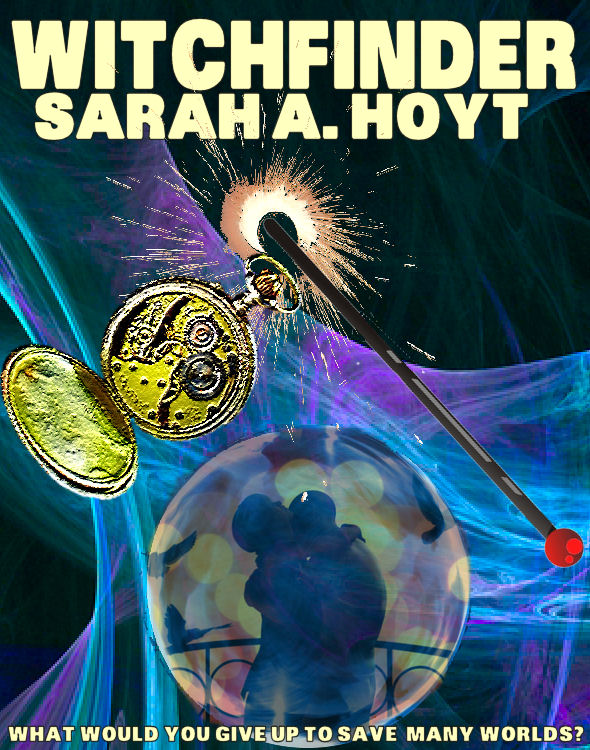
Witchfinder, Free Novel — Chatper 25

This time I really MUST apologize because today’s chapter is little more than a teaser.  As an apology it must serve that I am on the very last phase of a difficult rewrite and that I’m just recovering (at least hopefully recovering) from a weird wobble in health.  I WILL try to post a little more either today or tomorrow evening (Tomorrow I have a guest post by Dave Freer, and trust me, you don’t want to miss that.)  However the choice is to post this afternoon and spend the whole day trying to do this, or to deal with the pressing things interfering with my writing more Witchfinder and then coming back to it, fully refreshed.  So, for now, have the very small chapter 25.  More cake later or on Sunday (or late tomorrow) I promise.

*This is the Fantasy novel I’m posting here for free, one chapter every Friday.   If your conscience troubles you getting something for free, do hit the donate button on the right side.  Anyone donating more than $6 will get a non-drm electronic copy of Witchfinder in its final version, when it’s published.
There is a compilation of previous chapters here  all in one big lump, which makes it easier to read and I will compile each new chapter there, a week after I post.  When the novel is completed and about to be edited the compilation page will probably be deleted.

Oh, this is in pre-arc format, meaning you’ll find the occasional spelling mistake and sentence that makes no sense.  It’s not exactly first draft, but it’s not at the level I’d send to a publisher, yet. *

For previous chapters, look here:  https://accordingtohoyt.com/witchfinder/

Dangerous Roads
“In here, Mama,” Caroline whispered, her warm hand on her mother’s arm, pulling her close and into a dark space between buildings.  For a moment the dowager saw nothing, then, in front of her like the landscapes one sees in a dream, a doorway opened, filled with something like twinkling lights.
The impression of twinkling lights was a moment, nothing more, and then they were on a vast meadow, under the moonlight.  It smelled like a dream, too, except of course one didn’t normally smell in dreams.  But what surrounded Barbara was a warm scent of hay and flowers and of water running nearby, all of it untinted by smoke or any sign of human habitation.  Also, all the smells were heightened, stronger, the sort of smell one remembers from childhood, when the world is fresh and new.
She stood rooted to the spot a moment, as the warm breezes of the meadow wound around her, thinking that she didn’t remember fairyland being like this.  Perhaps they’d come somewhere else all together.  But in her mind she was remembering what her rescuers had done to find her and bring her out – everything that she’d ever heard about bringing people out of fairyland.  She hesitated before speaking.  If she told them to Caroline she reached offending her daughter.
It had become clear to Barbara over the last few moments that her daughter knew far more than Barbara herself about some things: those things being for instance how to go into fairyland and how to defend oneself from elf magic.  Crossing over into fairyland was a major working.  It required not only a susceptible location, where a portal could be opened, but also preparing the magical spell and working it for about half an hour, before the portal became obvious.  Barbara realized that Caroline must have been saying the spell under her breath the whole while they walked down the street, and wondered if this too was something Gabriel had taught her.  She wouldn’t ask.
But there was a good chance, she thought, that neither Gabriel nor any of her teachers had taught the girl what she must do, to come safe out of fairyland.  She’d risk offending her daughter, then, because if they should get separated, what Caroline didn’t know could kill her.
Just then Caroline pulled at her, but the first rule, Barbara remembered, was to stay on the road.  And they were not on the road but on the grass next to it.  She resisted Caroline’s pull forward, upon the grassy rolling hill and instead spoke in measured accents, in a little more than a whisper, “No, my dear.  The first rule you must remember,” she said, while she in turn pulled Caroline sideways and a little back, until their feet were firmly planted on a brick-paved road.  “Is that you must always stay upon the road.  It will change as you walk, but the road is your only measure of safety.  It exists only for visitors to fairyland, and, as such, it is part of a pact between our people and elves.  They cannot hurt visitors who are on the path and we, in turn, undertake not to deviate from the path, and to stay on it whilst in fairyland.  Do you know the other rules?  I hesitate to ask, but what did Gabriel tell you?”
“That I should not eat anything any elf ever offered me.”  Caroline paused.  “Other than himself, I presume, because that would make it very difficult particularly when I was little and he gave me candy.”
“I don’t think that Gabriel counts as an elf.  Not a true one.”  She paused in turn, as an odd thought occurred to her.  “At least not unless he wants to be one.”
Caroline seemed to understand this, as she nodded a little.  “I assume this applies to anything in fairyland.”
“Yes,” Barbara said.  “I very much believe so.  But there are other rules.”
“Such as?”
“You must help three people you encounter.  You must remain loyal and pure and impervious to temptation, and you must do your best to help those who need you, while refusing to either leave the path or eat anything.  This might include performing feats that would otherwise be impossible.  In these tasks, you will usually find three helpers.  These are not always wholly good, and usually they want something in return, but you must accept their help nonetheless, and count on being able to defeat their wiles, later.”
“And?”
“And you must under no circumstances accept an offer to live in fairyland.  Oh, it won’t be presented that way.  It’s usually presented as great riches, a palace, anything you care to own.”
Caroline looked at her mother curiously, her head tilted a little to the side, as though evaluating something.  “How very odd.  But you’ll be with me and able to remind me of these rules, will you not.”
“I don’t know,” Barbara said.  “What you have to understand is that fairyland works in ways that our world doesn’t.  The same rules of logic do not apply to both.  I wasn’t with the people who came to rescue me, but I know that they got separated, and never found out how.  So, if you get separated, do remember those rules.  They should be enough to keep you safe.  And now let us walk.”
“Which way do we walk on the road?” Caroline said, confused, looking behind her, and then ahead.
“It doesn’t much signify,” Barbara said.  “Direction also doesn’t mean in fairyland what it means in our world.  Instead of north and south, they have deeper and out.  Whichever way we walk in fairyland, while in pursuit of our goal of finding your brother, we will be penetrating deeper into the lands of magic.”
“But how do we leave then?” Caroline asked, as the two walked the way they were facing, along the genty rolling road, amid a meadow so beautiful it looked like an illustration from a child’s book.  In fact, everything from the too-green grass, to the intense scents of summer, to the rolling hills gave the landscape the impression of being too beautiful to exist – something not even out of a real dream, but out of a story.
“We leave when we’ve found your brother and we’ve fulfilled all the conditions of our coming here, such as our agreeing to render help to three unfortunates.  That is,” she said, as another thing occurred to her.  “When those are done, we are automatically ejected from fairyland and into the real world.  That is unless…”
“Unless?”
“The king of fairyland objects to our going,” Barbara said.
“And then we’re prisoners here forever?” Caroline asked, her eyes very wide and for the first time the hint of fear in them.
“No.  We’re here,” Barbara said.  Until we can find a champion to fight for our freedom.  She paused.  Somewhere ahead, something or someone was crying desolately.

For more witchfinder, look here

They All Sleep With Each Other

No, not my characters.  For heaven’s sake, don’t even say that.  There’s this chorus of “ew” in my head right now.

No.  What I mean is more… convoluted than that. (Isn’t it always?)

I don’t know much about going to college in the US, never having done it here.  I’ve heard of Student Union buildings but I don’t know if they’re actually unions in the style of labor unions.  I know that you have student councils in Highschool, which was jaw dropping for this kid from Portugal.

So, my first brush with “group organization” – community organization, you could call it! – in the style of unions came in my second year in college.

I don’t remember the exact circumstances, but they went something like this – the fourth year (where the grades you got were essential for a few things) had two German professors.  A female professor who (I ended up getting her in my third year, so trust me, I KNOW this) was a very tough grader, partly because she didn’t understand that students came to college with six to eight years of English but only two of German.  She expected the same proficiency in both languages.  Also, she took her clue for how proficient we should be from the highest scoring student.  If you’re nodding at this idea you don’t understand Portugal.  Each class would inevitably have at least one student who was the child of an immigrant to Germany (Immigrant children born abroad are given preference in entering college.)  So ours, like other classes, had someone who was native-proficient in German (though she couldn’t pass any other class.  Never mind that.)  I never understood WHY this woman didn’t understand that, but never mind.  Maybe she was simply a sadist and got off on making even the up-till-then best scoring students struggle just to pass.

The professor who taught second years quit, and they moved the fourth year professor down.  This would force each professor to take double the load, but was doable.

Except…  There’s always an except.  The professor they moved, at least that year, was the easy-grader.  Also, one of the fourth year students was connected to the administration, which, this being a public university, probably meant politically connected.  (At least one.  Might have been more than one.)

The end result is that they never moved the easy grader.  For whatever reason (pay?) The hard grader refused to be moved as well.  So the second year students, for whom German was REQUIRED (there’s less flexibility in Portuguese universities.  You get ONE elective in your last year, up to there, you pick from groups of courses depending on your ultimate degree.  And while you can pass dragging a class or two, there are classes you have to pass to advance.  Being a core discipline for most of us, German was one of those.) had NO German professor.

Impossible you say.  Ah!  Yes, that would be nice, but no.  We were told we had the option of signing up for and taking the semi-annual or annual exams and pass.

The fact that no one would be teaching us made no difference to them.  We could take the exam, so it was fair.

(I have to say going to college in Portugal DID prepare me for a life as a professional writer.  And the following experience, certainly did.)

I was young, okay, and very, very, very stupid.  The two conditions often occur together and, as I’ve said before, one of them is curable.  I thought “the only reason they can get away with this is that the public doesn’t know.”  So far so good.  And then I made a fatal misstep.  I organized the second years to demonstrate.

This was stupid because there were – at most – sixty of us.  Even if we protested in shifts around the clock, we didn’t make a very impressive display.

What I should have done – or at least what I’d do in the US – was start a letter writing campaign.  AT the time, though, I just thought “demonstration” and “Strike.”  But here’s the thing… the college couldn’t care less if we striked.  They don’t have trustees or any board of accountability.  All it meant was that some teachers got almost empty classes (we didn’t have every class together, since some of us were German-English, English-German (me), some Portuguese German (and vice versa) and for the truly weird ones, French/German (and vice versa)) and our grades would suffer.

After about three days, I realized we were in a situation where ALL we could do is cut off our noses to spite our faces.  Or, as my grandmother told me at the time “They have both the knife and the cheese.  what are you bargaining with?”

In other words, all the control of the situation was in the other party’s hands, and if we protested too much, all it would do was get us failed – should we indeed manage to make enough waves to be noticed.

So, we went back to classes and organized study groups to teach each other German, as best we could.  And I spent the next summer working in Germany, to compensate for that year.

And it prepared me for life as a Science Fiction writer.  Even if the publishers weren’t members, even if SFWA tried to do good things for every writer and deal with the important questions – what were they going to do?  Picket?  Two to a city…  Write letters to the editor?  And then what?  In an industry in which you can get kicked out for being “difficult,” what would that get the few who became visible?

When I said that SFWA was always, at best, a directory that’s because that’s the best they could be given the way they are organized, their numbers and the fact that until very recently the publishers had both the knife and the cheese.  AND they were the sole employer of most of the members.  So provided something really egregious – the no-compete clause, say – was something all houses were doing, what was SFWA going to do?  More important, what were the very human people running SFWA going to do?  Destroy their one chance at working ever again?  Riiiiiight.  They all sleep with each other.  They have to.  There is (or there was until very recently) no other bed.

The only semi-effective writers’ organization is RWA.  It is semi-effective because in addition to the pro-arm, they have a vast army of wanna bes.  But even if we enlisted EVERY geek in every college campus across the US I doubt we’d have much more than a tenth the number of wanna-be romance writers.

Even RWA suffers from knife and cheese problems, leading the biggest publishers to get away with murder.

Partly, of course it is because these are organized on the principle of labor organizations, which flourish/ed only where the workforce has limited mobility (true of writers, since there are big six) but a large presence in one place (which we don’t have) a service that’s essential to the public (well, we kind of have that but not really.  Only part of the public, and besides there’s old stuff they can read) and a not-easily repleaceable work force (which we also don’t have.  At least the publishers think they can replace us on the minute.)

A writers’ organization would probably be better if it functioned more like a “fraternal order” and got other support for writers.  You know, rainy day funds, medical funds, widow and orphans and health insurance.  We have had several attempts at that, but never really got them off the ground.  Partly because during the last ten years just keeping a writing career going has been a more-than-full-time-job, as more and more of the work got offloaded onto us: publicity; editing; sales.  Getting fraternal support services going requires time and full dedication.  Of course if we had something resembling retirees that would be a good job for them, but most writers retire when they pry our cold dead fingers off the keyboard.  And most of us never have enough financial security to even step back from the mad schedule.

Anyway, all this to say that I understand why SFWA is INEFFECTIVE.  That was not what set me off.  What set me off is their attempt at seeming effective by stepping in the middle of a dispute that has nothing to do with them and which, if the side they’re supporting wins, would probably (probably because these details are not really obvious) would end up hurting their members and almost certainly CANNOT end up benefitting them (though it will benefit the distributor involved in the fight, mind.)

Just because publishers have the knife and the cheese it doesn’t mean SFWA has to borrow the knife and cut of the member’s feet with it.

If I were in office at a writers’ organization (horrible idea. Was tentatively sounded out on it ONCE, made it very clear not only no, but h*ll no.  The six books under contract being only a part of the problem) I’d right now be looking at what is happening with Indie and looking closely – very closely – at any possibility of transitioning at least partway to a fraternal support movement.

Perhaps someone who is more sociable and plays better with others – I don’t know.  Perhaps the spouse of a writer? – can look into starting a Fraternal Order of Pen Pushers. (Yes, I know it’s anachronistic, but do you REALLY want to belong to the Fraternal Order of Keyboard Strikers?  Think about it!)

Me?  I have books to write.


Update:  I should add here, as David Burkhead has pointed out that SFWA has some of the functions of a fraternal organization, including legal fund, medical fund and such.  The thing is, I’d forgotten them momentarily which tells you something when I have been a member for eleven or twelve years.  I don’t think most of us turn to SFWA when in need because… well… the resources are limited  This is because, as I said, writers’ purses are limited, and we don’t have that pull of retirees which devote themselves to fundraising for such things.  The fact that we’re all as antisocial and fractious as cats might not help, either.

To be honest, neither MWA nor RWA, of which I’m also a member, is markedly better on that end, though RWA is a little more proactive than the rest (and also massive because they take on people TRYING to be published, into another category of membership.)

I still think particularly in the new era of publishing that’s the place for writers organizations to go, and not into misguided defense of the status quo and pseudo-labor-movement attitudes.  By being uniquely talented (not by meaning we’re special, just that each of us has a unique type of talent.  We’re not interchangeable), literate, mobile and disperse, we’re the least likely jurisdiction for a labor movement to help.

The Broken Van

No, this is not a post about my car troubles.  Do I want to start crying this early in the morning?

Though, metaphorically speaking it is a post about ALL of our car troubles.

Years ago when I was young and stupid – the first of which is curable – we had a good friend who worked as a French chef.  Turns out, at least at the starting levels this is one of those professions like writing where your work schedule and money aren’t always incredibly regular.

Because of this, like many writers, our friend owned an endless succession of pre-broken cars which he drove till they would go no more and then get another.

Then one day he bought this van.  As he was driving across town in Charlotte, NC (motto, our traffic makes NYC cabbies shudder) he suddenly realized the van wasn’t responding to the brakes.  So – as he approached a six way intersection – he tried to steer it to the side of the road…  And the wheel came out in his hands.

I no longer remember how he got out of this situation, except that he SAID he’d closed his eyes and prayed several rosaries, which – he said – was kind of funny since he was a practicing Jew.  I suspect he downshifted until it came to a grinding halt.

For a little over a year, since I realized something had gone seriously wrong in publishing, I’ve had that feeling, that we’re all in that van, with no brakes and no steering, closing and our eyes and frantically looking for the rosaries we don’t carry.  Since then I’ve been looking around and I’ve noticed that there’s something wrong with almost every field from science to politics.  And then a few months ago, it hit me.  It’s not us in that broken van.  Or it doesn’t need to be.  Because, you see, we’re not the drivers in that van.  The leadership of whatever the field are the ones in the van.  They’re twisting the wheel, they’re applying brakes, they’re pressing the gas and nothing is happening.

In publishing, of course, the bastages deserve it.  For years they’ve been taking that van four wheel driving, (the push model) to teach the reading public what’s good for them.  They’ve driven in the wrong lane (those very odd accounting practices).  They’ve applied the brakes for the heck of it on a steep downhill incline (the foreshortening of “careers” to three books, then two, then one unless a miracle occurred) and a ton of other practices designed to break that van.  Sooner or later the poor van was going to give out and grind to a stop.  We’ve been screaming that, here, from the back seats, whenever we dared scream at all.  (After all, you know, they were driving.)

So, now, they’re driving and they’re screaming, but we don’t need to be in there.  That road is now covered in all sorts of other vehicles: flying cars and mopeds, bicycles and the inevitable guy jogging.  Because this is a metaphor, all it takes is that you close your eyes, then open them again and see things from the other side.

Yes, I know, if you were in the van, getting pretty good advances and getting somewhere, you’re looking at the moped with distaste.  So?  Soup it up.  Trade it for something bigger.  It’s in your hands.

The problem is most of us aren’t used to having any REAL control – not in writing, not in politics, not in news reporting, not in life – we’re used to be able to get behind the “people who will get us there.”  There are entire systems of prestige and patronage.  They’re milenia old, in society, and they worked on the basic principle that only someone with power and influence could reach a lot of other people.

But technology has upended all that.  Joe Schmo at his computer can suddenly become a cause celebre if he hits at just the right time.  (Luck?  Of course there’s luck involved.  What, you think there wasn’t luck in the old system?  If anything less luck is needed now, and more persistence, more of what my friend Dave Freer calls “battler spirit.”)

You can publish your own books.  If there’s any stigma left, it applies to those badly proofed and badly formatted ones we get now and then.  If you do a competent job and you hit it just right, you can make a living online, on your own. No, I’m not doing that yet, but I still have contracts to fulfill.  I think I can, though.  Maybe not with one book or two but… eventually.  No one made a living from a book or two in the old system, either, not unless you were one of the favorite children whom the establishment picked up usually for reasons other than your competence at writing.

Yes, the van is careening towards a six-way intersection and the leadership – not just publishers, but all the fossilized hangers on of the establishment – are screaming at you about how bad it is, how terrible, how we’re all going to diiiiiiiiiiiiiiiiiiiiiiiiiiiiiiiiiiiiiiiiiiiiiiiiiiiiiiiiie.

Unless you’re one of the leadership or one of the darling children, I suggest you close your eyes, open them again, and realize you don’t have to be in that van.  You can walk, ride or fly towards the intersection and pick your own path.  You don’t have to diiiiiiiiiiiiiiiiiiiiiie.

Yeah, it won’t be as fast as the van, at least for now, but do you want to go fast where that van is going?  Let go of the broken wheel.  Stop praying.  Look around.  Inform yourself.  Research.  See the new opportunities.  FIND the new opportunities. Then pick the one best suited for you.  And if you want to follow the van for a while for the updraft, do so.  Just be aware that the rumors of the death of books and reading are grossly exaggerated.

You are not the van.

Art, Politics and Meaning

Yesterday, two rather fractious commenters, one on this blog and one on a friend’s post on another blog, made me think over a) the whole purpose of this blog and what I post here b) what is art, and what is the purpose of art c) the whole point of meaning in books and blog posts ranging from the meaning that can’t help being in it to the “message” bit d) the importance of politics to meaning and to art.

I know I’ve covered this territory before, but clearly I’ve not done it well enough, since it came up yet again.  Or perhaps what brought it up was a determined attempt to change/dismiss the conversations that go on here.  I’ve seen the same thing done to books.

So, pardon me while I try to explain again.  Warning: some of this is going to get all philosophical, but I’ll try to be clear and plain, nonetheless.  Note that these are not the answers for everyone, and I would not presume to dictate to other artists – I’d say other craftsmen – how to do their thing, but they are the answers for ME and in a way the only way I can function.

First let’s start with the purpose of this blog and what I post here.  I’ve called it a writer’s blog, and it is that.  I’m a writer.  Necessarily the way I’ve occupied my time the last twenty some years has left a mark on how I view life, the world and the metaphysical.  (I realized this, when I found myself at a very difficult time in my life, looking vaguely skyward and asking “What made you think that was a good plot twist?”  I could also go into how the way I read books is not the way I read books when writing them wasn’t my job.  Or the way life has become a way of researching, but I won’t.  All those are subjects for other posts and this one is going to be very long as it is.)  It also affects the things I’m interested in.

Some of my posts will be about how to write.  I know they’ll be of limited interest to pure readers.  Maybe.  Even in the days I thought I’d never write for a living, I liked knowing how the sausage was made.  Your mileage may vary, though.  A lot more of my posts will be about how things work/history/the mechanics of what we’ll call, with some poetic license, the human heart.  These too are part of my tool box and my stock in trade.  You have to understand others in order to write others convincingly.  Otherwise all your characters are yourself.  Yes, we know writers like that. Most of them fail to sell.  I suspect the ones who do sell do so by virtue of that magical “push” that publishing houses are finding is less and less effective.

And then, because we live in interesting times, some of my posts, at least, will be about the future and where the industry is going.  Because I’m a science fiction writer, some of them might even venture into where the world is going.  It might startle you to know that I have opinions about that too, and I can see trends that few people are talking about.  Part of this is that, I think, most people are only seeing the upheaval tech is bringing about in their own little sector.  Because of my specialty, I read EVERYTHING and talk to any expert who will stand still long enough, so I’m more of a generalist, and I wonder how many other people see that what affects them is happening ALL over, much less realize what kind of a world this will create.

If by now you’re going “But that leads you with both feet into politics.  And you say you don’t like politics or religion on your blog!”

Of course a lot of that leads me straight into politics, if by politics you see “the way things are organized” or “the way we view the world” or “the way we arrange economics” or “how we view the individual.”  Of course it does.  BUT that’s not the politics that’s banned on this blog.  You are allowed to comment on “That’s not how people work” or “Consider that altruism has a function in the human life.”

The politics that I don’t want on the blog are the same I don’t want in my books and work very hard to keep out of my books.

Sigh – this is going to be complicated, so hold on tight, okay?

I came over here for in time for the 80 election.  (And then I went back to Portugal for years, to finish my degree.  Never mind that.)  At the time Heinlein had just exploded in my own mind as the lodestar of the authors who guided my thinking.  Up until about two years before, I had had several influences, but as I got close to 18, Heinlein seemed to make the most sense to me.

As we neared the election, and I got involved in one candidate’s campaign, one of the questions that worried me was “How would Heinlein view what I was doing?”  And another “Who was Heinlein voting for?”  (Years later, talking to Ginny, I found he had voted for the candidate I’d worked for.  But that was through private knowledge.  I couldn’t have GUESSED otherwise.)

Now, no one, not even the least attuned of the fans could say that Heinlein’s books were completely apolitical or that he had no MEANING to his stories.  However, as far as his meaning applied to then contemporary American politics, I – a zany fan – was in the dark.

This is sort of what I aim for with my own writing.  It’s what I aim for in my blog too.

Yes, I do realize if I’d been in the con circuit I’d probably have KNOWN Heinlein’s political affiliation – or even if I’d heard the spiteful comments of some of his colleagues.  In the same way, my politics aren’t very hard to find out in terms of “who is Sarah voting for?”  Heaven knows I’ve written about it enough in the last few years, though never on this blog.  They aren’t as easy to DEFINE, as far as “what political philosophy does Sarah hold?” but they are still easy enough to find out.  I contribute to a couple of political blogs.  Most of you know this.

But then why the double-life?  Why keep myself innocent of politics here and in my books?  Why not reference current candidates, excoriate the ones I hate, laud the ones I approve of and generally talk here as I do in my political persona?

Well, see, that has to do with the nature of art.  At least art as I understand it.

Most people know art when they see it, which means most people have a different view of art.  (I still rather like the Terry Pratchett explanation that art has either urns or columns.  I’d guess in writing, art has descriptions of urns or columns?  Um… I’m falling down on art, if so.)
At least, most people who think for themselves have an individual definition of art.  A lot of the public who is not particularly interested in the art form being discussed – be it music, visual art or writing – just assumes whatever the experts say is art must be so, since these are “the people who know.”  (This is why even as the reading market fractures and “push” no longer works for your average, run of the mill bestseller, you’ll get more and more mega bestsellers and those will be the “pushed” ones.  Think Twilight or Hunger Games.  Those will succeed because the publicity around them is so extraordinarily massive that it will get people who don’t care much for reading to buy them on the principle that “everyone is saying these are really good.”  If you see the power of the mega-push decline, it will mean, paradoxically that MORE people are reading for entertainment.  This is because) Most people know what they like.  But a lot of them are vaguely embarrassed by it, because it doesn’t agree with the experts, so it can’t be “art.”

One of my family’s favorite pastimes (we have mentioned we’re bad people, right?) is to go through the modern art section of art museums and do unvarnished critiques of “installations.”  Because a) yeah, we know how to evaluate lines b) if something is a crock of pretentious baloney we don’t care what the “experts” say.  We know how the sausage was made.

Anyway, for me art – real art – be it in writing, music or visual art is by definition something that transcends its time and place and both holds a mirror up to the person experiencing it, by touching something so basic in his human experience that it tells him what it is to be human, and allows the person experiencing it to momentarily escape the prison of his brain and see what it’s like to experience the world as someone else.

In books, this is literally so.  We have the advantage over movies in telling stories, because movies can only TELL the story while we can have the reader BE someone else for the duration of the reading experience.  Or at least that’s what we aim for, and approach in varying degrees, (sometimes in the same day). [This is one of the reasons I despise the minimalist style of story telling that aimed for the stripped-down camera-eye.  Why should we put down our superior tools and take up the inferior ones?]

The great books we read become a part of us and we use them as references in our own lives and emotions.

So, why not let contemporary politics leak in?  Aren’t those important?  Don’t we live through them?  Aren’t I a political animal who often sees the next election, the next issue, the next cause celebre as a vital hill to die on?

Okay, let’s talk about Shakespeare.  Take a deep breath, it connects and it will all become obvious in a moment.

Shakespeare has, I believe, stood the test of time.  The fact that we can still emote with and “experience” his characters despite the fact that a) his art was closer to the script writers of today (though not quite) b) our world is so different from his he might well go mad trying to process it, means that he did indeed touch something essential about – that inadequate term again – the human heart.
Shakespeare lived at a time of great ferment, when the modern state was literally lurching forth out of the womb of the renaissance.  And yet most of his plays are apolitical – at least with reference to the personalities of the time, or the time immediately before him.

Those that aren’t…  Well, I know many more of you than I’d like to think about like USING Richard III.  We won’t go into that.  Richard III, the play, has become a pawn of modern political thinkers who push it this way and that to attack their enemies.  Stage it just SO and it is an indictment of fascism.  Turn it around the OTHER way and attack whoever you don’t like in politics today.

That is because Shakespeare was a genius, and when geniuses turn their minds to mere political hackery – which Richard III was for him – they still create a superior work that can be used as a weapon centuries later.

But it is a weapon and, as such, it is not as much art as it could otherwise be.  The reality of Richard III intrudes in the minds of those who have studied the history.  Beyond the fact that he was not a hunchback, he was a complex man and in many ways no viler than anyone in his time.  Richard III the play is political hackwork, written to curry favor with Shakespeare’s patrons.

Had all Shakespeare wrote been those “history” plays he would now be an obscure Elizabethan playwright, maybe as good as Marlowe, maybe a little better, studied only by those of us who have a jones for that sort of thing.  And had he, instead of Richard III written the Tragic and Faithful History of Sir Roland Octone, King of Fareeans, the play would likely be superior, because, unmoored from the need to appease his patrons and justify the rather icky Tudor reigns, he would have made the tyrant more human and touched more of that universal humanity that is life to writing.

Why would that identification with current – for any time – political parties/affiliations blunt art?

Because humans are tribal creatures.  Yes, I know I keep telling you that.  Listen, though.  Humans are tribal creatures and as such are predisposed to identify ours/not ours.  Writers are human.  (Well most of us.  At least when the writing is going okay.  You don’t want to place any bets when I’m blocked.)  If you start using labels and use the labels you identify with, you exclude other people.  Writing from the point of view of the label means, by definition, that the book is going to deal in caricatures.  Caricatures are very well in their place, but the Mona Lisa is not a caricature, nor is every portrait ever painted supposed to be a caricature.  In the same way, though one or two books one reads and likes (when it pulls for one’s side, at least) can be caricatures, we don’t always want to read caricatures.

Part of the issue with writing – particularly science fiction, to a lesser extent fantasy, but to a greater extent (weirdly) mystery – is that the publishing establishment – a very small group of people, most of whom either agreed with each other or were afraid to dissent – collided at high speed with boomer ethos [not to be confused with boomer Athos, which is either a time travel story or a reincarnation thing].  Boomer ethos demanded “message” in their books.  (Don’t ask me why!  It just seems to have been true in every art form all over the world for that particular generation.) And most people – certainly publishing establishment people – THINK message means “current politics” either in the form of echoing a cause celebre du jour, or in the form of naming party affiliation.

This became such a touchstone and a demand, that – before indie came and set everything on its ear – the establishment was busily making regency romances as unreadable as everything else by demanding political rants in the middle of those.  These political rants were usually about things that are VERY well decided in our days, and which frankly don’t need defense.  They made of every romance heroine a vocal supporter of woman rights (before she gives it up to the hero after one kiss…  Don’t go there) and every “good” character a vocal opponent of slavery or child abuse or whatever the publisher’s hobby horse was.

Let alone that this was in most cases a-historical (yes, it’s possible that most women thought they had a raw deal back then.  They did.  But they wouldn’t think of their rights in modern terms, which these books portrayed.  And yes, an amazing number of people at the time were publically or privately opposed to slavery.  But again, very few of them would think of racial – or social – equality in modern terms.  Humans are tribal creatures and the ‘consensus’ of the time was elsewhere.  Yes, there’s ways of making it convincing, but most writers can’t/don’t know how.  And besides… every book?  On subjects that are a “duh” in modern times?)

That type of demand for explicit political allegiance is the death of art.  All it creates is an endless succession of … not even Richard III, more like Henry VI.  You read them, you flinch past the bad parts, and then you never pick it up again.  And that’s if it doesn’t take flying lessons because it says something that amounts to an insult to the group you see yourself as fitting in.

Freeing us from that type of nonsense, expanding and fracturing the book market is one of the best parts of the ebook revolution.

Another good part – beyond creating what I consider better “art” – is that not having to identify and label yourself allows you to talk to readers who might otherwise disagree with you.  As much as I love Heinlein, I – of course – don’t believe as he did in everything.  For one, I find keeping a “group marriage” going, human nature being what it is would require WAY more emotional effort than most humans can muster.  (And yes, I realize there are group marriages that work.  I just don’t “believe” in them, and from the outside it seems a dicey endeavor, needing exceptional people.)  But there are other points, minor or major.  I can still read him and love his world and his characters, because his characters are internally consistent AND convincing.

This is partly because he didn’t tag them with contemporary politic tags, which would both hold me at bay and in a way allow him to – almost without noticing – create caricatures, instead of real people.

And that’s the other reason I don’t allow politics – or at least political identification tags – on this blog.  Oh, I’ll ignore it once or twice, but I will NOT allow the blog discussion to be diverted to current political tagging (most of which are deceptive, anyway, let alone that one of the sides changes names more often than a Chinese restaurant with a bad menu) or the current cause celebre because to do so means that the stuff that interests me, like futurism or ethics becomes diverted to a flood of tribalistic name calling.

Allow me to tell you, too, that if you what you identify with is the label, you are not thinking through any of the underlying issues and you’re dehumanizing your opponents – and yourself.

I’ll make an exception to this when talking of the ideology Heinlein called Red Fascism and its blinkered economic theory.  Like stupidity as referenced by Heinlein, there is no way to “try it” that it will work.  Not for human beings.  Not on Earth.  To quote Heinlein, “the result is always death; there is no reprieve.”  That it is considered bon ton and bien pensant in intellectual circles today only shows that education, like publishing five years ago, has become so confused it needs a revolution.  But that’s a post for another time.

My goal for the discussions in this blog is to discuss the real issues and the real causes, without recourse to touch-stones that call out to group identity and close off thought.

And my goal for my writing is to create stuff like Romeo And Juliet and maybe, one day, if I’m very lucky, Macbeth and even perhaps, in the fullness of time, King Lear and NOT an endless succession of Henry VI.

If that doesn’t interest you and that’s not your notion of the writer’s art, so be it.  In the end, I write what I have to write because it’s what someone like me CAN write interestingly (or even competently.)  No artist, not even the great ones, ever pleased every one.  And no one EVER liked every story he heard or read.  However this is my path and the only one I can walk.

Temporary Duty

Normally I don’t do book reviews.  This is not because I don’t read, but because I read everything.  Though most of my blog followers are odd ducks (this is said in the most appreciative way possible, because it takes one) I don’t think even you would stand still for a revolving selection of books, from mystery to regency romance, (I have yet to venture into the other kinds.  Baby steps) to sf, to history or popular science, some new, some re-reads, most with the notation “Meh, it was okay.”

Most books I read are in fact okay.  At least I pick them carefully enough to get that.  Very few excite a “wow” and even fewer for me to want to re-read sometime.  And even fewer do I wish to write more than one line about.  (Mind you, if you’re all extremely curious, I’m willing to post – when I remember – a series of “this week I read” probably on Saturday.  I don’t know why you’d be curious, though.  It’s kind of like listing what I had for breakfast.)

Anyway, this brings us, sideways and backwards (through gorse bushes) to Ric Locke’s book Temporary Duty.

I first became aware of it through a mention in Instapundit and I emailed Ric — I don’t even remember why.  He sent me his book.  I read it, thought “wow,” and set it aside.

Then I met Ric at Fencon, and he asked me for a blurb for TD.  At which point I thought I might as well do a review.  Only I got sick and hit my head and… life has been interesting.  So – here’s the review which would fall under “pimping my friends” and might if I meet Ric a few more times.  Right now, we’re just friendly acquaintances.

Ric Locke’s Temporary Duty is science fiction for the soul.  Not that it’s in the slightest bit spiritual or about the supernatural.

It is about the first contact between an interstellar-faring species and humanity.  The humans who get contacted are officialdom and eventually two low-ranking military men get assigned to serve in the alien ship, to prepare the ship for the detachment of troops who will go with the aliens on a voyage.  (Here you must excuse me for using – I’m sure – all the wrong terms.  I’m having trouble accessing notes on my kindle, and the reason I never write anything even vaguely military is that I make a salad of official designations.)

Through an intentional bureaucratic trick, the two end up staying aboard and visiting other worlds with the traders.

This is the barest of schematics for the novel, but Ric actually has a few surprises build in there that I don’t wish to give away.  We’ll just say that reading the novel brought back the sense of wonder I thought had vanished from science fiction.  It made me feel about 12 or maybe 13, in a good way.  I felt the same wonder and amazement I used to feel while reading The Adventures of Captain Morgan.

To an extent, it is because it’s the same type of book.  It taps into the “young man makes good” mythos going all the way to Babylonian legends.

In another way it’s a serious book of social analysis and critique, all of it wrapped in a bang up adventure.  And I liked the way his aliens answered pervasive story telling like Star Trek.  Let’s just say there is a reason that Temporary Duty is one of the finalists for the Prometheus Award.

All that said, let me say I know why it wasn’t bought by one of the major houses.  The beginning is pure wonder and takes time to develop our understanding of the world, as the main characters learn the language, etc.  A lot of the golden-age SF worked that way.  The sense of wonder was built slowly, by layers, while the characters discovered things they didn’t know about themselves and their environment.

These days, story telling requires a gun held to the head of the character in the first page – metaphorically if not realistically.  There has to be something hanging over your head.  Or, of course, it has to be a long disquisition on post modern philosophy with the barest trappings of fiction.  Thank heavens, Ric’s story is neither of these.  And thank heavens we have indie publishing which allowed this story to be published and allowed me to read it.

Now, kindly, go and buy his book, so that he’ll feel inspired to write the second one.  You see, he left a lot of puzzling hints, including an implication humans came from the stars (made me feel about 12 and reading Space Engineers) and I want him to write more about that universe and explain at least some of it.

So, go get it.  You won’t regret it.

Eeeeeeeeevil

Oddly enough this is not yet another post about Amazon.  You want to beat that dead horse, you go right ahead.  You can haz beat horse without me.

This is a post on the nature of evil.  Since I was accused (grin) of being a philosopher (okay, I did consider it as a degree but you know, weirdly, no one pays you to sit on the street corner and spin theories) you might think I’ve decided to embrace it, but no.  This is still a writer’s blog and I’m still a writer, and this is on the nature of evil in fiction.

Someone commented on my post that most – or all, I think this person said (snort) – the evil in fiction these days is some sort of corporation against which the plucky heroine goes up, single handed.

I suppose that’s true… if the only thing you read is The Girl With The Dragon Tattoo which was written by a man who willed all the profits to the communist party.  (I KNOW you’re shocked.  I am too, what can I say?)

I will confess there is a lot of stuff out there about evil corporations against which the plucky heroine fights.  This is because until recently the submissions were all strained through gatekeepers who frankly had no more knowledge of what they were doing in business or what business was for than my cat does.  Perhaps less, since my cat has no ulterior motives, besides getting tuna.  These people were using their job for a massive corporation to reward those they agreed with, punish those who didn’t, redistribute money accordingly, and “educate” the reading public.  Of course it never occurred to them publishing was a peculiar business at a peculiar point in time, where they could control both the distribution and (through it, because if you’re not on the shelves) the sales, and where accounting has always been at best loose, so that their playing of favorites and complete lack of regard for what the consumer wanted NEVER came back to bite them in the fleshy part of the back.  And because this never occurred to them, corporations and those who worked for them MUST all work like they did in their publishing corporations, and therefore they made perfect and convincing villains to them.

Because the rest of us didn’t necessarily work for corporations and because most of us knew how business can and does bite when you behave that way, most of us found this less than convincing.  (I remember being in a workshop with someone who submitted a story in which this man was running from corporate assassins.  It was never explained WHY and the editor running the workshop saw nothing wrong with this.  Both author and editor looked at me like I was a lunatic when I pointed out most corporations don’t have assassins – though I worked for one, long ago, who had corporate escorts of both genders.  Don’t go there – and even if they did, they had to have some reason to spend money sending them after someone.  In their minds corporation=evil, no explanation needed.)

In my case, I was bored with this by the mid nineties, and stopped reading SEVERAL mystery series once I figured out the solution to every crime was “business eeeeeevil” and “corporation eeeeevil.”

I’m not particularly fond of “government eeeevil” either, though of course I believe it is, or rather – it is an unaccountable power, which has to be limited to keep from being evil.  But I’m not going to give you a pass, whatever my personal beliefs, if in the universe of your book someone is evil because they work for the government.  The sweetest of my nephews is a government bureaucrat, and I really don’t see him becoming evil any time soon.  Sarcastic, occasionally, but not evil.

The other thing I’m not fond of is what I call “Moustache Twirling Syndrome.”  The villain is eeeeevil because he’s an eeeevil dude and does eeeeeevil things.  He eats babies for breakfast and cooked his own grandmother for lunch.  Why?  Because he’s eeeeeeeeeeeeeevil.

As a subset of this “he was good but is now eeeeeevil because he went mad” is … insane.  And lazy.  And a cop out.  Also, I don’t think it ever happens, but I’ll get into that later.

Oh, and “he’s eeevil because society made him so” is dead.  That dog won’t hunt.  If you want to sell that book – other than to our blinkered gatekeepers, most of whom were last awake or off opiates back in the seventies – I suggest a time machine.  Most of us have long since come to the conclusion that no matter how wretched your beginnings some people turn out more than all right.  So if your character went to the bad, there’s more to it than that.  I’m not saying his circumstances (duh) or moral upbringing aren’t to blame, but just “society made him bad” won’t cut it.

Ditto for the villains religious convictions; racial prejudices; or political beliefs.  Even when something like that is evil in itself, evil is not usually that black and white (pardon the pun.  Today is national pun day) and it doesn’t come that easily.

So… how does evil work?  Don’t you need evil in your work?

Well… for the type of thing I write, you do need evil or injustice to be conquered.  This is because I’m not satisfied with writing grey sludge in which, at the end, everyone is equally good or bad or … cheese! Lasers!  Whatever!

I suggest you study theological writings or the works of older philosophers (all the way to Greece) on the nature of morality and evil, and how evil arises.  Or… read history, particularly the wretched, wretched history of the twentieth century.

If you’re not willing to do that work, I’ll give you the short version: there are two things from which most of the really great evil of humanity arises.  One of them is the desire to do good.  The other is the desire to fit in.

But… but… but… greed!  Doesn’t evil come from greed?  Don’t people want to achieve lots of power, steal tons of money and then roll in it, like Uncle Scrooge?  Well…  Uh.  I wouldn’t object to that except for the rolling in, because ew, who knows where that money has been.

The thing is, mostly greed is not an end itself.  Wanting to have a lot of money is not usually brought on because you really like paper and metal, or you want to look at it.  It’s also not brought on because you want to take all the money and make everyone else have none (this idea, anyway, is based on the finite pie idea of economics, which, like most of what Marx ever wrote, is a crock) or even because you want to have all the luxuries.  Oh, sure, the luxuries are nice, but most of us have an upper limit to what we’re willing to do for them.  Will one or two people really kill for a slightly better grade of sheets?  Possibly.  But it’s not something most of us can empathize with, and therefore not something that translates well to fiction.

Greed is usually a means to power.  I.e., have a lot of money or stuff = have a lot of power.  And whether this is true or not, most people who crave power over others tell themselves they’re doing it for the good of others.

So it comes back to that: the desire to do good and the desire to fit in.  Most of the editors, for instance, who perverted the writing field beyond all market-forces reason were doing so for “good” motives: i.e. to “educate” the public or (gag) to “raise public consciousness.”  Occasionally, a few, might have been doing it to fit in with the other editors (and a few writers) in the cool kids club.  But most of them were doing it for the absolute “good.”

But… you say, sitting there…  Don’t most people do things for those two reasons?  Well, of course.  Apes – not just humans – are inherently moral (in the sense they’re prejudiced FOR fair play – ask Dave Freer) and inherently social, so these are basic drives of ours.

The difference – and if you read Romeo and Juliet this will make sense – is a matter of degree.  Evil usually comes from the desire to do good, coupled with a lack of perspective about the limitations of reality, coupled with something in you that pulls out all the stops – the type of drive that turned inward could make you a saint, but turned outward…

Say you love birds.  You really, really love birds.  You have nursed countless birds to health.  You give all your money to bird foundations.  How is this bad?

Well, for one, if you’re giving your entire salary to bird charities, who is supporting you?  Do you see how you’ve become a burden on the family and friends who look after you?

But, you say, that’s not an evil.  Uh… Think about the stuff they could do for themselves.  Think about how much harder they have to work so they can support themselves and you.  Then think again.

Okay, okay, you say.  You can see how this would make you a sort of minor domestic evil, and perhaps a good candidate to become a murder victim, but…

But suppose you’re the same bird-loving schmuck, walking around in a wheeze of feathers, spending all your money on seed, but you inherit a company from your uncle Gander.  No, let’s say it’s a controlling interest in a corporation.  You find out what this corporation makes are bird feeders.  And you work with engineers, make your bird feeders the best money can create.  Only one problem.  You’re selling them too expensively and they don’t move.  So you discount them to undercut all the other guys (!) and… go under, taking with your company the jobs of thousands of employees and all the savings of your trustees.  Or you – since this is fictional – deploy corporate spies to figure out how the other companies build bird houses so cheeply.  Or you – sabotage the other guys’ factories, so your superior, better-for-birds birdhouses will sell.  (If you use corporate assassins, though, unless your company is set in Russia or China, we can’t be friends any more.)

Now, suppose you’re the same bird-loving schmuck, but instead of inheriting a controlling interest in a corporation, your third cousin twice removed, Rudolph, is the ruler of the small and isolated country of Upthere, in the mountains of Europe.  He dies, and you’re next in line.  All of a sudden, you are in charge of a kingdom with a couple million subjects, an industry consisting of painted clogs, and a standing army of a couple hundred thousand (bear with me.)

You immediately, on your first day in office, write laws forbidding the killing or exploiting of any birds, in the fastness of your kingdom.  It takes some weeks before you realize that many people in fact lived from the chickens in their backyard, and because chickens are birds, people are starving.  Worse, the paint used to paint the clogs is made from eggs and because getting eggs is “exploiting” the birds, clogs can no longer be painted.

At this point, you can, of course, back off.  But the thing is, if you back off you’re sure that people will start shooting innocent sparrows.  So you double down.  You make it impossible to use even old feathers…  When people disobey, you arrest them.  Soon your persecution against the Bird-Exploiters is in full sway, and you’re censuring books that talk about making pillows out of feathers.  And then you find yourself in a very short time ruling over a starving nation, where people can’t help but obey you because you have the army and it’s too difficult to move (borders can be closed, besides most people for some reason don’t like to move away from what they know.)

Okay, the above examples might be influenced by the fact that I think while any group of humans is suspect, to really screw up things you need a government – otoh, keep in mind governments DO have armies, and often also assassins, and also that while it’s unlikely anyone would want to distort all of a kingdom in the name of birds, people have done it for crazier, less concrete reasons: in the name of equality and fraternity, for instance, of which no one has seen hide or hair.

But – but – if you must make a government the villain, keep in mind that it’s easier to do evil when you’re trying to do good and also that – WWII notwithstanding (or even the cold war) – not all evil comes with spiffy uniforms and goosetepping.  It’s easy enough to do evil with a writing implement and an official order.

This is not to say your evil people shouldn’t be truly evil.  There’s nothing as scary as those who think they’re doing good.  What I mean is that they can’t simply be evil because they work for a corporation; or because they are in government; or even because they live on the street and wee on themselves.  You MUST create believable villains – at least you must if you don’t want me rolling my eyes at you – and that demands they get where they are rationally.

People who want to see the world burn exist, but there aren’t many of them – and most of them aren’t rational enough to PASS anyway.  (Except perhaps natural psychopaths, but that’s a complex and still being researched subject.) – but most of us – yes, you TOO – can be led to extreme evil by our desire to do extreme good.  And that makes a very satisfying villain.

Oh, yeah, I’m running an interactive workshop over at Mad Genius Club for the next five (maybe seven) weekends.  Come on down and join the fun.

And the lemmings march on — by Amanda S. Green

*While I tend to write about the industry while I’m red-hot and frankly upset, and therefore it tends to have more heat than reason, Amanda S. Green tends to research her stuff, THEN write, and her articles are things of beauty.  She normally blogs Tuesdays over at Mad Genius Club, my group-writing-blog, but I asked if I could echo it here and she said sure.*

And The Lemmings March On

by Amanda S. Green

The past 10 days or so have seen lots of chest beating and crying unto the heavens by some members of the publishing community. Oh the gnashing of teeth and the blind leaping onto bandwagons as they roll off the cliff of reason. How easy it has been for these writers to cry against the evil that is Amazon, all the while refusing to look beyond the headlines or even read the headlines to see what is really happening.

Last week IPG (Independent Publishers Group, a book distribution company) announced that Amazon failed to accept new contract terms that would have been so much better for IPG’s clients than the current contract. We were told how Amazon was being the big bully and wanting better terms for itself to the detriment to IPG, its clients (publishers) and therefore writers. Without knowing what these wonderful new terms would be, writers hit social media sites condemning Amazon. How dare Amazon refuse to accept terms that would be better for the other party, for writers?!?

But let’s look at this. First of all, at the time of the announcement, we didn’t know what those so-called wonderful terms were. IPG all-too-conveniently didn’t say what they were. Nor did IPG detail what terms Amazon proposed and it turned down. Then there’s the fact that IPG is the middle-man. Just because terms are better for it, that doesn’t mean they will be better for the publishers using them, much less for the authors. Remember, authors may create the product but we get the smallest amount of the sales price of anyone else in the chain. But I can understand why writers were up in arms after reading the IPG announcement. Amazon was once again trying to screw the publishing industry. Evil Amazon! (yes, the sarcasm meter is on here.)

Then came the announcement that Amazon had removed IPG distributed e-books from its catalog. Oh the cries of outrage became howls. Authors’ fists pumped in the air like workers of old as they marched against the evil regime. How dare Amazon remove their titles! Didn’t Amazon know it was hurting authors by doing so? It had a duty to keep those titles in the catalog and for sale. Bad, Amazon, bad.Facebook was ablaze with authors rallying around the cause. Blogs flogged Amazon for being an evil capitalist machine out for no one but itself. And then SFWA (Science Fiction and Fantasy Writers of America) entered the fray.

SFWA leadership decided to stand by the few authors who had titles distributed by IPG. They would show their solidarity with the common man, er writer, and take action. They’d show evil Amazon that it can’t push people around. So, without consulting the members-at-large, SWFA leadership decided to redirect all product links on its pages from Amazon to other online stores. The only caveat to that was that if the book was only available through Amazon. In that case, the link would remain.

Solidarity! Solidarity! Solidarity! SWFA and others march unerringly toward the cliffs with the other lemmings.

What everyone seems to have forgotten in all this is that Amazon is not the big evil when it comes to publishing. The problems the industry faces now have their roots in practices that were outdated before Amazon was founded. Business plans have failed to evolve with changing times, changing technologies and changing consumer demands. How quickly these same authors have forgotten how the big box stores like Barnes & Noble came in and wiped out the majority of our neighborhood bookstores. How quickly they then over-expanded until they flooded the market. And now that practice, as well as other poor business decisions, have these big box stores in trouble.

Don’t believe me? Where’s Borders? Where’s Bookstop? Barnes & Noble has been trying to spin off Sterling to become more financially stable. That hasn’t worked so Sterling is no longer on the market. Instead, B&N is once more considering spinning off the Nook division.

But let’s continue. IPG presented Amazon with these wonderful terms for itself and its clients and Amazon had the audacity to decline to sign on the dotted line. Then, gasp, it removed those e-book titles. How dare it?

My question is how dare it not? Amazon no longer had a contractual right to sell the titles. It did the correct thing in removing them. After all, whether you like it or not, Amazon is a company. It has shareholders it has a duty to. That duty is to make money in return for their investment. I know that’s awful in the minds of some, but it is the truth. Just as it is true that IPG is in the business to make money.Even SFWA admits that Amazon has the right to decide who to do business with. But what is telling is that, while admitting that only 4,000 e-book titles or so were involved in the IPG dispute, SFWA was redirecting all links away from Amazon as long as the books weren’t exclusive to Amazon. There is nothing in the SFWA letter to say this is applying to just e-books. No, ALL BOOKS are involved.

But the authors who are beating their breasts and pumping their firsts have no problem with this. You must protect the few at the expense of the many.

The double-standard about this hatred so many in publishing have for Amazon continually amazes me. None of these authors cried “FOUL” when Barnes & Noble, and then other bookstores, announced it wouldn’t sell books published by Amazon. No, they actually applauded the move. After all, how dare Amazon have its own publishing arm. It’s out to kill traditional publishers. It is only enticing authors away and then it will turn on them because Amazon is evil.

I’m not going to say there won’t come a day when Amazon changes the royalty structure for self-published authors or small presses. It very well may. But the responsibility falls to us to be prepared for that day. In the meantime, we’re foolish not to take advantage of the tools available to us and, like it or not, Amazon is one of them.

Another example of the double standard is the deafening silence in the wake of Barclay’s announcement that it will not distribute one of its titles to any online bookseller. Their reasoning, to protest Amazon’s “unfair practices”. So, they don’t like Amazon but will “punish” all online stores.  I’m sure Amazon is quaking in its boots at the removal of one title and will soon capitulate. Yes, I’m rolling my eyes as I type this. But the point is, Barclay is removing the title from a number of venues and yet the authors pounding their chests and pumping their fists are silent. I can only guess their reason is because the evil one was mentioned so they didn’t read any further.

Nor have I heard these same authors condemning Apple for refusing to carry an e-book in iTunes/iBooks because, gasp, it had a link in the back of the book in the references section to an Amazon page. GASP. It linked to a book Apple didn’t carry. Not an e-book, if I remember correctly, but a hard copy. Guess what, boys and girls, Apple doesn’t sell hard copy. Not yet, at any rate. But no one is up in arms about this because, sigh, Amazon is involved.

As I sit here writing this blog this morning, I have the news on. A commercial just aired for a live show later this month at the American Airlines Center. The music in the background is “Do You Hear the People Sing?” from Les Miserables. How appropriate. I see these authors in my mind’s eye marching shoulder to shoulder, fists pumping as they call for solidarity against Amazon. But they aren’t marching toward the guns of their oppressors. No, they are marching toward the edge of the cliff, blindly supporting an industry that, if it doesn’t quickly change its operating model, will soon fall.

And, like it or not, these authors are playing a role in the decline of the industry. How? By doing exactly what they are right now. By getting on their facebook accounts and alienating a very large part of their readership by saying not to buy from Amazon. Guess what, authors, the Kindle still holds a major market share when it comes to e-readers. As long as your publishers continue to insist on putting DRM on your titles, most readers won’t jump through the hoops, hoops that are technically illegal around much of the world, to convert that title bought from B&N or Kobo, etc., to be able to read it on their Kindle.

Guess what else–the reading public doesn’t understand why an e-book should cost as much as a hard copy of the book. No, don’t go spouting the tripe about how it costs the same to make an e-book as it does a hard copy. That dog don’t hunt, especially not when there is a hard copy being produced. You don’t edit the book twice, once for the hard copy and once for the digital version. You don’t make two different covers for it.  I could go on, but I won’t. Why? Because you have dug your heels in, put your head in the sand and are going “lalalalalalalalala” until it’s over.

The time has come for writers to take control of their careers. I’m not saying every writer should self–publish. Why? Because not every writer wants that. Not every writer is capable of doing everything that is needed to self-publish, either because of time constraints, personal preferences, etc. But now is the time for writers to demand accountability from their publishers. That includes demanding to know why publishers are using distributors for e-books to sites like Amazon and B&N where it is simple to publish on your own. Middlemen add costs that publishers will take out of the whole before paying the author. But even more than that, it is time for authors to demand their fair share of royalties on a book. Remember, without the writer, there would be no book.

Wake up and realize that while Amazon isn’t pure, it is still the 800 pound gorilla we need to work with–at least until there is a viable alternative. It is not the beginning and end of all that wrong with the publishing industry. If you want to rail against something, writers, read your contracts and your royalty statements. Ask yourself why publishers are trying to claim digital rights to books when contracts were signed long before e-books were even thought of. Ask yourself how your books can still be on the shelves of physical bookstores more than two years after publication and yet your publisher tells you “it just didn’t catch on with the readers” and declines to pick up your option. Ask yourself why you haven’t earned out more royalties than your advance. Ask yourself why the quality of editing, copy editing and proofreading from your legacy publisher has been declining over the years.

Or, continue gnashing your teeth, beating your chest and pumping your fists in the air as you walk off the cliff, alienating readers and cutting yourself off from what most likely is your largest online market.

Cross-posted to The Naked Truth and here.

Free Novel — Witchfinder — chapter 24

*This is the Fantasy novel I’m posting here for free, one chapter every Friday.   If your conscience troubles you getting something for free, do hit the donate button on the right side.  Anyone donating more than $6 will get a non-drm electronic copy of Witchfinder in its final version, when it’s published.
There is a compilation of previous chapters here  all in one big lump, which makes it easier to read and I will compile each new chapter there, a week after I post.  When the novel is completed and about to be edited the compilation page will probably be deleted.

Oh, this is in pre-arc format, meaning you’ll find the occasional spelling mistake and sentence that makes no sense.  It’s not exactly first draft, but it’s not at the level I’d send to a publisher, yet. *

For previous chapters, look here:  https://accordingtohoyt.com/witchfinder/

*Sorry this is late and somewhat short.  If this hasn’t been the week from Hades, it’s been its near cousin.  IF everything goes extremely well I’ll add two other chapters to this tonight, but I make no promises.*

And The Dead
Gabriel felt as though he’d gone back in time.  These new lodgings were not the ones at Cambridge, but they were not so much different.  In fact, from sounds of children at play and the occasional carriage going past the shuttered windows, Gabriel guessed that they were in a city of medium size.  Perhaps Bath.
The inside of the house, too – at least this floor – had the same layout of the house in Cambridge.  The front room served as a reception parlor for visitors, perhaps not so much here, but it contained the same furniture, the rosewood sofa and lounge chaise, the golden oak bookcases lining the walls, crammed with books that ranged from ancient falling-apart leather bound books to cheaply printed folios with no cover at all.  They also ranged, Gabriel knew, from the most difficult books on the occult and magic to the latest novel making the rounds of young ladies circulating libraries.
A great part of the attraction of associating with Marlon had always been the books.  They were everywhere in the house; there was nothing Marlon didn’t consider worth reading, and nothing he didn’t consider worth discussing.
The parlor gave way, to a smaller room, which could be cut off by shutting a pocket door.  The pocket door was open, and this room, though in the same position as the dining room at Cambridge, did not have the same furniture.  Instead, it was crammed full of furniture that had been in Marlon’s offices at Cambridge: a workbench took up the entire length of the wall under a shuttered window.  Above the workbench hung a stuffed crocodile.  Against the wall to the right was a set of shelves with jars filled with magical substances.  In the middle of the room, in the place taken by the dining table at Cambridge, was a massive golden oak desk, at least twice as large as any other desk that Gabriel had ever seen.  It was covered all over in papers and books with marks in them, in notepads with a note scribbled on it, in correspondence that, if Gabriel knew Marlon, might very well be the same correspondence that had remained unanswered when the desk was in Cambridge.
As Gabriel was turned when he answered Marlon’s question – had he truly just agreed to sell his soul? It didn’t matter.  He owed Seraphim that and more – he could look at the desk, and its papers and did look at them, rather than look at Marlon as Marlon’s finger traced the line of Gabriel’s jawbone.
For a moment, with the tip of his finger just touching Gabriel’s chin, the silence lengthened between them.  Then Marlon stepped away.  A quickly barked word seemed to have an affect on Gypson who had been drawing closer and closer, and now stopped, and walked back, to stand against the wall, the scrap of soul clinging to it almost invisible in the semi-darkness.
Marlon looked Gabriel over and made a noise at the back of his throat.  “Awakened in the middle of the night and no time to dress?” he asked.
“Not really awakened,” he said.  “I’d barely gone to sleep.”
“Upstairs,” Marlon said.  “There is a room to the left.   I just had a fire lit in it so it will still be chill, but the water in the basin will be warm.  Wash and dress.  I’ll be in the kitchen,” He pointed towards a door to the back of the house.
At least, Gabriel thought as he took the stairs two by two, he wasn’t being forced to share Marlon’s bedchamber.  He wasn’t sure how he felt about that particular detail.  There were so many worse things one could do to someone whom one magically owned.
The room itself was tiny but larger than Gabriel’s room with the Darkwaters.  And the fire was burning cheerily in the fireplace.  Gabriel could tell it had been set and lit by magical means and wondered what Marlon was playing at.  It was dangerous to use magic in such trivial matters.
But when he went down to the kitchen, after a quick wash and dressing, he found Marlon himself just finishing making tea.  The tea service was his old Cambridge one – silver and polished.  Marlon used to say, joking – at least Gabriel assumed it was joking – it was a legacy from his mortal father.  It had to be a joke, since Marlon’s father had never acknowledged him and at least no one in fairyland knew his identity.
He nodded to Gabriel, as Gabriel came in, then carried the tray into the next room, where he set it on the table in between the sofa and the chaise.  Gabriel stepped forward to pour, but Marlon waved him back.
It wasn’t until Gabriel had a steaming cup of tea in his hand, that he said, “You’re using magic for household matters.”
Marlon shrugged.  “It wouldn’t do otherwise, would it?  I can’t exactly hire servants.  Or I could, but considering that every local magician knows who I am and that I’m a wanted criminal, it wouldn’t answer.”
Gabriel didn’t say anything, but his eyes went involuntarily to the wall, where Gipson stood, immobile, save for the vague flap of his soul against the darkness surrounding him.
“As a servant?” Marlon said, answering the unspoken words.  “One doesn’t use the remains of someone one once loved as a servant.  One doesn’t use slaves, Gabriel.  Drink your tea, Gabriel.  I should have asked you if you preferred wine.  I beg your pardon.  I’ve grown quite unused to company.”
“Not wine in the middle of the night and after all that’s happened,” Gabriel said.  “I try not to tempt fate.”
“Wise that,” Marlon said.  “You said you want to rescue your… brothers.  What do you wish me to do?”
“I want to take Michael from Fairyland,” Gabriel said.  “That is the first imperative.  Seraphim…”  He paused, to control himself.  “Seraphim is an adult, and should be able to protect himself.  Though he could very well be dead by now, as ill as he was when he fell into their trap.”
Marlon gave him a look with raised eyebrows.  “Prince, do you know what you’re up against if you ever step foot in fairyland again?”  He shook his head.  “Or I for that matter.”
“I know what I’m up against.  And that’s why I needed you.  I might have more raw power, particularly on the other side, but you know more.”
The eyebrows raised impossibly more.  “Perhaps,” he said.  And then, “And Seraphim isn’t dead, not if what I sense is true.  Though we might not be able to get to him.”  He sipped his tea, then lifted the cup, staring within, and Gabriel knew he was reading the tea leaves left on the porcelain.  “He was sent to pyramids, but transported from there, very rapidly, to a world where magic is low.  It must be an odd world, because there’s a sense of… iron about it?”
“Oh.  The madhouse,” Gabriel said.  “Or one of the worlds in that series.  I think, you know, they have magic, just a different type of magic.  When Seraphim and I went there, it was full of animated carriages that went by themselves.”
For a moment he thought Marlon was going to call him a liar, but instead the older magician shook his head.  “Some day, Prince, you’ll have to tell me what you’ve been doing with yourself these years.  It sounds terribly fascinating and more than a little addle brained.”
“My father committed suicide and Seraphim and I discovered–”
“Someday, Gabriel, means not now.  I know you dropped out without finishing semantics, but I assure you that’s what it means.”  Marlon stood up, with an appearance of unfolding, and, setting the tea cup down on the tray, and waving a hand, to make the whole thing disappear, walked over to this work bench.  “You want to go to fairyland, we shall go to fairyland.  After all, you know, I hadn’t anything planned for the next sixty years or so of life, so it makes no difference if it’s ended prematurely.  First, let’s locate that tiresome youngest brother of yours.”
Locating Michael proved far harder than it seemed.  Working with fairyland was always hard.  Scanning fairyland was harder.  No one who had no elven blood could hope to do it, but even with elven blood there were easier things to do.  Extracting blood from stones, for instance.
But more than that, after using his crystal ball and a not inconsiderable amount of magic, Marlon fetched a book from the shelves, and tried another approach.  At this point, Gabriel could tell his magic was running down and quite worldlessly provided his own to lend force to the endeavor.
He was rewarded with a brief, brilliant smile.  And then Marlon sighed.  “It is occluded,” he said.  “I can’t see.  OH!”  The oh was loud and echoed dismay, and his hand went up to his forehead.  “Oh,” he said again.  He looked at Gabriel, with a look of almost dismay.
“Tell me, Marlon, damn you.”
“He’s in the royal dungeons,” Marlon said.  For the first time there was a hint of fear in his voice.  “They’re strip mining his magic!”
“Well then, we must rescue him from them,” Gabriel said, even as his heart thudded fast and he felt, incongruously, cold as ice.
“You’re ready to face the assembled armies of fairyland in the name of rescuing your misguided brother?” Marlon asked, with something like a hollow laugh.
“Yes, yes, I am.”
The hollow laugh became louder.  “Very well then,” Marlon said.  “We can die but once.”

Good Author, Here’s A Fish

This post is not to be construed as meaning I don’t like my colleagues. I do.  Okay, by and large I do.  In fact, some of my best friends are also writers, and most of them are decent and reasonably sane people.  Fine, reasonably sane people for critters who dance in the half shadow between dream and reality.  Historically the lot of people who do this haven’t been the sanest people in the universe.  So, there’s that.

But the thing is that most of my colleagues, bless their pockmarked little hearts, don’t THINK.  Or they don’t think more than strictly necessary.  This shows in novels that take flying lessons because they can study history and still go with the platitudes they were taught in highschool or the latest insanity being screamed by so called journalists.  We won’t go there.  (And it’s not as if every sf/f/m writer does it, either, just enough of them to make me gnash my teeth and want to slap them with dead fish.  Mind you, since I live at the edge of this state, it’s not really difficult to get me there.  It’s good road, and well paved.)

And I understand – I do – that it’s not fair of me to expect writers to have more resistence to authority and group think than anyone else.  We are, after all, from the same evolutionary stock as other people, at least arguably, even if we are all probably descended from the same Neolithic mad man who roamed the plains of Europe (or, who knows?  Africa or Asia) raving and talking to people no one else could see, (but making up great stories and poems which got him laid and resulted in us).  Humans are, for our sins, a gregarious species, and we want to belong.  You could say that because we’re descended from Ugg the Storyteller and Inseminator, we’re different enough that we feel we don’t belong and therefore try HARDER to fit in.  Which means most of my colleagues have less resistence to authority than normal people.  And normal people have way less resistence to authority than I do.  (This is not hard.  People setting themselves on fire in the middle of squares, in front of tanks probably feel less sheer cross-grained resistence to authority than I do.)

However, this trained-seal act that all my colleagues rush into when someone who is OSTENSIBLY on their side or CLAIMS to be on their side waves the baton HAS to stop.

Lately, on top of the usual “bah bah, Amazon is bad” my colleagues (and SFWA, the world’s least useful professional organization) have been screaming that Amazon wants to control your mind (no, I’m not actually joking, at least three writers who should know better have been making with the mind-control screams) or at least what you read by removing from sale the books from a minor distributor – of small presses – called IPG.

From the sounds of screams echoing from the rank and file – they’re very rank, and they’re filing like nobody’s business – of my colleagues, you’d think Amazon has killed their mother and their father and is now preparing to serve them at a banquet.  They’re removing Amazon links from their sites and screaming J’Acuse at the top of their lungs.

But, you’ll say, surely removing books is a bad thing!  Why does Amazon say you can’t read these books?  Is it because IPG is a small distributor for people of no pull?  Is this because they are disenfranchised?  Shouldn’t you back the other authors (and SFWA – rolls eyes so hard they almost fall out) in speaking truth to powah?

Oh, BROTHER! – rolls eyes again – you people really are the limit.  Point you in the general direction of a cause, tell you that someone is the underdog and you get all wound up and start making with the unison screaming.

Stop waving your fists – if I see one more clenched fist, that person is going to regret it – in unison.  Stop screaming because all your colleagues are screaming, and therefore it must be right.  START THINKING for a change.

First of all, Amazon is NOT saying you can’t read IPG represented books. They’re just saying they won’t sell them (at least not if they don’t agree on a contract.)  This is called RETAIL.  Amazon is NOT a public utility.  If you can remove Amazon links from your site, they can remove IPG from theirs.

Second… Look, let’s start at the top, right?  What IS IPG?  Have any of you bothered looking into it?  No, of course not.  “Small” and “powerless” is all you heard.

IPG is a DISTRIBUTOR.  You know, like Ingrams? Or Baker and Taylor? They started somewhere around the seventies, when distributors were needed.  Are you with me so far?  Good.

What do distributors do?

They take the book from the publisher and put it on the shelves of retailers.  Right.  with me so far?  (No.  Put that fist down.  Don’t start with Amazon removing the books.  We’re going to get there, okay? Think.  I know the first time you try anything it’s hard, but DO try to think for yourself.)

The function of distributors used to be vital and it became REALLY vital in the last decade when bookstores were all big chains and would deal ONLY with distributors.  This is why small presses signed up with people like IPG – because they couldn’t go from state to state, talking to the distributor specialist at the chain or the manager at the few remaining independent bookstores.

So, distributors used to be vital, particularly for small presses.

Right.  So… you see, all these small presses need IPG, because otherwise they’ll have to go from state to state and city to city, talking to Amazon’s regional managers and making sure that the books they distribute are on every bookshelf of every small…. Oh, wait.

Amazon doesn’t have small bookstores.  It has one, central, LARGE site.  It’s ELECTRONIC, not on paper.  Remember that, okay?  It comes in useful LATER.  Yes, write it on your palm and don’t make a fist.  There’s a good writer.

But, you’ll say, that makes it much worse for Amazon to remove the books from this huge store that– Oh, for the love of Mike, bear with me: WHY DOES ANYONE – much less a press, no matter how small – need a distributor to get on Amazon?

Stop scuffing the floor with your toe and talking about how difficult the process of getting on Amazon is.  Are you that stupid, really?  Have you TRIED it?  I have.  I do this on my own for Goldport Press, a press so small that if it were any smaller you’d need an electron microscope to see it.  And I see this process up close and personal for Naked Reader, a press in which I have a part-interest.

Naked Reader is more with it, having the advantage of people who actually get software, which I don’t, and being able to have books printed and all.

However – backwards about software as I am – I can put stories up on Amazon (and Barnes and Noble, and Smashwords.)  Yeah, okay, sometimes depending on how old the file is and how sleepy I am, the file sucks rotten eggs.  And sometimes there’s coding errors in.  BUT again I’m a very, very, very, very bad software person.  And even then I’m learning and getting better.

So, why do these small presses need IPG?  And what does IPG do for them?

Well, judging by the essay on IPG’s site, what IPG thinks it can do is pull the same sort of idiotic trick that the big publishers did and get an “agency” contract that allows them to charge for ebooks at the same rate as paper books.  They need this, you see, to…  I don’t know.  To ensure that ebooks don’t sell as well and paper books continue being viable?  Which, now that I think about it is in IPG’s enlightened self interest, because times must be getting really tough for them with Borders imploding and circulation of paper copies going down.  (Their claim, btw, that an ebook costs the same to produce as a paperbook is utterly mendacious and bad math besides.  MAYBE it costs the same to produce ONE ebook and ONE paper book – or close enough as makes no difference – but here’s the thing, once you have the ebook?  Replication costs are zero.  Transmission costs are pennies.  A million ebooks cost the same as one.  The main publishers wanting to hold on to the paper model is a matter of keeping monopoly and advantages of distribution, NOT of cost.)  IPG’s only hope of surviving is to make eboks so expensive people buy paper and their model is viable for a few more years.

Amazon, who, of course, has invested big in the ebook revolution, doesn’t want that.  It had to swallow this live frog before, courtesy of publishers deploying their trained authors.  We’ll go into that later, again.  BUT it doesn’t have to take it, it thinks, from something the size of IPG and which isn’t even a publisher.  Again, this is in Amazon’s enlightened self interest.

So, you have two parties, each seeking an advantageous deal for its side.

WHAT ARE WRITERS DOING IN THE MIDDLE OF THIS?  WORSE.  WHAT ARE WRITERS DOING ARGUING AGAINST THEIR SELF-INTEREST?

But you’re not arguing against your self interest you say.  You’re on the side of the little guy.  You’re on the side of speaking truth to powah, you’re…  You’re prize patsies, every one of you.  And IPG knows it, because you’ve been here before.

Let’s start with what you did for your publishers, way back, when they leaned on you and you went to your fans, and you stirred the coals against Amazon before.  Remember when Amazon removed the books of some publishers from the shelves, because the publishers wanted the right to set their own prices?  Yeah, the publishers were hurting.  Their paper circulation was falling.

But no one knows and cares about publishers – they care about writers.  So the publishers got the writers to scream.  And the writers got the fans upset.  And it worked.  And now I get to pay 14.99 for an ecopy of a bestseller’s book.  (And let me tell you, buckos.  There isn’t that much money.  Unless you are one of the half dozen writers I buy in hardcover, I’m not buying you in paper at all, either.  Why not?  Because there isn’t that much money and because in these days of economic uncertainty we might need to move, and I’m cutting down on paper.)  Or more likely, I don’t buy it in either paper or ebook.

I thought back then you guys had gone friggen nuts.  Particularly those of you who are midlisters.  I kept thinking “What have your publishers done for you… ever… for you to be so loyal as to pull their fat out of the fire, even though IN THE END it means fewer sales for you?”  But I kind of got it.  Sort of.  This was three years ago, and our fate as authors seemed to be still tied in to the publishers.  If you wanted to reach your fans, you had to go through the houses, right?

And these were the big houses, the people many of you had built careers with.

Right.  Okay.  I don’t have to like it, but I can see how, at least for some of you, this too was enlightened self interest.

But… IPG?  REALLY?   To begin with they’re not a publisher, they’re a DISTRIBUTOR.  In other words they’re a relic from the past with no function in the modern book market and certainly NOT in the ebook market.  And they represent small presses, most of whom are paying their authors – I bet you – in spit and promises and not doing much more for the author than the author can do for him/herself.

So, you’re all ranking behind them and the organization that’s supposed to represent MY professional interests is pulling for IPG because….

I’ll be charitable.  The only reason I can understand for this is that you guys are so insecure, so frigging lost, that you need to say you have publishers and distributors.  Publishers – even small publishers so stupid that they can’t put ebooks on Amazon using an interface even I can navigate –  and distributors –  even very small ones who want to reduce your distribution by raising prices –  are status symbols.  You want to show this off.  You want to tell everyone you’re an “author.”  Your ego is invested in this.

It might be in YOUR enlightened self interest, then.  I’d dispute “enlightened”.

However, this doesn’t explain EVERY one of you screaming like someone is pulling your strings.  Most of you are traditionally published, by big publishers.  You have no dog in this fight.  SFWA certainly has no dog in this fight.  So why are you doing this?  It’s the “speaking truth to powah” and the fist, isn’t it?

Listen children, you want to speak truth to power?  You do?  Then start doing so.  Not to Amazon, which is a RETAILER and who can choose to carry whomever they want, but to the people who have REAL power in this field.

You want to make yourself useful?  Start doing things like protesting the rights-grabs of publishers keeping bringing things out in ebooks YEARS after they have BY CONTRACT lost right to those properties, or bringing out things for which they never bought ebook rights.  You want to make yourself useful?  Start going after the exclusivity clauses in contracts.  You want to make yourself useful?  Start going after some of the agency clauses which give the AGENCY copyright rights for the life of the property.

If you’re not doing all of that, stop shaking your little fist and screaming that Amazon is controlling your thoughts.  Amazon can’t do that, because it has yet to be shown that you’re capable of independent thought.  You’re only so many trained seals, ready and willing to serve the interests of publishers and distributors, even those who’ve been screwing you for years.  You’re good circus animals, ready to jump on your little bandbox and slap your hands together and arf for the rotten fish you’ve been fed for years – even while fresh fish are swimming all around you.

And yes, that is addressed at SFWA too, in spades.  For years you’ve been a laughingstock.  While distributors and stocking to the numbers and collusion between agents and publishing houses destroyed the mid list you kept quiet.  For years, your only usefulness was a directory that allowed us to find each other.  YOU LET publishers get away with possibly illegal exclusivity clauses that screwed writers to the wall.  YOU ignored what are in most cases blatantly cooked statements.   But IPG is the hill you want to die on?  IPG who wants to screw writers so it can survive a few more years?    Then die.  This is a case of right-to-die I’m 100% behind.  You’ve proved you can commit suicide and you don’t need assistance.

On your bandbox and arf, you trained seal!  Here’s your rotten fish.  Until you develop a brain and start fighting for YOUR OWN interests (and in SFWA’s case the interest of the writers it’s supposed to represent) that’s all you get.