Cannibals

I  realize Heinlein was making a point about cultural norms and how changeable they are.  He was right – to an extent.  He was wrong too.  And the point he made to me, when I read Stranger, and I was all of eleven, is that there are things so wrong that no one would do them.

The line is when a character says you don’t need to tell children not to eat their little play friends.  (This is only partly right.  My son, after all, had to be pried away from one of his little friends whom he had bit.  His teeth had sank deep into the other kid and he was, in fact, about to rip out a good chunk of flesh when we managed to make him let go.  Okay, he was three.  But getting him to let go was like getting certain dogs to open their mouths once they’ve bit something.  In his defense though I don’t think he was so much eating his friend as trying to hurt him.  Which of course is something we have to tell kids all the time “you shouldn’t hurt your friends.”)

Heinlein was making the point that cannibalism has been “right” or even “holy” for humanity at many times and in many places in ritual occasions, to appease some god, or in the name of some greater good.  He was right in that.  In fact, killing and eating each other has been an ancient pasttime of humanity, because well… in the end, it is always about the death and the blood.  But he was wrong too.  He was wrong in that there is no human society ever – not after we became humans – where people ate each other for no reason at all and haphazardly.

The reason is obvious to an adult, even if it wasn’t to my 11 year old self – societies in which you eat each other for breakfast aren’t societies.  There is no cohesion, and there is therefore no society.  “Everyone’s hand” – or tooth – “against everyone else” is, ultimately a recipe for a band or tribe to go extinct and disappear.  And that’s why you don’t have to tell your kids not to eat their friends.  People likely to do so have been weeded out of the gene pool long ago; so long ago that cannibalism for the sake of cannibalism is not something most humans contemplate.

This makes sense to me.  I am not, you understand, an idealist, enthralled with the milk of human kindness.  I am not one of those people that thinks humans will do what’s best for them because unicorns frolic and there are flowers and– I believe humans are capable of unimaginable evil in the pursuit of their own self-interest.  But I also believe most humans are smarter than the average cat, and know what their self-interest is, and where it lies.  I trust that most humans understand that while their little friends can make a satisfying meal, the ultimate result of eating your friends is that your tribe, your branch and eventually (if continued) your species dies out.

I will confess this belief has been tried by the follies of the publishing industry.  Clauses that grab an author’s copyright in perpetuity, or – worse – clauses that make it impossible for an author to write anymore until and unless they sell to a given publisher make sense…  If you realize that what the editor or publisher considers in his or her best interest is not to sell a lot of books, not to make the writer a household name, not even to make money, but to have power.

If you look at those miserable rat-bastard clauses as “we can keep those who create under our thumb forever, and we derive great satisfaction from this” then those clauses make perfect sense.  Mind you, it is a sort of “enlightened self interest” I don’t get, but perhaps those with size 2 souls in size 14 bodies need this sort of thing to make themselves feel good about themselves.  Who knows?

What I know is that this has stopped making sense – even that sense – in the days of indie publishing.  You know any sane author – and many insane ones – are just going to look at those clauses, stick their toes hard into the ground and say “fuckit.”  You have to know that.  Maybe not this contract.  Maybe not next, but eventually every author will do it… and not very far in the future even.

So why do it?  Why smear your reputation?  Why stain your soul?  Why throw your self-respect down the wind for that?

Oh, sure, for a time you will still have a few authors who sign those.  They have to.  They’re broke.  They think they need the validation.  Whatever.  But in the end, it won’t even take very long, like the kid who runs out of friends to eat, you’re going to run out of people who sign these.  And then what?  What will you live on?

And yet, not only is the industry still doing thse things in a time of indie publishing, no.  This insanity is extending to every every publisher, and becoming industry standard.

It’s as though, because your kid ate his little friends, every other kid in the neighborhood decided to eat his little friends, till all that’s left is one really fat kid whom all the other parents want to kill.  He can’t watch his back all the time…

It’s suicide, in other words, by elaborate means.

What’s worse, though, is that I’m now seeing signs of this EVERYWHERE.

I think all of you know about our brake job in which they failed to change one of the necessary components – which meant the brakes (newly changed) – went out on my husband in the middle of the road, with the whole family in the car.  We got lucky, but if we hadn’t been we’d be dead.  Just a few days before, if the brakes had failed, it would have hit us halfway from Denver, in rain.  It might have been impossible to stop the SUV.  And I remember the traffic was bumper to bumper that day.  Not only would we have died – we’d probably have caused a few more deaths along the way.

And why?  Well, the garage saved maybe $200 on a 1k+ job by cutting corners (less than that at their prices.  Probably $50.)  Is that worth losing customers in a spectacular way?  Well, okay… you CAN do it.  You CAN get away with it, since the contract didn’t specify you’d change those parts out.  You can save those $50 and maybe you feel really good about it – but don’t you understand in the long run that means if the people die you lost a customer, who’d have come back every year or so for a fix-up?  Even if they survive, after they know what you’ve done, don’t you understand you’ll NEVER EVER EVER get them to give you any work?  And that they’ll tell all your friends to stay away from you?

This week a friend of mine had air conditioning installed in her house.  She was told she could have it done in the spaces behind the wall and in closets.  Yes, she was “told” and this was not in writing.  Yes, she should have noticed it wasn’t going to happen that way from what the contractor was doing.  BUT my friend isn’t very savvy in these things.

She was shocked and horrified to find ducts running EVERYWHERE in the open.  HUGE ducts, all around her house, blocking windows and access doors.  And she blames herself, because she thinks it was something she did wrong.

Which makes sense, because it makes no sense whatsoever that a contractor, with a reputable national company would do this KNOWINGLY.

Having seen the pictures, I can tell you if I were that contractor I wouldn’t have done that, EVEN IF I THOUGHT THAT WAS WHAT THE HOMEOWNER WANTED.  In fact, I would have refused to do that, unless I’d drawn what the final result would look like, and the homeowner had initialed EACH OF THE SKETCHES.  The results are that horrific.  NO ONE IN THEIR RIGHT MIND CAN LOOK AT THEM AND THINK ANYONE SANE WOULD AGREE TO THIS, much less want this.

Again, it’s cannibalism.  Like the book companies, like the garage, they can get away with it.  Unless my friend got it in writing – and I don’t think she did – that the ducts would be hidden, they can legally claim to have fulfilled their contract.

BUT they have to know not only will my friend ever again work through them, but that she will tell her not inconsiderable network, and show pictures and that from now on none of us will work with this NATIONAL CHAIN without making sure everything is in writing.  And that we might not work with them at all unless there is no alternative.

Why do they do it, then?  Why eat all the little kids in your neighborhood, when you know you can’t survive it long term?  When you know long term it will destroy everyone?

One explanation is of course famine.  People have committed cannibalism – always – when the alternative is death.

Has the economy got so bad that we’re now one vast Donner Party?

Maybe.  MAYBE.

Publishers were doing this long before the hammer was done and the dog at the door.  They were doing it because they could and not caring in the least what writers (or, more importantly readers who didn’t come back because they couldn’t keep lifelong relationships with writers) they destroyed in the process.  And there have always been crooked garages and crooked contractors, though to my mind there’s more of them now, and the stuff they do more destructive and senseless.  That seems to be true from the fact that in both cases that touched me at all closely these were no fly-by-night companies, here today gone tomorrow but national chains with venerable reputations.

So I don’t think it’s a matter of hunger.  But something it must be, because sane people and companies don’t have to be told “don’t eat your friends.”

The answer is that they’re not sane.  Like the face eater in Florida, who was likely on a new and improved form of PCP, these companies are all operating on the drug of Marxism, which tells them that the economic system is a closed loop, in which wealth can neither be created nor destroyed, but taken or lost.  And in that system, of course, all wealth is theft, so you must steal more than anyone else, and the only law is that of the jungle.  You steal while you can, even if it destroys you long term, because that’s all you can do and all you’ll ever have.

The end of this is what always happens in every Marxist system.  An equal redistribution of utter poverty, proving very well that wealth can indeed be destroyed or, if you will, cannibalized.

And at the end of this road lies non metaphorical cannibalism just to stay alive a few more weeks, a few more days, a few more hours.

What a brave new world we’ve created.
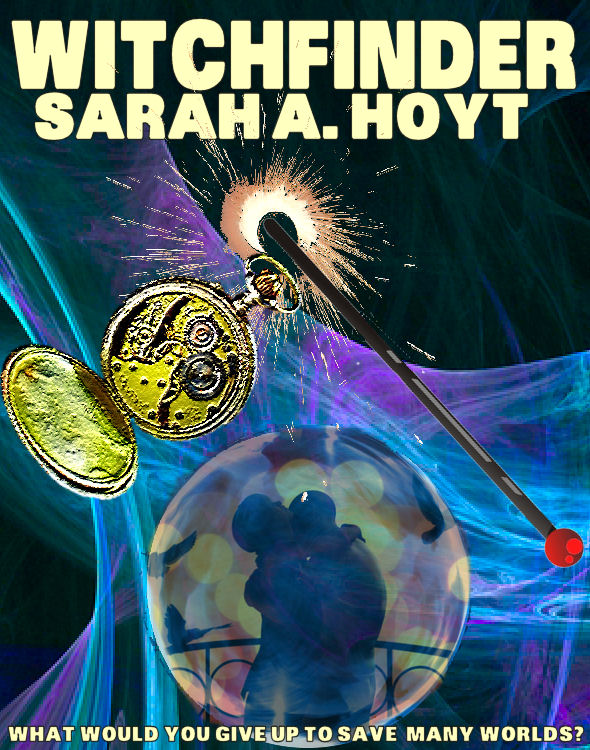
Free Novel, Witchfinder, chapter 39-40

*This is the Fantasy novel I’m posting here for free, one chapter every Friday.   If your conscience troubles you getting something for free, do hit the donate button on the right side.  Anyone donating more than $6 will get a non-drm electronic copy of Witchfinder in its final version, when it’s published.
There is a compilation of previous chapters here  all in one big lump, which makes it easier to read and I will compile each new chapter there, a week after I post.  When the novel is completed and about to be edited the compilation page will probably be deleted.

Oh, this is in pre-arc format, meaning you’ll find the occasional spelling mistake and sentence that makes no sense.  It’s not exactly first draft, but it’s not at the level I’d send to a publisher, yet. *

A Blessing Of Unicorns

You must not hurt them or kill them, Caroline thought, on the edge of the sacred clearing, staring at the unicorns with their blood stained horns.  How could she defend herself from these magical creatures without doing either of those?

Her mind…  The force of her mind.  She thought of the dragon touching her with the fire, the feeling that every impurity had burned away.  Perhaps that was it.  Perhaps.

One way or another, she thought, as she held the sword in both hands, she’d have to do it.  One way or another, she’d have to step into the clearing.  If she could not figure out how to use her mind force, or whatever her virtue the centaurs talked about was, she would just be a smear on the floor of the clearing.  This might be ultimately the end of it, but she must at least try.

She stepped over the threshold into the clearing.  There should have been a magic shock, a sense of having violated a boundary.  There wasn’t.  She was between two trees and onto soft grass.

Five unicorns were running towards her at once.  She raised the sword, hoping to stop them.  They didn’t even slow, but rushed…

One of them, nearer, plunged his horn into…  She thought he’d plunged his horn into her thigh, but she couldn’t feel it, even as a flower of blood bloomed through her skirt.

It seemed to Caroline that time had slowed down and that everything was happening very slowly.  It seemed to her that she stared for hours at the blood seeping through her skirt, even though she knew it must have been less than a breath, because the seemingly-frozen-in-mid leap unicorns were still approaching her.  

They would pierce her multiple times with their horns.  She would be a smear on the clearing grass.  She–

No.  The voice came out of nowhere, very clear.  No, not a voice because it wasn’t someone else’s word, or someone else’s decision, but her own, coming from within.   No.  Just that, forceful and serene.

No, she would not be a smear on the grass.  No, she was not going going to die.  No, she was not going to let the young centaur, Akakios – didn’t that mean no-evil? – die.  No.  These beautiful, ethereal death instruments could just think again.

She twisted around, the sword heavy in her hands, and pushed the unicorns away with it, trying not to bludgeon or smite, but merely use the sword as a shield.  Meanwhile, her mind reached, her magic searching for a strong mind.

There would be a strong mind, here.  Horses were, after all, herd animals.  That meant someone, probably a stallion, was the leader of the herd.

She found him, to her surprise – a tall white creature standing by the cage.  He was three hands taller than the others, and his horn gleamed like pure gold.  He must have felt the touch of Caroline’s mind, because he lowered his head in an aggressive gesture and looked as if he’d charge.

She never gave him time.  She remembered the dragon and the words that everything that was weak and impure in her had been burned away, and she threw her magic – all of her strength and her will power – at the creature, pushing at its mind.

The mind of a unicorn was not – as the legends said – pure magic, or pure anything.  Or perhaps it was, except that its purity was the purity of clear animal impulses, not muddied by reason or thought.

The mind she touched was an animal mind – a magical animal, but an animal nonetheless.  She pushed into it forcefully, finding the mind that controlled it – an older, stronger and definitely human mind.  It controlled the unicorn not directly, but by being its master, the way Caroline controlled her pony’s actions at home, because she was the one who carried sugar lumps in her pockets which could cause the pony to prance and nuzzle for the reward.

Very well.  It was time to break that control.  She seized the animal’s mind and made it known to him that she would not – now or ever – be hurt by it or its stallions.  She let it know she was the master, and gave it just a touch of the pain she could bring to bear, should it continue misguided attacks.

For a long time, she thought nothing would happen, then the head came up.  The unicorns that had been mid-charge in her direction averted their jump, sometimes falling in ways that looked disastrously painful.

Caroline, a horse lover, would normally have stopped and tried to find out if the animals were hurt, of if her magic could heal them – but the moment she realized she would not be skewered on those horns, the pain hit from her leg.

It was horrible pain, blotting out her thought, and for a second she swayed and took a deep, long breath, feeling as though there were no space in her mind for anything but the pain.  Sweat sprang to her forehead, soaking her hair, plastering it to her skull.

She reeled.  And then through the pain, her gaze focused on the cage.  Or perhaps it was the sound of the centaurs behind her, shouting something about Akakios.

Her eyes focused on the centaur in the iron cage, looking as though he would presently lose consciousness, his head inclined, his horse-body leaning on the cage bars.  She must save Akakios.

It took all her will power, all her strength of mind to force herself to walk.  She remembered the story of the little mermaid who’d become a human princess at the pain of each of her steps being as though taken on knives.  It felt to her now, that every step she took on that leg was taken on knives.  More, she could feel blood running down her leg to her ankle and sloshing into her shoe.  She knew there was an important artery in the leg, and that she could be dead in minutes.  It didn’t matter.

At some time, perhaps when she was very small, she’d heard her father tell a war story.  He’d said something about when you’re in a war, you have a duty to fulfill, and it doesn’t matter if you chose your duty or not, you must do it, even if it costs you your life – and that the pain and suffering to fulfill your duty doesn’t matter, so long as you fulfill it.

She could no longer remember what the story was about, or whom it spoke of, but she understood this now applied to her situation.  She had chosen to come into fairyland to find and free Michael.  If she wanted to fulfill that mission, she must help three people – or three creatures – who needed her help.  Akakios was the second of those.

The task might not be of her choosing, but the mission was.  If she died, she would die in pursuit of her mission.

Gritting her teeth against the unbearable pain, she realized she was using the sword to help support herself, as she crossed the clearing.  What an ignominous use for an eldritch weapon.

She found herself near the cage an eternity later.  She couldn’t have told exactly how she got there, only that she had.  A moment of panic, through the stinging sweat in her eyes, as she realized she had no key to open that lock.  And then in desperation, she raised the sword, and inserted it between the bars, and pried…

The cage door opened.  Akakios jumped out.  Relieved, Caroline let go a little of her iron will…  And the unicorns snorted and reared.

“Lady,” Akakios said.  His arms were around her, unexpectedly powerful.  In her confusion she thought that she shouldn’t let a centaur embrace her.  They were dangerous.  They–

“Lady, let me take you out of here, before you lose your control over the beasts.”

And then she was held in his arms, as he galloped to the edge of the clearing.

How odd, she thought.  He looked much less young and helpless, now that he was out of the cage.

    The Duke’s Duty

“Centaurs?” Seraphim asked.  He felt shaken to the core at the realization that Gabriel had committed a crime, and a capital crime at that.

Oh, he’d known – hadn’t he? – that Gabriel was in love with the necromancer. Seraphim had tried to tell himself it was no such thing, but it was not just Gabriel’s refusal to form any other connections after he returned to Darkwater.  There was also…  The look in his eyes when anything relating to the debacle at Cambridge had been mentioned.

And yet, Seraphim had convinced himself it had been seduction.  More, it had been seduction of one too young and innocent to know what was forward.  And the necromancer bore sole responsibility.

But if Gabriel had used a compulsion spell…  Seraphim shook his head.  No.  There was no time to think about it now.

Gabriel might not be who or what Seraphim had thought he was – maybe.  There was more to a man than the follies he committed in love.  Seraphim’s own father had committed follies enough in love, the siring of Gabriel being perhaps the smallest one.  Which hadn’t made him, as Seraphim had found out when he’d discovered Papa’s secret papers and his even more secret activities, less of a hero, or less of an honorable man.  Only children thought creatures came in perfect packages, all good or all evil.

Judging Gabriel’s soul was not Seraphim’s job, at any rate, something for which he would be eternally grateful.  Judging him temporally, might be, as his Lord and head of his house.  But that was neither here nor there, as Avalon’s law system didn’t apply here.

Instead, what was Seraphim’s duty, left to him by his father, was to keep every member of his family safe, and at that Seraphim had been failing miserably.  If someone were to be judged here, Seraphim would receive the harshest judgement of all.

So, he sat down, and asked the necromancer, “Centaurs?”

The man looked up and had the decency to give him an anguished look.  “I thought there was no harm.  Of course the king forbid anyone to travel into another world, even to rescue his daughter.  I even understand the justification for it.  The balance of power is such that the least magician in Avalon can control vast portions of other, less magical worlds.  But the centaurs were not asking me to come to this world – or any world. They just wanted to know where the princess was.  So I scried and found her.”  He stopped, and made a face.  “I swear it was not till afterwards – that I realized that this must have meant they wanted to send someone for her.  To rescue her?”

“Antoine,” Nell said.  It wasn’t a question.  She said it with decision, with absolute certainty.  And Seraphim nodded, and looked at Marlon again.  “When did you realize it?  And don’t tell me it was just a thought.  Something happened, something that told you why they wanted her location, and what they meant to do with it.”

“Yes.  Well.  I checked later, and I found she was in our world.  You see, they sent someone, an emissary of theirs, possibly a centaur, to find her.”

“A centaur?” she said.  “Antoine was not a centaur.”

“You wouldn’t have known,” Seraphim said, cutting off her protest, and continuing as he saw her open her mouth.  “So they sent someone to goad her into the kingdom.  Why?  In the name of what?”

“I don’t know,” Marlon said.  “Except that I know my father is involved in it.  As are the Blaines.”

“The Blaines?” Seraphim asked, felling suddenly frozen, as though someone had poured a bucket of cold water over him.  “Of Blaine Blessings?”

“Yes,” Marlon said.  Gabriel made some sound and looked at Seraphim and Seraphim, feeling a headache coming on, could only think that he’d found the note in his father’s writings that an alliance with Blaine’s Blessings should be procured at all costs.  he’d thought it meant…  He reeled back a little.  Had he been that wrong?

“For heaven’s sake, man, what can all this cryptic stuff mean?”

“I don’t know,” Marlon said.  “My exile made it difficult for me to investigate.  All I know is that there is a plot and that you and your family have now got ensnared in it.”

Seraphim cleared his throat.  That much had also become obvious to him.  And he’d let them be ensnared, even though they were his responsibility.  He cast a look at Nell’s profile, grave and attentive as she looked at Marlon.

Part of his confusion, Seraphim thought, had come from his attraction to her, the attraction he hadn’t even wanted to acknowledge.  Much good it would do him, he thought, to want the Princess Royale, the heir to the throne of Avalon.

It was time to stop being as foolish as Gabriel, and for as impossible a love.  Perhaps it ran in the family.

But Gabriel wasn’t the head of the family.  Seraphim was.  Time to stop acting like a moon calf, and start protecting those who were his to protect.

When Work Must Be Done

(This is a somewhat rambling post.  I hope it makes sense.  It is about my relationship with my work — how I feel much more bound to it because no one else forces to do it… and when to figure out I need a break.)

We live in peculiar times.  This is not a complaint, mind you, just an observation.  They’re peculiar in relation to the way most of our ancestors lived – they are also incomparably better, and in fact I suspect many of our ancestors, probably not so far back, would consider our age paradise.

I know I grew up in a pocket of time marooned somewhere between Elizabethan and Victorian England, so perhaps I feel this more acutely than most people, but I can’t emphasize enough that when I announced to my mom that my kitchen would have both hot and cold running water (I think I was about six) she laughed at me.  Another of those was, when she visited, my holding up a package of chicken thighs and going “Hey, mom, remember when you told me I couldn’t just buy chicken thighs?” (Which are/were my favorite part of the chicken) “Well, guess what?!”  (And yes, she did the perfectly sensible thing and rolled her eyes at me.  Eye rolling is genetic.)

Even though like most of my female relatives (mom had cleaning ladies and dailies, but she doesn’t do well with employees.  I’m not wonderful at it, either) I have a business and am responsible for the upkeep of the house and family besides, the work I have to do on the house is far less onerous than what my ancestresses did.  For instance, I don’t have to fill an iron with coal and I certainly don’t have to mix my own starch.  I also don’t have to start the stove with wood.

For these things, I’m incredibly grateful.  I’m even more grateful for the things I didn’t even know existed when I was a kid – even for the rich – like central heating and cooling.

All of this is to make sure you don’t think I’m complaining about modern times, much less saying we have it harder than people in past years.

BUT we do have it differently.  Most of us – at least most people reading this blog – work with their minds.  (I almost said the lucky ones work with their hands.  Well, it can be lucky, nowadays, if you have the right job.  If I ever walk away from writing something I’m seriously considering just now  – don’t ask, don’t even ask.  Mostly the old problem.  We have been hit with the emergency (cars, cat issues, small stuff) stick over the last five months, and let’s face it, this is just not paying enough.  IT MIGHT eventually if I can get off the ground in indie, but that requires time and not worrying about money and… – and if I walk away form it and  I get a choice it will be into reproduction-antique making or something of the sort.  Okay, so it won’t be THAT because that takes money and time for training but… it’s what I dream of.)

Anyway, because most of our work is in the mind, we who are self-employed – okay, at least I – face an issue our ancestors never faced: knowing when we are genuinely unable to work and when we’re malingering.

“But Sarah,” you’ll say, “don’t you know?”

Bluntly?  No.  First of all let me explain that I’m depressive by nature.  I don’t think I’m QUITE clinical level depressive, but then again I wouldn’t know, because I manage it and much of the management is now instinctive.  I learned to manage it without drugs and without its being anyone’s business.  It’s better now, by the way – it was much worse from my late teens to my mid thirties, when depression would descend on me out of nowhere and make me unable to function.

This post came about because yesterday my friend Kate Paulk sent me an article on depression and the symptoms of depression.  Things like: it becomes too much effort to stand up.  It becomes too much effort to take out the trash.  It becomes too much effort to think.

My major, most prolonged bout of depression was clinical: Post partum depression, with Robert.  I managed it without drugs.  I’m not sure to this day it was the safest thing I could/should have done, but at the time we had no insurance and we were so far beyond broke, there really was no other option.  Okay, I’m sure there were free clinics of some sort, but we’d just moved to Columbia South Carolina, and we knew NO ONE.  Dan was working 18 hour days and I was home with an infant and no car.

Anyway, because of that I know what depression looks like when it’s out of control.  It looks like getting up just enough to feed the baby, then going back to bed and lying there, looking at the ceiling.  And I know “the stupid” depression causes.  During that period, Robert had a few onesies which had the rivet-kind of snap closure between the legs.  Those snap closures would sometimes fall off, by tearing off the fabric.  I remember holding one and looking at it, puzzled, having no idea HOW to mend it.  Because I didn’t have the rivet/industrial snap applying machine, I thought I couldn’t repair it.  A couple of months later, when I was feeling better, I came across a folded pile of these, looked at them, went “DUH” sewed the tiny hole shut, and put a normal type snap on top of it.  But while depressed figuring this out was impossible.

I also know how you come out of it: slowly.  One day you feel a little better and actually shower and style your hair.  The next day you might actually prepare breakfast.  The day after you take the kid to the end of the yard to feed bread to the ducks…   And then the day after that, you start scrubbing the rental house, cleaning it, finally unpacking those boxes, playing with the infant and singing to him..

So… what is the problem with that?

The problem is that I’m also prone to upper respiratory issues, often of the kind that go directly to the lungs and show no cough or other symptoms.  The problem is that I never know when I’m really sick or when I’m being depressed.  And when I’m being depressed, part of my managing strategy is to try not to give in to it, to try to force myself out of it before it goes too far.  While when I’m sick, the best results are obtained by going to bed and staying there until I get over it.

You see where this can be a problem?

I’m not saying depression isn’t real.  I’m saying there are mental tricks I use when I feel it sneaking in, to keep it from becoming full blown.  It can be something stupid like taking the day off and going to the art museum.  BUT dragging self to the art museum while sick somehow doesn’t produce desired results.

The reason this matters at all is that my job is both mental and self directed.  If I worked with my hands, the best thing to do through depression is to keep working.  There’s always processes you can do when you can’t think clearly.  And if I worked at an office, there’s usually administratrivia you can do, too while you wait for things to fall in place.

But working at home as I do – or at my own office – I try to impose on myself the same discipline I would use for working at an external office for someone else.  I work regular hours; I set production minimums; I set project deadlines.  This is done somewhat externally while I work for publishers, but the bulk of my work is shifting to indie now, and this is becoming even more important.

If you want to succeed while self-employed you have to treat it as a job.  Yes, one of the benefits of working for yourself, and having flexible hours is being able to say “bugger that, I’m going to take the kids to the zoo.”  Some of that will happen.  I think they call it “mental health days” – the problem is you have to control it, or every day becomes that.  You’re your own boss, so you have to be responsible.  I think I take fewer sick days than my husband does, because he goes “Can’t function.  Probably contagious.  Going back to bed.”  I can’t do that.  I’ll go “Can’t function” “Let me inventory the stories I haven’t put up yet.”  Because I know what lies at the other side.  The few times I’ve given in, a year went by with nothing written.

On the other end of that is “If you’re forcing it, are you doing work you want other people to see?”  Kris Rusch says that even sick your work is a certain level (Or at least that’s what I understood her to say) but she must be more disciplined than I.  There’s a book that if it ever reverts to me will get completely rewritten.  I knew the series was being killed and I was so depressed I couldn’t think from point a to point b.  The most I could do was keep characters from changing names every three pages and to keep the thing from sounding like Atlanta Nights.  Beyond that…  Not much.

All this to say that when I read the article Kate sent me, I had to tell her “if the kids – the younger one just now – and Dan hadn’t all had similar symptoms to what I had, I’d think I spent the month of May depressed.  I think I wrote a page the entire month, outside this blog.  And the illness seemed, mostly, to consist of feeling REALLY REALLY tired, with very slight hints of stomach issues.  But the tired and the foggy were real.  I had trouble reading blog posts to the end, and I’ve kept this blog up only because I’m more stubborn than my body.  This came with a double dose of guilt, because I paid rent on the office and I didn’t go in more than maybe four times – but I just couldn’t drag myself awake long enough, must less walk to the office.

Again, if the guys hadn’t had similar symptoms, I’d have thought it was depression.  The thing is, when the guys came down with it, you can look at them and go “You look ill!”  It’s much harder to see from the inside.  I’ll look in the mirror and go “Am I sick?  Or lazy?”

I’m often asked by those of you who are just starting out “How do you make yourself produce?” “How do you make yourself finish things?”  And “If you go completely indie, how do you keep yourself writing enough to keep yourself in roof and meals?”

Well–

The way I deal with that is by forcing myself to work everyday, on schedule.  These days ten to four or so.  By preference at the office.

But how do you deal with the temptations to take a day off and go to the movies or whatever?  Well… I do it the way I’d do it if I were working flex time at an office.  If I’m ahead of “time” and worked a few extra hours, I allow myself time off.  If not, I might make it up on the weekend.

But what if you get ill?  How much sick time do you take?  And when is it real, and when is it that you hate that particular project?

That is the hard part.  I tend to err on the side of driving too hard.  I push myself, and what in the guys is a week’s illness, in me becomes a dragging sickness that swallows all of May.  (I finally pretty much slept for three days straight, which seems to have worked.)

I know this is a problem.  Would I advise you to do what I do?  Oh, heck no.  I never advise people to be crazy.  Well… not like that.  On the other hand, if I say “be kind to yourself” you might be the type who stops because he/she sneezed and never gets anything done and then say “It’s Sarah Hoyt’s fault I never finished even one story.  She told me to take care of myself above all.”

All I can tell you is that this is a problem of the new economy; a problem that will become more prevalent as more people are free lancers.  And that I wish there were some sort of guideline I could follow to decide if I’m physically ill, depressed or just lazy.  Just not blaming myself for work stoppages would make my life much easier.  And not pushing myself when I’m actually battling a virus would too.

But until a miracle occurs, I’m all I have.  So I’ll keep trying to work until I hit the wall.  And then… and then I’ll stop when I can’t go on.

Sane?  Would any sane person do this for a living?  But it is the best I have.

Wild, Wild Webs

This last weekend I saw no less than two posts, both by people I consider sensible and occasionally brilliant, deploring the freedom of association and freedom of expression on the web.

Oh, that’s not what either of them thought he was deploring.  One of them bewilderingly taking off from what sounds like a zombie outbreak in Florida (but was, apparently one of the run of the mill effects of taking certain drugs) lamented the possibility of people with really bizarre fetishes and perversions finding each other.

The other one, (which I now can’t find because I spent the weekend in a virus-induced haze reading everywhere, yes, even that site on how to make tinfoil hats) Update, [thank you Gregq for finding link.  Boy, did I range far] here  sounding like the lords of the dying press (all kinds of presses, fiction included) lamented that anyone can say anything on the net, and people will be attracted by “the most bizarre conspiracy theories.”

This is the part of the blog in which I must regretfully inform two columnists I respect that they’ve gone insane.  The type of insanity is what I often refer to as “But it SHOULD be perfect.”

Let’s stipulate that the web will allow a lot of crazy people to get together.  I know from crazy.  I am a science fiction writer, with friends who are science fiction writers and the internet is a huge boon to us, allowing us to compare notes, to call someone with specific expertise, to commiserate and talk about our peculiar problems.  Normally, to get the type of network I command at my fingerprints, I would have to live in New York City.  And so would they.  Oh, our forebears in the field made do with snailmail, but it was a slow and plodding business.

But Sarah – you say, once more taking your life in your own hands by talking back to me before I have enough coffee – that’s not what the columnist was talking about at all.  When he talked about people with a rare perversion or fetish banding together he was talking about those real crazies who wish to eat human flesh or blend puppies into energy shakes.

I know what he was talking about.  What I’m telling you is to back up – slowly, don’t go making sudden movements around me before I have caffeine – and look at the whole picture.  Will the internet make it easier for that kind of absolutely repulsive crazy to get together?  Of course it will.  Easier, not “possible” because guess what?  One of my hobbies is reading about very weird crimes (mostly because I look normal by comparison.  I think.  Or something) and people with the most bizarre fetishes and obsessions have been able to get together and indulge them since there has been mail, transportation, or large cities.  Is it a reason to get rid of or control those things?  No?  Then why the net?

Well, because… easier.  Yes, and?  Look, what do you think the proportion of people wanting to eat someone else’s face raw is in the population?  By which I don’t mean the people who will say “I’m so mad I could eat him raw” but the people who actually want to do it?  One in two million?  Five million?  I doubt it’s more than that.  So even if the internet facilitates their getting together our incident rate might grow to… four?  Five a year?

But Sarah, you say – man are you chatty early – “Four or five a year is too many.”  Maybe.  What makes you think people who are that far gone from human norm aren’t doing it anyway, with unwilling strangers?  How do you know it’s not “increased incidents” but “increased knowledge.”  And while we’re at it, how do you know that getting together on the net and talking for hours about face-eating won’t prevent these people from doing it?  The studies on this type of thing are murky.  On one side, some people get pushed into it.  On the other, some people will be perfectly content to discuss the proper circumstances to eat face and let out their obsession that way.

Which will it be?  How can you know?  And you do realize how tiny a proportion of the population we’re talking about either case, right?

Yes, but why should we allow it at all?

Because there is the flip side.  And the flip side is very important.  The flip side actually affects the lives of the majority of the people, the sanity of our policies, the health of the republic and the ability to be free.

And this is where I read, in some astonishment, the second columnist opining that the internet allowed people to go too far from “normal” – by which he meant going too far from group consensus – and fall down the rabbit hole of weird ideas.  He thinks that the only upside of the internet is letting small groups, whose obsession is physics or some abstruse portion of chemistry to discuss it, but what about those groups that will use it to come up with some odd theory about public events, conspiracies, or history?  Those people are tearing consensus apart and making us maaaaaaaaaad.  Maaaaaaaaaaaaaaad!!!!!!!

Okay, that’s not what he said, exactly, but it’s what he implied.  This was all the more baffling since this columnist is on the right, but is clearly longing for the days of uniform media where they each repeated each other’s story until people were afraid to think – let alone say – something that shattered the consensus.  In my lifetime at least (maybe the columnist is older?) the consensus of the mass media – a consensus enforced in ways ranging from professional ostracism to professional disdain – has been at the very least “soft left.”

What do I mean they repeated each other’s story till people were afraid to think or say differently?  Well, the columnist says as much in the column.  If you came up with a different opinion people would tell you “you’re nuts” because it wasn’t something that was in the media – back when the media had gatekeepers.  I’ll go further than he did and tell you that when the media had gatekeepers, entertainment had gatekeepers that read from the same missal.  For that matter so did education, partly led by the fact that schoolbooks were slow and expensive to produce.  They ALL echoed each other.  If you put something into a novel world-building that went against the consensus of “what everybody knows” you couldn’t publish it.  So novels, movies and all our entertainment also reinforced this concept.

Which means, of course, that we were kept sane and told the truth, because journalists and editors are always responsible, admirable people in the service of the greater good, right?

Sorry.  I got a bit of irony stuck in my throat.

To begin your education, google Walter Duranty.  Second go and find some popular entertainment from the early eighties.  Not news, but fictional world building which was downstream from that.  Mystery after mystery and, yes, science fiction after science fiction novel, explains how with Reagan in power we’d be a glowing crater.  It would be the end of the world and the superior Soviet system would win.  How was that fact checking and future analysis, then?  While you’re at it, and in a nostalgic mood, go watch ANY television series from the nineties.  Gee, those militias surely committed crimes.  And they were all racist, white supremacist militias, too.  You’d think there were several arrests of those per day in every small town and city, right?  Would it surprise you to know that the white supremacist militias of the sixties nineties (though they were about the same level as in the sixties, or less.) never rose above the normal background noise they constitute in normal, civilized society?  It wouldn’t surprise me.  But then I actually knew people in the militia movement, and most of them leaned Libertarian and the one issue causing them worry was ONLY the fear their weapons would get banned.  That was pretty much it.  They liked the second amendment.  But you should have tried saying that in the nineties.  You’d have got “Are you crazy buddy?  There was that thing in Waco.  Oh, and the bombings in Oklahoma, and I see tv crime shows, and I KNOW– Say, if you’re saying that, you must be one of them.”

Want more?  Get your favorite newspaper, or the newspaper of your town, go back and count the number of headlines in the last three years that announce the economy is recovering; no, it really is recovering; the economy is totally recovering; this time we mean it, the economy is recovering.  It’s amazing with all this recovery that I’m sitting here writing this instead of out there, trying out my new Cadillac.  More?  Look up Fast and Furious, and tell me why it’s not in every newspaper throughout the land, twice a day and why the TV stations aren’t talking about it.

Conspiracy?  Buddy, you don’t need a conspiracy when you’re in an industry with a few thousand people nationwide, where publishing something that goes against the current means when you get laid off there might not be another job for you.  I know this.  I am in one of those industries.  I know how far I’m sticking out my neck.  I know very well why I’m now working for only one publishing house, itself considered a pariah by the others.  I always knew it.  I was on the blogs for ten years under a cover so deep you couldn’t penetrate it, all the while maintaining a conventional persona for my editors and agents.

Yes, having news funnel through a small number of gatekeepers kept it uniform and built consensus.  THAT was exactly what was wrong with it.

Did it keep devotees of UFOs and Space Invasions from falling down the particular rabbit hole of their own illusions?  Sure it did.  Kind of.  Here’s the thing, people obsessed with something that odd have been in touch with each other for years.  I know, because sometimes I have to research this stuff.  (It’s a professional hazard.)  As long as I’ve been writing, you could get that stuff – it might be in purplish mimeographed sheets, but you could find it and order it.

On the other hand, it kept people looking at headlines from saying “But I don’t think the economy is getting better.”  It kept people looking at raw unemployment numbers from telling the less math-advantaged “Hey, there’s something seriously wrong with the way these numbers are tallied.  I think real unemployment is closer to fifteen percent.”  Because even if people came to believe they were right, what was the point?  If they opened their mouths and said anything – oh, like, say, “the superdome during Katrina was NOT a haven of murder and rape” – people would think they were insane.  If these things weren’t true, why would ALL newspapers say exactly the same?

THAT is what the precious “consensus” was keeping.  Yeah, it might build a community (of the deluded) but it also made you lack the real data you needed to live in the real world.

At least it kept crazy ideas from circulating, though, right?  Ideas that had no plausible basis in reality and in fact went against observed fact…  Which is why the phrase Grassy Knoll has NO meaning in American pop culture.

Yes, the net is or can be wild.  Yes, it might allow consensual cannibals to gather and do their thing.  It also allows people like me and my colleagues to talk to each other and help each other to better plots or more plausible science in our books.  It also allows people like me and my friends to have a social life and not feel like we’re out there on the fringes of thought and behavior alone, because we think reading about dinosaur digs is comfort-reading and we spend our spare time comparing two obscure medieval authors most people never heard of.  There might be a danger in that.  As I’ve said in the past, by allowing outliers to meet and marry other outliers, it might eventually lead to speciation (maybe) but in the mean time it leads to less human loneliness and misery.

Yes, the net can encourage conspiracy theories and little pockets of insanity to form.  But most people have their own internal bullshit meter.  I knew exactly the moment when the geology site I was reading for information on the climate of Pangea went off the deep end – it was when it talked about the spaceship full of intelligent dinosaurs who would come back and…  How do I know that’s bullshit?  Well, because it would require WAY too much silence from too many people who have nothing vested in keeping silent, including RETIRED NASA scientists.  Also, it had nothing to do with the climate of pangea, which is what the rest of the page was about.  And how many “films” of dragons or mermaids show up every week on you tube?  Most people recognize the “grey cotton wool” look of faked or odd footage.  Heck, so many people can tell photoshoped pictures that those get outed too, including a few put out by places like Iran.     And if you think “oh, come on, Iran.  No one would take them seriously anyway.”  I’ll remind you our own CIA data – let alone what was published – exaggerated the financial (and demographic) health of the USSR right to the end.  Because, you see, they were going off official figures.  Anything else would be crazy.

But it also allows respectable, well thought out minority opinion to be heard, and to get in touch with people who will verify it.

Yes, the media and entertainment and even to an extent the scientific establishment before the net was cohesive and formed a beautiful picture.  No one ever asked the disturbing questions such as “Since every packet of international aid is predicated on the population of the country, and since even in our own country we count people we think should exist…  What makes us think that small, third world countries aren’t manufacturing statistics wholesale?  What makes us so sure population is still climbing?  Wouldn’t the world-wide economic crisis be consistent with a falling and aging population?”  (Coff, not that I mean anything by those questions, of course.)  And no one with better knowledge and more time ever set out to investigate and prove or disprove those crazy questions.  So we never knew.  Or rather, we knew a lot of things that just weren’t so.

But… what does it matter?  Go read Puppet Masters.  Devote sometime to the period labeled Masquerade.  What you think you know can kill you faster than what you don’t know.

The Wild Wild Webs is wild – it is also uncontrolled, and therefore allows each individual to think for him or herself.

Knowledge is not just power.  Real data is important to navigating times of catastrophic change, where knowing only false things might destroy you.  For instance, if you know Amazon is evil, you might never read your traditional publishing contract closely enough.  On the other hand, if you’ve read on a crazy site or two – say this one – what publishers have been slipping into contracts, you’ll read very closely indeed.

The lives we save might be our own.

Welcome Instapundit readers.  Again, I want to reiterate that I’m a huge fan of Wretchard and I’m not picking on him but on the idea of his post — which bothered me for coming from him.  And I can’t for the life of me remember who posted the other post, but it’s also someone I read and like.  Which of course, is what got under my collar.  You know in-tribe arguments are always the worst.

Crossposted at Mad Genius Club

Death Or Chocolate Chips

As writers, particularly writers dealing in the shady side of “literature” where we can employ magic or magical “future science” we are told over and over and over “there must be a price” and “there must be a cost.”

It is amazing to me, now and always, how many of us forget that in real life.  And how many of us forget it in books, too, when we’re not dealing with magic or magical future science.

I made a post thanking those who served for Memorial Day.  And of course, right on cue, like something rehearsed – which it is, since it’s the response drilled into most of us who attended any school system in Europe, the US or possibly most of the world – someone came in to say that war doesn’t secure peace.

I will confess this is true.  No war, as yet, has managed to secure ever lasting peace.  Fortunately or unfortunately, though, I live in the real world and I study real history.  Oh, yeah, also I’m human and I live among humans and know (and rather like) the breed.  The only way to secure lasting peace is to kill all of humanity.  We managed to avoid this during the cold war, and I hope will continue to avoid it in these our fraught times.

But we’ve been taught Word War I was the war to end all wars.  We’ve been taught it didn’t work and therefore all war is futile, all war should be avoided and also that because we can’t secure lasting peace from the smallest kindergarten to the largest nation state, we are a worthless species and should go voluntarily extinct and leave the Earth to the peaceful species who don’t kill each other, don’t kill their own members and don’t engage in cannibalism.

There might be a species or two that follow those rules.  Possibly leaf molds.  But it’s entirely possible we ONLY think that because we don’t know enough about leaf molds.  Desmond Morris made a lot of sales out of his thesis that only humans were “the killer ape” and that, in fact, that was our edge over other primates, let alone all other animals.  Turns out the thesis was beautiful, cogent, and what people wanted to hear.  (Waggles hand.)  It was also completely and thoroughly wrong.

War – and fighting – does not (and won’t if we’re lucky) bring about eternal peace.  But it does, for a time, secure peace in a part of the world, or a corner of kindergarten.  Do the right people always win?  Oh, please.  SOMEONE wins, and that is usually enough for peace to last a little while, and for humans to go about lawful occasions and improve their lot.  One thing is sure, though, if your tribe won’t fight; if your tribe won’t stand its ground; if your tribe won’t defend itself, you will not last.  It doesn’t take two sides to engage in a war, just as it doesn’t take two sides to get in a fight in kindergarten.  If you think that it’s because you’re delusional kindergarten teachers drilled it into you.  And they were wrong.  A war is still a war if it’s a massacre and one side kills the other.  And a fight is still a fight if one of the kids is beating the other or breaking the other’s stuff.  It’s still not peace.

Outside of sitcoms, certain – largely unbelievable – books and the more tendencious type of movies, the word for “pacifist” is “dead” and the word for “peaceful” is “leaves no descendants” and no one, no one EVER managed to secure their side by bathing the enemy in loving kindness.  The first person to mention Gandhi in this context will get kicked around the block until they can’t sit for a week.  Gandhi engaged in psychological warfare, turning British morals and beliefs about themselves ON themselves.  If he’d tried to use that on any other enemy, or even on the British of a hundred years earlier, he’d have been a smear on the pavement.  This is exemplified by his belief that the Jews should have marched into the ovens to “deprive the Nazis of his victory.”  This shows either he was a dirty anti-Semite, or a fool, completely unaware of what made his strategy work or that it wasn’t so much he’d chosen to be peaceful but that the British Empire had chosen to go quietly into that good night.  Which is what happens when a civilization chooses “peace”

World War I might have been the last huzzah of Western aggression – or not – and it might have been largely a waste of time and young men.  Or not.  These things take place in response to mechanisms we, as mere individuals aren’t fully conscious of.  WWI was as much a response to changing technology and upheavals in culture as to territorial aggression.  We don’t know the truth about WWI.  We won’t for centuries, if then.

Meanwhile, even if you accept it was the “war of the defeated” and that there was nothing good come of it, taking from it the absolute pacifist vision made WWII far more lethal than it should have been and the “War never solved anything” has blood on their hands from the many flares up in the cold war.  The Soviet Union used your guilt and your vision of peace to do as they would.  And if you think that is good, then you have not ever studied what happened under Soviet rule.

See, the thing is, we are in the end mammals, not archangels.  We evolved to be aggressive – to be the most aggressive, to survive.  But – you say – must it always be that way?  Will things not get better?

Things have got better.  I always laugh at the idiots who think taking us back to rural times will make us nicer, or that “noble savages” are noble and peaceful.  While the Nation State has made possible the large-scale abattoirs in the valley of the Somme, higher civilization (defined as more prosperous and less tribal and land-dependent) translates into less war for each individual in their locale.   In small rural and tribal societies, war was pervasive and “distributed”.  War was what happened when boys from a village went courting a girl from another village.  War was what happened when a village’s gods wanted victims.  War was what happened when you wanted the crop the other village just brought it.  And while it might involve only half a dozen men on either side, war could devastate both villages – and did.  Peace was by far the exception.  

It took big bad sons of b– babies with large weapons and the ability to quiet most of these little conflicts (not all.  In insular societies, some still goes on.  It did when I was little.)  There is a reason Pax Romana is part of the vocabulary.  Romans didn’t achieve that peace with aqueducts, law or schools – though they had all those – but because they had bigger lances and a better organized army.

And that is because we are animals, not archangels.  Even good people – genuinely good people, with the best intentions – can convince themselves it would be best for everyone if only that wheat field weren’t in the hands of bad people, but in the hands of good people.  To be human is to be flawed. To be human is to be able to lie to yourself.  To be human is to crave power, even when you tell yourself that it’s not power but what’s best for everyone, and that you’re doing it for the hungry, and really, you’re the good guy.

Will there come a time when we study war no more?  I don’t know.  My religion requires me to believe so, but it will take a miracle, and miracles are the prerogative of the divine and nothing the human mind can understand.

Until then we’re stuck in this here world, where the choice is NEVER between death or chocolate chips.  The choice is always between the least of two evils.  And sometimes, yes, you have to fight for the least of two evils.

There is no perfect state and no perfect peace short of heaven.  We humans must always fight – and often die – for the best we can get.  Fools think this makes us a terrible species.  I think it makes us admirable and it makes those who give their lives for their tribe and their homeland admirable – and it makes even more admirable those who put their lives on the line for principle: for life, liberty and the pursuit of happiness.  Because if that miracle is ever to occur and make war really rare, I”m sure those principles will be at the bottom or it.

Thank you again to all who risk their lives and their peace that we might enjoy peace.  And those who think that peace can be bought with pretty words and no effort, think shame on yourselves.  Those who are kind to the cruel always, inevitably, are cruel to the kind.  Those who aren’t willing to defend the ones being attacked always end up with blood on their hands.  And those who think that fighting isn’t worth it because no peace is eternal have consigned themselves to the moral nursery, where it’s possible to purchase something for nothing.

And those who write about the world that way are propagating lies and worsening suffering.  If there’s ever a choice between death or chocolate chips, of course I’ll pick chocolate chips.  Unfortunately that choice has yet to happen even once in the history of the world.  But maybe you’ll get lucky.  Maybe tomorrow it will rain ice cream.  In the meantime, keep your weapons sharp and stop telling lies to the young.

Lures

When I was a little girl, my best friend’s father had a company that sold fishing lures.  If we had to go to his office – he worked from home and the lures were sold mail-order – for anything (usually a pen or a stapler or something for homework) I would walk around, fascinated staring at the lures and reading the descriptions.

The lures had names like grasshopper or fly or other stuff, but here’s the thing: they didn’t look a thing like grasshoppers of flies.  Instead, they often had violently colored tendrils protruding from oddly shaped plastic “bodies.”

And I used to think fish were really stupid, which of course, was true… And false.  Fish are perfectly fine in their environment, but they are not human-like, nor is their perception the same.

But this is not a post about the relative intelligence of fish and men – this is a post about how editing warps the mind and damages the taste (yes, there, I said it) and makes a person unfit for the very gatekeeping they do.  And how, ultimately, when they can’t figure out how to attract the readers, they turn it all into lures which are about as realistic and logical as fishing lures, but which attract the fish… er… readers, in a way, because they lock into hereditary pathways which were never meant to act that way.

Sarah, are you saying all editors are damaged?  Well, no.  Some editors are very careful to limit how much slush they read in a day or a month.  Some also filter that slush in various ways.  And editors of micro presses, particularly those working with indie, where the idea is not “read everything and filter it” but “take everything that’s good enough to sell, even if not my cup of tea.  So not ALL editors are damaged.  But a lot of them are.

Let’s start with what an editor was supposed to be, under the old model.  Here I’m going to use what I was told by at least four editors.  “We are the filter.  We receive all the raw, unfiltered stuff from writers and would be writers, and we filter it down to good stuff.”

Now, if you’re wondering what good stuff is, that was what the editors brought to the fray.  Their own taste and thei own view of what was “good.”  This was a narrow gate for stuff to pass through (hence the term gatekeeper) because making a book, or printing a story as part of an anthology was endeavor that took money.  Okay, never as much money per individual paperback as they told you – not unless they were promoting the book heavily – but a few thousand dollars anyway.  Besides a cover and editing, they had to produce a paper book which then had to be distributed, which implied paying the salary of the book reps, as well as transporting it to the stores, laying it down, taking it back if it didn’t sell.  Either the editor or the house the editor worked for had a strict budget and a number of books they could publish in a year.  This was usually a completely ridiculous number in comparison to what they had to read to select them.  These are not real numbers, but they are in the right vicinity: an editor might have to read a thousand books for each book they accepted.

Here’s the problem: I’ve done editing for short periods of time, and I can tell you after a while you go a little insane.  (I highly recommend the experience, because it will teach you what you need to do to make your writing stand out more than about anything else, including workshops and courses.  On the other hand, I don’t recommend doing it for more than a few months at a time, and here’s why.)  You go a little insane because even if you ARE a reader (and a lot of junior editors in NYC never were, but that’s something else) it changes the mechanics of how you read.  You’re not reading for pleasure, anymore, you’re reading for a job.

Now, ninety percent of the books you’re reading to reject and you find reasons to reject within the first page.  “Doesn’t grab me” is a reason, as is “three misspelled words.”

I’m a bit more soft hearted than that, and I remember being on the other end.  I also know – from mentoring – that some writers for reasons known only to their psychiatrists MUST write five to fifty (depending on the size of the story) pages of crap before the real beginning of the book.  And that THEY can’t see it’s crap.  So I usually tried to read at least that, depending on length, but I confess I rejected 90% of stories within that time.

The problem is in the other 10%.  The other 10% you’ll read to the end and find yourself baffled on what to do with them.  Mind you, if you were working for a traditional publisher, you can probably eliminate half of that, because they simply are NOT what your house publishes.  No matter how good a story about a baby elephant learning to balance on a ball, or how great the illustrations accompanying it, the chances of its getting published by Baen are probably zero… or very close to it.  And yes, people will submit crazy stuff like that.

But you’re still left with say 50 stories – 49 more than you need – that are perfectly functional, decent, and COULD be published by your house.  This is when – yes, I did it too – you start finding reasons to reject because you can.  The first and most obvious, which people even convince themselves is valid, is “this cr*p promotes evil opinions.” … Which wouldn’t even be a problem if the entire publishing industry hadn’t been concentrated in one region and limited to one rather echoey echo-chamber.  We all have stuff we consider evil – yes, even I – like, in my case, anything that recommends 2/3 of the population be killed so we can go back to being peaceful cowherders in an idyllic landscape will fall down “evil bullsh*tting lies” and get into that return envelope so fast it will leave burn marks.  Not that I don’t think people have the right to think – or even say – that, but there is no reason on Earth or beyond it that I should promote this under MY imprimatur.

That will allow you to get rid of maybe 10 stories, 20 if like me your triggers are the exact opposite (or close to) of those drummed into hopeful college students for years.  You still have nineteen.  You then start rejecting for what can only be called “bullsh*t reasons” One of the most obvious of those is “it’s too much like other stuff.”

The thing is that what triggers those alarms for an editor is not necessarily even what triggers that alarm for other people.  Why not?  Well, because they see a lot of stuff that – to put it bluntly – no one else ever sees.

Some of it might be obviously plagiarized from stuff that’s out, but a lot of it will be… ODD to extremely odd.  There is something to Pratchett’s idea that some ideas fall from the sky onto all receptive heads.  Some of them can be explained by a movie, an interesting science article, or current events.  And some just make you go “WHAT?”  Like, in my brief stint of editing in the early nineties, we got a FLOOD of stories about mailboxes that ate people.  it got to the point you opened the envelope and you went “ARGH.  Killer mailbox.”  At that same time, I was reading the major mags, and none of them published a cannibal mailbox story.  So…  Would people have liked a cannibal mailbox story?  Who knows?  I know we – editors – couldn’t take it anymore.

More commonly, though, what burns you out on ideas is that you’re seeing so much of them.  Look, this is the reason why high-volume readers like me tend to rotate our reading material among genres.  Truly, I can read regencies for three months, and then the very mention of Miss so and so and the Duke of– will send me screaming into the night.  The same with cozies and, to a smaller extent (because there’s a broad subgenre range) with science fiction.

But imagine you have to keep reading that subgenre.  Year after year.  day after day.  More misses and Dukes, endlessly.  You go a little insane.  You start looking for the “different.”  And if you live in an echo chamber and can’t be different on anything substantive without getting disinvited to all the RIGHT cocktail parties, you start looking for the different that’s REALLY different.  And you don’t realize it’s a different that will put off ninety percent of your readers.

Because here’s the thing about subgenres of popular fiction: when I’m in the mood for a regency, I don’t want an alien to come through halfway through the book and kill everyone, including the hopeful couple.  We want different but not crazy-different.  Yeah, if you can put a new twist on boy meets girl, yay.  But if your twist is that the boy is really a disguised girl, tread carefully.  Your average romance reader – and you average Sarah, too, for that matter – will go “ew” and fling the book across the room.  Not that we’re homophobic or don’t have Lesbian friends, but because frankly this is bait and switch on our romance reading.

This is complicated by another bit, which is where the editors give up on finding different enough and instead find “Agrees with me politically as much as possible.”  And because the editors live in an echo chamber, most of the stuff you get is SO BORING it makes your eyes glaze.  It’s the same stuff most of us got back in school in the SEVENTIES for crying out loud, and it is by way of being a catechism.  Blah, blah, humans bad for environment; blah blah, evil polluting corporation vs. glorious challenging worker; blah, blah young smarter and wiser than the old (minority of your choice might replace young); blah, blah, blah, woman refuses marriage to live un-oppressed… blah, blah, blah.  Paint eyes on my eyelids and I’ll sleep through reading these books.  How bad did that get?  Well, for a while there, before competition from indie introduced one MODICUM of sanity, EVERY regency romance heroine was a suffragette or a modern-day feminist in period clothing.  This included the maids, and, possibly, the female horses.  To make things worse, all of these are package in a way you feel the editor thinks he’s pushing something particularly daring and important and “speaking truth to power.”  Reviewers who suffer from something like this disease for similar reasons go trolling through books for reasons to approve or disapprove of them and often fixate on “agrees with me on something no one will dispute.”  For instance, the big reasons someone found to love Any Man So Daring was that it was against racism.  (Which no, was not what I was writing it for.)  This of course made it daring and different from all the books out there that promote racism, right?

Unfortunately, what ends up emerging from the combination of “I want something that validates my opinions and I want something very different – but it must sell” is stuff that no one in their sane mind would want to read.

Which is where we get lures.  Faced with falling circulations, publishing houses have moved more and more towards using one of the primal lures: sex.

Now, I like sex as much as the next person, and I’ll confess when I was very young I was curious about what people did behind closed doors.  It was, after all, among the “secrets of adulthood” I couldn’t wait to er… penetrate.

As an adult, though, reading about sex makes me yawn.  Unless the sex is integral to the plot (and very little is) I tend to skip those scenes (it makes some romances very short.)

I know however that I’m not in the majority in this.  I realized this back in the late eighties, when a colleague was devouring the clan of the cave bear books because they had explicit sex scenes.  She was particularly thrilled with his scene where the guy devotes attention to the main character’s breasts.  (Yes, when I read the book at her insistence, I read like three paragraphs, sighed and skipped it.  Sex is just NOT a spectator sport for me.)  

Throughout the years I’ve met many women like her.  They will read anything that has sex in it, particularly if they can have another excuse for reading it.  “I read it for the story” or “I read it for the character.”  It’s as thin and transparent as “I read playboy for the articles” is for guys, but it works, partly because guys want to believe that women are naturally pure.

Publishers, faced with burnout and the need to attract people to books that they were picking increasingly on “odder and odder” and “politically correct” factors, started putting more and more sex in EVERYTHING.  You can trace the decline of the popular appeal of editorial gate keeping in how much sex books started having.  By the time regencies included full pre-marital anal sex, you were will within “the only reasons people are buying this is for the sex scenes.”

Look, I don’t even have anything against pornography.  I’m a libertarian.  If people want to screw their neighbor’s daughters on the front lawn, I’m cool with that, provided the daughters are within age of consent, the lawn isn’t mine and they don’t scare the cats.  And maybe reading about it will keep them from making a nuisance of themselves and others.

BUT this is not the reason most of us read.  Just like the reason most fish snap at stuff is for food, not for hard bits of plastic with a hook concealed within.  BUT you can make the fish snap at the plastic, and you can make people read for the sex, even when nothing else in the story is interesting.

Which is how you end up with such interesting concepts as “YA erotica” – an idea that makes me throw up a little in my mouth – and which Dave demolishes here.  Or my rejection from a fantasy-romance house, because my book is not sufficiently “female-centric” since it has a strong male hero.  Or…

Beyond the reason that it gives young people a very odd idea of what’s important in life and/or relationships, the infusion of sex into everything allows some truly repulsive ideas (like that all men are evil) to fly under the radar.

BUT it is a direct result of what gatekeeping IS.  And a good reason to celebrate being rid of it.  Because while sex makes a good lure, in the end Man doesn’t live from funny bits of bright colored hard plastic alone.  Or, indeed, at all.

– and now I’m off to enjoy Memorial Day.  To everyone who served, thank you for your service which makes it possible for people like me to enjoy freedom and peace.  Have a good Memorial Day.

Tomorrow and Tomorrow and Tomorrow

As the last round of graduation parties the younger kid is invited to wears down in fizzle and sputter –  like a sparkler that’s almost spit out all fire, but still flashes and makes a subdued, menacing bang as you get near to pick up its remains – I find myself returning again and again to the matter of career choice.

It doesn’t help that this being graduation season there are articles everywhere about careers, how to pick careers and how to set the course for “the rest of your life.”

It also doesn’t help that I never picked my career, or rather, that my career choice went spectacularly, imaginatively – not to say astoundingly – awry, or that the main guiding principle leading me to pick what I picked makes me giggle now.  Of course, I am, to begin with, odd, and just like they say hard cases make bad law, so do strange people make bad patterns.

Still, I find myself increasingly discomfited with the way we’re advising people to pick careers, and all the more bothered by the fact that I don’t have any advice I can give people.  Not that it’s useful in my kids’ case.  The older boy wanted to be a doctor by the time he was ten, and, yes, has an almost as strong, backup pick if he doesn’t make it into med school.  The younger boy wants to build stuff that will go out to space and will be starting aerospace engineering this fall.  In both their cases, there is a clear interest, no secondary “pulling” interest, and the only issue is how to get to doing what they want to do for a living.  (Due to our rather stick in mud rules for training doctors – only partially tongue in cheek, though my concerns are not fit for this blog nor short enough to condense into it, and besides, they relate more to the doctors I’ve dealt with in recent years than to Robert’s future – Robert has only one path.  Marshall otoh seriously considered not getting a degree and just trying to find work in engineering, then working up from there.  Given who he is and what he wants to do, he finally decided on the degree, just before I pulled off all my hair at his blowing several application deadlines.)

However, for kids who need the advice, things must be puzzling.  At this point I’ve heard – on their behalf – the following advice: Don’t pick a safe career, because it’s safe; follow your passion; do something that comes easily to you; do something that challenges you for the rest of your life; don’t get a job just to have a job…  It goes on and on and on.

So, let’s start with the odd career path.  When faced with a choice of careers, I chose what was possibly the safest path in Portugal in the seventies.  Though my interest was – had always been – in engineering, I thought I couldn’t do it.  Part of this was because I was severely number dyslexic.  Given a teacher who understood the occasional transposing had nothing to do with my mental prowess or understanding of the matter, I could get high bs or low as.  Given one who went by “the result on the page” I struggled to get c.  Complicating things further was the fact that at the time the Portuguese universities only had space for about the top one percent of graduates.   Your entrance was determined by the combined results of an exam and your last two years in highschool.  If I had bad grades at Math, one of the core courses, I could never enter engineering.  So, that wasn’t really an option.  (And in an example of things changing, though my problem is still there – perhaps complicated by my being away from math for so long – it was manageable by the time I left highschool and I could do very well indeed in math, provided I made a little extra effort at concentration.  Apparently it’s a developmental issue.)

Also, against engineering, was the fact that both my brother and a cousin who had engineering degrees, had been unemployed forever, and were teaching in highschool (in Portugal you don’t need an education degree, though you still have to go through a “transfer” process.)

Well, I liked teaching.  In fact, in the “like the work” and “do something that’s easy” teaching was the obvious choice for me.  The only other thing I liked as much was writing and – duh – no one would ever pay me for that.  In fact, I was fairly sure it should remain in the drawer, where it belonged.

There were courses you could take that would prevent my having to go through the change over process to teaching which my relatives were enduring and so, sensibly, with my eyes open, I picked one of those alternatives.  As well, with the difficulty in getting into college in mind (many people had to wait and try the exams again two or three times) I picked something that came easy – English.  Of course, English came with a “mandatory” minor in German, which was nearly as much of a bete noir as math.  However, the alternatives: a minor in French or even in Portuguese both had the feel of failure and inability to cut it – something I have trouble with because of my inner teen boy – and wasn’t in that privileged path to teaching.  Which truly, in the horrible job market of the seventies, in Portugal, looked like my best chance at supporting myself before thirty.

So I went with the safest of the safest possible options, took English and German, and it worked perfectly.  I got into college at first try, the grades weren’t too bad (though German drove me nuts and literature was way too easy.)  The path to a secure career, hired straight out of college and working a safe job till retiring with great benefits was open before me.  Other than mom’s insistence that – since I had great grades in the languages – I should take up the diplomatic option, I was in fact in no trepidation for the future.

The thing about the future, though, is that it’s a total unknown.

In my sketchy imagining fo the future, I had left the option of coming to the states, possibly as a graduate assistant (something I, in fact, had an offer for from an ivy league school back east, when I decided to throw it all over for marriage and domestic bliss.)  However I knew in the end I wouldn’t want to leave forever, because it would break my parents’ hearts.  As much as I loved the US, I felt I had an obligation to my family.  So I figured with longer or shorter sojourns here, I would end up going back to my oh-so-predictable career, teaching languages to high school students.

They say the devil is in the details, but one thing you can say for me.  When I’m blown off a planned course, I don’t do it subtly.

Just before I finished my degree, I started talking to Dan, who proposed to me three months later (without us having seen each other in four years, yeah.)  We married that summer.  

While Dan understood the “security” thing that had led me to pick my career path and offered to move to Portugal, I thought that made no sense.  First, he spoke no Portuguese, so finding a job there would be extraordinarily difficult.  Second, even after he learned Portuguese, the job market there sucked.  And third and more importantly, I wanted to raise my kids in the States if and when we had kids.

So I came to the states, with my degree (almost, but that’s too complex to explain) a box of books and 20 lbs of personal effects.  And rendered my safe, secure, career path totally useless.  Not only does the US not accept Portuguese teaching degrees, but my secondary translation abilities are even more useless, since my major is in English, which is of course the easy, cop-out degree in the US.

I won’t say my degree has been completely useless.  It (or the other language courses I took while taking it) has provided support at times when things got desperate enough for me to go that way.  I’ve done technical translation, and I’ve taught at times when we really, really, really needed the money.  But it has provided neither security nor a clear career path.  

Mostly, though, and due to things like babies and moving, I found myself working at writing.  While the payoff hasn’t been what we expected – and that probably because the field was already sick onto the death – it also hasn’t been totally horrible.  In fact, within the field, money wise, I’ve done exceptionally well.  And though at this point I’m pegged at “underpaid secretary” I’ve also been able to be home to raise the kids something that it’s hard to put a price on.  Also with Indie and all, if I can find an extra day a week to do the publishing, there is a good chance I’ll be able to retire comfortably (maybe even very comfortably) on the writing.  Since my husband has made enough to support us so far, that’s not a bad option at all.

Yesterday while discussing choices of career, my husband said that I can’t really tell people not to follow their passion, because I have.  Which I suppose is true… backwards, sideways and  oddly.  He also asked me whether or not I like what I do.  I told him of course I do.  I can pull a book over me like a security blanket.  Writing a novel, seeing the character become real, is still my very favorite activity in life.  I just hate my career.  

Dan says that’s not something to influence the choice.  You can’t control the career.  BUT you should do something you can’t wait to get up and do every day – and that I do have.

So, what advice do I give kids?  What do I tell people wondering what to choose?

Part of me still hankers for security.  In fact, part of what has made my career path so difficult, is that I can’t have any.

If I had a kid stuck where I was, I’d say “do get a degree in something you can fall back on.”  For one, writing degrees are useless, and if you have another specialty, you can do that on the side while you bring the writing up to speed.  Of course, these days with Indie being available, if you’re an aspiring writing, you SHOULD be finishing stories and posting them, as early and as much as you can.  Given the long tail, you’re adding to your future income.

The point though is that despite all the “don’t get a job just to get a job” if you don’t have another support system you don’t mind using (I’d have minded sponging off my parents.  As was the only way I could justify to myself letting Dan support me, was to work my tail off at things like furniture refinishing, cooking from scratch, etc, and keeping our expenses really low) you still need to pay for the peanut butter and – occasionally – the jam.  So you should have a paying specialty that keeps you in food and roof.

The “follow your passion” thing makes me curl my lip – that inner teen boy again – and go “pfui.”  BUT there is something in it.  Something about doing what you can’t wait to do, anyway. Except I’d modify it “look at what your passion can be used to do.”  If I’d grown up in the states I would probably have taken the courses needed to be a tech writer. And I’d have been okay with that.  (In the early eighties I was too short on the “tech” courses for companies to hire me for this, though I tried.  It’s also entirely possible my accent freaked them out.)  Or say your passion is art… art teaching might not be a bad idea.  You sort of get to use it, and you have three months in the summer to work on your own stuff.  Or say you’re mad about computers.  Pure programmer seems to be passing from this Earth as a profession, but how about you take one of the hard sciences and a strong concentration on computers.  Look at the end result in terms of “what I’d do” and make sure it’s not something that makes you want to slit your wrists.  Yes, some research is encouraged.

However, more importantly and in a way that’s both a curse and a blessing, remember the MOST important thing is that you never know.  You never know how you’ll do.  You never know what you’ll do.  This future you’re charting for yourself can become completely different, if you fall in love with someone from another country; if your country goes to war; if a global crisis hits really hard; if you change enough you discover what you loved now bores you to tears; if technology changes and puts your chosen career out of existence.

Crystal ball is all broken, but given the level of change going on around us (catastrophic change, they call it) AND the careers of my friends and colleagues around my age – most of them taking place in times of slower change, mind – I’d almost guarantee one of these things – at least – will happen to every kid graduating high school this year.

So the best advice I can given them is what’s kept me working in the writing field through some of the most horrible times in the industry: Stay flexible.

To use my own career as an example, while your love might be space opera with a secondary interest in cozy mysteries, be prepared to do anything else, including historical, literary romance.  Be willing to work for or without the glory (in my field, be prepared to do write for hire, if needed.)  Work hard (who needs weekends, anyway?)  Be – sorry, I know it’s a slogan, but it’s true, too – the best you can be.  The future is not for slackers.  Work – always work – at getting better.  Keep your eyes open for opportunity and cast to the future, so when change comes you can grab it and let it carry you to a good or at least safe place.
You can’t predict the future.  Picking now for the next eighty years in a world you can’t even imagine, is foolhardy.  Tomorrow and tomorrow and tomorrow till bring all of us more surprises than sure things, before dusty death which is the only certainty in the end.

To all the grads of 12 and of the next few years:
Pick the best you can, for what will give you a steady perch now.  And when the storms of change start shaking those branches, be ready to jump and maybe even grow wings.

May you live long and fly far.

Me And My Cousins

When I was little, I wasn’t allowed to wear red.  My mom actually seems to have convinced herself red looked/looks bad on me.  (Look, I have tan olive skin.  No, it doesn’t.)  No one in the house could wear red.  Or buy anything red.  Or pain anything red.  Or sew anything red.  Or…

Now you’re going to think growing up during the cold war there was a reason for this ban.  Uh.  You’re going to think it and you’re going to be wrong.

The ban on red had absolutely nothing to do with politics.  It had to do with soccer.  You see, being from Porto my parents supported Porto, which you can find somewhere under my facebook likes – the colors are blue and white and (sensibly, I thought) the symbol is a dragon.  Porto’s Main rivals are the clubs from Lisbon, which are Benfica (red) and Sporting (Green.)  This is why I will never ever be friends with Mr. Kratman’s sister in law.  Her family supports Benfica.  what would the relatives say?  (In case you wonder this is, yes, heavily tongue in cheek.  I can totally make friends with people who support Benfica.  As long as my parents don’t find out, of course.)

Growing up in Portugal, in a time when there was only really one party, I saw people more split over soccer than over politics.  Marriages (and other promising relationships) could end because they supported opposite teams.

Yes, of course that wasn’t all it was about.  the support of soccer clubs tends to be regional, which bespeaks deeper, tribal rifts.  (For a tiny country, Portugal is an ethnically divided one.  Though all Portuguese are er… composites, because Portugal is one vast strip by the sea and a lot of different peoples came in throughout history, there is still a somewhat sharp divide between North – Greek, Celtic, Roman, Swabian, a little bit of Arab but not much (as it tended to be mostly an overseer placed there) and a lot of French Crusader and English remmitance man – and the South –  Carthaginian, Celtic, Roman, Visigoth, a lot of Arab.  Now, this is of course a broad brush as people could and did intermarry…  But not as much as you’d expect, because of cultural/tribal barriers.

Do you remember that Far Side cartoon that had the door to squid bathrooms, with the two drawings of squids and underneath “Only they can tell the difference?”  I’ve been harassed in Lisbon for being from the North.  This might be less so now, with the highway and all, but it used to be the difference was visible, quite sharp and certainly audible.

I always laugh when I’m reading something in the States and it says something about “European styling” or “European fashion” because, well… WHERE in Europe?  (It’s like the phrase African-American, where someone REALLY needs a hammer to the side of the head for thinking up that one.  Do they want something other than black, and Negro is too close to the bad term?  Fine.  Make up new words for ALL the races.  But using the name of a continent is stupid.  What in heaven’s sweet name do Berbers have to do with Zulus?  And besides, in the ultimate analysis, didn’t we all come from Africa?)  Yes, it’s a point of contention – partly because of the times people tell me “I thought you wouldn’t have problems with nudism.  You’re European.”  WHAT?  (Beyond the fact I’m over forty and pudgy and my last wish in the world is to have strangers see my bod.)  As if all of Europe is Sweden?  I bet you (though I wouldn’t know) not even all of Sweden is Sweden (Pickled fish, naked people and strong liquor – at least as far as I can determine what people think defines Sweden.)

Then there’s European Styling which for Southern European countries would of course mean “dark wood, heavy carving with religious symbolism and a bit of whitewash on the walls” – right?  Yeah.

Europeans are still FAR more tribal than Americans.  That Americans can think entire countries or entire continents are a mono-culture means we’ve got very far to overcome the ancient evil of tribalism.

Why do I call it an ancient evil?  Didn’t removing it encourage the even worse evil of the nation state?  Don’t know.  Ask me again in a thousand years.  Right now, sure, the nation state has piled the dead as high as tribal warfare, but it has also allowed a freer of way of life and more movement and creativity, which in turn has given us a lifestyle that’s not short, brutish and nasty.  (At last for some portion of us.)

Will the good in the long run outweigh the bad?  I don’t know.  Time will tell.  As CACS said in the comments on creativity, we still feel the pull towards tribes.  It’s very possible we’ll go back to tribalism.  There is the possibility of a future in which we ensconce ourselves in professional tribes, or worse, genetic tribes.  And then there’s the possibility that future will be very bad.  Or, if we remember we’re all human, it might be the best of both worlds (depending on how much mobility between “tribes” is allowed.)

Europe is tribal to a level Americans can’t imagine.  My mom hated the way we looked, since we’re a very “mixed” people, and though at the time the comment annoyed me, I’ve come to believe she didn’t even mean in the RACIAL sense.  It’s just that in Portugal you can tell upper class by the way people look.  (No, you couldn’t.  I probably can’t anymore.  Again, it’s bathrooms for squids level.)  Losing those markers, for her, was as annoying as when she tried to organize my canned goods, going solely on color and sometimes drawings, since she doesn’t speak Portuguese English (It is I who barely speak Portuguese anymore ;) ).

And yet, as tribal as Europe is, it is not that tribal.  In the end, they do stand with each other in larger units – countries, areas of the continent, even the continent – as proven by their fatal attraction to the horrible idea of unification.  They might not have anything in common but their wish to have something in common, but that’s (almost) enough.

I suspect even Africa nowadays is nowhere as tribal as it was when Europeans first landed.  This is not to say it is not tribal, but they can think of people as human, even if some humans are more humans than others (of course.  That’s how humans work.)

Yes, of course a lot of the way we’ve managed to overcome tribalism is by finding bigger units of people to fight.  “Me and my brother against my cousins, me and my cousins against the tribe, me and the tribe against the stranger” is not just an Arab thing – it’s a human thing.

The best – possibly the only way – to have a united and at peace humanity is to have an alien land tomorrow and start killing and enslaving us.

It is a flaw in the design.  We have many.  Comes from not being just minds, but also bodies.  With all that, and despite the many who died getting here, we haven’t done that badly for ourselves.  I mean, we ARE the dominant species, after al, and with very few natural assets to get us here.  The moral squeamishness on what we did to get here is human too.  It doesn’t mean we’re a bad species.  Look…  Bad, by whose standards?  Despite the books in the seventies calling us uniquely aggressive, most of our worst characteristics are shared with all mammals.  We just feel bad about it.  It’s a start.

As the overcoming of tribalism, limited and confined as it is makes a start too.  It seems to be a better way to run things.  Certainly cultures that have overcome it have the advantage over those who don’t.

Will it be an advantage going forward?  Time will tell.  It depends on what the future is.

Free Novel, Witchfinder, chapter 38

*This is really very short.  In my defense, I’ve been sick this week.  No, nothing serious, just whatsgoingaround which is viral and comes back until it gets so weak it stops coming back.  Unfortunately enough to stop work for two days and as we’re having a get-together this weekend, I MUST clean today, so I can’t continue writing.  I don’t think this is the natural chapter break, and I’ll try to add to to it tonight.  But it should be enough to get you puzzling some things out. ;) *

*This is the Fantasy novel I’m posting here for free, one chapter every Friday.   If your conscience troubles you getting something for free, do hit the donate button on the right side.  Anyone donating more than $6 will get a non-drm electronic copy of Witchfinder in its final version, when it’s published.
There is a compilation of previous chapters here  all in one big lump, which makes it easier to read and I will compile each new chapter there, a week after I post.  When the novel is completed and about to be edited the compilation page will probably be deleted.

Oh, this is in pre-arc format, meaning you’ll find the occasional spelling mistake and sentence that makes no sense.  It’s not exactly first draft, but it’s not at the level I’d send to a publisher, yet. *

A Pure Mind
Caroline reeled at the sight of the caged centaur, the bloodied unicorns.  A couple of unicorns, at the edge of the clearing made passes at her with her bloodied horns, and she stepped back.

She thought she would be safe, and that’s why the centaurs had called her.  After all, virgins were supposed to be safe from unicorns, weren’t they?  And a virgin she was.  But there was something else operating here, something that didn’t seem to fit in with that idea.

For one, while she was willing to believe perhaps the caged centaur, Akakios, despite his name, was no more than her age – perhaps younger, it was hard to tell – he might very well not be a virgin.  She had an idea that centaurs were more sensuous creatures than humans, and she was very willing to doubt that he was a virgin.  But all the same.  She bit her lip.  All the same it wasn’t possible that among all the centaurs – and where were their females? – there wouldn’t be at least one who retained his or her virginity.  Why would they have let Akakios go anywhere near the unicorns, if he weren’t safe?  And if the trap had been laid for Akakios unaware and he didn’t know there were centaurs about, surely they would have another member of their tribe who could free him?

So why Caroline?  Other than that she was a stranger and they didn’t care if she lived or died?  But no, that couldn’t be it either.  She could see the boy centaur was bleeding.  They might not care for her, but they cared for their friend.  If Caroline didn’t succeed, she wouldn’t save him.

She turned rounding on the male centaur who had spoken to her.  “You said he is your son.  But who are you?”

The centaur, still kneeling, threw back his head, “I am Nomiki, King of Centaurs.”  He somehow managed to look besieging and regal all in one.  “And I ask you as a boon to my whole tribe that you save my son.”

Caroline took a deep breath.  Then she disciplined her face, as she had learned in preparation for her season, when in truth the stakes would have been much smaller, even if not according to the lady her mother.  She showed no doubt, no emotion, and conveyed the impression of being somehow above all these creatures, as she said, “Not until you tell me why you chose me and what you want.”

She expected anger, or perhaps surprise.  She didn’t get it.  Instead the man – the centaur, got up from his knees, and tossed his head in a way that made her think of a horse.  “It is fair and proper,” he said.  “That we tell the champion what her weapons are before she goes into battle.”

Had Caroline been less trained in the social graces, she would have asked him what he meant and if he were mocking her.  But her understanding of social etiquette stayed her tongue and what she said, when she’d had time to take a breath and recover her composure, was, “I presume it is not just for my virginity you sought me.  Surely some of your people have that virtue too.”

He made a sound.  It might have been a chuckle, but it sounded like the sound a horse makes to clear its nostrils.  “Akakios has that virtue,” he said.  “And you see how much good it has been to him.”

Caroline looked at the boy centaur in his cage out the corner of her eye.  “Yes,” she said.  “I see.  So, what makes you think I can avoid the like fate.”

The king of centaurs shuffled his hooves on the ground, and Caroline had to exert all restraint to keep herself from rummaging in her pockets for a sugar cube, as she did when her pony was impatient or restless.  She had a feeling it would not be well received.

“It is like this, you see, we’ve heard tell, as you have, and as everyone has, from time immemorial, that the virtue of the virgin can stop the murderous unicorn.  So when we needed…  That is… When we wanted to rescue the–” He paused.

“When you wanted to rescue the?” Caroline said, implacably.

“The duke your father.”

“My what?” Caroline said, and on that, her composure broke, and her appearance of calm.

“Your father, Lady,” Nomiki said, and frowned slightly.

“But my father is dead!”

Nomiki looked puzzled and opened his mouth, then shrugged.  “It is not that simple, and I do not have time to explain it, though I promise to, once Akakios is safe and his wounds bound.  But the unicorns guard your father, to whom we owe a debt of honor, and Akakios, brave and pure, made a vow to free him…”

“It did not go according to his intent,” Caroline said, her composure returning.

Nomiki shook his head.  “No.  And we cast leaves into the fire and asked of the Pythoness–”

“Who?”

“It matters not.  We asked of the oracle and received an answer for our confusion.  Akakios is pure enough in his body and mind but not in his magic.  His mother, you see, she is a stranger, and from her he gets another type of magic.  He lacks the strength and the intent to…  It is not the purity of body that counts…. Though that does too, with the uncounted possibilities of a future unset, but it is the purity of the mind, forged and ready, steel and fire.  The way to keep the unicorn from tearing you to pieces is to keep him from piercing you by controlling his mind.  And he’ll take only the most clear, bright directions.  Among our band, we have many who are pure in body, but none so pure in spirit.”

“And you think I am?” Caroline asked.

“We know you are.  It was the clear fiery precision of your mind that attracted us.”  The King started to kneel again.  “Lady, daughter of the duke, save my son.”

It was crazy, foolhardy, full of unwarranted pride on her part.  In her mind she could hear both Seraphim and Gabriel screaming at her that she couldn’t risk her life in this way.  The trouble of having older brothers is that after a while they started living in your back brain.  But Caroline also knew what her duty was, and beyond all that, she’d come to fairyland to save Michael and she had to help three other people on the way.  Even if the people were dragons and centaurs.

She reached out.  She held the centaurs shoulders, pulling him up.  “I will, but get me a sword.”

The king of centaurs hesitated.  Caroline sighed.  “If I’m going in there, I will not go unarmed.  The sword might be pitiful, but at least it will make me feel safer.  Your son has hooves and is stronger than I and look at him.  I must have something besides my supposedly strong mind.”

Nomiki shouted something that sounded Greek, and a galloping centaur with a roan body brought forth a sword on his extended arms.  It was iron, and almost as long as Caroline.  She thought to herself that if all else failed, she could whirl around while holding it, because surely she couldn’t wield it in any meaningful fashion.  One more question, she had, as she lifted the heavy sword.  “Why are the unicorns there, in that clearing, and do not attack us here?”

“That is their sacred territory.  They cannot survive outside it.”

“So if I get hold of their minds and send them to you…” she said, thinking of a plan.

But Nomiki was shaking his head.  “No.  You must not hurt them or kill them. Their force is part of what keeps elfland in balance.  If you destroy them, it will unravel and all the magical worlds with it.  He knew that who set them as guards.  We dare not kill them with our magical arrows, or we kill ourselves and all the worlds with us.”

“He who set them as guards?”

“The king of fairy.”