Playing Hookie

Today I’m playing hookie from the blog and keeping online presence light otherwise.  It’s a beautiful sunny day in fall; if older son makes it into medschool next year we won’t have him around next fall, and so we’re going off for a family thing.  And when I come back I’ll edit some stories to put up on Amazon.

I don’t know if I told you my plan to put a short story free a week (well five days) on Amazon from here to the end of the year.  These will not be old stories or collections, but new ones I’m putting up and taking free to launch them.  I have no idea if it will work — as I hope — to broaden my readership, but I’ll try it and let you know.

I also want to see if I can work on setting up the zazzle shop this weekend and associating it with this blog.
But for now, I’m playing hookie.  Gone fishing.  (Only not really, because I’m not fond of fishing, though son #2 is.)

Oh yeah the coldish-fluish thing is way better, though it got very bad at the con hotel.  Glad in retrospect I wasn’t staying for the whole con.  Someone was smoking and/or wearing something that gave me headache from h*ll.

So, now to kick the boys awake and go off…

We Shall Have A Great Simplification

We’ve all met single-issue voters.  “I’m not voting for anyone who will send troops overseas.”  Or “I’m not voting for anyone who will try a gun grab” or …

This is a bizarre means of voting but my no means incomprehensible.  I’m not a single issue voter, unless “absolutely no communism” is a single issue…  Only that one is not.  You pull at one edge, say, the government having privacy over individual conscience, and next thing you know you have me foaming at the mouth and screaming about taxes, the Laffer Curve and using blunt instruments for social engineering.  That’s because when it comes to the primacy of the individual it’s not a single issue nor simple.


But I understand the people who say things like “provided I have my guns, they can’t get away with that other stuff.”  That’s fine.

I’m not a single issue voter but I can kind of see where they stand, and though I might make merciless fun of them, if it’s an issue I disagree with, I can go along for the ride intellectually as it were and follow their – often very flawed – ideas.  I also can understand, sometimes, where they came from.

What I can’t get is something else.

Here I have to do one of my digressions – TM – and point out America is very unusual in that people usually take up hobbies they take as seriously as careers when they retire/the kids move out.

It’s not that people in other Western societies don’t have hobbies, but Americans, at least it seemed to me when I came over in 1980 are unusually serious about their hobbies.  They sometimes become money-bearing enterprises, but even if not, they’re taken very seriously indeed, not as something that happens when it happens, on its own schedule.

Well, recently I’ve been discovering a subset of the “retirement hobby” which is akin to the “single issue voter” and is the hobby-obsession.

We had an eruption of it in comments from Friday, and we know – I’m sure – many other people with these hobby-obsessions.

Unlike the “single issue voter” these obsessions are usually not something that is likely to ever come up for a vote; they’re not something you can ever convince the vast majority of; but they are treated as if they were one or both of those.

And as such they are unfathomable to me.

We’re going to go beyond the merits of each of these hobby-obsessions.  Some of them, like the gentleman who posted here on Friday, I can almost see the merit of.  Almost because I think it should be an individual choice thing and I’ve seen it pushed (though not disproportionately by women, I hasten to add) and because there are arguments on both sides.  Others, like, say, the locavores are inoffensive but mildly insane, because of course if you convinced EVERYONE to do this, the food chain would collapse.  Others still are – I think – pernicious and more than a little scary, for instance the zero-population- growth people who tried to make my kids sign pledges not to reproduce when they were in middle school and who’ve been known to convince young women to be sterilized.  (Hint, bucko, if population is that bad, you kill yourself FIRST.)

But regardless of whether I agree with it or not, or whether it bothers me or not, all of these have two characteristics that drive me absolutely up the wall:

1-       The people afflicted with one of these obsessions tend to bring it up apropos everything and nothing.  Talk about Christmas trees and the zero-growther will pound you to the ground with the massive deforestation this will cause when the population is eleventy trillion.  Talk about the new color you painted your nails, and the locavore will start screaming about tints made from local plants.

At best, on blogs and online communities, these people bring the conversation to a screeching halt (and here, yes, I’m going to include also those that in the middle of a discussion on taxes and economics start praising the Lord and telling us to repent – even for those who are believers, like me, that causes almost immediate revulsion – but at least their obsession is traditional.)  At worst, in a party or something, you end up having to endure this person who sounds like a corner preacher while you sit there with your drink in hand wondering what you could have done not to bring about the fit.

2-      These people treat their pet obsession as a political action thing.  They want to convince as many people as possible (nothing wrong with that, which is what should be done, one on one, though might I suggest it’s more effective if the subject actually relates to what’s being talked about?  Otherwise you risk seeming like a lunatic.)  They want to make the other side of the matter illegal.  No matter how irrelevant the subject is, they treat it as if they could just get it on the ballot and made the law, then, ah, then, the world would be perfectly right.

Why do these drive me insane?  For the first it’s obvious.  It’s not only a breach of manners (and I was raised to smooth over social interaction with manners in a society almost as formal – once you get behind the appearance of Latin devil-may-care – as the Japanese society.  When people are openly rude, let alone lunatic, I have no idea how to respond.

The second bothers me because it feeds the first and because the people who want their pet hobby horse made into the law of the land never seem to understand the law of unintended consequences which will ALWAYS bite you in the butt.  For instance, those who think we should eat only local don’t seem to understand that some regions of the country simply can’t support that much population, or that other regions of the country would starve without income from their agricultural exports.

This type of thing, should it come to fruition, would do more damage than “the problem.”

But more importantly it’s NOT something that can come to fruition.  You’re never going to convince everyone in the land that it’s right and just to stop people circumcising their kids.  For one, it’s a religious practice for at least two major religions.  For another, it’s a tradition in many families and if it was “good enough for grandpappy, it’s good enough for me.”  And for yet another, yeah it might be mutilation, but considering this is one of those parts of the human body that has been subjected to extension, reduction and shaping as far as we can look back in history and from what we can extrapolate from art and modern primitives, stopping it would amount to stopping human nature.  It would be like putting in a law that no one can cut his/her hair or style it in any way.  This has been managed in very small (or very stupid) communities for a little while, but it doesn’t stick.  (Ask Hadrian about forbidding circumcision.)

So going around screaming at total strangers that this is a terrible thing, particularly when it’s apropos nothing (if women were the drivers behind circumcision, it would never have become part of Islam.) will only turn people AGAINST your cause.

To the extent a cause of this type CAN be advanced it’s one on one, person on person, with sensitivity and care.

However, all the issue-hobbyists behave the exact same way.  I’ve been thinking about it, and I think I know why.

When masses of people behave in direct contravention to what would get them their goal, you have to do what you’d do with a crafty five year old and think “He says he needs to go potty, but he’s not giving any signs of it, so what does he really want?”  (Usually in my kids’ case it was to escape a boring situation and/or to get mommy’s attention because mommy had been busy too long.)

First clue is the resemblance of issue-hobbyism to primitive religion – no, I don’t mean the more complex religions that enjoy you to live a good life, be productive and kind to your neighbors, as well as honoring G-d – I mean the sort of religion where you sacrifice a goat every Saturday and paint your privates purple and you’re all right with the divinity from then on.

This type of “religion” is of course the oldest form we know and it’s probably built into the human psyche.

It’s there for the same reason writer superstitions (those who write while wearing a blue shirt or by the light of a certain lamp, or…) are there.  It allows you an impression of control over a world in which you do not – otherwise – have any controlling power.

Does it work?  Who knows?  It doesn’t work as magic to establish control, of course, but it might very well work to calm you down enough that you can function.  (I know many writers, yours truly sometimes included, who are almost ironical about their superstitions.  They know it’s goofy, but they still do them, because it makes them feel better.)

These hobby-obsessions accomplish this and also accomplish a radical simplification of societal and moral choices.

Look, I’m a political junkie.  Given my choice and no work to do, I could happily spend the day cruising political blogs and arguing obscure points of policy.  This is to me what porn is to other people.  I can lose entire days and have no clue where they went.


HOWEVER even I will admit that this is not a hobby without consequences.  Depending on how stupid politicians in charge are being (and they START at dumb and go down from there) it can make me nearly-impossible to live with.

Also, we’re living in the midst of very fast technological change that is affecting almost everyone’s job/livelihood and will only get worse/better/faster.  (For the record, no, I don’t think we’re heading to a jobless society.  I think our unemployment is the predictable result of following European policies.  Their unemployment not only didn’t come down after the seventies but has gone up every year and is now structural.  If you adopt the same structure, you get the same results.  I do, however, think that jobs will change in such a way the change to mine – now writer/publisher/illustrator – will seem mild.)

People need to have a way of simplifying their choices and their way of looking at things.  For more… uh… integrated people like a couple of my friends, it might be declaring yourself a politics-free zone once you’ve made a choice of whom to vote for.

Or as I do, when I feel less worried than right now, sane people will go “Okay, then.  I can do this, this and this.  Beyond that, I’ll mind my own business and work at my job.”  I often use novels as defense against all the choices.  While I’m in the novels, I don’t have to think about anything else.

But some people are too overwhelmed to do either of those.  So they acquire an obsession, something they can use to keep all other choices and thoughts at bay.  This is why those come up whenever something is being discussed that might involve their having to think about other issues/choices.

Is it healthy?  Well, I don’t think so, but then I’m not a psychologist, except the practical psychologist I had to become as a writer who has to write plausible characters.

Also, I’m not one of those people.  It’s entirely possible their back-up plan for coping with the pressure is something out of Theodore Sturgeons “And now the news” and that without the hobby-obsession they’d take up some form of choice reduction involving sharp objects.

So, as annoying as it might be, I think the hobby-issue obsessives we shall always have with us.  Let’s endure them in good grace, and ignore them when we can’t.  They’re likely to multiply over the next few years too as tech change accelerates and becomes all-pervasive.  But if we remember this is a coping mechanism and not a genuine argument, we should be able to smile and let it be.


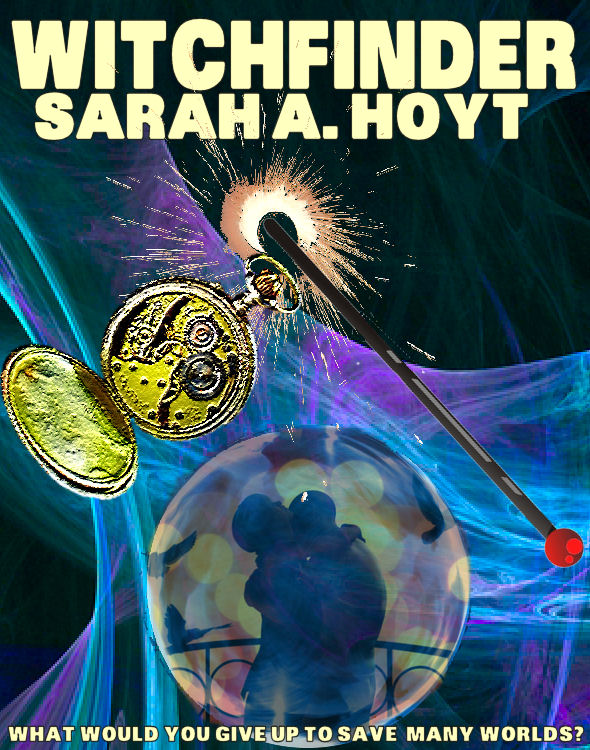
Witchfinder, Free Novel, Chapter 61

*Sorry to be so late.  Honestly, I JUST have a head cold, but it feels like my brain is stuffed with cotton wool.*

*This is the Fantasy novel I’m posting here for free, one chapter every Friday.   If your conscience troubles you getting something for free, do hit the donate button on the right side.  Anyone donating more than $6 will get a non-drm electronic copy of Witchfinder in its final version, when it’s published.
There is a compilation of previous chapters here  all in one big lump, which makes it easier to read and I will compile each new chapter there, a week after I post.  When the novel is completed and about to be edited the compilation page will probably be deleted.

Oh, this is in pre-arc format, meaning you’ll find the occasional spelling mistake and sentence that makes no sense.  It’s not exactly first draft, but it’s not at the level I’d send to a publisher, yet. *

Unleashed


Seraphim felt the power pull before he could think where it had come from or what it meant.

In panic, he clutched at it, holding, as a forceful pull snatched it clear away.  A pull stronger than any human could employ.


In that moment, he had a picture of Gabriel, of Caroline, of Nell, hurtling through space.  No.  Gabriel was jumping.  But he wasn’t Gabriel, he was… a creature.  A giant creature, made of something not human flesh, but made of something crackling with energy and power.  Yet, undeniably Gabriel, with Gabriel’s grimace as if he’d just realized whose power he pulled.


Only it wasn’t Seraphim’s own power, he realized with a start.  It was.  Marlon’s power.  Marlon’s power which had served to disguise—


“Darkwater,” the voice was Honoria’s, raised in startled surprised.


Seraphim had been in the princess’ nursery, looking around, amid a lot of other workmen and people outfitting the nursery for the next generation of heirs to the throne.  The idea that those would be Honoria’s and Sydell’s children made him want to shudder and abandon the world all together.


Something else that made him wish to abandon the world was the crisscrossing of power in the room.  It would be invisible to most of the workmen and, he would guess, to all the people willingly admitted to that room, at least if Honoria had anything to say about it.


No simple household magician or maid would know any better, and those higher up who would be admitted would be either screened to make sure they knew nothing of malevolent magic, or else within the conspiracy to lie to the king about his daughter.


But to Seraphim’s eyes, to the eyes of anyone who had trained in dark magic – though not for the performing of it – the ropes of dark and filthy stuff cross the room and forming a cat’s cradle made him think that no one, not even Sydell’s spawn deserved to live in this room.  Unless he was very wrong, it had taken human sacrifice and worse to create these, and Seraphim did not even wish to think about what the “worse” might be.


In his guise as a common tradesman, he’d been pretending to look at the drapes, and measure the walls, all the while trying to figure out where, in the center of this, the knot was holding the working in place.


For a working of this kind, to disguise and deceive people like the king who certainly knew better, it needed something material to hold it in the center.  For this filthy a magic, probably a captive human – or supernatural – soul.


He had been working through the tangle of magical ropes, and thinking only of that, when Honoria’s voice calling his title made him turn.  In it, he’d almost lost the squeak from Valerie, which was not quite his name, but might have been meant as a warning.


Seraphim’s first impulse was to hide or fight, but he could do neither, and besides both would be foolish.  After all, he still had his power, and he still had his wits.  At least he hoped he had his wits.


In power and wits – he’d never deceived himself otherwise – he was Honoria’s superior.  What he lacked, of course, was the back up of several palace guards.  But he’d been in worse situations, after all, and if worse came to worst, he could port out of here, to another world, and from that other world fight his way back here, to this moment, to confront Honoria again.


So he looked around and smiled at her, his best, dazzling smile.  “Hello Honoria,” he said.  “Or should I call you by the false name you’ve appropriated?  Did no one ever tell you, Miss Blythe, that pretending to be the heir to the throne is treason and likely to lead to stretching that pretty white neck of yours?”


She didn’t count on his coolness, he saw, and immediately perceived he’d scored a hit when her hand went to her neck, reflexively.  It took her a moment to find her voice too, and it came out squeaky and high, “How dare you?  How dare you?  After kidnapping me and giving me to a family not my own? After making me become engaged to you?  After—”


Seraphim had taken note of the fact that the room had gone deadly silent, with every maid and servant hearing this, drinking it in.  They wouldn’t remember it though.  Part of the working in the room was to make sure that anyone in here would believe the story that Honoria had put about.


So he must still find the center of this – though it was akin to finding the tip to embroidery floss the cat had been at.


And at that moment, on that thought, he remembered Gabriel’s method for doing just that.  When Gabriel was young and still out of place in the household, Seraphim’s mother, out of kindness, often called to him to help her disentangle the threads of embroidery floss.  Gabriel’s methods were unique.  He would break the thread, anywhere, he said, then start rolling it, and when the came to another point that was raveled, fix them together by magical means.


Seraphim didn’t have the need to do that here.  He wouldn’t be raveling this thread again.


So he answered cooly, “I don’t recall making you anything, milady.  I made you an offer and you jumped on it eagerly enough.”  He grabbed the nearest thread, and, employing all his power, broke it.


Honoria’s eyes widened, seeing what he was doing, though to the rest of the room it must look like he clutched at nothing.


“What are you doing?” She asked.


There was no appropriate answer for that, so he tried none.  Instead, he yanked on the filthy thread with all his might, at the same time opening a very small gate into a world of fire, where he disposed of such things.  He put the thread in it and started feeding it.


“Guards, guards,” Honoria screamed.


Seraphim ignored her.  He was now pulling on the thread, with both hands, feeding it as fast as he could, into the fire.


Ahead, he saw a knot in it, and bit his lip, because it meant he’d have to cut it again.


Guards approached, running.  There were guns pointed at him.  Honoria was saying something about being wanted.  Valerie, somehow withstanding the magic, was screaming a counterpoint.


But one thing Seraphim knew was that by virtue of his birth, only the king could order him fired upon.  Stopped sure, but not fired upon.  The guards were approaching, cautiously.  Cautiously because Seraphim must look to them like he was clutching at nothing, and a madman was always to be feared.


And then the knot was within Seraphim’s hand, only it didn’t feel like a knot, but like a tiny birdcage, of the sort that some people kept crickets in.  Jumping out of the way of the nearest guard, Seraphim applied all his magic to breaking the cage, so he could keep feeding the thread into the gate.


It resisted his efforts and he thought of throwing it through the gate, cage and all, but…


A guard grabbed Seraphim’s arm.  “You’ll come quietly your Gra–  Mil–  Mr.”


And Seraphim, in despair, before the other guard, approaching, could use a magic-restrainer on him, put all his strength into crushing the cage.


It broke like glass, the shards biting deep into his hand, blood pouring down.  It didn’t matter.


The moment the cage broke, all the threads unraveled, with a hissing sound like a raging fire.  Anyone with magical power in the vicinity felt it like a flail upon the magical sense.  Honoria screamed.  Valerie covered her eyes.  The guards let go of Seraphim who stepped back, stunned, letting the remains of the cage fall from his wounded hand.


From the cage, like a fog, a figure emerged and materialized, and looked around with a puzzled expression before saying, “At last!  It’s been such a long time in that filthy prison.”


The Myth That Kills

I’m very afraid this is another of those posts that will get me accused of being a “gender traitor.”

That’s just fine.  If you think a gender – the fact that you were born with one piece of physical equipment – demands your loyalty and forces your opinions to be the same as those people with the same piece of equipment, call me a traitor.  Guilty as charged.

You see, I tend to think of people as people.  This has largely been a handicap in writing fiction in the current age, because I’m expected to view women as saints-and-martyrs and men as oppressors-and-satyrs.

Have I met some examples of those?  Oh, heck yes.  Hasn’t everyone?  But I’ve met the opposite too.  Hasn’t everyone?  So why is only one of those the “correct” thing to put in a novel?

Ah, but you’re going to tell me that pushing women as victims, as saints, as nurturers is the way to go, so we can carry on with the feminist victory and equality of the sexes.

(Looks across the computer at you)  I don’t think that word means what you think it means.

Equality means, in this as in anything else, equality before the law not equality of results.  This is something that we keep forgetting.  Look, that was the ultimate difference between the American and the French revolutions.  Americans wanted equality before the law.  The French wanted equality of results.

They had justifications, too. They were dealing with an historically beaten-down peasantry, starved, uneducated (though not nearly so much – the revolution happened because education had started to spread.  Never mind. We’re going with how they viewed themselves) used to being deferential.  They needed more than just equality before the law, they said.  They needed to redistribute some of those advantages, to enforce equality of results for a while.

We all know how that ended up, right?

It always ends up that way.  Humans are individuals, not groups.  When you empower the groups, you empower the worst in any group. The power-thirsty, the aggrieved, those who want to manipulate group-outrage for their own purposes.

It is the same with women.  It’s lots of fun to read the more sentimental writers of centuries past (and the not so sentimental and totally un-ironic feminists of the last century) go on until your eyes bleed about women being kinder, gentler, softer, nicer.

Poppycock.  Poppycock with powdered speciousness.  Yes, women presented that way.  This was the result of centuries where women had the subservient position.

The first one of you to open her mouth about how this is the injustice feminism needed to correct is going to go to the corner with the dunce cap, so help me bog.

The reason women were “oppressed” for six thousand years (longer, for certain values of women) had NOTHING to do with men dethroning the goddess myth and destroying the perfect matriarchal society because they’re evil or any other re-writings of the Judeo-Christian myth of Eden.  Marija Gymbutas was – yes, I’m crossing Godwin, and I have a reason – as much of a fabulist as Hitler, and about as good a scientist.  She didn’t have armies at her disposal, but those who believe in her might in the end bring down civilization as effectively as the Nazis would have done, so I do not apologize for using the analogy.  (If you don’t think convincing women that all men are their enemies, handicapping boys in school, running men out of the teaching profession, and generally making men guilty-until-proven-innocent is a civilization-killing meme, you need to go out and meet some real men and some real women.)

Women were subservient in society due to that horrible oppressor: biology.  When you were going to have to be a celibate or spend half of your life pregnant, you missed out on other aspects of life.  Yes, I love those of you who had no problems in pregnancy.  I had to diametrically opposite experiences: the first pregnancy would have killed me without strict bed rest, for the second I kept forgetting I was pregnant.  HOWEVER in both of them in retrospect, not at the time, I missed vast chunks of intellectual function.  There is an hormone cocktail that is supposed to make you fat, happy and dumb during pregnancy.  It is what it is.

Worse, even for women who never get pregnant, until modern hormonal treatment, we women were prisoners of our hormones.  Even now I have more than a friend who hit menopause and… became someone else.  In very rare instances, the change is for the best.  Most of the time it’s a “What on Earth happened to your brain?”

I thought I had dementia for a long while – I literally couldn’t remember the names of my characters or what had happened from a chapter to the next.  And if I wrote it down, I’d have to go look at the notes, and then when I came back to the book I’d forgotten what I’d looked up.  For a while (most notably the last Musketeers mystery) I had to have a friend check my work because I’d forget what I was doing and had tons of internal inconsistencies.

Turned out it was an hormonal problem, not dementia and not menopause, as I thought.

Now, that’s an extreme case, mind you.  But it’s not unusual.  And though men, too, can have this type of issue, it is considerably more common in women.  What makes us women — the ability to generate new life – also makes us cyclical creatures, both in the monthly sense and in the life-cycle sense.  And if you think your hormones don’t affect the way you think, let me tell you the only reason you think that is that you’re inside your skull and being affected.  Until my experiences with hormonal insanity I too thought I was impervious.

Anyway, the point is until modern medicine with contraception and hormonal supplements, women were swimming with an iron vest strapped on.  Add to that that only women can be sure that their children are theirs.  This made men – of course – wish to make sure women were controlled, to make sure the kids they were providing for were their own.  It made for a society where women were somewhere between children and chattels and men had all the responsible positions. (Though even then some women managed to break through.  Individuals are… individual.  It’s one of their characteristics.)

Does any of that still apply?  No.  Thanks to modern medicine, we even can figure out whose daddy is whose without keeping women in purdah.

And though it took a little while, society changed. Women started taking the place of equals in society.  Like the French peasantry, which would have come along once barriers to their equality under the law were removed, we have started taking intellectual callings and sometimes physically intensive callings.

We are now, if we want to be, equals.

The problem is that most of us don’t want to be equals.  And the reason for that is that most of us have been sold on the feminist creation myth of the great mother and the perfect society with men as the spoiler of paradise and the villain.  And most of us are stupid enough to buy it.  (Yes, I know men worshipped goddesses.  If you think that made the society feminist, you have birds in your brain and you probably also believe there’s some magical herbs that are as effective as the pill and have no bad side effects.  (No.  There aren’t.  There was a bush that had similar properties, but it went extinct in Roman times).  Societies that worshipped goddesses often demanded the most control over women and engaged in temple prostitution.  They also had a marked tendency to child sacrifice.  On the other hand, most societies worshipped both.)

Also, most men are of course bigger than us.  Stronger. And there’s the whole historical inequity.  Just like the French peasants.  So we demand laws that favor us and more importantly we demand the blood of our enemies.  And we demand to be treated with a respect and a care that would have scared Victorian maidens.  We use the slightest thing as a weapon.  Because only when the oppressors are gone, will we be free.

This was bad enough when it was the French peasantry.  But men are not some aliens dropped on the Earth from afar – they’re our fathers, brothers, sons and husbands.  They’re an integral part of what makes humans humans.  They’re not a monolithic group, just like women aren’t, but statistically they’re better abstract-and-visual thinkers and the people who are more likely to think outside the box, just like statistically we’re the socially-oriented people, more detail-specialized and better at cooperating.

Society – a civilized society – needs both to survive and go forward.

But women have been sold on males-as-the-boogeyman and therefore they see evil intention and coordination and conspiracy behind males’ being people.  Meet one abusive male, and you’ll go through life convinced that all men are like that.  Does anyone do the same when meeting an abusive woman?  I don’t know about you, but I’ve had bosses from hell in both genders.  So, why is only one accused of being “oppressive”?

Because it’s the myth.  And it’s a myth the power-hungry people who took charge of the feminist movement (one that initially only wanted equality under the law) are happy to perpetuate.  It’s a myth every college, every entertainment gatekeeper cherishes.

It’s a poisonous myth.  It’s also a stupid one.  No one in their right mind would talk about “War on women” for instance.  Are you insane?  Why would normal men – yes, your husband, your brother, your son – want to make war on women?  And yes, that means you, your sister, your mother.  Hell, even my gay male friends like women and have mothers and women friends.  And yes, for those of you about to be stupid, even males on the opposite side in politics have all of those, and no, none of them hate women.  (Except perhaps the occasional pathological case.)

(If you bought that wanting to not pay for contraceptives out of the public purse and at the expense of other people’s religious conscience is a “War on women” you might want to inform yourself.  Not giving you something for free is NOT restricting access.  Otherwise, people are restricting your access to food, housing and entertainment.  Is that a war on humans?)

I’ve watched the rise of this myth with slack-jawed amazement.  HOW can you even think that.  Guys, my men – and I live with three of them, husband and two sons – couldn’t “conspire” to keep chocolate hidden from me (they’ve tried.) And they’re all three of them brighter than the average bear.  WHY would you think men in general would want to conspire to keep you in submission?  Most modern guys wouldn’t know what to do with a truly submissive woman.

Oh, I know.  It’s the myth you heard, from Gimbutas and her sisters in school all the way to the latest movie you watched.  Males want power over you.

Well, some males maybe.  Those who belong to a religion that dresses women like upholstered furniture.  But it’s just one culture and there’s reasons for that (including but not limited to a culture of scarcity and a tradition of bride kidnapping.)  It’s not all men, and it’s certainly not MOST men men of the western world.

Like the women who no longer remember why women were “historically oppressed” the men alive now were never in a society where men had the upper hand.

I have a friend who believes that it’s a pendulum.  Men had the upper hand, now women do, then it will swing back.

Unless science has some sort of pendulum too, I don’t see where she’s right.

What I see is women who were freed by tech advances and who THINK they were freed by marching shoulder to shoulder and taking permanent offense.  These women live in a state of paranoia, dreaming up male privilege that is invisible to anyone but them, and taking offense at ever more ridiculous things – even things that have nothing to do with gender – because they’re so terrified of men taking the upper hand again.

I look at them going to war with spelling: Womyn, Herstory.  I look at them dancing around dressed as vaginas (!) because apparently the most important thing in these women’s lives is their sexual organs. I look at them acting as a pack and attacking whoever they’re told to attack because “so and so is anti-woman” and I think… these are humans?  These are civilized people?  Don’t they see they’re being tools of the Marxist divide-and-conquer strategy?  Don’t they see the end of this is either societal destruction or TRUE backlash for the sake of saving civilization?

Apparently not.  So… carry on.  Dance around in your little fabric vaginas.  Think that all men are out to get you.  Refuse to have children, because some of them might be male.  And scream, scream, scream about made-up outrage.

That’s the way to bring civilization down and destroy the technological advances that brought us equality.  If that’s what you want, DO carry on.

Apres nous, le deluge.

To Everything Turn Turn Turn

*Being me I completely forgot about this:  Dyce makes a guest blog appearance.*

This is very important.  Lean closely darling.  Let me whisper in your conch like ear.

THERE IS NO SUCH THING AS THE RIGHT WAY TO WRITE  A BOOK.

No, seriously.  Anyone who tells you there is only one way to do it is selling you something, and the least pernicious thing they could be selling you is their method for doing it.  Usually they are selling you their moral superiority, which is worse.

What am I talking about?  Do I mean that every book is perfect, just as written ™?  No.  While Ric Locke maintained that all but the least comprehensible of efforts  would find buyers in this brave new world, in my case I believe there are good books and bad books.  Well, at least there are books I want to read and books you couldn’t pay me enough to.

But there is no right process and wrong process.  The process is not the result.

I can’t – though Amanda probably can – remember who in one of the first talks I gave at the Bedford Library Meet the authors night described this romance writer’s process which involved “I get up early in the morning.  I do my yoga.  I dress in my sexy robe.  I light my scented candles.  Then I sit in my desk at an east-facing window, and as the sun comes up, I let inspiration fill me, and—“  Whoever this gal was, her process was like mine “I visualize a writer like that and beating the living cr*p out of her, and then I’m inspired.”

Does that mean that romance writer’s process is wrong?  No.  It just means it makes me want to gag then beat my head against the desk because it feels so good when I stop.

I’m not a joiner, and I’m notoriously suspicious of this sort of airy fairy thing.  I don’t do yoga, I iron clothes.  (It induces the same sort of blank mind state, after a while.)  I don’t light scented candles because they make me sneeze.  And writing is my job, not my slightly porno-y obsession, so a sexy nighty is right out.  In fact, if I tried to do any of this I’d probably be grumpier than a bear with two heads.

But then I bet you what I write is not what that romance writer writes.  NOT EVEN if we were both given the same general story.

Your personality determines what works for you in terms of writing process and – here’s the thing – you need to be ready to change.

But Sarah, you say, why do I need to be ready to change when a process is working for me?

Because writing is this confluence of you as you are at that moment and the book you’re trying to write RIGHT THEN.
What does this mean?  It means that sometimes the book you’re trying to write won’t work with the process the last eight books worked with.  (And sometimes it will have to be shelved because it won’t work with who you are at the moment.  One of the reasons I HATE working from outline sold years ago, is that I’m not that gal anymore.  Fortunately that seems to be a thing of the past for me.)

For years my writing process involved an outline so detailed that you could have added dialogue and description and have had a novel.  Nowadays…  well, #1 son shocked me by saying I was a consummate pantser, and he was sure I knew my plotting very well, since I still have plots.

Am I a consummate pantser?  I don’t know.  The last two books I wrote only let me see about a chapter ahead, and yet they seem to have worked pretty well plotwise.  On the other hand, the current book I’m plotting five scenes ahead at a time, or I can’t write.  This is possibly because this is a rewrite, my having finished Noah’s Boy a month ago and realized it wasn’t functional.  (And that was a first for me too.  I’ve discarded/added as much as 1/3 of a book, but never have had to break it apart completely and insert a plot and withdraw one, and change tow main characters completely and… You get my point.  I guess it’s reassuring to be able to see ahead in this case?)

What I do know is that my process has changed completely several times, from careful plotting to almost-pantsing.  And at this point I wouldn’t tell anyone that one way is right and one is wrong, because I’ve written books in practically every possible way: character out; plot in; setting out; problem…

So the only thing I can tell you is that whatever you think you know about writing will change.  And change again.  And the best thing for a long career is to hang loose and go with the flow.

The art might be immutable, but you and the book aren’t.  You’re both organic, growing entities.  Writing a book is more like parenting a child than a 9-5 job.  (Yes, I’m gagging, and yes, I still try to work 9-5.)  Grow with it.

In A Warped Mirror — Literature as societal Relection –RES Speaks Again

*In kindness, or perhaps because he wants me to be done with Noah’s Boy already (and he’s not the only one breathing down my neck while I struggle with my writing-to-contract phobia) RES sent me a post on how the artist reflects society.  He’s promised me a companion piece already.  And, btw, I never knew he was a Times New Roman over Ariel biggot [live and learn.]

In a different note, today I have a free short story up up Amazon — it was up here for a week, but if you missed it, head on over.  Something Worse Hereafter should go free at noon Eastern, or in about two hours and change.  My goal is to keep a free story on Amazon between here and the end of the year, and see if that helps goose numbers.  We’ll see, right?*

In A Warped Mirror

By RES


It is said that the duty of the artist is to reflect Society.  Unlike many of the things often asserted, it probably is true, although probably not in the way most artists want to believe.


It is not that the artist should hold up a mirror to Society, it is that the artist, by the nature of creating art, does hold up that mirror.  In most instances it is a funhouse mirror, in rare cases it is a true mirror, but the artist cannot refrain from reflecting Society as the artist understands it.


No artist exists in the absence of Society; their values and how they see the world are shaped by Society.  Their conceptions of what is good and just versus evil and unjust are a response to the society in which they swim.  Even if an artist somehow supercedes Society, their art must remain of Society in order to be understood by that society.  Art is a conversation and the artist either converses with Society or talks to himself.


What, then, is the duty of the artist?  While many an artist thinks to hold up a true mirror, the mirror held is almost always warped because few artists have the depth of understanding necessary to offer a true reflection.  An artist has preferences and values (Tolerance versus Holding to Principles, Acceptance of Outsiders versus Group Cohesion and Identity, Times Roman versus Ariel) which warp the mirror raised because they form the basis of the artist’s understanding of Society, of Good & Evil, of Proper & Improper, of Couth & Uncouth.


Removing the timber from your own eye is extremely difficult, yet it is necessary to more accurately reflect the world.  One approach is to rigorously exert yourself to understand the world you are reflecting.  If you write a Historical, be true to the characters in their Time and Place.  Few Antebellum Southerners questioned their Peculiar Institution; few Yankees mill owners thought there was anything wrong with locking the workers into the mills during work hours.  Giving modern views and opinions to historical characters should be done with extreme care; avoid the temptation to wheedle readers’ sympathies by having a character reflect contemporary sensibilities.  In presenting the views of historical characters the antecedents of those views should be expressed, placing them in the context of an ongoing social debate.  One era’s enlightened view is another era’s Paleolithic thinking.


People are and have been shaped by the cultures in which they were raised, with those cultures’ envisionment of the Cosmic All imbibed at their mothers’ breasts.  Rare is the character able to reject the standards of measurement of their natal culture, and only extreme circumstances can bring them to do so.  It requires a powerful motivation for Huck Finn to reject the premise that Jim is somebody’s property, just as it required soul-searing experiences for him to even question that idea in the first place.  Had Twain not put Huck through a wringer those changed ideas would have failed to bring the reader along with him and dimmed the mirror’s reflection.


Characters should represent the zeitgeist of their era as accurately as possible, partly because the reader has chosen that genre in order to learn about that zeitgeist, partly to reflect both the society presented and the society to which that view is presented.  Part of the pleasure of reading a historical novel is to crawl inside a character perspective different from my own, both to experience that perspective in order to understand that era and to contemplate the differences between that era and my own.


It is important to provide readers various touchstones to properly orient in the historical era.  If reading a Western I need to know, the author needs to show me the basic premises of the culture.  I have to be told, for example, that $100 was a lot of money, was four months’ wages for a working ranch-hand.  I need to have explained the different concepts of Time and Distance governing people in that era, when fifty miles represented a hard day’s travel, when a month was the time for a letter to travel from sender to recipient.  Most importantly, I need to see how these factors affect the way people of that era think.


The goal is to provide enough information to allow readers to understand the nature of the culture they are viewing and to allow for the way our present perspectives distort the artist’s mirror.  It is vitally important for the artist to minimize projection of modern attitudes and values as a source of distortion; it is bad enough the readers bring their own values and expectations.  Because Society’s rules and standards are constantly shifting, Today’s blindspot is Tomorrow’s glaring fault.  Present characters and situations that are appropriate to their period.


Science Fiction and Fantasy present similar yet different challenges.  In them the author too easily succumbs to the urge to write lazily, to presume the attitudes which the author desires to promote.  Heinlein believed in “Free Love” and in later novels simply waved his hand, presenting characters who nobly and unselfishly enjoyed multiple partners.  At least in The Moon Is A Harsh Mistress he provided a back story to make such attitudes a justified response to extreme conditions, and provided historical basis for the reader to accept the meme.


Darkship Thieves handles the issue of presenting a Libertarian society by displaying it through the eyes of an outsider, dumped into the society unwillingly and unexpectedly.  We are given enough background of the culture’s history to imagine we understand how they reached this social solution, and because the narrator is naive in regards to the culture she challenges and asks questions, allowing the social adjustment to be justified.  Because the reader is equally naïve, the identification with and sympathy with the narrator are enhanced.  Willingness to accept the character’s conclusions is greater because the author has “shown her work.”


Ayn Rand’s characters, on the other hand, are generally cardboard, acting according to authorial requirements for the philosophy she wants to present, speaking all too often in polemical oratory, too rarely as real people.  The mirror she holds up to Society is a warped one, purporting to present both how Society is (conniving and corrupt bureaucrats striving to control everything) and how she wishes it would see itself (entrepreneurs acting to improve the general weal by advancing their personal interests.)  Because her characters are not brought to life their experiences are less moving to the reader than they ought be.  Her mirror is dulled; we do not see our own reflections therein.  Even people who share Rand’s politics are distanced from the novel by the flatness of the characters.


For truly powerful and moving art, the artist must understand the world being reflected, must know the motivations and histories of all the major characters and many of the minor ones.  Every character should have a personal code, a set of lenses through which they view their world, and the reader needs to know each character well enough to understand that viewpoint even if (especially if) they don’t agree with that view.  Villains should not simply be given Black Hats — repellant personal traits and characteristics that the reader recognizes as signs the character is despicable — and White Hats.  Their motives should be complex enough to be credible rather than something as jejune as a lost childhood sled (unless the lost sled represents a stolen childhood.)


Heroes and heroines ought be motivated by moral principles perceptible to the reader, if only through many layers of character.  Sure, Li’l Abner’s Mammy could declare that “good is better than evil because it’s nicer” but that’s because she was a character in a comic strip dedicated to parodying mindless memes, the bad mirrors of the strip’s era.  When a character has to struggle to make a decision the reader needs to know why this is a struggle, what values are in conflict and what their roots are.  If the character makes a decision without any struggle, the reader should have seen why the character was decisive, why Value This so readily trumped Value That.


A culture is defined by its values, and those values define the culture.  Subcultures exist and define themselves by the values they emphasize and de-emphasize: group loyalty over fidelity to the standards of the larger culture, recognition or non-recognition of rights of those not belonging to the group.  A reader’s ability to perceive and recognize these distinctions affects the level of involvement in the tale.


While it is nearly impossible to perceive the world so thoroughly and clearly to present a true mirror, the artist should strive to polish the mirror to the best of their abilities and to make the warps in the mirror as honest as they can.  Admit preferences — Human Wave or Grey Goo — so that the reader can sense the warp in the glass; trust the reader to share that warp, if only for the length of your story.

Who Are You, Really?

Do you ever look in the mirror and wonder who you are?  Sometimes, heading out of my tiny powder room, after washing my hands, I catch a glimpse of my paternal grandmother in the mirror.

No, I’m not as old – nor do I look as old – as she was when I first met her, much less my first memories of her (which were of her being sixty three.)  And we’re not objectively that much alike.  Like most people, I went through life looking now more like one parent, now more like the other, depending on how I wear my hair and what weight I am.

But as I catch a brief, sidewise glimpse of my own face in the mirror, there’s that quirk in the lips, that expression in the eye, and my heart flip flops and I think “Grandma” before I check myself.

There is heredity, of course.  I stop short of believing our heredity programs us like little robots, that, beyond fate, we’re acting in some kabuki theater where every action was predetermined from the moment of birth and we only think we have free will.  Someone like me who kicked over the traces pretty hard, and whose initial elaborate “running away from home” as an exchange student hinged on seeing a particular poster at a particular time would have trouble believing that.  Besides, as I’ve explained before, even if it were true, I wouldn’t believe it.  To believe it would be to concede evil has won, that there is no choice and no such thing as an individual, and that we are like so many ants, following scent trails.

Besides, if that were true, the one nation that enshrined individual liberty would have done worst of all in prosperity and living conditions.

So unless it is proven at some point we really are living inside a computer simulation (!) I’ll continue believing that most of what we do is… well, not nurture so much (though that comes in) but self-will.

Which leaves me baffled by the things that aren’t, by those bits of actions/expressions/attitudes that seem to pass down the stream of DNA without our volition.

It is impossible, of course – Sarah says, channeling her inner Miss Marple – to live in a village and no know something about human nature.  And what I know about human nature is that to an extent “what is bred in the bone will come out in the flesh.”

My family was known in the village for “A gift of words” – despite some stunning sports we threw out now and then, like my inarticulate grandfather, whose words were likely to come out backwards and sideways, as did my older uncle’s and as do my younger kid’s (though that might be developmental, as it’s going away now, being replaced with family-normal fluency) a disability that seems to always coincide with some form of engineering ability.

If they needed a spokesman for the village, someone to write a poem, some sort of wordsmithing, they came to us, even when the current representatives of the family were manual laborers or craftspeople.

How much of that was bred in the bone?  How much was the conversations around the dinner table where philosophical questions would be unpinned and you learned your vocabulary at three from listening to dad and granddad argue about the differences between various methods of governance?

One of the things that indicates heredity is the resurgence of the same characteristics in the descendants of a “sport.”  My inarticulate grandfather, whom his parents, in despair, had apprenticed as a cabinet maker, produced – among his grandchildren – as many lawyers, psychologists, doctors and engineers as his far more articulate brothers who were in those professions.  This despite the fact that as the much poorer branch we were more or less isolated from that side of the family.

In fact, going back as far back as one can, in my paternal line, one finds reasonably well educated people (even when general literacy in Portugal was minimal, all of us knew how to read, the women included) who predominantly show a flair for wordsmithing which might or might not be coupled with other abilities.  Professions range from crafts to law, though the family has a strong tendency to engineering and doctoring.

How much is bred in the bone?  It shows as bred in the bone, but is it?  How much is the talk around the dinner table?  And how much is picking mates who understand that talk?  My articulate father married an articulate and casually brilliant woman whose scant education was dwarfed by an interest in … everything.  (Though mom, like my younger son is very suspicious of fiction.)

Perhaps it is that I’m getting older which causes me to worry when I catch a glimpse of grandma in the mirror.  Not because I’m afraid I’m looking older.  I have no illusions about the fallibility of the flesh.  But because I wonder about gifts received and what I’ve done with them.  I wonder if I am living as I’m predisposed to or if I’m truly choosing.  I wonder about things like the Almeida tendency to pick the most bassawkward political theories to follow.  (With me being small l libertarian and my brother being a communist, though, it leaves  one in a puzzle.  Maybe we’re headed to an era with no political theory at all?)

Perhaps it is because I’m raising kids away from all the relatives who could have reasonably influenced their expressions, their beliefs, their ways of being in the world. And yet, my younger son is so close to my dad we might as well have cloned dad.  He even follows the same developmental milestones.

Then there’s Robert who is a patchwork of both families and who startles me suddenly with a look like my grandfather Alvarim’s, or by sitting like my grandmother Carolina.

Bits and patches, and …  Who are we?

If we go back far enough, we’re all cousins, probably several times over.  As Older Son is fond of reminding me, human population has gone through extreme bottle necks at least three times, and there might have been less than a hundred individuals.  So, we’re all cousins.

But you still see a continuity in a line, when you know the line.

And when you don’t?  I know adopted children who are more like their adopted parents than the parents’ natural kids.

I know that our pediatrician, when we talked about adopting and being afraid of getting a kid who’d be lost in our family, said “In your family?  Not a chance.  By the time they’re three, they’ll have the same vocabulary and fluency and they’ll test bright, anyway.”

Is it true?  I don’t know.  In the same way both kids often feel like total strangers, or like all too familiar, I suspect it would be the same.

Who are they?  Who are we?  What unknown/unremembered ancestor gave us that nose?  Where on Earth did those eyes gaze before?  That tendency to lead with the chin when arguing… where did it come from?  Was the last ancestor to do that some Phoenician merchant whose last remaining bit of DNA in the blood left me only that?

Thinking about this stuff brings about the same sort of vertigo that looking down on an endless abyss does.

And of course in the end the answer is always the same – you take your bits and pieces, patch them as best you can and carry on.  You mend what you can, you accept what you can’t (because even you aren’t endlessly changeable, no matter how much will power you have) and you carry on.

But sometimes you catch that glimpse and you can’t avoid thinking “Who am I really?  And what hidden depths have I failed to unlock?”

My Readers, Their Friends And I

This report about what my readers have been up to is somewhat hampered by the fact that half of them seem to have wittlows which have prevented their finishing things.

The most creative excuse is from CF who was rescuing kittens and therefore can’t write.  (Um… don’t you rescue kittens too, Sarah?  Yeah, but I often also don’t write.)

So, I’ll start with the ones that have stuff, you know, actually up and for sale.  So:

STRYDER DANCEWOLFFE:

Karma’s Beach,  in the Family Influence series

STEVE POLING:

Finding time

(Sarah note – your title should be larger and your name must be larger on that cover, Steve.)

KAREN MYERS:

To Carry The Horn.

And, being an overachiever, Karen reports on her endeavor, also:

Just published my very first novel (actually, my very first work of fiction), the first book of a fantasy series. Landing page here: http://perkunaspress.com/wp/books/the-hounds-of-annwn/to-carry-the-horn/

Took five months, morning before work (I was on a mission). I’ve been ascending the very steep learning curve and, while I have a lot to learn, it has actual architecture and I’m content that it’s good as I can make it at this point in my experience. Did all the cover and formatting work myself (I’m a techie, but Smashwords just about killed me.) Hard-copy proof arrived last night — what a rush! — should go up in about 2 weeks.

What I’m crowing about is that the very instant the book goes live on Amazon this week some kind person buys it. But even better, the instant it’s up on Smashwords, someone not only buys it, but reads it immediately and writes a 5-star review which cites a meaningful aspect of the book. In other words, someone paid me money and when he read the book, he “got it” in some basic way. Whoo-hoo! Better than drugs!

I haven’t announced it yet to my initial prospects, waiting for the hard-copy (they’re by-and-large Luddites), and who knows how it may chug along at just a few sales until the next few books in the series come out. But I couldn’t be more pleased to be rewarded with an intelligent and satisfied reader right out of the gate.

(And don’t worry Karen, Smashwords annoys everyone — Sarah)

DEBORAH KINNARD:

The Faith Box Book One: Peaceweaver (TheFaith Box)

She also reports:  Peaceweaver, my 973 Wales book my agent said would never sell, came out last month from Desert Breeze. Working on its sequel and my first try at indie-work: Hello Again, a contemporary romance, will release as soon as I figure out this formatting thing.

D. JASON FLEMING:

For The Fragile Muses

MARTIN L. SHOEMAKER:

Ulterior Motive Lounge: UML, 80s Flicks, and Bunny Slippers

Sense of Wonder

The Mother Anthony

It ALSO comes with a report (for one the links above are kindle, but he has them in other formats as well:

My two self-pubbed stories are now on B&N and Smashwords as well as Amazon (where they’ve been all year).

“The Mother Anthony” tells of a teacher on a starship in peril, and the sacrifices she makes for the sake of her students. http://www.barnesandnoble.com/w/the-mother-anthony-martin-shoemaker/1113474440?ean=2940015588194 https://www.smashwords.com/books/view/244949

“Sense of Wonder” tells of a Lunar geologist and the price he pays to do science on the Moon. http://www.barnesandnoble.com/w/sense-of-wonder-martin-shoemaker/1113474444?ean=2940015588262 https://www.smashwords.com/books/view/244990

Kim Du Toit:

(In the interest of keeping Monsieur Du Toit from kicking the cat again, I’m adding links received via email which I was remiss in not posting — besides, if he kicks Greebo, he’ll withdraw a bloody stump.)

www.kimdutoit.com for the one-stop shopping experience; or, if you’d prefer the Amazon.com links:

Prime Target

Creative License

Vienna Days

Family Fortunes

Then there’s those that have stuff, but not for sale, yet:

TRAVIS CORCORAN:

  1. I’m revising my first novel “The Powers of the Earth”. Without false modesty I’m a pretty decent NON-fiction writer (I’ve sold something like 7 out of 7 articles I’ve submitted to national magazines), but fiction is new to me, and there’s SUCH a juggling act with plot, characters, dialogue, fore-shadowing, and so much more.

I started work on this libertarian-rebels-on-the-moon-vs-socialist-Earth-government (yes, yes, I know Heinlein did it first. …and better. novel about two years ago (1 Jan 2011). Since then I’ve

* written the first draft (160,000 words)
* revised it to make the plot coherent (220,000 words, split into two novels)
* and am now 40% of the way through revising it again

I hope to finish this pass (draft 3) in another 50 days or so, take a two week break for the holidays, then work on draft 4 (the FINAL draft, I pray!) for the first 3 months of 2013. Then off to copyediting.

Details, in case anyone is interested:

http://morlockpublishing.com

CELIA HAYES:

The Tiny Publishing Bidness just signed two clients this week, and I’ll have to be working on their books over the next two months – so I went all-out this week on my own next book: working title “The Quivera Trail” . It’s about an Englishwoman who marries a Texas cattleman in 1876; think of it as Mrs. Gaskell meets Zane Grey. I’ve posted sample chapters, and put together a list here: http://celiahayes.wordpress.com/2012/10/05/back-pages-and-sample-chapters/ I’m about three-quarters through. I think. Something may come up, plot-wise. Settled some of my Christmas schedule: three days at the Weinachtsmarkt in New Braunfels, and a Saturday at Christmas on the Square at Goliad, the first Saturday in December. And there was also a bit of the usual blogging, and an excursion into the Hill Country by back roads, which produced some marvelous photographs.
And yesterday, we went to the BMT graduation parade at Lackland, to support the son of a neighbor of ours, whom we had encouraged and helped to enlist in the Air Force.
Busy week, all told.

CYN BAGLEY:

I am posting a novel on my blog http://scrambledsage.blogspot.com called Perchance to Dream. Plus I you can find some of my shorts there. Come on by and tell me how I’m doing

Perchance to Dream is about three protagonists talking in their own voices. I don’t usually use first person.

Then my readers pimp their friends:

KALI:

But please put in a word for the free serial Ilona Andrews is running at their website:
http://demo.ilona-andrews.com/category/clean-sweep/ It’s urban fantasy but with Andrews’ distinctive flavor, so even if you’re tired of UF or would never give it a try, well, give it a try

CYN BAGLEY:

Also you said friends – Shelly Arkon at her blog http://shellysnovicewritings.blogspot.com/2012/10/sir-poops-and-hair-ball-host-secondhand.html is doing a free drawing for her newly released book Secondhand Shoes. She has two dogs helping with the drawing and also does interviews of authors on her Nosh Tuesdays.

BOB STOCK:

I recently Kindleized (probably not a word, but should be) a friend’s amusing fantasy novel, Aluvir and the Circle of Twelve. Old-school gamers should get a nostalgic kick out of it. Sean Rhoades, the author, was active on the gaming scene and wrote for Cosmic Encounter and Earthdawn. I’m also pleased how the cover came out, as I have minimal artistic talent; just took some photos and used Microsoft Picture It to apply some filters:
Aluvir and the Circle of Twelve
Reading your recent comments and articles, I’m going to have to raise the price soon from $2,99 by a buck or two!

The synopsis is: “The formidable mercenary guild known as The Circle of Twelve had perfected a simple, lucrative business model: Orc Exterminators Incorporated. Their latest job clearing caverns of dungeon vermin was supposed to be routine. But soon they were caught up in a web of ancient intrigue involving dark elves, daimonic possession, and nothing less than the dragon apocalypse. Would anyone be left alive to pay their wages?”

I’ve also been working on improving the formatting, redoing the covers and adding NCX to some early Kindle books I put up, which were vanity projects to publish the posthumous poetic works of my grandfather, chief among them the Gospel of Demetrius, which in 400 verses purports to explain where God came from, where the Universe came from, where You came from, where your Brain came from, where your Soul came from, and why Atheists are definitely wrong. With a full description of Life after Death!
Gospel of Demetrius

So much content to format, so little time…

Then I pimp my (family and) friends:

Cat’s Paw, by Robert A. Hoyt

Written when he was 13 but NOT a YA.  Not even though all that stands between the humanity and the end of the world is an alcoholic stray cat.  The Gods Must Be Crazy meets Aesop meets The Terminator.

ConSensual, second in Kate Paulk’s vampire at SF conventions series

Vampires, succubi, incubi, werewolves AND my entire family tuckerized in the bargain.  (Lies, all lies.)

Nocturnal Origins first in the Nocturnal Lives Series by Amanda S. Green

If you like it, try the second, Nocturnal Serenade, too.

Then there’s Lawyers of Mars by Pam Uphoff – which is insane.  No, seriously.  It makes Cat’s Paw seem sane.  Try it!

And if you don’t mind mysteries with gay main characters, give C. S. Laurel’s B. Quick a try.  It’s the first of a series.

Next week I shall try to have some of my stuff up for free, and maybe I can get one or two of Dan’s stories up as well.  I’m trying to get him to rewrite his space opera for NANOWRIMO.   I put up an excerpt here.  Maybe I can get help with the nagging?

So what have you guys been up to?

Other than discussing theology (again — rolls eyes.  Like a dog with a favorite bone.) and making puns, I mean…

In a publishing sort of way?  Post in comments, and I’ll make it into a coherent post sometime tomorrow.

New stories?  Favorite stories?  Yours?  Your friends?  Something going free or discounted this week?  Teaching any workshops?  Let me know, I’ll post it.

Witchfinder, Free Novel, Chapter 60

*This is the Fantasy novel I’m posting here for free, one chapter every Friday.   If your conscience troubles you getting something for free, do hit the donate button on the right side.  Anyone donating more than $6 will get a non-drm electronic copy of Witchfinder in its final version, when it’s published.
There is a compilation of previous chapters here  all in one big lump, which makes it easier to read and I will compile each new chapter there, a week after I post.  When the novel is completed and about to be edited the compilation page will probably be deleted.

Oh, this is in pre-arc format, meaning you’ll find the occasional spelling mistake and sentence that makes no sense.  It’s not exactly first draft, but it’s not at the level I’d send to a publisher, yet. *

Falling

Saying he’d use the power of a subject of fairyland was one thing – finding power to use was another.  Gabriel Penn, still Gabriel Penn, fighting against the encroachment of something alien and strange upon his mind, and knowing he was both himself and that strange thing and had always been, lay on his back at the center of the neck sack enclosing them all.

It seemed to him he was very alone despite his sister and brother, despite the princess and the centaur – was Caroline holding the centaur’s hand?  Damn the prophecy and damn its casual pulling of people into roles it had prescribed.  Seraphim would–  He cut the thought off.

If he gave in, if he succumbed to the prophecy’s demands, he would not have to worry about Seraphim’s wrath.  He would not have to worry about wounding Seraphim’s feelings, either.

It wasn’t just that he would not be going back to Earth – Gabriel’s memory played over his years in the Darkwater household with a fond nostalgia that might have surprised those who had always thought of him as oddly out of place, neither servant nor family member.  But it wasn’t only that that he’d been leaving behind.  Part of what made his time at Darkwater idyllic was that, away from his mother, away from fairyland, he’d been able to pretend that he was human: just human.

Even his time with Marlon had been the same or close enough: they’d been pretending they were humans together, and it had been a lovely game, down to cleaving to human moral rules or at least to the extent of hiding and pretending.

But neither of them was human, and Gabriel was something more than a mere half elf.  He’d tried to deceive himself for years that the prophecy was not really about him, that the cold, vast entity he felt, at the back of his own mind, the odd knowledge he had, the things he could sense were not – in any way – part of the fact that he’d been born to be king of elves.

He envied mere humans and their free will.  He envied elves and their lack thereof.  Created, as angels were said to be – though Gabriel had never met an angel and couldn’t attest to it of his own knowledge – without free will, elves were bound to their fate like slaves to a master.  They could rebel, but the rebellion either lasted very little, or it twisted the elf…  Like Gabriel’s uncle.

But Gabriel was neither human nor elf, walking between the worlds forever.  Which didn’t mean he hadn’t known what his elf fate was, or what he as meant to do…  He’d just thought his human half would help him escape it.  And for a while it had.  But prophecies were powerful things, especially in fairyland.  And there were more than one person – more than one entity – conspiring with the prophecy to bring him to the point and to make him obey.

And he’d run himself off his legs – he thought, going lax against the net, feeling the net dig into his back, and looking up at the nebulous dark where the net was hooked, probably to nothing more than a belief that something hooked it.

He glared at it, probing the fixings there.  If he caused the net to fall, could he manage to catch everyone else in here in his power and transport them somewhere, possibly Earth?

Could he do that and arrange his own death?  His mind flinched from self murder, but it was the only way to avoid his fate, and oh, he wanted to avoid his fate.

But then he thought of fairyland, and of the few glimpses he’d had of his uncle’s mind, in recent days, and also of the complications he senses extended all the way to Avalon and maybe to Earth, of the Others that Seraphim and himself had had to find, to rescue unfortunates from non-magic worlds.

Something very bad had been happening in fairyland, and if his uncle continued holding power, it would only get worse.  Gabriel had been taught, back on Earth, that fairyland was a parasite world, feeding off other worlds, like a leech upon a healthy being.  But his feeling, from the thing at the back of his head was something else.  Not something he could fully access or release without also releasing the… not human personality back there, but he knew that somehow a healthy fairyland was essential to the all the worlds.  As much as he would like to destroy the thing and make it burn, he couldn’t.  As much as his human half hated it, the slipperiness of it and its strange ways, he could no more destroy it than he could destroy his human family.

He narrowed his eyes, looking at the suspended net, overhead.  No.  He couldn’t kill himself or destroy fairyland.  Worse, he couldn’t balk the prophecy.  If he somehow managed to get out of here without letting the thing in the back of his head out, it would still get out sooner than later.  The prophecy would push him around and corner him, like a dog with a hare, until it had him just where it wanted him.

So, let the thing out, a little.  Use it a little.  Delay the evil moment as far as possible.

He said “Be ready, princess,” and was shocked at the odd harmonics in his voice, which seemed to echo with a weird force and bounce off non-existent walls.  “When I release you, find your way home with … my siblings and this misguided centaur.  Go home.  Go home as quickly as you can.”

She said something, but Gabriel couldn’t hear it.  He’d gone inside his own head, searching for the link to subjects of fairyland.

It wasn’t unexpected that he found doors barring to him – metaphorically.  The sacred groves rejected him, and the centaurs too, even though Akakios was his proof that the centaurs too were playing the prophecy and risking their lives and their prince to do it.

Magical fountains edged him off.  There were no words of course, but if there had been, it would have been the classical ones of “turn away, turn away, for you are not of fairyland.”

The dragons turned their head away from him, though he sensed they too were not quite refusing to take his side, but afraid of what the current sovereign might do to them.

And there hinged the dilemma.  He could not fight his uncle for the royal position and the royal power unless he got out of here.  But to get out of here, he needed the royal prerogative that would allow him to cut through the net and challenge his uncle.

It was a paradox, and he was more bound in it than in this net.  His hands clutched futilely at the threads of the net on either side.

He’d need someone who was of fairyland, but who had walked away, as Gabriel had.  Someone who would give him the power to do this.  He thought of his mother and shuddered.  His mother…  He’d never been sure if she loved him or not, or even if she felt anything at all.  She’d been thrown out of fairyland as a changeling at the age of five, and though she’d returned after, yet in her mind she remained a five year old child.  She could break things without malice or intent, just to know what was inside.

No, in this straight, his mother was the last person he could trust.

And the first person?  He tried to fight against the thought.  All he could remember was that poor animated corpse against the wall.  But Marlon had said that wasn’t intentional.  Which left…

Which left the ridiculous binding he’d tried to put on Gabriel when Gabriel had come back.  But Gabriel sensed, in a way he couldn’t quite think clearly about that this was because Marlon had a horrible fear of being left, of losing those he loved.  Perhaps not unwarranted.  He’d never had many people who loved him back, from what Gabriel had gathered about his truly horrible childhood.

And despite that fear, he’d removed the bind and let Gabriel go.

Gabriel was imprisoned but his mind and power were free.  He searched through the worlds, finding Marlon’s familiar mind-touch.  Seen through the mind only, he looked younger and less defensive than Gabriel was used to – younger than Gabriel in fact.

Gabriel had only a dim awareness of Marlon’s surroundings: A house, a threatening presence.  Heavens, was that a dragon?  Was Marlon, then, in fairyland?

He got the impression Marlon was … busy and in the middle of a knot of magic.  But his response to Gabriel’s mind touch was immediate.  “Gabriel!”  Marlon mind-spoke at him, recognition and gladness in his mental voice, and also the sort of total shocked surprise that made Gabriel feel a little like he’d been unjust.

“I—” he said.  He’d thought to demand and to order.  But that surprised took the rug out from under his feet.  He kept his mind and mental voice strictly human and his request was framed in human words, “I am in trouble, Marlon, and I need to borrow your power to survive this.”

“My… power?”  Gabriel had a feeling of… not reluctance, but almost fear.

Gabriel let him see the net, above, the people in with him.

“No chance of… waiting.  An hour, two?”  Again that not quite reluctance, but almost fear.

“Uh, as you know… time in fairyland.”

“Oh.  Yes.  And Himself would manipulate it.”

“Yes.”

He almost heard Marlon swallow.  For some reason the idea of ceding his power just now terrified Marlon, but on the heels of the swallow came an answer, “How do I do this?  How can I let you have my power.”

“You recognize me as your sovereign,” Gabriel said.  “You pronounce your power mine to use.”

“It is yours to use.”

“No, in elven.”

“Well, then,” Marlon said and spoke the words, ancestral and inborn, at the back of every elf’s brain, and he used Gabriel’s true name.

It was like holding lightening.  The shock of the influx of magic cut through Gabriel, as well as, suddenly, a clear view of Marlon’s mind, of where Marlon was.  Or what he was doing.

Oh, hell.  Not only had he just taken Marlon’s power away during a duel, but he’d also pulled away his protections from Seraphim and someone else.  It couldn’t be helped.

His power pull would throw people about, too.  That too couldn’t be helped.

What could be helped was using the power to do what it should, and to keep his human self sane as the elf-self, unleashed by Marlon’s fealty, sane and in control.

It seemed to Gabriel as if all that was him stood in the middle of a black and blue hurricane of howling magic pouring out from his own mind.  And the enemy was there, waiting.

He ripped the net with a wave of his hand and screamed at the others, as he tried to conjure stable ground for them to run on, “Run.  Run on home.  Run and leave me to my fate.”