*In the next two weeks, now and then, I’ll post stuff I have started here. What I’m looking for is some type of reaction. Yeah, some of you have seen some of this before. But now I’m looking at finishing things for indie, so… looking for reactions. You know “yes, yes.” Or “for the LOVE OF G-d, bury it” or… :) Well, be gentle, I’m a fragile flower, but give me the general feeling.*
Hell Bound
Sarah A. Hoyt
Dancing In the Dark
Dead people shouldn’t send emails. And dead people shouldn’t text you on your phone. Not only does it play havoc with your mourning process, but it makes you start wondering about your grip on reality.
It was November, six months after my fiance’s death, and I was wondering. I was wondering so hard that I felt as though I were spinning at the end of my tether, gyrating over the void, holding on with cracked fingernails to what passed for my sanity, refusing to let go. Because if I let go there was nothing below me. Nothing but the endless void of madness.
I was driving between Colorado Springs and Denver, in the dark of night, halfway through the sixty some mile stretch on I-25 when the phone beeped. I had it on the dashboard, in case a client called. You have to. If you’re a freelance researcher, you have to. You live from job to job.
Glancing over at it, cresting a hill on the highway, suspended between sky and Earth, with the city lights a distant, glimmering promise, I saw the glowing words scrolling across the screen: Call Heaven Bound. He Can Help.
I didn’t need the initials that scrolled after that. I knew they would be there. C. L. Christopher Liu. Chris.
Six months ago there would have been nothing at all strange about getting a text from Chris. We were engaged to be married. According to the announcement in the Post a fall wedding was planned. The only problem was that Chris had died at the end of June. Just shown up dead, at the edge of South Broadway. No reason he should have been there and never an explanation for why he was. He’d been found leaning against the dilapidated facade of a used book store. Dead of a heart attack, they said. And that he probably had just been walking by when he died, suddenly.
None of which explained why he was naked.
It had been a week-long sensation, in the Post and in their competitor that Chris worked for. Mining News Reporter Found Dead and Nude. For two weeks, I hadn’t been able to answer my phone. Someone wanted to know how I felt, or if I knew what Chris might have been doing, or if he had tie ins to local drug runners or…
And then nothing.
Nothing until the first note showed up, hastily scrawled on a piece of paper from my desk and stuck to my monitor. Chris’ handwriting, undeniably. Heaven Bound. I’d thought it was an old note, somehow stuck to the monitor. I had only momentarily cringed at the dark irony of those two words.
The other notes were not so easy to explain. They came fast and strange. From the name Heaven Bound cut in my living room wallpaper, to the words pricked out on fallen leaves on my front porch. Again, and again, and again.
I’d changed the locks. I’d installed a burglar alarm. And the messages kept coming. Scribbled in egg yolk on the fridge shelf. Smudged in lipstick on my mirror. Always in Chris’ handwriting. Always signed CL.
Lately the word Call had appeared before Heaven Bound, but this was the first time there was an intimation that there might be a he behind the words and that the he could help. Though what he could help me with, beyond the fact that I was getting messages from a dead man, I didn’t know.
Look, I’m not the kind of woman who does seances. I don’t believe in aroma therapy. I have nothing against crystals, but if they can do something to my aura, I’ve never seen it happen. And if there are Atlanteans or Extraterrestrials or any other so called superior beings, I want them to prove their superiority by minding their own business and leaving Earth in general – and me in particular – alone.
I believed in what I could see and touch. Which, right now, meant I had to believe in the impossible.
My hands had clenched tight on the wheel, so tight that it felt as if my fingerprints would be forever indented into the plastic. I pried one of them away using all my will power and then some, and pressed the button on the phone to make the message stop scrolling.
I remember very little of the rest of the trip. I’d done it so many times before, when I was engaged in genealogical or land ownership research, that it no longer registered. I realized my hands were still clenched tight as I pulled up into the driveway of my half of a single story duplex on Diamond Road, on the edge of the Washington Park. It was dumpy – having started out as a workingman’s bungalow – with a low-slung roof that came within five feet of the ground on this side of the house. In the front it had a graceless porch, separated from the neighbor’s graceless porch by a wooden partition. The front lawn was all of six feet by six feet, most of it taken up by an ancient oak tree whose roots made it hard to mow. The back lawn, if it could be called that, was a ramshackle patch of weeds within a tall fenced enclosure also six by six and in shadow so much of the time that real grass had no hope of growing.
I pushed the parking brake to and turned the wheel, because my driveway went up at a thirty five degree angle and there was always a chance the car would roll out onto the street. I grabbed my laptop bag and the file folder from the passenger seat, and then, almost afraid to touch it, afraid it would ring, I grabbed the phone from the dashboard cradle and threw it into the pocket of my leather jacket.
Up two steps to the porch, into the square living room with its third hand straight- backed sofas, its retired-hotel-furniture coffee table, its dinky small-screen television and the magnificent marble top fold-up bar cabinet that Chris had brought with him into the relationship. Through the door at the left to the long corridor that ran the length of the house. The room at the front was my office, the bathroom was next to it, and then my bedroom, almost too small for the king size bed which had been Chris’ other addition to my furnishings. Those rooms and the broad, white-painted kitchen with its outdated appliances and utilitarian white cabinets comprised the entire place.
Charm is relative. Right now the place felt as desolate and cold as an empty hotel room, but when Chris had been alive, it had been home. And I hadn’t noticed stuff like the smudges on the white walls, or the fact that you couldn’t scrub enough to make the tub actually look clean.
I dropped my stuff on my office chair, and headed past bathroom and bedroom to the kitchen. Nothing to eat in the fridge but two slices of cold pizza from yesterday. I didn’t bother heating it, just grabbed it cold out of the box and ate it over the sink.
Chris would have had a fit. He insisted that we eat together as often as both of our chaotic schedules allowed, and he liked to cook elaborate three course meals from whatever cuisine struck his fancy at the time. His cookbooks still littered the top of the fridge in haphazard confusion, covering everything from French cuisine to Thai.
Me? Cooking was an utilitarian thing except for maybe once or twice a year, for a special occasion. And I hated cooking for one.
I washed down the pizza with warm coke from the pantry — I always forgot to put it in the fridge — and felt the lump of the cell phone in my pocket. Call Heaven Bound?
Do you think if such a person, business or location existed I wouldn’t have called it by then? Of course I would. But I’d looked in the phone book, and I’d googled, and as far as I could discover, nothing existed by that name.
There was Heaven Sent, a baby store; Heavens to Betsy, a greeting card store and Heavenly Treats, a fudge store. None of which could help me.
Not only shouldn’t dead people send texts, dead people should avoid being cryptic. Though in that, at least, this was Chris all over. When he was in the midst of a project, driven by it, he would assume I knew what he was doing, even when he hadn’t actually told me anything about it. I’d get notes informing me he was dining with the Purple person, or some other unlikely comment. Fragmentary messages and disjointed notes were very much Chris. Or rather, had been. Chris was dead. He was not coming back. I didn’t know what these messages were, but they couldn’t be from him.
I threw the pizza box in the trash, the empty coke can in the recycling bin and went into the bedroom. The good thing about living alone was that you could clean up after dinner in a couple of seconds.
The bad thing about living alone was the empty bed, cold, looking bleached-white under the moonlight and the bedroom that was too still, too clean. Too cold.
Chris had been in the habit of removing all the change from his pocket and putting it on the dresser over by the window. Because he never used that change, it just accumulated there, a visible mark of his presence even if he wasn’t home. And he would always have a notepad and pen on his bedside table and – at night – his cell phone.
Even when I came home and he wasn’t home, I knew he’d be coming back. I knew he’d belonged here. But now it was just my room. All that was left of Chris was his briefcase and an urn with his ashes, on the highest shelf of the bedroom closet.
I did my nightly routine in the bathroom. Brushed my teeth and cleansed my face and moisturized; stared at the wrinkle of puzzlement on my forehead – formed by repeatedly raising my eyebrows in wonder at what I could not understand — sighed, slipped on the oversized t-shirt I used as my nightshirt. There was no one to see me, but I hated the idea of sleeping naked.
I turned back the covers, lay down and pulled Chris’ pillow towards me. I hadn’t washed the pillow cover since he’d died, and it retained a very faint trace of his smell.
It wasn’t sentimental, it was just that part of me refused to believe that he was gone, refused to sleep without his presence.
When eternity sends you emails, it’s hard to convince yourself that it’s out of reach. Tomorrow I had to continue my genealogy research for my current client, but it should finish tomorrow. I hoped. I closed my eyes and breathed deep and willed myself to sleep.
Just As Though You Were Here
Sleep didn’t come immediately. My mind would not shut down. I tried to think about my sources for this genealogy research. Perhaps I should go look at the pioneer’s cemetery in Old Colorado City again? Or perhaps–
But my heart was not in it. Instead I wondered what Heaven Bound could be. What other than a figment of my imagination? If someone was gaslighting me, making me think I was going insane, why would they give me the name of something that didn’t exist?
I should check the white pages, under Heaven. Or perhaps under Bound. Perhaps Miss Bound’s mother thought that Heaven was a wonderful name for a girl. I turned again.
And then I must have fallen asleep. I don’t know how long I slept, but I woke up with a sound in the room. In that space between sleep and wakening, sure that I wasn’t fully asleep, but just as sure I wasn’t fully awake, I heard the front door open and close.
I tried to wake fully, but couldn’t and remained in that suspended state, as I heard steps down the hallway. Familiar steps. It was Chris.
In relief, I let go, leaned back into sleep. Some part of me protested that Chris was dead, that it couldn’t be Chris, and the confusion was just enough to keep me somewhat awake, as the steps neared.
A tinkle of change on the dresser, the sound of his notebook and pen hitting the bedside table followed by the dull thud of his phone. Two thumps for his boots on the wooden floor. Chris always wore work boots. Black leather. It was his one proletarian affectation. I wondered where those boots had ended up. They’d never found them. The swish of clothes removed. In my mind’s eye, I saw him shimmying out of his khakis, pulling off the white polo.
Chris’ steps towards the bathroom, water running. The familiar hum of his electric toothbrush. Well, I hadn’t thrown it away. It was there, still, besides mine. But why would it be humming?
Chris’ steps approached again. It was a lovely dream in which Chris hadn’t died, in which Chris was coming home.
I leaned further into sleep, only to be jolted out of it as the mattress dipped a little on the left side, and the covers lifted. A rush of cold air, and then Chris’ body, next to mine.
Dream-Chris mumbled something. I shifted closer to him and tried to form, “What?” but my lips let through no more than a faint moan with a vague interrogative lilt at the end.
He nuzzled my neck, beneath my ear. “Sorry to be so long,” he whispered, his breath tickling my earlobe. “It was… difficult.”
I nodded. His face felt a cold, as if he’d been walking outside in the fall air. He never wore a scarf. I felt the faint scratch of his stubble against my neck, the tickle of his hair against my chin. His hair smelled faintly of tobacco and that odd bar-smell people got when they’d been out pub crawling. The smell of strangers in a crowded room and of particles of alcohol and perfume all mixed together. It was a familiar smell, when he’d been out, working.
I reached back sleepily and felt his face, the line of his chin, scratchy with stubble. Then down his neck and along his shoulder to where it bulged a little over to the top of his arm and then down, down, across the soft skin on the inside of his elbow and down to his wrist. His skin felt cold and faintly dewed as though he’d been sweaty in some pub then come out into the cold of the street.
It couldn’t be a dream. Dreams were not this detailed. Dreams were never this detailed.
I felt his lips faintly touching just under my ear, then trace their way down my neck to my shoulder. Where they stopped, as his head nestled instead between my neck and shoulder, his sandpapery chin rubbing against my soft skin. “You don’t know how I’ve missed you,” he said, which was foolish, because of course I knew. I’d missed him too. And it was good to have him back, warm and solid in my bed.
Maybe this wasn’t a dream. Maybe the other one had been a dream, with Chris found dead in such unlikely circumstances. Much more likely to be a dream, I thought, and almost told him, but his hands had moved down, caressing my hip, gently lifting the nightgown, almost as if he were diffident, not sure I’d allow it.
I pressed back into him, hoping to reassure him, feeling him hard against my thigh.
Glass broke. The hand against my hip froze in place, suddenly less of a caress and more of a firm hold. Where his body had been warm against me, cold intruded, like a draft beneath the blankets.
Chris’ voice sounded, clear, hurried, “Shit. Call Heaven Bound.”
Fools Rush In
I sat up in bed. No sign of Chris. Did I really expect there to be?
I didn’t know. In the semi-darkness of my room, with only the light of a distant street lamp, diffused and hallowed by the white roman shade, my heart hammering against my ribs, I felt like a child who dreams of Christmas morning and wakes to deepest, darkest January night.
Chris had been here. My senses insisted on it. A feeling of him persisted in the room, his smell haunted the air, remembered more than sensed. I was sure if I turned to look, I’d see the impression of his head on his pillow, the wrinkles that told of his body between the sheets.
But I didn’t look. Instead, I sat up, taking deep breaths. Glass had broken. I remembered that. The sound hadn’t been a vase dropping from a table, a picture dropped from the wall by a truck passing by on the street outside. It had been the sort of sound that meant a window had shattered. I thought of the unlovely picture window on the side of the house, that might one day have faced a side garden, but which now faced the neighbor’s house — all too close by.
I’d been unable to find a blind big enough for it, so I’d swathed it in lengths of sheer cloth.
Had I dreamed the sound? I didn’t think so, but I’d once researched this condition that an author wanted to use in a book. It was called exploding head syndrome, but it didn’t nearly make as much mess as it sounded. It referred to waking up convinced you heard an explosive, loud sound, and it was caused by a small blood vessel in the head blowing.
I didn’t remember anything about its including the tinkle of breaking glass.
Getting up to check on a noise was the man’s job in a relationship. There was no man in this house. I blinked my eyes against the sudden stabbing pain of this fact and refused to cry. So, I lived alone. I was a big girl now.
I kept uncle Elmore’s saber by the bed. I had no clue where the saber had actually come from, though I was sure he’d told me. He used to tell me that it got him out of many tight spots – but his stories of World War II bored me so much that I couldn’t remember any of them. Still I’d sat and stayed with him while he talked, so he’d left me the saber, which I kept propped against the wall, by the bed.
Chris had teased me about it, saying I was ready to repel any pirates who might board the house. But I’d kept it, because of how often Chris was out late. The neighborhood was fairly safe, but there were break ins. And while Chris said what I needed was a gun, I knew from childhood games that I couldn’t hit the broadside of a high-rise with any given projectile. But for the kind of casual criminal who might break in here, a woman in an oversized t shirt holding a saber would probably look scarier than a woman holding a gun in shaking hands.
My hands still shook as, holding the saber upraised in both hands, I pushed the door to the bedroom fully with my foot, and stepped out onto the darkened hallway. There was a rustling sound from the living room.
Fine. I knew that if it wasn’t exploding head syndrome, then the window had been broken by some bird, and now the bird was rustling and hopping on the floor.
It was just a bird.
I padded on bare feet along the blond bamboo floor Chris and I had installed together over a weekend. Slap, slap, slap. It was a bird. That rustle was the rustle of the bird’s wings.
Damn big wings. That’s all. Airplane sized wings. It was a pigeon. Mutant t-rex pigeon. Just a pigeon.
I stepped through the door into the living room. The saber fell from my nerveless hands, as I jumped back.
There was a bull in the middle of the living room. It’s Colorado. It probably escaped from a rodeo. Or… or a stock show. The bull had wings and a human face. Okay, not a stock show.
It advanced towards me, its face more scary for being human. Well, sort of human. Those eyes…
The green, slitted eyes, like a cat’s, turned towards me, and it clicked and hissed, in a sound that wasn’t human. A sound that was like nothing on earth. It advanced, its front hoof scraping the ground like the hoof of a bull about to charge. And behind it… Behind it – in between it and my shattered picture window, from which the curtain hung in forlorn tatters… ancient warriors with helmets and beards, with shields and spears, formed up. They formed up by the dozen, rank on rank, squeezed shoulder on shoulder in my living room. It was like watching soap bubbles become solid. Menacing soap bubbles.
I started to step back. This had to be a dream. But dream or not – I ducked down and grabbed the saber again.
Even the warriors weren’t humans but were like shiny brass statues that had come to life. Shiny brass, human sized statues, that moved with an odd click and rustle.
I backed through the door into the hallway. Dream or not, they couldn’t follow me. That bull thing would never fit in the hallway. But as I backed up and up, past the door to the bathroom, it put its wings up and followed, hoof scraping the ground, warriors massed behind it, shaking spears at me.
I held my saber high, wishing it were something else – some symbol, some … some powerful thing, the sort of thing an archeologist in an ancient temple would find. Something that could dispel this nightmare.
I had to wake. I had to wake up now.
As the hallway filled with the bull thing and the warriors, and I heard the metallic scrapes of brass against the walls, my mind whispered run. Run out the kitchen door.
I took a step that way. But the kitchen and the bedroom door were side by side, and if I ran out through the kitchen, the creatures would get into the bedroom. Into the bedroom where Chris’ clothes still were. And Chris’ briefcase. And Chris’ ashes, on the closet shelf.
Chris is dead.
I’d be damned if I’d let them in the door of the room where all I had left of Chris remained.
So I stepped backward into the bedroom, holding the saber high. “Back,” I croaked, my voice coming out with a raspy sound, as though I’d spent years marinading it in brandy and tobacco. “Back, or I…” Or you what? Brandish uncle Elmore’s saber against them? And infuse them with extreme boredom?
But the inner voice couldn’t make me see reason. I stood on the threshold of the bedroom and made a broad arc with the saber, so it plunged down, its tip just touching the breast of the bull thing.
It bellowed, like a stricken creature, its eyes flying wide open and showing nothing but pure glaring white light inside.
I pulled the saber back. What do you know? Maybe Uncle Elmore was an archeologist and found the saber in some ancient temple.
It does something… I lifted it again and hacked with it, madly.
At the second pass, the bull exploded. Yes. I know it makes no sense at all. But imagine a large, overstuffed helium balloon punctured by a giant pin.
It blew like that, only each of the pieces, as it burst, screamed like a human being. And the warriors that had been behind it hesitated only for a minute, then started forward again.
The front ones pushed their shields at me. The shields were hot, as they touched me, as they pressed close. I wanted to swing the saber, but I had no room, and they were pushing me into the room, pushing me into the foot of the bed. I scrambled onto the bed, standing, stepping back.
They didn’t climb on the bed after me. Instead, they flowed – as though they were a mass of water or molten metal rather than individual humans or statues – around the bed, to Chris’s side. Towards the bedside table.
The foremost one dropped his spear and lifted a glistening brass hand to the … To Chris’ cell phone, which, somehow, was resting on the pine bedside top.
The phone would be in his briefcase, the inner voice screamed. It was in the closet.
But it was now atop the bedside table, small and black, the phone that Chris used to pull from his pocket at the drop of a hat. And this thing was going to touch it. Was going to take it.
I didn’t know what I was going to do till I did it – till I heard a scream coming out between clenched teeth.
My foot rose, and kicked away the hand – scalding my foot as I did so – and the saber came down and swung at the creature. I sliced through its head, and light erupted from the sliced halves, and then the thing burst, and I leapt from the bed, and raised the saber again and again, till my arms hurt.
The blow back as I exploded the creatures felt like hot air against my arms, and they screamed like demons or sacrificial victims, but I didn’t care. I wanted them gone. My house. Mine. Mine and Chris’.
I sliced and exploded my way through the bedroom and out the hallway, in a blur, half-blinded by the bursts of white light. Not caring. Not giving a damn. The hallway and the living room, all, were covered in these creatures, until I cut them with my saber and then they were not. My arms hurt and my hands burned.
I cut, I sliced, I screamed, till I found myself exhausted, sweaty, shaking, in an empty living room. The saber in my hands glowed white-hot.
I dropped it and, my last bit of strength failing, I dropped on my knees beside it. Someone was screaming, and I wished the screaming would stop. My throat hurt, as though raw. I realized I was crying, my face wet, my lips dripping.
Breaths hurt as I sucked them into my lungs as though I were drowning.
Little by little, I became conscious of the floor, cold and hard against my knees. I became conscious of my hands, which hurt like hell. I looked at my palms with a puzzled look, as though I’d never seen them before. Well, I’d never seen them like this before, not all red and puffy and starting to blister. What the hell?
The saber pinged loudly as it cooled, and wisps of smoke rose from the floor beneath it.
Well, I didn’t want to start a fire. I removed my nightshirt, used it as a potholder to pick up the saber, then walked back to the bathroom, dropped the saber into the bathtub, then dropped my smoldering nightshirt after it, plugged the tub and ran water over both. I had some vague idea it was a bad way to treat decent metal, but I didn’t care.
I was amazed none of my neighbors was pounding on my door yet. Welcome to urban America. I doubted anyone wanted to get involved. But I also knew that at least one person was frantically dialing 9-1-1. Of course they were. Begging the authorities to save them.
So I needed to be decent. Or look it. Any minute now I’d hear sirens.
I fumbled blindly in the cabinet behind the mirror. There was a can of spray in there against sunburn. We’d bought it last summer when we’d gone to the water park and hadn’t used sunblock. I was sure it was not the right thing, but I remembered it was analgesic and right then that’s all I wanted. My hands hurt as if they were on fire.
Sirens echoed, right on cue.
I grabbed the can, sprayed first one palm, then the other, then went back to the bedroom, opened my dresser, grabbed pajamas pants and a sleeveless top advertising a local bookstore, and shambled back into the living room as the doorbell rang, insistently.
There were two police officers. A man – tall, beefy, with the look of someone who was once the star quarterback in his highschool team – and a small, blond woman. I remembered something about the police always bringing women along on domestic calls.
“Ms…?” the man said.
“Neri,” I said. And wished I’d combed my hair and splashed water on my face. But after all I’d been asleep, right? Asleep till the window broke, till…
“Ms. Neri? Your neighbors reported a scream…”
“Oh.” I tried to pull my hair back, which was about as effective as trying to herd cats, since my hair is all frizzy normally and right then was an unholy mess. “I… I was asleep, and I heard a window break.”
I stepped back from the door allowing them to look around the frame.
“Holy shit,” the man said, to my torn curtain, hanging in tatters, to the bits of glass on the floor. “Did you see who did that?”
Yeah. It was a winged bull. “No. I… I was just scared.”
They looked at each other, then the woman said, “You live alone?”
I nodded. I was holding my palms together. How the hell would I explain the burns if they saw them?
They looked at each other again. The woman stayed at the door and the guy went around the house outside. When he came back, he had his notebook out and he was frowning. “Footprints,” he said, and my heart beat like mad. Footprints. Those things had left footprints. “Lots of footprints.” He looked at me. “Are you sure you didn’t see anything?”
I shook my head. Oh, I’d seen. But if I told him what I’d seen, he’d just take me to the nearest emergency room and drop me into the psychiatric award. It was this winged bull, you see officer?
No.
“May we look inside the house?” the officer asked. He flashed me his credentials, as did the woman. “Just a look, to make sure no one is in there.”
I nodded. Oh, I knew they needed a search warrant, but hell, at this point I was okay with things in my house that didn’t explode when I poked them with the saber. At least I assumed they wouldn’t. I gave them a worried look, but there was no white light shining through their eyes.
“We won’t look anywhere you don’t want us to,” the woman said, clearly misunderstanding my worry, and probably thinking I was afraid they’d find my stash. Maybe I have a stash. That would so explain the visions. “Promise. We just want to make sure you’re not in immediate danger.”
I nodded, numbly, and backed away.
The female officer stayed near me, and the man went ahead, opening closet doors, looking in rooms. I heard him open the shower curtain and was afraid he’d ask me why I was washing a saber and a piece of clothing, but he didn’t, and at this point nothing amazed me anymore.
There was no one in the house. At some level, I knew there wouldn’t be. And other than a couple of slash marks on the wall, which they didn’t notice, there was nothing to give away my life and death struggle.
I realized the woman officer was talking to me, and focused on her. “I’m sorry?”
“I asked if you had anyone with whom you could stay? That window is broken. You shouldn’t stay here alone. The intruders might try to come back again.”
“Oh,” I said. “Yeah. Uh. I have my mother.” It sounded plausible. I did have my mother. She lived in the Cherry Creek neighborhood, half an hour drive away even in bad traffic. They weren’t to know I’d rather die a thousand deaths than explain this to Maman. I swallowed. “But I don’t like leaving my place… I mean…”
They looked at each other again, as if they were consulting each other without words. I guess people got like that when they had worked together a long time. “We’ll arrange to have drive-bys tonight,” the woman said. “Every few minutes. But I’d really feel better if you didn’t stay here alone. We’ll file a report, though they don’t do much about break ins, you know. Too many of them around town.”
“Yeah,” I said, which was a nice noncommittal sound. I remembered when my car had been vandalized, months ago, and I’d filed a remote report because they didn’t have the manpower to send anyone over.
They seemed to believe me, though they looked worried as they went out the door. I locked the door behind them, which just goes to show that I was well past rationality, locking the door while there was a yawning open window in the same room. I must call the glazier to replace it.
And I must have been in shock, though I didn’t realize it, because I found myself looking in the phone book for window replacements, before I glanced at the clock and realized that it was four in the morning. Four in the morning meant no one would come to replace the damned window. Well, at least no one I wanted to come.
But four in the morning also meant I didn’t have to wait too long till daylight.
I looked at the window, expecting at any minute that a winged bull would come flying through it. If it tried I hoped to hell that the policemen would see it. At least I’d have company in my padded cell.
Afraid that I had gone mad but refusing to admit it, I thought I’d need to close the door to the living room and barricade it. From living intruders if not from the strange bulls and bronze warriors. There was nothing I could barricade it with in the hallway and tempted though I was to drag a bookshelf from the office, I didn’t think my hands could take the effort.
The living room had the usual furniture – sofas and a coffee table – except for the bar that was Chris’ one heirloom. It was a liquor cabinet with sculpted wood on the front and a top that opened to give a marble serving surface. It was his grandparents’, he said, and supposedly the one thing his father had brought with him to the US. Since his parents had died in a car accident two years before we met, he’d brought the bar with him from his bachelor apartment.
It was on wheels, but they only went sideways, which meant if I put it lengthwise against the door it would be immovable. Particularly since it was stocked with liquor. I maneuvered it sideways through the door, dragged it to the hallway, closed the door to the living room and maneuvered the bar in front of the door.
By this time my hands were on fire again, and I wanted to cry. Instead, I realized that I’d pointed the doors of the bar towards the hallway. So I opened it, grabbed for the bottle of single malt, opened it, and took a swig right from the bottle. If I was going to see things, I might as well drink. And it too had an analgesic effect. Or something. I took another swig and wiped my mouth with my hand – remembering to make it the back of my hand – before I set the bottle back atop the bar and went back to the bedroom.
I’d get dressed and make coffee and then I could call the glazier as soon as… No, not as soon as the sun came up. As soon as they opened. I didn’t think they had all night, emergency window replacements.
The saber was hidden beneath the floating t-shirt in the half-filled tub, which at least explained why the officer hadn’t asked me why I was washing war implements. I took it, dripping and all, and carried it in my aching hand back to the bedroom where, with one hand, I got panties, a bra, my jeans and a black t-shirt. Then I backtracked to the bathroom, where I locked the door behind me – set the saber on the corner of the bathtub like some exotic grooming implement, and ran the shower.
Soap hurt like hell on my palms which were now all blister upon blister. Oh, this was going to make typing so much fun. And driving. Shampoo felt like the sort of torture that should have been banned by the Geneva convention, but I forced myself to wash my hair, then to dress, then to comb in front of the mirror. My startled face looked back at me, surprisingly normal, if a bit pale, which was amazing, because I expected my hair to have turned all white like Marie Antoinette’s or something.
I was sure we had something better for burns. Somewhere in the back of my mind, I knew I should go to emergency but I would not do so until daylight. If the creatures came back, the only thing I could think of that would be worse than facing them again would be letting them have the run of my house without me.
In the linen cabinet, I found a kit that Chris had bought from some charity. All the emergency medical supplies you’re supposed to need if your car catches fire or something. Not including a fire extinguisher, of course. We’d never got around to putting it in the car, so it was in the linen cabinet, atop the good towels, the ones with the embroidered band that had been part of my trousseau and which Maman said I wasn’t supposed to use till I was married, as if they would just go up in flames or something if touched by the impure hands of someone who was just living with her fiancé. I would not go into what Maman had thought of Chris, exactly, because if I thought about that while feeling the way I did, I’d probably grab for the saber again.
There are practical issues with bandaging one’s own hands but, fortunately, as dad’s mom used to say, when two hands don’t suffice one must use one’s teeth. I slathered my hands thickly in burn cream. Then I bandaged the palms. There was no way I could roll up each individual finger. I wrapped the gauze around each palm, while holding one end in my teeth.
When I was done, it was serviceable, if not exactly the neatest job I’d seen. But it would do. I felt almost human as, saber in hand, I went to the kitchen, where I laid the saber across the sink, and made myself coffee.
Normally I put sugar and cream in my coffee, but this time I swallowed three cups black, before I even realized I had done it.
The fog lifted from my brain and I started thinking. I’d been having that weird dream about Chris when…
When I’d had a dream about winged bulls and ancient warriors? No. The policeman had seen footprints. And he hadn’t found the mangled corpses of intruders strewn through my house. I’d either hit them with the saber, or I hadn’t.
So… Well, it had either all been a dream or…
Or it hadn’t. If it had been a dream… if the window had been broken by vandals, then there was nothing I could do, except have the window replaced, perhaps this time with double, reinforced glass.
But if it hadn’t…
I was slumping in my chair, but sat up straight suddenly. Suppose the weird creatures –whatever they were – weren’t a dream. Then Chris wasn’t a dream either.
I remembered his hands on me and almost moaned. Dead men didn’t come back home for a bit of nookie, did they? Though at least it made more sense than sending me cryptic phone messages.
Phone. Chris’ phone. It had been in the closet, on the upper shelf, in his briefcase, next to the urn that contained his ashes. I was sure of it.
He didn’t have any other family. I had hosted a memorial service, with a few of his work friends, but then I had no idea what to do with his ashes. His mother had come from somewhere in Kansas, he had said, but her family had cut her loose when she married a Chinese immigrant. And Chris didn’t think even his father had known if he had any surviving relatives.
So I’d put everything on the shelf, with the morbid idea that eventually we’d be buried together, even as I was sure that eventually the stinging pain of Chris’ death would pass and I would marry someone else, and perhaps – with luck – find some relative of Chris’ to pass his effects to.
But the one thing I hadn’t done was put his phone on the bedside table. I took the saber with me, as I went back to the bedroom.
It All Depends On You
The phone was still on the bedside table. I hadn’t dreamed it. I set the saber on the bed carefully, as if it might get damaged now, after being dropped into a tub and shocked into below room temperature with cold water. I reached for the phone.
I flipped it open and pressed the on button but nothing happened. Of course, it had been in the briefcase for what? Six months now. It would be out of battery power. And if I knew Chris – and I did – the cord would be in the briefcase.
I hadn’t gone through the briefcase since he had died. The police had. The briefcase, and Chris’ clothing, had been found in a dumpster, five blocks from his corpse. So the police had gone through all of it, before giving it back to me.
The funny part of all this was that Chris’ ashes didn’t spook me. They were in a nice, white, porcelain urn, the lid sealed over the top, and they didn’t give off any feeling of haunting or any sense that his spirit hovered over them. Or at least, if it did, I didn’t feel any dread of it. But I’d felt no dread of Chris when he was alive, and I saw no reason to fear him now that he was dead.
Also, the ashes were not something that Chris had ever touched. They might be Chris, but it took an effort of will to believe that. A leap of faith. There was nothing visible in them of the golden body, the dark, dark eyes that glimmered with a faint lapis-lazuli blue under the light. Nothing of the man I’d loved.
But his briefcase… Ah, that was different. It wasn’t actually a briefcase as such – not a hard sided one, of the sort that one associates with bankers and business men. It was what I had filed in my back brain as a “liberal arts briefcase” – the sort of soft-sided, many pocketed shoulder bag one expects professors to carry. In magazine adverts, these always had a newspaper and a baguette sticking out of the top, I supposed to give the impression of a young and hip professional.
Chris had never carried baguettes in his. When he went shopping, he put his groceries in canvas grocery sacks, like a normal human being.
But that briefcase had hung from his shoulder whenever he was out of the house on work-related errands, every day I’d known him. He carried his notebook in it, and his phone, his power cords, his notebooks, his pens. It was all arranged neatly, the way Chris did, everything in its own compartment. I had got the briefcase back from the police and I hadn’t even touched it, afraid – with an almost superstitious fear – of looking inside it. Afraid of how things would look. Afraid they’d be as he had them. Or worse, that they wouldn’t. I had given the police a list of what was supposed to be in there. They’d gone over all of it, including his computer. They’d found nothing to give them a lead. Or at least I assumed so, since his death remained as unexplained. But then it wasn’t a murder, or not exactly, so it was hard to say what they should have done.
Yet right now, if I wanted the phone to be more than a small rock, I had to get the power cord. I got the briefcase from the closet and opened it. Yeah, it was all as Chris had left it. The power cord to the phone was stowed, neatly folded in an inner pocket, next to the cord to the laptop. I took it out and plugged the phone into the wall. It gave a little startled chirp, as though I’d wakened it from a deep slumber. I opened it. The screen said “Welcome, Christopher.” I realized I was clamping my teeth hard on my lips.
I didn’t know what I expected. Perhaps a message from Chris? Chris’ voice… I remembered that the message on the phone would still be his, his voice breezy, “Hi, you have reached Christopher Liu. Please leave a message at the tone and I’ll call you when I can.”
My mouth tasted of blood, and I eased up on the biting. Yeah. There was no power on Earth – or probably anywhere else – strong enough to make me listen to that message now. No. But I didn’t know what else I expected.
Only as the welcome screen faded, the phone beeped and a message flashed. You’ve missed one phone call. Heaven Bound, at 12 pm June 6.
June 6. The day Chris had died. Heaven Bound. I was sleeping. I had to be. I had to be dreaming. My vision got blurry and I thought I was going to pass out, until I realized that my eyes were full of tears. I blinked, and they ran, cold, down my face.
I swallowed hard. Then I told the phone to dial the number and watched in near-fascinated horror as it told me it was ringing. It shouldn’t ring. That business name didn’t exist. It shouldn’t ring.
But it rang. It rang a long time, and I kept expecting an error message, but it didn’t come. I managed to get the phone to my ear, just as the ringing stopped.
There was a series of sounds, like someone had dropped the phone on the other end – the fumblings and scrapings of a falling receiver. I found myself hoping it would hang up. Just hang up. I didn’t know that I wanted to hear whoever was on the other side. Dead men shouldn’t send messages. And they, presumably, shouldn’t answer the phone.
But the male voice that spoke at last – starting with the sort of deep moan, that sounded like the speaker was in pain or having sex – was nothing like Chris’. It was a deep, resonant baritone, the sort of voice that you expect to come out of a trained opera singer when speaking.
Moan. And then, “Yes?” and then a throat clearing, not that the voice needed it, but as if the speaker were trying to concentrate. “I mean, Heaven Bound. How may I–” Here there was a scuffing, as if he’d covered the phone with his hand. I heard his voice, as if from far away, presumably blocked by his palm. Then another voice – or at least a voice with the sound of answering the first. Then yet another voice.
Wonderful. He was having an argument while I was on the phone with him.
“I beg your pardon,” I said, and heard my voice come out very prim and proper.
Maman is a Frenchwoman of the old school, at least if the old school is defined as no place for all that rabble and parvenus that flood society today. Except for her three pack a day habit and her wearing of black pants and turtlenecks and while working as a documentary film maker, Maman might have been an aristocrat pre-revolution, such her disdain for the less educated and less well brought up. She’d tried her best to make me like her, but it hadn’t taken. By her own admission, I was too American, too much like my rancher father. But now, I heard Maman’s tones of polite outrage in my voice, as I said, “I realize it’s much too early to be calling. I will –”
“No.” The one word. Not a shout, but decisive enough that I couldn’t gather my wits to speak. Then softer. “No.”
More scuffles, in the background, while I tried to think of what to say that would give me the ability to hang up the phone. A female voice chirped something from the other end – but as though she were too far from the phone to be understood – and my interlocutor said, “It’s over there. By the chandelier.” Then he said in quite a different tone, “Forgive me. The caller ID says Christopher Liu, but it can’t be.”
“No,” I said. My lips felt cold. “No. He… Chris died.”
“Yes.” He took a deep breath, audible and as clear as a word. “Are you his fiancée?”
“Yes. Claudia–”
“Neri. I know. Chris… talked about you.”
He was well ahead of me, because Chris had never spoken of him. At least not while alive. And suddenly I found that I couldn’t just tell him that Chris’ ghost had told me to call him. No way could I do that. Any more than I could tell the police officers that there had been a winged bull in my living room.
“I don’t… that is, I’d never heard of you but I just… I just charged Chris’ phone, and there was… there was a missed call, from you.” Said like that it sounded infantile that I was calling back. What could he tell me but I’m sorry and hang up. And I didn’t know what to tell him to stop him from doing so. Chris hadn’t told me anything beyond Call Heaven Bound.
“My call didn’t reach him,” he said. And his voice, without really changing, managed to express deep sorrow. “I think he’d already been taken by then.”
“Taken?”
“Yes.”
And what the hell did I answer to that? The police hadn’t found any leads to foul play. Though they hadn’t told me so, I thought they more or less imagined that Chris had died of some exotic vice or illicit sex and that his associates had been so scared they’d disposed of his body and effects in a stupid way.
“Forgive me,” the man on the other end said. “You called me… You must have a reason to call me.”
Yes, indeed. And I didn’t know what to say, so I blurted out, “Someone broke into my house. Someone broke my window and…”
Another breath. “Oh no. Human?”
“Beg your pardon?”
“The … being who broke your window. Human?”
Okay… If I was going to end up in the madhouse, he’d be in the cell next to mine. Misery might love company, but madness does not disdain it either. “A winged bull. And a series of bronze warriors.”
The man said something. It wasn’t a swear word, or at least not a swearword I knew, but it had the feeling of a biggie, the sort of swearing that fried the air and left it sizzling behind. Yet, when he spoke, his voice was quite calm. “I’ll be there as soon as I can,” he said and hung up.
I closed the phone and frowned at it. I hadn’t told him where I lived. Okay, so maybe Chris had. But if he’d known where I’d lived all along, why hadn’t he come along before? Why hadn’t he said anything? Condolences, at least…
Fine, and if he didn’t know where to find me, then he was crazy, and I was better off not dealing with him.
I went back to the kitchen and made fresh coffee, and contemplated going back to bed. The sky was turning pink and a diffuse light crept through the kitchen windows. I couldn’t imagine supernatural creepy crawlies coming through under the morning light. It just wasn’t right. It couldn’t happen.
So maybe I should go to bed, until the window people woke up?
I’d come to this lovely conclusion, when the doorbell rang, followed by an impatient pounding on the door. For just a moment, I wondered if it was a trick, but hell, creatures that could materialize in my living room probably weren’t going to knock on the door. Or were they?
At any rate, I wasn’t going to spend the rest of my life huddled behind the sofa shouting out nobody here.
Instead, I slid the bar out of the way, crossed the living room and opened the door. The wreck of the picture window looked worse in the grey light of morning. I noticed that the place where I’d first dropped the saber was burned, in the shape of the blade.
It was an all too vivid reminder that I hadn’t dreamed all of this.
I was so rattled by that mark, that I opened the door without looking through the peephole first.
On the door step was sex incarnate, wearing a black leather jacket.
What Will I Do?
I’m not the sort of woman that appraises strange men on the street, and I can’t remember the last time a man made me turn to stare at him as he passed. If it ever happened, I must have been very young. As I grew older, I had to like a man for who he was before I noticed if he came in an attractive physical envelope.
But the man standing in the doorway made my breath stop, then start up again, as my heart sped up unreasonably. Weirdly, what caused this immediate reaction wasn’t something easy to describe. I could tell you he was blond, that shade of blond that looks like molten gold; that he wore his hair long, pulled back into a pony tail. I could tell you his features were perfect – his face an oval ending in a blunt chin, his nose high but perfectly straight, his eyebrows two exact arches, the eyes he revealed as he removed sunglasses that were wholly unnecessary in the diffuse morning light, were wide and the blue of a mountain lake but with the sort of shimmer one expects in a jewel. I could tell you that his shoulders were broad and square and that his chest was muscled enough for definition to be visible through the zipped black leather jacket. Or I could tell you that he had a waist that would make a teen girl cry, and long, muscular legs – all encased in jeans so tight you could tell his religion through them.
None of it explained the impression of sensuousness, of sexual attraction that roiled off him like heat from an open oven. And yet it was enough to knock the wind out of me and keep me quiet as he said, “Claudia– Ms. Neri.”
I realized he was stretching out a hand, and I extended mine automatically, then winced as he squeezed my wounded palm. He didn’t let go, but stopped pressing and looked down at my hand with a slight frown. “I see,” he said.
“It was the saber,” I said, sure I sounded like a total idiot. “I was holding it and it got hot. Very hot.”
He patted my hand, gentling it, as if it were a scared little animal. “It does that,” he said. Then reached for my other hand, and holding it by the wrist, lifted and stared at it. “I see,” he said, again, but didn’t enlighten me further. Instead, he walked in, past me, as if I’d invited him, and stood staring at my window, with his arms crossed on his broad chest. “You know you should have done something about that window, right?”
“Right,” I said. “But it was broken in the middle of the night. I’ll call someone in a couple of hours.”
“No,” he said. “I mean before.” He looked at me, and seemed to deflate a little, the sort of look people get when they realize that they were wrong about something. “Oh, my. You have no idea what I’m talking about, do you?”
I shook my head. Other than the fact that he might be headed for a madhouse, but I doubted he’d stay there, what with that bod and that face. The nurses would let him out on the promise of unspecified favors.
Besides, a woman who battles strange creatures in her living room in the middle of the night shouldn’t throw mental health stones.
He unzipped his jacket and pulled it off, throwing it, casually onto a sofa. Underneath he was wearing a white t-shirt. On either arm, he had a tattoo of a wing. It reached from his shoulder to his elbow, in full color, wrapping around his arms, in white shading to golden and yellow, each feather exquisitely delineated. Under the right one it said Heaven and the left one Bound. It should have looked ridiculous, but somehow, on the very muscular biceps, the wings looked right, as though they’d been formed there when he was born. And I was clearly going nuts. First I was drooling over a perfect stranger. Second, I was drooling over a perfect stranger with tattoos. I, who looked askance at people who had more than one piercing in each ear. I, who had been cured of my attraction to bad boys for once and all back in college. I banished memories of Wilder, my youthful mistake, and tried to glare at my visitor.
But the man turned his back on me – confirming that his hair was indeed long, the pony tail reaching to his waist. He looked at the window and gestured, with his hands, first this way, then that, forming a cross mid-air and speaking in a language that was neither Greek nor Latin but carried the impression of antiquity one expected of those.
I wouldn’t have been surprised – sleep deprived and confused as I was – if his gestures had sent glass flying and coalescing into an unbroken window. So much more the pity it didn’t. It looked just as it had before, the broken bits of glass sparkling on the floor, but he turned and gave me the full benefit of a smile that seemed to have physical weight. “There,” he said. “They shouldn’t bother you anymore. At least, not that way.” He frowned slightly. “Of course, Chris is doing what he can.”
I didn’t ask him about the present tense. Hell, I still spoke of Chris in the present tense more often that not. But his words made me think of Chris in my bed, of his hands on me. It had the effect of making me completely immune to the attraction rolling off the man, even as he stretched his hand to me again, “I’m sorry. I didn’t introduce myself, did I? My name is Uri Heaven. I run Heaven Bound investigations.”
“Like Uri Gellar?” I asked
He grinned disparagingly. “Uriel, actually. Very religious family.”
“Oh.”
He looked around, as though he were listening to some sound only he could hear. “I see,” he said, as though he were answering an explanation. But he was looking over my shoulder, and it was not as though he were talking to me at all. “Chris told you to call me?”
“Uh… not… not when he was alive,” I said.
“No.”
Okay, so it was that simple, was it? Right. Either I was still dreaming, or I’d fallen into some weird land. All this time of holding on to my sanity, and now I’d let go and gone spinning down the rabbit hole. “Would you… Do you drink coffee?” Or perhaps nectar. Or the blood of virgins.
He ducked his head and followed me to the kitchen, where I poured the newly made brew. He took his with cream and so much sugar that you’d expect the spoon to stand up.
He sat on one of the oak chairs, and leaned back, as he sipped his coffee. “Tell me everything that’s been going on.”
It was an order, so I told him. Not Chris’ death, since he seemed to know more about it than I did. But I told him all the rest of it. Of course it did occur to me that perhaps he knew more about Chris’ death than I did because he’d been involved in it, but I couldn’t make myself believe he’d somehow managed to send me odd messages with no originating IP, all in Chris’ name. If all he wanted to do was snare me in some way, it would have been easier to call me, and tell me that he had information about Chris’ death. I knew damn well I’d have called him back, and trusted him at least as much as I did now.
He listened to me, his gaze fixed on my face. “May I smoke?” he said at last.
I figured he was smoking already, but I guessed he meant it more literally, so I nodded, and grabbed one of the older saucers from a shelf. Neither Chris or I smoked, but we had friends who did, and we weren’t fussy about it. At least not in the kitchen, where there were no draperies on which the smoke smell could hang.
Uri seemed to light his cigarette by tapping it on the edge of the table, though I was sure that I had just missed his using a lighter.
He inhaled deeply with the satisfaction of the true addict. “The problem…” he said. “Is that I’m not sure how far Chris would like me to get you involved in this.” He took another deep pull on his cigarette and narrowed his eyes at me. “I think the best thing would be to protect you but not to enmesh you… I mean this is not your battle, even if you…” He looked at the saber, still resting on the sink. “Even if you conducted yourself ably.”
He got up, without a word, and came back, moments later, carrying his jacket. From a pocket, he took out two objects, which he set down on the table. There was a sculpted bone something… It looked like a the head of a woman. Beside it he set a flint knife, looking exactly like those you see in museums – leaf-shaped and sharp on both sides.
“This,” he said, pushing the pendant across the polished oak table at me. “Is very old and it protects the daughters of Eve who wear it. It will keep you safe.”
“The daughters–” I said.
“Women. Just women. I was being… poetic.” He gave me a quick smile, that somehow managed to be apologetic. The fact that he also made places inside me smolder that I hadn’t even known existed before was just an accident, I supposed.
I looked at the carving, miniatural and perfect. It was so small that it had to be machine made, from the tiny, straight nose of the statuette, to the carefully carved eyes, from which a pupil and iris seemed to look out. Above the oval face climbed a careful pile of curls. It looked machine made but it felt ancient and charged with the hopes and fears of generations untold. “Is it… old?”
He shrugged. “It is what it is, and it is powerful enough.” He draped his jacket over the back of his chair and put both hands around his cup of sickeningly sweet coffee. The disturbing, unreal-looking dark blue eyes stared into mine.
And I became aware that I was being glamoured. Oh, I don’t mean this in the magical sense. I had enough wiccan and pagan friends of various descriptions – who, with a liberal arts degree doesn’t? – that I knew who thought glamoury and various types of magic were real. Only, no magic was needed for this, just a very confident man who thought he could have it all his own way. Who had probably had it all his own way most of his life, between his looks and his undeniably strong personality. The wings on his arms seemed to flap as he brought the cup to his lips.
Who was he? And from where did Chris know him? Why had I never heard of him? And had Chris really sent me messages from the other side of death to tell me to call him. “And the knife?” I asked, touching it with my finger tip, and finding it cold and smooth. “It is a knife, right? A flint knife.”
He took a deep drought of his coffee then set the cup down before he responded. “It too,” he said, his voice smooth and controlled, like a priest addressing a faithful congregation. “Is what it needs to be. If you find yourself under attack by … creatures like those you saw, you will discover that this serves you better than the saber.” The corner of his lips twisted upward, in what seemed to be a fight not to laugh. “Or at least with less damage to your hands.”
I looked at my hands, in their gauze swathing. Yeah. Stone probably carried the heat less, and though my hands didn’t hurt as much as they had, I could see the good points of that. On the other hand, the flint knife was all of a palm long, with pie-cut edges. To get it to cut into the strange beings that had invaded my home, I would have needed to be far closer than I had been.
I frowned at it, then at the gorgeous man with the tattooed wings. As light grew in the kitchen, his hair sparkled as if interwoven with threads of gold that couldn’t possibly be natural. And I thought that he was trying to tell me as little as possible. If he was on the up and up, if Chris had known him, if Chris, or whatever remained of Chris, was trying to tell me he’d protect me, then he was doing just that. Protecting me. Or what he thought of as protecting me. No more. No less.
Perhaps it was the shocks of the night, but I felt a great wave of resentment at Uri. “You’re not explaining anything,” I said.
He took a deep breath, then joined his hands, the tips of the fingers touching, as though he were about to bless the coffee. Again he looked at me as if he were calculating something. “I don’t want to… Violate Chris’ trust. I think he wants me to protect you but keep you out of this as much as possible.”
“Chris is dead,” I said, and, in saying it, realized it was true, and it fell upon me like a cold blanket, a stark realization. Chris was dead. Whatever had been going on with the messages… I wondered for a moment if I’d gone crazy. If I was sending myself messages, if the things in the night had all been a dream, if all of this had been no more than an attempt to deny the undeniable – to obscure the dreadful finality of Chris’ death. Because even an attack of glowing creatures in the night was better than to never see Chris again.
And on it another wave of anger came, this one at Chris, himself. What had he been doing, late at night and naked, in one of the seedy areas in town? How had he died? Had it really been drugs and kinky sex? Had I known Chris at all?
My visitor was standing up, smoothly putting on his jacket. “I’ll leave now,” he said. “I see you’re still in shock and I’m imposing. I have put protections on that gap, so you don’t need to worry about it anymore. And as long as you keep those two things on you, you’ll be protected. Nothing will hurt you.”
“You can’t leave,” I said, getting up, not knowing what I was going to say. He loomed over me, tall, blond, muscular. He looked nothing like Chris, but in my mind they melded. He’d known Chris. He’d called Chris just before – just after? – Chris died. He’d known something I didn’t know. I’d been kept in the dark, like a child. There was a whole portion of Chris I’d never known. And I would never know. “You must explain.”
But he only smiled and said, “No,” with the sort of finality he’d used on the phone. He walked out of the kitchen and into the hall. I followed him. I wanted to shake him, kick his ankles, make him talk to me.
And yet I knew, knew with the sort of deep knowledge that bears no argument, that nothing would come of it. That the finality of that “no” betrayed a finality in his mind. And I didn’t know him. I knew nothing about him. Maybe I knew nothing about Chris either. There was a whole impenetrable world that I knew nothing about. And, as I walked into the living room, I realized that there was no way I could have broken that window. All the glass was inside. If I’d entered such a fugue stage that I’d gone around on the outside and to break my own window…
But I thought of the policeman saying there were footprints out there. Many footprints, so definitely not just mine. The idea that I’d hired a gang to come and break my window just so I could dream Chris was still alive was a non-starter. There had been no time for it. Even if I were that crazy.
I realized Uri Heaven was turning at the door. “Be safe,” he told me. “And protected.”
It felt like a blessing and I wondered how insane he was – or if I’d stumbled onto some cult. Had Chris belonged to some cult without my knowledge?
I closed the door as I heard – his? – motorcycle roar away.
I retraced my way to the kitchen. While I was putting the cups in the washer, I realized my fingers, showing above the bandages, were not red at all.
Unwinding the bandages, I stared, disbelieving, at my palms, which showed, not only no blisters and no red, but no sign of ever having been burned.
Why Try To Change Me Now
“I was driving by,” Maman said. She wore a black pant suit with a jacket tailored neatly to fit the still slim figure, on which she prided herself. Truth be told, at approaching seventy, Maman’s thinness made her look gaunt, not to say desiccated. But I wouldn’t tell her that. I couldn’t tell Maman much of anything at all.
She marched into my house, as soon as I responded to her frantic ringing of the doorbell. She cast a disdainful glance at the worker from Hazard Glass replacing the big plate glass window in my living room, as she explained. “I was driving by, and I saw the repairman’s truck outside, so, alors, I had to see what had happened.”
“Nothing happened,” I said, glad the man – the owner of the glass company, David Hazard, who had done this type of work for me around the house before – had his back turned. Maman looked at everyone disdainfully, but he couldn’t possibly know that. “Just an accident, but it will be all fixed in a few minutes.”
“Well, bien,” Maman said. Her periodic French elocutions were purely for effect. She’d married Dad almost thirty years ago and had lived in the US since, for all she complained about everything from the food to the speech – something I suspected she’d have done in France too. She had traveled abroad to make documentaries about various historic locations, but she always came back to Denver in the end. She spoke English perfectly and almost without an accent. Unless she felt someone needed to be put in his or her place. In this case I was the someone. “Do you have the money to pay for this, Diane?”
Fortunately it was a role I was quite used to. As I was used to her calling me by my middle name. Claudia was Dad’s choice, Diane hers. She’d never admitted I had any other name. “Let me make coffee,” I said, as I led her to the kitchen.
She muttered something under her breath which I did not bother paying to much attention to, but I was sure complained of the quality of American coffee. My primary interest, though, was to get her away from the nice Mr. Hazard, who, if he listened to her long enough might think that I was a pauper or perhaps a criminal. Or worse, he might decide that I shared the disdain Maman had for every human being not herself, but which he might think applied to manual laborers or some more common prejudice.
In Maman’s honor – and because I always tried to minimize trouble when she was around – I took from the cabinet the small espresso machine that Chris had bought me for Christmas last year, and started the elaborate preparations the thing required: from finding the right beans in the cabinet to grinding them just right. It had the very great advantage of keeping my back turned to Maman while I worked.
I heard her sniffle at my back and say, “Did you start smoking now, Diane?”
“No,” I said, even as heard her strike her lighter behind me. What did she intend to do, exactly? Start up a campaign against smoking? She smoked three packs a day.
But I should never have underestimated Maman’s ability to preach what she didn’t practice. I heard her draw in smoke, then she said, “Good. It is a repulsive habit, for those who don’t know how to do it elegantly. And you don’t know how to do anything elegantly.”
“Yes, Maman,” I said, in the accents of my childhood, which meant I was doing it by rote, and without any feeling. Until Chris had entered my life, I confess I’d let Maman get to me sometimes. She was just so well put together, while I always seemed to have scabs on my knees and dirt under my fingernails. But Chris had loved me exactly as I was. He’d also poked more than a bit of fun at Maman – quite often by taking her at her word and replying as if he thought she meant everything she said. She’d hated him with a never-ending passion, but I’d found myself taking her less and less seriously. And now I could almost hear Chris snorting as she spoke.
“Well, someone smoked has. There’s–”
“Ashes, I know,” I said. “I had a visitor.”
“Diane! Are you seeing someone?” The words came with the tone of someone who of course disapproves of anyone I might see. Which, so far, had been quite true.
In my mind, I heard Chris say, Is it another half breed, dear? You know how I disapprove of miscegenation, exactly with Maman’s accent.
In a wave of misty remembrance of my time with him — in which the recollection of our ability to laugh together was both the sweetest and the bitterest of things — I turned around to tell Maman that it was none of her business, and saw her put something in the little rectangular purse she carried under her arm.
For a moment, disoriented, I thought she’d thrown the ashes of Uri’s cigarette from the saucer on the table into her purse. But the saucer was still there, and still filled with cigarette butts and ashes. Into which she was, daintily, tapping her cigarette.
But on the table, where Uri had left it, the flint knife was now alone. The little statuette was gone. I stared at Maman. How does one accuse one’s mother of being a thief? Besides, was she? Maman had many defects, but as father’s mother had been fond of saying, she was neither a whore nor a thief. I’d taken comfort from that and now wondered if I would have to dispense with one of those exceptions.
I dove across the room, grabbed the flint knife and put it in the pocket of my jeans. Then I said, “Maman! Did you pick up the little ivory– ”
“What ivory?” Maman said, drawing herself up to the full height and dignity of her five feet. She’d picked it up, as sure as I was standing there, but there was no way to say that without calling her a thief and a liar. “Perhaps you confused it with your lighter,” I said, trying to offer her an out, a way to give it back without embarrassment. Heck, it was even possible she’d put it in her purse while thinking of something else. I did stuff like that all the time.
Maman gave me the slow, exasperated look that meant I was making no sense at all. It was due to that look that I still could not speak any French. I’d studied it in school, and I could read it and write it quite well, but every time I tried to stammer more than two words of French in a row, Maman would give me that look, and I withered into nothing.
“I did not pick up anything,” she said.
I opened my mouth, about to suggest that perhaps she was confused, but just then the espresso maker beeped behind me, to tell me it was done. I poured the coffee into the delicate blue porcelain cups that Maman had brought me from one of her trips, and came back to the table.
By that time Maman was wearing her I’ve made a decision, look. She stubbed her cigarette out on the saucer, then she got her pocket book from under her arm and snapped it open in a jerky movement.
Her thin, long hand dove into it and brought out a pair of keys, a cigarette case, a lighter, a slim black leather billfold, a lace-edged handkerchief, a bottle of perfume a lipstick and a silvery box of compact. Then she turned her purse upside down and shook it daintily. “See, Diane. I didn’t abscond with your jewelry.”
Jewelry. The little statuette could be used as a pendant, I supposed, but no one would call it jewelry. Statue, perhaps, or trinket. Perhaps Maman hadn’t picked it up. Perhaps I’d put it somewhere. I felt a prickle of unease at the back of my neck. I hadn’t touched those items once Uri had left. I’d swear I hadn’t. “No,” I said and felt my face heat up as it inevitably did during these confrontations with Maman. “I just thought you might have put it in your purse by mistake.”
“I didn’t,” she said, as she returned the objects to the purse. She picked up the cup and drank the coffee in one gulp. “Mud, as usual,” she said. “I must send you some good beans for these occasions at least. Americans drink colored water, really.”
This was familiar territory. I picked up the cups the cups to wash them.
To my back, as I ran warm water into the sink, Maman said, “But the odd object you just put in your pocket… Is that something you found in your research? It looks like it should be in a museum.”
“Reproduction,” I said.
“I see,” Maman said. “You take an interest in objects d’art now?”
“No. My… visitor gave it to me, as well as the… ivory.”
Maman snorted. “Are you being courted by an archeologist now?”
“I’m not being courted,” I said, flatly, setting the dainty cups on the counter, upside down, to dry.
“Well, that’s a pity. Are you still mourning that … what was his name?”
He’d lived with me for two years. Maman knew his name as well as she knew my full name, but she had never gratified Chris or by remembering it. And I wasn’t about to gratify her by mentioning it. Instead I stared at her, trying to give her a good imitation of her baneful glare.
“Well!” Maman said. “You’re better off without him and that’s a fact. If you listened to me–”
“Maman,” I said, and pushed by her tone in speaking of Chris’ death as if it were a good thing, “Chere Maman, you know very well I have never listened to you. Isn’t that one of your perennial complaints?”
She stood, and drew herself up. “I would not try mockery if I were you, Diane. You do not have the savoir faire to carry it off!” She shoved the pocket book under her harm and marched out of the kitchen in fine form. I knew I was supposed to follow her, thereby being reduced to running after her and being put in my place. Screw that. I did not attempt to follow her, not even as I heard her say something to Mr. Hazard as she passed the living room.
Instead, I grabbed the saucer with the ashes, and flung it in the trash. Just as I did so, I heard “Ah!” from the direction of the sink, in Chris’ unmistakable tone of annoyance. In the next second, the two cups hit the ground and shattered in a thousand porcelain fragments.
I turned around just in time to see the fragments fly. Looking back at the counter, I saw that the saucers the cups had been resting on were still there, upside down on the draining board. How could the cups fall off the saucers without dragging them as well? There was a ridge…
And it had been Chris’ voice, Chris’ tone of extreme annoyance, when he’d been tried beyond all possible shreds of patience.
Maybe I was so mad, I’d activated a poltergeist? But no. If I was going to believe stupid stuff, I’d believe that Chris had done it. For some reason, this more than the dream, more than the emails, made me feel him close by. He was always in a horrible mood after my mother visited. But never at me.
As I knelt to pick up the fragments, I felt tears surge to my eyes. And by the time a throat was cleared in the doorway to the kitchen, I was crying like an idiot.
“Ms… Neri?” David Hazard said, from the doorway, in an embarrassed tone. “Your… mother…”
I stood up, cradling the fragments of cup in one hand like some kind of relic. “I’m sorry. I really have no control over her and she has a very–”
“Oh, that,” he smiled broadly. “Never mind that. I understand old ladies. My own mother… bless her…” He gave a head shake that said everything that needed to be said. “It’s just she left this on the coffee table, she said to pay for the work.”
He lifted this which were three hundred dollar bills. I didn’t huff in exasperation. At least I didn’t think I had. Maman disapproved of my chosen line of work. She disapproved of my leaving college before finishing my doctorate. But then she disapproved of everything about me. Surely even Maman knew that I was not a pauper in need of her donations.
“It’s just,” Mr. Hazard said, “That the whole thing only comes to two hundred and fifty dollars and I…”
“Keep it,” I said. It wasn’t so much rational, as utter revulsion at touching Maman’s money. “Don’t worry about it. You came out so early, consider it an extra fee.”
He thanked me, gave me a receipt, and we shook hands. This was the problem with Maman, I thought. On the one hand she was what Chris called a tri-plated bitch, though he’d never told me what exactly she was plated with. On the other hand…
On the other hand, stuff like leaving me money to pay the for the window probably meant that she wished to do what was best for me.
And I knew that I was not the only person conflicted about her feelings for her family. And at almost thirty, I should know better how to deal with Maman better.
But then again, Father never had learned, and after some years of trying to live with her had left for his ranch, and came into my life – and hers – less than once a year. If it hadn’t been for the presence of my now late grandmother in my day to day life, her curbing of Maman’s instruction and her watching me while Maman was away for work, I’d have thought I was the result of a virgin birth and that my father had never existed. And Maman had not replaced Father in her life. She lived alone.
So maybe not being able to deal with Maman was more than my quirk.
I came back to the kitchen, picked up the rest of the cup fragments and threw them away, then washed my hands and dried it on the crisp, white dish towel.
I put on my leather jacket, locked the door on the way out to the car. I’d go to Colorado Springs and finish up my current job.
It wasn’t till I was in the car and driving down the road that I realized that I still had the flint knife in my pocket, but there was no point driving back to return it to the kitchen. I’d bring it back tonight.
That Old Black Magic
I was at the same point on the highway where I’d been when I got the message before, when the phone beeped. I looked at it on the dashboard and half-expected to see the words Call Heaven Bound scrolling across the screen. I was coming home late, having decided to eat in Colorado Springs, rather than face the empty house and the empty refrigerator. All day, I’d avoided thinking of the incidents of the night just past.
But the words scrambling across the screen were not what I expected. First came the shapes you see on a digital screen when it’s going bad, but slowly – even as I drove with an eye on it and an eye on the road – it resolved into danger. Careful. Defend yourself. CL.
I frowned at the screen. Danger from what? The highway unrolled ahead of me black and featureless, and I glanced at the letters, now and then. Traveling in November in Colorado was always an adventure. There had been cases of blizzards forming out of seemingly nowhere and overwhelming unprepared travelers. But there wasn’t even the look of an overcast sky. The horizon stretched dark and endless. When snow threatened, the sky looked white and reflective.
I drove with exaggerated caution through the night, but nothing happened even as I hit the city limits proper. By the time I got to Colfax, my watchfulness was justified by the flurries of snow dancing in the air.
Colfax did not look empty. It might actually be impossible for the street to be empty. The longest city street, running almost from one end of Denver to the other, the most that could be said for it was that at night it had less traffic.
Right then, at nearing eleven and with snow flurries dancing about on a growing wind, it had very little traffic indeed. I could see two other cars: one going the other way, approaching till our paths crossed and it was gone; the other ahead of me, their lights spiderwebed in the frosty air.
As for foot traffic, it only existed in little islands – one around a diner, another gathered in front of a late-open bookstore with a sign advertising a signing, and a few others around bars or coffee shops. Most of the shops were closed, though, and the sidewalks in front of them empty – a playground for the dancing snowflakes.
Sometimes a lone pedestrian came into view, head down, coat collar up, walking as fast as he – and it was almost always a he – could, to get out of the swirling snow and the cold night air and back to shelter and warmth.
And I didn’t want to go home. I didn’t want to go back to a house where there might be something of Chris remaining, or perhaps only phantoms created by my own insanity.
As I thought that, I noticed my car slowing down. I’d been so absorbed in my thoughts that, like most people driving a familiar route, I’d been driving with my back brain. Startled as I felt the car slow, I looked down to make sure I wasn’t somehow pressing the brake. Of course, I wasn’t. My foot was pressed firmly on the gas pedal.
I frowned as I applied gas. Or tried to. The car did not move any faster. In fact it slowed more. I looked frantically at the dashboard, for a clue. All the lights flickered. Then again.
“Shit,” I said. Clearly my electrical system, after three years of blameless performance, had decided to be creative. Frantically, as the car slowed yet more and I pictured being stranded in the middle of the Colfax, unable to push the car to the curb in the snow storm, I steered towards the sidewalk, all but willing the car to make it before the sputtering lights died and it stopped.
It just did. It ended up funkily parked, the back much further from the curb than the front but not enough to be an hazard, which was good, because as soon as I reached the curb, the lights died and the motor with them.
I turned the ignition off, though it seemed rather pointless. Right. I glared at the phone on the dashboard. Thank heavens Chris had made me get a triple A membership, because he was afraid I would end up stranded somewhere in my research trips all over the front range.
The phone message had stopped scrolling, which seemed odd. Or at least it seemed odd until I picked up the phone and realized it was turned off. I pressed the on button. It blinked to life for a second, then went off again.
I said “Shit” again, and meant it. I was sure I had charged the damn thing. I always did. So… I looked at the dashboard again. So, this was my lucky night, was it?
Well, it could have been a lot worse. The car could have decided to call it quits once I’d turned into my – solidly residential – neighborhood and forced me to either walk a couple of miles or disturb some total stranger for the use of his phone. At least this was Colfax. I could walk a couple of blocks down to the last open coffee shop I’d passed. And then I could call triple A.
I grabbed my purse and my folder from the floor, shoved the phone into my pocket and got out of the car, locking it after me. The folder had nothing important in it – or at least nothing important except to the law firm which had paid me to investigate someone’s ancestry in order to defend an inheritance. But, while Colfax was nowhere as dangerous as it had been in the eighties or even in the nineties, it was the sort of street that was safe and unsafe in patches. And unless you knew the particular patch you were in very well, you’d best assume it was shady.
Considering the area where the car had died was mostly shuttered warehouses and the like, I thought it was likely that someone would break the window to get the folder, hoping it contained pay day checks. And, having replaced one window, I didn’t need to replace another.
The night was cold. Frigid air stung at my hands and face, as I started down the sidewalk back in the direction I’d driven from. A man walking the other way caused me to tighten my hold on my purse, but he didn’t even look at me, or slow as he passed me, head down, walking fast.
All the same I hurried my step. It felt like someone was following me. The shadows on the cracked sidewalk, fast becoming speckled with patches of snow, seemed to writhe and project as if there were people who were following me – people who danced and leaped and changed shapes. I didn’t look back. It was one thing was to become paranoid, it was another thing to let it get out of control.
It turned out the coffee shop had closed. I almost passed it – just one unlit facade in a row of them, but as I was going past, a car came from the back parking lot and drove past me. This caused me to look up and see that the coffee shop – a squat little building with broad windows – was empty and cold. I could see the tables inside, with chairs turned upside down on top of them, and I restrained the stupid impulse to flatten my nose against the cold glass, in case someone was left inside who could open the door for me. Or who was in possession of a functioning cell phone.
“Claudia!”
I turned. Impossible not to. That voice could arguably have got me from my death bed. Or from the depths of my tomb. Which was all too appropriate, since it was Chris’ voice and it was supposed to be in the tomb – or at least in the jar of ashes atop the shelf in my closet.
He was coming towards me through the snow, walking briskly, ignoring the fast-growing-slippery patches on the sidewalk. And it was Chris. There was no way I could deny it. He looked just as he had that day in June, when I’d kissed him in the morning before he went to work. He even wore the clothes he’d worn that morning – a white t-shirt and over it, because Colorado mornings could be quite chilly even in summer, a loose, many pocketed jacket. He wore olive chino pants and his immutable black boots.
My mouth fell open and went dry. After last night, after all I’d seen, I could not be surprised, I should not be surprised.
But something deep inside me was protesting. No wonder he’d been sending me messages. No wonder. Of course, he’d been alive somewhere. Had he also come to visit me yesterday night, before I was fully awake? But why?
I felt the hair rise on the back of my neck, as my body tightened with tension. Why the charade? I presumed the body they’d found was not Chris’, though it beggared the imagination how they’d found someone who looked so much like him. I’d identified his body. I’d thought I was absolutely sure it was him. Did Chris have an unacknowledged twin, someone he’d never met? It was the stuff of soap operas.
But I could not deny that it was him, as he came closer, and I could smell him – the particular smell of him, and see his face – oval, with features just strong enough to be masculine, and the deep, deep almost-blue eyes under the Asiatic fold. “Where…” I started. “Where have you…”
He put out a hand and touched my arm, not quite grabbing it, but touching it, gently, “I’ll explain,” he said. “I promise. But right now, you must get out of here. You are in the greatest of dangers.” He gave a smile that was pure Chris, a slight lift and twist of the right corner of his mouth. It was the expression he made when he was embarrassed and amused. “And so am I.”
“In danger!” I said. “The flying bulls.”
He frowned at me, the expression he always made when he was utterly confused by something I’d said. “The… yeah,” he said. “I guess so.” But it seemed to me that he had not the slightest idea what I was talking about. Just the type of thing one says to stop a child or a mad woman from going on incomprehensibly. “Come on,” he said and turned sharply towards the side of the building and around to the back.
I followed, while I tried to explain and to get some sense out of him, some explanation of what all this meant. “I was attacked…” I said. “By a flying bull. At least the flying bull didn’t… Well, none of them did attack me, but they came into the house. And it was a flying bull and a bunch of what looked like animated bronze statues. Some sort of ancient warriors.” The image found a niche in my mind from work I’d done for a crazy writer in Colorado Springs who wanted a mythology that hadn’t been used to death, but neither did she want to invent her own. The strong features, the odd peaked hats, the bare chests and kilts. “Assyrian warriors,” I said. “Assyrian warriors. That explains the flying bull!”
He looked back for a moment, and his eyes sparkled with amusement. “If you say so, honey.”
“They came into the house to–” I said, and stopped. We were almost at the back parking lot, and Chris turned back to look at me. “What is wrong?”
I couldn’t tell him, because I didn’t know. At least I didn’t know in any way I could gather into words. Something was wrong. Something was very wrong. I could feel it in the prickling of the hair on the back of my neck, I could feel it in the way the air around me stung my skin, the way everything seemed more real than ever, the way everything seemed very slow. But I couldn’t tell what was making me react. “I…” I looked him over, from the fall of his impeccably cut, black, glistening hair, to the way his chin jutted just a little, the way he held his shoulders square, a little pulled back, as he usually did.
The look was right, the clothes were right. That he wore exactly the same outfit as on the day he’d disappeared – considering one was in June the other in November – was a little strange, but not too much. Chris wore that color combination and that attire very often. Sometimes he exchanged the chinos for black jeans, but that was about it. If he was going to have to talk to one of his supervisors at work, he wore a polo. And under duress or for weddings, he’d wear a shirt and tie.
We turned into the back parking lot, and then I realized he had his shoulder bag over his shoulder, and froze. He reached to pull me forward. “You can’t have…” I said, and swallowed. “Did you go home?”
“What?” he said equally puzzled.
The prickling at the back of my neck felt like a hundred frozen needles, and I couldn’t have taken another step forward to save my life. My throat worked. I tried to get words out but they wouldn’t come, and when they finally did, they weren’t rational. “The bag. Your… bag…”
He looked blank, which I suppose made some sense, since I hadn’t explained – couldn’t explain that his bag had been on the top of my closet for six months. How had he got it, and why? If there had been some convoluted identity theft, then the bag in my closet wasn’t his. But the bag in my closet had to be his, because Uri had answered the phone, and Uri had known Chris.
And “Chris’s” reaction to my question was wrong too. It was not what he would have done. It wasn’t what any human would have done. If your lover goes pale and stutters about your bag, the usual thing to do is to look at the bag, to see if you have snakes coming out of it, right? But instead, the … person, reached further back for me, as if to pull me forward. And, as he reached towards me , the light fell on his palm, which looked odd.
It looked odd enough to make me jump back, attempt to run. It wasn’t till… the pretense of Chris had uncoiled, shredding into multiple ribbons, like a paper construction coming unraveled, that I could think of what was so wrong.
His hand didn’t have any lines. It was as blank and smooth as a plastic doll’s.
I heard a scream come out of my mouth, but it was drowned in a scream the apparition gave. It was all ribbons – a bit of khaki jacket, a bit of pants, the white that had faked a shirt, but it flailed about with a purpose, grabbing me at ankles and arms and chest, holding me immobile, while a high, piercing human voice, emerged from the mouth it didn’t have, and called out a series of strange sounds.
The sounds were words. I didn’t know what they meant, but they had to be words. They were spoken with that sort of intent, that sort of rhythm. I couldn’t see. My hair had come undone and the portions of my vision it didn’t obscure were covered by waving ribbons of what had been an almost flawless walking-talking picture of Chris. But I could hear running feet from the parking lot, from the corners, and the revving of a car engine from the alley I vaguely remembered ran along the side.
The motor entered the parking lot, and I could hear it somewhere in front of me, and I was kicking and struggling, desperately, trying to escape but hands – warm, human hands – joined the ribbons holding me still, pulling me.
My throat felt scratched from screaming, but I couldn’t stop. They didn’t seem to mind. That meant that there wasn’t anyone else to hear me. And I couldn’t stop them dragging me, no matter how much I tried to fix my heels to the asphalt of the parking lot. The hands of the people holding me, the ribbons of the creature who’d got me in a bind, still pulled me.
In front of me, I heard a car door open. They were going to throw me in a car. And after that?
I kicked to one side, then the other, but nothing happened. Someone talked in front of me. I kicked again. To my left I hit someone. I knew I had, because there was a gasp, and for a moment my left hand was free.
I reached for the only weapon I could think of – the bit of flint in my back pocket. As a weapon, it sucked, but it was better than my nails. I grabbed the top of it, just as the hands attempted to grab my arm again.
Blindly, I fought with all my strength, throwing my arm to the side and up, attempting to cut my captor.
At first I thought the blinding light was something my captors had done, but then I heard them scream, and I was suddenly free. In my hands – I instinctively brought the other hand up to help hold the suddenly increased girth and weight of the weapon – was not a little flint knife, but a huge, blazing sword.
It looked, and felt, like the old medieval swords, made in some glistening silver like metal that shone with bright, white fire blazing along it and from it and illuminated the ribbon creature, which was attempting to move away from it, but didn’t seem to know how to walk on the many tentacles its feet had become. Beyond it, five or six young men stood, petrified, staring.
The ribbon creature first. That it seemed to be made of pieces of Chris both revolted me and scared me. I swung the sword forward, cut through the middle of it and the fire from the sword seemed to shrivel the rest, so that it could only stay in place and wave its tentacles at me.
The young men were piling into the car, haphazardly. I let them go. I wasn’t sure what they’d wanted to do with me, but they were human. This wasn’t. I sliced. I cut. I burned. I swung the sword until nothing was left of it, and the car was driving away, in a squeal of tires, leaving me alone in a Colfax parking lot, under steady snow, staring at a gelatinous burned mass and ashes on the ground.
I tried to slow my breathing and, as I did, the fire burned down on the sword, and then the sword… shrank? It was more like it collapsed on itself. In my hands was a small sliver of flint, polished along both edges. And yet, I had no doubts that it had been a fiery sword. Or that it would be one again, if I needed it. I could feel tiredness in my muscles from hefting the much larger, much heavier weapon. And I knew, against all my senses and the evidence of my eyes, that this was that weapon, just like one of those automatic umbrellas was the same fully open or compacted. Ready to extend again at the touch of a button.
I slipped the flint knife back into my back pocket. Nifty thing to have around. But I probably – I thought, as I looked around the deserted parking lot – shouldn’t stay here and give them a chance to try again. I wasn’t sure who they were or what they would try, but I was sure there was a they and that they would try something.
As I hit the distinctly non-weird sidewalk – late night Colfax under street lights – I was also sure that whoever had just tried this, had also been behind the winged bull and the ghostly warriors. It only made sense, I thought, as I half-ran back, in the direction of my car.
The chances of something that strange happening to me in two consecutive nights must be very small. The chances that one event was not related to the other were even smaller. They had to be related. Some sort of… magic? was at work. Magic or something weird and I didn’t even want to think about.
And going to the car was just sense. I was going to lock myself in and wait for morning. Or at least till the coffee shop opened.
Thinking this, I ran faster and faster, till I reached the car, beeped it open with the automatic unlock. Flung the door open. Dropped onto the seat. Dropped my purse and folder on the floor of the passenger side. Slammed my door closed. Locked it. Rested my head on the steering wheel and willed my heart to slow down.
Looking down, I saw that my cell phone had dropped out of the purse when I threw the purse down. And the little light at the bottom of it, that indicated the state of the battery, was glowing green. It had been out of charge, hadn’t it?
With a nerveless hand, I reached for it, opened it. The screen said Welcome Claudia. And beneath it, the time.
I don’t know how long I stared at it, disbelieving. Sweat dripped from my forehead onto my eyebrows and some got through to sting my eyes.
With trembling fingers, I found the pre-programmed number for triple A roadside assistance, but then I thought if it was working, then why wouldn’t my car be? Both had suffered an electrical issue, right? Both…
I got my keys from my pocket, inserted them in the ignition. And the car turned on, flawlessly, the lights in the dashboard glowing, the lights ahead of me – when I switched them on – illuminating a road fast-growing white, and a continuous falling curtain of snow.
Releasing the parking brake, I drove slowly down Colfax. Before I reached the turnoff to my neighborhood, I was certain of two facts: Things were happening that, rationally, should be impossible. And Uri Heaven had a lot more to tell me than he’d chosen to reveal.
If You Are But A Dream
By the time I pulled into my driveway, I was sure of something else – that whatever Uri was, he was not just sex on two legs with cool tattoos on his arms. There was something else there. He was involved with – part and parcel of the weirdness.
Not everyone, after all, could give you a flaming sword.
I hadn’t exactly had what anyone would consider a proper religious upbringing. Maman considered all religions, and everything supernatural, the same thing – stories invented by cavemen in their dank caves and all worth the same. Father believed in a sort of uncomplicated Christianity. If asked he would say he was a Christian, but he wasn’t one to dote on the words in any book, and he never went to church. He said he felt G-d every morning, watching the sunrise over the mountains. That left me grandmother. She was buried in an Episcopal service, but I didn’t know if she ever attended the church. All the same, she had a bible, in her basement and that bible I’d read, just as I read about anything else that the adults in my life owned which had print on it – from cereal boxes to old issues of Reader’s Digest.
And I remembered something about a fiery sword.
This was no magic, like my pagan friends practiced it, raising the energy and hoping – the results invisible or felt only in the mind, and perhaps detected, if looked for, in future events. No, this was something else, something old and scary. Something beyond the ken of humanity. Something from the time before humanity was humanity perhaps.
Just thinking about it gave me the same feeling you get when you run up to the edge of an abyss and stop. What had I met? What had been in my house? What were his powers? And was he benevolent? No. It was more than that. What did benevolent mean, to a creature like that?
I galloped up the step to the front door, opened it, locked it behind me, and stopped, in the living room, looking at the room in the moonlight. Uri Heaven had done something to the window. And he’d fixed my hands. I was sure my hands had indeed been blistered enough to – at least in other circumstances – warrant a visit to the emergency room. But now the palms were smooth… no, not smooth. I thought of the palms of the ribbon-creature who’d impersonated Chris and shivered.
Turning on every light in my path, I ensconced myself in the arm chair in front of my desk. I half expected, as my laptop fired up to be confronted with the message that I should call Heaven Bound, or perhaps – with luck – that I’d done well to survive the attack. But there was nothing but wall paper – picked up on a free site on the net, some weeks before Chris’ death – which showed a muscular blond man in armor with wings folded behind him. Chris had teased me about it, saying I was lusting after blonds. Now the echo of blond angels made a shiver run up my spine and I shook my head, as I brought up my browser and clicked through to a search engine.
The query on flaming swords brought thousands of sites. And I clicked through a few, my hair rising on my head as I realized that Uriel was the archangel of the sword, the one who had been set to guard the gate of the lost garden, to prevent humans from returning to it.
I thought of the ivory statuette slid across the table at me, and of his words: daughters of Eve.
It was like leaning over a howling abyss and feeling eternity reach up for me. Look, no, I don’t believe that the world was created six thousand years ago. Not in the sense that most people would say it. But then, neither would I believe in angels. Or fiery swords.
But what if there was something… something out there beyond the obvious and material creation. What if time ran differently for that dimension? Didn’t scientists talk of holographic reality and of time being an illusion peculiar to the human brain?
Who could quibble over six thousand years or millions of them? It was like arguing over oranges when the subject was eggs. My feeling was that the object in my pocket, and the ivory that had been lost, both had come from eternity and belonged to it – to the first hesitant and slow steps of mankind. To a time before rationality had given us the mind-tools to measure time itself.
Normally, research like this, done for a client – say some crazy writer having me do his footwork before writing some fantastic novel – would take me months. I would document every step. But right then, I just wanted to know. No. I needed to know, just like a person walking down a path needs to know whether it continues or drops off, abruptly. Or if there are attackers hiding in the shadows ahead.
I tore through all the cutesy pages on angels and the countless, saccharine novels where angels come down from heaven to touch someone and make their lives better gratis and for nothing. I have said before that I don’t believe in aroma therapy. I don’t believe in benevolent aliens. Well, neither do I believe in creatures who are benevolent and do things for you just to make your life better, for no reason.
Heavenly guardians? Oh, perhaps. If that’s what they were created for – though again, that’s hard to conceive – but they won’t be individual guardians, will they? Not the kind that make sure little Janey finds her doll and that little Billy doesn’t crash his first car. No. If the Almighty – if he existed – ever moved his everlasting hand to ponderously set his thumb on the scales of fate, it would have to be something incredibly important.
Not a child’s lost toy. Not a bride’s wish for a sunny day. No. It would have to be something on which the fate of all of mankind hung. Of course, that MIGHT involve a bride’s wish or a child’s happiness. But it might just as easily involve snow on a June wedding, or a child’s death. The power to do the best for the whole world must inevitably mean that little things would get crunched in the web of decisions and that the ultimate good could sometimes see unimaginable evil to those experiencing it.
I shivered and reached for my jacket, to wrap myself in it. There was a feeling like someone else was in the room with me, but a look around disclosed nothing. Which did not help. Not after recent events. I had a feeling as though, if I listened carefully, I would hear breathing, just behind me, in a steady rhythm. It’s just the heater blowing out. Just the heater.
Avoiding all pages with smiling pretty girls in spangled gowns particularly those that had little birdies holding up their hallos, I cut through the nitty gritty. I was starting to get a glimpse of angels – or what was behind angels – and I was not entirely sure I liked it. For instance, most if not all of our angels had come from the angels of Babylon and older religions, and had incorporated along the way many elements of pagan gods.
Uriel was supposed to govern Tartarus – not the hell of Christians, though he was ostensibly a Christian archangel and a saint – which was as like the Hades of the ancients as there was very little difference at all. Were these just wrong, unfiltered, human perceptions, that had foreseen in pagan divinities and spirits the glory of the messengers of a God they didn’t know? Or was it that those divinities, those creatures were really part and parcel of these beings? Scratch Uriel and get… Pluto, Lord of Hades?
I had a feeling that the answer to these questions was “Yes,” and the shivering became worse.
Which was the worst possible time for the phone to ring, in the depths of my purse. I almost dropped it, my hands were shaking so hard.
Opening it, without even glancing at the caller ID, I didn’t expect a deep voice, with operatic tones, “It wasn’t supposed to happen,” it said.
I took a deep breath, that I swear was echoed behind me, and managed to say, “Ah!” Which meant nothing much, except that the last person – being? – I expected to call me was Uriel Heaven, the same creature whose details and bio filled my screen.
“I beg your pardon,” the voice said, all polite niceness – would an immortal being older than time be nice? – “I should have started at the beginning. Christopher… I had a phone call from Christopher’s phone, saying that you were attacked, that…”
“Yeah.”
“It wasn’t supposed to happen. It shouldn’t have happened. I gave you protection.”
I was biting my tongue, because insanity howled just behind my veneer of normalcy and I wanted to scream, to shriek, to laugh. I felt as if the ribbons of the creature that hadn’t been Chris were wrapping around me anew, as though I were back in the parking lot, away from everything, ready to be dragged off… to what? And Uri Heaven hadn’t told me. And Chris hadn’t told me. And neither of them could protect me, that was clear.
“You had… the amulet with you, yes?” he said. “The one I gave you?”
“No,” I said. “My mother… She said she didn’t take it, but it disappeared.”
A long silence, and then a frostiness crept into the musical, masculine voice. “How could you let it?” There was a long silence which carried with it a feeling of exasperation, though nothing like a long exhalation conveyed it. “Don’t you realize that you are in the very gravest of danger?”
This time my chuckle escaped me, though I didn’t feel particularly amused. “Oh, I think I’ve realized that.”
“Then–”
“Then perhaps it’s time to tell me what I’m in danger of,” I said. “Now.”
The silence again, this time feeling as if he were deliberating. This time there was an exhalation, forceful, full of annoyance. “Chris went through all this to keep you out of it. He didn’t think you should even be exposed to it. He thought–”
“Chris is dead,” I said, even though the words felt like the slamming down of a door.
A giggle that seemed purely spontaneous. “You say it like it makes all the difference,” the voice said, but then a throat was cleared as if the man – the thing? – were trying to make itself behave rationally. Or perhaps simply behave more as he thought that humans should behave. “But he died because of you. To keep you safe.”
And he seemed to think that by saying this he made all the difference – that it would make me stop wanting to know what was happening and what threat hung over my head. He said it as if he expected me to go oh, all right, if he died to make me safe, I will be a good girl, and I won’t ask any more questions.
Now that I thought about it, from my imperfect understanding of Christian theology, it was full of that sort of thing. Christ was supposed to have died for all our sins, and that, somehow, was to wipe clean all our evil impulses, and we weren’t supposed to feel debilitating guilt or the wish to lash out at a gift of that magnitude, unasked for.
Perhaps the minds of angels were that simple. Perhaps those pages with the spun sugar hair and the pretty-pretty gowns had gone to their heads. Perhaps they truly believed that life was that simple, and that gifts didn’t come with obligations.
He had another thing coming. “You know how Chris died?” I asked.
“Uh…”
“No spun sugar please. You know?”
“Uh. Yes. By which I mean, I knew when it happened and I–”
“And you didn’t tell me?” I asked, my voice roaring with the tone of an affronted lioness whose cub has been molested. “Was it drugs?”
“No!”
“Sex?”
“Yes, but…”
“What?”
“But not in the way you mean it. I shouldn’t tell you this. I’m not supposed to–”
“You’re not supposed to? You’re not supposed to tell me the truth?” I asked. I was raging. If he’d been around, I’d have skewered him with his own blazing sword. “I thought you people were all about the truth. I thought you were holy.”
“Yes, but–”
“But you won’t tell me what I need to know to defend myself. Oh, no. It’s all about people sacrificing themselves for you. It’s a pretty lie but I won’t have it.”
There was something like a moan from the other end of the phone, and he said. “What won’t you have?”
“This. The idea that you’re all spun sugar and goodness, that–”
“Did I tell you I am spun sugar and goodness? Did I at any time–”
“It’s all of a piece,” I said. “And I don’t like lies. You’re standing between me and whatever it is. You gave me an ivory trinket but you didn’t explain anything, and you –”
“I can’t explain. It’s not the sort of thing–”
“For puny human minds? Try me.”
The silence this time extended, long, long. I had a feeling of something being weighed, of a debate going on. A debate in which I had no part.
When he spoke, he sounded all collected and final. “No. It is not mine to tell, nor yours to hear. I’m sorry you lost the ivory. If I were you, I would try to find it. It will protect you. The sword can help you keep evil at bay, but not stop it from molesting you.”
And then – and then, to my disbelieving ears, there was the click of a disconnected phone.
I sat there for a moment looking at the glowing screen of my computer. I’d argued with an angel. I’d argued with a creature that had seen the world formed, that had known the first humans. It seemed stupid, or impossible, but not as impossible as the fact that he had hung up on me.
What did he think I was going to do? Sit here and quietly sniffle my sorrow on my little lace handkerchief? What, right after a creature I couldn’t even describe had taken the image of my dead fiancé and tried to grab me and deliver me to a bunch of men who clearly had no good intentions? Right after my house had gotten broken into by the gods of a lost myth?
Yeah. Of course I was going to sit here quietly. If I were someone completely different. If I didn’t feel that every person alive had the responsibility to defend himself. If I believed in spun sugar and little birdies that hold up hallos.
Unfortunately for me – and for Uri – I didn’t not fit that mold. Which meant that I thought I was responsible for myself. Which meant… That I had to figure out a way to make him answer me.
Someone To Watch Over Me
Do you know how many versions of how to invoke a spirit, an angel or a demon there are on the internet? I do. Ten million, one hundred and fifty five.
Kidding. I’m sure there are at least ten times that many. They ranged from the more… applied version of the spun sugar angels – people who thought you should invoke spirits with kindness and maybe a little bit of sprinkled rose water, to those who thought invoking a spirit was much like making a roast – first you made a marinade consisting of a certain number of herbs, always including sage, since apparently spirits had a lot in common with turkeys.
There was another set of rituals older and darker. I looked through them while, outside, the howling wind blew snow round and tapped on my windows with a sound like fingernails. Tap, tap, tap. Like something wanted to get in. Which, if true, I was not about to let it.
Halfway through my reading, I turned the heat up, wrapped myself in Chris’ robe, which he only wore on cold nights and which therefore – having been washed at the end of the last winter – retained no scent of him, except perhaps an almost ghostly fragrance and sense.
It was old, having seen him through his college days and of the sort of fluffy material that collects all sorts of pilling after the first washing. It didn’t matter. Each crease and stretch in the robe had been made by the way that Chris wore it. It was enough.
I discarded some of the rituals out of hand. It did not seem to me like the best of ideas to invoke a creature of dubious goodness by using blood, mine or others. In fact, the idea of using my own blood seemed just plain stupid.
Although I was not pagan and had never performed a ritual, I had a strong feeling that one’s blood had an essence of oneself. Ancient religions had attached the meaning of life and individuality to it, and modern geneticists would agree. I did not need to give Uriel, whoever and whatever he was, the keys to my being.
So my work would be mostly symbolic. Salt and water, air, light – the basics of life. The idea of any religious symbols, I rejected. Theoretically he was a Christian saint, but he was so many other things. And though none of these identities were mentioned for him, personally, what I read about angels indicated that many of them… moonlighted as demons, or perhaps worked as double agents. The problem of double agents – as anyone who studied the lives of such people as Christopher Marlowe will tell you – is that after a while you’re not sure for which side they are working. So a cross might or might not work. But more importantly than that, since I didn’t believe strongly in any organized religion it seemed to me their symbols would make ineffective protection for me.
In the end I settled for one of the oldest rituals, one of the oldest possible symbols – a double wheel, one inside the other, symbolizing heaven and Earth or else the material world and the spiritual one.
I had no chalk, but I reasoned that flour would also work – it was also one of the elements of life, after all. Grain. Food for men and beasts. I took a handful from the pantry
and headed into the open area of the kitchen, in front of the sink. It was easy enough to draw by letting the flour trickle between my fingers in a thick line. Against the wooden floor, the pale brown of the whole wheat flour looked stark and clear. I looked at the printout and drew the little lines like spokes between the two wheels. Twelve of them for the months of the year. It looked like a grid, or like bars on a prison.
I outlined the outer circle again in salt, carefully trickled through the spout of my salt container. Sea salt, which I judged to be good, since, if all the smart people were right, life had begun in the sea. Thinking of the sea and for good measure, I started to get a cup of water, but it occurred to me that water, purified by the city and spiked with various chemicals was not what was called for in this old ritual.
However, it was snowing. Outside my kitchen door, I collected a cup full of fast-accumulating snow. I set it on the table to thaw, and went in search of candles. At first this proved fruitless. I did mention I’m not an aroma therapy kind of girl, right? So, no perfumed candles to outline the bath in. At any rate, the permanently greyish bathtub did not invite soaking. Chris and I had planned to replace it with a whirlpool bath, if and when we had the money.
I sighed and thought I heard the sigh repeated behind me, but didn’t turn to see. I would deal with one form of the supernatural at a time.
Next up were a series of birthday candles. The one in the shape of a tombstone with a 30 engraved on it, last used for Chris’ birthday, now seemed in the worst possible of tastes. The other ones, skinny and striped would burn down in no time at all.
And then I remembered that Chris, being Chris, had insisted that we have, along with the safety kit for the car, what he called a disaster preparedness kit – flashlights, candles, and a couple of bottles of distilled water. As far as protection against a major disaster, it seemed about as effective as a band-aid on an hemorrhage, but it would have to do.
I found them on the uppermost shelf of the bathroom closet, where the first aid kit had been. And was happily surprised that they had the yellowish tint of wax. The fact that they were linked together at the top, with one big loop of wick told me where Chris had got them, and it was such a typical thing for him to do that it made my eyes sting with tears. Someone else, struck with the idea they might need emergency lighting would either have got a bunch of batteries for the flashlights or, being a little more traditional, would have gone to the local supermarket and picked up a handful of white, paraffin candles. Or maybe both.
But Chris had probably intended to buy candles all along for a few months, and had never remembered, until he found himself at a medieval fair or colonial days celebration – in fact, I vaguely remembered he had covered the Pioneer Days Festival just before he died – and had thought he might as well grab some of the expensive, self-consciously old-time candles.
I wasn’t complaining. I had feeling that for this ritual old fashioned was better than ultramodern. I think the human spirit and the realms it touches are like computers that take a long time to program and whose basic programming can’t be removed and reapplied – only changed infinitesimally over time. So the … collective human spirit, or whatever you wanted to call it, would not recognize electrical light, or even newer candles.
In the same vein, I refrained from cutting them with scissors, and, instead, got Chris’ sharpest pairing knife and used that to cut each candle free, and then set each of them at the divisions of the spokes between the wheels. There. One for each month.
I took the now-thawed snow and sprinkled water over the whole bit. Oh, it was going to be FUN cleaning the wet flour off the floor. Now, the candles. I hadn’t incurred fire hazard, yet.
I looked at my printouts. Uriel was the angel for the month of September. So, I would start in October.
I got a matchbook from my dresser drawer, where I kept my socks and the matchbooks that Chris dragged home a bit from everywhere. The one I grabbed was for Black Magic night club, something I found funny, though I was trying very hard NOT to make this black magic.
I removed Chris’ robe because it was too long on me, and it encumbered my movements, and because I wanted to have easy access to the flint on the back pocket of my jeans. It was, after all, the only protection I could count on in the end. Well, that and the fact that I had been a marathon champion in highschool.
I’d heard friends talk of rituals. I’d done my research. I started by lighting the candle to the left of the one I’d been facing. I said aloud, as I did so, “Strength and power of the month of October, I invoke your protection and binding for this ritual.” It sounded unbearably silly, but though I still had the impression – more sensed than audible – of someone else breathing in the room, I did not hear any sniggering. Which was good. So I continued, whispering the name of each month till I came round to August. Having lit that, I paused because something special seemed needed for September. “Month of September,” I said. “Transition between seasons. I invoke your power to hold your titular guardian behind your light.” And then I lit the candle.
It looked very pretty, in the middle of the floor – a circle of candles and the brighter lines of flour. Of course, it might all be completely insane. I had a strong feeling if Maman saw this she would have me committed.
Even to my wishful mind, after all the research I’d done, the idea that a circle of flour on the ground would prevent a supernatural being from getting out seemed kind of ridiculous. When I was in highschool, I’d read about experiments on turkeys, who could not see in three dimensions and who, therefore, understood a chalk line on the ground just like bars or a wall. Perhaps angels REALLY are like turkeys, I thought, and smiled a little as I fetched the ritual I’d hastily typed, composed of bits and pieces from a hundred other rituals. Not that it was that long, but I’d taken the sentences that seemed to recur most often, as well as what seemed to me to be logical ideas.
Of course, bringing logic into the realm of magic was probably about as indispensable as a fiddle in a rhinoceros hunt. This all seemed to hark back to the primitive brain of man, which had no logic at all, expect maybe the logic of association.
But I had been born a logical and reasonable woman. I needed the logic. And after all I’d read, I’d fastened on to the following reasoning – the reason the flour, the light, the water and the salt could bind an angel, or any spirit, was that these weren’t entirely alive. Their substance, such as it was, could only approximate that of living things and of the material world, but it wasn’t as strong and concrete. At least, it wasn’t as strong and concrete in our world.
Also, as I understood it, the angels and such were in a way subordinate to us. The ideas on why this was so varied – it could be because humanity burned briefer and for that reason more intensely. It could be because we, not them, were made in the image and semblance of God. It could be simply because we were the union of two aspects – physical and spiritual – while they had only one. At any rate – and though I was willing to admit this might be wishful thinking – every page I looked at from Christian to Pagan and from spun sugar to the sort that wanted you to paint the room red, believed that in general the power of the relationship between normal, mortal human and these immortal magical creatures of light and spirit rested with the human.
Oh, I was quite willing to concede it might be mortal chauvinism that made us believe this. But perhaps not. If these creatures were in fact so much more powerful than us, why had they not wiped us out and taken over? The goodness of their hearts? Right. If they hadn’t it was because they couldn’t, and that meant that somehow we had them by their ethereal short and curlies.
The other fact seemed to be that when invoking these creatures their name was a sort of bind on them, in a way it wasn’t on humans. The true name – or perhaps in the case of an angel as many true names as possible – was an important weapon.
With all the candles blazing, I picked up my paper. “Uriel, Archangel of the Presence, Fire of God, Ruler of Hades, Archangel of Salvation, I summon Thee.”
It seemed to me that the candles flickered, but it could have been anything, including a draft from the windows or… something. The circle remained empty. Fine. Maybe it wouldn’t work. But I was not about to give up. I let loose with the string of names I had read associated with him, culminating in the most powerful. “Uriel, Nuriel, Uryan, Jeremiel, Vertil, Suriel, Puruel, Phanuel, Jehoel, Israfel, Metraton, the voice of the Almighty, I command you!”
This time there was a hazy mist in the middle of the circle, visible like a reflection of a reflection or a ghostly image in an untuned TV. It was clear enough to see that it was a muscular, tall man – or angel – his hands stretched above his head and together, possibly tied, and his chest bare, but while his bottom was encased in tight blue jeans. There wasn’t enough clarity to the picture to see his expression, but I got a feeling of surprise – if from him or me, I didn’t know.
I cleared my throat, and managed to raise my voice, louder, “Angel of Vengeance, Regent of the sun, Master of Alchemy, Warner of Noah, Destroyer of the hosts of Sennacherib, Prince of Lights, I command you to appear and answer me.”
There was a sound like a tire bursting, a brilliant spasm of light like a thousand camera flashes erupting at once, the smell of ozone like a disaster in an electronics factory. I blinked, trying to rid myself of both tears and confusion.
Then I jumped back, as my vision cleared.
Uriel was in the middle of the circle, amid the candles. He was half-crouched, as though he’d been dropped from a height, and his hair stood out in a wild mess, with tendrils in every direction, as if it had been loose down his back and then he’d been caught in a wind storm. Or perhaps dragged backward, by his heels, across not-quite real space.
He was naked. Not naked as if he had undressed, but as if the clothes had been ripped, or possibly exploded from his body as he was brought here.
He rose from his crouch to stand in the middle of the circle, blinking at me with the strangely vacant look of someone in shock. His body was as muscular and perfect as could be guessed through his clothes before, but exposed now, fully, to my gaze, which gave me a curious feeling of voyeurism and an even more curious feeling of embarrassment. I was fairly sure for good or ill that angels shouldn’t wear silver nipple rings. I was almost as sure that angels shouldn’t sweat, or lose control of their saliva – wiping his lips to the back of his hand – or have eyes overflowing with tears, in clear reaction to the violence of his arrival.
The only tattoos on his body were the wings on his biceps. He opened his mouth. Closed it. Then – in defiance of all the web sites who called Uriel the cleverest of angels, he tried to step over the ring of candles.
A sound like an aluminum sheet struck by a projectile and causing it to bounce back echoed and he fell backwards, only to hit the back boundary of the circle and cause it to make the same sound.
Tottering to a stable position, he glared at me. “Why?” he said, his lovely, operatic voice little more than a croak. “Why bring me here? Why…”
“Silence,” I said. “You will speak only to answer my questions.”
Something like fury blazed through his eyes. Could angels feel angry? He was giving a good enough impression. He crossed his arms on his chest. “I don’t think so,” he said. “My duty is to protect humans, not–”
Right. “Silence I command you, by all your names and the power that brought you here.”
He opened his mouth but no sound came out. His eyes blazed in silent fury.
“How did Chris die?” I said. “Answer me.”
I could see him thinking. I could see the wheels turning in his head as he tried to come up with an answer that would satisfy the injunction but would yet not tell me whatever it was he thought I should be protected from. At long last, his lips moved, slowly, and his voice came out, little more than a growl. “He stopped breathing.”
“What caused him to stop breathing?”
Again the careful thought. “The spark of life went out,” he said, and then in a rush, as if volunteering important information. “His heart stopped beating. His brain stopped functioning. His soul… fled.”
I realized I’d got the flint knife from my back pocket and was holding it in both hands. In that moment, I understood that before thinking about it, I’d meant to sweep it across my captive to… Do whatever it was a fiery sword could do to an angel.
He squared his shoulders, threw his head back, and I knew he had come to the same point in his reasoning and decided that he would take it, whatever it would do. The flickering of his gaze – this way then that – and the way he blinked twice, told me he had no more idea than I did whether he could survive it.
And I couldn’t do it. Oh, I’d used the fiery sword on a creature that was attacking me, and if the men with that creature had pressed their luck, I’d have used it on them too. But they had been attacking me, and that made all the difference.
I held the sword in only one hand, and prepared to put it back in my pocket. Then I thought the sword was part of Uriel – or at least a divine gift, handed to him before the beginning of time as men reckoned it. It had to have power.
He was looking at it, attentively, almost fearfully.
“By the power of the sword,” I said. “By the power of the fire that was first discovered by men, by the power of humanity for good and ill, by the power of divine vengeance embodied in this weapon, I command you, Uriel, Archangel of the Presence, that you should tell me the truth of all you know that might pertain to me.”
He writhed. I’d read that many times, but never really seen anyone do it. Not as a standing body, edging this way and that, as if trying to avoid hot pokers surrounding him on all sides. His mouth opened, then closed, then opened again. He closed his teeth so forcefully I could hear them clang together and, had he been human, I suspect they would have cracked. The wings that were on his arms seemed to unfold backward and open, unfurl – white wings made of feathers sculpted of pure light.
“In the beginning there was the word,” he said through clenched teeth.
And I understood that this was a lot like a computer program and I’d given a wrong command. Clearly the creation of the world pertained to me, as did the creation of mankind, the fall of Eve… Well, look at it this way, I was the result of all of human history up to this moment. Had to be. If things had gone different I wouldn’t be me. Maman would never have met Dad. Or else my personality would be different.
I had just given Uriel permission to tell me the entire history of mankind, at least as seen from Heaven.
“Stop,” I said, just as he volunteered something about the serpent being the most beautiful of all animals. “Tell me everything that pertains to me and Christopher since we met and that explains why I’m under supernatural attack and why Christopher told me to call you.”
He struggled. His lips moved. He cleared his throat, and then he howled. The sword held in front of me, between me and the circle, glowed white.
“It was Ishtar,” he said.
“Ishtar the goddess?”
He nodded.
“Tell me.”
“There is a supernatural fault line running through Denver. The planes of many worlds touch here. Mountains… mountains are like that. Here… The goddess Ishtar was invoked by… seven young men… they… They’d read she was the goddess of fertility, that a hundred men a night were incapable of satisfying her. And they thought…”
I wanted to laugh, but cry too. “That they could get laid? Was Christopher one of them?”
I’d known my darling very well in his maturity, but what had he been like in his pimply college years? There was no accounting. Late adolescence and madness were close kin at the best of times.
“Speak,” I said.
“No!” he said. And before I could command him again, he clarified. “Christopher was not one of them. But Ishtar is a powerful… being. She took over the young men. She taught them her ways. They recruited others.”
“How did Chris get involved in this?”
“Christopher… found out that they meant to steal a young woman, to make her the living incarnation of Ishtar. They had… stolen young men, to feed their vitality to her. He was investigating their disappearance, and he found out they meant to take a young woman.”
“A young woman? What kind of young woman?” I said. “Just anyone, or–”
“The young woman needed to have the sort of… the pattern of soul where the power and mind of Ishtar could imprint. There was only one. Or only one they could find in this part of the world, a woman descended from the ancient priestesses of Ishtar.”
He looked at me, his blue eyes blazing – and I mean that. It wasn’t an expression. They seemed to give off flashes of blue-white light. His wings flapped against the barrier of the circle. He didn’t want to tell me something. And I very much suspected I didn’t want to hear it. But I wasn’t really surprised as he said, “It was you. Claudia Neri.”
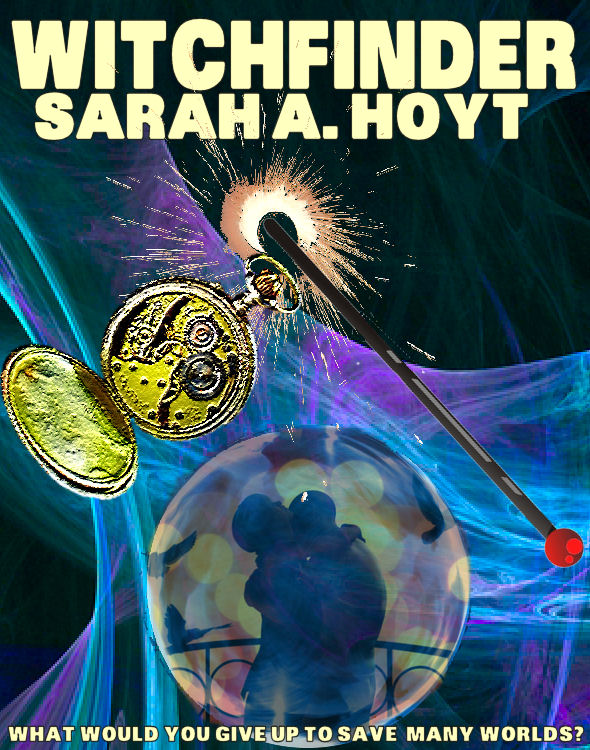 *This is the Fantasy novel I’m posting here for free, one chapter every Friday. If your conscience troubles you getting something for free, do hit the donate button on the right side. Anyone donating more than $6 will get a non-drm electronic copy of Witchfinder in its final version, when it’s published.
