It Turns Out There Is No Cake

I’m going to blame it on Amazon which threw some new and very interesting rubs in the way of my getting the book up, including, apparently, a glitch in loading the cover.

It is loaded into Amazon.

It will go up on various other venues over the week, and will be in paper within two weeks (I’m not promising more than that, since it’s a very long book which means the gutter set up for bringing it out in paper, is driving me nuts.  (Yes, yes, I need to get my mind out of the gutter. ah ah ah ah ah.)  And of course, I’m working on this against the background of trying to get Through Fire delivered.

Needless to say, I’d very much appreciate it if any of you who have a blog of face book account echo the buying link and this where people can read more. Particularly if you liked the book and can honestly say so.

I’m also almost done cleaning, which I didn’t finish yesterday because I was writing and then we had an engagement in the evening.  Normally I would now sit down and write you the chapter — but I’m afraid we have another engagement this evening.  (Regular social butterflies, we are.)

I shall send the revised version of the manuscript to the people that got the e-arcs.  Not much different, but it’s amazing how many typos can survive THREE separate editors.

At any rate, the thing is done and it’s up, and now it only remains for me to bite my nails and have this feeling like when you left home in a hurry to catch the bus and spend the entire ride convinced you left the door wide open, the oven on and all the faucets on in the bathroom.  (Well, sometimes it’s true.  I once came home from a play date to find water pouring out under the door of my mother’s kitchen.  The amazing thing is that they didn’t kill me.  The incident was afterwards referred to as “when we replaced the downstairs flooring.”)

I’m sort of hoping I didn’t do something disastrously wrong, and I’m going to hold my breath and hope it actually sells.

And I’ll give your chapter tomorrow.

BUT I’m very afraid the cake is still a lie.  or at least, while there’s a batch of cup cakes cooking on my counter, they haven’t yet invented a modem so I can send one of those to each of you…

You must endure it as best you can.

And yes, I’m still unbelievably nervous and worried, and it feels like I’m standing naked in church.  I didn’t realize how much COURAGE those of you who published  indie had.  I apologize if I ever told you to stop being a ninny and start putting your stuff out because you didn’t need a gatekeeper to tell you it was good enough.  I was right, yes, but I had no comprehension at all of how SCARY it all is.

Hold me.


Today we’re just promoting Cyn!

*And if you wonder what I’m up to — I’m entering the changes and fixing typos so I can keep my promise to bring Witchfinder out today.  Bear with me.

Later there will be a chapter of Rogue Magic.  Also, cake.*

Just one entry this week, from our Poet in Virtual Residence, the fabulous Cyn. Go buy her book, and come back next week for more great reads! Hey guys, we’ll have more books next week, right? Right. Same Hunnish time, same Hunnish place! As always, future entries can (and should!) be sent to my email. Happy reading!
Jason Dyck, AKA The Free Range Oyster
Server Wrangler, Mercenary Wordsmith, and Lackey to the Stars

Cyn Bagley

Living in the Desert

Living in the Desert

Living in the Desert is a collection of short stories about living in the high-deserts of California, Utah, and Nevada. There are stories of wildfires, and desert rescues, including a cougar attack. Also in keeping Nevada stories, there is at least one alien encounter.

The author grew up in the high desert of Utah, where T.V.’s were uncommon and every one had a favorite story.

Also available from Smashwords

For The Children

Yesterday here we got into a sort of discussion about what is owed children – specifically, what is owed the children of people who have them solely to extort a living from the well meaning and caring in society (or those who wish to be thought so.)

One of the first forms of assistance any human society gave or tried to give was for “widows and orphans.” As far back as it’s mentioned (in the Bible as a form of charity, for instance) there really wasn’t anything widows could do to support themselves and children. (Sometimes they could support themselves, barely. But throw in children and they were up a creek.) The differential of manual/brute force work that males and females in our species are capable of – and the fact that most of the work at the time was physically demanded left the woman with children with a lot of unpalatable options, the most palatable of which might have been “find a protector.”

So charity to widows and orphans was exhorted and, as soon as it could be done, something was done by “widows and orphans” – even by kings and queens and feudal lords, at least ones that tried to appear benevolent.

I’m not disputing – no one is – that looking after helpless children is a function society should fulfill. I am disputing how we do it, but that’s a topic for another day. It seems to me that was with a lot of otherwise useful institutions, writers and filmmakers concentrating on the worst examples of the kind (and not always with the aim to bring about social reform. Sometimes simply with the aim to build on those who critiqued these institutions and found fame through it) orphanages and madhouses have been willfully destroyed without anything better replacing them. (And before you say that orphanages were uniformly bad – I’m sure a lot of them WERE. BUT all of them? I don’t know anyone raised in an orphanage, but my mom did. Yes, he had some issues, including a feeling of belonging to no one. More than children raised in a merry go round of foster homes, though? Do tell.)

Part of the problem with where we are is that we have to trust adults who MANIFESTLY aren’t able to look after themselves or be responsible about their own lives, to be responsible with the money we give for assistance to the children in their care.

The flaws of this are illustrated every time those who are receiving assistance for their children show us pitiful pictures of ill-dressed, ill-fed children. I know that there is a faction that denies that parents receiving assistance for their children blow the food money on non-nutritious and often non-edible things, or things that in no way benefit the children. I know the same faction is fond of saying every time we see a case of a kid raised on assistance, that what we need is to give them more money. I remember a lively discussion in a forum, where someone said they watched a mother pay with an assistance card for an order consisting of a massive cake, balloons and soda. The tenor of the answers was “well, poor children need birthday parties too. Why shouldn’t they have nice things.”

Of course no one is saying they shouldn’t have nice things, but I sometimes wonder if the “more assistance needed” flavor of do gooders who tend to be comfortable upper middle class have ANY idea how those of us just a little below them fare and how we look after our kids through the tight times.

All of us have known tight times, in my generation. ALL OF US. Particularly those of us who are middle class by dint of a technical job. We came of age in the eighties when temporary jobs were all most of us could get, and we’ve navigated through jobs that very often unexpectedly disappear and – 2001-03 – sometimes stay disappeared for months or forever in some regions. I have friends who haven’t worked for more than six months at a time since the tech bust. We’ve learned to cope. Most of us continue to live middle class lives, in the sort of houses you’d expect, but… but we cope.

What I mean is that whether our children got to “have nice things or not” in the abstract, in the practical, we made compromises. A “birthday party” around here is often a trip to the zoo. (Yes, still. We like animals.) If we’re doing well financially, it might be an overnight trip to Denver and include museums, but that’s because the kids are older. If we’re not doing well, there might not even be a trip to the zoo. As with many other things, it becomes “mom cooks a nice meal and we have some friends over.”

My kids have had a bakery made cake, I think, four times in their entire life. (And only because there was this mom and pop bakery which was good and quite reasonable. Gone now.) The rest of the time they made do with my baking skills. (Those actually aren’t bad. My cake decorating skills however needed work, and I had to learn.) This is how I ended up making the multi-tier robot-cake for Marshall’s robotics group at their graduation.

And now you’re going to say that if the mothers of most kids on assistance were the kind who could/would put themselves out to make a cake/learn to bake/decorate they probably would have escaped assistance quickly, even if they’d fallen into it by sheer bad luck.

That is not necessarily true. As we’ve talked about before, the entire welfare bureaucracy seems to keep people there, once they fall in. This also I suspect leads even competent parents to the sort of state of despondent despair where they can’t make rational decisions.

But that is precisely the point. To render assistance to the children, we got through the parents. And if the parents weren’t broken to begin with, the system breaks them.

Part of the problem is that none of us on the – ah – side of liberty is particularly sanguine about terminating parents’ rights. Given how, say, the IRS is used we can easily see kids being taken from parents for having the wrong opinions/teaching children to pray in a way that’s considered bad/someone else wants the kids.

Mind you, the state already capriciously removes children from homes because they think the parent looked at them crosseyed while at the same time ignoring life-threatening abuses from much worse people. Sometimes it seems to be designed solely to make it as bad as possible.

No, I don’t have a solution. As with mental health and involuntary commitment, the closest I can come to a solution is “make these things happen on as micro a scale as you can; make the decisions in the smallest community possible.” Will there still be injustices? Well, of course there will. There have been for centuries. Besides, any human institution malfunctions and has injustices and horrors, even the best ones. BUT we might avoid the sort of “error by default” that we see in children services these days.

Take mental health, because I have an example. When I was little, the village decided to commit a young man, a local farm hand for hire. He was built on a massive scale, and a nice, quiet man. He did the work of ten men and lived with his widowed mother.

Then one day something happened. He would yell and moan at night. And during the day, he would run through the village street, stark naked, claiming that “This isn’t ours.” I.e. he was absolutely convinced that his body, from the neck down, wasn’t his.

The village elders (well, informal, you know. The grocer, two of the largest farmers, the pharmacist, that kind of people) got together and decided to commit him. You see, his mother couldn’t stop him doing this (she came up to his chest, barely) and it took several men to restrain him. He was running around naked and heedless of (rare but unpredictable) traffic.

So they got him in one of his good times, and took him by taxi (none of these men owned a car) to the mental hospital where they swore he posed a risk to himself and others. He was committed and I heard recently he died in the hospital (of old age. By “Young” man I suspect my elders meant late thirties.)

Imagine my distress when I found out years later, while doing research, that his symptoms were not of mental illness, but of a stroke.

Was it an injustice? Well, yes. BUT the men were doing the best they could with the knowledge then available. They really couldn’t wait for future knowledge of the human body to be granted them, so they could deal with the poor man’s problem adequately. (I don’t even know if we can “Fix” the issue now. It would involve brain surgery I suspect, and I don’t know how sophisticated we are on that micro a scale.)

What they did was by no means perfect, but it relieved his widowed mother of the necessity to try to wrestle with a man three times her weight. It relieved the village men from having to down tools and leave work in a rush to go restrain him in the middle of the day. It stopped village kids from being exposed to a naked adult male but, more importantly, it stopped them from being trampled. (No, seriously, imagine a man who is more than 300 lbs running, uncontrolled, in a panic. It wasn’t pretty.)

Local solutions aren’t perfect, but they at least will try to achieve concrete goals. (“We need to stop him endangering self and others.”) And they’re usually reluctantly done when they involve drastic measures. No one wants undue harshness brought to bear on them by their neighbors and communities remember how you decided for others.

Yes, this might be impossible in our fragmented, mobile communities. BUT having the decision made by faceless bureaucrats who cannot and do not know how it affects the local community isn’t an improvement. In the situation above, I can well imagine today’s institutions ordering us to let him keep doing what he was doing, or to appoint two slight females at full time pay to help his mother or something equally ridiculous.

Which is what we’re stuck with for assistance to children.

This is made worse the farther way/more different culture the children are. There is this photo essay going around Facebook about “Children in their bedrooms” but, as people who link invariably tell us, “this is about so much more.”

Well, it opens with a photo of an Arab kid from the West bank. Knowing the culture that gave us the term Paliwood for the staged photos of “Israeli atrocities” I immediately felt skeptical at the picture of the kid posed in what appears to be a chicken coup, with a lamb on his shoulders, in typical iconographic fashion.

It soon became obvious that was, in fact, going to be the theme of the essay. Oh, there were a few red herrings thrown in: a child in China, with a massive poster of Mao over his bed. A sofa outdoors in what looked like one of Rio’s Favelas… and such. But then we returned to the theme of the West bank with the photo of an Israeli child (and look, I often see photos of children from Israel – long story – and I’m going to tell you they had to search hard and long not just to find a massively fat one, but one who had a sullen, unpleasant expression with it) in a perfectly decorated bedroom. (He’s not really a child, either. While the other children in the “photo essay” run about six, he’s about 14. Because that will elicit less sympathy.)

At this point, I closed the “photo essay.” I have no clue what all those well intentioned people think the “so much more” this essay says is, but I’m going to tell you what it really says: it says that countries that have issues also have issues caring for their children. No matter how much money you pour into them, none of them will go to the children. It will go instead to pay for rockets with which to attack their neighbors; for “presidential palaces” to impress the fools or, in the case of China, for massive, impressive empty buildings which no one can even live in or to finance US debt – and I leave to you to figure out which use is worse.

Oh, I know what the point of the photos was supposed to be. It was to point out that children were in want and need, while others weren’t. But what THAT is supposed to do, unless it’s assumed that economics is a finite pie and that to give to a child is to take from the other, I don’t know. And no one really believes that. No, not even our ever so bleeding heart liberals. If they did, they’d take the money they use taking their kids on trips abroad and buying them designer outfits, and give it to needy children.

Instead, they look at these photos and feel guilty (because they have the economic sense of my cat, and I might be overestimating) and then want the government to “do something” – which on the international level is even more stupid and dangerous than on the national level.

Those photos were designed to elicit the “make this go away so I don’t have to feel bad” reaction.

And they are designed, planned, and paid for by the governments that won’t look after their children and by their enablers abroad, which are the equivalent of those irresponsible and abusive welfare parents, but armed with rockets which they buy with their international aid WIC cards..

I don’t remember who said that there could be peace in the Middle East when Palestinians loved their children more than they hated Jews, but they were right.

There can also be less suffering to children in Brazil and China when people with power to allocate money think that providing meals, education and care for desperately poor children is more important than another big, showy building.

Dictators and irresponsible poseurs use children to get what they want out of idiots.

That applies on both the national and the international scale.

The only thing we can do is not be idiots.

Looking after children and providing for children is perhaps the deepest instinctive drive of individuals and societies.  But sometimes obeying it will only make things worse.

As with the problem of abusive parents I have no solution.

All I can say is that giving money to dictators who hide behind women and children always ends with more dead and abused women and children.

Be aware of how you’re being manipulated and refuse to do anything — from material aid to echoing a facebook photo essay — just to “make the bad feelings go away.”

Sometimes a photo essay is the electronic version of hostages chained to military installations and bomb depots, so that every military strike can be called a war crime.


Mistakes I’ve made a few!

So, on the way to this pinnacle of understanding and wisdom (ah!) on which I stand, poised at the turn of the half century, I’ve made a few mistakes. They started – probably, or at least, it’s as far back as I can remember – with letting the neighbor kid play with my expensive doll while I went indoor to get something or other. When I came back, she’d broken the doll and taken off.

I think I was three. If I knew then what I know now…

Since then there has been a long accumulation of errors. Had there been none of that, I’d be as wealthy as Bill Gates. Okay, maybe not, but good enough for my simple purposes.

Let me see, only the more clear, obvious errors, just as relates to my career: I spent three years learning to write and submitting short stories, because I thought I should do it to become a published writer; I never attempted to get to the Baen Bar before I sold to Baen. (And I should have, but I was afraid of online forums.) I spent years first writing things that there was no market for, then trying to write to the market. I believed what they told me when they said there was no market for the type of science fiction I wanted to write. More stuff? Four agents. Enough said.

I’m not going to detail them, but rest assured there were the same sort of errors in the realm of investment, choosing where to live, choosing where to shop and what to buy (particularly cars – though this one is doing pretty well and, knock on wood, will continue to do so, because it’s 17 years old and we do not have the money to replace it.) Improvements done to houses we then had to sell so we could move. Buying this house. Not that there is anything wrong with this house – now. After we fixed everything – but you know we’ve known for 12 years that it wasn’t right for us. Okay, 11 years. After one year, it became clear that we were moving furniture around ever six months because the house did not fit the way we live. But we didn’t want to move again, and I’d become so busy that we didn’t have the time to unpack boxes, much less to move… which has led to us living for 11 years in a place that just didn’t fit… Never mind, we’re doing something about it.

But what I mean is that we’ve made mistakes. All of us who are adults have. Not some of us. All of us. We’ve dropped the ball, been duped, got fooled by a clever con artist, had a bizarre concatenation of circumstances clean us out of savings (what is investing the company whose CEO then died on 9/11?) but more importantly all of us have done things that can only be explained by a sudden and total death of the brain. Usually temporary, but you know what I mean as well as I do. This is how I came to go driving without my glasses one morning, which given my level of astigmatism resulted in my neatly bisecting the car with a telephone pole.

And sometimes you do stupid things – the most appalling mistakes as any sane person would consider them – and they turn out all right, by a miracle. You turn a blind corner without looking. You run across the street, and it’s only when you hear the car behind you that you realize you were fortunate. You jump, land on your feet, and then realize the jump was much higher than you thought, and you could have hurt yourself badly. You buy bum stock and it turns out to make a recover. You buy an old piece of furniture, and, when you strip the 15 layers of paint (two metallic) you realize you’re in possession of a colonial-era bookcase. … you marry in haste and are very lucky that not only don’t you have to repent at leisure, but that you found the one you were meant to be with.

But those things, the good and the bad, adults take with a shrug. It happens. Oh, I’m not saying that, like the rest of you, I haven’t wasted a whole day – or two – in heartburnings. Usually of the kind of “What on Earth made me do that?” and “How could I be so incredibly stupid?”

That I know at least none of my mistakes have cost someone his/her life, yet. Though a couple of the near misses could have. Like the time Dan and I handed the baby off to each other, late at night in front of the house, and the other didn’t have the hold, as it were, and… let’s say I grabbed the kid by his ankle, stopping his head a cartoonish half inch from the sidewalk. (No, he didn’t wake. #2 son takes after me, and I once slept through an earthquake that sent the entire village to the middle of the street. And me too, in my brother’s arms. I woke up, eventually, out on the street, because I was cold. Go figure.)

I imagine that’s the hardest of all. I’ve made mistakes that resulted in the irretrievable breaking of a cherished possession and I imagine the process is the same, writ smaller. You sit there and replay what you did. If you’d just moved your hand a little faster. If—

But here’s the thing: adults, normal, well-adjusted adults, or as well adjusted as most adults are, get over it. I don’t know if you’d get over causing someone’s death, but anything short of that, right? You get over it. You shrug it off, with greater or lesser difficulty. You pick yourself up. You dust yourself off. You remember people who were more broke than you are now at greater ages than yours and who ended up millionaires. You sigh and call yourself five kinds of dumb ass and you vow not to make THAT mistake again, at the very least.

Because you are human, in the world of humans, and because none of you are perfect and because even brilliant people (I live with three of them. TRUST me) make dumb mistakes, you know that stupid stuff that shouldn’t happen will in fact happen, and the best you can do is learn to recover and roll with the punches. No one has it perfect, and to demand perfection would be stupid.

It gets harder to recover as you get older. And it might be impossible to fully recover if your health fails.

BUT we try. We move on. We say “okay, that was spectacularly stupid, but—“

I know, at this point you’re all wondering why I’m saying this stuff. It’s obvious, right?

Oh, sure. It’s obvious to us. We were raised on stories of people who failed and failed and failed, and finally succeeded. We were raised to pick ourselves up and move on.

But this is not true of a lot of people. More and more, even if people are raised this way, the popular culture brings home the idea that if you fail, or you’re discriminated again, or, G-d forbid, if something truly awful happens to you, this makes you a victim. And as a victim, you’re owed something “by society.” (Note that it’s never explained to these people that they too are part of society and therefore expected to make it up to everyone worse off than themselves in real or imaginary ways.)

Some of what you’re owed is being walked around on tenterhooks, even if your terrible injury is that you were once frightened by a spider, or failed to get the pony you really wanted for Christmas.

If it’s anything more serious, people should go out of their way to tell you how brave you are or to make good your financial losses, or make up for the fact that you slept around and got an std or an illegitimate child. And not only are you never supposed to blame yourself for anything, other people can’t point out to you that you made a mistake which led to this situation. That’s victim-blaming and slut-shaming and … who knows? What next thing won’t we be allowed to do? Stupid-shaming?

This both fosters the notion that mistakes are never, ever your fault – and therefore allows you to make them over and over again – and that somehow, if you made a mistake, you’re now sanctified by victimhood, so there’s no need to try again.

And thereby these people do end up victims. They’re victims of a failed culture.

We owe it to them – and to ourselves – to explain that victimhood isn’t sacred; that failing doesn’t make you special.

Failing and doing stupid things makes you human. Picking yourself up, learning from your mistakes and going on to try again and in different ways? That makes you special. A member of the rare fraternity of human beings who have achieved unapologetic adulthood.


Learn And Labor

I’ve been listening to Patricia Wentworth while I clean and twice in an audio book I’ve come across a character remembering her days of religious instruction, and a particular bit of instruction that I know I never got, and perhaps it was an Anglican thing, and an Anglican thing in the early twentieth century.

Apparently the beginning of the answer to “What is my duty to my neighbor” is to “To learn and labor truly to get my living.”

The idea – and the idea in the books that everyone had been taught this, that it was a fundamental, underlying, basic idea everyone that – that this was the duty of every human being TO THE OTHER HUMANS AROUND HIM/HER. “To learn and labor truly to get my living.”

Imagine that you thought that was your basic, underlying duty to humanity, and so did most people around you? Your religious duty. Something you did as you hoped for heaven?

The idea is almost mind-breaking in our current day, when people demonstrate because they can’t find a job despite their degrees in Women’s Studies or Puppetry. (Or at least can’t get a job that pays enough for them to live in the way they hope to become accustomed to.)

Because it is not the duty of society to provide you with a job in something you enjoy and find fun to learn/do. It is your duty to “learn and labor truly to earn your living.”

Another thing that wouldn’t happen would be politicos announcing that they just freed you from the tyranny of work, by either rendering your job very sincerely dead, or by making it possible for you to get all your ills taken care of. Because you’re not supposed to depend on other people unless you truly aren’t able to “learn and labor”.

No wonder people possessed of that idea built and extended a civilization that spawned the world and made daily life far more pleasant, healthier and longer for the average person.

One of the things in those books is that – though the class structure makes me insane – I’ve noticed that every good worker is considered important. So, if you have someone who is making up your fire, but they’re good at it, the girl (usually. Young) receives a sort of respect from those who hired her. She’s doing a good job, and so she is fulfilling what she’s supposed to do.

I think that’s part of what we lost when we lost the idea that learning/adapting/working is our duty. We lost the respect for our fellow men, no matter how menial their labor, who are doing it well enough to support themselves; well enough to remain employed. We lost the boundary between honest labor – and how many feel obliged to snicker at that? – and faking it. We’ve learned to respect people who do a shoddy job, but get to the top through tricks, seduction or misbehavior.

All because we lost the idea that it’s each person’s job to support himself – not society’s, not his friends’, not his parents, not his neighbor’s, but the individual’s himself.

Understand me. I’m not speaking out against charity. I’m not speaking out against giving someone a hand when they need it. And I’m certainly not speaking out against parents helping their children. One of the seeming motivations of being a parent is to try to make our children’s lives better than our own. (Not necessarily easier, but better.) We want them to be able to reach their dreams and get where they want to go.

But it is the children’s duty for each to learn and labor to get their own living. And it is our duty to be compassionate and look after those who can’t. We’ve come a long way since grandma in the ice floe. I’m not advocating going back there. The infirm and the old deserve our care just as we’d hope to get cared for in their situation. Trust me, I know (and if I didn’t I’d have learned it last year) that regardless of how much will power you have, there are physical and mental states in which you can’t perform even that which you’ve learned satisfactorily well enough to get your own living.

But the charity recipient should aim to return to making his own living as soon as possible. The idea of taking charity forever should rankle.

In the same way, if someone labors his entire life, doing very well at a humble job, never getting promoted or going anywhere in particular, but making enough to support himself, he’s performing his basic “duty to his neighbors.” But if he’s out there flipping houses with shoddy repairs, or making money in crooked deals, no matter how big, how important, how rich, he’s not worthy of our respect because he didn’t “labor truly.”

In that one precept is the cure for the lack of “meaning” in modern life. You don’t need to be striving for the pinnacle, and you don’t need to create anything astounding. The only thing you owe your “neighbors” is to do the best you can and not be a burden.

And in that precept is the cure for the illusions of our would-be aristos who think that to whom they were born, their contacts, the colleges they entered by virtue of influence and contacts, make them special. Since it’s less likely they’re learning and laboring TRULY, they’re worthy of less respect than those who attend humbler schools or work manual jobs but give it their all.

In this is the cure for the continuously extended hand and the whine of the would be artist. “I am making good art. People just don’t pay me.” Well, fine, then learn and labor to get your own living and do your art on the side. In this is the cure to the entire inversion where people expect society to provide for them, instead of trying to do their duty.

In this simple precept is pride and dignity. My grandmother used to talk about “the pride of honest work.” I think that’s what she meant. Once you get to night time, and you know you did the best you could, worked hard, and you got enough to keep you another day, you can sleep in peace.

You labored truly.

And you won’t be swayed by the siren call of those who tell you that someone else having more is somehow a crime against you; and you won’t even laugh – because it’s too weird for laughter – when a presidential spokesman says the loss of jobs due to an awful law will “free people to be poets.” I have nothing against poets. Poets who learn and labor and earn their own living can be admirable people. (Even if some are really bad poets.) But no one is entitled to be a poet, or an artist, or a cruise director, or a wedding planner, or for that matter a barista.

You need to earn your living – you need to do it, because otherwise you will be failing your duty to society – and it is on you to learn and labor to do it.

Now I know our job market has got twisted by all sorts of influences, and sometimes you can’t get a job at any price or in any way. If I stop making my living from writing, I’ll be up a creek as the last twenty years have nuked my resume. BUT if you find yourself in that situation, it is your duty to figure out a way to learn something that will allow you to at least try to support yourself. If nothing else, as Jerry Pournelle put it at the beginning of this mess, if you can’t find a job, and you can’t do anything else, make your surroundings really clean. It will give you a purpose, and who knows, maybe you’ll end up with something you can do.

Look – I’m not preaching. I’m the last person to. I’m talking to me as much as to the rest of you, because I’m prone to despondency and to seeing no way out of my predicament.

And sometimes there isn’t a solution. But if in our minds we think it is our duty to find a way; to keep trying to find a way, at the very least we’ll keep at bay the awful despondency that can rob us (me) of months or years when we could have been doing something.

Besides, one thing I’ve learned which is not quite “G-d helps those who help themselves” is that the more irons you have in the fire, the more likely one will get hot. Or as Kevin J. Anderson puts it – in his “popcorn theory of success” – if you put a lot of kernels in oil and turn up the heat under them, some are going to pop – and perhaps a lot will pop.

And if nothing does, at least we did our duty. We tried to fulfil our duty to our neighbor.

To learn and labor truly to get our living.

Announcing A Major Upcoming Release

Okay, guys, you’re going to have to forgive me for keeping things dark, but having been bitten by presses-other-than-Baen before, I let this one go all the way through page proofs and cover before I fully believed it.

But it is indeed coming out, and they’ve done a superb job of promotion and all, so now I can announce it.

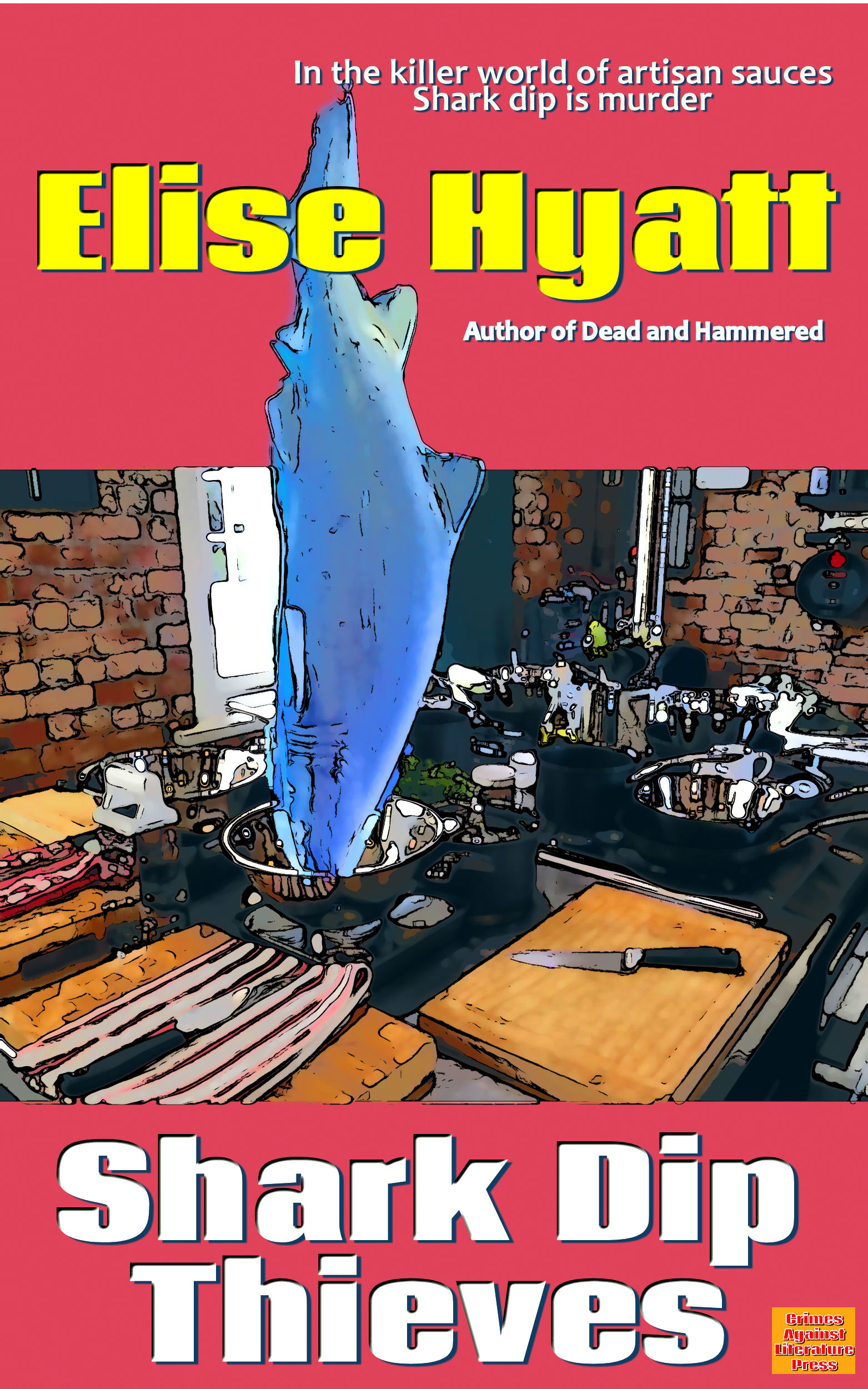
Yes, it is a Elise Hyatt mystery.  No, it’s not (yet) orphan kittens.

I’m fairly sure you’ll see, once you see the cover, why this book and why it was important to announce it today of all days.

It is a craft mystery, set in the cutthroat world of artisanal sauces.

Anthon Dextra and his girlfriend Kitty are about ready to take that world by storm, until they find a dead man in their barrel of shark dip.

Will their highly trained palates allow them to distinguish the flavors of murder, greed and thievery, before their dreams fall into the sauce?

Don’t miss this year’s big mystery release of…

Shark Dip Thieves.

It starts with the dip, but it ends in foul play!

sharkdipfinalcover

If This Isn’t the Real Thing … — a guest post by David Pascoe

If This Isn’t the Real Thing … — a guest post by David Pascoe
I’m too tired to be angry right now. Or witty, for that matter. It’s been that kind of month. And on top of it, the Hordes of the Perpetually Offended have been remarkably quiet in the last week or so. Or maybe it’s just that I’m learning to tune out the wailing and gnashing of teeth from the outer dark where such reside. In absence of any particular foolishness from the publishing industry, the world certainly seems to be going to hell in a woven container of choice.

Close to home, celebrated government officials are enjoying the attention of the very faceless minions with which they (and progressives like them) would use to oppress those of us who believe in concepts like individual liberty and individual responsibility. Apparently, the opportunity to serve the public as an elected official wasn’t enough for Mr. Yee, who more deserves a title like Doctor or Professor in his pursuit of Bond villain level shenanigans. Facilitating illegal weapons transfers from sources in Russia, Chinese gangs and rebels in the Philippines. Not content with breaking weapons laws while campaigning for greater restrictions on the citizenry, Mr. Yee decided to try his hand at unduly influencing the legislative process in return for contributions to his campaign for Mayor of San Francisco.

Out on the world stage, everybody’s favorite former soviet strongman is flexing his muscles. Vlad Not-the-Impaler is making noises about “reclaiming” those territories that Russia possessed under Stalin (everybody’s other favorite former Soviet strongman and orchestrator of millions of human deaths in service to the idea of his own ego) and also under Tsar Nikolas II. He’s suggested that the Bolsheviks and Communists made mistakes, which the source (a former chief economic czaradvisor) suggests is a reference to allowing Finland independence in 1917.

So, we have a man who runs one of the largest countries in the world more or less to his own tune, eyeing his neighbors with covetous eyes. He’s orchestrated the acquisition of territories in the past, and repeatedly thumbed his nose at the world’s remaining superpower. Not that the current dis-administration has made it particularly hard for him to do so. An administration, it is of note, whose people are running afoul of the law left and right. Laws which then (see the last link, there) seem to lack a certain something when it comes to enforcement. Odd, that.
It has been argued that the last century is abnormal through all of human history. Prolonged periods of peace punctuated by widespread conflict; conflict that seems to be gathering steam once again. We are living in times of wars and rumors of wars. If these aren’t the Crazy Years, they’ll do until the real thing comes along.

That said, I wonder. I keep asking people if they felt this un-secure when they were my age. Did it seem like the world teetered on the knife’s-edge of chaos? Did past presidents abuse the office and the American people in the ways this one has? Reading through history, it seems like most people have experienced this kind of uncertainty. Were Romans in the streets concerned that Hannibal might take their city? Did the citizenry of Venice worry over events in London when Great Harry broke away from the control of the Vatican? Did American citizens watch the French Revolution and the Napoleonic wars with the same kind of worried intensity with which we pay the events ongoing around the world? I imagine they did, at least in part.

I firmly ascribe to Pratchett’s words about the teeming masses of humanity, that most people want today to be pretty much like yesterday, and tomorrow to be pretty much like today. I’m not really comfortable with that. I want tomorrow to be better, and the day after that better still. As a species, we’ve touched the stars, and I want to reach back out and seize them. If I had to do it over again, I’d try to make that happen in a more direct manner, through science and engineering. Probably. I’m told I’m pretty good at putting words together in a manner people enjoy reading, so I might not do a single thing any differently. Disregarding all the what-ifs, I have skills that can serve to further those goals. I can spin yarns that encourage others to take up the fight. I can tell stories where decent people triumph over adversity and opposition; stories where evil in its myriad forms falls to good.

That’s our responsibility right now, not bowing to fear.

This Article Does Not Exist — a blast from the past GUEST post from January 2011

*Because today has been one of those days, I was looking for a post I could re-run.  Something from a couple of years ago.  But I came across a guest post by my older son, Robert, and I couldn’t resist it.  And yeah, three years and change later, he STILL thinks he’s an elephant in cunning disguise*

This article does not exist or how not to practice zoology, by Robert A. Hoyt

* A guest post by Robert Anson Hoyt aka #1 son — who has suspected he’s an elephant since he was about two, in the same way I’ve often suspected I’m a cat. So excuse the pachiderm-o-centric imagery. He is what he is. :) And, oh, yeah, he does overthink it. (Wipes furtive tear.) My boy.*

Postmodern Blues
Or: This Article Does Not Exist
Also: How Not to Practice Zoology

I’ll be blunt. Postmodernism makes me itch. There are very few viewpoints on this planet that annoy me to the extent that postmodernism does. Postmodernism actually manages to be worse than Nihilism.

Oh, you think they’re the same? They aren’t, and I’ll tell you why. Sure, a Nihilist will raise their nose and tell you that all values are subjective. But it takes a Postmodernist to look at the Nihilist and tell them that – not because of the ideas they asserted, but merely because they asserted ideas – they are wrong.

But I’m getting ahead of myself. To understand my position, let me lead you back through the mists of time to Hell, also known as my high school classroom. I am, for my sins, an IB graduate, and like all IB graduates, that meant I had to participate in a class called Theory of Knowledge. I won’t lead you through the details as to what the class was supposed to teach, because no matter what it was, it didn’t succeed.

Not to say the class taught me nothing, it just didn’t teach me anything the prim and proper IB heads in France would dream of putting on their brochure. It took me along the bowels of the nightmare carnival from Hell known as postmodernism, showing me in loving detail its every blemish, often saying those were features rather than bugs. Then it spit me out into the world with a philosophical certainty etched in my heart that – many demons though I might have – I will never resort to postmodernism.

Let us take the first parable chosen by TOK class. It concerns several wise men, all of them totally blind, observing an elephant by hand. One feels the trunk, and proclaims that an elephant is like a snake. One feels the leg and says it is like a tree. One feels the side, and suggests it is like a wall. One feels the tusk, and proclaims it is pointy like a spear. Then, because all of them has a different answer, they get in a flaming row. The very postmodern moral: the elephant can be likened to the truth, and the men to people searching for truth, such that each understands a part of it, but none of them all of it.

This sounds very sage, of course, until you start poking at it. I’ll admit up front that the very metaphor itself annoyed me. What, for example, qualifies these men as “wise” if their general approach to learning about an object is to poke it and then immediately assert opinions? Is this how postmodernists think people do science? If that object was a bear trap, would their scientific opinion be that you shouldn’t poke it? Or are they normally wise, but today they were very drunk? Does that explain why they thought it would be a good idea to rub an elephant? Then again, perhaps their aforementioned method of gaining information pissed off the villagers so much that they’re trying to get the men trampled, because the village maidens are really tired of them “looking for information” in their bosoms? For that matter, just why hasn’t the elephant trampled them? Is it just so confused that old men are coming from the woodwork to rub it that it hasn’t thought up an appropriate reaction?

I realize that’s nitpicking, so let’s consider what the story is actually supposed to mean, instead. There is some central truth, and a variety of people examining it. The people come away with observations that are all partially true, but none are entirely true. And here’s the problem, right away. This may be postmodernism’s explanation of science, but in a strange way, it isn’t what postmodernism actually believes. Postmodernism asserts that all points of view are just reflections of the people making them. The men in the parable were making concrete, verifiable, but incomplete observations. But if the parable really wanted to express postmodernism properly, the village idiot would have come by and observed that the elephant was covered in feathers, and therefore like a chicken. (And then, if it were real, all the old men would have beat him with sticks. And rightly so.)

But wait, I need to explain why postmodernism believes that all points of view are reflections of the people making them. It has to do with a given society defining things in certain ways that make people observe things using specific patterns. And the postmodernists engage in a variety of little games to attempt to explain away reality by using this statement. Of course, for all that they argue that reality is just patterns of social constructs and individual observations, I notice that the current number of postmodernists to have successfully jumped off a building and flown via arguing that gravity doesn’t exist, or doesn’t work the same if you come from a different culture, or if you call it by a different name, remains at zero. But the problem with postmodernists is that, even if one of them tried it, even if you and every other person on Earth watched them splatter on the ground, their very devoted postmodernist friends would just say that it was possible that within that person’s perception, they flew.

What made this even worse was that the postmodernists at some point got science. This is laughable to begin with, since postmodernism was supposed to be a counter-response to the rigidity of scientific thought. And what branch did they select as their own? Quantum physics, of course. The thing that attracted postmodernists to quantum physics, like flies to a jar of honey, was that very little beyond the basics is properly understandable without post-doctoral education. But the general ideas presented by many famous experiments, if not the actual mechanisms behind them, were very useful. The idea that the observer affects the observed alone was intriguing to postmodernists. Finally, they could get credibility.

After all, this was essentially their central thesis. With a little due diligence and a thick dose of illogical thought, that was what postmodernism could use to infect the sciences. And while from the perspective of the sciences it never succeeded (thank heavens, or we might get wooden rockets powered entirely by the belief of the builders that they could fly), from the perspective of the humanities, they have had the forces of science on the run since that time. Being a self-admitted reaction to the philosophies behind science, they could have asked for nothing more. And when you get right down to it, it demonstrated to what lengths postmodernism was willing to go to become an all-embracing philosophy.

By now, I hope you’re starting to realize the problem with postmodernism. For a social movement working to span ever vaster swathes of academia, it’s frighteningly empty. By intent, it has no substance. Everyone has had the experience of arguing with a postmodernist on the playground in elementary school. Remember the imaginary battle you had with someone at some point, where you said your robot had one hundred missiles, and they said they had a thousand, and so on until infinity-plus-one? No matter what the argument, the postmodernist writes everything off as no more than a perspective: there is no goalpost they can’t move, no fact they cannot disprove through a simple twist of mental gymnastics. For the postmodernist, being right requires very little thought and certainly no actual understanding. Infinity plus one can be bigger than infinity if you believe it is, in other words.

But you see, the ultimate strength of postmodernism is also its ultimate weakness. Definitionally, postmodernism should not be capable of existing. Because the postmodernists, as proud as they are of believing no one perspective is correct, are taking a perspective. Postmodernists do not truly believe all perspectives are equally valid. They believe that their perspective — that all perspectives are equally valid – is correct.

Now, of course, the true postmodernist can easily overcome that little hurdle by becoming what you might call a post-postmodernist, believing that the belief that all perspectives are equally valid is simultaneously correct, and incorrect. Of course, many would argue these are mutually exclusive but (trust me, if you ever meet one, you’ll find this out the hard way), this does not deter them. The problem becomes that one can also believe that post-postmodernism is incorrect. And so, to embrace the ever-expanding range of opinions, our nascent post-post-postmodernist arrives at his new philosophy, only to realize that even as he took the new position a new opposition instantly appeared.

In other words, postmodernism manages to be so faulty as a philosophy that it has something previously available only to computer programs: a memory leak. In an attempt to perform its function, post-modernism must necessarily continue expanding ad infinitum, never capable of holding itself under any umbrella or even fully defining itself.

Our crafty post-modernist might try to escape by challenging this directly, simply saying that postmodernism does not have to do this. Of course, our opinion that it does is equally valid, they say condescendingly. But wait: we don’t believe both opinions are equally valid. Sweat appears. That opinion too is equally valid. And now the pattern has emerged, and we’re back in the swing of it. We don’t believe that all three options are equally valid.

We could chase every possible such thread to infinity around postmodernism, but we really don’t need to, for I can already see the proponents rallying. Proving that postmodernism is inherently prone to running to infinity in this way doesn’t prove it’s wrong, per se. We could chase that, too, to infinity, but we don’t really need to. Remember, the whole point of postmodernism is that it can’t be proved wrong. It can’t be proved right, either, but that’s a very minor setback for any philosophy. The infinity game, however, lays bare the mechanism that is the death of postmodernism.

Postmodernism must, always and ever, avoid taking a position. Functionally, therefore, it is exactly as useful as taking no position at all. For a philosophy with such a loud mouth, it’s amazing that it has nothing whatsoever to say. Some postmodernists will defend it as making people more aware of the positions that others hold, but the instant they assert that opinion, they fail as postmodernists. And if they want to regain the title, then they cannot defend postmodernism, but must flee into infinity again, frantically accepting the indictments of it.

In the end, the problem that people who assert that no objective truth exists run into is that, to take their own favorite parable, that would mean there is no elephant. But even in the absence of an elephant, mankind is a species made for producing elephants. It doesn’t really matter, in some ways, whether anyone could objectively define good, evil, justice or truth. Saying that they can’t find an objective truth misses the point entirely, because humanity in general can feel those elephants; even if no one person can define them because of their personal bias, true, but more importantly, even if those elephants do not exist.

If that sounds suspiciously postmodern, it’s really not. Postmodernism purports to desire more diversity of opinions, but as a philosophy it forces you to abandon all opinions and accept theirs. It purports to desire more purity in defining knowledge, but it puts empirical evidence on par with the babble of the junkie on a streetcorner. It is inherently deceitful, always doing the exact opposite of its stated goals. I’m not sure I could ever get far enough away from that.

Rather than pummel the issue with my own words, let me sum up the issue by quoting Terry Pratchett’s character Death in the Hogfather: “Take the universe and grind it down to the finest powder and sieve it through the finest sieve and then show me one atom of justice, one molecule of mercy. And yet you act, like there was some sort of rightness in the universe by which it may be judged.”. What Pratchett touched was not merely the essence of humanity, but the antithesis of postmodernism… which should be a serious warning to us.

We create the elephants that people feel because as humans, we desire them. They help give us something to live up to: standards that raise us above what we might otherwise be. Rules that we live by. You can’t find objective truth for these things, but not for the reasons the postmodernists think. Each person’s definition of these words is personal, it’s true, but each person also has a stake in the larger elephant. That larger elephant is simply how people everywhere act according to these words. That system is inherently correctable. Because we create the elephant, it changes as we do. Because we live according it, we change as it does. It is not objective because nowhere did it ever claim to be objective. Just the opposite. These are the ideas that humans establish so that they will know they are more than simply human in species.

These are not religious ideas, per se. These are the ideas you need to even understand something like religion, or complex secular ideas like “decency”. Rather than concentrating on the question of whether any person’s bit is valid, it’s more important to question whether the elephant they create, in terms of the actions it inspires, is doing good or ill. That’s critical, because someone could evolve the purest, most moral philosophy on Earth, but if no one buys it, it means nothing. The FIRST priority of a philosophy, even and especially postmodernism, is and must be gaining a stake in the larger elephant, and our first priority must be to fight, therefore, those contributors to it that are most harmful. And depending on the answer, the next question is how to change it. And that’s another argument, to be judged by the lights of other elephants, but in this case, it doesn’t really matter.

Because postmodernism, which likes to claim that all these ideas are equally valid, forgets the ultimate purpose of the ideas humanity forms. Some ideas are inherently contrary to the survival of the human race, and by calling them all equal you are destroying the purpose of humanity’s guiding lights. If you let it, it will make you swallow honey and poison in equal measure and declare the two exactly the same. It shows no understanding of why questions of truth and justice exist in the first place. But unlike nihilism, it forges that belief into a single overarching idea. In doing so, it tries to “win” the argument. And to a postmodernist, winning is more important that the survival of the species.

In short, postmodernism fails for multiple reasons. Part of why it fails is that it is internally inconsistent and impossible to define. But it also fails because it does everything in its power to avoid taking a definite position, and so completely loses all usefulness. And finally, it is contrary to the very purpose of philosophy and ultimately creates great potential to harm humanity.

Despite all this, however, postmodernism can be insidious. Many people are tempted by the ability to win every battle, even if they realize on some level that it means losing the war. It appeals, certainly, to those who have always wanted to feel as though they are a little smarter than everybody else, most especially if this is far from the truth. It appeals to the jaded and the cynical, who feel that they can finally rise above every conflict of ideals, where both sides always look alike to them. It appeals to those who want the safety in numbers it offers, to those who can impress a professor with it, to those who think their high-minded rhetoric will help them get girls. Some put it on and wear it like fashionable clothing but never really buy it, others take the dangerous step of accepting it.

But from the minds of those who see through the postmodern facade, a little baby elephant has also been born. That elephant stands in the path of the diseased old bull of postmodernism and trumpets defiance, not because it is objectively right, but because it is right by human standards. For the good of our species, we must contribute all we can to keep that baby elephant alive. In part, it stands for the very ideals that are best in humanity. But more than that, it stands for the idea that humanity could have ideals at all.

Remember this, if you take nothing else away from this article. If that elephant should ever die, if postmodernism should ever ultimately win, then we will be walking down a difficult, deceptive, and dangerous path. And when we walk down that path, there is no guarantee we will ever be able to turn back.

The Saturday Reader Pimping

*Beneath is the weekly reader-pimping post from the oyster.  There will be a chapter later.  But first I need cofffeeeeeeeeeee (Imagine it said like braiiiiinz)*

This week brings a nice haul of new books and a couple of familiar faces for those of you who haven’t picked them up yet. Again, I should note* that I was involved in the production of A Difficult Damsel to Rescue, so you’re aware. So go, buy, read, enjoy, and especially remember to leave reviews! As always, future entries can (and should!) be sent to my email. Happy reading!
Jason Dyck, AKA The Free Range Oyster
Autodidactical Multipotentialite, Mercenary Wordsmith, and Purveyor of Braggadocio

* I do this out of my own ethics. The FTC can address its gestures of affection to my callipygian endowments.

Alma Boykin

Hubris: The Azdhagi Reborn (A Cat Among Dragons)

Hubris

Two little genes can bring down an empire.

Maker Seeri promised to create the perfect super soldier: strong, fast, telepathic, and endothermic. Three generations later, the survival of the Azdhag Empire, and perhaps of the Azdhag species, depends on six Azdhagi and an undersized True-dragon barkeeper.

Lord Kirlin’s disapproval of genetic technology rivals his disgust with Lord Tarkeela. Tarkeela thinks the Pack Lords deserve the disaster they created. Tarkeela’s ears on the street, the story-catcher Cheerka, suspects the Makers and Pack-Lords know more than they admit about the surge in dead and dying juniors. When the truth boils out of hiding, Pack Lords and commoners must hunt together, reunifying the Azdhag Pack before all hell breaks loose and hubris becomes nemesis.

Also available from these fine sources:

Cyn Bagley

Smoke & Mirrors

Smoke & Mirrors

There is an underworld that normals do not see with their eyes. They have lost the terror and the wonder that they once knew as children. In this short story collection there are eleven stories and one bonus story of ghosts, goblins, ghouls, and other nasties that live in our world. Read if you dare.

This is a short story collection.

Also available from Smashwords

TK Naliaka

A Difficult Damsel to Rescue (The Decaturs)

A Difficult Damsel to Rescue

SWAT officer Enrique Vargas was smitten with exotic Chlotilde Decatur from the first glance. Helping to save her brother’s life got his foot in the door, but the tough young cop faces new challenges when it comes to courting the irrepressible daughter of the Decatur family.

Young love is never easy, and dating a Decatur brings dangers far beyond romantic drama. When their first date ends with a brutal shooting, the young couple’s courtship is off to a perilous start. As spectres from both their families’ pasts assail them, Chloe and Enrique must lean on each other and their loved ones to survive. Love, danger, and betrayal carry them from the Mountain West and Florida to the tyranny of Cuba and, ultimately to the brutal, lawless desert of the Sahel, where dark promises will be fulfilled. Joining the Decatur family can be a dangerous proposition!

A Difficult Damsel to Rescue, the second book in The Decaturs series, continues the high-stakes adventures of the Decatur clan. Love. courage, and determination go head to head with greed, hatred, and lust for revenge in this roller-coaster of adventure, and unlikely romance. This gripping novel was inspired by the likes of Louis L’Amour, Alistair McLean and the heroism of Stephen Decatur.

Michael Kingswood

Passing in the Night

Passing in the Night

Prelude to The Pericles Conspiracy.

A year-long shift in the middle of the interstellar void can get pretty boring. For the Fourth shift crew of the starliner Pericles, enroute to Earth from one of the colony worlds, the passage could best be called routine.

Until the forward sensors detect an unknown and unexpected object ahead. What they find there, in the endless night of space, will forever change the universe, for them and for all mankind.

Assuming they survive to tell anyone about the encounter.

Also available from these fine sources:

The Beast And The God-Woman

The Beast And The God-Woman

The greatest terrors come from within.

Yili never questioned the Gods’ decrees, as handed down to the people from the elders. Do not tarry long on the beach, for there lurks the Beast. Do not venture beyond the breakers, for the sea holds nothing but death and man lives on the island alone.

Until the day a strange object approached the island, borne by the wind and waves toward Yili’s home until it broke apart on the reef and deposited a woman and a man, who could only be Gods themselves, onto the beach. The Beast wants to destroy them. The elders distrust them. And Yili finds himself helplessly drawn to the God-Woman, at the risk of all he knows and loves.

The Beast And The God-Woman is a 16,500 word novelette, about 75 pages in length.

What Lurks Between

What Lurks Between

From a place beyond reality, it comes to consume the world.

For Barry, getting a transfer to a new position as an electrician aboard the Ketcham Space Station summed up his professional life perfectly: just one dead-end job after another. Little did he know that job put the fate of the world in his hands.

Waking up at home with no memory of how he got back from the Station, Barry soon finds that he brought something back with him. Something hungry. Now he has to stop it. Somehow.

Walt Pimbley

Forgiving Michael

Adapt and Overcome

“Mikey, what trouble he’s been!” thought Grandma Liu. “Why do we wish for smart children? Mikey’s so smart, he melted the basement and made us all run. Not on purpose, he’s a kindhearted boy. Except when he’s sending dirty pictures to his friends on the Internet and getting my children killed!”

A school project gone wrong. The secret to a doomsday weapon in a teen’s head. Michael’s wanted alive in Moscow, Peking, Tehran. Wanted dead by Tel Aviv! Even Washington’s grown a little peevish with this All-American boy. With sinister spies and comely assassins on the prowl, can Mike’s family find a way to safety?

Cesar Sanderson

Pixie Noir

Pixie Noir

You can’t keep a tough Pixie down…

Lom is a bounty hunter, paid to bring magical creatures of all descriptions back Underhill, to prevent war with humans should they discover the strangers amongst them. Bella is about to find out she’s a real life fairy princess, but all she wants to do is live peacefully in Alaska, where the biggest problems are hungry grizzly bears. He has to bring her in. It’s nothing personal, it’s his job…

“They had almost had me, that once. I’d been young and foolish, trying to do something heroic, of course. I wouldn’t do that again anytime soon. Now, I work for duty, but nothing more than is necessary to fulfill the family debt. I get paid, which makes me a bounty hunter, but she’s about to teach me about honor. Like all lessons, this one was going to hurt. Fortunately, I have a good gun to fill my hand, and if I have to go, she has been good to look at.”

Dave Freer, author of Dog and Dragon, The Forlorn, and many others, says: “To those of you who thought there was nothing new worth reading in Fantasy: Cedar Sanderson’s Pixie Noir proves that you are wrong. The author plainly knows and loves her setting and characters, and this carries through to the reader. The pace picks up throughout, so save this book for a weekend, or you’ll be complaining about a lack of sleep at work. A very good read!”