Winter IS coming

I’m not stealing this from a series I neither read or watch.  I am echoing it from many discussions recently in which the phrase is used like a short code for “things are gonna get rough.”

Yesterday I was at village inn (don’t judge me.  Our very rare violation of no-carbs, no-sweets is in the minor form of no sugar apple pie about once every two months.  On Wednesday, of course.  Which is how I realized it was Wednesday.  Sorry I didn’t do MGC guys.  Things are still confusing.) and a group of women I’d say ten years older than I, (but I’m bad at judging so probably my age) were discussing how bad things have been going over the last eight years.  (It wasn’t said, but I got a strong feeling they’re voting for Hillary anyway.)  And then they said “We need to get used to this.  It’s the new normal.”

There was in their words a feel of “we’ve lived so well so long” and of the Marxist fallacy that making us poorer makes the rest of the world richer, and being decent people they accept their fate with resignation, because, really, would you want to be responsible for starving children in Africa?

Only the starving children in Africa are the victims of their own (mostly socialist, though there’s a few tribal nationalists) corruptocrats, and our own (mostly socialist, though there’s also tribal nationalists of various stripes) corruptocrats making us poor won’t make them rich or even better off.  Arguably the stuff the first world sends them is already responsible for economic malformations that makes their best and brightest work for NGOs as chauffeurs instead of working in something useful to their country.

And as for “the new normal,” the advantage of being half a century old is that I’ve seen this movie before, and the laugh lines aren’t any funnier the second time around.

My own host parents who were Democrats (generational democrats.  We still have them) were sure that the malaise wasn’t Carter’s fault and that Carter’s heart was pure.  He meant the best.  Reagan was going to plunge us in a war.  As for the economy, I mean, do what?  It was the way it was going, all over the world.  The new normal. (They eventually voted for Reagan in no small part because there might have been a campaigning mole in their house… ahem.)

It’s funny how Reagan made the economy work again, and suddenly we were all doing better.  Well enough to last through a Democrat and a Democrat light, two terms each.

But people get used to the slide down.  As I’ve said before, sliding down is easy.  If it’s gradual enough, we resent the first few cuts, then sort of get used to it.  After a while we start viewing it as virtuous to make do with less, to become “frugal” and proficient in things we never needed to do before.  There is a pride in that, of course, and people should be proud of their survival skills. In Portugal where delivered bread had been a thing for years, people were very proud of making their own bread during a bakers’ strike.  I’m still proud of them.  Better than bitching and moaning and doing without.

However, learning to do new things, getting used to going down easy and coping is the slow slide down. You can go a long way that way, and not sparkle rebellion.  People are amazingly good at adapting.  They forget there was ever anything different.  Or if not forget it existed, they forget how nice it was.  They find excuses.  “we’re more self-sufficient now” or “we’re running out of raw materials” and “overpopulation.” (the later two were very popular in the seventies.)  I suspect the new one is (rolls eyes) “climate change.”  Like massive overpopulation this imaginary animal can be blamed for everything those in power want to do, and because it’s nebulous (how over must overpopulation be before it counts.  Last I heard we could all live snugly in a state (not one of the big ones) at NYC densities.  And people live in NYC on purpose.) it can be described as anything needed at the time.  I mean the latest thing I heard blamed on “climate change” was unemployment.  Yeah.

The thing is that the slide down easy has worked for other countries in large measure because of the US.  In many ways the US is the economic pillar holding up the world.  We’ve all heard when the US sneezes the rest of the world gets pneumonia.  Having lived through 99.9% of the seventies abroad, I’m here to tell you it’s true, very true.

But what happens when the pillar gets socialist termites?  What happens when snaity goes mad?  What happens when the salt of the Earth loses it flavor?

You know what happens.  And all of us, at the back of our head are feeling it.  Hence, the sentence “Winter is coming” cropping up everywhere, despite the summers of recovery (six? Seven?  How many now) and the cooked numbers, and GDP reports that would make the former soviet union proud (they never managed that much misinformation even with a captive press, while ours are captive on purpose, presstitutes who will spread their leggy lies for anyone with sufficient lefty credentials.  Heinlein was right.  You can’t imprison a free man.  But if you get inside a man’s head, he’s already not free.  You need no force to coerce him. Just sweeter journalistic gigs, more money, and the happiness of knowing they’re “the good people.”)

But winter is coming.  Partly because we’ve lived so well so long.  Because through the Reagan years and the years that followed people were told how much better off they’d have been if Jimmah had got a second term, if we had stayed the course.  He only needed some time for his policies to work, see.  And Reagan destroyed it, which is why by the time we got to GWB things were failing and and and…

So we’re trying to cure the ills of socialism with more socialism.  And we know where that ends.  And because of who we are in the world, we’re taking the world with us.

Winter is coming.

Things to remember:

Winter is not endless – it might seem so, and this time it might outlast me, and most of you, but it is not endless.  In the depths of winter, work towards spring.  In any way you can, keep building, keep the idea of freedom alive.

Winter is not total – Again, I don’t believe in total collapses.  Can they happen?  Oh, sure.  Like ice ages happen.  There are ways.  We could get hit with a nuke, or a lot of nukes, all over the world, which could, as Heinlein pointed out decades ago, catapult us to the stone age in most places.  BUT barring that, collapse is just uncomfortable, annoying, restrictive, with occasional bouts of violence (less occasional if your area is particularly… ah… vibrantly endowed with people who have been taught the man is hiding the ‘stash.)  And because America is starting much higher than the rest of the world, collapse here no matter how bad will be better than anywhere else in the world, unless you’re very very very rich in the rest of the world.

Winter is not dead – Our government might be doing its best to encase us in a coat of snow, but beneath the snow growth and activity continue, ready to explode when the environment allows it.  This is why after the ice ages more or less the same plants came back.

So. Continue working.  Stay true to what true liberty is.  Remember that what these people are doing in curing socialism with socialism is no part of America.  It is an European thing, where both sides of the “political spectrum” are socialist.  (In the ROJIVYV, their colour stops at red. You can have any color you want provided it’s pink, red or crimson.) Remember the constitution even when honored in the breach.  Remember we are the fruits of a radical experiment, and in radical experiments there are set backs.  Work.  Believe. Create. Form community.  Teach your children well.

In the end we win, they lose, winter or no winter, but that’s no reason to be unprepared when winter is coming.
 

Cats -Dave Freer

Cats -Dave Freer

“Like herding cats” (we approve of people who don’t herd).

I grew up on “The cat that walked by himself (and all places are alike to him – well not really, but that the cat’s story and he’s sticking to it.)  We’re cat people and dog people – three cats and three dogs we moved through quarantine from South Africa to Australia, and it cost around $26K which, although I managed to raise 11K from selling SAVE THE DRAGONS for it, came close to bankrupting us. There were good reason – from the animals points of view to not re-homing them (they were all in some way ‘problem’ animals – problems we’d dealt with, problems finding people and situations suitable for would be difficult.) I take responsibility seriously, and we’re in a two way bargain. They give me their unquestioning love and trust, and I in turn try to deserve that.

Well, with the dogs anyway. With the cats it’s a lot more complicated. It may be the same thing but they’re not letting on…

Because they’re cats.  Quite what goes on in the head of a fluff-ball kitty – with claws, teeth and spitting fury when necessary (or sometimes when they just feel like it) is mystery to science, and they’re working on keeping it that way.  There is a theory that says if we ever succeed in translating cat-to-human, most of it comes down to ‘give me Tuna or die, puny human.’  Or “sniff. The quality of staff these degenerate days, really. I had to wait for you to open that door.  Ten whole microseconds it was! I will shred living-room for your temerity. Can’t get good help anymore.” Or “Sit still. I am sleeping.”

Still there are definite catlike (and doglike… and sheeplike) attributes to some humans – particularly in the ‘cat that walked by himself’ sense – which is to say substantive resistance to running with the pack, just on principle. Catlike people are, I feel, naturally contrary, even when being sheeplike would seem a better deal. We do not ‘belong’ easily and there is always a streak of wildness in us. Yes, a cat will seem to be fitting in (or at least have fitted you to pattern of service) for years… and then…

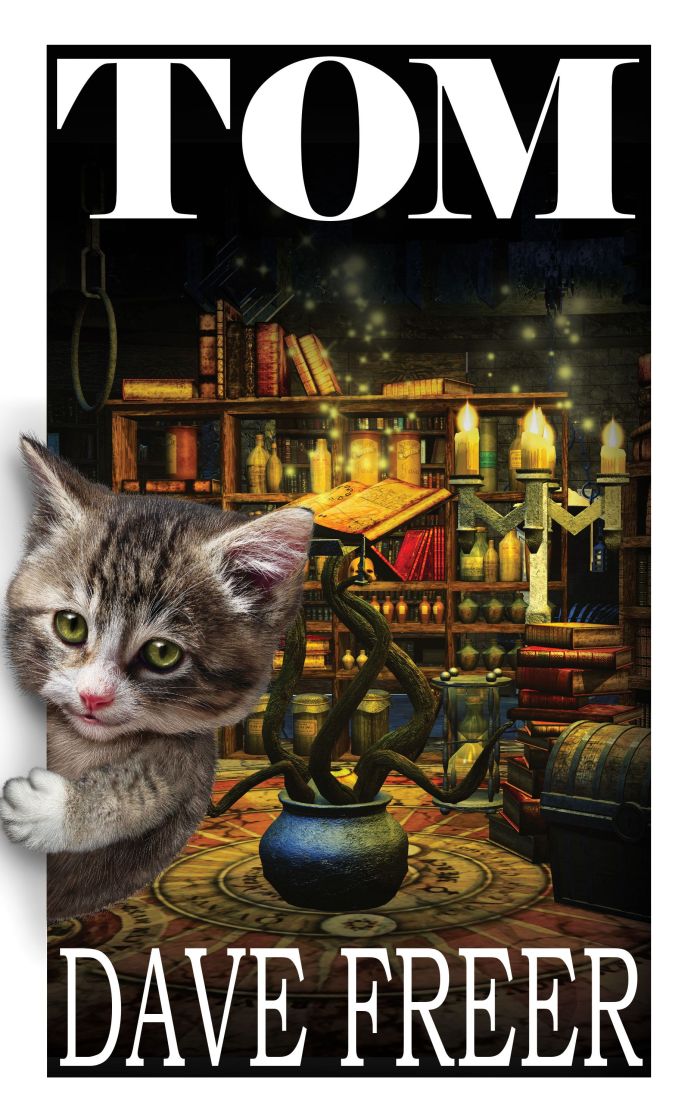
I’ve used my attempt at understanding a cat’s point of view – having been in feline service for most of my life (including having been one cat’s adopted kitten. She used to wash my hair every night) to write several stories from cat point of view. The latest of these (based on a couple of shorts I wrote years ago) is TOM – a novel based on the idea of a curmudgeonly old magician having failed to find or keep a solitary human famulus (a combination of servant and assistant. A step down from an apprentice – and you thought that was the bottom. Learn. There is always lower down and worse off).

This was always going to be a hard path.  Cats have no natural skills at service, unlike dogs, and definitely think it worth escaping from, or avoiding, while still being fed. Humans are domesticated and trained, not the other way around.   Tom is very unimpressed by the arrangement.


Tom woke. Not instantly, alert and ready to run, as he usually did. A feral kitten that didn’t, was soon dead. Instead Tom awoke… clumsily. In bits, as it were, but knowing that something was very, very wrong. He did what any cat would do under the circumstances – he sprang to his feet, in one single bound, claws out, ears back, hissing defiance, ready to flee.

Well, that was what he set out to do. What he actually did was to go from lying down to falling over in many separate disasters, starting with his front legs betraying him and him landing with his chin on the floor. He failed to stick his claws out. His ears refused to do what they should, his hiss was more of ‘squark’, fit for a bird! His hind legs were just too big and clumsy…

Only his tail felt right. And it felt ‘right’ by being dead straight up, with the hair on it fluffed, as it did when things were really, really, bad.

It happened to be true, too. Twisting awkwardly and peering at it, Tom could see his tail, tabby, fluffed and straight. That part of him was right and what it should be. The rest of him was not. His fur had fallen out. And his body was just obscenely wrong. “Wrong, wrong, wrong!” he yowled.

That sounded wrong too.

A human mouth was just terrible to howl out of. No better than a human body for springing and fleeing.

He still did his panicky, angry best.

It didn’t help him get out of the stone-walled room. He head-butted the wooden door, but that didn’t help, it just hurt his head. The noise he was making had just about the same effect. So, after a few minutes, he did what any sensible cat would do: lay down and thought about it, while giving himself a wash. His tongue couldn’t reach the bits of him that badly needed that washing. What a stupid, useless body this was. He came up with no other answers right then, but a great many questions.

A while later the door opened. Tom spun to his feet… well, he fell over trying to do that, rediscovering that he was not a cat any more.

It was the scrawny old human, in his dirty star-and-moon spangled robe. He spoke… but what he said was not ‘Scat!’ or ‘Damned cat!’ or even ‘I’ll kill yer, yer little fleabag!’ . As Tom wasn’t sure what he meant, he decided on trying a cautious mew, while keeping a sharp eye out for the first chance to escape.

All that happened was that the human made the same noises again. And Tom gave him the same reply. The human shook his head and muttered to himself. Then he scratched his beard, and raised his stick. Tom did his best to retreat. He knew what sticks meant, even if he had no idea what the human meant. The stone-walled corner of the room limited his ability to flee. But the old human merely touched him with his stick, while rattling off a string of words…

And then he said: “I have work for you to do, idle boy. Stop lying around, dress yourself and get down to the kitchen!”

Amazing! The old human had just touched him with that stick and now the human spoke perfect cat…And then it came to Tom that there weren’t even words in cat for ‘dress yourself.’ He tried to meow plaintively, in shock at this new horror. It came out as “Mwhaat’s happened to me?” which was not what he set out to say, even if it was what he wanted to know.

He got an answer. “I need a new famulus. You’re it.”

Tom knew he shouldn’t have understood what a ‘famulus’ was. But he did, even if the idea of him, a cat, being an attendant, a servant… was nearly as horrifying as finding himself in this body. “Let me go! I’m a cat,” he protested, despite the fact that having looked at himself, he obviously wasn’t.

The old human snorted. “You’re a boy, now. I left your tail on though. That’ll stop you running off. They’ll kill you out there if they see it. Now, get on with it, boy. I want my supper, and there’s pots needing to be scrubbed.” And with that he turned and walked out of the room.

No matter what the human said, Tom was desperate to escape. Even though his mind was still whirling with all this newness and horror, that idea was still his uppermost thought. He looked at the doorway, at the retreating back of the human, as the door swung closed. The latch clicked. Tom stared at it in horror. To a cat that was confinement. And then it came to him slowly… It wasn’t to a human. He’d seen them open doors.


Ah yes. A cat with thumbs.

Cry Havoc, and let loose the… well, can-openers.

Tom learns to be a human, while of course, remaining at least a little a tom cat.  I had a lot of fun with this book – it’s a gentle satire making a jest of many of fantasy’s tropes and political correctnesses. A cat would make less sense of those than we do.

Of course any self-respecting curmudgeonly magician has suitable supply of fiendish foes, an unreliable magic carpet (requires a jump start from the tower-top) and has appropriate accoutrements for a cat to cope with – a raven-familiar, an evil haunted skull of the late housekeeper, a vicious and ambulatory cheese, magically changing architecture, and demonically possessed chamber pot. To add to Tom’s complications there’s a missing and cursed princess and the wickedest witch in the West.

But a cat will remain a cat, even if he has been transformed into a boy. Independent, sometimes loyal, sometimes fierce. Thinking human ways strange, and that humans had beeter change to fit in with him. Oh, and rather cute, but don’t mention it to him. It would affront his dignity.
Tom-Cover

In Between

The office is almost done. The bedroom is half unpacked. We have a fridge, but I need to go and remove all the protective plastic from everywhere. Village Inn will be disappointed.  They quite counted us as breakfast regulars by now.  (I don’t have milk for my coffee and if I drink it black, the acid tears up my stomach.)

The cats are still locked up.  Will be dealing with them momentarily, after I set up the boxes.  Havelock is sure there’s been some terrible mistake and keeps trying to explain.  Greebo is sure he’s displeased the most high (me) and has stopped eating.

We still don’t know where younger son is going to live.  He doesn’t like the longer drive.  I don’t like (or think we can afford) his living alone.  We’re… negotiating.  Given that this is the kid who takes after me from the top of his little horns to the bottoms of his little woofkins that he don’t got, our negotiations are somewhat like the old talks between the US and the USSR when tensions were running high and both sides playing hardball.

The arms are better.  You could now mistake the eczema for a bad sunburn. I need to go get the meds that should be in the supermarket pharmacy.

It’s a friend’s birthday and we have to figure out how to take him out to dinner, one of those tradition things.

I found my speakers, now if I find the old ones I can give them to younger son.  I found my manuscripts to edit.  If I hustle today, tomorrow I should be able to keep normal working hours.

Reminding me that (to paraphrase Heinlein) Denver though metropolis is still a western town, its cowboy boots polished but still there under the glitz, the table next to ours at breakfast was taken up with cattle ranchers, talking acreages and breeds.  Perhaps it’s stock show week.  I haven’t looked lately, as I was only aware of when it was when it interfered with our ability to get a place to stay for the weekend.

It’s kind of interesting.  As science fiction authors we tend to try to create “coherent” societies, all at the same level of development.  Real life isn’t like that.  In real life, you have cattle ranchers and computer programmers all crammed in to the same place, to grab a quick breakfast on the way to their own pursuits.

And since I’ve entered the realm of random musings, I’m listening to one of those audio books that are 90% conspiracy theory.  (Why, you ask?  Well, because it was cheap and is tangentially related to a project I’m working on as soon as DR is in.)  I love the way the reader of the book (which is about secret histories) reads the book with a hint of malice and madness that makes me think of spit flecked microphones.  One of the things hilarious about it, is that he seems to be confused about where the right and left stand on things.  For instance, he thinks those who oppose the idea that other people might have lived in the territory of the US before the Amerindians are “the right wing imperialists,” instead of tribes bent on their theories of creation being respected by everyone else.  He’s also the worst kind of equivalence seeking multi-culturalist, and thinks the myth of the Noble Savage is “Right wing.”

In the middle of his rather mad rambles he goes on about how capitalism is incompatible with democratic notions of equality.  I have absolutely no clue what system he thinks would be compatible with such.  Communism?  What about the planners and komissars, comrade?

I find capitalism, in dignity, very compatible with equality.  Take the men who delivered our fridge this morning.  I didn’t consider them — nor would it occur to me to consider them — my inferiors.  Surely, I wouldn’t ask one of them to help me with the novel, but truth be told, I’d die if I were asked to carry a refrigerator.  And society would come to a half without people like them faster than without people like me.  OTOH without people like me, a society of people like them might (note I said MIGHT) well stagnate and never be capable of adapting.  Without people like my husband and sons, more than likely, it would come to a grinding halt and technology would deteriorate and back slide.

Specialization is not inequality.  Specialization is freedom of choice.

Sure, sure, I agree with Heinlein that specialization is for insects, but that’s in another sense.  I believe in developing my capabilities in areas other than writing and skull sweat.  I know how to build furniture and could do a decent job from found materials, even if the result would be rather like that crate-furniture that used to be popular in the eighties with families with small kids. I can dig a furrow (by hand) and I’m passably good at growing potatoes (everything else tends to fall victim to the brown thumb.) If pushed I could wash clothes by hand.  I can throw a lopsided pot, and can probably fire it unevenly in a kiln of my own devising.  More to the point, I can sew and knit (badly) and crochet, passably.  In what’s more likely to be needed in our society, I can take raw materials and with a day’s work transform it into a feast for 100 for minimal investment and in such a way they’ll never know it wasn’t catered. (More than 100.  I have run hospitality suites.  At a profit.)

That type of specialization is for insects, and human beings, though better at one thing, should know how to turn their hands to other things, in a pinch.

BUT society rewards being really uncommonly good at ONE thing.  That’s the virtue of capitalism.  Sure, I can build my own furniture.  Or I can write a novel and buy it.  And if I work more at writing novels, I become better at that and can help support more furniture makers (instead of refinishing antiques, which is what I do right now.)

All of which brings us to capitalism and equality.  The men who delivered the fridge are free to choose to do so, or to go to school and learn to be plumbers, or to stay home and turn their hands to writing novels.  It is no part of my concern which they do.   Well, if they write novels about fridge deliverers who solve mysteries, that’d be fun.  Not fun enough to force them to do it, though.

In the long run, given who they are and what they want out of life (me, to husband yesterday “You realize we’d need a much smaller house if all we did after work was chill out and watch TV, instead of your doing the writing and the music, and my doing the art thing, and…”) what they want to do, what makes them happy (that pursuit of happiness thing) they are free to find the occupation and entertainment that suits THEIR needs.  I don’t care.

In a communitarian system, though, be it a small seemingly idyllic tribe community or a large immiserated country.  (Or a small immiserated island country, for that matter) what other people’s occupation and their use of their time and resources is of vital interest to me.  If they don’t do their part in the plan, then everything falls apart.  Heck, even if they do their part in the plan, depending on how many thumbs the planner had when he threw the societal “pot” together.

In a communitarian system, so long as humans are humans and not hive creatures, there HAVE to be planners making sure someone is delivering the fridges and someone is writing the novels.  And because these have to be assigned according to the needs of the community, the individual suitability and preference don’t matter.

Which explains why those large, small and tribal communities tend to live on dirt and bugs.

I never understood the appeal of “equality” since I’m an odd, and I’m never going to be equal to much of anything or anyone.  And I don’t think equality should be the goal of any society.  Decent living standards and something approaching the ability to choose, and respect or at least non-interference with what other people choose to do that doesn’t hurt you, should.

Capitalism — understood as free trade — is liberty.  Communism is for insects.

Good Morning Blog

This post is coming at you from a new evil lair of evil, high up on the Rocky Mountains, so new that the dungeons still have that fresh paint smell and the only blood stains are where the carpenter hit himself with the hammer.

Okay, the house is not actually new, but it’s the first house we’ve lived in since 1989 that was built AFTER World War II, so it seems new to me.

We don’t have a fridge till tomorrow, only half of our stuff is here, the rest being still at the other house (that move is scheduled for the 14th) and my entire worldly possessions are in boxes somewhere.  BUT the auto-immune attack is receding and the cats are doing well, and I can hear the birds singing.  We’re going to be all right.  I think.

Actually our possessions are not all in boxes, exactly.  Faced with unpacking the kitchen or the office, I chose the office, so about 2/3 of it is set up, including opening boxes I hadn’t seen since we moved from our house in downtown Colorado Springs.  A lot of “Oh, so there you are.” and “Ah, I wondered where you’d gotten to.”  We’ve found ALL the batteries, which is good, but not my computer speakers, which means I can’t give younger son his beat up one back yet.

Needless to say we haven’t unpacked or set up the library yet, but older son came for a visit and climbed the library ladder to feel powerful (or something.)  THAT job  will probably take us to winter, since what’s going up is largely my research library, so instead of JUST organizing it alphabetically I’ll have to do it by subject.

Priorities right now are setting up the office then the bedroom and kitchen.  After that I can prioritize the writing again and unpack an hour or two a day.

I’m hoping the house will be livable by Denver comicon (I’m attending.)  Right now, depending on older son’s schedule, we should be going to Portugal right after Liberty con (which I’m also attending, unless his schedule throws a snag and we have to go to Portugal at the beginning of July.)

Apparently this area’s fire works will be visible from our back porch (we hear) which means after we get the back porch repaired and we’re settled in (i.e. next year) the Hoyt’s 4th of July party will resume after a 15 year hiatus.

Okay, now I go wake up the husband, to see if he feels well enough to go to work (he shouldn’t. He really did something heinous to his back.  But you know men.)  And then I’ll go shower, dress, scrounge some breakfast and finish setting up the office.  IF I shake a leg I should be able to write tonight.  I want to send Darkship Revenge in ASAP, and I didn’t forget I owe everyone Royal Blood, and Eternal Blood, and then The Brave and The Free, and somewhere along the line DRAGONS.

But I also want to finish the first chapter of Guardian and send to Larry for approval/editing/ohmygoshno,yougotJulieallwrong.  And there’s another secret project I can’t discuss (but you’ll like) which I need to finish in the next couple of months.

So.  I go. Time enough to sleep in the grave.  Forgive if my posting is irregular in the next week or two. New house internet service and all.

I’ll go and do all the things, now.


Worldbuilding: a question of depth – Sabrina Chase

*The resident blog owner is frantically packing her office, so she can frantically unpack her office at the other end and then frantically finish a book.  How in h*ll this move feels “surprise” I don’t know, except we didn’t expect the deal to go through till last minute.  And because it was a short sale, I’m on phone to contractors twenty four seven, even in my sleep, mostly trying to get estimates.  It was hilarious to have the doctor come in late to her office, and I’m on the phone.  I think she appreciated the irony.  there was a little smile.  On that front, I have had a steroid shot, I’m on antibiotic, but they didn’t have the steroid cream anywhere in town, so I’m waiting on that. The shot worked to the extent it’s now merely a very bad auto-immune attack, not a near-fatal one.  OTOH Dan threw out his back, so I REALLY have to go and do stuff.*

Worldbuilding: a question of depth – Sabrina Chase

A really good story is one that you keep thinking about long after the last page is read—where you think about living in that world yourself, or worry about what happens to the characters later on. As the proud recipient of a fine collection of reviews from readers complaining that I “made them” keep reading until the wee hours or demanding further adventures, I think I may have figured out one or two ways to suck the reader in and keep them submerged. Happily.

Make your world consistent:

If there is an impediment in chapter 1 it had bloody well better be an impediment in chapter 20, or you must present a really good reason why it isn’t any more. No waving of hands, either. Somebody will have had to work at solving the problem, and usually on-screen. E.g. in the Sequoyah series, there is no FTL data transmission. Every message has to be carried on a physical courier ship, and the delays from the frontier/war zone are on the order of weeks. This has the effect that in some instances, the characters can’t call the high command for instructions when an emergency comes up. They have to use their initiative and really, really hope they are right when the board of inquiry convenes.

In a similar vein, if the Holy Bunny Slippers are the most important religious artifact in your world, the characters should act like that all the time—or feel very daring and wicked when they make tentative jokes about wearing them. Nothing makes the reader surface like an exploding submarine faster than being told something is important, and then seeing it treated like a stale sandwich.

Oh God, the dragon is moulting again:

What do ordinary people in this world worry about? Most of the action in the Sequoyah series is in artificial environments—either space stations or ships. (or a planet, Bone, where there isn’t enough oxygen to breathe all the time). So, people worry about air a LOT. Think about our expletives. They tend to feature things we feel a sharp spike of emotion about. Sex, violence, blood, religion. So, to the Fringe people, anything to do with compromised breathing environment is a Bad Thing. Expletives I used in the series are things like “hissing leak”, “leaky gasket”, “pissing air”. And then, see step 1 above, BE CONSISTENT. Do not have people acting all nonchalant about leaks later on.

Crimes:

Crimes are committed by people who want what they can’t get, for whatever reason. In a fictional world, you can have new stuff they want, or you can have ordinary stuff that for some reason is very hard to get. If you have a scarcity that is unusual in our world, there won’t be a corresponding crime wave here-and-now. But in your alternate world, this need will have people finding criminal ways to scratch the itch. Example: on the Fringe, labor is scarce. And people can restrict mobility easily, by restricting access to spaceships for escape. Ergo, slavery happens. It has happened enough, and is enough of a temptation, that it is a capital crime in this world.

Biological science is also much more advanced. Therefore gene theft is a real thing, and also has severe punishments. Culturally, people regard it in the same light as sexual molestation—a violation of a person’s privacy and body. Moire, from our time with our mores, thinks her crew will not be willing to take the risk of rescuing the artificially created human slaves, but the crew thinks of it a gene theft and wonder why she thinks they wouldn’t take action.

Don’t change everything:

Assuming your characters are human, there will be some universals. Parents will still brag about their children and show the equivalent of pictures to all victims that can’t get away. Interactions will still involve status evaluation and negotiations. People will still get lonely/jealous/bored. Every large human gathering will have the equivalent of CMOT Dibbler trying to make a fast buck. It might be mimmoth on a stick, or Venusian mudgrub, or a cultured protein nodule, but the basic concept remains the same. The credulous and the bored will read gossip magazines with highly improbable stories—only the details of what is improbable will change. Sequoyah has the equivalent of the National Enquirer, and it features “deranged gestational facility worker switches babies” (advanced biotech=artificial wombs, but people still worry about getting the right baby back from the hospital, oh yeah, and some people are just plain nuts) and “pirates attack” (that is a hardy perennial from all eras. Everyone worries about Bad People doing Bad Things to them.) And of course, the bureaucrats you shall always have with you.

There are other ways, but these have worked for me. I hope these prove useful to you, as well.

Measuring Men

When I was very young, 12 or so, I thought you could judge people only by the descendants they left behind.

In a way, that has a certain validity.  I mean, if you don’t have children, your genetics aren’t going to show up in future humanity.

It took me years to realize that people like Shakespeare and Heinlein had left countless non-genetic descendants.  For Shakespeare, arguably, most of western civ.  For Heinlein, only the future will tell, but I’m sort of hoping he’ll be the father of many new worlds.

Which brings us to measuring humans and your life.

Many humans and a lot of politicians are convinced he who is remembered the longest wins.

There is something to be said for that, of course.  To quote the late Sir Pterry, a man is not dead as long as his name is spoken.  And we’ll be sending Pterry’s name home in the sf/f virtual clacks for a long time to come.

I always liked when I attended worldcon, the huge display during the awards with the names of all who had gone during the year since the last worldcon.  It was useful, in terms of some of us realizing con-friends had died unexpectedly, but most of all it was “sending their name home.”  Most of us (self being exception, among a few others) leave no descendants, most (self included) are somewhat of a puzzle to birth family, most have family by choice, yes, but a lot of it scattered all over the world.  It is good to have our name spoken one last time, sent on its way with good wishes by those who knew them best/shared their passions.

Last month one of you, occasional blog readers, book readers, Odds and Huns, contacted me.  The occasion of that was OF COURSE a demand for more books.  I’m not going to name him, because I barely knew him in terms of time, and many of the readers here actually knew him and are mourning him, with more right than I have.

He could be any of you.  He pinged me on FB to demand more books, moar!  Normally I answer politely and excuse myself (no, it’s not just you.  I’m short on time.)  BUT I had become newly-fried on writing and was drinking a beer and hanging out with my posse online, anyway.  So, this gentleman and I talked books, starting with mine, moving to Kate’s (whose fan he also was) moved on to our dismal politics.

He felt like… family.  Like someone I’d known forever.  (One is tempted to believe the Mormon doctrine of pre-incarnation ensoulment sometimes, because there are people we’ve just met but have known forever.  However perhaps it suffices RES’s and my son’s theory that the soul is eternal and multidimmensional.  So sometimes you’ve known people before and after and forever (not a way to explain something out of time) our brief carnal sojourn on Earth.)

Turned out he was dying.  We had hopes.  There were experimental treatments.  But he died, suddenly, far too quickly.

In the time I knew him I got used to sending fight scenes and gun stuffery to him for proofing/suggestions.  In the time I knew him he taught me a lot.

This last week, I’ve been watching the hole he left behind in the lives of those who had contact with him.

And I think that’s the measure.  Look, if you have descendants or not might not be wholly under your control.  Sometimes you don’t meet anyone you want to have them with in time.  Sometimes health forbids it.  Sometimes it just doesn’t happen.

And as for being remembered, there are limits.  Unless you’re the new Julius Caesar, you might be remembered as much as centuries after your death, but it doesn’t last.  Human memory is frangible, ephemeral.  You might be “remembered” but that might not have ANYTHING to do with who you were actually or what you actually did.

But you can live each day as if it matters.  you can try to be as good as you can to those around you, generous with your time, gentle with the weak, fair with the strong.

You’ll fail sometimes, of course, but this is a game of averages.

Live so that when you go what you leave behind is not “Thank G-d, he’s gone” but a million little things where people think “I wish I could tell him/her this joke” and “I wish I knew what he/she thinks of this” and “man I miss him/her.”

Unraveling your myriad kindnesses and help from their lives will give your friends, relatives, acquaintances and passing strangers a momentary pain.  But it is a good pain.  It means you didn’t live or die in vain.

Switching Genres – Peter Grant

Switching Genres – Peter Grant


petergrantlightening

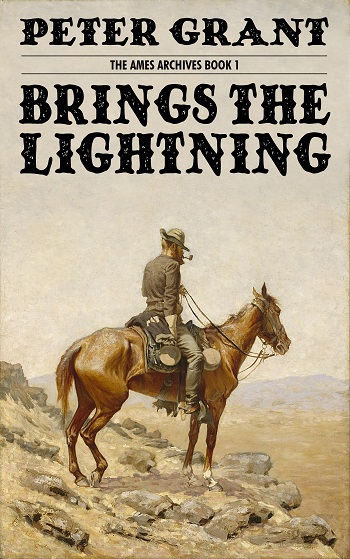
I’ve just had the fun of publishing my first Western novel.  In the process, I’m learning a lot about marketing across different genres and categories, and its implications for success.

‘Brings The Lightning’ is a considerable departure from my earlier science fiction novels, plus one volume of memoir; but there are also similarities.  Someone – I have no idea who – is alleged to have said that “Space opera is Westerns with rayguns”.  Sounds reasonable to me, particularly in the light of my Laredo War trilogy, which explicitly begins on a planet named Laredo where old-fashioned Western-style chemical firearms are deployed in the very first chapter!  There’s even (according to Wikipedia) a literary genre known as ‘Space Westerns’.  I’d never heard the term until I started researching this article, but there you are.

I got into the Western genre through three different, but mutually supportive avenues.  The first is that I was born and raised in South Africa.  Its history is not unlike that of the United States in terms of internal expansion.  The USA saw the opening of the Western frontier through early settlers and the so-called ‘Mountain Men’ in the first half of the nineteenth century.  After the Civil War, emigration to the west accelerated and expanded, so that by the end of the century the west was no longer wild, but settled.

In South Africa, internal expansion was to the east, not the west, and was driven by resentment among the Boers (descendants of the original Dutch settlers) against British colonial policies, including freeing the slaves. However, whereas in the USA settlers and emigrants overwhelmed the resident Native American tribes by sheer weight of numbers, in South Africa the opposite was true.  White settlers never amounted to more than 10% of the total population of the country, and were usually a far smaller minority in the frontier regions.

The inevitable wars between settlers and native tribes were decided by the superiority of firearms over primitive local weaponry, and by a xenophobic racism fueled by a strict, ill-educated and very primitive Calvinism. The Boers regarded black Africans as the Biblical children of Ham, and therefore subject to the so-called (and mis-named) ‘Curse of Ham’. They were regarded as divinely predestined to be in perpetual subjugation to the white race. (This, in turn, went on to form the often unspoken underpinnings of the later policy of apartheid.) Having grown up studying in school the history of colonial expansion into the African interior, and the wars with native tribes that were thus engendered, it was natural for me to see the parallels between it and white expansion into the interior of the USA.

This was reinforced by the second avenue by which I came to the genre: reading Western novels during my youth, and particularly during my military service, where they were endemic in army camps, barracks and other installations. The latter was frequently frustrating, because a book would become so tattered and worn through being handed around that the first and last few pages would often go missing. One might find a particularly engrossing tale, only to be left in ignorance of how it ended until one could get one’s hands on another, intact copy at the next base and learn how things unfolded.

The third element in my interest in the Western genre was moving to the USA in the 1990’s, and being able to see many of the places mentioned in the books for the first time. Frontier towns such as Dodge City and Abilene were no longer just names, but places I could actually visit. Exotic-sounding locales like Tucumcari (used to good effect by Sergio Leone in his ‘spaghetti Western’ movies) and Taos (infamous for its eponymous bootleg alcohol) were no longer all that exotic, but every bit as dusty and beat-down as the histories described them. I renewed my acquaintance with Westerns from the benefit of that new perspective, and enjoyed them all the more.

The big question for a writer (and, in the case of my new book, the small press that’s published it) is: how does one reach readers in a genre where one hasn’t previously written? I note from initial sales that the book is popular with readers of my blog, and the shared Mad Genius Club writers’ blog, and other books from my publisher. However, despite using categories and keywords typical of the genre, it doesn’t seem to be attracting much attention – yet – from ‘regular’ Western aficionados. That’s not surprising, given that most of them don’t know it exists yet; but what channels should be used to inform them? The genre’s been moribund for so long that it’s hard to think of a commercial outlet that will reach them.

One avenue I’m going to explore is the shooting community. The sport of Cowboy Action Shooting is very popular, and the various organizations involved have their own Web sites, forums and newsletters. Since I’m a shooter, and I’ve striven for authenticity in my descriptions of the weapons involved, there might be a natural tie-in there. I’m also going to talk to the Western Writers of America about potential marketing outlets. If anyone knows that market, I guess they will.

Finally, I’m going to have to learn to fine-tune my Search Engine Optimization (SEO). Choosing categories and keywords for the book is an important part of marketing, and knowledge in one area (such as science fiction) doesn’t necessarily carry over to another, like Westerns. My wife and I made an initial study of that area, but we’ll have to analyze closely who’s getting to my new book, and in what way. We’ll look to reinforce avenues that are proving fruitful, and modify or replace those that aren’t bringing in new readers.

This will be a long-term effort, because the picture doesn’t remain static. For example, who could have predicted, twenty years ago, that changing tastes would put ‘Mail Order Bride’-themed books – which in the past were considered to belong to the romance rather than the Western genre – squarely in the Western category on Amazon.com today, and well up in its bestseller lists? Being a traditionalist, I think that’s nothing less than heresy, but I’m sure the modern fans of those books regard that as the opinion of an unreconstructed stick-in-the-mud. Oh, well… just as long as they don’t expect me to write one!


Learning to UN-Think

When I was very little I was afraid of all sorts of things, including that devils/trolls/evil creatures would grab me from the back of grandma’s garden.

This was probably the result of trying to make me properly afraid of SOMETHING so I wouldn’t run up to strangers or try to pet the neighbor’s semi-feral pig, or equally crazy adventures.

But what it did was make me so afraid that I had entire sets of prayers that started playing in my head when heading out of sight of adults.  It took me till my late teens to stop the words running through my head reflexively whenever I was in trouble/scared.

These weren’t prayer as such.  I mean, they really didn’t mean much except saying these words, even when I was little.  What they did was stop me thinking.  I stopped thinking about the bad thing that could jump out or the bad thing that could happen.  They were a thought stopper.

I was talking to a younger friend, a few days ago, and he said that’s what schools teach mostly.  They teach you to “un-think”.

There are a set number of phrases and sentences, and approved thoughts.  If you deviate from them, starting when you’re very young, you get punished.  Worse, you get cast out.  You’re told you’re an awful person, not one of us, evil.

When evil is defined in terms of having an unapproved opinion/belief, and not in terms of what people DO with that opinion/belief, people become deathly afraid of their own thoughts.

This is not an invention of the progressives.  I have no idea why in heck I’m fascinated by Tudor England, but it was another such period.  If you were a Protestant/Catholic you were evil in the eyes of the other side, regardless of who you were or what you’d done or not.  They would cheerfully turn in their best friend, from whom they had nothing but good on finding he was a secret Catholic/Protestant, depending on who was in power.

They had, in their defense, more reason for this — at least rationally and explicitly — than our current-day fanatics. They thought one’s thoughts and beliefs, more or as much as one’s actions determined one’s fitness for eternal life.  So there was a lot of burn the heretic to stop the infection going on.

Of course, to an extent our current fanatics believe the same as well.  They think that people’s wrongthink is the only thing standing between them and utopia.  If they could just change humans enough!  Which means stopping humans thinking/saying/believing whatever they want, and instead believing what the fanatics wish them to.

Unfortunately what the fanatics wish us to believe goes against not just human nature, but reality.  No one in his right mind thinks that a person of pale skin has inherent “privilege” when you consider the person with pale skin can be born to a coke addicted mother in the Appalachia, and the person with dark brown skin might be the son of an upper middle class communist who married an upper class foreign polygamist, both of them with channels in the corridors of power.

As a person of relative swarth who has friends who are blond and also raised by wolves, (I lie.  Wolves would have been better parents) I never felt the overwhelming burden of their privilege.

The only people who can believe that twaddle are upper class ninnies who never had to struggle a day in their lives and, if they’re pale, believe that other people have it much worse (true) because of their tan (untrue); if they’re tan believe that anything they failed to get is the fault of “unconscious racism.”  BAH.

In the real world where people live among real people and not Marxist constructs, there is a certain recoil (unconscious) from a certain type of looks.  There are ways to get around those, often amounting to cultivating a studied upper class accent and a certain mode of dress.  Take my older son (please? He has a final today and his driving me bonkers) who is a tall, dark, bulky swarthy menace built like a football player (or a mini-Larry-Correia) and who looks inexplicably Cuban.  (I guess my African ancestors and Dan’s Amerindian ancestors met and made whoopy in his genes?)  Sure people — even I when I’m scanning for menace, not for son — will cross the street to avoid him.  This is why at thirteen or so, when the beard came in, he started wearing a button down shirt and tie every day.  NO ONE recoils from a guy in a shirt and tie, no matter how big or blunt featured.

Now, yeah, sure there are prices we pay for the fact that people who look like him are considered menacing (and that’s a statistical analysis people do, and it has bloody nothing to do with racism and a lot to do with certain communities being troubled) such as we had to pay more for his apartment to be in an area he wasn’t likely to get caught in gang crossfire with police (not literally, but possibly literally.)  Heck, given his ambiguous looks, for him not to get caught in the crossfire of rivals gangs.  But that’s okay, because as a professor of his pointed out sometime ago, he had lots of books growing up and a family that insisted he learn, so he always had “lots of privilege.”  In other words, yeah, he has some factors that tell against him.  For him he has only one: a family that told him early on the only inheritance we could give him was a good mind and the ability to use it.  So far he’s doing okay, swarthy menacing looks notwithstanding.

And in the end, in the whole question of privilege, that’s what normal people notice.  No matter who you are, if you behave like a decent human being, you will do better than people who don’t.  Also, the only real “privilege” is money and connections and (except at the highest levels of society, which I think is where they get the idea) this correlates poorly with inverse ability to tan an has for at least the 30 years I’ve been in country.

People can’t help noticing this.  Because it’s before their eyes.  And that’s just an example. There’s a ton of other things they can’t help noticing: like for instance that no, women and men AREN’T exactly the same in different bodies.  That those who work hard tend to get ahead.  That some people are just lazy/crazy, NOT victims (except of themselves) etc.

It is because they can’t avoid noticing these things — it starts as early as pre-school when my younger son noticed that contrary to cartoons, most girls don’t want to get dirty and have adventures, while most boys DO — that they learn to unthink.

Consider that a single, stray thought can get you cast out of “decent people” and you’ll understand why people start deploying magical words of unthought to cast out the bad thoughts.

This is why so often, in conversation with otherwise decent people, you say something unapproved of — say that men and women are different (without any value judgement) and they call you racist, sexist, homophobic.  Or accuse you of privilege.  Or call you a neo-nazi.

ALL of these things are ridiculous from the statement you made, and often applied to you are risible.  VISIBLY so.  That doesn’t matter, because the words are not “real” words with meaning.  They’re an incantation, a string of “unthought” to keep the person talking to you from having badthought that would get them cast out of the community of “good people.”

I remember feeling like that, though my triggers were much higher than other people’s.  Coming from Europe, though, I found all nationalism uncomfortable, having been taught NOT to feel it.  So open expressions of patriotism made me reach for the same place those prayers came from when I was little.

Until I started evaluating things in the cold light of reason, and understanding the differences between the US and Europe.  Now I still despise European blood-and-soil racialism applied to the US (not so much to Europe, not unless they come up with a version where only blond people can be German, or other a-historical nonsense.  Which a lot of them do.  But I come from a mixed country where that doesn’t apply and the idea that someone who wants to be Portuguese — I don’t know, I presume there are misplaced Portuguese born in other places because the stork was imbibing Port Wine! — needs to worship the Portuguese ancestry even if they don’t have it themselves, sounds about right.)  I despise it because we’re a covenant nation, not one of blood.  But I don’t need to reach for magical words and call those who have that idea bad names.  Only a few of them deserve those, anyway.  The rest are confused bunnies who know no REAL history.

As far as I can tell, the only cure for “unthought” is thinking.  And the only way to force someone who’s been thoroughly indoctrinated in unthought to think is to make them very uncomfortable.  It is a process like de-programming cult members.

I did it to myself when I immigrated and decided to acculturate.  How to do it to the vast majority people under 30 or so is a puzzle.  Except that life itself makes them uncomfortable enough to plant doubts.  It’s important to remember this unthought has been taught in one degree or another to three generations, and yet some of us escaped.

My guess is with what’s coming down the pipe, a lot more people can’t help escaping.

So, in addition to economic turmoil we’re going to have some very angry, confused people who know they’ve always been lied to.  The problem is that the first reaction is to fall into unthought of another kind, to turn the American left exactly on its head.  Which leads to the European right, not the American.

Be ready to offer an alternative and to tell them thought IS safe.  Thought doesn’t make you evil.  Only actions make you evil.

Teach your children well and fight unthought.  It’s all we can do.


A Destiny Beyond the Crab Bucket – Kate Paulk

*Kate is now in the process of becoming an American.  And this is why I’ll borrow beg or hitchhike to go to her swearing in ceremony.  She’s one of us. She won’t take that oath lightly.  And even despite the last 8 years and the present political insanity, she’s CHOOSING us.- SAH*

A Destiny Beyond the Crab Bucket – Kate Paulk

Nature or Nurture, DNA or Culture


In a sane world, the answer is “yes”.


It’s become self-evident that we do not live in a sane world. We have people trying to simultaneously claim that culture is race (that is, that nature/DNA is all there is) and that humans are endlessly mutable (that nurture/culture is the only factor in what we become). Meanwhile, some of the opponents of said mental midgets are claiming – without apparent irony – that DNA is destiny.


No, it’s not. No more than having poor parents is a guarantee of being poor one’s whole life, or that growing up in a slum means never being able to escape it. Unless, of course, you actually do believe that Nature, or DNA, is the whole sum of a person and therefore there is no free will, no ability to rise above one’s nature and become something better.


To which I say, bullshit. The evidence is against it. There is no tabula rasa, but there is also no predestined path determined at or before birth. We all, every last bloody one of us, have a choice in how we respond to the shit life dumps on us.


To claim that DNA is everything is to insult every person who has chosen to rise above shitty circumstances – to climb out of the crab pot, if one borrows Pratchett’s analogy. All of us have the ability to climb out of the crab pot that is our nature – but not all of us choose to do so.


To put it another way – all of us get a bunch of traits, abilities and so forth wired in. Some are more coordinated than others. Some are more intelligent. How we express those traits depends a lot on what our culture – both the local culture in our homes and the broader society we observe as we’re growing up – regards as the proper way. In Australia there’s an extremely strong streak of cutting down the tall poppies, so people with unusual abilities tend to be rather modest about them – yes, even in sports. The tendency is to attribute success to “luck” and misfortune to “not doing it right”.


The US cultures I’ve seen since I moved here are somewhat the opposite: success is because one worked for it and did it right, where failure is because you didn’t work or didn’t do things right.


Of course there are nuances: you don’t make broad sweeping generalizations without a boatload of exceptions. But the overall trend holds.


To claim that because someone belongs to X “victim group”, be it black lesbian unicorns with three legs or whatever they will always be this way is to claim that we are the sum total of our DNA and what happens to us – in short, that we have no free will and our choices are not our own. To reject this view and claim that DNA is destiny is equally short-sighted: DNA is the start. You can have genetic issues out the wazoo and adjust your life so their impact is minimized. You can let them hammer you and wail about your victimosity. Or anything in between.


Similarly, the claim that we in the West have to “accept” the atrocities committed by certain parties in the name of their disgusting ideology disguised as a religion is as bigoted as the notion that blacks or arabs (or anyone else, for that matter) are inherently more violent because DNA, and equally disprovable. Ask older American blacks (or check the statistics of the time): in the 1950s despite often blatantly bigoted policy in many parts of this nation, despite widespread poverty, there were a great many thriving black communities, with colleges and schools that – despite far less in the way of resources than their white counterparts – were the equal of many of those white counterparts, and the better of quite a few of them. The young men of those communities did not try to kill each other on a daily basis, nor did they make large swathes of inner cities no-go zones. Their descendants are hardly genetically different, as a group.


What has changed is the dominant culture: it’s gone from “beat whitey at his own game” – which ultimately leads to good outcomes for the largest number of people – to “whatever whitey does, do the opposite and call it good” – which does not. Why?


The Western culture, particularly the USA variant of it, values the individual independent from his or her ability to contribute to society at large.


This shows up in any number of little ways: the US habit of counting every live birth, no matter how premature, as a childbirth even if the baby only takes one breath outside the womb (which, incidentally, does interesting things to the US infant mortality stats as well as to the average expected life span); the notion of the three great inalienable rights – nobody else has this. Nobody. The other major Anglo nations (Canada, Australia, New Zealand) come close, but even they don’t go as far as the USA; the idea that an American – any American – is the equal of anybody else and this is why American Presidents traditionally do not bow to foreign royalty; hell, the arguments over damn near everything that spring up and get carried out loudly and cheerfully in public.


Nobody else does this. Every other culture I know about is less concerned about the rights of the individual than the USA. Even Australia, which in many ways comes closest, is more likely to favor the needs of society at large (and small) over the rights of the individual.


Thing is, as Sarah has mentioned a few times, when you allow the rights of the individual to take precedence, you get a whole raft of things happening, the majority of which wind up being massively beneficial to society at large and small because the misfits are able to spend more energy being themselves instead of fitting in. Hell, the non-misfits with bright ideas are able to spend more energy being themselves instead of fitting in.


It’s a small thing, but over the course of years and millions of people it adds up and you get the USA instead of, oh… Russia. Or China. The average Russian or Chinese person is no less capable than the average American, but both Russian and Chinese culture actively discourage individuality. The State, Mother Russia, whatever… these are more important than any individual Russian or Chinese life.


But be warned: America may be more resistant to the culture of conformity, but we’re not in any way immune. Our media and education system have spent decades indoctrinating us with the “society above all” culture and calling it good.


It isn’t. The radical American experiment has borne fruit far beyond anyone’s expectations. The poorest American has a standard of living more or less on par with middle-class Europeans (and Australians), and thinks this is normal.


Let’s not allow anyone who says race is culture or DNA is destiny to screw that up.