The Future — it is Open

There is no sword about to fall on your shoulders.  The world isn’t coming to an end.

To those of you rapidly paging down to yesterday’s blog, no there is no contradiction.  The people – at least for now – in charge of our destiny as a people are performing acts of astonishing malpractice.  Things can get very, very sticky.  As sticky as a wad of chewed up gum that got covered in stickfast.

So?

So, what am I talking about now?  Do I really expect you to think there is no problem?

No, of course I don’t.  Look, you silly critter, when did anyone ever promise you a problem free time to live in?  Not only was that always highly unlikely – you have read some history, right? – but you’d probably end up finding it boring if it came about.

We are in an exceedingly tight spot and our foreign policy of speaking softly and carrying an apologetic stick is going to get us in wars.  On the other hand we are and have always been the most innovative civilization in the history of mankind and we have some awesome fighting machines.  (And those are just our guys.  You should see the mechanical ones.)

What I’m trying to say here is that there is no predetermined outcome.  Decay and loss of power and civilizational strength is a choice, not an inevitable destiny.

The big difference between 1984 and Friday is that no one dropped a Heinlein character in the middle of 1984.  The big difference between The Moon Is A Harsh Mistress and Brave New World is not much greater.

In other words, you’ve been sold a bill of goods by the cultural elite that kept all the entertainment and information industry locked tighter than a drum until very recently.  Not that they wanted to consign you to depression and despair, mind.  No, they had a bright dream of their own (some of them still do) which went something like this: capitalist society is doomed, therefore it collapses, and beyond it arises the great day of equality and perfect communism, where we shall all be like onto gods and—

The problem is that capitalism proves remarkably hard to kill, and then when you manage to kill it, SOMEHOW the bright day of perfect equality never dawns, possibly because a society that makes humans into things can’t function because humans aren’t things.  But I digress.

So the poor dears have to try harder to show you how bad capitalism is, and then when communism doesn’t work, well, frankly they’re just fed up with humanity, so they show you how that doesn’t work either, so that in the end what passes for all literature and entertainment and art becomes the loooooooooooong sustained whine of a two year old who’s just found out he can’t have a pony and (appropriately) a little red wagon “But I waaaaaaaant perfect communism!  You promised you’d give me perfect communism!”  followed by “I only can’t have perfect communism because capitalism is a poopy face, humans are poopy faces, reality is poopy face.”

Or, if you prefer the “high end” of that kind of expression, as translated to science fiction, the future is rusty and closed to the possibility of new invention and technology and nothing works, and it feels like the 1930s redux, and then they all die.

These are the people who say space travel isn’t really sf, and no one would have adventures in space, but of course, if you read them these are people who grew up in comfort unimaginable to kings and princes of even a few years back, and who think you can’t have fun anywhere, and that, frankly, we should all listen to them when they say incredibly stupid moralizing things like “you can’t go to space until you learn to take care of the Earth.”  (Why?  The Earth might very well turn out to be the least of our worlds.  Our cradle, sure.  But anyone who knows how reality works, knows if we had had to stay in Europe till we learned to take care of it, we’d never have expanded to the New World.  Because part of learning is to experience new things.)  This is sort of like SF written by the devotees of a scatological cult.

Wait, it is SF written by devotees of a scatological cult.  They believe the Earth is overpopulated, human invention has finished its run and we’ll never get further technologically, and besides, no system of society works.  (What they mean is that no system works perfectly, which is how they demand that all systems but socialism work, and of course socialism doesn’t work at all.)

They got hold of the publishing houses late seventies which is when most people say they stopped reading SF – though they don’t tell you why, because most of them don’t know.  They just know that there was nothing on the shelves for them.

Well, I’m telling you why: because at that point the supposed writer-entertainers started selling gloom and doom as our only future, the same gloom and doom people were getting from their schools (we were all going to freeze to death) their newspaper (coming ice age because of the sins of industrialized society) and even their scientific publications (coming ice age for sure, the only good thing was that it would probably exterminate humanity.)

I think I was twenty nine when I realized that all these prophecies of doom weren’t true.  I remember the big sigh of relief when I realized the Earth probably wasn’t overpopulated (Statistics suck, overpopulated is not what you think it is, when tech allows us to survive on the produce of smaller and smaller areas and at any rate, the world, MOSTLY is full of empty space) and that even if it were, that was just a spur to invention and with more people we had more minds to invent things.  I’d assumed till then I was living in twilight years (and sparkly vampires hadn’t even been invented yet.)

Yesterday a lot of people in the comments said they hoped the feeling of doom would pass, just like it passed before.  I agree.  I mean, I remember the Carter years, and the people preparing to go back to the Earth.  There’s always something a little silly about that, anyway, because when a crisis like that hits, it hits in ways you don’t expect.

At any rate, a lot of us are having 70s flashbacks, and in my case they are worse than most.  (I appreciate that a lot of Russian immigrants agree with me, but to them I want to say “you have it easy.  You didn’t see the fall and if you had it wouldn’t be in a modern society.  In my case… PTSD might better describe what’s happening.”)  But they’re also reassuring in a way, because we didn’t end up in the soup then and maybe we’ll escape now.

Don’t yell at me.  I’m aware – very aware – we are all of us in much worse shape than in the seventies, for several reasons, among them a slow bleed away of competency due to our execrable school system.  But – this is important – while our kids are uneducated it doesn’t mean they’re stupid, and nothing wakes you like a bucket of unemployment in the face.

Also, the feeling I have about the American economy is that of a barely restrained horse, wanting to be racing.  Many things could loosen it and two of the simplest would be the end of regulatory insecurity and permitting us to exploit our vast mineral wealth, to wit oil.

Never happen?  Don’t bet on it.  Now the things after that, including a simplification and defanging of the tax code… that I can’t promise you.  But I think we have a fair shot at the first two.

And if we don’t?  If it all goes pear shaped?

Well… Portugal – and other countries – have lived through bankruptcy.  There was civilized life of a sort still going on in Lebanon in the middle of the civil war.  Things just become very weird, and ways of doing things become odd, and supplies can become irregular (which is why it’s a good idea to have some stop gaps laid by.)  Yeah, you might have to be more careful when going out.  Yeah, you might have to fence your yard.  No, you won’t like it.  But in the end all of that are minor adjustments.  Yes, even the bars on the windows and tall walls around the houses are minor adjustments.  You aren’t catapulted suddenly back to the 10th century with no reprieve.

Remember the difference between a dystopia and a dystopia with a Heinlein character in it.  Be a Heinlein character.

In other words, to paraphrase the man, if faced with the choice between being a live lamb or a dead lion, be a live lion.  As he noted, it’s often easier.

Don’t give up.  Don’t accept decay as an inevitable fate.  Fight.  Improve.  Think up new ways to do things, and new ways to get around problems.

We’ll do.  We’re humans and humans survive.

(Human Wave.)
Son of QE2, This Time It’s Deadly

It is perhaps a feature of human life that the things you laugh at as a kid are the things you tend to be, do or think as an adult.

As a kid who was always very interested in both politics and economics, my favorite objects of derision were the gold bugs and the UN opponents.  As we know more about the UN, from the rampant corruption that vanishes billions and manages to make things even worse in the third world countries and other kakistocracies in which it purports to intervene to child prostitution and exploitation of natives by UN troops or envoys, I find myself thinking the old guys who said “UN out of the US” were perhaps much brighter than I gave them credit for.  (To be honest, unlike most of the kids today who are getting this soft-lit version in school and the idea the UN is some kind of super hero – I never thought it was good for much but talk-talk, but I thought as such it was inoffensive, and perhaps a show of good will.)

As for the gold bugs…

Years ago, at a panel at world fantasy, I found myself the only writer with three editors at the table.  I don’t know if I mentioned that economics is my hobby?  Well, in any case, it clearly wasn’t these editors hobby and they were all older than I.  Which shouldn’t matter, as they weren’t old enough to explain this: when currency came up, to a man (well, there were two women and one man, the man is the one who was vocal about it, though) they insisted that US currency represented a certain amount of gold.  To guffaws from about a third the audience (yes, a third) the male editor continued to argue that our currency was gold based.

As I disabused him of this notion, his eyes grew wide and panicky and he said, “You mean there’s nothing behind that paper but that the government says so?”  His expression of almost comic-book terror said it all.  “We’re depending on the word of politicians to make our life-savings worth something?”

When I said yes, you could feel the collective shudder in the room.

There are many reasons this was thought a good idea at one time.  I’d like to point out at that time, most of the people also thought that eugenics were a bang up idea and that eventually all of life would be run by a few people at the top, who would be kind of super-engineers of society and make sure we didn’t have any of those little stumbles that we, unenlightened, are prone to.

Yes, there are people who still believe that later one.  Mostly they’re politicians.  And you don’t want me to go into detail on why they’re wrong, because I refuse to swear this early in the morning and before coffee.

Part of the reason, of course, was the idea that gold is not actually correlated to the value in society.  Pratchett does a great job of explaining this in Making Money.  Of course, he doesn’t address the weaknesses.

But the point of people who moved us to a fiat currency was that gold as such is not used to make enough of our goods and wealth to correlate to how much wealth there is in a society, and that it would be better to create a currency that represented the actual wealth of a nation.

This is all well and good, except, how does anyone know what wealth a nation has?  Look, let’s leave aside doctored news reports, controlled press as was common in the old-USSR or voluntarily(?)-controlled press as we seem to have here.  Let’s leave aside funny reports doctored to show less unemployment or more job growth than there is, which get quietly (or not) revised downward when no one is looking.  Let’s assume everyone in this equation is honest (yes, even politicians.  Shush now, this is a fairytale) and therefore what we’re looking at in reports and activity and movement of work and value in society is what it is.  How do we know how much wealth there is?  Even if we appoint very smart men to look at it, how do we do it?

Companies have very smart men looking at them too, to determine their value, and betting with their own money which keeps them honest.  They’re called investors.  And how many times is a company pretty papier mache looking like solid stone?  And that’s a company, not something as solid as a nation.

As for gold… not, it has no intrinsic value beyond that which we humans give it.  Which means what?  Unless we’re dealing with aliens, the creatures in this world needing to transact business are humans, and humans always do seem to value gold, which means a certain amount of gold seems to have a certain price which tends to be higher than other commodities.  But I’m not a stickler.  I’m okay with the diamond standard, or the rare Earth standard (except if possible the standard should be non-consumable, even when used in applications and its value shouldn’t be dependent on our current level of technology) or some other, odder standard, provided we are all agreed on it and use it.

Yeah, I know.  That’s crazy talk.  Next I’ll go into guns and canned food.  (Both of which, incidentally, are a good idea, right about now.)

You’ll say after all the whole world is on fiat currency (just about) and look how well it’s worked and how well everything runs, and hasn’t the economy grown?

Yeah, yeah, yeah, but…

I’ve spent the last week incandescently angry.  Not just about the embassy attacks and the blatant and infantile lie that it was all about a movie (shh, go to sleep children, it was all about a movie.  Nothing to worry your pretty heads about it) nor even the craven response of arresting an American citizen because the movie supposedly offended foreigners (as if offense should ever be a reason to curtail our first amendment.)

The other reason for my rage was the so called QE3 – quantitative easing three.  For those who don’t recognize the deadly reality behind the cutsy abbreviation – this time …  no, wait, I have to do this movie style: QE 3, this time it’s open ended.

Yes, Sarah, but what in heck is quantitative easing?

Quantitative easing means the economic giants in charge of deciding how much our economy is really worth have decided our economic troubles are REALLY just a lack of pretty printed paper.  Ie. That there’s more value in the society than our paper is representing.  In fact, they’ve decided the money supply is too tight and that’s the problem.

Part of the reason they decided this is optics.  Printing more money sends the stock markets up, and that looks good on paper, though I’ll note all the increases in the last few years have barely kept up with inflation.

Inflation?  Yep.  That means how much more money you need to buy a good or service.

But why would you need more money?

Because ALL the cash in circulation represents ONLY a certain value: the value of the economy.  And our economy is not in fact expanding, even as they are running the printing presses at full speed and indefinitely.  (They’re also using that new cash to buy foreclosed homes, which you know, is the economic equivalent of eating your own boogers and calling it supper.  Never mind.)

Our economy in fact seems to be contracting, not expanding.  So what increasing the money supply does is have more dollars chase the same good/service, which by laws of supply and demand which these magnificent geniuses of finance have never heard about, means that prices go up.  Which means… all of us that have a little money in the bank because, say, our income is massively irregular?  Or those of us who agree on contracts for a fixed amount that might not be paid for years?  We – all of us – just got a little poorer.  The supergeniuses of finance just reached into our pocket and stole from us.  And smiled.

But wait, there’s more.  Insofar as an economy and a monetary system is not just a way to ease transactions between people but a contract with the future – you invest, borrow and such from people twenty or more years ahead by having something that will keep its value into the future – we’re breaking our contract in a spectacular way.  Whether the economy or civilization itself can survive this remains to be seen.

But wait, there’s more.  As mentioned, our fiat economy is dependent on other fiat economies.  In addition to running our printing press non-stop, we’ve also burrowed from China, a controlled economy with a controlled press, whose politicians are answerable to no one.  Yes, the supergeniuses in charge thought this was a bang-up idea.  Don’t you?

Turns out some of China’s economic expansion might have been… slightly exaggerated.  And by “slightly” we mean of course massively.

So, where does that leave us, that we founded our ghost economy on China’s ghost steel?

Do I need to tell you?

Maybe we’ll get lucky.  Maybe it will all crash down without a massive blood bath.  But if it does, it will be no credit to the supergeniuses in charge of our finance.

Now, keep in mind “Fiat” means “let it be made”.  These men think they can wave a wand and conjure an accurate representation of the value in our society out of thin air.  They think they’re that smart.  But they believed in the assurances of a communist country.

Do you feel the confidence, yet?  No, neither do I.

And I think the whole world is headed to a headlong crash with reality.  And suddenly I don’t feel like laughing at goldbugs.

Grownups In the Mist

Grownups are a vanishing breed, creatures half-glimpsed in the mist who disappear when we try to follow with our cameras and get a picture to prove they exist.

Part of the reason for this is very good.  No?  Try reading the biographies of people in centuries past.  You don’t have to go as far as the sixteenth or seventeenth century, though if you do you will find stuff that will make your jaw drop.

You know how proud you are your five year old can read and write?  Well, in the past, your five year old – from an educated family – might have known the rudiments of Latin and Greek as well.  And if you were a colonial farm family, he might well have work-duties around the farm, which might be relatively light or very hard.

But you don’t have to go that far back.  The early twentieth century – and in places of the world, the mid to late twentieth century – will do.  Some people in this blog have talked about watching their siblings when they were little more than children themselves and when by the law of my state, at least, they wouldn’t even be allowed to be left alone.  I remember seeing a lot of such families, usually in markets, while the mother was doing the selling the older daughter would be in the background, helping, and often the next older daughter would be carrying around a baby almost as big as herself and keeping order over two or three unruly little boys maybe a couple of years younger than her.

I was pampered, as my family was thoroughly middle class, if not upper middle class (It’s hard to tell such distinctions in what would have been, for the US, a poor village – for Portugal where it actually was, it was a relatively prosperous one – but we had indoor plumbing, after a fashion, we never missed a meal, and the kids went on to high school and college, without having to enter a factory at ten.)  But most of my classmates started working at ten and worked full shifts in the textile factory down the street (yes, yes.  Child labor is illegal in Portugal.  Portugal was one of the first countries to ban child labor.  That meant that parents went to the doctor who signed a paper saying their child was uneducable and mentally retarded, and then they could work, under the heading of “professional training” or something.  I WISH people would stop legislating economics.  It does about as good as legislating the amount of rainfall.  Child labor stopped, or at last mostly stopped when most people stopped needing it.)  And most of the farm kids were considered adults for the purpose of work at eight or ten.  And I had household duties my kids would find back breaking.

Bah.  Economic facts.  It is a good thing we no longer have kids performing that kind of labor for the very simple reason that we no longer need them to.  That means that as far as our species goes, we are wealthy/easy enough that kids don’t need to work and we can afford to grant them what to our ancestors would have been an extended infancy  (Since childhood involved some work.)

Am I not equating adulthood with the amount of work you can do or perform?

Yeah.  I kind of am.  The reason for this is that work matters.  Put it another way: everything works.  Animals work for a living.  It’s just their work is chasing down and eating other animals…  Or plants or whatever.  But everything works for a living.

Everything but the young of any species, who rely on mom and dad to do the work for them.

The work you do for a living matters at the most basic form of nature living (Not the one you engage in when you go back with your ripstop tent and your thinsulate jackets, okay?) if you don’t work you don’t eat, which eventually means you die.

It matters even at the level of people in the early twentieth century if a kid doesn’t do his share of work in his family it will affect the rest of the family and eventually family survival.

Even we who are adults or technically adults don’t have that level of immediate pay-back in our society.  If you slack off and the bathroom doesn’t get cleaned one week (my least favorite chore) it’s not going to affect your family survival (probably.  We’re assuming it’s somewhat clean anyway, meaning you wipe down the sink and stuff everyday, of course.)

Our kids, therefore, don’t get that work-to-adulthood ratio.

I read something this week about how millenials work harder but fewer hours and expect faster promotion.  Please.  Millenials are overgrown infants – like, to an extent almost everyone in our society.

See, we’ve got to the point that growing up requires an act of will.  I know forty and fifty year olds still living off their parents’ “help.”  Not occasional (we all need occasional help.  Well, look at the economy) hand up when things get really tough, but continuous “I’ll pick up the tab for your house/food/clothing indefinitely” type of help.  Most of those “adults” who live that way do so in order to “pursue their dream” – being people I know, this dream is mostly becoming writers, but there are others, including perpetual students.  And some live with the help of societal help structures and not their parents.

This is what I have against the “you must pursue your dream” or “you must do what you love” speeches at graduations (and occasionally cons.)

Do I have room to talk?  Heck, no.  I took 13 years to sell a short story, and I’m still barely making a living wage eleven years later – and not every year, at that – but here’s the thing: although I’m aware I couldn’t have done it without a husband who brought home the money for roof and meals, at least I TRIED to pull my weight.  This means on top of the trying to break in, I worked to do many of those things my friends in two-income families shelled out money for.  And while I sort of enjoy refinishing furniture, there was stuff I enjoyed far less.  For a while, for instance, I made a lot of my own (and some of the kids’) clothes.  I cooked almost every day unless there was an emergency.  I cleaned (even the bathroom.)

In other words, in return for the flexibility to “pursue my dream” I worked d*mn hard to give us the same life level as our peers without the money to do so.  That meant I sacrificed mostly time and sleep.  It was worth it.  (I am now at the level that, given a bit more income – please G-d.  Let me show You it wouldn’t spoil me – I’d pay someone to do some of it, in return for time to push on the career now, when it might make a difference.)

I was trying to be an adult.  As an adult, you pay for what you want to do.  And that’s what I’m trying to get at.

It doesn’t matter if your parents or a governmental agency or your significant other or a trust fund are willing to pay for you to “pursue the dream” – chances are neither the dream nor you, yourself, will ever reach full “adulthood” in the sense our ancestor knew it, unless you, yourself, pay for what you want.

If it’s a trust fund, at least, you’re not taking from anyone else, but both with government support and with support from your parents or even your significant other…  You’re taking what someone else accrued, in order to “chase the dream.”

Again, we’re not talking about a hand up, or a temporary help.  My parents have given me that in emergencies and I’ve been grateful.  We’ve never taken governmental aid, but that’s because we were willing to skip a few meals – give us one more kid and a little more trouble and we might have once or so.  What we’re talking about are “adults” quite willing to be supported by family or strangers, so they can do what they really want to.

What makes you such a special snowflake?  What gives you the right to take the living someone else earned in order to pursue your “dream.”  Do others have dreams, also?

Shouldn’t you at least do something to “pay” for it: even if it is taking an extra burden in the family, or doing things you’d otherwise have paid for?

If not, why not?  Because you believe all the movies about how geniuses need support and might never be commercial?  Let me tell you, those movies for the most part lie.  And those geniuses are very rare.  And it’s unlikely you’re one of them.

Being an adult these days requires a conscious decision – “I’m going to pay my way if it kills me.”  It might never be achievable, not at the level our ancestors were adults and understood the link between work and survival.

But as weak and flailing as my own attempts have been, I can tell you that making the attempt is worth it.  It will put everything in perspective: the dream as well as the living.

Yes, it takes almost a miracle, a decision, a strength.  Yes, it hurts like living h*ll, as all emotional growth does.  But it might just be worth it.

So, on the count of three, let’s try it, shall we.  Small steps.  Try to figure out if anyone is carrying your burden and what you need to do to lighten it.

It might mean postponing the dream.  But when you get it it will taste all the sweeter.

Don’t Poke The Caged Writer

Sometimes I get embarrassed at writer events.  No, make that I often get embarrassed at writer events.  You know the type of thing – anything from a panel at a conference to a round table at some local gathering, to a soiree where people come to see the working authors (slightly more amusing than seeing monkeys in a zoo.  Or at least, you have less chance of being hit by flung poo.  Though no promises made against territory marking, in the way of the great jungle cats.  At least metaphorically.)

Anyway, you’ve probably attended one of these: the author gets up and says “hi, I’m so and so and I’ve written this book.”  They usually come provided with copies of the book, or at least of the cover, to wave around in a meaningful manner and perhaps convince you to buy it.

As more and more self published authors join the mix, it becomes more a matter of their bringing piles and piles of books to sell.

… and here I am.  On a good day, I’ll remember to bring bookmarks and/or one of my business cards.  Most days aren’t that good though.  Most days it’s just me showing up – usually late – with purse and sometimes with laptop bag (if Dan failed to surgically detach me from it.)

Then the intros start.  Some of the authors have written one book.  I’ve been at events with writers who have as many as three.  Last year, on one panel, I had a co-panelist who had fifteen books out, in one series, but she was older than I, and, let’s face it, the books were ALL in one series.

Then there’s me.  I am improbable, bordering on the near-impossible.  It starts with “I’ve published twenty three books.”  If I slur this, sometimes people think I said “two or three.”  This helps because they tend to stare and point less.  If they get it, I immediately get the appraising looks, something like “My aren’t you well preserved.”

Mind you, I have friends who have published way more, but they usually don’t have to follow it up with “under three… no wait, four names… that I admit to.”   Mumble.  “There are others, but that’s more like…”  Mumble “Twenty eight?  No.  Nine.”

By this time I usually can see one person, maybe two, speed dialing the men in white coats.  The others are just smiling at me, sure I’m lying and waiting for the punch line.

If sometime during the panel I let it fly that I’ve only been published eleven years next month, it makes it worse.

People seem to think the productivity is at best unlikely and at worst a sign of something deeply broken with me.  I’d argue I’ve got friends who write as much (or more) but then again how do I know my friends are normal.

So, instead, I usually end up feeling vaguely guilty and ashamed.

In my defense, therefore, and for all time, I’d like to invoke the following justifications:
1. I never set out to write that much.  In fact, I’d love to slow down to a comfortable jog of four books or so a year and offload to an assistant everything else, including putting my old short stories up as ebooks.  So far, this goal hasn’t met up with the goal of having three meals a day and a roof over my head.  I shall continue trying.  Which means… more writing.

2. I never set out to write in multiple genres.  Honestly, I set out to write in science fiction and thought I might eventually write one or two mysteries.  The fantasy, historical fantasy, historical mystery and romance just sort of… well… some were wished on me by publishing houses…  Mostly, though well…  They just sort of happen.  And don’t tell me writing an accidental novel or two never happened to you, because… well, why do you think they call them accidental novels.

3. I don’t actually have a work ethic, let alone a good one.  What I have is a huge, looming fear of failure, which means I must run very hard to avoid failing, and … well… that keeps me working.  Unless fear and paranoia are a virtue, it’s not a work ethic.

4.  I’m not the world’s laziest writer – well, at least Dean Wesley Smith, who can write circles around me every day of the week and twice on Sunday CLAIMS that title – but I do waste any amount of time. For one I’m a news junkie, and I must check the blogs five times a day, just in case the wheels have come off the world.  (They have.  I just don’t know what to do to put them back on.  It’s not as easy as in my fiction…)  For another, I’m still sleeping a good six hours a night.  And periodically I just sit and stare at the screen, too.  Or watch a movie.  In fact, the time I spend not typing probably outweighs the time I spend typing.

5. I don’t know how NOT to write.  Trust me.  If I did I’d have walked away a dozen times in the last ten years.

6.  The dog ate my homework, I have a witlow (also cleaning lady’s knee), I have congenital graphomania, and besides…

Maybe I’ll just start lying and only admitting to the books in the last two years?

A Guest Post By Stryder

*She publishes her stories as Stryder Dancewolffe.*

Shooting for the Stars, or why it’s important to have dreams that may seem unreachable.

by Stryder Dancewolffe

When I was a small child, but after I had been told I’d be lucky to live to adulthood; I decided that I would grow up and be a paleontologist. I was probably only eight or nine, and I came from a relatively down to earth family.  I remember it being my mother that told me, though it could have been any number of the adults I grew up around, ‘You should get your head out of the clouds’.

I had already learned that I wasn’t allowed to disagree with the adults, at least not aloud.  But, I also remember, that the first time whoever it was said this to me, I knew one thing.  That I may dream of the stars, and maybe, maybe I would fail in my attempts to reach them, but at least, in trying, I would get off the ground.

Throughout my life, I’ve met people, or been with people, who have tried to convince me to be more realistic with my dreams, because I’m disabled, because I won’t live as long as other people, because I dream of doing things that even healthy people find hard to accomplish.  Every time they say something that gets my back up, that frustrates me, that belittles me, that same calm voice rings in my head, encouraging me to keep reaching for those stars.

It has become my inner mantra.  ‘I may not reach the stars, but in reaching for them, I will at least get off the ground.’

I have had many obstacles in my life, and my dreams have changed, as they often do, but those words, always give me strength, no matter what the obstacle in my way.  I know, that in trying, I am one step closer than I would be if I gave up.  To me, that says something.

I’m not trying to say that my little mantra will give you your dreams, I don’t even really believe that it will give me mine.  It just gives me the strength to fight for them, to give value to the journey; to appreciate each tiny step I take, to value that I am moving, and that by moving, I am not standing still.  Which may seem obvious, but it’s one of those obvious things that people seem to not notice.  If you are not moving, it usually means you’re standing still; but so many people; spend their whole lives, standing in one place.

It is easy to say, that the things going against us are too strong, too big, too powerful.  Easier to give up, to stop moving, or to never even start; to lie to ourselves and belittle our dreams, to accept the ‘truths’ my mother tried to tell me, and set our goals closer to the ground, easily attained.  It is a lie, or a truth, depending on how one looks at it, that one must struggle against every day, if one is to reach the stars.

Whatever the obstacle; it can usually be overcome, given enough creativity and willpower; if you want to overcome it; and if it can’t be overcome, then you can even come to find the beauty in struggling against it anyway.  Two of my biggest obstacles; are my struggles with my Id; and my failing health.  My Id; I beat him regularly between my mantra and my experience in fighting with it; my failing health, falls into the category of things I struggle against that I know may defeat me, but that I feel is worth fighting against anyway.

The thing is, we all have obstacles, and I’m not any stronger or smarter, or braver than anyone else, I just believe in taking one more step.  I may never reach those stars, but every step I take, that gets me closer to them; every step I take, before I fail, before I fall, before I die; is one step closer.  I’m looking forward to seeing how far I get.

A Guest Post From Doctor Roberts

*Having been an editor, I know that some formatting is important.  You need to be able to read the submission without battling for the information through a Horror Font or asterisks galore.  However I know what Doctor Roberts is talking about.  This is different.  I’ve said before that gatekeepers get so jaded they lose track of what good stories are.  Which is why they start hanging inflexibly on crazy stuff.  I once read an interview with a major professional editor — back in the nineties — who said that he hated word processing because it made everyone look the same and he “couldn’t tell who is good.”  Now, not to brag, but I usually know who is good after three paragraphs, even if it’s written in crayon on wax paper.  I don’t propose that people should send crayon on wax paper stories, but to hang up on minor formatting issues is also insane.  The other part of this is ageism.  In a case of thinking they’re Hollywood, they think they need  young writers to appeal to young readers, which is insane — not only do we not read by age, but most young readers aren’t looking for writers their age.  The way they’ve found to discriminate against those forty and older is to say that pieces with two spaces after the period aren’t acceptable.*

I have a bone to pick…

As a fiction writer, I admit that I’m still very much in the wannabe stage.  I am not yet published in Science Fiction/Fantasy, although I have been submitting short stories to various contests for a few years now.  I recently started submitting to the two big magazines – Analog and Asimov’s.  As expected, to date I have received only rejections.  That’s ok, I’m learning what they don’t want as I go along.  I have no great expectations about getting published in my first or early tries, therefore I shall muddle on, keep writing and keep submitting.

Still, I have a bone to pick.

You see, I am not truly a novice at writing.  I am a scientist – and not just a theoretical or practical spend-all-day-at-the-lab-bench type, but the I’ve-written-over-100-published-articles-20-book-chapters-and-25-years-worth-of-grant-applications type. I know how to write, how to speak, and how to use all of the tools that people of all professions use for writing.

Oh sure, you can say “but writing Science is not the same as writing Science Fiction” and I’d agree with you. I have a blog in which I am attempting to explain brain science to writers (and readers) of Science Fiction.  I try to take the technical information and remove a lot of the jargon and details that require a PhD just to read.  I have been told I do a decent job of explaining, even though I was recently criticized by a press officer for not making my explanations understandable at a 7th-8th grade reading level.  Guilty as charged.  I write science for the public at about high school graduate/first-year college level, and for people who don’t mind looking up the occasional term for further understanding.

But writing for the “common audience” is a different mind-set for me.  So much so that I find I cannot switch back and forth between writing scientific articles or grant applications and writing SF/F (or my blog).  If I am going to write for 2-4 days on a short story, I cannot read, write or even review scientific papers.  Once I drop into the “public” writing mode, I dare not do any of my professional writing or I risk using inappropriately casual structure and colloquial language.  This is less of a problem when writing my blog, since the material is still science-related, but I still have to be careful  when I switch back to work-related writing.

That’s not the issue I have, though.  I admit that my fiction writing is probably still not up to the standards of certain authors and publications, and I have much to learn about the craft of writing.  I also freely admit that I have not necessarily been writing exactly what those magazines may be looking for.  My stories tend to be at the long end of “short story” and I’ve been all over the place with genre as I try to experiment with my writing.

No, I don’t have a problem with rejection.  My issue is with something else in the rejection letter.  Several of the letters have included the comment:

“In the future, we’d appreciate it if you formatted the story in standard manuscript format (SMF). You can find out more about SMF here: http://www.shunn.net/format/story.html”

My first reaction was “How could this be? I did format the manuscript as if it came off of a 50 year-old Royal typewriter!  I did leave space above the title for those hypothetical handwritten notes from editor to typesetter, and I even included a word count and page number/title/author heading at the upper right (must be the right not left, because it may be clipped in the left) corner.

What was my crime? My infraction that may bring down the wrath of editor and industry upon my head?  Was it the fact that I forgot and used my pen name in the heading, and not my real name?  Was it that fact that I used “Courier New” instead of just plain old Courier monotype?  As I read further, I discovered my crime.

I am guilty of inappropriate punctuation.

I learned to type on a typewriter and still tend to put two spaces after a period or colon. I use dashes in my text – somewhat like this – and I put spaces around them.  In my defense, when using just about any proportionally-spaced font, my word processor will not automatically convert double or stand-alone hyphens to em-dashes unless I do put spaces around the character.  My usage of three asterisks on a line by themselves to indicate a break in the story is yet another infraction, instead I should have been using a single centered hash mark:

#

There are a couple of other minor details that I may have missed, but they are all just that… minor.  I have been unable to find any major infractions in the stories I have submitted.  I am thus left with the conclusion that my infractions have been minor.  However, it also leaves me with the vague fear that if I do not correct these stylistic differences I may be labeled as unteachable (or worse yet, intractable) by the editors to whom I submit my manuscripts.

Mind you, I know something about the preparation and review of manuscripts.  In 30 years I have written all or part of 100 articles that are published in scientific journals (about 10,000 to 15,000 words each).  For the past 25 years, not a year has gone by that I have not written at least one grant application for submission to National Institutes of Health or other funding agency.  During at least half of that tenure, I have also been a reviewer of such grant applications.  Each application runs about 35,000 to 50,000 words in length and they are a veritable pain in the posterior to write and to review.  Whereas an academic researcher such as I may write 1-to-3 grant applications a year, there is also the potential to review 10 applications (by invitation) for a single NIH review meeting (of which there are three per year).  That’s the equivalent of 3-5 novel-length manuscripts read and commented upon in the course of about two weeks.  A typical committee reviews a minimum of 75 applications per meeting, and there are currently 200 committees reviewing applications at a rate equivalent to 24,000 novel-length submissions to NIH.   NIH has several standards for readability – Arial or Georgia 11-point fonts, they scan better.  There are length, margin and line spacing standards.  The reviewers need to write notes all over a grant application – yet all applications are single spaced because of length concerns.  Surprisingly, NIH has found that monospaced fonts are harder to read than proportionally spaced fonts.  I guess those dumb NIH reviewers just don’t know all the tricks that fiction editors can teach them!

Not that I have not even gotten into the numbers and perspective of writing scientific articles, but many of the same In scientific review, we do have those reviewers who pay close attention to the formatting details of a submission.  We have a phrase for that – we call it “inappropriate attention to irrelevant details” and a reviewer either learns to pay attention to the appropriate aspects of the manuscript at hand, or they are no longer sent material to review.

As both a scientist and a writer, I find there is equal irritation with myself for failing to realize that there are certain formatting standards that I am failing to acquire – but I am also irritated with an industry that still adheres to a formatting style that is at least 30 years out-of-date  (since the advent of the IBM Selectric and digital printers).  With all of the discussion these past few months about changes in the publishing industry and failure to adopt appropriate business models, I find this to be a most egregious example of the “gatekeeper” mentality that Sarah Hoyt, Kris Rusch, Amanda Green and others have written about in recent months.

I do understand the need for a consistent format for readability, and I can certainly acknowledge that there is a standard format to which editors are accustomed.  But if a writer has adopted a readable style, should they be scolded for missing the details, especially when those details are irrelevant to the story?  Perhaps it’s just me and those of you reading this rant will tell me I’m wrong.  But I don’t think so…

…And I personally have over a million words in print on my side of the argument.

Here’s the link to Dr. Roberts’ blog:
http://teddysratlab.blogspot.com/

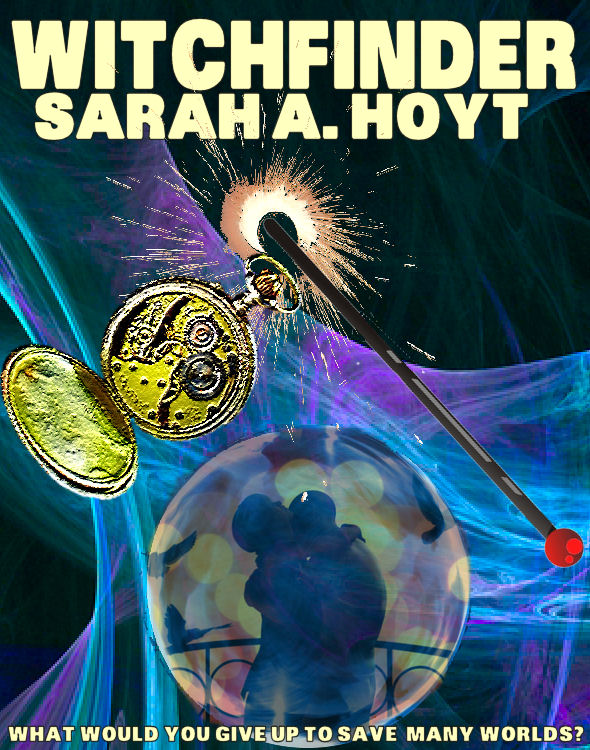
Witchfinder, Free Novel, 56

*This is the Fantasy novel I’m posting here for free, one chapter every Friday.   If your conscience troubles you getting something for free, do hit the donate button on the right side.  Anyone donating more than $6 will get a non-drm electronic copy of Witchfinder in its final version, when it’s published.
There is a compilation of previous chapters here  all in one big lump, which makes it easier to read and I will compile each new chapter there, a week after I post.  When the novel is completed and about to be edited the compilation page will probably be deleted.

Oh, this is in pre-arc format, meaning you’ll find the occasional spelling mistake and sentence that makes no sense.  It’s not exactly first draft, but it’s not at the level I’d send to a publisher, yet. *

A Fine Catch

Nell was scared.

She’d thought she’d been scared before, but she’d known nothing about what fear was.  Yes, she’d left her home with Antoine when she was barely adult.  She’d come to Avalon.  But all of it was understandable, if strange, to a girl who’d grown up with a grandmother who practiced some arcane arts and who read more than her share of fantasy books.  Nell had cut her teeth on Tolkien – literally.  Her mother’s copies of the books still bore the mark of Nell’s teeth and gums along the edges  – and then progressed to every kind of fantasy she could find by the time she was in high school.  That into that mix there had also fallen a levening of Regency Romances from the local library had given her the map she needed to navigate Avalon.

Some things it hadn’t prepared her for.  Nothing in her upbringing had prepared her, for instance, for the sheer material poverty of a world just starting into its equivalent of the industrial revolution.  It had brought back to her that common use objects: plates, cups, glasses, silverwear, or even pins and needles had once had to be carefully crafted and made by hand and were therefore expensive and their quality varied greatly.  In the same way, she’d come to see that while the industrial revolution in Avalon was cleaner than on Earth, the machines being run by magic, not steam, it was still brutal and painful in many ways.  But on Earth, when they told you about the children who worked twelve hours on looms and who had their little bodies twisted by having to get under and between machines, they didn’t tell you about the system the machines displaced.  They didn’t tell you about rural poverty and squalor and of five year olds going out with sheep and goats in the cold and damp and staying out all day, or performing tasks that people on Earth would blench to have even teenagers do without supervision.  They didn’t tell you of the accidents, the deaths.  But most of all they didn’t tell you of famines.

The new machines and the newfangled magical ways to improve the land meant fewer people working there, but fewer famines too, and the people came to the cities willingly, to work their punishing industrial jobs that were, nonetheless, better than the farm jobs they left behind.

All that – the new society, the strange way of seeing things, even the way that, the moment they’d come to Avalon Antoine had been captured and held hostage by Sydell – should have scared her, and it had, as had her servitude to Sydell while trying to earn Antoine’s redemption.  But she had never been this scared.

At first she thought that she would have earned Antoine’s way out.  By the time she realized that wasn’t possible…  She swallowed hard at the memory of Antoine’s animated corpse.  By the time she’d realized she couldn’t save him, things had gone too far out of control for her to feel fear as such.  She’d been too busy saving Seraphim and… and a fine muddle she’d made of that.  Maybe that was why in the fairytales they never had the princess rescue the handsome hero.

But no, truth be told, the handsome hero had also made a muddle of it.  At least, he wasn’t here, she thought, in this net into which the rest of them were caught, spinning over what appeared to be an endless void, punctured with pinpoints of star light.

She closed her eyes and told herself – hard – that there was no net, no pinpoints.  That she was free and near the throne room.  But nothing changed.  She could feel the threads of the net – thick, and made of what fishing line would be if it were as thick as mooring ropes – digging into her back.  She could feel Akakios’ bare feet digging into her side.  And she could smell them all: sweat and fear and various grooming products.

Her eyes came open again.  There was absolutely no point closing your eyes and pretending, if you couldn’t, in any way, make it true.  People had pulled away from the center, by their weight creating niches in the net which allowed them to spread out.  Michael – she assumed he was Michael, since he looked like the changelling she’d first seen in Michael’s workshop – sat sprawled, his back propped on the side of the net, his arms akimbo.  His eyes had lost their vacant, shiny look, and his brows were now knit, over his nose, in a puzzled frown so reminiscent of Seraphim it made something within her ache.

Caroline and Akakios had backed away together.  Nell noted they were holding hands, and cringed a little inwardly, wondering what Seraphim would think of that.  A lady in Avalon had limited say on who she wished to marry, and Nell would be willing to bet even a Centaur Prince would not be considered a eligible match.

A quick look at the remaining person, Gabriel Penn, lying still at the bottom of the net, looking up at the top where the net was gathered and held.  It was nebulous up there, and Nell could not see how or what held it.   “It will not disappear, no matter how much I think about it being gone,” she told Gabriel.

He turned to look at her, and she scuttled back, alarmed.  He looked… wild – she thought. His hair had now come completely undone, and there was an odd shine to his eyes: not like Michael’s but more as though he were laughing wildly at some joke only he knew.   In their situation, she couldn’t imagine what that would be.

There was wild humor in his voice, a hint of suppressed laughter, “No, you wouldn’t be able to,” he said.  Worse, his voice echoed in odd harmonics that she couldn’t quite place.

Michael spoke before she could ask Penn what was so funny – not that she meant to.

“I was dreaming,” he said.  His voice sounded small and very young, as if he’d been a little boy, instead of a teenager.  “I was dreaming about…”  He made a face of deep thought.  “There were machines, but… he… he– The King– He said that… He told me I’d have power, and I– ” He burst into tears and like that, the mad, laughing light went out of Gabriel’s eyes.  He seized hold of the threads of the net, dragged himself to where Michael was, put his hand on Michael’s head.  “Never mind.  Never mind.  It was all a bad dream.  It is always best if you don’t think of fairyland as more than a mad dream.  When they– ” he took a deep breath.  “When we get in your mind it splits it.  We’re not the same you are.  We’re not– ”

Akakios said one word that Nell, without understanding it, knew meant King, or Sire, and then in English, “You know now that you must take your place.  You have come to the prophecy.”

The mad light was back.  Penn, matter of factly wiped his younger brother’s face with a handkerchief pulled from his sleeve, and managed to look tired, even as the mad light came back into his eyes.  “I see the design,” he said.  “And the intent pulling me in, damn it.”

“Intent?” Nell said.

“The prophecy,” Akakios said.  “It said a man born of elf and human and raised on Earth would come back and become king of fairyland, and– ” an elven sound.  “Is the man.”

“Mr. Penn?”

“Yes, that is my other name.  It translates loosely as Night Arrow.  I haven’t used it since…  Never mind.  The prophecy.  I grew up with it.  I think it intended me for the role.  Stories that old, particularly in fairyland, acquire a power.  It pushed me.  I did not want it but…”  He made a face.  “Never mind.  It might have to be.”  He looked at Akakios.  “I’m not sure I appreciate centaur interference though.”

Akakios’ face went stern.  “My father sacrificed his first born and risks me for– ”

“Oh, very well,” Gabriel said, a king dismissing a pointless complaint.

“But how do we get out of here?” Nell asked.  “And where are we?”

“I fancy we are between worlds,” Gabriel said.  “Not that way.  There is air here, of course, but we’re not quite in any world, anyway.  Even if we got free, there would be nowhere to fall.”

“Then– what?”

“I’ll have to borrow power,” he said.  “I’ll have to use the power of one not confined in this trap.”

“What do you mean?”

“The king of fairyland,” he said.  “Can reach the magic of any of his subjects.  I’ll have to reach for one of them.  But since I’m not yet the real king, it will have to be someone I know well.  I’ll use that magic to transport us out of here.  And then, I think, curse it, I’ll have to fulfill my destiny.  But you and the others…  Take them, Princess, and see them safe.”

When You Have To

When Robert was very little and weighed something like a metric ton his favorite thing in the world was to sit on one’s leg while one pretended one’s leg was “horsy.”  And when one had done it a million times, there was always the “do again.”

And because we were his parents, and he was a cute child (even if he weighed more or less a metric ton) we tried and we often did far more than we expected.

This relates to yesterday’s post, of course.

It is not just laying down your bets and taking the result – it’s how hard do you try.

Every traditional story – every satisfying story – the result comes after failure.  Anyone who has read the biography of great men knows that, to paraphrase Phil Dick in The Man In The High Castle, it is told that way because it is real.

I’ve tried this book thing, for instance, for TWENTY ONE iterations, before Darkship Thieves sold relatively well.  Was it a learning curve?  To an extent – but those are the published books, and while most of them were not bestseller material, they should have sold “wellish”  except that there continued to be… issues I couldn’t control in distribution and such.

So.  I continued trying.  In my case, perhaps beyond the bounds of sane human beings.  But I didn’t have an option not to, so I did.

The thing is, I hear, with my kids’ generation we’re not seeing as much of that.  People give up at the first countretemp.

Maybe I’m being unfair. That’s the ones people complain about, not necessarily all the kids.  On the other hand we’ve managed to give them an almost adversity free life and an education while adversity seems to rain on people randomly, for things having nothing to do with the quality of their work.  Part of me wishes to say “this will not end well.”  Of course, I have no idea how to fix it.  How do you make a kid  go through adversity without being a horrible parent, just for the heck of it?

And besides, perhaps it’s not this generation.  Perhaps it’s human.  We try really hard and at a certain point we go “I’ve tried enough” and give up.

Perhaps that’s why we need stories to tell us that it’s not like that.  It’s when you’re bleeding and broken, and dragging yourself on shredded feet that the reward comes.  It’s when you push beyond what’s possible.

Since I’m pushing beyond my brain, having flown yesterday and then slept too late, I’m just going to say “Go you, then, and do likewise.”

Our nation, our world, our current evil times have need of many exceptional people.

Lay Down Your Bets

This is not a post about world building, though it is that too.  It is mostly a post about life – though I’ll come at it through writing, which might make it easier to understand.

It is a cliche, tired and worn, that one has to remind new writers that magic must have a price.  This is because, particularly when you bring in something that doesn’t exist in our world, it is all too easy for young – in age or craft – people to get carried away and think all laws of reality can also be suspended.  While these books can be lots of fun to write, (kind of like those Saturday morning cartoons where your character suddenly achieves the ability to draw things and make them come to life), they are tedious to read (even that sort of cartoon throws in an archenemy or someone who’s chasing the kid to get the wondrous crayon.)

This is where life differs from writing – maybe.  I think – because acquiring that sort of power in real life would be a blast.  Well, okay, maybe it would grow tedious after a while, but frankly that’s the sort of challenge I’d like to have “how can I stop life from growing wearisome while I have everything I want and a magical pony on the side?”

Annoyingly, it is also the sort of challenge no one has.  Not in real life.  Probably part of the objectionable (or obnoxious) nature of the books where there’s no price for magic is that it’s not nice to taunt us with images of a world we can never live in.

In fact, humans so much wish they could live in a world where there’s no prices, that we often pretend those prices don’t exist, because it makes us feel better.

I don’t mean by this the price of goods and services, though the most amoral among us like to pretend that those have no cost either.  This is where the bright idea comes from that one should just take goods and services and give them to other people, in a sort of fairy-godmothery way, because…  Because when you’re a morally blind idiot you don’t realize the people who produced or acquired goods or who provide services pay a price for them – in learning or sacrifice or even a narrowing of life options – and therefore you don’t realize what you’re advocating is nothing less than slavery.  (All objections of course are removed when people voluntarily share with others things or services for which they’ve paid the price.  That’s their choice.)

It goes both ways of course.  Businesses engaging in “Hollywood accounting” (including those in Hollywood) are engaging as much in theft of another person’s life as those in the bureaucracy who legislate that type of theft.

It’s very easy to think “oh, he’d write screenplays, anyway.  And we paid him.  He doesn’t need the extra howevermuch.”  But while the screen writer might have written screen plays anyway, trust me, to get to the point you want to make a movie of it, he engaged in learning his craft, he wrote a lot of unusable screenplays, and he sacrificed time and effort without which you wouldn’t have that play.  So when taking the extra compensation that accountants make disappear, you are in fact engaging in stealing years or months of his life.

No, I’m not endorsing the Marxist theory that labor equals value.  I’m simply saying that nothing of value was produced without labor – or without learning, or without talent, or without…

I’m saying there is a price to magic.  There is a price to anything and everything in life.  You pays your dust, you takes your chances.  And, as I’ve said before, in the end you always get more or less what you want. … unless what you want is the magical crayon that can draw things and make them come to life – because that violates the rules of life in this particular universe.

Do you want to be the best runner ever?  Well, you exercise, you practice, you put in your effort and you’ll be a very good runner.  You might not be the best ever – or the best in your team – because you have the wrong body type, or because you fall and break your ankle, or…  But you’ll still be a million times a better runner than you were when you started out.  The same goes for playing an instrument, for writing, for any of the arts, crafts or sports.

Most people understand that price.  Most people even understand what we’d call “the price of fame,” where the character becomes ruler-of-the-world or the most famous musician since Elvis left the scene to open a diner in Arizona.  That type of price has been shown again and again in movies, and even though it’s a variant of “poor little rich boy/girl” we know it by heart now.  You become rich and famous, and spoiled, and you lose the contacts in your small town, and your best boy/girl (or for the more edgy movies, both) sends you a Dear John.  You either chuck it all to go back to your origins (happy ending) or you die of an overdose (unhappy ending.)

But Sarah, you say, I never want that kind of fame, so why should I consider that kind of price?

I don’t want that kind of fame, either, and – Praise the Lord, Brothers and Sisters! – I’m very unlikely to ever achieve it.

However, what most people – myself included a few years ago – fail to grasp is that there is a price to more mundane achievements, too.  For instance, having children.

Robert and I were talking yesterday about some woman about my age who said she had to find herself.  Although I despite that trite phrase, when Robert said “How do you EVEN lose yourself?” I had to point out you do.  You can’t help it.  When they’re little you’re not you, you’re mommy.  H*ll, even when they are teens, you still are giving up a major portion of your life to being mommy – to being the adult.  Someone has to do both of those.

I remember the first time I went to the grocery store without the kids, because they were old enough to be left at home alone.  It felt weird.  It was like I didn’t know how to be in the store alone, by myself, anymore.  My habits of shopping from when I was childless were quite gone.  Ditto, the first time I took a walk alone.  The first time I sat down and read a book because I wanted to (and the kids were both at school.)

It’s not just time or habit, either.  During those intensive child rearing years, my thoughts were different.  I wasn’t me.  I was Robert-and-Marshall’s mother.

As the child-rearing pressures ease (do they ever go away completely?) I’m starting to re-find myself; to see the outlines of the person there, who is Sarah Hoyt, not Robert-and-Marshall’s mother (though she is that too.)  This is not the same as the Sarah Hoyt many years ago.  For one, she doesn’t look nearly as good anymore.  For another…  She’s changed through the years and the experiences.

There’s a price.

When I chose to really try to write and publish, I started devoting vast chunks of time to it.  This means I lost some of the kids’ childhood.  There were days I wanted to just take them to the park and watch them play, but I was on deadline.  There were times I wanted to sit around and enjoy them, but I had writing to do.

Now, a lot of what I paid to have a writing career was dictated by the boundaries of the old model.  However, Indie will have its own boundaries too.  Sure, you can write and put things up there, but if you want to sell significant number, you’d best learn the craft.  (And if you haven’t read Dwight Swain’s Techniques of the Selling Writer, why NOT?)  And that will take time.  More than that, it will take effort.  You’ll emerge on the other side, not just as a selling writer, but changed.  Years will have passed that you weren’t even aware of, and you’ll be a different person.

This is true even if what you choose to pursue is a more normal career, like, say, cab driver or server.  You will have to train, and then you’ll have to practice and your rewards are likely to be commensurate with your effort.

The same is true for every hobby, at every level from casual to serious.

Achievement – magic – has a price.  It always has a price.  Mostly what you pay is your ability, your vitality, your time, your life.  But you also pay all the things you could have been doing instead.  For instance, when I chose to be a writer, I chose not to be a translator anymore.  Now if I tried to be a translator, I couldn’t.  The ability is gone.  To get it back would take almost as long as to learn it in the first place.

Ah, you say – but I won’t pay. – I’ll just sit here and do nothing.

But then you pay the price of doing nothing.  You won’t learn, you won’t do, you won’t BE.  In the end, doing nothing, choosing nothing, deciding nothing has the highest price of all.  You find yourself pushed aside from the world.  You find you have in fact paid your life, your time, your talent… for years and years of doing nothing and being nothing.

So, when you’re considering doing something, learning something, trying something; when you’re considering what you wish to concentrate on; when you think one path has no cost and the other is expensive; when you shy back from doing things and take the path of least resistence, remember – everything has a price.

Yes, sure, magic has a price.  It might take years of the magician’s life.  BUT if he doesn’t use the magic, he might instead lose his home, his friends, his kingdom.  He might have to live out his life in vile slavery.

Everything has a price.  Action and the lack of action have different prices, but nothing is free.  TANSTAAFL.

You pays your dollar.  You takes your bet.

What will it be?

Eleven Years

Has it really been eleven years?

It was a beautiful day.  I remember that.  I got up to check email, and the AOL homepage had something about a plane flying into a building.  I thought it was a goofy thing, like that idiot who had earlier flown into – was it the Empire State Building? – in a small plane.

It was a beautiful morning, and I had a kid to take to school.  His older brother could walk on his own the five blocks to elementary, but Marshall – in Kindergarten – went in an hour later, and at any rate was too little to walk alone. (And too sleepy.  I used to get him up, bathe him, shovel breakfast into his mouth and walk him to school and if I were very lucky, he’d wake up when we got there.)

So I walked him to school, waited till the teacher took him in and walked back home, under a cloudless sky, across our little mountain village, looking forward to our writers’ group meeting that Saturday, feeling financially stable for the first time in my adult life (I’d just sold my first book) and thinking “This is when we reached adulthood.  From now on, it’s the easy part.  Things will only get better.”

When I got home, I went to the kitchen to get a cup of coffee before going up to write.  And the phone rang.  It was Rebecca Lickiss and she was screaming for me to turn on the news.

Over the rest of the day I alternated between watching the very grainy TV station and swigging Jim Beam from the bottle.  At some point I must have fried doughnuts, because I ate a pile of them.  My friend Charles was sent home from his job because it was in a tallish building.  The kids came home from school, and all through this – like a muffling fear – I couldn’t reach Dan who was, literally, working (as a contractor) at an undisclosed location somewhere near DC.  I knew of no reason he should be near the pentagon, (the company his company worked for was R. J. Reynolds, for crying out loud) but companies have weird contacts and contracts.

Turns out he was in a “Secure” — as in silent on purpose — meeting room, and didn’t know the news.  He called as soon as he heard.

I think he drove home two? Three days? Later.  Our friend Alan Lickiss drove to meet him in Hays, Kansas, and I went along as the designated swearer.  (Alan’s religion forbids swearing.)  The only way I slept until Dan got home was blotting everything with alcohol, then I got up with coffee to send the kids to school.  I sent them to school because Marshall thought Dan was dead.  He saw him leave on a plane.  He saw the plane crash.  Kindergartners have problems with the idea of more than one plane.

Has it really been eleven years?

On the one hand, part of me wants to laugh at the terrorists.  They thought they could break us.  They thought they could scare us.  They underestimated both the size of our territory and the mettle of my people.

And part of me thinks of the psychological twisting that has taken place since then: people who blame their own country for the actions of barbarians; people who kowtow to the barbarians and claim to be multiculturalists because that sounds so much better than vile cowards; people who think that a country the size of ours, as wealthy as we are should do nothing to deter attackers because we’d be protected by our halo of purity and goodness.

But then I think of the other side of it, too.  Our friends who pitched in to help me meet Dan on his way home.  Our friends who gathered in our ratty movie room so we could be together.  I think of our troops who fought the enemy there, so we wouldn’t fight them here.  I think of the brave young men and women willing to lay down their lives for this country — for the last, best hope on Earth.

And I think of those who died, even on 9/11, to save others: the people who went into the towers, to help total strangers down.  On 9/11 on the Jane Austen board, a woman who worked with Rick Rescorla was telling us all about his heroism.  You could hear her tears through her typing, but she was awed and humble as people should be who met a hero face to face.

Then there are the people of flight 93.  I know a lot of you aren’t believers, and my deepest beliefs are none of your business,  but like many writers I end up thinking of G-d as an author.  Impossible not to, of course, since it’s the mind set I know best.  (Though standing in the middle of the yard, looking up at the sky and going “Does THAT sound like a good plot development?  Seriously?  Why don’t you join a workshop already?” tends to baffle the neighbors.)

And as an author to an Author I have to admire the plotting touch, where the three burly and brave guys who spearheaded the fight back in flight 93 were a born again man, a Jewish man, and a gay man.  Can you imagine any group designed to give more heart burn to the enemies that brought down the towers and who tried to use flight 93 as a weapon?

I can’t either.  But, more importantly, I can’t imagine any other culture, any other country, any other place where those three would have banded together, immediately – instinctively – putting aside any perceived differences, thinking only of trying to save the defenseless, laying down their lives for others.

Their lives were forfeit, but they died free men.  They died heroes.  More importantly, they died Americans.

Surely a nation that produces such men will not perish from this Earth.

We will not go quietly into that good night.

We’re the land of the free and the home of the brave.  And we will stand.