Where Have All The Writers Gone?

*I will do the post promoting y’all’s work this evening.  I did not forget.*

Writers Who Disappear

In 03, the first great “layoff” I witnessed, where at world fantasy you’d see people go off with their editors and come back crying, (This didn’t include me, I decided I wouldn’t die even if they killed me which was the beginning of the zombie career) things got bleak.

They got even more bleak in the Summer of 04, when the writers list I belonged to often carried stories of attempted suicide and people just disappearing and no one could reach them.

This is not the type of “writers disappearing” that Kris Rusch is talking about in her posts.  What she talks about is accurate (I think.  I know only one writer who had “accomplished what he wanted to” and I think that was because new-wife didn’t approve of SF) and of course she is going to continue the series next week, so it’s incomplete.

For those of you too lazy to click through on this Sunday morning: what Kris is talking about is not writers who vanish as though taken by a very specific Rapture (though there’s a story in that.  “I need a team to help me write the next part!” said the booming voice in the sky) but writers who vanish from the shelves not to be heard from again.

This includes writers whose series stop mid stride – I still get angry letters from fans of the Musketeer’s Mysteries – because the house decided it wasn’t selling ‘enough’ and of course it was the writer’s fault not covers, insane titling or lack of push.

It also includes – according to Kris – writers who’ve accomplished everything they wanted to.

And it includes writers who’ve made themselves toxic.   (Weirdly, I know who the guy is who called the distributor to ask why his book wasn’t on the shelves.)

It doesn’t include what, in my experience, over the last ten years is the main reason for giving up: battle fatigue.

That is, you are not doing badly enough (are you doing badly at all?  Depending on how my negotiations go to get my rights back from a publisher that shall remain unnamed until and unless they go badly – when the statements go public — you might be able to judge.  The statements just received cross the line of believability, claiming well under 100 sales for a book still on the shelves (two years out) AND apparently having phantom books held as reserves against returns, while the returns count separately, leading to a negative number, where no negative number can be.  Very interesting.  I think they have their accounting done in a fantasy world, or perhaps by the Fed.  It prevents their cutting me a check, though, so all is good, right?  They used to just take the books out of print at that point, but now, well… there’s erights, so they’re keeping them on, and dancing like nobody’s business.  Considering this particular publisher is now suing authors for amounts that should be petty-cash, I REALLY want my rights back.) that they fire you for good, but they keep hiring you and making you (trust me) write four books a year, and then the numbers are dismal again, and…  And you start feeling like someone who just has baby after baby and hands him/her off to the high priests to throw in the volcano.

After a while this feeling of “What the heck, why bother” sets in.  Worse, it’s like aversion therapy.  Because you’re selling on proposal and when the book’s turn comes around you might not feel like writing that (H*ll, you often won’t feel like writing at all) it makes what you’ve always loved doing into a form of torture.  After a while, just the thought of writing makes you depressed.

Part of this I think is the body’s defense mechanisms.  I’ve often told people that when Mercedes Lackey talks about magic and “stripping the magical channels” in the Valdemar series, she’s really talking about writing.  Of course whatever you write with (other than certain brain areas) isn’t physical, but you feel like it’s a channel attached to you, and when you’re forced to write book after book you feel less than enthusiastic about and which you know they’re going to kill one way or another, you start feeling like it’s stripped raw and like you’re doing yourself physical damage.  And your body learns to shut down whenever you sit at the computer to write.  I got to the point I’d be feeling fine, and suddenly, at the desk, all I wanted to do was sleep.

Some of us stay on.  Like dancers who dance on injuries, like athletes willing to become deformed through excessive training, we go on.  Maybe we don’t do our best work, but we work.  Sometimes we wonder if we’re getting Alzheimers, because we can’t remember our character’s name (or occasionally our own) from page to page, but we go on.  And if you’re there, step back and consider indie — I later, during the year Dan forced me to take off (sort of.  I only wrote one book) realized this was a sign of clinical depression.

The sane ones don’t.  And here, I’d like to point out I’m sane enough, but when we bought this house we were paying on two houses.  And then… stuff happened.  Like replacing our heating system.  Like the wall of the bathroom falling down on Robert during a shower.  Stuff like that.  And lately tons of stuff happened, stuff like runaway inflation, two kids in college, etc – and we need my income.  It’s as blunt as that.  Notwithstanding which, were it not for Baen, were it not for indie, I too would have walked away two years ago. I came within a coin toss of doing just that and going “Let the house be foreclosed.  Let’s just walk away.”

Because there is another barb that the writer in that position must suffer.  If you say anything – the slightest complaint – you get, from both the publisher, and the wanna bes who’ve never made it “How can you complain?  You’re living the dream.  You’re making a living doing what you love!”

Which is sort of like telling that to a ballet dancer forced to dance with broken feet and weighed down with a ton of rusty iron.

And you can’t talk back.  Or you couldn’t.  Now I can and my answer is: If you work at anything 18 hours a day, seven days a week, unless it’s something REALLY stupid, you too can make a living at it.  But after a while even what you enjoy goes stale.

No, I’m not announcing my quitting – you guys saw me go from “I can only go traditional” to the freedom of indie.

I just wonder how many of those writers who disappeared, leaving the windows of their writing house wide-open and the doors swinging in the breeze, will be aware of the opportunities of indie.

I’m hoping some of them come back, close the windows, light a fire in the hearth, find their writing desk and resume their work.  Because some of the ones driven away were very good indeed.

And meanwhile, today – the completion of Noah’s Boy having been put-off by a return of the stomach flu in an attenuated form (seems to be one of those that comes back weaker and weaker till it’s gone) – I’m going to write rights reversal letters for ¾ of my work (yes, in case you wonder, I REALLY want to continue the Musketeer series.)  And then I’m going to do some publishing.

Because I can.  And because I refuse to fade away.
PROMOTE!

In the comments below tell me what works you have out that you want to promote this week, what you have free, what will come out, etc.

Come on, don’t be shy.  I’ll do a post on it tomorrow!

An Ode To Happiness

Recently in an email exchange, two of you reminded me that happiness is a choice.

Of course, I’ve known that for a long time, perhaps always.

A look around will be enough to verify this.  It’s not a matter of how much you have or how perfect or imperfect your life is, but whether you decide to be happy or not.

We all know people who have everything they want and a cherry on top and they still hate their lives, themselves and everything.  They get up every morning wishing they were dead and they go to bed even more so.  (In fact the unhappy rich has become a truism, partly because it’s true, though only in limited circumstances – and partly because it serves a purpose.  It might convince a lot of people they have to be unhappy, too.  Who knows?) And we all know people who have horrible miserable lives, but at heart are quite happy.

Being happy is not a matter of what you have, of how hard you work, of what you do or don’t do.  Being happy is a choice you make.

No.  Stop.  Don’t tell me you’ll be happy if only…

I have my own list of if-onlys, mostly relating to making enough money from this writing thing that I can hire someone to do the endless list of other stuff I need to do, including but not limited to house administrivia, cooking, and editing and publishing.  Also, that I can write just a smidgeon less so I have time to take, say, Sundays off and sleep late then read in bed.  Oh, yeah, enough money to go out to eat on weekends would be nice too, but I might be reaching for the moon.

And I’d like to live nearer the places where they have lunch time lectures I’d like to attend, so that I don’t have to factor in the price of gas before considering a free presentation.  And I’d like…  you know what I mean.

But that just gives me something to strive for.  Right now I’m pretty happy.  Hey, I have my husband and kids, a roof over my head and three meals a day.  What is there to be unhappy about?

I think the first time I realized how happy I was was when I was lying in bed and expected to die of pneumonia.  The room I was in had this BROAD view of the rocky mountains and I wasn’t sleeping well.  So I’d lie there and watch the sun come up over the mountains, and realize I’d lived another day, and be happy about it.

I wanted to be out of bed and going to garage sales with the guys, but that was a higher form of happiness, and it could wait.

Still a lot of people are unhappy – and I don’t want to blame them, because it’s not …  They don’t view it as a choice.

There are of course obvious circumstances when it isn’t a choice.  If something were to happen to my family, I’d be pretty unhappy for a long time and if I ever found happiness again it would be a happiness of small things: of cats on lap, of doing a task.  Of not thinking beyond that.

But if you’re not grieving or in horrible pain (and some people in horrible pain are still happy) and you still aren’t happy, then think about why you aren’t.

Is it that you want something you don’t have?  Well, then… sketch out a plan to obtain it, to the best of your ability and subject to revision, of course.  And then be happy because you’re on the road there.

Or is it something about yourself that makes you unhappy?

Here we must distinguish between two things: if what you don’t like about yourself is something that affects only yourself — you’re too fat, not brilliant enough, you never learned to waltz, whatever the heck you use to beat yourself over the head – well, start working towards it, and understand you don’t have to be perfect.  If you think you have to, you’ve been sold a bill of goods.  No one is perfect.  The best we can do is try.  If you’re trying you’re doing your best.  Pat yourself on the back, and don’t be too hard on yourself when you fall.

Or is it that something you are/do hurts someone you love?

Here too we must distinguish between two instances.  Is it that they disapprove of something you do/are?  And if so, can you change it?  For instance, if they disapprove of your being too tall or – in the case of someone I dated – having breasts that are too large, or… whatever…  It’s not your problem.  It’s theirs.  State firmly that they’ll have to live with it, and then remember it’s their problem.  If it’s something you CAN change, like leaving the toilet seat up, or something more serious like refusing to do something that needs to be done or doing something that actively hurts someone you love, the thing that’s making you unhappy might be your conscience.  Change it, or make efforts to change it.  You’ll be happier that way.

What if you’re unhappy because you can’t find the minimum of existence?  There’s always a way.  Yes, the job market sucks.  Do you perhaps have extra books you could sell on Amazon?  Is there a hobby you can turn into a paying profession?  Take steps towards that, and you’ll start feeling happier, even if the ultimate goal is out of sight.  CHOOSE to take charge and be active about it, and you’ll be happier.

But what if you were never wanted, and no one in life has ever loved you, and you don’t belong to anyone or anywhere?

First… You belong to you.  Be happy in you and what you are.  Be happy you’re breathing.  Be happy in your hobbies/your pets/whatever.  And start reaching out.  I had a teacher once who whined no one had ever loved her.

The problem was that she had never loved anyone.  Take the focus out from within you and put it outside in something else.  It could be something as inconsequent as rescuing kittens or puppies, or as important as volunteering to do research.  All of them will allow you to connect with your fellow humans, and that’s important too – we are social animals.

But I don’t understand.  You had a truly horrible past, and you have scars.  Yeah, and?  You’re not that injured child.  You’re an adult.  Deal with the scars.  Stop holding your breath and going “but I wanted it to be different.”  You’re not entitled to perfect, and if you knew other people’s stories, you’d find we’re all walking wounded.  We all favor one point or the other.  We all shift and walk around burned spots in mind and heart.  We all do the best we can to be happy.  And holding your breath and wanting it perfect won’t get you anything.  That’s not how the world works.

I’m not telling you “Don’t worry, be happy.”  That was one of the stupidest phrases ever coined.  I’m not sure why those two things should be linked.  Some people like me would break in two to stop worrying.  Worrying is part of making sure we look ahead and we plan, and that’s how we survive, and some of us can’t stand to live any other way.

But it doesn’t mean, for all the worry, we’re not happy anyway.

Be happy.

(Right now I’m going to be happy while doing a massive amount of laundry.  Catch you on the flip side.)

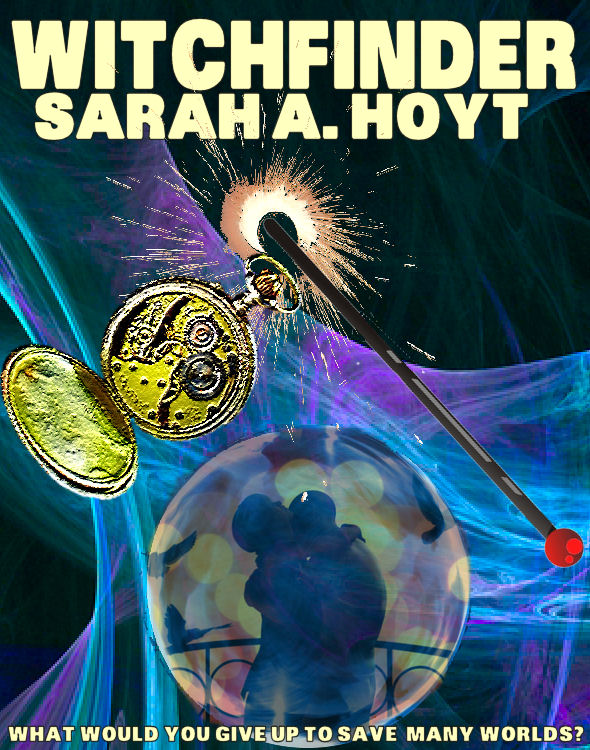
Witchfinder, Chapter 59

*Better late than never, right, guys?*

*This is the Fantasy novel I’m posting here for free, one chapter every Friday.   If your conscience troubles you getting something for free, do hit the donate button on the right side.  Anyone donating more than $6 will get a non-drm electronic copy of Witchfinder in its final version, when it’s published.
There is a compilation of previous chapters here  all in one big lump, which makes it easier to read and I will compile each new chapter there, a week after I post.  When the novel is completed and about to be edited the compilation page will probably be deleted.

Oh, this is in pre-arc format, meaning you’ll find the occasional spelling mistake and sentence that makes no sense.  It’s not exactly first draft, but it’s not at the level I’d send to a publisher, yet. *

The Princess And The Power

“Honoria?” Seraphim said.  “No!  I was–  I suppose I still am–  engaged to marry her.”

Something in his reaction, possibly his genuine shock seemed to reassure Valerie.  She looked at him a long time, as though examining his expression, but her features relaxed.  “I see,” she said, at last.  “There is a conspiracy, but it is not yours.  I thought—” she ran a hand over her face.  “But then I thought perhaps it was because my magic is not of this world.”

Seraphim had in turn managed to back against and old rocking horse and half-sit on it.  He should feel, he thought, scared or outraged, or perhaps confused, but he felt nothing.  Absolutely nothing.  “Is that what we’re accused of?” he said.  “I thought it was murder…”

Valerie frowned.  “It was murder at first, I think.  It’s very hard to think about it, but it was undefined, they said, and then…”  She shook her head.  “And then things changed.”  Her frown indicated deep concentration, deep thought.  “Until you said that, I didn’t remember it, and now it’s hard for me to think about it.  I think they first said you were accused of murder, and I think they couldn’t… I think they couldn’t locate the corpse.  And then they said that you, and your father, and your whole family were guilty of conspiracy to kidnap the royal princess and, by magical means, make it seem like she belonged to another family.”

“But why would we make her seem to belong to another family?” Seraphim said.  “Would it not make more sense to keep her to ourselves?”

“No! Much was made of your offering to marry her, because, you know, if you married her… you’d someday be king.  You could not marry her if you were her brother.”

“No,” Seraphim said.  “But we have, or at least we had, friends and dependents and surely any of them would be more reliable as marriage prospects than our rivals, the Blythes.”

“Yes, but—” Valerie was visibly fighting something.  “I think they did something – something magical.  I’m not sure what, and even saying it makes me feel as though I might be going insane, because the amount of magic it would take… and for it to be undetected…  but I think they did something to make us believe it.  Because, despite all the changing stories, everyone has believed.  And the king has recognized the lady Honoria Blythe as the princess Helen.”

Seraphim groaned deep in his throat.  Urgency came now.  Not because Honoria had usurped the place of the princess, not because she would be the heir to the throne of Avalon if this went unchallenged, but because she had taken Nell’s place. The idea of Honoria in Nell’s place was unbearable and near-paralyzing.  When he could think again he said, “You must take me to the nursery, Valerie, you must.  Trust me, that’s where the spell was first set, and if I can reach the center of the web, I can stop it.”

She stared at him for a moment then sighed.  “It is only, Your Grace might not know it, but you are—”

“Wanted?  I do know it.  But I have a spell on me which makes me unrecognizable unless…  Unless I wish them to see me clearly.”

She looked at him and frowned a little again.  “I wondered why it made my eyes want to unfocus, but I’d guess I’m not getting the full effect, since you do wish me to recognize you.”  A little thought and she nodded.  “Can you pretend to be here to measure the nursery.  It is of course being completely remodeled since the Prin–  Is she the princess?”

Seraphim shook his head.

“I was afraid of that. In any case, she is engaged to be married and therefore the nursery must be remodeled, in the hop—”

“Honoria is engaged to be married?  To me?”

Valerie looked down.  “No, Milord, to Lord Sydell.  It was of course thought odd, his being old enough to be her father, and not exactly high enough in nobility… but he was the one who rescued her and the king could not deny him her hand, their being sincerely attached.”

Seraphim opened his mouth to say from what he had heard and things he’d glimpsed at certain clubs he found it hard enough to believe Sydell was Marlon’s father, and the idea of his being sincerely attached to any woman was so unlikely as to border on the impossible.  Then he realized he couldn’t shock Valerie with any such implication, and felt a strong pang of missing Nell.  Nell wouldn’t at all be shocked.  In fact, if Nell had any hint of it, she might blurt out what he was thinking without checking her tongue.

It would be, he thought, great fun to have Nell as a Princess Royale, even if it made any union between them impossible.  Her solecisms and that irrepressible humor would set the palace on end.

But of course, he might as well wish for the moon.  As far as Avalon was concerned, Honoria was now the princess royale, and his family the villains who had stolen her.  It made no sense to anyone who knew anything of the tracings done at the time of her disappearance, but very few people remained clear on that, and a lot would never have been reported at the time.  Just a strong spell over the people in the palace, and it would carry.

And the spell had to be in the room from which the infant Nell had been taken.  Any further spell layered on the one that had hid the identity of her captors, any spell designed to make it seem like Honoria was Nell would need to be twisted into the original.  He would go and he would pull it apart, if it was the last thing he did.

“Will you have the power to do anything,” Valerie asked.  “If you are spending it to keep the illusion over your features?  And the illusion that there is no spell there?”

He smiled at her, though it felt like his face would crack.  “It is not my power being used for that, and I suspect that the one spinning the illusion doesn’t even notice the expending.”

Valerie inclined her head.  “Very well then.  I shall take you through back stairs,” she said.  “Begging your pardon.”

“I’d expect nothing else, and remember I’m no longer a duke.”

She looked like she would say something, then shook her head, compressed her lips and said, “Please to follow me, Your Grace.”

The heartbreak of dyslexia and insufficient caffeine.

And this blogger needs a “there, there” dear.  I just misspelled something on Insty.  Okay, so it’s the President’s name.  This is why my characters are named things like Mary and Bob and Candyce and…  Seraphim.

SOBS.

STOOOOOOOOOPID fingers.

Sulks.  It’s not my fault.  The sun was in my eyes.  And I LIVE at high altitude.  And I never have enough caffeine.

Eh.  At least I’m not running for anything.

Dyslexics of the world untie!  You have nothing to loose but you cairns  cans chaims  aims? commas!

Seriously, for the love of Bob, those of you who are following it?  Ping me when I mess up, okay?  You HAVE my email  sahoyt – at- hotmail – dot- com.  It’s not like I’m only doing one thing at a time.

A Fatal Stain Is Out

*I will be doing a post — maybe — this afternoon.When I’m this far in a novel (Noah’s Boy) I have trouble functioning in blog-mode.  So, for today, to amuse you here’s the beginning of my mystery A Fatal Stain by Elise Hyatt, which came out yesterday.  Better late than never, right?  (Yes, it also applies to Noah’s Boy) For those of you who haven’t read the series, it’s a cozy mystery, light on plot and big on characters and laugh.  Though I’ve parted company with the house, I intend to continue it, probably early next year, as well as its twin series “orphan kittens.” starting with A Deadly Paws soon.*

A Fatal Stain

Elise Hyatt

 Another Fine Mess

The first time I tried to run away from home I was three.  I’d packed all my comic books and a box of cookies in a book bag emblazoned with Remembered Murder, the name of my parents’ bookstore in Goldport Colorado, and I’d made it all the way down to the bus station, where I realized I didn’t have the money for a ticket.  I’d sat quietly in a corner bench and eaten my cookies and read my comics until my grandmother noticed I was missing and came to find me.

It never occurred to me that a three year old with a mystery bookstore shopping bag would be sort of noticeable.  And it was several years before I realized that, even if I had the money to buy a ticket somewhere, I wouldn’t have known where to go.  My knowledge of geography at the time was limited to my street, the road leading to the kindergarten, and the diner where grandma took me for kids eat free Monday dinner.  The only reason I’d found the bus station was that you could see it from the diner.

And I was married before I realized that, even had someone let me buy a ticket and run away by bus somewhere, no one would have given me a job when I got there.

The saddest thing of all was that at thirty one this was still about my level of planning.  And that I was, once more, contemplating running away from home.  Or at least running away from my parents’ store, where I sat by the fireplace, in one of the sofas provided for the comfort and convenience of customers wishing to browse mystery books, and listened as my mother and my best friend planned my second wedding.

Ben, aka Benedict Colm, has been my best friend since middle school.  He is tall and rugged looking, with a face that’s more interesting than handsome and the sort of body that makes one think of Viking ships.  He tones down the feeling that he should sport a horned helmet by wearing a selection of impeccably color-coordinated and blandly conservative suits during the week.  On the weekend, he dresses down by wearing slacks, no coat, and sometimes shirts with an almost imperceptible pattern, which he convinces himself are garish.  Today he was practically slumming, as he wasn’t wearing a tie and had unbuttoned the first three buttons in his subtly-striped shirt.

I suppose the attire goes well in his job as a financial planner.  Unfortunately I suspect it was one of the things that had kept my mom – a porcelain doll-like woman who could have played a more true-to-life Miss Marple than the rather butch TV series actress – from believing me when I told her Ben was gay.  Though if she still didn’t believe it as he leaned forward and said, “I’m wondering if perhaps we could find someone to make a tuxedo for Pythagoras, so he can be best-cat?” I washed my hands of her.

No, in any case, I washed my hands of my mother, whose response was, “So, your pet rats, are we putting them in the specially designed harnesses, so they can be used as boutonnières?”

It was at this moment I realized my hands had come up of their own accord and clasped the sides of my head, in horror.  Cats and rats?  Did they hear themselves?  And while Pythagoras, who is not so much my cat as a cat I allow to crash at my home, might be nominally my pet, the rats weren’t even mine at all.  Okay, so I’d rescued them from inside a piano I’d bought to refinish for my fiancé Cas Wolfe.  I’d only nursed them and looked after them because otherwise they’d be snake food.  Besides, they were Ben’s problem now.  Ben had adopted them.  I didn’t want them in my wedding.

“I don’t want anyone in my wedding,” I heard myself say.  I sounded surly and unaccountably like a teenager.  My hand moved, all on its own, making a horizontal slash from side to side to indicate how much I didn’t want anyone at my wedding.  “At least no one besides me and Cas.  No cats.  No rats.  No tea roses.  No boutonnieres and NO book distributors.  Also, no, mom, my wedding is not the ideal venue to display the covers of upcoming mysteries that can be bought at the store for a discount of twenty percent.  And paperback books do not make tasteful wedding party favors.”

The two of them stopped talking for a moment and looked at me, for all the world as though they’d completely forgotten I existed.  Which, to be frank, they probably had.  Then mom reached over and patted my hand, absently, more like she was fluffing a cushion or something.  “There, there,” she said.  “Brides always get nervous.”

“I’m not nervous,” I said.  I realized my voice was louder than it should be.  “This is not my first time getting married.  I don’t want a dress.  It’s not a church wedding.  I don’t want a guest list.  I don’t want a reception.  I don’t want–”

Mom and Ben traded a look that implied they were the adults in the room and that I must be humored and cajoled into playing my part.   Ben tapped the pen he was holding against his teeth.  It was one of the most annoying habits in the world, and I’d told him so several times since sixth grade.  “To be honest,” he said.  “Perhaps the mystery books as favors are a bit over the top.  They’re damn hard to wrap in a tasteful way.  Besides, we can’t know for sure what the guests will like to read or even if all of them read mystery.”

Mom narrowed her eyes at the unlikelihood of someone not reading mystery, then wavered.  “Well,” she said.  “My husband has said that perhaps tasteful bottles of fingerprint powder…”

And like some slumbering warrior awakened from long sleep, my father perked up behind the register ten feet away, and beamed at us.  “It would be handy, you know.  Funerals and weddings often result in murder, and when someone kills Sherlockia on her wedding day, we’ll be all ready to take fingerprints.”

My name is not Sherlockia.  Had my name been Sherlockia, I would have run away from home well before the age of three.  In fact, probably before I’d learned to walk.  Mom and dad had almost divorced over what to name me, with my dad wanting Sherlockia and my mom holding out for Agatha.  They’d met to discuss reconciliation in the local candy shop and mom had gone into labor over the parfaits.  Which might explain – but did not excuse – saddling me with the names of Candyce Chocolat.  Dad had dealt with the defeat as he always dealt with such things: by pretending it had never happened.

Which meant the only way I could deal with this was by running away.  I’d take my on-the-verge of dying third hand Volvo station wagon, kosh my fiancé, police officer Cas Wolfe, stuff him in the passenger seat, then wait until my ex husband – All-ex, couldn’t be more ex if I’d killed him, something I often contemplated doing – returned my son E whose real name is Enoch,  I’m trying to save on therapy bills by calling him E.  I’d strap E in his car seat in the back, and we’d drive like bats out of hell to…  Maybe as far as Denver before my car died.

I revised my plan.  I’d kosh Cas FIRST and steal the keys to his white Honda SUV.  Then drag him to the passenger seat, move the car seat over and…

I paused.  I could see E sitting in the back seat, screaming all the way to Las Vegas because we’d left Pythagoras – whom he called Peesgrass – at home in Goldport.

Right.  I’d throw Pythagoras – a mangy and extremely neurotic black cat – in his cat carrier and strap him in next to E’s child seat.  And then…

In my mind’s eye, I saw Ben – as opposed to the real Ben who was sketching something on a paper pad and showing it to my mother – crossing his arms and giving me his more in sorrow than in anger look at being left out of my elopement.  After all, he’d been left out of my first wedding, mostly because All-ex was jealous of him, which ranked up there as extreme stupidity even for All-ex.  It probably wasn’t fair to leave him out of my second wedding as well.  Besides, I’m superstitious.  The first wedding had been Ben-less and the marriage had ended up on the rocks.  What if the lack of Ben also blighted the second marriage?

My mental self koshed the image of Ben over the head, dragged him to the car – a monumental feat of strength since he probably weighs double what I do – and strapped him in next to E and Pythagoras.  Only in time for me to realize that Ben’s significant other, Nick, would probably be very upset if I took his boyfriend away for a few days.  And probably even more upset to miss Cas’ wedding.  Nick and Cas were not only best friends and colleagues in the Goldport Police Department but also cousins who had been raised almost as brothers.  It would be unforgivable not to take Nick along to Las Vegas to see us married by an Elvis impersonator at the Little Chapel of Quick And Regrettable Unions.

Sighing, I koshed my mental image of Nick, too, and stuffed him in the car under Pythagoras’ carrier, which probably would keep Pythagoras calmer for the trip, too.

Then, just as I was about to get behind the wheel of my imaginary get-away car, I realized that though my parents had never exactly approved of me since I’d disappointed them by not becoming a private eye, I was still their only daughter and they – alas – my only parents.  They might be – and often were – the world’s most annoying people, but they probably deserved to be there when we told Elvis that we did…

I’d just done strapping my mental image of mom to the roof rack and dad to the front bumper, like a very befuddled looking deer, when I realized this wouldn’t do.  I mentally untied dad’s hands and put a mystery book in them.  He wouldn’t even notice he was strapped to the front of the car, provided that the book was interesting enough.

And then I realized that Fluffy, mom and dad’s cat, would be left alone for the whole time.  But I had to draw the line somewhere.  And Fluffy hated me and had – twice – tried to eat Pythagoras.

“No,” I said.  “I’m NOT taking Fluffy.”  And as mom and Ben turned to look at me, I realized that eloping while taking all your nearest and dearest was probably not practical and got up.  “I have had enough of this,” I said.  “I’m going to work.”

As I rushed out of the store, I heard Mom ask Ben “What was that all about?” And Ben answer, “She just realized that she couldn’t take us all along if she eloped with Cas.”

You should be able to buy this book in your local bookstore, if you patronize it.  If not, here is the link for Amazon.  A Fatal Stain by Elise Hyatt.   (I apologize for the high price of the ebook and for the DRM.  I have no control over it, but it is in part why the next book will be indie.)

Who Goes There?

Sometimes I would think I am insane, except that I don’t think I am.

Okay, so that statement was clear as mud.  Blame it on my blazing sinus headache.

What I mean is, sometimes I worry that I’m insane, then I read something written by my fellow authors and I realize that for my class and type of – admittedly – unusual critter, I am actually… well… no one would call us sane, but I’m probably normal.

Why would Pratchett say that the most important thing is to know which voice is yours, if his skull weren’t stuffed to the breaking point with voices that weren’t his?

Why would Nero Wolfe be to Rex Stout somewhat like a friend he hasn’t seen in a while but with whom he’s keeping in touch, so that years after the last book came out, Rex could answer with certainty what Nero was doing and what was fascinating him?

Why would Heinlein fight to kill a character?

Because they’re real – duh.

Oh, wait.  Please, don’t dial the men in white coats.  What I meant is, they’re real to us, authors.

What mechanism is it that makes it so?  Is it a sort of playing a chess game with your own subconscious?  Or is it a craft, a learning to suspend disbelief, so the readers can in turn ride on your certainty these people exist?

Who knows?  No real studies have been done on this.

Is it perhaps a mental illness that has useful side effects?  (Not that unusual.)  A genetic tendency to an odd form of schizophrenia which, by making it possible for the sufferer to subsist as a story teller (or in the older days, shaman) can and does pass on by conferring an advantage on the victim.

Or is it “real” – do some of us have some sort of weird transmitter/receiver at the back of our brain and do we capture stories that are events/potentialities in other time lines?

And what do you make of pen names?  You know the Pratchett thing, that once you name something it acquires a life of its own?  There are six people living in my head.  Sometimes the babble is deafening.  Recently a scientist friend wanted to hook me up to apparatus and see if the brain signals read as different persons while writing pen names.

I’m a little scared to find out.

The one thing I know for sure is that writing is not a cold, calculating, fully controlled enterprise.  Most of it feels like a journey of discovery to find out what the story REALLY is beyond the layers of nonsense it accretes on the way to my brain.

Yes, I’ve had characters talk to me.  I’ve also had characters lie to me.  I’ve had people I wanted to be villains turn good, and vice versa.

And now I’ve had a decent Urban Fantasy, wot had never done any harm to anyone turn into a … uh… weird science fiction.

It’s not the other people in my head I mind so much.  It’s the fact they won’t talk to me, one on one, adult to adult.

And I’m not crazy at all.  Most writers are like this.  Some just lie better.

Oh, yeah, I forgot to say: A Fatal Stain is out today.

Stop This Union

In the old says – and probably still for the poor people trapped in that model – we got told ALL the time that a relationship with your agent or your editor was “like a marriage.”

(Sarah pauses for a moment to allow people to appreciate the rich irony of publishing professionals, possibly the group with the highest number of single people of any professional group were the ones offering this model.)

The idea, of course, was that as in a marriage, you were entering in an exclusive relationship with this person, with whom you’d work very closely, and they’d have your best interests at heart.

I regret to admit I fell for it to an extent.  To the extent that I knew leaving an agent (I left three.  Well, ultimately four.) was often attended by the drama and emotional turmoil of a bad divorce, including but not limited to the letter that told you that without the ex you were going to starve in the gutter (agent number one.)

I was reminded of this, recently, by reading a magazine article, (which I now can’t find) which claimed your relationship with your employer is “just like a marriage.”

I don’t know why this metaphor is so prevalent, but I wish people would quit it.  Just because it’s something permanent and you might (or then again might not) be building something together, it doesn’t mean the relationship is like a marriage.  And if you insist on viewing it that way, you’re going to get badly hurt.

In fact I think the continued pushing of the metaphor was supposed to project this image of “love and devotion” and hide the ugly facts behind it.

So, next time someone tells you whatever relationship (business, partnership, classroom, whatever) is like a marriage, here are some things to keep in mind.

1-      Unless you’re living somewhere where polygamy is legal (in which case I’m so sorry) marriage is one on one.


Unless you’re your agent’s and/or publisher’s only client/writer (and if you are, how much pull does that company have) this is not like a marriage.


2-      Marriage is reciprocal.  Yes, yes, for those of you who believe in certain forms of traditional marriages, (and even for those who don’t.  As my husband puts it, it’s always good to know who’s to navigate and who’s to steer) there are mutual duties and obligations, well defined and daily enforced.  A spouse would miss the other spouse’s contribution if it disappeared

While you are bound to send books to your agent or editor (by contract) they’re not bound to read them as soon as they arrive, and they’re not bound to consider your career the most important thing in their schedule.  This is what we refer to as an asymmetrical relationship.


3-      Marriage binds your success/failure into a common cause.


Again, unless you’re your agent’s or publisher’s only writer, your publisher/agent can do quite well without you.


I think most employers also fail the test.

So what is the point of the whole “marriage” talk, and how does it work?  Well, by making it sentimental and giving the whole thing an image of mutual faithfulness, life-long, the hope is that it will cloud your judgment enough you won’t see the power imbalance in the relationship.  If you think that you have invested in a “relationship” and aren’t merely contracting with someone or leasing your copyright to someone for the purpose of getting your book seen by as many people as possible, you’re less likely to drop an agent who doesn’t send anything out or a publisher that messes up distribution or isn’t very prompt on the statements.


So, whenever you encounter that type of metaphor: “marriage”; “family”; “brotherhood” in a context that’s clearly not appropriate – business, politics, place of residence – it’s time to start wondering what people hope to accomplish by evoking such fuzzy, sentimental concepts.  Then say you Don’t.

Oh, What A Brave New World This Is

I spent all day catching up on much delayed indie publishing, though for those of you who read Amazon, I regret to say there’s not much new yet.  Mostly I was taking stuff that had expired on Prime and bringing it out on Smashwords and Barnes and Noble.  (I haven’t anything – yet – that justifies All Romance.

Then we had to move my auxiliary brain/work space from the old laptop to the new one.  It is an odd thing to update to a much faster laptop and yet retain all the same stuff I had in the old one, including all my files buried away somewhere in the depths of the computer.

I finally have control of the new machine, and figured out my password to get into wordpress.  I am, of course, somewhat  dead on my feet (oh, the wild and amazing excitement of a writer’s life.  The once every three/four years changing of the computers [and only because I needed a better one for the new office-ish arrangement which starts tomorrow.  That inherits my old one, and now I have new one at home.]  This TOTALLY is how I visualized the mad glamour of being an author.)

Anyway, so I thought I’d share what I’ve learned from self-publishing so far TM.  (It’s almost a year since I put my first “trial” story up and about nine months since I did the first real for-sale story.


1-      Dean Wesley Smith was right.  (It’s a bad habit of his.)  This thing grows exponentially for every five stories or so you have out.


2-      I only have short stories out – right now, close to 23, then those same stories in some collections – but by December if I put a few more out, I should hit $200 a month (Should – it’s hard to calculate because Smashwords affiliates pay by the quarter.)  The thing to remember is that I had/have around 250 short stories sitting around.  Of course, the older ones will need substantial rewrites.  Which brings us to:


3-      Even after I was published in novels, I was capable of untold cruelty towards innocent short-stories.  Part of it was trying to be flip, something that I think short stories tempt you to do, and part was that I was trying to conform to what I saw in the magazines.  Well, now I don’t have to conform.  Mwahahahah.  Which brings us to:


4-      My bestselling short stories are the space operas one, only very few of which ever sold to the traditional presses.  Bestselling, you ask?  What do you mean?  Oh, nothing much, but these stories are selling 6/7 copies a month, while most of the ones that sold to magazines sell NOTHING.  Weird, uh?  Which brings us to:


5-      As soon as I have time, I need to write two more stories in the ever popular (in anthologies Nephillim Kentucky ) shorts, so I can do a collection.  The next story they get married by Zombie elvis in Vegas.  (Hey!  They’re supposed to be funny.)


6-      I can see, (though not yet) having another fifty or so stories out and a few novels (they say novels sell exponentially better) and making what I make now, only the work is already done, and then I can slow down a little.  Maybe.  Which brings us to


7-      I have three novels in various stages of completion and requiring only some rewriting.  Which brings us to:


8-      Since it’s clearly going to take novels to make a living wage off indie, I need to sleep less and write more.  Which brings us to


9-      That is not going to happen tonight.  I’m shutting down and going to bed.  See you tomorrow afternoon.

Witchfinder Free Novel Chapter 58


*This is the Fantasy novel I’m posting here for free, one chapter every Friday.   If your conscience troubles you getting something for free, do hit the donate button on the right side.  Anyone donating more than $6 will get a non-drm electronic copy of Witchfinder in its final version, when it’s published.
There is a compilation of previous chapters here  all in one big lump, which makes it easier to read and I will compile each new chapter there, a week after I post.  When the novel is completed and about to be edited the compilation page will probably be deleted.

Oh, this is in pre-arc format, meaning you’ll find the occasional spelling mistake and sentence that makes no sense.  It’s not exactly first draft, but it’s not at the level I’d send to a publisher, yet. *

Blindly

There might have been more embarrassing things than finding himself being attired by the Honorable Jonathan and the publicly known to be non-honorable Marlon Elfborn, but if there were, Seraphim Ainsling would rather not experience them.

It wasn’t so much the attiring him, as Seraphim had dispensed with valeting too many times to need that material kind of attention, but the procuring of an old suit of Marlon’s, a detailed discussion of whether or not the suit was too good and would call attention and finally – but not least – that Marlon had re-sized it by frowning at it, with no visible magic expended, and no passes or magic ritual employed.

This was starting to worry Seraphim as much as anything else about this whole affair, and he’d ventured to ask Marlon, “How much magical power do you have – precisely?”

He got back a weirdly unfocused look, and a shrug.  “It’s not how much power,” he said.  “It’s which power.  If I access my elf power, I have normal power for a half breed.  That is what I normally allow to be seen.  In the home—”  He stopped and shrugged.  “But there’s also dragon power, I suppose.  I used to have no idea what it was, but I suppose that IS what it is.  And there is human power, since my ancestors were noblemen and therefore magical. And I can draw from all of them…  Often do.  I just learned early not to let it be seen, and to operate like anyone else.  Part of the reason I felt–  That is, I didn’t have to disguise my power around Gabriel.  Being of the royal blood of fairyland, his is a match for mine.”  He gave a pallid smile.  “But we’ll not speak of it.”

And with that, and a few comments from Jonathan, they’d let Seraphim go, attired in his borrowed suit, an unexceptionable suit of black wool with a white shirt, but not at all something that Seraphim would normally have worn.  Whatever Marlon had done to dim Seraphim’s obvious power signature, he’d done other things also.  Looking at himself in the mirror, Seraphim found he looked… blurry.

“I made it difficult for anyone to focus on your features,” Marlon had said.  “Unless you wish them to.”  He’d hesitated.  “While it’s possible no one would associate you with the Duke of Darkwater, dressed as you are, they might and you can’t risk it.”

“Features like mine are no great distinction,” Seraphim had said curtly.  “My father made sure there were plenty of them about.”

“Not exactly like yours,” Marlon said.  “Gabriel’s comes the closest to that.  And both of you are distinctive looking enough, and both of you fugitives.  But he told me, yes, that there were plenty of other bastards on your line”  He’d hesitated.  “Will you tell me, perhaps, why your father chose to shelter Gabriel, while ignoring the others?”

“I don’t think he ignored the others exactly.” Through Seraphim’s head had paraded a number of tenants, farmers, servants, all of whom bore a distinct resemblance to him and all of whom had been in some measure supported by his parents.  “I think he left it to mother to… to provide.  Most of the time.  He wasn’t exactly heartless, just the least…  That is, he didn’t seem to think about his former paramours or … or their children, once he’d left them.  But my—I think Gabriel’s circumstances were what made him bring Gabriel home.  That or perhaps the fact that he did resemble me so much.”

“I see.”

“Why did you wonder?”

“I thought perhaps it was the fear of that untrained talent and what it might do.  Or that perhaps Gabriel—but no, it will not be thought of.”

Now, walking around to one of the innumerable entrances in the palace, Seraphim thought that he couldn’t stop thinking of whatever might be driving Marlon’s doubts.  From the sound of it, he suspected Gabriel of something, or perhaps was afraid Gabriel had done something.  For the life of him, Seraphim couldn’t think what it might be, but he felt as though the last few weeks had pummeled his ability for disbelief.  If someone had told him that Gabriel had committed some horrendous crime, perhaps including murder, Seraphim would merely ask whom his half-brother had killed and why.

But even in his present state, he couldn’t imagine Gabriel doing anything heinous without dire need or without its being for a materially necessary purpose, and one that involved saving someone or something else at that.  He was, in fact, unable to imagine Gabriel being evil on his own and without need.  He was, if truth be told, missing his brother horribly.

It turned out that Seraphim, who was used to thinking of himself as the pinnacle of society and free, might have been more limited by his position than Mr. Penn, who, as a gentleman’s gentleman could very well go high or low in society, provided he didn’t presume to mix with the ton on equal terms.

For instance, he had no idea how to penetrate the royal palace and find his way to the princess’ chambers.  He might have been disguised so no one would recognize him, but surely not every bourgeois or clerk could enter the royal palace?

Turned out they could, to an extent.  Marlon had indicated to him the service entrance at the back, and primed him with the name of a resident and told him to say he was delivering a message.  So far so good.  Seraphim had managed to go up a flight of stairs, into a large salon.

And from there, he’d not managed to move, since each of the doors to the interior seemed to be guarded.  What happened, perforce, was that each person in turn asked for the person he was supposed to see, and then when the person came out or sent word he’d see the visitor, the visitor was allowed in.

Here Seraphim stopped, because he had a feeling if he asked for the man Marlon had named, the man might expect to receive a real message.  And if there was a person in the royal palace for whom it was an habit to receive messages from a wanted necromancer, it was more than Seraphim wished to know.  And the person, certainly, was more than Seraphim wanted to meet.  Besides, from Marlon’s expression, the name had been a throwaway one, used only as a means of passage…

That Marlon hadn’t thought further than that had upset Seraphim momentarily, but then he’d shaken his head.  No, he, himself, hadn’t thought further than that.  And it was his adventure.  He had in the past gone into strange worlds and—

And there on the tip of his tongue was the name he could use to gain access.  There was a young maid in the palace, someone he’d rescued from a world where even her small amount of magic was enough to get her killed.  He’d brought her to Avalon where, after some adaptation and a lot of training by the housekeeper of the Darkwaters, she’d found a post in the royal palace.

Seraphim – feeling some trepidation at the act, even though Marlon had assured him that Marlon’s power, continuously spun, would keep him disguised – approached the superior, uniformed footman at one of the entrances and asked if perhaps he could see Miss Valerie Arthur, whom he believed to be in charge of the East receiving rooms.

From the look the footman gave him, Seraphim deduced that Miss Arthur was far too superior a personage to involve herself with the likes of him.  And then—

And then he was asked to give a name.  If he gave his own, Valerie would see him on the instant, but even just his unusual first name was enough to get him arrested.  So, shaking a little, he gave the name of his housekeeper as someone from whom he’d brought a message.

As soon as he spoke it, he was afraid that his housekeeper too was on the wanted list.  She would have been, had it been widely known she’d turned a blind eye and helped place all these people coming from other worlds.  But the footman asked Seraphim to wait, then called over a runner.

What seemed like an eternity later, Valerie appeared.  She came out into the room, looked at Seraphim, and obviously wasn’t taken in by the disguise or the magical blurring.  The later probably because Seraphim, after all, wanted her to recognize him.

She was a slip of a woman, smaller than Nell, with light brown hair severely confined under a lace cape, and completely unremarkable countenance that, nonetheless, suffused with pink at the sight of him.  She went to drop a curtsy, but stopped it in time, running her eyes over his suit, and seeming to understand that he couldn’t be here as himself.  She opened her mouth in a silent O.

And Seraphim did the only thing he could do.  He stepped forward, both hands extended, and took her little, cold hands in his and said, “Valerie!  Do you not remember me?  It is I, Joseph.  My mother said I was to call on you and see how you were faring.”

To her credit she rallied.  She blushed further, looked at her hands as though she couldn’t believe his, holding them, and then said, “Your… mother, to be sure.  How kind of her.  I have… a small… that is, there is a parlor where we’re allowed to receive visitors, if we take care to keep the door open, but I–  Well.  It is a good thing I am taking a few hours–  Please come, Joseph.”  In all confusion, she led him past the door, into a shabby corridor.  Seraphim could not correlate these worn hallways in need of a painting with the sumptuous parts of the royal palace he’d seen when he visited.

It also appeared to him, after a moment, that if Valerie were taking him to a receiving parlor, she was taking a very odd route, because they abandoned the plain and somewhat shabby hallway for even shabbier stairs, and all the way up those to what appeared to be a level of servant rooms, then through a door almost hidden in a corner of the hallway, and up a set of distinctly old and uncared for stairs, into an attic which was filled with objects, swathed in dusty grey cobwebs, looming in the darkening gloom.

On the way he tried to question, “Valerie, where—”

But she’d taken her finger to her lips and shaken her head.

Now she closed the door to the attic and turned around.  “I wouldn’t have done this,” she said.  “If I didn’t owe you my life, but…  What are you doing here when you have a price on your head?  What are you doing here obviously magically disguised?  What can have possessed you to risk that.”

“I must,” Seraphim said.  “See the nursery from which the princess disappeared.”

Her eyes went very wide, then, and she stepped backward, as though looking for a place to sit.  She balanced herself with a hand on a long discarded table and turned around.  “Is it true, then?  Was it your family who kidnapped it and who magically confused things so she was raised as the honorable Honoria Blythe?”