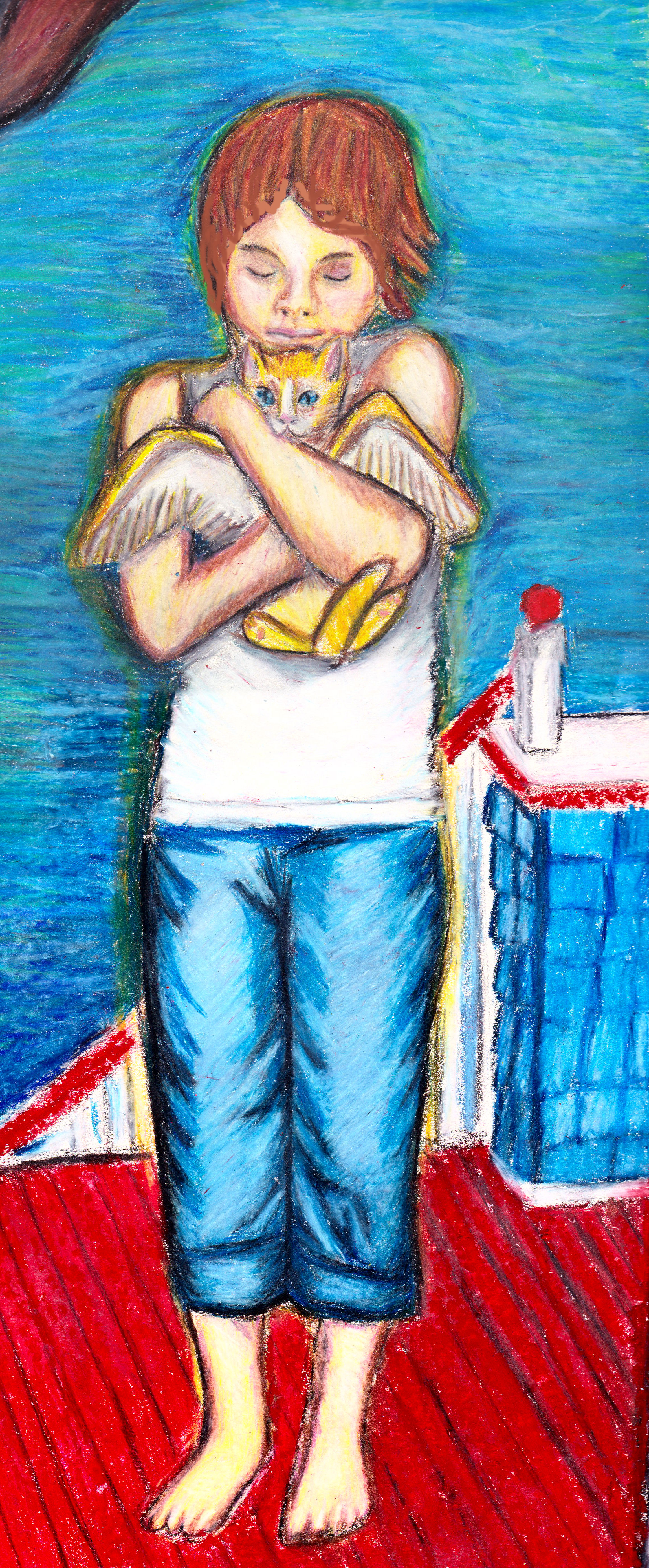
“And Oh, My Darling, be not afraid,
We are so lightly here
It is in love that we are made
In love we disappear.” Leonard Cohen
So yesterday I was listening to this song, which I haven’t listened to in a long time but which used to be a favorite growing up.
And I started thinking about what they mean by “love.”
You know I don’t call myself an “artist” mostly for the same reason older son doesn’t call himself “someone who wants to help people.” It’s not that at some level we don’t know we are precisely those things, it’s that so many people claim to be one or both things while what they really want to do is tear down, destroy and force others to do stuff they construe as “helping.” Both in the helping professions and in the arts, the mentality of “tear down so we can build utopia” has done a great deal of harm.
And in a way, that’s what got me thinking about this song, and Vincent Van Gogh (who apropos nothing, except that’s why I was looking yesterday, is son’s favorite painter.) Vincent has a unique and individual style, of course, one that is rather in vogue or was, for a while, with the left. It was a style that overturned the previous “realistic” style and so people on the left tend to look at it as “tearing down.” However, no one — and I mean that — NO ONE can be exposed to the man’s paintings en-masse, particularly in a comprehensive (from earliest to latest) sort of exhibition like we had here three years ago, without realizing he wasn’t about tearing down but about building.
Sure, the style he used was a complete denial of the style that went before. I don’t know if that’s why he THOUGHT he used it, though I doubt it. He seemed to be experimenting with all sorts of styles, trying to appease the internal hunger for expression, until he found what satisfied it.
However, it’s impossible to look at the later styles and not realize what he was doing was not tearing down, but building.
Art, as such, is a way to remove the habit-goggles through which we gaze at reality. In a test in Portugal, because I was out of time and frankly peevish I had been asked the question (and also because I assumed I would fail and have to retake) I answered the question with “What is the difference between literature and life?” with “To understand the difference, one must go to Plato’s cave metaphor. The reality most of us see, day to day is filtered through what we’re used to seeing and what we’re used to believing, so that we don’t really see it. Literature is that real reality outside the cave, and the accomplished artist gets you to turn around for just a moment and glimpse the truth.”
The weird thing is that I still stand by that answer. And if you’re going to say, “But Sarah, you say no one can judge whether what they’re doing is art, because art is that which causes an intense emotion in the reader/viewer/listener.” Well, yeah. And the intense reaction is because of catharsis, the reaching into something true and fundamental that takes you out of yourself, your habits, your routine. Which is the PURPOSE of art.
Look, I’m a libertarian, so I’m not going to say that’s what artists should aspire to doing. HOWEVER for me, as a decent craftsman, that’s the next level I aspire to, the level that peels back the layers of habit and culture and the way you learned to look at things, to show the truth beneath it.
Now, no one can fully escape the culture they were raised in (or acculturated to — in my case by choice — or a combination thereto.) This is why we don’t really understand past eras and other civilizations. (I’m running into this with, of all things, Portuguese politics, which is why I haven’t written about it. Portuguese don’t understand how different their system is from the rest of the world, and Americans REALLY don’t understand how different the Portuguese system is. Even I having been away 30 years miss some nuances, which is the other reason I haven’t written about it. And remember Portugal is at least technically a WESTERN country.) Going through an exhibit on Rome, it was amazing both the commonalities, particularly for someone like me who grew up in a descended-from-Rome culture, and the bizarre shocks. (Like, for instance, pictures of monkeys screwing people? TOTALLY appropriate for a living room painting. Monkeys with huge erections? Totally okay for children’s toys. And let’s not go into their weird relationship with defecation and such, which were very much PUBLIC matters.)
However, good art can for a moment remove the blinders, which is why I made a point of mentioning that it was a glimpse (over the shoulder) at reality.
Now the reason this is important is that the closer you come to reality, the better your ability to make decisions that are relevant and improve things, be they aesthetic or social or purely personal things.
And right now you guys are staring at this and wondering when Sarah got taken over by the dark side.
I haven’t been. It’s just that we (by which I mean myself and the followers of cultural progressivism, who view it as necessary to dismantle western culture in order to build utopia) disagree on what is art, what is revealing the real truth. I think, for instance, that Heinlein books do a fantastic job of both telling a great story and removing cultural blinds. (Though to me, as a foreign-born person, it is fascinating to see how many blinders he also retained, like believing the rest of the world was to a great extent, the US written large.) So does Shakespeare, and to an extent even Jane Austen (who made romance comprehensible to me for the first time in my life. A very practical and level headed Romance but there it is.)
Now if you believe you know the real truth, which is in general a problem of people who think history comes with an arrow and that it moves, inevitably, to the grand vision of a nineteenth century neurotic and bookish white male, then you are impaired, a priori in creating great art. Because you are not trying to glimpse reality. You are trying to superimpose a revealed and external vision on your vision. This revelation might be different from the cultural filters used by those around you, but it is no less artificial.
This is the blight of so much of medieval art, which imposed extra Christian/Catholic filters on their cultural filters. This wasn’t arrived at by each individual artist, but what was expected. In the same way the pseudo realist art of the Soviet union largely sucks for the same reasons. Because the artist is not making an effort to reach the truth, he/she is just conforming to another set of social filters.
And this is what is wrong with so much of the grey goo that passes for writing in genre since it has become infected by litchrature. Instead of using a minimal set of parameters to “conform” to the expected experience of the genre, and then infusing the content with your own vision and passion, you are conforming to a group-think kind of vision (and in the case of our own annoyances, submitting to group criticism, ala Maoist cultural revolution.) When that group vision requires the tearing down of the existing vision, then it becomes even crazier, because you’re trying to create while actively hating the genre, its parameters and to an extent the people who want to read it because they love the genre.
And that by itself is enough to cripple you. Whatever art is, it is born of a restless desire to create, an infatuation with your chosen mode of expression and field that forces you to search for continuous improvement. It is that “love” that creates real art.
No one sane would work in any artistic field and suffer both to create and to make a living. No, it is a restless desire that causes us to try to do that. And it’s probably why so many of us are slightly unbalanced and desperate even when we DO make a living. Because we have to work outside the consensus, we have to reach ever farther and try to peel more of the habitual matrix, in order to see what is real and convey it to others, even in a fictional package.
Any system that has a code of rules for what you can “create” as “art” which includes respecting certain politics, certain ways of seeing the world, is not only useless but detrimental, be it the French Academy or the “Code of Progressivism.”
Art is fear and longing, it’s going out on a limb, and it’s love. Without love there is no creation. There is only grey goo and mannerly imitation.
Love and create and be not afraid.