Rock and Roll: The New Madrid Fault System Part VII: Comparisons By Stephanie Osborn
Excerpted from Rock and Roll: The New Madrid Fault System, ©2017
By Stephanie Osborn
http://www.stephanie-osborn.com
Images in this article are public domain, unless otherwise specified.
This whole collection of writings started off with an email exchange, months ago. Our illustrious hostess was part of the discussion, and expressed interest in my converting the info to one or more blog articles. Then, when the LibertyCon programmers heard about it, they asked me to give a presentation on same, which I did.
The presentation was a full house, and at the end, there was a request for me to convert it to blogs and/or an ebook. I asked how many would like to see an ebook of the material; virtually every hand in the lecture hall went up.
A little over a month later, with additional research under my belt and factored into the manuscript, the book has gone live. And as promised, I am providing Sarah a series of blog articles on the subject. This series of blog articles is only a small fraction of the material contained in the ebook; it may be considered in the nature of a series of informative abstracts of the information contained therein. For additional information, may I recommend that you check out Rock and Roll: The New Madrid Fault System.
Part VII: Comparisons — New Madrid versus San Andreas
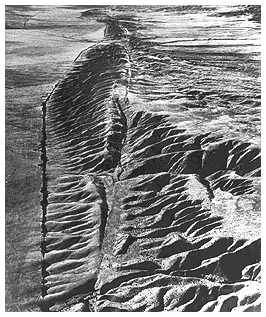
[An aerial view of a portion of the San Andreas main fault.]

[An aerial view of part of the central Mississippi River region,
depicting no sign of a fault.]
The two fault systems produce quakes reasonably comparable in magnitude. The biggest quakes on both systems can range from ~7.0 on the Richter scale up to around 9.0. The frequency of occurrence of “big ones” on the San Andreas is shorter, however; a few decades on the San Andreas vs a few centuries on the New Madrid, on average.
The length of the San Andreas main fault is greater; the San Andreas is ~800mi long, while the New Madrid main fault/graben is ~150mi long.
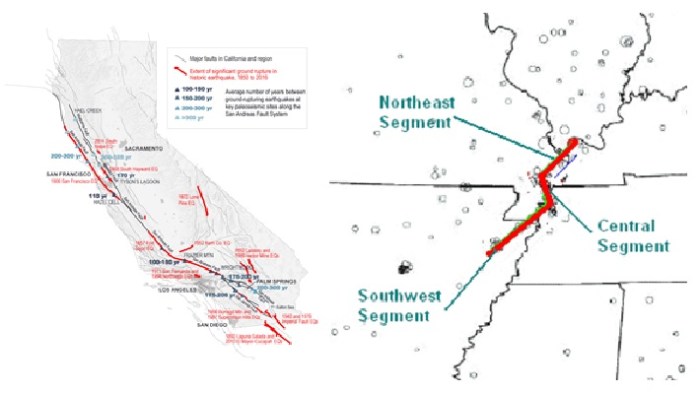
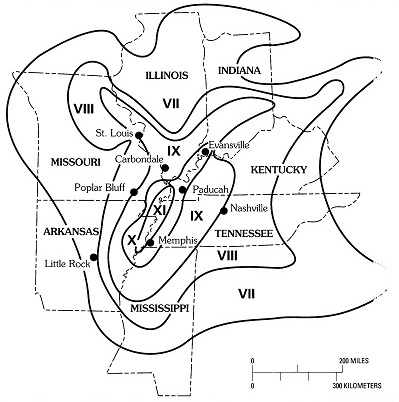
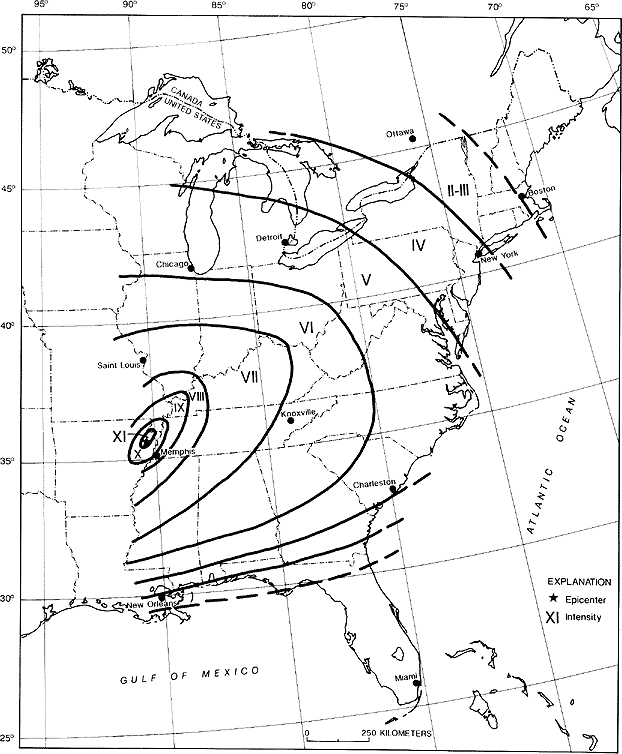
[California map, left, courtesy USGS, public domain.
New Madrid map, right, courtesy http://showme.net/~fkeller/quake/maps7.htm.]
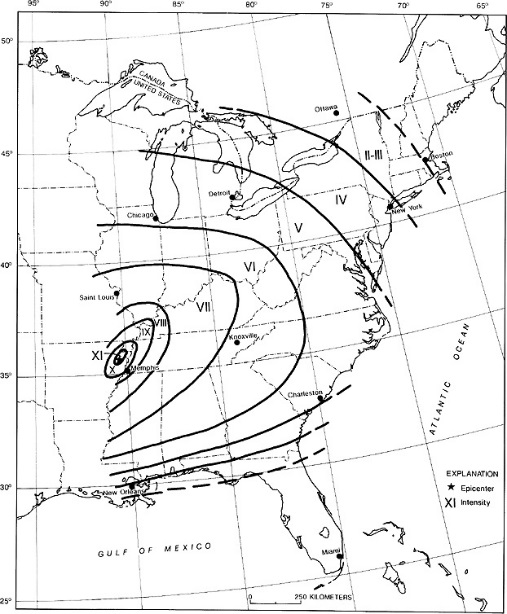
BUT the New Madrid affects a vastly larger area, some 10x larger than the Great San Francisco quake, and even 2-3x as large as the 1964 Alaska quake!
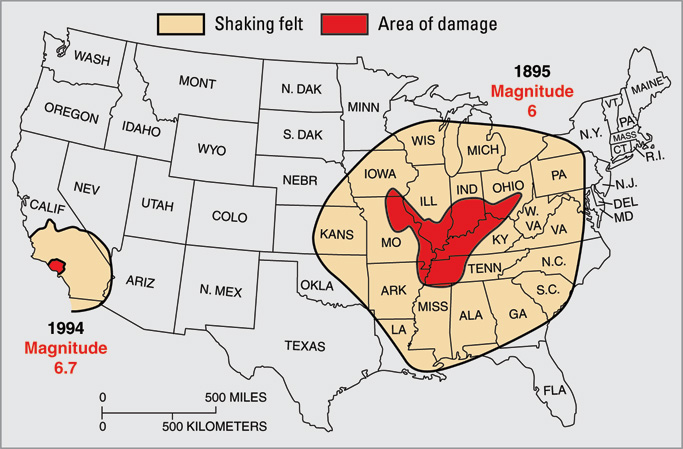
[A comparison of affected areas from comparable-sized quakes
on the San Andreas and the New Madrid faults]
Why the difference? The underlying geology is very different, and that proves to tell the tale.
The San Andreas lies in an area of consolidated rock. This rock is shallow, broken, and hot. (There has been—and in many areas continues to be—active volcanism in the region.)
Therefore the rock strata of the region have high energy attenuation—the quake energy dissipates rapidly with increasing distance from the epicenter.
The New Madrid lies under literal miles of unconsolidated (loose, uncompacted; not stone), waterlogged sediment. Unconsolidated sediment tends to amplify wave motion. And then there are the rocks in which the actual fault(s) is/are found.
The rocks here are deep, relatively hard, solid and intact, and cold. (What volcanism occurred in the region occurred in the ancient geologic past, and all volcanos in the area are long since extinct, most worn down to nothing recognizable as a volcano.)
Therefore the underlying geology around the New Madrid system not only tends NOT to damp out the quake waves, but the unconsolidated sediment overlay AMPLIFIES them.
When is the next “Big One” in the New Madrid Seismic Zone?
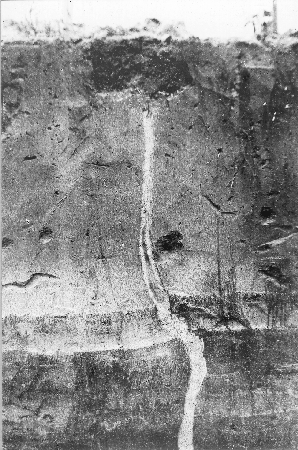
Geologists look for signs of earthquakes in older strata to determine the frequency of major quakes. By dating the strata using found human artifacts, fossils of animals and plants, carbon-14, etc., it is possible to roughly date the objects/structures contained within a given stratum. A quick averaging of the dates yields a reasonable frequency of occurrence.
Periodicity
According to CERI, the Center for Earthquake Research and Information at the University of Memphis (working in conjunction with the USGS), the periodicity of major quakes/swarms on the New Madrid system is roughly one swarm every ~500 years.

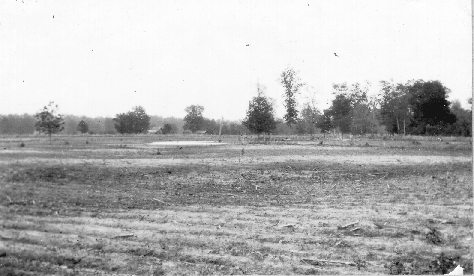
[Photo: https://www.buzzfeed.com/tgounley/the-day-the-earth-stood-still?utm_term=.veA8pv1jO#.vqwVRNg5A
Note the lack of anything resembling a fault.]
So…when is the next Big One due?
Per CERI:
- There is a 7-10% of a mag7+ quake in the next 50 yrs.;
- There is a 25-40% of a mag 6+ quake in the next 50 yrs.
What To Do?
Prepare as you would for any natural disaster—a tornado, a hurricane, etc.
Assume that the infrastructure may be down for a considerable time (several weeks) and plan for it. Do not assume you will have access to electricity or other power sources, or cable, internet, and phone lines. Even cell phone towers may be down.
Keep plenty of bottled water on hand, and/or a means of filtering/purifying water from local sources. Store nonperishable foodstuffs sufficient for a couple of weeks (up to a month) per person, in an area easily accessible after a quake. (Basements are not a good idea for this.) If you need medications, ensure you keep at least one month’s supply available.
Ensure you have a means of heating and cooking in the winter, and fuel.
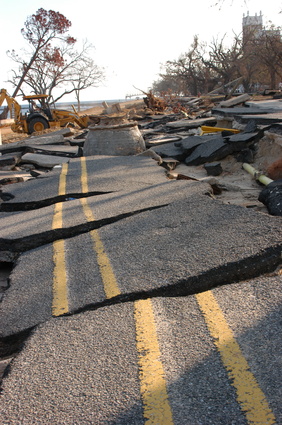
Check your city or county building codes to determine if your home was built to withstand a major temblor. If it doesn’t, look into the possibility of retrofitting your home.
If you are preparing to purchase or build a house, take these things into account: of normal foundation types, a slab foundation withstands quake movement best, because it tends to “surf” the waves. Wood-frame houses fare better than masonry structures, as does welded steel frame. Incorporate earthquake dampeners into your foundation, especially if you live near the central Mississippi River.
Unlike many natural disaster events, faults don’t change locations. If you live in the eastern USA and Canada, you need to be aware of this threat. There is every indication that this fault system has an ongoing lineage of major, destructive quakes, and when it finally releases another “big one,” you WILL know it.
Be ready.
To obtain a copy of Rock and Roll: The New Madrid Fault System by Stephanie Osborn, go to: