Book Promo And Vignettes By Luke, Mary Catelli and ‘Nother Mike

If you wish to send us books for next week’s promo, please email to bookpimping at outlook dot com. If you feel a need to re-promo the same book do so no more than once every six months (unless you’re me or my relative. Deal.) One book per author per week. Amazon links only. Oh, yeah, as an Amazon Associate, I earn from qualifying purchases. By clicking through and buying (anything book-related, actually) through one of the links below, you will at no cost to you be giving a portion of your purchase to support ATH through our associates number. A COMMISSION IS EARNED FROM EACH PURCHASE.*Note that I haven’t read most of these books (my reading is eclectic and “craving led”,) and apply the usual cautions to buying. I reserve the right not to run any submission, if cover, blurb or anything else made me decide not to, at my sole discretion. Remember though all of these submissions are from people willing to be associated with this blog. So if you’re trying to buy from people who don’t hate you, this is a good place to start.– SAH

FROM DALE COZORT: The Best of Space Bats & Butterflies

Space Bats & Butterflies Book Four is part of a collection of books that bring together alternate history or time-travel stories, book excerpts, essays and world-building exercises from the ninety-plus issues of a long-running Alternate History zine.

  • Japan Wins at Midway.
  • Earlier B17 Trigger a Bomber Race
  • France Fights on From North Africa
  • Barbary Pirates Raid New England
  • Alternate Biography
    • A Con Artist & His “People’s Car” Changes the World
    • Lenin Lives on to Shape the Soviet Union
    • A German Master Army Builder Transforms Nationalist Chine into a Powerhouse

Fiction stories and excerpts:

  • In 1937, High Tech Descendants of Japanese pirates invade California From an Alternate Reality.
  • A British Wizard tries to Save the US Pacific at Pearl Harbor
  • The Apollo 13 Missions Succeeds & the US Triggers a Deadly Trap Lurking on the Moon.
  • In a Strange Variation on Alternate History, Dinosaurs and Mammoth Fight a Desperate War.

FROM JAY MAYNARD: Lone Star Crystal (The Crystal Therapy Chronicles Book 3)

Magic heals. But can it survive the light?

Crystal therapy has transformed lives in rural Missouri and distant Wales. Now it is coming to Houston, rising at the heart of the Texas Medical Center.

CJ Hollister knows how to build things that last. He trusts foundations, schedules, and hard reality — not magic. But as the Texas Crystal Therapy Institute takes shape, he finds himself drawn toward something more permanent than anything he has ever built.

His daughter Rachel is a bioethicist trained to question power and defend autonomy. From the outside, crystal therapy raises troubling questions: permanent suits, new names, and a commitment that can never be undone. When her father chooses to step inside, professional skepticism becomes something far more personal.

The system works. The people inside it choose to be there. No one is forced to stay. But Rachel must decide whether consent is enough when the choice changes everything.

As the institute nears completion, father and daughter must face the same question from opposite sides:

What does it mean to choose a life you can never leave?

Lone Star Crystal is the third novel in The Crystal Therapy Chronicles, a science fiction series about healing, identity, radical choice, and the consequences of changing the world.

FROM RACONTEUR PRESS, WITH A STORY BY J. KENTON PIERCE: The Muse Within Us: An Anthology of Dark Fantasy and Horror (Raconteur Press Anthologies Book 77)

What happens when inspiration stops feeling entirely human?

Paintings that command armies. Songs that shatter crowds. Ancient poems that speak directly into an immortal ear. A revolver forged from the ruins of Earth, passed from hand to hand across generations, delivering justice with a chorus of the dead riding in its steel.

The Muse Within Us is an anthology of dark fantasy, horror, military science fiction, and literary speculation. These eleven stories all ask one question: does inspiration come from within, or are we tuning into signals already moving through the world?
Editor Wally Waltner has gathered writers from across the speculative spectrum. Within these pages: a sorcerer-seamstress transformed into a dragon by her masterpiece; a court prince whose animation magic revives a forgotten civilization; a musician haunted by crowd-controlling spirits called the whispers, carrying two hundred dead from one show; a Norse scholar who realizes he has been speaking ancient kennings directly into an immortal ear; and a war painter ordered by a god of war to paint ever bigger victories until he refuses and pays the price.Also here: a baker empowered by a minor demon of boiling oil trapped in petrified wood; a mason’s boy whose hands transform into the arches of a destined cathedral; a blues musician whose song outlives him through new vessels; a gunsmith on a dead Earth forging a revolver that carries a chorus of voices across centuries; and a young woman who discovers that flowers blooming where bodies fell grant strange artistic power at a terrible cost.

Some of these muses are generous. Several are predatory. All of them change the people they pass through.

The Muse Within Us because what moves through you may have its own agenda.

FROM RACONTEUR PRESSES, WITH STORIES BY KARL GALLAGHER AND ROSS HATHAWAY: For Want of a Rivet (Raconteur Press Anthologies)

Small decisions. World-altering consequences.

That’s the premise behind For Want of a Rivet, an anthology of eleven alternate history military stories that asks one deceptively simple question: what if a single invention, tactical choice, or quiet act of courage had gone differently?The stories span a century of conflict and a dozen theaters of war. A Royal Navy pilot spots the German fleet and changes the shape of World War One. Air privateers carrying Letters of Marque dogfight over the Western Front while a brash young balloon-buster rewrites the record books. A Japanese naval officer quietly suppresses a breakthrough antenna technology that will shape the Pacific war. German engineers develop a submarine that makes the Atlantic a killing ground. British scientists discover how to bend the enemy’s own guidance beams back against them, and a stage magician helps make the resulting deception invisible. An all-Black paratrooper battalion that was supposed to be fighting wildfires instead drops into the Battle of the Bulge. A French Foreign Legion scout finds a Roman tunnel under the most heavily defended line in Italy. A Polish tank crew fights to hold the cork in the bottle as Operation Unthinkable opens. A SOE agent moves through occupied France on a prosthetic leg — and the rivet that keeps it silent may decide the war. Britain and Germany forge an uneasy alliance against Soviet France. Japan defends the Imperial Palace to the last man.

These are stories about the human cost of invention, the weight of small advantages, and the soldiers, spies, and engineers who never made the official record.

Eleven contributors. One question. For want of a rivet, the war was lost — or won.

Stories include: ”Wings over Jutland” (William Meinert) · “Ace of Aces” (Karl K. Gallagher) · “Radio Waves” (Joe Salem) · “The Danzig Ghosts” (Michael Patrick Coady) · “The War They Could Not Print” (Ross Hathaway) · “Little Groups of Paratroopers” (Bart Kemper) · “Callis Caecus” (Nick Aalderink) · “Operation Unthinkable” (Samuel A. Mayo) · “Cuthbert’s Silence” (D. S. Ligon) · “Axis of Alliance” (G. Scott Huggins) · “The Last Kamikaze” (Robert Miller)

FROM J. MANFRED WEICHSEL: Savage Headhunters

Based on a more-or-less true story of World War II

All World War II soldiers Brian and his pal Jefferson want to do is collect the skulls of their enemies. Their exploits are captured on film by Abigail, a hot female war correspondent, and they become celebrities back home.

But one day Abigail, jealous of the attention Brian and the other men are getting, has a picture of herself with a skull published in Life magazine. The American public is outraged, and when the American public gets outraged, they demand blood.

Who will live and who will die in this gory, grotesque satire from the subversive author of Action Girls: Triple Threat, Ebu Gogo, and Five Maidens on the Pentagram?

FROM LEE ECKHARDT: SECRET OF THE LOCKED CITY: A Novel of Mars and its Canals
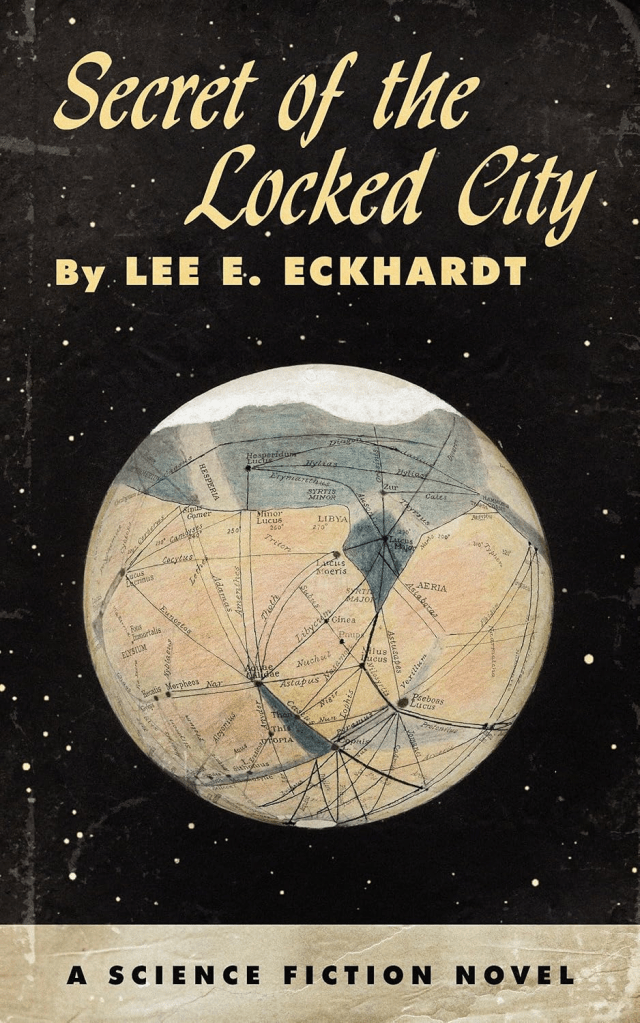
Nineteen-year-old Cyril Michael Haskin is the youngest NASA astronaut ever to set foot on Mars. Through an incredible series of events he finds himself transported – not across space, but across dimensions – to another Mars, a completely different Mars from the one he knows, a Mars crisscrossed with canals built by a long-vanished alien civilization.
There seems to be no way to get back home – until he learns of the Locked City in the Syrtis Major region, the only Martian structure Terran colonists have been unable to enter, a place some believe to be still inhabited by the Old Martians. Cy becomes convinced that he must reach the City, but is prevented from doing so by the authorities, for he, the young man who appeared out of nowhere, finds himself under the increasing suspicion that he is actually a Martian sent to spy on the colonists.
Along with three new friends he sets out for Syrtis Major, braving the perils and terrors of this savage Mars to reach his goal, not knowing if he can even gain entry to the City, much less find a way home.
Will he be able to solve the Secret of the Locked City?

FROM SARAH A. HOYT: No Man’s Land: Volume 1 (Chronicles of Lost Elly)

Sufficiently advanced science is indistinguishable from magic.

On a lost colony world, mad geneticists thought they could eliminate inequality by making everyone hermaphrodite. They were wrong. Catastrophically wrong.
Now technology indistinguishable from magic courses through the veins of the inhabitants, making their barbaric civilization survivable—and Publius Cornelius Scipio Africanus Kayel Hayden, Viscount Webson, Envoy of the Star Empire—Skip to his friends— has just crash-landed through a time-space rift into the middle of it all.
Dodging assassins and plummeting from high windows was just the beginning. With a desperate king and an archmagician as his only allies, Scipio must outrun death itself while battling beasts, traitors, and infiltrators bent on finishing what the founders started: total destruction.
Two worlds. One chance. No time to lose.

FROM FRANK HOOD AND S. T. GAFFNEY: That Has Such Creatures

How does a man find home when nowhere and everywhere is home?
An aging rocker sets the record straight about his controversial career and unknown love.
Why does a humble mixologist in a vape shop think he has the right to claim he saved baseball?
A young man catches a leprechaun who changes his life in a most unexpected way.
A wandering wizard and his young apprentice are tasked with performing a secret and dangerous task for a powerful king.
Six years after his friend’s death, Charlie Moore finds a document that may lead to terrible consequences for all those who have connections to the late, rich, and eccentric David Larkin.
A cat is offered a chance to protect his mistress from a mysterious creature.

These are a few of the short stories in this collection that range from science fiction, fantasy, and horror to mystery. The husband and wife team of Frank Hood and S. T. Gaffney serve up a book full of mostly fictional stories, and a few that might just be stranger than fiction.

“Very much enjoyed DARKNESS, DARKNESS.” Ray Bradbury

“The man knows how to write a sentence!” Harlan Ellison

FROM LEIGH KIMMEL: Time Enough to Spy

A spy has at long last come in from the cold — but all is not as it seems. The longer his debriefing continues, the more uneasy he becomes. In particular, how can he reconcile his presence here with the impossibility of both rescue and escape from a polity with the power to remodel the bodies of their subjects at will?

What secret hides behind those cool professional faces of the agents who briefed him so long ago? Has he been induced to betray all he was sent to protect?

A short story of the Madrian Empire.

FROM NATHAN C. BRINDLE: I’m The Beautiful But Evil Space Princess Who Rules A Galactic Empire But Really Wants To Leave People Ruthlessly Alone!: Volume 1

Alice is the Imperial Princess Regnant of the Galactic Empire. At 22, she has been thrust into power after her father (the Emperor) and her two older brothers have all died in various ways. Her Imperial Chancellor, Lord Rupert, does everything he can to support her, but has somewhat different ideas about how the Empire should be run than did his late Emperor.

Alice has one major problem: She cannot be crowned Empress Regnant until she marries and produces an heir.

But Alice, being kept busy three days a week by interminable audiences with petitioners, and the rest of the week with what she terms “mostly busy work”, has no real way to meet young men — well, reasonably eligible young men, anyway, and of her own age — with whom she might eventually take up and form a household. And she chafes at the necessity of trying to rule, hands-on, an Empire so huge it cannot be truly ruled by any one person to begin with.

She just wants to leave people alone, as her father and his predecessors did for centuries.

Then, into her life walks the Crown Prince of a planet many, many parsecs away from the Capital Planet…and her life begins to take on a life of its own…

FROM SARAH A. HOYT: Witch’s Daughter (Empires of Magic Book 2)

FOR SOME REASON AMAZON IS PLAYING SILLY GAMES WITH THE REVIEWS FOR THIS BOOK, WHICH I THINK IS AFFECTING SALES. IF YOU’VE READ IT, PLEASE REVIEW!

Some letters come from the living. Some come from the dead. This one comes with a formula that turns a rowboat into a miracle.

Seventeen-year-old Lord Michael Ainsling — youngest brother of the Duke of Darkwater, builder of mechanical marvels, survivor of fairyland — receives a letter from a man sixteen years dead. The inventor Tristram Blakley has not perished; he has been imprisoned by his own genius and begs the one mind in all of Avalon brilliant enough to understand his work to set him free. All Michael has to do is find seven missing brothers first and walk a magical path..

Fifteen-year-old Albinia Blakley has spent her whole life under her mother’s iron thumb — and her mother is a witch. The day Al finally escapes down a rope of knotted sheets, she lands in a world she doesn’t recognize, with no money, no magic kit, and no idea that the stranger who catches her is about to become her greatest ally.

Together, a girl with more secrets than she knows and a boy who builds machines that try to murder him must outwit a sorceress, navigate the treacherous courts of Fairyland, and unravel an enchantment years in the making — before a family is lost for good.

Witch’s Daughter is a gaslamp fantasy brimming with wit, warmth, and wonder, for readers who love their magic wrapped in velvet and their adventures served with morning tea.

FROM JOHN BAILEY: Book I The Glass Constellation (The Calibration Fall Trilogy 1)

At the height of interstellar civilization, humanity and its allies have achieved what earlier ages believed impossible: instantaneous communication across light-years, perfectly calibrated faster-than-light transit, and seamless cooperation between hundreds of worlds.

Then the measurements begin to fail.

A military reconnaissance squadron disappears despite flawless telemetry. Manufacturing systems produce identical components that no longer behave identically. Communication relays return contradictory timestamps from the same transmission.

At first, the anomalies are dismissed as statistical noise.

But when a catastrophic trinary stellar cascade destabilizes the hidden constants underlying interstellar technology, the great network binding civilization together begins to fracture. Navigation diverges. Synchronization collapses. Entire fleets lose agreement on shared space and time.

As governments struggle to preserve order, scientists and archivists race to understand a terrifying possibility:

The universe itself is drifting out of calibration.

Caught between political denial, military desperation, and the accelerating collapse of physical certainty, humanity faces a crisis unlike any war or invasion in history. The enemy is not a hostile species or empire.

It is the failure of reality-dependent civilization itself.

The Glass Constellation is the first volume of The Calibration Fall Trilogy—a sweeping hard science fiction saga of collapsing interstellar order, drifting physical law, and the enduring struggle to preserve meaning in a universe that no longer agrees with itself.

Perfect for readers of:

  • Foundation
  • Dune
  • Revelation Space
  • A Fire Upon the Deep
  • Hyperion

FROM KAREN MYERS: Bound into the Blood – A Virginian in Elfland (The Hounds of Annwn Book 4)

Book 4 of The Hounds of Annwn.

DISTURBING THE FAMILY SECRETS COULD BRING RUIN TO EVERYTHING HE’S WORKED SO HARD TO BUILD.

George Talbot Traherne, the human huntsman for the Wild Hunt, is preparing for the birth of his child by exploring the family papers about his parents and their deaths. When his improved relationship with his patron, the antlered god Cernunnos, is jeopardized by an unexpected opposition, he finds he must choose between loyalty to family and loyalty to a god.

He discovers he doesn’t know either of them as well as he thought he did. His search for answers takes him to the human world with unsuitable companions.

How will he keep a rock-wight safe from detection, or even teach her the rules of the road? And what will he awaken in the process, bringing disaster back to his family on his own doorstep? What if his loyalty is misplaced? What will be the price of his mistakes?

Vignettes by Luke, Mary Catelli and ‘Nother Mike.

So what’s a vignette? You might know them as flash fiction, or even just sketches. We will provide a prompt each Sunday that you can use directly (including it in your work) or just as an inspiration. You, in turn, will write about 50 words (yes, we are going for short shorts! Not even a Drabble 100 words, just half that!). Then post it! For an additional challenge, you can aim to make it exactly 50 words, if you like.

We recommend that if you have an original vignette, you post that as a new reply. If you are commenting on someone’s vignette, then post that as a reply to the vignette. Comments — this is writing practice, so comments should be aimed at helping someone be a better writer, not at crushing them. And since these are likely to be drafts, don’t jump up and down too hard on typos and grammar.

If you have questions, feel free to ask.

Your writing prompt this week is: MONEY

The Week In Clankers

As I said, as I was getting better — situation indeterminate right now, further tests booked for mid July — I wrote a lot of clanker songs.

I’ve been putting them up one a day, sailing into the sound-track cover for the third volume of No Man’s Land.

(I’ll link the post with the previous below, if you haven’t been following the saga.)

Note that I had much fun experimenting with different ways to do the graphics because, let’s face it, Ellyans hit the uncanny valley.

So, anyway, here they are.


This one has all the previous songs in order and apparently I’d already shared Kitten? And Six Months for 23 years? Ah well. You know they say the memory is the first thing to go. Meh.

Again, what have we learned about getting a writer into a quixotic “let’s write a sound track for the world’s longes book” quest? Precisely?

Write the answer down on your exercise book. You will be graded.

First They Lie To You

I know everyone here is semi-amused when I go on rants about people of the wrong race getting cast.

Look, seriously I don’t even mind race swapping in theater or something that’s obviously artsy. One of the best Pride and Prejudice adaptations I’ve seen, the cast was small enough you had to pretend you didn’t know Mr. Darcy was also Mr. Bennet. (To be fair they wore different coats!) And all the girls were different RACES (okay there weren’t five races, but the girls who were white were so different they might as well be, and one was Asian and Mary was black.) and it didn’t matter. It all worked, because it had a just slightly campy and deranged edge, and accommodations were made, such as the girls unrolling a carpet, to make the “path to Oakham mount.”

That’s fine. no one watching that could take it for reality.

It’s the lying that disturbs me. Things like Bridgerton, or historical movies which cast Africans in a time and place where an African who was there would only be known for this characteristic. Like the episode of a Robin Hood show where the scamming “nun” was black. My doods, this might seem reasonable in America in the 21st century, but let me assure you it wouldn’t even seem reasonable in Europe in the 20th century, much less the 13th. When I was a kid, the village had one black person (a young couple had moved to the village. She was black.) NO ONE KNEW ANYTHING ELSE ABOUT HER. Took three years for me to know she had a name. People were absolutely friendly to her. (Her kids and grandkids now live in the village.) It’s just that this one characteristic was so out of the common way no one knew her for anything else. Same way there was one protestant family and their name as far as I knew was “The protestants.” Like that.

The series completely lost me because honestly, how could you be a scammer and assume different identities when your skin color made you immediately and clearly obvious to be you for miles and miles around?

And if you’re going to say “There were always black people in England/Europe” we can’t be friends anymore. That’s what is used to justify these abominations. Were there always black people? Yes, probably. Look, homo sap moves around a lot, mates promiscuously (lit.) and is never actually that isolated. If we were, we wouldn’t be able to mate anymore. BUT the question is “how many black people were there around at any given time.” Well, from accounts, any that existed became a sort of curiosity. And for the common run of folk, their experience calibrated by those of their kind, Portuguese were blackamoor. Heck, the expression blackamoor itself tells you the calibration, since most moors were at most deeply tan Mediterranean. Also, Anne Boleyn was considered dark, and as someone explained “Dark was anyone not as pale as Jane Seymour” a woman that was so pale she appeared green in certain lights.

So, yes, I take issue with stuff that’s blatantly a-historical. But that problem is minor.

No, you see, the problem is that our schools — all the schools in the west, not just here — do such a craptastic job of teaching our kids history — or anything, really — that people take entertainment for history.

So, what’s happening is that they are straight up lying about history to people who don’t know any better.

But that’s not all they lie about, and I swear Great Britain is worse. I mean, we’ve all noticed (thank you for asking, yes.) that every commercial these days has a bi-racial couple. Which is bizarre, as in real life, yes, Americans intermarry a lot –maybe a lot more than at any time in in the past — but it’s not the majority or even half. Because guess what? White people or “pass as white at a glance” are still the vast majority in this country. So, yes, by and large they marry each other.

But the English programs are worse than this. And it’s the programming, not just the commercials. I stopped watching British mysteries, which used to be one of my primary modes of decompressing because I noticed every couple was different races. Every single couple. And once you notice that, for something set in the bucolic English countryside, it’s impossible to un-notice or watch the show and not notice it every time. Yes, yes, “use the best actors’… you mean white people can’t act at all? Because by proportion of the population they’re still the VAST majority in England, more so than even here. And that makes no sense whatsoever.

Also, after a few months I decided to try watching again, and the plots were all about racism. It culminated in a show about this woman who had joined a white supremacist group as a runaway teen. As an adult, she was married to an Indian man, and helped African immigrants learn to read. But as they investigate and her past comes out, everyone turns their backs on her, and the moral was that she deserved this, for being an idiot when she was under 20. That was the last time I tried. I still occasionally watch British mysteries, but only old ones.

Understand, I’m not bothered by bi-racial couples. As a lot of you know. Heck, if you squint and shake the snow globe, Dan and I are in a bi-racial marriage. You just have to decide which of us is the minority and through which ancestry (we is Heinz 57.) Without bi-racial couples, I wouldn’t BE here. Or my kids, which would be a greater loss.

What I’m bothered by is lies. I’ve now watched the producer and one of the stars of Bridgerton give interviews in which they said Queen Charlotte — German, blond, cousin of the king — was really black and that there really was this separate system of black nobility, like an appartheid state in the Britain of the 18th century.

And I want to scream, because, you know, it’s a lie.

I don’t care about the races. I care about the lies.

Because what it does is it causes young people to try to make sense of it. It goes something like this: Wait, if black people were always here in numbers, just separate but different, why didn’t we hear about them until now.

And then OMG the racism!

The same way the portrayals of incredibly mixed small communities will cause people to wonder why their isn’t and think “OMG, the racism.”

I’m not saying there’s no racism in England/Britain. As I pointed out, my relatives counted as a different race to them until very recently. Might still.

I’d go a long way to say racism in America is negligible. Not non-existent, for is it not written, “the chowder heads thou shall always have with you” BUT negligible.

In Europe things are different. And you know, people in Europe have a much stronger narrative (and slightly stronger reasoning) for being “one blood.” So some racism or at least xenophobia is understandable.

BUT what I’m saying is that lying about the past, to show newcomers have always been there, and we should be more tolerant is not the solution. As it should be bloody obvious.

LIES ARE NEVER THE SOLUTION. They just create other problems.

In this case the problem it has caused is a bunch of white policemen so determined not to be racist that they take the opinion of the murderer and arrest the victim while he’s dying.

These same people now think the solution is hiding their web site with policing rules, and lying some more.

Note that the left has for over a hundred years screamed about the propaganda that got us into WWI and WWII. Propaganda is evil.

Unless they do it of course. And do it in the most bassawkward way possible.

And stoke hatred.

A Lump of Feelings

I was going to blog about the people who don’t want to celebrate the 250th. But it’s difficult because there’s this lump of different feelings in the way.

A lot of it is related to the death of Henry Nowak, in England, and I’ll got into that first. No, Great Britain is not us. Though, let’s face it, we got a heck of a way down that path before the election in 24. And it doesn’t mean anything, necessarily about the people of Great Britain but more of the boot on their necks. Except they’ve tolerated the boot a lot longer, and let themselves get disarmed, which…. never mind. Europe.

But that’s probably why this hit me harder than it should have. Look Great Britain was a beacon of freedom compared to late seventies Portugal (and we won’t even mention before, okay?) and I grew up reading British authors. There’s a reason Skip in No Man’s Land is from Britannia on High, a series of colonies established to mimic the “impression” of Victorian England of pro-British novelists. There was an early romantic attachment to the idea of England, warts and all.

More importantly, that poor kid, Henry Nowak was a first year college student. I was once a college student doing an absurd route of walk, train, walk, bus, walk to get to college in town and then across town. Of necessity this took me through some pretty iffy parts of the big city I had to cross, though thank heavens that was “pre-diversity” Europe and the worst thing that happened to me (multiple times) was having a crazy person follow me yelling either threats or obscenities. And there were the inevitable late nights, both for study and to hang out with friends, mostly Swedish-language-club friends, for various reasons. I can imagine being in his position all too easily.

And then there’s the police reaction. how do you even? I mean, I’m sorry. The fact that this is in accordance with the instructions, not to say the indoctrination of the police in England is evil, bizarre, but most of all red-veil inducing. I’m a berserker. I try not to let myself get riled up to the point I have to depress myself to stop going off. But it is too late in this case, and worse there is no one to go off on. Not anyone I can reach anyway.

Then there is the idiot in Congress (the House, I think) who thinks it is very suspicious the ICE detention centers contains mostly non-white people. The composition of the people coming in, apparently, doesn’t matter. They should just and only arrest white people. Apparently.

And all this, like the blatant male-hatred that was being pushed down every channel by the autopen’s administration, is based on the Marxist’s restricted and dual vision.

Because Marxism divides the world into oppressed and oppressors, with the groups shifting according to the time and the subject, but still maintaining that duality, they can’t conceive of say ending racism without shifting to anti-white racism. And they view wanting to stop mistreatment of white people as “racism” because they are incapable of imagining a system in which there is no oppressed group.

It is inherent in their view that someone must be oppressed. You simply have to pick who is oppressed.

So, of course, for women to be free, men have to be oppressed. For black people to be free, white people have to be oppressed.

They are incapable to break free of this completely wrong duality in their heads. And in the name of this duality they are dragging us straight to hell.

To stop the cultural suicide of the west, and, frankly, of civilization and ultimately of the human race, we must break this wrong duality.

People are people. Shoving them into arbitrary groups does nothing to solve any problems. And then arbitrarily deciding which of those groups is “bad” and which is “good” and acting accordingly is outright evil.

Their idea of anti-racism is being racist against whites. Their idea of feminism is being prejudiced against men. Their idea of balancing the scales is to put stones on one side.

And it does nothing, absolutely nothing, except leave an innocent boy bleeding out on an English street, while the police who should be helping him wax sarcastic at him.

A horror they’re trying to export here, and have succeeded in many places.

Mind your teaching of your children, and more importantly mind what others are teaching them. Marxism must be eradicated root and branch and sent back to the hell it came from.

On Iran

I don’t like writing posts about my disagreements with Trump. This is neither because I feel muzzled, or am afraid of my commenters, or idolize the man.

In fact, far from idolizing him, what I like best about Trump is that I’m fairly sure he can handle the country without tilting us into a ditch and so I don’t feel I have to keep an eye on him 24/7. I do a round of my usual sites early morning, in the same spirit I used to read the newspaper, often just skimming headlines, and then I’m free to run off and play with fiction or clean the house, or clean the house then play with fiction. All fine by me. Note the “fairly sure”. The TDS afflicted will say I think he’s a god, but their inability to understand simple English is legendary. It just means I don’t think he has an active animus against the country. Which from the other presidents in the last 20 years, is getting to be a rare quality.

No, the reason I don’t like to protest something he’s doing on this blog, is that he has a way to outflank me in mere hours or days after I complain about something. Note, not saying he plays 3-D chess either. I’m saying that he has access to information I don’t have (DUH) and his decisions are hard to predict. Also that what I think is going on based on even the best reporting I can find, is often so wrong as not to be in the same universe. So it has lead me to adopt a policy of “let the man cook”.

I’m about to break that policy. And what’s more, I don’t even have any constructive solutions. But I have to get this off my chest. The last time I did this was with his enabling (even if he didn’t do it himself) the Covidiocy. I had a feeling he was listening to the wrong people. The feeling is back.

First I want to make clear I don’t oppose the war in Iran. Like most people my generation, “I’ve been waiting for this moment for all my whole life, oh, Lord.” Or close enough. I’ve wanted us to go beat the mad mullahs into a prayer rug since the “hostage crisis”. Because, seriously, who takes diplomatic personnel hostage? And gets away with it? We should have gone in guns blazing THEN. Or right after they were released. We didn’t make it clear “don’t touch our diplomats” and then Benghazi happened, and this is going to keep getting worse till we teach savages the lesson that you don’t touch our diplomats.

When I was an exchange student in Ohio in 80, my comparative political systems teacher, a Marine, hung the Ayatollah in effigy every morning before starting class. I loved that man. I fully agreed with him.

So, no, I’m not upset we finally went in and bombed the living daylights out of the Mullahs. Because you know, it had to be done.

It particularly had to be done since, after Obama had pelted them with pallets of cash, they’d gotten froggy. Not just with financing/helping the neolithic barbarity unleashed on Israel in 10/7, but with their nukes. They’d gotten ambitious.

And the problem of them getting ambitious is not that they’d have a nuke. The USSR (allegedly) had nukes for decades and we’re still here. It’s that they’re crazy-cakes religious fanatics with a nuke. Their religion explicitly enjoins them to bring about the end of the world. And boy, oh, boy, would they love to.

So I cheered the bombing. But then–

Why did we stop? And why are we trying to make a deal with people whose main drive is to BRING ABOUT THE END OF THE WORLD?

Yeah, yeah, I do get it. Trump is notoriously averse to putting American military lives at risk. Frankly it’s refreshing. Yeah, maybe he avoided the draft, but so did Clinton and that never stopped Clinton spending American lives like water, particularly when there was no real benefit to America from doing it. He was perverse that way.

But–

There is a but there, ain’t it? But– Mr. President, sometimes it’s necessary. And yeah, I do understand the imperatives pinning you: the midterms are breathing down all our necks, and we can’t let the precious little LIVs (Low Information Voters) saddle us with outright communists and jihadists, because we’re trying to clean out Iran. Yeah, yeah, you don’t want to bomb their oil infrastructure to kingdom come because you don’t want to hamper the possibility of world development, and a civilized world runs on energy. Yeah, yeah, you’re taking on heavy winds from the loyal opposition in your own party.

All that is a given. However: if you’d sent boots in two months ago to clean out the IRG, it would be done and gone, and now we could settle back into taking care of other things.

So why didn’t we? My guess is polling and public opinion not allowing it.

The problem with all that? We’re not going to be able to fix the problem of Iran and are going to have to keep doing pretend peace talks until after the midterms.

And the problem with that is that a) Trump is sounding like Obama “This is my line, and if you don’t like it, I’ll draw another one.” b) Iran apparently was and is much closer to a nuke than we thought.

Given that it’s an old technique in the US for the president to allow or incite an attack on us as a chance to turn the public opinion to a war like footing (we’re notoriously reluctant to go to full America on someone. And when we got full America we’re fully deadly.) yet what are we willing to lose to an Iranian nuke to do that?

Look, it would be one thing if we were sure they’d hit Seattle, but even so, I have friends there, and some people who read here are there. Same for NYC. Same for the ivy leagues, same for Los Angeles and San Francisco. Because even hives of scum and villainy have decent Americans in them.

But you know, I know, and even my cat Havey who doesn’t remember his own name or that he’s a cat knows that the most likely target is Israel. Are we going to lose our most reliable ally in the Middle East to this? Well… And the second most likely target is DC. Which, yes, where do we send the thank you note, but guys? Right now the most likely result of a decapitation strike like that is that our cold civil war goes hot at a speed.

So– are we really going to risk this?

Mind you, if we sent boots in, my idea would be, go in, break everything, come home and tell them not to make us come out again. The era of “nation building” should be not only dead, but buried so deep that it will be forgotten. BUT–

But if we’re going to shy away from it because elections, and votes and–

Is the risk we’re running acceptable? And who is the president listening to? Because whoever it is, they don’t have the world’s best interests at heart.

I don’t like criticizing the president, because he usually proves me deep at sea within days of a post doing that.

I can’t tell you how desperately I hope that’s the case now.

Part Two: “AI Datacenter” Water Consumption By Larry Good


Yesterday, I gave background on my experience with this topic

and the idea that “Data Centers are poisoning our communities.”

Water is just about the most common resource on the planet. Just about the most easily accessible and manipulable, and one of the cheapest resources to refine.

That doesn’t mean it’s easy, cheap in absolute terms, or unimportant.

Most public policy issues with water come down to the water being pure enough to healthily drink, or to discharge into the natural environment. As I put it yesterday, “as part of the ‘drank from the garden hose’ generation, I have a lot of disdain for the hype about water pollution in this context.” The difference between potable water and drinkable water is definitional.


One thing I don’t think gets enough acknowledgement: a building produces “waste water” by existing. I recently had reason to calculate the roof run-off of my house, garage and barn, at about 275 thousand gallons per year. That is “OVER A QUARTER MILLION GALLONS OF NON-POTABLE WASTE WATER OMG!!!11!1!”. This is a small family farm.

I covered a lot of this yesterday from the angle of “pollutants”; but to recap: The water in your sink is contaminated. The water in your toilet is contaminated. The water from your roof, and in your garde hose are contaminated. They’re NOT “polluted”. They’re perfectly acceptable to discharge into the ground (via a septic tank) or a municipal sewer. Storm water run-off doesn’t generally get discharged into the same sewer system in cities, but ONLY because it isn’t septic (doesn’t have humans defecating directly into it- unless you’re in Portland or another big left-wing city) and MOSTLY because the sheer volume of it is impractical to treat in the municipal sewage treatment facilities. In fact, a big problem in Portland (as an example reasonably near me) is when heavy rains overcome the stormwater drain capacity and the septic sewers and storm sewer overflow with sewage sludge into the Willamette River. This is an example of a problem of scale and design at big city levels. But the storm runoff of any big building and its surrounding infrastructure like parking lots is naturally going to have literal tons of bird feces washing away at any given time. Sorry folks, the world is not sterile.

This water is not consumed and forever beyond re-use. It isn’t removed from the natural environment; it is BARELY diverted from where it would have gone anyway. But the devil is in the details. Concentration and channeling of runoff is a significant problem because once in place, a building’s runoff always goes to the same place. Over time, that matters a lot, erosion and concentration both being compounding problems.

But for at least a century, we have had some form of stormwater and wastewater planning and permitting process, that has been incrementally improved over that time. It’s NEVER going to be PERFECT. But at some point, the line plotting safety and the line plotting expense cross somewhere deemed to be “good enough” based on data and professional estimation.

Just keep in mind, that at the end of ALL of these water management processes, there are 3 and only 3 places the water can go.

1. Into the air

2. Into the ground

3. Into the ocean (generally via a river)

It doesn’t disappear, and it isn’t ‘consumed’ in the sense of not existing any more. It isn’t ruined. It is far easier to remove contaminants from water than almost anything else. You just distill it. It may not be fit for drinking without processing, but in modern risk management mindsets and legal definitions, no water is “safe for drinking” that hasn’t been processed and tested and monitored. It’s a definitional thing.

Industrial buildings have several options for cooling.

Purely passive air convection is the most basic. Doesn’t work well if there is a big source of excessive heat in the building. But there are some surprising effective low-tech passive cooling designs out there where the whole structure is designed around cooling, rather than other functions.

Open loop systems expose the coolant (for pure open systems, generally water) to the source of heat. This doesn’t mean they flow water over and in contact with the hot thing. It usually means they have a cooling loop, like a radiator in reverse, exposed to the radiant heat of the object needing cooling. The coolant flows through the loop, picks up heat, and is discharged along with the extra energy. Like spraying water from the garden hose on your hot roof during the summer, the water picks up heat and runs off, leaving the surface somewhat cooler than it was.

This is not very efficient, and there is the effluent to manage. It doesn’t scale, and in most cases is not a permitted use of water (you can’t get a building or use permit to do this.)

More commonly, there is a hybrid system. There is a closed loop, and an open loop working together. The closed loop is designed to be efficient at picking up heat, and the open loop is designed to be cheap at discharging it. This is where we get cooling towers and evaporative cooling.

Most of the time, the municipal supply is used by default because it’s a convenient source of relatively clean water to start with. Sometimes it still has to be filtered again prior to use. Some industrial processes use de-ionized water. It can’t even have the normal mineral content that humans NEED in our water (trace minerals) and cannot tolerate the additives like chlorine and fluoride used for sterilization and tooth support, respectively.

Both loops COULD be water. Usually, the closed loop is a liquid with a better ‘coefficient of thermal conductivity’ than water. A material which transfers heat faster, more efficiently, at lower or higher temps without boiling. Water is a great heat conductor, but glycol is better. You can expose glycol to a heat source, then expose the open loop evaporator to the glycol, and the water takes up energy by evaporating into the air. Evaporating water takes almost no other trace elements with it. It’s essentially distilled water at that point. It leaves any mineral content behind. In general, it takes more area to dissipate heat than to collect it. This disparity drives the ‘heat engine”. Taking advantage of area dispersal and gross temperature differences is an old technique and can be pretty cost effective, depending on the cost of water and space (area) to discharge heat. You use fairly cheap fans and liquid pumps, at relatively low pressures, so all the machinery is easy to make and cheaper.

The “cooling chemical”, more properly referred to as coolant or refrigerant, stays in the closed loop. It’s the expensive part, and the part that has potential to affect the environment negatively. We use coolants in ALL KINDS of applications. Refrigeration of food, automobile air conditioners, automobile radiators for cooling the engine, building HVAC systems, and specialized industrial processes. Over the years we have determined some coolants are more problematic than others for disposal or leaks, and standards have evolved in regards to allowable uses and types. The refrigerant used in car AC and home heat pumps has changed a lot in recent decades.

The evaporated water (a small part of the overall water used) becomes rain. The remnant water that is not evaporated (we’re talking large flow for efficiency) has slightly more concentrated levels of whatever mineral content that already existed in it coming from the source. Not high enough to require specialized treatment. This water is not “used up”, or eliminated. It simply isn’t ready to drink without being verified. It does tend to have a higher than ambient temperature, which is the biggest reason not to discharge it into natural bodies of water, as stream temps affect aquatic life and they are adapted to the existing temps. Sometimes the solution is as simple as a settling pond on the premise.

Evaporative systems and most forced heat pumping systems for that matter, have ranges (min/max ambient temperature and humidity) where they are most efficient, and they work best when the differential is significant within that range. If you want to cool a hot space, it’s best if you’re pumping hot coolant to a quite cold place to exchange heat. Evaporative cooling towers work best when the air isn’t already saturated with moisture (high humidity), where the ambient temp is not slow it causes the evaporated water to condense back into the tower or so high the closed loop can’t ‘lose’ heat to it. Altitude and partial pressure of the atmosphere at your location can also matter (see Boyle’s law discussion below).

Inside the cooling equipment there IS a potential to pick up contaminants that affect health. If the cooling equipment is built with substandard materials, solder that isn’t rated for drinking water, etc, some unhealthful metals could leech into the effluent. This doesn’t mean the water is fore ever poisoned or unusable. Building codes require cooling system discharge to be within tolerance before going into municipal sewers, where the water gets treated anyway.

Depending on the municipal water supply’s mineral content (varies wildly across the USA, as long as it is within EPA tolerances), cost, and delivery availability, a closed loop system might find they don’t want the municipality involved. They might have water trucked in, or tap a natural supply from roof run-off or natural water source, and filter it themselves. In that case, the water they discharge could potentially be “cleaner” than what they take in. Again, they have to have permits that have been through the planning and approval process for all of this. The water isn’t being diverted to Mars.

There are also entirely closed-loop systems. These generally do not use water at all. Your kitchen refrigerator is a ubiquitous example. It has two stages, and uses a compressor and Boyle’s law to move heat. When you compress a gas, it gets hotter. When you decompress it (allow it into a larger volume) it gets colder. When you hook up two big BBQ grills to a single propane tank and turn on all the burners, you may let the gas out so fast it freezes the gas in the valve. That kind of thing.

All systems have less than perfect efficiency. A closed loop system still needs top-ups due to leaks, maintenance, etc. But closed loop systems aren’t deliberately discharging coolant at all. They’re just pumping it from one pressure vessel to a different containment to benefit from the changes in ambient heat and pressure. Glycol and other thermally-efficient coolant liquids are expensive. You don’t discharge “cooling chemicals” and refrigerant, you keep it in closed loop systems. Data centers are hardly the only, or even primary user of this tech. Most office buildings use it too. Home (window units, heat pumps and mini-splits all) and automotive air conditioning is all closed-loop.

Closed loop systems are more energy intensive than open loops systems with evaporative towers. You’re forcing higher and lower temps through pressure changes, more than simple heat exchange through exposure and conduction. That requires higher pressure piping, pumps, and more powerful fans. When you do maintenance, you have to pump out the refrigerant/coolant into safe temporary storage and replace it when maintenance is done. Leaks are a bigger risk of contamination (modern refrigerants are less problematic than the past but not without impact.)

Closed loop systems for building HVAC mostly don’t use water as part of the process. People seem to be (deliberately?) conflating power plant (hybrid system) cooling towers with building HVAC. They are not even close to the same thing. Water just isn’t efficient enough at heat transfer to make closed loop systems work well. But even if it uses water for the cool side, and has a REALLY BIG reservoir to do so, that water is maintained in the system, minus only leaks, maintenance, and unavoidable losses of efficiency. It isn’t being “used up”, it’s being used “over and over”.

The word “millions” gets thrown about a lot. It’s a big number. But context matters. A million leaves on the trees in the park only sounds like a lot until you think about it. A million gallons of water is less than two Olympic size swimming pools. It’s a lot of water for an individual, it is not very much for a process or facility that serves thousands of people daily. I pointed out above that my home and barn combined have “over a quarter million gallons” of rain runoff per year. Your home probably has at least half that if you live a rainy place like I do. If you’re an office worker, the building you work in probably doubles it.  If you work in a smaller commercial building with a parking lot, probably quadruples it. The data center you’re bitching about almost certainly generates more stormwater runoff than it uses in cooling. These things matter, but they’re generally accounted for in the building planning and permitting process already. It all adds up, but it isn’t a catastrophe, and certainly not a unique, new problem.

The water isn’t gone, and it isn’t ruined forever. Data center cooling systems are not going to turn your home into a desert. If you already live in the desert, you won’t notice a difference.

Data centers are ALL AROUND YOU. You don’t even know they’re there. They are just another ugly industrial/commercial building and you have no idea what is happening inside. Many of them are in one or two floors. Or the basement of an office building. A bigger national chain bank building almost certainly has a datacenter in it. I’m not saying there is no negative impact to them. Lots of reasons to not want a big industrial building next to you. But plenty of reasons to want them to exist: without datacenters, you would have no electricity at your house to read this, no Internet to read it from, and you’d be using metal coins and paper folding cash to pay for everything.

It’s quite likely that the AI Hype is causing over-speculation into data center investment. But since a data center can be housed in nearly any modern commercial building shell, that construction will be largely fungible. Right now, a great deal of the discussion is on how much heat this dense computing will generate, but efficiencies in that aspect of computing have been a target for a long time, and it keeps improving. Crypto-mining has largely jumped the shark, so super dense GPU card (a very hot tech, literally) manufacturers are probably loving this hype right now, and salivating over anticipated sales to replace the waning enthusiasm for crypto-mining as electricity prices have risen… but here is a prediction. Over the next 24 months, this market segment will cool off significantly.

As more big tech companies (and some of them are already backing away) fail to find the expected benefits and savings in LLM implementations because it doesn’t live up to the ‘intelligence’ part of AI, and more space and efficiencies are found in existing datacenters and spare capacity on existing cloud infrastructure is found for additional workloads, many of the projects now on the drawing board for discussion will be cancelled or scaled down.

Some form of this tech is going to be with us for the long haul, but we are not currently on the path to machine consciousness, and the appeal of a digital sycophant designed for addictive levels of engagement rather than useful computing rigor, is already wearing thin. The base of this tech is too heavily entwined with social media algorithms to be a great base for helping us live a better life. It is a useful but flawed tool, and it is designed for things most of us don’t actually want while being marketed to us as something it isn’t.

If I’m wrong about it*, in 2 years you have my permission to throw pumpkin pie at my face, as long as some lands in my mouth.

Larry Good, Author at Ordinary Times
Facebook: Lawrence Good, Scribbler

*Y’er wrong about it, Larry. It’s just right now few people have any idea how to use it, but those are massively more productive than they ever were, and that is going to redound in marked benefits as we go on.
Also we’ll all find uses (better uses than now) for them as we go on. It takes time. What you’re saying is the equivalent of “Computers are a fad. They’re not useful for most of us.”
This is said without prejudice, because at least you’re arguing in good faith, instead of trying to panic us with water or something. I won’t throw pie, but I will reserve the right to say “I was right!” – SAH

AI Data Center Contamination by Larry Good

This is going to be a two-part talk. First I’m going to address “AI Datacenter Water Pollution” and because that will already be long enough, I’ll do a second talk on water consumption. I may have to do a third on electricity consumption and the planning processes for “Large Load” consumers and their effect on grid infrastructure. That’s another area where I am not the definitive expert, but I’ve picked up more insight than the average person, merely by being in the industry and in a risk management capacity, looking at future impacts and technical planning needs.

For background: I work in Information Technology, and most of my career has now been in large infrastructure. Internet banking, large public-school districts, telecommunications, DoD support (including 5 years forward deployed to combat zones) and for the last 13 years, supporting the bulk electric system (‘the grid’) at a large utility.

I don’t work in AI datacenters specifically, but I’ve been doing data center operations, planning, engineering, and cybersecurity support for quite a few years. Running this big chunk of the national bulk electric system grid literally cannot be done effectively and efficiently without computers. From the physical plant perspective, it doesn’t matter what purpose the computing resources are being used for. I’ve done a lot of capacity planning for physical space, HVAC, and continuous & backup power requirements for IT installations. I’m not a civil engineer, but I’ve had to interface and collaborate with many over the years, and for budgeting and resourcing purposes I have picked up a general knowledge of the necessary infrastructure considerations as it pertains to large, multi-year, multi-million-dollar projects.

Currently, the public zeitgeist is all atwitter with panic over the water supply being sucked up into the ‘AI Datacenter infrastructure that will enslave us for 1000 years, and poison the earth forever’. Look, I’m not a huge fan of AI but let’s not be luddites, either.

And as part of the “drank from the garden hose” generation, I have a lot of disdain for the hype about water pollution in this context. It’s (mostly) bullshit.

Singling out this ONE type of commercial/industrial application simply isn’t rational. A large part of it is (as so many things on the Internet currently are, especially with AI making it easier and faster) nation-state and other organized propaganda farms generating FUD for their own purposes. Like those other nation states “winning the AI race”. That’s my cyber-security/critical infrastructure protection specialist hat I’m talking through there.

Yes, data centers in general use more cooling *on the data center floor* than the average office building (per floor, at least. Many office complexes are WAY bigger than most datacenter facilities), but less than the average industrial plant. We have a more concentrated electric usage on floors with server racks (than cubicles), but we don’t have nearly the personnel usage of environmental controls, water fountains, flushing toilets, and inefficient heating/cooling/lighting needs for human comfort and large open spaces. This difference in water usage is significant. Office cubicle farms really require a lot of juice too, with all the individual machines, monitors, peripherals, lights etc. Human density on the data center floor is tiny compared to cubicle farms in office buildings. Traffic is low, with all kinds of knock-on effects like we don’t need janitors vacuuming carpeted floors daily. We don’t need lights on all the time.

Yes, the water flowing through the cooling system is technically industrial wastewater. As one supremely over-confident person told me: “once it leaves the distribution system, it isn’t drinking water anymore.” True: water that has been used in a cooling system is *deemed* non-potable by standard building codes and conservative safety practice, not by tested mineral content.

It is non-potable water. Which does not mean you would be poisoned by drinking it directly from an effluent pipe. It’s a definitional thing. If your kid is homeschooled at the age when your neighbors’ kid is in kindergarten, the neighbor kid is a kindergartner and yours is not. By definition.

Water in your toilet tank (not talking about the bowl- not yet) is the same water coming out of your kitchen tap. Is that water in the toilet tank drinkable? Would you go scoop a glass of water out to drink? Would you drink it confidently in an emergency? (I would). Water coming out of your kitchen tap into your kitchen sink; would you scoop a glass of water out of your filled sink and drink it? What about using your bathtub for storing water in advance of a predicted storm or natural disaster? Would you drink that? I think for most people it depends on need, and they can acknowledge that the reaction of disgust is not rational, it’s emotional and could be overcome by a risk-based evaluation of cost/benefit.

What about water in a freshly-cleaned and sanitized toilet BOWL, that hasn’t been excreted into. Is that water “*polluted*? I wouldn’t want to drink it. But I would have no problem putting it on my garden.

All of these scenarios provide a risk/reward calculation that a person has to figure for themselves, and all deal with less than perfect water quality, but none of them are absolute, and none of this water is “polluted”. But here’s another thing- your municipal tap water isn’t perfect either. You just accept that it is “good enough” and never think about it unless it hits the headlines with a “boil water” advisory. We don’t even know what the perfect mix and amount of minerals in water truly is, or even that there is a perfect mix for all populations under all conditions. Although I’m sure the makers of Brawndo would tell you their sportsball drink is the perfect mix: because it has electrolytes (sodium chloride, iron, magnesium, calcium, etc.).

But yes, industrial/commercial buildings generate water that is not recommended for drinking directly.

Water in cooling towers evaporates. It doesn’t get treated by industrial process. It just rains down. The remnant may have some higher levels of metal & minerals in it than the treated inputs from the municipal supply. So does the water going INTO the municipal supply before it is treated. The municipal supply typically ADDS some other chemicals- chlorine, fluorine. By code, the remnant water from g evaporative towers can be discharged into normal sanitary drains, even if the mineral content is slightly more concentrated. That means decades of engineering and testing has deemed it safe. It is by any rational standard, MUCH less dangerous than your toilet water which gets discharged into the same sort of drain.

Most of the time, the municipal water supply is used by default because it’s a convenient source of relatively clean water to start with. It may even be REQUIRED by local ordinance and city/county planners. Sometimes it still has to be filtered again at the industrial site prior to use. Some industrial processes use de-ionized water. It can’t even have the normal mineral content that humans NEED in our water (trace minerals) and cannot tolerate the additives like chlorine and fluoride used for sterilization and tooth treatment.

Depending on the municipal supply’s mineral content (varies wildly across the USA, as long as it is within EPA tolerances), cost, and delivery availability, a closed loop system might find they don’t want the municipality involved at all. They might have water trucked in, or tap a natural supply from roof run-off or natural water source, and filter it themselves. In that case, the water they discharge could potentially be “cleaner” than what they take in.

In no case are they going to get permitting to release contaminated water that is a risk to the public. And EVERY building must go through a building permit process, and EVERY commercial building gets even more scrutiny for water usage, runoff, even plans for stormwater management.  Alexandria Ocasio Cortez was in the news lately: her jars of brown water stunt were supposedly taken from a site where a datacenter was *under construction*, not *in operation*.

“Rep. Alexandria Ocasio-Cortez displayed two bottles of dirty water that she claimed came from Morgan County, GA, where a Meta data center is being built.”

(Source: https://www.yahoo.com/…/aoc-pulls-two-jars-brown…)

“Being Built.”

AOC didn’t have *data center effluent*. If what she had even came from a municipal water supply (doubtful), she had evidence of local government corruption and incompetence (common), not capitalist exploitation.

Some cooling systems might (not definitely, but may) use piping that may not be certified for drinking water. Perhaps it has soldered connections that aren’t rated for consumption. But closed loop systems aren’t just discharging it. And glycol is expensive. You don’t discharge “cooling chemicals” and refrigerant, you KEEP IT in closed loop systems. Data centers are hardly the only, or even primary user of this tech. EVERY OFFICE BUILDING constructed in the last century, every movie theater, every grocery store, feed store, department store and government building uses it too.

‘Contaminants’ are not necessarily persistent poisonous toxins, but may be anything not necessary for human health in drinking water. Could be irrelevant to human health. Or too much of something you do need: too much salt, too much calcium or iron, and BTW there are actually allowable levels even for arsenic coming into your drinking water from primary sources like aquifers. Parts of the USA have always had arsenic levels.  Right now, there is a democrat effort underway to block testing for birth control hormones and abortifacients in municipal water supplies, because they say “it’s a witch hunt to demonize and ban birth control, and couldn’t possibly be at a level that is harmful.” (Weaponizing Water: How the Campaign Against Medication Abortion Co-opts Environmental Policy | Guttmacher Institute)

Industrial standards already exist for what level of contaminant are allowed to be discharged back into the municipal sewers, and the municipal sewage system then treats before discharging into natural bodies of water or returning to the drinking water distribution system. When it exceeds these levels, it must be treated on site first. These standards even extend to *water temperature* before being discharged into natural bodies of water- but such discharge is almost never allowed in the permitting process anyway.

In the cases where water is contaminated at an industrial building, it simply gets piped across to the building where they process it, and piped back into the cooling loop. Doubly so for silicon fabs. Most industrial processes and any chemical plants do this all day, every day, with far more dangerous “pollutants” than will ever leach out of a modern air conditioner’s guts.

This is a solved problem.

Larry Good, Author at Ordinary Times
Facebook: Lawrence Good, Scribbler