If you wish to send us books for next week’s promo, please email to bookpimping at outlook dot com. If you feel a need to re-promo the same book do so no more than once every six months (unless you’re me or my relative. Deal.) One book per author per week. Amazon links only. Oh, yeah, as an Amazon Associate, I earn from qualifying purchases. By clicking through and buying (anything book-related, actually) through one of the links below, you will at no cost to you be giving a portion of your purchase to support ATH through our associates number. A COMMISSION IS EARNED FROM EACH PURCHASE.*Note that I haven’t read most of these books (my reading is eclectic and “craving led”,) and apply the usual cautions to buying. I reserve the right not to run any submission, if cover, blurb or anything else made me decide not to, at my sole discretion. Remember though all of these submissions are from people willing to be associated with this blog. So if you’re trying to buy from people who don’t hate you, this is a good place to start.– SAH
FROM DALE COZORT: The Best of Space Bats & Butterflies

Space Bats & Butterflies Book Four is part of a collection of books that bring together alternate history or time-travel stories, book excerpts, essays and world-building exercises from the ninety-plus issues of a long-running Alternate History zine.
- Japan Wins at Midway.
- Earlier B17 Trigger a Bomber Race
- France Fights on From North Africa
- Barbary Pirates Raid New England
- Alternate Biography
- A Con Artist & His “People’s Car” Changes the World
- Lenin Lives on to Shape the Soviet Union
- A German Master Army Builder Transforms Nationalist Chine into a Powerhouse
Fiction stories and excerpts:
- In 1937, High Tech Descendants of Japanese pirates invade California From an Alternate Reality.
- A British Wizard tries to Save the US Pacific at Pearl Harbor
- The Apollo 13 Missions Succeeds & the US Triggers a Deadly Trap Lurking on the Moon.
- In a Strange Variation on Alternate History, Dinosaurs and Mammoth Fight a Desperate War.
FROM JAY MAYNARD: Lone Star Crystal (The Crystal Therapy Chronicles Book 3)
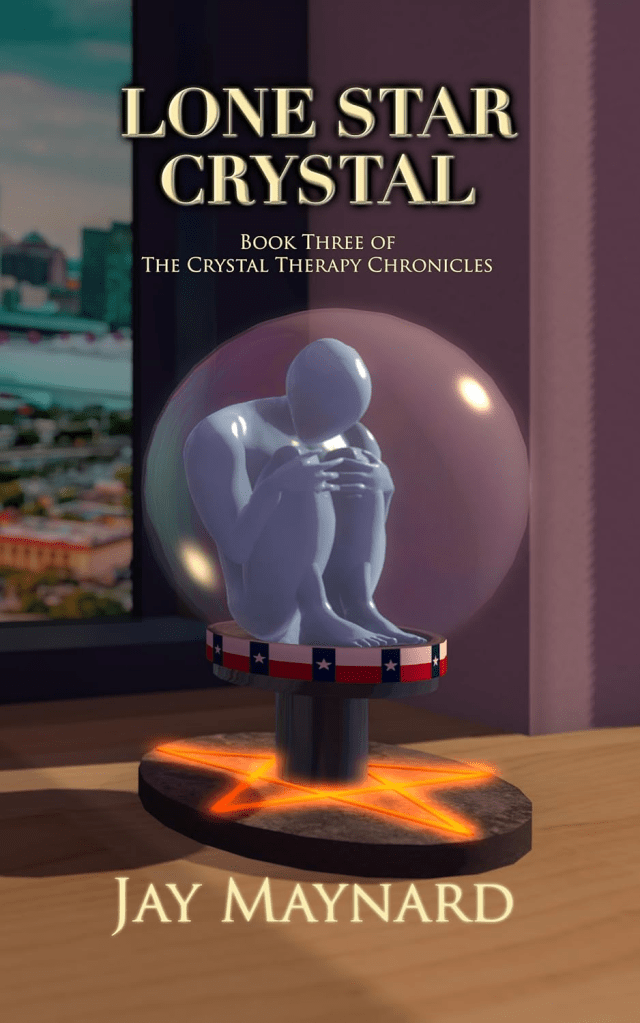
Magic heals. But can it survive the light?
Crystal therapy has transformed lives in rural Missouri and distant Wales. Now it is coming to Houston, rising at the heart of the Texas Medical Center.
CJ Hollister knows how to build things that last. He trusts foundations, schedules, and hard reality — not magic. But as the Texas Crystal Therapy Institute takes shape, he finds himself drawn toward something more permanent than anything he has ever built.
His daughter Rachel is a bioethicist trained to question power and defend autonomy. From the outside, crystal therapy raises troubling questions: permanent suits, new names, and a commitment that can never be undone. When her father chooses to step inside, professional skepticism becomes something far more personal.
The system works. The people inside it choose to be there. No one is forced to stay. But Rachel must decide whether consent is enough when the choice changes everything.
As the institute nears completion, father and daughter must face the same question from opposite sides:
What does it mean to choose a life you can never leave?
Lone Star Crystal is the third novel in The Crystal Therapy Chronicles, a science fiction series about healing, identity, radical choice, and the consequences of changing the world.
FROM RACONTEUR PRESS, WITH A STORY BY J. KENTON PIERCE: The Muse Within Us: An Anthology of Dark Fantasy and Horror (Raconteur Press Anthologies Book 77)
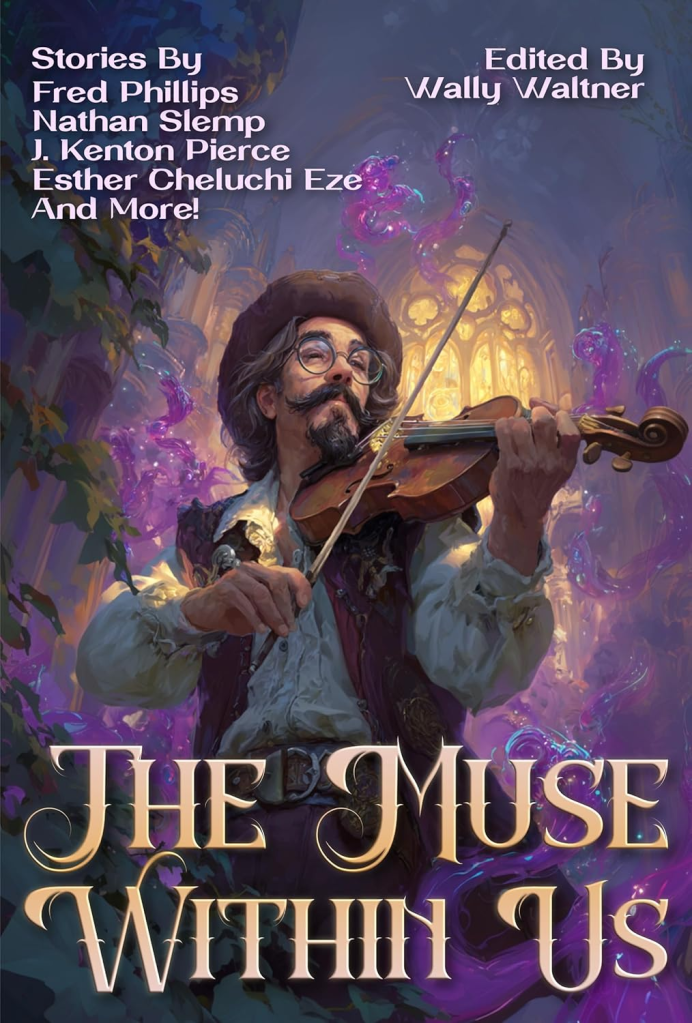
What happens when inspiration stops feeling entirely human?
Paintings that command armies. Songs that shatter crowds. Ancient poems that speak directly into an immortal ear. A revolver forged from the ruins of Earth, passed from hand to hand across generations, delivering justice with a chorus of the dead riding in its steel.
The Muse Within Us is an anthology of dark fantasy, horror, military science fiction, and literary speculation. These eleven stories all ask one question: does inspiration come from within, or are we tuning into signals already moving through the world?
Editor Wally Waltner has gathered writers from across the speculative spectrum. Within these pages: a sorcerer-seamstress transformed into a dragon by her masterpiece; a court prince whose animation magic revives a forgotten civilization; a musician haunted by crowd-controlling spirits called the whispers, carrying two hundred dead from one show; a Norse scholar who realizes he has been speaking ancient kennings directly into an immortal ear; and a war painter ordered by a god of war to paint ever bigger victories until he refuses and pays the price.Also here: a baker empowered by a minor demon of boiling oil trapped in petrified wood; a mason’s boy whose hands transform into the arches of a destined cathedral; a blues musician whose song outlives him through new vessels; a gunsmith on a dead Earth forging a revolver that carries a chorus of voices across centuries; and a young woman who discovers that flowers blooming where bodies fell grant strange artistic power at a terrible cost.Some of these muses are generous. Several are predatory. All of them change the people they pass through.
The Muse Within Us because what moves through you may have its own agenda.
FROM RACONTEUR PRESSES, WITH STORIES BY KARL GALLAGHER AND ROSS HATHAWAY: For Want of a Rivet (Raconteur Press Anthologies)
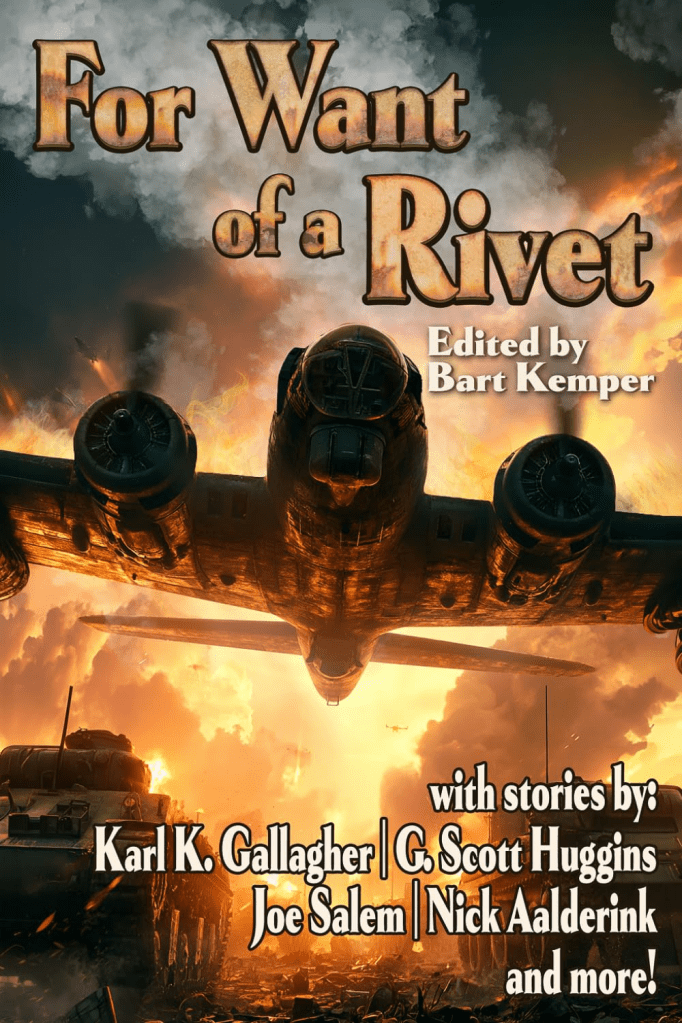
Small decisions. World-altering consequences.
That’s the premise behind For Want of a Rivet, an anthology of eleven alternate history military stories that asks one deceptively simple question: what if a single invention, tactical choice, or quiet act of courage had gone differently?The stories span a century of conflict and a dozen theaters of war. A Royal Navy pilot spots the German fleet and changes the shape of World War One. Air privateers carrying Letters of Marque dogfight over the Western Front while a brash young balloon-buster rewrites the record books. A Japanese naval officer quietly suppresses a breakthrough antenna technology that will shape the Pacific war. German engineers develop a submarine that makes the Atlantic a killing ground. British scientists discover how to bend the enemy’s own guidance beams back against them, and a stage magician helps make the resulting deception invisible. An all-Black paratrooper battalion that was supposed to be fighting wildfires instead drops into the Battle of the Bulge. A French Foreign Legion scout finds a Roman tunnel under the most heavily defended line in Italy. A Polish tank crew fights to hold the cork in the bottle as Operation Unthinkable opens. A SOE agent moves through occupied France on a prosthetic leg — and the rivet that keeps it silent may decide the war. Britain and Germany forge an uneasy alliance against Soviet France. Japan defends the Imperial Palace to the last man.
These are stories about the human cost of invention, the weight of small advantages, and the soldiers, spies, and engineers who never made the official record.
Eleven contributors. One question. For want of a rivet, the war was lost — or won.
Stories include: ”Wings over Jutland” (William Meinert) · “Ace of Aces” (Karl K. Gallagher) · “Radio Waves” (Joe Salem) · “The Danzig Ghosts” (Michael Patrick Coady) · “The War They Could Not Print” (Ross Hathaway) · “Little Groups of Paratroopers” (Bart Kemper) · “Callis Caecus” (Nick Aalderink) · “Operation Unthinkable” (Samuel A. Mayo) · “Cuthbert’s Silence” (D. S. Ligon) · “Axis of Alliance” (G. Scott Huggins) · “The Last Kamikaze” (Robert Miller)
FROM J. MANFRED WEICHSEL: Savage Headhunters
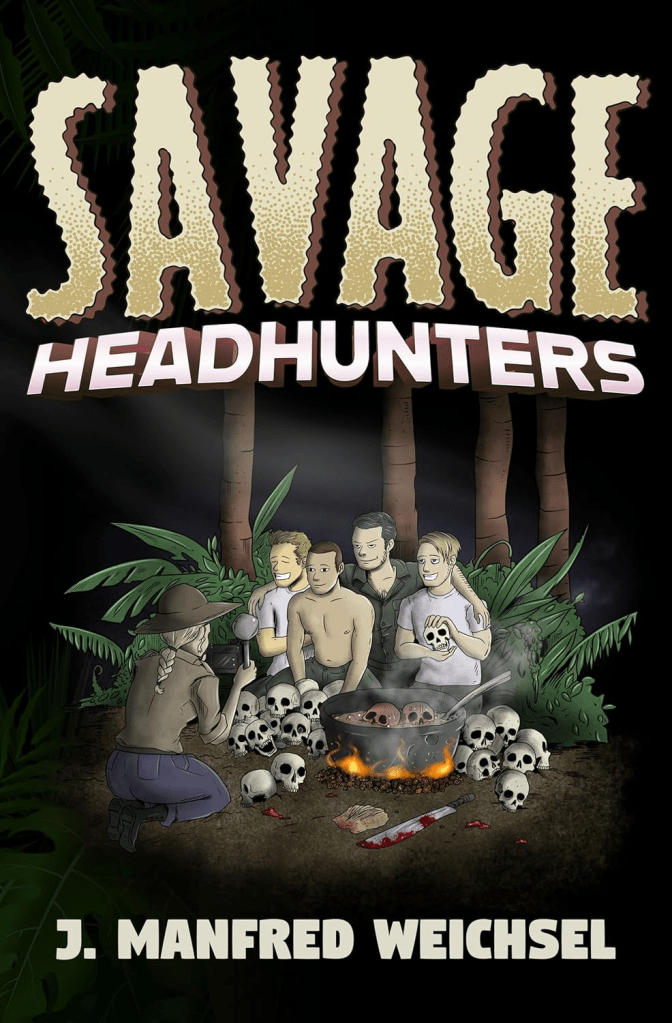
Based on a more-or-less true story of World War II
All World War II soldiers Brian and his pal Jefferson want to do is collect the skulls of their enemies. Their exploits are captured on film by Abigail, a hot female war correspondent, and they become celebrities back home.
But one day Abigail, jealous of the attention Brian and the other men are getting, has a picture of herself with a skull published in Life magazine. The American public is outraged, and when the American public gets outraged, they demand blood.
Who will live and who will die in this gory, grotesque satire from the subversive author of Action Girls: Triple Threat, Ebu Gogo, and Five Maidens on the Pentagram?
FROM LEE ECKHARDT: SECRET OF THE LOCKED CITY: A Novel of Mars and its Canals
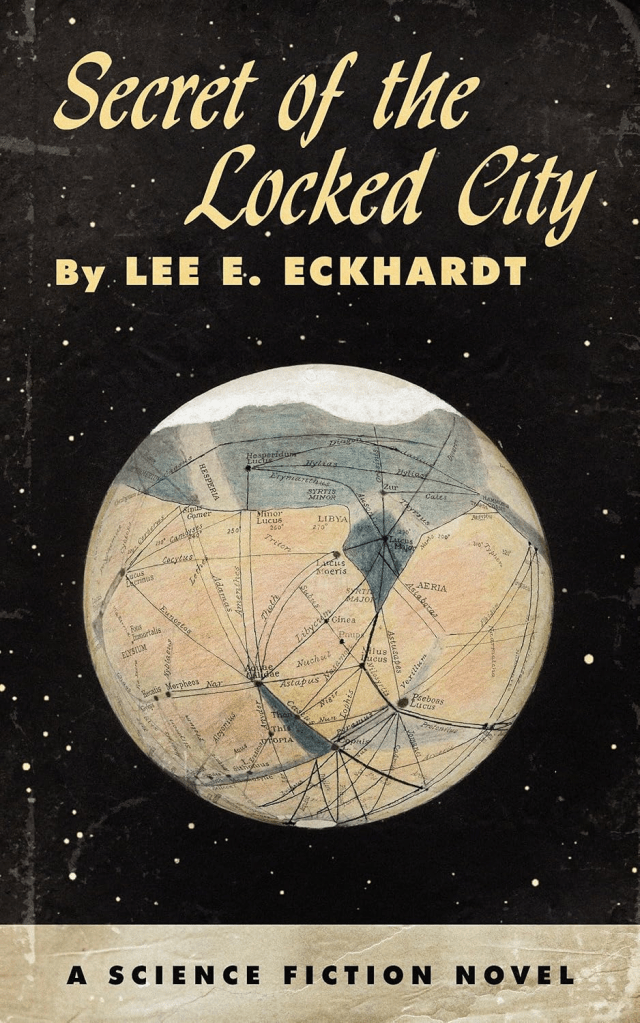
Nineteen-year-old Cyril Michael Haskin is the youngest NASA astronaut ever to set foot on Mars. Through an incredible series of events he finds himself transported – not across space, but across dimensions – to another Mars, a completely different Mars from the one he knows, a Mars crisscrossed with canals built by a long-vanished alien civilization.
There seems to be no way to get back home – until he learns of the Locked City in the Syrtis Major region, the only Martian structure Terran colonists have been unable to enter, a place some believe to be still inhabited by the Old Martians. Cy becomes convinced that he must reach the City, but is prevented from doing so by the authorities, for he, the young man who appeared out of nowhere, finds himself under the increasing suspicion that he is actually a Martian sent to spy on the colonists.
Along with three new friends he sets out for Syrtis Major, braving the perils and terrors of this savage Mars to reach his goal, not knowing if he can even gain entry to the City, much less find a way home.
Will he be able to solve the Secret of the Locked City?
FROM SARAH A. HOYT: No Man’s Land: Volume 1 (Chronicles of Lost Elly)
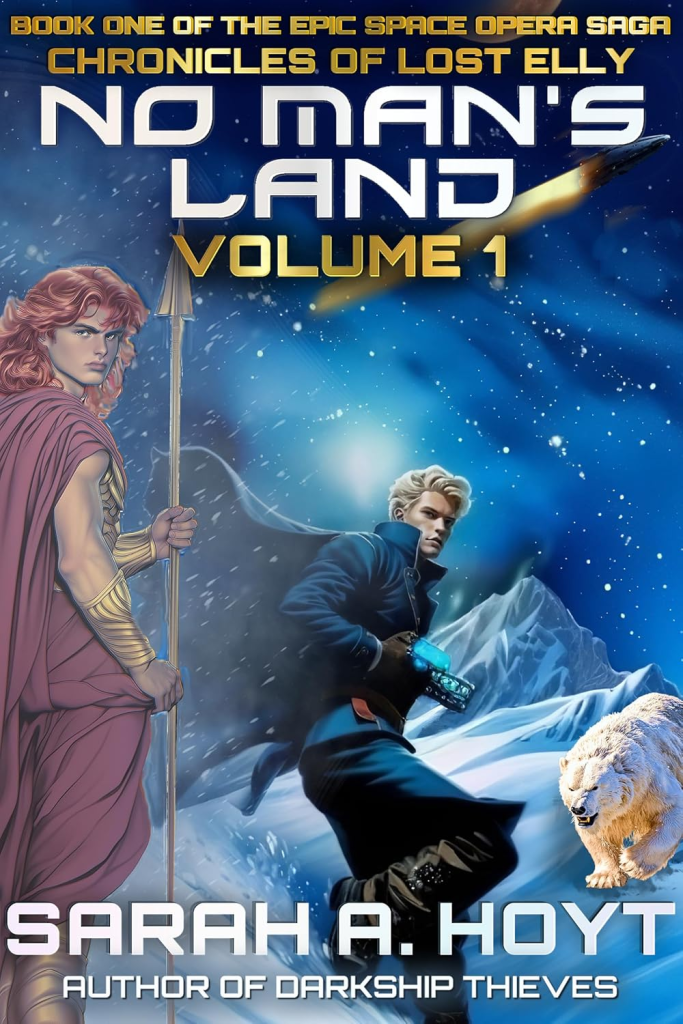
Sufficiently advanced science is indistinguishable from magic.
On a lost colony world, mad geneticists thought they could eliminate inequality by making everyone hermaphrodite. They were wrong. Catastrophically wrong.
Now technology indistinguishable from magic courses through the veins of the inhabitants, making their barbaric civilization survivable—and Publius Cornelius Scipio Africanus Kayel Hayden, Viscount Webson, Envoy of the Star Empire—Skip to his friends— has just crash-landed through a time-space rift into the middle of it all.
Dodging assassins and plummeting from high windows was just the beginning. With a desperate king and an archmagician as his only allies, Scipio must outrun death itself while battling beasts, traitors, and infiltrators bent on finishing what the founders started: total destruction.
Two worlds. One chance. No time to lose.
FROM FRANK HOOD AND S. T. GAFFNEY: That Has Such Creatures
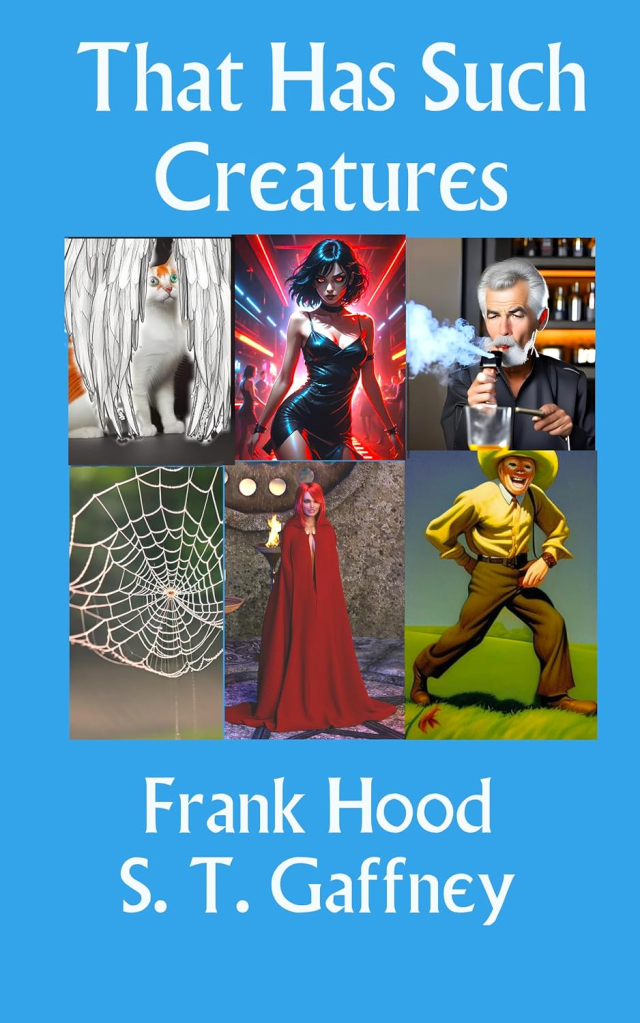
How does a man find home when nowhere and everywhere is home?
An aging rocker sets the record straight about his controversial career and unknown love.
Why does a humble mixologist in a vape shop think he has the right to claim he saved baseball?
A young man catches a leprechaun who changes his life in a most unexpected way.
A wandering wizard and his young apprentice are tasked with performing a secret and dangerous task for a powerful king.
Six years after his friend’s death, Charlie Moore finds a document that may lead to terrible consequences for all those who have connections to the late, rich, and eccentric David Larkin.
A cat is offered a chance to protect his mistress from a mysterious creature.These are a few of the short stories in this collection that range from science fiction, fantasy, and horror to mystery. The husband and wife team of Frank Hood and S. T. Gaffney serve up a book full of mostly fictional stories, and a few that might just be stranger than fiction.
“Very much enjoyed DARKNESS, DARKNESS.” Ray Bradbury
“The man knows how to write a sentence!” Harlan Ellison
FROM LEIGH KIMMEL: Time Enough to Spy
A spy has at long last come in from the cold — but all is not as it seems. The longer his debriefing continues, the more uneasy he becomes. In particular, how can he reconcile his presence here with the impossibility of both rescue and escape from a polity with the power to remodel the bodies of their subjects at will?
What secret hides behind those cool professional faces of the agents who briefed him so long ago? Has he been induced to betray all he was sent to protect?
A short story of the Madrian Empire.
FROM NATHAN C. BRINDLE: I’m The Beautiful But Evil Space Princess Who Rules A Galactic Empire But Really Wants To Leave People Ruthlessly Alone!: Volume 1
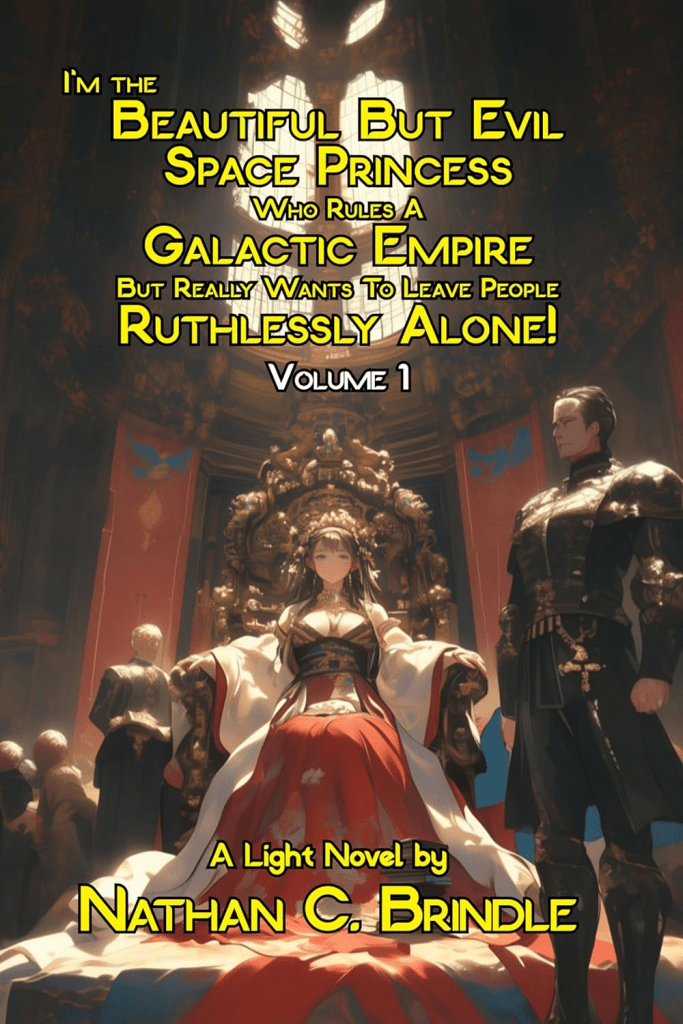
Alice is the Imperial Princess Regnant of the Galactic Empire. At 22, she has been thrust into power after her father (the Emperor) and her two older brothers have all died in various ways. Her Imperial Chancellor, Lord Rupert, does everything he can to support her, but has somewhat different ideas about how the Empire should be run than did his late Emperor.
Alice has one major problem: She cannot be crowned Empress Regnant until she marries and produces an heir.
But Alice, being kept busy three days a week by interminable audiences with petitioners, and the rest of the week with what she terms “mostly busy work”, has no real way to meet young men — well, reasonably eligible young men, anyway, and of her own age — with whom she might eventually take up and form a household. And she chafes at the necessity of trying to rule, hands-on, an Empire so huge it cannot be truly ruled by any one person to begin with.
She just wants to leave people alone, as her father and his predecessors did for centuries.
Then, into her life walks the Crown Prince of a planet many, many parsecs away from the Capital Planet…and her life begins to take on a life of its own…
FROM SARAH A. HOYT: Witch’s Daughter (Empires of Magic Book 2)
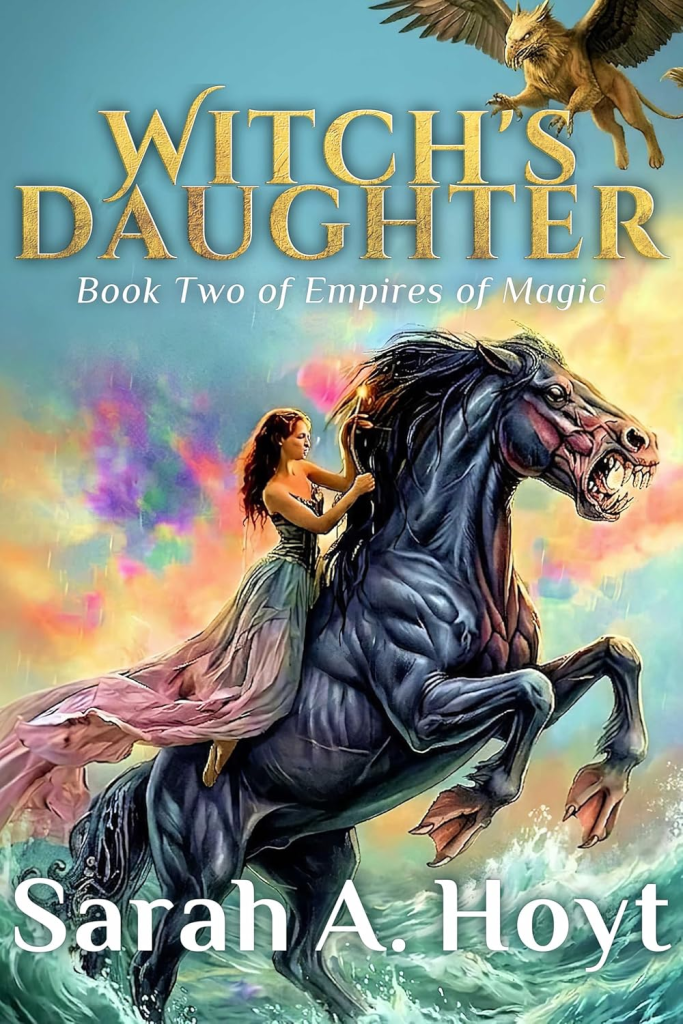
FOR SOME REASON AMAZON IS PLAYING SILLY GAMES WITH THE REVIEWS FOR THIS BOOK, WHICH I THINK IS AFFECTING SALES. IF YOU’VE READ IT, PLEASE REVIEW!
Some letters come from the living. Some come from the dead. This one comes with a formula that turns a rowboat into a miracle.
Seventeen-year-old Lord Michael Ainsling — youngest brother of the Duke of Darkwater, builder of mechanical marvels, survivor of fairyland — receives a letter from a man sixteen years dead. The inventor Tristram Blakley has not perished; he has been imprisoned by his own genius and begs the one mind in all of Avalon brilliant enough to understand his work to set him free. All Michael has to do is find seven missing brothers first and walk a magical path..
Fifteen-year-old Albinia Blakley has spent her whole life under her mother’s iron thumb — and her mother is a witch. The day Al finally escapes down a rope of knotted sheets, she lands in a world she doesn’t recognize, with no money, no magic kit, and no idea that the stranger who catches her is about to become her greatest ally.
Together, a girl with more secrets than she knows and a boy who builds machines that try to murder him must outwit a sorceress, navigate the treacherous courts of Fairyland, and unravel an enchantment years in the making — before a family is lost for good.
Witch’s Daughter is a gaslamp fantasy brimming with wit, warmth, and wonder, for readers who love their magic wrapped in velvet and their adventures served with morning tea.
FROM JOHN BAILEY: Book I The Glass Constellation (The Calibration Fall Trilogy 1)

At the height of interstellar civilization, humanity and its allies have achieved what earlier ages believed impossible: instantaneous communication across light-years, perfectly calibrated faster-than-light transit, and seamless cooperation between hundreds of worlds.
Then the measurements begin to fail.
A military reconnaissance squadron disappears despite flawless telemetry. Manufacturing systems produce identical components that no longer behave identically. Communication relays return contradictory timestamps from the same transmission.
At first, the anomalies are dismissed as statistical noise.
But when a catastrophic trinary stellar cascade destabilizes the hidden constants underlying interstellar technology, the great network binding civilization together begins to fracture. Navigation diverges. Synchronization collapses. Entire fleets lose agreement on shared space and time.
As governments struggle to preserve order, scientists and archivists race to understand a terrifying possibility:
The universe itself is drifting out of calibration.
Caught between political denial, military desperation, and the accelerating collapse of physical certainty, humanity faces a crisis unlike any war or invasion in history. The enemy is not a hostile species or empire.
It is the failure of reality-dependent civilization itself.
The Glass Constellation is the first volume of The Calibration Fall Trilogy—a sweeping hard science fiction saga of collapsing interstellar order, drifting physical law, and the enduring struggle to preserve meaning in a universe that no longer agrees with itself.
Perfect for readers of:
- Foundation
- Dune
- Revelation Space
- A Fire Upon the Deep
- Hyperion
FROM KAREN MYERS: Bound into the Blood – A Virginian in Elfland (The Hounds of Annwn Book 4)
Book 4 of The Hounds of Annwn.
DISTURBING THE FAMILY SECRETS COULD BRING RUIN TO EVERYTHING HE’S WORKED SO HARD TO BUILD.
George Talbot Traherne, the human huntsman for the Wild Hunt, is preparing for the birth of his child by exploring the family papers about his parents and their deaths. When his improved relationship with his patron, the antlered god Cernunnos, is jeopardized by an unexpected opposition, he finds he must choose between loyalty to family and loyalty to a god.
He discovers he doesn’t know either of them as well as he thought he did. His search for answers takes him to the human world with unsuitable companions.
How will he keep a rock-wight safe from detection, or even teach her the rules of the road? And what will he awaken in the process, bringing disaster back to his family on his own doorstep? What if his loyalty is misplaced? What will be the price of his mistakes?
Vignettes by Luke, Mary Catelli and ‘Nother Mike.
So what’s a vignette? You might know them as flash fiction, or even just sketches. We will provide a prompt each Sunday that you can use directly (including it in your work) or just as an inspiration. You, in turn, will write about 50 words (yes, we are going for short shorts! Not even a Drabble 100 words, just half that!). Then post it! For an additional challenge, you can aim to make it exactly 50 words, if you like.
We recommend that if you have an original vignette, you post that as a new reply. If you are commenting on someone’s vignette, then post that as a reply to the vignette. Comments — this is writing practice, so comments should be aimed at helping someone be a better writer, not at crushing them. And since these are likely to be drafts, don’t jump up and down too hard on typos and grammar.
If you have questions, feel free to ask.
Your writing prompt this week is: MONEY


Money’s tricky in an interstellar polity. Sure, the Chongu have superluminal travel and communication — but the technology requires slipping ever so slightly into paratime, which complicates everything. So even with quantum keys to lock negotiable documents against manipulation, there’s a non-zero risk that the transaction could become distorted or rendered impossible by sliding into an adjacent timeline that’s just a little too far away.
That means the risk of every transaction between systems is higher than even lightspeed-lagged transactions across interplanetary distances within a system. The mathematics for figuring it involves some seriously heavy hypercomplex numbers, and according to the physicists I’ve talked with, no, they’re not just shortcuts for math that’s just more cumbersome with real numbers.
But I can tell you that the effects on prices are very definitely real.
LikeLiked by 2 people
“They say that money is the root of all evil, so to make the world a better place, we must destroy all of the money”.
“Sorry George, but it’s the “love of money” that’s said to be the root of all evil. And since I believe that St. Paul meant “love of possessions” you got a major problem especially since I know how much you love your Teddy-Bear.”
LikeLiked by 2 people
Remember, o Readers, that you can be FORCE MULTIPLIERS!
When you read books, you can rate and review them.
Even short reviews are of aid to the writer, because sheer mass helps. (And if you really can’t review, still rate.)
LikeLike
On a personal note, if any of you feel moved to rate Sylvie’s Escape on Amazon, I would appreciate the counter to the one-star rating.
LikeLike
“Well, then,” said Princess Katherine, “it is well to know that. Money can not buy the safety that you can win me with that spell. I shall have to get you a purse of silver for your work for me.”
“Shall we soon approach a fair where I can spend it?” said Clara.
Princess Katherine laughed, and Clara wondered what, exactly, she had sounded like, but she smiled.
“Oh, no, there shall be few times to spend it soon.” The princess subsided. “I shall have to remember that purse of silver, for a fair, or a city, when it comes.”
LikeLike
“Mister Laramy, what is ‘fiat currency’?”
Crap. The prof must have seen me resting my eyes during his lecture over the virtual link from Ceres U where he was lecturing in person. I actually thought I had put up an AI animated sim of my face showing rapt attention. Maybe it was not as effective as I had thought. Okay, you’ve got this, Jimmy. You read the assignment.
”Money that has value by ‘fiat’, or government decree, rather than being backed by a physical commodity such as rare metals,” I said after unmuting manually from my end, noting the prof had already unmuted me on his end as well. There was a slight delay as my signal crossed the distance back to Ceres, and then as his reply returned to our ship.
”And what caused the end of fiat currency?”
Given what my family’s ship actually did for a living, this one was easy. “Asteroid mining. The flood of metals from even the earliest space resource extraction operations destroyed the underlying economic assumptions that Earth governments had counted on to restrain competing national fiat value edicts and prevent preposterous exchange rate proclamations. After the Economic Chaos Years, the Malta Accord agreements returned the concept of money to a commodity basis, indexing to the rarest metals in asteroid mining yields, which initially were the platinum group metals.”
”Very good. Ms. Oren, what effects did the Cerberus Strike have on the monetary policies of both Earth and outsystem governments?” Thank goodness Professor Zhang’s baleful gaze had moved on, to Mary Oren over on the “Fairly Obstinate”. I hard-muted my mic, left the video actually live with no filters, and tried hard to keep an attentive look on my face for the remainder of the lecture.
LikeLiked by 1 person
I opened up the briefcase and saw bundles upon bundles of bills, holographic watermark and RFID tags instantly showing up in my vision.
No matter how much people try to end it, physical cash money will always have a place because nobody wanted to let anyone know what they bought. ATHENA made the clicking sound that she used as a low whistle and said, That’s nearly a hundred thousand talents in hard currency. Openly carried, so not a money mule.
LikeLike
“It’s really very simple,” said Clem. “We act like addlepated yahoos, the Martian tourists come, we give them pretend moonshine, and they give us money.”
“If you don’t mind abandoning your dignity,” grumbled Delbert.
“Pick what you want to abandon, then,” said Clem. “Dignity or grad school. It’s your choice.”
LikeLike
Time travel and money don’t mix. It’s a lesson I learned on my first timeslip.
Even period-correct counterfeit currency of the highest quality is not to be trusted. There’s just too high a risk of landing in an adjacent quantum reality where Ben Franklin is reviled rather than revered.
LikeLiked by 2 people
Bon looked at the fat pouch he’d pulled off the body’s belt with distaste. “I don’t care for the thought of robbing the dead,” he said, “But given the months this – person – kept me locked up in that tower, I’ll be glad to make an exception.”
LikeLike
Two silver crows a day. Plus expenses.
Two silvers was a lot to some people. Pocket change to others. A rounding error to the truly profligate or blessed. But to others? Two silvers a day plus expenses bought answers. Sometimes the kind of answers that couldn’t be had anywhere else.
The job was a simple find and fetch. Supposed to be simple. Item got lost in a park or the theatre. Heirloom, sentimental value they said. Not worth pawning but well loved for the memories, they explained. For a wedding to be held within the week. Promises to keep and all that.
Standing up from yet another bloody corpse it was becoming clear that there were lies and then there were Lies. Bigger ones.
The fat man hadn’t been dressed for the weather. Cheap suit with a bit too much starch. Knife in his waistcoat never drawn. No defensive wounds. Big messy hole in his stomach, like something reached in and dragged out all the goodies and gobbled them down. Blood splatter was being washed away by the rain, but the droplets that splattered the opposite wall told a tale of their own.
Now lycanthropy gets a bad name around these worn out streets, but the local pack is old enough and strong enough not to tolerate this sort of shit on their turf. This sort of thing sets a bad precedent. Even now the blood scent would be waking up whoever was closest.
Tick tock went the clock. Two silvers plus expenses walked down the alley to its end. Eased the loose boards out of the way and ducked into darkness.
The pounding rain on the steel roof erased all sound in a wall of white noise only broken by the erratic boom of thunder and crack of lightning. No light. No sound. The smell of sawdust and grease and underneath that a coppery wet scent just barely noticeable to a Gifted nose.
The loose boards shifted again.
“Arlen.” The shaggy half man, half wilder spoke softly, without the growl or lisp that the new bloods used.
“Ben.” Ben was an old veteran of the pack. Not so old as to be relegated to training kits and watching the docks. Not so young as to be foolhardy.
The two prowled through the old warehouse with the ease of long familiarity. Blind and deaf did not matter. Other senses did the work. The trail was getting warmer.
“Blood trail,” Arlen said softly.
“Fresh.”
“An hour. Two at most.” He didn’t need to see the nod to know it was there.
Following the trail was the work of a moment. The problem was it disappeared down a storm drain. The bigger problem found them when it dropped down from above.
LikeLiked by 2 people
From personal experience: If you are good enough to leave our hostess a review, keep a copy in case Amazon loses your review completely.
LikeLiked by 2 people
“Fiat currency is unworkable in an economy that includes nanotech. No matter how many security features you build into your money, duplicating them with nanotech is trivial. Which brings us back to those old standbys, silver and gold. Nanotech can’t transmute elements, meaning rare metals represent a fixed supply of money that can only be inflated by mining more — and mining is a productive endeavor. Making it anathema to the sorts of political parasites that seek to print their way to prosperity.”
LikeLike
Bon looked at the fat pouch he’d pulled off the body’s belt with distaste. “I don’t care for the thought of robbing the dead,” he said, “But given the months this – person – kept me locked up in that tower, I’ll be glad to make an exception.”
LikeLike
(Part 1/4)
“So, Arthur, are you settling in to the natural ebb-and-flow of our local life yet? I know coming from Earth for a visit then turning yourself into a sudden refugee had to’ve been… jarring.” She took another sparing sip of her amber-honey-colored sherry, smiled as she looked all around them at busy street scene and towering rocky quasi-urban walls on either side. All of it now bright in the (muted-seeming, at least to him) lowering sun.
“It’s different, I’ll grant you that. Likely the biggest thing is simply not being able to enjoy the far distances — I mean, unless you go up on the surface, I mean, outside the ‘domes’ where you have to wear a suit and mind the grays all the time, I mean the cosmic. Or look precisely down the length of the street.” Arthur Denton took another drink of his own coffee; real coffee, grown on high-hillside slopes… so it was said, to outsiders like them… of a well-terraformed crater under a wide flat roof, a place he’d likely never be allowed to visit anyway. Mars’ single great human and cultural divide, Settlers and Formers. Regular people, if of a different bent than so many at home; vs. people with machines in their heads, too.
Here was a sort of buried street, between ‘cliffs’ of deep-cut rock; under a tented greenhouse window of heavy glass and plastic, filled with a few feet of water for long-term radiation shielding. Water, tinted a bit away from its natural blue to seem almost colorless. Street and sidewalk cafes and roadside trees below, story upon airy story for maybe a hundred feet down. Lovely; almost like Italy, as he’d visited it once, before the new World State had metastasized stiflingly across so much of the globe.
“Even not having any close relatives or romantic entanglements to worry after, I’d not likely have had the courage, Miranda, without them sending that — ugly fleet of scary gunboats at us here, just a few months after I arrived. But after that, I found I needed to… find myself a good place to stand on.” Another mindful drink of his black, excellent, rich coffee.
“Never think we don’t appreciate it, Arthur. You’re really good at the sort of machine-assisted software engineering you do, and it helps us greatly.”
He looked at her, a little oddly. “Nothing to what the ‘Formers could do, with their, hm, not-so-natural advantages, I am somehow very, very sure.”
Miranda Lake laughed, not muffling or stifling it. Like tinkling silver. “You’d be about the only one secure in such a certainty. While they can do things of most-amazing novelty, like that X-ray Cherenkov plate, it’s very often quite obscure exactly what they do, on their own side of things.”
Arthur looked a question with his eyebrows, then said, “That’s actually not one that I’ve heard of. A matter-plus-field crater roof a dozen miles across, man-machine integration, paraterraforming of square miles, sure. Mere Cherenkov-effect detectors for X-rays sound very tame next to that.”
She laughed again. (Somehow she reminded him irresistably of a character from an old book series from his youth; though Sarah Zellaby was far more and other than human, and Miranda was… simple scary genius.) “Detectors we’ve had. Imagine a lump of cesium-137 or something. You can put a sort of solar-cell device next to it, and make electricity, until the radiation damage to the crystal lattice wrecks that effect; in days at most. Even if your semiconductor junction cell is made of diamond instead of silicon.
“Or, you can put one of those little things between; and the electrons go through that, give up most of their energy to X-rays that are absorbed in the silicon or diamond, and almost none of the atoms get displaced. Same for the gamma rays — those can make defects also, believe it ot not, even from photon recoil — they get down-converted to X-rays, too. Clear, what looks like plastic, about the thickness of… one of your credit cards. It happens to be pretty good at converting cosmic rays too, on a very small scale.
“Of course, it’s not plastic; not even strictly ordinary matter either. And if you ever get to see one, you’ll love their handheld fission lamps; the reactor filament’s core is made of what amounts to ‘collapsium’ that just happens to be fissile, too. All done with electron stacking.”
He sighed. “I do miss credit cards. Used to pay for just about everything, that way. Now, I have to handle raw money, and it’s all so complicated.”
LikeLike
(Part 2/4)
She chuckled, and bit into another wafer of shortbread. “There are people back on Earth who have never shown their kids what it is to buy something using real money, actual exchange of value, no computer nets or blockchain hashing involved. I’m sure they think they’d be lost without a ‘net, could never figure out how to buy so much as a peach at a roadside stand, else.”
(Yes, they did have roads here. Which ran, very frequently, through tunnels, almost always with inhabited side branches.) Her voice was subtly chiding, but far short of nasty. “And of course, the biggest thing, you can’t buy so much as a pack of gum without leaving a hard digital audit-trail. Bah. Strangle that’n in its cradle, swift.” She took another sparing drink of her sherry, another slim bite of that plain, pale, delicious shortbread.
“What’s especially confusing is the different currencies. None of them are quite money in the older sense, you know, government issue, from a single source. ‘Backed by the full faith and credit of the United States’ — back when there was a United States, of course.” He fell silent, with that sort of lost look on his face. She’d come Out Here as a child; but still she understood. And simply waited a decent pause while the moment passed.
“You do of course know how to run the on-line converters, and how values vary with time.” She shoved the basket of chips with their dish of salsa invitingly (even hintingly) a ways in his direction. Her voice was mild. And of course, indeed he did know; he’d programmed a few of ’em himself.
“Oh, for heavens’ sake, yes. It’s the underlying idea, how money itself is subject to fluctuations in its value, or rather the different kinds are. Like trading stocks on a market, every single time you buy or sell.” He’d taken the hint and dipped a chip already. (Odd, but she’d found how strong spice seemed to distract the grieving mind from that particular sort of loss, as long as its particular spiciness was somehow redolent of ‘home.’)
“You know everything is based on commodities, right? Always was, when the money in question was (underneath it all and fundamentally) worth anything in particular, right on down to the old-fashioned ‘gold standards’ — hard to justify as those are now, what with asteroid mining.”
Arthur paused with another corn-chip halfway to his mouth. “Maybe you can explain that one to me. Is it simply how easily accessible metals are, out in the asteroid belt with those busy Belters on the job?”
Miranda waggled a hand. “Not only that, though it helps. Funny thing about gold and a few other elements, they’re what they call ‘siderophilic’ as in they like to hang out with iron. Which means on a planet like Earth, or to a lesser extent even Mars, they mostly end up down in the core. As in, two thousand miles” (she pointed straight down) “thataway. Twice or nearly as far, inside Earth. None too accessible; and so, pretty rare up here.”
Another tiny little sip of sherry, taken almost musingly.
“But out in the Belt, at least for the rocks that used to be part of large enough ‘parent bodies’ as they call them, that stuff that fell down into a core is right out there floating in space. Some metal rocks are around a tenth of a percent gold, and so forth. Only a by-product from getting the nickel and the iron, sure enough; but an immensely well-paying one.
“So the ‘gold standard’ wasn’t going to happen here, no way no-how. And of course there’s proven reserves of ice, whole glaciers of it, which in turn means five-times-Earth deuterium for fusion or fission moderators; and all despite our weird land-ownership laws, reserves of either tract-right land or true outright-owned land.” Miranda shrugged. “Please don’t ask me to explain the mess the Outer Space Treaty and the Artemis Concord left of land ownership Out Here, off Earth, that’d take another lunch or two. And never mind that Amended Moon Treaty flup the World State just pulled off, that assigns ownership in perpetuity of all land off Earth to some United World Nations ‘Authority’ — that’s all bunkum, top to bottom. But look up ‘Lockean homesteading theory’ on the zero-net, if you’re curious, that’ll get you well started on how it is out here, really.”
Arthur smiled, lopsidedly. “Another thing I’ve had to get used to. Back at home there’s only the one Internet or ‘Net. Singular.”
LikeLike
(Part 3/4)
She laughed, outright, again. “They only want you to think that; there’s a whole other level for Statey ‘crats, and their military, and on and on. If we’re much different to that model, it’s only in how we recognize there’s levels and levels to our network’s public-ness or lack thereof right out loud, and call our zero-level public ‘Net what it is to make the point.
“And, before anyone starts to bemoan ‘fiat currency’ to you, you ought to know we allow that, too. Lots of economic functions work better, or maybe seem to work well at all, if people like the Banking Cartel can make up their money out of thin air. But look up ‘minimum required reserve ratio’ from the old pre-State and pre-computer days, and see how we at least do require (in most kinds of money at least) that it be backed by something, some decent fraction of the way.” There was a flutter of wings, and they were dive-bombed, but only at a courteous distance, by a pair of birds.
Miranda smiled. “Ah, dogfights; do love the territorial integrity stuff.”
But something had clenched at Arthur’s heart, at that. “So, what do you think of our chances, to keep ours?” He said it low, like anyone who’d lived long under the World State tended to do, and do almost by instinct, maybe even learned reflex. At least his voice hadn’t gone fearful, too.
Miranda smiled, slowly. Not looking like a yawning cat; but still on some deeper level — seeming so like that. “Like everybody here says, once in a long while and sooner or later, Mars is the planet of war. Now, you know simply from being here only a couple of months that we’re not always going ‘to see the elephant’ here, nation-against-nation over and over around and around. It’s not like that; usually our disagreements are either resolved by direct negotiation or by the heavy mediation of the Intercongruency.”
“The what? I don’t think I’ve ever heard of that.”
“The closest thing we have to a world government. Which is mighty little, and mighty weak, unless people contribute money or troops or materiel to that particular cause of action. So the Cong — yes, that’s what we call the Intercongruency most of the time — does what it does only with a lot of specific support, and has to do it within the Declaration of the Rights of Man, too. Most smart people and nation-city-states never go so far.”
And she smiled, that way, again and even clearer. A carnivore’s old and true smile. “But when it comes to it, we know how to fight, we just do and we play at it like kittens, often and for fun. Like kittens learn. And when and where some dumpcave out in the middle of nowhere tries to isolate its people, or raise and keep slaves, or whatever — we send in the teams, and it gets cleaned up fast. Nobody deserves evil stuff like that.”
The glow of it lit her eyes, like firelight did the night, camping, once. Like red coals glowing in a campfire’s bed; like fell Mars at opposition blazing balefully in the skies of Earth. And the heat of it felt like the radiant heat from a well-stoked stove. Miranda Lake, one of the levellest people he had met, ever… yet it felt like ordinary reality was… distant.
And Arthur remembered feeling what he did, now, once upon a time down in Little Byelovodye; a few people telling him about Russian culture here, a new and unfamiliar thing they called krasnovery — ‘the red faith’ more or less — with the ‘red’ part being Mars, not some old Soviet slop. And he’d slowly understood it as a kind of meta-culture, common not only to a city-state named after an old legendary Russian quasi-paradise, but also to pretty much everyone on the Red Planet. At least, allegedly.
Now, he met it again. Krasnovery. The shared faith, of people who were, when and how it really counted, truly one people together. And he could not help shuddering a bit, as old fictional-song words came back to him:
“They little knew of brotherhood, the faith of fighting men,
“Who once, to prove their lie was good, hanged Colonel Jacques Chretien.”
And, she asked why he shuddered; and bashfully, mumbling something first about tunes and buckets, he sung maybe eight lines, more or less right.
LikeLike
(Part 4/4)
Ah, yes, Dickson, I’ve read about that song. Nice.” Now that smile upon her face was really just like watching a cat yawn wide. No nicety in it.
“‘Look down, look down on Rochemont Town.’ While you can, at least.” She raised her glass, as if in salute, took a measured wistful drink.
The guardrails on Mars were wide and low, yes. But they carried 600 volts.
“Any predator species,” she was saying meditatively, “has to be able to limit its own capable aggressions against its own species, or it cannot long survive. That’s what so many outsiders don’t understand, about us.”
And Arthur thought of common house cats, prolific predators fully capable of overcoming and destroying whole existing ecosystems. Yawning, then not. Asking next to come over and sit in your lap and share your companionship.
Because they felt something in common with humans, ultimate apex predators just alike. Maybe we can compare some tricks, later. Us killers.
Of course humans were omnivores, really, not obligate carnivores like cats were. That only means we’ll eat anything that’s worth eating and will stand still long enough to allow it. Oh, right, shoot it and roast it and then it will stand still for you, plenty well enough. More sauce?
And then she smiled a very different smile, and that impression of distance and fiery, inner light — simply faded. Only, once glimpsed, never to be forgotten. “But of course, hopefully it’ll never come to that. Earth is so big yet fragile, and we’d like to keep it whole. Only, without the scourge of a — rotten rancid evil dumpcave, grown to twice the size of our whole planet.”
What was it Dickson said, maybe in the same book, about his warriors? That they knew how to move off into a ‘high, hard, cold and stony land’ at will or need, one theirs alone, then come right back to daily life just the same? A land a ‘mere’ man from Earth could not know how to reach?
“And now you’re one of us, Arthur, you’ll be expected to join in, or at the very, very least to hold yourself well out of the way. That fleet is halfway here, now; and their World State’s little Armada ain’t likely to be coming over for… tea and sherry and shortbread, or coffee and chips and salsa neither.”
And he found himself smiling, what felt a little like her own smile, from before. “What’s that old saying about having an itch you can never scratch, except now, suddenly, you can?” Or maybe it was a wolf’s smile, he felt on his own face, rather than a cat’s. It was strange, yet… oddly agreeable.
“Sometime soon I, that is to say we, might have a project more substantial yet right up your alley. Something like accounting, only… applied to a more basic and physical thing than ‘mere’ money.” She tossed a few small gold coins on the table (Belter gold being as abundant as it was), and got up to leave. “Take your time, Arthur, don’t rush what’s left of your meal and this lovely afternoon, and I’ll be in touch again quite soon.”
Keeping track of what happens, chemically and isotopically, when 100+ MeV neutrons from matter annihilation hit what’s around them really is a precise sort of accounting. And if we can get our so-called ‘Keeling-Lake device’ upscaled from a piping-hot neutron source to a nice rocket engine suitable for ships of commerce or war — well, we’ll need an accountant programmer for sure, to simulate the material impacts in detail, now won’t we?
Miranda turned back around, gray skirt twirling with unconscious grace. A warm smile again, then “We’ll make a true-red Martian of you yet, Arthur McNally Denton. Just you wait and see.” And winked.
He smiled back, and toasted her with more excellent crater-grown coffee.
(Based on some pre-existing setting and characters.)
LikeLike
I’m late, but thanks for the promo! I needed new reading material!!!
LikeLiked by 1 person