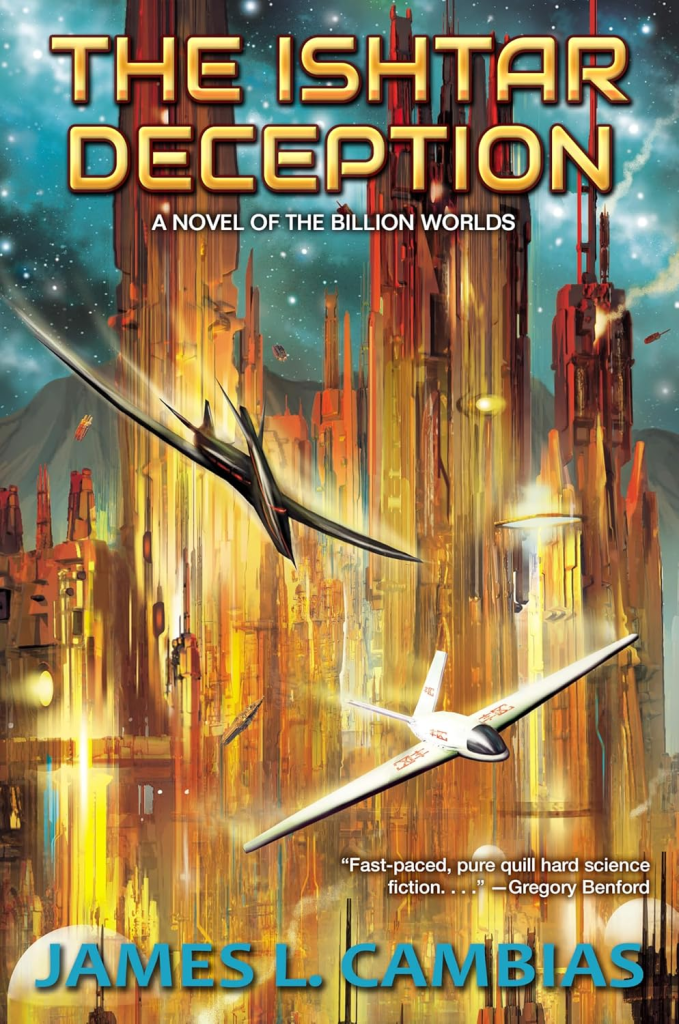
High school English teachers get obsessed with fairly minor aspects of literature. One perennial favorite is “Theme,” and this leads to hours of frustration in class as teachers struggle to make a room full of bored students understand — let alone care about — the theme of a story. Moby Dick is about Man versus Nature, or the sin of Pride, or the nature of obsession, or some damned thing like that. The Great Gatsby is about social class, or the nature of identity, or the moral corruption of the 1920s, or maybe about giant eyes watching you.
The students come away convinced that literature is either filled with hidden secrets they’ll never be smart enough to understand, or that literature is full of plonkingly obvious messages and it’s a bunch of hooey not worth understanding.
The funny thing is that English teachers — and let me note here that my experience was in a very good school with amply qualified teachers — focus on theme and message but ignore a lot of the mechanics of telling a story. I don’t think any of my English classes talked about dramatic structure, or narrative voice, or how to create a scene. It’s as if we were studying automobile repair and the instructor spent all his time telling us about different kinds of fuel injector systems without really going into why you need fuel in the first place.
In recent years I’ve taught in a summer program at Smith College, trying to guide a dozen bright high school girls through how to create a science fiction story over the course of two weeks. I think I’m learning as much as they do. In the process I’ve had to rediscover what all those topics that bored me in high school English are really for. And the biggest revelation has been theme.
Theme isn’t (only) a way for high school teachers to frustrate students by having them try to discover some secret hidden lore in every story. It’s a cheat code for writers.
Let me explain: the process of writing involves a little physical effort, chiefly moving your fingers around on a keyboard. But it does demand a lot of mental effort. Every word on the page represents a decision. And decisions are hard.
Seriously! What neurobiologists call “executive function” involves multiple regions of the brain, including much of the prefrontal cortex, the cerebellum, and parts of the midbrain. Lots of cells are active when you make a decision. And when cells are working, be they brain cells or muscles, they burn energy. They generate waste. They get tired. There’s a reason why we make bad decisions when we’re tired. Your brain literally doesn’t work as well.
For experienced writers, the specific words in a sentence don’t require a huge amount of decision-making — rather the way that the details of driving a car become essentially “muscle memory” for an experienced driver, so that one can drive while having a conversation, or planning a novel. But plenty of decisions remain even for writers who can crank out sentences by reflex: what’s going to happen in a scene, what scenes go in the chapter, and so on. And those decisions take work.
Themes are a way to streamline your decision-making process by narrowing the scope of things you have to decide about. I’ve always said that “constraints cause creativity” and it’s true. Faced with a blank sheet and infinite possibilities, most people can’t create anything. Give them a set of constraints and then the creative spark ignites. That’s what story prompts are: constraints, so that you can apply your limited executive function ability to a defined task instead of wasting time and effort trying to decide what task to do.
A theme is a ready-made set of constraints. Let me use my new novel The Ishtar Deception as an example. As the title might suggest, the theme is deception. My main character, Sabbath Okada, is a secret agent sent by the government of Deimos to the megacity of Ishtar on Venus in the year 10,000. The life of a covert operative is naturally full of deception, and having that as my theme made all my story choices very simple: nothing can be as it seems. Every action is a deception of some kind, every relationship a betrayal. Even the betrayals aren’t what they appear to be.
This actually makes the job a lot easier. In every interaction between characters, I already knew that there was deception going on. That decision was made for me when I picked my title. Following the famous guideline of “who, what, where, when, how, and why,” I had already made many of those choices before any scene began. “Who” was everybody. “What” was lying. I managed to off-load a third of my decision-making effort to my theme!
Along the way I finally understood the distinction between a theme and a message. A theme is a process, a message is one possible outcome. In my novel there are many deceptions going on, for many different reasons. Some are justified, some are silly, some are deadly. Having deception as my theme meant I could explore the various kinds of deceptions people commit, and the reasons for them. Whereas if I started with a message — “Lying is bad,” perhaps — then all I could do is state it, over and over.
So don’t be afraid of themes. They weren’t invented by high school English teachers to fill up class time, they were invented by working storytellers as part of the universal tool kit for creating stories. When Homer was trying to figure out what would happen to Odysseus next, he just had to decide “who is going to violate the rules of hospitality in this section, and how?” He knew his theme. Pick a good one for yourself and half your work is done.
James Cambias’s newest novel is The Ishtar Deception, the latest in his “Billion Worlds” series of far-future hard science fiction adventures from Baen Books, due for release June 2 of 2026. You can read his blog at www.jamescambias.com.


C4C
LikeLike
I have already bought this book as part of the June Baen Bundle. Yay. 😀
LikeLiked by 1 person
You know, having a theme makes life easier too.
LikeLike
Like the James Bond theme? 🤣
LikeLiked by 2 people
It would make entering a room far more exciting, that’s for sure.
LikeLiked by 3 people
But then there are more decisions. Leave aside the actual music – will you be followed about by a mariachi band or ‘conceal’ a sound system in a briefcase? Will you need an associate (007′) with a similar system for stereo?
And selections of movements will be important – life has quiet moments amidst the no-doubt exciting bits. Will you choose to have a choral reminder to ‘shut your mouth!’ as the Theme from Shaft, or something more subtle?
—
Used to change jobs back when I was working; couple of layoffs, sometimes just left one for another. And as I was packing my office, I’d think I’d like to play this as ‘scene music’
LikeLiked by 1 person
Life having musical cues would make things easier in a lot of ways.
LikeLike
There ya go making my perfectly serious comment appropriately humorous.
LikeLiked by 2 people
Dum da-da-dum dum dum-dum-dum dum da-da-dum dum dum-dum-dum… 🤣
LikeLike
I listened to my Bond movie theme music album a LOT while writing Ishtar.
LikeLiked by 1 person
Every good hero should have some.
LikeLike
Underrated gem of a movie.
LikeLiked by 1 person
Black Dynamite was a more successful parody of the genre, but no movie with Bernie Casey and Steve James in it can be bad.
LikeLike
This insight is well timed for me. I’ve been writing scenes that I like, but just don’t seem to fit. I think this is why. I _think_ my theme is “exploration”. I haven’t really thought about it. Now I will.
13 years after Sarah’s How to Write a Novel in 13 Weeks, I’m finally doing it! Now that it’s rolling, it’s quite fun. I finally understand the “my characters won’t shut up” comments.
Stealing the forum a bit: If anyone wants to volunteer to alpha read the first half of a first LitRPG book about gay werewolves (admittedly a narrow market), I’d love volunteers who I don’t know personally.
LikeLike
Modern publishing seems to have the last part well covered. :)
LikeLiked by 2 people
Years and years ago, I got ready to turn in a manuscript to Steve Jackson Games—and stupidly (it was either late or early, and I wasn’t focusing) I erased the entire text. This was before computers had all sorts of recovery options! So I asked for a delay, and reconstructed the whole book. But it took me only two weeks, where the original writing had taken eight week. I had made all the important decisions, and they clearly had taken up three-fourths of the writing time.
The idea of “theme” completely perplexed me when I heard of it in ninth grade, and for many years after. What finally made sense of it for me was partly a passage by Ayn Rand—not her dicussion of theme, which still didn’t help me, but her statement that art is “the selective re-creation of reality in accordance with the artist’s metaphysical value judgments”—and partly thinking about my own experience as a GM. I realized that I had to be selective about what I came up with in the way of situations or challenges for player characters; they had to fit what was going on in the campaign. And that made me understand that theme was primarily a necessity for the writer: a concept of what the game or the story or the drama was about, that they could use to judge whether the new thing they had just thought of would actually fit or would be extraneous and leave the reader wondering where THAT came from.
And you’re right about the difference between theme and message. In GURPS Adaptations I had a section titled “A Theme Is Not a Thesis.” A message is a statement; a theme is a subject that you could make a statement about—but the theme can still be there even if you’re not making a statement.
LikeLiked by 2 people
Sign on an IT support person’s wall, circa 1995: “Blessed are the pessimists, for they have made backups.”
Sign engraved in my brainspace: “Blessed are the Murphy-aware pessimists, for they know the primary backup will fail.” I’ll skip the “why”, but it was painful.
LikeLiked by 3 people
My wall sign is “Blessed are the black-pill pessimists, for they have made backups and then made sure they will recover.”
LikeLike
I’ve been known to use the primary backup…
LikeLike
? Optimist
LikeLike
Theme?!? I just figured out how to the protagonist to do what he needs to do, and you also want an overarching theme?
*Races off to hide under the blankets stacked in the far closet*
LikeLiked by 2 people
Yeah I kind of take the view that themes are for novels where rhetorical you can’t rely on the characters or the vibes to carry you :)
LikeLike
TBF, me too.
LikeLike
Theme is easy because it can be whatever the teacher wants (I think Larry Correa has mentioned at least once that his own daughter had to get him involved when a teacher insisted that the theme of one of Larry’s books was different from what it actually was), and can be very broad strokes (though it doesn’t have to be). Explaining story-telling is harder because it requires getting into the nitty-gritty, and having a firm grasp of how the mechanics of it all work. However, I have a sneaking suspicion that if teachers spent more time on the latter, then the students coming out of their classes would be better equipped to write good essays. And that’s a skill that we’ve heard much about the absence of, where today’s students are concerned.
LikeLiked by 1 person
Gee, Larry explained the theme himself:
Kill monsters
Don’t die
Get paid
Saving the world just sort of happens in between all that. 😁
LikeLiked by 1 person
No, nom, the theme of Monster Hunter is clearly a metaphor for the hegemonic use of outsourced racial violence by Western Capitalism against the marginalized peoples “monsters”. I have four years of college and am very smrt.
LikeLike
“nom” = “no”, clearly
LikeLiked by 1 person
Not the theme, maybe, but Larry has spoken of the inspiration behind Monster Hunter International. One day he asked himself: “What if the people in a horror movie were not idiots?” 😁
LikeLiked by 1 person
Yep, I heard about that question he asked.
LikeLike
Lol. Long long ago I decided my recurring childhood nightmares sucked moose dingle, so I dreamed myself armed with a Phaser. Now when ChildhoodMonster#1 appears and starts its sh!t, I set for “twinkle” and disintegrate his fool ass. Ditto the others.
Note, if you obtain a nice replica/prop phaser, and keep it on your nightstand as a mental refresher, you too can bring the hurt to PTSD dream monsters. A Han Solo DL-44 blaster also works.
Recently added lightsaber props to my toy collection. Chopping monsters to pieces is satisfying in a very visceral way.
LikeLike
A lot of writers seem loath to admit that once a story goes out into the wild, they’re no longer in charge of what it means. You’re absolutely in charge of your own intent and the words you put together to express it…but what the reader does with the words is completely out of your control. Meaning is created between the reader and the words on the page. A story absolutely can have meaning you didn’t intend to put into it and acquire meaning/themes that have nothing to do with your intentions.
That said, knowing the author’s intent can be very helpful, especially when some idiot is acting like her own dumb interpretation is The Truth and her word on it is law. (Uh…no. You know who actually does know more about what went into that story than anybody else? THE AUTHOR. A guy your student has direct access to. I think I read about that incident on Larry’s blog several years ago. Oy vey…)
LikeLike
Oh, it means what it means, which is not whatever the reader chooses to make it mean by torturing the evidence.
Otherwise you have to get behind the famous argument that Napoleon Bonaparte was really a solar myth.
LikeLiked by 1 person
Reflecting on theme sometimes help when you want to make sure that the subplots add to the story. Obviously variations on a theme are needed, but if they do not harmonize thematically, their cause-and-effect relationship with the main story may need more development.
LikeLike
I’ll have to chew that bit about theme. This, however, rang true for me:
I’ve always said that “constraints cause creativity” and it’s true. Faced with a blank sheet and infinite possibilities, most people can’t create anything. Give them a set of constraints and then the creative spark ignites.
For my short stories, at least, this has been true. I don’t think I’ve ever succeeded in writing something for an anthology of fantasy or science fiction; I’ve submitted to a couple, but it was always things I had written for something else and got rejected. Writing a story for a pirate anthology or a plasma pulp anthology or an anthology of stories about spies, however, has become second nature. The “your story will be about X,” where X is neither too broad nor too narrow, gets the ideas flowing.
LikeLike
And on a completely different topic:
In recent years I’ve taught in a summer program at Smith College, trying to guide a dozen bright high school girls through how to create a science fiction story over the course of two weeks.
What’s Smith like these days? It was my undergrad alma mater, but I haven’t been back in more than twenty years!
LikeLike
Dorothy L. Sayers’ classic mystery novel, Murder Must Advertise, is absolutely bonkers about theme.
First of all, she was working at an ad agency for her living, and she talks a lot about that. The good, the bad, and the weird moral and personnel situations.
But her detective is working at an ad agency to find out why somebody died there, and whether it was murder, and why it happens.
It turns out that the murder is tied to another kind of crime going on (as usual).
And then she ties this crime to the not-so-great side of advertising, and there’s a big hinge-ish theme chapter that basically does this in a really bizarre and arty way.
It’s a fun novel, it’s a moving novel, it’s a novel with lots of people whom you feel strongly about. It’s a realistic and a surreal novel, all at once. And there is so much theme in it, that it’s a great novel for recognizing that.
It’s also very good for motifs and imagery. I found it very helpful for showing the crazy spectrum of things a writer can do, to make a story more interesting.
LikeLike
Once she was describing it to a friend as two fake worlds, of advertising and of the Bright Young Things, and the friend said, “And Peter Wimsey, who represents reality, never appears in either world except in disguise.”
She was pleased that the theme had managed to come out in symbolism.
LikeLiked by 1 person