Of Fists and Noses

Those of you who think this is about to become a lecture on unusual sexual practices may leave.
Okay, now that the ten thousand or so are gone, the twenty of us left here can talk about the real point: private versus public.

When I was growing up in the seventies, under an increasingly leftist regime in Portugal (mitigated only by the fact that Portugal is so unorganized that any central planning is so only in name) I heard over and over, at school, at speeches and just about everywhere at all that your right to swing your fist ends where another’s nose starts.

As a statement it is irreproachable.  It’s also empty of meaning.  Like saying “we’re all naked under our clothes” or “people weren’t born with clothes, man” which were what the (older) hippie guys used to try to get me out of mine, they are indisputably true but to our purpose, nothing.

Or to put it another way – it depends on how many fists, how many noses and how they’re arranged.  Given enough will, it is possible to hem a potential fist swinger all around with noses so that he can’t breathe let alone swing his fist.

More importantly, when arguing hypothetical noses and fists, it’s all too easy to say “but you could hit a nose – if someone moved suddenly or a kid came running.”  Eventually it comes down to no fist swinging unless you have wrapped your fist in a feather pillow and after that, the appearance of swinging your fist can be perceived as a hatred of nose, and you must control your speech so you don’t even mention fists.

Yes, this is about chicken sandwiches, again.  Sort of.  What hit me, as I was watching it, was that the whole thing arose because we’ve got completely confused about what is public and what is private.  So a man’s private opinions which in no way affect how his business is run (they both serve and employ everyone regardless of sexuality) become part of public debate and discourse – and his private donations, from his profit, which is what he gets out of his work running his business are taken as evidence of corporate malfeasance.

All of which is nonsense, but it’s a type of nonsense we’re used to at this point.  The right of property supposedly secured to us by our constitution has become hemmed in with so many takings that are considered legitimate and for the common good, that sometimes it’s only by poetic license that we can say we own anything.

No?  Then explain to me why, when replacing a century-old railing on a century-old porch (a tree had felled it) I had to make sure the slats were no further apart than those in a crib?  Because a baby MIGHT crawl on the porch and get his head wedged between them.  Let alone that I didn’t have a baby at the time – we did sell the house, so that wasn’t so far an hypothetical – why would anyone in their right mind let a baby crawl unsupervised on a porch floor?  And ignore the baby long enough for it to wedge its head between slats?  You’ll say “it could happen” and undoubtedly it could, but look here, if a baby is being raised like that, you have WAY bigger problems than porch slats.  If in a hundred years, during which time the house was often an apartment house or a rooming house, used by various transients and what was once quaintly called “the under class” no baby had managed to wedge its head between the slats, what is the rational to have the city tell me what the distance between the slats must be.  No, it wasn’t that difficult to adjust, though it required a redesign so it didn’t look completely stupid, but it was a great piece of nonsense, and an unwarranted taking, which required me to submit plans to the authorities and delay and spend more before I was allowed to rebuild my railing.

This is a minor thing, you’ll say, and why am I so exercised?  Because we’re hemmed in with “little things” that all but paralyze life and the market place.  Say you find yourself unemployed and you decide, instead of taking unemployment, to open a business using your sainted grandmother’s cookie recipe, your very own kitchen oven, and your car.  You’ll make cookies, then take a license (well, it is a public space) to sell them near that park where all the school kids hang out in the summer.

Do I need to tell you all of this is a pipe dream?  You’ll need your kitchen inspected, certified, licensed and it’s so hard to pass the certification you might as well rent a commercial kitchen, for which you of course don’t have money.

“But Sarah,” you say.  “That’s different.  That’s food safety.  Upton Sinclair.”  Upton Sinclair was a socialist, writing apologetics for government control.  His book is filled with the type of “reality” that underlies all the blades put in apples given to kids on Halloween, and all the poisoned candy, too – it might have happened once, somewhere, but it was for reasons specific to that place, and it had bloody nothing, or less than that, to do with conditions most places.

Were food preparation areas less sanitary in the nineteenth century or even early twentieth than now?  Arguably EVERYTHING was less sanitary.  If you want to find what your great grandmother was up against, turn off the electricity and the running water, then try to clean the house.  (I’ve found myself in this situation several times, in the aftermath of a disaster.)  Add to that the lack or difficulty of refrigeration and you’re going to have food conditions that would make us go “ew.”  And probably the food of the time would sicken any of us.  BUT on the other hand, our ancestors had a level of resistence we don’t have.  (And less asthma and fewer other auto-immune diseases.  Our species didn’t evolve to be sparkling clean.)

HOWEVER food companies that wanted to stay in business COULDN’T logically make it a point to kill their customers with tainted food.  Yes, I do know what I’m talking about here.  I have no idea if there was the equivalent of an FDA in Portugal when I was growing up, but if there was it worked with the efficiency of other Portuguese institutions at the time.  And in the seventies, when the economy was in a state of semi-collapse (or slow-mo collapse) people could – and did – out of need for survival take the cookie route outline above.  In an economy where the price of bread was hard set by the government, and the bakers went on strike every other week, it was possible to knock at certain doors and buy fresh baked bread that the housewife had just baked and would give you for a consideration.  It’s how most of us got bread.  And while the price of meat went through the roof, everyone had a backyard chicken coop and a flock of goats, and for a little more, you could buy your meal ready prepared, again, by knocking at the back door and saying “so and so sent me.”  Unless you were already a customer.  In the same way, if you were handy with a sewing machine, you could sell not just clothes but handicrafts at the flea market.  Most of my jewelry at that time was made by unemployed recent college graduates, with no license, no supervision, no formal training.  The same sort of people would sell pastries in street corners.

Were there cases of food poisoning?  Of tainted jewelry?  Undoubtedly, though the only time I got food poisoning was from an established, licensed deli.  Most people – PARTICULARLY those working on a slim margin – were terribly careful not to do something that might give them a bad rep.  Because people talk.  Heck, if a pastry vendor where I normally shopped was coughing in the morning, I was likely to tell my friends “not today.  I think he has a cold and I don’t want it.”

In the same way, farmers who routinely watered the milk got known for it, and people didn’t buy from them.  And that was enough.  The general public had to pay a little more attention, and be aware of what they were doing.  On the other hand, frankly, don’t you have to do that now?  Do you really trust the government seal?  Do you think someone followed the piece of food from harvest to store?  You’ve never heard of tainted peanut butter, then?

Tell me, how many people have you heard of, recently, poisoned by the tamales sold out of the back of their car by some of our more enterprising citizen-aspirants?  You think they have licenses and their kitchens underwent inspections?  Guys, those people don’t even want the police near them in case it’s la migra.  (And by the way I have nothing against them.  They’re showing spirit and a desire to fend for themselves.  I say we put everyone with an illegal tamale and roasted chilli stand a fast path to citizenship.  We’ll call it the Dream-Tamale act.)  There was one station wagon near my older son’s highschool, there through summer and winter and they were always mobbed with customers.  The chances of this if their stuff was tainted is zero.

And this, ladies and gentlemen, is in food safety, the place where we “self evidently” need government supervision.  That is, we need to pay government to imagine all the circumstances in which an hypothetical nose might be in the path of an hypothetical fist.

Are there places where the public, legitimately has a right to stick its long nose?  Yes, of course there is.  I’m partial to “providing for the common defense.”  Also, it probably should intervene in private wars among citizens (that is, at least if the bodies aren’t properly buried and are left to pose a public health hazard.)  And it could be argued, though we’re on treacherous ground, that the community has an interest in protecting the defenseless: minor children and impaired people who lack other means of supervision and defense.  After all, taking care of the widows and orphans has often been judged beneficial by older cultures than ours.

However, that does not include the right to poke one’s nose into every home, to make sure children are being treated according to government regulations.  (No?  My kids had meetings at the schools where they were specifically asked how they got punished at home, among other things.  Fishing expeditions.  Fortunately my kids, being my kids, wouldn’t admit the sky was blue if it were a school official asking them.)  I’ll also note that even our over regulated society has spectacular cases of child abuse and neglect, often serial and often by STATE LICENSED CARE PROVIDERS.  Because once the government seal is on something people stop inspecting.

Look, it’s got so insane that I’m not allowed to drive my own car without wearing a seat belt.  It’s MY car, it’s my seatbelt, it’s my LIFE.  (For the record, yes, I do wear it – because I talked to an EMT once and he said they’d never cut a single dead man out of seatbelt.  BUT it should be my decision.)  I’m not allowed to buy the lightbulb I d*mn well please to put in my own light socket in my own house.  It’s been deemed that the Earth’s nose is burning up (or is it freezing this week?) and therefore I should not be allowed to spend whatever I deem I should spend on electricity.

I say it’s time to step back and take a deep breath.  Someone wants to build a house that’s not up to code?  LET THEM.  At most advise them, but they have the right to roll their own eyes at you.  (As we’ve all talked about even to-code houses have massive safety failures.  They’re human-built.  They’re imperfect.  Deal.  you pays your dollar, you takes your bet.)  NONE of the houses we grew up in passed current code, and most of them are still standing and our parents still live in them with no ill-effects.  Someone wants to sell food and someone else wants to buy it?  What exactly is the government’s interest in interfering in a lawful transaction.  Yes, the food might be tainted.  So might licensed food.  Sellers who willfully taint their food for short term profit don’t last.  Neither do customers who buy from fly by night here today gone tomorrow outfits.  You can’t save people from their own folly.  Not forever.

It’s time to admit that somewhere, somewhen, a swinging fist might meet a nose.  That’s fine.  It happens.  We live in an imperfect world.

Meanwhile let the owners of the fists and the noses look to their own safety and liberty and do what they want with their private property.  The main consequences of their actions should fall on them.  No third party with no skin in the game can judge as well as they can.

Let people decide what to do with what they have.  Get the government’s long nose out of my fist.

Let a million fists swing.

*crossposted at Classical Values*
Reader Book Announcement

I was supposed to do this yesterday, but in the excitement (shut up you) of cleaning the grease left all over the kitchen by the time the vent hood wasn’t working (no, it shouldn’t be that hard, but see, we don’t eat pre-prepared  (for one it’s expensive, when feeding an entire family) so cooking is a messy process and grease gets in every nook.  Yes, it’s almost done now, thank you) I completely forgot other considerations (also my name.)

So, I’ll do it now before the post for the day goes up.  Kim du Toit has asked me to announce the release of his book Prime Target.  Unlike his other books, this one is not an historical but set in the modern day and involves the US government illegally spying on its citizens.

The link to his website is here.

And yes, I’m perfectly agreeable to do this for the rest of you when you bring new stuff out, so long as you don’t require me to read it, because beyond my own reading schedule, research and mentoring — not to mention my own writing — I can never be sure I can read something in time.

I don’t know if it helps, but it costs me nothing, and it might.  If a lot of you indies start sending it to me, I might do these posts once a week as “ATH reader books.”  At any rate, I probably should announce mine too, so I can do it all at once.

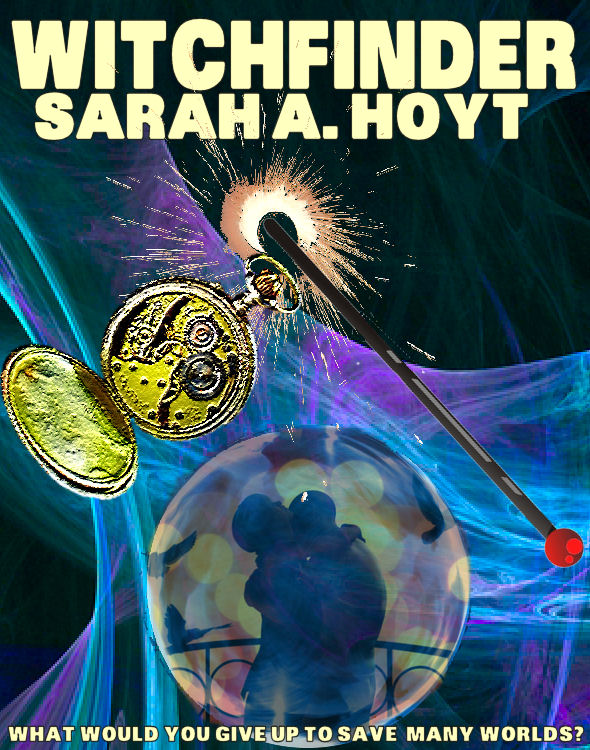
Witchfinder, Free Novel, Chapter 51

*This is the Fantasy novel I’m posting here for free, one chapter every Friday.   If your conscience troubles you getting something for free, do hit the donate button on the right side.  Anyone donating more than $6 will get a non-drm electronic copy of Witchfinder in its final version, when it’s published.
There is a compilation of previous chapters here  all in one big lump, which makes it easier to read and I will compile each new chapter there, a week after I post.  When the novel is completed and about to be edited the compilation page will probably be deleted.

Oh, this is in pre-arc format, meaning you’ll find the occasional spelling mistake and sentence that makes no sense.  It’s not exactly first draft, but it’s not at the level I’d send to a publisher, yet. *


The Knot

    Seraphim didn’t know precisely what he expected from a Necromancer’s hideout.  If there had been an image in his mind, it must have come from the dark illustrations in some children’s book – supposing his mother would have let something that insalubrious near her children.  Which she wouldn’t have.  

His mind insisted there should have been less light, cobwebs, and perhaps a smell of rot to go with the army of undead servants coming to bow to their master and tend his every desire.  There shouldn’t have been, he was sure of it, shelves lined with books he would have liked to read, a pleasantly untidy desk, covered in papers and notebooks that gave the impression of someone furiously working on something he enjoyed, and there certainly shouldn’t have been comfortable sofas in faded, cheerful floral print.  But most of all, he thought, there shouldn’t have been, on one of the bookshelves next to the desk, at eye level, a misshapen porcelain dog, with a lopsided grin and mismatched eyes.  There particularly shouldn’t be that, because Seraphim knew where it had come from.

Fearing at any minute to come face to face with what remained of the unfortunate Gypson, not sure how to react to such a thing, and fairly sure that – in the end – he was being a moral if not a physical accomplice to necromancy, he concentrated on that dog, on that shelf.  “That,” he said, in the terrible voice one might use to impart news of dread catastrophe.  “Is Gabriel’s.”

As he turned to look at Marlon, he’d swear that, for just a moment, unholy amusement danced in the man’s eyes.  And for just that moment, Seraphim’s hand started to curl into a fist, but then dismay succeeded amusement on Marlon’s gaze, and he nodded, once.  “Yes.  He gave it to me, years ago.  He said he’d had it from a child.  It’s all… I expect to keep of him.  Won’t you sit down?  I’ll fetch tea.”

Jonathan looked dismayed at this.  “Tea?  Have you no brandy.”

Saying in one voice, “If you’ll pardon me, I believe you’ve had enough brandy,” Seraphim and Marlon looked startled and grimaced at each other.  Then Marlon left the room, and Seraphim was left with the enviable task of trying to lead Jonathan to one of the cheerful sofas.  This was easier said than done, because Jonathan had reached that point of his intoxication or the recovery from it, where every detail of a room or landscape is riveting and must be narrated as loudly as possible for the edification of oneself, as well as that of those around us.

Which was how, having pulled away from Seraphim, and towards a dark corner of the room, Jonathan said, “Good God.  Is that him?  His…” and probably under the impression that he had lowered his voice, “lover?  The one he keeps as an undead catamite?”

And suddenly it all surged at Seraphim.  The first thing that happened too fast is that Seraphim realized that in the corner he’d ignored, what he’d taken for unidentifiable clutter was, in fact a human being, or what remained of one.

Aiden Gypson didn’t look like a corpse, exactly.  But neither did he look like a living human.  More like someone had taken a human and replaced his skin and flesh with dried clay.  Taking a deep breath, Seraphim could smell no decay, but all the same, it wasn’t even a good necromancy job.

In proper necromancy, from what Seraphim had read, the corpse was preserved to look exactly as it had at the moment of death.  Aiden’s eyes were dry and lusterless, and his lips had receded, exposing teeth.  He didn’t react to their presence either.  He was shuffling in place, little more than a flutter, which – Seraphim thought – was a permanent thing, and again a result of bad necromancy.  Good necromancy could command the corpse so that it was at repose or moved in the same way as a human.

All this was instant, as was the realization that Aiden Gypson’s soul – whatever remained of his individual spark – was pinned somewhere behind the body, and could feel what happened to the body.  And then Seraphim felt ill.  He had to swallow fast, so as not to be sick.  Not good necromancy at all and how could Marlon?

All the sympathy he’d felt for the man when he’d unwillingly realized how much he cared for Gabriel dissipated.  All the fellow feeling of realizing he was, perhaps, not a monster, vanished.  Instead, there was leaden dread and nausea.

Realizing that Aiden Gypson looked like Gabriel Penn – or at least that they were both the same type – only added to the dread.

The thought “Good God, had he meant to do this to Gabriel too?” crossed his mind at the same time that he realized that all this had been very fast and Jonathan was just now drawing breath to continue his narration.

It came at the same time that a flutter of silver and china, like someone trembling while holding a tea set on a tray, and he turned to look towards the door to the interior of the house, where Marlon stood, holding the tea tray.  And at that moment, Seraphim felt his anger evaporate, and the dread with it, and, against his own will, sympathy rush in.  Marlon had washed his face and changed, and should have looked more presentable.  Instead, he looked as white and dead as his dead lover.  Perhaps more so.  His mouth moved, though no words emerged, and the lips seemed to Seraphim to form, “Not catamite.”

Jonathan looked towards Marlon too, and chuckled, a chuckle of high amusement and said, “Far be it from me to say it is a terrible thing, if I’ve never tried it.  It is illegal of course, but tell me–”

In that flash, Seraphim felt as though the real division in this room was not between himself and Marlon, though their tastes in bed companions might be very different, and though Seraphim could not possibly imagine taking a lover and making him a living-dead object.  

But he understood the way Marlon both wanted to defend himself against the charge of keeping what remained of his lover for sexual purposes, and his dreadful horror of speaking of his private life to near-strangers.  In an insane world in which Seraphim’s life was more like Marlon’s, he could imagine feeling that dread, that conflict of pressing needs.

On the other hand, Jonathan was something quite, quite different.  He was, unlike Marlon or Seraphim, an uncomplicated man, who enjoyed carnal pleasures and took the world with hedonistic innocence.  If he’d done something like what Marlon had done – or was accused of doing – he’d have done it for the simplest of all motives: to see what it felt like.  And he might be pursued by the law, but he would not feel guilty.

Seraphim found that he had clamped his hand over the honorable Jonathan Blythe’s mouth.  “Not another word,” he hissed at the brother of his earstwhile – was she earstwhile? – fiancé, in defense of his the man he didn’t even like, the man whom he, for years, had suspected of corrupting Gabriel.  “Not another word, Jon, or so help me, you’ll have to do with me.”

“Why?  I only want to know how it feels to–” Jonathan said, as Seraphim’s hand lifted.  The hand clamped down again.  

“You’re disguised, Jonathan.  What’s more, you’re taking liberties.  We are in Mr. Elfborne’s home and it’s not for us to do him the gross injustice of accusing him of the worst.”

“For heaven’s sake,” the irrepressible Jonathan said as soon as Seraphim let go, knowing it was impossible to cover Jonathan’s mouth forever and, faith, wringing his neck was probably one step too far.  And besides Seraphim liked him, even though he disapproved of him.

“For heaven’s sake,” Jonathan repeated.  “How can I accuse him of anything worse than necromancy?”

“Just so,” Marlon’s voice said, from the sitting area.  “How could you?  So let’s establish that I’m a necromancer.  I don’t think that is a great insult, since I was proven to be so on a court of law, which is why there is a price on my head.  Will you sit down gentlemen?”

Feeling his back prickle, as he turned away from the corpse, Seraphim did so, as did Jonathan following him.  They sat, side by side, with Marlon sitting on a chair facing them.  Marlon poured, asking civil questions about cream and sugar with the equanimity of any gentleman receiving friends.  

“All very well,” Jonathan said, as he held the cup of tea in both hands.  “But I only wanted to know what it is like to tup–”

“Jon,” Seraphim said.  “Do you want to face me with pistols?”

Something like a suppressed cackle escaped Marlon, and Jonathan stared at Seraphim dismayed.  “What?  No.  Good God man.  I’m no match for you.”

“Good.  Then please let’s keep our talk to matters of the coil I and my family find ourselves in.  And let’s try to be civil to our host.”

Jonathan looked baffled, but Marlon was giving Seraphim a long, appraising look.  “Pardon me, your Grace,” he said, at long last.  “I think I’ve misjudged you all these years.  I never realized you were kind.”  He was still pale, and his face had a sort of rigid immobility that signaled, to Seraphim at least, that he was pushing himself beyond the boundaries of his comfort as he said.  “And, for what it’s worth Mr. Blythe, I could not answer you in any way.  I know as much about, how did you put it?  Ah, tupping the undead as you do.”  His eyes crinkled at the corners, as though amusement crept through despite everything.  “Perhaps less.”

Jonathan looked astonished.  He shook his head.  “They said–” he started, then shook his head.  “Well, then, it’s very strange, when you’re already under sentence for necromancy, what else could they do to you.”

Despairing of explaining to Jonathan that there could be restraints on a man other than external, Seraphim looked at Marlon and said, “Pardon Jonathan.  He’s one of nature’s own pagans.”

“I see that,” Marlon said, and something to his eyes told Seraphim that he did.  He wasn’t horrified or reproving of Jonathan.  He was worried about where Jonathan’s careening mind might lead, and also vaguely amused by such disregard for conventions and society, and perhaps a little jealous.  

Marlon took a sip of his tea, set the cup down still mostly filled and said, “Now, for the matter at hand.  We knew you and Gabriel – your whole family – were in a serious coil of trouble.”

“You can say that again,” Jonathan said.

“And you said…”  Marlon hesitated.  “That my fa– That Sydell is half dragon?  How do you mean that?”

Jonathan blinked at him.  “Why, I suppose in the usual why.  His father slept with a dragon.  Not that I blame him.  It is said dragons are–”

“Eminently tuppable, yes,” Seraphim said, antecipating what Jonathan would say, and feeling like he’d fallen into a mad dream.  He didn’t say these things.  He didn’t discuss these things with other people.  But then partly that was because dukes didn’t do that.  And if he was no longer a duke, then he need no longer exercise restraint.  But he was called to reality, as Elfborn said, “I didn’t know that,” in a strained, sober voice.  “How could I not know that?  I didn’t know he was raised in a foundling home, and how could I not, when I was raised in one?”

Jonathan made a dismissive gesture, drank down all his tea, noisily and then extended his cup for more.  Marlon poured, without looking, as though he did it automatically.

“Why should you?  Unless you made a study of Sydell.  And even then, you might not know it.  He’s taken great care to cover his tracks.  I only know it, because my father has known him from the time–” a hiccup broke Jonathan’s talk, and he put the back of his hand against his mouth.  “Pardon me.”  He took a sip of his new cup of tea.  “Has known him from when Sydell was claimed by his grandparents, on his father’s death, and so he remembers the scandal.  M’ father is maybe three years older than Sydell, but enough to remember, because Sydell was twelve or thirteen or some such when his father hanged himself.”

Marlon’s cup rattled in the saucer.  His eyes were huge.  Seraphim remembered, or thought he remembered, hearing that Sydell was Marlon Elfborne’s father.  It seemed an impossible thing, for one because Sydell was a perpetual bachelor, and it was rumored that he shared Marlon’s – and Gabriel’s – interests.  But there had been that half started, “My fa–” and looking at him, now, Seraphim detected some resemblances to the king’s left hand.

“Hanged–?” Marlon said.

“Oh, yes.”  Jonathan drank his tea, quite oblivious to the discomfort he was causing.  “It’s all the grand tragedy, you know.  Worthy of an opera.  My father says that old Marcus Sydell found out that his son was… That is, that he had, somehow, commandeered a dragon maiden out of fairyland and that they were–” He hiccuped again.  “That they were involved, and he was furious, because he was trying to arrange his son’s marriage, so he arranged for a banishing spell, restricting the creature to fairyland.  Costing the Earth, of course, but it worked.”  He frowned.  “Or at least, Sydell had already been born, and his grandfather hushed it up and put him in a foundling home for magic children.  Saint Patrick’s, I believe, because they handle–”

“Half dragons, yes.  And then,” Marlon took a deep breath.  “Sydell’s father?”

“They don’t handle half dragons well,” Jonathan said, frowning.  “Damme, what I mean is, no one but dragons handles them well.  The discipline needed–”

“Yes?  Trust me, well aware.  But what happened to my– To Sydell’s father?”

“What?  Andrew Sydell? The father of the current Lord?  He hanged himself.”

Marlon blinked.  “How?”

“In the usual way, I imagine.  No, wait, I heard of it.  With his belt from the entrance chandelier.  Devilish thing, and his father was hard put to hush the scandal because, of course, all the servants saw it, what?  But it can’t be denied that all who… who get involved with fairyland in that way lose their mind a little, and there it is.”

“There what is?”  This was Seraphim.

“Though he married his heiress he was not happy, never had children, was taken with melancholy, and then hanged himself.  I don’t see what you want me to explain more.”

Marlon was rubbing his upper lip with his index finger as though lost in a world of his own.  At Jonathan’s explosion, he looked up.  “Nothing.  You’ve explained things I’ve longed to understand my whole life.”  Then he looked towards the corner where Gypson stood.  “And why some disasters…  But that’s neither here nor there.  Tell us,” he leaned forward.  “Tell us in detail what my dear papa has been doing in this whole coil, for it’s a knot we must uncoil.”

“Your… papa?” Jonathan frowned.

“Sydell.”

He managed to stop Jonathan’s mouth.  He looked at Elfborn in shock.  “Sydell?  You are…”

“The result of a spell gone horribly wrong?  Yes, I believe so.  But let’s move to relevant matters.”

“It is a relevant matter,” Jonathan said, aghast.  “If you are…  Then what…  Then that was how he got access to–”

Seraphim’s mind had put together things that he wasn’t even aware of knowing.  “That was how he got access to fairyland magic, and managed to send the royal princess to another world, as well as use that magic, behind the king’s back to… what?  What does he aspire to, Jonathan?  The throne of fairyland or of Avalon?”

Jonathan frowned.  “Why,” he said.  “Both, I imagine.”

I’m Not That Guy

Do you know that point in your life, where you’ve been going along and suddenly find you’re not you at all?

No, I’m not talking about possession, mind swapping or even multiple personality disorder.  (It has another name, mind – one my son keeps insisting I use, but bah.  He’s asleep.  Besides, they’re all coming up with new fangled names for the same madness.)  I’ve written that type of thing excessively, mind, and in all genres which betrays perhaps a morbid fear or perhaps my subconscious screaming in your ears.

What I’m talking about, though, is something different.  One of the heartbreaking segments of Dandellion Wine is about the old lady who keeps everything from her childhood, so she can remember it, until the kids taunt her, and tell her she stole it from some little girl.  At one point she describes the experience as having got into a train, and then gets out on the other side and there are none of the people who knew her before, and she’s someone quite different, and she can’t prove she was the person who got on the train.

It’s something like that, only not.

To an extent we expect to get old, and few of us really get that much of a shock at it.  Well, perhaps me.  Because so much of my twenties was consumed with trying to have kids, and I finally had them late, and that brings with it its own variety of time warping, I find myself in my late forties going “waitaminute.  I was young just a minute ago.”

On the other hand, because – like Miss Marple – I grew up in a village where “sixty” was old, I’m aware of having both more vitality, more options and probably greater life expectancy than anyone I knew growing up had at fifty.  Or, for that matter, at forty.  And heck, I’m only eight short years from Shakespeare’s death age, and look what he accomplished.  Or flip it the other way, I’m twenty some years than Marlowe when we died, and though you can see the lack of maturity in some of his work, we sure know his name.  (No, I don’t want to hear about population densities and incidence of talent.  Shud up, you.)

Though I was pretty at one time, I never knew I was, so I haven’t put my “me” in my looks, so aging matters perhaps less to me than to most women.

At any rate, gradual decline is something that’s built into us.  We’re dying the minute we’re born and all that Jazz.  (A platitude as obvious as being naked under one’s clothes, but less chortle worthy.)

What I’m talking about is something different.  In one of those moments you sometimes have while reading books, I remember coming across Terry Pratchett’s reference to Vimes’ youth as “miles and miles of twerpitude” which you have to cross to become the person you’re supposed to be.

Unlike the faux revelation of us all being naked under our clothes, Pratchett’s line is a revolutionary insight in a society where we’re all obsessed with youth.  (I think this is a left over reflex from when they expected each generation to be larger: blend in, so they accept you.)  And frankly, I think the only reason I accepted it is that I first read it in my thirties.  (Maybe not.  Older son loved it.)

What I mean is, whatever your job is or your profession, particularly in writing for the last twenty years (and maybe longer) where establishing yourself to where more than a handful of people know you (unless the publisher pushed like mad and sometimes even then) would take most of your actual writing life, you start out as an apprentice, with idols and people who are like living gods to you.  And then you end, at the end of that train ride, if you’re prolific and hard working and somewhat lucky, as someone’s living god.

Does one ever adjust to that?

I’ll admit my bar for living idols is low.  When I was little, growing up in the village, far from the US, where the future – and therefore science fiction – comes from, all writers were gods in the Roman sense – mythical creatures, more than humans.

So for the longest time, I coped with being published by telling myself I wasn’t really a writer.  After my very first story got published and I had a panic attack over it, I started making excuses “I’m only published in short stories.  I’m not a real writer.  I’m only published in short stories.”  Getting over the novel was more difficult, but hey, it tanked, so…  I wasn’t a real writer.  Then the other novels, well, I was a midlister.  Hack, not real writer.

Conventions could throw me into a complete panic attack.  I was an impostor.  What if they found out I wasn’t a real writer?

I don’t know when that changed.  I realized talking to a friend the other day that it had, that I have accepted I am a writer and a semi-competent one.  Perhaps accepting it is essential to getting your voice right, since so much of the voice seems to hang on self-confidence.

My friend is just starting to publish, and she’s going through the panics I had “These people treat me as a real writer and I’m not.  I feel like such an impostor.”  She’s not, of course.  She is a beginning writer and – I have it on the opinion of another friend who read her (I haven’t got around to it, yet, being the world’s worst mentor) a damn fine one.

It’s just that her mental perception of herself hasn’t caught up with her yet.

I’m starting to suspect mine hasn’t either.  This is not a humble brag.  I’m not Heinlein, or Pratchett.      In skill I’m definitely not Dave Freer.  And in popularity, at some cons, I’m not even Kate Paulk.  (Several people at a local con were heartbroken she was not there to sign the stories we wrote together. Apparently a rumor had gone around. It left me feeling like chopped liver.)

But I’m starting to run into fans I not only don’t know but “fans in weird places” – like my plumber.  or my neighbor.  People who didn’t know I was “that Sarah Hoyt” and whose day is made when they find out.

I’m not anyone’s living idol (I hope.  Man, that would be weird.)  I don’t think anyone would wait in the rain for me to sign their book.  But for some people I’m “more than usually good writer” and someone to look up to.  And that’s weird.

I wonder – not that I’m ever likely to know – should I ever scale the heights others have, should luck smile on me, should skill align, should I write a few books that deserve to be classics in the field, if I’ll find myself at eighty like the engineer character on Galaxy Quest, mumbling distractedly at an adoring fan “I’m not that guy.”  (Well, in my case, girl.)

It’s already weird to find that when I critique someone, or hug an online friend at a con, this is accorded way more importance because I’m a semi-known author.

I imagine being on the other side – being “famous so and so we invited to draw guests” – would be even more so.  Weird, isolating and startling.  Like finding yourself in someone else’s skin.

We used to have protocols to deal with all this stuff.  Now we don’t.  What is it like?  What does it feel like?  My mom says I never knew how to act like I was important.  Which I think just makes me American.  But it might be disconcerting to people, should I ever find myself famous/admired.  Again, that’s not likely to happen, but I’m sure it’s happened to people with my makeup before.  (Well, a lipstick has gone missing.)

I remember that people like Heinlein, Asimov, Pournelle, were once people like me.  Starting out.  Diffident.  (Well, maybe not Asimov.)  Heinlein’s bio captures Bradbury as a raw beginner.  What was it like, then, when at the end of his life – ten? Years ago – he had a line for his signing going back eight LA blocks.  (I gave up and went home.  At any rate we have two signed Bradbury’s, which we traded for some furniture.)

I suspect there are equivalents in other professions.

To my friend, as well as to everyone else, who finds him/herself thrust into a public (however small the circle) position where they’re supposed to be the admired/in charge/knowledgeable ones, I give this advice: Keep public and private strictly separate.  Even if you have a blog, show only what you want to show.  Remember a blog is your public face.  You can joke about your kids or mention them, but don’t violate their privacy with anything you wouldn’t tell at a party.  Ditto your other relatives.  And then be very careful who you let into the inner circle.  You’ll make mistakes at first.  We all do.  Hopefully no fatal ones.

Establish that habit when you’re just breaking in, even if the precautions seem exaggerated and the whole thing blown out of proportion.  That will stand you in good stead when “well knowningness” creeps up on you.  I have this theory you won’t know you’ve hit actual fame until you have done it some time ago.  You don’t see yourself from the outside.

As for the feeling of being an impostor – chances are you’re not.  Yes, some poseurs make it into the various fields, but look, that’s more work than breaking in normally.  You’re not an impostor.  You’re not THAT good.  You’d know if you were.

You are that guy/gal.  Accept it graciously and study your betters to know how to act when you are in their position.

Keep your protest to yourself, and BE that guy.

Sausage, Dinosaurs And Culture

Amanda’s article at MGC yesterday linked to an article by some intellect-critter who referred to himself as having “made culture” for the last twenty years.

On reading that infelicitous phrase, I had two reactions.  The first was what my mom says, rather crudely, when someone is proud of something but the something is an actual mess.  It is meant as crudely as it sounds: “You may as well wipe your hands to the walls, then.”  The second was “And like making sausage, it’s a process that would do best remaining hidden.”

Shortly after that, I remembered a phrase that was popular among my ninth grade class (look, it was the times, but we were also precocious) “Hang all intellectuals.”

However, stepping back from the fact that I have a tiny little problem – almost unnoticeable, really – with authority, let’s consider the boast and what it meant, as well as the fact that this person thought it was not only something worth doing, but worth bragging about.

First, can you create culture?  Yeah.  You can.  It has been done at several times throughout history, sometimes better than others.  Shakespeare can be said to have created worldwide culture, to an extent, and various communists theocracies have created culture.  (what, you were under the impression it WASN’T a religion?  Let me see… prescribes what to believe on every case – check.  Has a completely coherent system that has no reference to reality and must be taken on faith – check.  When its prescriptions fail, time and again, the fault is of the imperfect humans who carry them out – check.  Has a myth of perfection “before the fall” – check.  And oh, yeah, aspires to creating a paradise with perfect people.  [Something only religions can aspire to.] The fact that paradise is in the ever-unobtainable future and that they don’t believe in personal immortality is truly no different than other historical religions.) Usually they didn’t create the culture they said they were creating, but well… that’s on a par with everything else.

To create culture you need only take over channels of information and entertainment as completely as possible.  This is, of course, more conveniently done via a totalitarian regime.  However, since humans are social creatures and want to stand “well” with their contemporaries and “embrace the tide of history” and all that, it can also be done in the way other social things are done: infiltration, bullying, but, above all the creation of a “cool” culture that everyone else wants to be part of.

It takes more time, mind, than simply commanding that people from now on will only believe this and thus – though we have that too.  No?  Try writing a government document without being thoroughly versed in “politically correct” language – or at least express this and thus.  However, it works just as well.  If you have a highly concentrated “mass” culture and you take over the critical and conceptual channels and start blasting at full bore that to believe anything but what you believe is uncouth, artists and other purveyors of entertainment and information will fall in line.  No, trust me on this.  I know my people.  Like any group that sticks out – no, really?  How many people do you know, other than writers, who are obsessed with getting “right” events that never happened? – we try to fit in in every way we can.  (Well, they do.  I don’t know.  Maybe in hopes of being killed last?  Me I live by the Heinlein dictum.  Better to be a live LION.)  And educators and other such?  Please.  Those aren’t even a challenge.  Any kid who goes to public school and can’t wait to return to it – unless he’s a very odd duck with a naturally subversive bent, and let’s remember subversives are of necessity few in any group – is by nature a conformist, forever trying to fit with the “right” group.

And there you have how we arrived at the culture of the last twenty years.  Ever since radio and TV became the main means of dissemination there’s been the “reality” that “everybody knew.”  Everybody knew it, not because they experienced it in their lives but because it was what came at them through schools, colleges, textbooks, tv, radio, newspapers and, oh, yeah, stuff read for entertainment too.

Everybody also knew that what they experienced in their real life was often at odds with what everybody knew.  No?  Come on.  You know it.  There are things that have been “true” in all those channels for years.  Things like “every religious person is an hypocritical criminal” – even though any of us knows religious people who live as close to their ideal as they can come.  And frankly, I’d rather entrust my kid to an evangelical Christian than to a homeless person in the park.  What?  Well, come on.  In movies, tv, entertainment and the news if they can slant it, it would be the other way around.

There are a hundred such things I don’t plan to list (it would take days.)  We all saw them, we all shook our heads over them, but we didn’t say anything because if we did people would think we were crazy.  You see, culture is in large part the stories we tell ourselves.  And the stories for the last… oh, eighty years, have been spinning increasingly loose from reality.

They always do to some extent, only the ability to broadcast them wide and have people go “well, it’s not that way for me, but maybe it is in the majority of the country” broke it free from “verification.”

And because in the way of the modern era professions – including those devoted to (gag) “creating culture” – tended to form their own echo chambers where they all went to the same colleges – or aspired to – and all knew what the “good places” to work were and followed people who worked there, the stories they told each other spun ever freer from reality.

In the heyday of this nonsense (if that bastard, Hegel, was right about something it was that when a system is at the top of its dominance, it is ripe to fall) in the early nineties, what ‘everybody knew’ actually proclaimed that any ninety pound woman could take out any man in a fight; that women enjoyed sex in exactly the same way as men and for the same reasons; that victims were always right; that “noble savages” (and therefore savages) were the most advanced form of humanity.

I wonder what would have happened if technology hadn’t shattered the unified means of distribution of “culture.”  I suspect that changing in the distribution of culture was inevitable, but there are several other outcomes that one can posit as an intellectual exercise: revolt, perhaps violent; revolt, non violent, just a moving of the posts of “cool” so they are the polar opposite of what they were then; or, more likely, increasing gazing past “culture” and eventually civilizational collapse.  Actually, civilizational collapse would be the result of the path we were on if people had continued on it, simply because the stories that made the culture were anti-survival.  If you go around afraid to entrust your child to your Christian friend and thinking that every muttering vagrant is not only a heart of gold but a moral authority, your life will be short (but interesting.)  The same, writ large, goes for the culture.

At any rate, that is neither here nor there, since the technology changed.  Which is either a sign of someone driving this gig or of the fact that something in us knew the culture was going bad and we needed ways to change it.

It started with talk radio – and please remember the vilification of it.  Then with blogs.  And now it’s moved on to entertainment with music and books and, if we’re all lucky and there’s another technological step, soon it will be movies.

In every one of these small overturns, the pattern is the same.  The Lords of Entrenched culture, those who sold their soul for someone else’s cool are first shocked.  “What?  Someone is creating culture outside our channels?  Inconceivable.”  Then comes the mockery, “Those grubby people, in their pajamas.”  Then come outright attacks “the tone of blogs causes murders.  Eeeevil.”  Or “only idiots listen to talk radio” or…  Then comes the soft sobbing appeals “Can’t you see you’re destroying the true professionals?”

Along the way come dirty tricks, personal destruction of those they view as their enemies and often counterproductive attempts at countering what they view as wanton destruction.  They will never, ever, ever understand why talk radio that echoed the rest of the “culture making” apparatus didn’t succeed, for instance.  Nor will they ever GET why their “carefully vetted” newsites attract fewer readers than someone’s blog.  And they will NEVER understand why writers would rather go indie than jump through the hoops of political corrected.  Nor why readers would prefer to read stuff that hasn’t been made “politically correct.”  Why, why, “everybody knows” their world vision is right.

Being insulated from reality by their professional associations, their colleagues and peers and – often – by companies in which performance has become totally divorced from reality – as in publishing where numbers were more or less a function of what you put into them – they have no clue how different the stories have become from reality out here, in what the rest of us know as the real world.

I wonder if the dinosaurs looked up at the approaching meteor and simply denied it was there.  It was just a fad, that glowing thing in the sky.  They didn’t need to do anything differently.  It would all go back to normal soon?  Or if they raged that their rich culture was passing?

In either case, the result was the same.

And when I read intellectuals lament the “death of culture” I see dinosaurs lumbering around moaning that life on Earth is extinct forever.  Because they ARE life on earth.

Meanwhile, us mammals have work to do.  Those ecological niches aren’t going to fill themselves.

*crossposted at Mad Genius Club*