We WILL Do

I’m about to say something my younger self would kill me for: work is essential to making a human capable of living in any form of democratic government.  (And no, no one here – inside my head.  We have a quorum, trust me – advocates for pure democracy.  Well maybe Good Man Simon St. Cyr who is, after all, a member in good standing of a secret organization called the Sans Coulottes.  Don’t fret.  His lesson is coming, and in spades.)

I was meditating on the subject of hotel maid service – in this case prompted by the fact that I think I understand our hotel maid worse than if I didn’t speak a Romance language or two.  Between her attempts at speaking English and my attempts at speaking Porto-Spanish we ended up grinning at each other like lunatics and nodding a lot and pointing.

This reminded me of when we hosted an exchange student, years ago, and shocked her by “talking to shop people like you’re trying to make friends.”

My smiling and bobbing like an idiot at the hotel maid would probably shock my mom, too, now that I think about it.  It is part of the reason she tells me things like that I don’t value myself and don’t give myself my own respect (It’s not only an untranslatable Portuguese phrase, it’s one I don’t get.  “Nao se da ao respeito.)

Of course the reason I don’t think I’m above the hotel maid is that I’ve done her work, when I spent a summer in Germany.  And I’ve worked retail, and as a field hand, and of course, I cook and clean all the time.

Which brought back the memory of buying our twenty fifth anniversary ring (part gold, part silver) and liking a very pretty one, and having my mom say “it will look like tin the first time you put your hands in dishwater.”  This shocked the shopkeeper who said “but, surely, the young lady” she has known me all my life “doesn’t put her hands in dishwater.  She has a maid!”

My mom delighted in telling her that not only did I put my hands in dishwater, but also in paint, solvent, garden dirt and just about everything because I delight in being contrary and not hiring help.  (My mom seems to think it’s much cheaper than it is, or my writing pays a lot more – for the record, I do hire help, usually on a task-basis.  I’m just lousy at it.  And my run of housekeepers has been dismal.  First they become friends, then I don’t want to fire them even when they’re bad, then…)

It occurred to me, though, that in the States no one assumes that just because you have a degree or your ancestors weren’t poor as dirt, you should have a maid.  Oh, sure, if you’re a millionaire, you probably have someone who does almost everything for you.  I’ve never been a millionaire, but I have very briefly been in a position where we made more money than strictly needed and I found it necessitated our spending more money, too, because just dealing with issues preceding from the money made it so we had less time – so we went out to eat more, got someone to clean… that sort of thing.  However, I wonder if even millionaires treat their servants as though they were a different caste.  Maybe hereditary ones – or ones brought up abroad.  But in the states, chances are even if you come from a wealthy family you worked summers scooping ice cream or walking dogs, or something.

Our kids haven’t, mostly due to the lousy economy, these last few years, but when they were very young, they used to hire out to our friends for yard work.

And it’s not even that I think you need to work “beneath yourself” as it would be considered in Europe, but just that you need to have worked at some point in your life, to know that other people work very hard also.  I know my hotel is cleaner is probably not writing novels in her spare time (and if she is I wouldn’t be able to read them) but I also know she works as hard as I do.  Harder, in many ways – a different kind of hard – if she has to do 100 rooms before ten, as I did.

I know this sounds goofy, but people abroad worry about losing face and keeping their “class” far more than Americans do, and they just don’t GET us – perhaps I’m attributing it all to the wrong cause – it wouldn’t be the first time – but I think it’s because most Americans have worked at real work, at some point.  By which I don’t mean just manual labor, but… work that produces things or does something needed.  What I mean here is most of us have had one or more jobs outside my bureaucracy (no, that is not normal in the other developed countries.)

We’ve cleaned, we’ve cooked, we’ve produced something, we’ve fixed, repaired or created.  In other countries, other than farming, which everyone regularly views as the lowest occupation, most people view their jobs as sinecures, as “posts” as something they do which confers status upon them.  (In fact in Portugal even retail clerks are now calling themselves “functionaries” – the title that used to be given people in the bureaucracy.  Because it is far more “important” than “employee.)

Again, I’m probably attributing it to the wrong things, but, for all our divisions there is among ourselves a brotherhood – a baseline understanding – that not only doesn’t exist between classes in other countries (Other colony-countries like Australia probably excepted) but that no one there wants to exist.  And it’s probably chauvinism, or jingoism or chauvinistic jingoism, but I think that improves our chances of survival.

America works.  Let’s not lose that, even when they make it d*mn difficult for us to.  It’s one of our more charming characteristics.

And it is why, though I think we’re in for a storm of cack and rotating objects, in the end, I think that we will do.  Or to quote poor Simon St. Cyr “Ca ira.”

The future will be better than the past.  Because we’re willing to work to make it so.

Update, unrelated: For sheer fun, head on over to Mad Genius club where my friend Amanda does fifty kinds of shredding on Fifty Shades of Gray.  Mind you, she’d read the sample and told me it wasn’t porn.  I’d read that from other places, too “not enough sex to be porn” — HOWEVER she has more… er… substantive issues with it.
Writing Under The Influence

There’s this very odd effect I’ve noted, the last ten years or so, that I wonder if it’s always been so, or just recently.

Feels like recent insanity, but it doesn’t mean it is. It’s entirely possible that this has been going on since the beginning of time.

What do I mean by insanity?

Well, from the Baen bar to conferences, I come across people who tell me they don’t read in the genre they write in, because they’re afraid it will taint their style.  Though the BAD insanity are the people who tell me they don’t read ANYTHING at all because they fear it will make their style “less fresh.”

Now, I suppose there might be some justification for the first one, if you’re one of those sort of people who gets entire phrases stuck in their heads, but have bad enough memories not to remember where they got them.  I could see where it would be safer not to read in the genre you’re working in (though it would also be very difficult for reasons I’ll explain.)

However, for those who don’t read at all for fear of not being fresh, I’d like to point out they should also plug their ears with corks, and try to speak a foreign language without having heard it.

You see, writing – stories on the page – aren’t the same thing as what really happens.  If what you’re trying to write is “real life” at best you’ll end up with formless goo.  At worst… At worst you’ll end up with the worst type of soap opera with all the more exciting bits of people having breakfast, reading the morning paper and maybe, just maybe, driving to work.

This is because fiction writing – any fiction writing, in any time, really – has a certain number of conventions and ways to go about telling a story.  Heck, even if you read a lot, if you put on your writer’s hat for the first time, you might find yourself trying to reinvent the wheel.  My own, rather specific bit of insanity was not realizing that stories were written in scenes.  So, say my character had a fight with his wife in the living room.  Instead of cutting off the chapter/scene and picking up in the bedroom, where he’s packing his clothes, no, I THOUGHT I had to show him walk up the stairs, step by step, then down the hallway…

Insanity?  Sure.  But I was in the critter’s head and he was doing this.  So… I had to, right?  And yes, I’d read books before.  And written books before.  It took me to book five to figure this one out.

But let’s say you’re not brain damaged in my unique way – most people who’ve read any novels would know better than to do what I did.

There’s other conventions.  There’s ways to convey emotions; there’s tricks of narrating a fight; there’s … things you can only pick up subconsciously from reading.

And this is why I said although I understand – for people with bad memory – not wanting to read in the genre you’re writing in – it can get really difficult.

Let me explain.  I read in multiple genres.  I write in multiple genres.  A certain amount of crossover is not a bad idea.  These days, to be honest Romance is to genre writing what Country is to music.  If you have a bit of crossover and can claim to be SF Romance, it’s as good as being Country-Rock – you just added a massive audience to your much smaller niche.

HOWEVER you don’t want to be writing mystery and using sf cues; or fantasy and using sf cues (guilty); or even SF with mystery cues.

I don’t fully know how to explain this, but there is a certain type of…  Well, Kris Rusch calls them “reader cookies” for each genre.  They’re not so much things that advance the plot or are extremely necessary.  They’re things that the reader of a certain genre or subgenre will devour and be all happy about.

As I said, I read everything.  But I’ve found that my early imprinting on science fiction means I understand science fiction readers better.  So I know I can put “cool stuff in” because it excites me, so it will excite them.  More importantly, my mind tends to think the way sf readers do, so when I give just an allusion to something, they usually follow along just fine.

Not so with fantasy.  I spent years writing fantasy, but the truth is, I don’t read as much of it as I do science fiction or mystery.  So, even though I read – and enjoy – Diana Wynne Jones and Pratchett, I keep giving my fantasy novels a “tone” of science fiction by being overly concerned with how and when things work, how and when they don’t, and how to explain them to people in a logical fashion.  This for some reason means I rub fantasy readers the wrong way – at least people who read exclusively fantasy.  I don’t even know how I do it, just like I don’t fully, consciously, try to hook the SF readers.  Or the mystery readers.

Every time I try to write a new genre, it’s like learning to walk all over again, and I virtually have a breakdown over the book.  You’re not quite a new writer all over again, but you’re also not fully an experienced veteran.

So, it seems to me it would be much easier to write a genre if you’ve read sufficiently in it to have an idea how things are done.

If you want an example of this, take a futuristic romance or a paranormal romance (if you read mostly sf or alternately fantasy) and read it.  It will drive you nuts.  I can’t explain it any other way than to say the writers not only reinvent the wheel, but they reinvent it in the wrong way.  For readers of sf/f, it feels like I imagine it feels to a cat getting their fur stroked the wrong way.

It’s not wrong, of course.  It’s not wrong for THEIR GENRE.  It just feels wrong for OUR genre.  These are not the same genres, but sideways steps.  OTOH they are as close as you’re going to get to “fantasy written by romance readers.”

You can make the same type of miscue writing in a genre you don’t read/have never read/don’t like.  (The ones I make tend to be more subtle, just because fantasy is where I’m least at home.)

Is it possible to do it?  I don’t know.  I was getting “accused” of writing romance before I’d read any, so I suppose it is?  I just don’t think you’re going to grow your audience to its maximum potential that way.  (Though, as the late Ric Locke was fond of pointing out, in the global market that e books open up, that might not mean anything.)

However, I guarantee that if you don’t read anything at all, your stuff will not be “fresh” – it will be virtually unreadable.  It would be like never looking at a painting and trying to achieve the effect with your fingers and bits of dirt.  Oh, sure, I can see someone painting a portrait that way (pastel is not much different) but not without ever having seen a painted portrait.  There are conventions of rendering three dimensions in two you’ll be sure to miss.

While not knowing the conventions can result in some good innovations, the chances of that are the same as of an accidental mutation being beneficial to an organism.  (No, I’m not disputing evolution.  I’m just saying that out of millions of mutations most will be harmful, a good number will be neutral, but the beneficial ones are few and far between.)

Yes, you might come up with a really cool way to individualize dialogue.  Unfortunately, we’ll never slog far enough in to find it, because your descriptions will be rendered in such a way we will not have the slightest notion whether your protagonists are mid-air or under the sea.  (Yes, it’s possible.)

I’d advise you to read widely.  I’d advise you to read the genre you aspire to writing, at least enough to know the conventions.  Of course, I’d also advise you to read outside the genre, back and forth in time, and different cultures – even if nothing but your own narrow genre truly appeals to you, it will give you an appreciation for what’s essential and what’s decoration in the current conventions.  (This is much like learning a foreign language will give you an understanding of your own.)

Yes – particularly when you’re a new author – you’ll borrow style without meaning to.  Not as much as you think, mind – that’s an illusion – but if you read a lot of Heyer, your space society might end up talking in high-regency style.  (Which might be a thing, who knows?)  So don’t read anything that’s so distinctive that the porting of manners and expressions will hurt your book.

On the other hand, if you read nothing at all, you will fall down the rabbit hole of your own mind, and at the end of it, the only reader you’ll be aiming to please will be yourself.  This is particularly a danger if you’re young and just beginning.

As Pratchett says of Edward D’Eath “he fell under his own influence.”  It can be a killer.

The Valley of Shadow

I’ve been sitting at this keyboard, staring at the blank screen and wondering what to blog about for over three hours.  Okay, not three hours straight.  I went to the kitchen, had breakfast and started a load of wash in the hopes of getting the mental cogs moving.

It’s not that I have nothing to say – of course I do.  I was born with my tongue attached to the bottom of my mouth by a thin tendril of skin.  It amuses me to think that in the US, at least today, there would have been a very concerned talk with my parents about my birth defect and a time would be set for surgery to free my tongue.

This was Portugal in 62, and I was born at home.  When the midwife realized I was crying funny, she investigated and, finding that my tongue couldn’t move freely, she slashed through it with her scissors.

Needless to say I have no memory of any of this.  I have freakishly early memories, but not that early.  However, my mom said – often – when I was little that G-d knew what he was doing when he stopped my tongue and they shouldn’t have meddled.

All this to say that while I had a lot to talk about some of it is not appropriate to this blog.  I have no intention of turning this into an outright political blog – though I do the occasional political post when things overflow – because my writing is not primarily political.  If it were – just as if it were primarily religious – I would not hesitate to make this my political blog.  However, except to the extent that beliefs bleed through to my writing, my writing is not political or religious, and this blog is – whether one likes it or not – my public face and therefore the face of my writing.

And while I also have a lot to talk about that’s not political, there too I find myself stymied because some of this involves other people and events in the business – things I am either not allowed to talk about; not sure of their veracity; or would embarrass someone who hasn’t driven me that crazy yet.

So, forgive me if I talk in general terms, please.

Lately it has been growing on me that the entire country (or at least the area around me, and I have a feeling about the more outlying regions) is headed for a crackup of epic proportions.  And lest you think I mean civil war or worse, no.  I mean psychological crackup.  I’d have titled this “here it comes your 99th nervous breakdown.”

Perhaps I’m imagining most of the signs – people driving in TRULY absurd ways, more than usual; people doing loony stuff like get in an argument with cashiers in supermarkets over issues known only to their psychiatrist; some true pieces of lunacy both on my business side in contacts with various literary-involved people (more on that later); stuff people say, and the like.  These things are not a matter of kind – things of this kind ALWAYS happen in a free society.  One of the things the rest of the world laughs at is how odd America is, without realizing it is a conjunction of freedom and wealth that causes the “oddness.”  What I’m complaining about is the frequency.  I can’t go two steps outside the house without running into some spectacularly bizarre behavior, which normally would be the talk of the next month, but now seems to be happening everywhere twice a month.

I might be imagining it, since the State of The Sarah is bound up with publishing which is obviously a nexus of insanity otherwise publishers wouldn’t be trying to dictate how OTHER PUBLISHERS treat books the publisher didn’t buy.  Other rumors that have reached one are of strange behavior and peevishness from both publishers and agents including some publishers demanding lead authors sign a clause to NEVER self-publish. (Which would be fine if the contract stipulated that you would get everything you write accepted by the publisher at minimum x payment.  Of course, that is just not on.)

Another state of the Sarah – as in things that impact me closely enough to matter – I had to stop using the little office I’d rented after two months (though I technically still have it for one more month) because the building was virtually empty, save for a direct marketing company up in the front of the building.  All the little businesses that were there when I rented disappeared one at a time.

I had expected it to an extent, but not that fast or that thoroughly.  And the emtpy building wasn’t secure against vagrants.  After an encounter with a feral one in the hallway, I couldn’t convince myself to go back there to work.  I kept telling myself I was imagining things and was crazy, but when I told Dan he said not to be stupid and to listen to my feelings – and the truth is, when I don’t, in those circumstances, I get in serious trouble.

So I’m stressed – though not about to have a nervous breakdown, mind – and could be imagining things.  Perhaps.  Maybe.

But I’m not imagining four shootings in a month.  I’m not imagining the fact most people I know are worried about jobs and/or money and that groceries are set to double again, and as the cold weather comes energy will get… funny.  We’ll just say that.

Other people have compared living in the US today to the Weimar republic.  There is that slightly frantic sense of pretending everything is normal or better than normal, while we all stand on the powder keg of a cacked economy.  But in this case it is perhaps worse, because it is not just our country’s economy that is er… unstable… but the whole world’s.  And we know it.  We’re all tapdancing at the edge of abyss and even those who are only mildly are of geo-economic realities feel the unease, if they don’t know why.

I’ve been in these situations before, and I’ve heard about them.  It has a feeling of holding your breath, a feeling of the calm before the storm.  In this case the many storms.

Look, we’re being driven by a tumult of technological change.  It’s going to make everything very unstable for a long time.  Most of you know my opinion of how politics and bureaucrats are making the whole thing worse, so I won’t talk about it except to say that it should by now be obvious to anyone that 20th century ideas of “progress” and of history having a direction that these people know and can get behind are in fact poppycock.  None of the political theorists in the world could have guessed where the internet would take us.  Even after the journey started, even five years ago, even those of us who have our heads in publishing, would find it hard to believe how it’s hit publishing and how fast.

They can’t guide us to the future.  They don’t know the future anymore than we do.  All they can do is protect our very basic liberties.  Trying to tailor anything more complex is like what the publishers are doing to publishing.  It won’t help, and it might hurt.

The fourteenth century is a byword for awfulness, but part of it was that things were getting better.  There was tech innovation and increased population and more food.  BUT all this was changing too fast, and human societies can’t change fast without fractures and war and confusion and psychological cracking.

It’s still better than no innovation.  And it’s usually better on the other side.

The storm is bearing down on us.

Things are going to get crazier before they settle, but they will settle.  Look to you, your friends, and those who can’t look after themselves.  Work.  Push in the direction you want things to go.  The only way out of the period of uncertainty and insanity is through the period of uncertainty and insanity.

All around us, people might be headed for their 99th nervous breakdown.  But we’ll be all right.  Writers and readers and story people have means of escape.  We’ll get through.

None of us asked to live in interesting times, but they are interesting, and we are part of them.

In publishing, in life, in work – let’s make them good.

My Commenters Work

From Sabrina Chase:  The second book in my *totally* human wave SF trilogy, Raven’s Children, came out last month. And my very first print version of my fantasy The Last Mage Guardian just went live this week. Linkages: http://amzn.to/OaCF8y http://amzn.to/QVTicy
From Tom Simon:

A week ago last Friday, I finally put my first novel out:

Lord Talon’s Revenge:
A Comedy of Greed, War, Hatred, Betrayal, and Other Desirable Things

(Sample chapter included at link.)

It’s an epic fantasy (not a goat-gagger, Mrs. Hoyt) and a satire, though not necessarily a satire on epic fantasy. I’ve labelled it as ‘Don Quixote tilts at The Princess Bride’.

Jonathan Moeller(whose own fantasy novels are well worth checking out) describes it as ‘a mix of P. G. Wodehouse, Lord Dunsany, and G. K. Chesterton’. If that sounds appealing to you, do please take a look

From Gina Marie Wiley:  I’ve been writing what I think is human wave fiction from before there was a human wave. I too have had health problems and those delayed my going indie for a year and a half, but I have two books out now Kinsella and Rescue Branch and four or five more to follow. The Amazon links to them are: Kinsella: http://www.amazon.com/dp/B008BV875K and Rescue Branch: http://www.amazon.com/dp/B008PDZPPY. I also have a website where I, and a number of authors, have been posting stories since 2005. I don’t know if you want to include the link; as some of the stories contain erotica and the site does require registration. It is beyondthefarhorizon.net. Some of the stories are professional grade and several of us publish on Amazon.

Hawking your own work in the comments will get you mention in the Saturday post about my commenters work.

From me — does any of you know someone qualified to translate into Portuguese my book Death of a Musketeer?  I’m willing to split the profits from the Portuguese edition (I don’t know if there would be any.)  I would just like to have my dad be able to read ONE of my books and that one is dedicated to him.

Now go write.

UPDATE from Celia Hayes:

And I still have the ebook versions of mine going on special until next Saturday at http://www.smashwords.com. Smashwords does e-book versions for just about every e-reader format on the market, including Kindle, Nook and iPad. Each of my books has a special discount code, as follows:
For the Trilogy –
Adelsverein: Book 1-The Gathering 25% Off Coupon Code FX65V
Adelsverein: Book 2-The Sowing 25% Off Coupon Code RZ73G
Adelsverein: Book 3- The Harvesting – 25% Off Coupon Code RC56A

For Daughter of Texas 20% Off Coupon Code AQ44Z
and the sequel, Deep in the Heart 20% Off Coupon Code KF75U
And finally for my old faithful of a book, To Truckee’s Trail 20% Off Coupon Code MN89H.
And if you are still dead-tree dedicated, they are all at Amazon.com and at Barnes & Noble.

Death Or Ice Cream

This is not a post about writing, but it is a post about reading – or a post about fiction and reality, humanity and myth.

There is a way in which fiction forms our mind.  Shakespeare has, after all, been accused of inventing modern men with modern emotions.  Then, through the immense popularity of is plays, these character types, these ways to react to things… spread.

This is possible, though I don’t think it’s true, which is good because if it were it would make a very bad case against the bard’s legacy.  it is true that before Shakespeare there were fewer plays that were coherently organized around character types and character dilemmas that made sense to the modern man.

But I grew up in Europe.  I was taken to see art from the middle ages and before before I even had an idea of art.  I remember the medieval statues, their proportions all askew.  I don’t presume that Leonardo DaVinci and Michaelangelo invented the modern body and we all grew up to conform to it, and part of the reason I don’t believe it is that the ancients pictured bodies similar to our own.

Now, as with the argument with the Venus of Dusseldorf and whether it was porn or an accurate representation of women during the ice ages, it is possible to say that with Barbarian invasions, malnutrition and colder climate during much of the middle ages, it is entirely possible bodies had a totally different shape.  One does periodically meet a person walking around who looks like one of those medieval statues, just as one does, occasionally, bump into a woman shaped like the Venus of Dusseldorf.

In the same way it is possible that during the middle ages, while trying to survive, the idea of the individual mind and emotions counting for much fell right out of the culture.  (It was never as dominant as in our era anyway.)  Survival and times of scarcity always bring about a tightening of social norms to whatever the society considers “average” or “normal” behavior, sometimes with lethal consequences for the odd.  (One of the reasons it always puzzles me why Odds – people who don’t fit in our society – admire despots and societies of enforced poverty.)

Romeo and Juliet, and certainly Hamlet are not fully comprehensible unless we realize we’re watching the struggle of the individual against the group social obligations which were considered paramount.

But enough of Shakespeare.  As you know – or possibly, fortunate people that you are, don’t – you can say the words “William Shakespeare”, start me talking, provide me with food and water at intervals, and I’ll go on under my own power, with no audience interaction, for a day or two.  (Possibly more if my voice doesn’t give out.)

However, the fact that the very notion of Shakespeare having invented the modern human exists tells you with absolute certainty how much we’re aware of having acquired our notions of how the world should work from fiction, in all its means of delivery.

Fiction serves – or can serve – great purpose.  It can show things that otherwise can’t be seen in human life except in the very slow development of a whole life, clearly and in a minute, and through emotional delivery.  Concepts like deferred gratification or limited altruism (sacrificing for one’s kids) or even the ups and downs of a long marriage.

That is the problem too – It shows us what is slow and mostly internal as immediate and external.  Where fiction gives us odd notions – oh, all but the very “literary” sort, and that, I dare say might inform the minute moments of life, but will not (from what I read) give you a general thesis of existence (unless it is “Kill yourselves, all is lost” – the slightly more elaborate form of “Fly, all is discovered”) is the climax.  (You, the lady in the back row, stop blushing.  I didn’t mean that kind of fiction.)

Terry Pratchett whose works are, in a way, a meta-critique of our fables and stories pokes fun at this in (I think) Men at Arms (I always confuse it with Guards! Guards!) when they’re on the roof top and have a bow and one arrow and are attempting to hit the dragon on the “voonerables.”  The clinching argument is “There’s a million to one chance, so it’s a sure thing.”

Fiction operates on creating cathartic release.  As such, it requires a big climax for big stakes (or arrows) and a reward immediately after.  I try my best (because I have trouble believing it otherwise) to indicate there will be a long slog to set all right after the big climax, while still making it satisfactory to people.  But it’s not easy.  

I’m not criticizing literature (or other fiction) mind.  The other times I’ve written this sort of thing people get al mad and say “what do you want then?” – but I like literature fine the way it is.  I like the big climax and the big payoff precisely because they rarely happen in life.

On the other hand, it is important for the readers to remember that fiction is a representation, not the reality.  In reality, when you take the one in a million chance, there’s a good chance you’ll fail.  And even if you succeed and the dragon is gone, you still have to deal with all the crazy people who brought the dragon over and wanted to crown him king.  (The plot of whichever of the Pratchett books is mentioned above.  The covers I have are so similar I routinely confuse them.)

They’re not going to vanish over night; they’ll get up to ever more interesting stuff; and killing them is just not part of the game because it creates other problems.  (We all know what happens to societies that do that.)

So killing the dragon in real life would never be the all-encompassing solution it is in the Discworld  world (though Pratchett too hints at other issues, of course.)

There is a moment when I’m very ill – I don’t know if it happens to everyone – usually in the middle of the night, when I wake for a moment, and I feel the wellness below the illness.  (Just like when I’m getting sick, I feel the sickness beneath what’s as yet health.)

It doesn’t mean I’m well.  There will be days of feeling terrible still, and impatience with weakness, and sleeping far too much.  But it means I’ve turned the corner and I’m going to get well.

In real life it is somewhat like that, and when we throw fits and demand perfect and stark choices, we’re doing it because we want life to be a fairytale.  We want someone to offer us a choice between death or a bowl of ice cream with extra marshmallows, and we’re going to hold our breath until we get every last sweet mushy marshmallow.  We earned it, we deserve it, and we’re going to enjoy it.

I think this is part of human nature and fiction merely gives us an outlet for it.  In the same way I don’t believe Shakespeare invented modern humans, I don’t believe fiction invented the big climatic choice.  It goes back through our fairytales and legends – far back indeed.

But let’s remember that’s the only place it can be achieved, shall we?  The starkest choice you’ll get in real life is between sure death and less sure death (or whatever other evil you’re trying to avoid.)

So, you can choose between death and a bowl of ice cream that might be cyanide laced.  You can choose between letting illness take its course or feeling that moment of wellness and building on it, and taking great care and eventually after a lot of work, getting well. It won’t be easy.  It won’t be fast.  Recovery is not assured.

I’m an optimist.  I’ll take the chance.  And hey, cyanide tastes like almonds.

*crossposted at Classical Values*

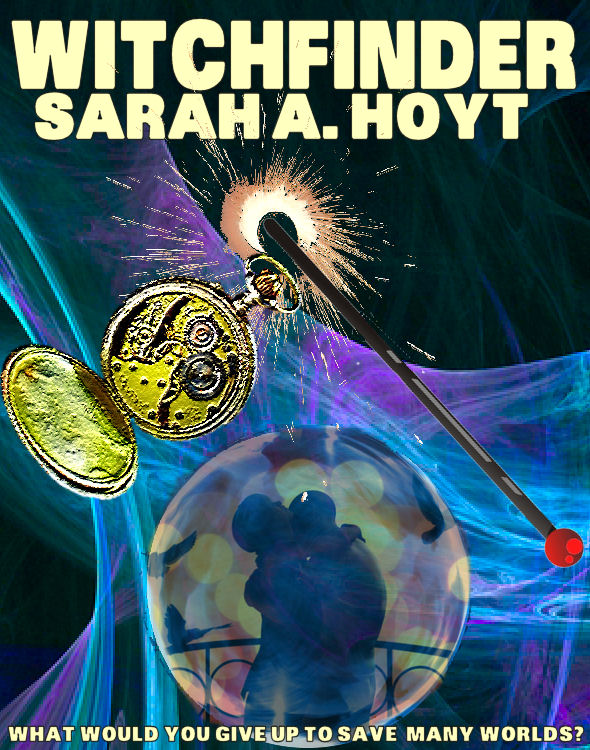
Witchfinder, Free Novel, Chapter 53

*This is the Fantasy novel I’m posting here for free, one chapter every Friday.   If your conscience troubles you getting something for free, do hit the donate button on the right side.  Anyone donating more than $6 will get a non-drm electronic copy of Witchfinder in its final version, when it’s published.
There is a compilation of previous chapters here  all in one big lump, which makes it easier to read and I will compile each new chapter there, a week after I post.  When the novel is completed and about to be edited the compilation page will probably be deleted.

Oh, this is in pre-arc format, meaning you’ll find the occasional spelling mistake and sentence that makes no sense.  It’s not exactly first draft, but it’s not at the level I’d send to a publisher, yet. *

Between The Dogs And A Hard Place
“Only passing through my Lord,” Gabriel boomed back at the leering sort of voice that taunted him.  “I want nothing of yours, and only what’s mine.”
“What’s yours, I understand, is my crown?”
“No, but only those mortals you keep captive here which are bound to me by blood or affection.”  As he spoke, he continued fighting.  There was to him a sort of nimble lack of concern, a quickness of feet and wrist, as he cut at the Hell Hounds.
Caroline, beside him, tried to match his ability and so busy was she that she didn’t realize for a moment that Akakios hadn’t joined them.  While he could stand, it was obvious his forelegs pained him, and he could do no more than defend himself.
There was a long silence, and then the voice that Caroline couldn’t identify boomed again, but said a word that Caroline couldn’t understand, a word like liquid fire that seemed to scrape the senses as it fell.  Behind her Akakios made a sound of outrage, but to Caroline’s surprise, Gabriel laughed.  His hair had come loose from its binds, and flowed around his head like brambles growing in a wild place.  Somehow it made him look more elf than human, and his laugh was also more elf than human, seeming to hit some places out of her hearing range.
“Kind of you,” Gabriel said.  “But that is no offense.  I might as you say be a human-lover and in thrall of the low magic creatures.  Since I intend to live my life among them, I care not what your opinion might be.  I care only to have my own returned to me.”
“You cannot have them.  I would not demean myself by dealing with such as you.  You only seek to go behind my back and fulfill the prophecy.”
This time it was Gabriel who answered in syllables of liquid fire.  Caroline looked back at Akakios who was very pale and looked unsteady on his feet, but show smiled a little at her expression and said, “Ask not, Lady.  Your brother wouldn’t thank me to translate those words for your ears.”
A snarl made her turn back to the fight, just in time to slice off the head of one of the hounds.
Her victory lasted only seconds.  She was just wondering how come she, not an experienced fighter, had managed to kill one of the dogs, when the corpse on the floor became instantly whole and came at her again.  She backed up.  She now realized no matter how many wounds she inflicted, the dogs would keep coming at them, again and again and again, their number never diminishing.
That was why Akakios had said that no matter what happened, if they left Gabriel alone, then he would die here.  But what would their having jumped in to help do, but increase the time he would survive?  In the end, he must still, per force, die.  There was only one of him, and all told infinite numbers of these re-born dogs.
But then …  “Akakios, you said he would die if we left him alone,” Caroline said, “But what has our joining him ensured, but that we die with him, if a little late.”
“Well may you ask him, Caroline,” Gabriel said.  “The prince is a fool, and has brought you into an untenable position where you will do nothing but die with me.  I do not wish to see you die, and anyway, Seraphim would find a way to raise me from the dead and kill me.”  He slashed forward, suddenly, earning them a little space and kicking the carcasses of dogs far away before they reconstituted and came alive again.  It seemed to Caroline that he had more strength here than on Earth, because these dogs were almost man-sized and he was kicking them easily.  He looked at her, just a glance, his eyes wild.  “It is me they want.  Prince Akakios,” the name was a shout.  “Can you manage, despite your wounds, to do the inverse journey of what you did?  They’ll close in on me when you leave, so you should have to leap a shorter space.”
Akakios replied in the liquid-fire language this time, and Caroline thought it too must be those words that Gabriel wouldn’t want her to know, except that Gabriel’s answer back made it obvious it was something else, “You might not be disloyal, but you are stupid.  I am not your lord nor your sovereign, and dying for me will earn you nothing, and certainly not your prophecy.”
This seemed to shut Akakios up, because he said nothing for a long while.  Fighting as hard as she could and starting to feel not only her arms hurting with holding the sword of power, but her magic sting from the long-drawn-out-power needed to keep the sword going, Caroline wondered if Akakios was considering taking her out of here, and what she would do if he decided to do so.
Part of her wanted to leave.  She was very young.  She had never had a season.  She’d never been allowed at grown up parties, and somewhere at the back of her mind was the idea that eventually, should she escape this, she would like to be married and have children, and perhaps get to travel a little and see the world beyond the isles.  
It had never been a part of her plan to die at fifteen in fairyland, defending her illegitimate brother.
On the other hand, if she left, if she walked away…  She could imagine Seraphim asking her where she’d left Gabriel and what was the last thing that had happened to him.  She could see the pain in Seraphim’s eyes when she told him, and she knew she would carry the same pain with her her whole life.  Gabriel might never have been acknowledged as their brother, but he’d been one of them and her friend her whole life.
And then there was the other side of it – that Seraphim would forgive her easily.  After all, she was just a woman.  No one expected of her gallant acts of self-defense, much less in defense of others.  It was logical, because she was weak and she was young, and yet the idea infuriated her.  She wanted to be able to protect Gabriel, who had so often protected her.
She’d just set her chin and decided that dying here was less painful than living a life considering herself forsworn, when Akakios tugged on her cloak.  “Give me your cloak, Lady, do.”
“My cloak?” Caroline asked, mid sword-swipe, wondering if the centaur had lost his mind.  “What are you going to do with my cloak?”
“I cannot explain,” he said.  “Just give it to me.  I promise not to harm it unduly.”
“Do with it as you will,” she said, without turning, loosening from her throat the pin that had held the cloak.  She felt it fall from her shoulders and thought that it must be some arcane magic, particularly since Gabriel seemed to have antecipated what Akakios would do, and said, sternly, “Prince, this will not help.”
“Perhaps nothing will help, Sire, but we must try.”
There was…  Caroline could not describe it.  There was a sound that wasn’t a sound, a whisper that wasn’t a whisper, and a feeling like a small wind behind her, and Akakios let out with a small groan as if of pain.
When she turned back to look at him, he stood by the wall, and at first she thought he had shrunk.  Then she realized the now-familiar Akakios face was atop a… human body, with her cloak wrapped around himself in the way the men of ancient Greece had worn a chiton.  
She barely turned back in time to defend herself from a snarling dog, and would have been wounded, had not Gabriel come to her aid.  “He is a fool,” Gabriel told her, and for the first time looked truly angry.  “He should get you out of here.”
“If he got me out of here, I would not go,” Caroline said, then shouted back.  “Akakios, Prince, what do you intend on doing.  How does this help?”  She felt a little odd about his shape change.  It was all very well for her to have ridden a-centaur back.  Centaurs were a different species and no one could consider them marriage prospects.  But now he was, to all eyes, a man like all others. And she’d ridden upon his back.
She could almost hear Seraphim tell her this was no time to be missish, and Gabriel would probably say it too, if he thought of it, but she could not banish it from her mind, even as Akakios said, “My other form, lady, doesn’t climb too well.  Or jump like this very easilly”
And then she realized the wall behind her ended just far enough above for even Gabriel not to be able to reach up there.  And she couldn’t fully see Akakios leap, but he must have used magic to assist himself, because he’d jumped up and was holding to the top of the wall with his hands, then scrambling up with his feet.  Before Caroline could fully get her breath, he was leaning down, almost from the waist down and extending her both hands.  “Lady!” he said.  She got what he meant to do, and reached up.  He grabbed around her wrists and pulled her up, with minimal assist of her feet scrambling up the wall.
When he hauled her all the way up, she threw herself, face first, onto a path that seemed to be fine white sand and run at the top of the wall, all the way up, like a widow’s walk atop a fortification.  Akakios feet were twined around a marker on the other side of the path in a way that must hurt his injured legs, but he didn’t complain.
She didn’t need Akakios prodding.  She immitated him, then both of them leaned down.
“Sire,” Akakios called down to Gabriel, now with his back against the wall again.  “My Lord.  Your sister can keep you safe a little while, if you give us your hands.”
And Caroline realized what he meant, and bent her mind to stop the dogs.  It took longer, this time, and was harder, but her mind was clearer if not stronger than that of the king of Fairyland.  For a moment, the dogs stopped, as though frozen in their tracks.
Gabriel didn’t argue.  He must be very tired indeed, Caroline thought.  Instead, he turned around and while she and Akakios each held one of his arms with both hands, he scrambled up the wall with his feet.
He fell half atop of them, heavy, panting hard, then rolled off and lay on the path, still panting hard.  “You are both idiots,” were the first words he said.
“You’re welcome, I’m sure, Mr. Penn,” Caroline said with a sniff.  Gabriel took this cutting remark with a sudden and explosive laugh and sat up.
“I didn’t say I wasn’t grateful to you two idiots.  Do you have any idea where you landed us?”
Akakios had sat up, also, and was rubbing at his ankles, which were bleeding from what seemed like giant dog bites.  “I expect on the path to the king’s castle,” he said.  “I will not shift if it’s the same to you and if I can continue borrowing the cloak, Lady.  The wounds are bigger as human, but they are of less consequence, and this is no path for a horse’s hooves.”
Caroline looked up and saw that they were in fact on the proverbial path that spiraled up the proverbial white mountain, to the proverbial fairytale castle, which flew with pennants and flags.  For a moment, it was so beautiful, it took her breath away.  Then she remembered the voice of the king of fairyland and shivered.
Gabriel, stretched, reached over, and touched Akakios’s ankles.  The wounds retracted, closed.  In seconds there were only scars.
Akakios took a deep breath.  “The king’s touch.”
“Or just very good elven power,” Gabriel said.  “Don’t go saying stupid things, or we can’t be friends anymore.  I wonder why my ever-loving uncle dropped me outside this particular wall.”
“He couldn’t help it.  It’s the prophecy.”
“Talking about the prophecy will also mean we can’t be friends anymore,” Gabriel said.  “We could walk the other way, but my guess is the dogs will be waiting for us as soon as they can reach us.  Also, I have a strong feeling Michael is kept up there,” he pointed towards the castle.
“Then we’ll go there,” Caroline said, and thought how long it would take on this weary road.  But at least there were no dogs.  A nagging feeling told her there might well be something worse, but she ignored it.
“We will indeed,” Gabriel said, standing up, and extending a hand to her.  “And we might yet wish ourselves back with the dogs.”

I Am Working On The Chapters

I did print out the rest of the book, but haven’t gone over it, yet, so discontinuities still not fixed.  The younger boy started classes at college yesterday, so as you imagine the week was consumed in what I call “Freshman follies” including the visits to counseling that they want him to make for reasons only they know.  Turned out he had all his ducks in a row, but I guess most freshmen don’t, because the school insists on checking.

Anyway, other experiences this week (not to do with Baen except that they inconvenienced Baen as well as myself in one occasion) has me wondering with Kris Rusch and Cory Doctorow “Has all of traditional publishing done insane?”  (Baen as usual excepted.)  I thought you guys might want to head over to Kris’ blog and read this.  Also, Amanda Green covered same topic at Mad Genius Club this week.

The Order Of The Storyteller

More than anything, we writers are bringers of order and coherence to the world

I know, I know, you’ve met writers before.  Or if you haven’t, you’ve hung around this blog long enough to get the impression of a woman who is a nervibore – mostly she lives off her nerves – and whose life can become a crisis at the drop of a hat.

So you’re looking at that title and thinking “order”?

Yeah.  Because what we do is not what we are.

At any rate, my friend Dave Freer was right in his Monday blog at MGC.  Writing qua storytelling is a total activity.  It resembles a nine to five job less than it resembles a spiritual (or physical) practice.  Given half a chance, and sometimes even without being given any chance at all, it takes over your life before you even notice it.

I remember when I read one of the very first – if not the first – book on how to write SF/F – by Orson Scott Card.  He said something along the lines that one should tell a hoplessly untalented writer to get out of the field, before it ruined “his life, his family, his marriage, his career.”

I disagree with Mr. Card on the idea that one can tell who is “talented” from who is “untalented.”  The most naturally talented people I know, one has failed to finish his book, the other has rewritten the same book ever since I met her 18 years ago.  And I’ve known total hopeless hacks to suddenly, over night, get their ducks in a row and produce not just saleable but good prose.  Mostly it takes a lot of work, a minimum of rationality and wanting to do it (which my friend who hasn’t finished is book is lacking.  He can take it or leave it, so he left it.)

More importantly, I never fully understood whether he thought that being successful in writing (or what passes for successful these days) would prevent destroying your life, your other career or your marriage.

Yes, okay, I’m married and very happy, but part of this is that my husband is a very patient man – particularly since when he married me he had no idea I shared my head with an assorted cast of characters.  It’s like thinking you’re marrying a woman and instead running away with a circus, a cast of thousands, and three trained elephants – and the other part is that our life is not QUITE absolutely normal.  For instance, there are these “GIY” (get it yourself) dinners, where the kids come over and go “Is it guy?” and I nod and keep on typing.  A few years ago it was only the younger throwing a fit on being tired of eating boiled eggs (the only thing he knew how to make) that made me realize I hadn’t cooked for two weeks.

Writing is insidious. It not only pushes all other activities out of the way, given a chance, it pushes most of your thoughts away too.  So you emerge at the end of a book and suddenly realize your library book is three weeks overdue, there’s a pile of contracts you forgot to sign and OMG, weren’t you supposed to go to the doctor last week.

This sort of creates a roller coaster of chaos in the writer’s life.  Things that a normal mother, wife or housewife would do every day and gradually, get deferred until they explode (loudly) in my face.  I’ll think something isn’t due yet because I did it two weeks ago… and it will be six months or a year.  I start projects like gardening and idea hits and I leave it half finished.  Then forget it ever existed.

This is probably why every writer I know, even those who manage to be happily married and have semi-well-adjusted children, is always dealing with something or other, usually postponed health checkups or dental work.

But this appearance of chaos and disorder is deceptive.  Beneath it all we’re working in stories, and stories are order.  More, stories bring order into the world.

Given a number of disparate events, writers – or storytellers, in this case, since we could narrate the story orally – can’t help but make a coherent story.  A dog on the road; a ballerina with tattered clothes; a worn shoe in front of a fence – any of these and we make a story and even a “moral” explanation – in the sense of a satisfactory cause and effect – behind it.

The dog is on the road and dodging cars because she escaped a cruel master who mistreated her.  The ballerina wears tattered clothes because she doesn’t care for material things, but only for her art.  The worn shoe in front of the fence was left there by peg-legged man who…

The difficult part is not for me to make up a story – the difficult part is for me to prevent myself from making up a story.  To the extent the human brain is a machine for bringing order out of chaos and creating a satisfactory chain out of random events, the writer’s brian is a well-honed machine for doing so.

It used to be, when mom sent me to get something in the store, that I had to consciously not link people I saw on the street, or odd neighbors talking to each other, or something out of place.  Sometimes I couldn’t resist, and told the story to mom as if it were all linked (and it’s amazing the number of times it really was.)  But in real life, I have to keep reminding myself that I can make as many stories as you like, but you shouldn’t BELIEVE them.

If you’re sitting at a diner counter and the person next to you is saying something like “they found everything but the head.  They’ll never find that.  I know what I did with it, but I’m not telling anyone” – did you just sit next to a murderer?  Or was he talking about a recording device part, or a hundred of other things called a “head?”  Heck, even the page has a head.  (Presumably you didn’t sit next to someone who hid a whole bathroom, though you might have.)

But so long as you don’t mistake truth and imagination for each other, you can and will make stories.  And you might even be sure they’re true.  But if you find an add in the local craigslist for a “Clever Girl” Velociraptor you might “know” it is a code between thieves, but you shouldn’t call the police on that basis.

The thing is, our writers have the same sort of mind, only they’re not always – or they’re not most of the time – as good at making up the chain of order and sequence as we are.  But we’ll still love books that start with a seemingly random event that suddenly becomes far more significant.

In one of my favorite scenes of They Walked Like Men as they’re driving along, they see behind them a car with only one headlight… and then they realize the headlight is in the middle, which is when they know the car isn’t real.

The truth is driving a rural road, you might come across stuff like that (and we have) and it’s just someone whose truck headlights quit, and they hung a lantern in front to drive the five miles or so to get the truck home.

But I could see Clifford Simak in that position and thinking “Um… what if it were aliens pretending to be a car?”  And that is somehow more satisfactory because a truck with a lantern hanging mid-hood is just crazy, while aliens pretending to be a car makes sense, makes a pattern and can be a story.

In turn, humans are the stories they tell themselves. If you go far back enough in time, you find plots that are either unorganized and things seem to happen at random or as the result of the gods whim or some other device that seems to obey only the promptings of a restless subconscious.

Then, they slowly acquire organization and a sense that things happened for a reason.  And then readers (or listeners) integrate this into their lives.  And this makes it easier, in turn, for humanity to organize, particularly when the idea of what causes what effect becomes more or less universal.

Stories mold our minds, our relationships, our societies.  All because some story teller couldn’t hear a random phrase like “And then I found out they were aliens” and think “Oh, yeah, foreigners” but instead looks over the very normal girl who said it and thinks “She met aliens?  How did she escape?”

Oh, we’re imagination too, but most of all we’re bringers of order, of rationality, of sense into the world.

Now excuse me while I go get the cat out of the bookcase and tell the kids arguing in the hall to shut up.  There’s a story that needs my brain as an engine of order for the world.

Stealing the Fire of The Gods

Hey, buddy, want to buy a plot?  I got it cheap down at the corner, but it’s really good.  Boy meets girl, boy loses girl, boy recovers girl again.

When I was a beginner writer knee high to a pot of ink, I was obsessed with plots.  The reason was much the same that teen boys are obsessed with girls: They’ve never been close enough to one to grab her properly and aren’t even sure which bits they’re supposed to grab.  Besides everyone says they’re supposed to have one, but no one says how.

In my case, it was worse than that – everyone kept saying that I needed to learn to plot or that my stories needed more plot. They were wrong.  My stories had plenty of plot – what they lacked was even a hint of foreshadowing and occasionally more than a hand waved at explaining motive.  Being a child of the seventies I thought everything was supposed to be SURPRISE! And also so deeply buried, psychologically that no one fully got it, so it was “deep.”

Of course, I also had no clue of the foreshadowing, or that I was supposed to do it, until Dave Freer rubbed my nose in it, after I’d published my first three books. So the editors stand excused(ish.)

But because I had no more notion than they did what plot actually was, I obsessively bought books on stuff like “the twenty plots” and “ten basic plots” and…

Ignore that – this is not about plots or how to plot per-se, but something totally different – how to steal the spark of the gods, if you wish.  It’s as close to rational explanation as I can come.

The problem (or the joy) of stealing plots as such is that no one will ever know.  If it’s not obvious both from the opening and from the titles of the books on plotting, plots can variously be boiled down to twenty essential ones, or ten essential ones, or three essential ones, or whatever.  The key is in the “boiled down.”  You boil humans down enough, and we’re all skeletons that rather resemble each other.  (Note, this blog is neither endorsing nor condoning such activity.  It is, at the very least, improper disposal of human remains. In Other Words, Children, don’t try this at home!)  In ultimate instance all plots are one “creature with problem solves it/not.”

So go ahead steal that plot.  If you’re going that route steal good and old and be aware tons of people have done it before you.  Shakespeare has been ripped off more ways than Uncle Scrooge’s money bin in the Disney comics.  So have the Iliad and the Odyssey and pretty much every fairytale known to man.  However, these port within genre (except Shakespeare) by and large, to Science Fiction and fantasy.

What I’m talking about is something quite different.  I was recently converted – as you know – to Regency Romances.  Some of them are even on the “good book” category.  Most are in the “popcorn” category… ie. I can’t get enough of them because I half-read half-skim and don’t remember them afterwards.

I swear half the regency romances I read are ripoffs of Heyer.  And not at the level that I appear to have ripped off Heinlein, to an extent, for space opera.  Not at the level of “I grew up reading this and read it so many times there will be a similarity of words, of phrases, of ways things are justified.  I internalized that stuff, and it’s now in fact part of me.  No, these ripoffs of Heyer are, if not conscious, then ripped off from someone who CONSCIOUSLY ripped her off.  

The problem with doing this is that while it’s not plagiarism – you can write a story about a young girl kept in the country in ignorance of her circumstances, and the rake who wakes up her womanhood without really stealing anything.  You can even add an indifferent older brother or a lame younger brother without problems. – the story is still close enough that you know where they got it, at least if you’ve read Heyer.  The further problem is that NONE OF THEM – not one of the idiots – writes anything even approaching Heyer.

I like Heyer well enough that given the paucity of her books (she wasn’t immortal and couldn’t write forever) I’d welcome something I’d call “good fanfic” – stories that are close enough in spirit to hers, but twisted another way or spun differently.  The stories she would write if she were this person.  And there’s a lot of variety to that sort of thing.  The Austen fanboard I belong to (though these days time rarely allows me to go there) has at least 90% of its content be variations on Pride and Prejudice.  But they’re still interesting enough or different enough you read them.

Most of the Heyer imitations aren’t.  Some are okay.  While it still has most of the same bones of the original story, it spins differently so fast that you don’t mind it.  Some are honest fanfic and have the “If this crucial point had been different change” and that’s okay.

They still all fail when the book they’re ripping off is one of my favorites.  It is a mistake to invoke Sylvester or Frederica or Venetia “Now with explicit sex” – You’re not Heyer, you’re not close to Heyer, and to imitate her close enough for me to recognize the book only sets the standard I now expect.  And you’ll fail.

However, since I read everything, I’ve come to realize that you can do this between genres with great success.  Say you read both science fiction and mystery, and you start reading something and feel that “spark” there somewhere, like a sudden excitement.  And you decide to steal the fire of the gods.

This works because you HAVE to change it.  Yes, sometimes you can do it minimally.  Say, the Maltese Falcon with aliens – and in that case, you’d best own up, because everyone will know.  But say you want to do science fiction Nero Wolfe.  Well, first you move them from New York City.  Then you make Nero a super intelligent something – robot? Bio-improved?  Alien? – and Archie a different species.  No orchids, so what does he grow?  And then there Fritz – what is he?  Mechanic?  A bio-engineer?

By the time you’re done, you could steal Fer de Lance and no one will ever know.  No, I don’t intend on doing this.  I love the book as a reader, but it doesn’t feed the WRITER spark.   

And that’s part of it – that tingle, that spark is not even often fed by a GOOD novel.  At least in my case, half the time, it’s likely to be pushed forward by something someone botched badly.  They start with an interesting character, then it goes down hill fast.  And as far as I steal the spark, these days, it’s usually a scene which gives me another and sets me up for a whole book.  I swear A Few Good Men attacked me when I opened a – turned out so so, but nothing to write home about – book that starts with someone unjustly accused of murder being transported to Australia.  I never read past page 5 – not for a while – because that situation sparked the voice in my head, with Lucius in jail, the break happening and well… what follows.

All this to say, if you’re a writer, you should be aware what’s plagiarism, and what isn’t, and also that no matter how careful you are people will find things in your stories you never put in there.  There was this editor of a now defunct magazine who routinely told me “you ripped this off from a tv plot.”  This was baffling, as when I was sending him stories, I didn’t own a TV, hadn’t even watched any in ten years, and frankly never watched much beyond cartoons and science programs when I was little, and the occasional mystery series since then.

The thing is Pratchett is right in that ideas rain from the sky and into your head, anyway.  (In bed, pull the covers on your head, and pretend that you are dead – the zeitgeist is gonna get you.)  For instance I had this story, written before the series, which not only reads like something out of Stargate, but I call the device to travel between worlds Stargate.  Fortunately I had done with getting it rejected (at that time more than likely unread) when the series came out.  In fact, they were probably written/conceived of at about the same time. (It has been proven tinfoil hats make the condition worse!)

So stuff is going to fall into your head.  There’s no avoiding it.  It’s best to know what you’re doing and where you stand.  And it’s best, of course, to let your sparks come cross-genre.

Stuck?  Don’t be.  Pick up a novel in a genre you normally don’t read.  Or ten novels.  Read them.  Something might ignite the spark of the gods.  Then al you have to do is make it yours.  (And watch out for liver-loving eagles)

And The Poor Red Clay Had Rest

Someone in my comments yesterday brought up the whole question of the division between art and craft, and right now – at this very moment – old habitues of the blog are groaning and shaking their heads and saying “Did you have to start THAT again?  Don’t you know what she’s like when she gets wound up?”

But it’s okay – truly – you may crawl out from under the various pieces of furniture.  I’m still just the slightest bit under the weather, so there will be minimal flingage (it is too a word if I say it is!) of fish, and anyway, I want to talk rationally about this.  (You, yes, you, the gentleman with the pug, smirking in front of his screen! – Wipe that smirk  off your face.  I’ve been rational in the past.  Once.  It was a Thursday.  It might have been foggy.)

Is there such a thing as “Art” – as distinguishable from really, really, really, really, really good craft?

Stop looking at me as if I’d lost my mind.  (It’s not true anyway.  I know exactly where I left my mind – University Hospital delivery room, Charlotte, NC, 21 years ago.  I’m sure it’s still there, in the corner. Cowering.)

Seriously.  Is there such a thing as art, distinguishable from superb craft?  If there is, how would you tell?

Well…  If you’re mumbling “I know art when I see it” – I agree with you.  There is… a quality to art.  A touch of something more than human.  Something that shouldn’t/couldn’t be conjured out of mere blood, flesh and bone.

I discovered this when I was dead broke – about a year after leaving my mind behind – in Columbia, SC.  Dan left his job to look after me when I had pre-eclampsia.  Unfortunately the job he took on, which was supposed to let him work from home and pay him, didn’t PAY.  So… by the time Robert was born we were already in trouble.  By the time we gave up on getting paid, we were in MORE trouble.  By the time Dan found a job in South Carolina (I couldn’t work.  Took me forever to recover, besides having an infant) we were in so much trouble it wasn’t even funny.

This led to the first two years of Robert’s life as we paid back a mountain of debt and lived mostly off a gigantic bag of frozen veggies a week and a lot of rice.  (The meat was boiled with the veggies and given to Robert as soon as he could eat.)

It’s hard to explain how broke we were.  We’ve been stone broke since, but never to the point where buying a used paperback meant I skipped the daily meal for a couple of days.  (And yes, I still bought them.  You make your choices, I make mine.)

So, in that time, when life seemed like a sterile relentless slog of “must do” with no fun at all (we didn’t own a TV and this was pre-internet.  And I’d already read every book we owned five times. – G-d, I would have KILLED for Amazon and the free promotional e-books!) – before even we came to Colorado and things eased a very little – I don’t remember how or why, we found ourselves going through a used book store.  (They had a free rack up front.)  I guess Dan thought it was safe to take me to the coffee table books.  See, I had never been a “pretty pictures” kind of girl.

And then I opened a book of DaVinci works.  I can’t explain it.  Those pictures were like balm on my abraded stomped-down soul.  They were beautiful like nothing in our life was beautiful right then (well, except the kid.)  But it was more than that.  Something to those paintings stirred and touched depths I’d have sworn I didn’t have.

It must have shown in my face because Dan said something along the lines of “Screw paying back the bills as fast as possible.  You can and must have this,” and sprang he $40 we realistically could NOT afford to buy the book.  Through the next three years, until bills were paid off and we could breathe and schedule in a little fun, THAT book served as a refuge.  Spending a couple of hours staring at the pictures was like a mini-vacation for my eyes and mind.  (AND should you doubt the world is a better place, if we should find ourselves in the same situation again – and we’ve been close – now, twenty years later, there are art sites I could look at for the price of the net connection which we must have, anyway.)  In similar circumstances I’ve had my mind eased by watching a Shakespeare play (yes, they’re okay read, but that’s one thing I prefer to watch and hear) or by reading a loved book.

There is to art that which touches something you might not have been aware of having.  In books, it absolutely makes you live the story, drags you into it, pours emotion into you, and leaves you in a different place from where you started.

Oh, I found out years later, the same is true of music – and do to an hearing issue I am the world’s worst music-appreciation person.  BUT friends gave us symphony tickets during annus horriblis, when I was killing myself with six novels for which I had NO hope of success, AND homeschooling the child.  That evening surrounded by music (there’s no other way to describe it) was enough to carry me through the next six months, till things got better.

So, yeah, in my opinion, there is art – but how can you tell it from good craft?  What particle of canvas can you boil that will yield “art.”  I know it by its effect on me.  You know it by its effect on you.

And what is the difference between art and craft?  Well… craft, no matter how great doesn’t do that.  Also, art can cover a multitude of thumb prints and ill-mended plot points.  I.e. some things are art even though the craft sucks so badly that the Dyson people have considered integrating it into their vacuum cleaners.  And some things are wonderful, wonderful craft and utterly lifeless and do nothing for you.

What I want you to understand, though, is that this appreciation, this feeling in the soul, this transcendent beauty, is FELT – which means it’s subjective.

I love looking at DaVinci.  Robert, my older son, can be brought to tears by Van Gogh.  I have nothing against Van Gogh.  If you have to admire some post-renaissance artist, he’s a fine one, but I wouldn’t sit transfixed in front of his work for hours.

What is art to you, might be “oh, that’s just really good craft” to me.  Or it might be even “OMG, I couldn’t even read it.”

Here I must make a detour – No, Sarah!  Not you!  You of the clear and linear thought! – and point out that readers often “can’t stand” a book for reasons that writers find bizarre.  No, seriously.  You might write an 800 page opus, and pour into it every ounce of your life experience, every particle of feeling and thought you can imbue it with; you might polish each word till it shines; but someone out there will say “well, I hit that thing on page eight, where she buys a pink Cadillac, and it completely lost me forever.  Sorry.  I just couldn’t empathize with a character who would do that.”  Or your character has freckles.  Or you used the word imbue wrong.  (And it wasn’t even you but some copyeditor who did that, after your final go through, and you never saw it, till it was in print. – No?  It’s happened to me.  Like the one who put t at the end of every thou in a book set in Tudor England.)

The flip side of this is that what will make the book for some readers is something off the cuff that you just let fall.  There will be the conversation your character has with his dog, which you just dropped in because you could, or the fact your character drinks only single malt, and this will send a reader into raptures and make him or her a fan forever.  My assumption is it balances out.

But the fact remains your exquisitely crafted, maybe even artistic book, will never reach everyone, and might not reach people it’s perfect for, because they don’t like your use of hydrogen peroxide in disinfecting small cuts.  (No, seriously.)

And again, I must bring up the point that some of the books my best friends or even my husband think are art and stand outs are books that I can’t read past page three.  Worse, some of the books that shook me to my very core at 17, now read trite, contrived, and I see the wires moving the characters as it were.  Or even worse, books I loved at 30, I now can’t read because, inexplicably, the word cadence has become like nails on the blackboard to me.  (This is reversible, too.  For years there was an author I couldn’t read because his word choice bothered me.  EVERY ONE OF THEM was subtly wrong.  Ten years later, he became one of my absolute favorite writers and remains so another almost twenty years later.  What changed?  My own use of language?  (Well, being ESL, when I first got here, I felt language differently.)  My hormonal balance?  The attention I devote to reading?  Who KNOWS?

Was he art before?  Is he art now?  WHO KNOWS?

Art exists.  Is it universal?  Can you find it?  More, can you know if you are putting art into your work?

This is the part of the blog where Sarah throws her hands up in the air and asks you if you wouldn’t like a nice slice of cake instead.  You’re overwrought.  Thinking too much is bad for you.  It gives you astigmatism and puts hair in your eardrums.  Here – pours you some tea – take a deep breath.

The answer to your question is: Who knows?  Who cares?

If you try to figure out whether you’re a mere craftsman or an artist – worse, if you try to convince your friends some writer you adore is an artist, not a craftsman – you’ll drive yourself, your friends, and possibly total strangers who’ve never done anything to you completely insane.

Look, kid, we don’t know for sure – of course – but there’s a good chance Shakespeare wrote to pay his bills and buy his wife a nice house.  Dumas dang well wrote to pay his bills – with notable lack of success at times.  Heinlein said loud and clear that he wrote to pay his bills.  Rex Stout?  Yep.  Paid his bills.

So, write to pay your bills.  Or at least aim to.  This will keep you honest and keep you from going chasing after your own tail, starting to wear a pony tail, sit in fashionable cafes and hold your demi-tasse just so.  It will certainly keep you from using the excuse that your stuff just doesn’t sell because you’re too good for this terrible world.  And it will keep you grounded.  Also, if you’re not writing art – and you can’t know, and I can’t know.  Someone might know, but you might never meet them – at least your efforts helped support you.

And use all your craft the best you can.  IF the muse stoops down and kisses you, well and good.  Then ages yet unborn will sing of your genius.  And if it doesn’t, chances are you’ll never know.

AIM at competent and exquisitely crafted.  If you surpass that, win.

On the other hand, if you REALLY insist on being “an artist” I have a beret my mom sent me, which is two sizes too small for me (I am blessed with a massive head.  That’s it.  The gentleman who sniggered will stay after school and clean out the erasers.)  You’re welcome to it.  If all you want is to say that you’re an artist and strike a pose that’s easily done.

If not, go work and stop worrying your head about things you can never figure out. Might as well count the angels on the head of a pin or calculate the flight velocity of dragons.

If the muse has kissed you, someone else will feel it.  Stop thinking about it.

Write.