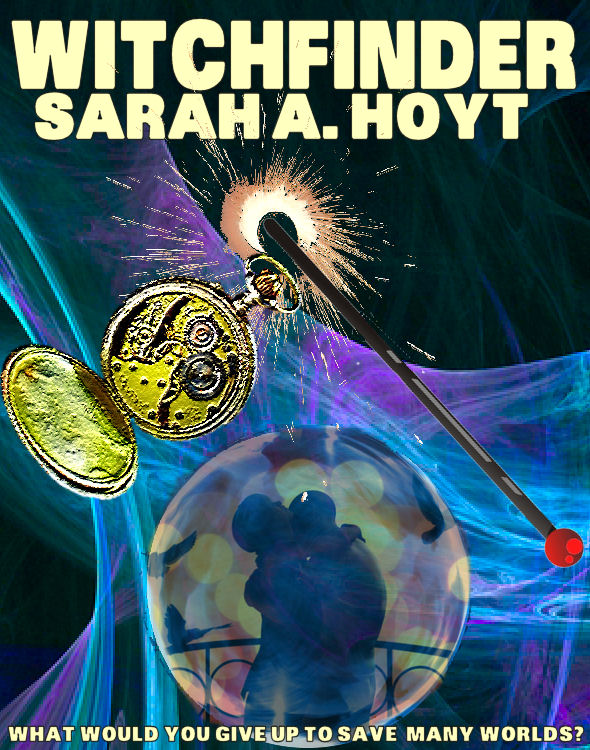
Witchfinder, Free Novel, Chapter 54

*This is the Fantasy novel I’m posting here for free, one chapter every Friday.   If your conscience troubles you getting something for free, do hit the donate button on the right side.  Anyone donating more than $6 will get a non-drm electronic copy of Witchfinder in its final version, when it’s published.
There is a compilation of previous chapters here  all in one big lump, which makes it easier to read and I will compile each new chapter there, a week after I post.  When the novel is completed and about to be edited the compilation page will probably be deleted.

Oh, this is in pre-arc format, meaning you’ll find the occasional spelling mistake and sentence that makes no sense.  It’s not exactly first draft, but it’s not at the level I’d send to a publisher, yet. *


Sugar And Spice

Nell was not stupid – or at least she thought to herself, she tried not to be more stupid than she needed to be.  And right then, she thought, it meant not going into those marble halls of fairyland unarmed.  So she reached blindly and found the neck of the bottle that had been labeled “drink me.”  Given that it was not the best of weapons.  She should have brought a hunting knife or even a gun, though if her studying of magic in Avalon meant anything, depending on what spells were on this place, guns might have behaved very oddly.

*Well,* she told herself. *Never mind that.  Everything can be a weapon.  After all, I can use this bottle to bean people on the head.  And besides, there is a very good chance if someone annoys me enough I can grab him and make him drink this.  There is a good chance whatever is in here is as good as that apple.*

She blinked at the liquid, ruby-red and sparkling unnaturally, then walked into the marble hall.  From inside it came the whir of machinery and she thought how odd it was that there would be machinery in fairyland.  Then closer, she heard as if the sound of many voices, all talking at once.

That was fine.  She would find the voices.  And she would figure out what they were doing, and what was happening with the Darkwaters, too.  Suppressing a thought about what might be happening to one Darkwater, and what it might mean that her heart clenched at the thought of his being in trouble, she walked down the marble hall, thinking that it sparkled very oddly indeed.  Marble and magic?  It made an odd sound underfoot, too, as though she were walking on fresh ice on a winter morning at the farm.

Cautiously, wearily she turned a corner… and blinked again, as her eyes adjusted to the impossible.

The corridor stretched on, white and sparkling, and that was not the shocking thing.  What was shocking was that to her right there was a door, and standing in front of the door – on either side – were clockwork soldiers.

They looked like something out of a Christmas play, all red uniforms and round faces painted with very red cheeks and large, black eyes.  Their tall helmets were adorned with plumes.  They held golden lances.  And they were clearly, unmistakably tin, and had large wind-up keys sticking out of their backs.

As she took a step towards them, they both turned to stare at her and Nell’s hair rose up at the back of her neck. It was their eyes.  Painted eyes which were little more than black dots, should not be alive, nor should they follow one’s movements.  And they shouldn’t have a sort of dreadful, intent expression.

She lifted her arm, pulling the bottle back, then let fly.  It hit the helmet of the nearer tin man, then fell.  It hit the wall and shattered, and liquid ran out, eating at the marble floor.  The tin men advanced towards her.  And now she didn’t have a weapon.

And then she thought that food of fairykind was corrosive and possibly lethal to humans, then wouldn’t it…

She eased the backpack strap off her left shoulder, let the backpack swing forward, all the while stepping back out of the risk of the tin men golden lances.  Without looking, she reached in, felt for the boxes of crackers, tore one open, got two crackers, maneuvered the back pack onto both shoulders again.  Then she held a cracker in each hand and ran.

The tin men started to swing the lances, but, of course, the problem of a tin man with clockwork innards is that they wouldn’t react that fast, would they?

So they were taken completely by surprise as she shoved a cracker into each of their gaping tin-cut mouths…  And ran past towards the door they were guarding.  She wasn’t even sure what would be behind that door, or why she should want to go there.  But she knew for an absolute fact that she wanted to get past the tin men, and the door gave her something to interpose between her and those shiny golden lances.

She was barely aware of a sound of tinkle and whirr behind her, and then of tin objects falling – heavily.  She didn’t turn.

To her surprise, the door opened when she pulled on the handle, and she stepped into…

It looked like a Victorian scientist’s mad dream.  She had seen something like this in much smaller scale in the Darkwater’s country residence.  The place where the young Michael worked.

Here, it was bigger, and filled with more tin creatures.  They ran huge complicated machines, they sawed glimmering sheets of copper in half, they ran here and there carrying buckets of stuff.

In the middle of all of it, like a maestro conducting a complicated symphony, stood…  She saw him from the back and swallowed, and opened her mouth to say “Seraphim!” before she realized that while the dark curls were the same and the general proportions similar, this person was smaller – smaller even than Gabriel Penn who resembled the duke in everything but size and height.

The word died on her lips, but she must have made some sound, because the young man turned around.  He did look like Seraphim, but she now perceived he must be the same age as Seraphim’s sister.  He was as yet beardless, his skin pale and clear like his sister’s.  And his green eyes, so much a Darkwater trait, sparkled from beneath goggles of beaten copper and strangely sparkling glass.

He looked at her, his eyes wide open.  “Who are you?” he asked.  “And what are you doing here.”

And then she realized it wasn’t just the glass that sparkled.  His eyes were wide but empty, seeing but unseeing.  They could see her, and yet they didn’t, and she realized she would not be able to reason with him.

The realization came just in time, as his eyebrows drew together abroad his patrician nose, and he said, “You’re not supposed to be here.  There were guards.”  He frowned towards the open door, then looked at the people around him – no, the tin men around him, and lifted a hand.

Before he said anything, she knew he was going to order them to seize her.  Also, she could see, around him the netting of strong magic, and she knew the personality that had formed it.  She also knew that though she might have powerful magic, she couldn’t dent the magic of the king of fairyland.  She could control simple minds under his power, but not the mind of a fully reasoning and seemingly smart young man.

Then she thought this was a trap, like the Alice in Wonderland room.  If she played by the rules, she would lose.  The food of fairyland…  Okay.  This was the equivalent, likely, of throwing the apple in that room.  Before Michael Ainsling could order her seized, she remembered that people under spells were by nature slow and gullible.  She said, aloud, “Wait.  I came to bring you a message.  Let me see…”

She swung the backpack from her shoulder, got a bottle of water from inside, and, before the young man could react to the strangeness of the packaging, pushed it at him, cap removed.  “Drink.”

He hesitated for a moment, and she thought that he was going to order his tin people to catch her.  But his mouth was open, and he was holding the bottle.  It was possible she couldn’t do anything, but she had to try.  Reaching out, she grabbed his wrist, and shoved the bottle towards his face.  Water splashed on him, a great deal of it bathing his face, but some must have gone into his mouth, because he screamed and lifted his hands to wipe at his face, and the threads of the golden spell-net around him snapped.

“Why did you do that?” he asked.  “What are you–”

The bottle had fallen at their feet and the water was gurgling out, corroding the marble.  Michael looked at her, his eyes awake and intent for once.   “You–” he said, and blinked.  “Who are you?”

And then, with a startled look around “And where am I?”

Nell opened her mouth but never spoke.  The ground behind her was crackling like egg shells, the tin people were converging towards them, and, suddenly, from the ceiling above, something fell.  No.  Someone.  No.  Several someones.  She had the impression of three people, two male one female, all dark haired.  They fell between Nell and Michael.  The ground gave way beneath them, and suddenly they were all falling, all of them, towards a darkness punctuated with pinpoints of stars.

Suddenly, as suddenly as they’d fallen, they stopped.  It took a moment for Nell to realize they’d fallen on a black, huge, open net, and that the net was gathering at the top, like a sack closing.  As this brought her in contact with the other prisoners: Miss Ainsling, Michael, Mr. Pen, and a young man dressed like an ancient Greek, it occurred to her, to look up, to where the marble floor appeared corroded as well as fractured.  Light from above shone through it too.  The sound of crackling under her feet came back to her mind and she said, “Sugar.”

“Oh, no,” Mr. Penn said.  “I think it’s quite all right to say shit in these circumstances, your highness.”

“No, I mean the floor is made of sugar.”

“Ah,” he said, his brow creasing.  “Yes.  My uncle is… whimsical.  He derives–” Deep breath.  “A great deal of power from the dreams of childhood.”

And at that moment, as though on cue, the sickly-sweet, threatening voice came out of the big void beneath them, “By the rules, I had to let your find your brother, Miss Ainsling.  I didn’t say I had to let any of you go.”

Scattered Writer With Chances of Sense

I was talking to someone yesterday on the concept of non-fiction cannibalizing fiction.

Banish the gruesome image from your mind.  Despite my late, great argument with THE non-fiction writer who shall not be named, she didn’t try to take a bite out of me.  (She wouldn’t have a chance.  I write for Baen and my commenters make shivs out of dictionary covers.  No refined place, this According To Hoyt.  In fact I think the lady called us barbarians.  Or something.)

What I meant though is the extent to which writing blog posts precludes writing fiction.  The answer must be… I’m not sure.

When I did the blog tour for Darkship Thieves, non-fiction was a new endeavor.  It took me a day to write a thousand word essay, the same it took me for a short story or 10k words on a novel.  Sometimes, if the mind was slow, it took me a week.  For six months I did nothing but blog tour (I want to book another of those, so if you have a blog and are willing to host it, email me at sahoyt – at- hotmail -dot – com.  I should start in early to mid October and carry on through December, at which time I’ll start blogging for A Few Good Men, as well because it comes out in March.  If you have a blog and wish to host me, you get to lay restrictions on me or whatever you’d like.)  This helped sell Darkship Thieves.  It did NOT help my income, though.  (Payment is at least a year later by contract and besides, that one has barely earned out now, two and a half years later.)  So it was part of the annus horriblis of 5k income.

If I wrote the nonfiction, I couldn’t write fiction all day or, sometimes, for a week.

Clearly I’ve defeated that, since I roll out of bed and write this blog.  (Well today involved dealing with kid issues before blogging.  And so, I’m scattered and late.)

However, I’ll confess some posts take it out of me, and make it hard to concentrate on fiction.  Also, some posts require a lot of energy.  I’m postponing one (probably till Saturday) because it will either be a full out rant or… well… in either case, it will require energy.

I remember reading a Shakespeare Scholar who said if he was writing the sonnets while he wrote some play (I think Two Gentlemen of Verona) no wonder it was such thin gruel.   This puzzled me at the time, but it is true.  Say I’m mid novel, and someone asks for a short, and the short comes out heavy and hot (not that way you pervs!) rushing forth full of life.  I have to take a day before I resume the novel, or the novel will be pathetic and lifeless till I forget the short.

With the blog I have to walk the fine line of still making the posts interesting enough to be worth your time (and occasional money.  This babbler works for tips) and not draining the novels of energy and excitement.

Still on the third hand, as some people have pointed out, there is such a thing as publicity and not exactly by design, this blog seems to be my best tool for that.  I didn’t plan it that way – facebook is so much less work.  It is just the way it is.  The number of fan letters I get that say “I read your blog and bought this book–” outweighs all other methods of promo save the blog tour.

So, what to do?  Well, I’ve tried writing a week of posts in advance.  The problem is, because the posts proceed from “what is passing at the moment” it’s very hard to conjure seven topics I feel passionate about one after the other.  I’ve managed four, and it takes me pretty much a full writing day.

This is not to announce I’m giving up the blog – as I said, it seems my most effective publicity tool.  OTOH it takes a lot of time and effort.  But then I gave up sleep for lent three years ago, so mwah ah ah ah ah.

I guess what I’m trying to say is that anything else you do that involves words can cannibalize your writing, and you need to be aware of that.  Teaching or talking in panels does that for me.

While I’m not like the young writer who thought she had a quota of words and couldn’t even talk on the phone for fear of wasting them – I am conscious of a limited supply of “push”, of energy to give the words.  And sometimes, I simply won’t have it.  Which is when I sit here going “uh…. duh.”

What to do about it?  I don’t know.  Part of this, and part of the reason I think the blog is effective is that I ENJOY the blog and ya’ll’s contributions.

Honestly, though, the greatest drain is “what to write about.”  Yeah, just fresh from a trip to DC, I can tell you that my GPS is trying to kill me.  And it was the perfect post for a day when I didn’t have much brain.  Yes, I’m contemplating a post on conspiracy and sociability.  And a post on revolutions.  And a post on whether women are needed.  (The guys can shut up now.  Like all the idiot men who say men are no longer needed – that’s what is going to turn into a rant – I happen to imagine myself as the sole surviving woman in a world full of males.  Oh, wait… my female friends and female commenters in this blog can stay too.  There’s enough for all of us.  As for the rest of women… sucks to be them. :)   And lest someone takes offense, of COURSE I’m joking.  It is a rebuttal to the New York Time’s continued attempts to Onionize itself, by printing an article on how men are obsolete.)  Those will all be serious posts and therefore energyy draining, but probably worth it.  And I have a guest post on hand from my friend Tedd Roberts.

On the other hand, that’s all I have on deck, right now.  No other post ideas.  So… all of you… what would you like to hear about?  I noted Beth making notes for low tech societies.  If my upbringing is worth something it is first hand knowledge of those and there are surprising accomodations.  And I or one of the people here who research/read history for fun can probably elucidate stuff I don’t now.  By that I mean not just “tell us about your childhood” but “How did people get around this?” or “did you have that?” or “I’m writing in society x – how did they do y?”

Then there is the fact some of you might be crazy enough to solicit my opinion on serious issues.  There’s a lot of opinions in here, and they’re worth what you pay for them.  And we can go into more Human Wave stuff, but ask me questions, please, because I’m finishing two novels and I’m writer of very little brain.  Stuff like “Sarah, how does human wave reconcile distopias?  You’re aware your books are not all fluffy bunnies?” are welcome.

Also, I will take guest posts.  If you think it’s worth it, I wouldn’t mind doing a guest post once a week or so from different people each time.  Just let me know what you wish to blog on, and if you’re one of the regulars I’ll probably take it.  (Though I might tweak it, she says, not thinking RES will want to do a guest post, but afraid of the punny depths he’d sink to.)

Also none of you have sent me announcements of upcoming stuff.  Have you all been idle?  (Cracks whip.)

Anyway – send questions my way, either via email or in comments here.  Questions, suggestions, oranges, characters…. whatever you have on hand.  I can ramble about a lot of things, but I need to be pointed in A direction first.

And now I’m going to take my scattered self and go work on Noah’s Boy.

Fresh and Hot

Fresh stories.  Freshly written.  Come get them while they’re fresh…

When I was a kid you’d literally wake up in the more urban areas (not thank heavens, the village) to the yells of various food vendors.  The sun would barely be looking out of a still-darkish sky, when bread vendors, pastry vendors, vegetable vendors and everyone else would be roaming around screaming their heads off.  It was all “fresh and hot this” “cold and tasty that.”

The screaming in the village started at around noon.  We were small enough that everyone knew who had what kind of vegetables just maturing that time, and so there was no point hawking.  People would go – quietly – to their neighbor who had a bumper crop of carrots and enter upon a mutually agreeable arrangement, sometimes in exchange for a few eggs “because I hear those hens of yours are laying like crazy.”  (I did mention at some point that until I went to middle school, in the next village over, I thought money was a wholly superfluous affectation and couldn’t understand why some people were so attached to it, right?  Of course most of the stuff bought and sold in the village WAS for money– the big stuff: rents paid, an account run on the general store for food, clothes – but all I ever saw as I followed my grandmother around – she was the most entertaining person of my acquaintance – was this sort of “accommodation dealing”  that involved a chicken for an arrangement to provide milk for a month, or a bag of onions for a basket of pears.)  The stores provided what little the village didn’t grow or make for itself, and everyone knew where those were too.  Bread was a gentlemanly thing, quietly arranged, paid a week in advance and delivered before people woke up.

I still miss that and more than once have wondered if there would be a market for that sort of service.  (There probably would be in NYC or somewhere similar, and probably not in this type of economy.)  People made their… bread subscription, then hung a bag at their back door (I imagine here there would need to be locking delivery boxes, particularly in the big cities.)  These bags, needless to say immediately became a matter of competition among village matrons, so they were fantastically embroidered, adorned with lace, spotless and starched.  Into that bag went whatever your daily order was: six rolls, two pastries and four sweet rolls, say.  (Ours was usually only ten plain rolls.  Mom didn’t believe in fancy, though she might buy me a sweet roll when she went grocery shopping on Saturday.)  So when you woke and groped your way downstairs, you would collect the bread from the door while coffee was brewing.  It was usually still warm and crusty-crackling.  Yes, I missed it when I moved here.  (Though it’s no longer done that way in Portugal, because they too would need lock boxes and even so, trust me, someone would steal the box.)

Anyway, so the only people who yelled like banshees were the fishwives, who usually got to the village around noon, having stopped at the other villages on the way from the seaside (by bus.  Picture that.)  Oh, there was also the oil and olive seller, but he came only once a week.  Also prone to shrieking their (irregular) visits down main street were: the pot and pan mender, the rag dealer (mostly buyer) and the elastics and lace woman (for some reason, and proving I had to be a writer, or they’d lock me up in the madhouse, because the poor lady had one leg shorter than the other and walked funny, at age three or so, I decided her legs were made of elastic and she ate children.  I was utterly convinced she used her elastic legs to reach upward into second floor windows and steal sleeping children from their beds for a snack.  I still can’t think of that poor creature without shuddering.  Of course, my loving family catching on to my fear, used the poor elastic seller as a boogey man to keep me under control.)

Anyway, the point of this – if you’re not quite catching on – is that in commerce reduced to its elementary form, people had to hawk their own wares – UNLESS they did something established, in an established place, in which case people knew where to find them.  You wouldn’t catch the pharmacist roaming the streets screaming.  You wouldn’t catch even the local dairy farmer going around yelling “Exceptionally fine cheeses.”

Now, if these people – not the apothecary – had booths in one of the local fairs around the village – and many of them had – there they would yell.  The way the fairs are, many of them have permanent infrastructure, anything ranging from stalls to tiny buildings, usually made of stone, and with iron gates (the buildings.)  This infrastructure belongs to the fair, and the vendors lease a spot.  Buildings are more expensive than a stone table, and a stone table covered with a awning of course more expensive than a mere stone table.

The fair takes place once a week, and usually is arranged in “sections.”  If you’re a clothes seller you’re put with the clothes sellers, not the fish mongers.  If you’re a meat seller, you’re also in a section.  (BTW and because I’m long-winded, some of the infrastructure was built by Roman Emperors.  Some by medieval kings, and the more modern dates from the nineteenth century.)

Anyway, the sedate village sellers who wouldn’t dream of screaming their wares, do scream like nobody’s business when they’re in the fair.  “Juicy Oranges, the sweetest” might get someone to come to you instead of the guy next door who waxes his oranges so they shine.

I hear there was a time that writers were more like the staid sellers and farmers in the village.  They wrote their books; they handed them in.  It was the job of the publisher to tell people how great your books were and to put them in the place where people expected to find books.  I also hear – and this is probably rumor – that at one time all publishers were more like Baen: they had a slant into the market, a view they pushed, something that made them unique.  The reader related to the publisher and appreciated the publisher’s seal of approval which, in turn, made it possible to buy anything from the publisher, sight unseen.  After you read a few by an author you might look for an author, TOO but up till then it was “I trust this publisher, so I’ll buy this month’s books.”

I say I hear these things, because I’ve never experienced them, and what is reported of the field is often unreliable self-mythologizing.

But I do know that it wasn’t normal, until at least the nineties for writers to have to sell themselves to the extent they do now.  I think part of what ate the individuality of the publishers was the fact that the people they hired all went to the same schools and all lived within ten square miles of each other.  A “collective point of view” was established that it wasn’t considered decent to buck, and all of them agreed on what was “good” – which left only Baen out of the circle j– of love, and only because Jim Baen was a stubborn cuss… er, had a very strong personality.  Otherwise, it would have gone the way of the others.

Then next hit the small number of distributors, the concentrating of the bookstores into chains, and next thing you know, every author was those vendors in the stalls at the local fair.

Even if you’re a Baen author and what you’re selling is, in point of fact, Japanese pears, how are you going to even be seen, in the middle of all the orange vendors.  And for that matter, how are people going to know they might like Japanese pears if no one else sells them and they’ve never tried them.  (And to an extent, this explains – but doesn’t justify – big publishers’ obsession with books just like the last book.  You might be producing twilight clones, but at least people know what that is, how to ask for it, and might decide they want one.  If what you’re selling is unique, you first have to convince people to take a bite.)

So, if you’re a writer, say, like me, who could be called unique (mostly because the other things you COULD call me are probably obscene and not safe for a family blog) what in heck can you do but cross the metaphorical streets of the literary village yelling “Fresh hot fiction, come and get it while it’s fresh.”

That is actually possibly worse (though better too – more on that later) in the global market place indie publishing has opened for us.  So many offerings.  And why would people buy it, if they don’t know it exists?

Trust me, if people don’t know your books are there, they won’t buy them, no matter how good they are.  For the years I worked for traditional publishing, grinding out sometimes six books a year which – none of them – made it to bookstore shelves, or at least no bookstores near me, and which – OFTEN – got accidentally left out of the publisher’s own catalogue, I learned this dictum well.

So you have to self promote.  And there are ways to do it.  What are those ways?  This is one of the most frequently asked questions by newbies.

First, as with writing, what I’ve found is this: use the medium that works for you.  I am long-winded and odd, so this blog seems to work for me, as do blog tours when a book is ready for release.  Facebook too, to an extent.  I never got Twitter which seems to require your living more online than I’m willing to do.  But this is personality.  If you feel Twitter is your thing do it.  If your easiest publicity is via pintrest, use it.  If you’re personable, have a winning smile and enjoy the company of others and – this is important – if you live in the Eastern part of the country where there’s a con every weekend in driving distance, then the con circuit might be for you.  If your book is about quilting, you might consider getting a booth at craft fairs.

But all of that is to our purposes nothing.  More important is to remember two things: to whom are you selling?  And what are you selling?

In the old days when you had to sell to publishers or never get in at all, it paid to affect the sort of personality they were taught to admire: intellectual with a touch of the bohemian and something mysterious about you.  It also helped to be visually appealing (though you could get around that by being SPECTACULARLY unappealing there triggering the “must prove I’m not prejudiced” reaction) and by blowing your own horn.  I know at least one “major” author who climbed very quickly via telling every publisher at every con how wonderful he was.  He was telling everyone he was the next best thing in writing before he sold a single pro story.  Because publishers were fundamentally insecure and unable to tell what was good (there are reasons for that, but it’s long and not here) they believed him.  Success.

I watched this tactic in a sort of awe, because well…  It worked.  And yet, it was so weird and so against all my early training in behavior, that I would need to not be myself to use it.

But it worked, because what the publishers were buying was not the writing but the writer as a marketable product, which is what they believed in.  Books were, after all, fungible, so they wanted a writer they could trot out and tell people was wonderful.  How much easier to do that when the author himself believes he’s the second coming of Charles Dickens?

Nowadays… well…  It might very well still work.  There are people still getting in the old route.  I suspect though those are mostly you know, old college roommates and second cousins and other people personally KNOWN to the publisher.

For the rest of us they seem to be looking at how you sell indie.  (And if you’re smart, you’re looking at how you sell indie, too, and comparing it to what the traditionals offer.)  Or, if you’ve gotten in at a low or midlist level, the publisher is looking at your numbers.

How do you increase those?  Well… you hawk the book.  The method you use is your own.  It might even be youtubes of your cat dancing with the book, for all I care.

Remember, though, it’s the book you’re selling – not yourself.  Telling the world how wonderful you are seems to provoke in most people a sort of recoil and a doubt.  I know a local writer whom con organizers call ‘the rudest man on Earth” – he’s not.  He’s trying to self promote and is completely clueless.  So instead of telling people about his book, about his subject and how wonderful it is, he behaves as if he were selling to an old style publisher, and acts like he’s an a’tist and tells everyone how wonderful HE is – which when people are looking at micro-press books and pays in copies publications fails to have much impact.  (It also, as he gets desperate, acquires a tinny, off-key tone that makes the whole thing worse.)

The readers don’t think books are fungible, and readers care about THE BOOK, not you.  (Of course, when you have a blog, it’s hard not to talk about yourself, but do try not to make it just a series of boasts, okay?  Write about the interesting stuff around you.  There must be SOMETHING. [ Hey, if I blog long enough I’ll find something interesting about me, too])

This I can do.  As a writer, my life is usually circumscribed to the desk, though I have wildly exciting grocery trips and kid-related stuff.  HOWEVER as a writer, I think up interesting worlds and read interesting stuff to setup those worlds, and spend a lot of time analyzing society and the world.  So, you see, I have stuff to talk about that relates (at least sideways and backwards) to my books.  And I’ve found talking about THOSE with lots of enthusiasm works.  It certainly works far better than walking down the village street shouting “Buy me, I’m hot.”  (Well, we didn’t have THOSE in the village.  Too small for that.  Besides, the two ladies willing to… never mind.)

As for those who are totally indie and in the global market place: if your marketplace is big enough, even hawking won’t do.  You can do a minimal and get people buying one or two books and then word of mouth might take off.  You can even get books to blog reviews, and that sometimes helps.

But ultimately, in a big enough market place, what seems to work is to have the big shop.  People who are strangers are more likely to see the big establishment or the stall with the colorful cover.  How do you do that?  Well… mostly by having a lot of merchandise out.  That way, if someone stumbles on you and buys one, they’ll come back and buy all the others: hundreds of books, perhaps, if you have that many out.  (And keep in mind a short story is a “book” in this market.)

All the ones I know making a living in this manner put out a lot of books on a regular schedule.  I only have a few so far.  But I’m writing more.

And meanwhile, because I’m also on the traditional market place, I’ll continue the yelling, “Good, Fresh Fiction, hot and … er… fresh.  Buy it here.  We don’t wax our characters.”

The Achingness of Culture

It always amuses me when non-writers think about writers.  In the same way it amuses me when “literary” writers talk about writing.  I amuses me even more when people much younger than I decry the evils of internet communication and roll on the floor moaning about language degradation and other such stuff.

So, you understand, ladies and gentlemen, that this David Swindle piece was like getting my own comedy show bright and early in the morning.  You see, I was stuck for something to write about and lo and behold my friend Kate sent me this.

Swindle amuses me, in general, because he seems to have got a job writing for a conservative website and decided that “conservative” means “fuddy duddy.”  It’s like he never met a conservative in real life, doesn’t get that the term is completely out of synch with what these people actually believe (by and large.  There are, of course, SOME fuddy duddys) and thinks they’re sort of like the dad in 50s sitcoms.  Therefore, like the idiot shooter carrying a chick-fil-a bag to fit in, he puts on his mental sweater and takes his “the world is coming to the end because of those d*mn whipper snappers doing doughnuts on my lawn” attitude.  And he thinks he sounds conservative, instead of odd, clueless and definitely young.

Yes, David, the world is coming to an end.  What’s more, it’s always been.  And yep, language as we know it is ending, ending, I say.  Your friends worrying about it are SO totally right.  Because language as each generation knows it ends every twenty five years or so and the accumulation of changes means that Shakespeare is now hard to read for most people.  Which means that we can no longer of course express ourselves with any richness of feeling, any thought, any depth.

Let me interject here, that I grew up in Portugal in an era when people were JUST starting to get phones into their houses.  The normal arrangement when I was three or four was for the nearest shop to take calls for everyone around.  And when you got called to the phone it was BAD.  By the time I was six, we all had phones and people called their friends a propos not much.  (Mom had EPIC gossip sessions.)  This meant we were inundated by articles about the gentle art of letter writing being lost, and this leading to a time of darkness when people didn’t know how to write.

This is what this piece reminded me of.

I am the mother of two kids who grew up in the internet age. Yep, they know all the texting abbreviations, and they have AIMed with friends since they were four or so.  Their language on the phone when talking to friends is half foreign dialect that I have to think to understand.  Eh.  So was ours.  Yes, my older son says “Lols” when amused, but only when he’s in a very informal situation.  In a non-informal situation he can write rings around most people, including dear old mom who makes her living with words.  So, incidentally, can his younger brother.  Depth of feeling?  Language levels?  Oh, please.  As in any other era, what in heavens name does fast communication have to do with the more literate, feeling-filled one?  Do you really think Shakespeare ordered fish pie in iambic pentameter?  (You might, for all I know.)

If “kids these days” can’t express themselves coherently in writing – and I’ll give you most of them can’t.  I’ve read them – it has to do with two things: first, the ability to express oneself coherently in writing is like the ability to draw something that remotely resembles the model.  There is training of course, but there has to be natural ability.  In various countries and over the last half century, I’ve come to the conclusion most people’s use of language is like most people drawing stick figures.  And it’s always been.  (I wouldn’t kick too hard.  It’s what allows some of us to make a living.)

Second even innate ability needs training.  You need to know the proper form of the language you’re writing in.  Your vocabulary must be large enough.  You must have read widely enough to KNOW the “tricks of the trade.”  Well – I know that’s where you think the internet fails you.  You are wrong.  This has been going down hill since I was in school.  It’s the schools, the schools suck.  They try to teach the kids they can’t learn and learning is “hard” – seriously, the way they go about teaching anything language related is backwards and sideways and amounts to playing keep away.  Instead of teaching the kids to sound out words, they want them to treat words like ideograms.  Instead of teaching them grammar rules, they want them to stumble on them by try-fail.  Etc.  Most current pedagogical theory is IN FACT a blockade in the way of learning.  On top of that, the schools – apparently under the impression someone died and made them the arbiters of taste – select only “worthy” books, full of victimhood and Marxism.  Most kids hate these books and never tumble on to the fact that not all books are like that.  (And to be honest, until recently, if they went by bookstores, they might be confirmed in their fears.)

In fact, to the extent the internet is affecting this trend at all, the effect is positive.  The kids mostly interface via typing and reading – so they have to learn to read which makes books more accessible to them.  And before you say they only learn to read texting – no.  From the sample I see, these kids eventually start to read news, political blogs, recipes, and A LOT of fan fiction.  Fan fiction is a mixed lot.  Anything without a gate keeper is.  There is fan fiction that makes you want to cry and pluck your eyes out.  HOWEVER some of it is more than publishable quality.  And ALL but the very bottom of the barrel expresses emotion, and delves into whatever it was your la-di-da friends thought kids had lost the ability to talk about: the secret recesses of the deceitful human heart, or whatever the heck it was.  They might punt the occasional pronoun (like, who doesn’t?) their grammar rules having been taught by people who believe in “environmental grammar” and “cultural correctness” might be shaky, but from what I’ve seen, the feeling, the sweep and the story telling is there.

So, stop fearing internet will rob the future.  It might very well save it.

As for the method one uses to write.  My kids love moleskine planners.  I buy moleskine art notebooks – mostly because they make a nice pocket sized one I can take in my purse if there’s something I want to sketch.  I would love to buy their notebooks for jotting notes like when I suddenly find myself in the middle of a news event I didn’t see coming.  But they’re really expensive, and I usually end up using hotel pads.

The whole thing about using notebooks to get the depth of feeling or what not, reminded me of when I was buying the house before last and the realtor told me that the enclosed back porch facing the mountains was “perfect to keep you inspired to write.”  I sort of blinked at her and didn’t say anything.  Since I wasn’t writing about mountains, and since writing means looking at the screen not the view, I thought she was out of her rocking mind.  But I also knew it’s a common misconception of people who AREN’T writers and who view what I do as a sort of romantic affliction, like consumption in the 19th century.  They think we roam around aching, just aching with sensibility, instead of having our heads invaded by a cavalcade of zanies who want their stories told.

Yes, perhaps moleskine is too good for me.  I prefer a computer with a fast processor and a decent monitor.  I’ve written when I’m inspired.  I’ve written when I’m not inspired.  I’ve written while happy, while bored, while ill, while tired.  I once dragged myself up after childbirth and crawled on hands and knees (I was on morphine for a raging uterine infection and it affected my sense of balance) to the computer to write a story.  Took me the whole day to type, but hey, it was an honorable mention in best fantasy and horror for 1994.

Now – do I sometimes hit a wall and have to write by hand?  Of course.  Interestingly, this is usually for OUTLINES.  This is where I need to think before every line and not be beguiled by my own word-bullshit that papers over stuff not thought through.  So sometimes I take the notebook.  The same thing when I’m struggling with the opening of a novel and trying to nail down the voice.  But once things start flowing I need to go to the keyboard.

You see, slinging words is what I do for a living.  It’s just as if I made pots for a living.  The artisan taking a class at the local continuing education center might choose to do without a wheel. He/she might see great value in the lumpy pot this produces.  But even a craft-level potter who lives from it will use a wheel.  It’s a tool that makes the work easier.

That’s what computers are.  I’ve written with quills.  I’ve written with ball point pens.  I’ve written with typewriters.  I’ve written with computers.  In general the more advanced tool and the easier to use the more I like it.  It makes it more immediate and easier to put my words into stories and the stories into the readers’ hands.

The older, artistic implements that make the work harder?  That’s for people who mistake themselves for nineteenth century poets with a vaguely romantic affliction.

I don’t write to feel superior to the illiterate hoi polloi, so putting on airs doesn’t interest me.  Producing good work (defined as what sells) does.  I’m less interested in decrying the democratization of writing, and more in praising the renaissance of reading.  You see, I work for a living…

Human Wave Dreaming

This is not – exactly – about Neil Armstrong.  The truth is that I knew very little about him as a man.  I did watch the moon landing.  I think I’ve told before – you have to remember I was a BAD girl – that there were two televisions in the village at the time, one in the coffee shop, where it wasn’t quite all right for little girls to go even with their ten-years older brothers, and the other in my aunt’s home.

I have no idea if this is the true story, or if I’m conflating it from some other event (look, I was six!) but the way I remember it, my aunt was on vacation and so we broke (without damage.  Most houses in the village were easy to break into.  Yes, I knew this.  No, I didn’t have a career as a cat burglar.  I had a career as the resourceful kid in a family who often forgot their kids inside.) into her house to watch the moon landing.  I know my memories are somewhat scrambled, because the room I remember us being in is her living room in the house she moved into a year and a half later (next door to my parents.)

HOWEVER the story fits well into my personal mythology and gives my fans warning that I was ALWAYS a bad girl, (now semi-reformed.  Well, I try to be.) So I’m sticking with it.  To paraphrase from Stranger in A Strange land, because I’m too lazy to go find the book and look up the passage (which I haven’t read in ten years, since it’s not one of my favorite books) “When I was six, my mom wouldn’t let me sleep with my junior space explorer’s helmet on.”  – that sort of personal mythology.

Now let’s move past me, a topic all too likely to focus my attention and make me go on for pages, and instead go to what the moon landing meant.  What we thought it meant at the time was new frontiers (it’s interesting that growing up in Portugal I devoured books about Daniel Boone, David Bowie   Crockett — Bowie knife got in the way and damn it, not enough coffee — and Little House On The Prairie.)  The chance to go where no man had gone before and to forge new ways of living among the stars.  As a kid, that’s what resonated with me, I think, and it resonated very deeply because there’s something instinctive about it.  Humans want to go forth.  Humans want to conquer.

Or we did, once.  We did.

As an (amateur) historian, as far as I can tell the cycle goes like this: the mainland spawns the colony.  The colony is originally populated by the odds – those who don’t fit in well in the motherland.  Not just the eccentric but also those with odd ideas of how society ought to be organized and those who just don’t conform well.  In the normal way of things these aren’t survival-enhancing for the individual, but they are for the species, because they cause the species to send forth (as it were) pods to colonize new lands.  Overtime the colony ossifies and it sends out its odds to colonize…  And this way we came from the savannah to everywhere in the world that our ingenuity and work can carve a way for us to live.  Well done.  Pat yourselves on the back.  And what now?

It was no coincidence it as the US that sent a lander to the moon.  It would have made sense to then have sent out a colony.  Instead…  Instead we sat on our hands and became Europe.

This is no disparagement of Europe which is, in general, a fine place and has very good food.  But Europe is what is known as a “mature” civilization.  In the way of nature, you really can’t mature before you start to become senescent.

We in the US turned that corner at a screeching pace from brash adolescent to seeming senescent in ten seconds flat, going from the sixties to the depressed seventies in no time.

The thing is – and the reason I use “seems” – that I don’t think it’s real.  It’s a cultural pose, an idea imposed from above that “Europe knows best, and we should be more like her.”  It might be a good enough pose to fool the elites who go abroad and meet with Europeans in controlled circumstances.  It wouldn’t fool for a moment anyone who has lived there and who knows Europeans in private life, when the pant crease comes undone.

Comparing nations and their development to individual development is a violation of taste and metaphor.  Guys, I write Space Opera.  The intellectuals would say I violate taste for a living.  What is more, I ENJOY it.  So, here it is, what the US is going through is not true senescence but that rather trying time in which a thirteen year old affects the world-weary pose of its elders and meditates on the crimes it imagines it has committed, inflating its pecadillos not only to the same level as its elders’ sins but to world-staggering violations.

The key to this is the “affects” and “immitates” (Thomas Bailey Aldrich in Tom Bailey, story of a bad boy – a book I recommend everyone who can find it read – refers to this time as “when I was an unfortunate being” – which is how we called it as each of our boys went through it in turn.)  Underneath the world-weary pose and the drooping airs (it’s worse for girls.  No, really.  We usually fancy ourselves in hopeless love.) lies all the vitality of a young person.  Either a crisis that forces them to drop that pose, or an interesting enough project, and they forget they’re unfortunate beings and turn joyfully to the new thing.

I think that’s what annoys most Europeans about us, and why they can’t articulate it.  They approve of our unfortunate being intellectual elites, but our vitality shocks them and confuses them.  They never had any time for our pulp fiction.  Our glorification of colonization and expansion has horrified them since about the time they stopped colonizing and expanding, too.  And our tastes are crass and brash, and we find way too much enjoyment in life.

The problem is that Europeans and European tastes rule “real literature.”  The bigger problem, too, is that our well-educated elites wanted to be accepted by them.  When they took over science fiction, they too were appalled at the brashness, the boldness, the polished tin spaceships, the men who were the best thing among the stars, the simple codes, the frontier values.

They recoiled.  Their recoil brought us mannered Science Fiction which “held a mirror” to today’s problems, as their college teachers had told them it should.  The college teachers said it was the only reason that people read it and that it was so popular, and the well educated young writers (most of the pulp writers were well educated too, after a fashion, but not in the literary arts) obeyed.  Enter the involuted novels, gazing at the present through the navel of a future that could never be unless everyone in it were on prozac.  (No, really, seriously.  Thought experiment.  Drop a Heinlein character into 1984.)  Enter the tooth sucking – and please, keep in mind I actually like some of these – novels where we go to the past and try to remake it, a pastime of old age, not of a young, vibrant colonizing civilization.  Novels of going out to space and starting colonies were right out, unless there was some feminist moral and all the men died at the end or another approved political just so tale.

Turns out, though, that the college literature professors were wrong.  (yes, I know.  Who would have believed it?) and that SF sales plummeted right along with the introduction of “relevant” themes.  People moved on to fantasy, which was, of course, just colonization novels under a new guise.

Unfortunately fantasy does not point in the right direction.  I firmly believe literature is how we dream, and science fiction is how we dream about the future.  It points us in a direction; it tells us “this is how we’re going to be when we grow up.”

We lost that.  There are other problems, that might or might not be related.  We lost our birth rate, which in turn lost the needed “expendable genetic investment.”  (No, I’m not being evil.  But when you only have one child, or even two you’re more careful of each of them than if you have six.)  Some of our elites seem to outright hate mankind.

This might be because Earth Species, such as we are, have only two modes.  Expand and die.  If you’re not expanding, you’re dying.

Our literature has been dying.  Our dreams of have been dying.  But there is no way in h*ll I’m going to say we should go quietly into that good night.  Nor would most Americans and for that matter a significant minority of Europeans.  There’s life here beneath the mock-seriousness and the die away airs.

It’s time we stop being unfortunate beings and learn how to expand again – how to get out there and colonize the stars.  And we should start, first, by stopping putting all our thoughts and dreams into how bad we are and how we should die.  Stop with rewriting the past (literally or by default.)  Stop sucking your teeth.  Stop sitting by the fire wrapped in a shawl.  You’re barely a teenager, and you’re not sick.  Get out there in the universe and discover some new places, invent new things, go forth…

Write awe, courage, risk, endurance, survival, strength.  Dream Human Wave.

And choose to live.  There is a future out there.  And it’s ours.

Ten Ways To Know Your GPS Is Trying To Kill You

Look, I love my GPS.  I’m one of those people whose sense of direction is so “great” she can get lost in her own living room.  (oops, right, not left at the science fiction bookcase, then left, or is it right at the mystery bookcase and… why is there a sofa in my way.)  The guys don’t like it when I leave a trail of breadcrumbs and besides, Havelock cat eats them.

The GPS gives me the chance to TRY to go places I’ve never been.  I can now punch an address into the thingy, and it takes me there.

However, for the last year, I’ve been suspecting the GPS is trying to kill us.  There is this edge of malice to the voice, and besides… well… I leave it to your judgement:

10 – Despite the fact that there is a Hobby Lobby in town, and at least three others I’ve visited in the state, and which have been there as long as I’ve been in this state — 20 years — when I punched in Hobby Lobby on a snowy night (my kid needed balsa wood.  Which he remembered at 9 pm.  Of course) it tried to take me to Oklahoma and swore that was the nearest Hobby Lobby.  The inescapable conclusion is that knowing I was night blind, it thought taking me hundreds of miles in the night and the snow was the best way to kill me.  Fortunately I foiled it by remembering Wal-Mart was next to Hobby Lobby and searching that instead.

9 – It is absolutely obsessed with getting us to make a u-turn and often advises it in the middle of the highway.  You know those guys lost in the grassy median because they’re in compacts and hung up their car?  yeah, they followed the GPS.

8 – Drive to Highlighted Route.  No, seriously.  This is always the first instruction.  Look, if texting and driving is so dangerous how much safer is it to drive WHILE looking at the highlighted route?  Particularly since half the time the highlighted route is not remotely like any roads around there.

7 – in the same spirit is telling you to turn AT THE LAST POSSIBLE moment.  Either in GPS world there are absolutely no other cars on the road, or it expects you to press the hover button and go OVER the other cars.  Or, of course, it’s trying to kill you.

6 – Trying to get you to drive into the forest.  We still can’t understand this one.  Trees don’t grow that fast.  HOWEVER once, in South Carolina, our GPS ordered us to drive through a road that was cut halfway through by a massive pine forest.  Yes, it continued on the other side, but it was like a mile of forest…

5 – Trying to get you to drive off the road.  This only happened in Astoria, Oregon, but it would tell us to turn onto a road… that was 100 feet below ours.  We have no explanation for this, and we chose not to drop on someone’s house.  (Odd of us.)

4 – Takes you a different route every time.  This is a plot so even if you stumble onto its designs, you can’t dispense with it.  You can’t even go to the grocery store without it.  It took you a different way every time for the last ten years.
(And GPS, I’m on to you.  I KNOW I don’t need to drive to Denver to get to the grocery store a mile from my house.  I can go through Pueblo!)

3 – It tries to confuse you by “recalculating” while you’re following the route it mapped to the letter.  This is an attempt to enrage you and make you lose judgement while behind the wheel.  After a while that smug voice saying “recal-culating” makes you scream back “recalculate this” and give it the middle finger.  Then the car next to you thinks it was for them and then… well… it’s not good.

2 – when in a strange city and starving, no matter what restaurants it assures you are RIGHT THERE will have gone out.  It will drive you all over town (but not past ANY restaurants which is how you know it’s deliberate) to banks and real estate companies and decorating stores.  The idea is to make you starve OR eat a passerbye and get the chair.  Nefarious.

1 – The number one give away that your GPS is trying to kill you is that it tries to get you to make donuts in the middle of the city’s busiest intersection at rush hour.  Fortunately for us it tipped its hand too soon.  It said “Make a u-turn” and since we couldn’t figure out why we should we hesitated a moment, and then it said, waspishly “make a u-turn, then make a u-turn, then make a u-turn, then–”  at which point we turned right and, foiled, the GPS took it with bad grace.  “Re-CAL-culating” it said, in its most chiding voice.

But we know it’s already planning its next attempt.

The Wall

This is not a post about Pink Floyd.  Sorry.  I know next to nothing about them, save that once in Ninth grade, and I don’t remember why, my entire (gifted and troubled) class got up and greeted our Portuguese and Language Arts teacher witha rousing (off key) rendition of The Wall.  I’m still not sure if the fact she sighed and told us to sit down was well handled or if we’d trod on her last nerve.

I’ll get my apologies out of the way now: this is also not a post about hitting the wall on Witchfinder, I haven’t – I just have a feeling of stuff being all up in the air and I’m trying to compose my mind on it – but I’m going to postpone/cancel the chapter for this week.  The reason for that double is that I don’t know which one it will be.  However, given travel – the travel curse struck again yesterday and we got in very late and very tired, and went straight to bed and now I have several administrivia details to deal with because of the week away – and the fact that as a result of this trip I now know what to do with the (GROSSLY) overdue Noah’s Boy makes it very likely that next week will be a double post, instead of this one.

The wall I want to talk about is internal.  I have mentioned it before but not by that name.  There is this point you can be at, where you have the entire story in your head, sometimes even words, but SOMEHOW it won’t make it to the fingers.  There’s a wall in the way.

There are several reasons for this wall.  It often – in my case at least – is just a lack of energy.  For a while, leading to the years of almost no income, it was sheer “mygiveadamnisbusted” – I had done my best and failed, and work was difficult because what was the point.  I was throwing my words out into the world and it seemed like nobody was reading, and “why bother” formed a solid wall around me, till it seemed the only words I wrote I had to pass out one by one through a cinch in that wall only large enough to admit a fortune cookie paper.

That was perhaps the most frustrating of times.  The words still come, and the stories, but you simply can’t get them out.  What freed myself from it was – weirdly – writing Sword And Blood on spec.  It was a book like nothing I’d ever written, so I had to step outside my mental comfort zone, and I felt like it had unlimited potential – I still think it does.  Less than happy with placement, but that’s something for a very different day.  And it wasn’t “mine” – ie. It was different – therefore it might not be doomed.

After that I reoriented to find my happiness in the writing itself – hence the indie and on spec books.  Weirdly this came at the same time something finally started moving, and it looks like I might have a career after all and readers – however the possibility of just writing on spec, with no agent or editor telling me “that will never sell” and of publishing indie if nothing else.  That freedom was the final knocking down of that wall.

But I still hit the wall now and then in anything.  And then the trick is to know WHY.

New writers tend to assume they hit the wall because they lost interest.  This accounts for the young writers I know with twenty started novels and not one finished.

Honestly, the only thing that saved me from that fate is that I’m the most stubborn person on the face of the Earth, except for #2 son.  This is no idle boast.  Until marshall was born, if they needed to distill stubornium the best way would have been to grind me down and concentrate me.  (And mind, the publishing industry might have done both.)

This type of obstinacy is ALSO not normally a survival trait.  I wonder HOW I ended up here at all, because I can well imagine an ancestress advancing on a mammoth and going “No, YOU move.”  I presume she’d had kids before that.

Anyway, being obstinate applies to my own stuff and to stuff I do and make.  I don’t like being defeated by a story.  So, when I was a young writer I learned how to get through, over or around the wall.

There’s a lot to be said for each method.  Sometimes you power through and afterwards you’re not sure what held you captive.  Over is where you skip the point that gave you trouble and move into two or three chapters ahead, to the next scene that catches fire for you.  What I find in those cases is that when I go back I find I’d made a huge logic misstep in the plot (or character misstep, for that matter) and that the section looks not at all like I’d outlined.  This happens mostly when I HAVE outlined.  It’s sometimes very hard to look past one’s clever contrivance and see it will not do.  Around is more complex.  This is when I find myself cleaning, cooking, rotating the cat, going for a walk, forgetting the novel, until in the middle of the night IT gets tired of being ignored, takes advantage of my being tired and weak, and assaults me, flowing past the wall and out the fingers at speed.

The problem is when you’re not sure what’s causing you to hit the wall – and that was the problem with Noah’s Boy.  Frankly, I thought my subconscious was just throwing a fit because it wanted to write science fiction.  Or perhaps it was JUST the fact that this Summer has been rather hellish, and I was doing too much.  Maybe I was just tired?

In these cases, going away helps.  Not that the wall broke till my last day there, but it did break.

It didn’t break in the sense of getting me great wordage.  I did produce some, slow as molasses and will mostly be discarded.

But that’s because I figured out there was a HUGE flaw in the novel.  Not in the point at which I first sensed the problem – oh, no – but in the concept of the novel.

How in holy h*ll can someone like you, you’ll say, with twenty three books under your belt, still hit the wall because of a fundamental flaw in conception of novel?

Oh, let me tell you.  First, to a certain extent each book is your first book.  I don’t care if you’ve written 100 books and have more experience than G-d, you will eventually come across a book you don’t know which end you should start on.  Worse, the method that worked for youf or 15 books – say, detailed, careful outlining, half the size of the book – will suddenly not work.  The writing thing – whatever that is – will rebel and throw a fit, and not allow you to write to that outline at all.  You find yourself killing your main character in the first chapter, grabbing goon #3 to whom you’d not even given a name, and taking off on an uncharted course through primeval subconscious which only allows you to see – if you’re lucky – a chapter ahead.  Sometimes it doesn’t allow you to see more than a page ahead and you feel like you’re writing straight from someone else’s head, until you emerge on the other side, with a full book that’s undeniably yours, might be the best thing you ever wrote, and you have NO clue how it happened.

Two – and partly because Noah’s Boy is the last of my “old model” books, sold on detailed outline… three? Years ago, after which intervened a year of deep depression, then years of writing space opera and vampires and heaven knows what, to leave me here, staring in bemusement at that outline and going “I am not this writer.”  This is very weird, because I am demonstrably still the same Sarah – my husband hasn’t noticed anyone slipping in a body double, nor have the kids complained of pods in the basmeent.  Also, Darkship Thieves was MUCH older and I could go back to it with no effort.

But the last three books I’ve written have been… scouring books.  If my writing were a gun, the last two projectiles fired, especially, changed the rifling of it.  It is … different.  And the way it is different is a way that directly hit Noah’s Boy.

That other writer could have done it, no problem.  This writer needs it to be something more.

I’d been making very slow progress on it for weeks, because I had “stuff that must be done” – stuff for the kids and the cats and the house.  In a hotel room, forced to face it, I suddenly realized that the plot was missing an essential element, one that sets the series up for not just unlimited sequels, but BIGGER sequels.  I’d say I kicked down one of the walls of the world, to let the light in.  HOWEVER in examining the other two books, the hints are there that the wall never existed, the characters just assumed it did.  And there are hints of the big-bad lurking just beyond it, things that make the Great Sky Dragon downright cuddly, and which also tie the universe together and give the shifters – all the shifters – a purpose.

So, now I know. And all I have to do is toss my outline and recast the whole thing, losing perhaps 3/4 of the book (groan.)

Which is where I am.  However, it is a relief that the writing-wall is no longer confining my work, and maybe I can stop rotating the cat.

And now I’m going to shower, go to bank and the grocery store, then sit down to work.

In Which The Writer Has A Witlow

And before you wonder if I’ve hit a wall on the book — no, I actually know exactly what comes next, but I’m going over the printed chapters and — trust me on this — it will be richer, not to mention more coherent if I actually look it over today.

This is part of my process, and I find it funny to see it played off like this in a book that is being written as I’ve never written a book before.  Never? you say.  Never.  I’ve taken years to write a book, but that’s usually a week one year, a week the next, due to issues of time/place/pregnancy/poverty, etc.  I’ve never, in my working life, written a chapter a week.  In a way it’s fascinating to me how it’s working out.

Part of it increases my natural issues.  The reason I tend to write novels in a heated rush is not that I’m either not interested enough to take longer nor because I’m a super genius.  It’s because I have about a two week attention span — two weeks in which I can keep the story with all its nuances in my head.  (Yes, I can write outlines, but not with ALL the nuances.  Also, half the time the d*mn story hides in my subconscious and writing it is a series of “opening doors” each one revealing a bit more.

Even in two weeks to a month that it normally takes me to write a novel, the d*mn thing changes shapes on me.  I must be incredibly stupid, because I start out thinking I know what the story is about, but it takes being 2/3 in to see the theme behind the theme (for all stories — short stories, novels, series sometimes.)

Witchfinder is suffering from straying into the weeds a few times.  Not a big deal, nothing that can’t be cut and fixed, but at the same time I feel like the meaning of the novel should already be plain.  It usually doesn’t take this long for me to know for instance “why the title.”  (I think honestly the title is setup for the series, but we’ll see.)

What I do when I feel this way is go back, read and mark up, then finish.  This usually happens one and a half weeks in, but this needs it all the more for being slower.

Meanwhile, in the way of such things, after struggling for a week with Noah’s Boy, (I was offered a chance to go away for a week and isolate myself to write at very little cost for myself — and this from the writer who has been known to fly across the country and camp in a friend’s living room for the purpose.) I just figured out why it felt so out of kilter.  See, I’ve now finished the setup for the series, and the true meaning has unfolded.  I was trying to write this to outline, written four years ago, which made this book the last one of the setup — but instead it needs to be the first one of the unfolding.  Well…  It’s work for the plane today — in a couple of hours, actually.

Also I’ve figured out how to rewrite an OLD (rejected — for various reasons) fantasy work and file all the serial numbers that weren’t mine, so I can release it indie sometime in the next month.  That was part of what I wanted to achieve this week and it’s done.  (The figuring out is done, not yet the rewrite, of course.)

Now that the kids are in school and seem to be falling into their routine, if I can JUST avoid getting sick, I should be able to start feeding the fans again.  Which would be good as, with two kids in college, we’re what’s known as “dangerous levels of broke.”

Anyway, I’ll be back at the (command) desk in the normal Hoyt Writership this evening, and might even post a chapter then — or it might be tomorrow afternoon.

The one thing I have done this week is sleep A LOT.  And I mean industrial levels of sleeping.  Since I’m normally an insomniac and a broken-sleeper this is not exactly bad.  And even though it didn’t result in as much USABLE wordage as I expected, it seem in fact to  have broken through the MENTAL barrier behind which the words were hiding.  Part of it is that like my commenter Beth, who says she needs to read but the novels won’t let her, I too tend to come to a point where I block because I haven’t been reading any fiction, but feel guilty about reading fiction because then I’m not writing.  This time away gave me the chance to read some, if not a lot, and might have broken that particular logjam.  I REALLY should take a day a week to loll around and read.  The problem of course is that my pen names don’t have their own set of fingers and while I’m reading deadlines are passing.

Meanwhile, those of you interested in the field and epublishing and what the changes mean to us pixel-stained wretches, go read Kris Rusch.  For the record when reading that keep in mind that in contrast to the moaning and gasping of the big, big names, I’m set — this year — to match and perhaps surpass my highest net gross yet.  (Of course — waves hand — between college fees and the hole we’re still filling for the years of virtually no income, that gross is gross indeed.  Positively disgusting, in fact.  However, if payments for stuff not signed but hand-shaken on so far come through I’ll be making around 40k, which is not something to sneeze at or wouldn’t be if it weren’t for aforementioned hole.  The last time I came close to that was 35k — I THINK — 7 years ago.  Normally I hover between 20 and 30k but for the last two years have made 5 and 8k [hence the hole and the reason I will have a fundraiser, because we have to fix the house and sell it and move somewhere smaller and cheaper.  Because we can’t count on staying at this level.  But heck, I’m going to try.)

We Are NOT All One World

When I was seventeen I ran away from home in a complex way.  I became an exchange student to Ohio.

I did it for various reasons most of them “enlightened self interest.”  I thought the experience would be good and perhaps the only way to break out of my provincial upbringing as well as other issues which I do not intend to discuss here.  I thought, in the parlance of another generation, that if I went away from home, I’d find myself and could then come back and deal with things.  To an extent I was right.

Weirdly, I didn’t apply to come to the US.  I wanted to go to Japan.  The US was where I’d come – eventually, one way or another – but Japan was as different a culture as I could think of, and the idea was to sort of shock myself out of myself.

I got placed in Ohio, though, and that worked well enough.  For one, I met Dan.

But even at seventeen, I was made uneasy by the organizations objectives, which seemed to me to be a variant of wishful thinking I’d only found in science fiction novels before.

The objective of the organization – started by ambulance drivers in WWII – was to introduce young people of different cultures to each other so that they would learn to know and love each other and a war like this couldn’t occur again.

I didn’t know at the time – or until recently – but most ambulance drivers were conscience-objectors of a religious nature.  Maybe that explains the other-worldly beliefs?

Even at seventeen it seemed obvious to me some of the worst wars had been civil wars, brother against brother, friend against friend.  And then there’s the deadly hatred between Poles and Russians, French and Germans, Portuguese and Spaniards – a hatred that’s particularly strong in border areas, where mixing is also more frequent.

And thinking of this yesterday got me to thinking of that peculiar idea of mid-twentieth-century sf, the “one world administration.”

Yes, I know even Heinlein did that.  Heinlein also thought the UN was a force for peace.  Look, we’re all prisoners of our time, our place, our upbringing.  The middle of the twentieth century was the time when “progress” could solve everything and would erase cultural differences, and for that matter, the idea of a one-world governance, “scientifically” administered made sense.

Give Heinlein credit, though.  When writing the stories, one world became the place to escape from and the colonies where it was man or small group for himself the place to go to.  He was not writing a utopia.

My view of it is both more optimistic and more pessimistic.  I think a one world government would be one of those epic disasters that is almost impossible to describe.  The EEC writ large.  And the EEC is going to end in tears and will/might escape blood only because they’re out of young people to do the fighting.  Shortly and not exhausting all the reasons: humans are tribal.  A world where there’s only a huge government at the top, far away, is a world of little tribes, everyone’s hand against everyone.  Also the legitimate functions of government as they are are worse when performed from further away by a less connected ruling body.  Also a bureaucracy the bigger it is, the more it attracts bad actors.  A world-wide bureaucracy would make Chicago seem clean.

On the other side, though, I don’t think a world government can ever happen because it is one of those concepts that works well in fiction, but never in reality.  Nationalism/tribalism will never pass away.  It’s part of who we are.  And nations will fight to NOT be absorbed into the maw of such an entity.  Even if it were created, it would never work more than on paper.  Like the UN it would be a nuisance and a burr under our saddle but not “real” as a government.  And that’s a good thing.

Now the very idea is intensely American, as is the idea of the exchange students (I still think the program is worthy and I’m disappointed I can’t convince either of my kids to try it.  I just don’t think it brings about world peace) bringing about world unity.

The reason the idea is intensely American came to me yesterday as I sat in the restaurant, surrounded by people of all races and from the accents all upbringings.

It seems to us, as Americans, that there is no reason we shouldn’t all get along, no reason not to have the world a big kindergarten under the supervision of benevolent teacher.

I have no problem with all getting along, and mixing and matching is already happening.  It will happen more as travel becomes more widespread and cheaper.  Racism shall always be with us.  It’s built into the human gene.  It will just go odder than we’re used to it.  Some parts of the world maybe people with red hair will be frowned at.  Or you know, it’s those red-head-Asian fusions that are a problem.  But if this is from individual humans and not from above, it won’t be as bad.  (True racism needs government backing.)

But let’s lose the idea of one world government.  Cultures are important, if races aren’t.  Erasing cultures is ultimately erasing individuals.  I don’t mean by this the dopey “if it’s cultural, it’s fine” – I mean that people will die to defend their culture or subculture.  Stripping them out worldwide would just destroy humanity.

And of course, again, ruling people as if they were units is a problem.  Robert was talking to me about Soviet history and said “Lenin treated people as if they were things, but Stalin treated them as though they were numbers.  He didn’t seem to understand people existed outside numbers.”

A world government would treat groups of people – tribes, villages – as numbers.  We’d create a million Stalins.

There will never be a world government, because the world is not a vast America where people to an extent left behind their culture and willingly fell into the pot.  (More in other ages, and don’t get me started on that.)

But that surrender of individual culture and regional ideas has to be willing and voluntary and man on man and woman on woman.  If it’s pushed from above it’s worse than tyranny.  It’s a destruction of the individual and a lack of recognition of individual thought and reaction.  It is treating people like numbers — which always ends with destroying half of them and distorting the rest.

Let America be America.  And let the world be the world.

On Our Way to The Future

My younger son came to me and told me he wanted to write an article about how much the internet had improved life.  Before he explained what he meant, I formed a picture in my mind.  It wasn’t what he meant.  His article, if he writes it, I shall submit to one of the more political sites.  This article is the one that formed in my mind, and it touches on things that I have mentioned in passing in other blogs, but which – frankly – deserve a mention of their own.

When I was little – and when you were little, probably too, if you’re any older than thirty and perhaps if you’re any older than twenty – when I dreamed of the future it had a Jetsonish tinge.  Not that I ever thought the Jetsons were really science fiction – as with most TV science fiction none of us who read the stuff took it seriously, we just “liked” it because it at least introduced some of the ideas to “normal” people.  (Unfortunately it introduced some very odd ideas too.  One had to go around explaining to everyone that no, this stuff we read was not about discovering strange new worlds and seducing the aliens in them.  Oh and that, almost certainly, there would be more to aliens than a different forehead.)

On the other hand, and even though in a way we knew it wouldn’t be true (at least by my childhood it was obvious things weren’t moving in that direction where I lived.  I wasn’t sure about America.  I mean, everyone knows the future comes from America and maybe in America they had all this stuff) we tended to dream of flying cars, housekeeping robots, three hour work days and machines that did almost anything.

I suppose if my personal addiction had been to romances and I’d imagined true love coming the way I imagined the future coming, I wouldn’t have known it when I fell in love – or I would have found it very hard to navigate a relationship that would be different from the dream of love in books.  Fortunately I read stuff like Simak, who portrayed love in a rather realistic way.

But it meant I didn’t recognize the future when it came.  And I’m not alone in that.  In tons of panels, and even the man on the street, you find kind of a disconsolate, drippy grief that we don’t have flying cars, we don’t have trips to Mars, we don’t have any of that.  We’re in fact – we say – living in the twenty first century as though it were the twentieth.

Don’t get me wrong, I want all that and the tourism to the moon.  With extra robot-served ice cream at that.

But even before my kid came to me, I’d been thinking back at the things we do have, and how fast they’ve spread.  It is only that they spread in such an insidious way, in little, non-flashy things that allows us to say that we live just as people did in the twentieth century.

Take cell phones, possibly the only thing that was – more or less.  People tended to go more for the video phone. – anticipated.  Just a little thing, right?  Now you can take a phone with you wherever you go.  Big whoop.  And inconvenient to boot.  I mean, your boss can find you everywhere.

Only go read any of the mid twentieth century mysteries and you’ll understand how much our life has changed in the what – fifteen? – years since cell phones have been pocket-sized, affordable and reach everywhere in the nation.  Most of those mysteries would never work now.  Girl alone and car breaks down?  No problem.  Dial triple A.  Stumbled on a body?  Don’t spend hours walking around in circles looking for someone to report it to and make yourself the primary suspect.  Get that cell phone out of your pocket, you ninny and call the police already.

Other things make that last scenario of finding a body then spending hours walking or driving, looking for the law, even more unlikely.  What are you doing in an unknown area without a GPS?  Okay, so maybe you’re a hiker, but even most hiking trails are on GPS these days.

Then add in the internet.

When we first moved to the Denver area, when we took the kids to Denver for a weekend, we had a routine which we had used whenever we went to a new city.  First, get a map.  Then go to the phone book and look up stuff you want to do.  Museums.  Amusement parks.  Restaurants.  Map out the route.  Then you can go.  And of course you might get there and find the place is closed or that something that was called La Haute Cuisine is ironically named.

This got a little better by the end of the nineties for restaurants and most of the museums there were places you could call on your cell phone that would give you reviews right there by phone, and often directions too.

But even to people like us who always buy older technology (cheaper) it is much easier now.  While we use an el-cheapo cell phone that is so not smart it probably never passed elementary school, we always take at least one computer (or at least the tablet) on vacation.  And before we go I google those days in that place, to see if there are any festivals, museum free days or other special events we don’t want to miss.  I also do broad searches for the sort of place we like – like Greek diners.  Usually we have stuff mapped out before we leave the house, but if things fall through, we have a laptop to look up more, and a GPS to take us there.

Simple stuff?  Oh, sure.  But it also means when a genuine emergency happens, like when Robert was having an asymptomatic ear infection that went explosively symptomatic while we were in Denver, we wouldn’t have to drive around in circles and call the very few people we then knew trying to find an emergicare to take him to while he was in pain.  (Of course, now we know Denver as well as our neighborhood, but imagine any strange town.)

But again, the “convenience” of this dwarves the other changes the internet has brought about.

Guys, I spent two years not sending anything out because what I wrote was novels, they were too expensive to mail and I simply didn’t have the money.  To an extent, this influenced my decision to learn to write short stories, which are not natural to me, because I could that way maximize my investment in postage by maybe getting a story in front of someone who would read it.

Forget Indie exists for a while – hard to, right, and yet it’s newer than tomorrow – if I were now where I was twenty years ago, I could sent those novels electronic to at least three houses and most agents.  And given how fast I could write, I could keep sending them.

While on how fast I could/can write.  I don’t think any of you whippersnappers have any idea how isolated writers – and other odd people – were in the bad old days.  I do.  Being a writer was, by nature, an alienating thing.  People would be very puzzled by what you did.  The standard questions – still heard, no longer as resented – if you were a woman were always “do you write children’s books”?  And by that they meant picture books, or “Do you write romance?”  I wasn’t so lucky.  Nine times out of ten the first question of anyone so privileged as to have heard my accent was to go “What language do you write in?”

This might seem like I’m being picky and in a way I am, of course, but here’s the thing: it made you feel AWFULLY alone.  I remember how happy I was when I moved to Colorado and found out that there was a writers conference downtown and also the experience of attending that very first conference and being among other writers.  The first writers’ group I joined not only had people of different genres, but had fiction and non fiction writers thrown together, as if that were really helpful.  We, sf strangers, got weird comments on our stuff such as the immortal “Are you sure this is science fiction?  It’s not a thing like Star Trek.”

Just being able to get online and access friends, acquaintances and sometimes total strangers who also write, and ask how to do something, or how something works, or just being able to joke with friends.

Oh, it’s nothing, you’ll say, and besides it’s a distraction.  Sure.  Of course it is.  But I’ve always been the sort of person who has friends halfway across the world.  Being able to call them was something that happened once a month if that and cost a fortune.  Right now, my best writing buddies are halfway across the country or halfway across the world, and yet we can contact each other several times a day and if I write something I’m not sure of I can run it by them in seconds.  (Okay a little more for long stuff, since they have lives.)

I’ve also found that I can dispense with half of the “just in case” books.  You know the “just in cases” – a walking map of NYC; a guide to automobiles in the mid twentieth century; books on how to treat various odd ailments; books on the native plants and animals of various lands.  Half the books I picked up at library sales were “just in case I need to.”  Most never got used, of course.  Now?  Well, if I need it there’s a net for that.

And that’s just in writing, and I haven’t exhausted all improvements and everything that’s easier – I just want to move on to the rest of life.

Do you know how much I would have given, when I had small kids and couldn’t leave the house whenever I wanted to, to be able to get on the net and in seconds – not the half an hour or so it took to deal with catalogues and all – order stuff I needed which would be at my door in two days?  Yeah, I think I bought books from Amazon on the day it opened up for business, but I couldn’t order a mop, then, or bread, or…

Do you know how much I would have given when I was broke and depressed for the chance to read free books?  I did have them, sort of – the rejects in front of the local used bookstore – but they were mostly gothic romances or very, very odd college text books.
Just that takes the sting off what I found the worst of poverty.

And then there’s videos – which I grant you I get through Prime Amazon Membership, but even that it’s not very expensive when you consider.  I don’t watch TV very often and movies less than that, but if I want to they’re there.  What’s more, they’re there not in whatever is available in my area, but in whatever I WANT at that moment.  Do I want to watch a mystery?  There’s a mystery series.  Period drama? It’s there.  SF?  It’s there.  It’s like having a near infinite video library in your living room.  And if you are willing to pay, the library is very close to infinite.

These things seem small but they’re not – they’re creating a more connected, more informed and yes, more diverse world – diverse in the way that counts, where your news and entertainment aren’t being channeled through some gatekeeper’s preferences.

And we’re not using the half of it.  People who scream we need to move closer to our places of employment, or use trains to save gas are living in the early twentieth century.  First of all – please, read up – the new tech has revealed new deposits of obtainable oil, so that Colorado and Israel can rival Saudi Arabia as oil producers.  Second – why on Earth do most people have to go in to work, other than outmoded habit.  Most people in white collar jobs can easily work remote from home.  They can work from anywhere in the world.

No, of course this isn’t happening.  There is resistence to it, a suspicion that people won’t self-motivate or… something.  But then the same thing was true of ebooks for years, till the barrier broke.  By the time it broke, most people assumed it wouldn’t.  And if people were really serious about saving gas or cutting emissions or whatever that IS what they’d be pushing: telecommuting.  You known none of these politicians care about what they say they are trying to save, because if they did they would be cutting down on regulations against working from home and giving companies incentives to have a remote workforce.  Instead, they’re building trains and tightening regulations – which I grant you has better opportunity for graft.

In the same way as ebooks, I suspect when the barrier against working from home falls down it will move with catastrophic speed.  It will be a good thing and very fast.  The very fast will make life interesting.  No?  Well, where you live right now is predicated by where jobs are.  This in turn supports local infrastructure, house prices, etc.  Now imagine you can life in Podunk and work in NYC.  Think what that will do to house values, salaries, social life and the price of drapes.  Yeah – when that hits it will make what’s happening to publishing and will soon happen to education look like a storm in a teacup.

The future is now and, by and large, the future is better than the past.  But to take advantage of it we need to open our eyes and move past things like screaming about how we need more public transportation.  We need to stop applying old solutions to new problems.  In the seventies it seemed to me tons of people were nostalgic for the thirties.  The same people seem to still be nostalgic for the thirties, now with a tinge of the seventies.

But the way forward is forward, not towards some imagined misty-rosy past that never existed.

The future is now.  It’s time to grow up and enjoy it.