Drunken Debauchery

Mine.  I’m back home after night of drunken debauchery with evil companions.  Best kind of drunken debauchery since I didn’t drink a drop of alcohol.  (Couldn’t, had allergy meds before going.)

I think this is the latest I’ve woken in… ever.  Decided not to grace you with my profound thoughts this morning.  Had profound thoughts but can’t remember it.  Maybe actual sleep is bad for profound thoughts.

Will now go feed the cats which are — they ASSURE me — starving.  Then I’ll go have something resembling caffeine.  If I have profound thoughts by then, I’ll post again. ;)

Pieces

This blog was going to be entitled “yes, writers ARE your b*tches” mostly because – though I don’t believe that I also believe stating “So and so is not your b*tch” is incomplete. Relationships between writers and fans are not that simple. But because relationships between writers and fans are not that simple and because I have in the past ran across a couple of unhinged ones, I thought I’d better not get too playful.

To go right to the heart of the matter, no, writers are not, technically, their fans’ slaves. You can’t tell us “write this one. Now write that one. Now do it faster and with pudding on your head.” On the other hand readers are also not the writers’ slaves. No matter how dedicated a fan is or how much he loves a series, he’s going to get tired of waiting for the next book (a verity I’m quite aware of as I juggle four series); he’s going to get upset when your character gets a personality transplant in book ten; he’s going to get mad at you when you announce you’re not going to write his favorite series anymore and instead are going to start a new one (in this last case, though, please check with the author, before badmouthing him/her far and wide. Chances are he/she was a victim of real or imaginary computer numbers [imaginary, you say? Look, it’s computers. If there isn’t a kink in the program somewhere, I’ll eat their circuits. It’s hard to believe a series with enough distribution to elicit death threats when stopped doesn’t have enough fans to keep going. And yet, I’ve seen it.])

What’s more, fans have a right to be upset – even if they don’t have the right to send death threats. As both a reader and a writer, what a writer contracts for is selling more than a few hundred pages of words. A write sells worlds. A writer sells lives. A writer sells imagination that is not contained in the reader’s head, but which the reader does end up owning, and making his own by the process of reading and re-imagining.

It is that process of owning that creates fans – as opposed to just readers – and makes them go out and hand sell the book everywhere. And it gives them fractional ownership in the writer’s imagination. And the writer, who makes a living from having enough fans to do this, cannot complain. He or she might not like it, but it’s what he/she signed up for.

So am I saying that from now on when one of you wails that you want another book in… oh, let me pick a good and dead series, the Shakespeare series, I’ll rush to provide? Well no. Because see, while you’re not my b*tches and I can’t take you for granted, I’m not your b*tch either, and you can’t take me for granted. We have, in a way, a relationship, but it’s more like courting, where we each have to be sensitive of the feelings of others.

For one, for people who want say another Shifter’s book now, I can only way “right now I’m working on Darkship Renegades. Barring cloning, I can only write a book at a time.”

Lately I’ve found myself in the odd position of not being able to post on FB when I am cleaning (which is actually relevant, as I’m away from computer and can’t answer messages or pokes) or if I’m engaged in some non-writing project, because people will yell at me and tell me my job is writing. Yes, I know what happened to George R R Martin and his post about doing something fun, which occasioned Neil Gaiman’s “George RR Martin is not your b*tch” post to which this one is a “no, but…” response.

No, but, as a reader, I imagine the resentment they must feel. The new electronic communications has linked readers and writers in a way that gives both very odd ideas about the other. I can imagine people who subscribe to my facebook page to hear about the next book being frustrated when I talk about kids and cats. “Why is she doing this? Why is she not writing?” I can understand it. They shouldn’t take me for granted, but neither should I take them.

So, instead I’m going to explain – lately I’ve come to think of my books as pieces of myself. It’s not far off. In fact, reading other authors’ books I can sometimes get the almost physical sense of a piece of their mind/their emotions/their personality torn from them and put on the pages.

For the purpose of the analogy, these pieces regrow. Also for the purpose of this analogy when one has been on a killing schedule for a while – and the pace of killing schedules varies per author. For some one or two books a year is a killing schedule – there is no time for the pieces to regrow, and you start filling the books with parts that are vital. This is often the author’s best work. It is also unsustainable. Keep it up long enough and you’ll be empty, and a great silence will come that can’t be broken.

Fortunately this is not very common. More common are writers who go silent for a month or a year and then start writing again. And each of us has a different way of refilling the bucket (my friend Chris McMahon has a great running analogy for this over at Mad Genius Club yesterday.) My favorite way, when money and time permit is to go to Denver with Dan and the kids and spend three days bumming around mini-golf courses, museums and diners or occasionally hiking, and reading – voraciously. I usually buy 50 or so books at the beginning of those vacations, and have finished by the end. (Have I mentioned I love my kindle?)

 That hasn’t happened in a while which, yes, is an issue right now. Other things I’ve done include taking art classes, because sometimes my brain spins over the same spot of the plot and I can neither resolve it nor get past it, and art chases the words away.

And sometimes I just put the book down for a week and paint walls or crochet a curtain.

The important thing is to allow those pieces to grow back, so I can fulfill my unspoken contract with you guys. Because otherwise the contract breaks both ways, and no one gets what they want and need.

Trust me, I want to write those books as much as you want to read them.  If I weren’t enamoured of the worlds and characters I wouldn’t have created them to begin with.  But writing is not totally an act of will, and sometimes you have to let the subconscious catch up.

Stuck In The Group With You

Here we talk about writers groups, when they’re useful, when they’re not, and when you should run screaming into the night.

This is something I get asked about at every possible (and some impossible) writers venues. “Do I need a writers’ group?” “How do I find a writers’ group?” “How do I know if my writers’ group is bad for me?”

If I were to say “Probably”, “Varies” and “Is it making want to give up writing?” you’d be upset, so let’s get a little deeper.

Yes you probably need a writers’ group, particularly if you’re not selling yet, but are serious about selling eventually. And don’t be playing all professional and cool and saying “I want a group that just does critiques; I don’t need buddies. I already have buddies.”

Actually you need a writers’ group for TWO reasons: one is to critique you and give you a sense of what’s out there, outside your head; the other is for camaraderie and comfort. The first one is always imperfect – remember that – depending on where people are in your group, it might be very good or very, very bad. A lot of what raw beginners do is “share ignorance.” The second one is always imperfect, too – there is a lot of competition as well as support in any group worth its salt – but on the other hand there is empathy you won’t get anywhere else. Those other friends you have, who aren’t writers? Yeah… I’m going to quote from Kevin J. Anderson who should know “All writers need writer friends, because they’re the only ones who understand your crazy life and your crazy job.”

In a way, I would say particularly in the beginning, before you sell a word, the social function is more important than the critique function. It gives you a sense you’re neither alone nor completely around the twist. It gives you strength to keep going.

The critique is useful too, but sometimes writers groups are worse critique partners than your buddy from the army. Why? Because people tend to obsess on the things they’re fighting themselves. So, someone who is struggling with plotting will say “Hey, you know, you can’t plot.” Or focus on all the minor errors in your plotting that other readers might not even notice.

Here you need to get all psychological and take in account what your group is like and what each individual is fighting, before you decide to take the critique seriously.

Some rules help: No discussing of members’ submission before meeting – for ex – and copyedit marks in text but not spoken; also, member going late that found same issue as member before, just say “what she said” and don’t embroider, to avoid feeding frenzy; also, time critiques. Oh, yeah, and always allow rebuttal.

As for how to find a writers’ group… Well… danged if I know. My first one was formed by us falling in with each other more or less by accident, and added to by us putting an ad in local paper and library. The later might work for any of you.

As for whether your group is bad for you… Well, sometimes through no fault of its own, a group is bad for someone. We’ll leave aside the obvious, such as they’re all pros and you’re a newby (actually that one can be very, very good, depending on the pros) or they’re all newbys and you’re a pro; they all write romance and you write science fiction; they are a religious group and you write erotica. Beyond that, there is personal, undefinable, chemistry. Some people just rub you wrong/are rubbed wrong by you.

If you find your story gets pounded on all out of proportion to other people’s and there is no obvious reason for it, or that the critiques you get are blocking you, it’s time to move on. If you write a story a week and are in a group that doesn’t write, it’s time to move on. If going to group has become a chore, it’s time to move on. If the group just tells you everything is wonderful and bows to you, it’s time to move on.

Accept that in every writer’s life, unless very lucky, a time comes when they can’t have a group. There aren’t writers at their level (high or low) in the area. Other work won’t allow it. The people available are not the people you want. Etc.

At that point it’s time to remember you write for you and your readers, not group approval. It’s time to remember your own wellsprings, and maybe train a half a dozen first readers to give you perspective.

It’s Fatal, But Not Serious

So, I keep telling you guys you need to get someone other than your mom, your boyfriend (particularly you straight guys, who would have to get a boyfriend, and think how inconvenient that would be) or your cat to give you an opinion on your writing.

The reason for this is obvious – chances are not only that the people close to you won’t want to hurt you (unless they’re mean mommies like me, who fling their eleven year-old’s attempt at a story in the kid’s face and say “That’s not a story. Stop fooling around unless you mean to write a story. Here are some books you should read.”) but also that even if they wanted to give you honest critique they wouldn’t be able to. Part of it is that you’ve probably talked the ear of the people close to you off about the novel. (Yeah, I always tell the kid not to talk it, too. But everyone does.) This means they’re reading into it things that are only in your head, and now in theirs. And part of it is that they’re not writers themselves and have no idea of the type of critique you need.

Heck, a lot of you out there, I would bet, have no clue what kind of critique you need. This is part of the reason a writers group is better than just an assemblage of first line readers because you can’t help but stumble towards the right type of critique. On the other hand, I’m the first to know for a fact a writers group (which if you want me to I’ll talk about more/again in next post) is not always possible and if possible it’s not always the writers group you need. It’s hard to find that many loon– er… writers in your area who are as dedicated as you are and with whom you can work in some sort of harmony. This before you bring in the mismatched levels the writers might be at. And long distance groups don’t seem to have the same chemistry. They just don’t.

So, sooner or later – even if later, in my case – you need to round up and train first readers. (Note “train” not “shoot” though you might be tempted to to begin with.)

This is a trick in itself, though once you’re published people will volunteer to first read at astonishing rates, and then you can afford to toss out those who don’t work out right. Or to save them for the type of stories they do well with.

Most first readers start by giving you the type of critiques that are fatal but not serious. Fatal because if you’re beat enough with them you might doubt your basic competence and toss something that could be very easily “fixed” into a brilliant masterpiece.

What do I mean by this. Well… take the friend who once told me that a book was horrible, terrible, sucked and then when I asked him in what way started giving me a list of missed commas and typos. (And we’re talking maybe one per chapter, okay, not one per line.) Fortunately I was far enough along as a writer to laugh at this. But then this made him upset… He meant well, he really thought that was what he was supposed to be doing.

In fact this is what 99% of people think when they first read something for you. They think they’re supposed to typo-hunt. Slightly more sophisticated ones will try to grammar-hunt, or might tell you where you changed the character’s eye color on page 35.

Is this useless? Well, no. It can be fatal – there’s another friend who once told me that all my verbs were weak and cost me six months of writing. Why? Because there were no examples, and he didn’t have anything concrete to point to. So every time I was about to write a verb, I flinched – and it’s not serious, but it’s not useless, either. (It turned out he was generalizing impressions, which is something else that beginning beta-readers do. I did have a few weak verbs in the story, but not nearly al of them. But I had to get to the point of seeing which verbs were weak and analyzing the text myself before I could write again.) Yeah, if you’re published and under contract, you’re going to get a proof reader/copy editor, but trust me, they don’t catch everything.

HOWEVER, this is not why you need first readers. If this were the main point then English teachers would have lucrative side businesses reading hopeful writers’ books.

What you want from your first readers – what will make a difference in your getting accepted and where – is something totally different.

Here are some questions you can use when you send a book out to them, so they get their heads in the right place:

1 – Is there any place where you lost interest and almost put the book down? Are there other places where you’d have put it down if you weren’t doing this for me?

2 – If this were a book by someone you never heard of, where would you have stopped reading?

3- Was there any scene/action/plot point that threw you out?

4 – What is your general impression of the book?

5- If you have any typos/grammar/inconsistencies, would you mark them. I’ll just find them in the text. (This avoids people concentrating on them so they start reading you a list and think “it’s full of typos.)

After the critique comes in, there are some other questions you should ask:

6 – How do you feel about character A? X? Y? (This is to test they come across as you want them to, of course.)

7 – Did scene X? Y? Z? Scare you/make you laugh/make you wonder…

8- Did you see the plot twist coming. If so, how far back? (And don’t get necessarily discouraged by this? I always see these coming way back. Some readers do.)

Oh, and when you have the answers, run them through what I call a reality check. Some people ALWAYS think a book is funny. Some of them are going to tell you it’s scary because you mentioned the word zombie, once, even if it was just “when he woke up in the morning he acted like a zombie till he had coffee.” Some people are going to think any book without explicit sex is boring, and some people will like any book that has gore in it. So, be aware your readers are people, not interchangeable robots, and take who they are in account in what they say.

And now, go forth and hunt opinions.

Anger

Dave Freer wrote about anger almost a year ago. Mostly he wrote about the incredibly self-destructive anger that comes with being a writer.

I can’t improve on what he said particularly the part about how every crash is assume to be driver’s error even if the wheels came off the publishing effort before the driver took the wheel.

A few years before Dave wrote that, I stumbled on a book on burnout, because I hit a wall of sorts, where I couldn’t motivate myself to write, even when I wanted to write. (This wall is endemic. It comes, I fight against it. It comes again.)

The book on burnout was, of course, not directed at writers. It was actually a book on escaping the situation that caused the burnout. And the first thing it identified was the situation that almost inevitably causes the worst burnout – what they called the perfect storm.

Apparently people are able or at least willing to withstand working their hearts out at things where the outcome can’t be under their control (i.e. no matter how excellent they are or how hard they work, they can’t guarantee the outcome will be good.) They can survive this situation given, ideally, two things – recognition (pats on the back, prestige, the sense that what they’re doing is special and needed) and very good pay. The lack of control over their position will still tire them, and they’ll need vacations and cosseting. Now, if you remove just one of those compensations – the high pay or the recognition – you’re going to make it more likely that burnout will happen. If you remove both the compensations, so you have someone with no control over the outcome of their work, no high compensation and no recognition you’ve just created a mid list author… er… I mean the perfect storm for burnout.

Or perhaps “the reason my dentist thinks I should wear a mouth guard at night because of tooth-grinding.”

(Their advice, btw, was to run away from such a situation at all costs because it will kill you in a short time. Of course, for writers, at least up till now, the escape hatches are few.)

I happened to re-read Dave’s post last week, while looking for something on MGC and this brought to mind the book on burnout (remind me I need to find my mouth guard) which in turn came to mind again when I read a post by a friendly colleague about her extreme depression, brought about by… lack of control of the outcome, lack of recognition and lack of money. This post touched me greatly because there but for the grace of Baen go I. I was saved from being exactly where she is, by Jim and Toni giving me my own conference in the Baen bar oh… six? Years ago. Which in turn resulted in my hearing directly from Baen fans, so that even if the establishment doesn’t know my name, I do get people asking what happens next, and talking about my characters like real people, and that recognition keeps me going, even through all the worry about money and book distribution and my wretched attempts at publicity.

And then yesterday, while writing on rejections, it occurred to me that there is something there that links in with both Dave’s post and this colleague’s plea for help and that is – they treat us like children or fools.

Now, I mentioned this to a friend who said she knew many stores that treated their employees like that. Yeah, I’m sure she does. I know some computer shops that do the same. But it’s not an industry wide syndrome. Exploited employees can usually walk down the street and get something new. (Well, maybe not in the present economy.) In writing – though there are quite a few exceptions – the norm seems to be for anyone in an editorial position to treat the writer like dirt beneath their chariot wheels.

Crude, rude and overbearing rejections are not rare. Making generalizations about writers being like children are not rare. In fact, anywhere that industry professionals gather, writers will often be treated like idiot children.

My friend suggested perhaps this is because – though the number of writers who fit the stereotype is very small – there is a stereotype that writers are unstable.

I don’t think so. Look, the stereotype for postal workers IS that they’re unstable. Hence the “going postal” and I don’t see a supervisor treating a carrier this way – say, taking a professional of twenty years and telling him “you don’t know how to distribute mail. You can’t drive that car properly” or anything like that. Why not? Because they are afraid the postal worker will go berserk.

On the contrary, I think the general rudeness and unprofessional belittling of writers comes from the fact that until recently, to quote my grandmother’s expression for these situations, the publishing side of the equation had both the knife and the cheese. If you were so much as rude to them, or they just didn’t like you, you could be shut out of publishing. It didn’t even take any formal blacklisting. I personally observed one of these cases up close and personal (no, not me) and despite excellent sales all it took was putting word about that the writer is “hard to work with.” (Which isn’t even true.)

Even beyond that, if they didn’t actively like you/your book and get very involved in it, your distribution would suck, and failing all that if, by a miracle, you still sold, they were in control of your statements and you couldn’t see your numbers, so they could p*ss on your neck and tell you it was raining.

So you had to approach them cap in hand, and bow and tug on your forelock. You had to stay in their good graces to keep working, and your entire livelihood was dependent on this handful of interconnected (with some exceptions, like Baen) people.

Did this breed contempt? Good Lord, yes. I mean, seriously, it doesn’t surprise me that people with the ink barely dry on their fine arts diploma would presume to tell professionals how to do their job. What surprises me, under the circumstances, is that they didn’t feed us to literal lions for their amusement. (We won’t mention the metaphorical lions.)

What is the point of this? Other than venting my anger?

Well, writers are starting to acquire other channels. Not as viable as mainstream publishing yet, I’ll give you that. For all but a lucky few, it won’t support us… yet.

But things are changing very fast. And long before it is viable for a writer to make a living from self publishing, it will be possible for enough exasperated writers to walk away or die trying. (And no, I’m not ready to yet. Read about where I got a conference from Jim and Toni. And also, things seem to be finally starting to sell.  Besides, at this point I’m more or less down to editors I enjoy working with.  But there are a lot of people where I was a few years ago.) And for enough competing offerings to be available to take money from the publisher’s bottom line.

In other words – long before we can live without them, publishers will find they can’t live without us.

And then they’ll run up against that anger Dave mentioned.

I’ve long ago preached about writers growing up. Don’t bitch at an editor. Don’t tell them they’re stupid because they rejected you. (I’ve been on the other side of that desk. Most people who do that are not people I want to work with.) If an editor offers politely expressed non-ludicrous comments, consider them before you dismiss them. (But don’t rewrite unless they’re paying you or at least agreeing to read it again. As for ludicrous, if I get one more rejection critiquing a three page synopsis as though it were the whole book… I’m going to find my mouth guard.) Accept in your heart that no matter how good you are, some books are simply not what the editor (or sometimes anyone) is looking for. Be willing to move on to the next book.

Now, hark, for I’m the voice that cries in the desert, and who doesn’t expect to be heard until … a year or two from now, when the desertion of the midlisters (and lower) starts hurting. And even then, it might take a while.

But perhaps it’s time for editors (and some agents) to consider (this just from things that happened to me I’ve heard much worse, and I’m sure our readers have too):

– Not telling the writer that you have read better things from your three year old son;

– not telling the writer that you disapprove of his/her moral stance and he/she must be “depraved”;

-not spending hours thinking of belittling ways to describe the writers’ work (the one that stuck in my mind was ‘flipping voices like a cook flipping pancakes in a cheap greasy spoon’ (12 years ago, from an agent for… Darkship Thieves.);

-not sending a rejection saying “your novel was terrible” when the only thing the author ever sent you was a request for guidelines (and the author hadn’t published yet, so chances of your having seen one of her novels are small to none.)

Editors should instead – particularly when they’re dealing with authors who have published more than one or two books – treat them as professionals treat other professionals. Oh, sure if there’s a chance you’ll buy the book if they fix a detail or two, point out what they got wrong. If they’ve got some egregious error of science of history (or grammar, like the lady who had a character with a “copulant face” in a story I read for a slush pile long ago. I was forced to point out “I think you mean corpulent, and that’s still wrong.) you can mention it politely.

Of course, if the author doesn’t behave like a professional, THEN you may take your gloves off, but don’t preemptively assume you’re dealing with the mentally unstable. It takes a degree of fortitude and work to produce readable work. I know you’ll find this hard to believe, but truly, anyone off the street CAN’T do it.

See, now you might still have the knife, but the writers have the cheese. You’re going to have to behave as if they matter, because they do. And you won’t survive without them.

 *crossposted at Mad Genius Club*
 

Your Baby Is Ugly And You Dress It Funny


I know middle aged people who are paralyzed at the thought of changing jobs simply because of the chance they’ll experience rejections. This is completely understandable and for someone who persevered at writing and submitting enough to be published, almost unbelievably cowardly.

You see, I’ve talked a lot about having the knowledge and the craft and studying and getting better, but you can do all that and still never be published, unless you conquer one thing: the fear of rejection.

Oh, you don’t fear rejection? Yes, you do. We all do. Let’s face it, unless we’re just dirtying paper on one side, the story we send out is our baby, part of us we send out into the world. It’s hard not to hurt when it comes back even with the kindest of rejections. “What do you mean it doesn’t suit your needs at the time? It’s pure genius!”

My story with rejections started on the first story I sent out at twenty two, two months after I was married and moved to the US. In retrospect it wasn’t a bad little story, though perhaps very derivative. (I no longer have a copy of it.) Unfortunately I labored under two illusions: 1) I was raised on the idea of genius. Genius was something you got for free and which was indefinable, but which everyone else recognized. If you had genius in one of the arts, even your apprentice efforts would be so amazing people would love them even if they hated that sub genre, style or form. 2) It didn’t much matter what a magazine published. If a story was good enough, they couldn’t help buying it.

Now, I wasn’t completely stupid, so I aimed in the general direction of fantasy and science fiction. And I got back, within three weeks a page long handwritten rejection explaining what they liked about the story and what didn’t fit with their magazine and why. They asked me to submit again and, because they thought it might help me “aim” better, they included a free copy of their magazine. This was a professional magazine. Now, only seven years later, I’d have been dancing on the streets at this rejection. At the time I just thought “It didn’t have enough ‘genius’” and stuck the letter and magazine in the bottom drawer of desk and decided my genius was in novels. (No, you can’t beat my 23 year old self. I have dibs, if time machines are invented.)

So, for the next six/seven years I wrote novels and sent them out when I had money (which wasn’t often. Sending a novel out cost about $8 and we were so close to the bone we had to budget buying saline solution for contact lenses.) I sent them out maybe three times in the seven years. Mind you, I used the same brilliant “aiming” I’d used with short stories, so the miracle is not so much I got rejected, the miracle is that no one got really harsh with me.

Meanwhile we had a kid and moved and I decided, as I’ve explained before, that I must write short stories and break in that way. The problem with short stories is that I didn’t have the excuse of “not enough money to send it out” and therefore I started getting rejections regularly. And with short stories, I really couldn’t afford to sulk for three months afterwards. For the next four years, I got mostly standard rejections for my short stories.

The exceptions were – a four page, handwritten rejection where the editor took exception to everything, from my writing style to the color of the character’s eyes. (Apparently characters aren’t allowed to have brown eyes. Who knew?) A rejection for a novel which had followed me through three addresses and in which the editor (for whom I worked some years later, btw) informed me she loved my style and I had the makings of a very good writer, but she hated my characters, my world and my magic system. (Whee.) Oh, yeah, and a novel that arrived on a Saturday morning, one day delivery on UPS and I had to sign for it. Inside was a letter apologizing about five or six times for not being able to buy it. (But it still ruined my weekend.)

Then eventually I started getting personal rejections again, and this time I wasn’t stupid and followed through by writing more for those magazines and engaging in correspondence, until eventually I sold to them.

At one time I was circulating sixty short stories and hadn’t sold any. There were at least three days when I opened my (industrial sized) mailbox and rejections poured out on me – everything I had sent out came back rejected. The same day. There were days when this happened and I was tired or sick or something major in the house had broken, and this was the final straw that got me depressed for a month.

I used to reach a hundred rejections by March, every year.

So, what have I learned – because this sounds like bragging of cutting myself – from all this?

– I don’t have a particular resistence to rejection. In fact, I might feel it more than most people.

– No matter how published you are, some stories or novels, when they get rejected it breaks your heart. Even if you understand why they’re rejected.

– It helps if you remember that it’s a business decision. It doesn’t matter how brilliant your work is, if it doesn’t fit what they’re looking for at the moment. Put it in the drawer and send it out again in a year or two. You’d be amazed what a difference a year makes.

-Keep sending the stories out. You can’t sell them if you don’t. Also, it helps if you have a lot of stuff out. Yeah, one day they might all come back at the same time, but most of the time they don’t. And when you get a rejection it helps to think “Oh, I still have another one out.”

– Take note of publishers that send unwarrantedly nasty rejections and consider not working for them if you have a choice. No, I’m not joking. Look, there’s never a reason for a nasty rejection. There’s never a reason (and yes, I’ve had this happen at all levels of my career including now) to tell someone that they don’t have enough craft to know what they’re doing or that they clear don’t know what makes a novel. And there DEFINITELY is no reason for anything nastier than that – and, trust me, I still get those. That’s unwarranted nastiness, it’s not a business interaction, it’s personal. Either something in your story flicked the editor wrong, or they know you and don’t like you. Consider removing them from your list of potentials. There’s ABSOLUTELY no reason to put yourself through that. If they’re that nasty at the hiring stage, imagine what it will be like working for them. Most editors will just say “doesn’t suit our needs” no matter how much they hate it. And yes I know, people get toothaches and boyfriends who break up with them and sometimes they can’t behave professionally. But they should do what writers do in those cases and write the pithy rejection note then NOT send it. It’s business. Not personal.  (This doesn’t mean they can’t tell you “this doesn’t make sense” or something, though if they’re rejecting you, one wonders WHY they bother.  [I actually considered the “I like your style, but not the world, the characters or the magic” a GOOD rejection.  It gave me perspective and hope.] But there are levels.  To put this in perspective, my husband has been in computers for almost 30 years.  NO ONE would reject him with “you just can’t code.”  Even if they thought that was the truth, they’d mumble something about not meeting needs or they might say “your program knowledge is out of date.”  BUT NOT “you can’t code.”)

-Write. Submit. Repeat. Allow yourself a day to mope around, eat too much and act like your cat died. (A week if it’s one of your very favorite novels and the rejection was unprofessional and nasty.) And then… Put your gloves back on and get back in the ring, writer. You lose some, but if you keep trying, eventually you win some.

AsK Auntie Sarah

Okay, as you’ve probably noticed, I’ve been running for the last week on questions and topics asked at the con I attended the week before. 

I’m not going to make this a completely mail-bag driven blog.  I’ll continue to write about things I wish to write about.  However, somedays I’m just empty on things to blog about, and perhaps I can run an “Ask Auntie  Sarah” column once or twice a week.

In that spirit send me any questions on topics you want to see written about by posting in comments, or, if you’re bashful, by emailing me or sending me a private message on facebook or twitter.  If you’re bashful you can make up any “handle” you wish to and I won’t reveal your name.

Questions about writing, publishing, book marketing, or even my own books or their backgrounds, as well as about the future of books, are welcome and will be answered as the spirit moves me.

The weekend was singularly unproductive for writing, so hopefully today will be better, as I labor to finish Darkship Renegade.

This, That And The Other

So, today is my day to promote, again over at Mad Genius Club * , which makes me feel rather on the spot. Since we last talked, I’ve sold a short story (An Answer From The North which will come out in Courts of The Fey, edited by Russell Davis.) Wrote another which I’m in the process of cleaning up (hopefully) for acceptance. I delivered a book – A Fatal Stain – to Prime Crime. I’m hoping to get the sample chapters for that up this weekend. The samples for the other two are here. And I had a few things come out with Naked reader.

First, I want to call your attention to Death Of A Musketeer. Excerpts are here. The trailer video is here.

There is also A Touch of Night, written by Sofie Skapski and myself. The reason we wrote this – Pride, Prejudice and dragons, oh my – is that my Magical British Empire Series wasn’t selling, so we did this to use the world. For fun. An unedited and shorter version is out at austen.com. Of course, the minute we’d written it, the MBE sold to Bantam Spectra.

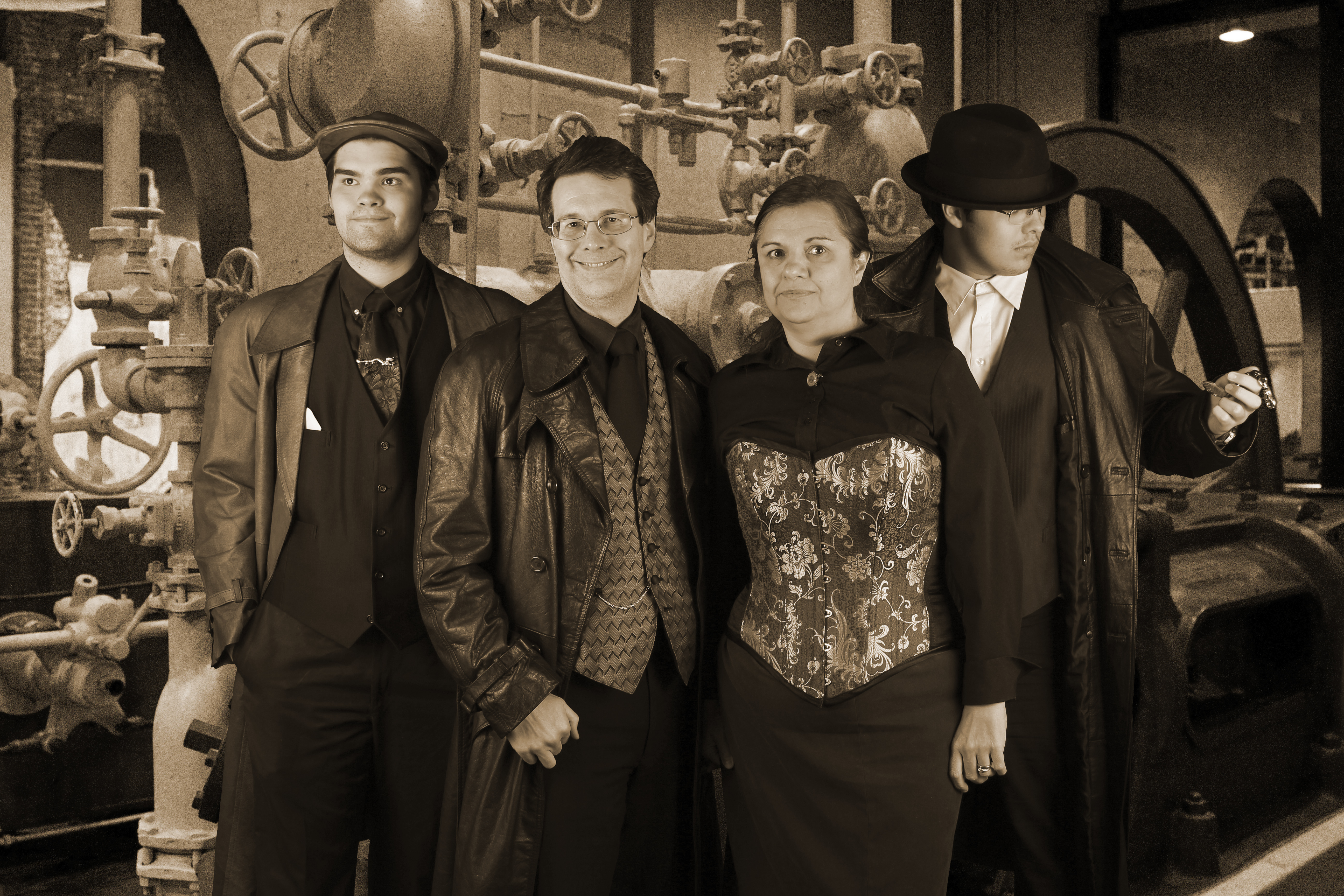
I have also attended a steam punk con. Yeah, that’s what the picture is all about. It was surprisingly fun. First, possibly because I hadn’t dressed up in years. Second because though it took place on a college campus – though, you say? Though, I reply – the attendees were all bright, engaging and interested young people who actually seemed to read for fun. Why is it “though”? Because with notable exceptions, a lot of young sf fandom seems to be more media and games based. My excuse to be there, of course, was having written the Magical British Empire Trilogy. Samples for which are here. It is a chase for the eye of the goddess in a magical land in which the industrial revolution is underfoot in a way you’ve never seen before, and all shape shifters are illegal and subjected to being killed on sight.

And right now I’m working on finishing Darkship Renegades, which is the sequel to Darkship Thieves. Excerpts for Darkship Thieves live here. Darkship Renegades starts this way:

Out Of The Frying Pan

I was a princess from Earth and he was a rogue spaceman from a mythical world. He saved my life three times. I rescued him from a fate worse than death.
We married and lived happily ever after.
Ever after comes with an expiration date these days. We’d been married less than year when Kit got shot in the head.

And if you’re totally at loose ends, let me remind you I give away some short stories and even a collection. If you haven’t tried the short stories, read them or download them here. As for the collection, please visit the Baen Free Library and look for my name. Happy reading.

And now, ladies and gentlemen, and the occasional dragon (thought I wouldn’t see you, lurking there at the back, uh?) have a good weekend. I shall go imbibe massive quantities of caffeine and work.

(The Picture is courtesy http://Fantascenes.net )

* Any Genius contained in this website can only be evaluated subjectively.  Failure to find genius cannot be held against the posters, their legitimately constituted representatives, or their illegitimately conceived charaters.  This concept was test driven by professionals on a closed course.  Your milleage may vary.  Don’t try to be a genius at home.  Death or injury might result.  According to Hoyt and Mad Genius Club shall be held harmless in case of explosion, launch into orbit or transformation into dragon.

Stupid Things I believed When I Started Writing #5

This is perhaps the most stupid thing I believed but it is also the one most beginner writers think it’s the absolute truth. Perhaps not consciously, but at the back of their minds, it’s how they operate.

I used to believe that writing was like those amusement rides that have a stick with “you must be this tall to ride.” I thought there was a bar that said “You must be this good to be published.”

So I worked really hard and I got mad when I wasn’t accepted.

Do I mean that there aren’t any standards, that they accept just about anything. Well, listen here, chum, there are days… But mostly, yeah, they have standards. Mostly you have to be above a certain bar before you can get published.

The difference is this… Just because you clear the bar doesn’t mean you’ll be published. You have to hit the editor on the right day, with the right thing. He/she has to have the right opening for it. Your book might be the most brilliant thing since the lightbulb. It might be the most commercial thing since someone started a lively trade in stone axes. BUT if the editor doesn’t think so, you still won’t sell. And editors are only great gods of perception in their own minds. In the real world they’re human like everyone else. I know. I used to be an editor, for a while, and I didn’t get handed any superpowers.

When you get rejected, the reason could be as trivial as the editor feeling women who wear red dresses are disgusting, and your character wears a red dress in the first scene. Or it could be as complex as their publishing schedule. Or it could be you didn’t make the mark. But it rarely is JUST that last.

Publishing is not an exam. It’s not “pass, you’re in.” Being accepted by publishers means their vote of confidence that you’ll make them money.

How does that make you feel better? It probably doesn’t. Now you know you need craft AND luck, and if you’re like me and started making baby bonnets babies would mutate to have no heads. BUT all the same, it’s good to be aware of how things work. And maybe it will prevent you sending letters to editors saying “How dare you not accept my story? It fits your guidelines and it’s good enough.”

(No, I never sent a letter like that. But I got some when I was a small press editor. A few dozen.)

Writer Purgatory

You Might Be a Writer IF

– The only thing worse than a book going disastrously wrong is a book going extraordinarily well.

Seriously. Darkship Renegade JUST pours out. So what is taking me so long? I keep stopping and trying to find holes.

This was actually explained to me long ago at the Oregon Writers Workshop. When a book is “right” and your voice for it is “right” you feel like you’re not doing any work at all and therefore it must be wrong.

So, now my greatest trouble is to stop rewriting things to death. What they told me (do I know if it’s true? No I don’t) is that when you’re completely in the voice you don’t think you’re employing any techniques or craft. But the reader will still see it, because it’s still there. It’s just you’re so completely immersed and it is so much YOU that you can’t see it. It would be like stopping in the middle of doing something you do everyday like driving and going “wow, I sure drive well. Look how I took that turn.” Or for me going “Fold that omelet, fold it!”

Yet, for a writer like me who always considered herself a creature of craft, not of art or genius this feeling is enough to drive one insane.

You might also be a writer if

– while you’re writing, the character of the next book in the series seems to loom over your shoulder (yes, I KNOW he’s not really there. I’m not gone as far as physical hallucinations) demanding you get done with this thing because his book IS the good one.

Of course the fact that I’m dealing with Lucius Maximilian Dante (by the grace of… well, not Himself above) Good Man Keeva probably makes it worse.

Note to self – do NOT write homicidal b*stards, even when they’re on the good side and it’s a story of redemption.

So, pity me as I go back to work.