The Caturday Post

We shall return to your scheduled, possibly incendiary post on Sunday, but today I’m introducing you to some of the reasons why I write — or at least the reasons I write for money.

Heinlein said that he wrote to feed his family, including his cats.  Well, the same is true here, though my husband makes most of the money for “feeding.”  I make vaccination, surgery after getting out and getting run over by a car, medicines and replace the sofa they had a p*ss war over money.  However, these are still some of the family members who keep me working.

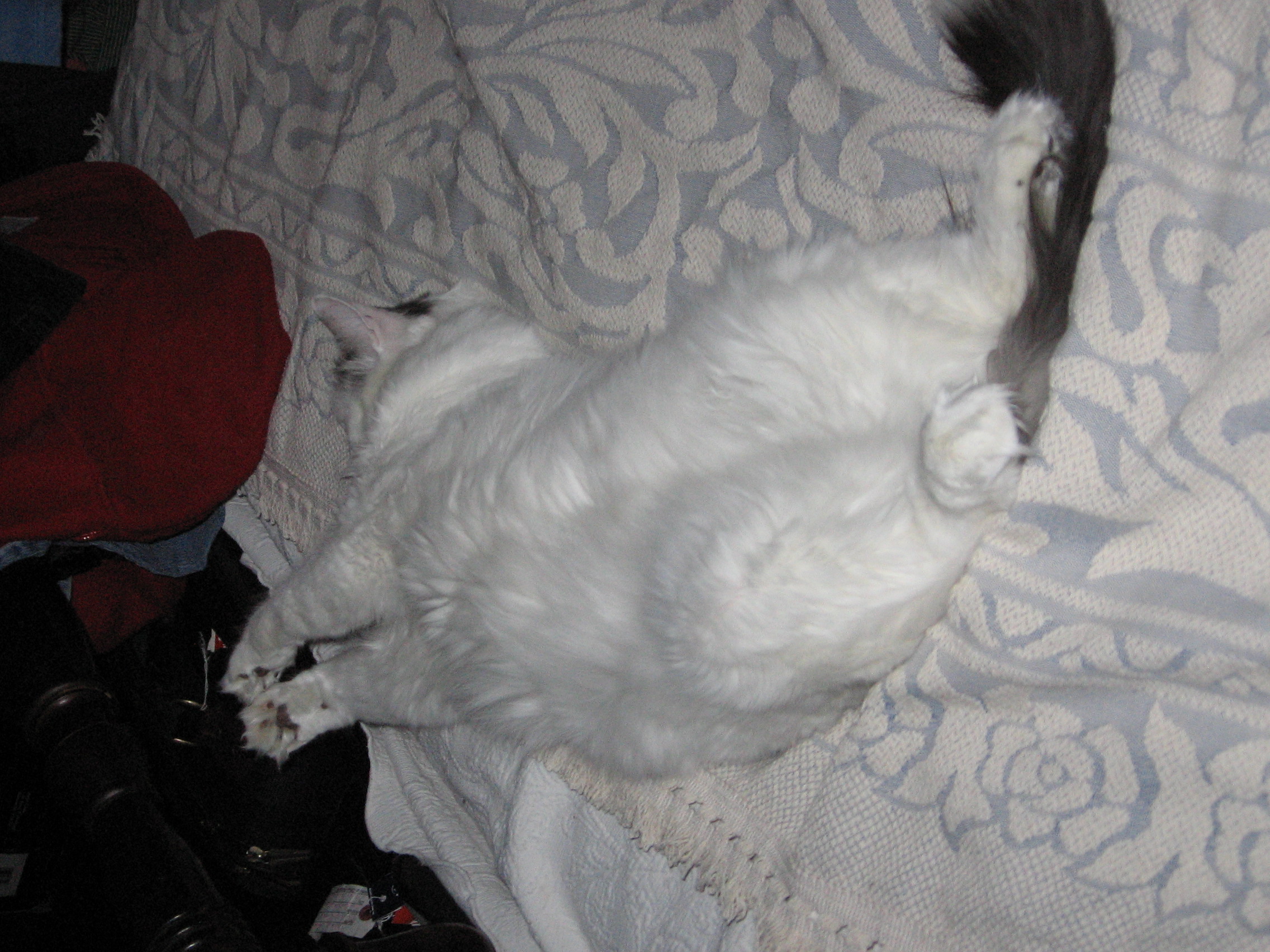
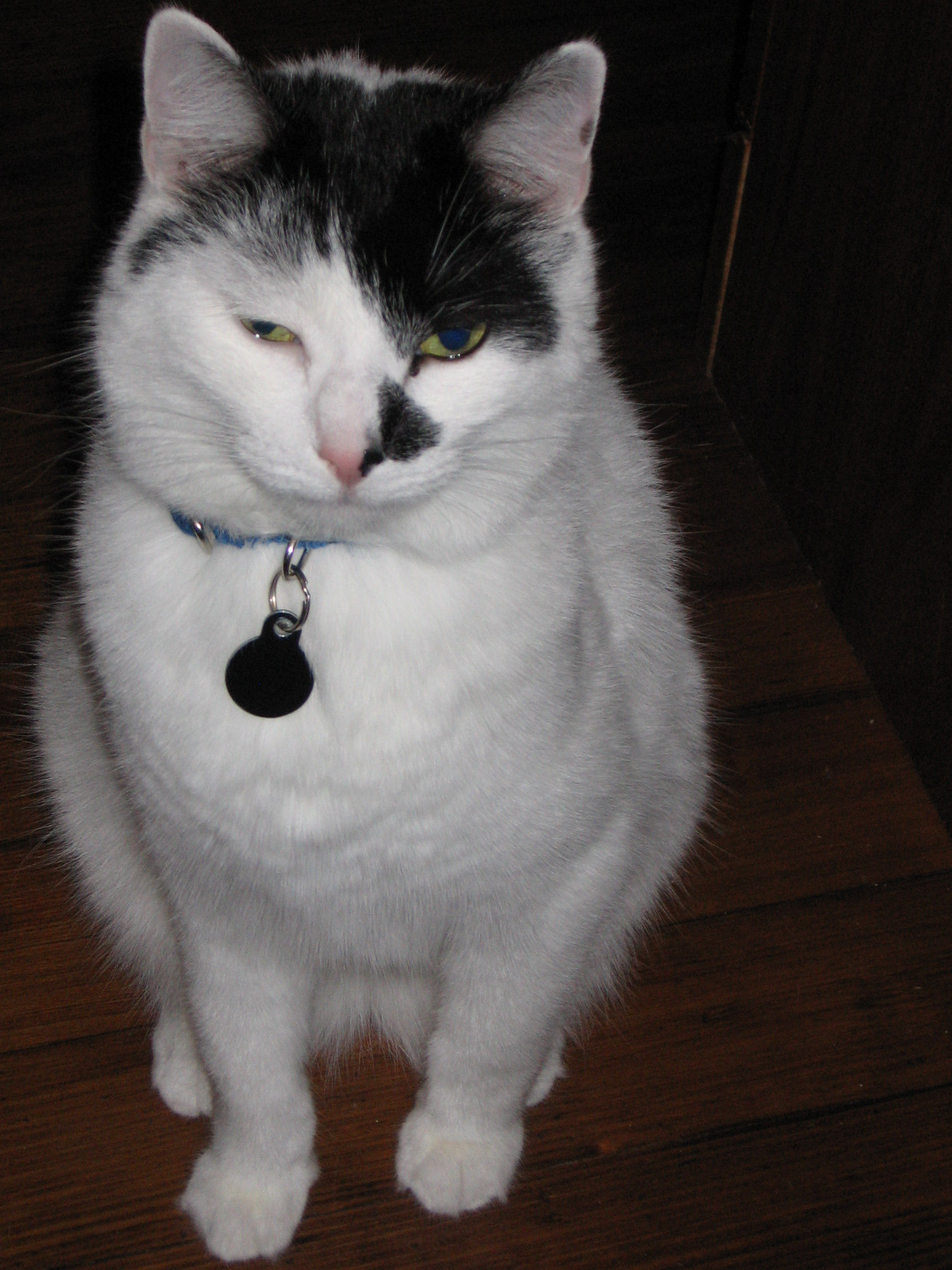
This is D’Artagnan.  He thinks his name is “Little Cat” which is kind of endearing as he tips the scales at close to eight pounds.  Mind you, that makes him the lightest male in the house, which is not saying much when the house contains Euclid and Havelock.  D’Artagnan wandered in at all of eight weeks, at the beginning of a Colorado snow storm.  It was Marshall’s birthday and the guys were unloading groceries.  D. rubbed on their legs, walked in, ate the chow, cuddled with Euclid.  He’s been with us every since.  His nose turns INTENSELY pink when he’s done something wrong, leading to his nickname, “Monsieur de pink nose.”  His names include butter pat (he feels like one.)

I’ve done a pastel portrait of Monsieur de Pink Nose.

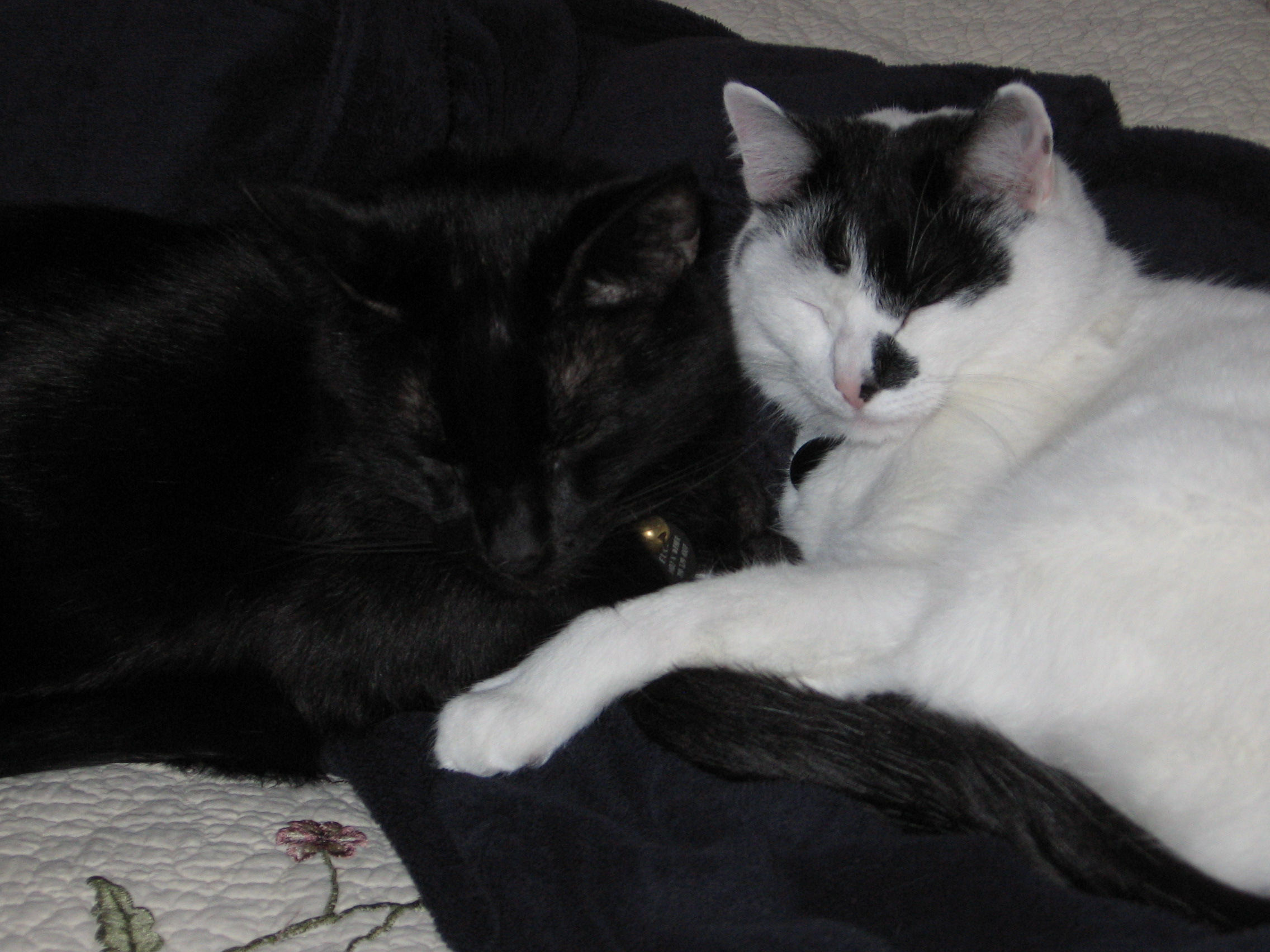
This is Euclid (psst, the one on the left.)   He’s a beautiful black cat and weighs fourteen or fifteen pounds.  If we could just convince him to stop pulling all the hair off his legs and belly, he’d be gorgeous.  (And yeah, we’ve checked for allergies, we’ve tried kitty valium.  Nothing works.  As far as we can tell he thinks he’s a poodle.  Also, valium exacerbates his alien-tail syndrome.  He’ll fight his tail for twenty minutes and lose.  It’s sad.  And funny.  But mostly sad.)

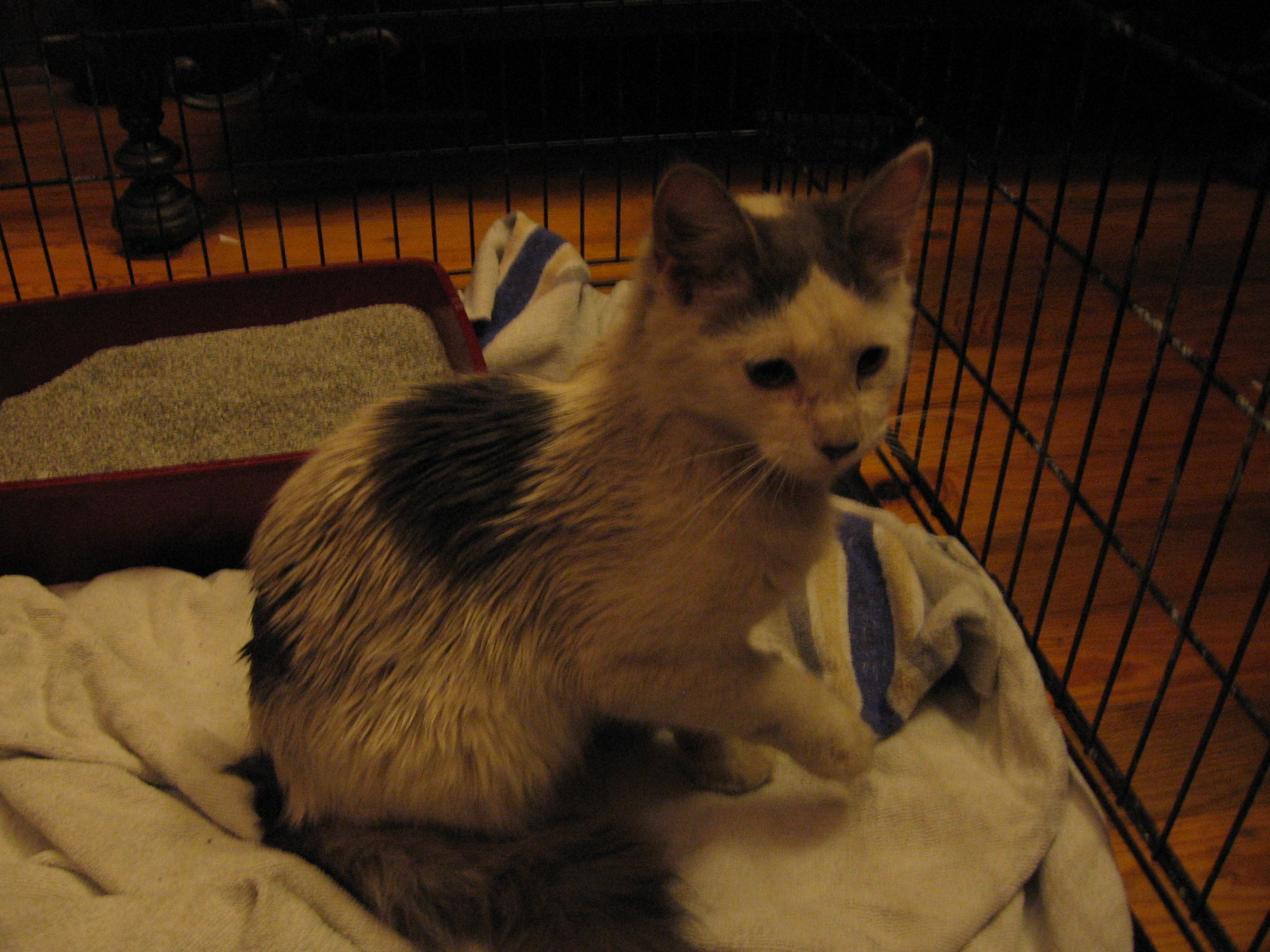
This is Havelock Vetinari Hoyt when we got him.  As you can tell he was a sorry sight.  He was living on our favorite mini golf course (yes, we play mini golf.  We’re very thirties-retro) as far as we can tell living from bugs and feature water.  He was also getting chased and hit with clubs because he messed people’s plays and some teen males (not mine) are dangerous idiots.  I do a lot of cat rescue.  we couldn’t resist.  Besides, since he seems to be a Turkish Angora we thought some family MUST be looking for him.

And, as you see, his family found him.  Or… er… he found us.  He’s still a very good cat, and tries to talk back if you talk to him.  But he’s clearly no longer a lost waif.

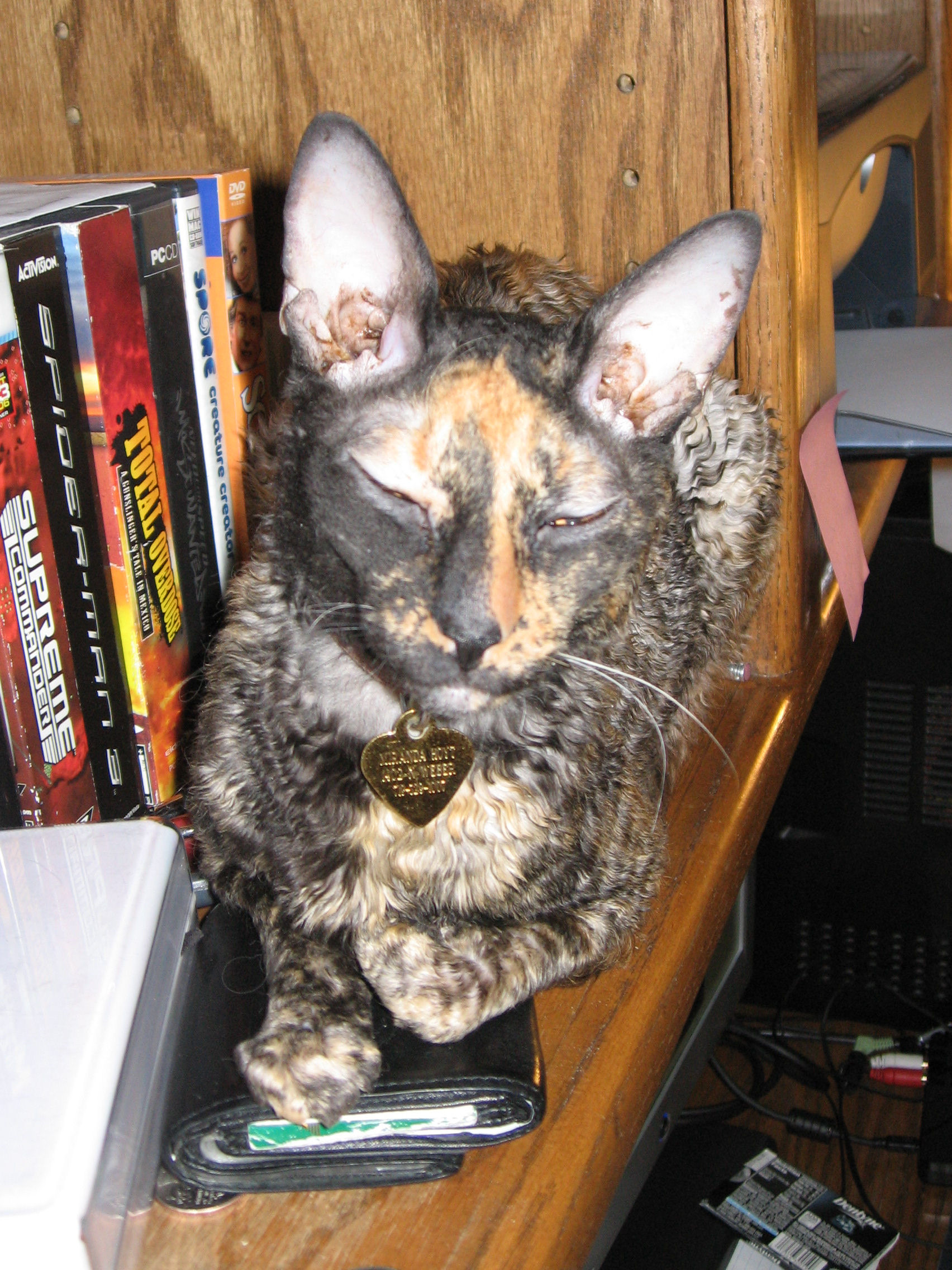
This is Miranda, who is helping us bring up our younger son, as you see.  Here you see her holding is wallet and wondering if he REALLY needs another video game.  She’s a Cornish Rex and the only cat we ever paid money for.  She’s a little smarter than the others and rules us all.

Yes, yes, one Rex to rule them all…

No, the Caturday post is not a normal feature.  Yes, I will try to update later in the day with something mroe… grown up.  But right now I’m feeling queasy (you know you shouldn’t watch news in the morning!) and I’m going to get tea.

Let My People Be Weird

Yesterday my husband and I went out with two of our oldest writing friends – Rebecca and Alan Lickiss. Oldest as in “we met them when we didn’t dare tell anyone we were writers in public and they were about at the same stage.” Writers need to socialize with other writers because they need to convince themselves they’re not insane.

Writers limit the instances of actual socialization to no more than once every few months because they’d rather spend their free time holed up, creating people in their head and writing. In other words, because writers are insane.

You see the problem there, right? Yeah, I do too. It might be completely unsolvable. Which means writers will continue to cluster together, but not too often. It also means to the outside world we’ll continue being mysteries wrapped in an enigma with a dash of strange, and most of what we do will continue seeming like weird rituals of crazy people.

This is probably not encouraged by my little rants. The post two days ago got linked in a non writing blog, and an – obviously – non-writer thought I was just being whiney. As a mark of how divided writers and non-writers are, I note that no writer thought that, though one writer (?) over at the Passive Voice thought I was being racist (Is white bread an arcane expression? I just checked to make sure I didn’t type white bred. Heaven knows what my fingers can do. But I don’t seem to have. And for the record I think the problem with being a minority – according to our government I’m Latina. Eh. I think my sons are perceived that way more often than I, but I know I am too. I get asked about my Spanish heritage ALL the time. Such ignorance. My ancestors were from the GOOD side of the border. Friends like Jason Cordova were not so lucky poor things. (Runs) – is that the only time having an “interesting”characteristic, like a different ethnicity does anything for you in writing career is if that’s ALL you want to write about and you want to play the victim. [And even this is usually only true in mainstream, not among us genre wretches.] Those who know me know this p*sses me off at the writing establishment. I don’t believe in restricting people’s creativity. And I am no one’s victim. You can victimize me. Doesn’t mean I’ll stay that way.)

I suspect it’s also not helped by my tendency to wander around the neighborhood in a fog. I’ve more or less cured myself of the sudden exclamations of “So, that’s what I do with the body!” but even so, my next door neighbor warn– er, tells everyone who moves in that I’m I writer, I suppose in an attempt to prevent their calling the police or thinking I’m doing heavy drugs.

So in the interest of my community, or, as I call them when talking to non-writers “my people” (No, I don’t say “Let my people go” to the publishing establishment. They do that with WAY too much relish. But you must admit in another year or two they’ll be pursuing us in chariots, as we walk dry-shod through indie publishing. And we all know how that ended) I decided to explain a few things that might puzzle you.

First and foremost, not all writers are rich. Yes, I know, I know. J.K. Rowling! Stephen King! Pratchett bought a castle! And, and, and… Yes, darlings, yes. But those you hear about splashing money are maybe 1% of the writing community. And that’s writers at ALL stages of development. The larval stage writer – as it were – while we’re trying to break in – a process that might be shortened by Indie, but I suspect not by much – if lucky enough to not work outside the house, will usually live very frugally. I stayed home after our first son was born, because after six years of infertility I was NOT handing him to anyone to spend most of the day away from me. To convince me that this was all right, my husband said “you can try to publish, at last.” I did. Robert was seven when my first novel came out. To contrive in the mean time on one salary, I bought our furniture used and refinished most of it. I did an awful lot of the sewing, particularly for the household (if you ever come over don’t ask why every curtain is a different length. I get touchy.) I cooked everything from scratch and as cheaply a possible. When I started selling, I made about 5k a year. I’m now making barely more than I did when I quit to stay home twenty years ago. Glamorous, our life isn’t. (But, hey, at least we scare the neighbors!)

Is this a complaint? No. You lays your money and you makes your bet. To put it bluntly I wanted to write FAR MORE than I wanted to be a multilingual translator (or a multilingual secretary, which is what I was at the time), which paid okay as a beginner and would make a lot more money now, twenty years later. Also, we always expected my writing to be our retirement plan more than any immediate money. (And how is THAT working for you Ms. Hoyt, as the industry sinks like the Titanic? – Well, so far so good. I’m atop the grand piano and afloat.)

It’s just that if you meet one of us working your local convenience store and say something like “Ooooh. You’re doing this for research, right? Because writers are all rich” make sure you do it while we’re not drinking or eating. I hear the Heimlich can crack ribs, and most of us don’t have insurance.

Second – we’re not romantic artistic types. Well, perhaps main streamers and poets are. But us, inkstained genre wretches are mostly crafts people. We have to be, as most of us – to survive – have to write two to three book a year. (And some of us are into Extreme Writing. To be fair, I also do extreme house cleaning and extreme ironing.) Again, if you MUST say stuff like “Oh, I bet the view of the mountains inspires you” or “Wouldn’t you love to write by the sea and drink in all that beauty” or “Do you dress up like your characters in order to get into the spirit to write?” make sure the writer doesn’t have anything in his or her mouth. Look at the previous paragraph as to why. (And I’ll admit I often dressed like Athena – naked – while writing Darkship Thieves, but only because I had an idea in the middle of the night and had to write.)

Third – Yes, we do work from home. Yes, we often seem to do something else all day, like wander around the yard, randomly moving stuff; painting; drawing. Do not assume this means it’s a good time to interrupt us. You have no idea what our mind is doing. If we encourage talk, go ahead. If we don’t, don’t think it’s personal. I’ve lost at least one friend who couldn’t understand that “you need to take a break” MIGHT be true, but it had to be on my schedule, not hers, and calling me halfway through the morning and expecting me to talk for hours was just not a sane assumption. (A variant on this, which never happened to me, probably because of weird accent or what have you, [the what have you being the kids who quoted Shakespeare, argued math and played an endless make-believe game as space explorers, for which they created their own world and society] is getting kids dumped on you to babysit, because you’re home anyway.)

Fourth – if someone tells you he’s a writer, believe him. This is more important as we go towards indie and self-published. I remember parties at which people asked “So, what do you do” and when I said “I write” they’d say “so, what have you published” and when I said “nothing yet” they answered “So, you’re just a housewife.” This is strange and wrong. It’s also quite normal. It is also driving a lot of new writers into really bad contracts, because they need that validation. Writing is a profession with a lot of ramp-up. If writing is what you do all day or in almost ALL your free time, then you’re a writer. You might not be publishing (or selling really well) yet, but that will come. And people should understand that. Would you tell a painter “so, you’re basically a housewife” because they haven’t had a show yet? Or haven’t sold for what you consider a decent sum? No. At least I’ve never seen anyone do it. Perhaps because painters work with brushes and canvas and have something to show for their work. Well, give us the benefit fo the doubt… We do produce a lot of paper dirty on one side. And sometimes, there might even be a novel on it.

Fifth – There is no “magical key” and I have some doubts that genius exists. So even if you know a writer who is so painfully bad you have to hide from his/her first drafts, treat him/her gently. A lot of this is ramping up and learning. I have seen a lot of people I considered hopeless have since got published and passed me on the ladder of success.

So, be kind to us writing lunatics. Ignore our odd tribal dances. We might yet furnish you with lots of stories you’ll enjoy.

We Also Don’t Walk Dogs

In traditional publishing there are things writers don’t control. In this case, this is not a complaint, so much, as “My fans should be aware I can’t do anything about this, and it’s no use at all to complain to me.” Yes, I’ve had complaints about all the things below. Now, if you’re a writer and contemplating publication you should also be aware that if you go traditional you are giving up these choices when it comes to marketing/packaging/distributing your books. Yes, you might be able to negotiate a say over some of these, particularly if you go with a small or medium publisher (those tend to be more accommodating, anyway) but for the large guys, foggedaboutit.

I’ve done this sort of post before, and talk about it at cons (except this post might be a wee bit more frank, since I’ve decided my trad publishing ventures will be limited in future) but yesterday a post by Sharon Lee, in the Baen Bar reminded me I need to repeat it periodically. For most people it’s so nonsensical that writers don’t control these, that they keep “re-setting” that knowledge.

So, from the top. Things traditionally published writers don’t control:

1- The cover.
You might get something called “cover consultation” which means you can give them ideas, and tell them if the cover they want to saddle you with stinks on ice. However, consultation is NOT control. You might wonder why in heavens name there’s a zombie with an udder fetish on the cover of your urban fantasy, but you can’t stop it being there.

2- Author bio/picture
The Author doesn’t even decide if there will be one there. And if the writer does, he or she can’t pick the picture. Yes, I do know in the one picture I have out in the back of a book I look like a right twit. In defense of my publisher, it was the best of several hundred. I do NOT photograph well. As for the bio – most of the time I get to write it. Sometimes I don’t. Sometimes the publisher is crunched and goes with an out-of-date bio. Sometimes they carefully excise all references to other names/genres/publishers. It’s their cover and it helps if you think of it that way. For more up to date and accurate info on me, try my website at http://sarahahoyt.com (Though not too accurate, as it seriously needs to be redone and I’m trying to find time. It’s unlikely to happen till after November, when the traveling stops.)

3- Copy editing
Okay, so I’m responsible for some typos. I’m sure of it because well… guys, just read my blog and be aware that I do proofread these posts. The mind that can’t keep letters straight has been through learning seven languages, which means the rules for doubling letters or not are a big scramble. This same mind, btw, tends to dictate too fast for the poor, stupid fingers, which means that they will completely forget half a sentence in their rush to catch up. Entering changes, once I’ve identified the need to, gets even more fun, as I’ve been known to erase the wrong word or type the new word somewhere completely different (sometimes both.) And I’m registered as a frequent offender in the Society Against Comma Abuse. However, with all that – my books do get copyedited when they come out through traditional publishers (or small ones. And in the future, when I bring them out myself, too.) Quality of copyediting seems to be going down across the board and recently a publisher took umbrage at an intimation that it shouldn’t JUST publish the manuscript as it came in. Yes, it was one of the big five. No, I don’t like it. but ultimately how well copy-edited it is is not in my hands, and they don’t pay me enough for me to hire a copyeditor on my own. (Though my assistant does go over the manuscripts most of the time just so I have a second pair of eyes on it.)

3a) sending me typos is totally useless if the book is already out in mass market paperback. Mass market paperback is usually the LAST stage. There is nothing I can do at that point. Yes, there is an off-hand chance an omnibus and/or second edition will come out, but unless you hear it announced, assume it’s not. So, sending me typos is sort of like teaching the pig to sing. Won’t do anything but annoy the pig. It also might make me hyper conscious about typos and slow down the writing. Which I assume would be a no-no for most of my fans.

4- Title
Please, please, please don’t ask me why I decided to change the style of a title mid-series. It’s not mine to do. Yeah, I can suggest it, but usually something of that magnitude comes from above. In the case of the musketeers changing book four to A Death In Gascony from The Musketeer’s Inheritance got me more angry letters than I care to mention – and it had been done against my will. I think it also helped tank the series (there were other issues.) So… Death of A Musketeer is now out with Naked Reader Press (http://nakedreader.com/storefront/index.php?route=product/product&keyword=Death+of+a+musketeer&category_id=0&product_id=61 — apologies, but for some reason WP is not letting me embed links unless I manually code the html which I dont’ have time for.) When I resolve a wee little dispute with Prime Crime over the next four titles (as in, they’re out of contract, ACCORDING TO THE CONTRACT but I might need to use a cast iron skillet to get the publisher to admit it.) they’ll all come out with Naked Reader Press. Because they’ll be extensively edited (long story, but I was having health issues that affected my concentration) and because they’re mine, dang it, I’ll change the titles back in line, so the order will be Death Of A Musketeer, The Musketeer’s Seamstress, The Musketeer’s Apprentice, The Musketeer’s Inheritance, The Musketeer’s Servant and (upcoming), The Musketeer’s Confessor, and The Musketeer’s Folly.

5- Byline
This means the author’s name on the story cover. What it boils down to, is right now I’ve used/am about to use four names (not counting a house name): Sarah A Hoyt, Sarah D’Almeida, Elise Hyatt and Sarah Marques. Of those, I’ve chosen to use Sarah Marques. I have intentionally chosen that as opposed to my real name because the novels (coming out of Prime Books sometime next year) are so STARTLINGLY different from my normal novels (how startlingly? Vampires. Historical. Sex and sexual tension. WEIRD sex and sexual tension) I’d prefer not to give my readers heart attacks. Also the main characters are the musketeers, but the musketeers themselves are not like my mystery characters (unless you strain them through hell first) and D’Almeida is associated enough with my main name (should be. It’s my maiden name) that it helps to have some distancing.

But all the other pen names were imposed by my editor. I don’t know how much of it was imposed by the publisher. She thought because the previous series had crashed, I should change my name, so the bookstores would stock me. Does that help? Not markedly. Nine years ago Jim Baen told me the bookstores (not being stupid) went off the copyright page. And yet I had to fight them over wanting to change my name for No Will But His. The one that upset me most was when they told me the name for the Daring Finds Mysteries had to be “white bread” because, you know, Sarah Hoyt is wild and exotic. And it couldn’t be Sarah. Hence Elise Hyatt, which is the name most people don’t associate with me. OTOH she has her own fandom and she’ll be bringing out an exciting (TM) series of Orphan Kitten Mysteries via Naked Reader Press. Watch this space for an announcement.

6- Distribution
Do I need to tell you I don’t control that? You’d not think so, and yet I get emails saying “Why are none of your books available in my local bookstore/in all of my county?” The temptation to write back “Because I hate to be read and make money” is enormous, but someone would believe me.

Distribution is a cluster– that is, is a complex mechanism, and about to become more so, now that Borders died. If you think of it as a Darwinian competition between bookstores and publishers, it might make some sense. The publishers’ goal is to put as many of your books on the shelves as possible. (Well, in theory. For some of them one wonders, at times.) The stores’ goal is to stock only books that will sell. Now, remember, children, regardless of what you think of the evolution of life, there is no intelligent design in publishing. There isn’t even inate wisdom of markets. Because of the war, both sides of the equation adopt measures that make absolutely no sense. Unless you’re them.

For instance, the name change gets countered by looking at the copyright page. But this assumes that authors are the ones responsible for the tanking of the book, which is built into the computer-numbers game that Borders initiated (for which they had their reward.) It also assumes that writers never change writing style and/or field and write the same book over and over. Never mind. Then there’s the fact that bookstores culled books every six months, so publishers started getting books published every three months, because it would then show as “more books on shelf” and have a chance of having the whole series up at once (unlikely, but publishers dream too.) So bookstores started culling books faster, which means you now have like four weeks on the shelf to sell your books – if you come out with no publicity and have two books per store, your chances of selling are about the same as of winning the lottery. The latest twist seems to be a refusal to special order the book, even if you pay for it in advance. How this gives them a leg up on Amazon is beyond me. No, seriously.

The inate wisdom of the markets is manifesting itself in the fact that the system – having become nearly non-functional – is now being replaced wholesale with Amazon/ebooks/indies.

Meanwhile, it’s not my fault where my books are stocked, where they aren’t, and whatever else publishing houses/bookstores do to each other in their games.

7 – Scheduling
This might or might not be the author’s fault. I’ve been known – oh, so rarely – to be late delivering. But I readily admit to THAT. If you are waiting for Noah’s Boy, third of the shifter series, I will be delivering it soon. It’s been delayed due to other more pressing projects. One advantage of my going mostly indie is that the publishers I still work for will get more regular deliveries. OTOH I delivered the third of the Daring Finds Mysteries in February and it’s not even scheduled yet. AND they took a year to buy the third after the second came out, and I had other things to do, so I didn’t write it on spec. This delay is not my fault. But it is why Elise Hyatt is about to start an indie series. (mwah ah ah ah ah)

8- DRM and ebook pricing.
I don’t like DRM. This is well known, right? I will not sign on with a small publisher that uses it. OTOH I have ZERO control over it when I sign with big publishers.

As undeserved as this might be (grin) I don’t have the name/sales/pull of say, Stephen King or J. K. Rowling. You need that kind of pull to make publishers take that nonsense out of the contract. Until then, you endure. Ditto for prices. Yeah, most ebook pricing is ridiculous and as a reader I’m 100% behind you. But it’s not my decision and not my fault. Yeah, I can go indie, and I suspect I’ll be doing so more and more. But babies need college fees and periodically the cars need fixing. I still need to earn a living, until indie earnings come on line. I’m sorry if you’re inconvenienced. I sympathize with you at heart. But there’s nothing I can do.

(IF I can’t get them to let me have the rights back to the musketeer mysteries, rights that are clearly mine as per contract, without invoking a lawyer, what makes you think I can make them dance to my tune in their pet delusions like DRM and ebook pricing?)

I’m sure there are other things that are not my fault. (I did not steal the cookies; I did not kick – well, trip over, but he thinks I kicked him – the cat; and I did not say a swear word in front of the kids – or maybe I did, but it wasn’t my fault, and besides the word was in Portuguese. Also, the sun was in my eyes. Besides, I was never there and I was led astray by evil companions.) But I think this pretty much covers the essentials that a writer loses control of when traditionally publishing (caveat scriptor) and what readers shouldn’t blame writers for (we’re all packages of frustration, fear and confusion right now, so try not to push us towards heart attacks and premature death. Our other fans will thank you.)

He Beats Me But He’s My Publisher

First let me point out no one beats me. Not literally. For those of you who’ve read Athena (Darkship Thieves) this should not be an incredible surprise.

The title is denoting of the relationship existing in traditional publishing between the writer and the publishing house. It is also the sort of thing I heard many women say about their husbands in the village where I grew up. Portugal, like most countries whose cultures were strongly influenced by Islam, had a streak of wife-abuse running through the poorer or more culturally backward classes. Since in the village where I lived my dad was one of the very few white collar workers, this meant my mother and my grandmother were forever saving women who ran away from home when they were two steps from landing in the emergency room… Only to see them go back to their husbands because “He beats me but he’s my man.” Or “He beats me because I’m not good enough.” Or “He beats me because he loves me so much.” Or even “Whom should he beat but his own.”

Needless to say, the one thing my family told me, from – I think – before I could toddle (I could talk before I could walk. No. Don’t ask.) was “If your husband ever so much as slaps you, you leave. That day. And you don’t go back.”

Unfortunately my family never knew about publishers and the status of the mid-list author.

I wasn’t going to talk about any of this. I wasn’t. I like at least one of my publishers immensely, and I do understand how their hands are tied. On the other hand the last few days have been very trying. First, is it my impression or are all the establishment’s blue eyed boys going out of their way to tell us how we’ll starve in the gutter without traditional publishing? They remind me of my first agent, who btw, ONLY made official the sale I had already made to the publisher, and who then told me I’d die in the gutter without her, when I fired her. (Yeah. That… didn’t work as she thought, curiously enough.)

But then yesterday, in the Baen bar, someone posted that he sent letters to WRITERS complaining about their publishers’ DRM policies and pricing for ebooks because, I don’t know, the Kool-Aid man is red? Oh, wait, no, it’s more nonsensical than that. Because and – clears throat – I am quoting: writers choose their publishers. I want them to choose publishers who don’t do these things.

And that pushed me over the top. Call it hormonal, all right? I’m getting to be the same age when my mom was more likely to take off with the cast iron frying pan to talk to one of the abusive husbands than she was to simply bandage the woman’s wounds.

So, to begin with, let me tell you right now that the chances of a midlist author dictating terms to his/her publisher are about the same as those of a village working class woman finding a man who doesn’t beat her. She might get lucky. She MIGHT. But she can’t count on it. In fact, a village woman once told me “If you think you’ll find a man who doesn’t beat you–” (And let me say, yes I have.)

Heck, as some of you know I have a lot of friends who are bestsellers. The way the market is right now, the chance of a bestseller dictating terms to his publisher are close to nill as well – unless he’s one of those blockbuster bestsellers that defy all classification. In our field you can probably count those in the fingers of both hands and have some fingers left over. And unfortunately none of them are close enough friends for me to ask if they, too, are worried.

Now, let me describe to you how much power the typical author has. Let me tell you how traditional publishing works for the unconnected, the non-fashionable and the doomed.

First of all, it’s a buyer’s market. Since the mega mergers of the eighties, there are five overarching houses. There might be more imprints, but, at least when submitting through an agent, you can’t submit twice to the same house. (Well, at least not using any agent I’ve had.)

Second, for each slot available on the publishing schedule there are thousands upon thousands of submissions. Even assuming the vast majority of those are either horrible or “don’t fit” the publisher’s “needs” there have to be at least ten books that would fit the slot at any given time.

So, let’s say YOUR book takes the editor’s fancy. Or maybe they owed your agent a favor. Or maybe they liked the title better than the other ten. Who knows?

You’re a brand new author, and they pick you out of slush. Oooh. Oooh. You’re in the money now, right?

Um… maybe. But first let’s talk about the important considerations: how powerful is your agent? How much does he/she believe in you? And do you know anyone in a publishing house? If all those are negative, you have one more chance at the big money – are you a “sexy package”? Part of this is literal. Are you cute and young? Can they count on displaying you and having people tumble over themselves? Part is metaphorical – do you have a hard luck story? Do you have something interesting about you? Do you perhaps have a well-followed blog? Or are you a politically correct refugee? (When my first series tanked the publisher told me she would buy me again and “make me a bestseller” if I wrote an autobiography. I was thirty eight. I’d done nothing but get married, have kids and write three failed books. So… she wanted me to write about my childhood in Portugal and make it “sexy.” No, I didn’t. What, am I stupid? No. I respect my family and friends there too much. I want to sell my books, not my unremarkable self. Also there are other reasons which are none of their business. Or anyone else’s.)

Let’s suppose you’re either white-bread American and unconnected to the publishing industry in any way. (Or you’re not white American but are stupid or honorable enough not to let them make a big deal of your life or treat you as an oppressed minority.) Let’s also suppose you wasted your twenties trying to break in, and in your thirties you’re blousy, somewhat overweight, with two small children.

Ah, my dear, welcome to hell. Here’s your accordion.

Having looked at this, your editor “forecasts” your numbers. I have it on good authority this doesn’t involve the bones of sacrificed animals. What they do is go “White, American, unremarkable and not sexy.” And you get the standard beginner’s advance. It used to be the princely sum of five thousand dollars (what, you can’t live on that for a year? Foolish you. Appliance boxes are free, and there are some nice underpasses. You can write at the library.) It is now three thousand.

Now the book and its advance pass on to the marketing department. Who… barely glance at it. To get back the money they invested in you, they don’t really need to do anything. No, look, I know what you’ve heard. They say that printing the average book costs 100k or some fantastical sum. But that’s because they’re charging to every book the same percentage of editor/publicist/secretary/etc salaries. (Many books at this level, if bought on proposal, never get READ in full. Except presumably by the copyeditor. That’s how much time you take of those salaries.)

Next, you get assigned to someone – probably someone’s secretary – who procures a cover for you. Usually you get a beginner artist (and some are darn good) but they might also use some form of out of copyright art – like my first three books. And then… and then you go to copyedit. And thence to the marketing department again.

I’ve been privileged to listen to a book reps spiel back before I was published, at my favorite independent bookstore, while I was waiting to ask the manager a question. Back then this was done with a huge catalogue with covers, and one or two books in actual advance printing. First these came up. They were either bestsellers or those the publisher had slated as bestsellers. They got handed to the bookstore manager and the manager was told “Well, we have strong confidence in these books. You’ll want to take…” twenty of each, I think, at a minimum. Might have been fifty. It’s been a long time. Then came the books in “second slot” for that quarter. For these the rep had the covers. He’d hand them over, do a little song and dance, and say “you want to take” – five or ten of these. He’d tell you how the publisher was promoting these books this way or that, or how interesting the life story of the author was, or what have you.

AND THEN, at the end, he’d say “You also can take these.” THAT, Mr. or Ms. Whitebread, is where you are. And if your cover is exceptionally pretty or the manager recently watched a movie that sounds somewhat like your book, they might take one or two.

At that point, you’re in the midlist zone. You’re also more than likely in the sales death spiral (no, I’m not going to explain that. This would run to ten pages. Google Books and Death Spiral.) After that, any book you sell, those numbers will be brought up. Can you escape the midlist, once you’ve been cast into it? I don’t know. One hears stories, but those are usually from before the computer number system. Perhaps, as with hell, you can swim out of it but I doubt it’s on a sea of tears of true repentance. More likely you’d have to marry a movie star, or perhaps run for president.

Note that SO FAR the writer has had exactly zero choice. Oh, he can chose NOT to sell his book and remain obscure forever. Does how good his book is influence anything? Well… it could. Supposing that word of mouth got going among readers. Except that, for all but one of my publishers (yes, you know which one) until very recently, it was one print run, one time, it sells out and the book is no longer available in any format. Too bad so sad. One of my publishers until the last two books made it a point of taking the books out of print at the year mark or when the book started earning royalties.

This meant the chances of your being discovered in back inventory were… you’re right. Zero. (I know through my fanmail a lot of people are NOW discovering my Shakespeare series which came out eleven years ago. I get no money for those, because they’re out of print and either used or remaindered. I don’t even get statements for them anymore. And there weren’t enough of them printed, so even if they all sold twenty times, my name recognition would be limited.)

In fact, if your book had been completely blank, or a compilation of nursery rhymes, it would have got exactly the same distribution and sales as it got with your words in it. You didn’t choose the cover. You didn’t choose the price. You didn’t choose the push. You didn’t choose the distribution.

More importantly and more than likely, the person who chose these things chose them NOT based on the book – which they might or might not have read – but on YOU and their perceived marketability of YOU. (And let me tell you, as a reader, that’s many shades of wrong.)

Most people don’t know your book even exists, and therefore they can’t ask for it. And if they do, they might get told it can’t be ordered.

And then… and then the fun starts. When the numbers are in, you’re told your numbers are only “midlist” and barely good enough (if you’re lucky) for them to buy the next one. And the next. they all get the exact same treatment. You might grow your fans, but it will be very slow. And even if you sign with a publisher who wishes they could do more for you, at that point the publisher is hamstrung by the numbers in the computer about your previous distribution.

You might (or might not) be asked to change your name again and again and again (one of my publishers has a fetish for this.)

And all along you’ll be told the fault for your lackluster sales is … yours. Yep. You wrote the book, and if it doesn’t sell, it’s ALWAYS your fault. No matter how demonstrably it ISN’T.

And under the old model, you swallowed and took it. You did what the village women did when I was a kid. You bandaged your worse wounds, and you made up stories. “I fell down the stairs.” “I bumped into bad sales figures in the night.” “I am so clumsy.” “It’s all my fault.” “They beat me because they love me.” And you crawled back. Because the alternative was unthinkable. The alternative was to never publish again.

And if you complained – if you so much as opened your mouth and said something along the lines as perhaps the crash of the books wasn’t ENTIRELY your fault (I’m not a conspiracy theorist, for instance, but I’m100 % sure that the crash of my first book was exacerbated by coming out exactly one month after 9/11 and while I’ve done many weird things in my life I’m SURE I never committed any terrorist attacks. But those numbers were SOLELY my fault, as far as the industry was concerned.) you got told how grateful you should be to the house for continuing to publish your worthless self, how each of your no-good books cost them 100k to get to the printing stage, and how they only did it out of the goodness of their hearts. And you had to swallow it, no matter how nonsensical it was.

THIS model. THIS MODEL is what the bright eyed harbingers of the establishment, the blue eyed boys of privilege want me to get maudlin about. Both as a reader and as a writer, let me say RIGHT NOW that I’m not going to.

No, I don’t know where the buck will stop in digital publishing. No, I don’t know what will emerge or what shape it will take. I do know just being able to say “It wasn’t my fault. I’m not the world’s best writer, but there’s something mighty weird with the system.” Or “I will not be grateful for hind teat” is good enough for me.

A biography of Marlowe claims that among his last words were “Just to tell the truth once, would be worth dying for.” This, it turns out, is also true when the result is the metaphorical death of a career. Particularly when there are alternatives.

No, I will not eat what’s put before me. No, I’m not the world’s most wonderful writer – every year I look at what I wrote the year before and cringe, so I know there’s room for improvement – but I KNOW I’m not a million times worse than J. K. Rowling. Sorry, that’s not just impossible. That’s obscene. I also know that until Pratchett got a new agent and editor, he was lost in mid-list hell in the US while a bestseller in the UK. His writing did not change. His marketing did.

Will I continue selling to big houses? Only if I like them. I write for a house I like, and there’s one other house I wouldn’t mind writing for.

As for the rest of them, they can go to hell. I’m going Indie.

*Crossposted at Mad Genius Club*

Welcome Vodka Pundit Readers. Thanks to Stephen Green for the link. Poke around. We don’t have Vodka, but we have Port. (Have to. I was born in Porto, Portugal.) It’s in the decanter over there. Go easy on it. It’s stronger than it looks.
You Say Editing, I Say Proofreading

Yesterday’s post at Mad Genius Club* (Yes, Dave, that was amazingly concise when I can’t say things in less than five pages) as well as Bill Quick ’s on the roughly same subject – that the establishment is trying to convince ebooks will be the death of all books (what they think we can do about it, even if it were true, is beyond me. They do know, right, that tech can’t be put back in the bottle?) – has led me to think about editing, copy-editing and proofreading.

Why has it led me to think about that?

Because Dave’s comments turned to the art of editing and because of Bill’s exchange with a commenter on his blog who said the country is awash in talent that simply didn’t fit the old model. Bill said that no. He’s read slush, and most of it is painfully bad.

He’s right of course. And so is the commenter.

Which brings me to the first point of this post. Writing is an art, true. Writing is also a craft. The country might be awash in art – it is not awash in craft. It will never be because craft is work and not everyone who is artistically gifted is willing to work at it. Or even has any clue in which direction to work. This is sort of like saying the country is awash in people with talent for sculpture. It might be true, but it doesn’t mean that every barn and every garage shelters the equivalent of Michael Angelo’s David.

This is the point at which, usually, my colleagues start running in circles like their head is on fire and yelling “oh, no, my precious gems will be lost in showers of sh*t” and “readers will never wade through slush.” These might be true for some people. I have heard some readers will no longer buy independent works at 99c because they assume it will be raw slush. It’s not true for me, though, and probably not for a lot of other people, because a) I’m cheap. b) I will read three paragraphs and if the writer is not competent enough to draw me in, I set it aside. And this happens as mucht o independent books as to well-published ones.

No, what worries me about every beginner being able to publish himself is not that my gems will get lost in the muck. There’s word of mouth. And there’s other considerations. I’ve made a post about it here: http://accordingtohoyt.wordpress.com/wp-admin/post.php?post=918&action=edit. The establishment (or even one of us when we read slush) cull for all sorts of reasons that have nothing to do with quality. Like “does it fit the publisher?” Or “will it sell enough to justify investment?” And independent publishing has the potential to free up a lot of talent that otherwise would have no outlet.

What worries me and has worried me since I heard a self-published author read five years ago, is more the Michael Angelos who will be lost because they had no clue how to learn or that their sculpture wasn’t perfect and – having shown it to the public – it didn’t do well.

Both as a once-upon-a-time clueless writer and as reader, I don’t like to see that talent wasted.

This was brought home by reading for a contest. I’ve done this over the years for contests ranging from sf to mystery to romance. Not a single entry in a contest was publishable as was, though several of the people I judged and encouraged (hi Connie!) have gone on to be published. And though this is hard to judge, I’d say 90% of the writers are more talented than I am.

What they lack is craft.

Now, this is the point at which my colleagues start running around in circles, screaming “without editing we’re lost, lost, lost.” Okay, all I can say is that these colleagues either came into the field much earlier than I did, or they’re G-d’s little precious snow flakes.

I didn’t even know what in heaven’s name they were talking about when they threw these hissy fits. Because, look, most of the contest entries – most of slush too – is grammatically correct and properly spelled. The exceptions, like the mention of a copulant face (they meant corpulent, and yes, that would be wrong too) on the first line, were easily fixable.

And then I read Heinlein’s bio by Patterson, and about how Campbell worked with him, sometimes sending things back for rewrite three or four times. All you have to do is read Heinlein’s short stories of the time in sequence to see Campbell taking him from a raw beginner to a master.

Children, if this has happened to anyone in my generation, it wasn’t to those of us who were thrown into the mid list to sink or swim. And I doubt it happened to very many people for one reason: there weren’t enough editors. Oh, one additional reason: the editor who can do this is rare. When you have fewer editors the chances of one of these are… zero.

I came in the hard way, by getting rejected so much any sane person would have walked away. In between, I read how to books, most of which are of course useless and a few of which are invaluable. At some point I started getting nuggets of editorial wisdom (not always from editors) which did help. Like my first agent told me to forget about coincidences as plotting devices. Toni Weisskopf at Baen told me I had to get past the “there’s a secret to be discovered” plot. (This was true and false. It’s a type of plot, and a type I like, so all my books have a “mystery” in them. But I had a tendency to try to play keep away with all knowledge and that was wrong, wrong, wrong.) But mostly I learned on my own.

The thing is, I learned because I wanted to get published. Will self-published authors do that, or just give up? I don’t know. I do know that I would love to find an editor like Campbell. And that I feel bad for newbies who are paying for “editing” and getting proof reading.

This is not a scam. It’s just what most people understand for “editing.” It’s what most writers’ groups obsess about. It’s what most first readers THINK they’re supposed to do.

I don’t know where this comes from. Perhaps it is because proofing is hard and fast and we all learn it in school. Editing, OTOH is an art as well as a science, and it requires not only that one be a voracious reader, but that one be a voracious reader who can extrapolate why things work and why things don’t.

Most writers who came in the hard way and had to edit themselves into success can do it.

Whether they WILL do it is something else. (I can do it, and do it for my mentees and my kids. I also hate it with a passion. Yes, this is why I’m the world’s worst mentor, and if you send me something to read, you have to KEEP on me, or I’ll forget it.)

Again – most of what I’ve seen in contests and slush could be salvaged with expert editing and a few rewrites. And none of it had anything to do with proofing. Proofing is easy. Any monkey can do it, editing is very difficult and you need a good match between writer and editor, or it will only get worse.

So, a quick, handy guide:

Editing – if you are a beginner writer and you can get good editing, you should definitely do so. How do you get good editing? Oh, search me. Here is what you should shop for: someone who has experience making books marketable. Here is what you should beware of: someone whose experience making books marketable has been thoroughly directed to making them fit the old model. That might no longer apply and it might be counterproductive.*

One of the best editors I’ve had, I paid to copy-edit/proofread, and was shocked he was also tightening my sentences, pointing out where the plot went weird, and tweaking scenes.

What was shocking about this, is that he’s GOOD at it. Though perhaps I shouldn’t be so surprised, since he’s a voracious reader, an introspective one, and has worked as a non-fiction editor for years. (Yes, that helps, because he’s used to making things sound clear.) He’s also the Seneschal of Snark, but you take the bitter with the sweet.

So, editing involves telling you when your plot gets incoherent within a chapter. It involves telling you things like “if your character is allergic to oak trees, why does she live in an oak forest?” For a very gifted editor, it might mean also telling you how to fix it without ditching the whole plot “she’s under a geas that makes her cleave to the oaks.”

To figure out what editing IS you should go out and buy Self Editing for Fiction Writers. It will at least point you in the direction of what editing is and isn’t, and maybe even get you to edit yourself into publication.

Chances you’ll be your own Campbell are minimal, but miracles do happen.

Copy Editing – copy editing is something completely different from editing. Yes, I know it says editing in the title. Note it also says “copy.” Copy means the story has been accepted and is being prepared for publication. In old newspaper parlance, articles are “copy.”

One of the reasons that writers groups and first readers harping on the copy edit drives me nuts is that in most traditional publishing this is done, anyway. So, unless it’s really, really, really in your face distracting, you shouldn’t bother, because it’s going to happen and it’s going to happen by people who are trained to do it and who know “house style.” (For instance, most houses use FAR fewer commas than are strictly indicated in grammar manuals. Some houses – I’m looking at you Berkley! – try to remove the subjunctive. Etc.) There’s a good chance what you’re doing to the book is going cause more trouble in the long run and browbeating the author in the process.

Proofing – I view this as a different stage from copy editting, though feel free to consider it the same. Proofing is that last, last, just before print stage you go through to make sure your search-replace didn’t get funny, and that you didn’t enter a word wrong after copyedit.

All works, whether indy or traditional should have all three stages – Editing, copy editing and proofing. For years now, the traditional have only had the last two, but the publishers kept out those that needed heavy editing. Now, that’s each author’s responsibility. And figuring out what editing means is a good beginning.

*A bad editor is worse than no editor. Actually where I see this the most is where writers’ groups or first readers think they’re editors and the writer is too green to know better. The reason first readers come in bunches is that the writer is supposed to FILTER the comments. For instance, if less than three first readers have a problem with a scene (for a group of say ten first readers) you ignore it. No matter how vehement the first reader was. I am currently editing a friend’s book which has been glopped into an utter mess by integrating in explanations for everything someone failed to get. So, in case you need to know this, first readers are ALSO not editors. They are useful, but only if corroborated.

A Flight Of Outline

A fan of mine, and someone who is one of my favorite people online, recently asked me how to outline a story. I don’t know if this was a short story or a novel. The outlines are vastly different. However, I thought I’d give him a quick overview of my process. You non-writers hum along with the tune or something. (Actually I think it would be fascinating as a reader to know how a writer one likes plots/outlines. I know it fascinated me to find out Terry Pratchett can reach the end of a novel with no clue what the closure incident will be.)

A few things to keep in mind before we start – think of this as our pre-flight announcements.

1) Everyone’s process varies. Kevin J. Anderson would no more reach the climatic incident of his novel with no idea what it would be than he would set his hair on fire. Clearly HIS process works for him, and Pratchett’s works for Pratchett. If your process is completely different from mine, it probably just means you’re not Sarah Hoyt. This is a good thing, now I think about it. The world is rather overfull with Sarah Hoyt most of the time.

2) A working outline is different from a proposal. Both are different from a synopsis. And both are yet again different from a concept. A proposal is made to read pleasantly and slanted for the house you’re sending it too. It is written in the present tense. It must start with some sort of hook paragraph, and you must have sort of a general road map before you go into what happens. Say, the proposal for DST should start with “It is the 25th century.” That level sets the editor reading it. A synopsis is sort of the same as a proposal, but often sketchier, more condensed for shorter attention spans. (At least that’s what I call it. This term is not absolutely nailed down. Some people call a synopsis + 3 chapters a proposal.) A concept (And so far I’ve sold three books on concept) is something much shorter, often no more than a paragraph. Say “Urban Fantasy in Space with tough girl and gene-modified man with a hard past.”

3 – For the purposes of this post, I’m talking about a working outline: a road map to your story, which you create to help you figure out where you’re going. Kevin J. Anderson says to think of it as looking up the road ahead in a map. It doesn’t mean you won’t stop at lookout point or take a picture of the pretty wild flowers. It just means you’ll have some idea where to turn and which exit number you’re aiming for.

4 – I won’t simply post one of my working outlines because a) they’re usually written long hand – that, editing and trying to find a voice are the only things I still do long hand. b) they would make no sense whatsoever to anyone else, not even my nearest and dearest. I will forever cherish the image of my husband having stumbled on the working outline for one of my unpublished novels while I was writing it, saying in a totally puzzled voice, “Allyra is a banana tree – WHAT THE HECK DO YOU MEAN?”

Now, ladies and gentlemen, tighten your seatbelts, and bring your seat to its full upright position. We are in line for take off.

So, where do we start? That is often the big stopping point. Unfortunately, I can’t help you with it. Where you start depends on who you are, and the little snag is that I’m not you. (Yes, I know, it vexes me immensely, too.)

It all depends on how ideas come to you. For most men, they seem to come as story. As in “I have this story about this guy who steals a spaceship, and then the space police is after him and…” For most women, it seems to come as character. As in “There’s this guy, and he’s really desperate. He’s lost his job and his woman and… He has to do something. So, he steals a spaceship–” Your mileage may and will vary, but I found this held startlingly true for middle schoolers when I acted as advisor a young writers’ club.

Both of those beginnings will carry you through the first chapter. The slant will be slightly different, but they will get you there, and perhaps part of the second. And then your grind to a halt. You’ve run out of the spark that motivated the story. Now what?

(I’ll note often when I get ideas I write down the first chapter and a half to get them to leave me alone. Unfortunately they’ve gotten really cunning and now make me write an outline, too. Yes, I have an ongoing fight with ideas. Yes, they seem like foreign entities. Yes, it is entirely possible I’m insane, why else would I be a writer?)

Now you sit down and think about it. Unfold that map.

There are two ways of maping the story depending on how you got it.

If you got the character, figure out how you want him to change. Then figure out what incidents will be needed to make him change. Backwards. I.e. figure out who you want him to be at the end of the book, and then figure out how he sees the error of his ways.

For instance, take our scrappy spaceship thief. First we need some background for him. Let’s say he is the son of a wealthy man who ran away to establish himself in this casino planet. (What, I was in Reno last week?) His father has found him, got him fired, got some big wheeler to seduce the girlfriend for whom Scrap McThief was doing everything. He has no money, and he must do something.

At the end of the book, say, you want him to have found true love (not that tramp he was hanging out with in the beginning) and have discovered that his father only did what he did out of concern. Also, he’s figured out he’s a lot like his father and ready to assume his position at McThief’s inc.

Okay. So, to get there… Scrap needs to start off trying to find his girlfriend, but things need to happen along the way to make him change. Um… why is he the way he is? Well, let’s say (a lot of this is arbitrary but since you want him to grow into responsibility it makes sense to start out at the other end) that Scrap has been raised by his indulgent father to not have a sense of responsibility. So, being responsible for himself would be an odd experience. Being responsible for someone else…

So, when Scrap steals his spaceship, and while he’s on the run, he comes across a young girl, stranded on an asteroid.

Okay, from here on I can’t get more detailed without writing the whole d*mn outline and making this ten pages. So, you take it from there. What incidents does he need to learn what he needs to learn to get to the end? Keep in mind that all the time he’s chasing his lost love, and being chased by intergalactic police.

What is the culminating incident where he has the dark night of the soul and has to change? Once you have those in place, writing the book is a matter of going finer-grained on events.

You’ve reached cruising altitude. Now go!

Now say you start from plot. You know that Scrap McThief will be on the run from the police the whole book, or just about. And that he’ll be chasing his wayward girlfriend. You know in the end he is in a position where the police can’t touch him and his girlfriend is punished. But all you have in the middle is this hazzy feeling of a loooooooooooong car chase in space. And you have the sneaky (and correct) suspicion that the reader will get bored.

(Understand I’m gaming the system here to get more or less the same plot. Yes, these two could end up as completely different stories. But it’s easier for me if they don’t.)

All right, then, Scrap-boy needs to up his jeopardy. There’s this girl abandoned in an asteroid, and she’s running away from something terrible. He has to take her up, but he has no idea exactly what she is, or what taking her up will mean. And it’s clear there’s another set of bad guys after her as there are after him.

What type of incidents would make this interesting? Well, as they land in a world, she seems to have connections. She acts in unpredictable ways. She puts them in danger, until the time she saves his *ss. He can’t drop her now, but she seems to put them in yet more danger. And all the time they’re chasing the tramp.

It ends up in a confrontation in McThief’s headquarters and the girl, in addition to the eventual true love, is a police spy/mole who got figured out by the bad guys in the casino, who are chasing her and who find that… Anyway, in the end, she justifies McThief to the police, speaks highly of him to his father, and voila!

You too have reached cruising altitude. Now it’s all a matter of finer-graining and going chapter by chapter.

If you get the sense using both approaches would make for a better story, you are indeed correct. It’s something I’m only slowly learning. (How slowly? Well, outlines from ten years ago seem really bad. From five years ago they merely seem insipid. I’m sure in ten years today’s will seem horrible.)

Anyway, I hope this answered at least some of your questions about outlining. Thank you for flying Crazy Writer Airlines, and I hope you think of us for all your future story needs.

The Excuses I Will Not Give

I don’t feel like blogging today and I’m not going to. So, what is this post about, you wonder?

Well, it’s a list of the excuses I’m not going to use.

1st – I’m not going to tell you the hurricane ate my homework. Though it seems a bit odd to blog about something frivolous while Irene is beating the living tar out of the eastern coast. So I won’t. Clearly my subconscious is far more concerned with Irene than I am, btw. I have no clue what I dreamed last night, but I woke up convinced our windows must have blown up due to wind. Go figure.

2nd – I’m not going to tell you it was because I was without internet access till late in the day. It’s probably true. Our internet is flakier than a croissant wrapped in philo, but the truth is that I got up late and only connected now.

3rd – I’m not going to tell you that I need to do a quick dusting, or at least riding the house of cat hair (Specifically Havelock hair) though that’s true too.

4th – I’m not going to tell you I have mount laundrymanjaro to do then iron – though that’s true too. I did almost no laundry last week, so I have it all to do.

5th I will not tell you that the great book culling of 11 demands my attention, though it does.

6th I’m not going to tell you I have stories to judge for a contest

7th and I’m not going to tell you that I have a novel to go over with a fine tooth comb and an outline to finish.

I’m not telling you those, not because they’re not true, or they’re not sufficient excuse not to blog today, but because if I wanted to blog, I’d still have done it, anyway. I do most days, and that list is not atypical of my normal day, only on school days I have to make sure everyone is out of the house on time, too. This is kind of like writing – the kind that pays. There are always ten thousand reasons I don’t have time to write any given day, but it still happens, anyway. So they’re reasons, but they’re not excuses.

Mostly, I’m not going to blog because they thoughts are scattered and unfocused and the themes I really want to hit are too big to do today, when I don’t feel like my head is fully screwed on.

So, you’ll have to be patient till tomorrow. And now, ladies and gentlemen, I’m going to see a washer about a load of laundry.

Ten Ways To Ensure You Never Have A Writing Career

I was going to write this seriously and reassure those of my fledglings who are of a nervous disposition that they really, really, really didn’t ruin their chances of a future writing career by — say – sending a submission to Analog with the address printed upside down on the SASE (stop laughing. Yes, I’ve had one fledgling in a tizzy over that. And that’s not the most puerile thing my “writing children” have chosen to be scared over.)

So, instead, I decided to write a guide on how to ruin your chances of a writing career. Mind you, all of them but the first fail to be foolproof, so you’ll probably have to use all ten if you really want to ensure all your chances at making a living from writing are THOROUGHLY dead. After all, I did at least half of them. (I’m not telling you which half.) And even if you use nine of them (the first is almost fool proof, unless you hit a psychic editor who sends you a check for something you’re only planning on writing. This only happens to my husband, so you’re fairly safe) if you have extraordinary talent it might not work. So, mind you, if you have extraordinary talent, come up with some new ways to put the knife through the beating heart of your career.

1- Never write anything. Talk about writing. Make poses as a tormented writer. Let everyone know that you could have been the best of the best if only. (We call this the Lady Catherine de Bourgh method, after the character in Pride and Prejudice. “And if I had ever learned to play, I’d have been a true virtuoso.”) If your name is not Dan Hoyt, you’re safe. (And even Dan Hoyt only got the call from the editor wishing to pay him for something not yet written or even planned, after he published a dozen pro short stories.)

2 – Write furiously, but never send anything out. This strategy is a little more risky than #1. I employed it myself with success for some seven years, but eventually you’ll want to send them out just because there’s no more room under the bed and even though you keep breaking the sofa legs, you don’t need any more manuscripts to prop them out. Also, you should make sure that no prying relatives or friends find the manuscripts and send them out. Remember Gone With The Wind.

3 – Write on butcher paper with crayon and illustrate the material with your hand-drawings of the characters. Make sure you’re not better than a first grade kid. Be careful to employ this with strategy #2, though. If you send it in, you might have the misfortune of stumbling on the one editor who finds it charming or refreshing and find yourself with a giant advance check, particularly if the book is of a disgusting nature and about the life of people whom the NY establishment imagines hold up their pants with bits of string and copulate with their own sisters. There was an author who tried this strategy in the early eighties and succeed became – briefly – a bestseller by dint of pushing.

4 – Violate every rule of spelling and grammar you can think of. Beware this is not a foolproof strategy. Some of the stories I sold on first try seem to have been reverse-copyedited before I sent them out. (What can I say, I have a tendency to “read” what I meant to write.) More carefully spell checked ones take longer to sell. Not sure why. Perhaps editors took pity on me? DO NOT combine with #3 which will only guarantee you’re considered more quaintly interesting. DO NOT employ this strategy in Portugal, particularly while carrying a communist party card. It will get you a Nobel prize, and then you’ll never kill that career.

5 – Be loud, obnoxious and boastful at cons. Before you publish a single line, tell everyone ad-nauseam how great you are and how you dwarf all the greats of the past. Be VERY aware this can backfire. You see, science fiction nerds don’t have much self esteem, and if you come across as self confident enough, they might take you at your word, and give you extremely large advance checks.

6 – Hold political opinions held in disdain by anyone who knows history and whose proponents are responsible for the death of millions of people. Expound on them at length both in public and private and in your published works as well. Please keep in mind this works if your views are those that once flourished in Germany. Not so much with any others. In fact, wearing a Mao shirt to cons might result in your having to build new shelves for all your Hugos and Nebulas.

7- Get in a huge hissy fit argument with your editor over nothing. Not a foolproof strategy. Laurell Hamilton tells everyone she did this with her first bought work. No, it was never published, but she sold the Anita Blake ones a few years later.

8 – Make fun of all the greats of the field in public. Tell everyone you never read them. Be careful, though, unless these people are living “greats” of the field, you might simply be echoing what most bestsellers say. This will just ensure you become a bestseller.

9 – A variation on #8 – gore all the sacred cows. Be careful though to be up to date on sacred cows. The real sacred cows are the ones that are never mentioned. The ones continuously mentioned stopped being sacred cows somewhere in the sixties. If you gore THOSE you’ll just find yourself building additional shelves for awards AND possibly considered literary. Think of the banquets you’d be invited to and the weight you’d gain. No, you must be very careful to gore LIVING sacred cows. Like, say, the idea that sex is some sort of universal panacea and there’s no virtue ever in abstinence. That one by itself should ensure your career is dead aborning. There are, of course, several other shibboleths you can mock. Investigate for yourself.

10 – Completely lose it and hold an editor (or more) hostage while you force them to read your stories. This comes with several caveats: Make sure said editor isn’t drunk, in which case he/she might find the escapade funny and/or get amorous; make sure editor understands he/she/it is being held hostage, not merely besieged; make sure the work you show him/her has no spark of talent, imagination or craft. At least one well known (mainstream) writer actually did this and ended up a bestseller. We still don’t recommend this strategy under any circumstances. It’s more likely to land you in jail. And then someone will buy your prison memoirs.

The Neverending Quest

Someone should write Science Fiction And the Search For Literary Respectability. It won’t be me, though. I don’t string readers on across an entire novel plus only to end badly. And this would be one of those grand – literary – novels in which the main character gives up everything that makes him great and happy, while in search for the glamour it can’t get. And then he dies.

Okay, I realize this is a gross simplification. There are many currents in the field and out killing science fiction. But, as perhaps because for my sins I have a literature degree, (It’s a long story and complex, and I wanted engineering, but… You can’t always get what you want.) I keep running into the “we want to be literary” crowd and into the “science fiction is not real litcharatchure” crowd.

And in case you think it’s not a direction one is pushed in, let me tell you that every agent I ever had and every editor I had save Toni (Yay, Toni) Weisskopf at Baen fought like living heck to get me pushed in a “more literary” direction. Worse, they did that without consulting me and finding out if that was where I was aiming. It was simply and tactically assumed that since I could do it – proved it with the first Shakespeare series, more or less – that must be what I aspired to.

It’s entirely possible – of course – that I’m special, but I don’t think so. I think “literary” is what these people are all aiming for, right or wrong.

Part of the problem, as someone pointed out in the comments of the post yesterday (I’ll respond tonight. I’m going away to office-ish all day) the field is flooded with liberal arts degrees.

I’d like to point out that I never felt as out of place – in a lifetime of feeling out of place – as I did while taking my degree. Part of the reason I felt wrong is that studying “modern literature” is just… silly. To an extent all study of literature is.

Oh, sure, there is a lot to study in Shakespeare or Austen. Even Dumas (who was as sloppy as I am) can teach a lot particularly to a budding writer.

But the problem is these people by and large weren’t budding writers. (Or readers. One of my friends in college read ONLY comics. Disney comics.) And they had no clue what to study about literature. My classes ranged from the useful to the appalling, their aim shifting from technique analysis to indoctrination. (Though even that doesn’t explain what in the name of sweet Daphne my German Literature Professor thought he was doing when he made us memorize Wagner’s libretos.)

The useful did what fits within the study of literature as an art – study the techniques the writer used. How does Shakespeare make us feel Cordelia’s death? That type of thing. The appalling looked for “social protest” in works. Or dug through with Marxist analysis to turn the book into something it never was. (Does Marxist analysis work? Sure, up to a point. But it’s sort of like the fact that you can sing all of Emily Dickenson’s poems to the Yellow Rose Of Texas. Just because you can fit an author’s output into a pattern, it doesn’t mean the author meant it that way or that the pattern reveals anything useful. And in the case of Marxist analysis, it also fails to connect with reality at any point. At least The Yellow Rose Of Texas has the utility of being a catchy tune and allowing me to shock my kids when I sing Because I Would Not Stop For Death.)

Anyway, all of this is sillier when it comes to modern literature – i.e. contemporary with us – because you can’t tell what is going to be considered “literature” a hundred, two hundred, a thousand years from now. By definition – well, at least my definition – literature is that which appeals to humans across time because it touched something fundamentally human.

We have no way of knowing what of today will appeal across time. Sure, popularity has something to do with it, but not always. For instance Austen is much more popular (and readable!) today than the Bronte sisters. And while Shakespeare was a Mega Block Buster, not all of what we revere today was.

For the record, I don’t aspire to literature. I don’t even think about it, except to enjoy it. In four hundred years there’s a very good chance I’ll be dead. What my great great great grandkids think of my writing is a matter of profound and unaloyed unimportance to me.

BUT there is a strand of things that people think are literature. Part of this is that they fit Marxist analysis so well, and also they’re a little difficult to read, which of course, every liberal arts graduate knows it should be. (Of course. If it were easy, you wouldn’t need a degree to read it.) And needless to say they bow rather obsessively towards all the sacred cows of our culture, while goring the sacred cows of the now safely disapproved of past. (No? Yeah. When is the last time a darling of the literary establishment wrote a book suggesting men and women neither are nor should be absolutely alike – or the women superior – in ability and achievement? Really? Why not? Aren’t we supposed to challenge convention? Right.)

In other words, they’re the perfect read for the smug and comfortable. If your purpose in reading is to reassure yourself again that you are smart, that you are special, and that only you understand the heartbreak of psoriasis (joke from last post. There will be a quiz) then these books are perfect for you. For me, life is too short. I don’t care what people think of my reading material and I don’t discriminate against the amusing parts of the written word. I read for fun. Yes, that does sometimes mean Borges (so, sue me, I’m weird.) Sometimes it means obscure Portuguese poets. More often it means science fiction, fantasy, mystery and the occasional romance.

I don’t know why or how SF decided to aspire to literature. I suspect I’m not old enough. But to me it looks like a nouveau rich thing. Science Fiction was selling well, so it decided to go for social acceptance. I suspect a lot of involved the boomers, too, but that’s because, hey, you guys, I came right after you, and you have no idea how annoying the view is from where I stand. From where I stand (born in 62 and no, we’re not boomers. I’d put the cutoff date around 53 or so, but never mind the side discussion) ya’ll were some smug sons and daughters of a boom. Ya’ll were SO MUCH smarter than the old man (and woman.)

I suspect ya’ll were involved in this, because I’ve seen the fingerprints in the way you guys refer to the greats of the past, including Heinlein. It’s all “Oh, but they weren’t real litchratchure.” (Besides, of course, standing accused of not being enlightened.)

Anyway, at some point SF decided it wanted a seat at the “literary” table. So…

So, being full of liberal arts graduates, it started aiming for what it had been taught was literature: very compatible with Marxist analysis, a little difficult to read and, oh, yeah, careful not to tread on the toes of any accepted shibboleth.

Weirdly, this didn’t sell even though it was marketed and promoted like the next best thing. Even more weirdly, reader interest moved into the fields that were beneath the touch of literary critics: fantasy first, till that too started getting taken over, and then to the sort of Urban Fantasy that might as well be Paranormal Romance.

Mind you, given enough time, and the establishment retaining enough power (I don’t think it will) they’ll come for Urban Fantasy next. Perhaps they already are. (I don’t read it enough to know.)

But at least science fiction is now respectable, right? We’re accepted as literature?

Oh, sweet heavens, NO! If I had a dime for every time I come across – in an how to book, in a magazine, in a social discussion – the recoil of horror of the “literature crowd” at the mention of science fiction, I could sculpt Versailles in dimes.

Perhaps in a fitting punishment for the fact that SF “challenges” a long dead establishment, literature people view us still as the sf of the fifties. “Oh, you guys write rockets and big-bosomed women.” (Guilty! I like writing it too. AND muscular men!)

Do some of our people – particularly our more literary people – make it to mainstream and/or literary respectability? Sure they do. But then they’re very careful to tell everyone they’re not REALLY SF or even Fantasy. “My family? Never met them. I’m a lost prince. I was found under a cabbage leaf on a spring morn.”

So, what do we take from this sad tale, other than the end of the Romeo and Juliet that “all are punished?”

I don’t know.* I know that it’s got to change. It’s got to change because I like SF too much to watch it die, and because, as Dave Freer said, we need it now. We need to believe the future can be better than the past if we just put our back to its and push.

So, what are you waiting for? Roll up your sleeves.


*Though my friends Charlie Martin and Patrick Richardson and I are going to start a project.  More on this later.

Honey, I shrank the Science Fiction

As we all know the ticket to fame, fortune and er… whatever it is we get from writing is to write fantasy. At least I was told as far back as the early nineties that science fiction didn’t sell.  As well as being told as soon as I broke in that ladies wrote fantasy. (No use telling them I wasn’t a lady. At that I escaped only lightly insulted. My friend Rebecca Lickiss was told she had the heart of a fantasy writer. She says she has the keys to that drawer and she can’t figure out how her agent knew.)

My clue to why science fiction isn’t selling came both with a review that insisted there was nothing new and no big idea to Darkship Thieves and therefore it wasn’t “important” and when a reader at Mad Genius Club – Hi Synova! – told me that she liked Darkship Thieves because it was science fiction as it used to be “before we made ourselves small.”

Before I proceed – and because this isn’t about me – the big idea in Darkship Thieves is that laws can worsen the problem they’re trying to control. Yes, I know the idea of growing someone as a spare body or spare parts isn’t new. You think I’m stupid? But I got sick and tired onto nausea of this being portrayed as an evil of OPEN and free market societies and “there ought to be a law” being recommended as a remedy for it.

Quickly – I’ve been told by no smaller authority than my son that these posts run way too long – laws don’t stop things. They certainly don’t stop technology. They just make it go underground. And in an open, free market society growing a full human being for parts or as a replacement body is inane. Humans are EXPENSIVE to grow. No matter what you do, you still have to feed them, clothe them, educate them at least enough to control them. In a society that doesn’t restrict science with stupid laws, ways will be found to grow the needed organ. Probably a lot faster, too. And anyone trying to grow a whole human as a replacement body will at the very least get shunned. (It is still murder!) OTOH in a society in which the IDEA of cloning has been forbidden for so long it’s literally unthinkable, people with money and power can have an “heir” grown as a spare body.

Unfortunately science fiction – excepting Baen, of course, (though that gets dismissed as “mostly military sf”) and a few non baen books that managed to get through the gauntlet – has devolved to a state in which two types of science fiction are accepted: 1- Hard science fiction in which the “new idea” has to be something startling, different and never used (this btw, is insane when it comes to readers. Readers don’t demand that every fantasy novel come up with a new, startling, totally different form of magic. The exploration of tropes happens incrementally, not by startling, totally new, never before voiced ideas. All of us, as readers, like the familiar with a new twist.) And 2- sociological science fiction.

For some reason to count as the second you have to pile on some social “issue” or danger that has been discussed to death in liberal arts courses in the last forty years. The anomie of modern society say. Or the aching pain of gender differences. To my knowledge the only reason the heartbreak of psoriasis hasn’t been mentioned is that liberal arts professors have yet to take it up. (And why should day? Eczema is a much more achy breaky hearty thingy. I mean, I have it, and this is ALL about my belly button, right?)

So, how was it different, before we made ourselves small? Well… Heinlein wrote about slavery and its social consequences in Citizen of the Galaxy. You don’t get much bigger social issue than with a young man being sold at the very opening. Stripping it of the racial overtones it has mostly in the US allowed him to analyze the institution in its full peculiarity (and irrationality) as well as the conditions that allowed it to occur. Ditto in one of the stories in Green Hills of Earth, whose name escapes me now.  Starman Jones?  A society controlled by guilds and unions.  Podkayne of Mars? Treat your children as commodities and see the results. Stranger? What the meaning of being human is. Is it genetic or inborn? The Lazarus Long cycle? What happens when our taboos meet life that’s prolonged beyond our wildest dreams.

Let’s take someone else – Clifford D Simak. They Walked Like Men. The big idea? Is fiat currency a good idea? City? What happens after Man and what is unique to Man? Way Station? Can a man live on out of his time? The werewolf principle? Can star travel change us to the point where we can’t be human on Earth anymore?

 Other big idea books and series: A canticle for Leibowitz; the World of Tiers; anything A E Van Vogt wrote (the man threw out three big ideas per page,) Foundation and a ton others which I’d tell you if I weren’t too lazy to walk over to my science fiction bookcase this early in the morning.

What do all those have in common? Shout louder, I can’t hear you!

Oh, yeah, I KNOW! They were fun.  People enjoyed reading them.  They sold.  The ideas were wrapped around an adventure, something that made it fun. And they were written in such a way that people in hopeless situations knew they could get out, if they worked hard enough and had just the right breaks.

Polyanish, you say? Oh, sure. It’s so much better to pound into people’s heads, over and over again that they’re victims, can’t escape and are ultimately doomed. What are you? The guardian of Hades? “Abandon all hope ye who enter here?” Or do you abrogate to yourself the power of pulling people out of their hopeless situation through your “art” or perhaps the power of “advocacy” so “government” can intervene and save them? (Flash – government is composed of people too. If the individual can do nothing, government can do nothing too – only they do it faster, harder and with somebody else’s money.)

At the end of this we’re seeing science fiction which SERIOUSLY advocates that all our destiny and actions on Earth are set by our genes (oh, I kid you not) and that this is a “good” thing, and science fiction in which good aliens come to save us from ourselves (because they have nothing better to do with their time?  Save two humans and get an interest rate of a human per millenium.)

And then people are astounded – shocked, shocked, I tell you – that this stuff doesn’t sell well. Because you know, people are a) dying to hear again all the sad stories that were pounded into them in college. b) people like to be told they can’t do anything and are without the ability to save themselves. c) hard luck sob stories that don’t end well always are good sellers. This is why people stop to read the cardboard of beggars by the side of the road. “Homeless; parents died in a fire; dog got run over; have seizures; child has the gnats; can’t work.” Riveting stuff that. And totally plausible.

Will the future bring us big problems? I should hope so. The past had big problems too. Will we be able to solve them? I should hope so. After some truly horrible interregnums we have by and large solved the problems thrown at us.

To face the future we need to think about the future. (I have nothing against fantasy. I’ve been known to write fantasy. But a different muscle gets used for that. And it prepares for different things.) To have the confidence in what is right, we need to know what is right and not continuously berate ourselves and doubt our judgement because of what distant ancestors did before our grandparents were born. But to solve big problems, we need to be big.

Training a telescope on one’s own belly button will only reveal lint. You like that? You go right on staring at it. I prefer looking at galaxies.