Chair, Whip, Character

Or How Not To Go Insane In One Easy Lesson

No, this is not about finding your own true voice in your books.  Well, it is, maybe, but not that voice.  not the style of writing that’s so clear and precise and so indelibly yours that readers know you under any pen name, in any format.  I’d like to do a post about that, but while I’m – I think – finally finding my voice, I’m not yet at the point where I can look at the process and write about it in a way that other people can follow.

This is more important.  No, I’m serious.  Important as a true and individual voice is, this is way more important, because if you fail at this you will never, ever find your writing voice or be successful at writing… possibly you won’t be successful at anything else, either.

To be at risk of this you need to be a character writer.  By which I mean, whether it comes to you first or not, the character is the most important element of the story to you.  (Here, Sarah clears her throat, professorially, and points out that without a good plot, your brilliant character will never be seen by the readers the way you see him or her in your head, so, you have to be both a character and a plot writer.  But some of us feel the characters more than others.)

Look, you’re in this business because your stories have an almost hypnotic quality, right?  You want to make them real for the readers, right?  And here’s the thing… first they become real to you.  And first the characters become real to you.

And there a lot of beginner – and not so beginner – writers run into a snag.  When you do this well, and you can “hear” the character in your mind (by which I’m saying you can think of their words.  Yeah, I know some colleagues who describe this as auditory – and sometimes visual! – hallucinations.  Yes, I’ve read The Bicameral Mind.  My own experience is just of thinking up both sides of a dialogue) it can become hypnotic and addictive.  Your fantasy world, if it’s good, can become an addiction just like any other form of escapism.  And like any other form of escapism, you can crawl into it and let the real world go by the wayside.

So, here’s how not to go insane… or at least not to go more insane than any other writer who does produce work and make money from it.

First – always know which voice in your head is yours.  By this I mean, don’t let the character start dictating how the story should go.  From whichever subconscious impulses you dredged up this character, if you start letting him or her start “telling you” the story without any effort at control or plot, you’ll end up with something that reads like this “I had eggs for breakfast.  Then I cleaned the living room.  Then I went to a great party,” for four hundred pages.  It’s not saleable and it’s ONLY fascinating to you.

Second – remember which side of the head your characters are in.  They’re inside your head.  Meaning, they have no existence and no real power in the outside world.  Yes, some of them have become so real to me that I expected to find them when I walked down the street.  But I didn’t.  It’s important to remember this, because at some point your character will try to give you advice on how to live.  Remember who’s plotting whom.  Oh, okay, so I took laundry advice from one of my characters, but that’s because the solution made rational sense.  I figure the part of the brain I had the character on was what used to think of laundry.  Or something like that.  BUT I wouldn’t take a character’s advice on my love life, my investments or child-rearing.  They’re not real.  They’re INSIDE my head. [From my friend Doctor Tedd Roberts: remember at all times – which voice pays the bills – Oh!  Maybe that’s not such a good idea after all.]

Third – Kill them.  If a character is taking over your book/series/universe, kill him/her.  This is very important because…  Well, for those of you who read Heinlein: Lazarus Long.  Need I say more?  Yeah, I love the character, but after a while it was “What?  Him?  Again?”  The longer you live with a character, the more you become attached to him or her, the less conscious you’ll be of how irritating he or she can be to readers.  It’s sort of like a long term marriage.  You no longer notice your spouse’s knuckle cracking, but it will drive a stranger batty.  Not good for the paying side of the writing, no matter how good to the daydreaming side.

Fourth – Remember creating the characters and making them “real” is sort of like lucid dreaming.  It’s a nice stage, but you can’t live there forever.  Again, remember the bill-paying thing (Thanks, Doctor Roberts.)  You’re not living in their world, you’re living in ours.  And you have to cope with reality.  And if you crawl completely into the dream – kind of like crawling into the bottle – no one will ever share that dream.

Your daydreaming has to end and become work, in order for your dream world and dream characters to go on in other’s minds.

So, stop dreaming and write.  You can always dream more later. And then write that…

A Writer’s Work Is Never Done

The Unfinished Work

When I was a kid, I read in school about “the incomplete monuments.”  I can no longer remember exactly their names and locations, but there were monuments that Portuguese kings started, whose building exceeded their lifetime.  Sometimes the heirs chose not to finish them, and so they were left for posterity as incomplete monuments, works of art but never finished, sad and beautiful in their incompleteness.

At some point every writer realizes their work, is, by definition, incomplete.  What’s more, it will always be.

I cannot envision the day when I will look around and say “my work here is done.”  I can’t imagine not having another idea – no, a list of other ideas – clamoring to be written.

It is in fact a lot like getting cats.  Until you get the first one, no one offers you kittens; a cat doesn’t walk through your backdoor; you don’t find starving kittens by the side of the road.  After you somehow stumble onto a cat and let him or her own you, all of a sudden people are shoving kittens at you, kittens are coming up and begging for food, and you end up with more cats and not-your-cats than you reasonably wanted.  Same thing.  Once you let that one idea out of your head and onto paper, there’s a “sucker” sign over your head, and other ideas attack at the most unexpected times.

This is good and bad.  Good because you can’t imagine ever getting bored.  Bad because many a beginner has left a trail of incomplete works and has nothing finished to show for it.

So, to be successful – or at least paid, which often comes to the same – you need to come to terms with incompleteness.  Not incompleteness as in leaving stories unfinished.  I know it’s picky on the part of readers, but they truly object to being sold a story that ends midair.  (Unless you have terminally literary readers in which case carry on.  Well done, you.)

No, first you need to finish the story or novel, in whatever form you think will be satisfactory to the reader (and somewhere along the line I’ve talked about your contract with the reader, right?  If not, I will, but not here.)  Then you need to revise it until it doesn’t read like you wrote it while smoking the contents of the spice cabinet.

And then – listen closely, this is very important – you need to realize it will never be perfect.  This is incompleteness of a kind.  You need to polish it to a point, but you cannot make it into a perfect gem of writing.  No, not even if you spend your entire life on it.  At some point you need to let go.  (I set myself an arbitrary number of three go overs, and one or two more for typos, as a limit – otherwise I’d go on forever.)

So, what do you do with that sense of incompleteness?  You take all your drive into the next novel or short – you’ve been writing down ideas in a notebook, right? – and carry it forth.  And make it better.  And then the next one better.  And then the next one…

At some point – sorry, but it’s inevitable – someone will pry your cold dead hands off the keyboard, and there will hopefully still be hundreds of story ideas in a notebook.

And your whole work will be an incomplete monument – that next thing of beauty never finished.  And that will be part of its beauty – the feeling that it could be so much better and go so much further.

Learn to live with that, as well as with the flaws.  Your body of work, as such, will never be done.  It will be imperfect and flawed.  But that’s fine, because so are your readers.  Leave them something to dream about.  Make your peace with your work never being done.  Unlike you, it is immortal, and will go on in the dreams of others after your dreaming is done.

To quote Leonard Cohen – in whom I often find inspiration (Yes, it IS an acquired taste.  Why?) – “There is a crack in everything.  It’s how the light comes in.”

Growing Up In Time

One of the things I liked about Portugal was both the sense of “deep time” – there were marks, structures, customs going back sometimes thousands of years.  There were stories of my ancestors in the same place I grew up going back hundreds of years.  There was a connection, a sense of belonging to the region and the region to me – and the (perhaps illusory) ability to know what life had been like long before.

A lot of this was illusory.  I used to think that the pine forests, dark green, hemming in the village, had been there forever.  But they hadn’t.  Areal photos on the net show the scars of buildings and villages and roads amid what remains of the forest, and I bet the rest (more at the edges) had them to.

I should have known this, since one of my favorite things on weekends was going for walks with dad and finding ruins with Latin inscriptions.  (Usually of the sort that went “This land given by Emperor Trajan to xxxx for completing a term of service.”) and also since the forest in the lower village – close to my parents’ house, instead of my grandparents – had roman mines still extant.  Heck, from the terraced look of land around there, I suspect a lot of the rest of it was fields in Roman times.  But the mind doesn’t always correlate these disparate bits of information.  I used to love that forest and to feel like it had always been there, that my ancestors had seen it and walked through it.

I know this is going to sound stupid, but it gave sort of a bolster at my back.

It also made me grow up with a sense of seeing not just in space but in time.  A place I sat down in was a nice flagstoned courtyard, and also it had been a threshing yard for centuries, and also, judging from a structure in the corner, it might once have been the access area to a little private chapel.

I don’t know if you can get what I mean, because in the states it goes back at most three or four hundred years, which feels like yesterday to me – and the fact that it feels like yesterday to me is part of the way this feeling molded me.

But it wasn’t just the stones or the remnants of buildings.  it was the customs that came through that felt old, in varying degrees.  May day when we went to gather may flowers – branches with little yellow flowers that grew wild – and put them on every opening of the house so ill luck wouldn’t come in.  Where did the custom come from?  I don’t know.  I also have clue zero where the custom of putting a red ribbon around a child’s wrist on the first day of spring, to prevent sunburns during the year.

More conventional customs, like saint-day feasts I knew where they came from.  They’re obviously medieval in origin.  Or at least parts of them, not necessarily the parts I liked best – I liked the rides and the cotton candy, neither of which, I think, could be medieval.  But the set-pieces were much older.  Each saint feast for instance had a special kind of vendor setting up stalls.  This was often a seasonal produce.  Watermelon for a spring feast, chestnuts for a fall one.  But it could also be crafts.  Pottery was, for reasons known only to people long dead, the domain of St. Benedict, the patron saint of broken crockery.  Before you mended crockery you prayed to St. Benedict. (And the fact that a crockery mender came by once a week tells you a lot about the relative wealth we have now.)  There was also usually a procession mid day.  This procession involved people dressed as saints, usually in payment of a promise.  If it sounds unbearably corny, well… it was.  But most of the people who got dressed (in payment of an adult’s promise) were kids, so it was like mini-Halloween for them.  (Beyond the fact Portuguese dress for Carnival, not Halloween.)  And at night there would be a fireworks display.

Why did this give me a sense of deep time?  Well… there was one a month – at least – within a ten miles radius from April through October.  And the pieces that came from long ago were … repetitive and a little lame.  It gave me the impression of how boring life must have been then, that these were the high points of people’s existence, and people lived from feast to feast, each with strict customs and set pieces.

Another thing that gives you a sense for how boring – beyond calm.  Well, often it wasn’t calm at all.  Even my grandmother’s stories from HER grandmother talk of famines (though that was probably the Napoleonic invasions.)  But it was still boring – life could be in the past is what everyone in the village did on Sundays when I was little.  They sat on their stoop, up and down the main street.  And when I say stoop I mean stoop, since most of the houses didn’t have a porch or any sort of garden up front, unless they’d been built in the seventies.

Actually families would bring chairs out and people would sit in front of their doors on Sunday afternoon.  The women would crochet or knit, the kids played and the men smoked.  And they watched.  What did they watch?  Their neighbors, starting with those around them, of course, but also those odd ducks who walked somewhere.  This usually included my family who walked up the length of the village to catch the streetcar to my maternal grandparents.  It also included any young couples who might be going to a show or a feast in a nearby village.

Yes, that was the ONLY entertainment, and less you imagine a crowd thronging the sidewalks, well, there really weren’t sidewalks (traffic was so rare, people just walked up the street itself) and people might walk by every ten minutes.  In between you talked about the people who’d walked by before.

It might not be any different from clicking through channels on the tv, but it couldn’t be summoned on command, which made a difference.  Oh, also, vendors would walk down the street selling sweets – mother-in-law’s tongue was this long, rolled up waffle, like a waffle cone without the ice-cream – and chips “fried potatoes English style.”  This livened up things about like an ice cream truck driving through a suburban American street today.  If you’re having trouble picturing these men, they carried on their backs long metallic, cylinders – somewhat like a small water heating tank – painted white, with a lid that opened to dispense the treats.  They took the bus from village to village.

I know it sounds deprived and boring, but it was fun.  However, it gave me the impression of another time, when entertainments were yet fewer and lamer.  When anything at all happening was fun.

This ties in with writing of course.  You might think the current “sound bite style” is sad, but try reading an early novel, in which people meander about nothing in particular, and entire novellas on unrelated subjects are put within the novel.  Then try pictures the level of boredom needed for putting up with it.

Of course, like most humans, I prefer life to be more interesting than that, if not terminally so.  But I try to bring this sense of bucolic peace, of need for excitement, with me into my historic or fantasy worlds.

And in all this, what do I miss most?  I miss walking into the woods with my dad and everything being so quiet, except for bird song and the tiny winding ribbon of my brother’s transistor radio (the only one in the village.  He usually took off to study in a clearing in the woods, and in the silence it could be heard for miles.)

About ten years ago Dan and I and the kids got lost in the Portuguese mountains – hills, really but they call them mountains – and came out on this road in the middle of a pine forest.  As we got out of the car, I found again the silence of my childhood broken only by the tinny sound of a portable radio.

I had the oddest sensation of being back in time and that, should I walk towards that sound, I would find my brother as a teenagers, sprawled on the clearing, doing his school work.

I didn’t follow the sound, of course.  I don’t know which would be worse, finding I really could travel back in time, or finding some stranger listening to his portable radio  (Which, I hasten to say, I know is what would happen.  Intellectually.)

But for a moment, for just a moment, I got back a piece of a place and time I wasn’t even aware of loving when I was there.

Speaking Truth To Rote

This might seem like a pretty funny post from someone who has at various times said at panels or written on her business card “I tell lies for a living.”

It is however something that needs to be said.  The truth often is.

I was teaching a workshop in Texas last weekend and one of my students wished to write the “Truth” which in his case meant the religious truth – entirely his right, no, his duty given his beliefs.  This is not about him, since he doesn’t wish to write fiction.

But at the time I told him all of us writers try to write the truth, otherwise what would be the point of it.

And then Amanda Knox’s case obtruded on my consciousness.  (No, I didn’t know about the case.  I live under a rock in multiple universes.)  And I realized there are many many writers who don’t even try to tell the truth.  Instead of the observable truth, instead of the real world (for given values of real) they write about a conventional world – a world that has become accepted by rote repetition and where the mechanisms of reality have nothing to do with this universe you and I live in.

What does Amanda Knox have to do with fiction?  Oh, let me count the ways.  To begin with, and before my comments become a free for all – I only heard about this case in the last week.  I don’t have an opinion on the young lady herself.  And no, I’m not going to put my hands in the fire she never killed anyone.   I’m not going to put my hands in the fire that anyone but me has never killed anyone.  How the heck could I?  The Shadow might know what evil lurks in the heart of men.  I claim no such power.

I am, however, going to say that not only is it highly unlikely she committed the murder for which she was imprisoned, we can’t judge any of the circumstantial evidence OR her character from anything that came out of Italy or Italian sources.  Most of it makes NO sense, to begin with.  Again, it’s not the way “any human would act” – and I’m not talking about the murder itself.

Take the girl who said that Amanda Knox asked her if she was a Jew then said “my people tried to kill your people” and “laughed and laughed.”  Okay, um… first… is this the first time a twenty year old American met someone who is Jewish?  She had to go to ITALY for this?  REALLY?  HOW?  Because the US is Judenrein?  Not impossible, but highly unlikely.  (Though it might make perfect sense for an European’s view of the US.  They tend to believe we live in race-and-religion-segregated communities.)  Second: my people… Knox is a German name?  Since when?  The woman reporting this seemed to assume Amanda Knox was of German ancestry.  Perhaps she is.  However, nothing about her indicates this prima-facie.  And most German Americans don’t consider Germans “My people.”  Second “laughed and laughed” – um…  Demeanor is different in different countries.  I don’t know enough about Italy to talk about that.  Also, perhaps she was tipsy.  But the whole anedocte is nonsensical and it’s either someone dredging up a story after Amanda was convicted OR and quite likely – as someone who was an exchange student – this was in broken Italian/English mix, and what the girl got out of it was not what Amanda was saying.  Was it likely that Amanda had never met a Jewish person?  No.  Is it likely that by “my people tried to kill your people” she was talking about World War II and Italy being on the other side?  Or some combination of the two?  Is it possible the laughter was about her own linguistic ineptitude?  Heavens, one of my Dutch “classmates” in my exchange student group pronounced “smile” “smell” – he heard it, he just couldn’t correct it.  This caused more instances of inappropriate laughter than I care to mention.

So, again, I’m not making a judgement on the young woman’s character or what she actually did, because we can’t tell.  We can tell, though, that most of the stuff coming out of Italy is the stuff of insanity – not hers, but the perception of her by everyone around – and we can tell where that insanity originates.

Take the murder.  They immediately captured a man with a record, whose DNA was all over (and inside) the rape/murder victim.  Amanda’s and her boyfriend’s DNA was IN MINUSCULE amounts supposedly on a bra clasp and a knife handle.  This knife, btw, was NOT used for the murder.  It doesn’t match the imprint of the murder weapon – in blood – on the bedspread.  EVEN if her DNA and the victim’s DNA were somewhere on the knife in minuscule amounts and even if the boyfriend’s DNA WAS on the bra clasp, this wouldn’t make them guilty.  Look, I’ve had female roommates, okay?  Finding a bra on the breakfast table wouldn’t even begin to be weird.  Usually it would mean someone set a laundry basket there on their way upstairs.  For the boyfriend to grab it, carry it upstairs and give it to its owner would be the work of a moment.  And enough to leave minuscule traces of his DNA.  The excuse btw, for why there was almost no DNA of theirs on the scene, but plenty of the third man’s DNA and also his bloody footprint on the hallway floor is that Amanda Knox and her boyfriend apparently cleaned the scene with bleach.

Guys, it doesn’t work that way.  You can’t selectively clean your own DNA from the scene and leave someone else’s.

There is also a welter of other things they supposedly did which we simply can’t tell if they’re true or not, including a lot of inanity about hearing the victim scream and accusing someone else.  Why can’t we tell?  Because they interrogated Amanda Knox for FIFTY TWO HOURS straight.  The main reason against using this for interrogating terrorists (which would never be allowed to spend that long on the spot) is that you don’t get good information.  I’ve been awake for forty eight hours and at the end of that I was hallucinating.

I can only imagine being FORCED to stay awake for days while interrogated in a language I’m not fully fluent in, by strangers, with no advocate present.

So, that’s all garbage.  Leave it out of my comments, please.

Let’s us however examine the STORY the persecutor thought was reasonable enough to explain the rape/murder and which a panel of judges and/or a jury (I’m not sure how the initial trial was conducted.  Italy operates under Napoleonic law.  QUITE different from ours.) thought reasonable enough to convict on.

He thought Amanda and her boyfriend got high on pot – this is important – and decided to ask this acquaintance to join in on a rape/murder for thrills.  He thought this story was perfectly reasonable.  A suburban girl with no record of violence goes to Italy, gets high ON POT and immediately decides to join in rape-murder.  No, wait, decides to DIRECT rape murder.

Does this sound likely?  I don’t know about you, but not where I’m from.  She didn’t have the history for this sort of thing.  Her boyfriend didn’t either.  Also, pot is a depressant.  It doesn’t cause someone to indulge in rape/murder.  It might cause someone to react weirdly to finding a corpse, but that’s about it.  Does this story sound familiar though?  Oh, h*ll yes.

This sounds EXACTLY like the plot of any of a dozen of “teenage wasteland” summer movies.  No, I don’t know their titles.  I have watched their type a lot though – all of us have.  Perfectly normal teenagers+intrusion of disaster or dislocation = murderous psychopaths.  Who, then, btw, return to their normal life without ever betraying what they’ve done.

This is a “truth” that exists only in those movies, which all seem to take lessons on human behavior from Lord of The Flies, which btw, by itself made sense only in the universe inside Sartre’s mind.  (No, I don’t care if it’s a classic.  It’s stupid.)

Or rather, these movies are produced for the thrill-and-shock value, and for a frisson of insinuating that “no one is decent or normal” a “revelation” that might have been thrilling in the twenties but which is now a big, jaw-cracking yawn.

They are accepted and watched as fantasy in the US, because we KNOW none of our teens are like that.  Or at least none of our relatively “normal” teens.  (Defined as wasn’t actually raised in hell and isn’t an habitual crack user.)

BUT – and this is very important – anyone outside the US doesn’t KNOW.  They consume our fables and they take them at face value.  They think “Our kids aren’t like that, but American kids must be different.  Otherwise, why would ALL these movies tell the same story.  And why would Americans watch them?”

I can’t begin to tell you the mythic dimensions the US assumes in foreign minds.  We’re the land where stories happen – and most of them happen as narrated.  Even I, when I came to the US in the early eighties, thought American teens lived lives of debauchery and drugs.  (Yes, in Stow, Ohio.  Why do you ask?)  It took me months to realize these kids were both less sophisticated, less deviant and more – yes – “decent” than my classmates in Portugal.  (This is no slur on Portugal.  I attended a large, urban high school, though, as compared to a little suburban high school in the US.)

Every time I go back to Europe I am confronted with this mythical US – beyond the teen thing.  Take the conditions in Portugal, at the moment.  Home invasions are so common that my parents – who live in a relatively safe and relatively prosperous area – have contingency plans within contingency plans for should it happen to them.  Also, most homes have bars on the windows or shutters that effectively make the house impregnable.  The cars are outfitted with ways to remove anything of value, and occasionally the wheel, while parked in even the “safest” areas.  My husband jokes next time we go over they’ll remove everything from the car, fold it and put it in their pocket.  Because it’s the only way to prevent theft.

Meanwhile, in Colorado, I often forget to lock my car for days.  (Okay, once we’re fairly sure someone slept in it overnight, but the car was still there.)  Our windows don’t have bars.  Our next door neighbor leaves her door unlocked.  In fact she doesn’t know where her key is.

But every time I go back I hear some variant of “I’d love to visit the US but I don’t know if I could take the daily rape/mugging.”  And they won’t believe me when I tell them the truth, because, duh they’ve seen the movies.

We won’t even mention how I was convinced for months that my future BIL was a rapist/murderer because he wore a biker’s chain holding his wallet in, had a beard and rode a motorcycle.  I had seen movies.  I KNEW.  (In retrospect, let us be grateful that David never guessed that.  As a self-consciously “bad boy” he’d have had a field day with that.)

So, what is this all about?  Am I going to prevent people from writing fiction, because it’s not the truth, and because it might give people abroad ideas?

No.  You guys know I don’t want to prevent anyone from writing whatever insanity they want to.

I just want to plead with you, when you write, to make sure the truth that shines through is YOUR truth, not anyone else’s truth.  There is a risk when you pile on someone else’s cliche that was once shocking and startling of your feeding an alternate reality which, yes, could hurt other people.  There is even a greater risk you’ll cause your readers to crack their jaw while yawning.  And there is an even greater risk that you’re creating an image in people’s minds that has nothing to do with the reality they live in and thereby making the young and impressionable act in ways that will hurt them.

No, I’m not arguing with the “conventions” of each genre.  Of course the boy and girl KNOW when they meet that they will be in love forever.  That’s a genre convention in romance, and most people see past it by the time they’re fourteen.  Ditto with the amazing detective who out thinks the police.  Or the fact that every SF hero is a born engineer.  Or that every Fantasy female is an expert swords woman while wearing medieval garb.  All of those are conventions without which the genre book wouldn’t exist as such and must become one of those 1000 pages slice of life tomes.

I’m arguing for each writer observing real behavior, which wasn’t got out of fiction books or bad movies.  I’m talking about going out there and mingling with real people and, yes, reading autobiographies or biographies and seeing how real people react to being marooned in an island, say.  I’m talking about building your character arcs in ways that don’t cause the gods of rationality to cry to the heavens for vengeance (no matter how many times the irrational way has been used, so that it’s like a literary convention, now.)

I’m talking about telling your lies in a way that the truth shines through.  Will you always be successful in getting to some ultimate truth?  No.  But at least you won’t be piling on to a “big lie” which makes people – abroad or here – react in ways which in this real world we live in will seriously hurt them or others.

The life you save might be your own.

Witchfinder — Free Novel — Two

Witchfinder cover

UPDATE:  A SLIGHTLY EDITED AND PRETTIED UP COMPILATION OF ALL CHAPTERS UP TO A WEEK OLD IS HERE

*I’m posting a novel here, a chapter a week on Fridays. This is being posted as I write it, so it’s in pre-earc (for those from Baen) or in close-to (but not quite) -first draft state. Once it’s finished it will undergo editing and then it will be published in some form. I’m going to put this up with its own category so you can find it. And yes, I’m going to put up a donate button eventually — as soon as I figure out how to do it. Yeah, I know, what can I say? I AM pathetic — and those who donate $6 or more  WILL get this, revised, when it comes out. Yes, those of you who are in Baen Diner have seen two chapters of this before. The difference is, this time I finish it “in public” which is a bit of a window to you on how things work out. Oh, yeah, this is a fantasy set in the same universe as the Magical British Empire, but not in the same world (at least to begin with.)

Witchfinder — by Sarah A. Hoyt

Second installment.  For first chapter look here

For chapter 3 look here

Two Brothers

Darkwater lay sprawled across a low chaise in his dressing room.  By the wavering light of two mage globes fixed on either side of the mirror  above his dressing table, he looked like the picture of debauch.  With his coat – tailored to a nicety to fit his broad shoulders and narrow waist like a second skin – unbuttoned;  his curls – in wild disarray –  framing his pale, sweaty face, he looked like he’d spent the night in wild orgies.

No one who saw him now would doubt the rumours that he’d been drinking heavily before the ball  at which his engagement to Lady Honoria Blythe was to be announced.  And no one would doubt that this was the reason the announcement had not, in fact been made.  And by morning the tongues would spread everywhere the story that one or the other of them meant to cry off.

Right then, the Duke was thinking nothing about the rumors, or how he looked.  His mind was dark, his breath coming in fast gasps, his brow creased with a pain he had not allowed anyone in the ballroom to suspect.

When he spoke to his attendant, who was rummaging through the drawers of the dressing table, his voice was little more than a croak, animated by no more energy than could be provided by extreme pain.  “Penny, curse you.  Can you not set about it?”

The valet spared him a look over his shoulder, gracing Darkwater with a frown that was much like the Duke’s own.  In fact, Gabriel Penn – whom only His Grace dared call Penny – was well known to be a byblow of his Grace the former duke, born  a full year to the day before Seraphim’s birth.

That the two had been brought up together almost as brothers, and that Gabriel was now the trusted confidant and closest servant to his grace showed Lady Barbara’s forbearance and her unusual turn of mind.  Or perhaps, some said, it just showed that she knew a high magical power, like Gabriel’s, when she saw it, and thought it best not to have him run wild and untrained amid tenants and farmers.

“I’m shifting as fast as I can Duke,” he threw impatiently in Seraphim’s direction.  Though in public he called him His Grace and showed him every respect, in private he took liberties no one who knew Seraphim’s stiff-necked propriety would believe.  He called Darkwater Duke or Seraphim, or occasionally, you damned fool.  Right then he said the first as if he meant the last, and added, “Because if you think that coat is coming off without being slit, you’re a fool.  And more of a fool for having squeezed yourself into it and gone out there to the ball, instead of calling me to you first.”

Seraphim gave a gurgle that might have been an attempt at laughing.  “I couldn’t disappoint Honoria or humiliate her that way.”

“What I think of your Honoria…” Gabriel said, turning with a sharp razor in his hand, and setting about cutting the sleeve of Seraphim’s coat with a skill that showed he’d often done it.

“No one has asked you,” Seraphim said, in the blighting tone that never worked on Gabriel.

This time, though, Gabriel did not answer him, as his cutting away of the coat, revealed not only a blood soaked sleeve, but a mass of ill-wrapped bandages – all of them equally tinted blood-red.

The stain, as he pulled away the remnants of the coat and tossed them, showed itself to continue all across the Duke’s shoulder and to over-spread his chest.

“Seraphim!” Gabriel said, as he cut away the shirt and the bandages, to reveal two jagged, irregular cuts, one extending all the way up the arm, almost to the shoulder, deep enough to show the glimmering whiteness of bones in its depths, and the other starting at the shoulder and stopping just short of the heart.

“My ribs deflected it,” Seraphim said.  “It was my heart the villain was aiming for.  Spelled dagger.”

Gabriel set his lips tight, in something that might be anger or concern.  His countenance, always white like Seraphim’s, had gone two shades paler, so that even his lips appeared to be glaring white under the mage lights.  He swallowed and nodded, as if he were swallowing the reproaches he would normally have made.  His concern showed in his creased forehead and in the depths of the green eyes both of them had inherited from their common father.

Turning, he rummaged in the drawers again.  A quick question of “I suppose you couldn’t close it magically?”

“No,” Seraphim said.  His voice had devolved into a whisper. His good hand clenched the arm of the chair so hard that its knuckles shone white.  “I told you it was a magical dagger.”

Gabriel nodded and set on the dressing table certain articles that even the duke’s mother would be very surprised to know were always kept in its drawers: needle; catgut thread; ligatures and lint.

From a smaller table nearby, where it sat next to the annotated volume of Plato’s republic which Darkwater had been reading before the alarm had called him away, he grabbed the bottle of brandy and, as if as an afterthought, a large glass.

He splashed the brandy liberally into the glass and handed it to the Duke, saying with unwonted force, “Drink.”

“After all the champagne I had in there, my dear Penny?” Darkwater rasped.  “I shall be sodden drunk.”

“Good,” Gabriel said.

Darkwater raised his eyebrows, but tossed back the brandy without further comment.  Gabriel had kept the bottle of brandy uncapped, and now set the top down on the table.  Possessing himself of Darkwater’s hand, he stretched the duke’s arm, leaving his wound exposed and up turned.

“Must you?”

“If it’s a magical wound,” Gabriel said.  “Magic won’t close it or disinfect it.  We don’t need you being carried off in a fever.  You take care not to alarm the house.”

“Have no fear,” Darkwater said, turning his head away.

Indeed, as Gabriel poured the caustic liquid along the open wound, then splashed a like amount into the chest wound, only a very faint complaint escaped his Grace’s mouth.  This was probably because he had taken the care of muffling any possible screams with his good arm.  And, as Gabriel returned the now half-emtpy bottle to its stand, only the red marks of Darkwater’s own teeth on his wrist showed what effort it had taken.

Gabriel said nothing, as he set about threading the needle.

Only as he started to sew the ragged edges of the wounds together, did he speak.  “I can,” he said.  “Put a pain reducing spell on it.  As soon as I’m done.  Not before, or it will retard the healing.”

Seraphim nodded, then spoke, in a bewildered tone.  “It was a trap.  There were, according to my…”  He swallowed.  “My foreseeing showed a boy and a girl, about six years of age, first coming into magical powers, and being condemned to death for them.  I tried to… intercept… but there was a trap.  And no children.”

“What world?” Gabriel asked.

“Oh, the pyramids,” Seraphim said and tried to shrug, before letting out a faint moan.  “But I ended up in Betweener.”

The pyramids was, if Gabriel remembered, the world where they sacrificed children with magical powers to their barbarous blood-gods.  He didn’t remember what the cartographers of their own world called it.  Possibly something inspired like 435-65-A.

Most the Earths, spread out along the magical continuum of several universes, blocked from each other only by the thinnest of energy veils, called themselves Earth.  And most of them thought they were quite unique – the only Earth in the only universe, inhabited by the only humans.  Avalloni, their own Earth, knowing there were many had given itself that name.  Legend maintained that it was the oldest of the Earths, the one from which all the earths had fractured away, when Merlin had been captured and imprisoned.  The occluding of his world-encompassing power had caused magic itself to fracture and the Earth to copy itself over and over – most of the copies retaining no magic, and those that did retain it often undertaking to forbid it.

Avalloni citizens were not allowed to travel to other worlds.  King Arthur XXVII had confirmed the prohibition first instituted centuries ago.  Even the kidnapping of the princess Royal — the only child of the king — out of her cradle, when Seraphim himself was a nurseling, though it was presumed to have been a plot from another world,  hadn’t lifted the prohibition.

And because the cartographers’ designations didn’t suit his mind, Seraphim gave these worlds to which he travelled routinely in an attempt to save from death as many magicians and witches as possible, names of his own coining.  There was Pyramids and Swamp – which was not one, but a foetid world mired in superstition and covered in vermin – Slum and Desert and – for a particularly noxious world – Madhouse.

Gabriel frowned.  “”An ambush!  They know of you then!”

“Yes.  No.  I don’t know.  I suspect they don’t know who I am, nor where I came from.  I suspect they were simply trying to stop the rescues…”

“Enough to set a trap?  And interfere with your foreseeing?  Take care Duke.”

Seraphim made a noncommital sound, in the back of his throat and, seeing that Gabriel had finished sewing his wounds, he sat up straighter.  “Give me a shirt and a coat… the… green one,” he said.

Gabriel cast a doubtful eye at him.  “You can’t mean to go back to the ball.”

“Of course I can.  I must.  An announcement must be made by midnight.”

Gabriel cast a curious look over the Duke.  He looked pale but composed, but– Almost without thinking, he raised his hand, and cast a pain-dimming spell over Darkwater.  He could see Seraphim’s features relax almost immediately and the duke looked easier, as he stood.

“At least let me help you wash,” Gabriel said.  “You reek of brandy.”

Darwater chuckled.  “So long as they think I’m such a desperate drunk as to come to my apartments for brandy before resuming the ball, they won’t suspect what I’m really doing.”

Gabriel clicked his tongue, as he wrapped Seraphim’s arm and shoulder in a thin layer of bandages.  “Take care Seraphim.  One day you’ll go a bridge too far.”

But he helped Seraphim into his shirt and coat, and removed his watch and accoutrements from the pocket of his ruined coat.

As he passed them to the duke, Darkwater’s pocket watch emitted a loud whine, which almost caused Gabriel to drop it.

Darkwater reached for it, swiftly, with his good hand, and flicked it open.  He swore under his breath.  “Swamp.  Give me my crystal ball, Penny.”

“Your Grace,” Gabriel said, using both the title and the tone of deference he rarely used except in public, and continuing, in tight-lipped, scolding tones.  “You cannot mean to go rescuing anyone right now.  You could barely rescue yourself!”

“My crystal ball, Penn, and do me the favor of being quiet.”

Not Ducks But Lab Rats

*Barely had the pixels dried on yesterday’s post when I had a ping in my email saying “we’re not ducks, we’re lab rats.”  My friend Tedd Roberts proceeded to argue this point until I told him “Just write it as a guest post.”  He did.  I’d argue for this model it is still essential he tells me who’s altering the maze and recording the results.  While I feel like Manny in The Moon Is A Harsh Mistress that “I don’t know who is cranking, I’m just glad he doesn’t stop cranking.” if someone is actively experimenting with me, then I want to break out of the maze and bite him.  Okay, okay, I’m willing to take for this that like we are a self-taming species we’re also a — perhaps unwittingly — self-experimenting species.  IOW we’re so sharp we cut ourselves.  Frankly, I’d very much like to hear more from Doctor Roberts about the ways our nervous system faces and adapts to change.  I think it might bring some light to what seems to be irrational behavior on the part of vast sectors of publishing.*

Not Ducks, but Lab Rats

by Tedd Roberts

As a follow-up to Sarah A. Hoyt’s blog yesterday, in which she predicts that in the very near future we may find ourselves following in the mold of Donald Duck – one day a beautician, the next a janitor – I thought of a counter proposal.  Those who know me may recognize the theme, and no, this isn’t going to be one of “those” posts…

In reality, we are all Lab Rats.

When I mentioned this to Sarah, her first question was “Who, then, is the experimenter?”  While this is indeed an interesting question, both from philosophical and metaphysical viewpoint, it is not the primary focus of this blog.  Rather, consider with me the viewpoint of the common laboratory rat:

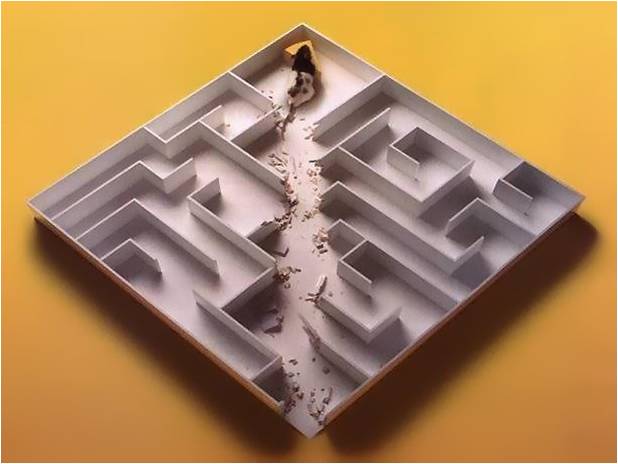
“Day 1:  I was put in a large wooden enclosure.  There are walls all around.  I smell cheese somewhere.  I can scurry around some of the walls.  Usually I find more walls, but sometimes there are openings.  It took a while, but I found the cheese.  It was good but there wasn’t enough.  Now I’m thirsty.”

We, as lab rats, have just encountered our first maze.  There are many different types of mazes, and many different purposes to the test, but the lab rat does not know any of this.  It only knows that there is a maze and there may be cheese at the end.

“Day 2:  I was put in a large wooden enclosure.  There are walls all around.  I smell cheese somewhere.  I can scurry around some of the walls.  Usually I find more walls, but sometimes there are openings.  It took a while, but I found the cheese.  It was good but there wasn’t enough.  Now I’m thirsty.”

“Day 5:   I was put in a large wooden enclosure.  There are walls all around.  I smell cheese somewhere.  – Wait, I’ve been here before.  If I turn left, right, right, left, then make all rights I will get to the cheese.”

Now we have familiarity with the maze and can find the cheese faster.  From an experimental context, we have demonstrated that lab rats have memory.  Once we have performed the same task a few times, we learn to do it faster, more efficiently.  We do it better.

“Day 10:   Whoa.  This is different.  I tried my usual path and there was no cheese.  I can smell it, but I can’t find it.  I’m hungry.”

Now the maze changes.  If we are flexible, if our “memory” does not impair us, we can adapt and eventually find our cheese.

“Day 11:  Back again.  No cheese, but I can smell it.  Maybe I’d better keep searching…”

There you have it.  We are lab rats in a changing world.  Each day we truly do not know if the maze is the same one we ran yesterday.  If it is, our memory can help us run the maze faster.  But if the maze is different…

Memory can be a help and a hindrance.  In neuroscience we have a term for persistent (sometimes pathologically persistent) memory – it is called perseveration.  Animals and humans with damage to certain areas of the brain lose the ability to alter or even over-write memory.  They keep doing the same old task without being able to change to perform the new task.  The ability to change is called “behavioral flexibility” and it is a highly appropriate topic for Sarah’s, Kris Rusch’s and other posts about changing strategies in publishing.

A popular saying among some groups such as the Baen Barflies is that insanity is doing the same thing and expecting different results.  Likewise, insanity is doing different things and expecting the same results.  Yet sometimes we have to change strategies in order to get a better result, as in the transformation from traditional to indie publishing.  I’m not an “insider” to this phenomenon, but I certainly  recognize the signs and symptoms from behavioral psychology.

The lab rats that yield the greatest scientific data are those with behavioral flexibility.  The ones that learn a maze, run it quickly and efficiently, but then are able to change strategies and learn a new maze or a new task quickly, and no less efficiently.  Such flexibility is not inherent in the lab rat, it must be learned, and like the lab rat, we all learn by *doing*.  PhD candidates learn this quite early.  Frequently we find ourselves completely changing our field from grad school to post-doc, from post-doc to first faculty position.  Unfortunately we often specialize, and change in direction becomes difficult and traumatic.  If only we could remember what we once knew as students!  Still, many of us are able to make subtle or even fundamental changes even late in our careers.

While I’ve been talking of lab rats in the concrete sense of experimental subjects, and “Lab Rats” in the metaphorical  sense of those performing the experiments, the lesson is applicable to us all.  I have watched my father reinvent his job and specialization even into his 80’s (yes, he is still working at age 82).  He is happy and quite flexible, able to make his jobs fit himself, just like the lab rat in our picture above.

It’s not a bad thing at all to be a lab rat.  After all, there’s cheese at the end of the maze!


Update:  Doc Roberts has expanded on this here:  http://teddysratlab.blogspot.com/2011/10/value-of-repetition.html

In The Future We’re All Ducks

When I woke up this morning, I realized two things. One, I hadn’t written a blogpost last night to go up today. I was supposed to, but I’ve been away two weeks, so I had a whole lot of house and postponed “stuff” to catch up on. Two, the blogpost was supposed to be at Mad Genius Club as well.

This last immediately sent me into a tail spin, because what I post on my own blog can be whatever, including bits of novel. But Mad Genius Club is a grown up blog for grown up writers and mostly deals with the business. Which means… I was staring into an abyss of lack of ideas and – yes, thank you for reminding me, darlings – I was already late.

And then, because my life is a constant game of “I can top that” I got a title for the post in my mind, and it wouldn’t go away. AND it was In the Future We’re All Ducks.

At which point I started running around in circles, metaphorically speaking. VERY metaphorically, because I was still lying in bed doing that catalog of body parts every science fiction writer does in the morning. “Item, two arms. Item, two legs. No tail. No tentacles. So far so good.” (What do you mean other sf writers don’t do that? Really? Odd of them.)

And then I thought: Duck, Donald. And suddenly I realized what this post was all about. However, the fact it came to me this way is a level of bad news I can’t begin to talk about. You see, until now my stories come to me this way, but my non-fiction came from the rational side. “Today, I’m going to write about…” Well, apparently those alcyon days are gone. From now on, non-fic will do what fic does and ambush me in the nook between the pantry and the basement door, prepared to jump out at me when I’m not thinking of anything in particular. Mark my words, no good will come of this.

But other than the fact articles have joined the viciously aggressive fiction ideas, what the heck do I mean about Donald Duck. Do I mean in the future we all stop wearing pants? I don’t know about you, my friend, but at 48, with fifty staring me in the face, you can have my jeans when you pry them off my cold, dead legs. So, no, that’s not what I’m talking about.

No. What I’m talking about here are Disney comics. (Which are subtly different from the other Disney productions in that they are sort of like sf stands to literary fic. There’s no money in them – they say – the houses are constantly changing, and finding them can be a little difficult, since even most comic bookstores don’t carry them. However, for some of us they’re an acquired taste.) I first started reading Disney comics when I first started reading. Or rather, they taught me to read. See, they had images to help me remember the words, and people read them to me over and over (stories about Atlantis and such. FAR more interesting than See Spot Run or even Dr. Seuss) and eventually the words and letters started making sense, and I figured out which letter went with which sound. I was very bored. Also, I didn’t have tv.)

What I’m talking about is this: In Disney comics, people don’t really have real jobs. Occupations are something that come and go, flit in and out of their lives. Donald will become a master beautician in one strip. In the next he’s working as a janitor for Uncle Scrooge. And they never really seem to worry unless the strip is about money.

For some time now I’ve been following Susannah Breslin’s blog Pink Slipped over at Forbes blogs. From her work and others, an image is sort of emerging.

First a little retrospective. In my father’s day, even when it wasn’t, we tended to view employment as a life-time thing. Heck, my brother – because Portugal is 20 years behind this stuff, though, for their sins, catching up fast – worked for only one company his entire lifetime.

When my generation came of age, we found a different world. For one, a lot of us only found work as contractors or (for the liberal arts majors) as “temps” with no security and no promise of anything beyond the two months or whatever the contract lasted.

Mind you, there are arguments pro and con that sort of thing, and this change was not only in response to tech, but in response to regulations. Absent the regulations, the employment market would have been more stable. But if you have figured out a way to make governments understand that economics is a SCIENCE and stop trying to play witch doctors with a chaotic system that even the best practitioners don’t fully understand, all I can say is “Use your powers for good.” Oh, yeah, and “Can you make pigs fly? It would be so cute.

However, the more mobile and adaptable work force did improve business efficiency and adapt us to a technology where computers replaced typewriters and office messengers and, oh, yeah, tons of other things and jobs.

Now the tech is different yet again, partly because of the internet, partly because of easier manufacturing, partly because of new ways of delivering information (so long, paper.) Government responded as government often does, in this case more or less explicitely surrendering to fantasies of being back in time, before WWII. Do what, right? We don’t elect futurists. We elect mostly lawyers, which means people who think the world is not only made of words (writers run into this, too) but that if you change the words the world will change. Yeah. They also think that laws do what you want them to, instead of unleashing a storm of unintended consequences along with the intended or sometimes instead. Never mind.

So we have an employment crisis and people who are finding employment (a minority) are finding it pays less and often lasts only a few months. Or days.

The same is true for writers. Most of us are either getting run out of contracts with publishing houses (not yours truly, yes, but I can read print when it’s twelve feet long and on fire. I might have employment for another decade, or forever, but it won’t be as much or as secure as I had before.) And those of us lucky enough to still work for the major players are getting nickle and dimed. Meanwhile there’s a new world of indie publishing and some people are getting rich at it, while others are making… nickels and dimes. And their relative positioning in the market before this doesn’t seem to mean much.

So… What is the future?

From reading Susan Breslin, and Kris Rusch, and a ton of others both in the industry and out, who are blogging these changes because they’re either going through them or because they too can read print, I have a few tentative conclusions:

1- In the future we’re all ducks.

It used to be, even for writing freelancers, that we had something close to “employment.” If you did well for your house, they kept “hiring” you and eventually you became a “solid sell” for them, and if you were lucky made a living wage. This was, with the exception of a couple of houses, before my time, when you – largely – got treated as a disposable temp. Now, you’re not even that, because the houses are desperate and bookstores are imploding. Even if your title did very, very well and they’d consider pushing your second title, do you know that particular imprint will be there in six months? Or that they won’t decide to canibalize your potential promo money to back a “sure thing” bestseller? (Who nine times out of ten isn’t, but never mind that either.) So… Take the money and run. And don’t sign anything that ties you to that house forever. And:

2- Learn to be flexible

While I don’t envision a future where you learn a skill like beautician but are just as happy sweeping sidewalks the next week (except as a stop-gap measure) you MIGHT have to learn to be more flexible in your own field. Say you have a beauty salon… Learn to do nails as well as hair. Consider learning braiding if it’s not regulated in your state (really! Yep, dangerous skill and all. GAH.) Look into makeup as well. You might not have the same slate of dedicated permers or whatever, but you can make the same money from different sources.

For me – because I was so hidebound <G> – this is meaning more and more learning non fiction as well. For others it might mean learning to write shorts and releasing those indie, because the nickles and dimes it provides will fill in the cracks between novels. Also, it might help publicity. Look at other opportunities in your area. Be creative.

3- My husband tells me there is a concept in business called, Nibbling. This is when businesses bid on projects as contractors. Instead of bidding on the whole job, you claim a little insignificant corner of it, and then “nibble in” i.e. find more and more ways to be useful in the project, until you’re doing a considerable chunk of it. Consider this. That house which is still treating you well does sf and mystery, say? You got in with mystery? Do a side novel and ask the editor to consider it. Make it sf. (See the be flexible thing.) Your short story is a runaway seller on Amazon (#1 son, I’m looking at you!) consider a novel in the same world. Or just increase your effort at shorts.

4- Freelance as a way of life

No, I don’t think EVERY occupation will be freelancers. Some have obvious limitations. But I think where writers are now, others will be soon, where more and more they’re freelancers loosely attached to various companies and projects. And where looking for work is just a normal part of life, so that the freelancing can continue. This has some serious drawbacks: Security is a big one, and some of us have serious issues with lack thereof, which means we’ll have to find a way to live with that. The other is the constant job search, which can make even sane people a little odd, particularly in a world where everyone lives in the limelight. But hey, it has side benefits too. Breslin says she now makes more money out of freelancing than she did out of her regular job. But she has more fun. And that’s part of this. The few times I’ve had honest work type of jobs (TM) I found that 80% of it was rote and boredom. Whatever the freelance lifestyle might be, it ain’t boring. It gives you a chance to learn and grow. In fact, it’s learn and grow OR die. And if you do exceptionally well one month, you can relax a little the next and to an extent your time is your own – or at least you have more control over it.

And to me that’s the ultimate reward. No, I’m still not sure how to make a living in the new world, but I guarantee I’ll figure it out. Yeah, times might get scary between, but look… I don’t know how to give up, so I’ll figure it out. And when I do, I’ll be my own woman. Win or lose, it will be under my control, and not at the mercy of someone else’s whims or perceptions.

I rather like that.

Quack.

Writers On The Storm

*No, this is not another post about writing in the middle of change and professional turmoil — that one is tomorrow <G> — but it refers to a more personal type of turmoil.  As I write this an hour before flying home from TX (well, before I have to be at the airport, at least) and had to make an effort to think coherently (as coherently as happens around here, wise guy!)  while trying to remember if I charged/packed everything and making sure I have  a ride home from the airport at the other end.*

At the workshop, one of the participants asked how I managed to do the social media, a blog a day and still finish books.  Of course the way I do it is by not being human.  It really helps when you’re undead and don’t need to sleep, eat or…  Oh, okay fine – grumble – it’s not that good a joke.  It’s early in the morning and I’ve only had a cup of coffee.

The truth is that – though I’ve since found most writers who are also mothers tend to wait till the kids are out of the house to start trying to write seriously – I had to learn to write around interruptions, so they slow me but don’t stop me.

When I first started writing my writing time segments were around 5 to 10 minutes, because #1 son was never that good at naps.  This expanded when the boys entered kindergarten because I had four to five hours, suddenly.  That is when I found how conditioned I was to writing in segments because I kept popping up every few minutes, feeling like I was forgetting something.

Now, of course, I often have the whole “school day” to myself.  Sort of.  Kind of.  There’s the days the phone rings ever ten minutes for some household admnistrivia “we’ll be replacing power lines in your area” or “this is the pharmacy and your order is ready” or “We wonder if #2 son means to take x y z test, because the payment is due today.”  The interruption ranges from “make a note, get back to them later” to “Oh, shoot, see if we have a receipt for this, or if it is something that must be done.”  There are days the kids are home for some reason and I always end up involved in whatever they’re doing if they’re home.  There are days when my husband needs me to find a document in our labyrinthine files and/or we find enough time to take a lunch break together.  There are days none of these happen, but I want to go to the museum so badly that it’s all I can think about.  And days when I play hooky and take off to go look at art, or to go paint in the art nook downstairs.

But most days – regular work days – those aren’t too bad.  It’s more that my routine, since I write but also do most of the housekeeping and keeping the house running, incorporates both.  Something like this – wake up.  Get presentable.  Make sure everyone is on their way to their appointments/work/school with all the needed materials.  Have coffee.  Feed cats.  Have more coffee.  (I normally wake up between five thirty and six thirty.)  Go for a walk.  Clean kitchen and/or straighten around us, including but not limited to cat boxes.  At around 9 am sit down to write blog.  Post blog.  Have cofee and throw laundry in or whatever needs to be done that is an “episodic task” for the day.  Sit down again at around ten thirty to eleven (depending on how long the blog post takes) and start writing.  Twelve thirty to one break for lunch.  This can take a longer time if one of the kids is home for lunch (college schedules are weird.)  Check FB, post, etc.  Answer blog comments.  Read news (I already read some in the morning.)  If I’m alone for lunch, I read during lunch and also during housework breaks.  Put more laundry in and start considering dinner and/or bring stuff out to defrost.  Go back up and write till 2:30 to 3.  Younger kid comes home pretty regularly at 3.  Spend some time with him.  If there are no appointments or something I must do, sit down again at three thirty to four, work till five.  Go make dinner.  Sit back down at seven thirty or so.  Work till ten.  Collapse.  Rinse.  Repeat.

Now if you’re going to tell me this is not an efficient schedule – yeah, I know that.  I’d like to start writing all my blog posts in the afternoon on Sunday and just scheduling them, partly because it’s not the best service I can do for you to write these in the stark light of uncafeinated morning.  For one, the grouch comes out.  For another I’d like to develop a daily theme, which I’ve outlined here, sort of, and the last minute postings stop it.

This is also the reason I’ve considered an office, and the reason I often go to office-ish.  It cuts out all those distractions.  It’s also the reason I often escape to another city, flights permitting, or hole up in a hotel in town to finish a book.  (This escape didn’t work that well as far as writing VOLUME.  I’m starting to think a week hemmed in by Fencon and a workshop is never going to be productive. [No, Sarah, astonish me!] But I DID get past the “difficult” chapters so now the rest should get done faster.)

The problem of course is that if I go to an office five days a week, then I have to catch up with all the other stuff.

Yes, an assistant, particularly a trusted one, and/or a housekeeper would be great.  They’re right up there on my list of wishes.  But barring winning the lottery or having a runaway bestseller (Indie, to be quick enough) I will not be able to afford that for another two/three years, when, the creek not rising, the boys will be out of the house, which I think will mean fewer interruptions and possibly less work.  (There’s a type of mess adults don’t make.  And no, it’s not what you’d expect.  It’s more “why is the milk carton under the dresser” type of mess, for which the answer usually ends up being “Well, we were playing soccer with it in the hallway and…”) I have vague (and fond!) memories of being just me and Dan in the house, and the house would stay clean, except for dusting/vaccuuming.  Even with cats there.

Of course, I PLAN to win the lottery, but they keep picking the wrong numbers.  I think it’s a conspiracy.  So, for now, I’m stuck writing around life.  It’s, like everything else, an habit.  I suspect when my circumstances change, I’ll write less for a few weeks, as my subconscious tries to figure out how to settle for longer periods of time.

Yeah, I’d like it to be different, but until a miracle occurs, I must do what I can with what I have.  I’ve found that like waiting to have your life completely stable to have kids, waiting to have your life completely stable to write is a fool’s game.  Life will change when you least expect it.  But you’re a writer, so you must write.  And years later you’ll read something you wrote and go “Interesting.  I remember how I wrote this.  But no one could tell from the book what a mess my life was at that time.”  Just like you read Heinlein’s bio and you go “He was writing those hope-filled books while, basically, living in personal hell.”

And that, in retrospect is the greatest achievement of all.  That you created an oasis of calm in the middle of insanity and that you shared it with others whose life might be even crazier.  And you didn’t let circumstances stop you.  Which is the best any of us can do, sometimes.

Who Edits The Editors

Kris Rusch said that some editors are now claiming that if you go indie they won’t get good editing and never develop into the writers they could be.  This is what is technically known as “poppycock” because most midlisters have got nothing but (hopefully) copyediting for ten years at least, and maybe more.  (Except from Baen which has a “light touch” philosophy and which I mention below.)

The thing is, most writers need editors.  And most writers need GOOD editors.  And there are very few of them, and they’re hard to find, and I don’t know how to solve that.

No, I don’t mean for myself.  I have a very good editor who has a real daytime job but who does this for me when I need it, and does it cheaply enough for me to afford because he’s a friend and a nice person.  I’m not giving his name (he knows who he is and he does periodically read this blog) because I don’t know if he’s interested in making this a full blown side line, considering he already works too much at his day job.  OTOH I must say, at the risk of your finding him through the blush-glow, that this will bring on: he is the best editor I’ve worked with, including professional fiction editors (He worked as an editor for a while, and perhaps still works as one – I haven’t asked exactly what his day job entails, lately :) ).  Yeah, okay, he does have a tendency to snark my turn of phrase and wax sarcastic about my characters.  But he does it GENTLY.  Or at least amusingly.

Part of the reason he works for me is that he’s a man given to wide reading (sorry, my mind is so in Austen I want to say “a mind improved by extensive reading.”  Yes, he also speaks several languages and has a certain something in his air… [rolls eyes.] and those of you who have no idea what I’m talking about must watch the Pride & Prejudice mini series from A & E.)

The other part of the reason is that he at least has some idea what I’m trying to do and he doesn’t have a dog in the fight other than to make my book the best it can be and secondarily make it more marketable.

In this he has an advantage over editors for houses that have bought my books.

An advantage, you say?  Yes, I say.  Because see, houses have styles and guidelines and things they want.  So sometimes an editor has to ask me to change the book, not because it’s best for the book, but so it best fits their line.  And that’s okay – they’re the ones paying.

The “me” in that paragraph is largely rethorical.  This has never happened to ME personally.  Mostly because I don’t write for romance lines.  There you often have to move sex scenes around, have the characters meet earlier or whatever.  It’s just the way it works.  To “fit the line” you make concessions.

Now, I’m not saying either that I’m worried indie writers won’t get good editing as opposed to traditionaly published writing.  I’ve been worried about NO ONE getting any good editing anywhere for some years now.

Okay, this is where I tell you that I’ve had exactly two books extensively edited: one by an agent, who actually made me rewrite completely so he’d send it out.  Another by an editor who made me make a lot of changes which changed (to an extent) the character of the book.  I’ll note both the books that were EXTENSIVELY edited were parts of series and the ones that sold worst of that series.

I’ve had other books edited as well just not EXTENSIVELY edited.  As far as editing goes, Toni Weisskopf at Baen is my favorite book editor.  Oh, she plays with my mind (I THINK not on purpose) by saying “I’m going to call you to discuss some issues.  And every time, my heart about stops, because I think it’s going to be “She wakes up naked and strapped to a bed in the hospital, and minutes later she’s leaving and the hospital is on fire.  What were you thinking?”  It never is.  Instead, it’s something sensible and sometimes essential like “You dropped this plot thread halfway through, was that intentional for next book or do you need to tie it up?” or “you never tell you if he survives” or… that sort of thing.  But Baen’s editorial philosophy is to keep the book as much the writers’ as possible and “let the writer’s style shine through, so it’s almost like your own hired editor, except of course, they’re paying you and if they DID ask for major changes you’d have to do it.

And as far as short stories go, the best editor I ever had was Denise Little formerly at Tekno, who used to be able to make the story wonderful so subtly that you had to look to see what she changed.

However most of my traditionally published books simply get copyedited which is not the same as edited.  And mostly I think “well, maybe they didn’t need anything more.”

But then I read about Campbell and how he helped Heinlein become the author he eventually was.  There are no editors working at that level today.  These are market forces.  I mean, Campbell had three magazines and he had to fill them, and he didn’t have enough writers to fill them.  It was worth his time to mold new authors.  These days there are too few editors with too little time, and a lot of would-be writers to fill the slots.  It’s easier to publish what you get, unless your vision is diametrically opposite the writer’s.

So how will it work for indie?  I don’t know.  Here is what I hope will happen: I hope that writers, in a free market place, will realize they need good editors, and that those who find a good editor will publicize/thank him/her in the beginning of the books, and that this will create a marketplace where something like this happens “Jane’s book did really well, and I notice she’s improving both her sales and her writing every book.  I hear she contracts Joe Blow as her editor.  I wonder if he’ll take me on.”  Then Joe Blow will get a lot of business and be able to charge good prices and live from this, and maybe EVENTUALLY there’ll be the “blow prize for new authors.”  (Stop giggling, you.)  And the reader will get better and easier to read and more fun books.

The worst case scenario is that nothing will happen.  Authors will publish themselves as is.  A few of them will be painfully bad.  Most of them will be so so and a few will be exceptional.  Some will get rich.  A lot will make a living.  A few will give up.

In other words, the worst case scenario looks a lot like what we have, except that due to economies of process more writers will be able to make a living, (I think) which right now very few of us can.
Will there be a lot of writers who could be great and never are for lack of good, inspired editing?  Sure there will.  But there are now, too.

This will not be a disadvantage of going indie.  But I do wish we had more good editors and a better process for writers to match with editors who are right for them.  But other than a lot of writers recommending what works for them, or thanking the editors in their books, I don’t know what else to do for indie authors.  Or for traditionally published ones either.

We should all hope for good editors.  And maybe we’ll get lucky.  And, hey, I think the market forces are arraying themselves in such a way, that for the first time in years there’s a chance it will be worth someone’s while to develop good editing skills and selling well.  Fingers crossed.

Belated (VERY) Prometheus speech video

I am a bit out of my mind, having just taught a very intensive three day writing workshop.  And I remembered I haven’t yet inflicted the Prometheus’ speech video on you (have I?)

I forgot to point out in the video that what I meant as equality being bad as legislated equality — as opposed to equality before the laws.  You do realize those are different, right?  Yeah, I do too.  But…

I had a much longer speech.  And then the bus between the hotels was an hour and change late, and I ran the whole way from the stop and got to the room 15m late.  And… well…

Anyway, there I am in my formal dress pour epater les bourgeois, and my pearls, so you know I’m not a slut, and my high heel crocs (yes, those ARE crocs, because my pumps were shredding my feet and that’s all I could buy) and… anyway… there it is:

Just remember, I’m wearing pearls, so I’m you know, grown up and a lady!