Rogue Magic, Free Novel, Chapter 24

(Sorry it’s so short this week!)

*This is the new free novel I’m posting here a chapter at a time.  This is pre-first-draft, as it comes out.  It is a sequel to Witchfinder which will soon be taken down (once edited) and put for sale on Amazon (It’s now done and with beta readers and editor.  My wretched health this year delayed everything.  (Meanwhile, if you donate $6 or more, I’ll get you a copy of Rogue Magic, once finished and edited, in your favored ebook format when it’s done.  Of course, if you’re already subscribing to the blog at a level at which you get whichever books come out that year, you don’t need to worry. *

NOTICE: For those unsure about copyright law and because there was a particularly weird case, just because I’m making the pre-first draft of my novel available to blog readers, it doesn’t mean that this isn’t copyrighted to me.  Rogue Magic as all the contents of this blog is © Sarah A. Hoyt 2013.  Do not copy, alter, distribute or resell without permission.  Exceptions made for ATTRIBUTED quotes as critique or linking to this blog. Credit for the cover image is © Ateliersommerland | Dreamstime.com

roguemagiccover

Myth And Man


Jonathan Blythe, Earl of Savage


I’d tossed her on the bed.  It was the sort of bed you expected at Mage Place – big and soft, covered in velvet and crowded in lace pillows.  She lay against the lace pillows, panting, her breasts pushing out on her dress, her skirts in a pile and exposing the exquisite form of a well turned and very white ankle.

I took a deep breath and thought of snow storms.  After all, with a creature – whatever she was – such as she was – whatever that might be – one could never be sure these little displays were unintentional.

In fact, I’d wager quite a lot on their being intentional.  And I never gamble to lose.

“Tell me why you set the blight on my world,” I said.  “And what it means.”

She was looking at me, her eyes slightly crossed as though she were trying to look at my magic.  She would too, I thought, but that was besides the point.  But what she said next shocked me nearly out of my skin, “Who are you?” she said.  “Really?”

That had never occurred to me as something that might be in question.  I blinked at her. “You know who I am,” I said.  “Jonathan Blythe, for my sins the Earl of Savage.”

But she shook her head, not so much calling me a liar but as though she’d asked me the time of day and I’d answered “cow.”  She shifted among the lace pillows and so far forgot herself as to cover her ankles.  “You weren’t supposed to be able to follow me,” she said.  “None of you were.  I let out a burst of magic, as I ran.  Not even on purpose.  It’s something like the ink a squid releases when scared.”

I refused to discuss ways in which this lovely woman – well, this lovely female creature, anyway way – was like a squid.  Instead I cast back my mind over the last few moments in Seraphim Ainsling’s office.  No.  There had been no difficulty at all to following her.  She’d taken the bomb from my pocket and run.  Now I found there were obfuscating measures.  Lovely.

How long before Seraphim set sniffers on our trail to find out why we’d maliciously exploded a statue?  He’d probably think I was in league with the lovely Ginevra, too.

I’d like to be in league with her all right, but not that way.  And in fact I was starting to wonder if I wanted to be associated at all.  Some people, no matter how tuppable, are not someone you can live with.  Or even consort with for a limited time.

Her eyes focused again, and she tried to give me what she probably thought was a smile, but which was really a small grimace.  Then she shook her head.  “Which story should I tell you?” she asked, worriedly, and frankly more as though she were speaking to herself than to me.”

“The truth,” I said.  And heard my voice become frighteningly like Papa’s when he used to say the same thing to me in childhood.  “Or I’ll know about it, and it will be the worse for him.”

Her eyes widened a little bit, and for a second the  cross-eyed look was back in her eyes.  Then she gave me a little prim school girl nod, rearranged herself so she covered her ankles and held her skirts down around them with her hands, and said, in a tiny voice, “I told witchfinder a great deal of lies.”

That was the truth, I realized, and at the same time I realized that her demure little girl act was just as much of a ploy to get me to go easy on her, as her showing her ankles and enticing me had been a ploy to distract me.  I didn’t hold it against her. After all we each must fight with what we had, and what she had was a female form, a weak but pleasing body and the inherent chivalric conventions of my society.  Of course she would use them to protect herself or gain advantage.

But I didn’t let the understanding show in my face.  Instead, I said sternly.  “I know, but now you’re going to tell me the truth.

She looked distressed, opened her mouth, closed it, opened it again.  What came out was pretty close to a wail, “But don’t you understand that would be breaking all the rules?”

“What rules?” I asked.

“The rules of the… for lack of a better world, Mythworld.”

“You are entirely of them, then?”

She gave me a very odd look, like she thought I’d taken leave of my senses.  “Of course not,” she said. “If I were, I wouldn’t be able to be here, in your world.  That’s why…”  She made a gesture midair and I was very careful to watch, in case it was some of her spells.  “That’s why Zeus had so many half breeds with humans and why…  Of all of our people very few pure bloods can walk between worlds.  And it is between worlds.  They can’t stay too long near the world of men.”  Her eyes crossed again.  “Hermes for ins–  You’re not Hermes, are you?”

“I’m Jonathan Blythe,” I said, with unwonted patience.  “Earl of Savage.”

Again the little head shake, as though I’d just informed her I was a particularly showy kind of duck or something equally inane.  “Well,” she said, as though conceding points.  “My mother was human.”

“I see,” I said.  “Then why did you turn against Earth and set evil magics on us.”

She blinked at me.  “Why, to save Fairyland, of course.”


I’m Alive

Mostly.  But chapter will be tomorrow.  It’s started and everything, but I’m having trouble concentrating because… sinus infection.  For today, I have two announcements, the first general.  I don’t know if you’ve heard of Liberty Island, but if you haven’t they’re looking for submissions from Liberty-minded people.  (And I owe them a short.)  Later on Charlie and I will be bringing out a Human Wave Anthology through them.

L iberty Island is a digital media company that publishes and produces short stories, novels, short films, documentaries and other creative products.

In addition to telling great stories, Liberty Island has a mission: to promotes the values of personal freedom and public liberty, and rejects all forms of orthodoxy, dogma and political correctness.

As a reader-supported enterprise, we encourage creators and readers to engage and interact throughout our site. While our online community is free for all to join and enjoy, we ask that readers share a few bucks in a creator’s “tip jar”–it allows them to keep working, and ensures that Liberty Island will continue to have a deep roster of talented, often undiscovered, writers, filmmakers, and other creators contributing to our enterprise.

Does this appeal to you? Then you’re in the right place.

If you’re a writer and would like information about our guidelines, write us at submissions@libertyislandmag.com. We are looking for original works in Science Fiction, Fantasy, Mystery, Thriller, Crime, Political and Historical fiction, Satire/Parody, and other popular genres.

If you’re a reader who loves high quality popular fiction, sign up with your email address for notification when we go live later this year.

If you want to talk to us about anything else (advertising, investing, press inquiries, etc.) write to us at info@libertyislandmag.com.

You can also join us on Facebook to become a charter member of our online community: https://www.facebook.com/LibertyIslandMagazine.

And follow us on Twitter: LibertyIsleMag.

We look forward to sharing Liberty Island with you!

Best, the Liberty Island team.

The next announcement is strictly local:

TOP SECRET //GCHQ/NSA/DGSE JOINT  SHAPESHIFTER TASK FORCE.…DECLASSIFICATION DATE 01AUG43

SURVEILLANCE FIELD NOTES // 1AUG13 THROUGH 30AUG13

SUPERVISING FIELD AGENT J. CAESAR

IN ACCORDANCE WITH GCHQ/NSA/DGSE JOINT SHAPESHIFTER TASK FORCE ORDER 12-003623 DATED 12NOV12, SURVEIL TEAM DELTA MOVED TO COLORADO DENVER METRO AREA ON 29JUN13 TO INVESTIGATE INTEL PROVIDED BY AGENT [REDACTED] REGARDING POSSIBLE LOCATION OF RUMORED “THE GEORGE”. SEE PREVIOUS FILED SURVEILLANCE FIELD NOTES DATED 30JUL13.

IN ACTIVE SURVEILLANCE OF POTENTIAL SHAPESHIFTER SUPPORT ORGANIZATIONS, SECONDARY ELECTRONIC SURVEILLANCE TEAM FOXTROT INTERCEPTED CONVERSATIONS BETWEEN PREVIOUSLY NOTED SUSPICIOUS PERSONS TENTATIVELY IDENTIFIED AS “HOYTS HORDE”, WOMAN WITH ONE SUSPICIOUS MALE AGED HER CONTEMPORARY AND TWO SUSPICIOUS MALES OF AGES APPROX 18 & 20.

INDIVIDUALS WERE DISCUSSING UPCOMING FUNDRAISING EVENT FOR A FIBER ARTS NON PROFIT TITLED “TACTILE” WHICH WAS OFFERING A FUNDRAISING SALE ON DONATED FABRICS, BEADS, YARN, SEWING PATTERNS, NOTIONS, INTERIOR DECORATOR FABRICS, WHICH WERE DESCRIBED AS GREAT FOR UPHOLSTERY OR COSTUMES. ALSO SEWING PATTERNS INCLUDING VINTAGE PATTERNS, SEWING MACHINES OFFERED FOR $25 EACH. ALSO DESCRIBED AT THE SALE WAS LACE TRIM, LACE COLLARS, VINTAGE TABLECLOTHS AND NAPKINS.

THE SALE IS SATURDAY SEPTEMBER 28TH, FROM 10:00 AM TO 5:00 PM WITH A SPECIAL BAG SALE – ALL YOU CAN FIT IN A BAG FOR $10 FROM 4:00 PM TO 5:00 PM.

LOCATION IS 1955 S. QUINCE ST. DENVER COLORADO 80231

WEBSITE: www.tactilearts.org

And now I’m going to clean the house and have a lot of caffeine, so I can write.  The chapter, yes, but other stuff too.

Our Weird Country

One of the things I love most about our country is that it’s weird.  No, I don’t mean deep-fried-beer-at-Texas-State-fair and come-see-the-world’s-largest-ball-of-yarn weird.  Those are cool too, and sort of a side effect of our weirdness, but not the main thing.  The ways in which we are truly weird make us… well… misunderstood by other nations.  And often cause us to misunderstand other nations, too.

It in conjunction with our truly horrible education is responsible for how so many of our fellow citizens hate their own country and attribute to us all the ills of mankind and none of the good.

Wait, what?  Didn’t I say I love the way in which we’re weird?

I do.  The way in which we’re weird is what has made me American.  And despite that horrible side effect above, it makes us also kinder, more morally conscious, and in many ways the best country the world has ever seen in terms of our effect on the rest of the world.

The problem is this – we need to be aware that we’re weird.  We need to be aware of it when we interact with other countries.  Else, they could kill us.  It’s what happens to kids who are like us.  Or at least they get severely beaten.

I’m not going to claim our country is autistic, though it has certain things in common with it.  Instead I’m going to claim that our country is Odd.

It’s become a truism to say that all SF/F fans and authors are somewhere in the autistic spectrum.  We related oddly to people, and we have weird ways of going at life.

I don’t agree.  I think it gets swept in the autistic spectrum because it’s a fashionable diagnosis and lots of things interact.  The reason most SF/F fans/authors present as autistic is that most either have a higher aggregate IQ than normal or a higher specialized IQ than normal.  (I’m the later.  I’m a very special kind of idiot savant, relating to verbal processing only.)  But even those of us who are “just normal” as far as tests are concerned tend to be… odd in our development.  That is because the literature itself self-selects for odd.  (It’s entirely possible too that the act of reading itself self-selects for odd these days.)

I’m only saying the “in the spectrum” thing doesn’t apply because some of us are almost pathologically gregarious.  (Younger son, me at one time.)  But we still have some of the odd symptoms that we share with people in the autistic spectrum.

I’d summarize these quickly as “unable to do what comes naturally to others” or perhaps “Thinks so much they hardly do anything else.”  Or if you prefer Pratchett “has the first sight and the second thoughts.”

What this means is that many of us on letting our kids go to the blackboard jungle for the first time, cringe a bit.  We know what waits them.  Our kids generally stick out like a side of beef on a seafood buffet.  And the other kids know it too.

How many of you had their kid come home and say something like “none of the other kids wants to play with me.”  This eventually, usually, eases, as they find their own group of odds and outcasts and form their own group.  At least people like me did, usually by protecting all the LITTLE odd ones (since I was a big moose by Portuguese standards.  Only Portuguese standards.  In my day, I grew out of pre-made when I reached my adult size of five six and a size seven. It’s different now.  Better nutrition.)

But most of us spend most of our lives in some form of “Why are they doing that?” or – at a certain age – puzzling our way through mating rituals that come normally to other people.  “He’s looking at me funny.  What does he want?  How do other people know when they want to kiss?”  (This is why the first guy ever to kiss me had to ask verbally and got the answer “okay, but I never kissed so it probably won’t be very good.”  Which made him laugh.)

I made it my business to study people, and I still get faced with stuff that I go “But WHY?” particularly when it’s completely irrational.  (For instance, how is it proper in an argument over the hugos to call someone a “conspiracy nut?”  Particularly when the argument is “people don’t care as much about the hugos as they used to?”  Or to complain the other side is “armed to the teeth” – if we were, buckos, and you knew we were, you’d talk more respectfully, I reckon.)

Well, as a country the US is an Odd.  If it were a kid, it would read SF/F and be able to give you the statistics on the bestselling books going back to 1940.  It would do it, too.  In public.  At parties.  And it would dress funny, not that it’s not completely able to analyze how people dress for various occasions, but because it spent time in front of the mirror overthinking it.  “They said business casual, so that means no tie.  But you always dress a bit above the norm, right, because when you’re new to the club… so, tie.”  This would result in its showing up three hours late, wearing a tux shirt and bow tie, with a sweater over to loosen it up, cerise pants to show its playful side, a loafer on his left foot and a tennis shoe on the right.

And this is what other nations see us like.

When they “get” us at all.  Half the time they don’t get us at all, and tend to assume we’re just like them.  And we assume they’re just like us.  And both of them are close to fatal errors.

What I mean is this: deprived of a unity of blood or a reason for existing as a nation other than our constitution – words on paper and principles agreed on – we think and argue and live by our constitution.  There have only been two nations in history formed by law and the other one had blood too.

We don’t.  We’re a nation of principles, of paper, of laws.  Take our law away and we’re nothing: a group of unrelated peoples living in a common area, that’s it.  Okay, genetically some other nations have great variety, but they also have history in common.  Our history of continuous immigration means we don’t have even that.

We have the laws, we have the papers, we have the principles.

We are like a little kid who grew up in books and doesn’t understand life outside them.  He expects the principles of the books to apply in the playground: honor, duty, right and wrong.  And he’s going to be pounded on by everyone until he learns that out here that doesn’t apply, only the self-interest and the casual cruelty of the playground.

Unless she – me – is a big moose, in which case she will run around imposing honor and duty and loyalty and all those things that she read about in books, until the entire class is a very odd one and makes the teacher puzzled.

In a way the US is like me in that playground.  Because we believe in things like that nations are constituted for the benefit of their citizens, we run around making it so.  Or we fall down on the side that claims to want so – sometimes with disastrous results.

The end is that we end up making the world a better place – a place where sometimes, occasionally, even outside this nation, the welfare of individuals counts.

But it also means the rest of the world hates us.  Even our allies think we’re weird and that’s at the best of times.  When we go a little nuts and try to prove how wonderful we are by electing someone who has confessed by word and deed that he hates us, well… our allies have reasons to keep their distance.

And yet, which odd kid hasn’t tried that in the past.  “If I’m nice to the bully, maybe he’ll reform.”  And while your friends look on in horror, you give them the cold shoulder and try to make up to the bully… until he betrays you, and then you wake up and it’s back to your old friends.

It’s very important that we, as a nation, understand that the world doesn’t work like we do.  Out there, on the world playground, the rule is instinct, self-serving, and the casual cruelty of children.

It’s no use coming out with things like “China will take over being the world’s policemen and make a good one because they were once victims” – that’s not how other nations work.  That’s not how anything works outside certain pious books.  China will act according to its self interests and subjugate all in its path if it serves them.

Yes, other countries have constitutions but to none of  THOSE are a raison d’etre.  They’re more the corporate statement.  And you know how much those matter.

It’s not use saying things like “but how could Iraq have WMD, they don’t even have clean water.”

These countries have different priorities.  Study their history.  Study the history of the European wars, and the shifting alliances.  None of it matters much, other than the ego of the kings or rulers.

No other country has ever beat itself over its moral (or lack there of) contribution to History.  The English make French jokes, they don’t go “If we hadn’t invaded them, and they hadn’t—“

We do that sort of thing.  We do that sort of thing to such an extent that, our seriously misstaught intellectuals view it as proof only we are culpable.

Take slavery (please?  I don’t want it.)  EVERY COUNTRY HAS HAD SLAVES.  (And now I see some people go “whoa, every country?  But… Africa!”  Africa had slaves too.  Many countries still do.  Also, there’s nothing particularly African about slaves.  Slaves used to come in all colors and types.)  But here we have people who angst forever about being descendant from slaves and slave owners.  DUH.  That just means you’re human.  ALL OF US ARE.

What’s more, other countries had as many African slaves as we did.  Some had  more.  BUT no other country ritually beats its breast over it like we do.

As a result our gullible young and even OTHER countries think we INVENTED slavery.

Or take the fact we ritually beat our breast over the wars we entered in, and in which we weren’t angels on Earth – oh, even the Civil War, but also every other war ever, including and not limited to WWI.  WWI was the butcher shop of Europe, but do other countries worry and fret over what they did in it?  No.  Only us.

We stopped them pounding each other into nothing, but somehow we emerged the villain.

That’s because we’re the odd kid.  We don’t act the way they do, they don’t understand how we act.

Only in the US could intelligent people honestly believe the UN would be anything but what it is – a squabbling of children, each trying for his own best interests – only in the US could anyone think of world government and not realize it would be two wolves and a sheep discussing dinner.

But we think about it, and our intellectuals believed and believe in it.

Oh, and we’re a big moose.  So all of them try to pound us.

We need to teach history in schools.  Real history.  The back and forth of nations and how little of honor and duty and loyalty there is in the interplay of nations.  It’s the only way we’ll stop creating a class of overly educated idiots who hate our country because they think all others are angels.

We need to teach why we’re exceptional – and we are – and how, though we’re human, at least we try for honor and duty and all that.  We fail, but at least we try.  Other nations aren’t trying, not really.

Other nations aren’t going to understand that what we say isn’t window dressing.  Other nations aren’t going to understand that when we beat our chest we’re NOT really worse than they are.  (You see, other nations don’t admit to even obvious atrocities, much less accusing themselves of made up ones.)  We need to stop making friends with the bullies.

You know the stuff you’d tell an Odd child to help him get through his first year in elementary?  Yeah – we as a nation need to learn all that.

We’re probably never going to get “the games nations play,” not at an internal level, just like your Odd child will never get the games of dominance and one upmanship in the school yard.  That’s fine.  Most of those are nonsense, anyway.  As long as we don’t let ourselves be drawn in to one of them needlessly by someone flapping jaws about “right” and “duty.”

Staying apart and intervening only when threatened works for odd kids, and will work for us.  Stopping obvious bullies is self-protection-before-time.  Because if the bully gets the rest of the world to attack you, even you could be obliterated.

Other than that feel free to stay out of the what-France-said-about-Russia-who-heard-it-from-Egypt battles.  Most of them are just jockeying for position.

But first and foremost we need to learn what every kid who is a little odd needs to learn to survive.

When someone says they hate you, believe it.

Oh, and – It’s not only okay but it’s right and just to defend yourself.  Particularly when you’re a big moose and a berserker, not presenting as a wuss is the best you can do to PROTECT others. BEFORE you’re forced to obliterate them, let them know you can and will, if pushed too far.

Like the odd kid in the playground, like the odd adult at work, failure to learn this will cost us our lives – literally or figuratively.

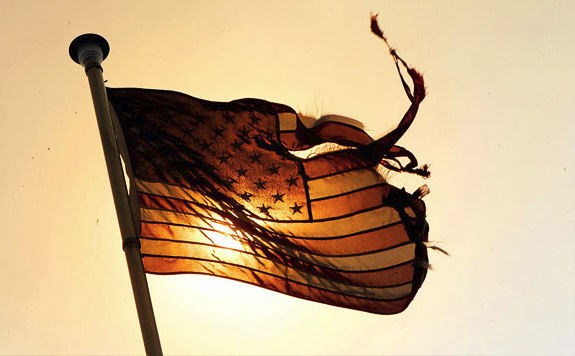
America Aeterna!

Gave proof thro' the night that our flag was still there. O say, does that star-spangled banner yet wave O'er the land of the free and the home of the brave?
Gave proof thro’ the night that our flag was still there.
O say, does that star-spangled banner yet wave
O’er the land of the free and the home of the brave?

I’ve been useless for about a week.  Spinning my own wheels.  Sweating the small stuff. Have the novel finally in my head, but not the strength to write it.

Yesterday I realized I was in “cringe mode”.  I was waiting for the other shoe to drop.

This is stupid.  Or at least my friends who know better than I do tell me it is stupid.  They say Al Quaeda might not be on the run, as our president so quaintly said, but it is too degraded to hit us.

Maybe.  I don’t think rolling over like a puppy and displaying our underbelly to the world is the way to avoid being hit again.  And no, I also don’t think that bombing Syria would make us safe because “they wouldn’t dare attack us.”  I think the clown show of the last two weeks has increased our danger immeasurably, but I also realize that even a simple attack can be years in the making.

Maybe.

This afternoon I came to realize that what I was feeling was what my grandmother used to phrase as “Once scalded, the cat is afraid of cold water.”  And also that I’ve totally lost faith in our government and our institutions to protect me or mine, or even to avoid making my kids’ future a third world horror.

Nine eleven – the first one, in 2001 – didn’t do it.  Oh, sure, I can talk all day about how we weren’t effective enough, we weren’t decisive enough, we shoulda, coulda, woulda….

But I felt like they were at least trying, like, you know, the people in power were trying to keep the nation safe and trying to punish those who had hurt Americans.

Then came 9/11/12.

What do you do with that?  What do you even do with that?  If I could forgive apology videos in Pakistan; if I could forgive blaming America for the attack; if I could forgive “What does it really matter” – I could not forgive that they’ve done nothing to apprehend the culprits.

If we’re very lucky, our children and grandchildren won’t pay with their lives for the feckless, reckless, self-aggrandizing nonsense of this Marxist administration.

And meanwhile?

They’ve abandoned us.  They’ve left us exposed.  Worse, in one of those crimes that used to make it to legends, back when societies had moral compasses and a sense of themselves, we’ve forgotten our dead.  We’ve forgotten those who were sacrificed just because they were Americans, we’ve forgotten those who died doing their duty, and we’ve forgotten the heroes who rushed to the fight and paid for it with their lives.

The tears un-cried over the blood shed call out to us. It is not a law we enforce.  It is not something we hope for.  But blood un-avenged leads to more blood.  It always has as long as humans were humans. It always will.  One way or another it will.

And in the lull before the storm – whatever form that storm takes, whenever it comes – I look at my neighborhood in the golden light of a September afternoon and remind myself that if I no longer believe in American authorities, or at least not in those elevated rarified authorities in DC who deal death with a word and appease enemies with the other, I do believe in America.

I believe in the Americans who live their lives honestly, who look after those who need them, who work  and pay their dues.  I believe in Americans, born free and unwilling to submit.  I believe in life, liberty and the pursuit of happiness.  I believe our constitution and our great founding, and our coming together from all over the world make of us a nation different enough, strong enough, innovative enough that we will come through the night and the storm and emerge stronger: a beacon of light and plenty for the world again.

Today we mourn.  Tomorrow we go back to innovating and building under and being American.  Tomorrow we go back to being that which the statists fling at us as an insult: Ungovernable.

Today American mourns its dead.  Tomorrow it resumes living twice as hard.

It would do well for our enemies to remember: our leaders are not the country.  This clown show can’t endure forever.  In the end we will survive.  And trust me, we will remember.


UPDATE: Post up at Lifestyle as well

Exercising my Right to Vote — and be exercised

Sorry to be so late in posting, but we got up early to go vote on the giant rat Morse recall.  For the Morse recall and in favor of replacing the giant rat, of course.

And because these days if I’m on less than five hours of sleep I get sick to my stomach (no, I don’t know why) I then had to nap an hour or so.

Look, I’m not even going to go in what is fair in recalling a legislator.  ANY legislature that takes power PARTICULARLY if it’s a side that hasn’t been in power in a long time, and sets about corrupting the voting process by doing things like all-mail-in-ballots, no id verification and other squirrely business should be automatically recalled.  There should be a safeguard in place that says in effect “you can’t change the rules so you’re never unelected.”

But, you say, isn’t it the same as changing the rules to require voter ID and voting in person and (though no one is suggesting this, they really should be.  It tightens the screws on the ability to perform fraud) early voting?

Of course it’s not.

Objectively – from a distance as it were – what would you consider more likely to encourage fraud?  Voting in person on the day of the election?  Or voting by mail, with no controls on the other end?  Voting after showing ID, or voting because you walk in and you’re so and so (particularly when you consider that our voters roles aren’t purged?  Only being able to register to vote in advance, after showing proof of citizenship, or the “motor voter” registration, where once a visiting Japanese journalist registered to vote in the US by using his Japanese passport as proof of identity, while getting a temporary permit to drive in the US?

Yes, of course, any of those restrictions will cost someone the opportunity to vote, who should “legitimately” have been able to.  But the opposite creates a chance for people who shouldn’t vote to vote and dilute the vote of people who are legitimately allowed to.

The reverse of the tightening of the ballot that might turn away one or two people who would otherwise vote, is to make the vote of hundreds or thousands worth less.  And don’t tell me there is no fraud. The way the system is instituted it’s IMPOSSIBLE that there is no fraud.  Human nature is such that the only thing we won’t cheat to obtain is that which has no value.  No, I don’t mean you personally, I mean people in general.  In other words, the only way to make people uninterested in cheating in elections and to make fraud INEXISTENT is to make government power so limited that only political animals like me care.  (I’m all for it.)

The second best thing is to make it so difficult to cheat that the fraud is very limited.

Look, if you really trust your fellow man not to cheat to that extent, I invite you to put all your passwords on line.  No?  Then shut up about “there is no fraud.”

Next, let’s take all of these measures that make voting more “inclusive” in order:

Mail in ballots – I mean, we’re all so busy.  So, why make us go in.  Just fill the ballot, drop it at any box.  Surely, it’s secure.  I mean you sign it.

Let’s leave alone for a moment that if you’re too busy to vote, so sad, too bad.  It’s a DUTY not a right.  But let’s leave that aside.

How is it that the part that doesn’t want parents notified their 13 year old girl has been given the morning after pill, or is having an abortion, because they’re afraid the girl’s decision will be influenced is nevertheless PERFECTLY okay with putting everyone’s voting in the hands of everyone else who lives in the same house?  Tyrannical father?  Sure.  He can vote for all his kids.  Crazy mother?  Sure, she can vote for her husband and kid.  Dementia patient?  Sure, caretaker will vote?

Why but the knowledge that this party benefits from most of that skullduggery?

Voting without showing ID – of course makes things much faster – and besides, you know, some people don’t have ID.  Really?  REALLY?  REALLY?  Who doesn’t have ID?  No, seriously.  Who, of legal age lacks any form of picture ID?  And how do they live?  Unless they are essentially dependents on other adults and possibly impaired, and even then I think an ID is needed to cash disability checks.  My bank requires me to show an ID.  Hell, my grocery store requires me to show an ID – but my government doesn’t.

There you have it, gentlemen.  Your right to vote is worth less than a load of groceries.

So – what about the person in a million who doesn’t have ID? – if they can’t be bothered to get one (no, the money is not that much, and besides I suspect anyone pleading hardship will get financed by either the state or private donors) why should they vote?  How much thought did they give it?

And motor voter – oh, the gift that keeps on giving.  Do you know what the rationale is for not asking to see proof of citizenship when you register to vote?  It’s that people are more likely to ask for that to people with an accent or who look “of another race” – read Hispanic.  Okay, then.  I have it on good authority I don’t look Hispanic, though the boys do.  BUT I do have an accent you can cut with a knife.

Would I be offended at being asked for proof of citizenship?  Would the boys?  Oh, hell no.  THEY’re proud to be American, and I worked to become a citizen.  I’m offended NOT to be asked for proof of citizenship, because that means my sons’ birthright is being given away for a pot of message.

YOU DON’T HAVE THE RIGHT NOT TO BE OFFENDED.  It’s not on the constitution anywhere.

What about early voting?  This is the one I’m most divided on.  It’s big risk comes from the other loose controls.  Because if they know in advance how many votes they need to fabricate to cheat, then it facilitates it.  If the rest were tight, this might not matter.  And yes, of course, you often can’t vote on the day.

But is there any reason it should be “no questions asked”.  I don’t see why.  Yes, it might be more convenient to vote early or late. BUT it’s not a NEED.  When voting was on the day, employers cut you slack on that day.  They had to vote too.  And early voting required you to do the same things you do to postpone jury duty: show that you wouldn’t be in the country or that you had the sort of job you simply couldn’t take time from.  I voted early once, before all these shenanigans, because we were going to be at World Fantasy and had plane tickets.

Again, voting is a duty, not a right – by which I mean that of course if you have right to vote, but from the moral pov it’s a duty, not something that should be made easy and brought to you, as it were.  It’s like being armed.  We have a duty to defend ourselves, but no one brings you a gun because you happen to be unarmed.  (In fact, I suggest tightening of voting parallels tightening of gun ownership.  Or vice versa.  You want this extremely lose voting, make it easy for everyone to have an arsenal.  Then at least we have redress.)

So, how do I feel about the recall of Rodentus Maximus?  Well… not hopeful.  Why not?  Because even though mail in ballots didn’t go out in time to most people, apparently “students” are dropping backpacks full of ballots at voting places.  And apparently we can’t do anything about it.

You know my view on how you know the fix is in: when the other side isn’t making even a token effort and yet is sure to win.

For instance, nominating Hilary and being sure she’ll win the presidential election is a sign the fix is in.  The fact that Hilary rolled over and played the good soldier for her enemy is a sign that the fix was already in back then.

In the same way, the Morse side has made less than token efforts to campaign.  Mostly some adds paid for by Bloomberg.  And outside the poling place there was only one of the unwashed brigade, with a homemade sign crossed and recrossed with unreadable stuff from which only NRA stood out.

The state party isn’t making an effort, because the fix is in, so why bother.  Also, at the poling place I heard workers say that they were turning away half the people for being outside the district.  Maybe they are.  Or maybe…  Who knows?

But hope springs eternal and sometimes a miracle happens.  So I went and voted for the recall of Ratus Giganticus Morsis.

It’s Quixotic, but sometimes tilting at windmills works and surprises both you and the windmill.  If you’re in the Springs go and vote.

I don’t want to have to move from Colorado.  Vote.  Why should they make US run away?  Vote.

Empty-Head-Monday

It’s Monday and my head is empty.  You’re just lucky I’m not roaming the netz looking for brains.

Partly, paradoxically, my head feels empty because I have too many things in there, including but not limited to several characters whining, b*tching and moaning that I haven’t written them yet.

I’m still in catch up mode – might be in it for the rest of my life at this rate.  Partly this is from having been sick, of course, but partly it’s because the way I figure it I’m holding down three jobs, or at least what passes for a job for other people who work on line: I’m doing a blog post a day; I’m (at least trying to.  We’ll see if I make it) writing four novels a year and a few short stories along the way; and I’m doing six to ten posts for PJM (I know it was slack last week.  I just couldn’t.)  On top of that there is the trying to put up the backlist in my copious spare time.  And I’m sure I’m forgetting other stuff…

Part of the sense of tiredness is that this month on Amazon I’m possibly having my worst month ever, and I wonder what is going on, if my prices are too low or too high or if the fact I’m ranty has a bad effect.  In other accounts I monitor, the hits are picking up, but not in mine, so I’m moping around and considering going to eat some worms.

I wonder if it’s because I put up the long collections and now no one is buying anything waiting for me to put more of them up? (ain’t happening.  I put those up because they pre-existed the ebooks, as it were.)

I need to get the musketeer mysteries up.  And I need to write new novels.  I need to get the recording booth set up, and I want to have t-shirts done for the subscribers and I need to finish my web site and… yeah. …And I just want to know where I can get the extra time.  Maybe that’s why we’re painting the recording booth as a tardis.

Of course, the fact this month is lousy in sales so far just makes me go “Why bother?” and that’s a bad thing when I’m on the treadmill and have been running as fast as I can for a long time.

Unfortunately I pretty much know I have a year – two if I’m lucky – to bring this up to where it can support us, (at least we can count on a year, probably.  I am not willing to bet on two.  Though we could get lucky) and honestly, sometimes it feels the more I do the less money I make overall.  It’s distressing.  Or maybe I’m just whiney today.

On the good side and extreme progress, I’ve sent Witchfinder to the editor.  I’m considering entering the obvious “in your face” stuff the early readers have sent back, then setting up a quick-and-dirty create space version so I can send out arcs.  I need to ask the artist about the cover, and if it’s not going to happen, I’ll need to make other arrangements.  But I understand arcs to places like Publisher’s Weekly and Booklist are important, even if they get awful reviews.  I understand it’s rougher (word wise) than my normal work, and I wonder if it is because I wrote it so slowly and piece meal, or if it is because I’ve now revised it four times, because I was trying to fix the structure.  I’ve learned long ago that when I revise something I lose the sense of what I was doing, and tend to kitchensink it, so if I do it too much, it will get rough.  I trust my editor with my words which for writers is more difficult than trusting someone with your life, (I’d probably trust him with my life too. He’s a friend.)  But should I send the earcs out, before that polishing is done?

Anyway, it will get done, one way or another.  Things will go up, even if I’m feeling tired and all discouraged.  It just might take a little while longer – like a couple of weeks.

This week I need to get back to Through Fire and stick wedges under Zen’s nails until she talks to me.  I feel like I’m missing 1/3 of the plot, at least and she won’t talk.  Of course, she’s Kit’s sister.  Torturing her might make her clam up more.

Unfortunately to re-orient from editing Witchfinder to finishing Through Fire, I need to re-read A Few Good Men, and you know how bad an idea that is?  No?   Lucius and Nat are going to camp in my head again.  I had a hard enough time not letting them have the entire series.

There are… characters who stay.  There are characters who show up for a story, then leave, others stay.  Unfortunately for me, those two – let’s face it — bad dudes who took up residence in my head when I was SOCMOB seem to be persistent ones.  I’m not sure if there’s a market for more stuff with them as main characters, so I just worry.  And once I read their book they’ll be awake and trying to get me to write them again.  There is a story, around the time Nat gets invalided from service, and it is either a long novella or a novel slotting in after Through Fire in the time line – but whether Toni would be interested, or whether I should even worry about that is something else.  Should I do them Indie instead?  But then will it sell at all?

At any rate, right now the plan is to finish Through Fire and then Darkship Revenge in the next month (by, say, mid-October) and then do either Bowl of Red for Baen or The Brave and The Free for me.  (And that one is also loud.)

Meanwhile should I go on throwing the back log short stories up there?  Or do I just concentrate on writing novels?  And what about the shorts?  Doesn’t volume count?  Or does volume make it harder for people to find my longer stuff?

And there’s other administrivia that needs to be done.

BUT for now, I’m going to read A Few Good Men and get back in the series mind space.  Then I’ll write the rest of Through Fire, hopefully with the missing third showing up soon.  (WHEN did I become a pantser?  I don’t like it.)

So pardon this scattered and whining blog.  It’s all TXRed’s fault (and for those who don’t read comments, TXRed is a commenter here) for having given me her sinus infection via the computer.  Infected sinuses always make me crabby and whiney.

I’m going to stick to blaming poor Red.

And we won’t even go into the sustained depression that is politics and international affairs, because NO ONE wants me to get locked up in a padded room.  (At least I hope not.)  And September 11 is coming, and I still haven’t got over the anger at what happened last 9/11.  See, if my nation gets angry, I don’t have to.  If my nation tries to sweep it under the rug…  I wake up screaming.

So, yeah, I know.  It’s a whine.  This too shall pass.

Real post tomorrow.  Thank you for letting me b*tch and moan.

Art and literature

RES (Whose real name is the Reverse Etymology of Science Fiction) has ordered requested us us to stop writing treatises on what is science fiction, or what science fiction should be.  Fortunately, I don’t need to because I ran across a rant that fits my ideas of “art and literature” exactly.

I didn’t remember this rant, as it’s found in Robert A. Heinlein’s Stranger in a Strange Land which I’ve not re-read since shortly before my older son was born.  There were too many resemblances there to sixties strangeness (mostly through no fault of Heinlein’s) and besides it is flawed — in my opinion.  Don’t kill me — by Heinlein having set out to prove one of his oddest ideas — that plural marriage is better for everyone — and then arranging the book so as to do just that.  Though of course, the principal purpose of the book was to show that humanity in its expression is learned.  Or not.  To explore, yet again, the enmeshing of body and for lack of a better word spirit which becomes obvious in books like I Will Fear No Evil.

I don’t want to initiate a Heinlein pounding fest, first because even though he had some odd notions (and which of us doesn’t) my best story doesn’t compare to the worst of his.  Second because that is not at all the purpose of this post.

The digression is merely to explain why Stranger (And Job, which I read only once) are not among my “Heinlein rotation” and to point out that I don’t think I got my idea of what is art (including literary art) from him.  Instead I think I came to it slowly and painfully, past the horrible period right out of college when I thought I MUST be “literary” and “highbrow” and that only in the last three or four years have I come to realize that emotion in literature is not a detriment (think of how romances are treated and you’ll see why I thought so) and have I started slowly pushing past my own barriers on inducing emotion in my readers.  (Though I still feel guilty about it.)

Only in the last few years have I come to the conclusion that the canvas we paint on might be words, but the medium is emotion itself.  For it the story and characters and all are just the means and the carrier.  If I could do the same work with a poem that it takes a novel to do, I’d absolutely do it.

Now, of course, perhaps it’s possible that Heinlein programmed me to come to this conclusion…. but I don’t think so.  If he did, it was d*mn slow in acting.

Now, before I quote extensively — first one bit about art, then a bit by the character Jubal Harshaw — more specifically on literature, I’d like to point out that like Jubal I dislike calling myself an “artist” a word corrupted by being applied to things that are either incomprehensible or unpalatable or even indigestible.  But in the sense of “real art” I should hope I am at least on my way to being an artist.

“”…. Jubal, why isn’t there stuff like this around where a person can see it?”

Because the world has gone nutty and contemporary art always paints the spirit of its time.  Rodin did his major work in the tail end of the nineteenth century and Hans Christian Andersen antedated him by only a few years.  Rodin died early in the twentieth century, about the time the world started flipping its lid… and art along with it.”

“Rodin’s successors noted the amazing things he had done with light and shadow and mass and compositions — whether you see it or not — and they copied that much.  Oh, how they copied it!  And extended it.  What they failed to see was that every major work of the master told a story and laid bare the human art.  Instead they got involved with design and became contemptuous of any painting or sculpture that told a story–sneering, they dubbed such work ‘literary’ — a dirty word.  They went all out for abstractions, not deigning to paint or carve anything that resembled the human world.”

Jubal Shrugged “Abstract design is all right — for wall paper or linoleum.  But art is the process of evoking pity and terror, which are not abstract at all but very human.  What the self-styled modern artists are doing is a sort of unemotional pseudo-intellectual masturbation… whereas creative art is more like intercourse, in which the artist must seduce — render emotional — his audience each time.  These ladies who won’t deign to do that — and perhaps can’t — of course lost the public.  If they hadn’t lobbied for endless subsidies, they would have starved or been forced to go to work long ago.  Because the ordinary bloke will not voluntarily pay for ‘art’ that leaves him unmoved — if he does pay for it, the money has to be conned out of him by taxes or such.”-Robert A. Heinlein, Stranger in a Strange Land.

(Needless to say, typos are all mine.  Also, note the above and note that subsidies sometimes come in the form of university salaries, and sometimes in the form of reading lists, too.)

“…. Most of these jokers don’t even want to use language you and I know or can learn… They would rather sneer at us and be smug, because we ‘fail’ to see what they’re driving at.  If indeed they are driving at anything — obscurity is usually the refuge of incompetence.  Ben, would you call me an artist?”

“Huh? Well, I’ve never thought about it.  You write a pretty good stick.”

“Thank you. ‘Artist’ is a word I avoid for the same reasons I hate to be called ‘Doctor.’  But I am an artist, albeit a minor one.  Admittedly most of my stuff is fit to read only once… and not even once for a busy person who already knows the little I have to say.  But I reach the customer… reach him and affect him, if possible with pity and terror… or, if not, at least to divert the tedium of his hours with a chuckle or an odd idea.  But I am never trying to hide from him in a private language, nor am I seeking the praise of other writers for ‘technique’ or other balderdash.  I want the praise of the cash customer, given in cash because I’ve reached him — or I don’t want anything.  Support for the arts — merde!  A government supported artist is an incompetent whore.” – Robert A. Heinlein, Stranger in a Strange Land.

You can’t hold it against me, because it’s not my treatise — but this he said and this I believe and this sculpting and reaching of human emotion into catharsis is in fact the essence of human wave fiction at whatever level it’s practiced.  And it is what I’m aiming for, even when I fail.

Representing!

Okay, first of all I should confess I’ve been on Facebook – aka, what I use to correct for abnormally low blood pressure – again.

Second, I have to confess that Amanda Green covered this topic in her post at Mad Genius club today.  There is an article in the Guardian book blog that made me want to pound my desk in fury.  Amanda covers it, but not from the perspective I see.  Or, to make it clearer, since it’s Saturday morning, I’m on insufficient caffeine and I am more than a little p*ssy, she shived it high and I intend to shiv it low.

The premise of the article, for those of you who don’t want to give traffic to the enlightened precincts of the Guardian (of course, are comments open?  It might be fun, if you too are p*ssy) is that Science Fiction is written only by and about white heterosexual males.

Pauses.

This is when I found out that the Guardian is publishing from a secret time gateway set in the 1950s.  In this world, New Wave, The New Weird, and all the other various changes in the field – that largely mirrored changes in society – never happened.  There was never (and unfortunately I can’t remember the title) a story in which space travel was powered by male on male sex.  There was no homosexuality in Dragon Riders of Pern (btw, written by a woman, unless they know something about Anne McCaffrey that I don’t) and one of the best regarded SF novels isn’t The Left Hand Of Darkness, also (last I checked) written by a woman, and featuring hermaphrodite humans. Also, in the same way, I guess, Ethan of Athos doesn’t count.  (Might not, after all it came out from Baen!)

I disagree with Amanda on one thing: it’s not that there’s not enough gay/black/purple with pokadots people out there, it’s that people like the author of the Guardian article discount all of those that also happen to be fun entertainment.  They’re all supposed to be about oppression, you see.

I agree with her on, to the extent the field is lacking in diversity that is more the fault of the editors than the writers.  Part of this is that editors and publishers live in an enclave so WEIRD that their idea of middle America and what middle America (to the extent it still exists) will buy is oddly skewed to the fifties.  Also, they don’t realize what will make us gag, even now, and so… their experiments back fire and confirm their prejudices.

When I was trying to publish the first book I wrote with gay characters (long ago – loooooong ago and far, far away) I talked to my (not Baen) editor about it.  I was told she could not buy a book with gay male characters (though she said it was very well written) because she’d tried publishing this book with an heterosexual, married cross dresser and it didn’t sell at all.

The fact that she thought that heterosexual, married, crossdresser was the same as a committed gay couple made my jaw drop.

Are there heterosexual, married crossdressers?  Sure.  I used to know one.  Are they anywhere representative of even the fringe?  Uh… no.

Most people either have gay friends or have friends who have gay friends.  But the only reason I knew even one heterosexual, married crossdresser is because I move in PROFOUNDLY odd circles.  And even then it confused me.  I couldn’t “get’ the psychological mechanism.  This is not a matter of approving or not approving – it was his and his wife’s issue and none of mine – it is a matter of going “Oh, my, that’s odd.”  Do I want to read a novel about it?  Well… not particularly.  If it’s well written, I’ll read anything, but the skill it would take on the author’s part to get me to board that train is rather more elevated than the skill needed to get me to read just about any other character.  And that’s me.  I’m weird.  Most people would look at that setup and go “I don’t get it” and walk away without making any effort to read the book.

There is a high entry barrier there which there isn’t with say a gay male (or female) couple. I might not have ever been attracted to a woman, but my husband is in love with one (he tells me) so it’s a mechanism I can “get.”  Unless it has explicit and repetitive sex (but that applies anywhere to any relationship in a book.  It’s sad, but I’m not bibliosexual) I’m not going to have trouble reading that book.

Keep that concept in mind “high barrier to entry in the story” – it will come into play later.

Meanwhile, just think about it.  My editor thought a married, heterosexual crossdresser was as much of a barrier to entry in a field as a committed gay couple who did not have sex on the screen, and where the main part of the plot was concerned with space piracy.  Yep.  Same thing.

I don’t honestly know if they set up these few things they let through to fail, or if they simply think that if they’re going to be daring they’ll go as extreme as possible.  I don’t want to know.  Of all the perverse minorities in the universe, getting into the mind of a NYC publisher is not worth my trouble.  As well get in the mind of the Dk’fd of Alpha Centauri during their Mdt’xyz ritual.

However, let’s leave aside the idiotic perceptions of the writer of the article, who clearly is immured in 1950s Stratford upon Thrush and quite unable to see the many examples that violate his premise.  (Or even that in recent decades the entrants to the field have been almost all female and certainly not all white) and concentrate on the topic of the article which, in my unbiased opinion can be transcribed as “Science fiction should be more representative, because wha wha wha, it should reflect the population.”

I’ve run into this argument before and – once I’m done hitting my head on the desk because it hurts less – I’m left bewildered for how to communicate to these people how fundamentally wrong they are. I mean, they’re starting from the wrong place and looking at it the wrong way.  It’s roughly the equivalent of looking through your thumb at the sea and complaining that the sea is all flesh colored with a nail.

Perhaps it will help if I point out that this is a common error about writing.  I used to tell my fledgelings, usually in a come-to-Jesus talk stuff like this: “Writing is not school.  You don’t get published when you become “publishable.”  Being publishable is the baseline you need to reach, of course, and I’m not saying here you even need to be better than that.  It’s not a QUALITATIVE matter.  It’s a matter of being good enough, yes, but that’s just the beginning, kind of like “you must be this tall to play”.  After that, other things come into play.  Like, you have to be able to hit the editor on a topic that interests him/her.  It has to be on a day that for whatever reason they’re looking to accept a book or story (hole in schedule, for instance) and it has to be a story that, rightly or wrongly, they think they can market.  To think that it’s a qualitative issue, as if you were in school, just makes you resentful, and it’s not even ¼ of it.”

This usually stopped them saying things like “Analog hates me.  I’m sure my story was good enough, but they didn’t buy it.”  If I had time I explained that I had three stories rejected because the mag had just bought something similar, and one of those reversed when the other story fell through.  It had nothing to do with quality and everything to do with timing.

My point is that most writers – even I, in the beginning – view writing as school.  We’re progressing, and as soon as we get “good enough” we’ll get published. Then when we get better, we’ll become bestsellers. This is bizarrely wrong and can hurt the writer.  You could be writing the best male-pregnancy story out there, but if it squicks 99.9% of the editors reading it (and it will.  Sorry.  I stumbled across this, once, looking for details on an sf show I wanted to make a joke about in a book – and someone called it “the male pregnancy slash/the only fandom that comes with its own barf bag.  It’s almost as bad as Duck Tails slash), it still won’t get published.  It won’t get published even if your technique is like Heinlein crossed with the best parts of Pratchett.  If you think it’s just quality you won’t step back and go “Oh, I see” and write something else.

In the same way, the Guardian article starts from the wrong premise.  It’s all “Shouldn’t science fiction be more representative” and “Isn’t time that….”

The idea at the back of the writers’ brain seems to be that there is a worldwide department of literature that oversees science fiction.  As a governmental entity, it behooves it to be representative.  It SHOULD include a statistically correct sample of every ethnicity, orientation or fancy.  It’s about time it started reflecting the world.  Or something.

Look guys, this is creativity viewed by the eyes of someone without a creative bone in his body.  (The fact that it also seems to be SFWA’s view is terrifying, but not anything I don’t expect.)

It’s also business viewed through the eyes of someone who never ran a lemonade stand.

First let’s start with “should” – why should it?  What does it owe you?  Do you ever go to the grocery store, not find your favorite type of canned beans and go “The store should carry beans for people who like this brand?”  No, of course not.  You sigh and buy the second best.  Because the store is not there to represent everyone.

Okay – literature is, among other things, a business.  I also often don’t find anything to represent me – say, space opera, with a lot of adventure and a touch of romance in the Heinlein style – or at least I don’t find it without something else I might or might not like.  So, I settle.  Because the world is not composed of me, and doesn’t revolve around my belly button.

So, what about representing society as it is?  Isn’t that a worthy goal?

What?  Why?  WHY SHOULD IT BE?  Particularly in a genre determined to depict the future?

The goal of any writer is to be read.  To sell as many of his books as possible.  This means that it might or might not represent anything in particular.  And if it doesn’t – well, your problem.

The goal is to write books that will be read.

And then we come to how the writer brain works.  In my case I get characters.  Other people get plots.  What I mean is we’re haunted by these things.  They’re not rational, carefully calculated creations.  We don’t sit down and go “I’ll have 1% lesbian Hispanics.”  If we need lesbian Hispanics in the story, they tend to fall in, either to fulfill the plot that haunts us, or because they show up in your head and go, “Hey, chickie, write me.”

(This incidentally is why talk about writers abandoning an audience to chase another make me giggle.  Yes, there are or might be some writers who do that, but most of us are simply nto that much in control, not matter what we say about it in public.)

And as for “Should” – WHY?  WHO DOES IT SERVE?

Let’s suppose I could teach the world to fire lasers in perfect harmony… so what?

Even if the book became a blockbuster… then what?

People who think reading a book with a particular character will “change the world” overestimate both the plasticity of the world and the importance of any one book or even any one genre.

For years our commercials have shown a perfectly blended society, but the blending of races has continued at the same pace or lack thereof as before, depending on regional quirks and the culture.  And commercials are watched by a lot more people than read SF.

So, until they institute a department of science fiction, to produce the stuff by the yard, the Guardian cognoscenti can gaze upon BOTH my middle fingers.

Could? Should?  WHAT kind of language is that to refer to a creative endeavor?  And who died and made you the boss of me?

You want science fiction by the numbers, there is already plenty on the market?  Don’t like that?  Write your own.

It’s a free country or at least this writer is determined to act as though it were.

Molon labe, you slaves of bureaucratic thought.

You and your diverse mama.  Go write yourself your onanistic exercises in correct think.  There must be some twisted souls out there who would like them.

Good luck.


Rogue Magic, Free Novel, Chapter 23

For previous chapters, click here

*This is the new free novel I’m posting here a chapter at a time.  This is pre-first-draft, as it comes out.  It is a sequel to Witchfinder which will soon be taken down (once edited) and put for sale on Amazon (It’s now done and with beta readers and editor.  My wretched health this year delayed everything.  (Meanwhile, if you donate $6 or more, I’ll get you a copy of Rogue Magic, once finished and edited, in your favored ebook format when it’s done.  Of course, if you’re already subscribing to the blog at a level at which you get whichever books come out that year, you don’t need to worry. *

NOTICE: For those unsure about copyright law and because there was a particularly weird case, just because I’m making the pre-first draft of my novel available to blog readers, it doesn’t mean that this isn’t copyrighted to me.  Rogue Magic as all the contents of this blog is © Sarah A. Hoyt 2013.  Do not copy, alter, distribute or resell without permission.  Exceptions made for ATTRIBUTED quotes as critique or linking to this blog. Credit for the cover image is © Ateliersommerland | Dreamstime.com

roguemagiccover

Monkeying

Wolfe Merritt, Overseer of Properties and Manufactories to the Earl of Savage:


If I’d met Hanuman in human form on a London street, I knew what I’d consider him.  A bounder or a loose fish.

I’m not saying this because of his dark skin, or because he acted and dressed like the native of warmer climes than England.  One of the things about the great leaps in magic and understanding over the last century is that we’ve come to see a lot of the magic abroad is not backward, just different and that with a little logic applied to it – which I grant you the natives rarely have done up to that point, but neither had our ancestors a hundred years ago – it can serve to do things our magic can’t do.

And at any rate, when not raised in their culture and in their often barbarous ways, people of other climes often are very good sort of folk, and very solid.  I’d seen it myself, when one of my mother’s friends had taken in a young Indian boy, brought home by some wealthy family who discarded him when they thought his magic too dangerous.  He’d been brought up by good village folk from the age of six or so, and at my age he was as solid and respectable an Englishman as you could want.

But there was to Hanuman a feeling of slick slipperiness, a feeling that he might at any moment change his mind or the rules of any agreement with anyone.

And then it occurred to me that as far as that came he was the culture of the warmer climes incarnate.  If gods were anything, were they not the outwards projection of that primitive thought which had molded the culture?  Or perhaps they preexisted the culture – I conceded, unable to remember my lessons in applied myth, which at any rate were scant and basic enough at the grammar school I’d attended – but had been picked because they fit the collective character early on.

In either case, it boded nothing good for this Hanuman fellow.

I must have given him the look I would give a bounder or a pretender, in my own circles, because he gave me a delighted grin, his teeth sparkling in the light of the lamps.  He had a gold tooth, which shocked me, because certainly gods would have no need of dentistry.  Then I realized that coating teeth with gold, or painting them, or inscribing symbols on them was long a practice of the human race.

“You disapprove of me, Mr. Merritt?” Hanuman said.

I remembered what I had told Miss Blythe about not disrespecting the god, no matter how outrageous he was, and felt I should have taken my own medicine.  “No, your … majesty,” I said, because divinity I recognized but one and he was not a monkey-king.

He grinned wider.  “Ah.  A man of thought.  But feel free to disapprove.  I believe our principles are opposed, as you’re a man of consideration and thought and deep planning.”  He shifted on the throne, continuously, as he spoke, as a very young child might fidget, but also as a Monkey might.  I realized his dual nature might be affecting how I saw him, and I tried to relax.  “But see,” he said.  “We have need of your deeper thought, and your planning.  It is against my nature, of course, thought there are plans I can lay.”

“Indeed,” I said, remembering his reputation as a trickster god.  “I have known your majesty to be referred to as cunning.”

He grinned again, then sighed.  “I do well enough when I can use people’s preconceptions against themselves, and trick others into doing what I wish, but you tell me, Mr. Merrit, how one can trick this,” his hand gesture encompassed the chamber we were in and everything above and beside.  “This creature of ancient myth, formed before man was fully rational and when gods were only things that made noise in the night and which sometimes left the carcass of one who strayed from the firelight half-eaten by the way side in the morning.”  His eyes sparkled at my reaction.  “What?  You think we know not that we originated from the minds and the wistful magic of men, before men knew they had magic.  We know.  At least we know.”  He put emphasis in we.  “Myself and mine are well aware of it.  This brutish beast, though…”  He once more made a gesture, towards the thing that encompassed us.  “I don’t think it is aware of anything but a brute desire to be out in the daylight of magic and feeding on the worship of men again, and that we cannot give it.

“And if our presence in its gut does not dispose it to kill us—“ He paused.  “We’ll die of starvation ourselves, or of boredom.”  He sighed.  “We were in transit between our world and another myth world, carrying a load of precious cargo when, out of nowhere it rose from the dark, tossed sea, and swallowed us whole.  And here we’ve been since.  And we grow weary.”

“I see,” I said.  Because what else could I say?  “And you wish to leave.  Where would you go if you leave here?”

“To your world, I guess,” he said.  And he made a little gesture. “Such it must be at least until I get my bearings.  Oh, do not suspect me of ill intentions.”  He laughed.  “Though I can see where you’d get the idea.  Yes, myself and mine also crave worship and human attention, but we do not need it.  Not in the brutish way this thing does.  And besides—“  He took another deep breath.  “And besides I suspect not even our ancient devotees would want us now.  But something must be done, and the worlds of myth set in their proper sphere again, and for that we must leave the gut of the beast.  And for that we need human magic, and human minds.”

I was willing to believe most of what he said.  Most of it.  But there was still that elusive, slippery quality to him.  And I had heard stories.

As he gestured for his monkey servants to bring candles and maps, I wondered if something this cunning, this slippery, this seemingly pleasing could not manage to reestablish himself on Earth, should he get there, and whether we wished to unleash it on unsuspecting mankind.


The Auditors and Their Measuring

So yesterday there was a mild kerfuffle – Kate wrote about it today over at Mad Genius club – with someone writing an article wanting to kick people off the SF book club.  [Oh, not the real bookclub, on which I gave up about ten years ago after getting a batch of “main selections” which I couldn’t get into at all.  (The one in that batch I got into was Diamond Age.  That’s it.  And I’ll never forgive them for making me skim some of the stuff they sent me.)]

My first thought on reading that article was “oh, good Lord, way to proclaim your ignorance before the world.  And you a Professor, too.”

Because, well, look guys – I know there aren’t many Romance readers in my audience, so you’ll have to take my word for it, okay?

This author was trying to kick people like Bujold off the Sci-fi shelf and into “romance.”

[Sarah takes deep breath, and steeples hands, which she does when she’s about to deliver herself of a sermon.]

Listen, trust me on this one, sci fi has certain genre rules, certain ways of introducing information.  If you don’t believe me, get together some of your friends who don’t read the stuff (what do you mean you don’t have any?  Kidnap some strangers then.  Totally okay.) and get them to read the first ten pages of any science fiction book you consider eminently accessible. They’ll drive you nuts.

I killed one of my first approaches to Darkship Thieves by taking it to a group of non-hardcore-sf writers.  They wanted to know EXACTLY what the ship looked like. And the lifeboats.  And all the history of the Earth since our time to Athena’s.  All this information swelled the first chapter to five, and made it about as interesting as a text book.

This is because one of the techniques of science fiction is “wait and learn the world as the adventure progresses.  This is how it works.  The readers and writers both have internalized the rules of the game.

On the other hand, Romance has its own rules.  I haven’t yet read enough to tell you all, but there’s for instance “the one” and his kiss will do things to you and…  Relationships between men and women (or women and women, or men and men – romance these days is a broad church) will not be in the least realistic.  If two people who just know are right for each other break up, there’ll be this feeling that no one else will do.  This is not real life, this is Romance.

And the hybrid that’s called Futuristic Romance?

It would drive any science fiction fan insane.  No, seriously.  I’ve read three or four of them, by authors I LIKE in Romance, and it makes me want to … kick things.  See, part of it is that they explain ALL THE WRONG THINGS.  It’s like they’re trying to reinvent the wheel.  There are ways to introduce future tech, for instance, but they don’t know it, so they explain everything that doesn’t need it, and gag at everything that does.  They give you more infodumps than Dave Weber, but all this stuff really doesn’t affect the world.  They do the romance beautifully though.

What I mean is that when someone on the Science Fiction side starts ranting and raving about how this stuff is Science Fiction Romance and the stuff is Lois Bujold, your jaw sort of hangs open in awe and you go “Wait, what?”

Because it’s clear that the poor man has never – never, never, never – in his entire life read Romance.  Though he might have sneered at it once or twice.  To him Romance means “people fall in love” which uh… is not what the genre of Romance is as such.

I spent some time trying to picture anyone from the Romance side saying a Futuristic Romance wasn’t Romance because “well, it has all this tech.”

First, I can’t do that.  Romance readers don’t care.  I’ve read some pretty good historical mysteries that also followed romance tropes.  They’re best sellers in Romance.  Second, people on the SF side would laugh so hard at the idea they’d get cramps.

And you know what?  Right now, Romance is THE best selling genre in publishing, bar none.  Not only that, but only in the weird sub branches, it is more likely to sell better than the equivalent in the “real” genre.  I realized this some years ago, which is why I’m studying the Romance touch, (not particularly good at it yet) so I can market SF as Futuristic Romance as well, and hopefully fly under both flags.  Because I want the largest readership possible.

Which brings us to “WHY are you kicking people out of SF?”

I realize this is just a professor’s opinion, but I’ve heard the same around sf cons and from “just fans” – “Oh, that’s not real science fiction, that has romance.”  “Oh, that’s not real science fiction, that has no engineering.”  OR from the publishing establishment “Oh, that’s not real science fiction, that has no major sociological point.”

Look, the reason Darkship Thieves took SO LONG to sell was that the establishment saw “no sociological point” to it.  They kept pointing me at The Sparrow as an example of what I SHOULD do.

The other reason – I’ll leave the connection as an exercise for the audience – is that SF is of all the genres the one that sells WORST.

So, basically what people saying “that’s not SF” particularly to well-selling books are doing is trying to make the ghetto even smaller, so they can…. Be properly marginalized?  I have no idea.

This goes right along with a certain member of SFWA who made a survey in an attempt to prove readership is too middle aged, too white and not “diverse” enough.  (Speaking of which, she flunked diversity.  She has an entire section for Hispanic and it does include Spanish, but not Portuguese.  This is roll on the floor funny, since families spread across both countries and in fact the difference between Lopes and Lopez is a matter of spelling.  Not that I THINK Hispanics or Latin are a different race.  They are a cultural subgroup – and there is no functional difference between Portuguese and Spanish, which even our government notes.  Oh, sure, my mom would kill me if she read this – fortunately she doesn’t read English – but the difference between the North of Portugal and the South is bigger, culturally, than the difference between Portuguese immigrants and certain Cuban Immigrants [I had a crush on one, once, long ago, and his family was just like mine.]  And certainly Portuguese of the North are closer to Spaniards of Galicia than to Portuguese of the South – there’s a reason for this.  The North of Portugal and Galicia were one under the Roman Empire which I think is longer than they’ve been separate.  BUT from over here, certainly the culture I grew up with has more in common with say Mexico than with the culture my husband grew up with in New England.  Heck, I have more in common with Italians and Greeks, too, but that’s something different. If we’re going to give special cultural points to people of tannitude, I tan as much or more than most Spaniards, certainly than those with heavy  Visigoth blood.  And back when I spent more time outdoors, people here regularly thought I was South American. – end of side digression.)

Tell me, have I gone nuts, or have they?

Is it the job of a writer to choose the audience?  More importantly, is it the job of a writer to choose the audience by exclusion?

I’m fairly sure that Heinlein did not like Fascists or Communists, but did you ever hear him ranting that they shouldn’t read his books?

On the contrary, right?  If  people we disagree with read our books, yes, we might persuade them, but more importantly, they’re buying the books and talking about them, and that will increase your reach.  Look, kids…

Like this…  If I heard tomorrow that Little Brown Shirts For Stalin had banned my books and were burning a million in public in front of the party headquarters, I’d throw such a big party…  First, it would put me on the bestseller list.  Second, it would make everyone who is against the Little Brown Shirts For Stalin run out and buy my book.  What part of this is not delicious win covered in chocolate?

So why would you want to tell people they can’t or shouldn’t read or write in your genre?  You know, Romance has some VERY sharp divisions. For instance, I can’t read most contemporary because it starts in bed and ends there, and I find this boring (no, I don’t find sex boring.  I find WRITTEN sex boring.  Deal.)

I read historical and Regency (which isn’t, really) and some mystery romance.  BUT I wouldn’t touch the other stuff.  But you know what, none of the Romance writers has told me that I’m not a real fan and they want me out, right now.  If I go to one of their cons, they don’t say “oh, you’re insufficiently sensitive to the plight of The Cowboy’s Bride’s Baby” and therefore should stop coming.  No, they try to sell me the Cowboy’s Bride’s Baby.  Which is forlorn, but good try.

And for the love of heaven, no Romance con, and no Romance group, and no Romance author has ever said “What we need is a more diverse audience.”

You know what?  If you put out a virus that attacks only the Y chromosome at any Romance con, no one would day (or two or three guys only.)  BUT no one cares.

You know why?  Because they’re there because they like writing and reading romance.  It’s not that they want to change the world or right past injustices, or any insane crap like that.  (Oh, a few of them might flap jaws about that, to sound important, but they don’t ENFORCE it.)

They want to sell books.  And the people who attend, want to read books.

And you know what?  Science Fiction was like that once.  Oh, totally déclassé, with bug eyed monsters and girls in chain mail bikinis.

And it sold.

Now it’s all about social conscience and bringing in people by the numbers, and righting past injustices.

And it doesn’t sell.

What is the lesson?  Yes, yes, I know.  The establishment would say we need more consciousness raising.  Right.

I’ll leave them to it.  I’ll be over here writing things that will sell to the largest number of people possible.

Because writing is first of all my job.  And if I’m not making that much money, I’m not doing my job.  And second, it’s a form of communication.  And if it’s not reaching as many people as possible, I’m not communicating very well.

If I wanted to be a social worker, I’d do that.  I want to be a writer, so I’ll do this.

Science Fiction is what the writer says it is, and what sells to science fiction fans of any skin color, orientation, disability or language group.

I say it’s science fiction, and I say the auditors* trying to discern which atoms are sf and which romance and which picaresque adventure can go hang themselves.


*Pratchett fans know exactly what I mean.