What ARE you lamenting for?

This post might be a little scattered.  I’m told I’m the twelve hour warning for this bug – throat a little sore, tired beyond all reason – and that two weeks of being rather sick follow.  So, I’m trying to do my posts on Sunday night, and will re-run MGC if needed.

This is one of the things that has been getting to me, though, and I don’t even think it needs to be a long post (though knowing me, it might very well be.)

Recently and pretty much everywhere, I’ve been reading Eulogies to America.  Do not get me started on how this makes me feel.  Someone shortly after the election texted me with “You must feel like the last person who got a ticket on the Titanic.”

But even then, even after the poll watching that got me very angry, I didn’t feel that was quite right.  I had a moment of despair on the night of the election, immortalized forever at Instapundit, and probably ending up as part of my funeral service, but then I started perking up.

Look, our strength is that we’re Americans.

No, wait, I’m saying this very badly.  It doesn’t mean we’re immune from being spun or tricked into socialism/communism (if anyone wants to argue the differences, have at it, but really, guys, unless you want to dissect the innards of “State ownership” or “government control of private ownership” or… there is no point.  Socialism/communism/ and let’s throw fascism in are all different colors of statist ideal.  They all believe that if you have “the right people” on top commanding the economy all the way down, the future will be great.  Their definitions of what a great future is; their ideas of how much people should be allowed to own; their choice of demonization victims and everything else may vary but in the end, it is all the same.  I don’t believe they have the right to decide in which manner the individual should be happy; I don’t want any part of their utopias – and all of them end up demonizing and objectifying humans, hating all of humanity and advocating for fewer humans. And all of them can gaze upon my middle fingers, as I hold them up. I’d rather die in a free society than live in their “utopias”) but it means that we’re less likely to stick that way.  As someone told me the other day, we’re neither Russian peasants nor German soldiers.  There are hopeful signs of what Glenn Reynolds calls “Irish Democracy”, including the simple, silent resistance to doing what your betters insist is best for you. There are mutters from above that we’re ungovernable.  Hopefully this will be enough.  We’re Americans.  We’re peaceful.  We don’t want to have a revolution.  If we need one – forbid the thought! – it will take more than this.

But the funny thing is, right and left, what I hear about America being in decline always harks back to the fifties as some form of golden age.  I can get this from the left – no, truly.  If you think FDR was a right winger, you’re insane – but from the right?  And I get it from the right, too.


Here are some of the signs of hope that I think are being mistaken for reasons for despair:

–          We can no longer undertake big projects.  Now, I agree that EPA regulations are out of control and that is an issue, though I suspect in the next decade or so, if there isn’t any other type of correction, this will become self-correcting. Smaller technologies, better remote-work ability, all of it require less big projects.  At any rate, the big projects everyone hankers over are always things like the hoover dam.  A big statist project, with tight government control.

–          The fact the US had little competition in the world.  Well, then.  When a war just left most of your opponents flat broke, you’re going to have a monopoly.  Take a deep breath.  Even if you wanted that back (and some of our elites might) it’s not likely to happen.

–          American schools just “worked.”  Sort of.  Kind of. Arguably education was better in the old days, by which I mean when communities hired their own school masters and set their own standards.

The state view of education in the fifties gave us the dismantling of public education in the sixties, in order to accommodate new “scientific theories.”  Education in the fifties (and sixties and arguably the seventies) is only better compared to today because this has been a process of slow disintegration.

The school we have now is not very adequate but at least, thank heavens, people are aware of it, and alternatives such as remote schooling, homeschooling and others are available.  There is hope for the future.

And the number one, unmistakable sign: both sides lament the loss of “unity”.  But there was never any unity, guys.  There was a feeling of it (and only in the second half of the twentieth century, caused by the left having taken command of all the means of communication.  Be glad that is gone.  If it weren’t, what it would mean is that right now we’d think we were in a recovery and that the president is a genius among men, and that we must be the only ones not prospering/seeing it differently.  Bah.  I’ll take my chances.

It is normal, I guess, to hark back to youth and by numbers our population is mostly aging boomers, who gave us nostalgia radio stations and nostalgia fashions and nostalgia furnishings – but enough is enough.  Nostalgia culture and nostalgia politics are one step over the line.

Besides our sixty year olds today can expect to live healthy productive lives for the same twenty years or so that their parents would have had at forty, back in the “golden age.”

Stop being nostalgic.  This might not be the best, in the best of all possible worlds.  The lies of state control being best for everyone are still with us.  (They have to be.  If communists/socialists/fascists didn’t have a good PR department, they’d be chased out of town with torches and pitchforks.)

But we’re headed towards more freedom for the individual.  Something that has not been true in all of my life before ten years or so ago.  And for right now, that must be enough for me.

My grandmother used to say Rome and Pavia were not made in a day.  (I have no idea what Pavia is, but I’m sure it was a city?) Neither is the recovery of freedom.  Keep calm and work towards the future.

My Last Post On SFWA — Pinky Swear

I’ve belonged to blogs in the past which got in fights and arguments with other blogs/organizations, and even when I agreed 100% it got boring really quick.  So, I’d fully intended to have that blog on Sunday be the very last one I did on the SFWA mess.

But then I got selected for worst person in the world (though I have to share the trophy with Kate) and I thought, what the heck, I’ll do a final post on my dealings with SFWA from beginning to end, and because I’m tired of being misunderstood, I’ll do it in a way they’ll understand: with video clips.

So, in the mid eighties, I started writing sf/f, and I was so green that I sent submissions to the subscriptions address.  I still managed to get a personal rejection asking for more, but I thought “I need help.”  And then I heard about SFWA and how it was supposed to help SF/F writers and as a newby, just arrived in the country, with no contacts or connections, I was like:

Yay, they’ll help me. That’s their whole purpose. Yay.

So I sent them a letter and they were like: You need to have three pro short story sales or one pro novel sale.

Not so fast, bitch

So, I was like “But how do I get that if I don’t know how and no one has invented google, yet?”  So, I was all like:

But I don’t give up easily, so I was like:

So I was like:

And I finally started selling.  And I sold two shorts, and then, before the third I sold the novel, and I was like “Now I qualify for SFWA!”

And then I had some problems with my agent, and some problems with my publisher, and SFWA was like “oh, no. If we get involved in all that type of thing, the publishers will stop publishing us.  There’s nothing we can do.  And besides your agent and your publisher are members.”  And I was like:

But then they said “You know we have helped these people” — mostly against small publishers — “and we run Editors and Preditors and we have a medical emergency fund” and I was like:

At least I was now a member of SFWA, so I could prove I was a real pro, and anyway, I got this nifty directory of all pro writers, so… I was like:

Yeah, I’m a member of SFWA, baby!

And then I heard from some friends that SFWA, in the past had caused issues for them in their work for hire, by going to the publisher and saying they were representing these people, who had no problems whatsoever with the contracts but who now were told they’d never work for the publisher again and I was like:

But I thought maybe they’d misunderstood something, and SFWA hadn’t done anything bad to me, so I continued paying my dues and I was like:

And then, you know, things happened, and I decided to go at least partly indie, and then SFWA got into this big fight with Amazon over some small-press distributor who was all butthurt.  And they were like removing the amazon buttons from member pages and being all like “All of SFWA hates Amazon.”  And I was looking at my check from Amazon and looking at SFWA and going like:

So money was a bit tight and when the renewal came around I didn’t renew.  If they weren’t going to help me, at least they shouldn’t mess up what was making money for me, right?

And then I heard they were kicking out a life member because they didn’t like stuff he’d said on a kind of might be sort of SFWA twitter feed (oh, there were other excuses, but if that were true, they’d have to get rid of half their membership, including the person he got in a fight with.)  And I was like:

But hey, I wasn’t a member and it was nothing to do with me, right?  I mean, they said they were a private organization, which is fine, but then shouldn’t they add an S to their name?  SSFFWA  Some Science Fiction and Fantasy Writers of America?  Just for truth in advertising.  But still I was like:

And then in my writing daze, I hear they’re going after Mike Resnick and Barry Malzberg for being sexist, and I’m like:

So I ask what the EFFE is going on, and I’m told that they were making lewd comments about women in bikini, and I know Resnick and know of Malzberg and I’m like:

Not unless both men suffered massive strokes?

So I asked around and got the article sent to me and I was like:

because the column was completely unexciting.  They were talking about female editors and writers they’d known, you know, back when they were still rare in the field.  Part of what seemed to have kicked this off was that they called them “Lady editors” and “Lady writers” which was apparently sexist and I was like:

I mean, it’s an article about female editors and writers.  Perhaps they’d prefer they’d used Bitch and Hoes Editors and Writers?  Or People of Vaginitude Writers and Editors.

Oh, yeah, and the bikini thing?  They said one of the editors was exceptionally beautiful and that all the male writers’ wives were jealous when they saw her.  And that was totally sexist because women never talk/have thoughts like that, no way.

And they were also all upset about like women in chain mail on the cover, and the bulletin needed to be carefully censured, so that no bit of sexism got through.

And I was like:

And they were like:

And I was like:

And then my friend Kate blogged about the latest insanity, where established writers of every political stripe signed a petition to have SFWA give up this charming notion of censoring speech on their bulletin and a coalition of young no name or very little name writers (and a few decent writers who are my friends and who must be smoking something) were like:

So, Kate made fun of them, because she does, and an idiot troll came out under the impression it was all about the blogger named Vox Day and I was like:

But then he said that people like Vox needed to be cut off from society and I was like:

Because it was like:

So I was like:

And then some idiots saw it and they were like:

and also:

Because apparently telling them they can’t kill/kick out of human society everyone who hurts their feelings is like:

And also, I dissed Marxism which is totally a saintly ideology, because I’m a dumb American and all this makes me the world’s worst person (though I have to share the trophy with Kate Paulk, which is too bad, because I had a place all ready for it on my shelf.)

But life is full of these little disappointments, so then I thought…  Hey… I’m the world’s worst person.  By pointing out that Stalinist purges are Stalinist and never end, because someone is always going to be offended, I’ve made myself the worst person ever.  Worse than Hitler, Mao, Pol Pot, Stalin, Lenin, and the blood soaked mass murderers and tyrants who have oppressed humanity.  I’m worse than Caligula!

I’m worse than Caligula! And I didn’t even get to put on shows at the Circus.

And I realized this is incredibly freeing, right?  I mean, if you’re already worse than Caligula, how much worse can you get?

I even caused a commenter on that blog to want to change her gender!

So now I’m like:

Yay!

And I have SFWA to thank for it.

This, my friends, is a full account of my interaction with Mr. Whickam the organization formerly known as SFWA.  And now I’ll stay out of it, no matter what the temptation:

Because they’re like this:

And I need to be like this:


UPDATE: WELCOME Instapundit Readers and thank you to Glenn Reynolds for the link. (I should have done this two days ago, but I was in a fever daze.  Anyway, ya’ll know me. Pull up a chair.  Stay a while.

With Unfolded Vision — a Blast From the Past post from 13-2-6

[ Note from 2-17-2014I normally don’t run posts this close together, but someone here mentioned that the left actually believe automation and stuff have made most of the population redundant.  I’ve been coming across this on the left AND right.  The thing is, I remember the seventies and JUST this kind of talk about how we’d outgrown work.  Then Carter was voted out and we had the eighties.

Of course, in the seventies NO ONE became crazy enough to brag that people were being freed from work.  They REALLY believe this.  They believe the economy could just continue trucking on without any humans worked.  It’s stunning in its craziness.  And yet, they believe it.

Maybe it’s true for them. Maybe they can stop working and not suffer for it.  Or maybe they wish they could.  I don’t know.  What I know is that for normal human beings, new technology just brings different ways to work.  Work doesn’t stop.

And I know what butthurt people who drink their own ink and don’t know what to do about the economy but are still so convinced they’re so smart will come up with to justify their own failings.  “We’re not going to need to work anymore” and “people will be freed from work” is the semantic null equivalent of “Americans are ungovernable.”  It should ALWAYS be assumed to be a declaration of incompetence from the current leeches.*

*No impugning of real leeches, like the ones that son keeps in a bell jar, and upon which on receiving the last royalty statement I was NOT allowed to slap a sign saying “Penguin Putnam Accounting Department” — because the guys said that would be mean.]

When we moved to Colorado Springs, the greatest part of choosing our location in town was that there were three bookstores within walking distance.  Practically the only way to insure I get exercise.

Now those three bookstores are gone.  There are a lot of bars and restaurants, but well… we are mini-galting (we need a logo for this) and therefore not eating out much, and bars… If I drank as much as I do NOT at home (or friends’ homes) but pay-per-drink, I’d be even more broke than I am.

The reasons we chose to live where we live are all gone – in less than ten years.

Then there’s my household arrangements.  We have so many books that I started culling into bins for eventual garage sale, about two years ago.  But I never finished the culling, and then act-of-kids intervened, and we bought more books, which means yesterday when I went in search of a book to check on a reference, I found instead that my bookshelves have got completely scrambled.  There’s all sorts of stuff in every bookshelf, nothing is in order, and the bookshelf on the way to the attic has become a convenient place for the guys to unload and/or store stuff they don’t want in their area.  The end result is that nothing is “findable” and everything is a total mess.

Which brings me to – I started reshelving.  And realized about half the mysteries taking up space on my shelves aren’t the sort I keep.  Heck, some of them might never have been read.

You see, every month or so, I’d take a trip to the local used bookstore and get a load of mysteries, read them, put the ones I didn’t care for back in for trade, and keep the ones I was likely to read more than once.  Then, once every six months we went to the BIG mystery bookstore in Denver (first day of a weekend away) and I’d fill three, sometimes four large bags with used paperbacks, read them during that weekend and the month after, then cull.

But sometime – four? – years ago, we got me a kindle, and then the trip to the bookstore wasn’t needed, and I think I forgot to read some of the books from the last one, as well as whatever books I’d got that month.

What do I mean by all this?  I mean that technology is changing the rhythms of how we do things, in ways that aren’t even obvious until we look back.

I did not know that last time we went by the used bookstore at the beginning of a weekend in Denver that it would be the last time.  I still bought the usual books.  I just ended up reading some stuff I had on the kindle, instead.  And when the next vacation came around, I had the kindle, and buying a bunch of used books seemed stupid.  I don’t think I’ve stepped into that bookstore since.

The rhythms change.

When we moved here, I walked downtown a lot, to buy books, or – more often – to browse books.  I used to take a laptop and sit by the fireplace in my favorite bookstore and write, while people watching.

The store is gone.  Downtown’s character has changed too.  There are fewer stores people shop at, so well, during the day it’s office workers and vagrants.  In the less populated area, it’s now a little iffy, if not dangerous (yet.)

We do the things that benefit us (in my case ordering more from Amazon) and other people do the things that benefit them.  And the entire landscape changes.

I’m not arguing otherwise.  I’m convinced things like “Save the indies” for keeping bookstores alive are in the end doomed and in the short term counterproductive.  They’ll either find a value-add to give people, or they will ultimately fail.  (I’d pay for a sort of in-person book café, with knowledgeable owners who can recommend books I might like, and who have space for writers’ and readers’ groups to meet, but I don’t know how practical it is, unless in a very large city.)

I’m just saying no one can see the future, even as it’s barreling down towards us.  Which is why any centralized planning tends to fail and any push-down (as opposed to pull down at will) business model tends to fail, and the bigger and more impersonal it is, the faster it fails.  And why the government subsidizing innovation usually means subsidizing things that real life ebbs and flows around.

I read, I don’t remember where, that the reason our government (to an extent both parties) is pushing for a welfare state that controls everything is that they believe in a future where humans really have nothing to do – where robots do it all.  They all – apparently – read “With Folded Hands” and thought it was inevitable.

But even we, science fiction authors, infallible though we are (of course) get things wrong.  Heinlein never saw computers barreling down the pipe.  Well, not in the form they came.  Which means my kids get to chuckle at slide rules in spaceships.

And the thing about robots doing everything for humans, and therefore there being no work for people, and therefore the government must step in and give people a raison d’etre and, if possible thin down the population.

This would be like someone in the nineteenth century seeing our civilization and going “We must create a vast welfare state for all the scullery maids put out of work by dishwashers and all the drivers put out of work by the horseless carriages.  And that’s not talking about the people who shoe horses and the crossing sweepers.  Doom, gloom, most of humanity will be useless and only the state can save us.”

It’s a serious under-rating of humanity.  We are clever monkeys.  We’ll find new things to do when the old drudgery is lifted.

Yes, some people will end up doing nothing – but I think that has more to do with learned helplessness and does not need to be subsidized.

I’m laying you a bet that a hundred years from now there will be jobs we don’t even imagine, and they’ll be all across the IQ and aptitude spectrum.  (We don’t need drivers, or maids, but I pay money for people to haul stuff to the dump.  And we still need gardeners and sidewalk sweepers.)  I’m also betting you that the jobs will in general be less onerous/filled with drudgery and far more interesting.

Am I sure – well, no.  And I’m unlikely (though it’s not impossible) to be alive 100 years from now (unless there’s really reincarnation) to pay or collect.

But I’ve seen where we’ve come from, and I know the trend.  I know the way to bet.

I don’t think robots will stop us inventing new work to do, or new ways of making a living.

The government, on the other hand, might – by killing incentive and curiosity and draining away the capital (human and financial) that could go towards innovation.

Refuse to live with folded hands.  Trust humanity.  Embrace the future.

Speaking out — A guest post by Kate Paulk

Speaking out– A guest post by Kate Paulk

So. There I was, wondering what to write about (okay, rant about) to the Huns when Sarah posted https://accordingtohoyt.com/2014/02/16/the-heart-of-darkness/ and made my eyes go all blurry with this  comment: Now I understand why Kate has been so hot in pursuit of this.   I was never bullied, but she was.   I’m fairly sure that’s where her wish to fight back on behalf of anyone a group unreasoningly turns on comes from. Which makes her a hero because most bullied people just break.

Well, damn. I’m not up to getting emotional at this time of day (okay, at any time of day). I try to avoid strong emotion of all flavors for a whole raft of reasons including but not limited to the way strong emotion plus narcolepsy can lead to cataplexy episodes (I don’t get them too badly: I don’t completely lose muscle control, but I do get even more uncoordinated than normal and usually end up with a reaction headache afterwards. It feels kind of like someone replaced all my joints with rubber), the issues that go with depression induced by chronic lack of good quality sleep (another narcoleptic’s delight), and the long hard journey I had to take to distance myself emotionally so I didn’t create my own ever-decreasing downward spirals of emotion.

Yeah, I’m a mess. But I’m a functional mess, so I’m no worse off than anyone else out there.

Usually I don’t get terribly emotional over anything much. Anger I tend to avoid – not least because I have the berserker, and I taught myself to subvert it by switching over to a depression crash – and most other emotions are muted by the simple fact that I spend most of my time in a state approximating just coming off an all-nighter (when I’m medicated. When I’m not medicated it’s more like just coming off two or three consecutive all-nighters). Sarah hit me between the eyes with this one – not because I think I’m some kind of hero, but because I don’t.

More because I’m well… Let’s put it this way. In some of my darker moments I’ve genuinely believed the best thing I could do for the people I care about was to permanently take myself and my problems out of their lives. Even during the worst of the bullying (and let me tell you, it’s a hell of a lot worse when girls are doing the bullying than when boys are. Boys are up-front about it. With girls, it’s whisper campaigns and things you own getting destroyed, and never anything you can use to pin down a culprit – and the culprit can and will smile sweetly at you and act like you’re her best friend… until your back is turned) I never wanted revenge. All I wanted was to be acknowledged: to have some value.

It took me a while to realize that the kind of person who’ll belittle you because you’re different will never acknowledge that you’re a worthwhile person. Maybe some of those people grew out of thinking that way, maybe they didn’t. I don’t care.

But when they turn their sights on someone else, then I have to speak out.

Why? It’s pretty simple. Nobody spoke up for me. Nobody even recognized that this was happening. The scars that left… They’re not visible, but they’re not pretty. If I stand by and let someone else cop that kind of treatment without speaking up then I stand with the people who came after me. I refuse to do that. I would be a failure to myself if I let someone else take the treatment I got without speaking out.

Even if I think someone’s views are reprehensible, even if I think they’re an utter piece of shit, they still deserve the dignity of justice. This simple statement from the Declaration of Independence demands it: “We hold these truths to be self-evident, that all men are created equal, that they are endowed by their Creator with certain unalienable Rights, that among these are Life, Liberty and the pursuit of Happiness.”

Forget the PC bullshit that holds some more equal than others. That leads to the millions dead, to the gas chambers and concentration camps. Remember that until PC got hold, “all men” meant everyone. Remember too that the Declaration of Independence is the espousal of the principles. The US Constitution contains the compromises we imperfect humans require to be able to get anywhere remotely close to the principles. In an ideal world, that one sentence from the Declaration of Independence would be all anyone needed.

My voice might not be much. It might be derided. That doesn’t matter. What matters is that my voice is there, that I speak up for the things I believe are right, and that I speak against those who would rate dissenting voices as less worthy, less human. To use an old, rather cheesy bit of sappy metaphor, it’s like the fellow wandering the beach after a storm picking up stranded starfish and throwing them back into the ocean so they don’t die. When he’s challenged because there’s no way he can make a difference to the uncountable thousands of stranded starfish, he responds, “It makes a difference to this one.”

Even if what I say doesn’t make a dent anywhere, it matters to me that I speak up in defense of those in the cross-hairs of the bullies. After all, all it takes for evil to succeed is for good to do nothing. Even if I fail to change anything, I won’t be counted among those who did nothing.

The Heart of Darkness

Most of you know where I stand in the current and inane SFWA follies.  For those who don’t, I find, as my friend Amanda put it the other day, that a professional organization that devotes itself to the professional well-being of its members, should neither know nor care if its members profess doubleplusungood opinions.  And no organization that moves according to rational, representative norms, would spend its time expelling a life-time member for comments uttered in a private forum, comments that the other person chose to take public – and that the other person chose to take offense at.

But SFWA can not do anything about its members careers.  It never could.  I’ve written about it before – on why SFWA is not a union, on how its attempts to work as a union do not work.  Also on why this is a disaster for unions as a model for worker representation because the model of work of fiction writers is where most of the educated workers of the world are going – you can work anywhere, with your own (mental) tools and are free to enter into any contract you find advantageous to yourself.  If the union (SFWA in this case) tries to control the employers, the employers go around them and start hiring fresh workers, far away.  What are we going to do in response to unfair clauses, to contracts that take our copyright, to reductions in already minimal advances, all the while shrieking you have to act professional (Professionals can totally live and focus on their work on 3k a year, can’t they?  Nota bene that all the fields taken over by “progressives” end up with unpaid work where the exploited ones – interns, adjuncts, beginning writers – are told that to complain would be unprofessional and where the weak people are held to much higher standards of behaviors than their masters.)

This flaw in the design of SFWA has always been apparent, and therefore the people inside chose the other route.  “Act like we’re a big bad union, but co-opt the employers, make nice to them.  We can at least secure good deals for ourselves and our friends.”
Note that everyone they go after, and everyone they pound on are small presses or things their pet authors disapprove of: write for hire, Amazon.

I haven’t been as involved in the SFWA wars as my friend Kate.  Part of this is because it doesn’t interest me that much – I dropped them over their idiocy over Amazon – and part of it is because I’ve seen the spectacle SFWA has become often before.  I went to a village school, where bullies had full run, and where they were as likely to take aim at the aged teacher as at the first grader.  Long ago my reflex to meet them was to grab a desk and march in front of my cowing classmates and teacher, using the desk as a winnowing fan against the bullies.  Actually being a target of PHYSICAL bullies was never a problem for me.  Those who’ve met my family will understand when I say I am in proportion to my generation in Portugal as big and imposing as my son.  A problem for dating – being a giant at 5’6” and wearing a size 7, as I was back then – but oh, so useful to keep me unmolested except by the particularly large and dumb.

Psychological bullying, otoh…

So the spectacle of SFWA insiders acting like school yard bullies in a small and unenlightened village long ago gives me heart burn, and I don’t get involved unless they’re particularly stupid, or particularly funny.

I am not, regardless of what people say, of think, a happy warrior.  I’m a happy writer and left to my own, I would be writing novels and short stories and letting the world go by outside my door, heedless of their actions and their insanity except where they might provide story fodder.  But I mind me the fate of Archimedes, who at least according to some accounts, was so absorbed in his studies he failed to see his city was invaded, and when going out to go about his business was murdered by an ignorant soldier who didn’t know the great man and who saw only a peasant disobeying orders.

So I am aware of what is going on.  I just don’t talk about it much, since it’s a club I no longer belong to, trying to ingratiate themselves with publishers I wouldn’t submit to at this point if they paid me a lot of money.  (Yes, Baen is a member of SFWA, but I don’t need to be in SFWA to ingratiate myself to them.  I just need to write books that sell.)

Since the protest by members on the right the left and sideways against what is going on in SFWA, and SFWA’s response, which I think amounted to “Neener, neener boo boo, all these writers we used to like are dead to us” I’ve been sure that what they’re destroying is actually their own organization.  No skin off my nose, and SFWA hasn’t been useful for anything but as a directory of members since I joined in 1999.  And in the age of internet, there are other ways to get hold of a colleague.  For one, most of us belong to ten informal email lists.

On Thursday, on her blog at Mad Genius Club, Kate referenced the blogger known as Vox Day by no more than he’s referenced above.  She pointed out the current president of SFWA’s first action in office was to expel the one who’d lost the election to him.

Kate attracted a troll.  This was not surprising.  The surprise is how weak the troll sounded.  Dilute drink.

His first comment was as follows:


John Wesley Hardin

February 15, 2014 at 2:42 pm (Edit)

Having no other dog in this fight, I would just like to say that Vox Day is a reprehensible human being, and deserved to be forcefully ejected, not only from the SFWA, but from society in general. But that’s just my opinion.

I probably wouldn’t have answered at all, in a normal day – but having spent Friday cleaning and its having been a rather violent sport because of Havelock’s digestive issues, yesterday I felt what is popularly known as “sick as a dog.”  Not that I recognized it as such, of course.  No.  I thought of it as “a bit out of sorts.” And “My brain isn’t engaging.”  Feeling much better today, all I can say is that I came as close as makes no difference to catching the thing that has laid the rest of my family low for a week.  I don’t THINK I did.  I feel – as I said – much better today.  (Besides, having spent the evening with Mr. and Mrs. Vodkapundit and the person known at Baen as Speaker To Lab Animals, enough alcohol was consumed to kill anything trying to take hold.)

However, I was this peculiar combination of tired and revolted at his comment, so I answered this:

accordingtohoyt

February 15, 2014 at 3:45 pm (Edit)

Oh, how cool. So, you have been given license to decide who gets to live and who gets to die? Great.
Because 100 million dead is never enough. Let’s give it another try.

His reply left me breathless.  It also led to this post, because what is going on with SFWA is the sad and pathetic episode of a bunch of creative people destroying their standing in the world and losing touch with what they are supposed to be doing.  That is silly and sometimes amusing, and mostly revolting.

But it is also a microcosm of what is happening in society – of how uneducated, semi-literate people, encouraged to think of themselves as so smart and so “right” about everything (easy.  When you’ve been indoctrinated instead of educated, you’ll never disagree with received wisdom, and you now you’re “right” because you agree with all of those you think of as your betters.) think they can take on racism, sexism, any other ism you think of, and drive it from the world by shutting up those who have thoughts they think are wrong.  Except that the line for what is not permitted as thought or opinion keeps changing, and the number of the ones who should be “expelled from society” grows ever larger and more arbitrary.

Did this poor creature read anything – a biography of Mao, say, or any of the very good books on how Hitler came to power?  Or maybe about Lenin?  Stalin?

Apparently not.

This was the reply:

John Wesley Hardin Feb 15, 5:02 pm

Live and die? Hardly. I’m sure the ruff, tuff libertarian Vox Day could, if he were ejected from society, single-handedly hack a Randian utopia out of the wilderness and show the rest of us namby-pambys how to really go Galt.

And this is my reply to him –  written here because I needed room.  The post be linked there as soon as I put it up.

Little boy, I am fifty years old, but you make me feel like I am a thousand.  Little boy, how old are you, and who had the raising of you?

Did you ever read the horrors of the 20th century?  The first step is ALWAYS to expel the victim from “society” – which of course makes it a non-human, who can then be expropriated, killed or have all manner of evil perpetrated against it.

Little boy, I don’t have any particular interest in Vox Day – we’ve exchanged a few emails, some of them arguments – but I’ll tell you this: when you tell him he’s wrong he doesn’t seek to “expel” anyone from society.  Instead he says “I might be, but…”

Yes, I know the double plus ungood comments the honorable (and reading comprehension impaired) female author who started this leaked about him. None of them were as abusive as what you’ve done to him.  No, not even if you take them at face value.  (And with him you never should.)

Objectively, what has Vox Day done to you that you are so full of hatred for him: He expressed opinions you don’t like.  Yes, some of those might be objectively despicable, if taken at face value.  But then again, Little Boy, the opinions many members of SFWA express – say the ones who think we should give communism another try – are objectively despicable, because encouraging the return of a regime that has led to mass graves everywhere it was instituted is objectively despicable.  However, you don’t see anyone howling for the ejection of communists from SFWA.  EVER.

What has SFWA done to Vox Day: You have maligned him in public.  Your anger at him has spilled from blog to blog, magnifying his offenses and blackening his character.  Worse, you’ve expelled him from an organization in which he had a lifetime membership.

And now you’re saying he should be expelled from society – and in the way you mean it, you mean from human society.

Because he doesn’t think like you.  Because he has ideas people (yes, me too, with some of them) find offensive.  ALL THE WHILE embracing to your bosom people who think using state power to control what people say and how people think is a positive – and this last, btw, is far, far, more offensive than anything that Vox can have said.  (I don’t know.  I don’t read him every day or even every month – but I can’t imagine any rational human being, not blinded by ideology wanting someone expelled “from society” for having incorrect thoughts.)

Do you believe in evolution, child?  Because I do.  I know, it will totally blow your mind that someone who is self-avowedly religious believes in evolution – but I do.  This is because most of us don’t take our beliefs off a shelf like little indoctrinated sheep.  We evaluate, we choose and we take this and not that, and sometimes take that even though we know on its face it conflicts with this because we know our intelligence isn’t perfect and there might be a higher knowledge that reconciles the seemingly ireconciliable.

It is possible to think outside a group.  It is possible to form your own opinions.


Unfortunately the clay that humans are formed of makes this very difficult, particularly for the weak willed and insecure.  This is why it is so important to study simian group dynamics.  This is where we come from, and if you think we’ve got so far from it, you should look at kids (particularly girls) on the playground, bullying one of them who committed the unpardonable offense of sticking out.  Or look at SFWA.  (Now I understand why Kate has been so hot in pursuit of this.  I was never bullied, but she was.  I’m fairly sure that’s where her wish to fight back on behalf of anyone a group unreasoningly turns on comes from. Which makes her a hero because most bullied people just break.)


Any human society that says “you can’t belong to us because you think the wrong thoughts” is on a very dangerous path.  Particularly when “wrong thoughts” are no more wrong than those expressed freely in the association.


Any human association that listens to people who continuously shriek offense and hurt is on its way to expelling people for thoughts and words.  SFWA is already there.  The spectacle of the expulsion of  Vox was followed by the maligning of Resnick and Malzberg for using the horrible word “ladies” and talking about an editor they respected as having been beautiful.  Then there is the eruption of the blogger who thinks everyone should write “non gender binary characters” because science fiction is – apparently – a school and we need to choose the curriculum.  This is only marginally associated with SFWA (I don’t even know if the woman is a member.  Her credentials are thin enough) but it’s the type of thought that drives SFWA “writing is an instrument for education and our organization is the most important thing evah and therefore it can by itself root out the ancient evils of racism, sexism and the tendency of humans to turn on anyone who is different and outlier.”  (They’re apparently going to do this by turning on anyone who is different or an outlier in a way not approved of.)  And now we have the truly unedifying spectacle of SFWA turning on old members, (many of whom DO hold statist beliefs I consider reprehensible, but SFWA doesn’t) for standing up for freedom of the press in the form of the Bulletin.

And SFWA is forming committees to determine what its members may think and say…

Can self-denunciation sessions be far behind?


SFWA doesn’t have armies or enforcers.  Actually most of its nebbish core would run screaming when faced with most people getting tired of its antics.  All it’s doing is committing suicide.


But you Little Boy, with your wish to ingratiate yourself to the bully-group, your blithe inability to understand the group mechanics driving this, your running back to tell them how you showed those ungodly oh, sorry, those double plus ungood things… you Little Boy worry me.  Because there are many like you, and they are all ready to do anything to be in the “in group” and the “cool people” – follow any charismatic leader, ostracize anyone, denounce your neighbors, cheer at executions of “bad thinkers.”


While you confine your antics to SFWA you’re merely pathetic and ridiculous.  But there are a lot of you, willing tinder to a fire that threatens to consume civilization.


Little Boy, with your little toys – what you’re really playing with is death.


The Writer Who Isn’t Dead Pimps Her Readers

For those expecting update on subscriber space, sorry.  I figured I’d go into a little more detail on the mess the last week was: Dan caught something at superstars writing seminar.  This is weird, because normally I catch it.  Meanwhile, Robert had a trip to Virginia and came back with something (not as severe.)  I also didn’t quite catch this (though I might have, very lightly.)  The Reason I’m not sure is that Dan tried not to infect me.  To this end, he slept the first three days in the movie room.  The problem with this is that I can’t sleep — or not deeply — if he’s not in bed.  So I catnapped for an hour, woke, rinse, repeat.  Needless to say I was quite useless during the day.

I might also have caught the illness itself, in a mild form, because when I walk I get disproportionately tired and yesterday, after I cleaned the house, I was useless.  Now, I know exactly where To The Dragons (And Through Fire” (Yes, my titles have prepositions ) are going.  I can taste the next chapters, so if stuff could stop happening so I can write, it would be wonderful, thank you.

Under that heading, I should be writing now, or at least going over witchfinder — edits but my glasses broke again.  Now, before you  point out we’re not so poor I can’t afford glasses — I know that.  In fact, I had an exam and have a new pair coming.  And I ordered a new ear piece for this pair.  the problem is this: It takes five days to arrive.  Meanwhile, they superglued this piece, but there’s not much contact surface and it broke again.  The problem is, without glasses, I can’t see to glue/tape the side.  So I have to wait for Dan to wake.  And last night we had one of those Colorado Wind Storms when the wind rages like hurricane strength, so we didn’t exactly sleep Well.

Anyway — I hope this is legible.  It’s mostly by touch.  I have to be two inches from the screen to read, which is not practical.  So.  I’m going to put up the  reader pimping thing, then go read with a book two inches from face until Dan wakes to fix my glasses.  And then I’ll see about “feeding” you ;)

The pimping below is courtesy of Free Range Oyster, and you guys should also be sending to book.plug.friday-at- gmail-dot-com.
We have a few options this week for your literary delectation. Science fiction, all, including the latest in the popular Maxwell Saga. Buy, read, enjoy! As always, future entries can (and should!) be sent to my email. Happy reading!
Jason Dyck, AKA The Free Range Oyster
Anachronistic Curmudgeon, Mercenary Wordsmith, and Out-of-work Ion Cannon Technician

Michael B. Caffrey

A Dark and Stormy Night (The Adventures of Joey Maverick)

A Dark and Stormy Night
Joey Maverick, a young Ensign in the Atlantean Union, takes part in a low-tech sailing regatta right before he’s supposed to ship out for space. A storm hits, causing Maverick to take command of his ship and mount a rescue mission. Along the way he picks up stranded nurse Belinda Simpson, along with many others. Sparks fly while the tension mounts . . . what will be the outcome of this dark and stormy night?

On Westmount Station (The Adventures of Joey Maverick)

On Westmount Station
Newly-minted Lieutenant Joey Maverick of the Atlantean Union is finally about to head out into space and is waiting at Westmount Royal Naval Station for ship assignment. Joey thinks no adventure is possible on Westmount Station, but he couldn’t be more wrong . . . there’s treachery afoot, black treachery, and it’s up to Joey and his temporary crewmates to stop a saboteur before it’s too late!

Michael Kingswood

The Pericles Conspiracy

The Pericles Conspiracy
Josephine Ishikawa changed the course of history, but no one knows it.

She cannot talk about what happened during her last shift as Captain of the starliner Pericles, nor does she care to. She passed the ball to the authorities, like procedure required, and now has her sights set on getting Pericles through a major maintenance overhaul and back out to the stars.

Until she learns of a betrayal so large it defies belief, leaving Jo to decide between the life she loves and her duty to the beings she brought back from outer space. Her decision will affect not just her future, but possibly the futures of everyone on Earth and the other colonized worlds.

Also available from these fine sources:

Peter Grant

Adapt and Overcome (The Maxwell Saga)

Adapt and Overcome
Assigned to investigate a deadly accident, Lieutenant Steve Maxwell uncovers corruption and criminal collusion reaching far above his pay grade. To save his career he’s dispatched to a distant planet to help upgrade its defense forces, in the company of an old friend and some of the most experienced Marines Steve’s ever met – plus one of the most distracting.

Trouble is, the planet’s antiquated defenses make its new-found wealth a very tempting target – and there are those planning to take full advantage. As Steve and his colleagues strive to whip a rusty, run-down defense establishment into shape, the clock’s running out…

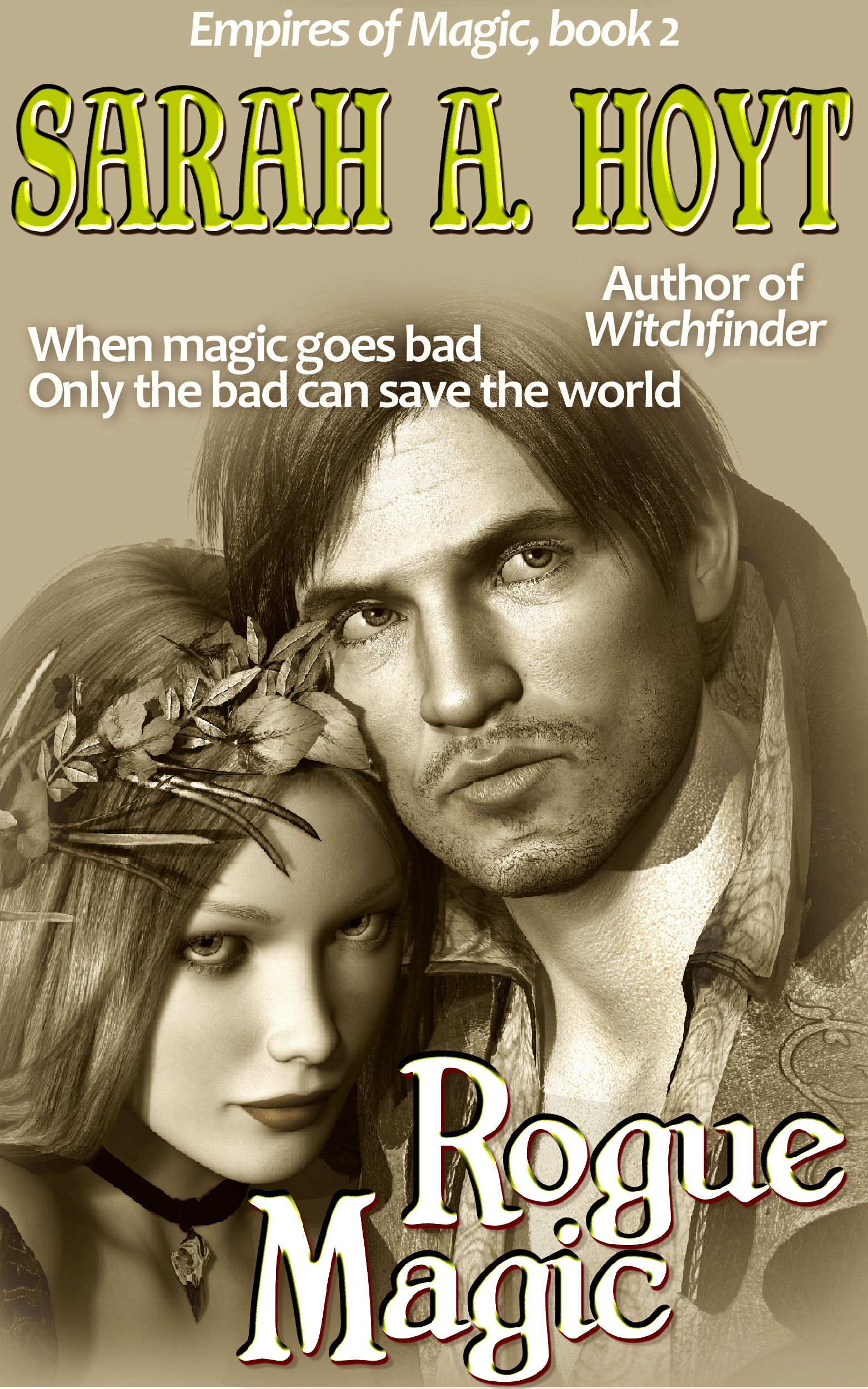
Rogue Magic — Free Novel — Chapter 38

*And now, I shall go and do cat boxes and the spots upstairs where Havey rubbed his behind in an effort to clean it :/  After that there will be subscriber’s content.  For reasons I can’t fully explain — I can, but it would involve too much and too long an explanation — my brain has been on hold most of the week.  Now it’s back.*

roguemagicnewcover

The prequel to this — Witchfinder — has been removed.  I do promise to go through the copyedits as soon as humanly possible and send the advance copies to those who pre-ordered.  You’ll know when that’s eminent because I’ll remove scattered chapters from this blog.  I do hope to manage it next week, but I’m not promising as I’m still finishing a novel under contract to Baen. Meanwhile, if you donate $6 and note it in the field, you’ll get advance-subscribed to this novel.  I do, however, understand it can be a long time to wait, and if you want to, do so.  I will continue to post chapters here, roughly one a week.
NOTICE: For those unsure about copyright law and because there was a particularly weird case, just because I’m making the pre-first draft of my novel available to blog readers, it doesn’t mean that this isn’t copyrighted to me.  Rogue Magic as all the contents of this blog is © Sarah A. Hoyt 2013.  Do not copy, alter, distribute or resell without permission.  Exceptions made for ATTRIBUTED quotes as critique or linking to this blog. Credit for the cover image is © Ateliersommerland | Dreamstime.com


Ginevra Mythborne


I was a little surprised Jonathan agreed with me that we needed to go to fairyland.  It was about this time that I expected him to get a glimpse of the plan, or at least of the people targeted, and to probe behind my motives.

I had of course forgotten that he was a human male, and how easy it was to cloud a human male with hints and promises and allusions to mating.

He might not be all human – from that magic glow around him, I wasn’t sure, yet, that he wasn’t Hermes himself, save for the fact that someone that close to the Father in blood, couldn’t have remained on Earth long enough to become Jonathan.  A few days at most.  You needed to be as dilute a bastard as I was to be able to withstand the lack of magic on Earth for long enough to accomplish anything.

Which left us with… mostly human.  And if mostly human, he was susceptible to the tricks of my kind.  Very susceptible, as it turned.

He let me do the translation magic between universes.  Not that I meant to play him false.  Not in this at least.  But I’d expect someone as full of guile and imagination as Jonathan Blythe to wish to say the incantations himself.

Instead, he let me say them.  His eyes widened a little, then narrowed, at the old language, then he shook his head and opened his mouth, and looked like he was going to say something, but didn’t.

I was using the wayfaring incantations, in the variant popularized by Espinosa, so what happened was that instead of a fey portal opening in the middle of this very mundane room, a … a discontinuity appeared in the room, right there between the tall dresser and the red-draped chair, and through that discontinuity you could see sort of, if you squinted, a dark way that seemed to wind amid a darker meadow.

I started towards it, and Jonathan held my wrist.  “Wait,” he said.  “Wait.  Where … where does this lead?”

I turned to him and considered giving him that kind of pose that human females use to suggest attraction without saying anything verbal.  I thought to jut my hip out, to move just slightly closer to him, to go willing and meek in his grasp.  But the time wasn’t ready for it.  Whatever thoughts the old magic language and Espinosa’s embroidering upon it had sparked weren’t amorous.  I won’t say he was all business.  There was a good bit of the trickster in him. But his eyes were narrowed, and I could almost hear him trying to think through things.

“To Fairyland,” I answered truthfully, willing to let him see my truthfulness and my quiet certainty.

He growled at me – or at least he made a sound of impatience in his throat that was very close to a growl.  “Don’t try that on me.  There are many points in fairyland.  Where are you taking me.”

“Fairyland doesn’t have a defined geography,” I said.  “Too much magic for that.  It has in fact, a mutable and always changing geography, a—”

“I’m not a child, Miss Mythborn.  I was not born yesterday.  I recognized the words you said, though damme if I know how.  I know all that about fairyland, but I also know there are places, like the centaurs meadow and… and worse, where you can end up imprisoned forever and worse.  There are many people, as you know, who think that Dante wandered into those dark meadows and that it was there he saw the place of eternal torment for the impious dead.”

I sighed.  He knew too much, but I knew he knew too much.  It was the point of all these we’d targeted that they stuck out, they were unsatisfied with their fate – they were mice captured in a trap not of their making, but refusing to resign themselves to their fate.  The high magic one of those were—usually interesting.

However, in this one thing I wasn’t playing him false.  Again, I willed him to see my total honesty.  “It is not,” I said.  “To one of those dark places that I’ve opened this road.  Rather, I willed it to take us near the King.  If I’m right, he’s still in the palace, in the center of fairyland, having spun for himself a reality that accommodates each of his halves.  I do not know what that reality would be, but I count on you, who have known him from early life, to do so.”

He demurred, looking at me, his eyes narrowed, then said, “Buggered if I can.  Gabriel was always a strange one.  Well, now I think about it, I was a strange one, too, but no more dissimilar men may be found.”

I didn’t say anything, nor yet move.  He sighed.  “I wish—”  he said.  He shook his head and let go of my wrist.  “Go on, fair temptress.  Damme, I’m going to regret this–  But possibly only for a very short time.  And anyway, the things I’ve regretted the most in life have often turned out to be the ones that…”  He looked surprised as though he’d suddenly seen clearly something that had evaded him all too long.  “The ones that bore me least.  You know, I don’t think I am ever amused except when I’m doing something regrettable.”  He grinned.  “Lead on.  This is about to get interesting.”

That part, at least, was true, even if I was not leading him into a trap.  Well, at least not into any trap he could imagine.  Even I, low-blood that I was, could only see the outlines of what lay ahead.

But I knew we needed to get the misfits into fairyland.  By any means necessary.  The result…  Well, if I was right it would be as catastrophic as if that bomb had gone on in the office of the Witchfinder.  And yet, I could see where it would be something else, also.  Something… interesting.  Even for people other than the Earl of Savage.

I reached for his hand.  Strangely, it was I who needed support and reassurance.  I knew the game was being played, but I couldn’t tell for sure that I had more – or less – say in it than the mortals we were gathering.

When we first set our feet on the path, all sound ceased – those sounds I hadn’t even been aware of: our breath, the minute sound of our steps in the brothel’s cushioned rugs.

We walked as one walks in a dream, without feeling of air on our bodies and faces, without the sounds of living.  When were ten steps in, or so Jonathan looked back over his shoulder.  “Interesting,” he said.  “The door is closed behind us.  The room isn’t back there.”

I didn’t say anything, and he chuckled.  “The … At least it doesn’t do what happened to Eurydice.  I’m not back in the room.”

“That only happens the other direction,” I said, and then wished I could bite my tongue in two.

“Does it?” he said, the amusement in his voice betraying he knew very well I’d let escape what I didn’t mean to.  “Useful to know, isn’t it?  Now lead on to whatever adventure waits us.”

Like that, as though conjured out of nowhere, a tall while place loomed.  It looked as though it might have been sculpted out of ice.

And from somewhere came the shouts and laugh of children at play.


This, That AND Most Particularly The Other Thing

So, weirdly I managed not to get sick — or not for more than about one night of weird fever-like dreams.  Why is this weird, Sarah?  Well because my entire family has spent the week being several shades of sick.  I never quite got sick, but the week might as well have been flushed anyway.

To make things better Havey-cat has got into something that gave him diarrhea, so the evening was spent trimming er… pasted cat tail.  He’s hiding from me now of course.

I sat here and thought “I can write the next chapter.  It’s Jonathan’s perspective, anyway and he’s always drunk.”  But I can’t, so I’ll have to write it tomorrow morning… So, check back in three  hours or so.

And Shame The Devil

To speak or not to speak?

Imagine that you are in a situation where everything you hear around you, all the points of accepted truth are carefully manufactured from above.  From your own experience, from the things you’ve seen yourself, you know that they’re not true.

Can you say anything?

Of course you can’t.  People will think you’re crazy.  In fact, you might start thinking you’re crazy yourself.

For years I seesawed on this point.  I knew that there were things I’d seen, things I’d lived through that no one in the US would believe if told (I imagine it’s much like someone who is for a democratic government in the Arab world now trying to tell the truth in the US about the Arab Spring.  Even with blogs, unless he’s very lucky, people will think he’s crazy or a supporter of a repressive regime.  Because everyone they hear about the Arab Spring tells them how chocolatesprinklesawesome it was.  And how it was populist and pro-democracy.) Heck, most people in Portugal, save the few who’d been there with me would believe it. And even SOME of those had gone into believing in the official version.  Because it’s easier.  Because then you don’t feel crazy.  And even if you can’t bring yourself to believe in it, you talk as if you do, in public, because you don’t want anyone to think you’re crazy.

This subtle disconnect followed me to the US, where I found that to get ahead in life you needed to be as far left as you could be, or at least make noises like you were, and yet where every single TV show and TV report and book and magazine shouted that the left was downtrodden and the right firmly in control of government and everything else.  Oh, and the rich were all right wing.  (Guys, for those people who are my age, this was never the truth.  Not even in Europe.  The rich are more likely to be extreme left.  And it’s not guilt.  It’s that they know what is the end result of communism:  a sort of techno feudalism. They want that.  In its end stage, communism is a complete reversal of the anti-nobility revolutions of the eighteenth century.  And that’s why the upper classes support it.  By their fruits, etc, as a wise man once said.)

And then at some point I reached the Kit Marlowe point: To speak the truth, just once, would be worth it, even if one had to die for it.

I won’t claim any great bravery.  I came out of the political closet when indie became available.  That’s because I have obligations.  To my family, to my kids.

I keep hearing that writers should still keep their politics quiet, because we’ll alienate readers.  Is this true?  I don’t know.

At this point, the way the left is, if you don’t vocally endorse their pet causes, they’re not going to read you anyway.

I know my coming out of the political closet has cost me maybe ten readers that I knew and that I liked as people (despite their vile prog politics) but I don’t know how much that propagated to the “real world” readers.

Does it matter?

Sigh.  I don’t know.  I have obligations to my kids.  I have obligations to my husband.  Maybe coming out as libertarian/conservative means I’ll NEVER achieve more than the audience I have just about.  Who knows?

Even if I knew that – even if I IRREVOCABLY knew that, would I have stayed in the closet?  No.  No, I wouldn’t.  Even if I knew it meant the end of my career (and, hell, it might.  What do I know?  I’ve seen the job of demonization they did on Heinlein.)

Partly because I couldn’t stay in the closet any longer.  Partly because… every time you stay quiet, particularly as the lies grow more deranged (I swear I saw someone defending the loss of full time jobs as “people worked less hours before the industrial revolution.  We don’t need to work that much.”  What work might mean in self-respect and in habits passed on to the next generation means nothing.  And what work might mean in terms of society subsisting means still less.  Do they really think that if no one works and everyone gets money from Uncle Sugar the country will stay prosperous?  No, don’t answer that.  I want to sleep nights) you’re forcing other people into that thought closet where I lived so long – the place where you double think, and guess yourself and wonder if you’ve gone nuts.

And the time came I couldn’t stay quiet any longer.

I imagine at some point people around 1773 made the same choice.  They didn’t want to.  They wanted to go on being loyal British subjects and bless the king in public and drink to him in taverns.  But after a while you have to choose.  Your silence contributes to the destruction of everything you hold dear.  Can you stay quiet?

I’ll add I still stay quiet sometimes.  If you erupt in every social occasion, at every minute, people will discount you.  It becomes a form of Tourette’s.  So I choose my times, but I do talk.  I do provide something people can read and say “I’m not alone.”  (And sometimes I do talk at the grocery store, and the park, when I hear something egregious. The first time I had an attack of this was in a bookstore in Portugal in the seventies, where employees were talking about… well, their summer of recovery.  And I came back at them with not only figures carefully gleaned but with how those same figures were viewed  by the same paper when the other guys were in power.  And I asked them “Do you have short term memory loss or are you a party parrot, willing to repeat whatever the socialists say, no matter how egregious?”  Then I walked out, shaking.  None of them detained me to explain.)

But in the end, you have to pick your place to stand and this is mine.  Does it cost me readers?  Who the frack knows?

If someone takes offense to my views – which aren’t standard conservative, or even (and this takes effort) Libertarian enough for the party, mostly because I arrived at each of them individually and painfuly and on my own – then they probably have a much greater choice of glittery hoo has to read.  But it is possible a demonization campaign means I never grow beyond the Huns, which are not QUITE enough to make a living from.

If that is it, well… I can cut back.  Or write monster porn under a deep secret pen name.  (I swear I’m not.  Because ew…  But I’d rather do that than stay quiet.)

Perhaps I’m expressing it all very badly.  I read Live Not By Lies in the journal of Law and Liberty.

And I thought “Yes, that’s it.  That’s why I came out of the political closet.  That’s why I must remain out.  That’s why I must continue talking even when the other side claims I offend them deeply.”

Because they need to hear this. They need to know that opinion isn’t uniform nor uniformly in accord to them.  It might not change their minds, but at some point, they’ll have to start explaining their philosophy to us and to themselves, and maybe that will clear away some of the oddest contradictions.  And maybe they’ll have to learn more about the history of their beliefs.

Because people who believe like me need to hear this.  Sometimes I feel I’m preaching to the choir, but by all that’s holy, you need that too.  There is a reason for weekly church services in a world hostile to religion (as it was at the beginning and in many places again.)

Because men (and women) are social.  We want to fit in.  We need a group.  And we’ll sell our souls to belong to the consensus, if that’s all we see.  (And if you want to know how close I came to it, read Magical British Empire.)

And because, even if my voice is small and weak, it shatters the consensus.  There’s only one of me, but there are a hundred other small and weak voices.

They might, maybe, dismiss us as crackpots (someone called Larry that.  Never mind.)  But in the process of doing that, they mention us.  And one or two of their sheep come over, and remember that they once thought the same.  And one by one, we pick at the unthinking flock.

Is it enough?  Is it possible to save our country and our world, one by one?

How else would you do it?  This is the only way it’s ever been done.  Speak out.  Live or die free.  Live or die on two, like a human being.

Don’t let them get in your head and change your thoughts from what you know is true, just because you want to fit in, to be feted, to be accepted, to be loved.  Don’t let them enslave you.

I speak out because: “You can’t enslave a free man. The only person who can do that is himself. The most you can do to a free man is to kill him.”Robert A Heinlein

Two And A Half Years Later — My Only Publisher Is the One Who Doesn’t Beat Me

[What follows below is a blast from the Past Post, He Beats Me But He’s My Publisher from 8-31-2011.  Posting it again was precipitated by this: The New Role of Gatekeepers by Joe Konrath.  My friend Amanda bloged on it yesterday at MGC.

I’ve made comments on the original article in square brackets.  However, it was impossible to say everything I want to say about it.

Overall, it’s frigging amazing how it held up.  Most of what is said below is still true.  At least for those entering traditional publishing.  However, I’m going to list some of the trends I’ve seen in the last two and a half years, both indie and traditional and indie changing traditional and traditional running around in circles like a chicken with its head cut off… er… I mean doing stupid things.

First, like when I quit my first agent, when I quit my last agent, and walked off on my own, I didn’t starve to death.  The last two years are the first time I’ve made a middle-class income.  (Even if the last year was terrible due to my health and I’ll probably pay for that in income this year, unless I make with the writing VERY FAST — hey, I’m trying.)  Is there a use for agents?  Perhaps.  But not as currently constituted.  I wouldn’t mind an agent for translations, but I don’t have that, and heck in my whole time with agents I sold ONE translation to Japan (which has gone to reprint, but I’ve no heard about buying anything else.)  About 20% of my income came from Indie and “Found money.”  However, in the last two months, my income on Amazon has increased exponentially, as I put more backlist novels out.  So, I’m not where I can live from it, but I can see it from here.

Which means, G-d forbid, should something happen to my publisher — like, should they get crushed by a giant alien ship or something and leave nothing standing and no one alive — I would have a bad half year, but my income would probably recover.  More importantly, people would STILL read my books.

Needless to say — or is it needed? — I will continue working for Baen as long as they want me.  This is because they treat me like a human being and when they make mistakes THEY ADMIT THEM.  (If you’ve never worked for anyone but Baen, you don’t know this is sort of like saying that the sky is poka dots with pink background.  And yet it’s true.)  Also they picked me up when no one else would and when traditional was the only game in town.  Picking up a newby author is one thing, picking up one someone else had burned was a gutsy and more importantly, humane act.  I owe them one of those debts you never pay back.  Never.  If they’d never picked me up chances are I wouldn’t have written for 11 years now.

I wish I could convince them to let me work outside contract, because I totally would be faster.  It’s a psychological kink. (And I finally understand the mechanism and could explain it, only it would take a whole post.) OTOH I understand their need for security.  I’ve decided I’m circumventing this, as soon as I finish the two books under contract (which are of course late — psychological kink) I’ll send them two books on spec, and that should stave off the contract a while longer, right?  (I’m thinking the fourth shifters and World War Dragon, which might be a one off, then the third of the Earth revolution, and then another Darkships at the beginning of next year if my health doesn’t crash and burn.) But humans are mortal, and in a time of rapid technological change, things could happen to Baen.  I prefer not to have my entire income rest on them.  You guys know my history.  I don’t like that my fate is out of my control. Also, I write in a million genres (that like the no-contract thing is a psychological kink.  THE SAME psychological kink, in fact.  Can’t explain without a whole new post, but trust me when I say without the occasional mystery or historical fantasy, the sf/f would stop cold. — it occurs to me to wonder if I should have offered Baen Witchfinder.  Since it’s in the world of the magical British Empire — well, the universe — and since I wrote it in public, I didn’t.  Um…) and some of them, like mysteries, or historical novel, or who knows, in the future, Romance, Baen won’t publish.

The other thing that has changed in two and a half years (has it really been that short) since I let go of the other publishers and said “I’ll keep the one that doesn’t drive me crazy” is that my hair isn’t falling down by the handful and I sleep nights.  I LIKE that.

The things that has changed the most  about traditional with indie publishing is that the push model isn’t dead but it’s ailing.  Right now, pre-orders on Amazon count for more than whether you are young and perky and went to college with the publisher.  This is a good thing! Some of us are making a spirited dig out of midlist hell, with mypublisher’s help.

The next thing that has changed markedly and not at my publisher is that those publishers who have become desperate now seem to be buying what I call “too stupid to know better.”  Also, they’re paying less, the contracts suck and often the publication is “digital only” — who wouldn’t want to sign up for that?

This is what I’ve learned to expect in the way of winning friends and influencing people, back in the days when:]

He Beats Me But He’s My Publisher — a blast from the past post from August 31 2011

First let me point out no one beats me. Not literally. For those of you who’ve read Athena (Darkship Thieves) this should not be an incredible surprise.

The title is denoting of the relationship existing in traditional publishing between the writer and the publishing house. It is also the sort of thing I heard many women say about their husbands in the village where I grew up. Portugal, like most countries whose cultures were strongly influenced by Islam, had a streak of wife-abuse running through the poorer or more culturally backward classes. Since in the village where I lived my dad was one of the very few white collar workers, this meant my mother and my grandmother were forever saving women who ran away from home when they were two steps from landing in the emergency room… Only to see them go back to their husbands because “He beats me but he’s my man.” Or “He beats me because I’m not good enough.” Or “He beats me because he loves me so much.” Or even “Whom should he beat but his own?”

Needless to say, the one thing my family told me, from – I think – before I could toddle (I could talk before I could walk. No. Don’t ask.) was “If your husband ever so much as slaps you, you leave. That day. And you don’t go back.”

Unfortunately my family never knew about publishers and the status of the mid-list author. So they couldn’t warn me.

I wasn’t going to talk about any of this. I wasn’t. I like at least one of my publishers immensely, and I do understand how their hands are tied. On the other hand the last few days have been very trying. First, is it my impression or are all the establishment’s blue eyed boys going out of their way to tell us how we’ll starve in the gutter without traditional publishing? They remind me of my first agent, who btw, ONLY made official the sale I had already made to the publisher, and who then told me I’d die in the gutter without her, when I fired her. (Yeah. That… didn’t work as she thought, curiously enough.)

But then yesterday, in the Baen bar, someone posted that he sent letters to WRITERS complaining about their publishers’ DRM policies and pricing for ebooks because, I don’t know, the Kool-Aid man is red? Oh, wait, no, it’s more nonsensical than that. Because and – clears throat – I am quoting: writers choose their publishers. I want them to choose publishers who don’t do these things.

And that pushed me over the top. Call it hormonal, all right? I’m getting to be the same age when my mom was more likely to take off with the cast iron frying pan to talk to one of the abusive husbands than she was to simply bandage the woman’s wounds.

So, to begin with, let me tell you right now that the chances of a mid-list author dictating terms to his/her publisher are about the same as those of a village working class woman finding a man who doesn’t beat her. She might get lucky. She MIGHT. But she can’t count on it. In fact, a village woman once told me “If you think you’ll find a man who doesn’t beat you–” (And let me say, yes I have.)

Heck, as some of you know I have a lot of friends who are bestsellers. The way the market is right now, the chance of a bestseller dictating terms to his publisher are close to nill as well – unless he’s one of those blockbuster bestsellers that defy all classification. In our field you can probably count those in the fingers of both hands and have some fingers left over. And unfortunately none of them are close enough friends for me to ask if they, too, are worried.

Now, let me describe to you how much power the typical author has. Let me tell you how traditional publishing works for the unconnected, the non-fashionable and the doomed.

First of all, it’s a buyer’s market. Since the mega mergers of the eighties, there are five overarching houses. There might be more imprints, but, at least when submitting through an agent, you can’t submit twice to the same house. (Well, at least not using any agent I’ve had.)

Second, for each slot available on the publishing schedule there are thousands upon thousands of submissions. Even assuming the vast majority of those are either horrible or “don’t fit” the publisher’s “needs” there have to be at least ten books that would fit the slot at any given time. [I’ve heard this is no longer true.  It’s all leaked through friends of friends and very hush hush, but it feels intuitively right and if it is how much those numbers have fallen shocked even me.  The one not following this trend is Baen, and as someone who works for them — DUH — In fact, their submissions might have gone up. — SAH 2014]

So, let’s say YOUR book takes the editor’s fancy. Or maybe they owed your agent a favor. Or maybe they liked the title better than the other ten. Who knows?

You’re a brand new author, and they pick you out of slush. Oooh. Oooh. You’re in the money now, right?

Um… maybe. But first let’s talk about the important considerations: how powerful is your agent? How much does he/she believe in you? And do you know anyone in a publishing house? If all those are negative, you have one more chance at the big money – are you a “sexy package”? Part of this is literal. Are you cute and young? Can they count on displaying you and having people tumble over themselves? Part is metaphorical – do you have a hard luck story? Do you have something interesting about you? Do you perhaps have a well-followed blog? Or are you a politically correct refugee? (When my first series tanked the publisher told me she would buy me again and “make me a bestseller” if I wrote an autobiography. I was thirty eight. I’d done nothing but get married, have kids and write three failed books. So… she wanted me to write about my childhood in Portugal and make it “sexy.” No, I didn’t. What, am I stupid? No. I respect my family and friends there too much. I want to sell my books, not my unremarkable self. Also there are other reasons which are none of their business. Or anyone else’s.)

Let’s suppose you’re either white-bread American and unconnected to the publishing industry in any way. (Or you’re not white American but are stupid or honorable enough not to let them make a big deal of your life or treat you as an oppressed minority.) Let’s also suppose you wasted your twenties trying to break in, and in your thirties you’re blousy, somewhat overweight, with two small children.

Ah, my dear, welcome to hell. Here’s your accordion.

Having looked at this, your editor “forecasts” your numbers. I have it on good authority this doesn’t involve the bones of sacrificed animals. What they do is go “White, American, unremarkable and not sexy.” And you get the standard beginner’s advance. It used to be the princely sum of five thousand dollars (what, you can’t live on that for a year? Foolish you. Appliance boxes are free, and there are some nice underpasses. You can write at the library.) It is now three thousand. [I have a friend — oh, heck, you can know Amanda Green, writing as Ellie Ferguson.  Wedding Bell Blues made 3 times that within a year of being out.  It’s still selling. — SAH 2014.]

Now the book and its advance pass on to the marketing department. Who… barely glance at it. To get back the money they invested in you, they don’t really need to do anything. No, look, I know what you’ve heard. They say that printing the average book costs 100k or some fantastical sum. But that’s because they’re charging to every book the same percentage of editor/publicist/secretary/etc salaries. (Many books at this level, if bought on proposal, never get READ in full. Except presumably by the copyeditor. That’s how much time you take of those salaries.)

Next, you get assigned to someone – probably someone’s secretary – who procures a cover for you. Usually you get a beginner artist (and some are darn good) but they might also use some form of out of copyright art – like my first three books. And then… and then you go to copyedit. And thence to the marketing department again.

I’ve been privileged to listen to a book reps spiel back before I was published, at my favorite independent bookstore, while I was waiting to ask the manager a question. Back then this was done with a huge catalog with covers, and one or two books in actual advance printing. First these came up. They were either bestsellers or those the publisher had slated as bestsellers. They got handed to the bookstore manager and the manager was told “Well, we have strong confidence in these books. You’ll want to take…” twenty of each, I think, at a minimum. Might have been fifty. It’s been a long time. Then came the books in “second slot” for that quarter. For these the rep had the covers. He’d hand them over, do a little song and dance, and say “you want to take” – five or ten of these. He’d tell you how the publisher was promoting these books this way or that, or how interesting the life story of the author was, or what have you.

AND THEN, at the end, he’d say “You also can take these.” THAT, Mr. or Ms. Whitebread, is where you are. And if your cover is exceptionally pretty or the manager recently watched a movie that sounds somewhat like your book, they might take one or two.

At that point, you’re in the midlist zone. You’re also more than likely in the sales death spiral (no, I’m not going to explain that. This would run to ten pages. Google “Books and Death Spiral.”) After that, any book you sell, those numbers will be brought up. Can you escape the midlist, once you’ve been cast into it? I don’t know. One hears stories, but those are usually from before the computer number system. Perhaps, as with hell, you can swim out of it but I doubt it’s on a sea of tears of true repentance. More likely you’d have to marry a movie star, or perhaps run for president.

Note that SO FAR the writer has had exactly zero choice. Oh, he can chose NOT to sell his book and remain obscure forever. Does how good his book is influence anything? Well… it could. Supposing that word of mouth got going among readers. Except that, for all but one of my publishers (yes, you know which one) until very recently, it was one print run, one time, it sells out and the book is no longer available in any format. Too bad so sad. One of my publishers until the last two books made it a point of taking the books out of print at the year mark or when the book started earning royalties.

This meant the chances of your being discovered in back inventory were… you’re right. Zero. (I know through my fanmail a lot of people are NOW discovering my Shakespeare series which came out eleven years ago. I get no money for those, because they’re out of print and either used or remaindered. I don’t even get statements for them anymore. And there weren’t enough of them printed, so even if they all sold twenty times, my name recognition would be limited.)

In fact, if your book had been completely blank, or a compilation of nursery rhymes, it would have got exactly the same distribution and sales as it got with your words in it. You didn’t choose the cover. You didn’t choose the price. You didn’t choose the push. You didn’t choose the distribution.

More importantly and more than likely, the person who chose these things chose them NOT based on the book – which they might or might not have read – but on YOU and their perceived marketability of YOU. (And let me tell you, as a reader, that’s many shades of wrong.)

Most people don’t know your book even exists, and therefore they can’t ask for it. And if they do, they might get told it can’t be ordered.

And then… and then the fun starts. When the numbers are in, you’re told your numbers are only “midlist” and barely good enough (if you’re lucky) for them to buy the next one. And the next. They all get the exact same treatment. You might grow your fans, but it will be very slow. And even if you sign with a publisher who wishes they could do more for you, at that point the publisher is hamstrung by the numbers in the computer about your previous distribution.

You might (or might not) be asked to change your name again and again and again (one of my publishers has a fetish for this.)

And all along you’ll be told the fault for your lackluster sales is … yours. Yep. You wrote the book, and if it doesn’t sell, it’s ALWAYS your fault. No matter how demonstrably it ISN’T.

And under the old model, you swallowed and took it. You did what the village women did when I was a kid. You bandaged your worst wounds, and you made up stories. “I fell down the stairs.” “I bumped into bad sales figures in the night.” “I am so clumsy.” “It’s all my fault.” “They beat me because they love me.” And you crawled back. Because the alternative was unthinkable. The alternative was to never publish again.

And if you complained – if you so much as opened your mouth and said something along the lines as perhaps the crash of the books wasn’t ENTIRELY your fault (I’m not a conspiracy theorist, for instance, but I’m 100 % sure that the crash of my first book was exacerbated by coming out exactly one month after 9/11 and while I’ve done many weird things in my life I’m SURE I never committed any terrorist attacks. But those numbers were SOLELY my fault, as far as the industry was concerned) you got told how grateful you should be to the house for continuing to publish your worthless self, how each of your no-good books cost them 100k to get to the printing stage, and how they only did it out of the goodness of their hearts. And you had to swallow it, no matter how nonsensical it was.

THIS model. THIS MODEL is what the bright eyed harbingers of the establishment, the blue eyed boys of privilege want me to get maudlin about. Both as a reader and as a writer, let me say RIGHT NOW that I’m not going to.

No, I don’t know where the buck will stop in digital publishing. No, I don’t know what will emerge or what shape it will take. I do know just being able to say “It wasn’t my fault. I’m not the world’s best writer, but there’s something mighty weird with the system.” Or “I will not be grateful for hind teat” is good enough for me.

A biography of Marlowe claims that among his last words were “Just to tell the truth once, would be worth dying for.” This, it turns out, is also true when the result is the metaphorical death of a career. Particularly when there are alternatives.

No, I will not eat what’s put before me. No, I’m not the world’s most wonderful writer – every year I look at what I wrote the year before and cringe, so I know there’s room for improvement – but I KNOW I’m not a million times worse than J. K. Rowling. Sorry, that’s not just impossible. That’s obscene. I also know that until Pratchett got a new agent and editor, he was lost in mid-list hell in the US while a bestseller in the UK. His writing did not change. His marketing did.

Will I continue selling to big houses? Only if I like them. I write for a house I like, and there’s one other house I wouldn’t mind writing for.

As for the rest of them, they can go to hell. I’m going Indie.