Don’t Sit Down, John! – Bill Reader

It is a tradition that I got from my friend Sarah that I watch 1776: The Musical on Independence Day. It’s a flawed gem, unquestionably. It’s brilliant where it isn’t terrible. But I watch it less for its cohesion and thorough historical accuracy than I do for a yearly reminder.

I appreciate that yearly reminders are lame. I’m not yet so old I don’t remember thinking that. Especially because life seems like nothing but a long string of them. And yet, we keep forgetting, and so we need reminding. The whole film/play, every inch of it, is summed up and embodied by Benjamin Franklin near the end.

“…what will posterity think we were–demigods? We’re men–no more, no less–trying to get a nation started against greater odds than a more generous God would have allowed.”
It’s something that, almost two and a half centuries hence, we still can’t quite get our head around. The founding fathers are viewed as a kind of amorphous hive-mind of freedom, and as a unit the founding fathers (TM) are credited with almost saintly selflessness and superhuman ability. And doubtless they were, many of them, quite accomplished men. But it is important to remember that they were men. Brave, mostly, quite successful, mostly.

But they felt, as much as any of us, the burdens, grinds, and fears of daily life. Moreso, in fact, living in a less technologically advanced time and having fewer resources to salve their pains.

So the next time you think about the revolution, think instead of this. Imagine you, your most talented friends, plus an array of equally talented friends-of-friends you didn’t necessarily like, got together in your garage and planned a revolution. That’s perhaps a bit strong. After all, the continental congress was convened somewhat more formally. But it’s a lot closer to the truth than a brain-storming session on mount Olympus.

I want you to remember that, the next time you think you can’t stand up to this or that power structure. Yes, Obama has the IRS, FBI, NSA… the whole can of alphabet soup. But you have a G*d-given right to stand when others tell you to kneel. It’s a lot more powerful than it looks, as better tyrants have learned before him.

Now I have always included this caveat: you are not required to be stupid. I understand the problem. But the economy looks to me to be well and truly cratering. The job market is a not-very-funny joke. The punch line is either “part-time” or “Obamacare”. And regulations are being piled on at a rate of knots. The EPA regulations alone are going to bleed us dry.

Maybe the time has already come for you. Maybe it hasn’t. Maybe it won’t, though if this goes on long enough I can almost guarantee you it will. You might look around you and realize you have very little left to lose.

If you’ve been knocked down by this mess, believe me, I sympathize. But if you can spare a moment from trying to make ends meet, we need you. Your country needs you. Maybe you’ve been quiet for a long time because the ruthless partisans across the aisle tend to have problems with non-compliance. That’s how a lot of jobs work these days. But if they’ve knocked you down and out, ask yourself how much worse it can actually get before you let habit dictate your choice in whether to speak. Freedom is granted, ultimately, by no one except yourself.

And if your instinctive reaction is that you are too uninteresting, ordinary, or humble to assert your beliefs, remember that the men who walked before you cast a shadow no taller than your own. They were brave, but to downplay the weaknesses they fought cheapens the victory they won. And like them, you don’t need to wait for a savior, or hope someone comes to fix things. The revolutionary the country needs… the person who will stand up for our principles and assert their correctness against bitter opposition… will be found not in a history book. There, sadly, you will find mostly saints, and they are all long gone. You and I have only our mirror.

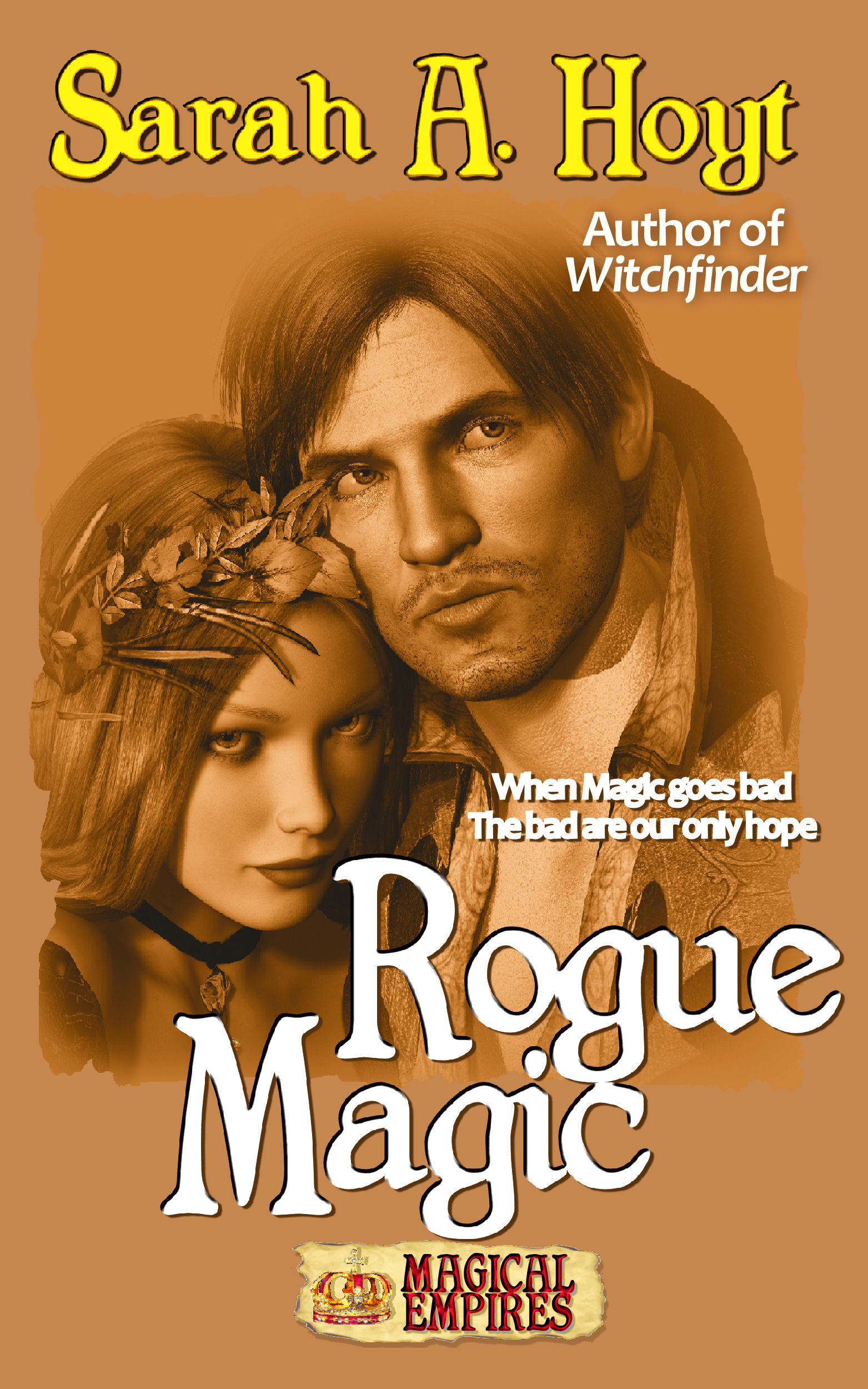
Rogue Magic, Free Novel, Chapter 52

*Yes, this is late.  I had the brilliant idea to sort and clean my closet for the first time in a decade and a half.  This is something that must be done preparatory to moving (which might not happen till next Spring because the damage from the hail storm must be dealt with and it’s eating our time) I MUST somehow find the time to reconcile this.  But for now, here is a LITTLE chapter.*

Rogue Magic, the second Magical Empires book.

The prequel to this — Witchfinder — is now up on Amazon.

This novel will get posted here a chapter every Friday or Saturday, or occasionally Sunday.  If you contribute $6 you shall be subscribed for the earc and first clean version in electronic format.  I think it will probably take another three months to finish.  Less, if I can have a weekend to run through and get ahead of the game.  It hasn’t happened yet.

NOTICE: For those unsure about copyright law and because there was a particularly weird case, just because I’m making the pre-first draft of my novel available to blog readers, it doesn’t mean that this isn’t copyrighted to me.  Rogue Magic as all the contents of this blog is © Sarah A. Hoyt 2013.  Do not copy, alter, distribute or resell without permission.  Exceptions made for ATTRIBUTED quotes as critique or linking to this blog. Credit for the cover image is © Ateliersommerland | Dreamstime.com


Ginevra Mythborne:


The tears trick had never failed to work before. It was a magic that even humans could work, and I put all I had into it. Though I’ll confess it didn’t start as planned. The first tears came as Jonathan Blythe – I’d never think of him as the Earl of Savage, a role he filled as badly as a man could fill any role, but as the young rogue I’d met that night the demons had invaded London – turned on me, his face stern and said I would tell him the truth.

The truth… The truth is that I couldn’t tell him what I’d been told, a story that I had, at any rate, long started to doubt.

But on top of that I couldn’t tell him anything. I’d run out of lies, to him and to myself.

I remembered only the softened look in his eyes, the way he’d looked at me when he’d met me that first night, and even the way he’d looked at me when he’d met me in the Witchfinder’s office, and now – and now it was all gone, and all broken, and his eyes were cold, his face stern, and something emanated from him like the cold and distance of the stars looking down on humanity.

I’d always known he could be distant and cold. He had His blood after all, and of all the children of the Pater He was one of the few that even I couldn’t read – a creature of fog and slippery thoughts. He was not emotionless, but what his emotions might be, few knew. I guess you had to keep yourself detached to walk between worlds. I’d tried it myself, but at Jonathan Blythe’s look, something snapped.

The tears came. After that I realized I was in danger, and giving myself away, and decided to use my not-inconsiderable power to encourage him to feel sorry for me.

I saw something like a spark light up his grey eyes, and then he said, “Kindly stop it. It will not work. Miss Mythborne, you’ve led me a merry dance, and you might have been responsible for setting the rogue magic loose upon my world. I believe it’s time you gave me an explanation. And no. Don’t consider crying harder. It simply won’t work.”

I looked up into his eyes and saw that it wouldn’t, and yet, my eyes kept trickling out tears. “I don’t do it on purpose,” I said. And sniffled.

He took out his handkerchief and handed it to me. There was barely courtesy in the gesture, there certainly wasn’t any careful coddling of my feelings.

I ran the handkerchief across my eyes, and pressed my nose to it, and then I sighed. “You see,” I said. “People who are conflicted in their position and… and trying to subsume themselves into a place they don’t quite fit in, if they’re magical people, they give off a power that…”

“Yes, Miss Mythborn?”

“I can’t tell you. They would destroy me!”

“They?”

“The people who… sent me.”

“People?”

I looked up and met with his clear and speculative gaze. The amiable drunk and the easy going dunce he could play were both that, playing. This one was for real.

I shrugged.

He sighed. “Miss Mythborne, you have two choices. You can explain exactly for whom you’re working and why – and no lies this time – or I can deploy my not inconsiderable capacity for magic, that magic of rogues you seem to think is so powerful, on you, right now.” He narrowed his eyes. “I wonder what the result would be of using some of the nastier sorts of spells in Fairyland. You know, when my papa died, I found on his shelves several books of forbidden knowledge, including Barbossa’s spells of control.” His voice had gone all cold and speculative. I felt the hair on the back of my neck rise. I remembered those spells from back when I’d got my education in the world of humans and I didn’t want to have them applied to me. I very much didn’t want to have them applied to me by this cold creature. But my concern was all too real. I let him feel it. “I can’t talk,” I said. “they will hurt me. They will… reduce me.”

His eyebrows went up. “Now, I wonder…” He said. And then cooly, managing to look as though he’d just gotten dressed, as though he were in his house, and in full control. “As I see it, a difficult choice is before you. You can tell me what I wish to know, right now, and I’ll protect you from those … others… to the best of my ability. Or I can use the best of my ability against you.”

I opened my mouth to talk, but he lifted an admonitory finger. “Only before I believe anything you have to say, I’m going to need to use a truth spell.” He grinned. It wasn’t a nice grin. “Perhaps the most innocuous of Barbossa’s spells, and frankly necessary to believe something such a gifted liar tells me.”

This was not going to be any fun at all. I wanted Jonathan Blythe back, the Jonathan Blythe I’d first met.

But I was afraid the games I couldn’t help but play had destroyed him. At least when it came to his feelings for me.

I’ll Be Back To Do A Chapter

How did I become this family’s cover maker?  Between doing covers for two of the guys (I still need to proofread for one of them, but that will happen tonight), trying to write and the high holy holiday, I was beat and only woke up now. So I’m a zombie in search of caffeine and yogurt.

However, I think you need to head over to MGC, before I come back and write a chapter of Rogue Magic:

F%$K me, SFWA, One More Time

Nothing like supporting the pimp and dissing the girls.

What? I give you pleasure, you give me money. What does that make me? 

Only… I don’t have a middleman over my head taking most of my money. I’m a free girl. 

I’ve blogged before at length about the whole Hachette-Amazon thing, here, and here, and here. It’s business, folks, nothing personal. Amazon is in the process of renegotiating, which comes after Hachette settled over a price-fixing dispute. If you’ve been living under a rock, this comes as a surprise to you. Otherwise, it’s everywhere.

And now, SFWA has come out in support of Hachette. “Author Don Sakers has posted an essay to his blog complaining that the SFWA has endorsed Douglas Preston’s letter. Sakers, an independent author who makes most of his sales through Amazon, is annoyed that SFWA’s leadership did not make any attempt to consult or discuss the matter with its members before acting, and points out that this comes only a week after SFWA asked its members to comment on a proposal for allowing self-published authors to join.” Chris Meadows does a good job reporting on industry news over at Teleread, and covers this one.

So here we have an organization that still claims it supports authors and helps them get the best deal, but now they are in bed with one of the biggest publishing businesses. Their cover story is getting thinner than a streetwalker’s top.

The always articulate Cedar Sanderson has had it, and I confess, if I were still in SFWA this would be when I walked out. And kept walking.  A long, long way off.

They might be in a panic, but do they own mirrors?  Or are they like the vampires of time past incapable of seeing their reflections as they betray those who trust them and behave in ever more despicable ways?

Don’t answer that.  Go read Cedar’s post.  And remember, in my circle of friends, Cedar is the NICE one.

Go read.

Getcher books right here!

Morning, ladies and germs. I hope your festivities yesterday were pleasant. I had the chance to meet a couple of Our Beloved Hostess’s fans and hang out in an air-conditioned hotel, and the Oyster Wife and Minion #4 arrived at the Oysterhaus while I was off committing commerce and Staying Out of the Way. Life is pretty awesome.

We have several entries this week, especially since we lost last week’s post to technical difficulties. So go buy books, enjoy them, and if you’re anywhere near Salt Lake City today, do drop by the Westercon dealers room and say hello. Lots of books to buy there, too! As always, future entries can (and should!) be sent to my email. Happy reading!

Jason Dyck, AKA The Free Range Oyster

Mercenary Wordsmith, Electron Herder, and Henchman to the Stars

Michael A. Hooten

Wizard’s Heir

A Bard Without a Star, Book 1

Gwydion ap Don is a talented harpist, and a known rogue. But his Uncle Math sees something more: a young man with the magical talent to succeed him as Lord Gwynedd. But to learn magic, Gwydion will also have to learn self-control, duty, honor, and the martial arts. He’s not sure which will be the hardest. And when his training in magic begins in earnest, his whole world will change, as well as how he sees himself.

Based on the ancient Welsh myths from the Mabinogion, but set in the world of Cricket’s Song, this new series looks at one of the three great bards of Glencairck, Gwydion. But long before he became a great bard, he had to learn how to be a good man. This is the story of how his uncle tries to temper him into a leader, and a suitable heir.

Sam Schall

Vengeance from Ashes

Honor and Duty Book 1

First, they took away her command. Then they took away her freedom. But they couldn’t take away her duty and honor. Now they want her back.

Captain Ashlyn Shaw has survived two years in a brutal military prison. Now those who betrayed her are offering the chance for freedom. All she has to do is trust them not to betray her and her people again. If she can do that, and if she can survive the war that looms on the horizon, she can reclaim her life and get the vengeance she’s dreamed of for so long.

But only if she can forget the betrayal and do her duty.

Walt Pimbley

Golf Cart Blues

A foursome from Fordo (Iran’s nuclear bomb research center) take a breather on the links, where they discover that Commies make poor caddies. When Mossad shows up to play through, things get dicey.

Cedar Sanderson

Plant Life

A science fiction novella of exploration and first contact. A quartet of planetary scouts make a startling discovery on an uninhabited planet. If a being can appear human and act human, how alien is it? When an entire planet has a voice, what does it speak for? The scouting team is left with a dilemma, a person to protect from those who want to experiment on her, and a revelation about the world they introduced to humanity.

Free until July 7th!

Ellie Ferguson

Hunter’s Home

Hunter’s Moon Book 3

They say you can never go home. That’s something CJ Reamer has long believed. So, when her father suddenly appears on her doorstep, demanding she return home to Montana to “do her duty”, she has other plans. Montana hasn’t been home for a long time, almost as long as Benjamin Franklin Reamer quit being her father. Dallas is now her home and it’s where her heart is. The only problem is her father doesn’t like taking “no” for an answer.

When her lover and mate is shot and she learns those responsible come from her birth pride and clan, CJ has no choice but to return to the home she left so long ago. At least she won’t be going alone. Clan alphas Matt and Finn Kincade aren’t about to take any risks where their friend is concerned. Nor is her mate, Rafe Walkinghorse, going to let her go without him.

Going home means digging up painful memories and family secrets. But will it also mean death – or worse – for CJ and her friends?

I Was Born American

Yes, I was born in another country of foreign parents who would no more become American than fly unassisted, but I figure that was an accident of circumstance.  What really matters is that I was an American in my heart.  I just had to get here and become one in truth. (And that, by itself, is an American attitude.)

This week while talking to a friend about a foreign SO, I found myself explaining that other people, in other countries, have a hierarchy in their heads all the time — who is powerful, who isn’t, what attitude is proper.  You can find it (if you know where to look) even when reading British novels.

We’re not like that.  Whether we were born elsewhere or here, Americans — those of us who are proud of the name —  are rebels, revolutionaries, something new under the sun: a people who believe people should be equal in their right to life, the right to liberty, the right to pursue their happiness undisturbed by either inimical neighbors or oppressive “betters.”

We have no betters.  We are American.  When I got citizenship I had to swear never to accept foreign titles of nobility.  I thought it was silly.  What title of nobility could compare to being an American?

I’m not saying that Americans are for absolute equality.  We’re not.  We’re however for equality before the law (and we want it back, thank you very much. Yes, IRS, NSA, the rest of the alphabet soup and Mr. “I got a pen and a phone” I AM talking to you.  Who are you to arrogate to yourself the authority of the people?)  And that notion, alone, has permeated the country and even in the breach it makes the humblest man feel like he’s able to stand up to the most powerful.  Because they’re equal before the law, and even when our law is corrupt, that equality of free citizens lives on in our hearts.  We can each of us stand tall, American citizens, unbowed.

In the same way, though I was born very far away, in a very (trust me) strange land, I never fit in there.  The hierarchy seemed wrong and contrived.  I evaluated people for what they did, not their clothes or their last name.  And though years later it would take me conscious effort to fully acculturate, the seeds were there.  I had a congenital inability to bow or obey; a tendency to roll up my sleeves and try to fix whatever was wrong, instead of just moaning about it; and a need to look after those people who were “my group”.  All I wanted to do was to shoulder my own life and do the best I could to the best of my ability and to call every battler striving along with me a brother or a sister.

I bought Stranger in a Strange Land, based on the title, because that’s how I felt.  Then I came here and found I belonged here, all along.  The day of my citizenship ceremony, after we came home, I walked out to the mailbox and on the way there it hit me “I am an American now.  I belong, in law as I always did in my heart.”  Then as now the thought is enough to bring tears to my eyes.  Thank you, guys, for accepting me as one of your own.  (And that total acceptance regardless of national origin is nowhere else as complete as in the US.  (Though some other ex-British-colonies come close.))

In Portugal I felt strange because I believed in life, liberty and the pursuit of happiness.

I believed in this, in fact:

We hold these truths to be self-evident, that all men are created equal, that they are endowed by their Creator with certain unalienable Rights, that among these are Life, Liberty and the pursuit of Happiness.–That to secure these rights, Governments are instituted among Men, deriving their just powers from the consent of the governed, –That whenever any Form of Government becomes destructive of these ends, it is the Right of the People to alter or to abolish it, and to institute new Government, laying its foundation on such principles and organizing its powers in such form, as to them shall seem most likely to effect their Safety and Happiness.

Still do.  Those beliefs make me American.

To their defense, I pledge my life, my liberty and my sacred honor, in the full knowledge that, like those long ago signers, I might be required to give them up for the cause.

I have my scrap of flag.

Oh, say can you see by the dawn’s early light
What so proudly we hailed at the twilight’s last gleaming?
Whose broad stripes and bright stars thru the perilous fight,
O’er the ramparts we watched were so gallantly streaming?
And the rocket’s red glare, the bombs bursting in air,
Gave proof through the night that our flag was still there.
Oh, say does that star-spangled banner yet wave
O’er the land of the free and the home of the brave?

Long may she wave over the land.  Long may she wave in our hearts.  The price is required of every generation, to keep this radical idea we call America going.  Our price might turn out heavier than we bargained for, but great things cost much, and what is greater than liberty?

The baton has been passed onto us, and it’s up to us to run with it, even if it means dying on the way.

We are a radical experiment, a nation not of blood and genes, but a nation of heart, of mind, of belief.

Don’t let it perish from this Earth!

Happy Fourth.

Did I forget to post?

Why, yes, I did, because, well, I’m still me.

I was working on And Not To Yield and had a bright idea at five am, so I got up to write and, er… then we remembered that we need to take cat for x-ray.  (Miranda.  They want to x ray her heart before they give her more heart meds, so…)  And then… I just remembered now.

Not my announcement to make, but the Oyster has a new little boy-oyster who seems healthy and doing well.

And I’m just busy with the sort of things that come up before a long weekend — like figuring out where we’re going to go for fireworks.

Then there’s the fact we didn’t put up a Liberty Tree and Bob Hayte  er my oldest son says we’re grossly unprepared for the high USaian Holiday.

Since I’m still myself, (I’m sorry, I thought I’d be someone better by now) I’m going to link some stuff for you to read.

Cedar did a Liberty Con After Action report.  (Weirdly this time with no threats of lawsuits.  Who knew?)

And for those of you who don’t follow Mad Genius Club, you should go over because Kate took on the Passive Guy’s impression of living in two worlds.  The original article is very worthwhile (I’ve often felt like that at cons and panels, when another writer, sometimes someone I like and respect, but who is older than I, starts with “you know, the first thing you do is get an agent.”  If they’re not people I like and respect, and or if they are impervious to hints, it’s all I can do not to yell “the nineties called.  They want their publishing advice back.”) and you might as well give Kate some hits on the way there.  (Mercenary, I am.)

And then there’s Dave Freer on Monday on what we shape and how it shapes us.  Part of the whole “write what you want but beware what you write and whether it has the effect you want.”


The Saintly Victim and other Poisons

This is one of my rare posts that applies to both writing and real life (that boring thing.)

I’ve always mentored people, since I was young enough in the craft that I frankly had no business doing it. But in this as in other crafts I attempt there is ALWAYS someone less clued than I whom I can lead in the rightish direction. (Early on this was often a case of the blind leading the blind. Weirdly, though it can do much harm, it can also do some good. In writing, to quote Heinlein, Too much alone isn’t good – probably because writing is a communication thing. And yes, the heartless individualist has always mentored people. I fail at heartless, sorry.)

About five to ten years ago, I started noticing a disturbing trend. Every fledgeling I had who was younger than, oh, thirty, didn’t understand the difference between victimhood and goodness.

If someone was being kicked around by fate, they were ipso facto good and heroes, even if the book failed to establish any of this and even, in fact, when their own story telling made them self centered and repulsive little maggots.

The worst part of this was the blank looks I got when I said “But what does he do to deserve ultimate triumph?” “They picked on him. So he gets to win.”

I told them that in reality, being “the meek” whether good or bad means the slice of Earth you inherit is six feet by two. But they didn’t hear, couldn’t hear. You see, they KNEW the way stories went.

I was of course dealing with extreme cases of story-absorption-syndrome. Though I’ve met a few, there are almost no people who decide to be writers without being addicted to story. These days about half of them REALLY want to write for the movies but think books are easier to get into (rolls eyes) and therefore aren’t readers as such but movie watchers (as their work shows) but still, they have been addicted to story as long as they can remember.

And this got me thinking. I made a post not so long ago, which I’m too lazy to look for (this convention has had an uphill recovery) about how Marxism has perverted things so everyone is trying to collect victimhood points.

And sure, Marxism is a factor in this weird twist of our culture, but so is Christianity (in perverted form) and possibly older philosophies. What I want to emphasize is that other than Marxism, in which this victimhood points thing is a way to undermine society, this is a perversion of whatever the original philosophy was. And the perversion is mostly because the “victim wins” has become a meme for us in the West

It’s not like that everywhere. One of the reasons Muslims believe that Jesus could not have died on the cross is that in their stories the victim is the loser. Jesus (their version) was a great prophet, so he has to have lived to lead armies and sire children.

You find this ethos in almost every ancient culture. If you’re a slave/on the bottom of society, then you or your ancestors did something to deserve it, so you’re being punished and contemptible.

This was arguably what sped the spread of Christianity, because you weren’t held contemptible for having been born “meek” but instead your greater trial in this life was held as earning worth for your reward in the next life.

The problem in our post-religious world is that the “if you endure with patience and saintliness, you’ll earn your reward hereafter” and we just get “if people are mean to you, you’ll win in the end, in this life, because… magic.”

This is not just false, it’s crazy. Oh, it worked to an extent, if you work in a field where the left dominates and your bosses/publicists are just as crazy. You present as victim, they’ll make you win, even if they have to make awards irrelevant and reward incredibly bad writing and puerile themes.

BUT life outside those cocoons doesn’t follow that script. And outside of school/academia/writing/arts there is no correlation between being oppressed and winning in the end. In fact, even there there isn’t since most who claim oppression are upper middle class white women.

In most endeavors being the victim and not fighting, just means you’re the victim.

But more importantly, and this was the part I couldn’t get through to my fledgelings: being the victim doesn’t make you good.

Terry Prachett is the only writer I know to say so explicitly. But it is an observable fact. As an inveterate “do gooder” (I really suck on the heartless part) I take up lost ducklings as much as I take up fledgelings (sometimes they’re the same.)

About 90% of the time, the people who are starving/lost/can’t rise in life/have no job/whatever are in that spot for a reason. And only about 20% (at a high estimate) are willing to change to get out of it.

I’m not saying they’re all despicable. There are a few of those, but very few. Mostly however, they are … human and very flawed, with the kind of flaw that will keep them where they are: they are unable to figure out things (without being dumb); they are “failed artists” and want to continue there; they have no ambition; they’re not willing to work at skills, writing or otherwise. They are mediocre and comfortable with it, and their occasional crisis are the price they pay to stay in that comfort.

It’s a life choice, and yes, it makes them “victims” in that they’re often in great privation. But they’re not willing to get out of it, which means, no they’re not going to win, and no, they’re not heroes of virtue and cunning or altruism and caring.

Sometimes you’re on the bottom because you belong there. And sometimes you’re on the bottom because you’d rather be there than make an effort to rise. And sometimes, yes, you’re on the bottom because you’re safer there. In a few rare cases, you’re on the bottom because of circumstances, and yep, a hand up and you’ll rise. (Which is why I feel morally bound to keep trying.)

Basically, people on the bottom are like the rest of us, only a little less adapted to life as it is. This doesn’t make them noble just like the life they think they’re adapted for isn’t better than ours (So tired of “radical losers” who think they’d fit in in the middle ages or roaming Amerindian tribes or whatever. Chances are if they can’t make it here, they couldn’t make it anywhere else! We ARE the easy mode.) It just makes them sad. And the extent to which they’re willing to struggle makes them worthy or not.

Someone once said, in a review, that my model for characters was the Fallen Caryatid as explained by Heinlein. You go down to hell, but you go down fighting and you never give up. Circumstances my crush you, but you keep trying.

I suppose it’s true, though I hadn’t noticed before.

This is not because I believe those in poor circumstances don’t deserve help – after all, I give help, on the off chance this is someone who will try – but because I believe help or not, it is your duty as a human being to do the best you can. Because the victim doesn’t win. And it’s your duty to try not to lose completely and become a burden on others.

Strangely, the policies I see from that tend to get me labeled as heartless (I wish.) For instance, I do my charity of my own purse and my own time, because government has trouble distinguishing between deserving and undeserving poor, that is, leaving morals aside, those who can rise above their condition and those who can’t. It subsidizes the undeserving at everyone’s expense and its rules prevent the deserving from attempting to rise.

Also, it does things like mess with everyone’s healthcare for the sake of the uninsured, only to find only about 1% of them sign up.

I also support putting malefactors – human or collective – out of our collective misery by any means necessary. That might make them (briefly) my victim but gives their victims the chance to rise (and live.)

And I believe in equality before the law, which is my most evil belief, because it doesn’t privilege “those who need it most” aka “those someone else has decided are deserving victims.” Or as a “Constitutional scholar” (ptui) once put it, it lacks “positive rights.”

But you see, if you give someone positive rights, you’re taking all rights from someone else. And this only works if someone outside decides who the victim is. Otherwise we’re all victims.

Which is closer to the truth. You don’t know what your neighbor is a victim of, not clearly. You only see yourself. And as such, it’s best to ignore it and do the best you can.

Oh, and if you write, please don’t write “he was kicked, and kicked and therefore he was saintly and then he won.” First, because it’s a cliché. Second, because it’s stupid. Being kicked doesn’t make you win. Third because being kicked doesn’t make you saintly. Martyrs in the religious sense are martyrs FOR SOMETHING and in order to achieve something, not just masochists. Fourth because you should be aware of tawdry tricks. It’s easy to make your reader sympathize with someone who is ‘a victim’ because humans are wired that way. But if you don’t back it up with solid character building, you’re selling gilded cr*p. It might look pretty, but it stinks.

THINK – both in life and in story telling, both as a writer and a reader.

There are lies that have a grain of truth and lies that corrupt the truth.

Make your fiction of the first kind.

For all our sakes.

The Other Side of the Periscope

Hi. I come from an alien place, and I bring you greetings…

So, I was going to write about a completely different topic, today – and I’m sorry this is so late. I’m trying very hard not to get con crud. I was allergic to SOMEHING in TN and I’ve been resting and taking allergy meds (which make me sleepy, anyway) to avoid getting the con crud, because I have books to write, move to organize, etc, etc.

Anyway, a discussion in the comments of yesterday’s post about where terrorists would hit/might be planning to hit (they ARE planning to hit, rest assured. I mean, we’re in retreat mode, at least through their eyes, and all they know of history tell them to hit now. Whether against us or one of our holdings abroad, I don’t know. However, if they want to make an impact and be on American TV (and of course they do, it’s cred) they want to hit on our soil. Nothing else gets any coverage.) made me do this post, because my peculiar history gives me insight into what is what.

First, let’s rank possible threats: We might get hit by terrorists from abroad; homegrown terrorists (not saying they won’t be muslim, just that they will be either immigrants or first or second generation Americans); and by foreign countries.

The possibility of our being hit by a foreign country is, as of yet, low. I mean, we still have armed forces and we have a nuclear arsenal. Our president might view the world through the underpants he wears on his head, but foreign countries know if they hit us we might suddenly have a new president. Um… make that a probably. Almost certainly. Even diplomatic services from the other side seem to have some odd and funny ideas about America and how we work. You see, they believe our fiction. (And more on that later.) Hence the cartoon Russian critter (not really a cartoon, but he sounded like one) who made a map about how the US would break up. Could the US break up? Sure. It’s doubtful because our divisions aren’t geographic, though. But he was taking our fiction and our humor, and projecting his own experience in the USSR, a “country” made up of a bunch of pieces, and then thinking we were just like that. Also, the divisions he came up with were roll on the floor funny for anyone who lives here, but not for people who only know us through books and movies. In terms of foreign countries “getting” us, I’d rank Russia and China very low. No matter how much you study something, you’re going to have to filter it through your very earliest impressions. And the very earliest impressions of Russians and Chinese my age and older – aka, those in control – are of anti-capitalist propaganda. They are as much in touch with reality as our own elites who by and large studied the same propaganda, slightly spun. I’ll now sit back and look at your horrified faces. So, foreign attack isn’t exactly out of the question. The chances are just low.

If they attack us, though, they’ll take out “big targets” that will cripple either our economy or our military. Remember the nations most likely to attack us are “ex” communist countries. Communism in its tertiary state is a form of bureaucratic feudalism and profoundly conservative and hidebound. What I’m trying to tell you is that there’s no telling how up to date their versions of our important economic and military targets are. It could very well be I’ll be radioactive dust because they either didn’t hear of the closing of Cheyenne Mountain or DON’T BELIEVE IT.

Most likely targets of course, other than various military installations (and I’d think HUGE because they too think power flows from the top) will be DC (almost for sure) NYC, Los Angeles. (I tell you it will be heck to attach the thank you note to the end of the missile that repays them for taking out DC.)

The possibility of our being hit by homegrown terrorists allied with foreign powers – whether our geopolitical enemies or the religion that has declared us the Great Satan – is high, of course. Not too high. There is a certain seduction effect in our culture, and only the very fanatic or very crazy will buck the desire to become one of us, to blow us up instead.

However, as we’ve seen it happens, and our immigration and naturalization services can be counted on to let through the very fanatic and the very crazy, of course.

Frankly that possibility has just gone up exponentially with the invasion going on on our southern border, mostly by non Mexican nationals.

Just because you’re under eighteen it doesn’t mean you’re not crazy or a fanatic. On the contrary. Bradbury wasn’t totally wrong when he said in Fahrenheit 451 “I’m seventeen and I’m crazy. My uncle says the two often happen together.” (I think that’s exact, but I’m quoting from the memory of a Portuguese translation, because the one you first read is forever the “real” one.)

Because of lack of experience and – older son who studies these things would say – an almost but not quite adult brain (the adult comes in between 21 and 23 usually. Can be as late as 35) in which some parts might be out of kilter with others (over or under developed) teenagers are all, by definition, a little nuts. Which makes it easier to engage in fanatical or violent acts. There is a reason that the crime rate goes up and down in concert with the percentage of teens in the general population. (Which means letting a bunch of them in wholesale is a really bad idea. No, seriously. The upside is that under 18 they’re more likely to acculturate and become of us. The downside is that under the tutelage of the social services network, what they’ll acculturate to is not the best of cultures, nor the one designed to make you successful in America. You wanted a larger underclass, right?)

With immigrants the question is “How far did they acculturate?” Look, as someone who came in wanting to be American, I’d acquired the speech patterns, and could pass long before I was American in my head. This was without any conflicting loyalties (I’d given up on Portugal LONG before) and with a wish to belong. The mind sets of everywhere else and the US are just too different, and the process takes time.

If the terrorist is a first generation immigrant who hasn’t fully integrated, he’s for all intents and purposes like the foreign terrorists, for which see below. If he’s halfway integrated, you might get a crazy hodgepodge. He might very well, as Pam Uphoff suggested, strike Disney World. Btw, that’s the only occasion I see that happening, unless one of the second or third generation “Americans” do it and one of the Disney installations are local to them. For why, see below.

If they’re second or third generation Americans, the hit will be local. They think, yes, this will impress foreigners. Does it? Meh. The world trade center? Known all over the world, shown in the opening of shows like “Friends”. The Boston Marathon? Not only not known abroad, but its size will be underestimated to some local-to-them event. Only kids who grew up in America would think this would make them heroes to the Islamic world.

So, local terrorists, local “big” targets. For instance, I can see a local to me Islamic (or, frankly, Chinese or other except they’re less with the terror) terrorists bombing the Pikes Peak train. To which the rest of the world would say “uh?”

I’ve been EXPECTING attacks like that. That we’ve only had one is rather astonishing.

They might also go after airports, simply because that stops traffic. The fact they haven’t done so (except for the guy who lit his own d*ck on fire. And that was the UK, right?) en masse means we’re not dealing with strategists but with show-offs, different thing, and it also applies to our last group

Foreign terrorists, even those who’ve been living here for a couple of years, but who came here on purpose to attack us. The Al Quaeda attacks on 9/11 fall under this heading.

Some of you were coming up with scary scenarios for widespread terror in the comments. I’m not going to tell you to stop it, because it doesn’t matter. Yes, sure, bombing every mall in medium size cities would do it.

But guys, it doesn’t fit the prime impulse that causes them to attack.

These aren’t strategists. They’re show offs. They don’t want to take us down (for one, like the dog with the car, what would they do after?) or at least not really, (though they’d love us to be subjugated to them which in the case of Islam, their religion promises them.) Most of them don’t want to go back to living in the middle ages and they know the future comes from America. What they want is to be big man on the terrorist campus. They want to get followers. If you think of them as the dingy tele-evangelists who are less interested in serving G-d or saving people than in padding their bank accounts, you’ll see what I mean. Being a big man on campus for Islamic terrorists particularly (though some Russian fanatics, etc. might come close) means getting money to wage war on the US.

Since Beslan happened I’ve had nightmares of 20 US Beslans simultaneously.   (And if that happens, they will never know what hits them. The US views its children as sacred, even as we neglect them.) Then I started wondering why they hadn’t happened.

Frankly, anyone of us can come up with a dozen national soft spots off the top of our heads, targets that would sow REAL terror amid the masses.

But that’s not what they want. Terror sure. If America surrenders, great. But what they want is visibility.

So what’s visible to the rest of the world about America?

New York City, Los Angeles. MAYBE Chicago. After that? Whatever has been in the news lately. Since we had the show set in the White House and making it seem much more powerful than it should be, probably DC. (And then we have to deliver individual thank yous personally, engraved on the bullets.)

Others? I don’t know what has been syndicated lately that makes the town it’s set in seem big and important. I’d guess all of the CSIs, but since I don’t watch TV you probably know better than I.

Look, I say America is aspergers and believes its own documents. For the rest of the world this is worse. THEY BELIEVE OUR ENTERTAINMENT.

Things I believed when I came here as an exchange student: the US was somewhere between a totalitarian regime and Europe. Had to be, because otherwise how could it stand up to the USSR in the cold war? So, communications must all be controlled. The spying must be even more intensive than what the NSA is doing right now. And there must be a lot of control going on behind the scenes.

Things my family believes and thinks I’m crazy when I tell them they aren’t true: Anything with American in it is owned in part by the government. If it’s called National, something is then national, because if it weren’t, why would they be allowed to be called that. Everything that says “First” was the first, otherwise why would they be allowed to call themselves that?

Other things my family believes: pretty much every trope of our entertainment. Like, for instance, corporations have assassins, and there are bizarre convoluted conspiracies at every corner.

Also, the US is still mired in racism/sexism circa FICTIONAL 1950s. Because that’s what they read. This is why they congratulate themselves on being oh, so much better than us on those fronts. They’re not. But they’re better than fictional US in the 1950s.

Also, working people in the US are near starvation; crime is so rampant that bombing, say, a local school wouldn’t make a difference, since that’s our way of saying “how do you do?” and we live in a sort of cross between mad max and the wild wild west.

All rich and powerful people are Republican and conspire to keep the little people down.

They KNOW this – we’ve talked about entertainment creating false memories – because they LIVED it in some show. You can’t talk them out of it.

I’ve talked to friends who visit the US not once but many times – like once a summer when they can afford it – and they can tell you how the scales fell from their eyes by increments and how they can’t tell anyone back home because no one believes them. And how the REAL US has nothing to do with the fictional one.

Which brings us back to the terrorists: Depending on what has been licensed on their TVs – New York, Los Angeles, Chicago (maybe), Dallas (maybe) DC (probably.) And the targets hit would be things like the Statue of Liberty or the Hollywood SIGN.

Not STRATEGISTS. Show offs. Think that way and you’ll anticipate all foreign terrorist attacks.

If they wanted to cripple us or kill us, there would already have been a million hits. We’re not that well defended. Fortunately for us, they just want to count coup.

Unfortunately for us, few Americans understand that, and probably none in our planning departments.

So, now you know. I’ll be glad to answer questions in comments.
 

Let’s You And Him Fight – A Realistic Plan For World Peace

War might be the inevitable condition of mankind.

By this I’m not saying humans are bad. Humans are humans. Even if you believe they were built by G-d, keep in mind they were built of the “clay of the Earth.” In a more evolutionary sense, we have, in our construction, lizard and ape and from what my son tells me, when he discusses structures in the brain, some of which still cause us to react, other things, too, like fish, and shrew.

Upon all this, we impose a structure of rationality and we say we’d like to have peace. (Like who wouldn’t? War sucks.)

But Freud, wrong on most things, was right on one thing at least – our thought processing doesn’t go on at the rational level, or at least not most of it. There’s a ton of stuff going on at the backend, stuff we’re not even aware of except vague feelings and ideas.
Complicating the situation for lasting world peace are two problems: the first is that most people aren’t really well acquainted with the contents of their own mind. This also isn’t a criticism. No, seriously. It’s a professional hazard that I have to spend way too much time examining how I think and come to decisions – because it’s important to create characters that sound real.—Spend too much time in the grey stuff, and you start being able to justify just about anything. If you haven’t had a very strong formation, you will entertain five heinous things before breakfast. OTOH spend too little and join in tribalism and the effects on group cohesion of attacking the same person, and war at any level is all too easy.

The other problem is that there is no over-authority that can prevent this. Every hope that an international body would do it missed the fact that international bodies are made up of humans in tribes. So, in the end, they worsen it.

Blame for war after the long war in Europe was placed on many things. The Europeans think it’s the fault of nationalism, and so have refused to stand for their own homelands, have instituted open borders to hostile immigrants, and have generally been committing suicide.

They blame all sorts of other things, too – militarism, the existence of armament’s, science (“If only we hadn’t invented the nuclear bomb.”) etc.

But none of that matters, because what causes us to go to war is what causes us to be humans. There are good sides to tribalism: without it we’d each be loners in a state of nature and the species would long since have died out. And there’s good sides to bellicosity. Without it, that mutant shrew who’d lead to us would have been someone’s lunch and we wouldn’t be here.

The same war like impulse that kills unprovoked, also defends the defenseless. The same nationalist impulse that caused the Nazis to goosestep (and frankly focusing on nationalism as the driver there is insane. As well focus on New Age Theories.) causes a country to provide mutual assistance to the weakest people, and to try to make their territory safe for their citizens. (And btw, the impulse to help others goes down as the surge of unrelated – blood or beliefs, including national allegiance – people come in.)

So even the best, most benevolent overseeing body in the world couldn’t stop war. It could at best, make them regional, smaller, and probably more vicious.

Actually we know exactly what a benevolent body can do. The US, poor Aspergers nation among nations, took seriously the “peacekeeper of the world” mission. Americans have not only bled in battlefields where there was no American interest involved, they’ve bled in contravention of objective American interest. For those following along at home and impressed by the “No blood for oil” slogans, it might interest you to know not even our oil companies benefited. We let France and Russia take all the contracts. Which either makes us prize patsies or well meaning people. Or yes.

And what the US has done is a) keep bleeding and dying b) impoverish itself while nations that no longer needed to defend themselves called us war-mongering. C) botched a few things, because in war as in commerce, you can’t make a decision for other people on what they want. Not in the end.

Which is why at long last, the US elected the man other nations wanted us to elect, the man who would make us just the same as the other nations. One in the group.

So, we’re disarming while Russia is on the march, China is testing weaknesses, and the middle East burns.

The first impulse is to say “well done, you prize idiots” and to step in and calm things down. You see, we don’t want war anymore than anyone else. And if we step in and calm things there will be fewer/smaller wars.

But here’s the thing: we’re broke. And the rest of the nations of the world haven’t been particularly thankful. In fact, they predictably hate us for not letting them slug each other to death.

Fine. If we’re going to be a peer among peers, we have to do something other nations have done since the dawn of time, to secure a generation or two of peace: “Let you and him fight.”

I.e. Russia and China? If they’re fighting each other we’re (relatively) safe from them. The Middle East? Protect Israel (our ally. Allies are important when we need them, and we will because war is inevitable.) and let the others fight.

Unsightly you say? Heartless? The world will burn and there will be piles of dead? And think of the children?

Look, bub, I don’t like war any more than you do. And I have very strong objections to dead children.

But there is no third option. Humans are not malleable. They can’t be posed into something they’re not.

There’s been war since Ogg beat Mogg over the head and stole his mammoth steak. There will always be war.

We’ve proven – and proven and proven – there’s no such thing as an impartial international body, and the US has done better at being impartial than the rest of those organizations.

So, you can let the US be the world’s policemen, with all the ugly stuff that entails, including anger and resentment from those we protect.

Or you can promote “lets you and him fight” and tend our garden, and look after ourselves, while the rest of the world burns.

Both solutions are unpalatable, but no one ever said life was fair, and heck, this administration might have closed the other door for us, and we might be down to “lets you and him fight.”

Most of us haven’t lived in a world without Pax Americana, and if we have to, we’re in for a bumpy ride.

But it could work, which rubbing the lamp and wishing for peace doesn’t.

As could – as does – Pax Americana. It doesn’t work perfectly, but it works better than anything else.

So – what is it going to be? Unpalatable one or unpalatable two?

A hated giant bestriding the nations, or a meek equal quietly saying “Let’s you and him fight?”


This is a total weaseling on a post

And there’s a reason for that.

Yes, I have guest posts from ya’ll.  Yes, you were even kind enough to resend them.  The problem is I haven’t had time to read them.  Well, except one, but that one, first got stripped of attachment and THEN the email thought it would be fun to put a bunch of symbols when he pasted it in the body of the email.  I can’t deal with that on this computer and on five hours sleep.

So, why five hours of sleep.  I don’t know.  I don’t even have that many panels (though I tried — and often failed — to make it to friends’ and relatives’ panels.

The thing is that there are so many huns at this con.  I haven’t even — yet — met Barbara Beck, so I’m going to guess she’s been spinning in a different direction from the rest of us.

I’ve tried to get time to talk to each of you guys, but I know some I haven’t SEEN.  I haven’t spent any time with Speaker, for instance.

I did get to hold practice-grandbaby, aka wee Dave… a lot.  Cedar posted pictures on FB.  And I got to spend time with the Grants, Cedar, Vanessa and I had a panel with the inestimable Sabrina Chase.  I also got to see Stephanie Souders and her parents, and we’ve sort of talked, though not for long.

I forgot to set a breakfast for the huns.  (If I only had a brain) but WE’re having breakfast at the nearer city cafe at nine, so if any of you are out here and awake (WHY?) come along.

We’ll be leaving after my last panel, the inexplicable panel on Through Fire.  Heaven knows what one does on a whole panel on a book.  I don’t.

I have various posts I need/want to do, including on changing mores and also on a strategy for world peace called “Let’s you and him fight.”

I’ll probably pre-empt Monday’s raiding party post and switch it to Tuesday for one of those.  Maybe.  Depending on how eventful the trip back is.

I got to read from And Not To Yield at my reading but I don’t say that to make you jealous.  Now there are a dozen people out there who will forever read my books and hear my accent, poor things.

Okay.  Be good.  I’ll be back tomorrow.