That Time the Parties Agreed to Switch Sides by Matthew Bowman
We continue our myth-blasting here at ATH; but Sarah asked me to handle this one, because she’s busy doing stuff like “working on a book” and “moving” (transparent excuses, but we’ll let it slide for now).

Today’s topic was inspired by a mutual acquaintance’s encounter with someone who was perpetuating the myth that anything bad that was done by Democrats in the past, particularly having to do with racism, isn’t an indictment on the history of the Democratic Party. Why? Well, because they were actually Republicans who then switched sides later. Duh.
Now, I grew up with this myth. It was actually told to me by my own dear mother, herself a former Democrat from the South who switched to the Republicans due to Reagan. She said, very matter-of-factly, that “Southern Democrats” were conservative; in fact, they would have been Republicans, but couldn’t quite make that leap due to cultural implications that made switching parties the same as changing your religion.
That last part is true; actually, in many ways, it’s a lot easier and less dangerous to your social well-being to switch political affiliation now than it ever has been in the past. Yes, we have an SJW crowd that’s making it very difficult to possess freedom of belief (“Und vat is dees? Hyou hold to zee wrongthink? To zee camps vit hyou! Unleash zee Twitter bots!”), but today you can also use the Internet to find like-minded people and not feel like you’re isolated for doing what you believe is rational. In the past, if you switched parties, you’d do better to be a Baptist converting to Catholicism.
Oh, yeah. That used to be a much bigger thing, too. Um, new analogy . . . oh, I know. You might as well have been a non-white, homosexual, or trans who thinks government overreach isn’t awesome.
As I grew up, though, I started doing what I wasn’t supposed to do. I started doing research. I started learning history. But even worse: before I got my history degree, I was a science geek. That means that I approach history the way I do experimentation. I don’t just read and absorb; I test, I fiddle, and I look for contradictions.
And boy, did I find contradictions.
The story was that the Southern Democrats stayed Democrat because of remaining irritation about this thing called the Civil War. My mother would tell me how her father was conservative; and we’ve had stories even in recent years about Democrats who, like Reagan before them, realized their party had left them. One can look at the anecdotal evidence and easily conclude that there was something very strange about the Democrats in the South.
And indeed there was, but not in this simplistic way. The problem isn’t whether the members of the two parties contained conservatives and progressives; the question at hand is whether the parties switched sides.
Actually, the current divide on the left/right, collectivist/individualist ideological spectrum is relatively new. Oh, the left/right thing has been around for over two hundred years (it started during the French Revolution, but even today the American use means something different from the European definition; that’s a different blog post, though), but it used to be that none of our major parties have had an exclusive claim on any one part of that spectrum. There used to be a lot of overlap. However, you could still tell the difference between them by how they approached, in the aggregate, the idea of the relationship between the state and the individual.
As we all know, the Republican Party was formed on an abolitionist platform. One could easily describe it as a party that stood for keeping government from taking away the freedom of the individual. Whether they succeeded at this all the time is not in question, even if you argue about some of the details; but on the whole, this has always been the core idea of the party.
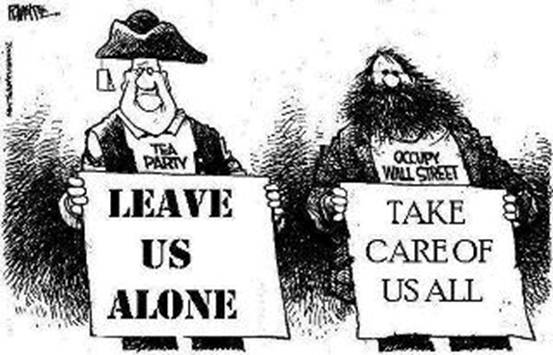
This does not mean the Democratic party was the boogeyman, even if they could — and fairly — have been described as the party of slavery a hundred and fifty years ago. They, too, were formed on a platform of individualism; but we could easily define its approach as being a party that stood for a government that supports the individual. There have been times when the Democrats have stood for the rights of citizens against the threat of government, but on the whole; it is a party that believes government should always act, even if it doesn’t work.
The Republican Party is not, historically, the party of smaller government. Similarly, the Democratic Party is not, historically, the party of big government. However, you can track their growth to both positions over the last (almost) two centuries.
And it’s that ability to track growth that puts the lie to this myth. It isn’t just about tracking party affiliation; even though there was much more overlap in decades past than there is today, the policies on both sides tended to stay along party lines. Even if you just stick to reading about Congressional debates and voting records, you’ll see that bearing out. No, the way to track the truth about this myth is to how each party implements its ideas.
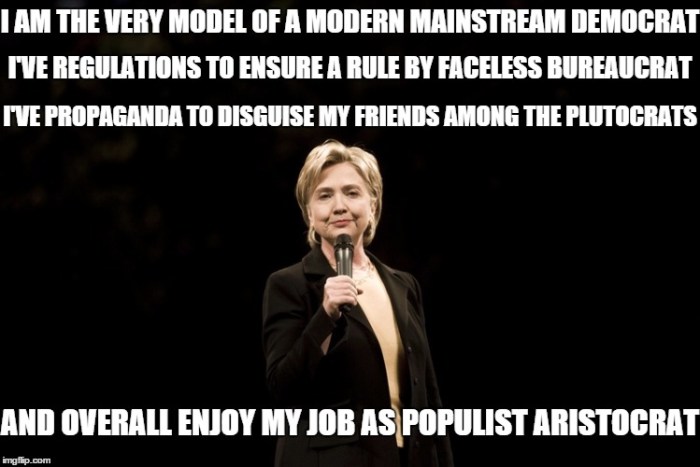
But that doesn’t matter to those who espouse this idea. The myth says that Republicans can’t hold on to the prize of being the party that freed slaves and ended oppression, because that’s not what the Republican Party is today. Southern Democrats, the “Dixicrats,” where just the ones who held out the longest before switching to the Republicans, just like all the other evil, racist, hateful people. They’re nothing like Lincoln, who was the very model of a modern mainstream Democrat.
Now, I could pull out all sorts of stats and charts to combat this, but that sort of thing makes for boring blogging. Instead, let’s just look at the argument itself. And not even the argument of two groups deciding to just get up and switch sides; let’s just look at the logic of the timeline.
At some point between now and the Civil War, we know the Republicans and Democrats switched parties. Now, obviously, this wouldn’t have been an amicable, mutual exchange during one election cycle where each party decided to use each other’s name, trademarks, symbols, or rhetoric. Let’s try to make this as realistic as possible. This is “merely” a mass migration, which means it could have happened slowly at first before gathering momentum. That allows us some leeway with things settling into place in more recent decades. Our job here is to examine exactly when this switch reached critical mass.
Since this theory is normally brought up to defend against reports of Democrats who fought to keep their right to oppress blacks, turning on firehoses, standing in schoolhouse doors, and unleashing trained attack dogs on unarmed adults and children, we know we have an upper limit on this switch: sometime after the Civil Rights Era. The Republicans who passed the Civil Rights Act weren’t really Republicans; they were Democrats, and switched their party affiliation after successfully getting this done because . . . they wanted to celebrate . . . or something.
Yeah, I know. It’s hard, but bear with me and accept it for the sake of argument. I don’t want to just prove this wrong; I want to obliterate it as much as possible.

This theory rests on the historical principles of each party being that of the other party today. Since the Civil Rights Act was passed in 1964 and Republicans are clearly evil by the time we get to Nixon’s presidency in 1969, we know that the critical mass happened sometime in those intervening five years. Before that, Democrats were Republicans, and Republicans were Democrats.
Now, those who cling to this myth in order to support their idea of the Democratic Party as the savior of all things non-male and non-white (with some exceptions for gay, transexual, and socialist whites, as well as any inconvenient non-male, non-whites, such as our lovely hostess today) do so by saying you have to understand things with switched labels.
Remember what I said about approaching history as experimentation? We’re going to try that out. So everyone remember, for the rest of the article, Republicans before Nixon are actually Democrats, and Democrats during the same period are actually Republicans. Everyone got that?
Good.
Democrats won the Civil War and passed amendments to the Constitution that guaranteed the rights of citizens irrespective of their skin color. The Democrats also elected the first black national politicians. In response, Republicans formed the KKK in order to keep that sort of thing from happening. The Republican strongholds in the South solidified their power, trying to chip away at racial freedoms any way they could.
Later, during what’s known as the Progressive Era, President Taft (Democrat) called for an income tax, and the 61st Congress (Democrat) passed the proposal for the 16th Amendment, which was then sent to the state legislatures to ratify. This created a split among the Democrats, some of whom left to join the Progressive Party.
Aha! So we’ve got Progressives in the Progressive Era splitting off from the good Democrats, which shows that they’ll eventually form the modern Democrats we have today! This theory is looking more likely all the time!
In the following years, a surge of left-leaning elections brought a lot more Republicans into power, as well as the first nationally-elected member of the Socialist Party, Victor L. Berger, who had also been a founding member of the Social Dem– I mean, Social Republican Party.
Wait . . . if the names were just reversed, shouldn’t the Socialists be buddy-buddy with the other side?
Ah, no matter. One data point isn’t enough to disprove this theory! Especially if we add a little unicorn dust.
Anyway, those left-wing Republicans got Congress the power to tax income itself, in an effort to pay for an expanding government. It was only a very small tax, and only on the richest segment of society. Over time, though, the tax was expanded by Republicans to what it is today. Well, today it’s shrunk considerably from a few decades ago, but that’s after the Civil Rights Era, and we don’t care about that part.
Soon after that, Prohibition started. That was the thirteen-year period when you couldn’t get a drink, at least legally. It was spearheaded by Protestant revivalists, women’s temperance movements, and bipartisan progressives who thought that —
Wait.
Progressives?
*reads that again*
Prohibition was a “victory for progressives and social gospel activists battling poverty.”

Okay, that’s really weird. But it’s bipartisan. So obviously they’re in the process of moving between parties.
Except . . . shouldn’t it be the conservatives who are behind this kind of moral crusading? I mean, come on, progressives are the ones who say morality should never be enforced on anyone who doesn’t want it, except for straight sex, gay sex, trans sex, contraception, health insurance, wedding cakes, Chik-Fil-A sandwiches, welfare, environmental mandates, Common Core, Hawaiian shirts worn by space scientists, feminism, spanking, breast feeding, illegal immigration, binders full of women — you know, the important stuff, not drugs and alcohol. Priorities, people!
Well, it was a strange time. That was back when flapper dresses were cool, after all. Obviously we have to make allowances for progressives who don’t realize they can’t be hanging out with evil Republicans (who aren’t yet called Republicans, but we’ll get to that).
Soon after this, President Coolidge, a good Democrat, took office, where he stood for good Democrat things like reducing taxes and government involvement in — Wait. Those sound like Republican things. But he was a Democrat! I mean, under the rule that the names were switched.
“In addition to these tax cuts, Coolidge proposed reductions in federal expenditures and retiring some of the federal debt. Coolidge’s ideas were shared by the [DEMOCRATS] in Congress, and in 1924, Congress passed the Revenue Act of 1924, which reduced income tax rates and eliminated all income taxation for some two million people.”
Unpossible! There must be some mistake.
“Coolidge opposed McNary-Haugen, declaring that agriculture must stand ‘on an independent business basis,’ and said that ‘government control cannot be divorced from political control.’”
Okay, nobody panic. Clearly, Coolidge was an outlier. And, you know, all the others in Congress who went along with it. Obviously, they hadn’t switched labels yet. Can’t use this switch-the-names trick all the time, right? Heh heh. Yeah. That’s it.
The next Republican President . . . ah, yes. Here we go. This is the guy that not only lead the United States into a massive, unimaginable war on two fronts, building up military forces to unprecedented levels, he also placed United States citizens into concentration camps just because of their ethnicity! See? See? Evil Republicans, right there.
Wait . . . that name. Roosevelt? Franklin Delano Roosevelt? FDR? That guy? The model of a good Democrat? No, can’t be.
*checks again*
Yeah, same guy. The same one who implemented good socialist policies like welfare and was strongly supported by minorities across the spectrum also did stuff like trying to pack the courts and warmongering and racist segregation. How could such a good Democrat do such evil things?
Well, clearly, it’s some sort of conspiracy. See, even though he was on the “bad” side of the political divide, at least after you do the name-switch trick, he must have been ahead of his time. It’s the only explanation. He was bravely trying to make the bad party good, and it was his influence that turned it into the good Democrat party we know and love today. It was just he was surrounded by evil Republicans who were trying to stop it. They were the ones responsible for the bad stuff.
Oh, and look. The Democrats in Congress were opposing his war effort. Excellent. See, the name-switch trick still works.
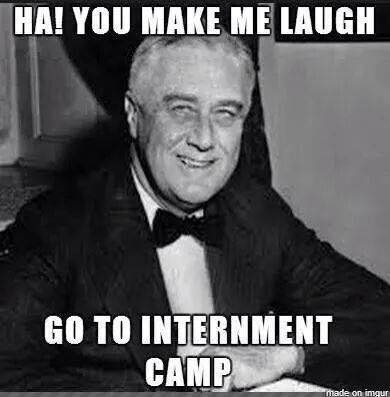
And it continues. His successor was Truman, also a real Republican, and we can safely hate him because he authorized nuclear bombs, which is evil.
. . . and he also began the presidential push for civil rights reforms, over the strong objections from the Southern Republicans. He said his forebearers were Confederates, but he couldn’t stand for the racism that these Southern Republicans were clamoring for. In fact, he’s the guy who mandated that the Armed Forces end all racial segregation, after reacting in horror to reports of what would happen to African-American GIs.
Well, he was the VP for Roosevelt, which means he must have been a good Democrat too, right? But . . . nuclear bombs . . .
Okay, we’re just going to ignore Truman.
He was followed by Eisenhower, a Democrat . . . who strongly opposed communism in all forms. But he’s the one who completed racial integration of the military, and directed the Justice Department to investigate, for the first time in a coordinated fashion, civil rights abuses. In fact, Martin Luther King, Jr., a R– I mean, a good Democrat, wrote to Eisenhower to thank him for his efforts to keep Southern Republicans from standing in schoolhouse doors after Brown v. Board of Education.
Obviously, more allowances have to be made; he probably just didn’t get the memo that communism is a good thing. In fact, he opposed McCarthy’s outlandish efforts to combat communist “threats,” even though McCarthy was . . . wait . . . a name-switch Democrat?
Well, obviously he was part of the new waves of people trying to make the good party bad. He was actually part of the first modern Republicans. It’s the only explanation.
And don’t forget that this is the same era when my grandfather was an evil Southern Republican, and when Reagan realized that the Republicans were going bad and therefore he had to become a Democrat.
After that, we get to Kennedy, the great Re . . . Republican? Wait. He’s the poster boy for the Democrats! The modern, good Democrats, I mean. He didn’t even live to see the Civil Rights Act pass! He’s before the singularity!
Wait, no, I keep forgetting. We can have fudge factors. After all, it didn’t all happen over night, right? So he really was a good Democrat, and called himself a Democrat. It was just that the majority of the party members hadn’t switched over yet. So he dies, the Civil Rights Act is passed by good Democrats, and then those good Democrats join the real Democratic Party, and all is well!
It’s fact. You can’t dispute it.
So there you have it, folks. That’s the story of how the Republican and Democratic Parties decided to switch their brands. Sure, it takes a lot of fudge to make it work, but what’s that next to the narrative? It’s still flawless logic.
Hey, I can only do so much. Polish a turd, and it’s still a turd . . .
Still, the mind boggles to think of just how much effort people have to go through to keep their myths and conspiracy theories alive. But then, the people who espouse this particular myth tend to be the ones who can’t stand studying history in the first place. They think the Constitution is complicated because it was written on four pages over two and a quarter centuries ago; and they think Obamacare is simple, because it was written on eight hundred pages a mere six years ago. History begins when they were born, and contradictions are simply to be ignored.
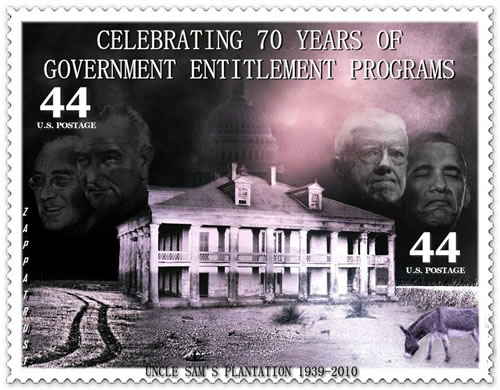
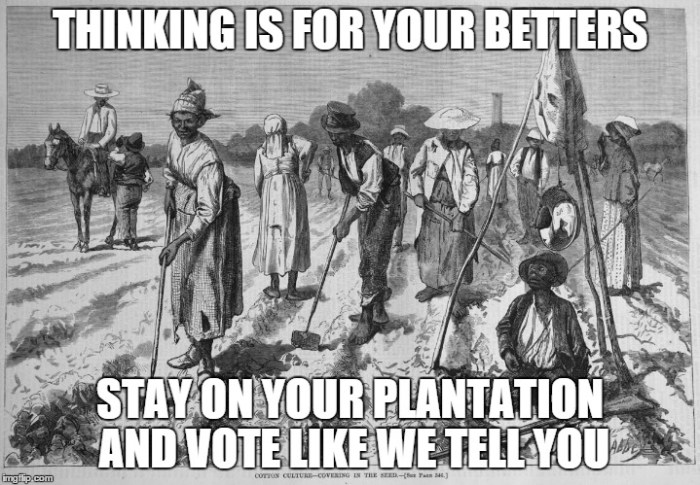
The truth of the matter (and here I finally abandon this silly name-switching game) is that the Republican Party was founded in response to slavery, within living memory of the founding of the country, because that evil had not yet been eradicated and those who wished to abolish it needed to do more than the Whig Party would let them. The Democrats opposed them, in order to preserve their interests and sources of power and influence. Today, the Democrats still preserve this goal, but by other means. Denied their previous standing as overseers in a literal plantation, they have worked hard at selling all minorities — myself included — on the lie that in order to do anything, we must depend on the government. We must depend on Massah.
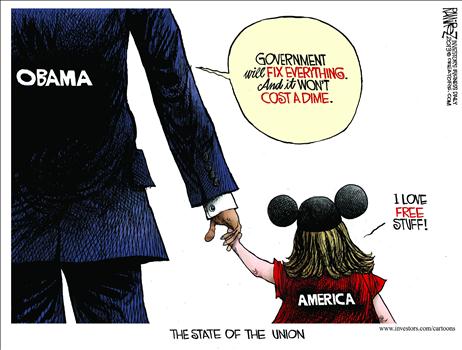
Republicans, at least those who have not become complacent and overly-attached to their country clubs, belong to the party that frees slaves. They free all people, and do so by helping them stand on their own two feet — a helping hand to get off the floor, and then moving on to the next person, trusting the previous one to continue after that first step has been achieved. A helping hand, and not a government-issued wetnurse.
That is how these parties have diverged: not because one side has always said the individual is bad, but because of two different ways of preserving the good of the individual. One side did so by changing what it saw as oppressive law; the other side made government punish what it saw as oppressors.
Whether or not the the Republican Party itself will live up to its origins remains to be seen. It’s dwindling fast, and perhaps it’s time for it to be replaced by the next party of freedom, that can take over the cause like the Republicans did for the Whigs. The one thing that’s certain in this comparison is that the Democratic Party is living high on the hog of shelling out government money to buy votes and media adoration.
And there’s an important thing to remember about that. With all those government handouts, with all that whitewash from reporters, the Democratic Party still can’t carry a guaranteed majority of the electorate. Even with bribery and collusion, they’re in a neck-and-neck race with the Republicans, whom I might fairly characterize at this time as the party of layabouts. Their opposition might as well be rolling over and playing dead, and the Democrats still can’t count on victory.
They can’t hide their history or their methods. No matter how you disguise the plantation, it’s still visible; when you look, the truth is all too plain.